Stay on track with your professional development and help futureproof your career goals by upskilling.

The latest figures released by the Australian Bureau of Statistics tell us that 2.7million Australians either lost their job or are grappling with reduced hours1  as a result of COVID-19 (coronavirus). Although retail and hospitality segments were hit hardest, few industries can now be considered safe, making it all the more important to develop an upskilling strategy that can help to futureproof your career path.

Here are a few ways you could improve your job prospects and keep sight of your career goals in 2020.

1. Research trends within the fastest-growing industries

Knowing which job segments and industries are set to grow in the next five years might help shape your next steps for professional development. According to the Federal Government, the service industries that were perfectly poised for growth pre-coronavirus included health care, construction, education and training, as well as technical services ranging from legal and accounting to product design2. While it’s expected COVID-19 will put a dent in the trajectory of some of these, like construction, others such as health care and education are likely to experience less of an impact.

COVID-19 is set to alter our workforce, and experts suggest there are now big changes afoot when it comes to the way our jobs are performed3 rather than the jobs themselves. Understanding this new environment – plus the skills shortages within the job market – can help you futureproof your career.

Experts predict there will be a need for flexible staff, who are able to apply high-demand skill sets across departments rather than in rigid and strictly defined roles. There will also be a new dependence on automation to help smooth out any kinks in service disruptions, if last-minute obstacles arise4.

Both flexibility and automation have helped minimise many workplace disruptions in the wake of COVID-19. This suggests that the post-coronavirus workplace will need an adaptable and flexible employee, ready to learn new skills and adjust to new challenges at a moment’s notice.

2. Develop a wide range of core skills

While a desirable set of hard skills (the tangible, measurable technical knowledge you have as a result of study or experience) is imperative to landing certain jobs, personality-focused soft skills are often just as important. For example, a potential employer might be looking for a whiz at software design but also someone who is creative and communicates well, to fit into the dynamic of a team. As such, you should look to increase both the skills that can be easily taught and defined, as well as developing your interpersonal aptitude.

By upskilling in some of the most in-demand skills for 20205 relevant to your career path, you could fast track the move to the next level in your career. These include competency in cloud computing, analytical reasoning, artificial intelligence (AI), user-experience (UX) design and blockchain. There are also the soft skills of creativity, persuasion, collaboration, adaptability and emotional intelligence. These soft skills don’t just apply to office-based jobs – they’re also particularly relevant in fields like nursing, aged and disabled care.

3. Build an upskilling strategy

Luckily, now is an ideal time to dive into professional upskilling. Global isolation measures due to COVID-19 have helped uncover a number of affordable and accessible platforms for learning and upskilling courses.

Closer to home, some training options have been supported by the government with free or discounted courses in subjects as diverse as leadership, digital security and nursing. And online courses span a staggering range of disciplines and certifications, from short courses to gradual-level subjects and professional certifications led by institutions as prestigious as Harvard, MIT, Yale and Oxford universities.

Always do your own research when looking for a training provider to escalate your professional goals, but to help you get your started, we’ve listed some here.

TAFE and universities

Many national universities are now offering online-only courses in addition to their on-campus education, providing an excellent opportunity to equip yourself for a post-coronavirus economy. Open Universities Australia collates courses (both short-term and full-degree options) from some of the country’s leading universities. National education provider TAFE is also offering free short courses for those who want to upskill, too. Visit your state-specific TAFE website for more details.

EdX

A global not-for-profit online education provider, EdX provides access to courses covering subject matters as diverse as quantum computing and biomedical engineering. Many courses are free but some, including full certification streams such as the MicroBachelors or MicroMasters degrees, are affordably priced. Both types are self-paced and easy to structure around your work day.

FutureLearn

FutureLearn courses delve into subjects such as environmental justice and digital marketing. FutureLearn offers three levels of access to its short online courses: ‘free’, ‘upgrade’ – which incorporates the course itself, associated exams and certificate at completion – and ‘unlimited’, which allows unlimited access to all courses. Degrees can also be obtained through partnering providers such as Deakin University.

Coursera

Coursera collaborates with a number of notable institutions across industry and education; Google, Stanford University and Goldman Sachs are all partners of the online provider. In addition to a wide range of course subjects, Coursera specialises in specific, program-based learning for those who are looking to upskill in high-demand areas like IT and AI.


1. https://www.abs.gov.au/ausstats/abs@.nsf/mf/6202.0
2. Australian Government: Future Outlook
3. Harvard Business Review: How the Coronavirus Crisis Is Redefining Jobs
4. Harvard Business Review: How the Coronavirus Crisis Is Redefining Jobs
5. LinkedIn Learning: The Skills Companies Need Most in 2020 – And How to Learn Them

Source : AMP June 2020

Important: This information is provided by AMP Life Limited. It is general information only and hasn’t taken your circumstances into account. It’s important to consider your particular circumstances and the relevant Product Disclosure Statement or Terms and Conditions, available by calling Phone: 07 5641 4134, before deciding what’s right for you. All information in this article is subject to change without notice. Although the information is from sources considered reliable, AMP and our company do not guarantee that it is accurate or complete. You should not rely upon it and should seek professional advice before making any financial decision. Except where liability under any statute cannot be excluded, AMP and our company do not accept any liability for any resulting loss or damage of the reader or any other person. Any links have been provided for information purposes only and will take you to external websites. Note: Our company does not endorse and is not responsible for the accuracy of the contents/information contained within the linked site(s) accessible from this page.

How much you need for a house deposit

A great savings goal for a house deposit is:

Some lenders only require a 5% deposit. But a smaller deposit means a bigger loan and you’ll have to pay for lenders mortgage insurance (LMI)

A bigger deposit also shows lenders you’re a good saver and able to manage your finances. This can increase your changes of getting approved for a home loan.

Loan to value ratio

The bigger your deposit, the lower your loan to value ratio (LVR). Your LVR is the amount of the loan divided by the purchase price (or appraised value) of the property. For example, if you’re buying a $600,000 house and you have a $450,000 loan, your LVR would be 75%.

The lower your LVR, the less likely you’ll have to pay for LMI. You’re also more likely to get approval for a loan.

Lenders mortgage insurance

If your LVR is above 80%, you usually have to pay for LMI. This insurance protects the lender if you can’t make the loan repayments and the lender can’t recover the loan balance. LMI protects the lender, not you or a guarantor

You’re charged a one-off fee to cover the cost of LMI. You can pay this fee on settlement or add it to the loan. If you add the LMI fee to your loan, interest will be charged when you repay it.

The average LMI fee is $6,200. But it can be a lot more if you have a low LVR. For more on LMI, see the Understand Insurance website’s frequently asked questions on LMI.

How long it takes to save for a house deposit

Saving for a house deposit does take time and it’s important to be realistic about how long. Nationally, it takes 4.6 years for the average first home buyer couple to save for a 20% house deposit. See how long it could take to save a house deposit where you live.

But by having a savings plan and sticking to it you can reach your savings goal sooner.

Help for first home buyers

If you’re buying your first home, you may be able to get help from the government.

First Home Owner Grant

If you’re a first home buyer or building a new home, you may be eligible for the First Home Owner Grant (FHOG). Different rules apply in each state and territory, but the grant can:

  • help you pay for your home — you can receive up to $20,000 in some states

  • reduce how much you pay for land transfer duty (stamp duty)

For more information on the grant in your state or territory visit the first home owner grant website.

First Home Super Saver Scheme

The First Home Super Saver Scheme (FHSSS) lets first home buyers save a deposit through their super. You can make up to $15,000 of voluntary super contributions a year that can be withdrawn to buy your first home.

Across all years, the maximum amount you can save in super for the scheme is $30,000 of personal contributions plus earnings.

See first home super saver scheme on the Australian Taxation Office website for more information.  

First Home Loan Deposit Scheme

The First Home Loan Deposit Scheme is available from 1 January 2020. It helps eligible first home buyers:

  • buy a house with a deposit as small as 5% of the purchase price

  • save around $10,000 in lender’s mortgage insurance (LMI) fees

Visit the National Home Finance and Investment Corporation (NHFIC) website for more information.

Tips to save for a house deposit faster

Prepare a budget

The first step is to get your finances sorted. If you’re planning to buy a house with a partner, do this together.

Do a budget so you can see:

  • what money is coming in and going out each month

  • how much you can afford to save regularly for your deposit

  • where you can cut back

Use a high-interest savings account

Put your deposit savings into a high-interest savings account or term deposit. You’ll earn a lot more interest compared to a transaction account.

Automate your savings

A great way to boost your savings is to transfer money to a savings account as soon as you’re paid. Ask your work to send part of your pay directly to a savings account or set up an automatic transfer from the account your wage is paid into.

Automatic transfers let you ‘set and forget’. You can grow your savings without having to worry about transferring money each pay.

Consider investing

If you plan to buy your house in a few years, you could consider investing. If you’re comfortable with the risk, investing in shares or a managed fund can help grow your savings.

Please contact us on Phone: 07 5641 4134 if you seek further discussion on this topic.

Source : MoneySmart .gov.au May 2020 

Reproduced with the permission of ASIC’s MoneySmart Team. This article was originally published at https://moneysmart.gov.au/saving/save-for-a-house-deposit

Important note: This provides general information and hasn’t taken your circumstances into account.  It’s important to consider your particular circumstances before deciding what’s right for you. Although the information is from sources considered reliable, we do not guarantee that it is accurate or complete. You should not rely upon it and should seek qualified advice before making any investment decision. Except where liability under any statute cannot be excluded, we do not accept any liability (whether under contract, tort or otherwise) for any resulting loss or damage of the reader or any other person.  Past performance is not a reliable guide to future returns. Important Any information provided by the author detailed above is separate and external to our business and our Licensee. Neither our business nor our Licensee takes any responsibility for any action or any service provided by the author. Any links have been provided with permission for information purposes only and will take you to external websites, which are not connected to our company in any way. Note: Our company does not endorse and is not responsible for the accuracy of the contents/information contained within the linked site(s) accessible from this page.


There’s an old saying, to only focus on the things in life that you can control.

But that adage has been well and truly stress tested on just about every level over the past few months because of the uncontrollable events stemming from the COVID-19 pandemic.

On an investment portfolio management level particularly, it’s been difficult if not impossible to have much control amid the wild daily fluctuations in the values of many financial securities.

And, on a household level, the repercussions arising from lockdown restrictions and widespread business closures are that many families are now experiencing unprecedented financial strain because of a sudden loss of regular employment income, investment income, or both.

Of course, we all still have some elements of life control and maybe the current conditions are an opportunity to reflect on our investments goals to see if they still make sense and are realistic.

Depending on your circumstances, which may have necessitated impromptu investment actions during the crisis – such as the withdrawal of some superannuation funds or the selling of other financial assets – some goal adjustments may be prudent.

Last week, we referred to the Australian Tax Office now requiring SMSF trustees to not only review their investment strategies regularly, but to justify them (see A reprieve to review your SMSF strategy).

The same sort of investment review also makes sense outside of the superannuation sphere.

Revisit your investment framework

Regardless of where and how you invest, creating clear financial goals is one of the fundamental pillars for having the best chance of achieving investment success.

Your goals should be well defined and as realistic as possible based on your current financial situation. If circumstances change, it makes sense to review them.

A review needs to take into account your immediate financial needs, and how they may impact your longer-term financial objectives.

Any adjustments will need to take into account factors such as your age, how your household income-earning capacity is likely to change over the short and medium term, and cater for revised expectations on investment returns over the longer-term.

Ideally, investment goals should always have a long-term focus and be designed to endure through changing financial environments over time, including periodic downturns in equity and property markets.

They should also take into account the potential for loss of income over time, which can be partially mitigated through appropriate personal insurance coverage.

Allowing for market risks

The current events have highlighted that investment risks are ever-present, and that when major value corrections do occur on markets they are usually widely unexpected.

In setting investment goals, it’s important both to understand that risk is a key factor in investment returns and to build in your own tolerance for risk.

Market risks and potential returns are generally related, in the desire for higher returns will invariably require taking on greater exposure to market risk.

A current example of this is in the fixed interest market, where investors with a higher-risk tolerance have invested into bond issues from companies with low-quality credit ratings (see Know your bonds, they’re not all the same). The investment temptation has been the issuers’ high income payments, however recent events have seen a large number of these companies default on their debt repayments.

Other key aspects in setting and reviewing goals is your investment time horizon, liquidity requirements, tax obligations, legal issues, or unique factors such as a desire to avoid certain investments entirely. Constraints can change over time, and should be closely monitored.

The danger of lacking a plan

Without an investment plan, it can be easy to lose sight of the bigger picture and to end up with a portfolio that’s not well balanced across different asset classes.

As a result your portfolio may wind up being concentrated in a certain market sector (see Over-concentration risk comes to the fore), or it may have so many holdings that oversight of your portfolio becomes onerous.

Most often, investors are led into such situations by common, avoidable mistakes such as performance-chasing, market-timing, or reacting to market “noise.”

Many investors—both individuals and institutions—are moved to action by the performance of the broad equity market, increasing equities exposure during bull markets and reducing it during bear markets. Such “buy high, sell low” behaviour is evident in managed fund cash flows that mirror what appears to be an emotional response—fear or greed—rather than a rational one.

Stay focused on your goals

A sound investment plan can help you to avoid such behaviour, because it demonstrates the purpose and value of asset allocation, diversification, and rebalancing. It also helps you to stay focused on your intended contribution and spending rates.

Vanguard believes investors should employ their time and effort up front, on the plan, rather than in ongoing evaluation of each new idea that hits the headlines. This simple step can pay off tremendously in helping you stay on the path toward your financial goals.

Being realistic is essential to this process. You need to recognise your constraints and understand the level of risk you are able to accept.

In reviewing your investment goals, don’t underestimate the importance of professional financial advice (find out about Quality financial advice in our Plain Talk library).

A financial adviser can help you  in developing a framework around your long-term goals and financial capabilities, which can be reviewed regularly over time.

Please contact us on Phone: 07 5641 4134.

Source : Vanguard May 2020 

By Tony Kaye, Personal Finance Writer, Vanguard Australia.

Reproduced with permission of Vanguard Investments Australia Ltd Vanguard Investments Australia Ltd (ABN 72 072 881 086 / AFS Licence 227263) is the product issuer. We have not taken yours and your clients’ circumstances into account when preparing this material so it may not be applicable to the particular situation you are considering. You should consider your circumstances and our Product Disclosure Statement (PDS) or Prospectus before making any investment decision. You can access our PDS or Prospectus online or by calling us. This material was prepared in good faith and we accept no liability for any errors or omissions. Past performance is not an indication of future performance.

© 2020 Vanguard Investments Australia Ltd. All rights reserved.

Important: Any information provided by the author detailed above is separate and external to our business and our Licensee. Neither our business nor our Licensee takes any responsibility for any action or any service provided by the author. Any links have been provided with permission for information purposes only and will take you to external websites, which are not connected to our company in any way. Note: Our company does not endorse and is not responsible for the accuracy of the contents/information contained within the linked site(s) accessible from this page.

If you’re fortunate enough not to have been affected financially by coronavirus, you might find you’re spending less and saving more

The COVID-19 (coronavirus) outbreak has seen Australians rise to the challenge of a new way of life involving a lot less time spent outdoors and a lot more time spent at home.

We’ve seen new concepts added to our daily vocabulary like social distancing, flattening the curve and self-isolation.

We’ve needed to adjust as our ability to socialise, travel and spend has been severely curtailed.

We’ve not been able to eat at our favourite restaurant, see our favourite band or support our favourite footy team.

It all adds up to a lot less money changing hands. Initial estimates indicate spending is down 20%1  per person in Australia compared to pre-COVID levels.

And it’s not just discretionary spending on recreation, eating out and shopping. We’ve also been spending less on regular household budget items like commuting (we’re doing less as we work from home), childcare for pre-school kids (temporarily free) and even health insurance premiums (many providers have put increases on hold).

How to put your savings to better use

So if you’re fortunate enough not to have been affected financially by coronavirus through reduced working hours or loss of income, you might find you’re spending less and saving more.

Rather than leaving this money sitting in your current account, here are some tips you can think about to help your money work harder—particularly with interest rates sitting at historic lows.

  1. Make extra repayments to get a head start on your home loan. Use our home loan repayment calculator to find out how much your ongoing mortgage repayments could be, and the amount of interest you’ll need to pay over the life of your home loan.

  2. Set up an offset account to reduce the term and interest on your home loan. An offset account linked to your home loan may help you to pay off your home loan ahead of its term and save thousands of dollars over the life of the loan, simply by depositing all your regular income and earnings into your offset account.

  3. Open a high-interest savings account like AMP Saver to get your money working harder. AMP Saver offers a great ongoing rate, no monthly fees and easy access 24/7.

  4. Put some money aside for a rainy day by setting up an emergency fund so you’re not caught short if something happens. An emergency fund could help you cope if you need instant access to money for those times life throws you a curve ball.

  5. Top up your super by making extra contributions to set yourself up for a comfortable retirement. There are plenty of ways to top up your super, including salary sacrifice, spouse contributions and government co-contributions.

  6. Look at investing in growth assets like shares to potentially build your long-term wealth—rather than trying to time the market by purchasing shares on any given day, AMP Capital Chief Economist Shane Oliver says “a good approach for long-term investors is to average in over several months” with regular investments, particularly in volatile times like these.

  7. Check out these investment options to see the different types of assets you can invest in, from cash to real estate investment trusts and all points in between. There’s more to investing than super and property when you’re building your own investment portfolio.

All investing comes with risk so it’s a good idea to speak to a financial adviser. Please contact us on Phone: 07 5641 4134.

https://www.businessinsider.com.au/australian-spending-economy-confidence-unemployment-recession-2020-4

Source : AMP June 2020 

Important: This information is provided by AMP Life Limited. It is general information only and hasn’t taken your circumstances into account. It’s important to consider your particular circumstances and the relevant Product Disclosure Statement or Terms and Conditions, available by calling Phone: 07 5641 4134, before deciding what’s right for you. All information in this article is subject to change without notice. Although the information is from sources considered reliable, AMP and our company do not guarantee that it is accurate or complete. You should not rely upon it and should seek professional advice before making any financial decision. Except where liability under any statute cannot be excluded, AMP and our company do not accept any liability for any resulting loss or damage of the reader or any other person. Any links have been provided for information purposes only and will take you to external websites. Note: Our company does not endorse and is not responsible for the accuracy of the contents/information contained within the linked site(s) accessible from this page.

by Darren Beesley

At a time when most investors are seeking out defensive positioning, savvy managers should have an eye to the opportunities provided by the unfolding pandemic. These may be asset classes that are already undervalued at the present moment, but also include those which stand to benefit from an eventual recovery to an extent not currently priced in by the market. The latter might not necessarily represent “buy now” opportunities, but may instead be triggered by changing economic circumstances. In our view, below are five asset classes to keep an eye on as we edge towards recovery.

1. High-yield credit

In the US, senior loans are currently priced at 90c on the dollar1, with potential for speedy recovery to parity as conditions stabilise. Following the 2008-09 financial crisis, in which secondary credit markets played an infamous and central role, loan pricing nevertheless returned to parity within two years2.

We believe, security selection is a vital component of investing in high-yield credit, as the asset class carries a high degree of asset-specific risk as well as potential for healthy returns. During the 2008-09 crisis, some managers achieved a default rate of as low as 2%, in the context of 10-12% across the broader market3.

2. Value stocks

The spread between growth stocks, comprising entire sectors such as technology as well as individual companies within other sectors, and their more cyclical value stock counterparts tends to operate like a rubber band, with sharp corrections following periods of greatest divergence.

Over the past two years that spread has widened dramatically in favour of growth stocks, and judging by past experience, there could be a substantial reversion as deflationary pressures ease and bond yields increase.

If and when this occurs, we believe that an asset class that would appear to be particularly underpriced is US banking stocks, trading at their lowest price to book ratio since the 2008-09 crisis4. In our view, bank balance sheets are more resilient today than in the last crisis, and current standards for up-front provisioning for non-performing loans means that the worst-case scenario is likely to be already priced in.

3. Emerging market equities

Equity markets in emerging economies are extremely cyclical, outperforming in an upswing when commodities boom and the US dollar is lower. In contrast, over most of the past decade they have tended to underperform equity markets in more developed economies, and are now struggling with a strong US dollar, commodity weakness and trade wars.

There are still hurdles to overcome for these markets, not least of which are concerns around debt liabilities and the unfolding path of the virus in the developing world.

In our view, programs of debt relief for these economies, a softening US dollar and more certainty around the outcomes of the pandemics are all key potential triggers for entry into these markets.

4. Dividend futures

Dividend futures are a financial instrument which gives exposure to dividends paid in future years at an index level.

They are susceptible to falls in value during equity market stress, as investment banks which issue certain retail products linked to price rather than total returns sell them to hedge against the risk of lower future dividends

In effect, these banks are forced sellers, and given that there are no natural buyers we believe there is a significant opening for investors to find value.

Dividend futures markets in Europe are currently priced at 30-40%5  below what we consider to be their likely real value in future years, with the current five-year contract 27% below the lowest actual dividend payout in the last 10 years6.

5. Inflation-linked bonds

Inflation-linked bonds in Australia are currently pricing in 0.8% inflation pa for the next 10 years7. Even for those who have become accustomed to a low-inflation environment this probably seems on the low side, and it is substantially so by historical standards.

We certainly believe expectations are overdone, despite the short-term output gap depressing CPI. The effect of the enormous stimulus that will enter the Australian economy may result in price inflation over the next two to three years. In our view, investors may wish to consider their portfolio’s sensitivity to rising inflation in which inflation linked bonds outperform nominal bonds and value stocks tend to outperform growth stocks.

Important reminder

Of course, we’re discussing the pandemic, so uncertainty is a given, if not by this stage a cliché. All of these opportunities will be to some extent affected by the pace and form taken by the eventual recovery. Through the uncertainty comes opportunities of mispriced and underloved assets that managers should be prepared to capitalise on as a recovery transpires.

You can watch my webinar on this topic here

https://vimeo.com/418290283


Author: Darren Beesley, BCom FIAA, Head of Retirement and Senior Portfolio Manager, Sydney, Australia

1 Bloomberg; S&P/LSTA U.S. Leveraged Loan 100 B/BB Rating Index Price, as at 28 April 2020
2 Bloomberg; S&P/LSTA U.S. Leveraged Loan 100 B/BB Rating Index Price
3 Bloomberg; S&P/LSTA U.S. Leveraged Loan 100 B/BB Rating Index Price
4 Bloomberg
5 Bloomberg, as at 28 April 2020
6 Bloomberg, as at 28 April 2020
7 Bloomberg, as at 12 May 2020


Source: AMP Capital  15 June 2020

Reproduced with the permission of the AMP Capital. This article was originally published at AMP Capital


Important notes:
While every care has been taken in the preparation of this document, AMP Capital Investors Limited (ABN 59 001 777 591, AFSL 232497) makes no representation or warranty as to the accuracy or completeness of any statement in it including, without limitation, any forecasts. Past performance is not a reliable indicator of future performance. This document has been prepared for the purpose of providing general information, without taking account of any particular investor’s objectives, financial situation or needs. An investor should, before making any investment decisions, consider the appropriateness of the information in this document, and seek professional advice, having regard to the investor’s objectives, financial situation and needs. The information in this document contains statements that are the author’s beliefs and/or opinions. Any beliefs and/or opinions shared are as at the date shown and are subject to change without notice. This document is solely for the use of the party to whom it is provided and must not be provided to any other person or entity without the express written consent of AMP Capital.

Expectation for future returns are being shaped by prospects of muted asset class returns, higher risks, and elevated market valuations. In addition, because of technology advancement and improved company disclosures we are seeing alpha opportunities being arbitraged away for many asset classes around the world.

We think investors looking to achieve their investment goals over the next decade could consider diversifying their exposure to niche asset classes that offer sustained high capital growth potential with idiosyncratic exposures that are less correlated to other asset classes.

In our view, Australian small caps offer investors the following characteristics:

  • High earnings/return potential and greater idiosyncratic exposure as compared to other equity asset classes

  • A large opportunity set of stocks in an inefficient market which offers an attractive return delivery for successful small cap stock pickers

  • Small companies offer leadership in innovation that has the potential to transform industries and deliver significant capital appreciation

  • Investment fundamentals in Australian small caps look more attractive relative to other market segments, supported by structural growth stories, both domestically and offshore

We believe Australian small caps ticks many of the boxes investors are looking for and exposure to this asset class is worth considering as part of a diversified portfolio.

High return potential in a low return environment

We believe the strong market returns generated over the last decade, which have been largely driven by central bank policies resulting in lower global interest rates and elevated market valuations, may be more difficult to achieve going forward with the prospect of lower asset class returns and higher risks.

In a low return environment, investors need to ask whether their existing investment strategy will achieve their return targets going forward. Equities are traditionally a key source of high returns and capital growth, but will this continue to be the case and are all equity markets equal when it comes to meeting the demands for capital growth? Investors are strongly motivated by the need to seek out new sources of capital appreciation outside of traditional beta exposures to meet their investment objectives going forward.

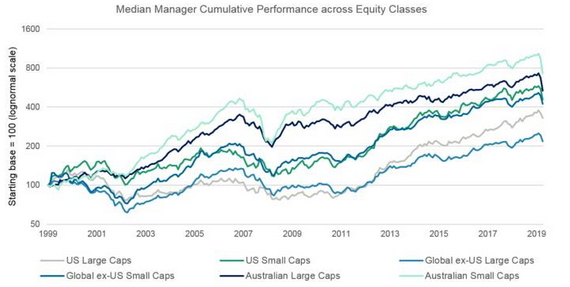
Over the long-term, an allocation to Australian small caps via active management has delivered strong capital appreciation and returns in excess of many other equity classes.

click to enlarge >>

Past performance is not a reliable indicator of future performance. Source: eVestment, March 2020. Note: The chart shows the cumulative performance for the median US large cap manager, median US small cap manager, median Global ex-US large cap manager, median Global ex-US small cap manager, median Australian large cap manager and median Australian small cap manager, respectively.

In summary, an allocation to Australian small caps we think may offer investors high return potential.

High earnings growth potential

Exposure to select Australian small companies have a track record of offering higher earnings growth relative to their large cap counterparts and other equity classes. Key reasons include greater exposure to emerging thematics that have accelerated growth profiles, in addition to higher upside earnings leverage given typical low industry market shares and cost structures. Many small companies look to increase market share from low levels, even during challenging market conditions, which can lead to significant earnings and valuation upside over the long-term.

We believe there is a strong correlation between companies that can deliver strong medium-term earnings growth to share price performance which puts Australian small caps in an enviable position relative to many other equity asset classes.

One of the last remaining inefficiently priced segments of the market

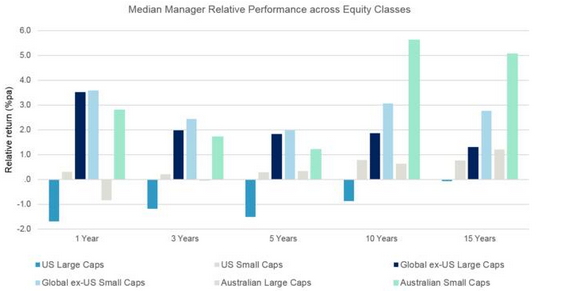
The ability for investors to consistently exceed market/benchmark returns is becoming increasingly challenged with advances in technology, smarter information systems employed by the investment community and improved company disclosures are contributing to a greater degree of market efficiency leaving fewer niche markets left to exploit. This is particularly evident in US large caps where investment managers have consistently struggled to outperform their respective benchmarks.

The ability for investment managers to beat their respective benchmark performance (commonly known as relative return or alpha) in niche markets like Australian small caps has been consistent and has delivered significantly higher alpha as compared to other equity classes over the long-term (over 10 to 15 year periods).

click to enlarge >>

Past performance is not a reliable indicator of future performance. Source: eVestment, March 2020.

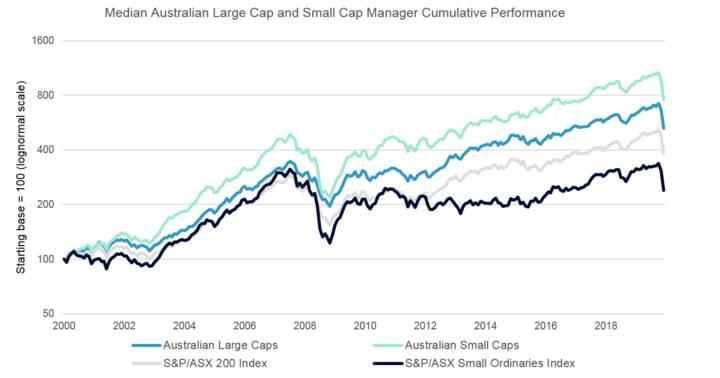
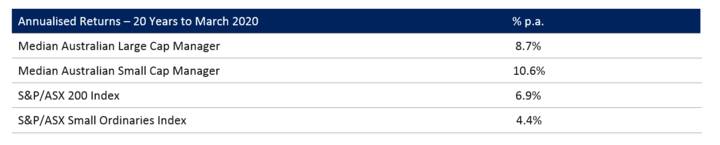
Over the long-term, the Australian large cap market (S&P/ASX 200 Index) has outperformed the small caps market (S&P/ASX Small Ordinaries Index) which is an anomaly when compared to many offshore markets. This is particularly interesting given the large cap index is dominated by banks and diversified miners which has substantially outperformed the small cap index which has recently contained material exposure to stocks that have captured investor’s attention over the past few years including technology, Chinese consumer consumption (e.g. infant formula and vitamins), electric vehicles and gold.

More importantly though is the median small cap manager has significantly outperformed not only the small caps index, but also the large cap index and the median large cap manager over a long time period. Investors who have trusted their money with even a middle of the pack small cap manager have seen strong compound returns over this period.

click to enlarge >>


Past performance is not a reliable indicator of future performance. Source: eVestment, March 2020.

click to enlarge >>


Past performance is not a reliable indicator of future performance. Source: eVestment, March 2020.

The Australian small cap manager outperformance has been driven by a high degree of market inefficiency which has provided significant opportunities for investors to exploit pricing anomalies. The elevated market inefficiency experienced has been driven by multiple factors, including:

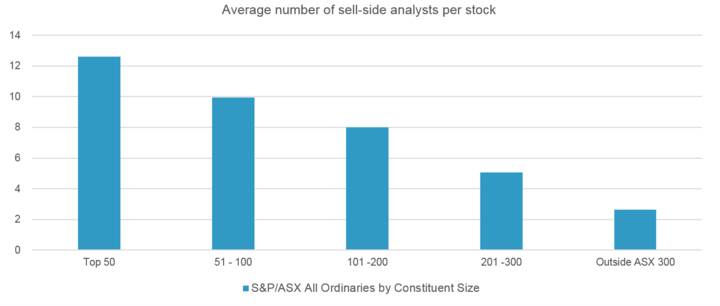
  • Sell-side analyst coverage drops off down the market capitalisation spectrum, notably outside the S&P/ASX 100 Index (see chart below) 

  • Small companies can attract lower institutional investment and therefore a less sophisticated investor base, notably smaller companies outside the top 200 listed companies

  • News flow (as measured by average number of news articles Bloomberg published per day) is typically lower/less frequent for small companies

  • Small companies typically have larger movements around news flow and result announcements

  • Many quantitative factor returns are magnified in small caps, notably price, earnings and quality factors

click to enlarge >>


Source: Factset, April 2020

Interestingly, we believe many of these factors highlighted above will be exacerbated (rather than reduced) for Australian small companies going forward given increasing passive investment and recent changes to stock research which has seen a dramatic reduction in coverage of small cap stocks by sell-side analysts.

click to enlarge >>


Source: Factset, April 2020

We believe this provides significant opportunities for fundamental based investors to continue to add value via rigorous company and industry research.

Emerging thematic exposure

Many large cap companies are ‘old world’ being mature businesses within lazy duopoly industry structures which are facing potential disruption and run the risk of being left behind in a fast-changing modern world.

How do investors gain access to emerging growth sectors and themes?

An allocation to Australian small caps we think provides exposure to exciting growth areas, including niche market segments and emerging thematics that are yet to be fully appreciated by the broader market. Small companies tend to be more focused (one market or product) or operate in niche sectors, including:

  • Technology – solutions provided by technology and innovation that solve the challenges of the rapid cycle of obsolescence in addition to businesses and consumer preferences – these companies provide attractive potential for growth and above-average profitability e.g. cloud computing, internet of things, 5G, data usage and software

  • Structural growth – offer sustainable growth and earnings backed by real cash flows in niche industries that are unaffected by global macroeconomic conditions – typically low market penetration in fragmented industries with a quality bias e.g. China consumption, education and ageing demographics

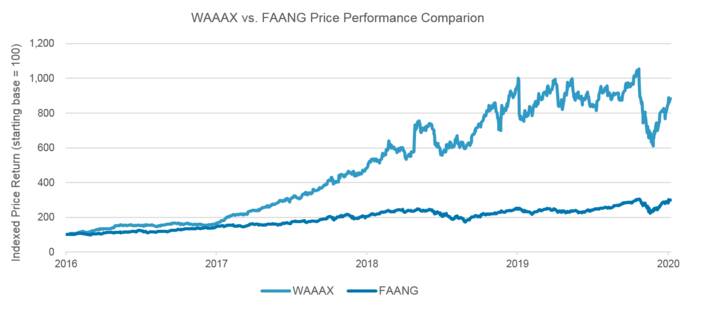
We see Australian small caps offering investors early-stage exposure to many of these emerging thematics that can deliver super-normal returns. A recent example is the recent strong performance of a cohort of ASX listed technology companies known as the WAAAX stocks (Wisetech, Afterpay, Altium, Appen and Xero). These companies started off as Australian small caps and many have since migrated to being large caps. The WAAAX stocks have delivered stellar returns which are well in excess of the FAANG stocks (the five prominent American technology companies being Facebook, Amazon, Apple, Netflix and Alphabet – formerly known as Google).

click to enlarge >>


Past performance is not a reliable indicator of future performance. Source: Factset, April 2020.

Diversification benefits

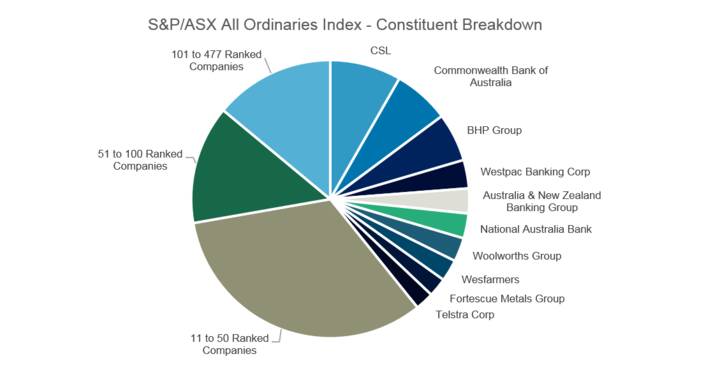
As compared to the Australian large cap market, the small caps market offers investors a greater level of sector diversification and idiosyncratic exposures. The small cap market offers a more balanced exposure to industries when compared to the large cap market which is heavily weighted towards the Financials sector.

click to enlarge >>


Source: Factset, April 2020

In addition, investing in small companies we think offers a significantly increased stock opportunity set to add value – the top 100 stocks represent 86% of the S&P/ASX All Ordinaries by market capitalisation but 79% of stocks by number are outside the top 100 stocks.

click to enlarge >>


Source: Factset, April 2020

Worth considering

In summary, we believe Australian small caps offer investors exposure to companies that offer leadership in innovation that has the potential to transform industries and deliver significant capital appreciation. The asset class offers what we see are unique idiosyncratic exposures, a large opportunity set of stocks and in an inefficient market which can provide attractive return delivery for successful small cap stock pickers. An exposure to this asset class may be considered as part of a diversified portfolio.

Please contact us on Phone: 07 5641 4134 if you seek further assistance on this topic.


Author: Phillip Hudak BBus, CFA Co-Portfolio Manager (Australian Small Caps) Sydney, Australia

Source: AMP Capital  29 May 2020

Reproduced with the permission of the AMP Capital. This article was originally published at AMP Capital


Important notes: While every care has been taken in the preparation of this document, AMP Capital Investors Limited (ABN 59 001 777 591, AFSL 232497) makes no representation or warranty as to the accuracy or completeness of any statement in it including, without limitation, any forecasts. Past performance is not a reliable indicator of future performance. This document has been prepared for the purpose of providing general information, without taking account of any particular investor’s objectives, financial situation or needs. An investor should, before making any investment decisions, consider the appropriateness of the information in this document, and seek professional advice, having regard to the investor’s objectives, financial situation and needs. The information in this document contains statements that are the author’s beliefs and/or opinions. Any beliefs and/or opinions shared are as at the date shown and are subject to change without notice. This document is solely for the use of the party to whom it is provided and must not be provided to any other person or entity without the express written consent of AMP Capital.

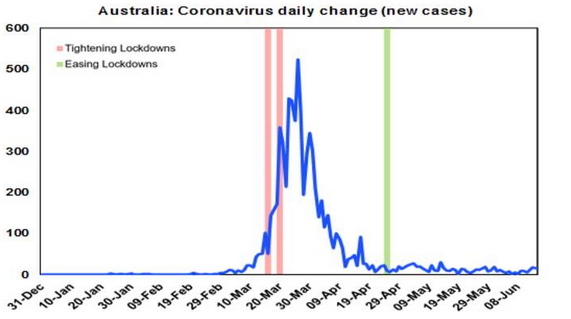
The past week has seen a flurry of concerns about a “second wave” of coronavirus cases. It started when US infectious disease expert Anthony Fauci warned the coronavirus outbreak is not over and media started to focus on more than 20 US states seeing a rising trend in new cases, and then over the weekend, China reported a cluster of cases in Beijing around a market. Mass anti-racist protests have probably added to the renewed unease. (While there is no place whatsoever for racism, unfortunately in the current environment, large protests that gather people together increase the risk of the virus spreading). And even in Australia we have seen new clusters – mainly in Victoria – although the daily number of new cases remains around or below 20, so it’s not a major issue in Australia. See next chart.


Source: Worldometer, AMP Capital

These second wave concerns have come at a time when share markets had become vulnerable to a pullback after huge rallies since the coronavirus panic low around 23rd March which had seen US shares gain 44% and Australian shares rise 35%. We discussed this last week in Shares climb a “wall of worry”. And so, shares have seen a 6 to 7% correction in the last week before recovering some of that decline in the last few days.

After major bear market lows associated with recessions its common for shares to surge higher, get very overbought, and then see a pullback on concerns about a “double dip” back into recession. The pullback then sees shares shake off some excesses which then allows the rising trend to resume. Second wave virus concerns and fears it may result in a renewed lockdown and double dip in economies looks to have triggered the pullback over the last week. But the question is whether it’s just a correction in a rising trend or will it turn into another big leg down in shares? A key determinant could be how serious any second wave is. This note looks briefly at the main issues.

But first, where are we with coronavirus globally?

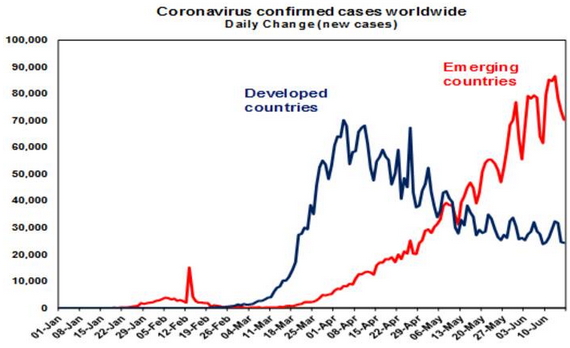
While worries about coronavirus perked up over the last week, there has been little change to the broad trends in terms of coronavirus cases. New cases continue to trace out an uptrend globally, driven by emerging countries, but new cases in developed countries are well below their early April highs (and this played a big role in the rally in share markets since March).


Source: ourworldindata.org, AMP Capital

What about a second wave in the US?

The US is at greater risk than most other developed countries of a second wave because reopening started before a sharp downtrend in new cases had really taken hold and many US states moved ahead of the US Government’s own medical guidelines to reopening. Around 23 states are seeing an increase in new cases (with about half just seeing a continuation of the initial rising trend and the rest seeing “second waves”). However, there are several points to note.

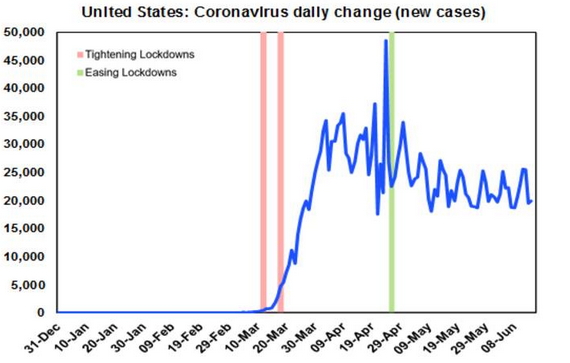
First the total number of new US cases on a daily basis has been relatively stable fluctuating in a range around 20,000 to 25,000 for a month now, with some states seeing falls and others rises – so there is nothing really new here.


Source: ourworldindata.org, AMP Capital

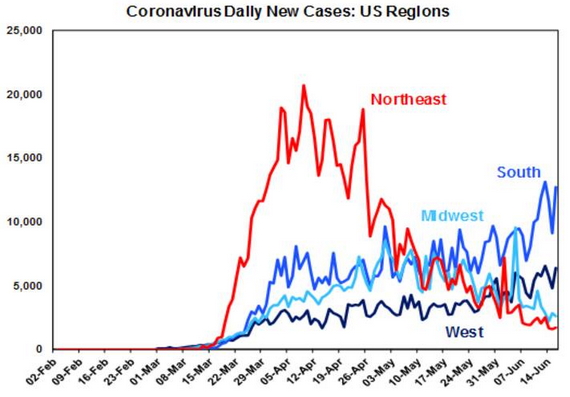
Basically, a rising trend in new cases in southern states (including Texas, Arizona and Florida) and to a lesser extent in western states, has over the last month offset a falling trend in the north east (led by New York) and the mid-west to result in a flat trend overall. And so far, the cities that saw big protests recently have not seen an increase in new cases.


Source: ourworldindata.org, AMP Capital

Second, the rise in cases in the south and west is partly due to an increase in testing with the positive test rate stable to slightly down over the last month in the US as a whole (although some states have seen an increase in positive test results including Washington, Arizona, Utah, Texas and Florida).

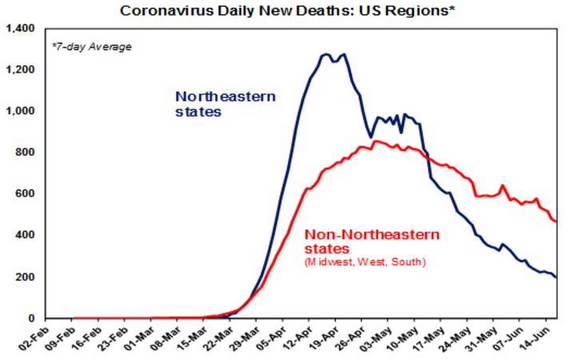
Third, hospitalisations and new deaths have been trending down. This is not the case in all states (notably Texas and Arizona are on the rise in terms of hospitalisation) but overall it suggests less pressure on the health system. As can be seen in the next chart, daily deaths have been trending down both in the north east and in the rest of the US.


Source: ourworldindata.org, AMP Capital

Fourth, the lower level of deaths in the US (both in the northeast and the rest of the US) despite a flat trend in new cases, may reflect that the US has learned to better manage new cases and treatments to minimise hospitalisation and deaths. Note that we are seeing more reports of breakthroughs in the treatment of coronavirus and over 100 trials of vaccines around the world.

Finally, the hurdle for a renewed shutdown may now be greater with people suffering quarantine fatigue. A more targeted approach may be more likely (at least initially).

The bottom line is that it’s inevitable that some US states will see flare ups, but as long as hospitalisations stay manageable and deaths stay down a return to a broad-based lockdown threatening a double dip in economic activity in the US is low.

In the meantime, this week’s move by the Fed to start buying corporate bonds directly through its main street lending program (called the Secondary Market Corporate Credit Facility) has underpinned the degree of liquidity support for the US economy that wasn’t there when coronavirus first flared up.

What about a second wave in China?

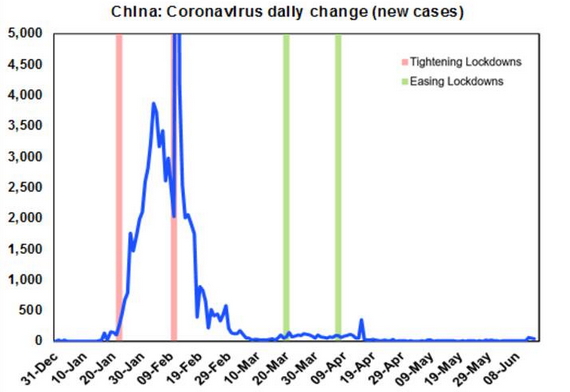
Over the last three days China has reported an average of 50 new cases a day compared to an average of seven a day over the prior 30 days. Most of these have been linked to a Beijing market with the possibility that the virus may have been connected to salmon imported from Europe. In response several areas of Beijing have been locked down with schools closed and restrictions placed on people leaving the city. This could escalate into something serious. Then again, there has been several flare ups in China in the last three months that have been brought under control with very rigorous testing, tracing and quarantining, as has been the case in South Korea and various other countries including Australia.  


Source: ourworldindata.org, AMP Capital

Concluding comment

A serious second wave of coronavirus cases in major developed countries is the biggest risk facing equity markets, and one investors will need to watch closely. However, provided any second wave is relatively mild in terms of pressure on health systems and the number of deaths, its unlikely to reap the havoc seen back in March. Particularly, given the degree of government and central bank support now in place. The risk should be able to be minimised with lots of testing, tracking and quarantining. As such, our base case remains that the pullback in shares over the last week is part of a correction in a broader rising trend.  


Source: AMP Capital 17 June 2020

Important notes: While every care has been taken in the preparation of this article, AMP Capital Investors Limited (ABN 59 001 777 591, AFSL 232497) and AMP Capital Funds Management Limited (ABN 15 159 557 721, AFSL 426455) (AMP Capital) makes no representations or warranties as to the accuracy or completeness of any statement in it including, without limitation, any forecasts. Past performance is not a reliable indicator of future performance. This article has been prepared for the purpose of providing general information, without taking account of any particular investor’s objectives, financial situation or needs. An investor should, before making any investment decisions, consider the appropriateness of the information in this article, and seek professional advice, having regard to the investor’s objectives, financial situation and needs. This article is solely for the use of the party to whom it is provided and must not be provided to any other person or entity without the express written consent of AMP Capital.

by Graeme Colley

It’s just weeks until the curtain draws on the 2019/20 financial year. But before it does, here is a checklist of 10 items to consider for an SMSF before it’s too late.

1. Concessional (tax deductible) contributions

Check concessional contributions and top them up. This financial year, there’s an opportunity to bring forward the left-over concessional contributions that weren’t claimed last year and add them to this year’s standard amount. While most people have a standard concessional contribution cap of $25,000, if the total super balance on 30 June 2019 of less than $500,000, leftover concessional contributions that haven’t been used since 1 July 2018 can be added to the standard concessional contribution of $25,000. But don’t forget, any contributions made by an employer or by salary sacrifice to an SMSF are counted towards the concessional contributions cap.

If a tax deduction is going to be claimed for personal contributions to super, an election must be made to the superannuation fund so it will be included in the fund’s taxable income. The fund is required to acknowledge the election and the person making the claim is required to give it to their tax adviser so the correct amount will be claimed as a tax deduction. The election is required to be given to the fund before lodgement of an individual’s income tax return, or at the end of the financial year after the contribution has been made, whichever happens first. However, should a person decide to roll over their super to another super fund to start a pension, the election must be made prior, otherwise the deduction may be disallowed.

2. Non-concessional (non-deductible) contributions

A person intending to make non-concessional contributions to their super, for this financial year it will depend on their age at the time of making the contribution, as well as their total super balance on 30 June 2019. If a person is under the age of 65, the person may have the opportunity to bring forward the next two years’ standard non-concessional contribution of $100,000. This means a person may be able to make a non-concessional contribution of up to $300,000 over a fixed three-year period commencing from the year in which a contribution greater than the standard non-concessional contribution has been made.

But there is a catch. The three-year bring forward amount applies only if a person’s total super balance on super on 30 June 2019 is less than $1.4 million. If a person’s total super balance was between $1.4 million and $1.5 million, they would only be entitled to bring forward just one year’s standard non-concessional contribution. If a person’s total super balance was between $1.4 and $1.5 million, the non-concessional contribution is limited to $100,000. It is not possible to make non-concessional contributions to a super fund with a total super balance of $1.6 million, otherwise a tax penalty will apply.

3. Making sure the super fund can accept the contribution

For persons older than the age of 65 this financial year and who wish to make personal contributions to super, they must meet a work test of at least 40 hours over 30 consecutive days, at any time during that financial year. This applies for personal concessional and non-concessional contributions. In the year a person reaches the age of 65, there is no requirement to meet the work test if they wish to make contributions prior to the age of 65. There are exceptions to the work test that apply to personal contributions made in the year after a person ceases gainful employment, or where personal contributions are made for purposes of the downsizer contributions. Personal superannuation contributions cannot be made to a super fund 28 days after the month in which the person reaches the age of 75. The only exception to the age of 75 limitation is for downsizer contributions made after the age of 65, which must be made to the fund within 90 days after the sale of a person’s main residence.

From 1 July 2020, the age for work test has been changed to the age of 67. This will allow anyone to make concessional and non-concessional contribution to super without meeting a work test up to the age of 67.

4. Don’t leave contributions to the last minute

The last day of the financial year falls on a Tuesday, 30 June 2020. If a person is considering to make a contribution to their super fund, they should do this well before 30 June to be sure the contribution will be treated as received in the 2019/20 financial year. This is essential when it comes to making contributions by electronic transfer. The ATO’s view on electronic transfer of contributions is that a contribution made by an electronic transfer will be considered as being received by the super fund only after the amount transferred has been credited to the superannuation fund’s bank account. So, making the transfer three-to-four working days before the end of the financial year is considered essential for the contribution to be made in time.

If a person has salary sacrifice arrangements in place and has used all of their concessional contribution cap, should confirm with their employer as to when the electronic payment of the contribution will be made. This allows them to work out whether or not the contribution will make it to an SMSF’s bank account by 30 June 2020 and consequently be treated as a 2019/20 contribution and included towards the person’s 2019/20 concessional contribution cap.

If the contribution is not credited to an SMSF’s bank account until after 30 June 2020, it will not be included in the person’s 2019/20 concessional cap. This may end up requiring an unnecessary adjustment to salary sacrifice arrangements. A person should that care should be taken with contributions made by electronic transfer on 30 June 2020 as they are most likely not going to show as a deposit in an SMSF’s bank account until 1 July 2020 or after. This is too late for the 2019/20 income year.

Making a contribution the old fashioned method by cheque may give a solution for last minute contributions. The ATO accepts that where a contribution is made by cheque, the contribution is treated as made once the cheque is received by the fund. As long as the cheque is promptly banked and honoured it will be accepted as made in the year the fund received the cheque.

As an example, if a cheque is drawn and given to the SMSF trustee on 30 June 2020 then banked promptly soon after the beginning of the next financial year, it will be recorded as a contribution made to the fund in the 2019/20 financial year. The deposit will not be recorded in the SMSF’s bank statement until after 30 June 2020.

Now let’s consider a contribution made as an EFT from a member’s personal bank account on 30 June 2020, which is shown in the SMSF’s bank account on 1 July 2020. In this situation the ATO would view the contribution to be made in the 2020/21 income year and not treated as a contribution for the 2019/20 financial year.

As you can see, the method used to contribute close to 30 June and when it is received by the fund, can have an impact on which income year the contribution is recorded as received by the SMSF. However, to remove doubt, the best practise is to make sure the contribution is shown as a deposit in the fund’s bank account no later than 30 June 2020.

5. Spouse contributions – can you access the $540 tax offset?

If a spouse’s income is below the maximum $37,000 threshold and less than the age of 70, then their husband or wife may be eligible for a tax offset of up to $540 for non-concessional contributions they make on their spouse’s behalf. For each $1 of spouse contribution that is made, up to a maximum of $3,000, then a tax offset equal to 18% of the contribution is available (maximum of $3,000 x 18% = $540).

The spouse’s income includes assessable income, reportable fringe benefits and reportable employer super contributions. The maximum tax offset is available if their assessable income is no more than $37,000 but the amount of the tax offset is phased out between $37,000 and $40,000 on a dollar-for-dollar of contribution basis.

If a spouse is between the ages of 65 and 70, they must meet the ‘work test’ (previously discussed above at item 3). For the 2019/20 financial year, a spouse contribution cannot be accepted by the fund once a person’s spouse turns 70. Whilst these rules apply to the receiving spouse, there are no work, age or income conditions applying to the contributing spouse.

From 1 July 2020, the maximum age at which spouse contributions can be made to the fund is to increase to the age of 75. This means that a wife or husband can make non-concessional contributions for a spouse who meets the work test between the ages of 65 and 75.

6. Co-contribution from the government of $500 for low-income earners

Despite being downsized over the years, the government’s super co-contribution remains one of the handouts for personal non-concessional contributions made by low income earners. For anyone who qualifies, the co-contribution is a payment made by the government to a person’s super fund, including an SMSF.

To qualify for the co-contribution:

  • The person’s income must be less than $53,564 to qualify. The full co-contribution is available if the person’s income is below $38,564. For personal income between $38,564 and $53,564, the maximum co-contribution is reduced by 3.333 cents for every $1 in excess; 

  • At least 10% of the person’s income must come from employment-related activities or they must be carrying on a business (i.e. self-employed); 

  • The person must make a personal (non-deductible) super contribution – which is matches by the government on a $1 for every $2 made, up to a maximum personal super contribution of $1,000; and 

  • The person must be under the age of 71 at the end of the financial year.

The maximum co-contribution is $500, which is available if someone earns less than $38,564 and makes a personal super contribution of $1,000. Income for co-contribution purposes includes assessable income, reportable fringe benefits and reportable employer super contributions (most commonly, salary sacrifice amount).

7. Taking a pension

If a person is receiving an account-based pension, including a transition to retirement pension, the person should make sure they take at least the minimum payment amount by 30 June 2020. There can be significant taxation costs if they don’t – potentially as it could result in the earnings on all the assets supporting that pension will be taxed at the 15% tax rate, rather than being completely tax exempt. The minimum payment is a percentage of a person’s pension account balance as at 1 July 2019, which has reduced by 50% in March 2020, regardless of any changes in the account balance. If a pension commenced during the year, the minimum pension is pro-rata basis on the number of days remaining in the financial year. If a person’s account based or transition to retirement pension commenced on or after 1 June, the minimum pension is zero.

8. Make the pension payment by 30 June 2020

It is considered important to ensure pension payments are accounted for the 2019/20 financial year. If a pension payment at the end of 2019/20 is made via an electronic transfer it can easily result in that pension payment not going through until after 30 June 2020, and consequently included in the 2020/21 financial year. The ATO has outlined their views on the timing of pension payments, similar to their view on the timing of contributions, as outlined in section 4 above.

A person should ensure that if the SMSF is paying a pension, the required minimum pension payment is made well before 30 June 2020. As an example, a person is of the age of 76 on 1 July 2019 and receiving a pension from their SMSF is required to withdraw a minimum pension equal to 3% of the 1 July 2019 balance. That is, if their pension balance at 1 July 2019 was $500,000, the minimum pension for 2019/20 was originally equal to 6% of the opening account balance ($30,000) but the account balance was reduced by 50% due to COVID-19 to 3% and is now $15,000.

If the pension is a Transition to Retirement Pension, there is a minimum pension equal to 4%, reduced to 2%, of the opening account balance on 1 July 2019 but a maximum of 10% applies, which is not pro-rated. For example, a person aged 58, commences a Transition to Retirement Pension on 5 June 2020 with $400,000 will have a minimum required pension for 2019/20 of nil (as the pension commenced on or after 1 June in the income year). However, the maximum pension allowed will be $40,000, with no requirement to pro-rata.

It is also noteworthy that the 10% maximum limit for a Transition to Retirement Pension must consider any PAYG Withholding in relation to a pension paid to a person under age 60. Exceeding this 10% maximum limit for a Transition to Retirement Pension may result in the ATO taxing all the payments received by the member from the pension, at their personal marginal tax rate, regardless of tax components, the member’s age and with no 15% tax offset.

9. Pension payment must be cash

For a payment to be treated as a pension payment it must be made in cash and not be considered as a transfer of investments or fund assets. Any transfer of assets will be treated as lump sums from the commutation of the pension.

If a person is under the age of 60 and receiving a pension, including a transition to retirement pension, or the person is receiving certain lifetime and life expectancy pensions, the fund may be required to pay PAYG withholding. Any PAYG Withholding remitted to the ATO as part of the June 2020 Activity Statement counts as a payment in the 2019/20 income year and towards the 2019/20 minimum pension payment. Super funds are required to issue a PAYG Summary Statement to the member by the relevant due date. Where an SMSF has made a lump sum benefit payment to a member under the age of 60, PAYG Withholding may be payable.

10. Review the fund for possible compliance issues

Now is a good time for a review of the compliance of an SMSF and address any contraventions that may have occurred during the 2019/20 financial year. Common problems that could occur is when an SMSF has been instructed to lend money or provide financial assistance to members and relatives. This is considered to be a breach of the in-house asset rules. Trustees of an SMSFs who contravene the superannuation rules may be subject to the SMSF Penalty Regime. This could lead to substantial penalties, so if there are any issues, it is best to have them resolved before year end rather than get a knock on the door from the ATO auditor.

Another matter for review is the valuation of the fund’s assets as at 30 June 2020. While this may be a simple process for assets quoted at market price, like listed stocks and managed funds. If an SMSF has assets that are not on-market, such as real estate and collectables, it’s a good idea to line up the relevant assessors or valuers, where needed, early. External valuations may not be required every year, however, the superannuation law requires the trustee of an SMSF, to determine market value for each year’s annual financial statements.

Responsibility

Trustees of SMSFs are wholly responsible for their SMSF and while they are able to delegate their duties to accountants, tax advisers and other qualified professionals, trustees must ensure the fund complies with the tax, superannuation and related legislation.

Please contact us on Phone: 07 5641 4134 if you seek further assistance on this topic.


Author: Graeme Colley Executive Manager, SMSF Technical and Private Wealth – SuperConcepts, Sydney, Australia.

Source: AMP Capital June 2020

Reproduced with the permission of the AMP Capital. This article was originally published at AMP Capital  

Important Any information provided by the author detailed above is separate and external to our business and our Licensee. Neither our business nor our Licensee takes any responsibility for any action or any service provided by the author. Any links have been provided with permission for information purposes only and will take you to external websites, which are not connected to our company in any way. Note: Our company does not endorse and is not responsible for the accuracy of the contents/information contained within the linked site(s) accessible from this page.


By Tom Stevenson, an investment director at Fidelity International. 

A new world

Jim Callaghan, an under-rated Prime Minister, put it best just before the 1979 General Election. ‘You know there are times, perhaps once every thirty years, when there is a sea-change in politics. It then does not matter what you say or what you do. There is a shift in what the public wants and what it approves of. I suspect there is now such a sea change and it is for Mrs Thatcher.’

Give or take a few years, his analysis was spot on. Looking back from the winter of discontent, he knew that the major shift to greater government influence in economic affairs that the Depression and Second World War triggered had run its course. He did not know what would cause it, but he also understood that the Reagan/Thatcher experiment that was turfing him out of power would be time-limited too.

These sea changes are never watershed moments but an accumulation of finally unstoppable forces book-ended by crises. The Depression and global conflict transformed what the public wanted to create in the post-war era; the rolling crises of the 1970s provided the intellectual justification for the new small-state philosophy that followed; and it has taken 12 years from financial crisis to Covid-19 to see the pendulum swing back again to the economic and social order that will most likely dominate the next 30 years.

What might this new order look like? My investment strategy colleagues at Fidelity have just published a white paper, The New Economic Order, which predicts three key features of the new world: state intervention, fiscal activism and continued Asian economic strength.

Central banks have been intervening at scale for more than a decade now, but monetary policy is pushing up against the limits of its effectiveness. Governments have little choice but to step into the breach. There are already signs that they will embrace the opportunity and the reversal of liberalisation, deregulation and free markets will accelerate. The response to an explosion of government debt will, therefore, take the form of more red tape and higher taxes, inevitably impinging on shareholder returns in the process. We should expect to re-familiarise ourselves with nationalised public services, state-mandated industrial policies and a more insular view of national security.

The second key feature of the new economic landscape will be a reversal of the now discredited austerity that led to an anaemic recovery from the financial crisis, and its replacement by a more active fiscal approach. This will be most obvious in the US, where a rise in unemployment to levels not seen since the 1930s will threaten a consumption-driven economic model that requires a virtuous circle of high employment and higher spending. The massive interventions required to soften the blow of lockdown may be dwarfed by the spending required to fuel recovery in the period that follows. Perhaps we will see a re-run of Roosevelt’s New Deal, arguably a long-overdue investment in America’s crumbling physical infrastructure.

The third characteristic of the post-Covid world is really just a continuation of the pre-Corona trend towards relative Asian strength. The region was first into the crisis and is emerging first too. This first-mover advantage will be boosted by Asia’s well-organised, disciplined, we might feel intrusive, technology-driven response to the outbreak. The gap between Asia and the rest of the world may well widen further if more liberal exit strategies in Europe and the US are derailed by second and third waves of infection. Even without this short-term advantage, Asia is likely to lead the economic recovery for deeper structural reasons too: lower debts, better demographics and higher growth rates.

A world of high-spending, interventionist governments probably sounds alarm bells among the beneficiaries of the globalisation and deregulation that characterised the period between Callaghan and the financial crisis. But investors must deal with the world as it is, not as they would like it to be, and the dislocation ahead will create opportunities too. Some of these will be predictable. Countries with young and growing populations will benefit from rising level of consumption, of technology, leisure and travel, financial services and healthcare.

Other opportunities will emerge from the shift from a globalised economy to one that is more regional, or indigenous, in nature. This trend was already well underway, demonstrated by the trade wars of the past couple of years, but the shock to global supply chains will accelerate the process. This protectionist impulse will be accentuated by countries viewing food supply, intellectual property and healthcare systems as matters of national security. By contrast, other sectors, such as hospitality and transport, will struggle in a less mobile, more inward-looking world.

Areas that will be fruitful hunting grounds for investors include any that benefit from an accelerated shift from physical to online consumption. E-commerce and home delivery, notably of food, will be among the more obvious winners. Wellness and quality of life will be drivers of new commercial opportunity. Investment in connectivity will be significant, driving contactless payments, tele-medicine and online education. Finally, expect massive investment in healthcare as populist governments seek to remedy years of underinvestment.

All this lies in the future, however. Before we reach this re-shaped economic landscape, we must navigate a deep and foggy valley, the contours of which remain unclear. Most likely we will tumble down a steep slope, traversing a long and bumpy journey before we can climb out the other side some time in 2021. This U-shaped trajectory is our base case, with a probability of perhaps 60pc.

Two alternative scenarios see, respectively, a V-shaped recovery in the second half of this year and a much slower, L-shaped pattern in which the sharpest contraction in decades is followed by slow or no recovery for the foreseeable future. Stock markets are pricing in the base case. The higher weighting of the gloomier of the two other outcomes argues against rushing back too quickly into the markets. As Callaghan discovered, it pays to be a realist.

Tom Stevenson is an investment director at Fidelity International. The views are his own.

Source : Fidelity May 2020 

Reproduced with permission of Fidelity Australia. This article was originally published at https://www.fidelity.com.au/insights/investment-articles/a-new-world/

This document has been prepared without taking into account your objectives, financial situation or needs. You should consider these matters before acting on the information. You should also consider the relevant Product Disclosure Statements (“PDS”) for any Fidelity Australia product mentioned in this document before making any decision about whether to acquire the product. The PDS can be obtained by contacting Fidelity Australia on 1800 119 270 or by downloading it from our website at www.fidelity.com.au. This document may include general commentary on market activity, sector trends or other broad-based economic or political conditions that should not be taken as investment advice. Information stated herein about specific securities is subject to change. Any reference to specific securities should not be taken as a recommendation to buy, sell or hold these securities. While the information contained in this document has been prepared with reasonable care, no responsibility or liability is accepted for any errors or omissions or misstatements however caused. This document is intended as general information only. The document may not be reproduced or transmitted without prior written permission of Fidelity Australia. The issuer of Fidelity Australia’s managed investment schemes is FIL Responsible Entity (Australia) Limited ABN 33 148 059 009. Reference to ($) are in Australian dollars unless stated otherwise.

© 2020. FIL Responsible Entity (Australia) Limited.

Important:

This provides general information and hasn’t taken your circumstances into account. It’s important to consider your particular circumstances before deciding what’s right for you. Any information provided by the author detailed above is separate and external to our business and our Licensee. Neither our business nor our Licensee takes any responsibility for any action or any service provided by the author. Any links have been provided with permission for information purposes only and will take you to external websites, which are not connected to our company in any way. Note: Our company does not endorse and is not responsible for the accuracy of the contents/information contained within the linked site(s) accessible from this page.

The end of financial year on 30 June is a good time to take stock and get your finances in order.

This is an end of financial year like no other.

Being prepared, reviewing your super contributions and submitting your return on time are good policies every year, but the shadow of COVID-19 (coronavirus) means many of us face unexpected pressures in a changing economic environment.  


Many people will have concerns around job security, which makes long-term planning seem less important.

You may face urgent priorities for your money, such as mortgage repayments, covering bills and paying down debt.

If you’ve worked from home this year, the government has recently released guidance on claiming working from home expenses as a tax deduction. Due to COVID-19, this financial year the ATO will accept a shortcut method for calculating running expenses from 1 March to 30 June.

Here are some other things to consider as 30 June approaches.

1. What’s new this year if you’re at or near retirement

Changes kicking in this financial year include lower minimum pension drawdown requirements to help retirees affected by significant losses in financial markets as a result of COVID-19.

The minimum annual payment required for account-based and allocated pensions and annuities has been cut by 50% in the 2019–20 and the 2020–21 financial years.

If you’ve recently retired, you may still be able to make voluntary super contributions and potentially claim a tax deduction for personal super contributions. Current regulations allow eligible ‘recent’ retirees, aged 65 and over, a limited exemption from having to meet the work test, which is otherwise required to make voluntary super contributions. This applies to contributions made from 1 July 2019.

This is also the first year that those who are eligible can use unused carried forward concession cap amounts from the previous financial year.

First applications for early release of super withdrawals up to $10,000 must be made by 30 June. A further application can be made between 1 July and 24 September 2020.

Super fund members born between 1 July 1962 and 30 June 1963 will reach their preservation age during the 2020/21 financial year and may wish to consider whether a transition to retirement pension is appropriate.

Proposed changes

From 1 July 2020, the following proposed changes, if legislated, may benefit members aged 65 and 66 who want to make additional contributions to super. Note that legislation around these changes hasn’t yet been passed.

  • Up to age 67 (currently 65) you will be able to make personal and non-mandated employer contributions to super without needing to satisfy the work test (ie been gainfully employed for 40 hours in 30 consecutive days during the financial year in which the contributions are made).

  • You will be able to access the bring forward provisions for the non-concessional cap up to age 67 (currently 65). This means you will be able to contribute up to $300,000 to super (you can generally bring forward up to $300,000 if your total super balance on the previous 30 June is less than $1.4m, or up to $200,000 if it’s less than $1.5m).

  • The maximum age at which you will be able to receive a spouse contribution will increase from 70 to 74.

2. Super contributions

End of the financial year is usually a good time to think about making extra contributions to take advantage of the lower rates of taxation on super.

While that might be harder this year with competing priorities, it still makes sense to keep in mind that additional contributions today could boost your super balance in the future. There are a number of different types of contributions to consider. You may also be able to reduce your taxable income and pay less on investment earnings.

To claim a tax deduction on your post tax contributions, you need to tell your super fund by filing a notice of intent. You will generally need to lodge this notice, and have the lodgement acknowledged by your fund, before you file a tax return in the year you made the contributions.

If you’re earning more than your partner and would like to top up their retirement savings, or vice versa, you may want to think about spousal contributions. The spouse making the spousal contributions could be eligible for a tax break.

You and/or your partner may also be eligible to receive a government co-contribution. If so, you might consider making a personal non-concessional contribution before 30 June to make sure you receive the matching government co-contribution for the 2019-20 financial year that you are entitled to.

3. Insurance

If you have income protection cover, and your budget allows, you may consider pre-paying your premiums 12 months in advance to take advantage of claiming a bigger tax deduction this year. This may work well if your income is higher in the current income year than next.

However, it is important to get some tax advice as to whether doing so this year is a good idea for you based on your income.

4. A bumper year for bargains?

Tax time often tempts retailers to discount older stock from computers to cars. This year, the awakening of the hibernating economy may see more businesses keen to generate short-term cash flow by lowering prices or extending credit terms.

Having switched to cashless payment during lockdown, many retailers may keep these arrangements and pay more attention to online sales.

Shopping via your phone or other online device means you don’t have to rub shoulders with anyone at the office supplies discount bin. You also don’t have to leave home to use price comparison sites such as Finder or Compare the Market to seek out a better deal on everything from children’s toys to pet insurance.

Remember to hang onto your receipts for anything relevant to your work for tax time.

5. Key dates

Online lodging has made most tax returns quicker and easier than the days of losing paper receipts. Lodging on time keeps the ATO happy and means that if you’re in line for a refund, you’ll get your money faster.

Individuals can lodge a tax return with the ATO from 30 June. If you’re doing it yourself, you have until 31 October 2020 to lodge it, or potentially longer if you’re using a registered tax agent.

For businesses, super guarantee contributions for the current quarter are due by 28 July, however, if you want to be able to claim these contributions as a tax deduction in the 2019–20 financial year they must be paid by 30 June.

6. Talk to a professional

If you use a tax agent to complete your return, it’s worth having a word with them about your circumstances to see if there are other potential savings you can make. You can also visit the ATO or Moneysmart websites for more information.

Also, if you haven’t called us already please do so on Phone: 07 5641 4134.

Source : AMP June 2020 

Important: This information is provided by AMP Life Limited. It is general information only and hasn’t taken your circumstances into account. It’s important to consider your particular circumstances and the relevant Product Disclosure Statement or Terms and Conditions, available by calling Phone: 07 5641 4134, before deciding what’s right for you. All information in this article is subject to change without notice. Although the information is from sources considered reliable, AMP and our company do not guarantee that it is accurate or complete. You should not rely upon it and should seek professional advice before making any financial decision. Except where liability under any statute cannot be excluded, AMP and our company do not accept any liability for any resulting loss or damage of the reader or any other person. Any links have been provided for information purposes only and will take you to external websites. Note: Our company does not endorse and is not responsible for the accuracy of the contents/information contained within the linked site(s) accessible from this page.