Dermot Ryan

We are charged with generating income for our clients and we think now is a crucial time for clients to reassess where their portfolios are positioned in the high-income area of Australian equities.

It was only in March that, some days, local markets would be down by 8-10 per cent on the market open, following some difficult overnight moves in the US. Now, markets are trending upwards, and we are around bull territory (+20%) compared to the bottom we saw about five weeks ago. This is a reminder that humanity has, and will, continue to prevail. It also reaffirms the old adage: “buy to the sound of cannons.” Though there is much that is unfamiliar – physical distancing and isolation especially – markets will be markets, and they always turn. We believe investors in the market at the point of recovery are best placed to capitalise.

As I explained in a recent podcast with market analyst at CommSec, Tom Piotrowski1, we’ve been rotating through markets over the last few weeks, as we can now see some value return to domestic markets. Some examples of the moves we’ve made, and the strategies behind them, can serve to assist investors who take a long-term view to generating income.

For context, in the February reporting season just before the COVID19 lockdown, we saw lacklustre performance for profits at an aggregate level and a tepid economy hit by bushfire disruption. Because of that, we were already positioned in what we saw as defensive stocks in industries like utilities, infrastructure, and supermarkets. We continue to believe there are good dividends to be had in essential services, but there are some very interesting opportunities turning up in the volatility.

As the market crashed, we began to rotate into more cyclical sectors, and took part in a number of capital raisings, even in some cases buying stocks that had been cut to zero but had the potential to be strong payers in normal times. As I said, we are charged with generating income for our clients, and in our view those companies were making prudent moves to bounce back, ultimately rewarding their investors. As always, we focus on the fundamentals: good management, strong balance sheets, and the ability to trade through a severe revenue disruption.

Hard to believe as it might seem, there are also some sectors that are relatively unaffected by the COVID-19 disruption. We believe dividends are very likely in some infrastructure sectors, like pipelines and transmissions, because they continue to experience normal functioning.

As I’ve said before, we think the banks are having a tough time, which is not surprising given they are not currently in a position where they’re generating a huge amount of organic capital. We forecast that aggregate dividends would be down by over a half and we have seen that come through since. In saying that, it’s important to remember that this won’t be forever either, and that Australian banks are moving into this crisis in a stronger capital position than they were during the Global Financial Crisis.

Further, Australia should be able to reopen quicker than most overseas companies. We’re not out of the woods yet, but Australia is in an enviable position on the global stage. We are among the top countries in the world for infection control , which forms part of the reason why we think domestically focused stocks will do well in the rebound. Some turning points we will be monitoring include how quickly state governments foster a return to regular activities, as a starting point. Other things we are monitoring for signs of a pick-up in local markets include spikes in domestic tourism and credit card expenditure.

For pre-retirees and retirees, this is of course a deeply stressful period. Hopefully there is comfort in knowing that already, the end is in sight, there are options on the table, and that markets have always recovered. Even with the temporary cuts to dividends, Aussie equities are still topping the table of income options for domestic investors and we believe they have the potential to grow capital over the long term. We also stand by our view that being properly diversified and set for the next cycle is a key part of being ready to capitalise on opportunity.

For more information about the AMP Capital Equity Income Generator Fund click here >>


Author: Dermot Ryan, Co-Portfolio Manager (Income), Sydney Australia

Source: AMP Capital  8 May 2020


Important notes: ipac asset management limited (ABN 22 003 257 225, AFSL 234655) (ipac) is the responsible entity of the AMP Capital Equity Income Generator (Fund) and the issuer of the units in the Fund. To invest in the Fund, investors will need to obtain the current Product Disclosure Statement (PDS) from AMP Capital Investors Limited (ABN 59 001 777 591, AFSL 232 497) (AMP Capital). The PDS contains important information about investing in the Fund and it is important that investors read the PDS before making a decision about whether to acquire, or continue to hold or dispose of units in the Fund. Neither AMP Capital, ipac nor any other company in the AMP Group guarantees the repayment of capital or the performance of any product or any particular rate of return referred to in this document. Past performance is not a reliable indicator of future performance. While every care has been taken in the preparation of this document, AMP Capital makes no representation or warranty as to the accuracy or completeness of any statement in it including without limitation, any forecasts. This document has been prepared for the purpose of providing general information, without taking account of any particular investor’s objectives, financial situation or needs. Investors should, before making any investment decisions, consider the appropriateness of the information in this document, and seek professional advice, having regard to their objectives, financial situation and needs.

This document is solely for the use of the party to whom it is provided and must not be provided to any other person or entity without the express written consent of AMP Capital.

Diana Mousina

On the surface, some figures suggest property prices haven’t been taken a huge hit from COVID-19, while others suggest a short-term collapse. For us, it’s the fundamentals which have always impacted property prices that hold the likely answers.

CoreLogic data from April showed Australian capital city dwelling prices rose by 0.2%. This follows a 10.2% decline over 21 months to June last year, and means average prices have now had their tenth rise in a row.

A superficial glance would suggest property prices haven’t been too hard hit by COVID-19. However, it’s important to remember that there is a lag in data, and we will start to see the true impact in the coming weeks and months.

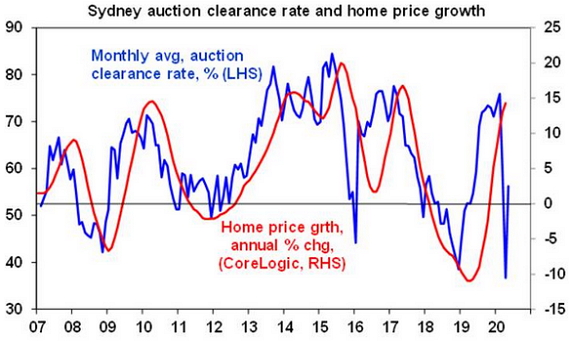
One of the clues to what the short and mid-term holds for property prices is auction clearance rates. Data is signalling a fall is ahead, as you can see from the charts below. These guides aren’t as reliable as normal due to the unprecedented restrictions with social distancing, but they still provide an indication of how auction clearance rates and home price growth can correlate. Note that data released this week indicates a spike – for the week ending May 9, Sydney recorded a clearance rate of 65.4% and Melbourne recorded 46.7%. These figures are still below average, but not as drastically below average than previous weeks.


Sources: Domain, CoreLogic, AMP Capital


Sources: Domain, CoreLogic, AMP Capital

We can now see the government intends to start re-opening dormant parts of the economy in the next two months. Physical inspections and auctions across Australia should gradually phase in as a result. While this is a welcome sign of activity, there are other factors to consider which have historically driven property prices in capital cities, especially in Sydney and Melbourne.

For one, a stop to immigration (in the absence of a vaccine) is likely to persist beyond the gradual lockdown lift. For now, prime minister Scott Morrison has marked restrictions on international travel as one of the last things to ease.1 Immigration is a strong contributor to house price growth in Australia. Just a few months ago, for example, a study found immigration can boost Australian house prices by as much as $6,500 per year.2

Further, a sharp rise in unemployment to approximately 10% and rent holidays/reductions point to property demand falling more than supply. This is a critical equation, and currently, it poses a big threat to property prices.

The outlook so far

If the domestic lockdown starts to be eased through this month, as has been announced, our base case is we expect then the fall in average property prices is likely to be around 10%, as the six-month wage subsidies and bank payment deferrals will have been long enough to protect the economy and hence the property market. In effect, this would just take prices back to where they were around the middle of last year.

It’s important to note the above figures would likely mask 10% to 15% price falls in Sydney and Melbourne, compared to 5% falls in other cities. These cities are more vulnerable due to much higher debt levels, higher home prices and a greater dependence on immigration.

There are many ways to slice and dice the figures, but the fundamentals remain the important things to watch, especially and as always, supply and demand. 


https://www.abc.net.au/news/2020-05-08/international-travel-still-banned-coronavirus-restrictions/12229114
2 https://www.domain.com.au/news/immigration-boosts-australian-house-prices-by-as-much-as-6500-a-year-study-924112/


Author: Diana Mousina, Economist – Investment Strategy & Dynamic Markets, Sydney Australia

Source: AMP Capital  13 May 2020


Important notes: While every care has been taken in the preparation of this article, AMP Capital Investors Limited (ABN 59 001 777 591, AFSL 232497) and AMP Capital Funds Management Limited (ABN 15 159 557 721, AFSL 426455) (AMP Capital) makes no representations or warranties as to the accuracy or completeness of any statement in it including, without limitation, any forecasts. Past performance is not a reliable indicator of future performance. This article has been prepared for the purpose of providing general information, without taking account of any particular investor’s objectives, financial situation or needs. An investor should, before making any investment decisions, consider the appropriateness of the information in this article, and seek professional advice, having regard to the investor’s objectives, financial situation and needs. This article is solely for the use of the party to whom it is provided and must not be provided to any other person or entity without the express written consent of AMP Capital.
Last night would have been Budget night and the Australian Treasurer would have been announcing budget surpluses. Of course, coronavirus intervened, and the surpluses rightly had to be sacrificed to support Australian households, businesses and jobs. And it makes no sense to provide detailed budget forecasts given the extreme uncertainty about the impact on the economy and hence the budget for the coronavirus shutdown. So, the Treasurer has provided a statement to Parliament on the economic impact of the crisis, updated budget numbers will be provided in June and the Budget itself has been delayed to October.

As the economic impact of the crisis is well known I won’t go through that again here except to note two things from the Treasurer’s statement. First, more than 5.5 million Australian workers are now covered by the JobKeeper wage subsidy program which is coming close to the Government’s initial estimate that it would cover 6 million. Second, the Treasurer reiterated that the best way to pay back debt is through productivity enhancing reforms focussed on workforce training and education, infrastructure, cutting red tape, taxation and industrial relations reform. So, reform to help the economy recover post coronavirus will likely be the key focus in the October Budget.

This note looks at our own projections for the budget deficit, the impact on Australia’s net public debt and whether it’s affordable.

Budget deficit projections

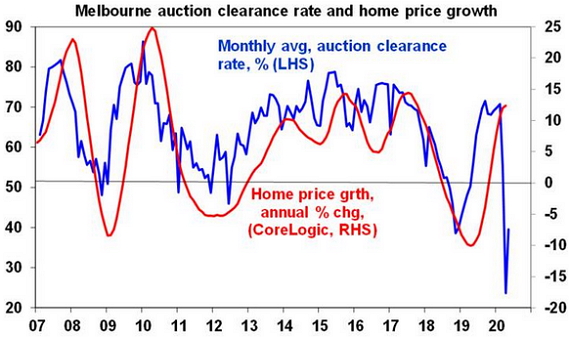
The next table shows our rough budget deficit projections, taking the Mid-Year Economic and Fiscal Outlook projections from last December as the starting point.  


Source: Australian Treasury, AMP Capital

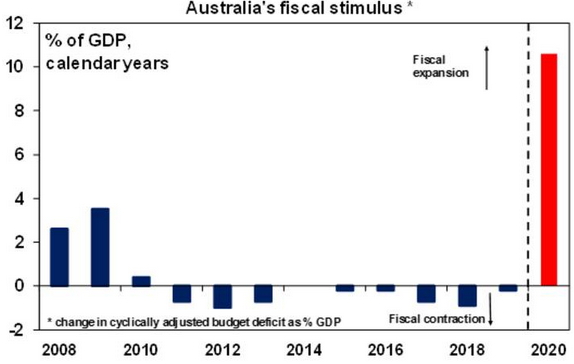
Under “policy changes” we have allowed for the three policy support packages announced through March, the health package announced in March, various industry support packages including that for childcare and bushfire spending. These are dominated by the $130bn JobKeeper program and are concentrated in this financial year and next, particularly for the period out to September. While the reopening of the economy may be coming a bit earlier than the Government had allowed for, we assume that the Government redirects some of the JobKeeper program from those who may no longer need it, to those who do, such that the full $130bn is still spent. In total and allowing for state fiscal stimulus this is resulting in a 10.6% of GDP fiscal stimulus for this calendar year, which swamps the stimulus seen in the GFC (and rightly so because the GFC posed a much smaller threat to the economy).


Source: IMF, AMP Capital

The hit to the economy will mean a hit to government revenue and increased spending demands under some existing spending programs and this is shown in the line called “parameter changes.” This is a guesstimate at present, because we are yet to get a firm handle on the size of the hit to the economy and how quickly it might recover. But the negative impact on the budget is likely to be bigger next financial year than this financial year because unemployment will average far more next financial year (around 8.5%) than this financial year (around 6.3%) and that provides a guide to lost Federal revenue and increased expenses.

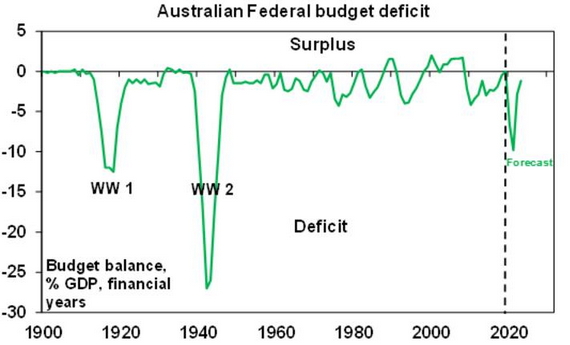
Put simply, the Government’s necessary fiscal support response and the hit to the budget flowing from the hit to the economy will see the budget deficit blow out to around $130bn this year and $200bn next financial year, before falling sharply from 2021-22, as support programs end and the economy recovers.

This would see the budget deficit as a share of GDP peak at around 10% of GDP in 2020-21, which would be its highest since World War 2.


Source: RBA, Australian Treasury, AMP Capital

Spread over several years, this will add nearly 20% of GDP to Australia’s public debt.

But can we afford the surge in the deficit and debt?

It’s not ideal, but it is affordable. First, it needs to be stressed that the stimulus is absolutely necessary. If the Government hadn’t imposed the lockdown the healthcare system could have been overwhelmed resulting in many more deaths than the 97 recorded so far. Australia has seen 4 deaths per million people, but the UK and Italy have seen around 500 deaths per million and if that had occurred in Australia it would mean the deaths of around 12,500 people. And if the Government along with the RBA and state governments had not moved to protect jobs, businesses and incomes, the prospective hit to the economy from the lockdown would be far greater, with a much slower recovery in prospect (and probably an even bigger blow out in the budget and public debt). Looked at another way the 10% or so hit to the economy this half year required a similarly sized stimulus program to offset it.

Second, it makes sense for the public sector to borrow from households and businesses at a time when they are stuck at home and can’t spend due to the shutdown or won’t spend due to uncertainty, and for the Government to give the borrowed funds to help those businesses and individuals that are directly impacted. Using the funds to subsidise wages was a very smart move as it keeps people employed, keeps them linked to their employer and helps minimize confidence zapping unemployment headlines.

Third, the support programs have been designed to support the economy when they are most likely needed – in the June and September quarters – and to phase down thereafter as is apparent in the table above showing policy stimulus falling sharply from 2021-22. So, under current law we have not seen a permanent step jump higher in government spending. This contrasts with what seemed to happen post the GFC.

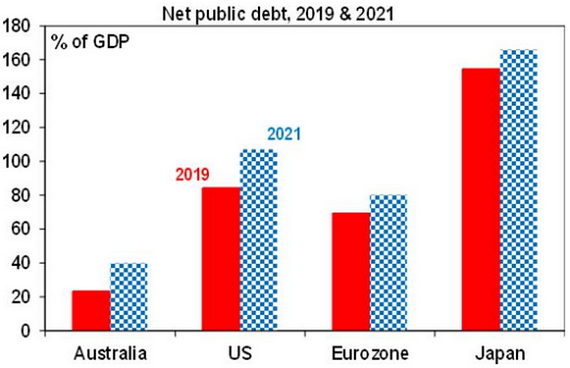
Fourth, Australia’s net public debt is relatively low at 23% of GDP in comparison with the US at 84%, the Eurozone at 69% and Japan at 154%. See the next chart. And even with the projected budget deficit adding 17% of GDP to public debt by 2021, according to IMF projections Australia’s net public debt will remain relatively small at around 40% of GDP in two years’ time. So, Australia has far greater scope to do fiscal stimulus than other comparable countries.


Source: IMF, AMP Capital

Fifth, the cost of borrowing for the Federal Government is very low at just 0.25% for three years and 0.95% for ten years. Of course, this is partly being facilitated by the RBA buying bonds in the secondary market, although even if it weren’t bond yields would be low anyway reflecting the massive hit to the economy from the shutdown. And the odd thing about the RBA holding more Government bonds is that much of the interest paid on the bonds by the Government to the RBA will flow back to the Government as a dividend.

Finally, the Australian Government is borrowing to finance the deterioration in the budget deficit in Australian dollars and given the turnaround in Australia’s balance of payments from a large current account deficit to a surplus or around balance in recent years, it’s not as if we are dependent on foreign creditors risking some sort of foreign currency crisis.

Concluding comment

The blow out in the Australian Government’s budget deficit and public debt is not great. But it’s a necessary price Australia has to pay to minimise the loss of life from the virus and at the same time minimise the hit to people’s livelihoods from the shutdown. In terms of getting the debt back down, a temporary deficit levy would be preferable to tax hikes or the cancelation of tax cuts. But I agree with the Treasurer that the best approach to getting debt back down is to grow the economy aided by a reinvigorated economic reform agenda.


Source: AMP Capital 13 May 2020

Important notes: While every care has been taken in the preparation of this article, AMP Capital Investors Limited (ABN 59 001 777 591, AFSL 232497) and AMP Capital Funds Management Limited (ABN 15 159 557 721, AFSL 426455) (AMP Capital) makes no representations or warranties as to the accuracy or completeness of any statement in it including, without limitation, any forecasts. Past performance is not a reliable indicator of future performance. This article has been prepared for the purpose of providing general information, without taking account of any particular investor’s objectives, financial situation or needs. An investor should, before making any investment decisions, consider the appropriateness of the information in this article, and seek professional advice, having regard to the investor’s objectives, financial situation and needs. This article is solely for the use of the party to whom it is provided and must not be provided to any other person or entity without the express written consent of AMP Capital.

In today’s non-stop work culture, stigma related to mental health is costing us more than money. To prevent long-term harm to our workforce, attitudes still need to change.

In a 2019 report, the Productivity Commission revealed negative mental health costs Australian workplaces up to $17 billion a year.

Only five years prior, a report released by Beyond Blue in 2014 estimated the cost of negative mental health in Australian workplaces as being $10.9 billion.

With a cost increase of over $6 billion in 5 years, it’s clear that the mental wellbeing of Australia’s workforce has never been worse.

So why then, with so many unhappy employees and so much money needlessly circling the drain, aren’t employers finding value in mental health initiatives?

It pays to invest in your staff’s wellbeing

Despite the failure to support workplace mental health initiatives, evidence suggests that directly investing in the mental wellbeing of employees makes good business sense.

In a 2015 report, Beyond Blue found that every dollar spent by an employer on mental health initiatives provides a return of $2.30. Yet even with this impressive ROI, business leaders are continuing to ignore the psychological needs of their employees.

Employers shouldn’t just consider the remarkable financial benefits, though – the vastly improved customer and client experiences made possible through a mentally healthy workplace improves brand awareness in ways marketing simply cannot.

In most cases, a happy workforce is the foundation of a happy, sustainable business.

But, with all the other benefits aside, the driving need for mental health initiatives is to nurture the lifeblood of a business – its employees.

MYOB research shows more work needs to be done

More than two thirds (67 percent) of small businesses have not discussed mental health days, according to data reported by MYOB late last year.

The finding, from a survey conducted with 757 Australian small business operators, is compounded by the fact that just half (52 percent) of respondents said they feel able to address mental health issues affecting their staff.

The number of businesses who had not talked about mental health days was particularly high for those with a small number of staff, with 72 percent of businesses with two to four employees saying they had not had the discussion.

Helen Lea, MYOB’s chief employee experience officer, said given MYOB recently reported 43 percent of small business operators had experienced some form of mental health condition since starting a business, a proactive approach to managing mental wellbeing would head nip potential problems in the bud.

“We are extremely cognisant of the pressures running a small business can bring. Having support from the outset to stop any sense of anxiety before it can take hold is an essential step, but it’s perhaps the toughest to fulfil when there are so many demands on a business owners’ time,” Lea said.

Other key findings of the research conducted included:

  • Businesses working in finance and insurance and agricultural industries were least likely to have discussed mental health days with staff (71% said they had not)

  • The likelihood of this discussion taking place declines with age. Seventy-seven per cent of small business operators aged 60 plus had not discussed mental health days with staff, versus 57% of business operators aged under 40

  • Male small business operators were most likely to report they did not feel able to discuss mental health issues with staff (21% versus 16% of women)

  • Business operators under 40 feel least equipped to have that conversation. Thirty-one per cent said they did not feel able to address mental health issues affecting staff

Positive attitudes make businesses better

Mental health initiatives provide simple ways for employees to discuss psychological needs without being scrutinised.

Needs don’t just have to be workplace-related, as the home life of employees can also weight negatively on them at work – it should be made clear that mental health initiatives are in place to open cathartic doors many other businesses are quick to shut.

Even with advertised freedom to discuss, employees may still find issue with private information being leaked.

For this reason, employees should always be given the assurance that mental health dialogue of will not negatively affect career development, and any information shared will not be relayed to managers and other staff.

With stigma-related barriers so deeply entrenched, it should then become the duty of employers and businesses to unpack common complaints and determine where issues lie in the workplace.

Common work grievances that quickly contribute to the deterioration of mental health include job insecurity, bullying or psychological harassment, low social support at work and effort-reward imbalance.

It’s through these small but significant changes that employees can better invest themselves in their work. This can take the form of increased performance, productivity and overall work quality, with the added benefit of less absenteeism and far better talent retention.

Make it clear that you’re here to help

The first step to remedying toxic attitudes towards the psychological health of employees is to promote mental health and safety as being just as important as physical health and safety.

This is despite only a small percentage of the population involved in the risks associated with physical labour, anyone currently employed is exposed to the job stressors that lead to negative mental health.

To encourage help-seeking behaviour in staff, employers must first distance themselves from the idea that an employee’s mental health is none of their business. It shouldn’t seem strange for a work network to also function as a support network.

Helping staff recognise that many people experience mental health struggles – particularly in male-dominated occupations – is the first step in helping them better relate to mental health issues related to stress, depression and anxiety.

A move can then be made to promote awareness as a whole – effective recognition shouldn’t just occur between employer and employee, but should be something employees are familiar with enough to recognise symptoms of ailing mental health not only themselves, but fellow employees.

Employees are more than a resource

At the end of the day, acknowledging the need for good mental health in the workplace is necessary for the health and wellbeing of employees. Plus, employees you care for also positively contribute to a business’s bottom line – look after your employees, and they’ll look after you.

Perhaps most importantly, every little bit of positive reinforcement counts.

Sometimes, all it takes is a caring conversation between an employer and an employee to make all the difference.


Source : MYOB  

Reproduced with the permission of MYOB. This article by Patrick O’Loughlin was originally published at https://www.myob.com/au/blog/keep-talking-mental-health-in-the-workplace/

Important:
This provides general information and hasn’t taken your circumstances into account. It’s important to consider your particular circumstances before deciding what’s right for you. Although the information is from sources considered reliable, we do not guarantee that it is accurate or complete. You should not rely upon it and should seek qualified advice before making any investment decision. Except where liability under any statute cannot be excluded, we do not accept any liability (whether under contract, tort or otherwise) for any resulting loss or damage of the reader or any other person.

Any information provided by the author detailed above is separate and external to our business and our Licensee. Neither our business nor our Licensee takes any responsibility for any action or any service provided by the author.

Any links have been provided with permission for information purposes only and will take you to external websites, which are not connected to our company in any way. Note: Our company does not endorse and is not responsible for the accuracy of the contents/information contained within the linked site(s) accessible from this page.

The coronavirus pandemic is having profound effects on Australian families, communities, businesses, the financial markets and the global economy.

Many people have lost their jobs and there is much uncertainty around the depth and duration of the current crisis. Governments and policymakers across the globe have announced unprecedented fiscal and monetary packages to provide some offset to the downturn.

The Australian Federal Parliament has approved the JobKeeper payments ($1500 per fortnight), boosted JobSeeker payments up to $1100 per fortnight, and allowed the unemployed and people whose hours have been cut by 20 per cent to dip into their retirement savings to help them weather the coronavirus crisis.

People will be able to apply online through the myGov web site to access up to $10,000 of their super, tax free, before 1 July 2020, and then another $10,000 after the new financial year begins, also tax free.

While some will have to access these funds to make ends meet, others may have a choice. Should they or should they not use the early access to superannuation?

How early withdrawals add up

Withdrawing superannuation funds now means an investor selling part of their portfolio in a depressed market, crystallising current losses and giving up the benefits of eventual recovery in investment markets. It will also erode the investor’s retirement wealth by forgoing future compound interest.

Consider the impact that an early withdrawal could have on an investor’s superannuation balance. The calculations below are for a balanced multi-asset managed fund containing a mix of equities and fixed income, with an average net return of 6 per cent per annum.

For an investor who has 20 years until retirement, the value of a $10,000 withdrawal is estimated to be worth $32,100 at retirement. Over the course of 40 years, the impact of the $10,000 withdrawal on the retirement savings climbs to $102,900, while a $20,000 withdrawal means an investor would have $205,700 less at their disposal. For this investor who chose to withdraw funds right now, it could mean delaying retirement for a number of years.

Comparing potential withdrawal impacts at different ages

Investor’s current age Years to retirement Value of $10,000 at retirement Value of $20,000 at retirement
67 0 $10,000 $20,000
57 10 $17,908 $35,817
47 20 $32,071 $64,143
37 30 $57,435 $114,870
27 40 $102,857 $205,714

Source: Vanguard calculations
Notes: This is a hypothetical scenario for illustrative purposes only. All values are nominal.

A disciplined approach

Global evidence supports the importance of disciplined saving for retirement outcomes.

In 2018, the World Economic Forum named low levels of savings by individuals amongst the six key challenges facing the retirement system worldwide. Many people delay retirement savings until they are in their 40s or 50s. This is not unusual as at each life stage, more immediate financial priorities come first – for instance, saving a deposit to buy a home, paying down a mortgage or investing in kids’ education. In addition, more often than not, savings intended for retirement do not last until retirement; sometimes they are drawn for medical emergencies or critical housing repairs, or during periods of unemployment.

As Australians live longer and spend more time in retirement, we require higher levels of savings to sustain our longer lifetimes and adequate lifestyles. The World Economic Forum estimates that combining auto-enrolment to superannuation, increasing savings over time and avoiding dipping into the superannuation savings prior to retirement is expected to increase wealth at retirement by 70 per cent.

Many people are currently doing it tough and will need to rely on the early access to superannuation as they do not have other means to support their families. For investors who have a choice, taking a long term perspective may prove to be beneficial. We recommend investors seek financial advice and explore other ways of obtaining financial assistance first.

Stay the course

Vanguard founder Jack Bogle famously said: “The courage to press on – regardless of whether we face calm seas or rough seas, and especially when the market storms howl around us – is the quintessential attribute of the successful investor.”

Historically bull markets last substantially longer than bear markets, and this downturn will eventually be over.

The best thing investors can do is to stick to their investment principles and philosophy, and “stay the course” to have the best chance for investment success.

Please contact us on Phone: 07 5641 4134 if you seek further discussion on this topic.


Source : Vanguard April 2020 

Reproduced with permission of Vanguard Investments Australia Ltd Vanguard Investments Australia Ltd (ABN 72 072 881 086 / AFS Licence 227263) is the product issuer. We have not taken yours and your clients’ circumstances into account when preparing this material so it may not be applicable to the particular situation you are considering. You should consider your circumstances and our Product Disclosure Statement (PDS) or Prospectus before making any investment decision. You can access our PDS or Prospectus online or by calling us. This material was prepared in good faith and we accept no liability for any errors or omissions. Past performance is not an indication of future performance. © 2020 Vanguard Investments Australia Ltd. All rights reserved.

Important: Any information provided by the author detailed above is separate and external to our business and our Licensee. Neither our business nor our Licensee takes any responsibility for any action or any service provided by the author. Any links have been provided with permission for information purposes only and will take you to external websites, which are not connected to our company in any way.

Note: Our company does not endorse and is not responsible for the accuracy of the contents/information contained within the linked site(s) accessible from this page.

Focusing on the long-term can be difficult when the here and now is demanding your full attention.

Saturation media coverage – whether it be on mainstream media or on your chosen social media platforms – makes it hard to tune out what have so far been largely negative messages.

Such is the reality of a global health crisis.

While money and investment markets come second to health fears daily gyrations in investment markets can add another level to the stress of dealing with COVID-19 risk, social distancing, working from home or simply finding essential supplies at the local supermarket.

But as some sense of normality returns naturally people will begin tuning into their portfolios and super account balances. Normally paying attention to your investment portfolio is good advice. In situations like this – and the global financial crisis back in 2008 – the reality is that the best advice may well be to not look right now but rather try to focus on the longer term perspective.

A valuable source of perspective – in my view at least – comes from a US financial planner and New York columnist and author Carl Richards. He is a Certified Financial Planner but probably better known for his Sketch Guy column in the New York Times because he has the gift of being able to translate complex money problems in simple sketches.

In his weekly contribution last week he contrasted the free hand sketch of five days of market movements – imagine lots of up and down squiggles – with the long-term trend line of stock market performance over decades.

The simple message is do you want to focus on Days or Decades? You can find it here at his website behaviorgap.com.

It is a simple but powerful reminder of the need to look beyond the day to day – as confronting as it may seem – and focus on the longer term view.

What is encouraging is what Vanguard is seeing through investor behaviours both over the past month of March and for longer timeframes.

Looking at Vanguard’s range of retail and wholesale funds and ETFs there has been positive net cashflow for March with the majority of investors buying into equity markets. The outflows have been in the fixed income category which suggests investors are funding their shift into equities by rebalancing out of fixed income – which has largely done its defensive job.

Similar behaviour has been seen in Vanguard’s US business.

Since the high levels of volatility began in late February, between 62 per cent and 79 per cent of Vanguard US households who moved money on a given day went into equities. The share of households moving into bonds ranged from 18 per cent to 34 per cent over the same period.

Trying to time markets – particularly when you are trying to judge the bottom – is nigh on impossible. One strategy for volatile times that helps overcome the feelings of inertia is to dollar cost average or spread your investments over several weeks or months until you get to your target asset allocation. It is a way to spread the risk because you will end up with a range of entry prices.

Please contact us on Phone: 07 5641 4134 if you seek further assistance on this topic.


Source : Vanguard April 2020

Written by Robin Bowerman, Head of Corporate Affairs at Vanguard.

Reproduced with permission of Vanguard Investments Australia Ltd Vanguard Investments Australia Ltd (ABN 72 072 881 086 / AFS Licence 227263) is the product issuer. We have not taken yours and your clients’ circumstances into account when preparing this material so it may not be applicable to the particular situation you are considering. You should consider your circumstances and our Product Disclosure Statement (PDS) or Prospectus before making any investment decision. You can access our PDS or Prospectus online or by calling us. This material was prepared in good faith and we accept no liability for any errors or omissions. Past performance is not an indication of future performance. © 2020 Vanguard Investments Australia Ltd. All rights reserved.

Important: Any information provided by the author detailed above is separate and external to our business and our Licensee. Neither our business nor our Licensee takes any responsibility for any action or any service provided by the author. Any links have been provided with permission for information purposes only and will take you to external websites, which are not connected to our company in any way.

Note: Our company does not endorse and is not responsible for the accuracy of the contents/information contained within the linked site(s) accessible from this page.

Back in January when the bushfires were raging, I feared Australia’s luck had ran out. But right now, I thank god I live in The Lucky Country! Donald Horne’s original conception of the term in the 1964 book of the same name about Australia being run by “second rate people who share its luck” always seemed a bit too negative to me. Sometimes it may seem that way for a patch and yes mistakes are made, but when it really matters, I reckon we are led pretty well. Particularly in times of crisis. Think the 1980s when Hawke and Keating opened up and modernised the economy. Or through the GFC when a rapid policy response was a big reason Australia avoided recession. The response to the current crisis will likely also go down as a time when Australia rose to the occasion.

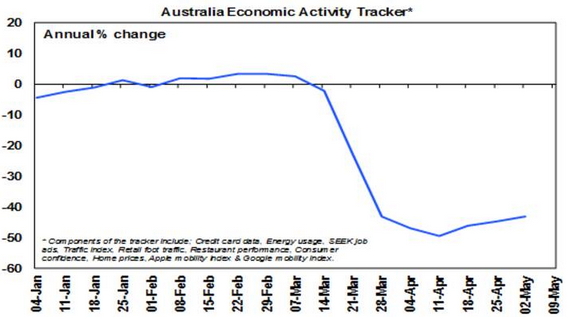
Of course, we are still not out of the woods on coronavirus and there are some bad stats ahead on the economy. This is indicated by our Australian Economic Activity Tracker which is based on high frequency alternative data and is running down 40% on year ago levels, reflecting a preponderance of components most affected by the shutdown.


Source: Bloomberg, AMP Capital

The good news is that it is up from its early April low, but there is still bad news ahead of us in the official statistics. Unemployment likely spiked to around 10% last month which is the highest since the 20% seen during the Great Depression and official data to be released in the months ahead is likely to reflect a 10 to 15% contraction in the economy in the first half of the year, all of which risks further depressing confidence.

But three things suggest Australia looks likely to come through this period of global misery relatively well compared to many other countries and this may mean the Australian economy contracts less and rebounds faster, ultimately supporting Australian asset classes relative to other countries’ assets.

First, Australia has performed better than many countries in controlling coronavirus

While things were bleak in late March, Australia’s success in “controlling” coronavirus (touch wood) stands out globally. After a rapid escalation in new cases, Australia imposed a shutdown around 22 March. New cases peaked in late March at over 500 a day and have since declined to less than 30 a day, albeit with a few clusters still causing problems. New cases may have peaked in the US but are still averaging around 29,000 per day.

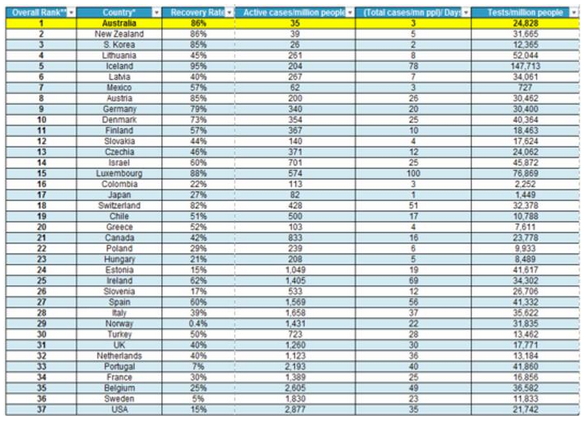
Comparing OECD countries in how they are managing the coronavirus outbreak (based on recovery rates, active cases per capita, total cases per capita adjusted for the number of days since the first case and testing per capita) Australia ranks first, with NZ 2nd (guess where your next overseas holiday might be!) compared to Italy at 28th, the UK at 31st, Sweden at 36th and the US the worst performer in the OECD at 37th.


Source: Worldometer, AMP Capital

Better weather, less congested living, a younger population and luck may have played a role, but the big driver looks to have been a public health response driven by expert medical advice as opposed to bravado or crackpot theories. And this has been backed up by Australians pulling together to do the right thing. By contrast Europe and the US have been marked by a slower response (eg lockdowns in Italy and Spain did not occur until new cases per million people were around 30, compared to around 12 in Australia). And Australia has achieved a similar virus outcome with a less stringent lockdown to New Zealand.

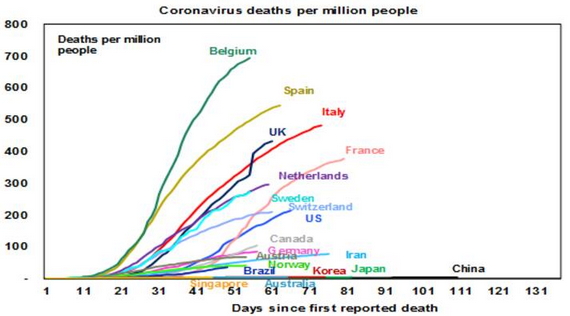
Australia’s better record in containing the virus means two things. First, it has kept pressure off the health system so those who need hospitalisation can get it. As a result, Australia has managed to do a much better job of saving its own people than many other countries. Deaths per million people are around 3.9 in Australia, compared to 84 in Germany, 221 in the US, 280 in Sweden, 443 in the UK and 485 in Italy – that’s 124 times worse than Australia’s death rate! The value of saved lives swamps the cost to the economy from the shutdown.


Source: Worldometer, AMP Capital

It also provides Australia more scope to open the economy sooner and with greater confidence that a “second wave” of cases will be avoided – in contrast to the US where there is no clear downtrend in new cases. Indications from the Government are that a phased easing of the shutdown looks on track to start this month with most businesses running again by July.

Second, Australia has seen a superior policy response

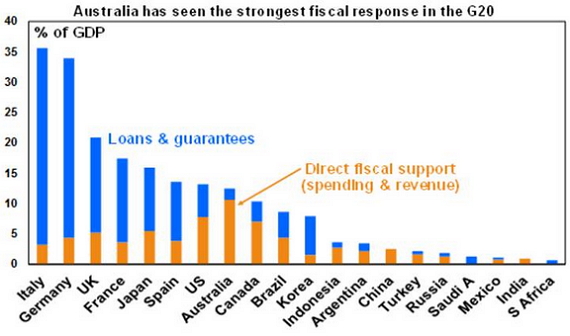
The global government policy response to the economic threat posed by coronavirus shutdowns has been huge. See the next chart. However, in many countries it includes a large element of loans and debt guarantees as opposed to actual fiscal stimulus in the form of spending or tax cuts. For example, providing a loan (or a guarantee to enable a loan) to a business to help it survive the shutdown versus providing it with a wage subsidy.


Source: IMF, AMP Capital

Loans and guarantees are helpful but they leave businesses more indebted, whereas actual fiscal stimulus provides a direct boost. So actual fiscal support is a better measure and on this front Australia at 10.6% of GDP has provided by far the strongest fiscal stimulus of G20 countries. What’s more, Australia’s centrepiece JobKeeper wage subsidy is superior to approaches taken by many other countries as it keeps people “employed”, minimises confidence zapping negative headlines around unemployment, preserves the employer/employee relationship, keeps workers getting paid and provides a subsidy to struggling businesses. Unemployment is likely to rise to around 10% which is bad, but its far better than the 15% that would likely occur in the absence of JobKeeper or 20% or so unemployment in the US.

Third, Australia’s major trading partner is 2-3 months ahead of the rest of the world

Finally, we may benefit from our biggest export market – China, which takes a third of our exports – being ahead of the global recovery curve by around 2-3 months and focused on infrastructure spending. This explains why prices for our key export – iron ore – are holding up relatively well compared to say the price of oil (of which we are a net importer).

Implications for the Australian economy

If, as appears likely, a phased easing of the lockdown starts this month, then April should prove to be the low point in economic activity and growth should return to the economy in the second half. This does not mean that things will quickly bounce back to “normal” – the easing of the lockdown will likely be gradual to minimise the risk of a “second wave”, some businesses will not reopen, uncertainty will linger, debt levels will be higher and business models will have to adapt to different ways of doing things. This may mean returning to the office on a rotational basis and shops & restaurants reopening but with distancing rules. Domestic travel may be back withing a few months, but international travel looks unlikely in the absence of a vaccine until next year (except to NZ). But it will still see a return to growth, albeit it may not be until end next year before economic activity returns to pre-virus levels.

The combination of better success in controlling the virus with less risk of a second wave, better protection of the economy with a stronger policy response and Australia’s exposure to China make it likely that the Australian economy will contract less and recover faster than other comparable countries.

While many fret that without tourism and immigration Australia can’t recover, this is not true. The travel ban has only accounted for a small part of the hit to the economy. Australia actually has a tourism trade deficit of 1% of GDP (we lose more from Australians going overseas than we gain from foreigners coming here) so a ban on international travel will actually boost GDP. However, we do have a 2% trade surplus in education, and this would be lost if foreign students can’t come. Similarly, immigration contributes just less than 1% to economic growth each year in Australia. However, this is all dwarfed by the 10 to 15% hit to economic activity which has mostly come from the domestic shutdown. And it could be argued that a workable testing and quarantine requirement could be introduced to allow students and immigrants to return on a 6-9 month timeframe.

Risks to watch

The main risks to watch for are: a “second wave” of coronavirus cases driving a new shutdown beyond the six month protection out to September provided by JobKeeper, increased JobSeeker and the bank debt payment holiday; the lockdown triggering a house price crash resulting in severe second round effects on the Australian economy – this is probably a much greater risk if the lockdown continues beyond September; and political tensions around the origin of Covid 19 damaging Australia’s trade relationship with China in some way.

Implications for investors

If, as we expect, the combination of better success in controlling the virus, a stronger economic policy response and exposure to a recovering Chinese economy result in a relatively stronger recovery for the Australian economy then Australian assets should benefit relative to global assets. This could come via an appreciation of the $A which is what has happened lately.


Source: AMP Capital 6 April 2020

Important notes: While every care has been taken in the preparation of this article, AMP Capital Investors Limited (ABN 59 001 777 591, AFSL 232497) and AMP Capital Funds Management Limited (ABN 15 159 557 721, AFSL 426455)  (AMP Capital) makes no representations or warranties as to the accuracy or completeness of any statement in it including, without limitation, any forecasts. Past performance is not a reliable indicator of future performance. This article has been prepared for the purpose of providing general information, without taking account of any particular investor’s objectives, financial situation or needs. An investor should, before making any investment decisions, consider the appropriateness of the information in this article, and seek professional advice, having regard to the investor’s objectives, financial situation and needs. This article is solely for the use of the party to whom it is provided and must not be provided to any other person or entity without the express written consent of AMP Capital.
At its meeting today, the Board decided to maintain the current policy settings, including the targets for the cash rate and the yield on 3-year Australian Government bonds of 25 basis points.

The global economy is experiencing a severe downturn as countries seek to contain the coronavirus. Many people have lost their jobs and a sharp rise in unemployment is occurring. At the same time, the containment measures have reduced infection rates in a number of countries. If this continues, a recovery in the global economy will start later this year, supported by both the large fiscal packages and the significant easing in monetary policies.

Globally, financial markets are working more effectively than they were a month ago, although conditions have not completely normalised. This improvement reflects both the decline in infection rates and the substantial measures undertaken by central banks and fiscal authorities. Credit markets have progressively opened to more firms and long-term bond rates remain at historically low levels.

In Australia, the functioning of the government bond markets has improved and the yield on 3-year Australian Government Securities (AGS) is at the target of around 25 basis points. Given these developments, the Bank has scaled back the size and frequency of bond purchases, which to date have totalled around $50 billion. The Bank is prepared to scale-up these purchases again and will do whatever is necessary to ensure bond markets remain functional and to achieve the yield target for 3-year AGS. The target will remain in place until progress is being made towards the goals for full employment and inflation.

The Bank’s daily open market operations are continuing to support credit and maintain low funding costs in the economy. To assist with the smooth functioning of Australia’s capital markets, the Bank has decided to broaden the range of eligible collateral for these operations to include Australian dollar securities issued by non-bank corporations with an investment grade credit rating. More details are provided in the accompanying market notice.

The Australian economy is going through a very difficult period and there is considerable uncertainty about the outlook. Reflecting this uncertainty, the Board considered a range of scenarios at its meeting. In the baseline scenario, output falls by around 10 per cent over the first half of 2020 and by around 6 per cent over the year as a whole. This is followed by a bounce-back of 6 per cent next year.

There has been a substantial, coordinated and unprecedented fiscal and monetary response in Australia to the coronavirus. Without this response, the outlook would have been even more challenging. These policies are supporting the economy right now and will help when the recovery comes. They are supporting people’s incomes, maintaining the important connections between businesses and their employees, underpinning the supply of credit to businesses and households, and keeping borrowing costs low. The deferral of loan and other payments is helping people manage their cash flows. The Australian banking system, with its strong buffers of capital and liquidity, is also helping the economy traverse this difficult period.

In the baseline scenario considered by the Board, the unemployment rate peaks at around 10 per cent over coming months and is still above 7 per cent at the end of next year. A lower unemployment rate than this is possible if the reduction in labour demand is accompanied by a larger reduction in average hours worked, rather than by people losing their jobs.

The Board also considered other scenarios. A stronger economic recovery is possible if there is further substantial progress in containing the coronavirus in the near term and there is a faster return to normal economic activity. On the other hand, if the lifting of restrictions is delayed or the restrictions need to be reimposed or household and business confidence remains low, the outcomes would be even more challenging than those in the baseline scenario. These scenarios will be discussed in the Statement on Monetary Policy, to be released later this week.

In the various scenarios considered by the Board, inflation remains below 2 per cent over the next few years. In the March quarter just passed, CPI inflation rose to 2.2 per cent, but it is expected to turn negative temporarily in the June quarter, due to falls in oil prices, the introduction of free child care and deferrals of various price increases. Further out, in the baseline scenario inflation is 1 to 1½ per cent in 2021 and gradually picks up further from there.

Given this outlook, the Bank will maintain its efforts to keep funding costs low in Australia and credit available to households and businesses. The Board is committed to do what it can to support jobs, incomes and businesses during this difficult period and to make sure that Australia is well placed for the expected recovery. The Board will not increase the cash rate target until progress is being made towards full employment and it is confident that inflation will be sustainably within the 2–3 per cent target band.

Source: Reserve Bank of Australia, May 5th, 2020

Enquiries

Media and Communications
Secretary’s Department
Reserve Bank of Australia
SYDNEY

Phone: +61 2 9551 9720
Email: rbainfo@rba.gov.au

Running a business can feel lonely at the best of times, and a lack of self-care can quickly cause mental health to suffer. Networking should be your first port of call, even under new lockdown restrictions.

recent University of Melbourne report demonstrated that, under normal circumstances, almost one third of business owners experience a high level of psychological distress.

With Beyond Blue set to introduce a dedicated coronavirus mental health support line for SMEs in Australia, and new measures introduced just to keep small businesses afloat, it’s safe to say that the mental health of business owners has never been worse.

In these tough times, turning to fellow business owners is one of the simplest and most rewarding ways to manage stress and anxiety – and the best way to do so is through networking.

How networking supports positive mental health

Even when business feels like a disconnected experience, remembering that there are others in the same boat is highly beneficial.

Patrice O’Brien, Beyond Blue General Manager of Workplace, Partnerships and Engagement, finds huge value in business owners connecting with those around them.

“Business leaders often take major decisions on their own and, to a degree, feel a need to separate themselves from their employees to maintain their impartiality when making those decisions.

“So, having a network of colleagues outside the business, who can relate to the issues a small business owner faces day-to-day, can be a great support,” said O’Brien.

This has never been truer with our current economic landscape, so if you’ve had to make tough decisions in the face of the COVID-19 pandemic, finding support in fellow business owners can help lift the burden.

Take the time to develop a rapport with the business community

It’s important to keep in mind that creating a business-related support network is about more than discussing the work at hand.

Connecting with others can protect against the onset of anxiety and depression through something as simple as discussing common business woes.

“Having a network of people who you can talk to about work challenges and being able to share your own coping strategies can do wonders for your mental health.

“By sharing these challenges with others, you realise that you’re not alone and that others care about you and what you are trying to achieve,” O’Brien said.

Employees need to reap the benefits of networking too

Business owners aren’t the only ones suffering mental health issues in the workplace, and networking can be just as valuable for employees.

“Having contacts outside of the work environment to share life and work’s challenges and successes are well worth nurturing.

“They might be former colleagues who understand the work dynamic or contacts who can bring perspectives from other industries,” O’Brien said.

O’Brien also points out that networking can also provide a variety of worthwhile opportunities for employees.

“These relationships can enhance the employee’s professional and career experiences and also help to keep their mental health in good order.”

Learning to get yourself out there

Whether you’re a business owner or employee, there are a variety of great resources and communities for those interested in networking, but you can’t do much unless you get yourself out there.

For some business owners, though, the thought of attending these events is anxiety-inducing in its own right. O’Brien suggests that these individuals may be pleasantly surprised after attending their first event.

“For many people who are stressed about attending a networking event, those feelings may subside once they settle into the networking event and have conversations with other participants.”

How you can manage your own anxiety

While anxiety can be unpleasant for business owners, most instances can be treated with some simple self-care.

Rather than immediately seeking out professional help, O’Brien provides some simple steps for those experiencing mild to moderate anxiety:

  1. Slow breathing. Try deliberately slowing down your breathing. Count to three as you breathe in slowly and then count to three as you breathe out slowly

  2. Stay in the present moment. Anxiety can make your thoughts live in a terrible future that hasn’t happened yet. Try to bring yourself back to where you are. Practicing meditation can help

  3. Keep active, eat healthy foods, go out into nature, spend time with family and friends, reduce stress and do the activities you enjoy

  4. Learn from others. Talking with others who also experience anxiety – or are going through something similar – can help you feel less alone. Visit Beyond Blue’s Online Forums to connect with others

Seek help when you see warning signs

Businesses are currently experiencing unprecedented issues in Australia and New Zealand, whether from unforeseen closures or sharp drops in demand.

With no end date in sight, mental health is often one of the first casualties for business owners.

If recent events are proving too much and self-care isn’t providing the relief you need, seeking support from a professional is always the best course of action.

In Australia, you can seek help via the Beyond Blue website, or call Lifeline Australia on 13 11 14.

New Zealand business owners can reach out via the Mental Health Foundation, or by calling Lifeline Aotearoa on 0800 543 354.

Source : MYOB March 2020

Reproduced with the permission of MYOB. This article by Patrick O’Loughlin was originally published at https://www.myob.com/au/blog/

Important:
This provides general information and hasn’t taken your circumstances into account. It’s important to consider your particular circumstances before deciding what’s right for you. Although the information is from sources considered reliable, we do not guarantee that it is accurate or complete. You should not rely upon it and should seek qualified advice before making any investment decision. Except where liability under any statute cannot be excluded, we do not accept any liability (whether under contract, tort or otherwise) for any resulting loss or damage of the reader or any other person.

Any information provided by the author detailed above is separate and external to our business and our Licensee. Neither our business nor our Licensee takes any responsibility for any action or any service provided by the author.

Any links have been provided with permission for information purposes only and will take you to external websites, which are not connected to our company in any way. Note: Our company does not endorse and is not responsible for the accuracy of the contents/information contained within the linked site(s) accessible from this page.


Facing cash flow issues and falling behind on repayments as a result of COVID-19? There are ways to manage debt during a crisis to help stay financially secure for the future.

We don’t need to tell you these are challenging times. The Federal Government estimates that around 6 million workers1 will receive financial assistance in the coming months, having lost all or part of their income due to the coronavirus pandemic.


Whether you’re a full-time employee experiencing a loss of income, a casual whose hours have been cut, or you’re a small-business owner now struggling to pay your bills, you’re not alone in facing and managing debt. Approximately 74% of Aussie households held an average debt of $168,6002 in 2015-16. Of this, credit cards are the most common form of debt, held by 55% of households, followed by home loans (34%) and student loans (17%).

At times of financial hardship like these, it can be all too easy to get further into debt without examining all your options. Some factors to consider include which debts are costing you the most money, which will have the greatest impact on your financial future and which will free up some much-needed cash. So, before you pull out your credit card to ease the pressure, here are a few things to ask yourself when you’re managing debt.

Can any of my repayments be paused?

When cash is tight, you may wonder how you’ll continue to repay any outstanding amounts – especially if you have multiple debts. However, it may be possible to temporarily pause or defer certain payments to help you get through the next few months.

Many Australian banks3 are offering mortgage relief on home loans by “freezing” repayments for up to six months, potentially freeing up cash flow. Do your research before taking this path – some banks may impose interest capitalisation on all freezes, meaning interest still accumulates and must be paid off when you “unfreeze” your loan.

On top of this, many banks are currently offering relief on credit card repayments, from deferring debt repayments to cutting interest rates4. Speak to your lender as soon as you can to work out what options are available to you.

Which debt should I pay off first?

If you are juggling multiple debts it can be hard to know where to start with your repayments. There are some rules of thumb that can help you work out which debts to prioritise. Let’s say you have four debts:

  1. $2,000 on a credit card, which charges 19% interest and has a $9,000 credit limit

  2. $336,500 home loan (the Aussie average for first home buyers5), with an interest rate of 3% and no redraw available

  3. $10,000 on another credit card, which charges 24% interest and has a $15,000 credit limit

  4. $7,000 personal loan at 7.5% interest

Generally, it makes good financial sense to pay off debts in order of interest rate charged, from highest to lowest. So, in this example you would pay off debt 3, 1, 4 then 2. The thinking behind this is that mathematically, this will lead to the lowest dollars-and-cents repayments in the long run.

If you have one smaller debt you might also consider paying this off first, followed by your other debts in order of highest interest rates. In this example that means paying off the $2,000 credit card (debt 1) first, followed by the debts 3, 4 and 2.

Independent of other considerations, the theory here is that you’ll likely pay off the small debt faster, get a psychological boost from doing so, and want the empowerment of seeing all your debts paid off.

Should I consolidate my debts?

Debt consolidation means rolling all of your debts into one new single debt.

The pros: it can equate to lower (and easier to manage) repayments and give you a clearer picture of your financial future. Let’s say you take out an unsecured personal loan to consolidate your high-interest debts, like credit card balances. You no longer have to juggle multiple repayments, and they’ll also likely be reduced thanks to typically lower interest rates on a personal loan compared to on a credit card.

The cons? It can potentially affect your credit score, and also turn short-term debt into long-term debt. For example, your home loan interest rates are likely to be much lower than your credit cards. However, if you were to increase your mortgage to pay off these high-interest debts, it can turn short-term debts (credit cards, personal loans) into a much longer-term debt (your mortgage), meaning you could end up paying more interest over the life of the loan. If you consolidate your debts in this way ideally you will want to maintain the previous level of overall repayments so the interest cost doesn’t blow out over the longer term.

Are ‘payday loans’ worth considering?

When you need cash fast, payday loans might seem like the ideal quick fix. These small loans – usually around $2,000 but in some instances up to $10,000 – are popular for many reasons: they’re short-term, there are no restrictions on what you can use them for, they can be approved in a matter of minutes online and the money can be quickly transferred to your account. On the surface, they’re so appealing that Aussie households took out more than 4.7 million individual payday loans between April 2016 and July 2019, worth approximately $3.09 billion6. However, there’s a flipside.

These loans can come with very high fees attached to them, which means you could find yourself in a debt spiral in a very short space of time. Borrow less than $2,000 and you’re generally faced with an establishment fee of up to 20% of your loan, as well as monthly account fees. Borrow between $2,000 and $5,000 and you could pay a $400 establishment fee and up to 48% annual interest. Borrow more than $5,000 and pay up to 48% annual interest.7 Compare this to average credit card interest rates, which are around 20% (some with additional annual fees).8

Should I worry about my credit score?

Think of your credit score as an overall picture of your financial health, taking into consideration things like how much debt you’re in, whether you pay interest on time and how many credit applications you’ve made.

While your finances might seem overwhelming right now, it’s a good idea to keep your financial future in mind. When we get through this, let’s say you want to take out an additional loan to boost your business, purchase property or go on a dream holiday. If your credit rating is low – which is to say, lenders consider you risky – then you may find it tricky to borrow money.

Please contact us on Phone: 07 5641 4134 if you seek further discussion.

What types of financial assistance may be available?

There has been a loud – and consistent – mantra across Australia in recent weeks: You are not alone. In addition to banks offering home loan relief, the government has announced a range of measures to support individuals and businesses affected by COVID-19 (coronavirus). These range from JobKeeper payments, to household stimulus packages and financial support for retirees.


1 Prime Minister of Australia (2020): $130 Billion JobKeeper Payment to Keep Australians in a Job
2 Australian Bureau of Statistics (2018): Household Income and Wealth, Australia 2015–16.
3 ABC News (March 2020): Are banks freezing mortgages? Here are the banks putting payments on hold amid coronavirus
4 RateCity (March 2020): Which banks are offering relief on credit card repayments for COVID-19?
5 Australian Bureau of Statistics (2019): Housing Finance, Australia, November 2019
6 Consumer Action Law Centre: Data reveals billion-dollar payday lending industry driving Australians into debt
7 ASIC: Loans and Credit Cards.
8 AAP (March 2020): CBA ‘Looking at’ Cutting Credit Card Rates.


Source  : AMP April 2020

Important: This information is provided by AMP Life Limited. It is general information only and hasn’t taken your circumstances into account. It’s important to consider your particular circumstances and the relevant Product Disclosure Statement or Terms and Conditions, available by calling Phone: 07 5641 4134, before deciding what’s right for you. All information in this article is subject to change without notice. Although the information is from sources considered reliable, AMP and our company do not guarantee that it is accurate or complete. You should not rely upon it and should seek professional advice before making any financial decision. Except where liability under any statute cannot be excluded, AMP and our company do not accept any liability for any resulting loss or damage of the reader or any other person.