Humans feel losses more keenly than gains. It’s better not to lose 10 dollars than it is to gain the same amount.

We share the common concern that something might happen to upset our standard of living if we suddenly can’t generate the income we’re used to. The good news is there’s plenty we can do to be in good financial shape to cope with life’s twists and turns.

How much insurance is right for me?

The whole idea of insurance is based around the need to be prepared for what’s around the corner. If something happens like a sudden illness, it’s good to know you’ve made provision for treatment and any interruption to your earnings. AMP’s insurance needs calculator helps you work out what’s right for you and your family.

You may also have cover through your superannuation. Find out more about the 3 types of insurance available within super, and some of the pros and cons.

Talk to your loved ones

Family is a major reason people increase their protection. Before you commit, you may want to talk with those close to you about their needs. It might throw up ideas you hadn’t considered.

A rainy day fund

One thing to consider is a savings account or something equally accessible with enough money to cover you for six months or a year if you can’t work. Think about what you’d need to cover everyday essentials and outgoing expenses you can’t easily vary, such as electricity bills, childcare or rent. Remember your health and wellbeing are paramount, so you might still budget to keep your gym or art gallery membership, for example.

Please speak to us

We help you work out the right way forward for you, and help you set and stick to your goals. Please call us on Phone: 07 5641 4134

Source: AMP

This economic and fiscal update is the first since December’s Mid-Year Economic and Fiscal Outlook when budget surpluses looked just around the corner. Since then things have changed dramatically due to the hit from coronavirus and necessary support measures from the Government.

Policy stimulus

The statement provided no new policy stimulus measures beyond those that have been announced in the last two weeks:

  • $2bn in spending on subsidies for apprentices & JobTrainer;

  • An estimated $16bn to extend JobKeeper to March next year but with payments stepping down to $1200 and then $1000 a fortnight for those who worked 20 hours or more per week in February and to $750 and then $650 for others and businesses having to meet the turnover reduction test at the end of the September and December quarters to keep receiving it; and

  • An estimated $3.8bn to extend the JobSeeker Supplement to December at the pared back rate of $250 a fortnight.

This additional $22bn in spending along with prior coronavirus-related economic support (in the form of actual spending, tax breaks and health measures) takes the COVID-19 response package to nearly $174bn. JobKeeper is the main element in this, but it also includes the JobSeeker supplement, payments to businesses and payments to eligible households. There is also loans & guarantee support (from the government and RBA) worth $125bn or just over 6% of GDP.

Proposals to bring forward the tax cuts and provide additional investment incentives look to have been pushed out to the October budget and additional industry support packages are also likely. The Government may have delayed this extra stimulus to gauge how much additional help will be required with a lot riding on how quickly the latest outbreak of coronavirus is brought back under control. Spreading out the announcement of new stimulus measures may also get more bang for the buck in terms of the boost to confidence.

Economic assumptions

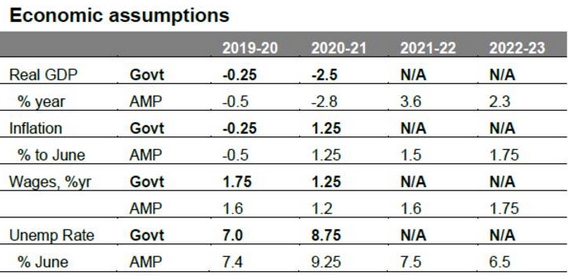
The Government is forecasting the economy to contract this financial year by -2.5%, its biggest financial year contraction since 1946-47. But this masks a “record” -7% contraction in June quarter GDP and a gradual recovery from the second half of this year. The Government is a bit more optimistic than we are in terms of economic growth and unemployment.


Source: Australian Treasury, AMP Capital

Budget deficit projections

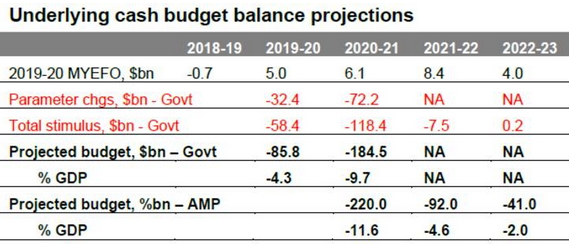
The Government’s revised budget projections and our own are shown below. These should be treated with greater than normal caution given the uncertain economic outlook.

Source: Australian Treasury, AMP Capital

The hit to the economy and hence revenue and expenditure since the Mid-Year Economic and Fiscal Outlook last December is huge at $72bn for this financial year and is shown in the line called “parameter changes”. It should gradually start to diminish as the economy recovers. Policy stimulus (mainly due to the coronavirus response but also other things) since last December is shown in the line labelled “Total stimulus”.

As a result of the Government’s fiscal response and the hit to revenue from the economic downturn, the Government projects the budget deficit to further blow out from around $86bn for the past financial year to a record $184.5bn this financial year.

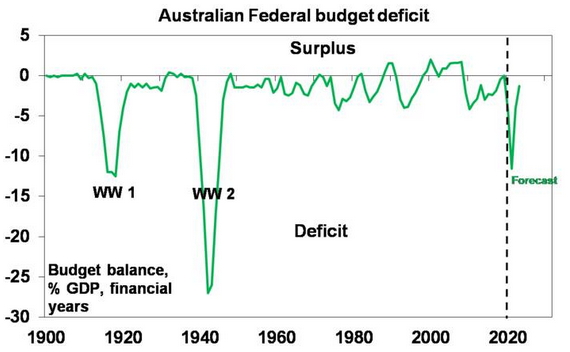
While it does not provide projections beyond this financial year the implication is that the deficit will decline in future years as support programs phase down and the economy recovers. On the Government’s projections this would see the budget deficit as a share of GDP peak at around 9.7% of GDP in 2020-21, which would be its highest since World War 2. We continue to see a bigger deficit for this financial year of around $220bn reflecting both a bigger hit to revenue and additional stimulus of around $17bn to be announced in the months ahead, including in the October budget. This is likely to include the bring forward of the 2022 tax cuts, more investment incentives and more industry support programs. The budget deficit blow-out will add about 20% of GDP to public debt out to 2022.


Source: RBA, Australian Treasury, AMP Capital

Assessment

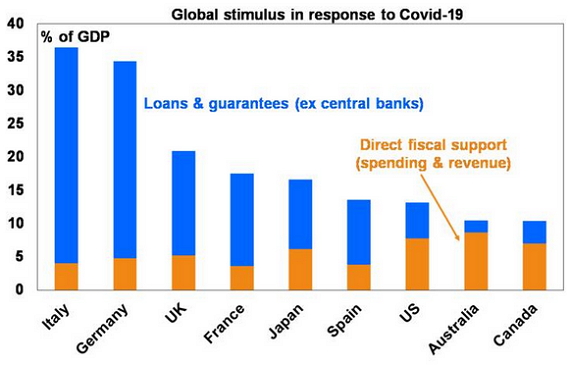
The additional $22bn in stimulus announced over the last two weeks is welcome and will help turn the fiscal cliff in October into a fiscal slope. The boost to stimulus announced in the last two weeks takes Australia’s total level of coronavirus related fiscal stimulus (excluding loans and guarantees) this year up to 8.7% of GDP, which is well and truly at the high end of comparable countries. This should aid the economic recovery.


Source: IMF, AMP Capital

However, it’s doubtful that this will be enough given the long tail of unemployment flowing from the coronavirus shock. We estimate that were it not for JobKeeper and people leaving the workforce the effective unemployment rate would currently be 11.3%, which is well above the official measured rate of 7.4%. This has fallen from 14.8% in April thanks to the reopening of the economy, but with the threat to the recovery posed by the second wave of cases in Victoria and the lockdown in Melbourne and the risk of a flow on to NSW, effective unemployment may only fall to around 10% or so by September and maybe 9% or more going into next year, so continued income support is essential. The Government’s focus now shifts to economic reforms in the October budget and this is likely to include even more fiscal support, as noted earlier.


Source: IMF, AMP Capital

Our assessment remains that the blow out in the budget deficit is affordable. First, it’s absolutely necessary as were it not for the support measures the economic hit would be far greater.

Second, it makes sense for the public sector to borrow from households and businesses at a time when they have cut their spending, and to give the borrowed funds to help those businesses and individuals that need help.

Third, the support programs are targeted at current needs so shouldn’t lead to permanently higher government spending. 

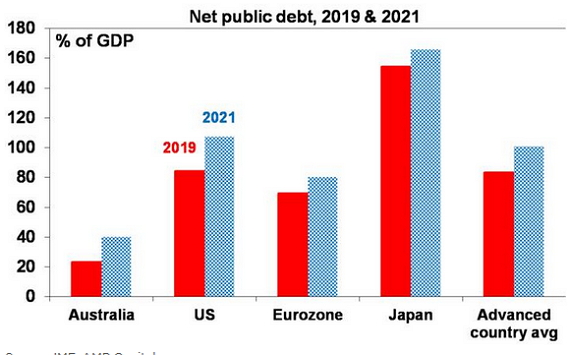
Fourth, Australia’s starting point for net public debt last year was low at 23% of GDP compared with other advanced countries averaging 83%. See the next chart. And even with projected budget deficits it will remain relatively small.


Source: IMF, AMP Capital

Fifth, borrowing to finance the budget deficit is in Australian dollars and we are not dependent on foreign creditors, so we are not vulnerable to a “foreign currency crisis.”

Finally, the cost of Government borrowing is very low at around 0.85% for ten years and 0.25% for three years.

Implications for the RBA

Ongoing Government support for households and businesses is not enough to change our assessment that the RBA will need to keep cash rate near zero for years ahead and possibly need to undertake more quantitative easing in the face of ongoing spare capacity in the economy and below target inflation.

Implications for Australian assets

Cash and term deposits – with the cash rate unlikely to rise from 0.25% for years, returns from cash and bank term deposits will remain low for a long time to come. That said the budget stimulus and increase in money supply holds out at the prospect that at some point inflation and interest rates will rise. But it’s probably at least three years away.

Bonds – the surge in public debt and bond supply would all other things being equal, point to higher bond yields, but this is offset by massive spare capacity, low private sector borrowing, very low inflation and the cash rate capped at 0.25% for years it’s hard to see a lot of upside in bonds yields. That said, if coronavirus comes under control it’s hard to see a lot of downside either so medium-term bond returns are likely to be low.

Shares – the addition of extra policy stimulus further helps to offset the hit from coronavirus and adds to confidence that growth will recover which is supportive of shares.

Property – ongoing income support is continuing to help the property market avoid a sharp fall in home prices but the negatives around high effective unemployment, the weak rental market and the collapse in immigration point to ongoing falls in prices into next year, particularly in Sydney and Melbourne.

The $A – ongoing fiscal stimulus at the high end of comparable countries coming at a time of rising commodity prices and a declining US dollar point to more upside for the $A.

Concluding comment

With private sector spending hit by coronavirus it makes sense for the Government to continue to help fill the breach and support the economy. The best approach to getting debt back down is to grow the economy aided by a reinvigorated economic reform agenda, but for a while yet government fiscal support will continue to be needed.


Source: AMP Capital 23 July 2020

Important notes: While every care has been taken in the preparation of this article, AMP Capital Investors Limited (ABN 59 001 777 591, AFSL 232497) and AMP Capital Funds Management Limited (ABN 15 159 557 721, AFSL 426455) (AMP Capital) makes no representations or warranties as to the accuracy or completeness of any statement in it including, without limitation, any forecasts. Past performance is not a reliable indicator of future performance. This article has been prepared for the purpose of providing general information, without taking account of any particular investor’s objectives, financial situation or needs. An investor should, before making any investment decisions, consider the appropriateness of the information in this article, and seek professional advice, having regard to the investor’s objectives, financial situation and needs. This article is solely for the use of the party to whom it is provided and must not be provided to any other person or entity without the express written consent of AMP Capital.

As markets continue to be wax and wane due to ongoing coronavirus fears and subdued employment and economic recovery numbers, it seems timely to remind ourselves of the types of behavioural and emotional biases that could lead to potentially risky investment behaviour, and how you can avoid them.

As human beings we are not well wired for the rational, dispassionate approach that economists love to think of as “normal”.

Loss aversion

Loss aversion refers to a bias in human psychology where we tend to prefer avoiding loss than acquiring equivalent gains. The principle here is that we’d rather not lose $100 than to gain $100. We tend to focus more on what we might lose, rather than on what we might get. The fear of loss can often reduce our ability to stay the course.

This was evident during the period of market volatility in late March, which saw some investors cashing out in a bid to protect a portfolio’s existing value. By realising those losses at that point in time, it meant that those same investors were less likely to have benefited when the Australian sharemarket quickly moved back and regained much of those initial losses.

A way of addressing this is to frame your portfolio gains and losses as wide as possible and over a long term horizon and not take a narrow view at one point in time. For example if you focused on just your Australian share investments you had an emotional roller coaster ride through March/April. But what would it have looked like if you total portfolio view – including international shares, bonds and even your home in your total portfolio view.

Vanguard’s Index Chart illustrates the value of a longer-term approach well with historical data showing that markets fluctuate from year to year but those who ignore the emotional swirl of short-term market conditions are inevitably rewarded for their patience and discipline in the long term.

Confirmation bias

This bias entails looking for information that supports our beliefs or choices. And during an ongoing period of market volatility, it can be particularly tempting to start thinking about changing your investment behaviour and in the process, seek out information that we think will help us make better investment decisions in the short term.

But consider this – we are told that the world is bracing for a second wave of coronavirus infections but in the same breath, we are also told that there is an 80 per cent chance of a vaccine before year’s end. Would you sell your investments now to avoid another market correction because you are convinced that a second wave of infections is on its way, or would you hold on to your investments because you know for sure that a vaccine is almost here?

The reality is, we have no way of knowing which of the two scenarios will eventuate. Actively seeking out information that confirms your thoughts on any of the scenarios, or subsequently ignoring any data that suggests otherwise and then making an investment decision based on current information, is likely to hinder rather than help achieve your investment goals.

Again, the challenge is to be disciplined and stay the course and understand what you can – and what you cannot – control. In keeping to the investment strategy that you have carefully put in place – one that will endure in both the boon of a bull market and the stress of a bear market – you’re still on track to achieve your investment goals over your investment horizon.

Herd behaviour

According to the best minds in psychology, herd behaviour is particularly relevant in the domain of finance and has on occasion, represented a major cause of speculative bubbles. During the March market volatility, it was not uncommon to hear many declare that now is the best time to invest in technology-related shares because they were booming or to invest in the health sector because a vaccine is imminent.

Are you buying bonds and moving into cash because your well-meaning uncle who’s not far off from retirement advised you to do what he did, or are you buying equities because your much younger neighbour is convinced that this is ‘the way to go’?

Rather than follow the crowd when making investment decisions that impact you alone and not the herd, you should take into account your unique circumstances and investment goals when executing on your strategy.

One strategy that you could deploy during volatile times is to spread your investments over a certain period of time. Rather than time the markets, you could instead try the dollar cost average method by putting regular contributions towards your investments until you get to your target asset allocation.

Cognitive biases are often hard to detect because they occur so naturally but learning and recognising how they can affect your decision making, especially in times of uncertainty, will be useful for every investor. And remember, this is much easier to do if you have taken the time to create an investment strategy tailored to your own risk appetite and investment objectives.

Understanding that we are all subject to biases as an investor is a powerful argument for the value of having a written financial plan that captures why you are investing and what are your personal goals. Then at times of market stress it can be retrieved from the filing cabinet (either real or digital) and used to either adjust or simply stay on course, accepting there may be well be some rough weather ahead.

Please contact us on Phone: 07 5641 4134 if you seek further assistance on this topic .

Source : Vanguard

Written by Robin Bowerman, Head of Corporate Affairs at Vanguard.

Reproduced with permission of Vanguard Investments Australia Ltd Vanguard Investments Australia Ltd (ABN 72 072 881 086 / AFS Licence 227263) is the product issuer. We have not taken yours and your clients’ circumstances into account when preparing this material so it may not be applicable to the particular situation you are considering. You should consider your circumstances and our Product Disclosure Statement (PDS) or Prospectus before making any investment decision. You can access our PDS or Prospectus online or by calling us. This material was prepared in good faith and we accept no liability for any errors or omissions. Past performance is not an indication of future performance. © 2020 Vanguard Investments Australia Ltd. All rights reserved.

Important:
Any information provided by the author detailed above is separate and external to our business and our Licensee. Neither our business nor our Licensee takes any responsibility for any action or any service provided by the author. Any links have been provided with permission for information purposes only and will take you to external websites, which are not connected to our company in any way. Note: Our company does not endorse and is not responsible for the accuracy of the contents/information contained within the linked site(s) accessible from this page.

Dreaming of retiring before you reach 50? The ‘secrets’ to early retirement may be more practical and achievable than you’d think.

While many people choose to work as long as they can, others want to retire early, perhaps in their 30s, 40s or 50s. If you’re in the latter category, you’ll want to have sufficient income-earning assets in place so you can live comfortably when you say goodbye to the workforce. Thanks to the FIRE (Financial Independence, Retire Early) movement, there’s an increasing spotlight on how to make an early retirement plan a reality.

When looking at Aussies who have retired recently, statistics gathered by the Australian Bureau of Statistics show that the average age we leave the corporate world behind is 62.9 years1. While many of us enjoy being in the workforce, many more stay employed simply because life without a regular income is not an option.

Retiring early is the aspiration, but getting there requires planning. Here, experts give tips on the secrets to early retirement: how you can have more time and flexibility to pursue your dreams – in the not-so-distant future.   

Tips for setting up your retirement

Calculate your FIRE date – Aussie Firebug blog2

The first step is to imagine what your retirement will look like: think about what you’d like to be doing, when you’ve got the time to do it. Will you be active in retirement, exploring Australia or the world? Will you be picking up new hobbies, whether that’s golf or photography? Will you be eating out with friends and driving to visit family? What standard of living do you want to maintain – and just how much is the cost of living in the long term?

These are not easy questions to ask of your future self, but they’re necessary so you can work out how much money you’ll need in retirement, and what sort of financial plan and budget you’ll have to put in place to get there. Use a retirement calculator to help get a clearer picture of what you’ll need to live comfortably when you’re no longer working.

Once you know how much money you’ll need to retire, work out just how soon you can reach your savings goals. This means taking into consideration your current income streams, your day to day outgoing expenses, and the year you want to retire.

If your aim is to bring your retirement date closer, you’ll need to re-evaluate how much money you have and how much you are spending. Create a budget to see how you can boost the former and cut back on the latter or use our easy budget planner calculator.

Save aggressively” – Ralph-Christopher Bayer, professor of economics at the University of Adelaide3

Professor Bayer says that FIRE is “a bit like dieting. [It’s] a very strict saving regime, with rewards in the future.” Unsurprisingly, living frugally now is one of the keys to being able to ditch work sooner. Your initial retirement budget is the best place to start to look at where you can cut back.

As you’ve probably done with other savings and financial goals, set up a separate account to help you save for an early retirement and channel a set percentage of your salary in here every month. As this grows, use the funds to generate a passive income stream. The sooner you start saving money, the sooner you’ll reach your targets.

Have a passive income stream” – Peter Thornhill, author, Motivated Money4

A passive income is money that you have coming in without doing anything other than investing it in the first place. A good place to start is by working out what style of investor you are, and then consider what kind of portfolio would work best for your risk tolerance. A diversified portfolio might include different income streams, returns at different levels, and a cash flow that will suit retirement. Think stocks and bonds that collect dividends, as well as investment properties.

Live mortgage free” – John Myers, Myers & Myers Real Estate5

The average home loan size in Sydney is more than $460,0006, according to the Australian Bureau of Statistics. Imagine if you were in a position to retire without having monthly interest and premium repayments on sizeable amounts like this hanging over your head? There are numerous strategies for reducing your mortgage payments fast, from setting up offset accounts to making lump-sum repayments.

Get rid of other debts” – Karen Ford, author, Money Matters7

Most of the money you borrow comes with serious interest rates: between 2.5% and 5% for home loans, and even more for personal loans and credit cards. If you’re not paying off your loans, chances are you’re racking up serious debt managing the interest on them. The sooner you get rid of this debt, the sooner you can channel your funds into saving and investing money for your retirement.

This article represents the views of the authors and does not necessarily reflect the views of AMP.

Source : AMP February 2020 

1 Australian Bureau of Statistics (2017), 6238.0 – Retirement and Retirement Intentions, 20 December 2017
2 Aussie Firebug (2019), Calculate your FIRE date
3 ABC News (2019), Julianne and Luke are about to semi-retire – in their 30s. Here’s how they’re doing it, 6 September 2019
4 Aussie Firebug (2019), Podcast – Peter Thornhill
5 Cheapism (2020), 18 things to do if you want to retire early, 7 January 2020
6 Australian Bureau of Statistics (2017), 6238.0 – Retirement and Retirement Intentions, Australia, July 2016 to June 2017, 20 December 2017
7 Karen Ford (2018), Money Matters

Important: This information is provided by AMP Life Limited. It is general information only and hasn’t taken your circumstances into account. It’s important to consider your particular circumstances and the relevant Product Disclosure Statement or Terms and Conditions, available by calling Phone: 07 5641 4134, before deciding what’s right for you.

All information in this article is subject to change without notice. Although the information is from sources considered reliable, AMP and our company do not guarantee that it is accurate or complete. You should not rely upon it and should seek professional advice before making any financial decision. Except where liability under any statute cannot be excluded, AMP and our company do not accept any liability for any resulting loss or damage of the reader or any other person. Any links have been provided for information purposes only and will take you to external websites. Note: Our company does not endorse and is not responsible for the accuracy of the contents/information contained within the linked site(s) accessible from this page.

We all know camping is a fantastic activity, providing hours of enjoyment and a welcome opportunity to connect with loved ones, as well as nature.

But that’s just the start. Did you also know that a whole range of wonderful health benefits result from camping? From physical and mental aids to those that are tailor made for children, these benefits ensure there’s even more reason why you should spend a night under the stars.

Check out the many reasons why camping is good for your health.

Put the iPad away and let children play…in a tent.

1. Camping helps with problem-solving

Sometimes camping and its associated activities present you with challenges (and some that not even Professor Google can reliably solve). Often these are challenges that you don’t deal with on a daily basis: where and how to set up your tent; or how to deal with scenarios where you aren’t armed with all your mod-cons or items of familiarity.

In addition, camping introduces you to new experiences – perhaps an activity you’d always wanted to try but never found time for. Whatever the case, new challenges and experiences keep your brain healthy, as they force you to think for yourself.

2. Camping is great for children’s education

Following the above point, spending the night in a tent has a clear benefit for children. This is especially so in the modern age where many kids are more confident navigating their way around an iPad than they are navigating the inside of a tent.

Camping introduces children to a whole new world and asks of them an ability to overcome new problems and challenges – particularly if it’s raining while camping. Having exposure to a different set of challenges not only keeps kids’ brains healthy but leads to increased learning opportunities. A 2015 UK study from the Institute of Education at Plymouth University found an overwhelming majority of parents believed that camping had a positive impact on a child’s education.

Camping can help to avoid this scenario.

3. Camping helps you sleep better

There’s another important reason why camping is good for your health, and if you suffer from lack of sleep you should be paying particular attention. Research in 2013 from the University of Colorado Boulder found that camping can re-set our biological clocks and help those of us who find it tough to get to sleep and/or wake up in the morning.

It’s all to do with the increased use of artificial light in our daily lives and the fact that camping can help us to adjust to the natural light-dark cycle if we’re given that chance. Receiving adequate sleep has long been touted as critical to our overall health and wellbeing. Plus, aren’t our partners and family members much easier to deal with when they’re not tired and grumpy?

4. Camping increases your vitamin D intake

Camping provides you with the chance to spend more time in the sun (as long as your timing is right). And more time catching those rays means extra vitamin D, which has benefits for you. While much research exists to say that some benefits remain inconclusive, there appears to be agreement that it does aid bone health. Furthermore, the Medical Journal of Australia states that exposure to sunlight is the main source of vitamin D for Australian residents.

Sun exposure has also been linked to mental health benefits, such as improved moods. However, direct sun exposure should be taken in moderation and adequate protection should be used to minimise the risk of skin cancer.

Explore your surrounds when camping and your body will thank you for it.

5. Camping leads to increased exercise

If your daily routine entails slaving away in an office or at home with the kids, chances are your opportunities to exercise are limited. The solution? Go camping. While camping, you will likely explore new surrounds; perhaps wandering through a nearby national park or even mountain climbing.

This increased exercise has been well-documented – from the Heart Foundation to the Department of Health – as having myriad physical and mental benefits, including combatting health problems and disease and improving your mood and energy levels. This point is not limited to camping: simply escape the daily grind and hit the great outdoors.

6. Camping makes you happier

That’s right – camping goes a long way to improving your mood. It’s all to do with serotonin, that wonderful chemical our body produces that helps to make us happy. We’ve already touched on some factors that help the body create serotonin: more sunlight, more oxygen, and increased physical activity. And when you’re camping, you’re likely to tick all these boxes. Happy days!

Camping can increase our happiness.

These are just some of the many great benefits of camping. What is it about camping that you enjoy most or get the greatest benefit from? We’d love to hear your thoughts in the comments selection below.

And with so many benefits to holidaying with a tent, isn’t it time you booked your next camping trip with BIG4?

Source : BIG4 Holiday Parks

Reproduced with the permission of BIG4 Holiday Parks. This article first appeared on BIG4.com.au  https://www.big4.com.au/articles/6-important-reasons-why-camping-is-good-for-you  and was republished with permission.

Important:
Any information provided by the author detailed above is separate and external to our business and our Licensee. Neither our business, nor our Licensee take any responsibility for any action or any service provided by the author.

Any links have been provided with permission for information purposes only and will take you to external websites, which are not connected to our company in any way. Note: Our company does not endorse and is not responsible for the accuracy of the contents/information contained within the linked site(s) accessible from this page.


We’re past the halfway point of a year that has marked a profound chapter in modern history. This time last year, the events of the last six months would have been unimaginable. This time a few months ago, there was no end in clear sight. Now, it’s hard to believe we’re this far through the year.

Realising all this is a reminder to us all that time and traumas will always pass, no matter how much the noise of the information age could tempt you to believe otherwise.

The same is true of markets. Though we can’t understate the impact of COVID-19 – it is severe and widespread – markets have always fought to normalise, and they’re doing that now.

For example, share markets around the world have produced some of their biggest rallies since their COVID-19 lows. This includes the US share market, which leads big moves in global markets, hitting a new recovery high in early June by ~45% from its low on 23 March. Countries around the world are at different stages of in terms of controlling the virus, management and recovery – averaging global numbers doesn’t give a true indication of what’s happening in different investment markets.

However, there are signposts which, worldwide, serve as a progress tracker. We’re keeping an eye on these as the pandemic runs its course, and we learn to live with COVID-19 until a vaccine is found.

We have been monitoring these signposts, we believe they are signs that a nation has got a handle on the pandemic, serving as promising milestones for economic and investment market recovery:

  1. Control of the virus.

  2. Policy support from government.

  3. Collateral damage has been kept to a minimum.

  4. Signs of a technical market bottom.

Here, we explain what this looks like in more detail.

Control of the virus

The speed at which communities can effectively control the spread of infection is an important signpost of how quickly economies can re-open and resume normal business activity.

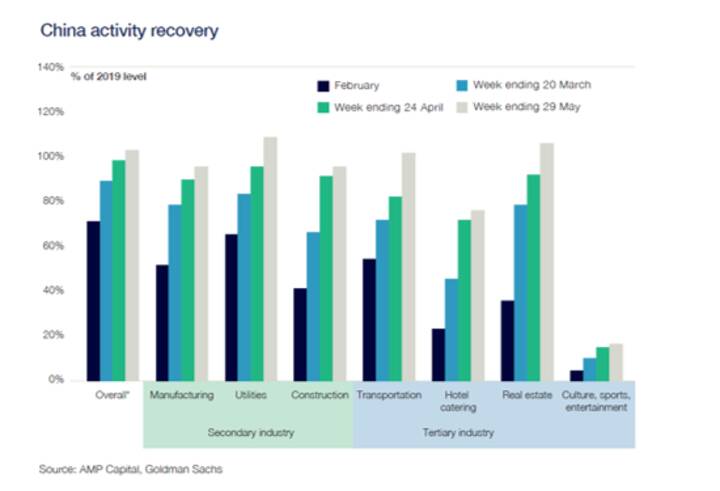
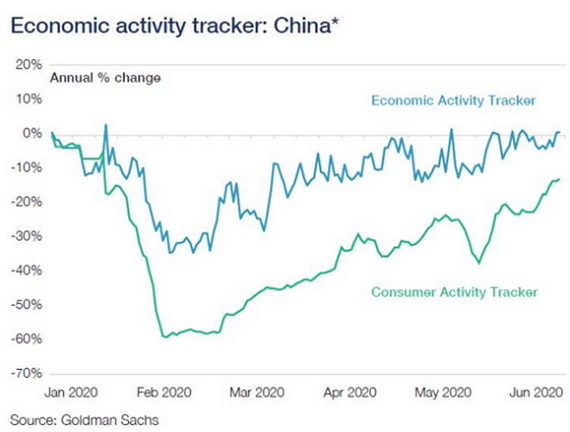
China was the first country to go through, and start to emerge, from the pandemic. Signs of infection control was an early indicator for the government of when it was safe to resume domestic activity, which has picked up since. GDP took a dive in the first quarter – a fall of 9.8%. However, the Chinese economy has shown a marked recovery since, which you can see in the chart below.

As another example, Australia and New Zealand’s success in virus control – the best in the OECD – is also promising for domestic economies. Both nations have started re-opening the economies, and share markets have rallied in response. For example, in late May, the Aussie share market was about 29% higher than its low point on 23 March, which was preceded by a 37% decline. By late June, the market was up ~27% since its low point.

Policy support from governments

One of the world’s biggest learnings from the Great Depression was how critical the role, type and timing of stimulus is for economic recovery. Though it may seem counterintuitive to spend big when cash is tight, history tells us that keeping money flowing through the economy gives us a far better chance of avoiding a depression than raising revenue through taxes to keep budgets balanced or keeping money in the bank.

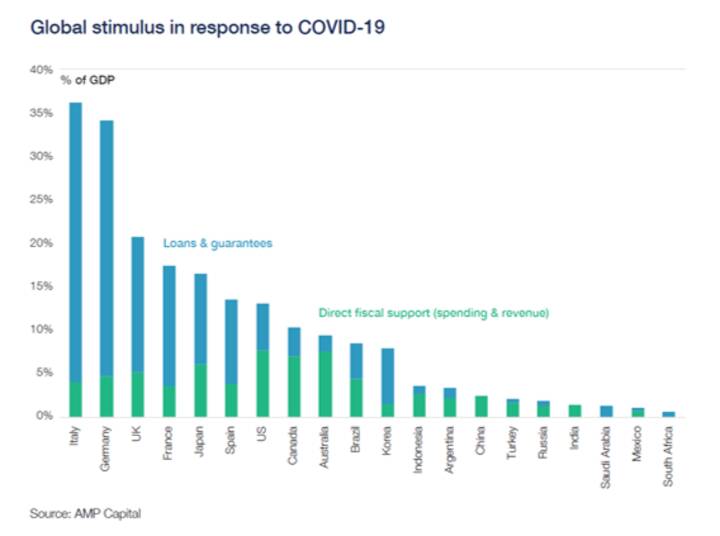
The level of stimulus worldwide has been substantial, as evidenced on the right. Even more so when you consider the level of direct spending countries like the US, Australia and Canada have injected into the economy.

During the Great Depression, precisely the opposite happened – there was monetary and fiscal tightening, with tax rates raised and spending cut. This contributed to the severity of the depression.

So, we have learnt the question is not just ‘can we afford all this spending?’ It is also ‘can we afford to not spend?’

Collateral damage is kept to a minimum

For an event to be a disruption to economic activity, rather than a prolonged drag, you want to see that sectors and confidence have not sustained irreparable damage, giving promise of spending and activity patterns recovering and normalising.

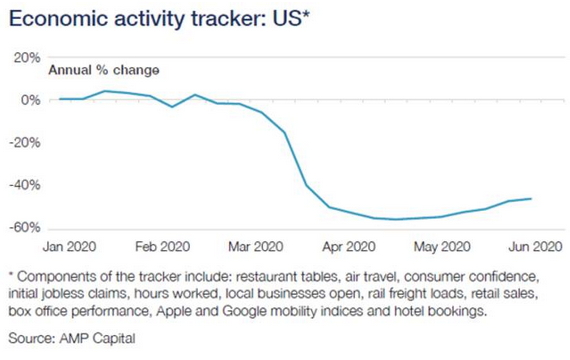
There are already signs of life in major economies like the US, where high frequency data continues to indicate that economic activity has likely hit the bottom.

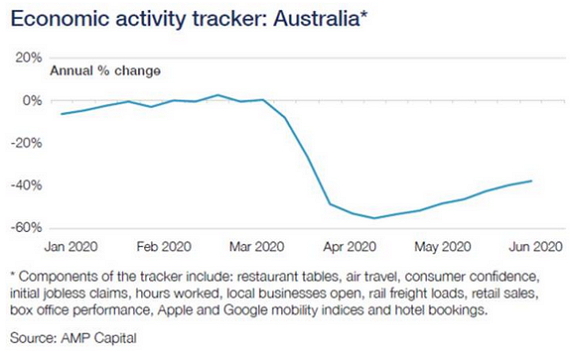
The risk, of course, is that the surge in new US cases will see some roll-back in the reopening of the economy. Our weekly economic activity trackers for the US are based on things like restaurant bookings, confidence, retail foot traffic, box office takings, hotel bookings, credit card data, mobility indexes and jobs data. So far, it looks as though they hit the bottom in mid-April.

In countries like Australia, where virus control has been world-leading and economies are re-opening sooner than originally thought as a result, signs of recovery in high-frequency data are even stronger.

As mentioned earlier, China is a couple of months ahead of the rest of the world, and its patterns indicate that activity is picking up, overcoming the collateral damage first caused by widespread shutdowns.

Technical signs of a market bottom

Trying to time the bottom of the market is incredibly difficult to predict. However, there are some hallmark signals that markets may have reach their low point. They include:

  • Extreme oversold conditions, which we saw in March.

  • Apocalyptic investor sentiment, the old ‘buy when there is blood on the streets’ expression springs to mind here, representing the lowest point of the market.

  • Signs that downwards momentum is falling, and less stocks are marking new lows.

While in some countries you could say markets have reached their bottom, it’s important to note that some threats still remain.

A second wave of COVID-19 cases is one of those risks, particularly in places like the United States, where the number of new cases remains high, and success at controlling the virus across different states is mixed.

There are also simmering geo-political tensions between China and the US, which have re-ignited the trade frictions and stand-offs we saw last year.


Author: Diana Mousina, Economist – Investment Strategy & Dynamic Markets, Sydney Australia

Source: AMP Capital 17 June 2020

Reproduced with the permission of the AMP Capital. This article was originally published at AMP Capital

Important note: While every care has been taken in the preparation of this document, AMP Capital Investors Limited (ABN 59 001 777 591, AFSL 232497) (AMP Capital) makes no representation or warranty as to the accuracy or completeness of any statement in it including, without limitation, any forecasts. Past performance is not a reliable indicator of future performance. This document has been prepared for the purpose of providing general information, without taking account of any particular investor’s objectives, financial situation or needs. An investor should, before making any investment decisions, consider the appropriateness of the information in this document, and seek professional advice, having regard to the investor’s objectives, financial situation and needs. This document is solely for the use of the party to whom it is provided and must not be provided to any other person or entity without the express written consent of AMP Capital.

Let’s assume for a moment that we are able to contain the outbreak in Victoria and any clusters in New South Wales in the coming weeks. Throw in also the possibility of an effective vaccine emerging, and there’s good cause for optimism about the prospect of life returning to a new normal sometime next year. I’m going to stress the word “new”, however, because while we’ve been hiding out, working from our kitchen tables, the world has changed. Here are a few aspects of our world and our economy where I think the effects of the coronavirus will play out for years to come:

Get used to low interest rates

Even before the crisis we were talking about an interest rate environment that looked set to be lower for longer. Thanks to rising unemployment and decreased spending, spare capacity is likely to linger in the economy for the foreseeable future. Despite the Reserve Bank’s expansionist monetary policy, we may be four to five years away from the point where enough of that stimulus starts to enter circulation such that rising inflation puts upward pressure on interest rates.

More government intervention and greater public debt

Much of the workload in keeping the economy afloat through the crisis has come from the Federal Government’s balance sheet, with fiscal stimulus this year current scheduled to be around $160 billion or 8% of GDP. Most of the measures undertaken as part of this package are designed to be switched off, in theory as the economy recovers, currently scheduled by the end of September. The government will face pressure to extend that date for a number of initiatives, in order to taper the stimulus and avoid a fiscal shock. Regardless of the action it takes, those programs that do continue, combined with the ongoing need for management of hard-hit sectors such as tourism and aviation will necessitate a heavier hand for the government in the economy going forward. Coupled with this, of course, will be a large bill, in the form of public debt to be paid back over the course of decades (albeit to ourselves!).

Lower immigration pulls the plug on economic growth and housing demand

The engine of Australia’s economic growth has increasingly been our increasing population, fuelled by immigration. The closure of our borders has brought that to a grinding halt, with net overseas migration projected to fall from 240,000 in the 2018-19 financial year to just 40,000 by 2020-21, for an overall loss of almost 200,000 migrants.1

Immigration has been an especially important factor in housing demand, which is likely to decline by about 80,000 dwellings per year as a result of lower levels of migration. All other things being equal, it’s questionable whether this will overly affect local living standards given that the economy was struggling to generate positive GDP on a per-capita basis even in the lead-up to the crisis.

Globalisation on the ropes

As we’ve seen already, the pandemic has struck a further blow at our globalised economy, with many companies re-examining the extent to which they’ve off-shored their supply chains. Even if the pandemic subsides, there’s no guarantee that this situation will ease over the short term, particularly in the shadow of a US Presidential Election. If the Democrats win, they may seek to de-escalate tensions with China; if Trump is successful in seeking a second term the tug-of-war between corporate interests and the President’s protectionist instincts will continue, and we know which side has had the better of that contest over the past four years.

The coronavirus may actually strengthen European unity

Rumours of the death of the Eurozone have been greatly exaggerated for many years now, and despite the imminent divorce with the United Kingdom (more a marriage of economic convenience than a genuine meeting of minds) the EU seems to be drawing closer in the face of the pandemic, recently moving towards the common issuance of bonds2  for the first time in history. It’s not unreasonable to think this might be the trend from this point forward, particularly given recent US ambivalence to its traditional partners in the region.

An uneven local recovery

Going forward, the effects of the pandemic on the Australian economy are likely to be tiered, with many companies (and markets) benefiting more rapidly from a return to normality whilst a large number of unemployed and those who have left the workforce struggle to find their place in the new status quo, bearing the brunt of higher inequality and social dislocation. Caught in the middle will be the majority of those still employed, for whom real wage increases will be more constrained.

Real downsides to business models that rely on in-person interactions

The pandemic has greatly accelerated the infiltration of online services in areas such as retail and workplace interaction, and even as the physical world continues to re-open we can expect that this won’t be completely reversed. In particular, the long-term effect of widespread video conferencing will have significant implications for airline routes and CBD hotels that generate much of their revenue from corporate travel. It may all mean the death of the city as we know it and a renaissance in regional centres.

https://www.afr.com/policy/economy/later-migration-plunge-to-hurt-economy and-housing-20200501-p54p2g
https://www.wsj.com/articles/investors-cheer-europes-step-toward-united-bond-market-11590602859

Author: Dr Shane Oliver, Head of Investment Strategy and Economics and Chief Economist, AMP Capital, Sydney, Australia

Source: AMP Capital 16 July 2020

Reproduced with the permission of the AMP Capital. This article was originally published at AMP Capital

Important notes: While every care has been taken in the preparation of this article, AMP Capital Investors Limited (ABN 59 001 777 591, AFSL 232497) and AMP Capital Funds Management Limited (ABN 15 159 557 721, AFSL 426455) (AMP Capital) makes no representations or warranties as to the accuracy or completeness of any statement in it including, without limitation, any forecasts. Past performance is not a reliable indicator of future performance. This article has been prepared for the purpose of providing general information, without taking account of any particular investor’s objectives, financial situation or needs. An investor should, before making any investment decisions, consider the appropriateness of the information in this article, and seek professional advice, having regard to the investor’s objectives, financial situation and needs. This article is solely for the use of the party to whom it is provided and must not be provided to any other person or entity without the express written consent of AMP Capital.


The start of a new financial year always brings with it new rules for super funds. Sometimes there are lots of changes, which are wide-reaching, and in other years there’s just a few. For the 2020/21 financial year, the two main changes are: the abolition of the work test for anyone aged 66 and 67 years old who wish to make personal non-concessional contributions; and an extension of spouse contributions to those aged between 70 to 75 years. However, we are waiting for the change in legislation that will allow access to the ‘bring forward’ rules. The continuation of the 50% reduction in the minimum pension rate for account-based pensions, due to the COVID-19 pandemic, will apply for the of the 2020/21 financial year.

Abolition of the work test extended to 67 years of age

Until to 30 June 2020, there was no need for a member to satisfy a work test for personal concessional and non-concessional contributions before reaching the age of 65. However, once they reached 65 years of age in the financial year, a work test of 40 hours in 30 consecutive days was required to be met at any period during that year, and prior to the contribution being accepted. Providing the work test is met in a financial year, personal concessional or non-concessional contributions can be accepted up to 28 days after the month in which the person reaches the age of 75. However, there are exceptions to the work test where personal contributions are made in the year after ceasing work, or for purposes of downsizer contributions.

From 1 July 2020, for those under the age of 67 years, it is now possible to make personal contributions without needing to satisfy a work test. In the financial year a person reaches the age of 67, personal contributions can be made prior to reaching 67 years old. However, a work test must be met at any time during the financial year prior to the contribution being made.

Example: Phillip is aged 66 years on 1 July 2020 and will turn 67 years old on 23 October 2020. His total super balance on 30 June 2020 was $875,000 and he worked 40 hours in the first week of September. It would be possible for Phillip to make concessional and non-concessional contributions to his super fund without the need to meet the work test prior to his 67th birthday. However, after Phillip reaches the age of 67, he will only be able to make contributions if he has worked at least 40 hours in 30 consecutive days. As Phillip worked for 40 hours in the first week of September, he is able to make personal contributions.

Ceasing Work Contributions

Ceasing work contributions are permitted to be made on a once-only basis after the member has reached the age of 67 years, previously it was the age of 65. Personal contributions can be made on a once-only basis in the financial year after work has ceased, and the person has a total super balance of less than $300,000 on 30 June in the previous financial year. These contributions can be accepted in the year after the person retired from work and up to 28 days after the month in which the person reaches the age of 75.

Example: Cynthia retired from working when she turned 68 years old on 1 June 2020. On 30 June in the previous financial year, her total super balance was $250,000. Although she will not be working in the 2020/21 financial year, Cynthia will be able to make personal concessional and/or non-concessional contributions in the 2020/21 financial year, which is the year after she retired. This concession is available on a once-only basis.

Downsizer Contributions

Downsizer contributions can made after the sale of a person’s main residence, as described for CGT purposes, which they have owned for at least 10 years. To be eligible, the person must be 65 years or older, and a contribution of up to $300,000 must be made within 90 days of the sale. The person’s spouse may also be eligible to contribute up to $300,000 if they are 65 years of age or older. There is no upper age limit when applying to downsizer contributions or any work test that applies.

Example: Bev and Howard are a couple. Howard has owned the house they have lived in since 2005. They decide to sell the house and go for a tree change in the country. They are both over 65 years of age and decide to use some of the proceeds from the sale as a downsizer contribution to super. A downsizer contribution of $200,000 each is made to their SMSF and the rest is used to purchase a new home. The downsizer contribution needs to be made within 90 days of the sale of their main residence being finalised.

Employer Contributions

When it comes to employer contributions for anyone 65 years of age or older, there are no work tests or age limit for compulsory employer contributions, such as superannuation guarantee contributions or those made under an industrial award. But a work test must be met if the employee wishes to make a salary sacrifice contribution to their super, and contributions must be made before 28 days after the month in which the employee reached the age of 75.

Example: Marion is 74 years old and earns $100,000 p.a. Her employer makes a super guarantee contribution of $9,500 for her during the year. She decides to salary sacrifice $10,000 to her super. The amount Marion has salary sacrificed to her super will need to be contributed by her employer within 28 days in the month after Marion reaches the age of 75, otherwise it will be refunded from her superannuation fund. The amount made by Marion’s employer for super guarantee purposes will be accepted by her fund irrespective of her age.

Access to the ‘bring forward’ rules from 1 July 2020

It is possible for those under the age of 65 to trigger the ‘bring forward’ rule which allows a person to make up to two years’ worth of non-concessional contributions to be made over a fixed period. The period commences from the year in which the person makes a non-concessional contribution that is greater than the standard annual amount of $100,000.

Whether a person has access to triggering the bring forward rule depends on their total superannuation balance on 30 June in the previous financial year. For anyone with a total super balance of less than $1.4 million, they are able to bring forward up to two years’ standard non-concessional contribution. For those with a total super balance of between $1.4 and $1.5 million, they are able to bring forward up to one year’s standard non-concessional contribution. Once a person has a total super balance of between $1.5 and $1.6 million, only the standard non-concessional contribution is available and there is no bring forward amount. If a person has a total super balance of $1.6 million, it is not possible to make a non-concessional contribution without incurring a tax and interest rate penalty.

It was announced in the 2018 Federal Budget that the bring forward rules would be amended to apply to people under the age of 67 on 1 July in a financial year. The legislation to bring this change about was included in Treasury Laws Amendment (More Flexible Superannuation) Bill 2020, which is currently in the House of Representatives. As parliament resumes in early August, the bill has a way to go prior to becoming law. It is expected that the legislation will pass as the amendment is not considered to be politically sensitive. So where are we now with contributions for anyone who is 65 years of age or older with the start of the 2020/21 financial year?

Those fund members in the 65 to 66 years old age bracket, they may be in a bit of a quandary until the legislation is passed. From a practical point of view, it is only those members with a total superannuation balance of less than $1.5 million as at 30 June 2019, or 30 June 2020, who may be impacted if they wish to maximise non-concessional contributions by using the bring forward rule.

Example: Rose is currently 65 years of age would have access to the bring forward rule of at least one year’s standard non-concessional contribution if her total super balance is less than $1.5 million on 30 June 2019. If she contributes more than the standard non-concessional contribution of $100,000, the bring forward rule is triggered and may make the relevant contributions over a two- or three-year period, depending on their total super balance. If Rose makes contributions prior to reaching age of 67, the fund can continue to accept the contributions without requiring the member to meet the work test.

However, in contrast, if Rose was aged 66 or 67 years old, she will not be able to trigger the bring forward rule as she was older than the age of 65 on 1 July in the 2020/21 financial year. This will limit the maximum amount of non-concessional contribution to $100,000 without penalty. However, the consolation is that there is no requirement for Rose to meet the work test unless she wished to make personal contributions in the financial year after she reached 67 years of age.

Spouse contributions and the tax offset

It is possible to make contributions for an eligible spouse, which are treated as non-concessional contributions, and counted against the spouse’s non-concessional contribution cap. If the spouse has an adjusted income of less than $37,000, it is possible for the contributor spouse to receive a tax offset of up to 18% on the first $3,000 of the any non-concessional spouse contribution. The tax offset amount phases out between $37,000 and $40,000 on a dollar for dollar basis.

Until 30 June 2020, it was only possible to make spouse contributions up until the age of 70 years. Between the ages of 65 and 70 years, the spouse was required to meet the work test of 40 hours in 30 consecutive days for the year in which the contribution was made. However, from 1 July 2020 this has now been extended to apply to spouse contributions made between the age of 67 years, and 28 days in the month after the spouse reaches 75 years old, which puts it in line with other personal superannuation contributions. The work test must be met prior to the spouse contributions being made to the fund.

Example: Mick wishes to make a spouse contribution for his spouse Jo, who is 72 years old and works as a florist and has an adjusted taxable income of $30,000. Mick decides to make a $100,000 contribution for her. Since Jo’s adjusted taxable income is less than the tax offset threshold, Mick may be eligible to receive a tax offset of 18% of the first $3,000, which is $540 against his income tax assessment for the year.

Reduction in minimum pensions for account-based pensions

In late March 2020, the government amended the minimum percentage required to be paid for account-based pensions by 50%. This meant that account-based pensions, transition to retirement pensions, and market-linked income streams would have their minimum pension percentage reduced by 50% for the 2019/20 and 2020/21 financial years.

The table below shows the reduced percentage that apply:
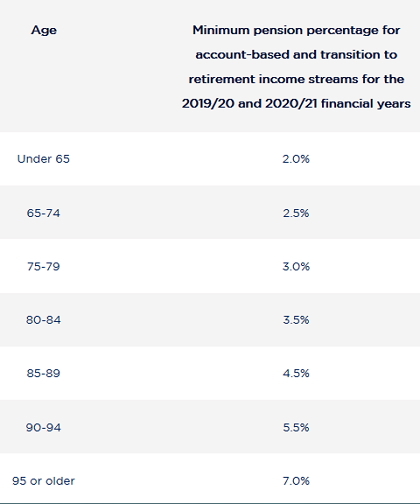
 

The minimum amount for market-linked income streams is reduced to 45% of the amount calculated under the formula in Schedule 6 of the Superannuation Industry (Supervision) Regulations 1994.

What Next?

The extension of the work test exemptions to the age of 67 years old for personal superannuation contributions has been a bonus in these difficult times, as well as the extension of the age at which spouse contributions can be made. However, we remain waiting with anticipation for the extension of the bring forward rule to the age of 67 years to become law when parliament resumes in the next few months.


Author: Graeme Colley, Executive Manager, SMSF Technical and Private Wealth – SuperConcepts, Sydney, Australia

Source: AMP Capital 25 June 2020

Reproduced with the permission of the AMP Capital. This article was originally published at AMP Capital 

Important notes: While every care has been taken in the preparation of these articles, AMP Capital Investors Limited (ABN 59 001 777 591, AFSL 232497) makes no representation or warranty as to the accuracy or completeness of any statement in them including, without limitation, any forecasts. Past performance is not a reliable indicator of future performance. Performance goals are merely goals. There is no guarantee that the strategy will achieve that level of performance. The information in this document contains statements that are the author’s beliefs and/or opinions. Any beliefs and/or opinions shared are as at the date shown and are subject to change without notice. These articles have been prepared for the purpose of providing general information, without taking account of any particular investor’s objectives, financial situation or needs. They should not be construed as investment advice or investment recommendations. An investor should, before making any investment decisions, consider the appropriateness of the information in this document, and seek professional advice, having regard to the investor’s objectives, financial situation and needs.

This document is solely for the use of the party to whom it is provided and must not be provided to any other person or entity without the express written consent of AMP Capital.


The thought of various government support measures expiring in the months ahead, causing some sort of fiscal cliff over which economies and share markets will plunge, has caused much consternation. But as with the original fiscal cliff of December 31, 2012 in the US, it’s likely to be tapered into a fiscal slope. Particularly with so called “second waves” of coronavirus reaping havoc with the economic outlook. Of course, this will add to the public sector’s debt burden associated with the coronavirus shock, in turn adding to concern about some sort of fiscal day of reckoning down the track.

This note looks at the key issues around fiscal support and the budget in Australia ahead of the Treasurer’s Economic Statement (due 23rd July) which is expected to provide new economic forecasts, an estimate of the budget cost of support measures so far and outline plans for future support measures.

Fiscal stimulus to be extended

It made sense for many of the coronavirus government support measures to expire at the end of September as it avoided a permanent/hard to reverse lift in public spending, and to borrow from the analogy likening the support measures to a bridge across a chasm, once the coronavirus chasm has been crossed there is no longer the need for the bridge. However, its increasingly clear that support will be needed for longer:

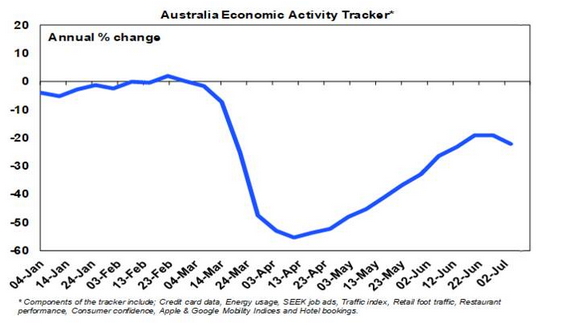
  • First, the second wave of coronavirus cases in Australia has seen the Victorian Government return Melbourne to a “stay at home” six-week lockdown which will slow the recovery. While we estimate the direct impact on the Australian economy to be around $5bn which will knock around 1% off GDP this quarter, there is a high risk that it impacts confidence in other states (as people “self-isolate”) and that other states may also return to a lockdown if cases spread, with NSW most at risk. This already appears to be impacting economic activity, with our Australian Economic Activity Tracker which combines timely weekly data faltering over the last two weeks, after ten consecutive weeks of recovery.


Source: AMP Capital

  • Second, the easy gains from the initial reopening including the unleashing of pent up demand may have mostly been seen but distancing requirements and travel restrictions mean that it will take much longer for some industries – travel, events, culture, accommodation, restaurants and housing construction – to get back to normal. 

  • Third, the coronavirus shock has accelerated the shift to a digital world, such that job losses associated with automation are now likely occurring faster than new jobs are being created. Three examples of this are a faster take up of online retailing meaning less jobs in retailing, more working from home meaning less office demand and less jobs in public transport and less business travel in favour of virtual meetings meaning less use of airlines and hotels.

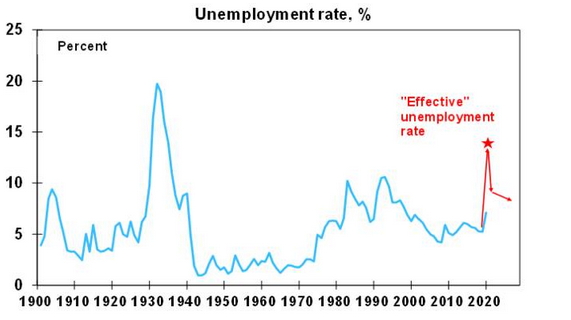
The last two mean that “spare capacity” will linger well into the future and this is likely to show up in a long tail of high unemployment. Without the JobKeeper wage subsidy and changes to JobSeeker, “effective unemployment” would have risen to 14.8% in April and would still be around 13.6% now.


Source: RBA, ABS, AMP Capital

The initial spike in “effective unemployment” may be reversed quickly taking it down to say 9% by year end, but getting it back to 5% as seen early this year could take years as some sectors take a long time to recover and accelerated structural change impacts. This suggests both a short-term and a long-term challenge for government which will likely be met at least in the short term by more fiscal stimulus.

Revised budget deficit projections

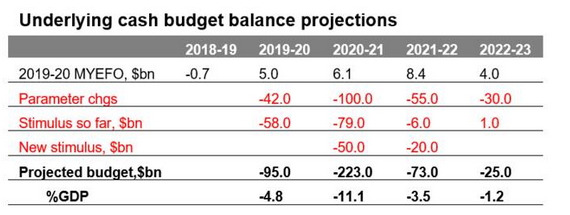
Our revised deficit projections are shown below and take the December 2019 Mid-Year Fiscal Outlook as the starting point.


Source: Australian Treasury, AMP Capital

The hit to the economy will mean a hit to government revenue and this is shown in the line called “parameter changes”. Budget data released for the period to May suggests that this has been running at just over $10bn a month since March.

The Government has already announced significant policy support and this is shown in the line “stimulus so far”. We have allowed for the three policy support packages in March, the health package and industry support packages. These are dominated by JobKeeper now estimated to cost $70bn.
However, the need for additional support for the economy has also been recognised by the

Government. As a result, in its 23 July economic statement we are likely to see:

  • An extension of JobKeeper – although it’s likely to be revamped with a monthly eligibility test and different pay rates and companies are likely to be discouraged from accessing it for jobs that won’t be revived; 

  • The doubled JobSeeker payment is likely to be pared back;

  • Income tax cuts due from 2022 may be brought forward;

  • Additional investment incentives; and 

  • More industry support packages.

The Government will partly fund extra support by taking JobKeeper from those who no longer need it, but the bulk will likely come from the $60bn saving already seen on JobKeeper, which we expect to be fully spent and then some (see “new stimulus”) although it may not all be announce next week.

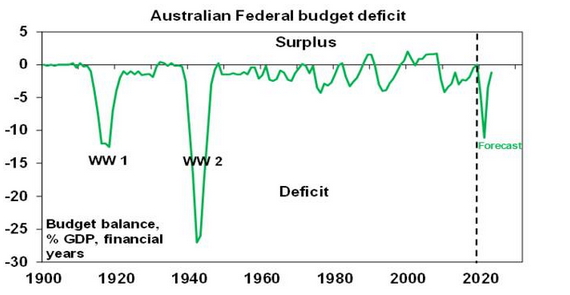
As a result of the Government’s fiscal response and the hit to public revenue from the economic downturn, the budget deficit is expected to blow out from around $95bn for the past financial year to around $223bn this financial year before improving from 2021-22, as support programs phase down and the economy recovers. This would see the budget deficit as a share of GDP peak at around 11% of GDP in 2020-21, which would be its highest since World War 2. Spread over several years, this will add nearly 20% of GDP to Australia’s public debt. This raises two questions though: will it be enough? And can we afford it?


Source: RBA, Australian Treasury, AMP Capital

Will it be enough?

By extending programs like JobKeeper beyond September and announcing additional stimulus including the likely bring forward of tax cuts, the Government will effectively taper the fiscal cliff and turn it into more of a slope. This helps solve the short-term reality that a lot of jobs won’t have come back by October. However, it remains to be seen whether this will be enough given the long tail of unemployment flowing from the coronavirus shock discussed earlier. The Government’s focus looks likely to shift to economic reforms in the October budget and this makes sense, but more fiscal support may ultimately be needed to soak up the likely long tail of unemployment.

Can we afford the surge in the deficit and debt?

Our assessment remains that it is affordable. First, were it not for the support measures the economic hit would be far greater, ultimately resulting in an even bigger public debt blowout.

Second, as Keynes showed, it makes sense for the public sector to borrow from households and businesses at a time when they have cut their spending, and to give the borrowed funds to help those businesses and individuals that need help.

Third, the support programs won’t cause a permanent step jump higher in public spending.

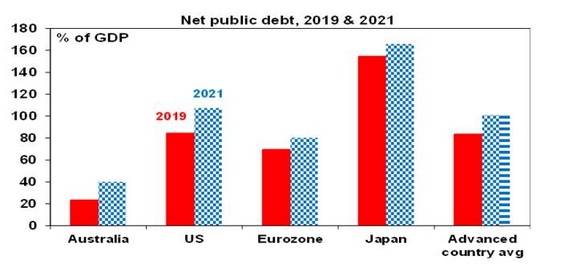
Fourth, Australia’s starting point for net public debt was low at 23% of GDP compared with other advanced countries averaging 83%. See the next chart. And even with projected budget deficits it will remain relatively small.


Source: IMF, AMP Capital

Fifth, borrowing to finance the budget deficit is in Australian dollars and, with a current account balance, we are not dependent on foreign creditors risking a foreign currency crisis.

Sixth, the cost of Government borrowing is very low at less than 1% for ten years. This is partly being facilitated by the RBA buying bonds, but bond rates would be low anyway.

Finally, consider what would happen if “shock horror” the Government and the RBA agreed to cancel the bonds that the RBA owns? Apart from a lot of grinding teeth from some commentators the answer would be very little – the Government’s loss on its “investment” in the RBA would be offset by a reduction in liabilities. In other words, it’s not necessarily the case that all public debt has to be paid back if it’s owned by the central bank. For the technically minded, the limit to this would be if all the extra money that the central bank printed to buy the bonds causes inflation – but as Japan has seen, if there is lots of spare capacity, inflation is not an issue.

Concluding comment

With the private sector spending hit by coronavirus it makes sense for the Government to continue to help fill the breach and support the economy. The best approach to getting debt back down is to grow the economy aided by a reinvigorated economic reform agenda, but for a while government fiscal support will continue to be needed.


Source: AMP Capital 15 July 2020

Important notes: While every care has been taken in the preparation of this article, AMP Capital Investors Limited (ABN 59 001 777 591, AFSL 232497) and AMP Capital Funds Management Limited (ABN 15 159 557 721, AFSL 426455) (AMP Capital) makes no representations or warranties as to the accuracy or completeness of any statement in it including, without limitation, any forecasts. Past performance is not a reliable indicator of future performance. This article has been prepared for the purpose of providing general information, without taking account of any particular investor’s objectives, financial situation or needs. An investor should, before making any investment decisions, consider the appropriateness of the information in this article, and seek professional advice, having regard to the investor’s objectives, financial situation and needs. This article is solely for the use of the party to whom it is provided and must not be provided to any other person or entity without the express written consent of AMP Capital.

The Federal Government has updated superannuation laws to allow older Australians to contribute to their super for longer.

Work test to apply from age 67

The government has increased the age up to which super contributions can be made without having to meet a work test from 65 to 67.

The work test requires you to be in paid work for a minimum of 40 hours in any consecutive 30-day period in the financial year to make voluntary super contributions.

From 1 July 2020, the work test only applies for people aged between 67 and 74.

So, people aged 65 or 66 will now be allowed to make voluntary super contributions—both concessional and non-concessional—regardless of whether they are working or not. The usual contribution caps will continue to apply.

AMP Technical Strategy Manager John Perri says, “This change recognises that many of us may have to work longer to have adequate savings for our retirement.

    “Extending the work test age to 67 will allow more individuals aged 65 and 66 to top up their super without having to meet the work test, if they are financially capable of doing so. For some this is important after the impacts of COVID-19 on incomes and investments.”

Increased age limit for spouse contributions

The government has increased the cut-off age for spouse super contributions from 69 to 74, from 1 July 2020. So, a receiving spouse can build their super for longer, assuming they continue to meet the work test from age 67.

Any contributions received by a spouse will count towards their ‘non-concessional’ after-tax contribution limit.

Work test exemption continues to apply

The ‘work test exemption’ for recent retirees will continue to apply for people aged 67 to 74.

This allows people with a total super balance below $300,000 on 30 June of the previous financial year to make voluntary super contributions for 12 months from the end of the financial year in which they last met the work test. It can only be applied once.

For spouse contributions the work test exemption applies to the receiving spouse.

Please contact us on Phone: 07 5641 4134 if you seek further assistance on this topic 

Source : AMP July 2020 

Important: This information is provided by AMP Life Limited. It is general information only and hasn’t taken your circumstances into account. It’s important to consider your particular circumstances and the relevant Product Disclosure Statement or Terms and Conditions, available by calling Phone: 07 5641 4134, before deciding what’s right for you. All information in this article is subject to change without notice. Although the information is from sources considered reliable, AMP and our company do not guarantee that it is accurate or complete. You should not rely upon it and should seek professional advice before making any financial decision. Except where liability under any statute cannot be excluded, AMP and our company do not accept any liability for any resulting loss or damage of the reader or any other person. Any links have been provided for information purposes only and will take you to external websites. Note: Our company does not endorse and is not responsible for the accuracy of the contents/information contained within the linked site(s) accessible from this page.