There has been much debate about the short-term economic and investment impact of coronavirus – on economic activity, unemployment, interest rates, house prices, shares, etc. However, the magnitude of the shock means it will have medium to longer-term implications as well. Of course, there is a danger in placing too much weight on current circumstances in assessing the future. Given this, we need to be a bit cautious, but here are 10 medium to longer-term impacts.

 

#1 Lower interest rates for even longer

The hit to economic activity has been huge, resulting in a lot of spare capacity that will take years to be used up. We don’t see global and Australian economic activity getting back to pre-coronavirus levels until late next year or 2022.
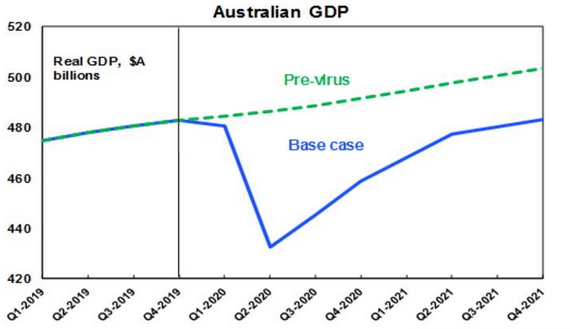

Source: ABS, AMP Capital

Unemployment will take even longer to fall – it tends to go up via the lifts and down via the stairs. This will mean low inflation or deflationary pressure for the next three years at least. Which will mean central banks will be biased towards low interest rates for several years which will keep bond yields ultra-low.

Another way of looking at this is that given the hit to economic activity, interest rates would normally fall a lot further. In the GFC the Australian cash rate was cut by 4.25%. But because rates are already at or near zero, they can’t – so monetary easing is being achieved by quantitative easing. But an unconstrained cash rate for Australia would see it fall to around -3% not getting back to 0.25% until 2023 at the earliest. In the meantime, it means several years of very low rates. It’s little wonder the RBA is targeting a 3-year bond yield of 0.25% and its low-cost funding rate for banks is also 0.25% for three years.

Implications – Low rates mean very low returns from bank deposits and ultimately bonds but they make higher yielding shares and assets like property and infrastructure relatively attractive to investors once the hit to earnings and rents passes.

#2 A further blow to globalisation

Recent years have seen a backlash against globalisation evident in the rise of Trump, Brexit and a backlash in some countries against immigration. The coronavirus disruption has added to this. Worries about the supply of medical items have led to pressure for their domestic supply. This could move on to food security and looks to be morphing into a push to bring supply chains “back home”. Borders have been closed for health reasons and it is unclear when they will all reopen.

Implications – While the outcome may simply be a diversification in reliance away from China to other emerging countries, the risk is that this all leads to reduced growth potential for the emerging world generally. Longer term it could reduce productivity if supply chains are managed on other than economic grounds and could remove a key source of disinflationary pressure from the global economy.

#3 Another leg up in the US/China “cold war”

The trade war of 2018 and 2019 turned into a truce with the mini Phase One deal signed in January. However, with the coronavirus-driven shutdown, China is behind in its agreed purchases of US goods. What’s more, President Trump now faces a difficult task in winning the November presidential election – US presidents have not been re-elected when there is a recession and rising unemployment. This has been made worse by Trump’s inept handling of the crisis. This has left Trump keen to shift the blame over the virus and China is an easy target. He has already made some threats on this front and imposed some minor sanctions on China. At present Trump’s approval rating is around where it’s always been and is not weak enough for him to conclude that he has nothing to lose by taking big risks on this front (such as tearing up the trade deal and imposing more tariffs). But if his prospects start deteriorating dramatically, he may conclude that he has nothing to lose, particularly with 66% of Americans now having a negative view of China, up from 48% in 2018. The latter also suggests a Democrat president may also take a tough stance with China – although likely with more of a diplomatic focus. The point is that the US/China trade war risks ramping up.

Implications – this could act as a negative for growth, work against multinationals and become a rising negative for shares. It also poses a threat to Australia but if Australia remains broadly neutral it may be minor (despite recent tensions around barley and beef) given that most Australian exports to China are for domestic use, not for reexport to the US.

#4 Bigger government and bigger public debt

The GFC brought an end to economic rationalism and support for smaller government and was associated with a leg up in public debt levels. Fading memories of the problems of too much government intervention added to this. The coronavirus crisis has likely added to support for bigger government intervention in economies and the tolerance of higher levels of public debt. Particularly given that it may have enhanced perceptions of inequality with well-paid white-collar workers being able to isolate and work at home whereas lower paid workers have been stood down or have to continue working in less safe conditions. Safety regulations to ensure distancing will also add to business costs, although hopefully this will just be for the short term if a medical solution to coronavirus is found.

Implications – bigger government and aggressive measures to address inequality could reduce productivity growth and hence economic growth. Although it’s worth noting that if the Australia adopts a productivity enhancing agenda it may buck this trend.

#5 Higher inflation with money printing

While it’s hard to see inflation becoming an issue in the next three years, the combination of rising public debt, money printing and more protectionism risks a longer term pick-up in inflation to say above 4%, particularly if central banks don’t reverse easy money quickly once spare capacity is used up.

Implications – a resurgence in inflation to high levels would be bad for productivity and negative for assets that benefitted from the “search for yield”. But it’s a much longer-term issue.

#6 Consumer and investor caution reinforced

The GFC led to a wariness and a degree of investor caution on the part of households. This has been evident in around 50% of Australians nominating bank deposits and paying down debt as the “wisest place” for their savings compared to around 30% before the GFC, and scepticism of shares. The coronavirus pandemic and its hit to incomes and job security has likely reinforced this. Some even argue that the period of self-isolation will drive a rethink in terms of what’s important in life resulting in more mindful consumers focused on “do I really need it?” I am not so sure about the latter beyond the short term as people have short memories, but it is likely that household caution will remain, resulting in higher precautionary saving and more conservative investment strategies.
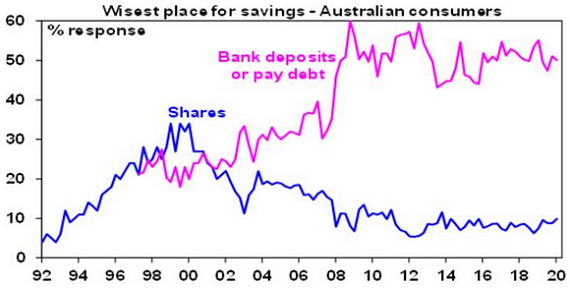

Source; Westpac/MI, AMP Capital

Implications – this will weigh on discretionary retailers, banks and wealth managers.

#7 Faster embrace of technology

Self-isolation has dramatically accelerated the move to a digital world. Workers, consumers, businesses, schools, universities, health professionals, young & old have been forced to embrace new online ways of doing things. Many more have now embraced on-line retail, working from home & virtual meetings.

Implications – there are six big implications from this:

  • The challenge to traditional retailing has been ramped up dramatically putting more pressure on traditional retailers and shopping centre owners to improve their offering.

  • Less office space demand – but this may be offset if more space per person is needed in the absence of a vaccine.

  • A shift from cities to suburbs/regions – as the shutdown shows that a “sea or tree change” is viable for many.

  • This in turn may mean the beginning of the end for peak hour traffic congestion (although it could spike in the short term as people prefer to drive as long as Covid is still a risk). 

  • Virtual meetings may see less demand for business travel.

  • This is positive for IT tech stocks facilitating online activity.

#8 Bad for airlines

Which brings us to airlines. Less business demand for travel points to lasting damage. Some say the same may apply to tourists – but if a medical solution is found or the virus just dies out I suspect tourism will bounce back but based on the experience after 9/11 it may take a decade to fully recover.

Implications – airlines have already taken a big hit, but they are likely to be the slowest industry to recover.

#9 Another test for the Eurozone?

Slow progress towards providing support for Italy has led to renewed concerns that the Euro area may break up. Populist anti Euro leaders may get a boost from the crisis, particularly if there is a new wave of migrants from Libya. However, Europe seems to be doing what it always does – gradually heading towards a solution with Germany agreeing with France for the common issuance of bonds and shifting in favour of fiscal stimulus. The pressures to keep the Eurozone together (safety in numbers, a high degree of identification as Europeans, solid public support for the Euro, Germany benefitting from the EU and Germany’s huge exposure to Italian bonds via the ECB) remain far stronger than the forces pulling it apart.

Implications – I wouldn’t bet on the Euro breaking apart.

#10 Lower immigration

This is already a reality in Australia with travel bans and since immigration normally accounts for around 1 percentage point of population growth in Australia its absence knocks up to 1% off economic growth. The issue is how long immigration remains low. Australia would likely be a popular destination for migrants and students given its success in limiting coronavirus. And a rigorous testing/quarantine regime could allow both back sooner rather than later. That said I suspect while students will return faster, political pressures associated with higher unemployment will allow only a gradual recovery in immigration.

Implications – this is bad for home building & home prices as the hit to immigration has cut underlying dwelling demand by 80,000pa. But I suspect it creeps back over the next five years.

Concluding comments

Several of these longer-term implications will constrain economic growth and hence potential investor returns – notably the reversal of globalisation, bigger government, consumer caution & lower immigration. The faster embrace of technology will work in the other direction though to boost productivity and lower for longer interest rates are positive for growth assets.

Finally, a word of caution – anyone who got too negative for the long term in the last really major pandemic of 1918-19 might have missed out entirely on the “Roaring Twenties!” It’s much easier to think up negative things.


Source: AMP Capital 25 May 2020

Important notes: While every care has been taken in the preparation of this article, AMP Capital Investors Limited (ABN 59 001 777 591, AFSL 232497) and AMP Capital Funds Management Limited (ABN 15 159 557 721, AFSL 426455) (AMP Capital) makes no representations or warranties as to the accuracy or completeness of any statement in it including, without limitation, any forecasts. Past performance is not a reliable indicator of future performance. This article has been prepared for the purpose of providing general information, without taking account of any particular investor’s objectives, financial situation or needs. An investor should, before making any investment decisions, consider the appropriateness of the information in this article, and seek professional advice, having regard to the investor’s objectives, financial situation and needs. This article is solely for the use of the party to whom it is provided and must not be provided to any other person or entity without the express written consent of AMP Capital.


By Food Matters contributor, Tess Patrick.

I love a good podcast. The ones that take you on a journey, that are engaging and captivating but not too serious. And in this day and age, there’s a podcast for almost anything. They’re great to play in the background while you’re getting ready for work, or when you get bored of hearing the same playlist over again. From true crime to pop culture, there are masses to wade through – so we’ve rounded a few of our most binge-worthy podcasts for slow days.

1. Unlocking Us Brene Brown

We love Brene Brown. She’s the woman who inspired our courageous, vulnerable selves to shine through and she’s just so darn relatable. Her hiccups make up her human-ness, so we’ve devoured her books and listened to her TED Talk on repeat. When we heard she was releasing a podcast, we couldn’t have been more stoked. She’s already been joined by the likes of Glennon Doyle, Alicia Keys, and David Kessler, and we’re waiting for every new episode with bated breath.

2. Hay House Live

Hay House has been one of our good friends for as long as we can remember. This podcast takes the talks you love from their live events and turns them into binge-worthy, on-the-go forms. Joe Dispenza, Anthony William, and Nick Ortner are just three of the brains picked on the star-studded playlist. Do yourself a favor and indulge in this series.

3. The goop Podcast

You’ve devoured the Netflix series and seriously considered purchasing a Yoni Egg, but did you know that goop is home to a podcast too? The program, hosted by Chief Content Officer Elise Loehnen explores the concepts we love at Food Matters, with industry leaders and culture changes. From parenting to quantum physics, nutrition to sex – nothing is off-limits, and we can’t get enough.

4. The Plant Proof Podcast

This podcast has been a favorite among all of us vegans out here for years, where stories and experiences are brought together with the latest in science and research to explore plant-based nutrition. Hosted by Simon Hill, if you’re a fiend for an eye-opener, this one is for you.

5. What The Hell Do I Eat?

As foodies with a desire to understand the truth of diet culture, this podcast has been a game-changer. Making hard-to-digest information as easy as A B C, nutritionists Monica Fenwick and Nadia Felsh are on a mission to myth bust their way to a healthy dinner.

6. How To Fail With Elizabeth Day

In this life, failure is guaranteed. It can be our biggest teacher with the biggest reward. We learn so much and it builds our resilience. In Elizabeth Day’s lifechanging podcasts, she goes so far as to say that we should be thirsty for those moments that are normally considered ‘failure’ because that’s where we will learn the most.

7. Serial

We wanted to bring you the best in uplifting, health, wellness, and nutrition content – but who are we kidding, no podcast list would be complete without this cult classic. A leader in true-crime podcasting, Sarah Koenig’s first series is a prompt to question all that we’ve been told in the criminal realm. And the groundbreaking third series is a profound anecdotal critique of the criminal justice system in America. This one’s for you, true crime junkies.

Source : Food Matters April 2020 

Reproduced with the permission of the Food Matters team. This article by  Tess Patrick  was originally published at https://www.foodmatters.com/article/binge-worthy-podcasts-slow-days

Important: This provides general information and hasn’t taken your circumstances into account.  It’s important to consider your particular circumstances before deciding what’s right for you. Although the information is from sources considered reliable, we do not guarantee that it is accurate or complete. You should not rely upon it and should seek qualified advice before making any investment decision. Except where liability under any statute cannot be excluded, we do not accept any liability (whether under contract, tort or otherwise) for any resulting loss or damage of the reader or any other person.  Any information provided by the author detailed above is separate and external to our business and our Licensee. Neither our business nor our Licensee takes any responsibility for any action or any service provided by the author. Any links have been provided with permission for information purposes only and will take you to external websites, which are not connected to our company in any way. Note: Our company does not endorse and is not responsible for the accuracy of the contents/information contained within the linked site(s) accessible from this page.

The Australian superannuation industry has been in the headlines almost every day in the past few weeks, with the Federal Government predicting that as many as 1.7 million people will look to access their superannuation early as part of COVID-19 relief measures. For those that have a choice and are wondering if they should take up this opportunity, we have published two articles recently that might shed some light: The cost of early superannuation access and How early superannuation withdrawals add up.

The key message is that accessing your super may be a critical matter of meeting life’s necessities in the wake of a global pandemic – but explore all other options first because the long-term cost on your potential retirement savings is significant.

An interesting by-product of all the discussion about early access to superannuation is that it may have sparked the interest of younger investors who haven’t always paid the closest attention to their own situation.

According to a research report by the Financial Services Council, the majority of young adults do not check their superannuation accounts and those under 35 were more likely to not know how much money they currently held.

With superannuation so topical, now could be a good time to learn a little more about it, even if retirement seems a long way away – particularly if you do not need to access but have rediscovered multiple accounts that you may have not got around to consolidating and still costing you in fees.

Superannuation 101

Superannuation is essentially money you regularly put into a fund in preparation for when you retire. It is deducted from your pre-tax earnings and when you stop earning a wage, your superannuation funds will be what helps provide you with a regular income in retirement.

Your employer is responsible for paying your superannuation into your specified fund at a compulsory contribution rate of 9.5 per cent of your annual salary. This applies to everyone who earns A$450 a month before tax.

Your superannuation fund then manages your money for you and invests it – either in their default fund or in the investment option of your choice.

Superannuation strategies

One of the simplest things you can do to manage your superannuation is to make sure you only have one account. If you’ve had multiple jobs in the past, your employer may have selected a default superannuation fund for you. And the more accounts you have, the more fees you are paying and the more your balance gets eroded. You can access ATO services to consolidate your superannuation via the MyGov website.

You are also able to select an investment option for your super, typically growth, balanced or conservative. Each investment option differs in their risk and return. A growth option will usually invest more of your superannuation in higher risk assets such as shares or properties, whereas a conservative option will invest more in lower-risk assets such as fixed income or defensive assets.

One of the key advantages that younger investors have is time, for the simple fact that the longer you have to invest, the more opportunity you have to realise returns. Choosing a high growth investment option earlier on means that although it may be riskier, you have the time to ride out market cycles and capitalise on the good years before you reach retirement. You also have time to reap the benefits of compounding interest on your superannuation balance.

Another strategy to consider is voluntarily contributing funds to your superannuation if you are in a position to do so. Even small amounts add up over time, and could reduce the tax you pay. According to the government’s Money Smart website, these concessional contributions are generally tax effective if you earn more than $37,000 a year as they are taxed at 15 per cent. This might be lower than your marginal tax rate. But just remember there is a cap to how much you can voluntarily contribute a year.

Early access

While ultimately the decision to withdraw superannuation should be determined by your own financial situation, it is also important to understand the potential impacts of doing so. Based on an average net return of 6 per cent per annum, the value of $20,000 (the maximum you can withdraw) could grow to approximately $205,000 in 40 years.

Drawing down on your superannuation right now also means you are selling assets when the market values have fallen because of the uncertainty around COVID-19 and the economic impacts. You are asking your superannuation fund to sell your assets at a lower market price and even if you intend to repay it over time cashing out now may mean you can’t recover this value when the market rebounds over time.

Conclusion

For those in their 20s or 30s, superannuation won’t seem like a priority when you may have only recently entered the workforce. And day-to-day living expenses take precedence so voluntarily contributing more to your superannuation won’t seem too appealing when you usually can’t access those funds until you turn 67.

But superannuation is more than just a distant pile of money for future you, it also represents financial independence and freedom, and is best cultivated from an early age. This is especially true in recent years where millennials are experiencing record low interest rates, a tough housing market to crack and low wage growth. Making the right investment decisions about your superannuation may be an accessible way to growth your wealth right now.

Please contact us on Phone: 07 5641 4134 if you seek further assistance on this topic.


Source : Vanguard April 2020 

Written by Robin Bowerman, Head of Corporate Affairs at Vanguard.

Reproduced with permission of Vanguard Investments Australia Ltd Vanguard Investments Australia Ltd (ABN 72 072 881 086 / AFS Licence 227263) is the product issuer. We have not taken yours and your clients’ circumstances into account when preparing this material so it may not be applicable to the particular situation you are considering. You should consider your circumstances and our Product Disclosure Statement (PDS) or Prospectus before making any investment decision. You can access our PDS or Prospectus online or by calling us. This material was prepared in good faith and we accept no liability for any errors or omissions. Past performance is not an indication of future performance.

© 2020 Vanguard Investments Australia Ltd. All rights reserved.

Important: Any information provided by the author detailed above is separate and external to our business and our Licensee. Neither our business nor our Licensee takes any responsibility for any action or any service provided by the author. Any links have been provided with permission for information purposes only and will take you to external websites, which are not connected to our company in any way.Note: Our company does not endorse and is not responsible for the accuracy of the contents/information contained within the linked site(s) accessible from this page.

Finding the right level of insurance cover is important when you’re thinking about retirement.

If retirement’s coming up on your horizon, the impact of COVID-19 (coronavirus) may have thrown a warehouse-sized rack of spanners in your planning.

It makes sense to concentrate on things you can control, such as insurance. Too-high premiums can chew away at the foundations of your savings, at a time when they’re more important than ever. Under-insure and one day your floor may collapse, undone by events you can’t foresee. 

Cover for a changing life

As you get close to retirement, you may want to make sure you’re holding the right insurance for the lifestyle you want.

Here’s a simple checklist that may help:

  1. Ask yourself how much money your family would have if you were to pass away or become disabled.

  2. Compare that with how much money your family might need in the same situation, including how they’d manage paying for day-to-day costs like child-care and mortgages.

  3. The difference between the two can help you work out how much insurance you may need.

Many of us take out insurance and are done with it – it’s enough to know we have the proverbial rainy day covered off. However, with economic clouds gathering, now’s a good time to review what you’ve already got and assess if it’s still right for you and your needs.

So, dig out your existing insurance agreements, taking special note of when they’re due to expire and your continued eligibility for the policies they hold.

An important area for many Australians is insurance held inside superannuation.

Insurance inside super

Insurance inside super can help us out when we really need it. Like any type of insurance, it works best when you’ve got the right level of protection for your situation. As you head towards retirement and your life changes, so might your priorities.

As well as life insurance, you might have total and permanent disablement (TPD) inside super. TPD cover may provide you with a lump-sum payment if you suffer a disability that prevents you from ever working again.

TPD could help you pay for ongoing medical expenses, alterations to your home to make day-to-day life easier and help provide future financial stability.

Total salary continuance, also known as income protection, is designed to pay a monthly benefit of up to 75% of your pre-disability regular income if you’re unable to work due to injury or illness.

Typically, within super, income protection provides you with cover either for a two-year or five-year period or until you turn 65, depending on the terms in your employer plan.

What to look out for

There are pros and cons of insurance within super. Things to think about if you’re approaching retirement include:

  • Cover through super may end when you reach a certain age (usually 65 or 70). That’s generally different to cover that’s outside a super account.

  • Taxes may be applied to TPD benefits depending on your age.

  • Claim payments may take longer, as the money is normally paid by the insurer to the trustee of the super fund before it’s paid to you or your dependants.

Don’t double up and stay flexible

As part of your review, it’s also a good idea to check insurance you hold inside super against other policies you might have outside super.

Then compare your cover, check whether you have any insurance double ups – if you have more than one super account with the same type of insurance, you may be paying for more insurance than you need.

As well as comparing the level of cover you get, consider any exclusions, such as the treatment of any pre-existing medical conditions, and waiting periods. Remember that if you do cancel your insurance, you might lose access to features and benefits and may not be able to sign back up at the same rate.

It’s also important to disclose your situation to your insurer honestly. Otherwise, the insurer may be entitled to refuse your claim.

Tricky times call for flexible thinking. Volatility can be daunting, whatever age you are. Fortunately, you’ve got the life experience to look beyond the headlines and adapt to changing circumstances. Reviewing your insurance is as good as any place to start.

Please contact us on Phone: 07 5641 4134 if you seek further assistance on this topic.

Source : AMP May 2020 


Important: This information is provided by AMP Life Limited. It is general information only and hasn’t taken your circumstances into account. It’s important to consider your particular circumstances and the relevant Product Disclosure Statement or Terms and Conditions, available by calling Phone: 07 5641 4134, before deciding what’s right for you. All information in this article is subject to change without notice. Although the information is from sources considered reliable, AMP and our company do not guarantee that it is accurate or complete. You should not rely upon it and should seek professional advice before making any financial decision. Except where liability under any statute cannot be excluded, AMP and our company do not accept any liability for any resulting loss or damage of the reader or any other person. Any links have been provided for information purposes only and will take you to external websites. Note: Our company does not endorse and is not responsible for the accuracy of the contents/information contained within the linked site(s) accessible from this page.

Australian shareholders are set to reap around $27.5 billion in interim company dividends over the next two months, courtesy of the latest corporate earnings season.

Those dividend flows will be very welcome to many investors during some of the most volatile market trading conditions on record, and following another cut to official interest rates last month to an all-time low of 0.25 per cent.

Yet, investors seeking out dividends, especially from companies that currently appear to be paying very attractive dividend yields, should be extremely careful.

What may look like a good yield opportunity at the moment may not pan out that way over the medium term, particularly as the economic and financial fallout from COVID-19 on the 2020-21 earnings results of listed companies becomes much clearer.

The spike in yields

Right now, the notional dividend yields on many of Australia’s largest listed companies look very attractive.

Dividend yields are calculated by dividing a company’s prevailing share price by its declared annual dividend payment per share. Yields move constantly, in tandem with share prices.

Take the major banks, for example. All of the “big four” are yielding between 7 per cent and 12 per cent, based on their share prices at the close of trading on Friday 27 March.

But keep in mind that a month ago, at the point global equity markets began to tumble, the same banks were yielding between 5 per cent and 7 per cent.

The recent upturn in their dividend yields directly correlates with the plunge in their respective share prices since late February – on average their share prices have fallen around 40 per cent.

In fact, the same scenario is evident for all of the companies in the ASX top 20 when their share price to dividends ratios are compared between 20 February (the market peak) and late March (following weeks of sharp falls).

Dividends pain ahead

Australian shareholders have a distinct advantage over those in many other countries when it comes to dividends, thanks to favourable tax laws.

Dividend imputation enables some or all of the income tax already paid by a company to be distributed back to shareholders, or imputed, as a tax-paid franking credit.

But there are now widespread expectations that many ASX companies, including the major banks, will either cut or defer dividend payments to shareholders as a result of severe business losses stemming from COVID 19. Franking credits could also be cut at a company’s discretion, based on its earnings results.

After announcing a 30 per cent increase in its final dividend to 13 cents per share fully franked in August 2019, last week Qantas said it was deferring the payment of its 2019 December-half interim dividend from 9 April to 1 September.

Which is one of the fundamental lessons for income-focused investors – dividend payments are not locked in stone, in the same way that dividend yields, especially during volatile trading conditions, can gyrate wildly from day to day.

In the latest earnings reporting period, for the half-year to December, a slightly smaller percentage of ASX 200 companies (87 per cent) have chosen to pay a dividend – down from 88 per cent in the August 2019 reporting season. Of these, just over half elected to lift dividends.

Difficult operating conditions, even ahead of the latest market downturn, are largely to blame.

Reducing dividend income risk

The easiest way for investors to reduce dividend income risk – the risk of being over-exposed to the payout policies of specific companies – is through diversification.

And the best way of achieving that is by having broader exposures to diversified income streams via a large pool of listed companies, such as though a managed fund or exchange traded fund covering the largest companies in a single market or across multiple markets.

Think of funds as a form of fishing net that will catch the dividends of very company that falls into their investment focus, for example every company that’s contained within the S&P/ASX 300 Index.

The key advantage for investors is that irrespective of individual company dividend yields and payouts, a fund will aggregate all dividends and distribute them to investors.

While dividend flows may decline over them medium term, having exposure to many companies allows investors to capture a greater amount of the total dividends spectrum.

Doing this also eliminates the need to focus on the dividends of individual companies and their dividend yields, which recent events have proved can be a dangerous trap for investors.

Please contact us on Phone: 07 5641 4134 if you seek further discussion on this topic.

Source : Vanguard March 2020 

Reproduced with permission of Vanguard Investments Australia Ltd

Vanguard Investments Australia Ltd (ABN 72 072 881 086 / AFS Licence 227263) is the product issuer. We have not taken yours and your clients’ circumstances into account when preparing this material so it may not be applicable to the particular situation you are considering. You should consider your circumstances and our Product Disclosure Statement (PDS) or Prospectus before making any investment decision. You can access our PDS or Prospectus online or by calling us. This material was prepared in good faith and we accept no liability for any errors or omissions. Past performance is not an indication of future performance.

© 2020 Vanguard Investments Australia Ltd. All rights reserved.

Important:
Any information provided by the author detailed above is separate and external to our business and our Licensee. Neither our business nor our Licensee takes any responsibility for any action or any service provided by the author.

Any links have been provided with permission for information purposes only and will take you to external websites, which are not connected to our company in any way. Note: Our company does not endorse and is not responsible for the accuracy of the contents/information contained within the linked site(s) accessible from this page.

By guest author, Emily Connell Gronholt, Nutritional Medicine Practitioner

Sleep – one of the most naturally powerful performance enhancers to humankind.  But why do so many of us struggle with getting restful sleep?

Many of us have a ‘love/hate’ relationship with sleep.  Undeniably, getting under those fluffy doona covers on a crisp autumn night, after a busy day, is one of the most satisfying feelings.  But that moment of pleasure soon passes as we toss and turn with the worries of the day filling our head, or our mind races with random thoughts.  This may be further exacerbated during this time of uncertainty of the COVID-19 pandemic, keeping us awake for hours.  

To pass the time, we might even reach for the phone charging next to our bed and enter into the ‘deadly scroll’ of social media or news, and all of a sudden our brain is back to being so stimulated that sleep is impossible! And, it’s not just problems getting to sleep, sometimes this is the easy part.  Instead, we may find ourselves waking in the early hours of the morning, unable to get back to sleep. 

Sleep is essential 

Good, restorative sleep is one of the essential things for wellbeing – as important as diet and exercise. It is vital for physical health, restoring energy supplies, repairing injuries, fighting off illness and infection, psychological wellbeing and mood, concentration, memory, work performance, and even weight loss. 

Many factors control sleep

Many different factors control the quality of our sleep, including:

  • the light we are exposed to,

  • the time-of-the-day when we eat our meals, 

  • exercise, 

  • our mental health and, 

  • the interaction with others.

Many of these factors are currently altered due to social isolation measures, changes in routine due to working from home or homeschooling, or staying indoors for longer periods and not as much as access to exercise.  This can make the challenge of getting a good night’s sleep even harder, ironically at a time where sleep is so crucially imperative.  

11 top tips to help prioritise good restorative sleep:

1. People vary in how much sleep they need.    

Aim for 8 – 10 hours of sleep per night for optimal health and wellbeing.  Try to get to sleep by 9 pm as the hours before midnight can be more rejuvenating than the hours after midnight.

2. Try to set a regular sleep schedule.  

Go to bed and get up more or less the same time every day, even on weekends. This helps your body fall into a routine and sleep better each consecutive night. Even if you’ve had a bad night’s sleep, staying in bed longer to catch up on lost sleep could negatively affect your body clock so get up at the same time regardless. Our bodies ‘catch up’ on sleep by sleeping deeper; it isn’t always about sleeping longer.

3. Get enough early morning sunshine.  

Exposure to light during the first waking hours helps to set your body clock.  This will help with alertness – just like having a strong cup of coffee as soon as you wake up!

4. Keep lights dim and avoid blue light from screens for at least 1 – 2 hours before going to bed. 

Turn your devices onto ‘night shift mode’ to reduce the amount of screen light.  A dark environment can help your body naturally produce melatonin and prepare your body for sleep.

5. Regular mealtimes can improve sleep by resetting the biological clock.  

Try to eat meals and snacks at the same time each day. Don’t go to bed hungry – however, avoid eating and snacking late into the night. Your body does a lot of hard work overnight repairing, so it needs a break from digesting. If you’re feeling peckish before bed try foods that contain tryptophan and support melatonin production like a snack of green apple slices or banana with almond butter, or a cup of bone broth, which contains glycine, an amino acid that supports sleep.

6. Avoid stimulants like coffee, tea (herbal tea is OK), coffee, alcohol, cigarettes, and chocolate (sorry!) for at least 4 – 6 hours before bed.  

The effects of caffeine can last up to 12 hours in the body.  And while alcohol can induce sleep, it reduces REM sleep and causes fitful sleep in the early hours of the morning, affecting the quality of sleep.  Swap out the glass of vino and the coffee in the evening for a soothing cup of chamomile or rooibos tea.  

7. Use your bed for sleep and relaxation

Do not eat, watch TV, use your laptop or work in bed and avoid charging phones or electrical devices in the bedroom.  These things trick our brain into thinking that bed is a place for wakeful activities.  If, during this period of social isolation and working from home, space is limited and your bedroom is your only place to work, try to make a separate area in your bedroom for work and pack it away before sleep.  

8. Develop consistent sleep rituals so that your body is reminded that it is time for sleep. 

Sleep rituals could involve having a bath each night and adding in some aluminium free Epsom Salts, full of magnesium, a nutrient known to support relaxation and sleep.  And having a hot bath can be useful as it raises your body temperature, causing you to feel sleepy as your body temperature starts to drop again.  Research shows that sleepiness is associated with a drop in body temperature.

9. Write your insomnia away.  Keep a notebook next to your bed.  

Thoughts racing through your head just as you lay your head on your pillow? ‘Download’ all those brilliant ideas and concerning worries into a notepad next to your bed.   And then you can get on with just sleeping.

10. Still can’t sleep?  Get up, and take a break from trying to sleep.  

Worrying about not sleeping makes it more difficult to sleep.  These negative thoughts about not getting enough sleep almost become a self-fulfilling prophecy and working harder at it, does not help sleep come faster (and watching the clock only reinforces these negative thoughts).  During the break, leave the bedroom, have a gentle stretch, read, listen to some music or a calming podcast.   When you feel like your level of alertness has dropped, try to sleep again

11. To nap or not to nap?

I regularly get asked about this in the clinic.  I am a huge fan of the daily nap, but it comes with strict nap rules.  It has to be 20 minutes ONLY.  Any longer and it starts to interfere with the following night time sleep.  Having a 20-minute nap can go a long way to regulating stress hormones and circadian rhythms, especially if it is done in the early hours of the day (before 9 am is ideal, but I generally advise not later than 2 pm) and can improve the following night’s sleep while helping with concentration and alertness during the day.  You can use apps like ‘Pzizz’ which have sleep timers and meditations so that you can be soothingly talked off to sleep and woken gently again at 20 minutes. 

There are a multitude of reasons for not getting quality sleep, and these are different for everyone.  But implementing a few of these sleep hygiene strategies can help you to become so good at sleeping, that you will be able to do it with your eyes closed.


Source: Emily Connell Nutritional Medicine 

Emily Connell, BHSc Nutritional Medicine, BAppSc Occupational Therapy

Emily is a Nutritional Medicine practitioner, writer, speaker, facilitator and trainer.  Emily combines her passion for Nutritional Medicine with her background in Occupational Therapy, mental health & management to support people to achieve health & inspire wellness.  

Important note: 

This provides general information and hasn’t taken your circumstances into account.  It’s important to consider your particular circumstances before deciding what’s right for you.  Any information provided by the author detailed above is separate and external to our business and our Licensee. Neither our business nor our Licensee takes any responsibility for any action or any service provided by the author.

Any links are provided for information purposes only and will take you to external websites, which are not connected to our company in any way. Note: Our company does not endorse and is not responsible for the accuracy of the contents/information contained within the linked site(s) accessible from this page.

A changing world of work holds old challenges and new opportunities for women

The coronavirus (COVID-19) pandemic is affecting us all, but women have particular trends to consider.

Women already face a number of financial challenges, including 28% less super at retirement1;. COVID-19 and the effect of policy responses may widen existing gender financial inequities. With women more likely to work part-time or casual, and to take time out of the workforce, the early-release super options may reduce women’s retirement savings further still.

According to the World Health Organisation2;, 70% of workers in the health and social sectors are women. Key occupations on the front line of the fight against COVID-19 such as cleaners, teachers, child-care and aged care workers all feature a high proportion of women.

Other affected areas with high female employment and lower pay include hospitality and retail sales, where the short-term job outlook is uncertain.

Help is available

One of the most pressing issues is financial hardship. This affects many low and underpaid women, who do the majority of caring, for both children and older members of the family. If you’re feeling the pressure, AMP’s financial hardship pages offers practical advice and explains where to get help.

The Federal Government has also announced a raft of support packages, payments and subsidies. These include the JobKeeper payment to subsidise wages for eligible business and JobSeeker payment changes to help facilitate access for unemployment benefits for employees, casual staff, sole traders, families and more.

A changing world of work

Adapting to a changing work environment may not be easy, nor is it the same for everyone.

However, history teaches us that change brings opportunity. Major economic upheavals last century due to world wars altered previous patterns of behaviour and opportunities for women in the workforce.

Although it’s impossible to predict the future, we can already see some changes in the world of work. For instance, the move towards a cashless society already underway has accelerated in this time of social distancing.

There’s been an increase in demand 3 for technology-driven areas including digital specialists and customer support and in the retail supply chain, such as delivery drivers.

Opportunities in work and education

As recovery kicks in, we may see a higher value placed on the care sector. Although much of this is presently low-paid (and based on the statistics carried out by women4), cleaners and nurses are in demand, as are logistics and communications professionals as government and businesses explain the changes to the way they work.

The experience of home schooling our children has also thrown up a new respect for teachers, where women form the majority of the workforce.

With small businesses owned or run by women moving5 to home delivery and promoting their businesses online, we may see an increase in demand for new skills to adapt to a changing economy.

Government assistance is available for people looking to improve their skills via higher education.

If you’re not sure which direction is right for you, check out some of the new free courses coming online. Remember that familiar providers from TAFE to Open University also provide a host of short and longer education for all levels of education and interests.


1,4. Gender equity in the health workforce, World Health Organisation, March 2019.
2. Financy Women’s Index, September 2019
3. ABC, Coronavirus data show job advertisements in freefall, April 2020.
5. SBS, Why are teachers mostly female?, January 2019.

Source : AMP May 2020 

Important: This information is provided by AMP Life Limited. It is general information only and hasn’t taken your circumstances into account. It’s important to consider your particular circumstances and the relevant Product Disclosure Statement or Terms and Conditions, available by calling Phone: 07 5641 4134, before deciding what’s right for you. All information in this article is subject to change without notice. Although the information is from sources considered reliable, AMP and our company do not guarantee that it is accurate or complete. You should not rely upon it and should seek professional advice before making any financial decision. Except where liability under any statute cannot be excluded, AMP and our company do not accept any liability for any resulting loss or damage of the reader or any other person.

Any links have been provided for information purposes only and will take you to external websites. Note: Our company does not endorse and is not responsible for the accuracy of the contents/information contained within the linked site(s) accessible from this page.

Matt Griffin

Over the past month we have seen a number of companies raise fresh capital in order to provide their businesses with sufficient liquidity to ride out the current COVID-19 related disruptions. This period has reminded us of the market coming out of the Global Financial Crisis (GFC) in 2009, where a large number of companies needed to recapitalise their balance sheets and some investors willing to participate have made very good returns. While we suspect the current window for these raisings may be shorter lived, in our view it has been an alpha rich opportunity for active managers.

The statistics since late March

  • 36 small cap companies have completed capital raisings

  • A total of $6.1bn has been raised by small caps

  • The average discount has been 20.3%

  • The average gain vs placement price is 15.7%

  • Only 5 of the 36 companies are trading below their placement price

Above data is for the period 18/3/20 to 1/5/20. Note that all returns are relative to the Small Cap index. Source: AMP Capital, Factset

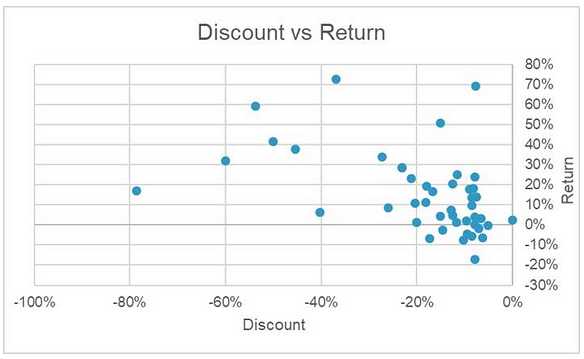
There has been a large range of returns on offer, with some top performers recording a 73% gain, a large number of stocks in the +10-40% range, and a handful which have underperformed the market. While the average discount has been around 20%, the range has been considerably wider.1

The chart below shows the relationship between discounts and returns, and it is interesting to note that every small cap company which has conducted a raising at a discount greater than the 20% average in March and April is showing a positive return.

By our analysis, the consistent theme among the winners has been the re-rating of companies that have faced severe revenue disruptions coupled with high debt levels, as the market looks through to normality returning with these companies now having sufficient liquidity in place to cross this bridge. The poor performers have been companies that have surprised with weaker than expected trading updates and those that may face structural issues going forward.


Source: AMP Capital, Factset. Data as at 1/5/20

How we approach these raisings

In general, recapitalisation or liquidity-driven capital raisings can fit our process quite well – prior to a raising these companies are usually trading on depressed valuations and have a very high risk score given the balance sheet risk. By raising money, we are therefore able to invest in companies with a good earnings based valuation score, and a vastly improved risk score given the enhanced liquidity and balance sheet profile of the company.
The AMP Capital Australian Emerging Companies fund has participated in a number of these recent capital raisings – a few of these have been in companies we have existing positions in, one that we intend to make a permanent position, and some in stocks that we have already sold or expect to sell shortly.
Importantly, all of these placements over March and April have contributed positively to fund performance to date. And while this will lead to elevated turnover for this period, the risk-reward equation on these placements has been stacked in our favour, they fit our process, and the alpha generated has been material.

Capital raising performance

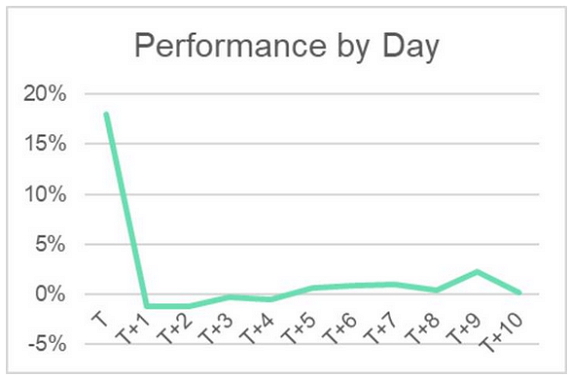
Within the 45 market-wide capital raisings that have taken place recently, we have observed a couple of interesting points relating to how stocks perform post-raising. Firstly, in the very short term, all the return for investors is made on the first day the stock resumes trading (point ‘T’ in the chart below). Performance then usually dips slightly as the new shares settle (generally two to four days later) and short-term holders looking for a quick profit exit the stock. See below graph.


Source: AMP Capital, Factset. Data as at 1/5/20

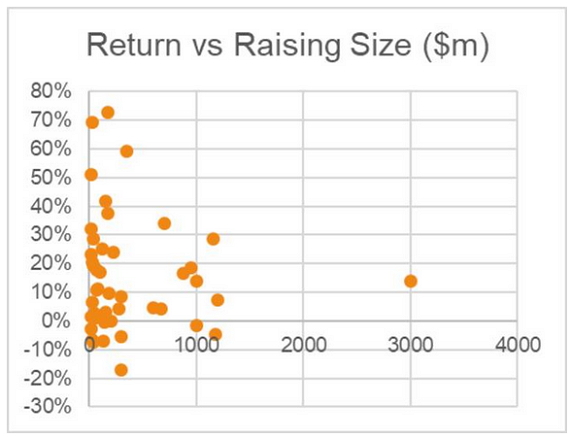
In addition, the smaller the size of the raising the greater the dispersion in performance. This certainly allows for some excellent returns but also raises the risk of substantial losses. In this environment, we believe small cap funds which conduct bottom-up research on companies are well positioned to capture the potential performance on offer. See below graph.


Source: AMP Capital, Factset. Data as at 1/5/20


Sources: AMP Capital, Factset


Author: Matt Griffin, Co-portfolio Manager, Small Caps, Sydney, Australia

Source: AMP Capital  13 May 2020

Important notes: While every care has been taken in the preparation of this article, AMP Capital Investors Limited (ABN 59 001 777 591, AFSL 232497) and AMP Capital Funds Management Limited (ABN 15 159 557 721, AFSL 426455) (AMP Capital) makes no representations or warranties as to the accuracy or completeness of any statement in it including, without limitation, any forecasts. Past performance is not a reliable indicator of future performance. This article has been prepared for the purpose of providing general information, without taking account of any particular investor’s objectives, financial situation or needs. An investor should, before making any investment decisions, consider the appropriateness of the information in this article, and seek professional advice, having regard to the investor’s objectives, financial situation and needs. This article is solely for the use of the party to whom it is provided and must not be provided to any other person or entity without the express written consent of AMP Capital.

Grant Hassell

The extent and implications of the dramatic economic halt brought about by Covid-19 are still to play out and it is too early to believe that economies will return to pre-disruption levels anytime soon. Yet equity markets are trying to recover in the belief that seemingly unlimited, unconventional monetary policy (UMP) and fiscal policy will be enough. A key tenant of the recovery in equity markets is that interest rates will remain low due to RBA buying. So, what is the RBA doing?

How things have changed since the GFC

Historically with higher rates, central banks could influence borrowing rates where they matter the most (i.e. in ‘the street’ for both corporate and consumer/ residential borrowers) by just adjusting the overnight cash rate. This worked well up to the Global Financial Crisis (GFC) when the transmission mechanism (the banking sector) between central banks and the street failed.

The financial crisis disrupted the ability of banks and other financial participants to borrow and on lend funds. Massive, targeted support to the global banking system stabilised the system and equity markets began a decade long rally, based largely on the premise that central banks and governments would do any, and everything to avoid another recession. Indeed, the last decade has seen prompt action from both parties at any sign of a downturn, potentially using ammunition (such as being able to lower rates from higher levels) that would be of more value now.

The challenges of Covid-19

Covid-19’s disruption is not a financial crisis; it is a health and economic crisis that risks infecting the financial system. Governments globally are addressing the health and economic crisis by supporting affected people through massive relief packages, funded through equally massive borrowing programmes. We expect government borrowing in Australia is set to rise by about 275bn by the end of 2021. Over the longer-term, we believe that the increased supply of debt is not likely to materially push rates higher. However, in the shorter term this wave of debt issuance cannot be absorbed by savers and investors.

RBA steps into the bond market 

The RBA’s participation directly into the bond market will assist markets to remain orderly, effectively stepping in to act as a buffer to these intermittent supply and demand imbalances. Some question the RBA’s ability to manage a large bond portfolio and that its involvement will distort the operation of the bond market. We do not believe this is the case. Central banks have experience in managing large bond portfolios as they historically manage the country’s foreign reserves, which have included foreign government bonds. Further, the RBA is a new type of investor into the domestic bond market and unlikely to compete with existing participants. Having a diversified range of participant types allows for a more efficient market (when markets become dominated by common investor types, distortions occur similar to the large-scale liability hedging that occurred in the UK bond market back in the late 1990s).

RBA helps keep rates low

The other action the RBA is undertaking is making sure that it still has influence over retail and corporate rates. It is doing this by keeping government bond rates out to 3-years at, or around 0.25%. It is within this 3-year term that the bulk of Australian borrowing is done.

If we look to offshore markets as to what other steps the RBA could take in support of the Australian economy, we can see some potentially far-reaching actions. The US Fed is a prime example, effectively throwing the ‘kitchen-sink’ into its support of companies. The most dramatic example of this is buying ‘fallen angels’, those once investment grade companies that have now dropped into sub-investment grade. In the US, businesses borrow a far greater amount directly from the market (investors) by issuing a far greater amount of corporate bonds, relying less on borrowing from the banking sector as we see in Australia. We don’t’ expect to see the RBA extending its buying program to include corporate bonds. Rather, its actions will be ensuring ongoing stability in the banking sector which we believe is in good shape.


Author: Grant Hassell BCA (Econ), Global Head of Fixed Income – Fixed Income, New Zealand

Source: AMP Capital  13 May 2020


Important notes: While every care has been taken in the preparation of this article, AMP Capital Investors Limited (ABN 59 001 777 591, AFSL 232497) and AMP Capital Funds Management Limited (ABN 15 159 557 721, AFSL 426455) (AMP Capital) makes no representations or warranties as to the accuracy or completeness of any statement in it including, without limitation, any forecasts. Past performance is not a reliable indicator of future performance. This article has been prepared for the purpose of providing general information, without taking account of any particular investor’s objectives, financial situation or needs. An investor should, before making any investment decisions, consider the appropriateness of the information in this article, and seek professional advice, having regard to the investor’s objectives, financial situation and needs. This article is solely for the use of the party to whom it is provided and must not be provided to any other person or entity without the express written consent of AMP Capital.

Shane Oliver

Superannuation is locked away for a reason, it is a long-term investment. That simple fact can be hardest to accept when markets are in turmoil and balances are taking a hit, but in our view, history works in favour of applying a long-term lens when everyone is heading for the exit.

Anyone could be forgiven for thinking an argument for holding your ground with superannuation during this period of turmoil is marketing spin. Similarly, the urge to flock to ‘safe’ assets like cash is understandable, as equities exposures in superannuation portfolios take a hit.

However, as we’ve now been reminded, growth assets like shares have always had periods of bad short-term performance versus bonds and cash. But in the long-term, they can provide superior returns, which is a key component of growing retirement savings.

These arguments may seem like the 101s of investing that don’t need explaining, but when times are tough, even the basics can feel challenging. It’s periods like this which put investors to the test in the short-term, and when rational thinking is needed to best preserve long-term goals.

This piece focuses on our views about the accumulation/growth phase – for those in or near retirement, goals and circumstances are different.

1. The power of compound

Superannuation is aimed (within reason) at providing maximum (risk-adjusted) funds for use in retirement. Typically, Australian super funds have a bias towards shares and other growth assets that grow in value with the economy, particularly for younger members, and some exposure to defensive assets like bonds and cash to avoid excessive short-term volatility. These approaches aim to make the most of the power of compound interest which sees returns build on returns over time.

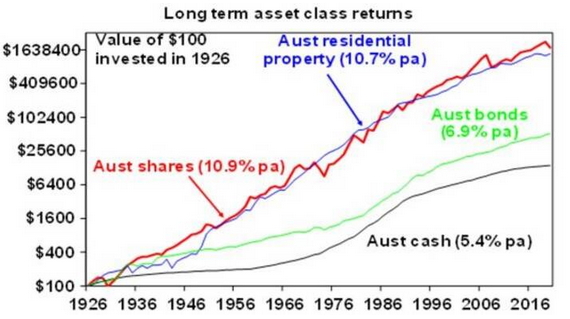
The below chart shows the value of a $100 investment in Australian cash, bonds, shares and residential property from 1926 assuming any interest, dividends and rents is reinvested along the way. As return series for commercial property and infrastructure only go back a few decades I have used residential property as a proxy.


Sources: ABS, ASX, Bloomberg, REIA, AMP Capital

Over the period shown since 1926 cash has returned 5.4% per annum, bonds 6.9% pa, property 10.7% pa and shares 10.9% pa. Because shares and property provide higher returns over long periods, the value of an investment in them compounds to a much higher amount over the long term.

So, it makes sense to have a decent exposure to shares when saving for retirement. The higher return from shares and growth assets reflects compensation for the greater risk in investing in them – in terms of capital loss, volatility and illiquidity.

2. Turn down the noise

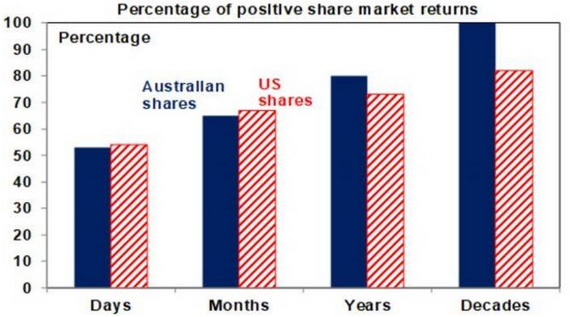
On a day-to-day basis, shares are down almost as much as they are up. But if you just look monthly and allow for dividends, the historical experience suggests you will only get bad news in the form of a negative return around a third of the time. If you go out to once a decade, positive returns have been seen 100% of the time for Australian shares and 82% for US shares.

So while it’s hard given the bombardment of information, misinformation and financial news these days, it’s prudent to be conscious of the rash decisions you can make based on short-term bad news. And remember: it only takes 24 hours for a bad day in markets to be yesterday’s news.


Daily and monthly data from 1995, years and decades from 1900. Sources: Bloomberg, AMP Capital

3. Wealth takes time to build

The temptation for short-term trades is immense when there’s blood on the streets. In these cases, it’s important to remember that wealth takes time to build (except in rare cases!) and short-term moves can work against that guiding principle. Also, short-term jumps work on the assumption that an investor can time the market.

With the benefit of hindsight many swings in markets like the tech boom and bust, the GFC and, maybe in the years ahead, the current episode look inevitable and hence forecastable and so it’s natural to think “why not give it a go?” by switching between say cash and shares within your super to anticipate market moves. Fair enough if you have a process and put the effort in.

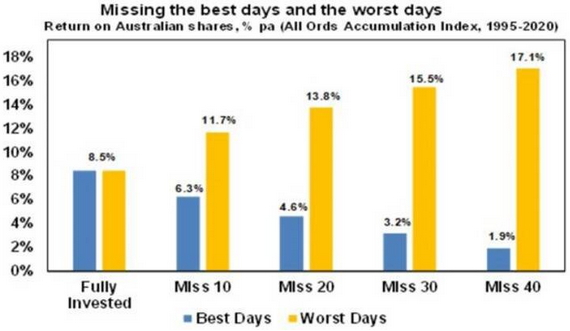
However, without a tried-and-tested market timing process, trying to time the market is difficult. A good way to demonstrate this is with a comparison of returns if an investor is fully invested in shares versus missing out on the best (or worst) days. The next chart shows that if you were fully invested in Australian shares from January 1995, you would have returned 8.5% pa (with dividends reinvested but not allowing for franking credits, tax and fees).


Sources: ASX, Bloomberg, AMP Capital

If by trying to time the market you avoided the 10 worst days (yellow bars), you would have boosted your return to 11.7% pa. And if you avoided the 40 worst days, it would have been boosted to 17.1% pa! But this is not easy as many investors only get out after the bad returns have occurred, just in time to miss some of the best days. For example, if by trying to time the market you miss the 10 best days (blue bars), the return falls to 6.3% pa. If you miss the 40 best days, it drops to just 1.9% pa.

In short

This is undoubtedly a stressful time for anyone watching the shares in their portfolio at the moment. But just as looking back on the GFC showed that some panic-selling and flocking to cash ultimately sacrificed future gains,1 this period of time in the market may again show that holding your nerve and keeping eyes on the long-term prize was a more sensible way through.


1https://www.bdo.com.au/en-au/insights/superannuation/articles/super-and-why-you-need-to-take-a-long-term-view


Author: Dr Shane Oliver, Head of Investment Strategy and Economics and Chief Economist, AMP Capital Sydney, Australia

Source: AMP Capital  13 May 2020


Important notes: While every care has been taken in the preparation of this article, AMP Capital Investors Limited (ABN 59 001 777 591, AFSL 232497) and AMP Capital Funds Management Limited (ABN 15 159 557 721, AFSL 426455) (AMP Capital) makes no representations or warranties as to the accuracy or completeness of any statement in it including, without limitation, any forecasts. Past performance is not a reliable indicator of future performance. This article has been prepared for the purpose of providing general information, without taking account of any particular investor’s objectives, financial situation or needs. An investor should, before making any investment decisions, consider the appropriateness of the information in this article, and seek professional advice, having regard to the investor’s objectives, financial situation and needs. This article is solely for the use of the party to whom it is provided and must not be provided to any other person or entity without the express written consent of AMP Capital.