The power of compound returns is startling and the mathematics in favour of starting to save early in life is undeniable.

At a 4 per cent annual return, $100,000 invested today will grow to around $580,000 over the course of a regular 45 year working life.

Vanguard’s retirement planning team has a worked example online1. A person starting at age 20 and saving $4,500 a year has a good chance of having $1 million in retirement. At 30, they would need to save $9,000 a year. And if they wait until 40, they need to save $18,000 a year to hit the same goal.

That’s all very well for the young, but what of us that didn’t hear that lesson in our 20s and find ourselves mid-career starting to think about putting something away for retirement?

And as the old radio ad said, the best time to start might well have been 20 years ago, but the second-best time is now even with the challenges being thrown up by the COVID-19 pandemic. Not surprisingly the global health emergency has people much more focussed on short-term particularly if employment or business income has been affected.

But with more people working from home then there may be a good opportunity to devote some of that time by getting back to basics.

First things first – starting late means making a genuine effort to understand your financial plan. How much do you really need to retire? And how long do you have?

The answer to this important question will set the scene for how much you need to save. Saving for retirement is effectively a balance between your quality of life today and quality of life tomorrow.

Only once you have a plan, can you work out how much you need to save each year.

The clearest path to a comfortable retirement is to step up the amount saved each year which can only be achieved by earning more, spending less or both.

Big ticket ways to spend less include renegotiating mortgage rates lower, paying down credit card debts and personal loans and avoiding replacing things like vehicles and home appliances where possible.

Whatever path taken, the extra savings can be used to prepare for retirement in two ways – paying down debt and investing for growth.

So how to decide between those two? It is almost always best to pay down personal debts with high interest rates first. That means getting rid of those credit card and personal debts. Retiring debt free is the holy grail. Any debt repayments you need to make in retirement directly reduce the amount of money you have to spend.

The next question is asset allocation.

With a shorter timeframe a key decision is in setting realistic goals for when you retire. If higher returns will be required that generally means taking on higher risk.

A key strategy here is shifting asset allocation away from assets like cash and fixed interest towards growth assets like equities. Understanding your risk tolerance as an investor is key in this step. You will need to understand the various types of risk that each asset brings. This could be a good time to consult a financial adviser.

Historically, equity investments like stocks have provided higher returns than fixed interest investments like bonds. This higher return comes with higher risk and so a diversified approach is critical. Setting realistic goals is also where a financial adviser can add real value.

You could choose to use an index funds-only investment strategy, which aim to replicate the performance of the market or, use an active investment strategy through the use of actively managed funds that seek to beat market performance. Or, you could choose to use a blend of both.

The important thing to note about the use of actively managed funds is that they typically have higher fees than funds which seek to track the index. And higher costs will always eat away at returns.

Even if you’ve waited a long time to begin your investment journey, it is always better late than never to start planning for your retirement. 

Please contact us on Phone: 07 5641 4134 if you seek further assistance on this topic .

Source : Vanguard

Written by Robin Bowerman, Head of Corporate Affairs at Vanguard. 

Reproduced with permission of Vanguard Investments Australia Ltd Vanguard Investments Australia Ltd (ABN 72 072 881 086 / AFS Licence 227263) is the product issuer. We have not taken yours and your clients’ circumstances into account when preparing this material so it may not be applicable to the particular situation you are considering. You should consider your circumstances and our Product Disclosure Statement (PDS) or Prospectus before making any investment decision. You can access our PDS or Prospectus online or by calling us. This material was prepared in good faith and we accept no liability for any errors or omissions. Past performance is not an indication of future performance. © 2020 Vanguard Investments Australia Ltd. All rights reserved.

Important:
Any information provided by the author detailed above is separate and external to our business and our Licensee. Neither our business nor our Licensee takes any responsibility for any action or any service provided by the author. Any links have been provided with permission for information purposes only and will take you to external websites, which are not connected to our company in any way. Note: Our company does not endorse and is not responsible for the accuracy of the contents/information contained within the linked site(s) accessible from this page.


Consumer sentiment and behaviour will play a critical role in any economic recovery from the COVID-19 pandemic. Federal and State government policy settings must walk a fine line between managing the incidence of new infections and avoiding irreparable damage to the economy. 

However, with persistent uncertainty and a long road ahead, the consumer sentiment and behaviour we see today may not necessarily reflect what it looks like tomorrow. Consumers hold the key to the economic recovery, but which door they choose to open remains to be seen.

Consumers currently are erring on the side of caution, prioritising health over finances. Our latest data suggests that 80 per cent of Australians are more concerned about social restrictions being lifted too fast, leading to severe health consequences, than they are about social restrictions being lifted too slowly, leading to severe economic damage. As time goes by the mood may shift.

We have also found that currently one in five are prepared to accept an infection rate in the population of 30 per cent in order to avoid a recession – I’ll spare you how that translates into likely mortality burden but it’s a lot of people. We will continue to track how attitudes shift in the coming weeks as frustrations grow and patience wanes across different segments of Australian society.

For many Australians, but of course not all, the hip-pocket nerve has yet to be fully pinched. With a mix of lucky-country optimism, a sense of geographical insulation and confidence in government actions to date, there is some degree of decoupling between current household sentiment and broader world economics. We see many signs that Wall St is running somewhat independently of Main St sentiment for the moment.

A tangible hit to personal income will shift our relatively optimistic local outlook. Government stimulus and support packages inevitably will come to an end, and if we are hit with a second wave of COVID-19 infections requiring another six-week shutdown, reality and fear will be felt closer to home.

More than one dimension to the impact

It is important to remember to remember that there is more than one dimension to the impact on consumers. Some of us are lucky enough to keep on trucking, but many of us have had our incomes decimated. While the burden is often disproportionately carried by lower wage earners, significant numbers of high earners throughout society have also been hit, due to the industry they work in or the nature of the business they run. An extended economic downturn will see this impact spread to more sectors, including the bellwether of our national prosperity: property values.

It is also important to remember that it takes a while for new habits to form. Humans have an impressive capacity to forget lessons learned, especially around experiences they didn’t enjoy. Of course, there will also be some things that have changed that we won’t want to lose – often our strongest drive is to hold on to what we have now.

A clear potential behavioural shift is in terms of risk aversion. Logically, recent events should provide a reminder for us all, regardless of how vulnerable or resilient, that bad and unexpected things do indeed happen, and it pays to save for a rainy day. The most recent figures do suggest an increase in insurance inflows this year from record low levels the previous year, but this may over-represent those that can afford it. A recent consumer survey suggests that many mass market consumers consider insurance one of the first expenses they’d cut if times got hard. 

Furthermore there is evidence that some consumers rushing to buy insurance now may be at under some misconceptions about what their insurance will in fact cover. Reports of insurance policies failing to pay full COVID-related claims and increasing premiums are only likely to increase, given the pressure the industry is under. The more this narrative takes hold, the more trust will be eroded in the promise of the protection insurance provides.

Finally, we can’t underestimate the human capacity for adaptation. If the threat to personal security is extended eventually we may see increased personal risk becoming hyper-normalised: we recalibrate what we consider to be acceptable risk in our lives. 

If uncertainty about the future persists for an extended period of time we may find some need to shift our perspectives to cope. Some of us may focus more on living in the now, to escape the anxiety of an uncertain future. So while increased risk-averseness is likely to drive down discretionary spending, there may be an point in in future when some of us decide to throw caution to the wind and seek some good, old-fashioned short-term gratification to relieve collective stress – as we see happen in times of war. 

Threats to security inevitably also trigger a revaluation moment, where many rethink their finances, providers and the deals they have. Early evidence suggests that there’s already been an increase in refinancing and provider switching as consumers search for a better deal. We may see many complacent consumers wake from their slumber to force financial services providers to make their offers more competitive.

An uptick of interest in advice

Current evidence also suggests a greater interest in professional advice. The financial benefits of advice are well known; the COVID-19 pandemic has highlighted some of the non-financial benefits, including more resilient mental health among individuals who have an advice relationship. But an increased demand for advice comes at a period in the industry’s history when supply is declining quickly. CoreData estimates more than 5000 advisers have departed in the past 12 months, as institutional players dismantle their vertically integrated models and others quit the industry altogether. Remaining advisers grapple with new education, professional/ethical standards and with rising compliance costs.

Meanwhile the super fund industry has been hit with a triple-whammy of record levels of government-endorsed early redemptions, a flight to cash investment options, and rising unemployment reducing contribution inflows. All this has dented the fee income used to fund member services. This may mean fees will need to go up, or services will be pared back (possibly jeopardising access to affordable financial counselling and advice). 

So while clearly hedging my bet on how consumer behaviour will determine our emergence from recession, and while wanting to avoid a sensationalist doom-and-gloom prognosis, the reality is we are now sitting on a cliff-edge. There are some encouraging signs of recovery, but a further extended period of lockdown following a secondary wave of COVID is likely to not only structurally damage the economy but also drive longer-term shifts in consumer behaviours. 

We are also going to see this play out at multiple speeds depending on what you do, where you live and how well or luckily you have managed to navigate this crisis. Developments in the next few weeks will be crucial. And we will keep you posted on what we are seeing at the consumer coal face.

Source : Core Data Research

Reproduced with the permission of Core Data Research. This article by 
Tai Rotem was originally published at:https://www.coredata.com.au/blog/consumers-hold-the-key-but-which-door-will-they-open/ 

Important:
This provides general information and hasn’t taken your circumstances into account. It’s important to consider your particular circumstances before deciding what’s right for you. Although the information is from sources considered reliable, we do not guarantee that it is accurate or complete. You should not rely upon it and should seek qualified advice before making any investment decision. Except where liability under any statute cannot be excluded, we do not accept any liability (whether under contract, tort or otherwise) for any resulting loss or damage of the reader or any other person.Any information provided by the author detailed above is separate and external to our business and our Licensee. Neither our business nor our Licensee takes any responsibility for any action or any service provided by the author. Any links have been provided with permission for information purposes only and will take you to external websites, which are not connected to our company in any way. Note: Our company does not endorse and is not responsible for the accuracy of the contents/information contained within the linked site(s) accessible from this page.
Introduction

The past financial year was poor for investors as coronavirus knocked economies into what is likely to be their biggest hit since the 1930s. Shares were hit hard, but the blow was softened by a strong rebound in the June quarter. This note reviews the last financial year and takes a look at the outlook.

Pre and post covid

The past financial year can effectively be divided into two halves. The period from July last year into early this year saw generally strong returns from shares and growth assets, as fear of recession faded helped by central bank easing and a truce in the US/China trade war and gave way to expectations of some improvement in global economic growth. Despite devastating bushfires and a subdued growth outlook even the Australian share market made it to a record high in February. Against this backdrop, returns from government bonds were subdued.

This now seems like it was a different world as it all started to fade and ultimately reverse as the coronavirus epidemic started to become a problem in China in January. Initially it was hoped it would be contained to China (which successfully controlled it allowing a reopening of its economy from March) but from late February the number of cases escalated in Europe then the US, Australia and ultimately emerging countries, resulting in severe lockdowns driving sharp economic contractions in economic activity. So, between 20th February and 23rd March share markets collapsed by around 35% dragging down commodity prices. This also saw the $US surge and the Australian dollar plunge to around $US0.55.

However, from late March shares staged a rebound driven by policy stimulus, a decline in new covid cases, economic reopening and a rebound in economic data. From their March lows to June highs global shares rose 40% & Australian shares rose 35% and commodity prices and the $A also rebounded.

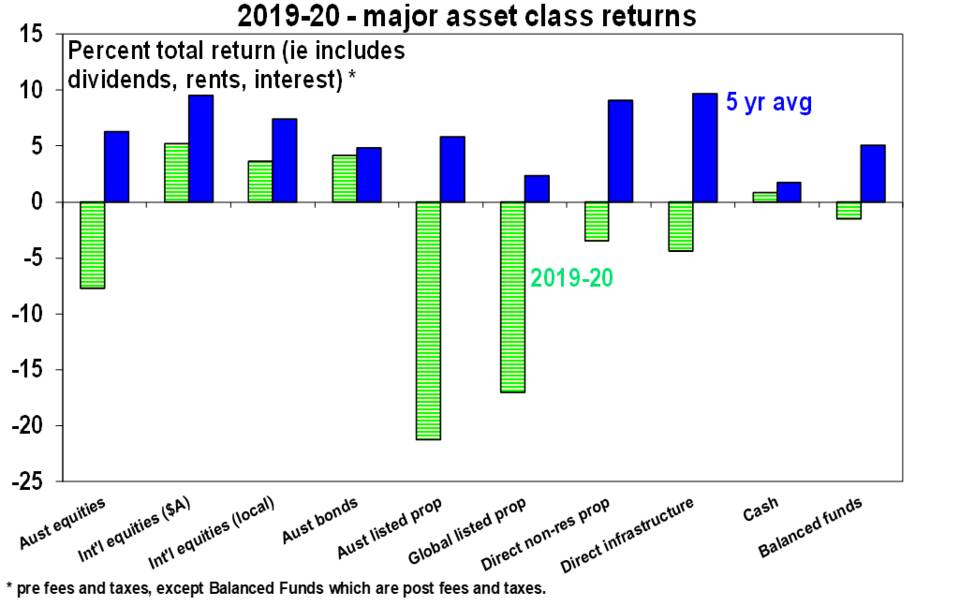
So, despite this wild ride, for the financial year as a whole global shares returned 5.2% in Australian dollar terms. This was led by the US share market which outperformed due to a heavy tech and health care exposure, a relatively low exposure to cyclical shares and massive Fed quantitative easing. Australian shares didn’t fare so well & still lost 7.7% for the financial year.

Cash and bank deposits had very low returns as the RBA cut the cash rate to 0.25% in March. But bonds had reasonable returns as plunging yields provided capital growth for investors. Despite the plunge in interest rates and bond yields, listed property saw double digit losses as the coronavirus driven slump in economic activity pushed up vacancies and depressed rents in retail and office properties. Returns on airports were similarly depressed weighing on direct infrastructure returns.

This all saw small negative returns for balanced growth superannuation funds of around -1.5% after fees and taxes. Of course, it would have been much worse were it not for the June quarter rebound in shares. The hit to super returns also followed several years of strong returns and the five-year average is just over 5% which is not so bad given (pre tax) bank deposit rates averaged around 2% and inflation averaged 1.5%.

Source: Thomson Reuters, AMP Capital

Like shares, Australian residential property had a roller coaster ride – first rising 10% on rate cuts and the Federal election before starting to slow as coronavirus hit.

Key lessons for investors from the last financial year

These include:

  • Maintain a well-diversified portfolio – while shares and listed property had a rough ride, bonds and exposure to global shares and foreign currency provided some stability.

  • Timing markets is hard – while it always looks easy in hindsight, getting out in February at the top and then getting back in March at the low would have been very hard to time.

  • Beware the crowd at extremes – as is often the case shares hit bottom in March at a time of extreme investor pessimism.

  • Turn down the noise – the noise around coronavirus is at fever pitch making it very hard to maintain focus on long term investing, so the best thing is to turn it down a notch.

  • Don’t fight the Fed – despite near zero interest rates and high public debt levels, policy stimulus can still be applied on a massive scale and still impacts investment markets.

The negatives

There are a bunch of threats which are likely to lead to a further correction in shares in the short term, ongoing bouts of volatility and constrained returns. Here are the big ones.

  • First, while some countries have got new coronavirus cases well down, it’s still on the rise globally particularly in emerging countries and the US and Victoria have seen a resurgence in cases. This is threatening a return to economically debilitating country wide lockdowns (as opposed to targeted measures). Even partial lockdowns will slow the recovery – eg, our rough estimate is that the new six-week lockdown of Melbourne, which accounts for about 20% of Australian GDP will knock nearly 1% off Australian GDP this quarter, which will slow the recovery (but not derail it as it should be offset by growth in other states).

  • Second, the shutdowns will leave lasting collateral damage in terms of bankruptcies and higher unemployment as the embrace of technology has been sped up, companies cut costs and skills atrophy, all of which will weigh on growth.

  • Third, in Australia the main collateral risk is that the combination of high unemployment, a collapse in underlying housing demand on the back of a plunge in immigration and a depressed rental market drive a sharp collapse in home prices triggering negative wealth effects.

  • Fourth, the run up to the US election has the potential to drive increased share market volatility if it looks increasingly likely that Biden will win and raise taxes, and the risk is probably greater if President Trump decides he has nothing to lose and ramps up tensions with China and maybe Europe. With betting markets favouring a clean sweep by the Democrats some of the former is probably already priced, but an intensification of trade wars is probably not.

  • Finally, shares are expensive on traditional metrics like PEs.

The positives

However, there are a bunch of positives providing an offset.

  • First, several Asian countries have shown its possible to control the virus – notably China, South Korea, Taiwan and Japan. Maybe the SARS experience helps along with the culture of wearing masks. Surely, we can learn from them.

  • Second, progress is continuing to be made in terms of vaccines and treatments for coronavirus. I am a bit sceptical about a vaccine, but the latter may be contributing to lower death rates. If deaths remain low compared to the first wave there is less risk of a return to hard lockdowns (Victoria excepted!) and less self-isolation.

  • Third, policy makers remain committed to do whatever they can to support businesses, incomes and jobs with record levels of fiscal stimulus relative to GDP and massive monetary stimulus. This is different to normal recessions where it takes longer for policy makers to swing into action. To this end policy stimulus will be extended in the US and in Australia (with the Treasurer talking about another phase of income support and possibly bringing forward tax cuts).

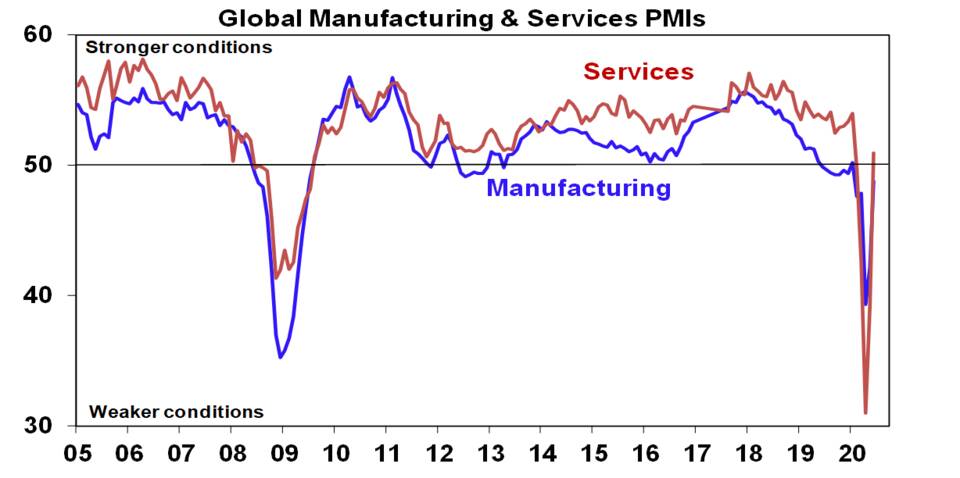
  • Fourth, a range of economic indicators have seen a Deep V rebound from shutdown lows starting in China and then in developed countries, suggesting significant pent up demand. This is most evident in business conditions PMIs but also in retail sales. On balance we see a gradual bumpy economic recovery from here. Australian GDP is expected to contract -4.5% this year and grow 4% next year.

Source: Bloomberg, AMP Capital

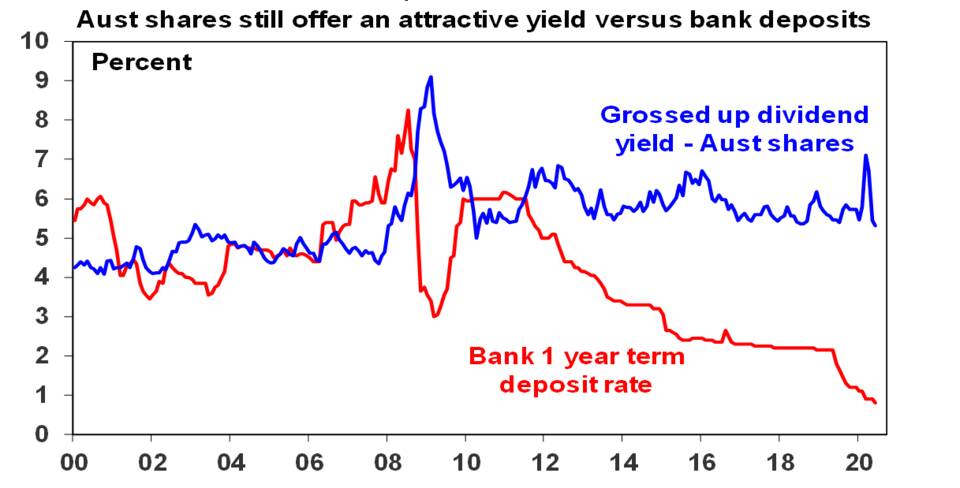
  • Finally, the plunge in interest rates and bond yields have increased the present value of shares and other growth assets, which explains why price to earnings multiples are so high. Or looked at another way, shares remain attractive despite lower earnings and dividends because the alternatives like bank deposit rates are even less attractive.

Source: RBA; AMP Capital

What about the return outlook?

With coronavirus risks still high, investment markets may see more volatility. But over the next 12 months returns from a well-diversified portfolio are likely to be constrained but okay.

  • After a strong rally from March lows shares remain vulnerable to short term setbacks given uncertainties around coronavirus and US/China tensions. But on a 6 to 12-month view shares are expected to see reasonable returns helped by a pick-up in economic activity & massive policy stimulus.

  • Cash and bank deposit returns are likely to be poor at less than 1% as the RBA is expected to keep the cash rate at 0.25%. Investors still need to think about what they really want: if it’s capital stability then stick with cash, but if it’s a decent income flow then consider the alternatives.

  • Low starting point yields are likely to result in low returns from bonds once the dust settles from coronavirus.

  • Unlisted commercial property and infrastructure are ultimately likely to benefit from a resumption of the search for yield, but the hit to economic activity and hence rents from the virus will weigh heavily on near term returns.

  • Home prices are expected to fall by around 5 to 10% into next year as higher unemployment, a stop to immigration and the weak rental market impact.

  • Although the $A is vulnerable to bouts of uncertainty about the global recovery and US/China tensions, a continuing rising trend is likely if the threat from coronavirus recedes.

Things to keep an eye on

The key things to keep an eye on are: coronavirus hospitalisations and deaths, as a guide to the degree of isolation; global business conditions PMIs and unemployment; US election prospects; and Australian house prices.

Source: AMP Capital July 8th 2020

Important notes: While every care has been taken in the preparation of this article, AMP Capital Investors Limited (ABN 59 001 777 591, AFSL 232497) and AMP Capital Funds Management Limited (ABN 15 159 557 721, AFSL 426455) (AMP Capital) makes no representations or warranties as to the accuracy or completeness of any statement in it including, without limitation, any forecasts. Past performance is not a reliable indicator of future performance. This article has been prepared for the purpose of providing general information, without taking account of any particular investor’s objectives, financial situation or needs. An investor should, before making any investment decisions, consider the appropriateness of the information in this article, and seek professional advice, having regard to the investor’s objectives, financial situation and needs. This article is solely for the use of the party to whom it is provided and must not be provided to any other person or entity without the express written consent of AMP Capital.

At its meeting today, the Board decided to maintain the current policy settings, including the targets for the cash rate and the yield on 3-year Australian Government bonds of 25 basis points.


The global economy has experienced a severe downturn as countries seek to contain the coronavirus. Many people have lost their jobs and there has been a sharp rise in unemployment. Leading indicators have generally picked up recently, suggesting the worst of the global economic contraction has now passed. Despite this, the outlook remains uncertain and the recovery is expected to be bumpy and will depend upon containment of the coronavirus. Over the past month, infection rates have declined in many countries, but they are still very high and rising in others.

Globally, conditions in financial markets have improved. Volatility has declined and there have been large raisings of both debt and equity. The prices of many assets have risen substantially despite the high level of uncertainty about the economic outlook. Bond yields remain at historically low levels.

In Australia, the government bond markets are operating effectively and the yield on 3-year Australian Government Securities (AGS) is at the target of around 25 basis points. Given these developments, the Bank has not purchased government bonds for some time, with total purchases to date of around $50 billion. The Bank is prepared to scale-up its bond purchases again and will do whatever is necessary to ensure bond markets remain functional and to achieve the yield target for 3-year AGS. The yield target will remain in place until progress is being made towards the goals for full employment and inflation.

The Bank’s market operations are continuing to support a high level of liquidity in the Australian financial system. Authorised deposit-taking institutions are continuing to draw on the Term Funding Facility, with total drawings to date of around $15 billion. Further use of this facility is expected over coming months.

The Australian economy is going through a very difficult period and is experiencing the biggest contraction since the 1930s. Since March, an unprecedented 800,000 people have lost their jobs, with many others retaining their job only because of government and other support programs. Conditions have, however, stabilised recently and the downturn has been less severe than earlier expected. While total hours worked in Australia continued to decline in May, the decline was considerably smaller than in April and less than previously thought likely. There has also been a pick-up in retail spending in response to the decline in infections and the easing of restrictions in most of the country.

Notwithstanding the signs of a gradual improvement, the nature and speed of the economic recovery remains highly uncertain. Uncertainty about the health situation and the future strength of the economy is making many households and businesses cautious, and this is affecting consumption and investment plans. The pandemic is also prompting many firms to reconsider their business models. As some businesses rehire workers as demand returns, others are restructuring their operations.

The substantial, coordinated and unprecedented easing of fiscal and monetary policy in Australia is helping the economy through this difficult period. It is likely that fiscal and monetary support will be required for some time.

The Board is committed to do what it can to support jobs, incomes and businesses and to make sure that Australia is well placed for the recovery. Its actions are keeping funding costs low and supporting the supply of credit to households and businesses. This accommodative approach will be maintained as long as it is required. The Board will not increase the cash rate target until progress is being made towards full employment and it is confident that inflation will be sustainably within the 2–3 per cent target band.

Source: Reserve Bank of Australia, July 7th, 2020

Enquiries

Media and Communications
Secretary’s Department
Reserve Bank of Australia
SYDNEY

Phone: +61 2 9551 9720
Email: rbainfo@rba.gov.au

Tracking your spending is a way to take control of your money. Knowing exactly how much is coming in and going out can help you spend less and save more.

1. Understand where your money goes

Taking the time to make a note of every dollar you spend can give you a clear view of where your money is going.

You may be surprised by how much all those small things add up. You might also discover hidden costs, like account fees, subscriptions you don’t use, or mistaken transactions.

Just knowing where your money goes may be all you need to start spending less. You may even start saving more.

2. Track your spending and expenses

Start small by recording your spending every day for a period of time (at least a week). This way you can see all the money going out.

If you have some weeks or months with more expenses, then track over two weeks or two months. This will give you a more realistic picture.

Don’t worry about changing your spending habits straight away. Just track day by day.

It might be easier to track with your partner or a friend: you can encourage each other and stay on track.

How to track your spending

Use a phone app

A phone app is an easy way to track your spending at the time you spend.

Some apps offer more options, such as setting spending limits and reminders, and seeing your expenses at a glance.

Look at your statements and receipts

When you use a debit or credit card, every transaction is recorded for you.

You can view or download these transactions using online banking, or look at your hard-copy statements or receipts.

Write it down

Write down every dollar you spend. Include the amount, item (or store name) and date. You should do this for both cash and card purchases.

Do this as you spend, or set a reminder to do it once a day, using your receipts.

3. See how you’re tracking

At the end of your tracking period, look at your recorded transactions to see where your money is going.

You might find that just by being aware of your spending you start to spend less. Take a moment to ask yourself: Do I need this? Would it be cheaper somewhere else? This can help you think twice about buying something.

See where you can save

A good first step is to look at any small items that add up over time. Try cutting back on small, frequent expenses, such as takeaway coffee or lunch. This is a great way to start a savings habit. See simple ways to save money for more ideas.

You could also see whether you could redirect this money, maybe to a savings account, an emergency fund or your mortgage.

Separate needs from wants

Look at all your transactions and highlight what are ‘needs’ — essential items you need to live.

This will give you a clear picture of what are ‘wants’. These are the things you could cut back on or live without to save money.

Set limits and reminders

Seeing how much you spend on certain things can help you set a realistic limit for the next week or month. This can help you avoid overspending.

Knowing when regular expenses are going to pop up means that you can set reminders and put aside money to cover these payments.

4. Do a budget

Knowing where your money is going day to day is great first step to creating a budget. The next step is to see where it’s going over a month, then a year.

Having a budget can help you feel in control of your money, prepare for big expenses, and save. 

Please contact us on Phone: 07 5641 4134 if you seek further assistance on this topic.

Source : Moneysmart gov.au June 2020 

Reproduced with the permission of ASIC’s MoneySmart Team. This article was originally published at https://moneysmart.gov.au/budgeting/track-your-spending 

Important note: This provides general information and hasn’t taken your circumstances into account.  It’s important to consider your particular circumstances before deciding what’s right for you. Although the information is from sources considered reliable, we do not guarantee that it is accurate or complete. You should not rely upon it and should seek qualified advice before making any investment decision. Except where liability under any statute cannot be excluded, we do not accept any liability (whether under contract, tort or otherwise) for any resulting loss or damage of the reader or any other person.  Past performance is not a reliable guide to future returns.

Any information provided by the author detailed above is separate and external to our business and our Licensee. Neither our business nor our Licensee takes any responsibility for any action or any service provided by the author. Any links have been provided with permission for information purposes only and will take you to external websites, which are not connected to our company in any way. Note: Our company does not endorse and is not responsible for the accuracy of the contents/information contained within the linked site(s) accessible from this page.
Have you written a personal financial register, listing your super and non-super investments, your other assets, your income and any debts?

This fundamental task for managing your personal finances, investing and saving for retirement would often be left on a must-do-tomorrow list – and perhaps never done.

Behavioural economists typically rank investor inertia and procrastination high among behavioural traits that are enemies of investment success. And never getting around to preparing a personal financial register would often be part of that inertia.

A personal financial register – updated as your circumstances change – is critical for a range of personal financial issues. These include saving for retirement, preparing a personal financial plan, setting your portfolio’s asset allocation, controlling your spending and estate planning:

  • Preparing a financial plan: A good starting point for preparing a comprehensive financial plan, perhaps with the guidance of an adviser, is to prepare a personal financial register. You can then make more informed and realistic decisions – including about your long-term goals, targeted returns and tolerance to risk – for your financial plan.

  • Setting your portfolio’s asset allocation: An up-to-date list of your super and non-super investments is necessary to set an appropriate asset allocation for your portfolio. Repeated research, including by Vanguard, shows that a diversified portfolio’s strategic asset allocation – the proportions of its assets in different asset classes – is the main cause of variations in its long-term returns.

  • Keeping your personal spending under control: A basic rule for investment success is to try to spend less than you make so as to have money left over to invest. An accurate personal financial register should help you to take a realistic approach to spending given your income and assets.

  • Saving for retirement: A financial register is necessary for estimating how much you will need to save for retirement. You can then plan how to save to meet your savings goals.

  • Spending in retirement: Without a personal financial register in place at the eve of retirement, retirees may have a poor understanding of how far their financial resources will stretch. This may lead to overspending or being too frugal given the state of your finances. And you may miss opportunities to more efficiently manage your investments and spending in retirement.

  • Estate planning: Having an up-to-date personal financial register is a central part of estate planning together with such tasks as making a Will and nominating beneficiaries for your super savings. A financial register should give you and, eventually, your intended beneficiaries a better understanding of your finances.

As Smart Investing has discussed, the last baby boomers celebrate their 70th birthday within the next 15 years as a growing proportion of the population reaches old age. This should underline the need to save for retirement and for estate planning – and that should include having a personal financial register.


Source : Vanguard

By Robin Bowerman, Head of Corporate Affairs at Vanguard.

Reproduced with permission of Vanguard Investments Australia Ltd

Vanguard Investments Australia Ltd (ABN 72 072 881 086 / AFS Licence 227263) is the product issuer. We have not taken yours and your clients’ circumstances into account when preparing this material so it may not be applicable to the particular situation you are considering. You should consider your circumstances and our Product Disclosure Statement (PDS) or Prospectus before making any investment decision. You can access our PDS or Prospectus online or by calling us. This material was prepared in good faith and we accept no liability for any errors or omissions. Past performance is not an indication of future performance.

© 2020 Vanguard Investments Australia Ltd. All rights reserved.

Important:
Any information provided by the author detailed above is separate and external to our business and our Licensee. Neither our business, nor our Licensee take any responsibility for any action or any service provided by the author.

Any links have been provided with permission for information purposes only and will take you to external websites, which are not connected to our company in any way. Note: Our company does not endorse and is not responsible for the accuracy of the contents/information contained within the linked site(s) accessible from this page

We live in a culture of smartphones, WIFI, home delivery, online shopping and online gaming, where most needs and wants can be met almost instantly. With so much temptation to spend, it’s vital to teach your kids the money skills to help them enjoy financial wellbeing as adults.

One of these key skills is learning how to deal with debt responsibly. Researchers from Cambridge1 University found that children develop financial understanding when they have their own personal ‘economic experiences’. That means it’s particularly helpful for kids to have the opportunity to handle some money themselves. But should you give your teenager a credit card?

Pre-paid, debit or credit?

You might like to start with a pre-paid card or a debit card, so there’s a limit on what they can spend. Set the rules on what it can be used for and how much they can spend. If they manage the process well, and if you’re confident that they’re responsible enough, you could give them a credit card (which would be a supplementary card connected to your own, as children under 18 cannot have their own card).

Understanding the difference between spending with a debit card, which is linked to a bank account, and borrowing on a credit card is an important money lesson.

Before you give your teen a credit card, take the time to have a conversation about credit card fees, interest rates, and how spending irresponsibly can give you a bad credit rating, which is bad news for their future. Be clear that they will be responsible for all expenditure on the card – if they can’t afford it with cash, they shouldn’t put it on the credit card.

Rules, limits and know-how

Giving a teenager a credit card may seem risky or even irresponsible, but it can be a great teaching tool if the right conversations, rules and limits are put in place.

Before you give your teen a card, be sure to speak to them about how it works, how to be responsible with it and how to avoid financial trouble, including:

  • How interest works – it’s important that they understand that a credit card is like a loan and if they don’t pay it back on time, they’ll be charged interest. Run an interest calculation with them so they understand how much they could be up for.

  • Paying it off in full every month – show your teen a credit card statement and explain that if they only pay the minimum amount, they’ll still be charged interest. Explain the importance of paying off the full amount every month.

  • Paying on time – show them where they can find the due date for payments and help them to set up reminders to pay on time every month to avoid interest.

  • Avoid overspending – teach your teen to keep track of their spending, and to never spend more than they earn. Use the credit card’s app to keep a tally on spending. To keep track of your teen’s progress, see if your credit card allows you to set up alerts whenever your teen makes a purchase, so you can monitor their spending.

  • Start with a credit limit lower than they earn – it’s a good idea to start with a credit limit that is not more than what they earn in a month. For example, setting a low limit for a teen may be $500 maximum so they can consistently pay it off at the end of each month.

Understanding ‘buy now, pay later’ services

The growing popularity of ‘buy now, pay later’ services such as Afterpay, Openpay and zipPay means it pays to help your teen understand how they work, and what the risks are.

These services allow shoppers to buy a product, take it home and pay for it in instalments via an online ‘buy now, pay later’ account, which deducts your preferred debit or credit card.

These services can be very handy if you have available funds and can pay on time. However, if you don’t, little debts stemming from things like late fees can quickly snowball into bigger debts, which can have various repercussions. For this reason, it’s important that your teenagers understand the need to have a budget in place when it comes to spending, so they don’t get in over their heads. Like credit cards, it’s wise not to spend more than you have.

Added to that, while the buy now, pay later provider might not charge interest on your purchase, you may still have to pay interest to your credit card provider if you don’t pay the full amount owing on your credit card by the due date.

It’s also a good idea to explain to your teen the potential long-term impact that using these services can have on their credit rating. While buy now, pay later services might not check their history, they’re still able to report any black marks against a person to credit reporting agencies, which could make it hard to borrow money in future.

Leading by example

While knowing the ins and outs of debt is important, one of the most powerful ways to help your kids develop healthy money habits is to lead by example. Our ideas about money are formed in our childhood, so if your kids see you living with healthy financial habits, they’re more likely to form those habits themselves.


1 Habit Formation and Learning in Young Children, https://mascdn.azureedge.net/cms/mas-habit-formation-and-learning-in-young-children-executive-summary.pdf

Source : AMP June 2020

Important: This information is provided by AMP Life Limited. It is general information only and hasn’t taken your circumstances into account. It’s important to consider your particular circumstances and the relevant Product Disclosure Statement or Terms and Conditions, available by calling Phone: 07 5641 4134, before deciding what’s right for you. All information in this article is subject to change without notice. Although the information is from sources considered reliable, AMP and our company do not guarantee that it is accurate or complete. You should not rely upon it and should seek professional advice before making any financial decision. Except where liability under any statute cannot be excluded, AMP and our company do not accept any liability for any resulting loss or damage of the reader or any other person. Any links have been provided for information purposes only and will take you to external websites. Note: Our company does not endorse and is not responsible for the accuracy of the contents/information contained within the linked site(s) accessible from this page. 
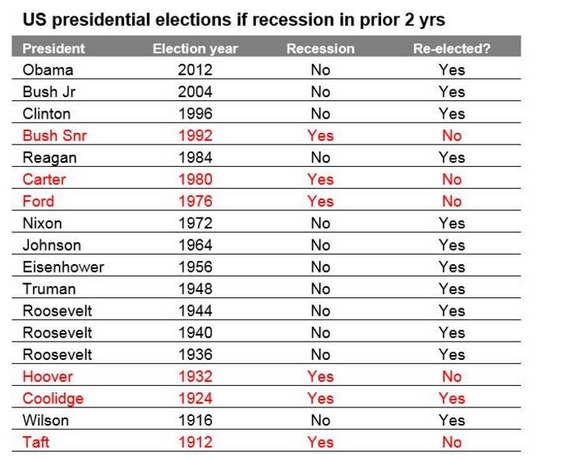
Investor focus on the US election waned earlier this year after socialist Bernie Sanders dropped out of the Democratic primary race in favour of moderate Joe Biden. At the same time coronavirus became the main focus for markets. However, markets may soon start to pay more attention as the election is rapidly approaching, while Joe Biden is a moderate, he is proposing higher taxes and more regulation and President Trump is not having a good run. Trump’s re-election chances have fallen with a majority of surveyed Americans disapproving of his handling of the pandemic and recent civil unrest at a time when the US has plunged into its deepest recession since the 1930s. The historical record indicates incumbent presidents tend to lose when there is a recession in the two years before the election and unemployment has gone up.


Source: Strategas

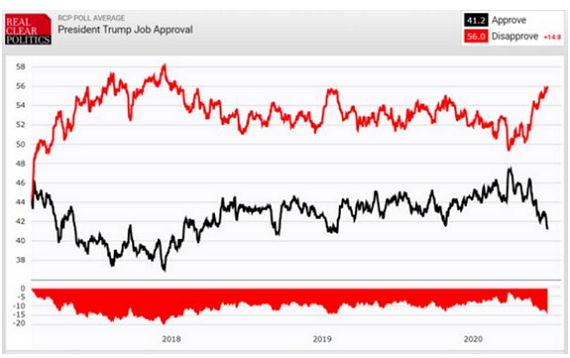
Normally at this point past presidents seeking re-election have started to see an upswing in approval, but this is not evident yet for Trump. Rather, consistent with the above, according to Real Clear Politics’ average of polls Trump’s approval rating has fallen to 41.2% over the last two months, his disapproval rating is edging above its 2019 high, opinion polls have Biden leading Trump by around 9 points and Biden is ahead in all 6 “battleground states”, the ‘Predict It’ betting market, which had Trump ahead of Biden up until late May, now has Biden with a 23 point lead and also now has Democrats winning the presidency, the House and the Senate. The Democrats already have control of the House and are likely to retain that, but they need three seats to then along with the Vice President, gain a majority of the Senate. A clean sweep for the Democrats would remove the Senate as a blockage to higher taxes.


Source: Real Clear Politics

However, it would be wrong to write Trump off. Polls and betting markets were not so reliable in the 2016 election, there are still four months to go to the election & ongoing civil unrest could see him garner support as a “law and order president” as Nixon did in 1968. And Trump rates more highly on the economy than Biden and this may get a boost if the economy continues to reopen and recover. A rebound in the economy is Trump’s best hope which partly explains why he cheered on reopening from the end of April. However, the rebound in US coronavirus cases in many states in the last few weeks puts all this at risk.

Key Biden policy directions versus Trump

Taxation: Biden plans to raise the corporate tax rate to 28% (reversing half of Trump’s cut to 21%), return the top marginal tax rate to 39.6% (from 37%) and tax capital gains and dividends as ordinary income.

Infrastructure: Biden plans to spend $1.3trn over 10 years.

Climate policy: Biden aims for the US to reach net zero emissions by 2050 by raising the cost of fossil fuels & boosting the development of alternatives (possibly with a carbon tax).

Regulation: Biden is likely to end the era of deregulation.

Healthcare: Biden wants to strengthen Obamacare and limit drug prices.

Trade and foreign policy: Biden would likely de-escalate tensions with Europe and strengthen the alliance, work with international organisations like the World Trade Organisation, work to re-establish the nuclear deal with Iran and adopt a more diplomatic approach to dealing with trade & other issues with China (working with Europe and Asian allies in the process). By contrast a re-elected Trump is likely to double down on his trade war with China and possibly elsewhere including Europe.

Budget deficit: For the near term, the budget deficit is likely to remain high whoever wins, but historically they have fallen under Democrats after rising under Republicans. That said, if the economy proves slow to recover Joe Biden may be more likely to respond with large public sector spending programs aided by ongoing Fed quantitative easing in order to deal with ongoing high levels of spare capacity and unemployment.

Economic impact

On their own higher corporate and top marginal tax rates, increased regulation and an increased cost of carbon which will weigh on energy companies when they are already struggling are negative for the growth outlook. For example, the rise in the corporate tax rate would knock around 6% off earnings per share for S&P 500 companies. In particular, they may reverse some of the supply side boost provided by Trump. However, as with all things economic its never as simple as that.

  • First, the negative impact of tax hikes and increased regulation in the short term could be more than offset by increased infrastructure spending (particularly if some of the revenue comes from those with high saving rates). 

  • Second once in office Biden may dampen down his planned tax hikes, particularly if the economy is still weak as is likely. 

  • Third, raising taxes on top earners while a negative for incentive may help reduce inequality which has been a key driver of the populist backlash of recent years and has arguably been made worse by Trump. 

  • Fourth, Biden’s trade and foreign policy focussed more on strengthening ties with Europe and a diplomatic approach to dealing with China may substantially reduce a source of angst and uncertainty under Trump (which is likely to intensify if he is re-elected). 

  • Finally, more stable and predictable policy making reliant on expert advice under Biden may provide a more certain environment for business and so result in increased business investment despite a rise in the corporate tax rate. Don’t forget that the uncertainty caused by Trump’s trade wars offset the boost to investment from his tax cuts.

So, on balance I see no reason to expect a weaker economic and share market outlook under a Biden presidency.

Likely market reaction

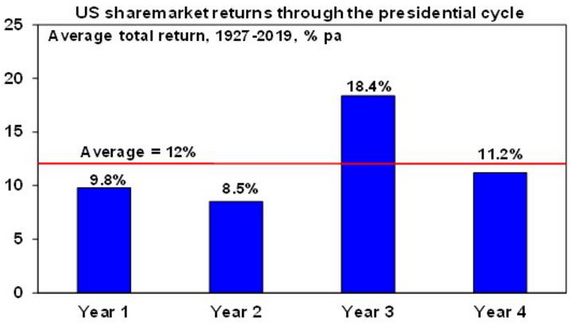
Firstly, despite the heightened policy uncertainty the election year is normally an okay year for US shares.


Source: Bloomberg, AMP Capital

Since 1927, the election year, or year 4 in the presidential cycle, has had an average total return of 11.2% pa, which is only just below the average return for all years. Of course, this year is complicated by the coronavirus hit to growth and so may well be weak regardless of the election.

Second, the run up to the election could see increased share market volatility if Trump’s prospects look bleak for two reasons: investors may start to fret about the prospects of increased taxes and regulation under a Biden presidency, particularly if it looks like Democrats will win control of the Senate; and Trump may reason that he will have nothing to lose by seriously ramping up tensions with China (and maybe Europe) in a way that threatens the economic outlook, but with the prospect of shoring up his base and rallying Americans around the flag. However, while there may be short term jitters ahead of the election, for the reasons noted in the last section, there is no reason to expect a weaker economy and hence share market under a Biden presidency. Investors may ultimately welcome more reasoned and predictable policy making.

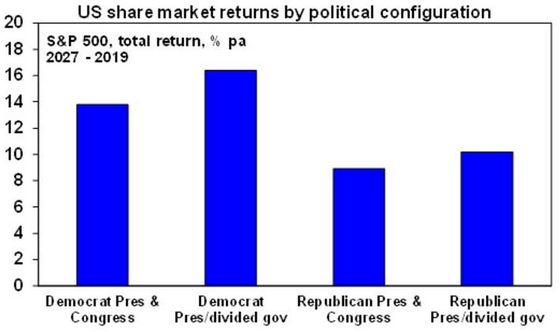
Third, historically US shares have done best under Democrat presidents with an average return of 14.6% pa since 1927 compared to an average return under Republican presidents of 9.8% pa. This has been evident in recent years with good average annual returns under President’s Obama (14.8% pa) and Clinton (19.1% pa) versus terrible returns under President G W Bush (-0.6% pa) but strong returns under President Trump’s first three years (16.3% pa).

However, the best average result has actually occurred when there has been a Democrat president and Republican control of the House, the Senate or both. This has seen an average return of 16.4% pa. By contrast the return has only averaged 8.9% pa when the Republicans controlled the presidency and Congress.


Source: Bloomberg, AMP Capital

Concluding comment

The run up to the US election has the potential to drive increased share market volatility if it looks increasingly likely that Biden will win and raise taxes and regulation and the risk is probably greater if President Trump decides he has nothing to lose and so ramps up tensions with China and maybe Europe. This would weigh on global and Australian shares and the Australian dollar given Australia’s exposure to China. However, this is likely to be short lived as there is no reason to expect a weaker economy and hence share market under a Biden presidency and he is likely to take a less disruptive approach to trade and foreign policy issues.


Source: AMP Capital 30 June 2020

Important notes: While every care has been taken in the preparation of this article, AMP Capital Investors Limited (ABN 59 001 777 591, AFSL 232497) and AMP Capital Funds Management Limited (ABN 15 159 557 721, AFSL 426455) (AMP Capital) makes no representations or warranties as to the accuracy or completeness of any statement in it including, without limitation, any forecasts. Past performance is not a reliable indicator of future performance. This article has been prepared for the purpose of providing general information, without taking account of any particular investor’s objectives, financial situation or needs. An investor should, before making any investment decisions, consider the appropriateness of the information in this article, and seek professional advice, having regard to the investor’s objectives, financial situation and needs. This article is solely for the use of the party to whom it is provided and must not be provided to any other person or entity without the express written consent of AMP Capital.

Gone are the days of childhood watermelon seed spitting competitions, a customary afterschool summer tradition of times gone by. Our kids today won’t get to share these childhood memories, and in fact, most won’t even know that watermelons have seeds, let alone how to spit them.

Meet the new ‘seedless watermelon generation’. A generation of kids influenced by a market where the majority of watermelons sold are seedless, driven in part by the rise of ‘fussy eating’, a phenomenon that as parents and grandparents, we struggle with daily as we worry about whether our kids are getting the right nutrition.  

The fussy eating behaviours of our new generations – so how did we get here?  

The contributing factors are multiplex. Could it be the abundance of food we are so used to in the Western world? Or the advancements in technology allowing for refrigeration and storage? Perhaps the farming techniques that result in food being available across all seasons? Or the consumer push for convenience as we rush through our daily lives trying to meet the demands of work, soccer practice, music rehearsals, homework, all the while trying to squeeze in a few hours of sleep each night – somewhere! Whatever the reason, the reality is ‘fussy eating’ is a thing, and dinner tables are turning into battlegrounds that rival the world wars of years gone by.

So, what can we do about it?  Top 7 tips!

1. Make meal times fun.  

Have a picnic on the trampoline or write a funny note in the lunchbox. Positive Psychology research teaches us that positive emotions open our hearts and our minds, making us more receptive, creative and connected. And this can apply to trying new foods.   

2. Scale back drinks and snacks.  

Sometimes children seem ‘fussy’ but really, it’s just that by the time dinner comes they’re not hungry because perhaps they have been filling up on the ‘not so nutritious’ snacks or juice and other drinks. Serve the veggies first and then leave additional snacks or drinks for after.

3. Set an example with your eating habits

We all know that our children watch our every move and can mimic them to perfection. So, capitalise on this innate ability children have to copy us, positively, by modelling healthy eating behaviours.  

4. Grow your own and get kids to prepare.  

The more a child can be involved in the process of food preparation, the more they will want to try the fruits of their labour. I have delivered cooking programs at schools and the number of times I’ve had parents message to say ‘Little Janey has always refused to eat anything green and now she wants kale for dinner every night’ all because little Janey had a fun time growing and cooking her kale at school. Five-year-olds have the skills to make simple snacks, and by ten, they have the skills to make their breakfast, cook dinner and pack lunch.

5. Coach them.  

Channel your inner soccer Mum or Dad and use your best coaching techniques to talk with your child about the problem (usually the broccoli!) and involve them in the solution. Ask them what is the problem and listen with empathy patiently acknowledging the excruciating mental anguish they experience accompanied with gagging every time they have to even look at broccoli! Dramatic – I know! 

Perhaps share a time when you didn’t like your broccoli (because there was a time when you too made life hell for your parents around the dinner table!). Explain the ‘why’ and align it with something the child values. For example, in the case of my 10-year-old son, who is on the trajectory to be the next soccer superstar (insert Lionel Messi) it’s all about foods that help him play the best soccer – that’s what he values. Then involve them in the solution by asking ‘so, what can we do about it?’. Provide structured age-appropriate choices – for example, ‘you can choose the broccoli or the carrot today’. Providing children of all ages opportunities to use their voices, make decisions, develop ownership, and solve problems invites cooperation and is also a great way to bond with them too.

6. Stick with it.  

Research shows that children need to be exposed to different food 8-10 times for it to be accepted. Try the one bite rule, asking the child to try at least one solid mouthful of a food whenever it is served. After enough exposure, the food hopefully will be more familiar and eaten without any fuss.

7. Celebrate the small wins.  

Whatever strategies you choose to implement, you need to celebrate the small wins – this is the ultimate key to changing habits. Any accomplishment, whether that be having one piece of baby spinach, or having one family dinner without World War III erupting, no matter how small, celebrating activates the reward circuit of our brains, and so we start to get addicted to progress.  

Looking to the future of champion watermelon seed spitters

No matter how frustrating it is when your child stubbornly refuses to try that brussell sprout, try to drum up all your strength and courage to stay positive and implement one of these tips.  Let’s look to the future for a new set of champion watermelon seed spitters!


Source: Emily Connell Nutritional Medicine

Emily is a Nutritional Medicine practitioner, writer, speaker, facilitator and trainer.  Emily combines her passion for Nutritional Medicine with her background in Occupational Therapy, mental health and management to support people to achieve health and inspire wellness.  

Important note:
This provides general information and hasn’t taken your circumstances into account.  It’s important to consider your particular circumstances before deciding what’s right for you. Although the information is from sources considered reliable, we do not guarantee that it is accurate or complete. You should not rely upon it and should seek qualified advice before making any investment decision. Except where liability under any statute cannot be excluded, we do not accept any liability (whether under contract, tort or otherwise) for any resulting loss or damage of the reader or any other person.  Past performance is not a reliable guide to future returns.Any general tax information provided in this publication is intended as a guide. It is not intended to be a substitute for specialised taxation advice or an assessment of your liabilities, obligations or claim entitlements that arise, or could arise, under taxation law, and we recommend you consult with a registered tax agent.

Any information provided by the author detailed above is separate and external to our business and our Licensee. Neither our business nor our Licensee takes any responsibility for any action or any service provided by the author.

Any links have been provided with permission for information purposes only and will take you to external websites, which are not connected to our company in any way. Note: Our company does not endorse and is not responsible for the accuracy of the contents/information contained within the linked site(s) accessible from this page.

 

In his book The Little Book of Common Sense Investing, Vanguard founder Jack Bogle included a very apt quote from Warren Buffet on the matter of market timing. And that is, “for investors as a whole, returns decrease as motion increases”.

In recent times, this seems to be more pertinent than ever.

ASIC last week published a report stating that in the early stages of the COVID-19 crisis when markets were at their most volatile, there was a rapid increase in the frequency of trading by retail investors and a decrease in the time they held onto securities.

In other words, ASIC noticed a concerning surge in the number of retail investors engaging in short term trading strategies and “unsuccessfully attempting to time price trends”.

Many of these retail investors were also completely new to the market, and many were buying and selling complex, high risk investment products.

While the age old philosophy of buy low, sell high seems a simple enough concept, it is definitely easier said than done.

According to the report, on more than two-thirds of the days on which retail investors were net buyers, the price of the shares they bought declined the next day.

Conversely, for more than half of the days on which retail investors were net sellers, their share prices increased over the next day.

Even for the brightest of professional traders, timing the market in such volatility is tough.

For an inexperienced retail investor – and ASIC says there has been a clear spike with new accounts being opened roughly 3.4 times higher during their research period (from February 24 to April 3) while the typical holding period has fallen during significantly and ASIC is clearly warning investors that the pursuit of quick “wins” is more likely to lead to losses.

Do or don’t… but always with discipline

When markets are in turmoil, emotions often are too. Our innate need to be in control can sometimes lead us to making impulsive decisions that don’t benefit a long term goal. Taking control doesn’t necessarily mean taking action (any action!).

In volatile markets, market timing is a dangerous temptation. Vanguard’s own and empirical research conducted both in academia and the financial industry has repeatedly shown that the average professional investor persistently fails to time the market successfully.

But that’s not to say investors should remain complacent when markets are volatile. Being disciplined also means sticking to your investment plan and rebalancing where necessary (although not on a daily basis).

Control your costs

It’s also worth keeping in mind that every trade comes at a literal cost. The more frequently you transact, the more fees you must pay and ultimately the more profit that gets eroded.

Perhaps we can also view costs from an emotional perspective. The stress of monitoring hourly share price swings and overnight market moves surely takes a toll. Not to mention regret over unexpected losses or missed windfalls, hence the saying that opportunities that are clear in retrospect are rarely visible in prospect.

Conclusion

The best chance at investment success doesn’t usually stem from impulsively picking one individual stock over another – and then selling it two or three days later. That is behaviour better characterised as gambling rather than investing.

Rather investing success is more likely to flow from setting goals, taking a portfolio approach and maintaining a long-term perspective and focusing on the factors you can control, such as your asset allocation and costs.

And like Jack Bogle once said, “time is your friend, impulse is your enemy”. Don’t let a turbulent market blow you off course.


Please contact us on Phone: 07 5641 4134 if you seek further assistance on this topic.

Source : Vanguard May 2020 

Written by Robin Bowerman, Head of Corporate Affairs at Vanguard.

Reproduced with permission of Vanguard Investments Australia Ltd Vanguard Investments Australia Ltd (ABN 72 072 881 086 / AFS Licence 227263) is the product issuer. We have not taken yours and your clients’ circumstances into account when preparing this material so it may not be applicable to the particular situation you are considering. You should consider your circumstances and our Product Disclosure Statement (PDS) or Prospectus before making any investment decision. You can access our PDS or Prospectus online or by calling us. This material was prepared in good faith and we accept no liability for any errors or omissions. Past performance is not an indication of future performance.

© 2020 Vanguard Investments Australia Ltd. All rights reserved.

Important: Any information provided by the author detailed above is separate and external to our business and our Licensee. Neither our business nor our Licensee takes any responsibility for any action or any service provided by the author. Any links have been provided with permission for information purposes only and will take you to external websites, which are not connected to our company in any way. Note: Our company does not endorse and is not responsible for the accuracy of the contents/information contained within the linked site(s) accessible from this page.