“Burnout is what happens when you try to avoid being human for too long” – Michael Gungor

Isn’t that the truth. Owning a small business is not for the faint hearted. You start with an idea and your passion sets it on fire. At first working all hours and juggling jobs for other income while you build seemed like nothing. Studying and honing your craft in the pockets of time you had just worked out.

Drive and determination to launch kept you going.

After launch, the late nights just kept coming, then your focus shifted to finding and retaining customers to make the business profitable. Working weekends, missing social and family events as yet another “great idea” has to be explored RIGHT NOW. 

Your relationships become strained from the lack of attention. Your body hits exhaustion from your adrenal glands pumping stress hormones day in and day out as you go-go-go at rapid pace.

One day you wake up and realise this business you’ve created is all consuming. Why does it feel like you’re “doing it all” and getting nowhere?  And the truth is, maybe you don’t even like IT anymore?

Here it comes… hello BURNOUT.

You’ve been running at the same pace for days, weeks, months even years… and you’ve literally held no space for anything else.

 “Burnout is a state of emotional, physical, and mental exhaustion caused by excessive prolonged stress. It occurs when you feel overwhelmed, emotionally drained, and unable to meet constant demands.” Melinda Smith, M.A. (HelpGuide.org)

From this place, I see it go two ways with my coaching clients. 

DOWN… where you end up continuing this cycle and eventually get sick, lose all the passion and drive for your business, lose a relationship, lose yourself in the process. Or, all of these combined from the overwhelming stress and anxiety.

Or, you go UP. You shift your priorities and bring your life back into BALANCE. Focusing on cultivating a healthy relationship with your work, a healthy mindset and body, and spend time reconnecting with the people in your life.

How to get back in balance

The key to living a fulfilled life is balance. Work, rest and play. What is success, if at the end of the day you have no one to share it with? Isn’t one of the fundamental reasons why we start our own business to have the freedom to run your day and make your own decisions?

Getting back into balance means…
1. Tapping out for self-care

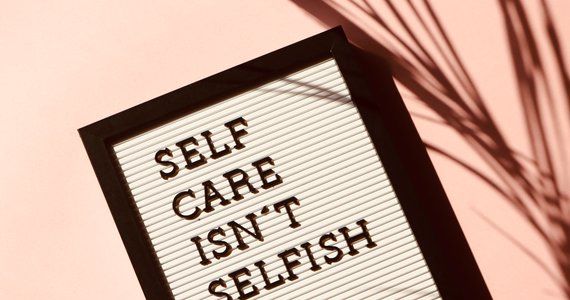
Taking care of yourself is not selfish, it’s necessary. How can you show up and grow your business – if you haven’t first filled your cup? You cannot keep taking from an empty well. 

Self-care isn’t all day spas and attending expensive health-retreats. Take the time to find what self-care looks like for you. Start with this question: 

What is one thing that you haven’t done in a VERY long time that gives you JOY? Go and do that.

2. Tapping out for Exercise

Moving your body is essential to mental wellbeing. Take a walk in the fresh air, go for a jog or bike ride. Book into a gym class or go for a swim. Make time for yoga or paddle boarding. 

Your body deserves love and your energy stores will fire from the movement. It will also help you get better sleep and clear your mind.

Try something you’ve always wanted to do and haven’t made the time to do yet.

3. Tapping out for connection

At our core we ALL crave connection. Relationships start to break when people don’t feel like they’ve been heard or valued. 

When you think of the people you want to share your success with – who are the first 3 people that come to mind? Organise a 1:1 catch up with those 3 people this month. A coffee date or dinner, a weekend trip away, or just a walk in the park. 

If your connection has been strained under the weight of work and time apart then commit to not talking about work AT ALL when you meet. Turn your phone off, ask a lot of questions and actively listen to help rebuild the connection. 

When you make the time to reconnect with yourself and spend time with people that you care about your energy well will be overflowing!

Remaining in balance

Doing it once this month is easy – the key to truly staying IN balance comes down to PRIORITISING and TIME BLOCKING your self-care, exercise and connection time on your calendar on a weekly or monthly basis. 

“I’m too busy” – is a choice.

You would time block for a client, you would do it for a child’s school concert, you would do it for the dog’s vet appointment… so, what prevents you from doing it for yourself?

Carve out the time, you are 100% worth it!

1. The ideal is three times per week you find time for:

  • 1 appt for self-care (or something that fills your wellness well)

  • 1 appt for exercise

  • 1 appt for connection

If you need to start with a baby step until you can get your calendar under control, then PICK ONE for each week of the month. Lock it in

2. You are going to need accountability.  Share your intention with your partner, a friend, your VA or someone at work. Ask that person to keep you accountable for the first couple of weeks until you start to build momentum (and feel how great it is to be back in balance!)

3. Set an ALARM on your phone as a reminder. This may seem like over-kill… but you know that it’s hard to step away when your business has always taken number 1 priority.

Getting your life back in balance may take some time to create this shift in your life. Your body and your mind will thank you for it, and you may just find that your productivity skyrockets and areas of your life start to flourish – because you’ve taken the time to get back in alignment.

I’ll be honest, I am a classic workaholic and I’ve spent a lot of my working life out of balance. Finding ways to balance my day and week was a skill I had to learn.

One thing that helped me was buying a dog. I work from home and besides my daily client video calls I see no one else during the day. I would get so enthused about a project I would work through the entire day without a break. After starting to feel exhausted and suffering migraines (hitting burnout!) my husband suggested we buy a dog…. At first, I wasn’t enthused it felt like another chore on my list. Turns out she is the world’s best “take a break” alarm clock. If I have not walked her by lunchtime, she will sit at my feet nudging me and giving me the guilts FOR HOURS. We walk, I get fresh air and vitamin D, we connect to nature, sometimes I meet new people and mostly I get the time and space my brain needs to rest and recharge. She really has been the best thing I’ve ever done for my business, and healthy addition to our family.

Author: Janel Briggs, Mindset + Business Coach and founder of Janel Briggs Coaching.

Source : Flyingsolo July 2020 

This article by Janel Briggs Coaching is reproduced with the permission of Flying Solo – Australia’s micro business community. Find out more and join over 100K others https://www.flyingsolo.com.au/join.


Important:
This provides general information and hasn’t taken your circumstances into account. It’s important to consider your particular circumstances before deciding what’s right for you. Any information provided by the author detailed above is separate and external to our business and our Licensee. Any information provided by the author detailed above is separate and external to our business and our Licensee. Neither our business, nor our Licensee take any responsibility for any action or any service provided by the author.

Any links have been provided with permission for information purposes only and will take you to external websites, which are not connected to our company in any way. Note: Our company does not endorse and is not responsible for the accuracy of the contents/information contained within the linked site(s) accessible from this page.


Recruitment is one of the many business functionalities that needs to be done differently in a COVID-19 world. Here are some ways keep your hiring efforts up to scratch in a remote work setting.

Hiring new staff has traditionally been a process that business owners have preferred to conduct through in-person interviews.

The belief has always been that meeting a candidate in person allows the recruiter to get a sense of the candidate’s personality through body language and eye contact, and also helps them tap into their own gut feelings about the quality of the person being interviewed.

But, due to the restrictions that have been put in place as a result of the coronavirus pandemic, business owners that are still seeking new talent have been forced to abandon traditional methods of recruitment and conduct interviews remotely.

Adapting to new trends and changes in pace is never easy, and with the concept being completely new for many business owners, the remote recruitment learning curve can be quite steep.

So for those who aren’t quite sure how to go about hiring in a remote work setting, here are some ideas from a couple of remote recruitment experts that can help you master the ability to interview and bring on new candidates from afar.


Choose the right software


Video recruitment technologies are a dime a dozen. Each platform has its own benefits that can appeal to different types of companies and organisations.

According to Hanna Thomas, director of Mint Talent, making sure that your organisation chooses a video recruitment technology that suits its specific needs is an important part of developing an effective remote recruitment strategy.

“There are so many to choose from,” said Thomas, “so I would recommend scheduling live demos with a handful of them and exploring which one can work best for your interview process.”

After finding a video platform that can be tailored to your organisation’s needs, Thomas also suggested that users skill themselves up on how to maximise the platform’s use.

“Train yourself so you know how to use all the platform’s bells and whistles, and make sure you’ve gone through a few tests runs before using it for your first interview.

“Don’t be afraid to ask as many questions as you need to the platform’s support team. That’s what they’re there for.”

Create the right interview environment


While the candidate in question could theoretically be anywhere in the world, it’s important to try and simulate an in-person experience as much as possible when interviewing them remotely.

Thomas believes that a big part of running an effective online interview was treating it like it was happening in person, and the ability to achieve that ultimately comes down to the environment in which the online interview is held.

“As the interviewer, your video background and environment needs to be quiet and simple,” Thomas told The Pulse.

“Arrive to the virtual meeting room early, dress appropriately and make sure there is nothing on your side that can distract you or the candidate.”

In place of being able to keep the interviewee engaged for an extended period of time through energy and chemistry that is generated in person, Thomas suggested that the interviewers find out-of-the-box ways to use the features of the software do achieve this result.

“Avoid allowing your video interviews to become static places with two people’s faces sitting glumly on a screen,” she said.

“Ahead of the interview, encourage to candidate to prepare slides and documents that can be shared on screen.

“As the interviewer, use the opportunity to leverage the online environment to show off your brand in innovative ways.

“Doing this has the potential to engage the candidate more than you might have done in person.”


Keep your recruitment team engaged


The quality of your company’s hiring and onboarding processes is ultimately in the hands of your recruitment team, and while keeping them engaged is always important, doing so in a remote working environment is crucial if positive results are to be achieved.

Aaron Dye, chief executive and founder of Referrer.io, shared his thoughts on how to keep remote recruitment teams engaged, and according to him, a great way to do so is through the use of gamification.

“Gamification has proven to be an effective method of keeping recruitment teams engaged while working in a remote setting,” Dye told The Pulse.

“By creating points, badges and leader boards for recruitment related activities, you’ll find your recruitment teams to be far more engaged in their work, which will lead them to come up with effective results regardless of where they’re working from.”


Preparing for the transition


Even before the start of the COVID-19 pandemic, many organisations had been flirting with the idea of changing many of their existing practices to become remote-friendly, and recruitment was one of those practices.

In many ways, remote recruitment has advantages that make the process far more effective than it is in the flesh. Some of the tech solutions out there can help recruiters make unbiased decisions, they make the process more efficient, and create an environment that offers unique insight into the candidate’s communication skills.

But, the fear of being unable to get a true sense of the candidate’s capabilities remotely had been preventing the practice of remote recruitment from becoming mainstream.

During COVID-19, we are being given the unique opportunity to learn how to master the ability to hire and onboard new staff remotely.

By taking the steps outlined above, you can get integrate remote recruitment into your regular business process, and when the storm finally passes, you’ll be equipped with all the tools necessary to enjoy the many benefits that remote recruitment has to offer.

Source : MYOB May 2020


Reproduced with the permission of MYOB. This article by Benjamin Kluwgant was originally published at https://www.myob.com/au/blog/remote-recruitment-hire-without-shaking-hands/

Important: This provides general information and hasn’t taken your circumstances into account. It’s important to consider your particular circumstances before deciding what’s right for you. Although the information is from sources considered reliable, we do not guarantee that it is accurate or complete. You should not rely upon it and should seek qualified advice before making any investment decision. Except where liability under any statute cannot be excluded, we do not accept any liability (whether under contract, tort or otherwise) for any resulting loss or damage of the reader or any other person. 

Any information provided by the author detailed above is separate and external to our business and our Licensee. Neither our business nor our Licensee takes any responsibility for any action or any service provided by the author. Any links have been provided with permission for information purposes only and will take you to external websites, which are not connected to our company in any way. Note: Our company does not endorse and is not responsible for the accuracy of the contents/information contained within the linked site(s) accessible from this page.
RBA on hold again

As widely expected, the RBA left interest rates on hold again for the fifth month in a row. It still sees its massive March monetary easing package as working as it expected and signalled more bond buying to keep 3-year bond yields at its 0.25% target but this is just a continuation of its Yield Curve Control program as opposed to new easing. It also noted that the coronavirus outbreak in Victoria is adding to the uncertain economic outlook and looks to have downgraded its 2021 growth outlook to +5% growth (from +6%) after an unchanged expectation for a 6% contraction through this year) and now sees the unemployment rate rising to 10% later this year. It reiterated that it remains committed to do “what it can to support jobs, incomes and businesses.” However, while it left monetary policy on hold, with Melbourne now in a stage 4 lockdown, pressure for further stimulus – particularly from the Government but also the RBA is building.

Victorian lockdown to cost at least $12bn

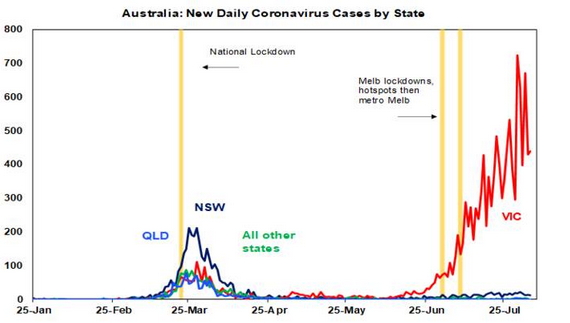
After a stage 3 lockdown of Melbourne for three and a half weeks failed to sufficiently slow new cases, Melbourne has now been placed into a far stricter stage 4 lockdown with the rest of Victoria moving into a stage 3 lockdown, both for six weeks.


Source: Covid19data.com.au, AMP Capital

Based on New Zealand’s experience with a stage 4 lockdown and allowing for the fact that Victoria had never fully recovered from the initial lockdown, we estimate that this will cost the Victorian economy around $12bn to $14bn. This is up from an initial estimate of the cost of the stage 3 lockdown of Melbourne of $5bn.

Prior to the stage 3 lockdown of Melbourne we had been assuming that national GDP would rise 2.5% this quarter after something like a -7 to -8% hit in the June quarter. The rebound in indicators like retail sales following the reopening in May was directionally consistent with this.

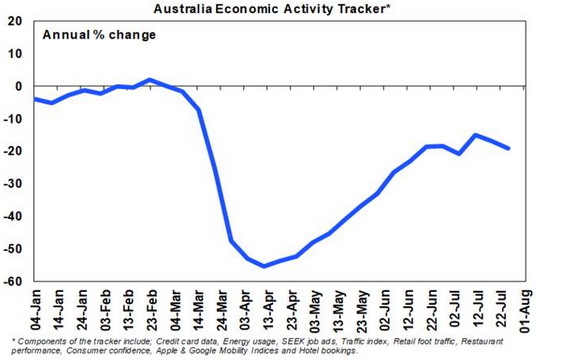
However, a $12bn hit from Victoria would take this back to around flat and negative impacts on confidence could see the economy even decline slightly again in the September quarter. This is consistent with our Australian Economic Activity Tracker of weekly economic indicators like credit card data and job ads flatlining since June after a decent pick up from mid-April.


Source: AMP Capital

Note though, that this would all mask a large contraction in the Victorian economy (25% of national GDP) but growth in the rest of Australia, assuming of course that confidence impacts on the rest of Australia are kept to a minimum and that the virus is contained outside of Victoria.

The net result though could be a further delay in the start of Australia’s overall economic recovery as measured by GDP into the December quarter – assuming that coronavirus is brought under control in Victoria again and that it can safely reopen.

Pressure for more fiscal stimulus…

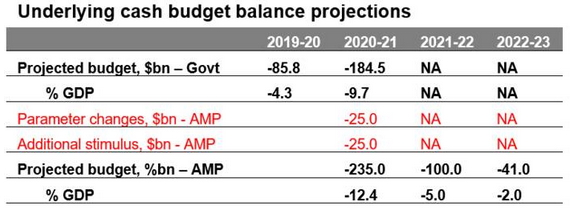
At time of the Federal Government’s Economic and Fiscal Update we felt that the deficit projection of $184.5bn for this financial year was too optimistic and saw it closer to $220bn reflecting softer revenue and more stimulus than the Government was allowing for. The tightening lockdown in Victoria has added to this and we now see the deficit this financial year as ultimately being closer to $235bn. Our revised budget projections are shown below. Of course, these should be treated with greater than normal caution given the uncertain economic outlook.


Source: Australian Treasury, AMP Capital

We are assuming that the slower economy depresses tax revenue by a further $25bn this financial year compared to the Government’s projections (see the line labelled parameter changes) and that an extra $25bn in stimulus occurs. The Federal Government has already announced paid pandemic leave of $1500 for two weeks for Victorians without sick leave but it’s likely that both JobKeeper and JobSeeker will now end up costing more than projected two weeks ago, as hundreds of thousands of Victorian jobs could be impacted by the stage 4 lockdown. Additional stimulus is also likely to come in more industry support packages, a bring forward of the 2022 tax cuts and investment incentives.

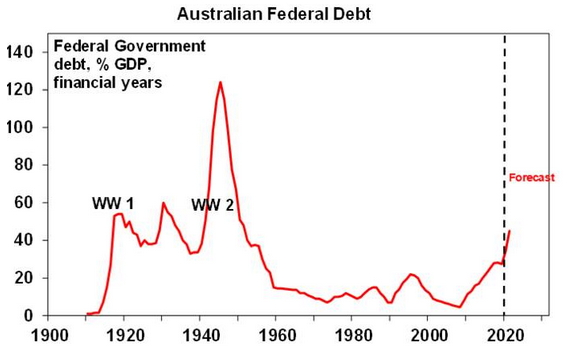
While the deficit and debt blowout to the highest levels since WW2 will alarm some, we remain of the view that without it the economic outlook will be much worse and that its made viable by ultra-low interest rates, Australia’s low starting point deficit and debt levels compared to other advanced countries and Australia’s lack of reliance on foreign capital.


Source: RBA, Australian Treasury, AMP Capital

…and likely more monetary easing

However, while the bulk of the pressure for further economic support stimulus will fall on fiscal policy, the RBA is also likely to end up doing more too. In terms what the RBA might do if it does ease further in the months ahead – it has all but ruled out negative interest rates, foreign exchange intervention and the direct monetary financing of government spending. But it sees still lower but positive interest rates and the purchase of more government bonds beyond what’s necessary to achieve the 3- year bond yield target of 0.25% as possible options. A rate cut to 0.1% would hardly be worth the effort (but they may still do it) which leaves more quantitative easing as the main tool for further easing. The latter could take the form of bond purchases beyond 3-year bonds and a possible target for the value of bond purchases. Meanwhile, rate hikes are at least three years away.

Concluding comment

All of this begs the question: why are shares holding up so well? The answer is simple – while the second wave of coronavirus cases has increased the uncertainty around the economic outlook, its being offset by more positive signs of containment (fingers crossed) and hence recovery outside Victoria, ongoing positive signs regarding coronavirus treatments and an eventual vaccine globally, policy stimulus supporting the economy and ultra-easy monetary policy making shares look relatively cheap. So, we remain of the view that while shares are vulnerable to corrections, they are likely to rise on a 6 to 12-month horizon.


Source: AMP Capital 5 August 2020

Important notes: While every care has been taken in the preparation of this article, AMP Capital Investors Limited (ABN 59 001 777 591, AFSL 232497) and AMP Capital Funds Management Limited (ABN 15 159 557 721, AFSL 426455) (AMP Capital) makes no representations or warranties as to the accuracy or completeness of any statement in it including, without limitation, any forecasts. Past performance is not a reliable indicator of future performance. This article has been prepared for the purpose of providing general information, without taking account of any particular investor’s objectives, financial situation or needs. An investor should, before making any investment decisions, consider the appropriateness of the information in this article, and seek professional advice, having regard to the investor’s objectives, financial situation and needs. This article is solely for the use of the party to whom it is provided and must not be provided to any other person or entity without the express written consent of AMP Capital.

At its meeting today, the Board decided to maintain the current policy settings, including the targets for the cash rate and the yield on 3-year Australian Government bonds of 25 basis points.

The global economy is experiencing a severe contraction as countries seek to contain the coronavirus. Even though the worst of this contraction has now passed, the outlook remains highly uncertain. The recovery is expected to be only gradual and its shape is dependent on containment of the virus. While infection rates have declined in some countries, they are still very high and rising in others. International trade remains weak, although there has been a strong recovery in industrial activity in China over recent months.

Globally, conditions in financial markets remain accommodative. Volatility has declined and there have been large raisings of both debt and equity. The prices of many assets have risen substantially despite the high level of uncertainty about the economic outlook. Bond yields remain at historically low levels.

The Bank’s mid-March package of support for the Australian economy is working as expected. There is a very high level of liquidity in the Australian financial system and borrowing rates are at historical lows. Authorised deposit-taking institutions are continuing to draw on the Term Funding Facility, with total drawings to date of around $29 billion. Further use of this facility is expected over coming months.

Government bond markets are functioning normally alongside a significant increase in issuance. The yield on 3-year Australian Government Securities (AGS) has been consistent with the target of around 25 basis points. The yield has, however, been a little higher than 25 basis points over recent weeks. Given this, tomorrow the Bank will purchase AGS in the secondary market to ensure that the yield on 3-year bonds remains consistent with the target. Further purchases will be undertaken as necessary. The yield target will remain in place until progress is being made towards the goals for full employment and inflation.

The Australian economy is going through a very difficult period and is experiencing the biggest contraction since the 1930s. As difficult as this is, the downturn is not as severe as earlier expected and a recovery is now underway in most of Australia. This recovery is, however, likely to be both uneven and bumpy, with the coronavirus outbreak in Victoria having a major effect on the Victorian economy. Given the uncertainties about the overall outlook, the Board considered a range of scenarios at its meeting. In the baseline scenario, output falls by 6 per cent over 2020 and then grows by 5 per cent over the following year. In this scenario, the unemployment rate rises to around 10 per cent later in 2020 due to further job losses in Victoria and more people elsewhere in Australia looking for jobs. Over the following couple of years, the unemployment rate is expected to decline gradually to around 7 per cent.

The Board also considered other scenarios. A stronger recovery is possible if progress is made in containing the virus in the near future. This progress would support an improvement in confidence and a less cautious approach by households and businesses to their spending. On the other hand, if Australia and other countries were to experience further widespread lockdowns, the recovery in both output and the labour market would be delayed. Details on these scenarios will be provided in the Statement on Monetary Policy on 7 August.

In each of the scenarios considered by the Board, inflation remains below 2 per cent over the next couple of years. In the most recent quarter, CPI inflation fell to –0.3 per cent in year-ended terms, reflecting lower oil prices and the effects of various policy measures, including the decisions to make child care and some pre-school free for a period. Inflation is expected to return to positive territory in the current quarter. Beyond that, given the ongoing spare capacity in the economy, inflation is expected to average between 1 and 1½ per cent over the next couple of years.

As Australians deal with the coronavirus, the economy is being supported by the substantial, coordinated and unprecedented easing of fiscal and monetary policy. The Australian Government’s recent announcement that various income support measures will be extended is a welcome development and will support aggregate demand. It is likely that fiscal and monetary stimulus will be required for some time given the outlook for the economy and the labour market.

The Board is committed to do what it can to support jobs, incomes and businesses in Australia. Its actions are keeping funding costs low and assisting with the supply of credit to households and businesses. This accommodative approach will be maintained as long as it is required. The Board will not increase the cash rate target until progress is being made towards full employment and it is confident that inflation will be sustainably within the 2–3 per cent target band.

Source: Reserve Bank of Australia, August 4th, 2020

Enquiries

Media and Communications
Secretary’s Department
Reserve Bank of Australia
SYDNEY

Phone: +61 2 9551 9720
Email: rbainfo@rba.gov.au

Portfolio construction is always a popular topic among investors, but as markets become more volatile, the practice of carefully piecing together a jigsaw of investments that weathers both good times and bad is particularly relevant.

Effective portfolio construction is essential to successful investing, but many investors struggle to understand the underlying concepts, much less put them into practice.

Fortunately, constructing an investment portfolio that suits your needs and delivers your goals is simpler than it sounds.

The first step to effective portfolio construction is simply knowing what you want to achieve.

Every portfolio has a purpose. It might be to fund your retirement or to provide an inheritance for the children. It might be to pay for education or housing.

Understanding your purpose and setting a goal for your portfolio lets you plan for how much you need to invest and how long you have for your savings to grow.

Good portfolio goals are measurable, attainable and based on reasonable assumptions. That means they do not require impracticable savings targets, lucky breaks or unlikely investment outcomes.

Take the example of an investor who needs to save $1 million in today’s dollars to comfortably retire and has 40 years of working life left to do it.

If that investor makes a $10,000 deposit today and saves the same inflation-adjusted amount every year for the 40 years, the real required rate of return from the portfolio only needs to be an achievable 4 per cent per year.

The portfolio construction process begins with this kind of plan.

From there, the next decision is to select the assets that will deliver the required 4 per cent return without exposing the investor to needless risk.

There are three main asset classes for investors to consider: equities, fixed income and cash.

There is also a wide range of sub-groups like real estate, infrastructure and commodities, but most diversified investors will have exposure to them through the equities asset class.

Asset classes are best understood by the way they typically perform in terms of risk and return.

Equities, or shares in stock market-listed companies, are characterised by demonstrating the highest historical return of the three, but with an associated higher risk of loss.

Fixed income investments like government and corporate bonds tend to provide lower returns but come with lower risk of losing money.

Finally, cash provides both low return and very low risk and protects you from the risk of being forced to sell other assets, but its value is continually eaten away by inflation.

So how do investors balance the three?

The aim is to find a way to deliver enough return to achieve the goal while minimising the risk of permanently losing capital on the way.

This concept of risk is worth exploring. Many investors conflate risk with volatility but for a regular investor with a defined goal, a better definition of risk is the chance of losing money at the very point you need it.

A period of negative returns in the market – as we are likely to see in the coming years – may not be a risk for someone willing to wait until the market recovers, thereby avoiding selling during the downturn.

But if another investor needs the money and has to sell at lower prices, that becomes a permanent loss of capital – the definition of risk.

This risk of permanent loss is why younger people can comfortably take more risk in their investments – and thus aim for a higher return – than someone nearer retirement.

A 35-year-old has at least 30 years of earning income ahead of them, allowing market downturns to run their course. Their income covers their living expenses, so they don’t need to withdraw investments at depressed prices, and they even get more assets for every dollar they invest during the downturn. This means they can lean towards equities which offer higher returns at higher risk.

Someone in their 50s has 15 years left of income to recover losses and might choose to take slightly less risk in their investments by reducing their equity holdings.

A retired person has no easy way to add to their investments so if they are forced to withdraw at depressed prices, they suffer permanent loss. In retirement, an even more conservative portfolio might be suitable.

For all investors, constructing a diversified portfolio spread across the three asset classes is the best way to reduce the risk of permanently losing money.

Asset allocation is a surprisingly powerful tool.

Repeated studies show that the vast majority of variability in portfolio returns is explained by asset allocation rather than stock selection or market timing.

So, by simply selecting an asset class mix that suits your risk and return needs – and then buying a widely diversified bundle of investments matching that mix – most of the work of portfolio construction is done with no need to worry about individual investments at all.

Contrast this kind of steady, planned, top-down approach with the bottom-up, investment-collecting approach many investors take.

By buying individual stocks and funds without giving thought to the overall portfolio construction, investors are introducing unnecessary risk to their investments and crimping potential returns.

Portfolios built this way often show concentration in an industry or sector and are prone to being buffeted by volatility and attempts at market timing.

A well-constructed portfolio should also diversify by holding assets across a variety of countries, sectors and industries. Investors may even want to consider a mix of investment styles by holding active managers alongside index funds.

By holding hundreds or thousands of individual securities, the chances of any one of them affecting total returns is minimised.

The next factor to consider is fees. One of the best predictors of the future performance of an investment is the fee it charges. Some find it surprising, but the cheaper the fee, the better the performance. This is because the less you pay in costs, the more of an investment’s return you get to keep.

Minimising costs is a crucial part of portfolio construction.

And finally, once the portfolio is in place, the critical trick is to stay the course.

Too many investors have been provoked by market swings to buy and sell at the wrong time, driven by fear or impulse.

A disciplined, long-term approach – rebalancing from time to time to stay within a chosen asset allocation and adjusting the risk profile as you age – gives you the best chance of achieving your goal.

Written by Robin Bowerman, Head of Corporate Affairs at Vanguard.

Please contact us on Phone: 07 5641 4134 if you seek further assistance on this topic .

Source : Vanguard July 2020 

Reproduced with permission of Vanguard Investments Australia Ltd

Vanguard Investments Australia Ltd (ABN 72 072 881 086 / AFS Licence 227263) is the product issuer. We have not taken yours and your clients’ circumstances into account when preparing this material so it may not be applicable to the particular situation you are considering. You should consider your circumstances and our Product Disclosure Statement (PDS) or Prospectus before making any investment decision. You can access our PDS or Prospectus online or by calling us. This material was prepared in good faith and we accept no liability for any errors or omissions. Past performance is not an indication of future performance.


© 2020 Vanguard Investments Australia Ltd. All rights reserved.

Important: Any information provided by the author detailed above is separate and external to our business and our Licensee. Neither our business nor our Licensee takes any responsibility for any action or any service provided by the author. Any links have been provided with permission for information purposes only and will take you to external websites, which are not connected to our company in any way. Note: Our company does not endorse and is not responsible for the accuracy of the contents/information contained within the linked site(s) accessible from this page.
Corporate Wellness is emerging as crucial for SMEs preparing for return to work. Here’s what you need to consider.

As businesses scramble to find the best way to safely welcome staff back into the workplace, the concept of ‘Corporate Wellness’ will be front of mind. Particularly given that COVID-19 has put an extra layer of pressure on staff in the workplace.

It’s a concept that has been a keen focus for governments and employers internationally for a number of years. Which is hardly surprising given that we spend approximately one-third of adult life at work.


Employee wellbeing is a costly problem


One report reveals that employers bear many of the indirect costs associated with chronic disease and ill health. In fact, the estimated cost of absenteeism to the Australian economy alone is $7 billion each year.

Meanwhile, the cost of presenteeism (not fully functioning at work because of medical conditions) is nearly four times more than absenteeism, at almost $26 billion, the report reveals.

Meanwhile, lifestyle-related illness has a huge impact on the already crumbling economy.

One study conducted last year reveals that annual productivity loss of up to $14.9 billion could be attributed to obesity, and up to $10.5 billion due to tobacco.

The role of mental health plays a huge part too. Not only does a person’s mental state affect their capacity to act in a safe way, it also affects their perception of risk. Meanwhile, the same report reveals that there is evidence that the evidence of workplace stress is growing.


The post-lockdown return to work


And as small business owners scramble to cope with lockdown and eventually map out a safe way for employees to return to the workplace, Corporate Wellness will no doubt be part of their considerations.

Well before the coronavirus and lockdowns, employees were already considered to be working longer hours and dealing with greater levels of stress than ever before.

Some businesses have been contemplating how to adopt corporate wellness strategies to retain their best people and ensure they’re at the top of their game.


Employers’ duty of care


Corporate Wellness expert Rob Lyon is the founder of Lyon Health. He’s been working in this space for 15 years, and says that Corporate Wellness is far more than just about adding a well-stocked fruit basket to the lunchroom.

During some 20-minute health consultations, employees reveal that they haven’t talked about their own health in many years and are grateful for the opportunity to do so in the workplace, he said.

In this day and age, businesses have a duty of care to consider when it comes to considering the health and wellness of each and every employee, he said.

“When you’re hiring the best and the brightest into your business and paying them $100,000 a year, you want to be making sure they’re operating at their best. Corporate Wellness is fast becoming an important part of dealing with burn-out, stress and anxiety,” said Lyon.

Lyon admits that measuring the impact of wellness programs within a business can be difficult to quantify.

There are no industry standards to measure against, and there are no stand formulas used to assess return on investment.

But indirect benefits to businesses include better productivity levels, improved employee retention, greater decision-making skills and better team unity among staff.


Seeking wellness in lockdown


The loss of the workplace community and culture has been tough during lockdown, but businesses have been adapting, he said.

Virtual group yoga sessions and regular video calls to check in with staff can be extremely important for employees.

Small businesses should look for ways to maintain a cohesive group nature. For example, meeting up at 8.30am and going for a walk together and grabbing a coffee and a chat on the way to the office can have a huge impact on mental health for employees, he added.

READ: Why mindfulness practices are good for business owners


Addressing Corporate Wellness doesn’t have to be costly


Some of Lyon’s clients invest around $45,000 a year on rolling out his programs, which aim to bolster employee productivity, fitness, health and wellness.

But small businesses looking to implement some elements of Corporate Wellness don’t need to spend a fortune.

Lyon suggests starting small. For example, introducing psychology services into the workplace, or sharing government-led information about the importance of Mental health, such as this Corporate Toolbox, which is free.

Encouraging staff to take care of the health basics – two litres of water a day, 10,000 steps a day and six to eight hours of quality sleep is a must through these uncertain times.

You can also create routines for staff that help employees strive.

“Allow more flexible work from home policies, look at moving the goalposts on KPIs and take care of them mentally and emotionally.

“Doing good for others in these ways makes you feel good about yourself,” said Lyon.

Source : MYOB July 2020

Reproduced with the permission of MYOB. This article by Nina Hendy was originally published at https://www.myob.com/au/blog/corporate-wellness-is-a-priority-now/

Important: This provides general information and hasn’t taken your circumstances into account. It’s important to consider your particular circumstances before deciding what’s right for you. Although the information is from sources considered reliable, we do not guarantee that it is accurate or complete. You should not rely upon it and should seek qualified advice before making any investment decision. Except where liability under any statute cannot be excluded, we do not accept any liability (whether under contract, tort or otherwise) for any resulting loss or damage of the reader or any other person.

Any information provided by the author detailed above is separate and external to our business and our Licensee. Neither our business nor our Licensee takes any responsibility for any action or any service provided by the author. Any links have been provided with permission for information purposes only and will take you to external websites, which are not connected to our company in any way. Note: Our company does not endorse and is not responsible for the accuracy of the contents/information contained within the linked site(s) accessible from this page. 
 

Financial year 2019-20 is now behind us and there’s nothing like closing a chapter to inspire thoughts of a fresh start. But global challenges persist: Australia is officially in a recession while also bracing for a post-JobKeeper economy in September.

While it’s impossible to anticipate future changes to the global economy, there’s plenty you can do to help prepare your personal finances for an unpredictable future. A new financial year is a great time for a check-up and to set yourself new financial goals.

Know your current financial position

The best way to know where you’re headed is to understand exactly where you are. Getting a clear financial picture of your current position – even if it’s one that you’re hoping to improve – is key to unlocking a financial future that you can control.

Start by totalling your monthly expenses and looking at your income. By looking at these two things in detail, you might uncover some unnecessary costs that could be trimmed from your budget. One of the quickest ways to do this is with an automated budget tracker, which automatically tracks and organises all your spending into relevant categories. If you’re an AMP client, the Money Manager tool creates a budget based on your transaction history. If your expenses are higher than you’d like, have a look at where you can curb costs and improve your cash flow.

Don’t forget to look at your liabilities, too. How much is your credit card debt? Do you have a car loan that’s eating into a possible savings plan and stopping you from achieving your long-term financial goals?

If you have similar information about your finances from last year, use this time to make an annual comparison of your income, expenses and liabilities. Maybe you’ve done better than you think, in which case, it’s cause for celebration. If not, you’ll have an idea of how much you need to recoup or alter in order to improve your situation this year.

Once you’ve got a grasp of your starting position, don’t just forget about it. Keep it somewhere you can refer back to this time next year – or even more frequently – to measure your progress.

Shift your mindset around money

Although we tend to think of money in dollars and cents, there’s a significant psychological component to personal finance. Recent research has found that 81 % of Australians ‘comfort spend’ to try to improve their mood; this is a staggering combined total of $25.5 billion a year1.

In addition to simply crunching the numbers, it’s worth taking a closer look at your mindset around money. Renowned psychologist Carol Dweck has spent decades exploring the importance of embracing a ‘growth mindset’, an approach that honours effort and perseverance in reaching goals, as opposed to the ‘fixed mindset’, which suggests our circumstances are unchangeable because our traits are predetermined2.

What does this have to do with your money? Dweck’s research suggests we can stay motivated by focusing on what is within our control: knowing that the changes we implement have a real effect on the outcome constitutes a growth mindset, and is more likely to serve us in planning our financial future.

Focus on what you can control

Some spending, such as utility bills and groceries, are inevitable and a necessary part of life. But it’s still possible to focus on those things that are within your control, linking back to Dweck’s research. For example, you could take some time to research ways to save money and switch to a cheaper energy plan, purchase home-brand groceries rather than more expensive options, or wait for certain items to go on sale.

Alternatively, you could commit to a more conscious approach to purchasing, such as mindful spending, as a way of curbing expenses and heightening awareness of where your money is heading. Try the seven-day rule as an easy way to cut down on impulse purchases and gain more control over every dollar in your budget.

Make clear plans

Getting clear on a plan for the future is a great way to achieve objectives for the financial year ahead. Setting goals that fall under the SMART category (that is, they are specific, measurable, attainable and realistic goals that adhere to a timeframe) is a popular way to approach your financial objectives. Some studies have found a 76% success rate3 for those who write their SMART goals down.

You could also try the ‘if-then’ strategy, which links a certain outcome with actionable behaviour. For example: ‘if I don’t pay off my credit card by November, I’ll stop buying my morning coffee for a month’. People who implement this strategy are up to 300% more likely to tick things off their list4.

Then, channel your goals into an actionable plan that works for you. Use a budget planner calculator or use a calendar to remind you of major bills and expenses throughout the next year, including car insurance and registration costs, quarterly strata fees for any properties or loan repayments.

Celebrate your financial success

A common problem with the concept of a budget is that it seems prohibitive. It’s all about what you can’t spend, which can have a negative connotation. Switch things up and make an effort to celebrate those times when you’ve made strides in your financial situation, whether it’s paying off debt or getting closer to that savings goal.

Keeping track of your starting position at the outset of the financial year can also help with this as you can measure your progress and goals in facts and figures. Please contact us on Phone: 07 5641 4134 if you need further assistance on this topic.


1. Mozo: Mozo’s Comfort Spending Report – 2019
2. Mindset Works: The Impact of a Growth Mindset
3. Michigan State University: Achieving your goals: An evidence-based approach
4. Harvard Business Review: Get Your Team To Do What It Says It’s Going To Do
#.  Harvard Business Review: Get Your Team To Do What It Says It’s Going To Do
^.  Mozo: Mozo’s Comfort Spending Report – 2019
*.  Michigan State University: Achieving your goals: An evidence-based approach


Source : AMP July 2020 

Important: This information is provided by AMP Life Limited. It is general information only and hasn’t taken your circumstances into account. It’s important to consider your particular circumstances and the relevant Product Disclosure Statement or Terms and Conditions, available by calling Phone: 07 5641 4134, before deciding what’s right for you.

All information in this article is subject to change without notice. Although the information is from sources considered reliable, AMP and our company do not guarantee that it is accurate or complete. You should not rely upon it and should seek professional advice before making any financial decision. Except where liability under any statute cannot be excluded, AMP and our company do not accept any liability for any resulting loss or damage of the reader or any other person. Any links have been provided for information purposes only and will take you to external websites. Note: Our company does not endorse and is not responsible for the accuracy of the contents/information contained within the linked site(s) accessible from this page.
The price of gold has now broken out to a record high and the Australian dollar has risen 30% from its coronavirus panic low in March and broken above $US0.70. What’s driving this and what does it mean for investors? This note looks at the main issues.

The US dollar looks to have peaked

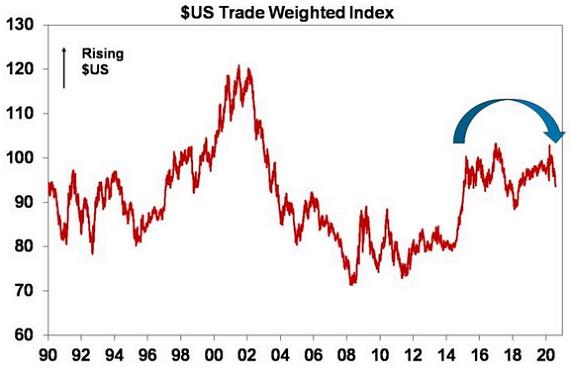
The recent surge in gold and the Australian dollar have one thing in common – namely an emerging breakdown in the US dollar. The $US surged during the early phase of the coronavirus panic in response to safe haven demand. The US economy has less exposure to cyclical sectors (like manufacturing, materials and financials) and a greater exposure to growth sectors like IT & health (that benefit from coronavirus) compared to the rest of the world. This means capital flows into the US when global growth slows and back out again when it picks up. Right now, the $US looks to be breaking down.


Source: Bloomberg, AMP Capital

From its March coronavirus panic high the US dollar index has fallen 9%. There are several reasons why the US dollar has likely peaked and will decline over the next six to 12 months.

  • First, the gap between US and global interest rates has now collapsed as the Fed has cut rates to zero making the US dollar less attractive to investors.

  • Second, the trade weighted US dollar has become expensive based on relative price levels (or what is often referred to as purchasing power parity).

  • Third, the Fed has been relatively more aggressive in its quantitative easing program than many other central banks which has increased the relative supply of US dollars.

  • Fourth, the Eurozone seems to be getting its act together relative to the US in terms of fiscal stimulus which makes the Euro (the main anti-dollar) relatively more attractive.

  • Fifth, a recovery in global growth (albeit a faltering one given the ongoing threat from coronavirus) is likely to hurt the US dollar reflecting the relatively lower cyclical exposure of the US. In other words, safe haven demand for the US dollar is likely to recede. This may be accentuated by the US’ relatively poor control of coronavirus.

  • Finally, for the technically minded, in early July the US dollar registered a so-called death cross with the 50-day moving average falling below the 200-day moving average. It’s also seen a double top with its late 2016 high

Historically, a falling US dollar is often seen as a sign that global reflation is working and that confidence may be gradually returning regarding the outlook for the global economy. If the $US has peaked then its good news for emerging countries (which often have US dollar debt) and positive for commodities including gold, and consistent with a rising trend for the Australian dollar – both of which we are now seeing. This partly reflects the reality that it’s all relative and so a falling US dollar naturally pushes up the price of gold and the $A as they are priced in US dollars. But there are other factors at play as well.

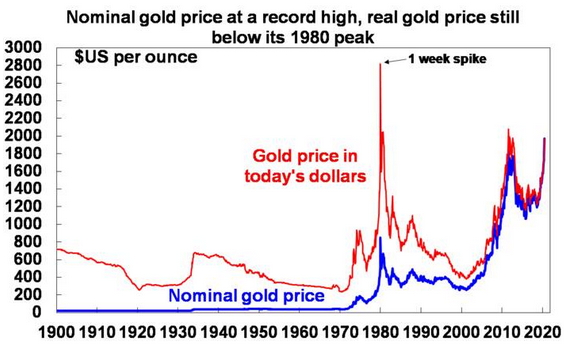
Gold taking out its 2011 record high

The next chart shows the price of gold since 1900 both in nominal and real terms. Until the early 1970s, the US dollar was fixed against gold. This was subject to periodic devaluations, such as in 1934. From the early 1970s to 1980 gold was in a secular upswing as investors turned to gold for protection against inflation. However, from 1980 to 1999 gold was in a secular downtrend as inflation was brought under control. The 2000’s saw gold enter another secular upswing in line with other commodities and despite a brief interruption at the time of the GFC, this got a further push along with the Eurozone debt crisis and more central bank monetary easing into 2011 which saw gold peak at $1921 in 2011. But this gave way as global growth improved with gold falling into 2015. However, since then, gold has surged again, and has now surpassed its 2011 high, albeit its yet to take out its 1980 price peak in real terms of $US819 in today’s prices (albeit it was just a one-week spike).


Source: Global Financial Data, AMP Capital Investors

Along with the fall in the US dollar several other factors have helped push the price of gold up:

  • First, some have been buying gold as a hedge against inflation on the basis that quantitative easing (which involves using printed money to buy financial assets) will generate higher consumer price inflation. 

  • Second, gold is seen as a good alternative to major paper currencies which some see as being at risk thanks to renewed money printing and surging public debt levels. Notably on this front gold has risen against most currencies.

  • Third, and perhaps most importantly, the opportunity cost of holding gold versus cash or government bonds as an alternative store of value has collapsed again thanks to the renewed collapse in interest rates and bond yields.

Gold likely has more upside until central banks start to tighten and bond yields rise significantly, which looks to be a while off.

Some might see the surge in the gold price as a bad sign, but given the mixed factors driving it higher its ambiguous as to whether its good or bad. But the fall in the $US is more clearly a positive than a negative in terms of what it signals about the global economy and falling safe haven demand from investors.

Should investors consider gold?

There are numerous ways to get exposure to gold, all with their pros and cons:

  • Physical gold – gives pure exposure but its costly to store.

  • Gold futures – no storage problem here & easy to leverage up but need to roll futures contracts over as they expire. 

  • Gold exchange traded funds – these are highly liquid but do involve counterparty risk.

  • Gold shares – these reflect gold prices but are also affected by the performance of the individual companies. 

  • Gold funds provide an exposure to gold – these may reflect a combination of the above.

But its worth stressing that gold is highly speculative. It’s not grounded by an income stream like most shares, property, bonds and cash. Virtually all the gold ever produced still exists and can potentially come back on to the market. At the same time, actual production and demand for jewellery and industrial use is trivial relative to the huge gold stock. As a result, ‘animal spirits’ can play a huge role in the determination of the gold price. This can make for a volatile ride and history has shown that the gold price goes through long term upswings and downswings. Sooverall, we think there may be a role for gold in investors’ portfolios as a hedge against major paper currency weakness/inflation, but it should be limited to maybe no more than 5% (depending on an investors’ circumstances).

Five reasons why the $A is likely to head higher too

The $A has broken above $US0.70 having bottomed out at the height of the coronavirus panic in March at around $US0.55. Just like gold it’s being driven higher by a combination of:

  • First, a falling US dollar for the reasons noted earlier. 

  • Second, the Fed printing more US dollars than the RBA is printing Australian dollars. 

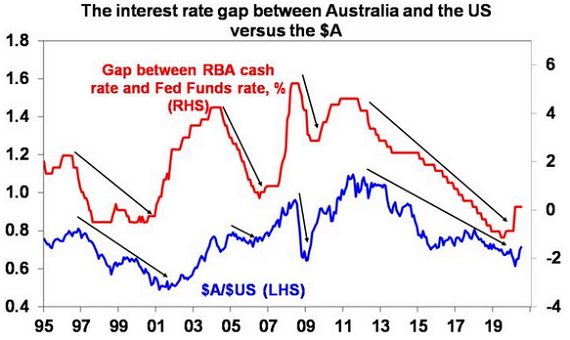
  • Third, the interest rate different between Australia and the US looks to have bottomed with the Fed cutting to near zero. As can be seen in the next chart, periods of a low and falling interest rate differential between Australia and the US usually see a low and falling $A and vice versa.


Source: Bloomberg, AMP Capital

  • Fourth, rising commodity prices with iron ore above $US100/tonne, metal prices up nearly 30% from March lows to be around pre coronavirus levels and oil prices having more than doubled since April.

  • Fifth, high commodity prices along with strong export volumes to China and a rising net equity position in Australia’s favour is helping to maintain Australia’s current account surplus. This in turn means that Australia is not dependent on foreign capital.

  • Finally, there is reason for optimism that Australia will recover faster than the badly coronavirus hit US.

For all these reasons I expect the Australian dollar will continue to rise and is likely to be above $US0.75 by year end.

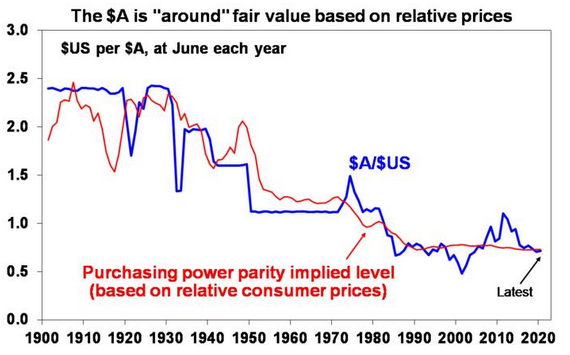
At this point, the Australian dollar is still around fair value (which is around $US0.73 based on purchasing power parity) and the rebound is consistent with underlying fundamentals such as commodity prices. But if it rises rapidly above fair value in the absence of fundamental support such that the RBA starts to see it as a threat to the recovery, expect it to respond with more quantitative easing, not negative rates and foreign exchange intervention as the RBA is not keen on either of these.


Source: RBA, ABS, AMP Capital

What does a rising $A mean for Australian investors?

Basically, it means that the case to maintain a large exposure to offshore assets that are not hedged back to Australian dollars has weakened. Of course, maintaining a position in foreign exchange for Australian-based investors against the $A provides some protection should things on the coronavirus front deteriorate badly here in Australia or globally.


Source: AMP Capital 28 July 2020


Important notes:
While every care has been taken in the preparation of this article, AMP Capital Investors Limited (ABN 59 001 777 591, AFSL 232497) and AMP Capital Funds Management Limited (ABN 15 159 557 721, AFSL 426455) (AMP Capital) makes no representations or warranties as to the accuracy or completeness of any statement in it including, without limitation, any forecasts. Past performance is not a reliable indicator of future performance. This article has been prepared for the purpose of providing general information, without taking account of any particular investor’s objectives, financial situation or needs. An investor should, before making any investment decisions, consider the appropriateness of the information in this article, and seek professional advice, having regard to the investor’s objectives, financial situation and needs. This article is solely for the use of the party to whom it is provided and must not be provided to any other person or entity without the express written consent of AMP Capital.

In the current low interest rate environment, an investment product offering low-risk, high returns may sound very tempting.

That’s especially when the offeror implies it has the personal backing of the chairman of Australia’s corporate regulator, the Australian Securities and Investments Commission (ASIC), by using his name and photos.

Unfortunately, though, it’s just one example of a recent investment scam uncovered by ASIC, and it highlights an alarming rise in fraudulent activities targeting investors since the onset of the COVID-19 pandemic.

Investment scams are a huge and growing problem, and they’re becoming more and more sophisticated through the use of fake websites, media releases and stolen company logos.

In the past fortnight, regulators including ASIC, the US Securities and Exchange Commission, and the UK’s Financial Conduct Authority have all issued warnings around a surge in investment scams.

They include outright fraudulent schemes, where there are no actual underlying investments involved, and the promotion of crypto currency assets and foreign exchange products, with fake endorsements from celebrities or government agencies.

In the US, there has also been a sharp rise in fraudulent stock promotions and market manipulation, with more than 30 companies suspended since the start of this year. A number of those relate to companies having made false claims of being awarded large medical supplies contracts related to COVID-19.

Fraudsters also have been busy taking advantage of the volatile markets to tout “safe” or “bottomed out” investments in companies that purportedly have interests in commodities such as gold, silver, or oil and gas.

Others activities involve fraudulent investment offers by unregistered companies, with reports by ASIC of companies asking consumers to pay money for financial products or services into different bank accounts each time funds are transferred.

Since the onset of COVID-19, ASIC has detected a 20 per cent rise in the number of investment scam reports from Australian consumers and investors.

ASIC is particularly concerned about the risk to consumers and investors of losing money when buying into crypto-currency assets, with most investment opportunities appearing to be outright scams.

Who is being targeted?

According to the Australian Competition & Consumer Commission (ACCC)’s just-released Targeting scams 2019 report, investment scams cost Australian investors $126 million last year. A further $132 million was lost to business email compromise scams.

In 2019, people aged 65 and over made the most reports to the ACCC’s Scamwatch website, followed by those aged 25 to 34.

However, the highest losses were actually reported by people aged 55 to 64, who lost nearly $30 million last year. The ACCC says this is likely due to this group’s accumulated wealth, coupled with their interest in investment opportunities.

Out of the total of 167,797 Scamwatch reports, 19,783 involved lost money.

Young people were more likely to report a scam that included a financial loss. For people under 18, 26 per cent of all reports involved a financial loss. This age group lost $471,595, an increase of over 170 per cent from 2018.

The ACCC says one piece of good news is that increasing numbers of people are now able to recognise and avoid scams.

The competition regulator points out the importance of telling others about scam experiences, with many people avoiding scams through word of mouth from friends or family.

How to detect an investment scam

To paraphrase a very old saying, if an opportunity sounds like it’s too good to be true, it probably is.

Scams can take many forms and, as noted, are becoming increasingly sophisticated through the use of technology. Some scammers are using fake websites that mimic the sites of legitimate financial institutions.

However, there are multiple ways to greatly reduce your chances of ever being lured into an investment scam.

  • Beware of any direct or indirect approaches to invest, especially from unknown companies but even from people purporting to be from a well-known company or a government authority.

  • Types of approaches can be investment cold calls from bogus stock brokers or portfolio managers pretending to promote shares, other investment schemes, or to offer financial advice. Other approaches can include advertisements or invitations to investment seminars designed to promote “exclusive” investment opportunities offering high returns. These can be straight scams, or involve very high-risk investment products or schemes.

  • Also be on alert for superannuation scams offering to give you early access to your super funds, often through a self-managed super fund. Accessing superannuation is subject to very strict conditions governed by federal legislation.

  • Never respond to unsolicited messages, calls or emails that ask for any personal information or financial details. ASIC advises to just hang up or delete suspicious emails.

  • Don’t click on any links or open attachments in emails unless you are completely certain of the authenticity of the sender. You can easily verify website addresses by searching a company separately (without clicking on an email link), or by checking their contact details through other online information sources.

  • If in doubt, check that the company’s website is displaying its Australian Business Number and Australian Financial Services Licence (AFSL) number. These can be checked using ASIC’s online search registers.

1. https://investor.vanguard.com/retirement/savings/when-to-start. Example assumes 6 per cent returns regardless of actual investment and ignores inflation for simplicity.

Source : Vanguard July 2020 

Reproduced with permission of Vanguard Investments Australia Ltd

Vanguard Investments Australia Ltd (ABN 72 072 881 086 / AFS Licence 227263) is the product issuer.We have not taken yours and your clients’ circumstances into account when preparing this material so it may not be applicable to the particular situation you are considering. You should consider your circumstances and our Product Disclosure Statement (PDS) or Prospectus before making any investment decision. You can access our PDS or Prospectus online or by calling us. This material was prepared in good faith and we accept no liability for any errors or omissions. Past performance is not an indication of future performance.

© 2020 Vanguard Investments Australia Ltd. All rights reserved.

Important: Any information provided by the author detailed above is separate and external to our business and our Licensee. Neither our business nor our Licensee takes any responsibility for any action or any service provided by the author. Any links have been provided with permission for information purposes only and will take you to external websites, which are not connected to our company in any way. Note: Our company does not endorse and is not responsible for the accuracy of the contents/information contained within the linked site(s) accessible from this page.

Whether you use a registered tax agent or lodge your own tax return, it’s helpful to have information you can refer to when you want to get ready for tax time.

The Tax Time 2020 toolkit is now available, and it includes a directory of links as well as several updated, and new, fact sheets for small business.

The fact sheets can help you get an overview of what you need to know if you’re:

  • claiming deductions for the costs of using your home as your main place of business

  • claiming a deduction for motor vehicle expenses for your business

  • claiming a deduction for expenses you incur when travelling for your business

  • a director or shareholder of a company that operates a small business, and you take money out of your company or use its assets.

We also have information to help if you’ve had to pause or permanently close your business due to COVID-19.

Ask for help if you need it, it’s never too late to speak with us or a registered tax professional.

Please contact us on Phone: 07 5641 4134 to seek further information on this topic.

Source : Ato.gov.au Small business newsroom June 2020 

Reproduced with the permission of the Australian Tax Office.

This article was originally published on https://www.ato.gov.au/Newsroom/smallbusiness/General/A-handy-toolkit-for-small-business/

Important: This provides general information and hasn’t taken your circumstances into account.  It’s important to consider your particular circumstances before deciding what’s right for you. Although the information is from sources considered reliable, we do not guarantee that it is accurate or complete. You should not rely upon it and should seek qualified advice before making any investment decision. Except where liability under any statute cannot be excluded, we do not accept any liability (whether under contract, tort or otherwise) for any resulting loss or damage of the reader or any other person.  Any information provided by the author detailed above is separate and external to our business and our Licensee. Neither our business nor our Licensee takes any responsibility for any action or any service provided by the author. Any links have been provided with permission for information purposes only and will take you to external websites, which are not connected to our company in any way. Note: Our company does not endorse and is not responsible for the accuracy of the contents/information contained within the linked site(s) accessible from this page.