How often do you feel you are burning your candle at both ends? That no matter how hard you try to destress or what boundaries you set, the to-do list gets longer and you find it harder to catch your breath? Even with businesses shutting down and our usual activities ceasing, somehow we’re still just as busy as before. We’re filling up our free time with activities and home workouts and picking up new hobbies, and it’s exhausting. This kind of burnout has been getting the better of our generation and we’re starting to fall victim to it from a very young age. The constant strive for productivity is making us unproductive.

The hardest thing about the society we built is that it has become increasingly difficult to extract ourselves from triggers; work, illness, racism, pandemics, environmental crisis’, social media… The list itself is endless. But one thing I found that helped me has been building a ‘medicine cabinet’ of rituals that I can treat myself to when I start to feel anxious or overwhelmed. Here are a few rituals that may help you too.

Make A Morning Routine

Figure out what it is you would like to do when you wake up in the morning and set your alarm so you have time to do it. It doesn’t need to be anything lifechanging or huge, but those little tasks add up. Simple things like making your bed, having a moment of mindfulness & gratitude, moving your body with a sun salutation, and eating breakfast sitting down all set you up for a beautiful day. 

Practice Meditation, Mindfulness, & Conscious Exercise

We know meditation, mindfulness, and conscious exercise are tools we can use to help us feel better, but we always forget to work them into our daily lives because more often than not it can seem like a chore. But if you work a meditation and gratitude practice into your morning routine, even if it’s only 10 minutes, you’ll begin to notice a difference within a week. Mindfulness is a practice that you can bring into every facet of your life, whether it’s getting the kids ready for school, being in a board meeting, or hanging out the washing, at the core of the practice it’s really about presence.

We also know that exercise makes us feel good (hello, endorphins) and keeps our bodies fit and healthy. But this doesn’t always mean exhausting ourselves in a gym class – ask your body what it needs today? It might be a sweaty gym workout, or it could be a gentle yoga flow or a walk in nature as you listen to your weekly podcast. You will know what feels right – and the more you love to exercise, the more you will want to do it.

Leave Your Work At Work (Say Goodbye As You Leave The Office)

This isn’t always achievable for everyone, especially as work fluctuates in this unpredictable climate, but make every effort possible to leave your work at work. Develop tools and skills to help you get more quality work done during the day and if you do have to log on from home, make it short and sweet. As a first step, you can even endeavor to only bring your computer home every second day. You’ll soon come to realize just how important that work-life balance is.

Eat Nourishing Meals (And Enjoy Cooking Them)

Food has incredible healing capabilities. Healthy fats are vital for brain function, adaptogens are ideal for balancing stress and cortisol in our bodies, and even just the process of cooking a nourishing meal can help you unwind and relax at the end of the long day. Nothing to focus on but the recipe, the aromas, and the all-important taste-testing, as you put on your favorite music and dance around the kitchen. It doesn’t need to be a three-course meal from scratch either, try our 5 Minute Nourish Bowls for Breakfast, Lunch, or Dinner.

Have A Feel-Good List (And Schedule Time For It)

It seems counterintuitive that we need to pencil in time for ourselves, but if we don’t, the days begin to pass us by very quickly. Making a feel-good list of your favorite activities is one of the best ways you can encourage your brain to relax. Grab a big piece of craft paper, some colored pens, and start to write down everything that you know makes you feel good. It could be yoga, meditation, running a bath, dancing to upbeat music, walking in nature, journaling, or watching a childhood movie. Keep your list nearby and in moments of stress and panic, know that there’s something you can do to fill up your cup.

Get A Good Night’s Sleep

You’ve likely heard how the key to good health is a decent night’s sleep – 8 whole hours of it. This seems do-able, but when the time for bed rolls around there are a million things that need to be done. So just as you set a morning routine, set a night-time routine to help you wind down from the day. Instead of starting to get ready when you’re meant to be sleeping, start an hour or so earlier. Make sure you turn off all technology and devices about an hour before you sleep, and if you use a smartphone for your alarm, switch it to flight mode. You can use this time to read a book, do some knitting, wash your face, have a bath, diffuse some oils or burn a candle and journal, do a gentle yin flow, or have a meaningful conversation with your partner in bed. You know what it is that helps to calm you better than anyone else.

Source : Food Matters 

Reproduced with the permission of the Food Matters team. This article by Tess Patrick  was originally published at https://www.foodmatters.com/article/6-simple-rituals-overcoming-stress-anxiety

Important: This provides general information and hasn’t taken your circumstances into account.  It’s important to consider your particular circumstances before deciding what’s right for you. Although the information is from sources considered reliable, we do not guarantee that it is accurate or complete. You should not rely upon it and should seek qualified advice before making any investment decision. Except where liability under any statute cannot be excluded, we do not accept any liability (whether under contract, tort or otherwise) for any resulting loss or damage of the reader or any other person.  Any information provided by the author detailed above is separate and external to our business and our Licensee. Neither our business nor our Licensee takes any responsibility for any action or any service provided by the author. Any links have been provided with permission for information purposes only and will take you to external websites, which are not connected to our company in any way. Note: Our company does not endorse and is not responsible for the accuracy of the contents/information contained within the linked site(s) accessible from this page.

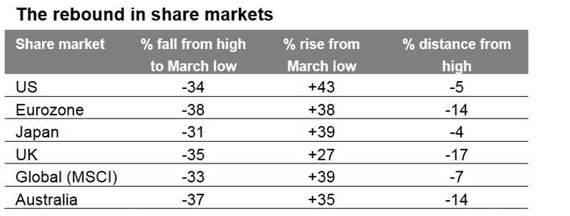
After a roughly 35% plunge from their February high point to their lows around 23 March on fears regarding of global recession on the back of the coronavirus shutdowns, share markets have since rebounded sharply, led by US shares. The rally has pushed the Australian ASX 200 back through 6000 for the first time since March.


Source: Bloomberg, AMP Capital

A common concern is that the rebound in share markets is “too optimistic” and “irrational” – how can share markets rebound so rapidly when economic conditions are so weak, coronavirus uncertainty remains high, the US is seeing civil unrest and US/China tensions are rising? I must admit that I have also been surprised by the speed of the rebound and think maybe the markets are ahead of themselves. But I have seen this happen before and it reminds me of the quotation from the investor Sir John Templeton “bull markets are born on pessimism, grow on scepticism, mature on optimism and die of euphoria” as this rally has occurred against a lot of pessimism with shares climbing a wall of worry. But as the quote reminds us, that’s what they often do. The plunge in shares into March led the coronavirus hit to activity & fear of recession on the way down and in the process surprised many at the severity of the fall and now it’s led on the way up despite still lots of worries.

Key drivers of the rally

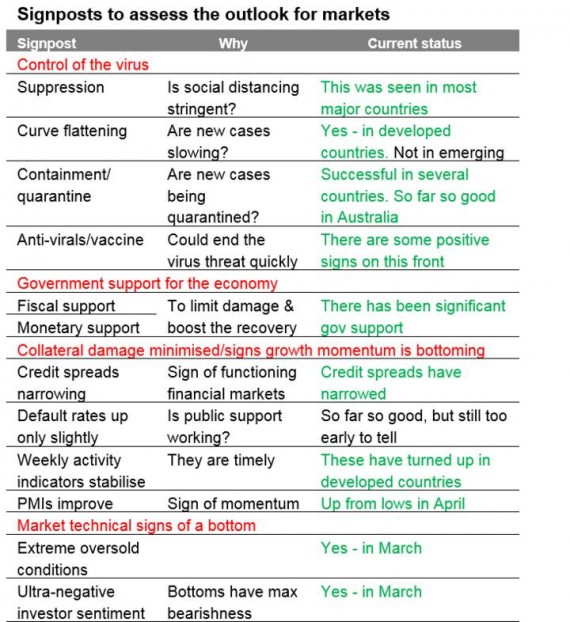
So what’s driven the rally? In early April we listed signposts to watch as to whether shares have bottomed. The key signposts are updated in this table.


Source: AMP Capital

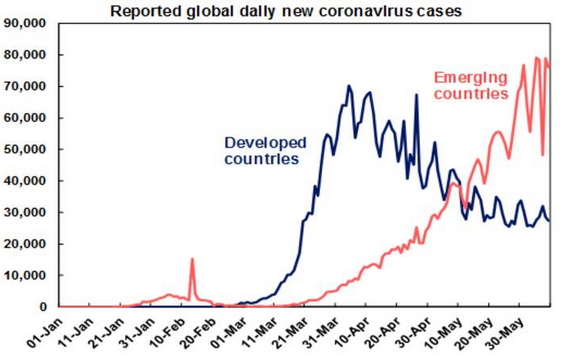
Virtually all of the signposts now tick off positively for developed countries. These are highlighted in green. So, put simply the rebound in shares has been driven by a combination of:

  • Falling new coronavirus cases in developed countries.


Source: ourworldindata.org, AMP Capital

  • Positive news regarding anti-virals and vaccines.

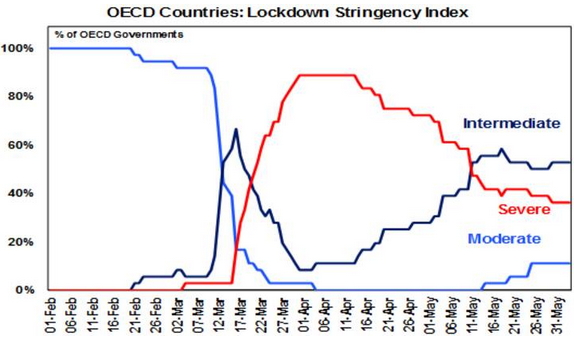
  • The reopening of developed countries as lockdown measures have been eased. This includes Australia which has gone from mildly severe lockdown to intermediate.


Source: Oxford University, AMP Capital

  • Massive fiscal and monetary support measures which have swamped those seen in the GFC. This has helped preserve businesses, jobs and incomes preventing defaults. Low interest rates also help make shares attractive for investors.

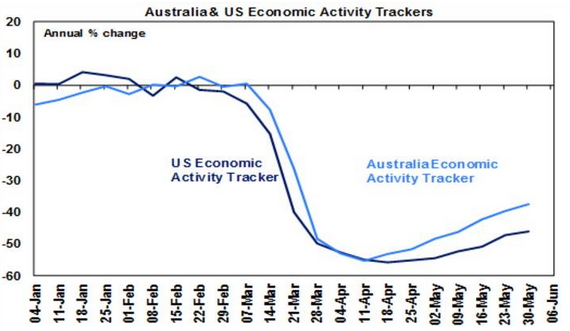
  • Green shoots of recovery. With the progressive relaxation of lockdowns, timely measures of economic data such as consumer confidence, restaurant bookings, retail foot traffic, credit card data, mobility indexes and jobs data suggest that US and Australian economic activity bottomed in April. See the next chart. Global business conditions indicators often referred to as PMIs also started to turn up in May after a plunge into April. This follows a similar pattern in China.


Source: AMP Capital

  • Investors being pessimistic and underweight shares after the plunge in March. This has meant there has been more investors who can be motivated to buy shares than sell.

These considerations have simply swamped concerns about civil unrest in the US (which now appears to be settling down anyway) and US-China tensions.

Confirmation from other markets

It’s not just shares that have rebounded as the rally has been confirmed by other growth sensitive assets/yields. In particular:

  • Oil and metal prices are up sharply from their lows.

  • Commodity currencies like the $A have rebounded at the same time that the safe haven US dollar has fallen.

  • Bond yield have lagged the upswing in share markets, but they have now started to rise, albeit they remain very low.

So why has the US share market led on the way up?

The US share market has a relative high exposure to tech and health care stocks that have been key beneficiaries of the coronavirus shock, Amazon is now 55% of retail stocks’ market capitalisation and the US has also seen more money printing or QE by the Fed compared to other countries including Australia. By contrast, non-US and Australian shares are more cyclical – but should start to benefit as the recovery continues.

Correction risk

After huge rallies most shares are technically overbought which could mean we see a correction over the next few months. But many shares in many share markets are at overbought extremes often seen in the aftermath of major bear market lows and this augurs well for returns on a 6-12 basis.

But what about the slump in earnings?

Earnings are taking a big hit from the impact to economic activity and this has seen earnings estimates slump and price to earnings multiples surge. This is clearly a concern but note a typical “cyclical” rebound in shares goes through three phases.

  • Phase 1 sees an unwinding of cheap valuations helped by easy monetary conditions but with receding downside risks causing some investors to snap up undervalued shares. This is the phase where shares climb a “wall of worry”.

  • Phase 2 is driven by strengthening profits.

  • Phase 3 sees euphoria with very bullish investors pushing shares to extreme levels. This is despite shares becoming expensive and central banks raising interest rates.

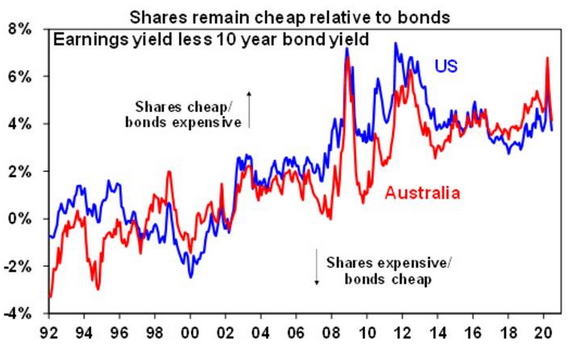
Right now, we are nearing the end of Phase 1. As economic conditions recover profits are likely to strengthen and we will move into Phase 2. While PEs are now high, it’s noteworthy that the equity risk premium which can be crudely measured as the gap between earnings yields (using forward earnings) and bond yields is still reasonable reflecting ultra-low bond yields. But an improvement in earnings will be a key thing to watch for.


Source: Thomson Reuters, AMP Capital

What are the key risks?

The three big risks are: a second wave of coronavirus cases (which should be able to be avoided with lots of testing, tracking and quarantining and even if it does occur may not have the same negative economic impact as any renewed lockdown is likely to be milder and deaths are likely to be lower given greater preparedness); collateral damage from the shutdowns resulting in a delayed or very slow recovery as bankruptcies surge and unemployment goes higher (so far so good – with government and central bank support hopefully heading this off); and risks around the US election (such as Trump ramping up tensions with China if he feels he has nothing to lose or investors fretting about higher taxes and more regulation under a Democrat victory across the Presidency, House and Senate).

Concluding comment

Shares are vulnerable to a short-term consolidation or pullback. But if we are right and April was the low in economic conditions then shares are likely to be higher on a 6 to 12-month horizon. The experience of the last few months highlights just how hard it is to time market bottoms – a good approach for long-term investors is to average in over several months after major falls.


Source: AMP Capital 10 June 2020

Important notes: While every care has been taken in the preparation of this article, AMP Capital Investors Limited (ABN 59 001 777 591, AFSL 232497) and AMP Capital Funds Management Limited (ABN 15 159 557 721, AFSL 426455) (AMP Capital) makes no representations or warranties as to the accuracy or completeness of any statement in it including, without limitation, any forecasts. Past performance is not a reliable indicator of future performance. This article has been prepared for the purpose of providing general information, without taking account of any particular investor’s objectives, financial situation or needs. An investor should, before making any investment decisions, consider the appropriateness of the information in this article, and seek professional advice, having regard to the investor’s objectives, financial situation and needs. This article is solely for the use of the party to whom it is provided and must not be provided to any other person or entity without the express written consent of AMP Capital.

In this article, John Rives of the Growth Mindset Institute provides his personal account of the outbreak of COVID-19, and how applying growth mindset theory has helped guide his business through uncertain times.

No doubt, just like I did, you woke up a few months ago in an environment of constant uncertainty and threat — many of us have never experienced this level of change.

Daily infection statistics try to reinforce the message to stay home while planes are being grounded, borders are close, markets tumble and forecasts predict dire economic impacts.

The novel coronavirus COVID-19 has already influenced every detail of our lives: how and when we work, who we can see, whether the kids are in school or not, and much of what brings us joy in life has been cancelled.

Your business may have to hibernate, pivot to remain relevant or struggle to cope with unprecedented demand overnight. How you respond to these challenges can be heavily influenced by your mindset.

Mindsets are the lenses through which we interpret everyday events. When faced with a challenge, like we all are at the moment, do you see it as a threat, or do you see it as an opportunity?

Avoid settling into a ‘survive mentality’

Is your goal to survive this pandemic or is your goal to thrive during this period of immense change? The answer to that question is heavily dependent on your mindset.

For most of us, we think solely about getting back to ‘normal’. That means hunkering down and waiting out this period of isolation and business disruption in hopes that we can resume right where we left off. Our customers will return, our business partners will start trading again, our borders will open, and life returns to normal.

This is the ‘survive mentality’ and through it we fail to see the opportunity to emerge better and more capable than before. Our mindset is seeing this time as a threat to our way of life and our future selves.

One proven concept for helping you to thrive, overcome a fear of failure and instil in yourself a belief that you can realise a better future is psychologist Professor Carol Dweck’s work on growth mindset.

A person with a growth mindset believes that your talents, skills, abilities and personality can be developed through hard work, good strategies, learning from mistakes and getting input from others.

A person with a fixed mindset believes that your basic qualities like your intelligence, talents and abilities, are fixed traits. As in, you have a certain amount of talent or intelligence and that is that.

In short, when you have a fixed mindset about your ability, you find it more difficult to navigate through the challenges that you’ll encounter during these demanding and uncertain times. But, if you adopt a growth mindset, you’ll be willing to set challenging goals and persist even when you have a setback.

Research has demonstrated that people with a growth mindset have a greater ability to thrive in even the most difficult situations (Dweck 2008).

What does thriving look like for you?

“The hallmark of successful people is that they are always stretching themselves to learn new things.” — Dr Carol Dweck, psychologist.

Take a moment to think about your future. In the simplest sense, you always have just three possible selves regardless of where you find yourself in life:

  1. A future where you’re worse off — you feel like external events, that you believe are outside of your control, will determine your future. In this mindset you see very few options to avoid losing the things you worked so hard to build.

  2. A future where you can minimise the impact — it may take some time, but eventually you see a world that returns to normal. This mindset is about survival. You shrink down and hold tight hoping things will get better sooner or later, and with each new announcement of shifting restrictions, your anxiety and frustration increases.

  3. A future where you’re better off — one where you see this time as an opportunity to develop new skills, build new capabilities in your business or develop new products to meet the needs of your customers as the economy gradually opens back up. You can choose to thrive.

The long road home from New York: A personal anecdote

I confess that for the first few days of this pandemic I had a survive mindset. I figured this event was something to be endured and, maybe with luck, it would be over quickly.

You see, the Growth Mindset Insitute (of which I’m a co-founder), derives 80 percent of its revenue from delivering training programs that help people to develop a growth mindset. We teach people to thrive. It’s been successful and we have seen strong growth year on year.

As things began to unfold, I was travelling to New York to deliver a program for a new global client. I had hopes that this pilot would lead to large deal and our first global licensing contract. I landed in Los Angeles to clear customs and catch my flight to New York. I checked my email and found one informing me that my client’s company had cancelled all international travel. The people I was planning to train were flying in from Stockholm, London and Singapore. Now, very suddenly, they were unable to attend.

So, we decided to pivot. I would train the local team based in New York instead and the training would go ahead. That was in early March 2020.

The training program was scheduled to take place on Wednesday, 11 March. Feeling a sense of relief, I flew on to New York only to receive an email on Monday afternoon that the company had declared an immediate work-from-home policy.

The program wouldn’t be going ahead.

I’d some other meetings in New York, and I stayed to pursue those opportunities. Every meeting I’d scheduled was either cancelled or conducted through video conferencing (all of which I could have done back in Australia).

Each day, the city became more desolate. They announced that Broadway would close and cancelled the St Patrick’s Day parade for the first time in over a century. I was alone and developed a sense of foreboding as events escalated around me.

My business partner rang me later that week. Before I’d left Australia, we had a full schedule of workshops for March and April. It was going to be one of our busiest and most profitable periods. Now, clients were cancelling. By Friday afternoon, we didn’t have a single workshop left.

The day of my flight home finally arrived. It was Saturday, 14 March. I flew out of LA bound for Melbourne wondering how things had changed so dramatically in a week.

My goal was to get out and meet with our clients. At that time there was no lockdown. I would start to line up work on the other of side this ‘brief’ period of disruption.

While I was in flight, unknown to me, the Prime Minister declared all international travellers would have to self-isolate for 14 days commencing Monday, 16 March. I landed at 5am that Monday morning to hear the pilot telling us that we were all required to self-isolate for 14 days.

I spent several days anxious, frustrated and afraid of what the future held. I clung desperately to the idea that this would be over quickly. I just wanted life to get back to normal and our business could get back on its feet. You see, the power of our fixed mindset is that it wants to avoid challenges and fall over when we have a setback. And it had me firmly in its grasp.

I woke up on Wednesday realising my mistake. I’d fallen into a survive mentality and was blaming everyone else for my misfortune. People were overreacting, I’d thought, and it was unfair that they cancelled work on us.

I rang my business partner and we started to apply our work to our own business.

What could we do to thrive? What would that look like for us? For me it wasn’t about learning a new skill, although I believe this to be a very good strategy for many. We started talking about how we could use this time to emerge more competitive with new and better products and services.

How would we protect ourselves from the next downturn?

We made three key decisions:

  1. We would develop a version of our services that could be delivered remotely. This would make us relevant during an extended work from home period and we could sell into overseas markets more effectively.

  2. We had been struggling to develop a new product due to the demands of managing a growing business. We would finish that product within six weeks, and it would have offline capabilities.

  3. Our partner in China had been asking us to translate our products into Mandarin and to get our online mindset assessment deployed on servers in China so that they could sell it their customers. We would make that happen.

None of these ideas solved our immediate cash flow problems, but they would make us more competitive than ever before if we could achieve them.

The thrive mindset gave us hope and a focus on building a better future.

On 21 April our business partner delivered their first virtual workshop in China, including a Mandarin version of the online mindset assessment deployed on servers based in China. It would have taken us a year to deliver that during business as usual. They now have a full pipeline for May even before China emerges from lockdown.

The client I flew to New York to train is going to complete our new virtual workshop on 11 May, and our other clients are starting to book our virtual programs as well.

We’ve made good progress on or new product and it should complete the design phase by mid-May.

Maintain a growth mindset for stability in an unstable world

Your mindset is powerful whether you realise it or not. It’s influencing your thoughts, your habits, your business success and your relationships every day.

Unfortunately, when you don’t actively choose which mindset to apply during challenging times, you’re more likely to have a survive mindset. But, if you take a moment to reflect and to coach yourself to have a growth mindset, to see challenges as opportunities, you can develop a thrive mindset.

Times have changed. Possibly forever. Which mindset you choose is up to you.

Fortunately, there is strong evidence that mindsets can be changed by developing self-awareness in people about their fixed mindset triggers and assisting them to recognise when they are at play.

Once a person recognises their fixed mindset triggers, they are able to develop strategies to manage back toward growth. This accelerates personal and business performance and acts as a multiplier for investment in innovative business models.

Research demonstrates that a growth mindset is essential for learning and development (Dweck 2008). A fixed mindset undermines attempts to thrive by creating a psychological barrier to learning. Overcoming this barrier is critical to developing people’s capacity to change and have the self-efficacy to persist through a challenging transition.


Source : MYOB May 2020

Reproduced with the permission of MYOB. This article by John Rives was originally published at https://www.myob.com/au/blog/growth-mindset-helps-business-owners-thrive-covid-19/

Important: This provides general information and hasn’t taken your circumstances into account. It’s important to consider your particular circumstances before deciding what’s right for you. Although the information is from sources considered reliable, we do not guarantee that it is accurate or complete. You should not rely upon it and should seek qualified advice before making any investment decision. Except where liability under any statute cannot be excluded, we do not accept any liability (whether under contract, tort or otherwise) for any resulting loss or damage of the reader or any other person. Any information provided by the author detailed above is separate and external to our business and our Licensee. Neither our business nor our Licensee takes any responsibility for any action or any service provided by the author. Any links have been provided with permission for information purposes only and will take you to external websites, which are not connected to our company in any way. Note: Our company does not endorse and is not responsible for the accuracy of the contents/information contained within the linked site(s) accessible from this page.
How compound interest works

Compound interest is the interest you get on:

  • the money you initially deposited, called the principal

  • the interest you’ve already earned

For example, if you have a savings account, you’ll earn interest on your initial savings and on the interest you’ve already earned. You get interest on your interest.

This is different to simple interest. Simple interest is paid only on the principal at the end of the period. A term deposit usually earns simple interest.

Save more with compound interest

The power of compounding helps you to save more money. The longer you save, the more interest you earn. So start as soon as you can and save regularly. You’ll earn a lot more than if you try to catch up later.

For example, if you put $10,000 into a savings account with 3% interest compounded monthly:

  • After five years, you’d have $11,616. You’d earn $1,616 in interest.

  • After 10 years you’d have $13,494. You’d earn $3,494 in interest.

  • After 20 years you’d have $18,208. You’d earn $8,208 in interest.

Compound interest formula

To calculate compound interest, use the formula:

A = P x (1 + r)n

A = ending balance
P = starting balance (or principal)
r = interest rate per period as a decimal (for example, 2% becomes 0.02)
n = the number of time periods

How to calculate compound interest

To calculate how much $2,000 will earn over two years at an interest rate of 5% per year, compounded monthly:

1. Divide the annual interest rate of 5% by 12 (as interest compounds monthly) = 0.0042

2. Calculate the number of time periods (n) in months you’ll be earning interest for (2 years x 12 months per year) = 24

3. Use the compound interest formula

A = $2,000 x (1+ 0.0042)24
A = $2,000 x 1.106
A = $2,211.64

Case Study

Lorenzo and Sophia compare the compounding effect

Lorenzo and Sophia both decide to invest $10,000 at a 5% interest rate for five years. Sophia earns interest monthly, and Lorenzo earns interest at the end of the five-year term.

After five years:

  • Sophia has $12,834.

  • Lorenzo has $12,500.

Sophia and Lorenzo both started with the same amount. But Sophia gets $334 more interest than Lorenzo because of the compounding effect. Because Sophia is paid interest each month, the following month she earns interest on interest.

Source : MoneySmart. gov.au May 2020

Reproduced with the permission of ASIC’s MoneySmart Team. This article was originally published at https://moneysmart.gov.au/saving/compound-interest

Important note: This provides general information and hasn’t taken your circumstances into account.  It’s important to consider your particular circumstances before deciding what’s right for you. Although the information is from sources considered reliable, we do not guarantee that it is accurate or complete. You should not rely upon it and should seek qualified advice before making any investment decision. Except where liability under any statute cannot be excluded, we do not accept any liability (whether under contract, tort or otherwise) for any resulting loss or damage of the reader or any other person.  Past performance is not a reliable guide to future returns. Important Any information provided by the author detailed above is separate and external to our business and our Licensee. Neither our business nor our Licensee takes any responsibility for any action or any service provided by the author. Any links have been provided with permission for information purposes only and will take you to external websites, which are not connected to our company in any way. Note: Our company does not endorse and is not responsible for the accuracy of the contents/information contained within the linked site(s) accessible from this page. 


As the curve continues to flatten and as states around Australia begin to ease lockdown restrictions, many might be wondering what life will look like “on the other side” of the COVID-19 crisis.

Restarting economies after they have been in hibernation will surely be no small feat for governments and it will take a coordinated social effort over time to get businesses back on their feet, people back into their jobs and for some sense of normality to return.

In the last few months, investors around the world have certainly had their resolve tested given the wild market swings and portfolio fluctuations.

We’ve written recently on the perils of recency bias and loss aversion, but perhaps there are also a few other behavioural biases to be aware of as you begin to emerge from your own investing

The use (or misuse) of information

With the amount of readily available market information out there, and the speed at with which they change, it’s sometimes difficult to process it all to inform a rational decision.

Some have even termed the amount of information (and misinformation) out there about COVID-19 as an “infodemic”.

When this happens, we can easily fall into the trap of seeking information that supports what we already believe in. This is known as confirmation bias, and may lead us to place more emphasis on information we are familiar with and to ignore information that’s new or contradictory.

If you are of the view that markets will rebound sharply and follow a perfect V-shaped recovery, you might not even realise you are filtering out data that might suggests otherwise.

Conversely, this also applies if you are particularly pessimistic on global efforts to contain the spread, or perhaps have a lack of faith in those in charge to make the right economic decisions.

Remaining impartial in what is a highly emotional situation is perhaps impossible, but just being able to acknowledge when you might be favouring one perspective or source over another can still help lessen confirmation bias, and ultimately contribute to more sound decision making.

It’s also worth remembering that the situation is still fluid, and meaningful economic indicators are still emerging. While there is credible research and economic modelling out there, it’d stand you in good stead to adopt a sense of flexibility and willingness to adapt or rebalance as more concrete information becomes available (but all the while remembering your long-term investment goals!).

The comfort of crowds

There is a certain sense of comfort when you are part of a crowd, and when it comes to unprecedented times like these, doing what others are (on mass) doing seems safer than sounding out your own judgement. By taking this shortcut, it’s also arguably less mentally straining than figuring it out yourself.

We are more prone to “herding” behaviour when we face difficult decisions or uncertainty. If others we know are cashing out as a precaution, doing the same can be tempting even if it’s not the best investment decision for your own situation.

Likewise, as we start the journey towards economic recovery, you might be hearing people say it’s now the best time to buy as shares are at a discount. But consider if these “cheap buys” will throw your pre-determined asset allocation into disarray or if it means ignoring costs or tax implications.

Just because everyone else is doing something doesn’t necessarily mean it’s the right course of action for you even if you fear you are missing out. If this is the case, it might prove useful to consult your financial adviser.

Conclusion

These are just two behavioural biases worth acknowledging as we continue to adapt to the evolving COVID-19 crisis.

The challenge with biases is that they are deep-seated aspects of our decision making process and are often difficult to spot as they play out so naturally. While perhaps we cannot cure them completely, we can however mitigate.

Just being aware of behavioural biases is a good place to start. Additionally, focusing on the investment factors we can control is another. This means tuning out the noise and sticking to your investment plan even when those around you might not be.


Please contact us on Phone: 07 5641 4134 if you seek further assistance on this topic.

Source : Vanguard May 2020

Written by Robin Bowerman, Head of Corporate Affairs at Vanguard.

Reproduced with permission of Vanguard Investments Australia Ltd Vanguard Investments Australia Ltd (ABN 72 072 881 086 / AFS Licence 227263) is the product issuer. We have not taken yours and your clients’ circumstances into account when preparing this material so it may not be applicable to the particular situation you are considering. You should consider your circumstances and our Product Disclosure Statement (PDS) or Prospectus before making any investment decision. You can access our PDS or Prospectus online or by calling us. This material was prepared in good faith and we accept no liability for any errors or omissions. Past performance is not an indication of future performance.

© 2020 Vanguard Investments Australia Ltd. All rights reserved.

Important: Any information provided by the author detailed above is separate and external to our business and our Licensee. Neither our business nor our Licensee takes any responsibility for any action or any service provided by the author. Any links have been provided with permission for information purposes only and will take you to external websites, which are not connected to our company in any way. Note: Our company does not endorse and is not responsible for the accuracy of the contents/information contained within the linked site(s) accessible from this page.
At its meeting today, the Board decided to maintain the current policy settings, including the targets for the cash rate and the yield on 3-year Australian Government bonds of 25 basis points.

The global economy is experiencing a severe downturn as countries seek to contain the coronavirus. Many people have lost their jobs and there has been a sharp rise in unemployment. Over the past month, infection rates have declined in many countries and there has been some easing of restrictions on activity. If this continues, a recovery in the global economy will get under way, supported by both the large fiscal packages and the significant easing in monetary policies.

Globally, conditions in financial markets have continued to improve, although conditions in some markets remain fragile. Volatility has declined and credit markets have progressively opened to more firms. Bond rates remain at historically low levels.

In Australia, the government bond markets are operating effectively and the yield on 3-year Australian Government Securities (AGS) is at the target of around 25 basis points. Given these developments, the Bank has purchased government bonds on only one occasion since the previous Board meeting, with total purchases to date of around $50 billion. The Bank is prepared to scale-up its bond purchases again and will do whatever is necessary to ensure bond markets remain functional and to achieve the yield target for 3-year AGS. The target will remain in place until progress is being made towards the goals for full employment and inflation.

The Bank’s market operations are continuing to support a high level of liquidity in the Australian financial system. Authorised deposit-taking institutions are making use of the Term Funding Facility, with total drawings to date of around $6 billion. Further use of this facility is expected over coming months.

The Australian economy is going through a very difficult period and is experiencing the biggest economic contraction since the 1930s. In April, total hours worked declined by an unprecedented 9 per cent and more than 600,000 people lost their jobs, with many more people working zero hours. Household spending weakened very considerably and investment plans are being deferred or cancelled.

Notwithstanding these developments, it is possible that the depth of the downturn will be less than earlier expected. The rate of new infections has declined significantly and some restrictions have been eased earlier than was previously thought likely. And there are signs that hours worked stabilised in early May, after the earlier very sharp decline. There has also been a pick-up in some forms of consumer spending.

However, the outlook, including the nature and speed of the expected recovery, remains highly uncertain and the pandemic is likely to have long-lasting effects on the economy. In the period immediately ahead, much will depend on the confidence that people and businesses have about the health situation and their own finances.

The substantial, coordinated and unprecedented easing of fiscal and monetary policy in Australia is helping the economy through this difficult period. It is likely that this fiscal and monetary support will be required for some time.

The Board is committed to do what it can to support jobs, incomes and businesses and to make sure that Australia is well placed for the recovery. Its actions are keeping funding costs low and supporting the supply of credit to households and businesses. This accommodative approach will be maintained as long as it is required. The Board will not increase the cash rate target until progress is being made towards full employment and it is confident that inflation will be sustainably within the 2–3 per cent target band.

Source: Reserve Bank of Australia, June 2nd, 2020

Enquiries

Media and Communications
Secretary’s Department
Reserve Bank of Australia
SYDNEY

Phone: +61 2 9551 9720
Email: rbainfo@rba.gov.au


Back on 19th March when we first looked at the impact of the intensifying shutdown of the Australian economy on the housing market (see here) we concluded that the impact would depend on how high unemployment rose. Our base case was a recession that saw unemployment rise to around 7.5% and would push average home prices down around 5%, but the risk was that a deeper downturn with say 10% unemployment could see a 20% fall in prices. Subsequent government support measures along with an earlier reopening of the economy have reduced the risk of worse case scenarios for home prices.

So far so good

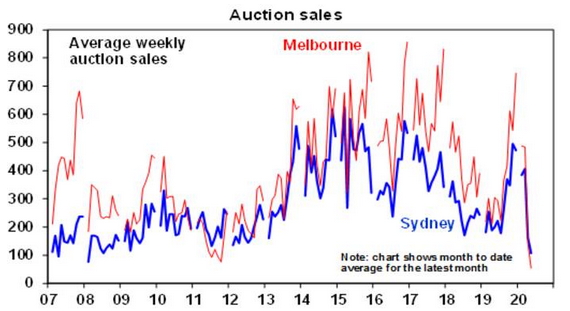
Since March property sales have slowed to a crawl.


Source: Domain, AMP Capital

The combination of the need for social distancing and the banning for a while of traditional on-site auctions led to a sharp decline in properties for sale. In addition to this, the Federal Government’s JobKeeper scheme keeping around 3.5 million people in paid employment and a doubling in unemployment benefits along with bank mortgage payment holidays, all of which are for the six months to September, have helped head off an increase in forced sales that might have occurred given the size of the hit to the economy. So, while property demand has fallen, it’s been matched by a collapse in supply, which has left the property market in a bit of a twilight zone.

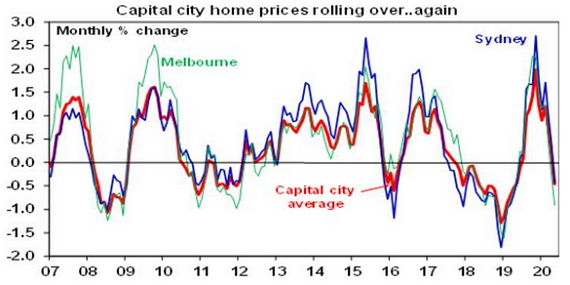
While listings have started to pick up a bit lately, they are still very low and this has all helped soften the blow to house prices that would have otherwise occurred, but prices are still starting to fall. According to CoreLogic, after slowing to just 0.2% growth in April, average capital city home prices fell -0.5% in May. Prices fell in all cities except Adelaide, Hobart and Canberra, with Melbourne -0.9%, Sydney -0.4% and Perth -0.6%. This has seen the monthly change in capital city home prices collapse from a peak of 2% in November.


Source: CoreLogic, AMP Capital

So where to from here?

The positives for the property outlook

There are basically five “positives” for property prices.

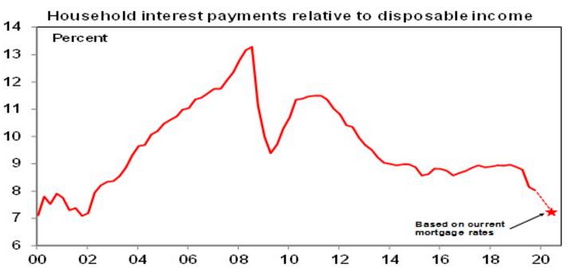
  • Mortgage rates have fallen to record lows with deals around 2 to 3%. This is keeping mortgage debt interest costs as a share of household income well below historic highs even though the ratio of household debt to income is at a record high of around 200%. Low mortgage costs also make the funding costs for an investment property very low.


Source: ABS, RBA, AMP Capital

  • As noted above, while listings remain low.

  • Government support measures have provided a huge boost to household income, supported businesses, supported employment for around 3.5 million workers, prevented a confidence zapping surge in measured unemployment & with bank mortgage payment holidays (which has seen around 440,000 mortgage deferrals) are preventing a sharp rise in mortgage delinquencies and hence forced sales. 

  • The shutdown, impacting mostly services jobs, has hit women and younger workers harder in contrast to past recessions which have hit male breadwinners harder and this may have helped keep down debt servicing problems.

  • China is running 2-3 months ahead of Australia with respect to the coronavirus shock and its experience provides some guide. While property sales were near zero in the peak lockdown month of February average property price growth slowed but did not go negative and is now picking up a bit.

The negatives

Against these positives, there are these big “negatives” for property prices flowing from the coronavirus shock.

  • High unemployment. We have long regarded the combination of high house prices and high household debt as Australia’s Achilles heel and so we feared back in March that a large rise in unemployment could trigger debt servicing problems, forced sales and so sharp falls in prices. As it’s turned out, measured unemployment is being suppressed and household incomes supported by stimulus measures. This is by design to help businesses, jobs and incomes hold up through the shutdown period. It’s likely headed off the worst case 20% decline in house prices scenario we saw in March. But once the support measures end later this year, measured unemployment will likely rise to around 8% and take a long time to fall back to the pre coronavirus levels around 5.2%. This in turn is likely to lead to some increase in mortgage defaults as bank payment holidays (for around 440,000 mortgages) end, boosting forced sales and act as a drag on property demand, albeit it’s unlikely to be anywhere near what would have occurred in the absence of support measures through the shutdown.

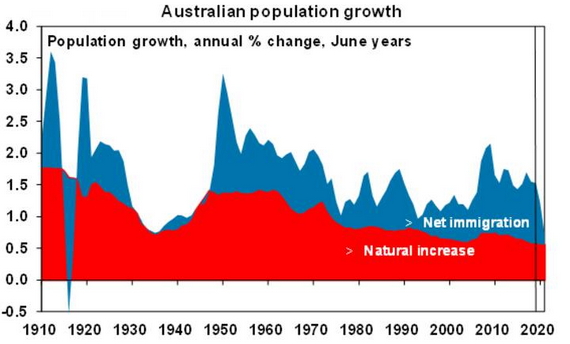
  • A big drop in immigration. Thanks to travel bans, the Government expects net immigration to fall to just below 170,000 this financial year and to around 35,000 next financial year from 240,000 last financial year. This is a huge hit and if it occurs – the Government could always allow a faster return of immigration – it will take population growth over 2020-21 to just 0.7%, its lowest since 1917.


Source: ABS, AMP Capital

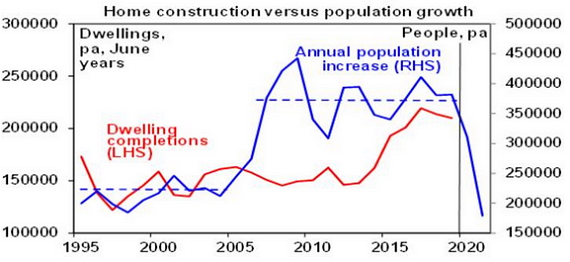
It will imply a hit to underlying dwelling demand of around 80,000 dwellings over the next 12 months taking it down to around 120,000 compared to underlying demand last year of around 200,000. This risks resulting in a significant oversupply of dwellings, reversing years of undersupply that has maintained very high house prices since mid-last decade. A cut to immigration is not something China has had to deal with, so its property market experience is not directly translatable to Australia.


Source: ABS, AMP Capital

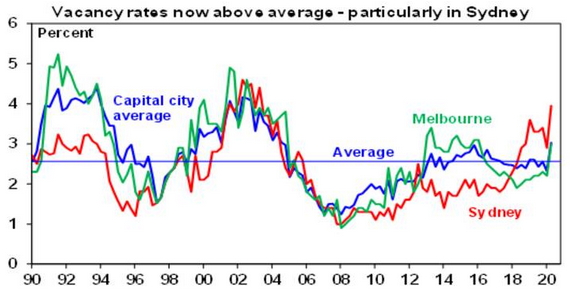
  • Falling rents and rising vacancy rates. Vacancy rates rose sharply in April and this plus rent relief is putting downwards pressure on rents. This will be further impacted by very low immigration. It will further weigh on investor demand and may cause problems for heavily geared property investors.


Source: REIA, SQM, AMP Capital

  • Measures to boost housing construction. Faced with a big reduction in housing construction activity over the year ahead, governments appear to be working on plans to boost activity to protect home builders’ jobs via new home building grants and possibly the construction of social housing. Normally first home buyer grants provide a boost in overall demand. But if the focus is just on boosting supply at a time when underlying demand is very low reflecting lower immigration it could add to downwards pressure on average prices. (Proposed moves from stamp duty to land tax in some states could provide a short-term boost to home prices but should be long term neutral if the same revenue is raised and it’s unclear whether or when it will occur.)

Concluding comment

Our worst-case scenario for a 20% decline in prices and those of others seeing 30% plus falls are unlikely thanks to support measures and the earlier reopening of the economy. To get these worst-case scenarios would require a “second wave” of coronavirus cases & so a renewed shutdown or another down leg in the economy in response to a surge in bankruptcies.

However, further falls in prices are still likely, as “true” unemployment (to become clear after September) remains high for several years, government support measures and the bank payment holiday end after September, immigration falls and likely government measures boost housing construction. Our base case is for national average prices to fall around 5-10% into next year. Sydney & Melbourne are likely to see 10% falls as they are more exposed to immigration and have higher debt levels whereas Adelaide, Brisbane, Perth & Hobart are only likely to see small falls and Canberra prices are likely to be flat.

This may be seen as a reasonable outcome in terms of making housing more affordable but without posing a big threat to the economy (via a downwards spiral of falling prices and negative wealth effects on consumer spending) at the same time.


Source: AMP Capital 1 June 2020

Important notes: While every care has been taken in the preparation of this article, AMP Capital Investors Limited (ABN 59 001 777 591, AFSL 232497) and AMP Capital Funds Management Limited (ABN 15 159 557 721, AFSL 426455) (AMP Capital) makes no representations or warranties as to the accuracy or completeness of any statement in it including, without limitation, any forecasts. Past performance is not a reliable indicator of future performance. This article has been prepared for the purpose of providing general information, without taking account of any particular investor’s objectives, financial situation or needs. An investor should, before making any investment decisions, consider the appropriateness of the information in this article, and seek professional advice, having regard to the investor’s objectives, financial situation and needs. This article is solely for the use of the party to whom it is provided and must not be provided to any other person or entity without the express written consent of AMP Capital.

There are often upsides and downsides in any piece of legislation, especially when it comes to superannuation.

That’s the case with the Federal Government’s “downsizer measure” announced in the 2017-18 budget, which came into effect on 1 July, 2018.

On the surface, there are significant upsides for individuals and couples wanting to top up their superannuation accounts either in retirement, or just before.

The measure allows individuals aged 65 years old or older, who meet specific eligibility requirements, to contribute up to $300,000 into their superannuation using the proceeds from selling their home. Couples can contribute up to $600,000, and a downsizer contribution can still be made even if one’s total super balance is higher than the Government’s mandated $1.6 million pension transfer balance cap.

There are various rules around the legislation, including that the home sold must have been owned for at least 10 years, and contributions into superannuation need to be made within 90 days of receiving the proceeds from the sale.

The downsizing data

To put some context around this article, we contacted the regulator of the downsizer legislation, the Australian Tax Office (ATO).

Since coming into effect 18 months ago, neither the Government nor the ATO has published data on how often the home downsizing measure has been accessed. However, the ATO has advised that, as of 17 January, 2020, it had received $2.19 billion in downsizer superannuation contributions on behalf of 9,429 individuals.

The ATO says downsizer contributions have been reported for every state and territory, with 55 per cent of contributions having been made by women. The average superannuation contribution has been approximately $232,000.

But the regulator adds that, as its data is based on individual contributions, and there can be multiple superannuation contributions made for the same home, for example from a husband and wife, it does not have data on the number on homes sold since the legislation was introduced.

Based on the aggregated numbers, the downsizer measure is proving popular for some retirees. Adding more than $200,000 in additional contributions into superannuation by freeing up equity from a home, and which will generate tax-free income for those in pension phase, can go a long way to funding one’s needs in retirement.

Yet, it’s also important for individuals and couples considering the downsizer measure to fully understand the potential downsides of downsizing.

A potential pension trap

Having enough money in retirement to maintain a comfortable lifestyle is obviously an aspiration for most Australians.

Longevity risk – the risk of running out of money in retirement – is a clear danger for many.

Yet, while the home downsizing measure may seem attractive for those aged over 65 wanting to get more into their superannuation or pension account to offset longevity risk, it also presents potential financial risks.

Those risks primarily relate to eligibility for a full or part Age Pension, because a large cash injection into a superannuation account may result in a breach of the assets test rules.

Consider that the family home is an exempt asset when calculating entitlements for the Age Pension, while all other assets outside of the home including superannuation are taken into account.

Under what’s known as the taper rate, Age Pension entitlements are reduced by $3 per fortnight for every $1,000 in assets over the Government’s asset test thresholds.

The current assets test limits are shown in the table below.

Full Age Pension

Homeowner

Non Homeowner

Single

$263,250

$473,750

Couple

$394,500

$605,000


Part Age Pension

Homeowner

Non Homeowner

Single

$574,500

$785,000

Couple

$863,500

$1,074,000

Source: Department of Human Services, limits effective 20 September 2019

The problem is that, in the current environment of record low interest rates and forecasts of lower investment returns for longer, some retirees could find that they are actually worse off.

Once an individual or couple breach the limits for the full Age Pension, their fortnightly payments will gradually reduce using the taper rate. Those on a part pension could find their payments cease altogether if they move above the maximum thresholds.

So, even with a higher superannuation balance as a result of their home sale, their total income stream could be less than what they received when they qualified for a full or part Age Pension.

Look before you leap

Average superannuation account balances at retirement already put many Australians close to the Age Pension assets test thresholds.

Using the data provided by the ATO, where the average downsizer superannuation contribution has been around $232,000, it’s likely that some of the individuals and couples that have taken up the measure will have breached the maximum assets test levels.

What’s most important for individuals and couples considering the downsizer measure is to review your personal circumstances to determine if it is going to work for you financially.

Do the numbers stack up? Keep in mind that any additional tax-free superannuation income earned in pension phase may be completely offset by a loss of Age Pension income if you breach the assets test rules.

For those wanting to downsize, how your home proceeds are reinvested, to maximise investment returns in retirement, is key.

It’s therefore essential to seek out professional financial advice before proceeding, especially with respect to social security means testing.

Please contact us on Phone: 07 5641 4134 if you seek further assistance.

Source : Vanguard 

Reproduced with permission of Vanguard Investments Australia Ltd

Vanguard Investments Australia Ltd (ABN 72 072 881 086 / AFS Licence 227263) is the product issuer. We have not taken yours and your clients’ circumstances into account when preparing this material so it may not be applicable to the particular situation you are considering. You should consider your circumstances and our Product Disclosure Statement (PDS) or Prospectus before making any investment decision. You can access our PDS or Prospectus online or by calling us. This material was prepared in good faith and we accept no liability for any errors or omissions. Past performance is not an indication of future performance.

© 2020 Vanguard Investments Australia Ltd. All rights reserved.

Important:
Any information provided by the author detailed above is separate and external to our business and our Licensee. Neither our business nor our Licensee takes any responsibility for any action or any service provided by the author.

Any links have been provided with permission for information purposes only and will take you to external websites, which are not connected to our company in any way. Note: Our company does not endorse and is not responsible for the accuracy of the contents/information contained within the linked site(s) accessible from this page.
As rewarding as it can be, running a small business can also cause stress and anxiety. That’s why MYOB has partnered with leading Australian not-for-profit in the preventative mental health space, Smiling Mind, to create a unique, free-to-use Small Business Program.

Business owners are known for regularly suffering through sleepless nights as they work through all the various challenges, contingencies and pressures their business faces.

And at a time like this — with business owners dealing with the additional stress of natural disasters, drastically changing business conditions and different living situations – their mental health becomes even more important.

Last year, MYOB conducted research that showed that mental health and wellbeing is a big deal for small businesses.

In fact, more than half (56 percent) of small business operators in Australia said running their own business has directly impacted feelings of anxiety or depression, with nearly half (48 percent) of all respondents reporting feelings of anxiety were largely caused by financial and cash flow concerns.

Alarmingly, only one in four business owners will actively seek help. And MYOB wants to change that by making mental health everyone’s business.

That’s why MYOB has partnered with Australia’s leading mindfulness app, Smiling Mind to create a dedicated program that addresses the psychological wellbeing of small business owners. And while we began working on this partnership before the outbreak of the COVID-19 pandemic, it’s clear to see there’s an even greater need for it today.

Chief employee experience officer for MYOB, Helen Lea said the initiative is aimed at providing business owners an additional tool to maintain happiness and productivity during tough times.

“We know the small business community is doing it tough right now, and MYOB is dedicated to assisting them in as many ways as we can.

“This partnership with Smiling Mind gives all of us a useful tool to help guide us through these challenges, with useful strategies for maintaining positive mental health and wellbeing.

“Better still, it offers business owners a framework to begin having these conversations with staff and other key stakeholders – building community and support for each other.”

Smiling Mind and MYOB: In detail

The new program is available now for free via the Smiling Mind app, under the ‘At Work Section’. It explores a range of topics to support small business owners with Mindfulness activities and resources they can use everyday to support their mental health and wellbeing.

Dr Addie Wootten, chief executive for Smiling Mind said the contents of the program target the most effective ways business owners can work to prevent mental wellbeing challenges overwhelming their business.

“We’ll explore what mindfulness is, why it might be useful in managing stress and uncertainty and how we can use mindfulness to proactively support our wellbeing and more broadly our productivity, creativity and connections with others,” said Wootten.

“Overall, the program aims to support a positive and proactive approach to good mental health and wellbeing and strategies to support resilience in the face of challenges.

“We need these skills now more than ever before and we hope these new resources will support small business owners across Australia and New Zealand.”

These programs will support small business owners to:

  • Establish a routine to proactively look after their mental health

  • Learn about mindfulness – the benefits and the science behind it

  • Maintain a healthy work-life balance

  • Foster healthy relationships both at work and at home

  • Navigate the stresses of owning a business

“Over the three-year partnership, we will continue to add and update this program content, so it continues to be relevant to you and your business,” said Wootten.

Research shows these mindfulness activities can help small business owners and their staff take a pre-emptive approach to managing their mental health, stress and their emotions in the workplace.

With MYOB, Smiling Mind is building practical tools and resources to equip business owners with the skills they need to manage not only their own wellbeing, but that of their employees, too.

The result, Lea said, will combine with MYOB’s current offering to create a suite of tools for business owners that covers nearly every facet of business support.

“Our aim is to provide a truly holistic approach to the way we support our small business community,” said Lea.

“You’ll be able to find a range of freely accessible program resources in the Smiling Mind app – designed just for you and your employees,” said Wootten.

“These resources are designed to be easy to use and fit into your busy day but underpinned by a strong evidence base so you can rest assured that the programs are high quality and written by experts.”


Source : MYOB May 2020

Reproduced with the permission of MYOB. This article by MYOB Team was originally published at https://www.myob.com/au/blog/making-mental-health-everyones-business/

Important: This provides general information and hasn’t taken your circumstances into account. It’s important to consider your particular circumstances before deciding what’s right for you. Although the information is from sources considered reliable, we do not guarantee that it is accurate or complete. You should not rely upon it and should seek qualified advice before making any investment decision. Except where liability under any statute cannot be excluded, we do not accept any liability (whether under contract, tort or otherwise) for any resulting loss or damage of the reader or any other person. Any information provided by the author detailed above is separate and external to our business and our Licensee. Neither our business nor our Licensee takes any responsibility for any action or any service provided by the author. Any links have been provided with permission for information purposes only and will take you to external websites, which are not connected to our company in any way. Note: Our company does not endorse and is not responsible for the accuracy of the contents/information contained within the linked site(s) accessible from this page.
Life’s busier than ever for small business owners. Scammers hope you’re too busy to check what they’re saying so you’ll hand over your personal or financial information.

While the ATO is supporting you through the COVID-19 (coronavirus) environment, scammers are trying to steal your money or identity while you’re most vulnerable.

Look out for these tell-tale signs of tax scams if you get a suspicious call, message or request.

The ATO will never:

  • send an email or SMS with a hyperlink to our online services such as myGov

  • request personal identifying information via a return email unless you’ve agreed to engage with us this way

  • threaten you with immediate arrest and insist you stay on the line until you make a payment

  • prevent you from discussing your tax affairs with your registered tax professional

  • request payment of a debt via iTunes, Google Play cards or other vouchers, cryptocurrency, cardless cash transfer, offshore wire transfer or into a bank account not held by the Reserve Bank of Australia

  • ask you to pay a fee to receive a refund.

If you’re ever unsure about an ATO communication, do not reply. Phone the ATO scam hotline on 1800 008 540, visit ato.gov.au/scams, or speak to your agent or trusted adviser.


Source : ATO Small business newsroom May 2020 

Reproduced with the permission of the Australian Tax Office. This article was originally published on https://www.ato.gov.au/Newsroom/smallbusiness/General/Tell-tale-signs-of-a-tax-scam/

Important: This provides general information and hasn’t taken your circumstances into account.  It’s important to consider your particular circumstances before deciding what’s right for you. Although the information is from sources considered reliable, we do not guarantee that it is accurate or complete. You should not rely upon it and should seek qualified advice before making any investment decision. Except where liability under any statute cannot be excluded, we do not accept any liability (whether under contract, tort or otherwise) for any resulting loss or damage of the reader or any other person.  Any information provided by the author detailed above is separate and external to our business and our Licensee. Neither our business nor our Licensee takes any responsibility for any action or any service provided by the author. Any links have been provided with permission for information purposes only and will take you to external websites, which are not connected to our company in any way. Note: Our company does not endorse and is not responsible for the accuracy of the contents/information contained within the linked site(s) accessible from this page.