I have always loved working from home for the flexibility to toggle between work and home tasks; I feel like I’m more efficient and a little more in control of my day.

Yet for all the great things about it, being able to eat better than the days I spend in an office, is actually not as easy as it seems. In fact when I work from home I often find myself chowing down on a muesli bar, or a wedge of feta and some nuts, and calling it a meal.

The problem with this is I have two little children in tow, and so lunch is often my most relaxed meal of the day (because I’m usually alone!). I also find the more nutritious my lunch, the better I feel for the rest of the day. (Read: I don’t spend it fossicking for chocolate)

Not rocket science, is it? But yet – still hard.

Susie Burrell, a solo nutritionist, and busy mum to twin boys, says while breakfast is an important meal of the day, lunch has equal value, if we want to ensure smooth energy levels and avoid binging on junk foods in the late afternoon.

“I have found find myself chowing down on a muesli bar, or a wedge of feta and some nuts, and calling it a meal. “

“Lunch holds the key to nutritional balance. Achieving the right lunch balance to support weight control and energy regulation is relatively easy once you know the mix to aim for,” Susie told Flying Solo.

“To get the amount of vegetable bulk we need to keep full for another 3-4 hours we need at least 2-3 cups of salad and/or vegetables at lunch. Next, a decent serve of protein such as canned salmon, lean chicken breast or beef or beans or tofu if you prefer a vegetarian eating plan. The amount of carbohydrates you will need will depend on your level of activity. If you sit down all day for work, just 1/2 to 3/4 cup sweet potato, beans or brown rice or a slice of bread or a few crackers will be adequate, more active workers may require 1-2 cups.”

And don’t forget the good fat! According to Susie, olive oil dressing, nuts or avocado will help to slow your digestion after lunch and keep you full.

Susie told Flying Solo that with a little forward planning, soloists who work from home actually have the opportunity to eat better, and more economically.

Here are Susie’s 6 tips for making this process easier.

  1. Make once, eat often; never is there a better time to make something and keep in the fridge to enjoy all week. It’s also economical. These five recipes will cost you less than $5 each.

  2. Make good supermarket choices; keep nuts, high-fibre crackers (Ryvitas and Rye Cruskits a good choice), canned tuna and fresh fruit and vegetables on high rotation.

  3. Make a vegetable soup on the weekend; it’s easy to heat up a bowl and eat with a sandwich or crackers as above for a high nutritional boost.

  4. Use up your eggs; scrambled eggs, an omelette or frittata are great lunch choices because they are high in protein and vegetables.

  5. Eat early; before 1pm is optimum for keeping your energy levels and metabolism high throughout the rest of the afternoon.

  6. Don’t eat at your desk! Even if you can only manage a 20 minute lunch break, use the time to get some sunlight and some much needed time away from a screen to mindfully enjoy eating your lunch.

Bon appétit!

Source : Flyingsolo August 2020 

This article by Lucy Kippist is reproduced with the permission of Flying Solo – Australia’s micro business community. Find out more and join over 100K others https://www.flyingsolo.com.au/join.

 

Important:
This provides general information and hasn’t taken your circumstances into account. It’s important to consider your particular circumstances before deciding what’s right for you. Any information provided by the author detailed above is separate and external to our business and our Licensee. Any information provided by the author detailed above is separate and external to our business and our Licensee. Neither our business, nor our Licensee take any responsibility for any action or any service provided by the author.

Any links have been provided with permission for information purposes only and will take you to external websites, which are not connected to our company in any way. Note: Our company does not endorse and is not responsible for the accuracy of the contents/information contained within the linked site(s) accessible from this page.

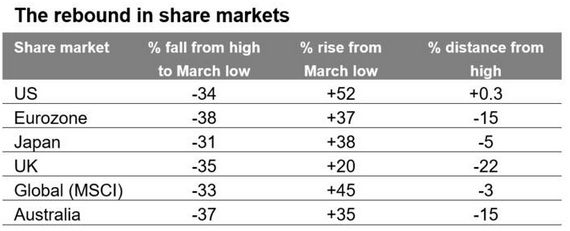
Share markets have had a spectacular rebound from their March lows. The rebound has been led by the US share market which is up 52% and has just risen above its February record high, making it the fastest recovery after a 30% or more fall on record. Other share markets have lagged but are still well up from their lows. This includes the Australian share market which recently rose to its highest level since early March.


Source: Bloomberg, AMP Capital

A common concern remains that the rebound is irrational. How can shares be so strong when June quarter GDP collapsed – by an average of -10% in developed countries and an estimated -7% in Australia – and coronavirus continues to reap havoc?

But as the investor Sir John Templeton once said: “bull markets are born on pessimism, grow on scepticism, mature on optimism and die of euphoria” and we have certainly seen the run up since March occur against the backdrop of a lot of pessimism. The plunge in shares into March led the coronavirus hit on the way down and surprised many at the severity of the fall and now it’s led on the way up despite lots of worries. It’s also worth noting that shares have spent much of the period since early June rangebound (and apart from the US share market, many still are) and this has helped correct the excessive speed of the run up into June that left shares technically overbought & due for a consolidation or correction.

More fundamentally though, the positives for shares continue to outweigh the negatives. Let’s start with the negatives.

The negatives

Several negatives continue to hang over shares and are often cited as the main reason to expect sharp falls ahead.

  • First, coronavirus has yet to come under control globally, particularly in emerging countries, and most developed countries have seen second waves. This poses the threat of a return to debilitating lockdowns and people behaving more cautiously. So far it’s seen the global reopening stall. In Victoria it’s been reversed, which will likely delay the recovery in Australian GDP into the December quarter.

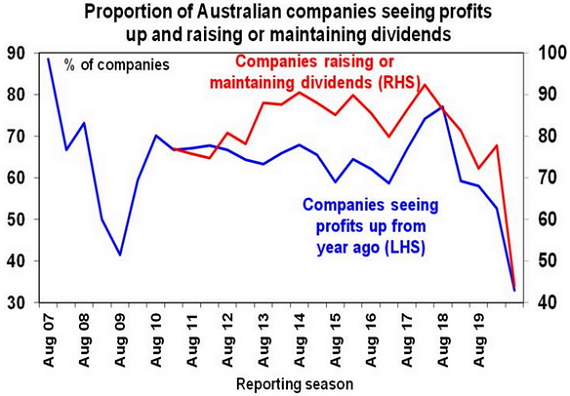
  • Second, this is occurring at a time of a massive hit to economic activity and profits, and very high underlying unemployment. The US June quarter earnings reporting season saw earnings fall 32% year on year and 2019-20 earnings in Australia are expected to have fallen 22%, resulting in the worst slump since the 1990s recession, with 67% of companies to have reported June half earnings so far seeing a decline in earnings and 56% cutting dividends.


Source: AMP Capital

  • Third, the recovery going forward may be slow as some things will take longer to recover (eg, travel), some things may never fully come back (eg, a big shift to on-line shopping, working from home, education & health care) and businesses will use the uncertainty to accelerate cost savings. All of which will mean a long tail of unemployment and economic activity below its pre-coronavirus path. 

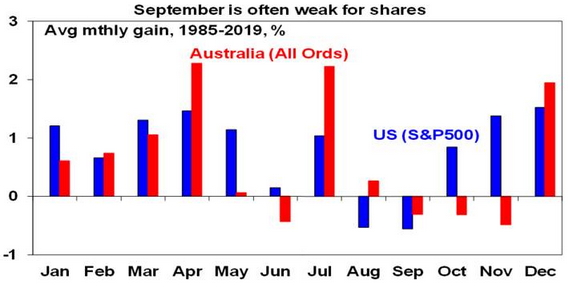
  • Fourth, we are now in a seasonally weak time of the year for shares, with August and September being the weakest months of the year on average for US shares. And consistent with this, the recent rise in the US share market to new highs has come on narrow participation amongst stocks suggesting the risk of another short-term correction.

  • Fifth, the run up to the US election has the potential to drive increased share market volatility if it looks likely that Biden will win and raise taxes, and if Trump decides he has nothing to lose and ramps up tensions with China & Europe. 

  • Finally, shares are expensive on traditional metrics like PEs and more esoteric measures like the ratio of share market capitalisation to GDP and the market value of companies relative to the book value of their assets.

The positives

However, there are a bunch of positives providing an offset.

  • First, the second wave of new coronavirus cases in developed countries has been far less deadly than the first. This likely reflects more young people being infected, better testing, better protections for older people and better treatments. This in turn has seen most countries avoid a return to a full lockdown and limited the hit to confidence.


Source: ourworldindata.org; AMP Capital

  • A decline in new cases in the US has enabled the recovery there in high-frequency economic indicators like credit card spending and mobility to resume after a pause in July.

  • Second, there has been good progress in terms of vaccines and treatments. Several vaccines have seen promising results and are in Phase 3 trials to see if they provide protection. Note though that mass deployment is unlikely till next year & they may not provide complete protection (more like a flu vaccine than a measles vaccine) and may have to be combined with treatments (of which there has also been positive developments with Remdesivir and a steroid). 

  • Third, easy monetary and fiscal policy is continuing to support economies, incomes and jobs in contrast to the situation when the first wave started in developed countries in late February. This is different to normal recessions where it takes longer for policy makers to swing into action. 

  • Fourth, the fall in the “safe haven” US dollar and rising commodity prices (with metal prices back to their pre-coronavirus levels) is a sign of global reflation and recovery.

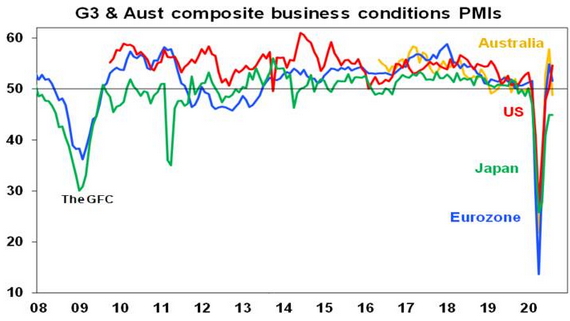
  • Fifth, a range of economic indicators have seen a Deep V rebound starting in China and then in developed countries, suggesting significant pent up demand and that people still want to spend. This is most evident in business conditions PMIs. While developed country PMIs were mixed in August (with Australia and Europe down, Japan flat and the US and UK up) they remain consistent with recovery and have enabled share markets to look through the June quarter slump in earnings (which itself has been less bad than feared). On balance we see a gradual economic recovery from here as some things take longer to return to normal.


Source: Bloomberg, AMP Capital

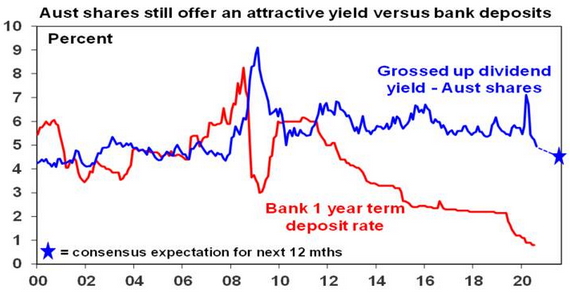
  • Sixth, the plunge in interest rates and bond yields have increased the present value of shares, which explains why PE ratios are so high. So shares remain attractive despite lower earnings and dividends because the alternatives like bank deposit rates are even less attractive.


Source: RBA; Bloomberg, AMP Capital

  • Finally, investors are still cautious which is positive from a contrarian perspective. Despite day traders piling into some stocks retail investor sentiment is soft & there has continued to be fund flows out of equities in the US into bonds.

Concluding comment

On balance the positives dominate in our view. Shares remain vulnerable to short-term setbacks given uncertainties around coronavirus, the speed of economic recovery, the US election and US/China tensions. But the positives should keep any pull back to being a correction and on a 6 to 12-month view shares are expected to see reasonable returns.

But will the US share market continue to outperform?

As evident in the first table, US shares have outperformed since the March low. They have also outperformed year to date with US shares up 5.2%, but Eurozone shares down 13%, Japanese shares down 3.1% & Australian shares down 8.5%. The strong outperformance by the US share market reflects its relatively low exposure to cyclical sectors (like manufacturing, materials & financials) that were hit hard by coronavirus and a greater exposure to growth sectors like IT and health that benefit from coronavirus and very low interest rates. As the global economy gradually recovers and interest rates bottom, this will benefit cyclical sectors relative to IT and health which have become expensive and this will likely see US shares underperform relative to non-US shares, including Australian shares.

In terms of the US election, a Trump victory would likely benefit US shares (tax hikes averted) but a Biden victory would benefit non-US shares (more harmonious foreign and trade relations).


Source: AMP Capital 25 August 2020

Important notes: While every care has been taken in the preparation of this article, AMP Capital Investors Limited (ABN 59 001 777 591, AFSL 232497) and AMP Capital Funds Management Limited (ABN 15 159 557 721, AFSL 426455) (AMP Capital) makes no representations or warranties as to the accuracy or completeness of any statement in it including, without limitation, any forecasts. Past performance is not a reliable indicator of future performance. This article has been prepared for the purpose of providing general information, without taking account of any particular investor’s objectives, financial situation or needs. An investor should, before making any investment decisions, consider the appropriateness of the information in this article, and seek professional advice, having regard to the investor’s objectives, financial situation and needs. This article is solely for the use of the party to whom it is provided and must not be provided to any other person or entity without the express written consent of AMP Capital.

When people buy property together, particularly if it’s with a partner or spouse, they often register the title in both people’s names – especially if they’re going to live in the property.

But other arrangements are possible, several friends might opt to own individual shares in a property, for example, or a couple might choose to have only one of their names on an investment property title. The following information provides you with a good starting point to help you on your way.  Also tax legislation and other Australian laws governing property ownership and investment are complex, so seek proper legal and financial advice before entering into any arrangement.

Joint-ownership titles

The two main types of joint-ownership titles in Australia are joint tenancy and tenancy in common.

Joint tenants own the whole property together. If one of them dies, ownership passes to the surviving tenant or tenants, you can’t sell or transfer your ‘share’ in a joint tenancy. This is the most common arrangement when a couple owns a family home.

Tenants in common own individual shares in a property, and those shares do not have to be equal. Shares in a common tenancy can be transferred to someone else. When one tenant dies, their shares pass to their heirs if they have a will.

Legal liabilities

Tenancy in common is a useful arrangement when a group of people want to buy property together. Each tenant can own a share proportionate to how much money they’ve contributed, and can sell or otherwise dispose of their share as they wish (unless the tenants have entered into a prior agreement that prohibits this).

Tenants in common can take out individual loans to finance the purchase of their share of a property, with each tenant repaying their own loan. However, tenants in common are “jointly and severally” responsible for all the loans – if one tenant falls behind in their payments, the other tenants are responsible for those payments. You should also be aware that a lender could force the sale of the property to recover money owed by one tenant.

One persons name on the title

When you’re buying an investment property with a spouse or partner, there could be tax and other advantages to putting the title in only one person’s name.

Capital gains tax is payable when you sell a property that is not your family home, such as an investment property. Tax on capital gains is calculated as part of your annual income in the year the gain is realised. If the property is in the name of the partner who has low or no income, less tax could be payable than if the income from the capital gain was shared with the partner with a higher income.

Future borrowing

If you already have an investment property, a lender will take into account both the income from the property and the loan you’ve taken out to buy it when assessing how much they can lend you.

If you own a share in a property as tenant in common, a lender will count the whole debt on the property as your liability – not just your share of it. This could in turn decrease the amount of money they’re willing to lend you.

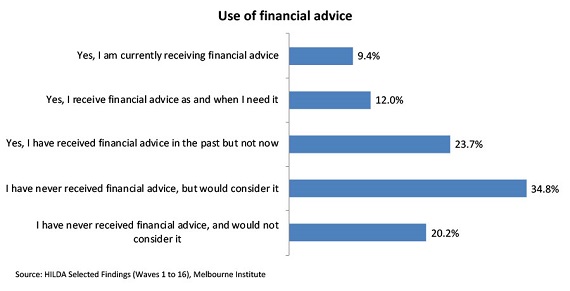
CoreData’s research over the past two decades has consistently found that at any point in time, only around one in four Australians are receiving financial advice.


This is a relatively low proportion considering we have also consistently found that the value of financial advice is clear, both at a tangible and intangible level. Those who receive financial advice tend to save more than those who do not receive advice, manage their debt better, have a better-performing investment portfolio and have adequate insurance cover, to name just a few of the benefits.

As a result, those who are receiving financial advice tend to have less stress, a greater sense of control, greater peace of mind and improved well-being, both financially and holistically. After all, we know that financial issues can and do have an impact on physical and mental health and on the relationships of Australians.

Despite this impressive array of evidence however, the market penetration of financial advice has remained relatively low, and one potential reason may lie with a certain group of Australians.

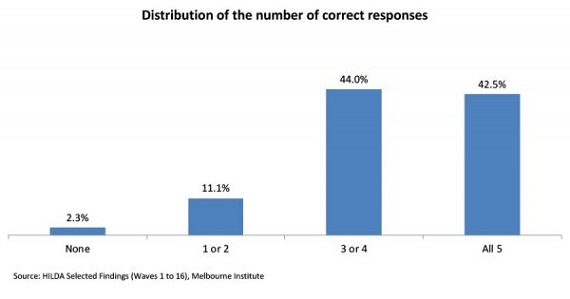
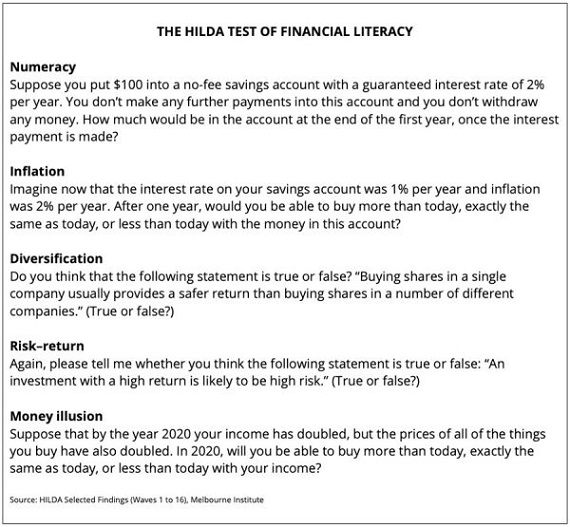
The 2018 Household, Income and Labour Dynamics in Australia (HILDA) Survey, conducted by the University of Melbourne’s Melbourne Institute, provides a comprehensive objective snapshot (as opposed to a subjective self-rated assessment) of Australians’ financial literacy by asking five questions about basic financial concepts (see box for the questions).

It was found that fewer than half (42.5 per cent) of Australians could answer all five questions correctly, with women and younger Australians performing worst. 

It was also found that those with lower financial literacy usually have poorer financial health, save less, and are consequently more vulnerable to experiencing financial stress.


Unfortunately, it is women and younger Australians with lower financial literacy who are more likely to be under-serviced by the financial advice sector. Although they tend to be less wealthy, the need to budget effectively, pay off debt and save more does not disappear and is likely to be more critical as they have less of a financial buffer for unexpected needs. 

Although they are typically less inclined to seek financial advice given a perception that their less complex financial circumstances do not warrant it, too many may have been overlooked by financial advisers given their lower wealth profile.

While some of those with lower financial literacy may be living in blissful ignorance about their relatively poor financial situation and choose not to do anything to improve it, many are likely to be well aware that their financial situation could be better and have a desire to improve it – the very people who could benefit from receiving financial advice.

Although some of those with lower financial literacy may have a natural inclination or preference to manage their finances themselves, given their generally poorer financial health, many could probably do with and actually want the support of a financial adviser. However, they are typically hampered by a range of barriers to turn the motivation into action, particularly the lack of perceived need and the perceived high cost relative to value.


Clearly the financial advice sector needs to do more to highlight the value of receiving financial advice to the masses, including those with lower financial literacy, emphasising that it is not just for the wealthy or those with complex financial needs. 

More work also needs to be done towards providing cheaper and simpler financial advice for less complex financial matters to make it more accessible for Australians. Encouragingly, some work has already been done on these fronts. 

But the work needs to be done consistently over the long-term to make a real difference in lifting the market penetration of financial advice and ultimately improving the well-being of Australians, financially and holistically.


Source: 

By Fumin Rianto, Head of Operations at CoreData.

Reproduced with the permission of CoreData Research. This article was originally published on New Model Adviser, a website powered by CoreData Research, showcasing its research and insights on financial advice: the profession, advisers, advice practices, licensees, legislation and more.

Important:

This provides general information and hasn’t taken your circumstances into account. It’s important to consider your particular circumstances before deciding what’s right for you. Although the information is from sources considered reliable, we do not guarantee that it is accurate or complete. You should not rely upon it and should seek qualified advice before making any investment decision. Except where liability under any statute cannot be excluded, we do not accept any liability (whether under contract, tort or otherwise) for any resulting loss or damage of the reader or any other person. Any information provided by the author detailed above is separate and external to our business and our Licensee. Neither our business nor our Licensee takes any responsibility for any action or any service provided by the author. Any links have been provided with permission for information purposes only and will take you to external websites, which are not connected to our company in any way. Note: Our company does not endorse and is not responsible for the accuracy of the contents/information contained within the linked site(s) accessible from this page.
 

The sooner you start, the more you can save. Find out how to make a savings plan that motivates you and use our tips to save money every day.

Set a savings goal

Whether you’re saving for a holiday, home renovations or want a little extra in the bank for a rainy day, having a savings goal will help you get there.

Work out how much money you need and how long it will take you to save.

Use our savings goal calculator

Work out how long it’ll take to reach your savings goal.

Have a savings plan

The secret to saving is start early and save often. Create a savings plan so you can manage your money and stick to your goal.

Know where your money is going

Have a clear picture of your regular expenses and spending habits. This helps you see where you can cut back and save. For example, cancel an unused gym membership or bring your lunch to work. It may surprise you how little things add up.

See track your spending for practical ways to get started.

Start a budget

Once you know how you’re spending your money, you can set a realistic budget. Your budget will help you to stay on track, review your progress and reach your money goals sooner.

See how to do a budget to get started.

Pay off some debt

If you have some money left over after your regular expenses, use it to make extra repayments towards any credit card debt or loans you have.

Paying off your debts sooner can save you thousands in interest. Pay off the one with the highest interest rate first.

Use our credit card calculator

See how much you can save by making extra repayments.

Shop around for the best deal

Do your research before you sign up for a financial product like a credit card or loan. Make sure the product is right for you and that you’re getting the best deal. For example, choosing a credit card with a lower interest rate and fewer fees can save you a lot.

Similarly, when it’s time to renew your insurance, compare premiums with other providers online. Your current insurer may offer to beat competitors’ offers if you stay.

Comparison websites can be useful, but they are businesses and may make money through promoted links. They may not cover all your options. See what to keep in mind when using comparison websites.

Find the best deal on your electricity and gas on the Australian Government’s Energy Made Easy website.

Set up a separate savings account

An online savings account is a great way to manage your money. Unlike a transaction account, you can’t spend money directly from a savings account, so it’s harder to dip into your savings. Look for an account with the highest interest rate and no fees, to grow your savings faster.

Automate your savings

Transfer part of your pay into your savings account. You can ask your employer to do this for you or you can set up a direct debit. This way, you’re saving without even having to think about it.

Round-up transactions

Some savings accounts let you round-up your daily transactions to the nearest $1 or $5. The change then goes directly into your savings account.

For example, James buys a coffee before work each morning:

  • The coffee costs $4.20.

  • His account is debited $5.

  • 80 cents goes straight into his online savings account.

After a year, James will save more than $200.

Change a spending habit and save

Change one regular spending habit and save. Small spending changes add up to big savings in the long run.

  • Switching from a large to a small latte can save $1.50 a day. This saves more than $500 a year on buying coffee.

  • Cut down on alcohol – it will save you money and can have health benefits.

  • Make your lunch at home. Saving even $5 a day on buying lunch adds up to $1,200 over a year.

  • Cut back on eating out or ordering in. Australians spend 34% of their food budget eating out on average – or $1,600 a year.

Source : Moneysmart .gov.au August 2020 

Reproduced with the permission of ASIC’s MoneySmart Team. This article was originally published at https://moneysmart.gov.au/saving/simple-ways-to-save-money

Important note: This provides general information and hasn’t taken your circumstances into account.  It’s important to consider your particular circumstances before deciding what’s right for you. Although the information is from sources considered reliable, we do not guarantee that it is accurate or complete. You should not rely upon it and should seek qualified advice before making any investment decision. Except where liability under any statute cannot be excluded, we do not accept any liability (whether under contract, tort or otherwise) for any resulting loss or damage of the reader or any other person.  Past performance is not a reliable guide to future returns.


Important Any information provided by the author detailed above is separate and external to our business and our Licensee. Neither our business nor our Licensee takes any responsibility for any action or any service provided by the author. Any links have been provided with permission for information purposes only and will take you to external websites, which are not connected to our company in any way. Note: Our company does not endorse and is not responsible for the accuracy of the contents/information contained within the linked site(s) accessible from this page.
 

When you are looking for professional advice on anything to do with money, knowing who to turn to can be challenging. Should you contact an accountant or a financial adviser or both? The two fields are vastly different in how they can help you. 

What does a financial adviser do?

Financial advisers (also known as financial planners) provide a range of advice to help you at different life stages. Financial advisers can help you:

  • save for a deposit to buy your first home,

  • manage your cash flow,

  • develop a share or investment property portfolio,

  • invest for your children’s future, 

  • manage your debts effectively, 

  • have an appropriate level of insurance to protect your income and your assets,

  • plan for your retirement.

Financial advisers work with you to develop a financial plan based on your individual needs and financial circumstances. Financial planning focuses on the future effects of financial decisions you make today.

It’s a legal requirement for all financial advisers in Australia to be licensed. This licensing requirement helps to protect consumers from receiving financial advice from unqualified advisers. Financial services licences in Australia are issued by the Australian Securities and Investments Commission (ASIC). ASIC maintains an online register of current financial advisers. 

What does an accountant do?

Accountants are responsible for helping you fulfil your legal obligations by accurately reporting on financial activity each year. 

Accountants provide a range of services, including:

  • providing tax advice and lodging your tax returns (to do this, they need to be registered with the Tax Practitioners Board). They can help you to legally minimise the amount of tax you need to pay by maximising your eligible tax deductions and tax rebates.

  • helping you with your financial records and legal reporting requirements if you’re running a business or if you have a self-managed super fund and,

  • taking care of complex tax issues, providing business advice and audits. 

A qualified accountant will be registered with a relevant professional body such as Chartered Accountants Australia and New Zealand

Certified Practising Accountants Australia or the Institute of Public Accountants

The bottom line

Financial advisers and accountants can provide you with a range of important services. Make sure that a financial adviser or accountant is appropriately qualified and registered before engaging their services.


Source: Clientcomm library

References:

https://asic.gov.au/for-finance-professionals/afs-licensees/financial-advisers-register/

https://www.tpb.gov.au/registrations_search

https://www.charteredaccountantsanz.com/

https://www.cpaaustralia.com.au/

https://www.publicaccountants.org.au/


Important note:
This provides general information and hasn’t taken your circumstances into account.  It’s important to consider your particular circumstances before deciding what’s right for you. Although the information is from sources considered reliable, we do not guarantee that it is accurate or complete. You should not rely upon it and should seek qualified advice before making any investment decision. Except where liability under any statute cannot be excluded, we do not accept any liability (whether under contract, tort or otherwise) for any resulting loss or damage of the reader or any other person.  Past performance is not a reliable guide to future returns.Any general tax information provided in this publication is intended as a guide. It is not intended to be a substitute for specialised taxation advice or an assessment of your liabilities, obligations or claim entitlements that arise, or could arise, under taxation law, and we recommend you consult with a registered tax agent.

Any information provided by the author detailed above is separate and external to our business and our Licensee. Neither our business nor our Licensee takes any responsibility for any action or any service provided by the author.

Any links have been provided with permission for information purposes only and will take you to external websites, which are not connected to our company in any way. Note: Our company does not endorse and is not responsible for the accuracy of the contents/information contained within the linked site(s) accessible from this page.


If you’re prone to procrastination, you’re certainly not alone. When there’s so much to do, it’s all too easy to postpone action because you can’t quite bring yourself to get started. Most things feel like overwhelming hurdles, until you take the first step towards completion. It’s this first step that gets the ball rolling, so all you need to do, is find the motivation to take it.

Here’s how to do it, quickly. 

Change your body language

Do you often slump over the laptop, amble reluctantly to your next meeting or sit with your arms and legs crossed? Postures and gestures you use not only communicate something to everyone around you, but affect your mood and productivity levels. As soon as you feel procrastination taking over, check in with your body to see how you’re sitting, standing or walking. 

Instead of any posture that makes you look and feel small, slumped and tightly crossed, open up and stretch confidently, by extending your chest, arms and legs. Walk briskly and with purpose, while taking deep breaths. Smile, even if it’s just to yourself. These small changes tell your brain to get going, in a mere matter of minutes. 

Become aware of your thoughts

Like most things, motivation is a skill that takes practice to cultivate. When you’re constantly telling yourself you can’t achieve goals, finish projects or even get out of bed, your putting yourself into a pessimistic state that blocks action. To change this, it’s crucial to remain aware of your thought patterns. This is the easy part, because the signs of negative thinking are starkly obvious, via the associated negative feelings. 

As soon as you feel yourself succumbing to non-productive thoughts, whip them into shape by reframing them in a positive light. Mentally debate them if you need to, by acknowledging that they’re not necessarily true. For example, while today’s ‘to-do’ list might seem overwhelming, is it true that it’s entirely unachievable? Not likely. If it is, adjust your thinking by focusing on proactive solutions, rather than the feeling of being overwhelmed. 

Simplify your goals

No matter how motivated you are when you start the day, if your goals aren’t measurable it’s far too easy to sink into non-action. Let’s say your goal is to get fit, which is something that’s not going to happen overnight. Without specific, measurable steps to take each day, it’s not going to happen at all. 

While it’s fantastic to have long term goals and even better to reach high, it’s these very aspirations that can hold you back by projecting too far into the future. It’s in this ‘future thinking’ space that goals seem unattainable, thereby squashing your motivation to get started. 

When you find yourself procrastinating, give your motivation a boost in minutes by kicking one, simple goal that puts you one step further on the path. In this case, get up and go for a quick jog, and pat yourself on the back for it afterwards. 

Practice taking small steps and rewarding yourself for them, changing your body language and reframing your thoughts towards positivity every day. You’ll soon find your motivation muscles growing stronger, in order to propel you towards successful action and working smarter, not harder. 

Source: Clientcomm library

This provides general information and hasn’t taken your circumstances into account. Any links have been provided with permission for information purposes only and will take you to external websites, which are not connected to our company in any way. Note: Our company does not endorse and is not responsible for the accuracy of the contents/information contained within the linked site(s) accessible from this page.
Having a budget helps you to feel in control of your money. You can put aside money for big bills when they arrive, and plan savings to achieve your money goals.

You don’t need an accountant or special software to set up your own budget. Start by looking at where you are right now and where you want to be.

Set your money goals

First, work out why you want to do a budget. This can help you to decide where you want your money to go.

Ask yourself: what is my goal? It could be to stay on top of bills, save for emergencies, pay for your children’s education, or save for a holiday or a house deposit.

See where your money goes

Having a clear picture of your regular expenses and spending habits will help you set up your budget.

To do this, track your spending over a week, a fortnight or a month. See track your spending for practical ways to do this.

How to set up your budget

Use how often you get paid as the timeframe for your budget. For example, if you get paid weekly, set up a weekly budget.

Then follow these steps to set up each section.

Use our budget planner

Set up your budget and save it online or use our Excel budget spreadsheet.

1. Record your income

Record how much money is coming in and when. If you don’t have a regular amount of income, work out an average amount.

Make a list of all money coming in, including:

  • how much

  • where from

  • how often (weekly, fortnightly, monthly or yearly)

This money could be from your wages, pension, government benefit or payment, or income from investments.

2. Add up your expenses

Record your regular expenses, including:

  • what for

  • how much

  • when

Regular expenses are your ‘needs’ — the essential items you need to pay for to live. These include:

Fixed expenses, for example:

  • rent or mortgage payments

  • electricity, gas and phone bills

  • council rates

  • household expenses, like food and groceries

  • medical costs and insurance

  • transport costs, like car registration and public transport

  • family costs, like baby products, child care, school fees and sporting activities

Debt expenses, for example:

  • personal loan repayments

  • credit card payments

  • mortgage repayments

Unexpected expenses, for example:

  • car repairs and services

  • medical bills

  • extra school costs

  • pet costs

To make sure you’ve recorded all your expenses, look at your bills or bank statements. If you tracked your spending, use your list of transactions.

3. See if you can save

Having some savings can help create a safety net for unexpected expenses. Set a savings goal and work out how much you can save each payday.

Use our savings goals calculator

Work out how long it will take you to reach your savings goal.

4. Set your spending limit

The money you have left after expenses and savings is your spending money. This money is for ‘wants’, such as entertainment, eating out and hobbies.

Make a plan for what you want to do with your spending money. This will help you to keep within your limit. Keep track of your spending so you always know how much you’ve got left.

Set up three bank accounts: a high interest savings account for savings, and two transaction accounts for spending and bills. Schedule transfers of your savings and direct debits for your bills to automate your finances.

Review your budget regularly

It’s important to adjust your budget as things change. For example, if you find you can’t cover all your expenses, savings and spending, you may have to reduce your spending limit, or change your savings goal.

For ideas to help reduce spending, see simple ways to save money. You can also look for ways to increase your income.

Please contact us on Phone: 07 5641 4134 if you seek further assistance on this topic .

Source : Moneysmart.gov.au August 2020

Reproduced with the permission of ASIC’s MoneySmart Team. This article was originally published at https://moneysmart.gov.au/budgeting/how-to-do-a-budget

Important note: This provides general information and hasn’t taken your circumstances into account.  It’s important to consider your particular circumstances before deciding what’s right for you. Although the information is from sources considered reliable, we do not guarantee that it is accurate or complete. You should not rely upon it and should seek qualified advice before making any investment decision. Except where liability under any statute cannot be excluded, we do not accept any liability (whether under contract, tort or otherwise) for any resulting loss or damage of the reader or any other person.  Past performance is not a reliable guide to future returns.

Important Any information provided by the author detailed above is separate and external to our business and our Licensee. Neither our business nor our Licensee takes any responsibility for any action or any service provided by the author. Any links have been provided with permission for information purposes only and will take you to external websites, which are not connected to our company in any way. Note: Our company does not endorse and is not responsible for the accuracy of the contents/information contained within the linked site(s) accessible from this page.
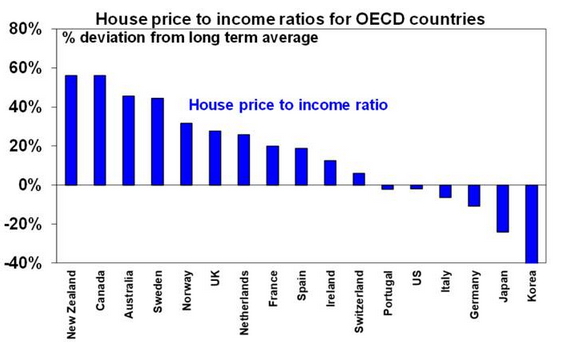
For years Australia has suffered from poor housing affordability. According to the 2020 Demographia Housing Affordability Survey the multiple of median house prices to median annual incomes is 5.9 times in Australia compared to 3.9 times in Canada, 4.5 times in the UK & 3.6 times in the US. Consistent with this the ratio of house prices to incomes relative to its long-term average is at the high end of OECD countries.  


Source: OECD, AMP Capital

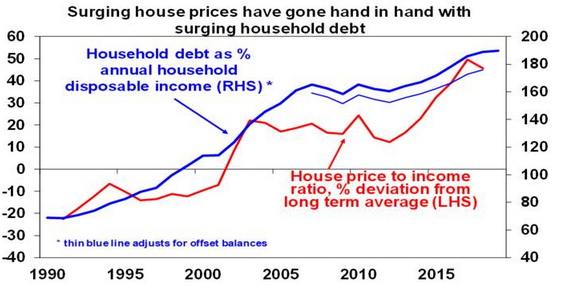
It wasn’t always so – Australia was once seen as a country with relatively cheap and affordable housing. Having a house on a quarter acre block was an essential part of the “Aussie dream”. But that changed last decade as average house prices went higher and higher relative to average incomes and this went hand in hand with a surge in household debt relative to income. See the next chart. There have been several cyclical downswings in property prices that have brought short term relief in terms of affordability – around the GFC when average capital city dwelling prices fell 7.6% based on CoreLogic data, around 2011 when prices fell 6.2% and in 2017-19 when prices dipped 10.2% – but they have been short lived with prices quickly bouncing back.


Source: OECD, AMP Capital

The coronavirus shock may have a more lasting impact. It has brought lots of pain and suffering on a human level but also on an economic level. And it has caused much disruption to the property market in the short term with more likely to come. But it may have a lasting positive legacy in relation to property – that is more affordable housing in Australia.

Why is Australian housing so expensive?

To understand why this may be the case its necessary to consider what has caused poor housing affordability in Australia in the first place. It’s been popular to blame tax concessions, foreign buying, government related housing infrastructure charges and stamp duty and low interest rates and easy credit. But none of these really explain it.

Lots of other countries have a variety of housing tax concessions too, but with much cheaper housing. Foreign buying is a relatively small part of the overall market and has declined in recent years. Infrastructure associated with housing is hardly unique to Australia. Stamp duty adds to the cost of transactions and is a silly tax, but if anything may have kept prices lower than they otherwise would be (when supply is constrained). The shift from high interest rates to low interest rates enabling bigger loans has enabled ever more expensive housing – but other countries have also seen ultra-low interest rates in recent decades and yet have much cheaper housing.

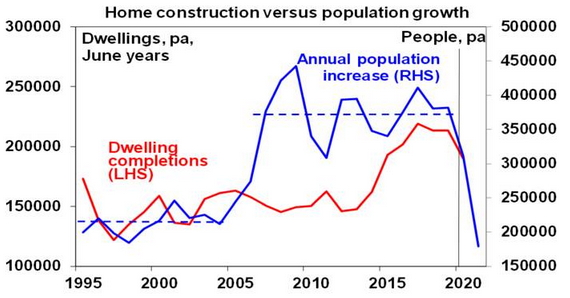
Rather the basic problem has been a surge in population growth from mid-last decade and an inadequate supply response (thanks partly to tight development controls and lagging infrastructure). Since 2006, annual population growth averaged about 150,000 people above what it was over the decade to the mid-2000s. This required the supply of an extra 50,000 new homes per year. See the next chart. Unfortunately, this was slow in coming. But with an insufficient supply response to surging demand, prices were able to stay elevated. And so poor housing affordability got locked in.


Source: ABS, AMP Capital

Each cyclical downturn in house prices has brought hope of a solution, but it was invariably dashed as the fundamental supply demand imbalance remained or re-established itself. The same looked to be applying more recently with average house prices surging 10% between June last year.

The longer-term impact of coronavirus

The coronavirus shock has the potential to change this dynamic of cyclical fluctuations around ongoing poor affordability. It has already triggered a renewed downturn in property prices with capital city prices down 2% on average since April, with Melbourne prices down around 4%. JobKeeper and the bank payment holiday are preventing faster falls at present. But further declines in national prices are likely, as high unemployment, the depressed rental market and the collapse in immigration impact. We now see average capital city prices falling 10-15% from their April high out to mid-next year with Melbourne most at risk and likely to see a 15-20% decline.

Past experience would suggest that this may be just another cyclical downturn and once coronavirus comes under control and the economy rebounds it will be back to normal with poor affordability. Particularly with record low interest rates making it feasible to borrow up big. However, the coronavirus shock has the potential to change this for three reasons.

  • First, the hit to economy from coronavirus is bigger than anything seen in the post war period. While most of the activity hit by lockdowns should bounce back once the virus is brought under control some things will take longer to recover (eg, travel & tourism), some will be permanently changed for ever (with eg, a big shift to on-line shopping, education, health care & watching sports) and businesses will use the uncertainty to accelerate cost savings. All of which will mean a long tail of unemployment. JobKeeper has shielded Australia from what otherwise would have been 15% unemployment in April and 11% unemployment now. But officially measured unemployment is still likely to hit 10% by year end and will probably have only fallen to around 9% by end 2021. This will likely result in more forced property sales and act as a drag on home prices, as income support measures & the bank payment holiday wind down.

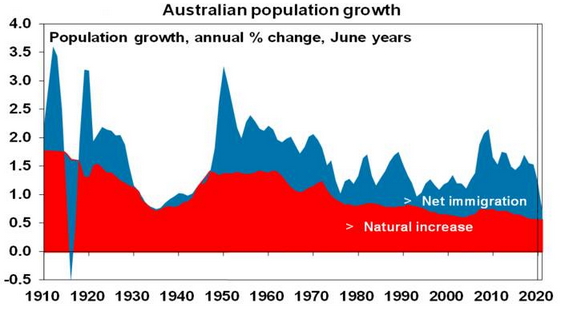
  • Second, immigration has been a big driver of property prices and it’s taken a huge hit and may take a long while to recover. Thanks to travel bans, net immigration is likely to have fallen to just below 170,000 in 2019-20 and to around 35,000 this financial year from 240,000 last financial year. This is a huge hit which will take population growth in 2020-21 to just 0.7%, its lowest since 1917. See next chart.This will reduce annual underlying demand for homes to around 120,000 dwellings, compared to underlying demand last year of around 200,000. This could result in a significant oversupply of dwellings, and in turn could reverse the years of undersupply that has maintained very high house prices since mid-last decade. (See the population versus dwelling completions chart above.) A big cut to immigration is not something many other countries have to deal with, so their experience is not directly translatable to Australia. Of course, if this is just for a year, it wouldn’t have much lasting impact. And the return of expat Australians may provide a short-term offset. But with unemployment likely to remain high for some time, it will be hard politically for the Government to quickly ramp up immigration to previous levels, even once it is safe to do so from a coronavirus perspective. After the early 1990s recession net immigration stayed low at around 90,000 pa until the mid-2000s. All of which points to a long period of constrained housing demand and hence more constrained house prices.


Source: ABS, AMP Capital

  • Finally, a mass shift to working from home potentially has huge implications for residential property prices. Prior to coronavirus, working from home was only slowly creeping in. Now coronavirus driven lockdowns and social distancing has shown that its feasible for most white-collar workers and can be good for productivity. Of course, full time working from home does come with costs in terms of team cohesion, corporate culture, the development of younger workers and less opportunities for spontaneously exchanging ideas. So, some sort of hybrid may become the norm – some at home all the time, some in the office all the time, but most doing half and half. And working from home works best in houses where there’s lots of room as opposed to apartments. All of which could revolutionise residential property demand – and from what I am hearing anecdotally maybe already is. Which will mean less demand for property close to the CBD, greater demand for property in suburbs, with a decent community and environment and increased property demand in regional centres. All of which could break down the dominance of the city with its expensive property. This would turn the trend of recent decades favouring more condensed living close to the city on its head. Some office property (and possibly also some retail property impacted by the shift to online retailing) could be repurposed for residential use, thereby boosting housing supply. By fostering decentralisation, a shift away from cities to regional communities could dramatically improve housing affordability over time.

Concluding comment

We are still fighting the war against coronavirus but it’s likely, as we have seen with various shocks in the past, we will get over it, and go back to something more normal. But not everything will go back to normal. A lasting impact could be more affordable housing in Australia. It’s not our base case that this will come in the form of a property crash (and that would be a bad outcome for the economy anyway via negative wealth effects) but it could come in the form of much softer property price gains over time (after the initial hit into next year).


Source: AMP Capital 12 August 2020

Important notes: While every care has been taken in the preparation of this article, AMP Capital Investors Limited (ABN 59 001 777 591, AFSL 232497) and AMP Capital Funds Management Limited (ABN 15 159 557 721, AFSL 426455) (AMP Capital) makes no representations or warranties as to the accuracy or completeness of any statement in it including, without limitation, any forecasts. Past performance is not a reliable indicator of future performance. This article has been prepared for the purpose of providing general information, without taking account of any particular investor’s objectives, financial situation or needs. An investor should, before making any investment decisions, consider the appropriateness of the information in this article, and seek professional advice, having regard to the investor’s objectives, financial situation and needs. This article is solely for the use of the party to whom it is provided and must not be provided to any other person or entity without the express written consent of AMP Capital.

If you think storms may lie ahead, it makes sense to prepare your craft for choppy waters. With Australia facing continued economic uncertainty, it may be time to take stock of your finances and get in the right shape.

First the good news. The Australian economy fared better in the first quarter of 2020 than many other countries¹. To the end of March, the economy only contracted 0.3%, compared with 2.0% in the UK and a whopping 9.8% in China.

More challenging times may lie ahead. A century on from the last global pandemic, this looks like a downturn unlike any other in living memory. Back in 1990, Treasurer Paul Keating lamented the “recession we had to have.” This time around, we’re trying to thaw an economy that’s been deliberately placed into hibernation. It isn’t something we’ve seen before, so lessons from previous recessions may not apply.

However, if you’re worried about the threat of redundancy, your investments or your retirement plans being disrupted, there are things you can do to secure your financial lifeboat.

1. Revise your budget

A realistic budget helps you get a clearer view of what you can and can’t afford.

If you don’t have one already, you can create a view of your total income and expenses, on a weekly, fortnightly, monthly or yearly basis.

There are many free options available, such as a simple spreadsheet or taking advantage of apps or online tools.

2. Decide what matters most to you

Reassessing your budget helps you decide what’s essential and what you can put on hold, or perhaps ditch altogether to lessen the strain on your household finances.

Essentials might include your mortgage or rent, utilities or car insurance if you need to keep running a vehicle. Remember that even if something is essential, you might still be able to make a saving on it.

Look for a better deal on comparison sites like Finder, which can help you find potentially preferable offers on everything from car insurance to shopping.

Low interest rates are likely to remain for some time, so this might be a good time to approach a mortgage broker to see if there’s an alternative that’s right for you.

3. Pay down and consolidate debt

Debt consolidation is one way to take control of your finances and potentially pay off your debts sooner.

This means combining or consolidating your debts into one loan with, ideally, a lower overall interest rate. Assuming you can cover your repayments, the lower interest rate means you’ll pay less interest and pay off your debt sooner, as long as you continue to make the same repayments on the original debt. Otherwise the consolidated debt is spread out over the life of the bigger loan.

This approach might also help you simplify your finances by reducing multiple repayments for credit cards, store cards and a car loan for example, into one monthly payment.

Fees and conditions may apply. Check your existing loan terms to see if any early termination fees apply. If you’re applying for a new loan, confirm the application fee costs and eligibility criteria.

Keep in mind that debt consolidation will only be effective if you’re disciplined about making your repayments. And before making a decision, you might like to speak to us on Phone: 07 5641 4134.

Getting help with debt

If you’re finding it hard to keep up with your repayments, help is available. Call your providers as soon as you can to let them know you’re experiencing financial hardship. They can assess your situation and see if alternative payment plans may be able to assist you during difficult times. 

You can also access free financial help via:


Avoid payday lenders

Payday loans, also known as short-term loans, provide fast cash so they may seem like a quick fix for money troubles. However, you could end up paying back more than you borrowed in higher fees and interest2.
These loans don’t tend to address the root cause of debt problems and can potentially trigger borrowers to spiral into deeper debt distress.

4. Do the hustle

While you sort through your budget, you might do the same for your house. Garages or spare rooms can be a treasure trove, from forgotten kids’ games to clothes you’d only ever need if you get invited to a 90s theme party.

You might be able to turn these into ready cash on eBay, Gumtree or by taking a stall at your local market.

If you’d rather trade your skills than your Friends boxset, you might be able to earn extra income via sites like hipages or Airtasker.

The gig economy means there’s more readiness than ever to use short-term contractors for all types of white collar work. These might even present new contacts and jobs you’ve not previously considered – and lead to more permanent opportunities. You can register online via sites like Freelancer to get started.

5. Keep your eyes on the horizon

As with most investment and super strategies, it helps to look long term rather than thinking only of the next few weeks or months. It’s easy to get discouraged when many forms of media concentrate on negative or shocking news.

Finally, as AMP’s Head of Investment Strategy and Economics and Chief Economist Shane Oliver points out, anyone who got too negative for the long term in the last major pandemic of 1918-19 might have missed out entirely on the ‘roaring twenties’, a decade of economic growth and widespread prosperity.

Staying informed

As we saw with the JobKeeper payment, new initiatives may emerge to help your job search, your savings or your business, so it pays to be as well informed as you can. Listen to experts you can trust such as the ATO and other government sites.

Mental health

Remember, if you’re feeling overwhelmed or need to talk to someone about how you’re feeling right now, you can access free services anytime, including:

  • Lifeline: 13 11 1

  • Beyond Blue: 1300 22 4636

  • Mental Health Line: 1800 011 511.

Please contact us on Phone: 07 5641 4134 if you would like to discuss any of the issues raised in this article.

Source: AMP June 2020 

1. ABC News, Australia in its first recession in 29 years as March quarter GDP shrinks
2. Moneysmart.gov.au