As the ATO begins knocking on the doors of SMEs and sole traders with queries about their JobKeeper eligibility, quality record keeping is proving to be critical when asked to substantiate a claim.

Just like with most tax related matters, businesses and sole traders  looking to claim JobKeeper payments are expected to self-assess their eligibility before applying.

In most cases, payments are automatically made to the applicant, but they are subject to reviews and audits by the ATO, even after the money has been paid out. In fact, according ABC News, the ATO has allocated some 3,000 staff to conduct ‘compliance reviews’, and has already rejected more than 6,500 applications as a result of ineligibility or fraud.

The ATO has also sent out letters to 8,000 businesses with warnings that they may have to repay their JobKeeper stipends due to being unable to adequately demonstrate their eligibility upon review.

If COVID-19 has shown us anything, it’s that SMEs are very vulnerable when they don’t have access to cash, and JobKeeper has single handedly kept the doors of thousands of Australian businesses with weak balance sheets open.

For many businesses, being forced to repay these funds will send them into duress and fast track their downfall. But just because you believe that your business is eligible, there’s no guarantee that the ATO will agree, which highlights the importance of doing everything possible to present a strong case of eligibility in the event of an ATO audit.


Three areas to focus when preparing for a JobKeeper audit


There are three key components to accessing JobKeeper:

  • Being an eligible entity/business

  • Claiming for eligible staff

  • Making a valid and correct claim

Each of these components are being scrutinised by ATO representatives conducting compliance reviews, and here are some ways to increase the quality of record keeping for all three of them, so that if the ATO comes knocking, your business can be ‘review-ready’.

READ: JobKeeper 2.0 for small businesses

1. Are you using reliable accounting software?

Being eligible to receive JobKeeper payments comes down to whether a business has seen a 30 percent drop in revenue in comparison to the same period 12 months earlier.

Given the high number of tip-offs about system-rorting that the tax watchdog has received, it has been asking businesses to present older versions of their accounts to see whether any deliberate manipulation has taken place.

For those sole traders and SMEs that use excel spreadsheets and basic filing systems to track their finances, being able to present defensible versions of old accounts can be very challenging and may not be sufficient for the ATO in the event of a review.

If you haven’t been doing so already, make sure to use an accounting software system that tracks your every move.

Using a system that has been specifically revamped to include JobKeeper-related functionality (like MYOB Essentials or AccountRight) is certainly the gold standard and will make it easier for you to maintain compliance and prove eligibility to the ATO.

2. Make sure all recipients are accounted for

For those businesses claiming JobKeeper payments for their employees, part of the due-diligence that the ATO expects is that all employees are accounted for. In the event that a business needs to exclude an employee from its JobKeeper claim, records need to be kept explaining why they’ve been excluded.

Failing to include all eligible employees in a JobKeeper application renders the business ineligible to receive payment.

If the ATO conducts a JobKeeper review on your business, providing records that were created retrospectively will never look as good as those that were prepared as each claim was being made.

So, as part of your process of claiming JobKeeper, make sure that adequate and up-to-date documentation is being kept on all employees regarding their employment and eligibility for JobKeeper.

3. Retain advice and outsource if you need to

When it comes to matters that relate to the tax system or the ATO, it never pays to do things whimsically or without proper process and due-diligence.

It may come at an extra cost but retaining advice from a registered tax agent on your business’s eligibility, the quality of its record keeping and everything in between, is the safest way to go about claiming JobKeeper payments.

Relying on the advice of an accredited tax practitioner (and outsourcing record keeping processes to them) will allow you to rest assured that valid claims are being made each fortnight, record keeping and reporting process are at the highest of standards, subsequently removing panic from an ATO-administered JobKeeper compliance review.

Please contact us on Phone: 07 5641 4134 if you seek further assistance on this topic .

Source : MYOB July 2020 

Reproduced with the permission of MYOB. This article by Benjamin Kluwgant was originally published at https://www.myob.com/au/blog/how-to-prepare-your-business-for-a-jobkeeper-audit/

Important: This provides general information and hasn’t taken your circumstances into account. It’s important to consider your particular circumstances before deciding what’s right for you. Although the information is from sources considered reliable, we do not guarantee that it is accurate or complete. You should not rely upon it and should seek qualified advice before making any investment decision. Except where liability under any statute cannot be excluded, we do not accept any liability (whether under contract, tort or otherwise) for any resulting loss or damage of the reader or any other person.

Any information provided by the author detailed above is separate and external to our business and our Licensee. Neither our business nor our Licensee takes any responsibility for any action or any service provided by the author. Any links have been provided with permission for information purposes only and will take you to external websites, which are not connected to our company in any way. Note: Our company does not endorse and is not responsible for the accuracy of the contents/information contained within the linked site(s) accessible from this page.


Having a ‘job for life’ is mostly a thing of the past. Many Australians will change jobs a number of times during their career, and in doing so, may end up with multiple super funds. This could mean you end up paying multiple sets of fees that chip away at your retirement savings. Your super is your money, and you have a choice of where your super is paid, even when you change jobs.

Keeping your super on track

Starting a new job involves a lot of change – a new workplace, new colleagues, a new role to learn – so it’s little wonder that people often forget to organise their super and just go with the new employer’s default option. In fact, changing jobs is likely to be the main reason that many Australians have more than one super fund. Of the 15.6 million Australians with super, 39% have more than one super account1.

Unfortunately, this can mean more fees and more paperwork. By taking the time to understand your options, you can help to keep your super on track to a comfortable retirement. This is what you need to know:

What happens to my super when I change jobs?

If you change jobs, it doesn’t mean you have to change your super fund. In most cases, if you already have a super fund that you would like to stick with, you can. Once you start your new job, your new employer has 28 days to give you a standard choice form. You simply need to fill out the details of your existing fund on the form, and your new employer will pay your super contributions to it.

If you don’t make a choice, your employer will pay your contributions into their default fund. That means you’ll have at least two super accounts, with no new contributions going into your current fund.

Research your new company’s super fund

If you don’t yet have a fund or want to change funds, it pays to know your options and do your research. Find out about your new company’s super fund to see if it’s right for you. Be sure to take into account considerations such as the investment options, the performance of the investment options, the level of risk you’re comfortable with, the fees and any available insurance options. You can look further afield and select a fund separate to your new employer’s default fund if you prefer. If you don’t nominate an investment option, chances are your super will be paid into your employer’s default fund, with your super invested in a default MySuper account.

What is MySuper?

Many retail, industry and corporate super funds now offer a new type of investment option called MySuper – a government initiative for simple, cost-effective default super options for Australian employees. It is a default investment option for those who don’t select a super fund when they start a new job.

Funds that provide MySuper investment options must either have a single diversified investment strategy or, alternatively, a lifecycle investment approach. Single diversified investment strategies invest your money into a standard mix of investments and the level of risk stays the same each year. Lifecycle options move your money from more growth investments when you are young to more conservative investments as you increase in age and are closer to retiring.

What happens to my insurance cover?

It’s important to understand how changing super funds may impact your insurance benefits. For example, you may lose your automatic insurance cover if your super fund no longer receives employer contributions or there may be changes to your insurance premiums. Before making any changes, it’s a good idea to compare the cover provided by your current fund versus your employer’s fund, as well as the premiums you’ll pay from your super account. There may also be eligibility requirements or age limits that apply to obtaining insurance cover or default cover. Be sure to understand what’s involved so you don’t get caught out without cover.

Remember to review your super

Changing jobs can be a timely reminder to review your super investment options to make sure they’re still appropriate for you. This is a good idea regardless of whether you’re sticking with your existing super fund or moving to a new one. It may also be a good time to consider consolidating your super, as having one super account can mean less fees and less paperwork, making it easy to keep track of your money.

Please contact us on Phone: 07 5641 4134if you seek further assistance on this topic.


https://www.ato.gov.au/About-ATO/Research-and-statistics/In-detail/Super-statistics/Super-accounts-data/Multiple-super-accounts-data/

Source : AMP August 2020 

Important: This information is provided by AMP Life Limited. It is general information only and hasn’t taken your circumstances into account. It’s important to consider your particular circumstances and the relevant Product Disclosure Statement or Terms and Conditions, available by calling Phone: 07 5641 4134, before deciding what’s right for you.

All information in this article is subject to change without notice. Although the information is from sources considered reliable, AMP and our company do not guarantee that it is accurate or complete. You should not rely upon it and should seek professional advice before making any financial decision. Except where liability under any statute cannot be excluded, AMP and our company do not accept any liability for any resulting loss or damage of the reader or any other person. Any links have been provided for information purposes only and will take you to external websites. Note: Our company does not endorse and is not responsible for the accuracy of the contents/information contained within the linked site(s) accessible from this page.

Recent volatility in investment markets can be frightening when you’re saving for retirement, but one of the key lessons from history is that volatility is a normal and necessary part of investing.

Markets are made up of individuals making buying and selling decisions based largely on their view of the future. Given the future is uncertain, those individual views differ. From time to time, events that increase uncertainty about the future or lift the chance of a weaker economy can prompt sell-offs in the markets.

The daily market moves reported in the media can make things seem worse than they are.

A 1000 point move in the Dow Jones Industrial Average sounds big but it represents less than 4 per cent of the index in 2020. Contrast that with October 1987, when the Dow fell 500 points in a day—but it was a full 22 per cent of the index’s value.

Investors have certainly had to cope with severe volatility and uncertainty in recent years (and especially in 2020), from the worldwide spread of COVID-19, to US-China trade tensions, to fears of impending recession and worries about inflation taking off.

So how can investors remain focused and cope with market fluctuations?

The first step is to accept that volatility is normal and that it should be expected.

The second step is to have a financial plan. It does not need to be War and Peace just capture the essence of why you are investing in the first place, the goals you are hoping to achieve and a realistic stock take of where you are today.

The third step is to stay diversified, be disciplined to avoid impulsive decisions and stay focused on your long-term goals.

Sometimes, investors can be tempted to sell during downturns, getting out of the market to avoid the potential for further losses.

The problem with this strategy is it locks in losses and provides no exposure to the eventual recovery in prices.

Global markets experience eye-catching downturns on average about every two years. In fact since 1980 (and even not including recent market events sparked by COVID-19), global stock prices have fallen more than 10 per cent (called a ‘correction’) on 11 occasions. On eight occasions they fell more than 20 per cent, the very definition of a bear market.

Remaining in the market is a better strategy than selling.

Some investors might also be tempted to try to pick up a bargain during a downturn, buying stocks that have fallen heavily in the hope they will make outsized gains as sentiment recovers.

But the odds of picking the winners are small and the odds of timing market up days and down days are even slimmer, particularly as days of big moves (in either direction) tend to cluster together.

So remaining diversified is the superior strategy.

Diversification is a proven approach to managing investment risks, reducing the risk of damaging losses from the performance of a single asset or sector.

Not all markets perform badly at the same time and a diversified portfolio ensures that exposure to the worst performing markets is mitigated while delivering at least some exposure to the better performing markets. 

Written by Robin Bowerman, Head of Corporate Affairs at Vanguard.

Please contact us on Phone: 07 5641 4134 if you seek further discussion on this topic.

Source : Vanguard August 2020 

Reproduced with permission of Vanguard Investments Australia Ltd

Vanguard Investments Australia Ltd (ABN 72 072 881 086 / AFS Licence 227263) is the product issuer. We have not taken yours and your clients’ circumstances into account when preparing this material so it may not be applicable to the particular situation you are considering. You should consider your circumstances and our Product Disclosure Statement (PDS) or Prospectus before making any investment decision. You can access our PDS or Prospectus online or by calling us. This material was prepared in good faith and we accept no liability for any errors or omissions. Past performance is not an indication of future performance.

© 2020 Vanguard Investments Australia Ltd. All rights reserved.

Important: Any information provided by the author detailed above is separate and external to our business and our Licensee. Neither our business nor our Licensee takes any responsibility for any action or any service provided by the author. Any links have been provided with permission for information purposes only and will take you to external websites, which are not connected to our company in any way. Note: Our company does not endorse and is not responsible for the accuracy of the contents/information contained within the linked site(s) accessible from this page.
 

From “eye watering” to “eye popping”

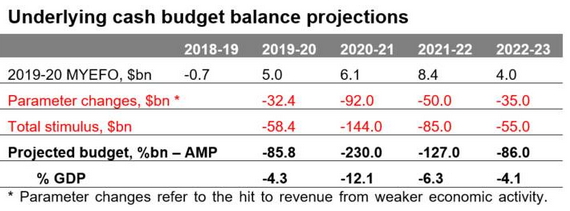
Much concern has been expressed about the longer-term consequences of the blowout in budget deficits and public debt in response to the economic hit from coronavirus. This is understandable given their scale. In Australia, the Treasurer described the projected budget deficit for this financial year of $185bn as “eye watering”. That’s more than three times the previous record of $54.5bn seen at the time of the GFC and at 9.7% of GDP is the highest since the end of World War 2.

And that was back in July! When the latest update is unveiled in the Budget next month it’s likely to be an “eye-popping” $230bn or so on our estimates, reflecting additional stimulus (including the bring forward of tax cuts, investment incentives, more infrastructure spending and stimulus payments) and the further blow to tax revenue from Victoria’s second wave. And given the ongoing hit to tax revenue and need for more stimulus it’s likely to remain big for several years, even though some of the stimulus payment programs will end once the hit to the economy recedes (we are assuming a vaccine and/or antivirals are successfully deployed next year to control the virus). Our revised budget projections are shown below.


Source: Australian Treasury, AMP Capital

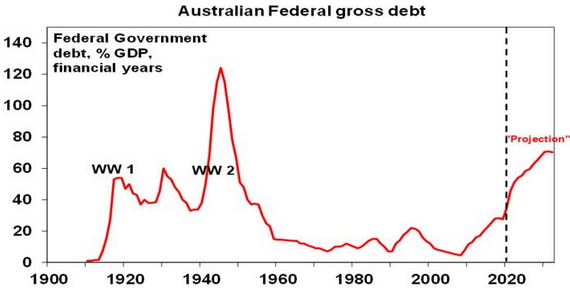
This is likely to see the Federal Government’s gross public debt rise from around 34% of GDP (or $684.3bn) in June to around 54% of GDP (or $1.1trn) in three years’ time.

Our view remains that the Government has done the right thing. Fiscal stimulus has been necessary to protect businesses, jobs and incomes from the impact of the shutdown and associated uncertainty and without it we would be seeing a much bigger hit to the economy and ultimately to the budget and a slower recovery. And further near-term stimulus will be necessary to boost demand. But what about the longer-term consequences? Will the debt ever be paid down? Will fiscal austerity crimp the economy? Or do we live with higher public debt indefinitely?

The post WW2 experience

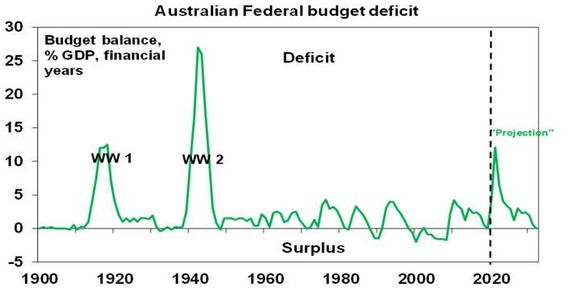
The current situation is not new. A similar challenge was faced after WW2. During WW2 the Federal Government’s budget deficit increased to a record 27% of GDP as a result of war time expenses. This was more than double the likely peak in the budget deficit this year of around 12% of GDP. See next chart.


Source: RBA, Australian Treasury, AMP Capital

The huge war time budget deficits saw Federal gross public debt peak at 124% of GDP, which again is likely to far exceed the level it will reach in the years ahead. See next chart.


Source: RBA, Australian Treasury, AMP Capital

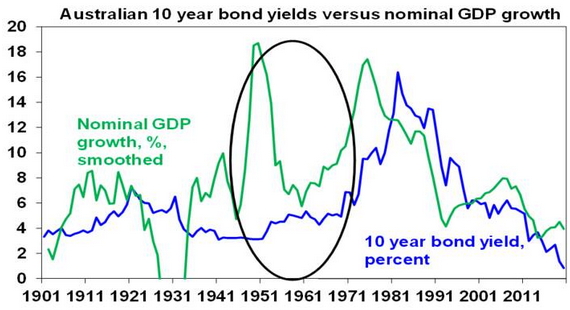
Interestingly the 1950s and 60s rarely saw balanced budgets let alone surpluses and so debt was not actually paid off. But the ratio of public debt to GDP fell sharply and by the early 1970s had fallen to 7% of GDP. The decline was facilitated by:

  • Low interest rates – between 1946 and 1970 10-year bond yields averaged just 4.5% pa; and 

  • Strong nominal economic growth – between 1946 and 1970 nominal GDP growth averaged 10.1% pa.

See the circled area in the next chart.


Source: RBA, ABS, AMP Capital

The low interest rates (helped by prudential regulations that forced financial institutions to hold a certain amount of their assets in government bonds) contained the interest burden on the debt and the strong level of nominal growth meant that the debt burden declined relative to the size of the economy.

The strong growth in the nominal economy reflected:

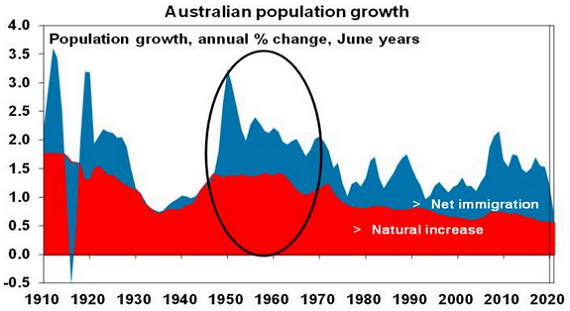
  • Strong real GDP growth – which averaged 4.4% over 1946 to 1970. This in turn reflected a huge increase in the population from the post war baby and immigration booms. Between 1946 & 1970 population growth averaged 2.2%pa. See the circled area in the next chart.


Source: ABS, AMP Capital

  • And protectionist policies were employed to expand Australia’s manufacturing base which in turn helped employ the expanding population and boost productivity.

  • Inflation averaging 5.6% pa over 1946 to 1970 – mainly due to the Korean War boom.

So Australia grew & inflated its way out of its WW2 debt burden.

Can Australia do it again?

The Federal Government has so far ruled out big spending cuts (beyond the eventual ending of pandemic emergency programs) and another deficit levy. And for good reason – if people start anticipating a hike in taxes or cuts to public services they will behave accordingly, and this will endanger the recovery. Rather the Government has emphasised a strategy to boost growth – with the focus likely to be on tax reform, industrial relations reform, education and training, deregulation and increased infrastructure spending. More on this is likely to be announced in the October Budget. However, while these things will help and should be done, it’s doubtful they will get us anywhere near the post war real GDP growth rate of 4.4% pa:

  • Removing niggly taxes like stamp duty will help but to get a big productivity boost from tax reform would require a big shift away from personal and company tax towards the less distortionary GST – and that’s unlikely to get up politically.

  • Much of the low hanging fruit from industrial relations reform and deregulation has likely already been picked.

  • More infrastructure spending will help but it’s hard to see it accelerating much from the boom of recent years.

  • There is no baby boom in prospect and high unemployment will make a quick return to high immigration levels unlikely, so population growth (which this year will be its slowest since 1917) is likely to stay well below pre-covid levels of 1.6% pa, let alone the 2.2% pa seen in the post war era.

  • Finally, while some production of medical essentials may be brought back onshore, a return to full scale protectionism looks unlikely and would be counterproductive anyway.

Higher inflation would help but the RBA has been struggling to achieve that for a while now and high levels of unemployment mean that it is likely still several years away at least.

So, a re-run of the post war experience, which saw the debt burden decline rapidly as growth took off, looks unlikely. The budget and public debt projections in the first two charts above assume the same profile for budget repair from 2023-24 as occurred over the 2010-11 to 2018-19 period, and suggests that budget balance is unlikely until around 2032 by which time Federal public debt may have risen to 70% of GDP or over $2 trillion. Hopefully it doesn’t take that long, but the key point is that based on last decade’s experience we likely have to get used to a long period of high public debt to GDP levels. This is not necessarily a big problem.

First, Japan, Europe and the US have been running high levels of public debt for years now without a major problem. In Japan gross public debt is already in excess of 200% of GDP, in the US its around 130% and Europe its nearly 100%.

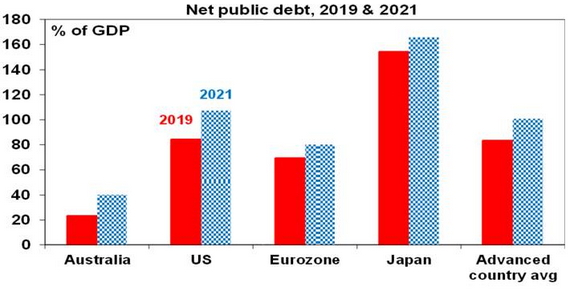
Second, Australia’s starting point for net public debt last year was low at 23% of GDP compared with other advanced countries averaging 83%. And even with the projected blow out over the next few years it will still be relatively small. So, it’s not likely to be a drag on Australian assets versus other countries.


Source: IMF, AMP Capital

Third, one positive versus the post war period is that interest rates are even lower with the Government able to borrow for 10 years at 0.86% and for 3 years at 0.25%. This is well below what nominal economic growth is likely to be and so once budget deficits are reduced could help result in a faster decline in the public debt to GDP ratio than shown in the chart earlier.

Fourth, with Australia borrowing in Australian dollars and not dependent on foreign creditors, Australia is not at risk of a “foreign currency crisis” as a fall in the value of the $A will have no bearing on the Government servicing its debt.

Finally, it’s conceivable that if a problem arose the Government could cancel the bonds the RBA has purchased. This would mean a loss on the value of the government’s investment in the RBA, but it would be offset by a fall in its liabilities. Hence no big impact. The main constraint on this debt monetisation would be if inflation were to take off but that’s still a long way off.

Concluding comment

The bottom line is that the blow out in public debt is a concern and we may have to get used to a long period of relatively high public debt in Australia and in other developed countries. But this won’t necessarily cause a major problem.  


Source: AMP Capital 22 September 2020

Important notes: While every care has been taken in the preparation of this article, AMP Capital Investors Limited (ABN 59 001 777 591, AFSL 232497) and AMP Capital Funds Management Limited (ABN 15 159 557 721, AFSL 426455) (AMP Capital) makes no representations or warranties as to the accuracy or completeness of any statement in it including, without limitation, any forecasts. Past performance is not a reliable indicator of future performance. This article has been prepared for the purpose of providing general information, without taking account of any particular investor’s objectives, financial situation or needs. An investor should, before making any investment decisions, consider the appropriateness of the information in this article, and seek professional advice, having regard to the investor’s objectives, financial situation and needs. This article is solely for the use of the party to whom it is provided and must not be provided to any other person or entity without the express written consent of AMP Capital.

Public liability insurance is one of the most important business insurances in Australia. It can cover legal costs and compensation for damages caused by your business operations.

For example, a water pipe you installed leaks and damages your client’s property. Or an expensive artefact is damaged by your contractor while painting a client’s home. Or a customer hurts themselves at your cafe simply by falling on your slippery floor, or from your “faulty” chair. 

Public liability insurance provides protection against claims of third-party injury and property damage caused by your business operations. 

Jane Betschel, Head of Marketing for MYOB joins Flying Solo editor Lucy Kippist to discuss a range of digital marketing strategies to support small businesses post COVID.

Small Business lifestyle · 227. 5 effective digital marketing strategies for the post COVID world


Understanding the Cost of Public Liability Insurance

While public liability insurance is essential for all business types, it is important to understand how its cost is evaluated. 

This is because the cost of public liability insurance varies based on coverage and insurer. There can be a difference of a few hundred dollars or even a few hundred thousand. How much you have to pay is determined by several factors. 

Here we will walk through the factors that affect the cost of public liability insurance. 

  • Business Type 

The type of business is a crucial factor in determining the cost of public liability. 

An insurer analyzes how much risk is involved in your business operations. For example, trades such as plumbers and electricians typically have more public liability risk than a home or office-based business. That is why generally their premiums are costlier. 

Cafes and restaurants also pose a high liability risk due to a combination of large amounts of people passing through the doors each day, and a high number of things that can go wrong in the hospitality industry which lead to a claim. For example, food poisoning, slips and falls and consumption of hot liquids. 

However, an office-based business, such as a marketing agency or consulting firm, is likely to be considered less risky from a public liability perspective due to the relatively low amount of third party traffic moving across their premises, and less risky physical business activities. 

  • The Size of Your Business

The size of a business is also a factor in determining the cost of public liability insurance. Typically, a company with more staff or higher revenue is likely to claim more often. Some insurance companies check the business size by staff numbers, some measure annual turnover and many consider both. 

For example, if you employ 10 plumbers who visit multiple properties each day your business is typically considered a higher risk than a similar business employing 2 plumbers. 

  • The Location of Your Business

Public liability cost can be influenced by the business location. For example, a business that operates in locations with frequent storms, heavy winds or high crime rates may attract higher public liability costs.

If you operate in areas prone to risks or accidents, or operating activities which are outside of the norm, your cost is likely to be higher. Even worse, it may be difficult to find suitable cover. 

Interestingly, the state where your business is located also influences the cost of the cover. This is because each Australian state and territory have different stamp duty imposed on insurance premiums—which can be anywhere from 0% to 11%. Therefore, stamp duty impacts what you pay.

  • The Level of Cover

Public liability cost is also determined by the level of your cover. The good news is that the cost does not typically go up exponentially with the increase in the level of cover. For example, $10 million public liability insurance will not typically cost you double $5 million cover. 

To summarize, public liability insurance costs for businesses is influenced by key factors including:

  • industry/occupation

  • business size (turnover and employees)

  • location of premises and business activities

  • level of cover

Source : FlyingSolo August 2020 

This article by Romit Malhotra  is reproduced with the permission of Flying Solo – Australia’s micro business community. Find out more and join over 100K others https://www.flyingsolo.com.au/join.

Romit Malhotra is the brand representative of Smart Business Insurance, a leading Australian insurance broker. A big foodie, he loves to travel the world. Also, a diligent businessman, Romit likes to pen down his thoughts on related topics whenever he finds some free time.


Important:
This provides general information and hasn’t taken your circumstances into account. It’s important to consider your particular circumstances before deciding what’s right for you. Any information provided by the author detailed above is separate and external to our business and our Licensee. Any information provided by the author detailed above is separate and external to our business and our Licensee. Neither our business, nor our Licensee take any responsibility for any action or any service provided by the author.

Any links have been provided with permission for information purposes only and will take you to external websites, which are not connected to our company in any way. Note: Our company does not endorse and is not responsible for the accuracy of the contents/information contained within the linked site(s) accessible from this page.
Disclaimer : 

*Important: Cover may be available subject to meeting insurers underwriting criteria. Some of the covers listed may or may not be available or may have limitations or exclusions. Cover inclusions vary significantly from insurer to insurer. DO NOT rely upon the above. Check your policy schedule carefully for inclusions and exclusions and limitations. Talk to a business insurance broker for more information.


The news around the pandemic in past weeks has not been promising. New COVID-19 cases have shown early signs of stabilising over recent days, but it’s too soon to call a downtrend in new cases. The world’s largest economy remains under siege from COVID-19 as the virus begins to take hold in the Midwest and the Great Plains of the US.

Unemployment rates in the US1, the UK2 and Australia3 are likely to reach levels not seen since the Great Depression, and whilst a return to growth before the end of the year isn’t out of the question, it’s far from a certainty.

Yet share markets are still holding at values that belie their dismal context, particularly in the US, where the S&P 500 rallied nearly 5% through July4, and now stands at more than 95% of its pre-COVID-19 level5.

This is an extraordinary outcome under the circumstances, and admittedly helped by the fact that the US market is dominated by tech stocks, which comprise over a quarter of the S&P 500’s market capitalisation. However, the same dynamic can be observed in markets around the world, with valuations seemingly indifferent to the surrounding turmoil.

There are very good reasons for the faith that investors are placing in equities markets – here are four of the most prominent at this point in time:

There’s a good chance of an effective vaccine by the end of the year

A number of promising vaccine candidates are in the final phase of testing6, with a large handful of others hot on their heels. The Oxford7 and Moderna8 vaccines are the furthest advanced and, if successful, could be publicly available by the end of 2020. Major vaccine producers are already manufacturing hundreds of millions of doses9 in the hope that they are proven safe and effective in mass testing.

Death rates in the US appear to be falling

Even as new cases continued to skyrocket through southern and south-western states in June and July, death rates in the US have been significantly lower than they were in the early months of the pandemic. There is obviously a lag in recording mortality as opposed to new cases, which is why deaths continues to rise in places like Texas and Florida, but at this stage it appears that as health services learn how to better manage the disease, the severity of the pandemic is waning.

Central banks have gone all out to shield their economies

We’ve never seen global monetary stimulus on this scale – low interest rates, quantitative easing programs, cheap financing for banks – policy-makers are throwing the kitchen sink at the task of keeping their economies moving, and markets are responding with confidence.

There’s no real alternatives

With interest rates at zero or near-zero across the world, share markets are one of the few places where investors can generate reliable returns on their investments at this point in time. As such, the current reduced dividend yields look relatively attractive against record-low bond yields.10 The stimulus cash washing around the world’s economies needs to find a home somewhere, and for the moment investors are willing to overlook short-term systemic issues in favour of the longer term and hopes of a return to normality sometime in the new year.


https://www.washingtonpost.com/business/2020/07/30/gdp-q2-coronavirus/

https://www.telegraph.co.uk/business/2020/07/07/unemployment-hit-15pc-second-wave-strikes/

https://www.smh.com.au/politics/federal/unemployment ….

Bloomberg, as at 31 July 2020

Bloomberg. Data period between 19 February 2020 and 31 July 2020.

https://www.nytimes.com/interactive/2020/science/coronavirus-vaccine-tracker.html

https://www.thelancet.com/journals/lancet/article/PIIS0140-6736(20)31604-4/fulltext

https://www.nejm.org/doi/full/10.1056/NEJMoa2022483

https://www.nytimes.com/2020/08/01/world/asia/coronavirus-vaccine-india.html

10 https://ca.finance.yahoo.com/news/treasury-market-fired-vault-over-110000121.html


Author: Diana Mousina, Economist – Investment Strategy & Dynamic Markets, Sydney Australia

Source: AMP Capital 10 August 2020

Reproduced with the permission of the AMP Capital. This article was originally published at AMP Capital

Important notes: While every care has been taken in the preparation of this article, AMP Capital Investors Limited (ABN 59 001 777 591, AFSL 232497) and AMP Capital Funds Management Limited (ABN 15 159 557 721, AFSL 426455) (AMP Capital) makes no representations or warranties as to the accuracy or completeness of any statement in it including, without limitation, any forecasts. Past performance is not a reliable indicator of future performance. This article has been prepared for the purpose of providing general information, without taking account of any particular investor’s objectives, financial situation or needs. An investor should, before making any investment decisions, consider the appropriateness of the information in this article, and seek professional advice, having regard to the investor’s objectives, financial situation and needs. This article is solely for the use of the party to whom it is provided and must not be provided to any other person or entity without the express written consent of AMP Capital.

Key points:

  • Always check the different retirement village legislation in your State or Territory

  • Stamp duty applies depending on what type of tenure you have on a unit or house in a retirement village

  • There are quite a few fees associated with exiting a village, so make sure you understand all the costs involved before moving into a retirement village

The cost of entering and living in a retirement village do vary, depending on the type of property, the facilities and services offered.

It is important you seek legal advice and have the full details of all applicable charges, what they cover and what you need to pay on exiting before you sign any contracts.

Here are some costs you will need to consider:

Deposits

Generally, you will need to pay a deposit before moving in. Check with the village how long it can be held for you. Should you change your mind within this specified time, the deposit will be refunded. If you enter into a binding arrangement with the village, the deposit will be part of the purchase price or entry payment.

In some states and territories, following the signing of a residency contract purchasers are entitled to a refund during a ‘cooling off’ period. Check with the village operator if this cooling off period applies.

You will also need to check whether the village requires an administration fee for refunds.

Entry payment/Purchasing price – what are they?

When you buy into a retirement village, depending on the type of tenure you have, (read about renting or owning) you will either pay an entry payment (sometimes known as an entry fee or entry price) or a purchasing price.

Leaseholds and licences tenures are generally set up so the entry payment is usually the current market value of the property.

Under strata, community and company titles, you generally pay a ‘purchase price’ for the legal title to your property.

Stamp duty

You will normally have to pay stamp duty if your tenure is strata, community or company title. You will also have to pay stamp duty on leasehold titles if the lease is ‘assignable’ – this is when you can sell the balance of the term of the lease to a new resident when you leave the village.

For other leasehold arrangements, no stamp duty is payable on leasehold in New South Wales, Queensland and South Australia.

Generally you do not have to pay stamp duty on licence agreements wherever you live in Australia.

Extra fees and charges

Almost all retirement villages have monthly charges to cover the running costs of the entire village. These will cover for instance, upkeep of facilities, staff, water rates from common areas, security, insurances including workers compensation and public liability, contents insurance for common areas as well as village building insurance.

You may also have to pay for additional services such as laundry or help with personal care.

Centrelink assessment

Centrelink considers that your entry contribution includes all amounts you must pay when you move into a retirement village. It does not include ongoing fees and charges for services and facilities.

The amount of entry contribution you pay depends on whether Centrelink considers you to be a ‘homeowner’ and if you will still be eligible to receive rent assistance. This figure is called the ‘Extra Allowable Amount’ and is the difference between the non-homeowner and homeowner assets test thresholds at the time the entry contribution is paid.

The Extra Allowable Amount is currently $146,500. Whether you are considered a homeowner affects the amount of assets you can own without affecting your pension entitlement.

If you are not considered a homeowner, your entry contribution is included as an asset. It is not classed as a financial investment and income will not be deemed.

Visit the Centrelink website for more information.

What happens upon vacating?

When you leave a retirement village permanently there are some additional costs to consider.

Selling/re-licencing

Management either takes the responsibility for, or assists you or your estate in the resale or re-licencing of your property.

Leaseholds and licences tenures will be refunded when you move out of the village, minus any exit or deferred management fees. Refunds are usually reliant on the property being re-occupied, so it may take a while to come through.

Under strata, community and company titles, you will not get any money back, until the property is sold.

While the resale value will be determined by the market, there are additional factors in a retirement village that can add value to your villa or apartment. These include sound management, attractiveness and the services and amenities available to enhance lifestyle.

Departure / Exit Fee

The village will deduct a ‘deferred’, ‘departure’ or ‘exit’ fee at the time of settlement of sale or re-occupancy of your home. The fee forms part of the purchase price, but its payment is deferred until the end of the occupancy.

It is calculated at the time of entry and applied on exit. The amount is calculated using a formula that generally involves a percentage of your successor’s entry cost multiplied by the number of years of your occupancy, and may include a proportion of capital appreciation.

Other fees

Even if you have left the village, you may be charged some fees to cover costs, such as ongoing maintenance fees, until your property is sold or occupied.

Regulations regarding this vary from each state and territory; generally there is a maximum amount of time that ex-residents are liable for fees after leaving. This ranges from 42 days in NSW and the ACT, up to 9 months in Queensland and years in South Australia.

To find out about the legislation in your state or territory, use the links on our Renting and Owning section.

Where to find help

When considering moving into a retirement village, it is advisable to seek legal and financial advice from specialist individuals or organisations.

Please contact us on Phone: 07 5641 4134 if you seek further assistance on this topic .

Source : Aged Care Guide August 2020 

This article was originally published on https://www.agedcareguide.com.au/information/costs-overview. Reproduced with permission of DPS Publishing.

Important: This provides general information and hasn’t taken your circumstances into account.  It’s important to consider your particular circumstances before deciding what’s right for you. Although the information is from sources considered reliable, we do not guarantee that it is accurate or complete. You should not rely upon it and should seek qualified advice before making any investment decision. Except where liability under any statute cannot be excluded, we do not accept any liability (whether under contract, tort or otherwise) for any resulting loss or damage of the reader or any other person. 

Any information provided by the author detailed above is separate and external to our business and our Licensee. Neither our business nor our Licensee takes any responsibility for any action or any service provided by the author. Any links have been provided with permission for information purposes only and will take you to external websites, which are not connected to our company in any way. Note: Our company does not endorse and is not responsible for the accuracy of the contents/information contained within the linked site(s) accessible from this page.
 

by Dermot Ryan

The turn of a decade is a significant thing for people who make predictions for a living, and a lot of economic commentators took the opportunity around the beginning of this year to publish outlooks for the decade ahead. But if any of them had managed, at the time, to adequately convey a sense of how events would actually unfold over just the first nine months of the decade I wonder whether we’d actually have believed them? It has been a bizarre rollercoaster.

Most of us naturally expected that the coming years would, at least to a certain degree, resemble the past. But 2020 was the start of a very different decade, and for markets, the optimism which dominated the first month of the year turned very quickly to fear. A once in a decade buying opportunity followed through March and April, but this appears to have mostly played through. Investors are left trying to figure out exactly where we stand and what will stick; how much of our experience will still hold true in the years to come and how much we’ll need to reconstruct anew.

As this search for solid learnings from a disrupted year continues, Australian equities have recovered to within 15% of the all-time highs recorded at the beginning of this year. There is undoubtedly still value to be found, but we think fundamentals investors need to be highly aware of political and economic circumstances surrounding their options and more discerning in their assessment of a business’ prospects.

August reporting provides answers and further questions

The most recent reporting season had something for everyone. Dividends generally exceeded some pretty low expectations, which reflected diminished corporate revenues during the lockdown period, but the market’s performance across various sectors was mixed:

  • Mining stocks led the way in terms of cashflow, with over half reporting net positive cash positions and a number posting record revenues, with iron and gold particularly strong. 

  • The energy sector has not fared nearly as well, with low commodity prices across oil, gas, and electricity constraining profits, although energy stocks are well positioned for a rebound as demand recovers.

  • Excessively optimistic valuations around technology stocks have helped that sector lead price momentum in the market, but a number of tech companies may be running on fumes for some time to come with regards to profitability.

  • Banks have been particularly exposed to fallout from COVID-19 across the wider business sector, with both dividends and growth likely to be affected for some time to come.

Where next for Australian equities?

The broader picture facing the Australian market we think is more steady but promising, to a degree. Local businesses have been more resilient than many expected, and valuations have mostly normalised to mid-cycle levels. There are still a number of reopening trades that we would consider are still quite attractively priced – under-valued stocks with good balance and cash flows to weather the remainder of the pandemic.

Unfortunately, despite a promising start effective long-term control of the virus is proving to be quite difficult, and eradication in the Australian context looks like somewhat of a fantasy, especially given that a vaccine may still be some time away. So we’re likely to have to face into the difficult reality of life with some level of disruption from the virus in our lives and the market. But humans and businesses are nothing if not adaptable.

The market is still vulnerable to significant economic and geopolitical risks, with the gradual withdrawal of stimulus and an oversupply of capital chasing questionable prospects amongst the former and the potential for a trade showdown between China and the West (if not an actual military confrontation) prominent among the latter. Our key trade partnership is at risk.

Consumer confidence will be key and will lead the road to recovery

A bright point for the Australian economy over recent months has been the extent to which consumer confidence and spending has held up through the pandemic. The Federal Government’s stimulus measures have been timely and well-implemented, and it is showing in both our GDP numbers, relative to the rest of the world, and our propensity to open our wallets.

A wave of online purchasing has led the way, with households spending up on homewares, furniture, DIY and electronics – basically anything that makes home life more comfortable as we all spend more time there.

As the full effects of the crisis continue to play out in business closures and unemployment following the winding back of stimulus measures through 2021, the extent to which this consumer confidence holds up will be key. Working in our favour will be a raft of pent-up demand for products and services not available in 2020, especially in the tourism and entertainment sectors. While investors could consider becoming more discerning at this point, companies with good balance sheets and adaptability should fare well as we face into the challenges and opportunities ahead.


Author:  Dermot Ryan, Dermot Ryan Co-Portfolio Manager, Equity Income, Sydney, Australia

Source: AMP Capital 15 September 2020

Reproduced with the permission of the AMP Capital. This article was originally published at AMP Capital

Important notes: While every care has been taken in the preparation of this article, AMP Capital Investors Limited (ABN 59 001 777 591, AFSL 232497) and AMP Capital Funds Management Limited (ABN 15 159 557 721, AFSL 426455)  (AMP Capital) makes no representations or warranties as to the accuracy or completeness of any statement in it including, without limitation, any forecasts. Past performance is not a reliable indicator of future performance. This article has been prepared for the purpose of providing general information, without taking account of any particular investor’s objectives, financial situation or needs. An investor should, before making any investment decisions, consider the appropriateness of the information in this article, and seek professional advice, having regard to the investor’s objectives, financial situation and needs. This article is solely for the use of the party to whom it is provided and must not be provided to any other person or entity without the express written consent of AMP Capital.

by Dr Shane Oliver

On the back of a global pandemic and the worst economic contraction in US history1, the S&P 500 and NASDAQ indices kicked off September at record highs, and even the Dow Jones is approaching pre-pandemic levels. This suggests a level of confidence in the US business sector that extends much more broadly than the tech giants who have done relatively well from the pandemic, although they are certainly leading the recovery.

The contrast played out in the media almost on a daily basis between this market confidence and dire predictions for output is striking. For example, a recent National Association of Business Economists survey showed half of economists think that US GDP won’t return to pre-pandemic levels until 2022.2

Is this confidence justified or are investors turning a blind eye to the realities of the situation?

In answering this question, it’s important to remember that media coverage of economic data and market movements usually reflect the reality of two different time periods. Economic data releases are typically retrospective, whilst market movements are based on sentiment about the future performance of those assets.

This is why we often find that market performance leads economic data. Not perfectly, by any stretch of the imagination, but enough that we can say that the state of play reflected in recent market results represent a brighter future than the situation represented by recent GDP numbers.

Markets certainly led the way down into the recession, tumbling well before we could fully comprehend the extent or severity of the pandemic and the measures that governments would take to protect their citizens. To a large degree, the big falls in major indices in February and March actually reflect the reality showing through in recent economic data, and their recent exuberance signifies confidence that a light is emerging at the end of the tunnel.

Investors have been known to get it wrong, but in this case, I think there’s most certainly room for optimism.

From a US perspective, new case numbers have been falling since July3 off the back of the second wave, and deaths declined slightly through August4. The case fatality rate – the proportion of those diagnosed who are dying – has also fallen significantly from the first wave. Whether that’s because we’re getting better at treating the disease or more testing for it is irrelevant to this point; what matters is that the second wave looks to have been less fatal than the first back in March and this has enabled the US economy to continue to recover with only a slight pause.

Regardless of when the first vaccine actually arrives, we seem to be getting closer to that day and with so many irons in that particular fire it would seem the market is effectively pricing in the probability that one of them proves to be effective in the short-to-mid term.

Official data and leading indicators out of China support the case that economic activity there has already rebounded strongly, meaning that one of the key engines of global growth for the last few decades is firing again.

Finally, we can’t ignore the probability that share market valuations are being boosted to some degree by the low interest rate environment, which makes less stellar returns from equities markets look good in comparison to the prospects from cash and fixed interest alternatives.


Author: Dr Shane Oliver, Head of Investment Strategy and Economics and Chief Economist, AMP Capital Sydney, Australia

Source: AMP Capital 02 September 2020

Reproduced with the permission of the AMP Capital. This article was originally published at AMP Capital

Important notes: While every care has been taken in the preparation of this article, AMP Capital Investors Limited (ABN 59 001 777 591, AFSL 232497) and AMP Capital Funds Management Limited (ABN 15 159 557 721, AFSL 426455) (AMP Capital) makes no representations or warranties as to the accuracy or completeness of any statement in it including, without limitation, any forecasts. Past performance is not a reliable indicator of future performance. This article has been prepared for the purpose of providing general information, without taking account of any particular investor’s objectives, financial situation or needs. An investor should, before making any investment decisions, consider the appropriateness of the information in this article, and seek professional advice, having regard to the investor’s objectives, financial situation and needs. This article is solely for the use of the party to whom it is provided and must not be provided to any other person or entity without the express written consent of AMP Capital.


by Diana Mousina

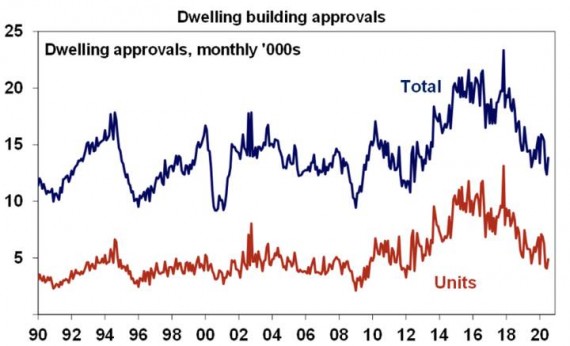
Building approvals in Australia surged by 12% in July, up 6.3% compared to a year ago. This was a much stronger result than consensus expectations of a fall in the order of 2%, and follows a run of better than anticipated numbers since April’s low point.

As an important leading indicator of national construction activity, and with implications for the lending sector as well, this is something of an encouraging sign for economic growth over the coming quarter. That said, approvals are still well below their pre-COVID levels, which were already declining before the pandemic hit our shores.

The outperformance was led in large part by multi-density approvals (such as, apartments), which rose by more than 20%, against 8% for house approvals. Non-residential building data remains extremely volatile, with the value of approvals down by 19.8% in the June quarter, on the heels of a 20.7% rise in the prior month. Looking through this monthly volatility, the trend for last few months shows a demonstrable weakening.


Source: ABS, AMP Capital

Construction contributes about 8% of Australian GDP1, and the sector’s woes were responsible for 0.6% of the country’s contraction in gross value added through the June quarter2. A sustained recovery construction would be positive news for Australia’s path out of recession, but there are a number of complicating factors.

First, restrictions on movement in Melbourne will continue to constrain the number of workers on construction sites in that city over the next few months at least, and potentially delay the entry of new projects into the pipeline. It’s worth noting that the July approval numbers pre-date Victoria’s state of disaster declaration and further tightening of COVID-19 restrictions at the beginning of August.

Second, drastically lower migration rates are dampening demand for housing and will likely affect investment in the sector whilst our international borders remain closed.

Third, consumer and business confidence will be tested by eventual shifts in unemployment that will accompany the phase-out of government assistance packages in 2021, and flow-on effects to investment in construction projects are entirely possible.

Weighing against each of these factors will be the effectiveness of the government’s HomeBuilder program, which was designed to stimulate residential construction, and which should benefit alterations and approvals construction in particular, which fell by 1.1% in July.


https://www.rba.gov.au/education/resources/snapshots/economy-composition-snapshot/
https://www.afr.com/policy/economy/australia-s-recession-in-five-graphs-20200902-p55rkw

Author: Diana Mousina, Economist – Investment Strategy & Dynamic Markets, Sydney Australia

Source: AMP Capital 15 September 2020

Reproduced with the permission of the AMP Capital. This article was originally published at AMP Capital

Important notes: While every care has been taken in the preparation of this article, AMP Capital Investors Limited (ABN 59 001 777 591, AFSL 232497) and AMP Capital Funds Management Limited (ABN 15 159 557 721, AFSL 426455) (AMP Capital) makes no representations or warranties as to the accuracy or completeness of any statement in it including, without limitation, any forecasts. Past performance is not a reliable indicator of future performance. This article has been prepared for the purpose of providing general information, without taking account of any particular investor’s objectives, financial situation or needs. An investor should, before making any investment decisions, consider the appropriateness of the information in this article, and seek professional advice, having regard to the investor’s objectives, financial situation and needs. This article is solely for the use of the party to whom it is provided and must not be provided to any other person or entity without the express written consent of AMP Capital.