Recent falls in global share markets have triggered talk in some quarters of a potential market crash, but investors should maintain some perspective, given the historical propensity for market corrections and seasonal weakness through the month of September.

The apprehension felt by many in the lead-up to this correction is understandable, given the juxtaposition of record market highs (in the US, at least) with the worst economic downturn since the Great Depression. But this recent pull-back doesn’t necessarily mean that markets will come down into lockstep with broader economic indicators, and the reverse is actually more likely over the medium to long-term. That said, there are still a number of sources of volatility that could affect markets through the remainder of the year and potentially deepen some of the losses we’ve seen already.

Some positive points:

1. So far, most of what we’ve seen appears to be a natural correction
The US tech market has boomed through the course of 2020 due in large part to the acceleration of online commerce and services through the pandemic. Towards the end of the rally it was becoming evident that the valuations in the sector had become overheated, and that there was a high likelihood of a correction.

2. Central banks look set to sustain supportive monetary policy settings
This was underlined by the US Federal Reserve’s recent confirmation of policy changes that mean they’ll be less responsive to immediate increases in inflation when determining whether to raise interest rates in the future.

3. The search for a vaccine continues
It might not arrive per Donald Trump’s preferred timeline, and it might not be the silver bullet that some people expect, but there’s a strong chance of an effective vaccine within the next six months. In combination with preventative measures and more effective treatment it will be a key instrument in reopening the parts of the global economy that remain shuttered. The resumption of the Phase 3 trials for the Oxford/AstraZeneca vaccine is positive news in this regard.

4. The major economies are recovering
In fact, most high frequency data shows that the Chinese economy is already operating, for the most part, at around normal levels. Industrial production growth in the Middle Kingdom has risen to 5.6% year on year, retail sales to 0.5% y.o.y., investment to 8.1% y.o.y. and house price growth remains solid.

The good news is that the US economy is also getting back on its feet, with September quarter GDP on track to grow by approximately 8% on the back of a strong run of economic data, almost recouping its 9% decline in the June quarter.

Cause for concern

1. The US election looms as a major short-term risk
I’m not talking particularly about the risk of one candidate or another winning the election, although they certainly exist – trade tensions with China for President Trump, for example, and market concerns around tax settings under a Biden Presidency. Most concerning is actually the prospect of an unclear outcome, a possible leadership vacuum at the head of the world’s largest economy and President Trump not accepting the outcome.

2. COVID-19 is making a resurgence in the northern winter
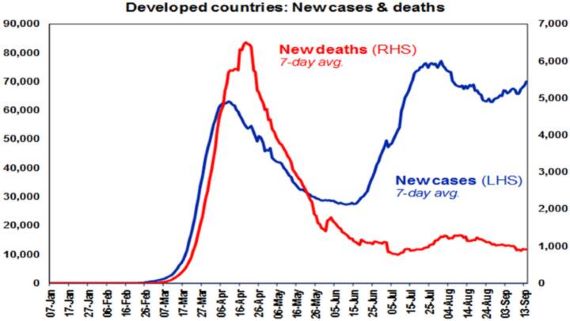
Global COVID-19 cases have trended up again in recent weeks, after plateauing through August, driven by local increases in Europe, India and parts of the US.

The good news is that as time progresses, the case-fatality rate of the virus has been falling, and although daily new cases are actually higher now than in the first wave, daily new deaths are considerably lower. There are a number of explanations for this lower mortality, including better testing (meaning that authorities are identifying a larger number of less-serious infections), better treatment, and better protection of vulnerable people.

The positive takeaway for economic activity is that there should be less imperative for authorities to return to lockdowns at any given rate of infection. That said, surges in Europe remain a concern given the temptation there for governments to repeat drastic measures that they might consider were effective the first time around.
 

Source: ourworldindata.org, AMP Capital

Even discounting these risks for a moment, seasonal weakness often extends into October and it’s not clear that markets are out of the woods yet. Shares will remain vulnerable to these and other short-term setbacks for some time to come, but the outlook over a 6 to 12-month period appears to be much more positive, with returns supported by a continued upturn in economic activity, ultra low interest rates and concerted government stimulus efforts.

By Dr Shane Oliver 

Head of Investment Strategy and Economics and Chief Economist, AMP CapitalSydney, Australia

Source : AMP Capital October 2020

Reproduced with the permission of the AMP Capital. This article was originally published at https://www.ampcapital.com/au/en/insights-hub/articles/2020/october/risks-remain-for-global-markets-in-an-otherwise-positive-outlook

Important notes

While every care has been taken in the preparation of these articles, AMP Capital Investors Limited (ABN 59 001 777 591, AFSL 232497) makes no representation or warranty as to the accuracy or completeness of any statement in them including, without limitation, any forecasts. Past performance is not a reliable indicator of future performance. Performance goals are merely goals. There is no guarantee that the strategy will achieve that level of performance. The information in this document contains statements that are the author’s beliefs and/or opinions. Any beliefs and/or opinions shared are as at the date shown and are subject to change without notice. These articles have been prepared for the purpose of providing general information, without taking account of any particular investor’s objectives, financial situation or needs. They should not be construed as investment advice or investment recommendations. An investor should, before making any investment decisions, consider the appropriateness of the information in this document, and seek professional advice, having regard to the investor’s objectives, financial situation and needs.

This document is solely for the use of the party to whom it is provided and must not be provided to any other person or entity without the express written consent of AMP Capital.

As an investor its very easy to get thrown off by the ever present worry list surrounding investment markets that relates to economic activity, profits, interest rates, politics, etc. Or by the perennial predictions of an imminent crash. Or by talk of the next best thing that’s going to make you rich.

The investment world is far from predictable and neat. Its well known for sucking investors in during the good times and spitting them out during the bad times. Investing has become more difficult in recent years reflecting a surge in the flow of information and opinion. This has been magnified by a digital media where everyone is vying for attention and the best way to get this attention is via headlines of impending crisis. This all adds to uncertainty and potentially erratic investment decisions.

Against this backdrop I have written regularly over the years about nine key things for investors to bear in mind in order to be successful. But how does the coronavirus pandemic impact these? This note reviews each in view of the pandemic.

1. Make the most of the power of compound interest

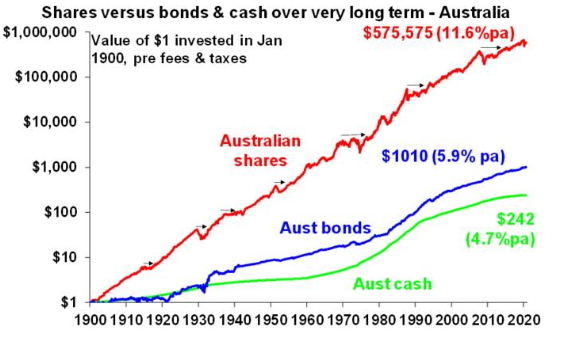
The next chart is one of my favourites and shows the value of one dollar invested in 1900 in Australian cash, bonds and equities with interest and dividends reinvested along the way. That one dollar would be worth $242 today if it had been invested in cash. But if it had been invested in bonds it would be worth $1010 and if it was allocated to Australian shares it would be worth $575,575. Although the average return on shares (11.6% pa) is just double that on bonds (5.9% pa), the magic of compounding higher returns over long periods leads to a substantially higher balance. The same applies to other growth assets like property. So, the best way to build wealth is to take advantage of the power of compound interest and have a decent exposure to growth assets. Of course, the price for higher returns is higher volatility but the impact of compounding higher returns from growth assets is huge over long periods.


Source: Global Financial Data, AMP Capital

The coronavirus pandemic does nothing to change this, any more than previous setbacks like WW1 and Spanish Flu, the Great Depression, the 1973-74 bear market, the 1987 crash or the GFC did. The collapse in interest rates and earnings yields means the returns seen over the last 120 years will likely be a lot lower over the next decade. But this partly reflects the collapse in inflation (so in real returns thangs are not quite so bad). And without getting into forecasting, shares offering a dividend yield of 3.5% (4.5% with franking credits) should provide superior medium term returns and hence grow wealth far better than bonds where the ten year yield is 0.85% pa (which is the return you will get over the next ten years).

2. Don’t get thrown off by the cycle

Investment markets constantly go through cyclical phases of good times and bad. Some are short and sharp, some can spread over many years. But all eventually set up their own reversal – eg as falls make shares cheap and low interest rates help them rebound. The trouble is that cycles can throw investors off a well thought out investment strategy that aims to take advantage of longer-term returns. But they also create opportunities. Looked at in a longer term context the roughly 35% plunge and then rebound in shares associated with coronavirus was just another cyclical swing – albeit it occurred faster reflecting the unique nature of the shock which saw a faster than normal hit to economies and then faster than normal deployment of fiscal stimulus and monetary easing. The key was not to get thrown off when markets plunged into March.

3. Invest for the long term

Looking back, it always looks obvious as to why things happened. But that’s just Harry Hindsight talking! Looking forward no-one has a perfect crystal ball. As JK Galbraith observed “there are two kinds of forecasters: those who don’t know, and those who don’t know they don’t know.” Usually the grander the forecast the greater the need for scepticism as such calls invariably get the timing wrong or are dead wrong. If getting markets right were easy, then the prognosticators would be mega rich and would have stopped doing it. Related to this many get it wrong by letting blind faith – eg “there is too much debt” – get in the way of good decisions. They may be right one day, but an investor can lose a lot of money in the interim. The problem for ordinary investors is that it’s not getting easier as the world is getting noisier. This has all been evident through the coronavirus pandemic with all sorts of forecasts as to what it would mean, most of which provided little help in actually getting the market low back in March let alone the rebound. Given the difficulty in getting market moves right in the short-term, for most it’s best to get a long-term plan that suits your level of wealth, age, tolerance of volatility, etc, and stick to it.

4. Diversify

Don’t put all your eggs in one basket. Having a well-diversified portfolio will provide a much smoother ride. For example, global and Australian shares provide similar returns over the very long term but in the March quarter this year global shares in Australian dollars fell less than half as much as Australian shares. Similarly, income investors who just had a few Australian bank stocks would have been hard hit by bank dividend cuts earlier this year whereas those with a broader exposure to high dividend paying companies would have seen their dividend income hold up a lot better.

5. Turn down the noise

After having worked out a strategy that’s right for you, it’s important to turn down the noise on the information flow and prognosticating babble and stay focussed. The trouble is that the digital world we live in is seeing an explosion in information and opinions about economies and investments. But much of this information and opinion is of poor quality. As “bad news sells” there has always been pressure on editors to put the negative news on the front page of newspapers but there was hopefully some balance in the rest of the paper. But in a digital world each story can be tracked via clicks so the pressure to run with sensationalised and often bad news headlines is magnified. Hence click bait. This has gone into hyperdrive through the coronavirus pandemic – with a massively stepped up flow of economic information (eg the Australian Bureau of Statistics now publishes key jobs reports three times a month and there is now a focus on weekly economic statistics). This may be of use in providing timely information on how the economy is travelling but it’s also added immensely to the flow of information and often its contradictory. This is all leading to heightened uncertainty and shorter investment horizons which in turn can add to the risk that you could be thrown off well thought out investment strategies. The key is to turn down the volume on all this noise. This also means keeping your investment strategy relatively simple. Don’t waste too much time on individual shares or funds as it’s your high-level asset allocation that will mainly drive the return and volatility you will get. Here are several tips to help turn down the noise:

  • Put the latest worries in context – the global and Australian economies have had plenty of worries over the last century or so – from wars to depressions to pandemics – and yet long-term investment returns have been fine

  • Recognise that its normal for markets to swing from one extreme to another;

  • Focus on only a few reliable news services and turn all “notifications” on your smart device off. 

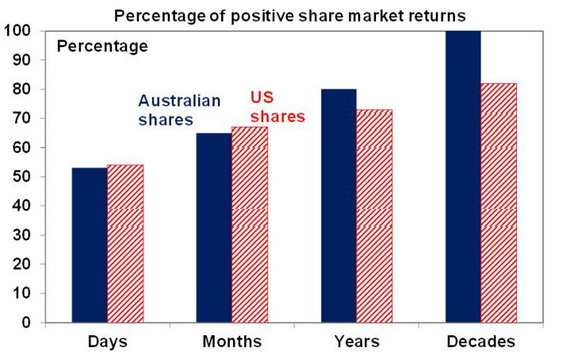
  • Don’t’ check you investments so much – on a day to day basis it’s a coin toss as to whether the share market will rise or fall but the longer you stretch it out between looking at your investments the more likely you will get positive news. See the next chart.


Source: Bloomberg, AMP Capital

6. Buy low, sell high

The cheaper you buy an asset (or the higher its yield), the higher its prospective return will likely be and vice versa, all other things being equal of course. So as far as possible it makes sense to buy when markets are down and sell when they are up. Unfortunately, many do the opposite, ie buying after a big rally and selling after a collapse…which just has the effect of destroying wealth. Selling at the panic low point in March would not have been a good move as it would have just locked in a loss – but of course it might have felt easy in the midst of the panic at the time. Again turn down the noise!

7. Beware the crowd at extremes

It often feels safe to be in a crowd and at times the investment crowd can be right. However, at extremes the crowd is invariably wrong – whether it’s at market highs like in the late 1990s tech boom or market lows like in March. The problem with crowds is that eventually everyone who wants to buy in a boom (or sell in a bust) will do so and then the only way is down (or up after crowd panics). As Warren Buffet has said the key is to “be fearful when others are greedy and greedy when others are fearful”. And coronavirus does nothing to change that.

8. Focus on investments with sustainable cash flow

If it looks dodgy, hard to understand or has to be based on obscure valuation measures then it’s best to stay away. If an investment looks too good to be true it probably is. By contrast, assets that generate sustainable cash flows (profits, rents, interest) and don’t rely on excessive gearing or financial engineering are more likely to deliver. Again, the coronavirus hit does nothing to change this.

9. Seek advice

Given the psychological traps we are all susceptible too (like the tendency to over-react to current investment market conditions, or to pay more attention to information and opinion that confirms our own views) and the increasing complexity of investing that makes it anything but easy, a good approach is to seek advice via an investment service or a coach such as a financial adviser, in much the same way you might use a specialist to look after your plumbing or medical needs. As with plumbers and doctors it pays to shop around to find a service or adviser you are comfortable with and can trust. Even I have a financial adviser to help deal with the complexity of investing.


Source: AMP Capital 14 October 2020

Important notes: While every care has been taken in the preparation of this article, AMP Capital Investors Limited (ABN 59 001 777 591, AFSL 232497) and AMP Capital Funds Management Limited (ABN 15 159 557 721, AFSL 426455) (AMP Capital) makes no representations or warranties as to the accuracy or completeness of any statement in it including, without limitation, any forecasts. Past performance is not a reliable indicator of future performance. This article has been prepared for the purpose of providing general information, without taking account of any particular investor’s objectives, financial situation or needs. An investor should, before making any investment decisions, consider the appropriateness of the information in this article, and seek professional advice, having regard to the investor’s objectives, financial situation and needs. This article is solely for the use of the party to whom it is provided and must not be provided to any other person or entity without the express written consent of AMP Capital.
There are very good reasons for the faith that investors are placing in equities markets.

News around the COVID-19 pandemic hasn’t been promising. New cases have shown early signs of stabilising, but it’s too soon to say we’ll see a dip in new cases. The world’s largest economy also remains under siege as the virus begins to take hold across many parts of the US.

Meanwhile, unemployment rates in the US1UK2 and Australia3 are likely to reach levels not seen since the Great Depression, and while it’s not impossible for the situation to turn around before the end of the year, it’s far from certain.

Share market performance on the other hand has still shown some positive signs, particularly in the US, where the S&P 500 rallied nearly 5% through July4, with it now standing at more than 95% of its pre-COVID-19 level5.

This is an extraordinary outcome under the circumstances, and admittedly helped by the fact that the US market is dominated by tech stocks, which comprise over a quarter of the S&P 500’s market capitalisation. However, the same dynamic can be observed in markets around the world, with valuations seemingly indifferent to the COVID-19 chaos.

In Australia share market performance has been weaker compared to the US. While shares have rallied by 34% since the March low, equities are still down by 15% compared to their pre-COVID highs.

In saying that, there are some good reasons for the faith investors are placing in equities markets – these being the four big standouts:

There’s a good chance of an effective vaccine by the end of the year

A number of promising vaccine candidates are in the final phase of testing6, with a large handful of others hot on their heels. The Oxford7 and Moderna8 vaccines are the furthest advanced and, if successful, could be publicly available by the end of 2020. Major vaccine producers are already manufacturing hundreds of millions of doses9 in the hope that they are proven safe and effective in mass testing.

Death rates in the US appear to be falling

Even as new cases continued to skyrocket through southern and south-western states in June and July, death rates in the US have been significantly lower than they were in the early months of the pandemic. There is obviously a lag in recording mortality as opposed to new cases, which is why deaths continue to rise in places like Texas and Florida, but at this stage it appears that as health services learn how to better manage the disease, the severity of the pandemic is waning.

Central banks have gone all out to shield their economies

We’ve never seen global monetary stimulus on this scale – low interest rates, quantitative easing programs, cheap financing for banks – policy makers are throwing the kitchen sink at the task of keeping their economies moving, and markets are responding with confidence.

There are no real alternatives

With interest rates at zero or near-zero across the world, share markets are one of the few places where investors can generate reliable returns on their investments at this point in time.

As such, current reduced dividend earnings look relatively attractive against record-low bond yields.10 The stimulus cash washing around the world’s economies needs to find a home somewhere, and for the moment investors are willing to overlook short-term systemic issues in favour of the longer term and hopes of a return to normality sometime in the new year.

Please contact us on Phone: 07 5641 4134 if you require further discussion on this topic.

Diana Mousina is a Senior Economist with AMP Capital.

https://www.washingtonpost.com/business/2020/07/30/gdp-q2-coronavirus/
https://www.telegraph.co.uk/business/2020/07/07/unemployment-hit-15pc-second-wave-strikes/
3 https://www.smh.com.au/politics/federal/unemployment-to-soar-as-economy-suffers-deep-recession-20200723-p55etz.html
4 Bloomberg, as at 31 July 2020
5 Bloomberg. Data period between 19 February 2020 and 31 July 2020.
https://www.nytimes.com/interactive/2020/science/coronavirus-vaccine-tracker.html
https://www.thelancet.com/journals/lancet/article/PIIS0140-6736(20)31604-4/fulltext
https://www.nejm.org/doi/full/10.1056/NEJMoa2022483
9 https://www.nytimes.com/2020/08/01/world/asia/coronavirus-vaccine-india.html
10 https://ca.finance.yahoo.com/news/treasury-market-fired-vault-over-110000121.html

Source : AMP August 2020 

Important: This information is provided by AMP Life Limited. It is general information only and hasn’t taken your circumstances into account. It’s important to consider your particular circumstances and the relevant Product Disclosure Statement or Terms and Conditions, available by calling Phone: 07 5641 4134, before deciding what’s right for you.

All information in this article is subject to change without notice. Although the information is from sources considered reliable, AMP and our company do not guarantee that it is accurate or complete. You should not rely upon it and should seek professional advice before making any financial decision. Except where liability under any statute cannot be excluded, AMP and our company do not accept any liability for any resulting loss or damage of the reader or any other person. Any links have been provided for information purposes only and will take you to external websites. Note: Our company does not endorse and is not responsible for the accuracy of the contents/information contained within the linked site(s) accessible from this page.

To invest well, you need to find investments that fit your financial goals, investing time frame and risk tolerance.

Get an overview of the different types of investments so you can find the right ones to reach your financial goals.

Types of investments and returns

Investments can be classified as defensive or growth investments.

Defensive investments

Defensive investments are lower risk investments. They aim to provide income and protect the capital invested. Defensive investments include cash and fixed interest investments.

They’re typically used to:

  • Meet short-term financial goals (up to two years).

  • Diversify a portfolio.

Investment

Characteristics

Risk, return and investing time frame

Cash

  • Includes bank accounts, high interest savings accounts and term deposits.

  • Used to protect wealth and diversify a portfolio.

  • Average return over last 10 years: 3% per year

  • Risk: very low risk of losing money

  • Time frame: short term, 0–3 years

Fixed interest

  • Includes government bonds, corporate bonds, debentures and capital notes.

  • Used to earn a steady rate of income and diversify a portfolio.

  • Average return over last 10 years: 3–4% per year

  • Risk: low risk of losing money

  • Time frame: short term, 1–3 years

Growth investments

Growth investments are higher risk and offer a higher potential return compared to defensive investments. They aim to give capital growth and some provide income (for example, dividends for shares or rent for property). But, price of growth investments can be volatile over short periods of time.

Growth investments are typically used to:

  • Earn a higher rate of return (but this comes with higher risk).

  • Meet longer term financial goals, five years or more.

Growth investments include shares, property and alternative investments.

Investment Characteristics Risk, return and investing time frame
Property
  • Includes investing in residential and commercial property.

  • Used to earn a steady rate of income (rent) and offer capital growth.

  • Average return over last 10 years: 6.3% per year

  • Risk: medium to high

  • Time frame: long term, at least 5 years

Shares

  • Investing in a company. You get to vote on management and share in the profits.

  • Offer capital growth and some provide income (dividends).

  • Average return over last 10 years: 6.5% per year (Australian shares)

  • Risk: high

  • Time frame: long term, at least 5 years

Alternative investments

  • Includes private equity, infrastructure, commodities and other investments that don’t fall into the investment classes above.

  • Most aim to provide capital growth. Some have the potential for steady income.

  • Most alternative assets are high risk.

  • Returns differ depending on the type of alternative investment.

How to choose your investments

Before you invest, make sure you research your investment to understand:

  • How the investment works.

  • How it generates a return and the type of return expected (capital gain or income).

  • The risks involved for the investment.

  • The fees and charges for buying, holding and selling the investment.

  • How long you should invest to receive the expected return.

  • Legal and tax implications of the investment.

  • How the investment will contribute to your diversified portfolio.

You can find this information in the product disclosure statement (PDS)

Decide how you’ll invest

When it comes to investing you need to decide whether you’ll:

  • do it yourself, or

  • pay a professional to do it for you

Both options have their pros and cons — and you can, of course, do both.

Buy and sell investments yourself

The advantage of investing yourself is that you’re in control of all the decisions. It can also be cheaper than paying someone to invest your money. The risk is that you may overrate your expertise and may not diversify.

If you invest directly, it’s important to plan and put in the time to research your investments. You should also keep track of how they’re performing.

Use a professional investment manager

If you invest in a managed fund, some managed accounts, exchange-traded fund (ETF) or a listed investment company (LIC) your money is pooled with other investors. A professional investment manager then buys and sells investments on your behalf.

When you use a professional, you benefit from their skills and knowledge to make investment decisions. But you have to pay fees for this service. These can include management fees, administration fees and entry and exit fees.

See managed funds and ETFs to learn more about these investments.

Investing with a financial adviser

A financial adviser can help you set your financial goals, understand your risk tolerance and find the right investments. See financial advice for more information. 

Invest through your super

If your goal is to save for retirement, contributing more to super is generally the best way to do this. See super investment options for more detail.

Please contact us on Phone: 07 5641 4134 if you seek further assistance on this topic.

Source : Moneysmart.Gov.Au September 2020 

Reproduced with the permission of ASIC’s MoneySmart Team. This article was originally published at MoneySmart

Important note: This provides general information and hasn’t taken your circumstances into account.  It’s important to consider your particular circumstances before deciding what’s right for you. Although the information is from sources considered reliable, we do not guarantee that it is accurate or complete. You should not rely upon it and should seek qualified advice before making any investment decision. Except where liability under any statute cannot be excluded, we do not accept any liability (whether under contract, tort or otherwise) for any resulting loss or damage of the reader or any other person.  Past performance is not a reliable guide to future returns.

Important Any information provided by the author detailed above is separate and external to our business and our Licensee. Neither our business nor our Licensee takes any responsibility for any action or any service provided by the author. Any links have been provided with permission for information purposes only and will take you to external websites, which are not connected to our company in any way. Note: Our company does not endorse and is not responsible for the accuracy of the contents/information contained within the linked site(s) accessible from this page.


Worrying about superannuation balances is something most of us do from time to time, but as we approach retirement it can become a regular pastime.

Unfortunately, in the current economic climate, many of us are heading into retirement with less than we expected. This can sometimes be because market volatility has temporarily reduced our balance. It could be due to years out of the workforce caring for family. Or it could be simply bad luck.

But if you find yourself heading into retirement with a little less on the books than you would have liked, there are some steps you can take to ensure your retirement is everything you wanted.

One of the big moves available to help you catch up is immediately within your control, if often unwelcome. Spend less.

Cutting back on spending has two benefits. It allows you to save more, topping up your retirement savings and allowing more time for investments to grow and compound.

But it also allows you to rethink the amount of money you actually need to live on. Sometimes our retirement plans are based on unreasonable or outdated views of how much money it takes to have a comfortable retirement.

Everyone is different, but you should ask the question: do you really need as much as you think you do? Are your calculations still accurate?

Often, an investment plan that was set in stone years earlier might no longer reflect your situation. So do the sums again: calculate how much you have, how much you need and how many saving years you have left.

For many, rethinking those sums can provide new confidence that there is actually enough in the kitty. People change, and by the time retirement is near, things are different from when an original plan was put in place. Kids are out of the house, renovations are complete, education costs have faded into memory and hobbies and leisure activities have evolved with your age.

It is also worth rethinking how you want to go about retirement itself. The retirement you planned all those years ago might look different now it is drawing nearer.

In the heat of a career, many of us fantasise about retiring to an empty diary.

But as retirement approaches and working becomes less of a chore, and sometimes even a pleasure, it might be an option to stick with part time paid work or consulting in retirement.

This will stretch your savings further by helping cover your living expenses and could even allow you to continue to put some money away to save for the full retirement down the track.

It is also worth looking into what government benefits might be available to you.

There is a vast range of government assistance available to help make retirement more affordable, from the age pension itself to discounts on health care, public transport, banking and many other goods and services. Not all of these benefits require an income test, so they are worth exploring in full.

While you are revising the plan, it is important to give some thought to your health needs.

Unexpected health costs can derail the best planned retirement. Minimise surprises by making sure all your check-ups are up to date and your GP is on top of your needs. Knowing any potential health requirements – no matter how distant – allows you to plan for them.

If retirement still looks precarious after the belt-tightening, replanning and redoing the sums, there some other moves you can make to catch up lost ground. First up, now is a good time to check your asset allocation.

Most people aim to reduce risk as they near retirement to reduce the chance of permanent loss of capital by moving money out of equities into safer fixed interest investments.

But if you are looking a little short heading into retirement, that move would simply lock in a less than ideal retirement.

Instead, continuing with a growth-oriented equity weighting – or even lifting the weighting if you have already started winding back – could lift your chances of saving enough to retire. Remember that this move also increases your risk of loss and the likelihood of the two outcomes needs to be balanced.

Another move is to consider moving some money to an active manager and reducing exposure to indexed investments.

Active managers aim to beat the market by picking investments that they believe will outperform or avoiding investments they think will underperform. This kind of management is more expensive, which is normally something to avoid, but a well-managed active portfolio can be an option to help you make up for lost ground.

Next, make sure you understand the opportunities available in the superannuation system to get your finances in order ahead of retirement.

For those with super balances below $500,000, and money outside super, the carry forward rules allow unused concessional contributions to be used up to five years later.

Meanwhile, the so-called downsizer contribution rules allow people above age 65 to contribute up to $300,000 each from the proceeds of selling their main residence. Many people nearing retirement have considerable wealth built up in homes that may no longer suit them once they stop working. Using the downsizer provisions can help move you into a home that better suits your retirement lifestyle while boosting your super balance at the same time.

Despite the name, the downsizer provisions do not require you to actually reduce the size of your house. But moving to a smaller residence has other benefits like reducing maintenance costs and outgoings like electricity and gas, further saving you money.

These catch up provisions can make all the difference to a comfortable retirement as tax free superannuation earnings in pension phase means more money to spend. A final note on retirement. It is all too common for retirees to spend their retirement in fear of the money running out only to unintentionally leave a too generous bequest to the children.

By planning properly, you can ensure not only that the money lasts a lifetime, but also that you live the lifestyle you earned.

Please contact us on Phone: 07 5641 4134 if you seek further assistance on this topic.

Written by Robin Bowerman, Head of Corporate Affairs at Vanguard.

Source : Vanguard August 2020 

Reproduced with permission of Vanguard Investments Australia Ltd

Vanguard Investments Australia Ltd (ABN 72 072 881 086 / AFS Licence 227263) is the product issuer. We have not taken yours and your clients’ circumstances into account when preparing this material so it may not be applicable to the particular situation you are considering. You should consider your circumstances and our Product Disclosure Statement (PDS) or Prospectus before making any investment decision. You can access our PDS or Prospectus online or by calling us. This material was prepared in good faith and we accept no liability for any errors or omissions. Past performance is not an indication of future performance.

© 2020 Vanguard Investments Australia Ltd. All rights reserved.

Important: Any information provided by the author detailed above is separate and external to our business and our Licensee. Neither our business nor our Licensee takes any responsibility for any action or any service provided by the author. Any links have been provided with permission for information purposes only and will take you to external websites, which are not connected to our company in any way. Note: Our company does not endorse and is not responsible for the accuracy of the contents/information contained within the linked site(s) accessible from this page.


At its meeting today, the Board decided to maintain the current policy settings, including the targets for the cash rate, the yield on 3-year Australian Government bonds, and the parameters for the expanded Term Funding Facility.

The global economy is gradually recovering after a severe contraction due to the pandemic. However, the recovery is uneven and its continuation is dependent on containment of the virus. While infection rates have declined in some countries, they have increased in others. The recovery is most advanced in China, where conditions have improved substantially over recent months. Globally, inflation remains very low and below central bank targets.

Financial conditions remain accommodative around the world and supportive of the economic recovery. Financial market volatility is low and the prices of many assets have risen substantially despite the high level of uncertainty about the economic outlook. Bond yields are at historically low levels, as are interest rates for most businesses and households. The Australian dollar remains just a little below its peak of the past couple of years.

The Australian economy experienced a sharp contraction in the June quarter, with output falling by 7 per cent. As difficult as this was, the decline in output was smaller than in most other countries and smaller than was earlier expected. A recovery is now under way in most of Australia, although the second-wave outbreak in Victoria has resulted in a further contraction in output there. The national recovery is likely to be bumpy and uneven and it will be some time before the level of output returns to its end 2019 level.

Labour market conditions have improved somewhat over the past few months and the unemployment rate is likely to peak at a lower rate than earlier expected. Even so, unemployment and underemployment are likely to remain high for an extended period. Wage and inflation pressures remain very subdued. The Bank will publish a full set of updated forecasts next month.

Over the past six months, the Australian economy has been supported by a substantial easing of fiscal policy. Public sector balance sheets in Australia are in good shape, which allows for continued support, with the Australian Government budget to be announced this evening. Both fiscal and monetary support will be required for some time given the outlook for the economy and the prospect of high unemployment.

The Bank’s policy package is working as expected and is underpinning very low borrowing costs and the supply of credit to households and businesses. There is a very high level of liquidity in the Australian financial system and borrowing costs are at record lows. $81 billion of low-cost funding for authorised deposit-taking institutions (ADIs) has been advanced under the initial allowance of the Term Funding Facility. ADIs currently have access to a further $120 billion under this facility. As this is drawn down, there will be a further very significant expansion of the Reserve Bank’s balance sheet.

Government bond markets are functioning well, alongside a significant increase in issuance. Bond yields are around record lows. Early in September, the Bank bought a further $2 billion of Australian Government Securities (AGS) in support of its 3-year yield target, bringing total purchases of government securities since March to $63 billion. Over the past couple of weeks, 3-year yields have fallen to around 18 basis points as markets price in some probability of further monetary policy easing.

The Board is committed to do what it can to support jobs, incomes and businesses in Australia. Its actions, including last month’s decision to expand the Term Funding Facility, are keeping funding costs low and assisting with the supply of credit. The Board views addressing the high rate of unemployment as an important national priority. It will maintain highly accommodative policy settings as long as is required and will not increase the cash rate target until progress is being made towards full employment and it is confident that inflation will be sustainably within the 2–3 per cent target band. The Board continues to consider how additional monetary easing could support jobs as the economy opens up further.

Source: Reserve Bank of Australia, October 6th, 2020

Enquiries

Media and Communications
Secretary’s Department
Reserve Bank of Australia
SYDNEY

Phone: +61 2 9551 9720
Email: rbainfo@rba.gov.au

Surprises of a financial nature can happen at any time, whether the occasion is happy or sad. A gift or inheritance from a friend or relative may be put to good use in many ways. It could be spent on something on the long list of ‘nice to haves’ or could be invested or a combination of both – the choice is endless.

If the decision is made to save or invest the gift or inheritance, there are many ways in which it can be done. It could be deposited to an interest-bearing savings account, term deposit, purchase shares or used to pay off the home mortgage if this is considered to be the better investment. Whether it is invested personally, jointly, via a family trust or company, or superannuation, there are many ways in which the investment can be made – each can have its own advantages.

If the investment is joint, it will mean each joint owner can share in any income equally, or in proportion to each owner’s contribution to the investment. If it’s via a company or trust, income can be distributed to shareholders or beneficiaries of the trust. If it’s a super fund, the amount contributed cannot be accessed until retirement or another condition of release has been met. The benefit of investing an inheritance into superannuation is that it can be tax deductible and the fund is taxed at a relatively low rate on the investment income.

With super, it’s possible to be entitled to a total standard tax-deductible cap of up to $25,000, depending on what other tax-deductible contributions have been made by a person’s employer. In addition, if the total amount a person has in super as at 30 June in the previous financial year is less than $500,000, it is possible the ‘bring forward rule’ may operate. This rule allows a greater tax-deductible amount to be claimed for amounts that have not been claimed between an individual’s tax-deductible cap, and the amount claimed as a tax deduction, since 1 July 2018.

Here’s a couple of short case studies to give an idea of how gifts and inheritances can be used to contribute towards super:

Case Study 1

Pat and Sally’s daughter, Bridget, is in Year 12 and intends to attend tertiary studies over the next few years. When she turned 18 in June this year, various family members gifted Bridget ASX-listed shares to her via off-market transfers.

Bridget works part-time and last financial year earned about $2,000. Her income
this financial year 2020/21, will probably be around $50,000, including dividends and imputation credits. Bridget is considering making super contributions of up to $25,000, which is the current annual cap for tax deductible contributions.

If Bridget makes super contributions and claims a tax deduction, she will not only get the advantage of reducing the amount of tax she pays, but will have the benefit of the fund’s investment earnings until she retires- which could be in 40 or more years’ time. Whilst it may not be necessary for the contributions to be made in cash because if Pat and Sally have an SMSF, Bridget may be able to transfer the shares to the super fund as an off-market transfer and their value will be treated as tax deductible.

Case Study 2

Mark and Emily who are both nearing retirement and are under 65 years of age. They have received an inheritance from a distant aunt as there are no other living relatives in the family. They have some superannuation but consider the boost from contributing the amount received to their super fund should provide them with a tax-advantaged income for many years.

They decide to use part of the inheritance so both can make a tax-deductible contribution to super up to their $25,000 cap. This would need to take into account contributions made by their employer. In addition, they have decided to make non-deductible contributions of $300,000 each by accessing the ‘bring forward rule’, which allows up to three times the annual cap of $100,000 over a three-year fixed period, depending on the total amount they have in super as at 30 June in the previous financial year.

Once Mark and Emily have retired, they intend to draw a pension from their super, which includes the contributions they have made due to the inheritance.

When a gift or inheritance has been received, if it is not required for immediate expenses, then investing it or contributing it towards a super fund should be considered. If an individual can qualify, a tax deduction may be available for superannuation contributions to help build their retirement savings.

Please contact us on Phone: 07 5641 4134 if you seek further assistance on this topic.

By Graeme Colley Executive Manager, SMSF Technical and Private Wealth – SuperConcepts

Source : AMP Capital August 2020 

Reproduced with the permission of the AMP Capital. This article was originally published at https://www.ampcapital.com/au/en/insights-hub/articles/2020/august/some-tax-considerations-when-it-comes-to-an-inheritance?csid=1047469593

While every care has been taken in the preparation of these articles, AMP Capital Investors Limited (ABN 59 001 777 591, AFSL 232497) makes no representation or warranty as to the accuracy or completeness of any statement in them including, without limitation, any forecasts. Past performance is not a reliable indicator of future performance. Performance goals are merely goals. There is no guarantee that the strategy will achieve that level of performance. The information in this document contains statements that are the author’s beliefs and/or opinions. Any beliefs and/or opinions shared are as at the date shown and are subject to change without notice. These articles have been prepared for the purpose of providing general information, without taking account of any particular investor’s objectives, financial situation or needs. They should not be construed as investment advice or investment recommendations. An investor should, before making any investment decisions, consider the appropriateness of the information in this document, and seek professional advice, having regard to the investor’s objectives, financial situation and needs.

This document is solely for the use of the party to whom it is provided and must not be provided to any other person or entity without the express written consent of AMP Capital.

We live in a global world and many of us have lived and worked overseas. For some, it has meant our overseas employer has made super contributions or its equivalent for us. After coming back to Australia, we find that moving super back home isn’t as easy as just jumping on a plane, as it used to be, and bringing it with you. Sometimes overseas superannuation must stay there until a person reaches a particular age or all employment has ceased.

Under the Australian superannuation and tax laws, it is possible to transfer some amounts from overseas superannuation funds. However, the overseas fund needs to meet the definition of what our law defines as a superannuation fund for a direct transfer to take place.

As examples, pension funds in the United Kingdom are considered superannuation funds and benefits can be transferred directly. However, the Australian fund may be required to meet certain conditions. In contrast, some funds in the US, such as 401k plans and Individual Retirement Accounts (IRAs), do not meet the definition of a superannuation fund and a direct transfer to an Australian super fund is unable to take place. This is because the benefits available under those funds are not solely for retirement and associated purposes.

The first port of call with any transfer is to talk to the overseas fund to see whether the transfer can take place and whether there are any conditions apply. Next, it needs to be determined whether all of the overseas benefit, or only part of it, can be transferred to Australia. Finally, the tax implications both in Australia and overseas are crucial as to whether the transfer can go ahead.

From a taxation point of view, tax may be payable on some of the amount transferred to the Australian fund and in addition excess contribution tax rules may apply as well. The taxable amount is calculated as the income that has accrued on the benefit that has remained in the overseas fund since the person has become an Australian resident for tax purposes. However, if the transfer takes place within 6 months of tax residency or when foreign employment ceased, then no tax is payable on the transfer.

Any amounts that are not taxed in Australia from the overseas transfer are treated as non-concessional contributions and measured against the person’s non-concessional contributions cap. This can act as a limiting factor to whether the benefit is able to be transferred from some countries. The reason is that the amount transferred to the Australian fund may continue to be subject to the payment restrictions as they applied in the overseas country.

Transfers of UK super benefits to Australia

As mentioned above, pension funds in the UK meet the definition of a superannuation fund for purposes of the Australian superannuation and taxation law and it is possible to transfer benefits to Australia. However, anyone wishing to transfer their benefit needs to check with their UK fund to see whether the transfer is possible. This may take some time and should be done in advance of coming to Australia to maximise any taxation benefits that are available.

Prior to the transfer of the benefit, it must be ensured that the Australian superannuation fund is registered as a Registered Overseas Pension Plan (ROPS). To find out whether the Australian fund is registered, it is necessary to check on the HMR&C website1, which includes a list of all approved ROPS. There are many SMSFs registered as ROPS, but only a handful of APRA funds due to the UK requirements concerning benefit payments.

For a fund to be registered as a ROPS, it must show that any benefits transferred from the UK are subject to the same conditions for the release of benefits as in the UK. This may require an amendment to the fund’s trust deed to ensure these requirements are satisfied. In addition, limits may apply to the UK transferred amount being invested in residential property.

Once the fund has been registered as a ROPS, then the trustees are required to report certain event to the UK revenue authorities. The reason is that any breach of the registration requirements may lead to the transferred benefit held by the Australian fund being subject to very stringent penalties.

So, it is essential for individuals thinking of transferring their benefit from a UK fund to Australia to make a few checks to see whether the transfer is possible, requirements for registration as a ROPS, and understand the reporting and compliance obligations under the UK rules.

Should a super benefit be transferred from overseas?

That’s an individual decision, however, sometimes the benefits payable from the overseas fund may end up being more generous than transferring the benefit to an Australian fund. This could occur where the benefit in the overseas fund provides a lifetime indexed pension, which may not be available if the amount was transferred to an Australian fund.

In most cases any pension payable from the Australian fund would be as an account-based pension. This may not provide a lifetime’s income stream as the benefit may run out earlier depending on the fund’s performance and how quickly it is drawn down.

Transferring super from overseas funds are not as simple as it seems and depending on where the benefit is coming from, there may be limits applying to the transfer as well as tax implications.

Please contact us on Phone: 07 5641 4134 if you seek further assistance on this topic .

https://www.gov.uk/guidance/check-the-recognised-overseas-pension-schemes-notification-list

By Graeme Colley Executive Manager, SMSF Technical and Private Wealth – SuperConcepts

Source : AMP Capital September 2020 

Reproduced with the permission of the AMP Capital. This article was originally published at https://www.ampcapital.com/au/en/insights-hub/articles/2020/september/transferring-super-benefits-from-overseas

Important notes

While every care has been taken in the preparation of these articles, AMP Capital Investors Limited (ABN 59 001 777 591, AFSL 232497) makes no representation or warranty as to the accuracy or completeness of any statement in them including, without limitation, any forecasts. Past performance is not a reliable indicator of future performance. Performance goals are merely goals. There is no guarantee that the strategy will achieve that level of performance. The information in this document contains statements that are the author’s beliefs and/or opinions. Any beliefs and/or opinions shared are as at the date shown and are subject to change without notice. These articles have been prepared for the purpose of providing general information, without taking account of any particular investor’s objectives, financial situation or needs. They should not be construed as investment advice or investment recommendations. An investor should, before making any investment decisions, consider the appropriateness of the information in this document, and seek professional advice, having regard to the investor’s objectives, financial situation and needs.

This document is solely for the use of the party to whom it is provided and must not be provided to any other person or entity without the express written consent of AMP Capital.



It’s a question most of us ask eventually: what happens to our investments when we die?

The answer often depends on the type of asset you own and the structure through which you own it.

Generally, when you die an executor that you nominate in your will takes control of your assets and has responsibility for distributing them in accordance with your wishes. The executor will normally apply for a court order declaring your will is valid. This court order is called probate.

If you die without a will, or if your executor is unable or unwilling to act, the court will normally appoint an administrator to the estate. The administrator has similar powers to an executor.

Then, they will deal with your assets in accordance with your will, or in accordance with the rules of your state if you didn’t leave a will.

Let’s look at what happens to your investments one by one:

Real estate

An interest in real estate held in your name alone forms part of your estate and is passed on or sold in accordance with your wishes as set out in your will.

This not necessarily true when you own real estate with someone else.

Jointly owned real estate can be held in one of two ways—as ‘joint tenants’ or ‘tenants in common’. If a tenant in common dies, their interest in the real estate is an asset of their deceased estate and can be passed on to beneficiaries as dictated by their will.1 If they are joint tenants, however, their interest passes directly to the other joint tenant and does not form part of the estate.

Shares and managed funds

Directly-owned shares and units in managed funds that are in your name only form part of your estate and will be passed on in accordance with your will by your executor. The executor can sell shares and distribute the proceeds or distribute the shares directly.

But jointly owned shares come under similar rules to real estate. Where shares are held as ‘joint tenants’—which is common in many brokerage accounts—the other owner automatically takes full ownership.

Bank account

If you have a joint bank account, the money will also transfer directly to the other joint holder.2 Otherwise, bank accounts are closed and the money paid to the executor or administrator, who then distributes the money to your beneficiaries.

Personal assets

Your personal property like cars, furniture, clothing, artwork and other goods form part of your estate.3 Most personal property will be distributed according to your will. Property that requires registration, like cars and boats, will need to be formally transferred by the executor.

Family trusts

Assets held in a family trust do not form part of your estate. Assets held in a trust are owned by the trust, which continues to operate after your death.4 The trust determines who gets the assets regardless of what your will says.

Private companies

Similar to family trusts, any assets owned by your private company do not form part of your estate when you die because those assets are owned by the company, not by you personally. This is true even if you are the only shareholder in the company.

The shares that you own in the company do form part of your estate and can be passed on.

Private companies can be complicated if you are the only director and don’t leave a will appointing an executor who can appoint a director to the company after you are gone. In that case, a relative would have to apply to the Supreme Court for letters of administration to manage the estate which can take months5, during which time the company may be unable to trade.

Superannuation

Your superannuation is also not part of your estate as it is held in trust to fund your retirement. Your super is passed to your beneficiaries in very specific ways, usually through a Binding Death Benefit Nomination or a reversionary pension.

The benefit of considering what type of assets will need to be dealt with when you are no longer around may not seem like a big deal but it can make it much easier for those set to receive things you want them to have and for those charged with distributing your assets. So it is well worth while giving the matters covered in our three part series on estate planning serious consideration. 

Please contact us on Phone: 07 5641 4134 if you seek further discussion on this topic.

  1. https://www.ato.gov.au

  2. https://moneysmart.gov.au/losing-your-partner

  3. https://www.lawaccess.nsw.gov.au

  4. https://moneysmart.gov.au/wills-and-powers-of-attorney

  5. https://asic.gov.au

Written by Robin Bowerman, Head of Corporate Affairs at Vanguard.

Source : Vanguard July 2020 

Reproduced with permission of Vanguard Investments Australia Ltd

Vanguard Investments Australia Ltd (ABN 72 072 881 086 / AFS Licence 227263) is the product issuer. We have not taken yours and your clients’ circumstances into account when preparing this material so it may not be applicable to the particular situation you are considering. You should consider your circumstances and our Product Disclosure Statement (PDS) or Prospectus before making any investment decision. You can access our PDS or Prospectus online or by calling us. This material was prepared in good faith and we accept no liability for any errors or omissions. Past performance is not an indication of future performance.

© 2020 Vanguard Investments Australia Ltd. All rights reserved.

Important: Any information provided by the author detailed above is separate and external to our business and our Licensee. Neither our business nor our Licensee takes any responsibility for any action or any service provided by the author. Any links have been provided with permission for information purposes only and will take you to external websites, which are not connected to our company in any way. Note: Our company does not endorse and is not responsible for the accuracy of the contents/information contained within the linked site(s) accessible from this page.

The US election is only a month away. Markets are now paying close attention to it for several reasons. First, Joe Biden is proposing higher taxes and more regulation. Second, the proximity of the election made worse by the move to replace Justice Ginsberg may have reduced prospects for needed fiscal stimulus. Third, increased use of postal voting could mean it will take longer before the outcome is known. Finally, President Trump’s scorn for postal voting (which polls show 45% of Biden voters plan to use versus 10% of Trump voters!) looks to be setting up a challenge to the result if he loses and his refusal to guarantee a peaceful transfer, adds to uncertainty.

Polls and betting odds favour Biden

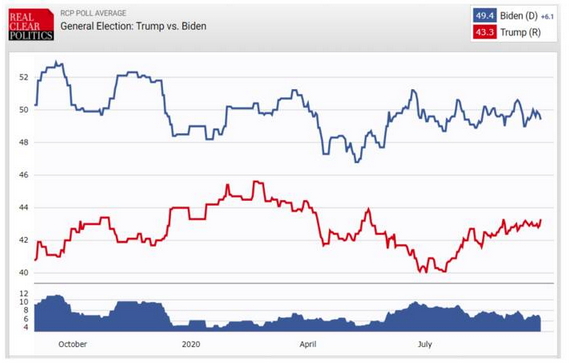
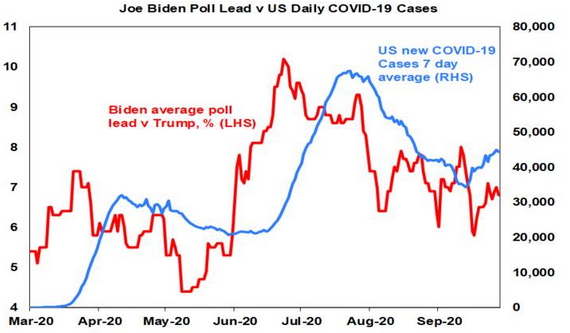
  • Real Clear Politics poll average has Biden ahead by 6 points. This is down from around 9 points since July as Trump got a boost as the daily number of new coronavirus cases fell from nearly 70,000 to 40,000 but it’s been pretty stable over the last two months. This contrasts with four years ago where polls mostly had Clinton ahead, but it was very volatile with Trump out front on several occasions. In late September 2016 Clinton was about 2.5 points ahead.


Source: Real Clear Politics

  • Biden’s lead averages about 3 points in battleground states.

  • The ‘Predict It’ betting market has Biden with a 17 point lead but has a Democrat clean sweep (where it wins the presidency, House and Senate) at around 50/50. The Democrats already have control of the House and are likely to retain that, but they need three seats with the Vice President, to gain a majority in the Senate. A clean sweep would remove the Senate as a blockage to higher taxes.

  • Nate Silver’s 538 election model that combines state polls with economic data puts a Biden win at 78% probability.

  • More shy Trump voters than Democrat voters in revealing their true intention adds to the uncertainty around polls.

  • The first debate didn’t offer anything new on the policy front and is unlikely to have changed things much.

The economy versus the virus

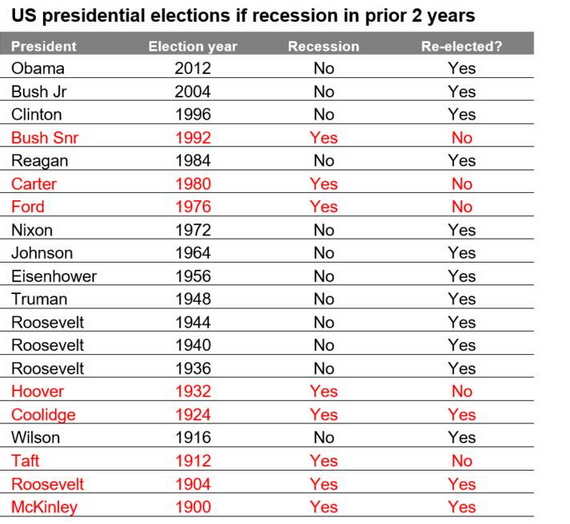
History indicates incumbent presidents tend to lose when there is a recession in the two years before the election.


Source: Strategas

However, Trump’s best hope is for a rebound in the economy, with data pointing to an 8% rebound in September quarter GDP (due just before the election) thereby ending the recession. There has been a precedent for incumbent presidents being re-elected if the recession ends prior to election day. But it’s only 50/50 and was early last century – with Presidents McKinley in 1900, Roosevelt in 1904 and Coolidge in 1924 getting re-elected as recessions ended prior to the election but not so for Presidents Taft in 1912, Ford in 1976 and Carter in 1980. Working against this for Trump would be if the recent resurgence in US new coronavirus gathers pace resulting in renewed uncertainty about the economic outlook.


Source: RCP, ourworldindata.org, AMP Capital

The US share market is sending a more positive signal for Trump. It has been one of the best guides to the election outcome – if the S&P 500 is up over the 3 months prior to the election date the incumbent party tends to win and vice versa if it’s down. This has been 87% accurate since 1928 and 100% accurate since 1984. Right now, its up 1.2% since August 3rd!

Bottom line: Biden is ahead but its premature to write Trump off.

Key Biden policy directions versus Trump

Taxation: Biden plans to raise the corporate tax rate to 28% (from 21%), return the top marginal tax rate to 39.6% (from 37%) and tax capital gains and dividends as ordinary income.

Infrastructure: Both plan to spend $1trn or more over 10 years on infrastructure with Biden focussed on renewable energy.

Climate policy: Biden aims for the US to reach net zero emissions by 2050 by raising the cost of fossil fuels & boosting the development of alternatives (possibly with a carbon tax)

Regulation: Biden is likely to end the era of deregulation.

Coronavirus: Biden is likely to oversee a more robust, organised and consistent response to dealing with the virus.

Healthcare: Biden wants to strengthen Obamacare.

Trade and foreign policy: A re-elected Trump is likely to ramp up his trade war with China with “made in America” tax credits and more tariffs on imports on China and possibly elsewhere including Europe. By contrast, Biden would likely rebuild the alliance with Europe, work with international organisations like the World Trade Organisation, work to re-establish the nuclear deal with Iran and adopt a more diplomatic approach to dealing with issues with China (working with Europe and Asian allies).

Budget deficit: For the near term, the budget deficit is likely to remain high whoever wins, but historically they have fallen under Democrats after rising under Republicans. That said, if the economy proves slow to recover, Joe Biden may be more likely to respond with large public sector spending programs.

Economic impact of a Biden victory

Higher tax rates and more regulation under Biden would be negative for the growth outlook on their own. However, as with all things economic, it’s never as simple as that.

  • First, the negative impact of tax hikes and increased regulation in the short term could be more than offset by increased infrastructure spending. 

  • Second, once in office Biden will likely delay or dampen down his planned tax hikes, given the weak economy. 

  • Third, raising taxes on top earners, while a negative for incentive, may help reduce inequality. 

  • Fourth, Biden’s trade and foreign policy focused on strengthening ties with allies and a diplomatic approach to China will reduce a source of angst and uncertainty under Trump (which will likely intensify if he is re-elected). 

  • Finally, more stable and predictable policy making under Biden may provide a more certain environment for business and so result in increased business investment.

So, I see no reason to expect a weaker economic/investment outlook under Biden beyond near-term uncertainty.

Likely market reaction

Since 1927, the election year has been reasonable for shares with an average total return of 11.2% pa. Of course, this year is complicated by coronavirus & this election comes with greater than normal uncertainty. There are several points to note.

First, the next month or so could see continued volatility and the correction in shares may have further to run:

  • if it’s going Biden’s way investors are likely to fret more about the prospects of higher taxes & regulation, particularly if it looks like Democrats will win control of the Senate;

  • if it’s close and contested it may be a while before the winner is known and markets won’t like the uncertainty; and 

  • Trump may also refuse to go peacefully as he’s signalled.

Second, while delays in counting postal votes may mean it takes longer to get a result (which under one scenario could see counting first go in Trump’s favour and then in Biden’s as more postal votes are counted), Trump’s refusal to guarantee to go peacefully should be taken “seriously but not literally” – it’s hard to see him starting a civil war and senior Republicans have not supported him on this with Senate majority leader McConnell saying “there will be an orderly transition just as there has been every four years since 1792.”

Third, if ultimately Trump is the winner, US shares may initially celebrate and outperform global and Australian shares but would be vulnerable next year as the trade war with China ramps up again. By contrast, after an initial negative reaction if Biden wins, for the reasons already noted, there is no reason to expect a weaker economy, and hence share market, under a Biden presidency.

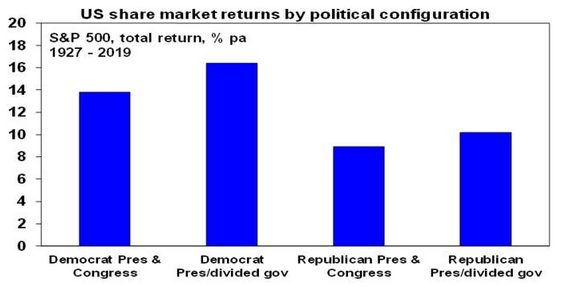
Finally, historically US shares have done best under Democrat presidents with an average return of 14.6% pa since 1927 compared to an average return under Republican presidents of 9.8% pa. The best average result (16.4% pa) has actually occurred when there has been a Democrat president and Republican control of the House, the Senate or both.


Source: Bloomberg, AMP Capital

Concluding comment

The US election has the potential to create further volatility in investment markets. A Trump victory will mean more of the same and at least initially would probably be more positive for US shares than global and Australian shares (all other things being equal). By contrast a Biden victory may add to short-term volatility but this is likely to be short lived as there is no reason to expect a weaker economy and hence share market under a Biden presidency and he is likely to take a less disruptive approach to trade and foreign policy issues.


Source: AMP Capital 30 September 2020

Important notes: While every care has been taken in the preparation of this article, AMP Capital Investors Limited (ABN 59 001 777 591, AFSL 232497) and AMP Capital Funds Management Limited (ABN 15 159 557 721, AFSL 426455) (AMP Capital) makes no representations or warranties as to the accuracy or completeness of any statement in it including, without limitation, any forecasts. Past performance is not a reliable indicator of future performance. This article has been prepared for the purpose of providing general information, without taking account of any particular investor’s objectives, financial situation or needs. An investor should, before making any investment decisions, consider the appropriateness of the information in this article, and seek professional advice, having regard to the investor’s objectives, financial situation and needs. This article is solely for the use of the party to whom it is provided and must not be provided to any other person or entity without the express written consent of AMP Capital.