How much tax you pay on retirement income depends on your age and the type of income stream.

For most people, an income stream from superannuation will be tax-free from age 60.

How super income streams are taxed

Types of super income streams

Income from super can be an:

  • account-based pension — a series of regular payments from your super money

  • annuity — a fixed income for the rest of your life or a set period of time

What is taxable and what is tax-free

Part of your super money is taxable, made up of:

  • employer contributions

  • salary sacrificed contributions

  • personal contributions claimed as tax deductions

Part is tax-free, made up of:

  • after tax contributions

  • government co-contributions

If you’re age 60 or over

Your entire benefit from a taxed super fund (which most funds are) is tax-free.

If you’re age 55 to 59

Your income payment has two parts:

  • taxable — taxed at your marginal tax rate, less a 15% tax offset

  • tax-free — you don’t pay anything more

If you’re age 55 or younger

You can usually only access your super if you experience permanent incapacity. If this happens, you’ll be taxed the same as people aged 55 to 59.

If accessing super for a different reason, such as severe financial hardship, your income payment has two parts:

  • taxable — taxed at your marginal tax rate

  • tax-free — you don’t pay anything more

Tax on other types of super funds

Defined benefit super fund

If you’re with a defined benefit super fund, you’ll get a statement from your fund before becoming eligible for your benefit (super money). This will tell you how much of your benefit is taxable and how much is tax-free.

Untaxed super fund

Some government super funds don’t pay regular tax on contributions. These are known as ‘untaxed funds’. If you’re a member of an untaxed fund, you pay tax when you access your money. Check with your fund to find out more.

Self-managed super fund (SMSF)

If you’re part of a self-managed super fund (SMSF), how you access your money depends on the ‘trust deed’ (rules).

Tax on transition to retirement income streams

With a transition to retirement (TTR) income stream, you can access your super while working. To get one of these pensions, you must have reached your preservation age  (between 55 and 60).

You can take out up to 10% of the balance each financial year. You can’t withdraw it as a lump sum.

You pay the same amount of tax as on other super income streams, according to your age. Investment returns on TTR pensions are taxed at up to 15%, the same as a super accumulation fund

Tax on non-super income streams

With an annuity bought with money from outside super, you get a fixed income for a set period of time. This pension income, less a deductible amount, is taxed at your marginal tax rate

The deductible amount is the part of your original money (capital) coming back to you with each pension payment.

Get help if you need it

Find out more about withdrawing your super and paying tax on the Australian Taxation Office (ATO) website.

Services Australia’s Financial Information Service offers free seminars on topics such as retirement income and pension options.

For help with tax matters, see a tax professional or contact us on Phone: 07 5641 4134.

Source: Moneysmart

Reproduced with the permission of ASIC’s MoneySmart Team. This article was originally published at https://moneysmart.gov.au/retirement-income/retirement-income-and-tax


Important note: This provides general information and hasn’t taken your circumstances into account.  It’s important to consider your particular circumstances before deciding what’s right for you. Although the information is from sources considered reliable, we do not guarantee that it is accurate or complete. You should not rely upon it and should seek qualified advice before making any investment decision. Except where liability under any statute cannot be excluded, we do not accept any liability (whether under contract, tort or otherwise) for any resulting loss or damage of the reader or any other person.  Past performance is not a reliable guide to future returns.

Important Any information provided by the author detailed above is separate and external to our business and our Licensee. Neither our business nor our Licensee takes any responsibility for any action or any service provided by the author. Any links have been provided with permission for information purposes only and will take you to external websites, which are not connected to our company in any way. Note: Our company does not endorse and is not responsible for the accuracy of the contents/information contained within the linked site(s) accessible from this page.

Contrary to what would normally be suggested by the worst recession since the 1930’s, high unemployment, the worst riots since 1968 and the poor handling of the coronavirus pandemic Donald Trump performed very well in the US presidential election resulting in a close outcome. However, while counting is still continuing in some key states, major US TV networks and Associated Press have called the result in Biden’s favour and he has claimed victory as it looks highly likely he will secure at least the 270 electoral college votes required to win and possibly 306. In the popular vote President Trump received at least 70.8 million votes but Joe Biden received 75.2 million votes (and still counting), more than 4 million above Trump.

With likely run-offs for both Senate seats in Georgia in January there is a possibility the Democrats ultimately achieve a “clean sweep” having retained control of the House and gaining control of the Senate if they win both seats in Georgia given that this would give them 50 Senate seats plus one vote from the Vice President Harris in the event of ties. However, the likelihood of the Democrats winning both Senate seats in Georgia is low given Georgia is traditionally Republican and the Republican vote in both Senate races was above the Democrat vote.

So, the most likely outcome is a divided government with Biden as President, the Democrats retaining control of the House and Republicans retaining control of the Senate. So, no “blue wave.”

A victory by President Trump based on final counting (which now looks very unlikely) or recounts and challenges (which is possible but unlikely given the margins that Biden is ahead in key states) would mean more of the same. US tax rates would stay low, but the trade war would ramp up again – which would be bad for non-US shares including Australian shares relative to US shares and be positive for the US dollar including against the $A and the Renminbi. This note looks at the key implications of a Biden victory.

Biden’s key policies

Taxation: Biden plans to raise the corporate tax rate to 28% (reversing half of Trump’s cut to 21%), return the top marginal tax rate to 39.6% (from 37%) and tax capital gains and dividends as ordinary income.

Infrastructure: Biden plans to spend $1.3trn over 10 years.

Climate policy: Biden aims for the US to reach net zero emissions by 2050 by raising the cost of fossil fuels & boosting the development of alternatives (possibly with a carbon tax). He would take the US back into the Paris Climate Agreement.

Regulation: Biden is likely to end the era of deregulation.

Healthcare: Biden wants to strengthen Obamacare and limit drug prices.

Trade and foreign policy: Biden would likely de-escalate tensions with Europe and strengthen the alliance, work with international organisations like the World Trade Organisation, work to re-establish the nuclear deal with Iran and adopt a more diplomatic approach to dealing with trade and other issues with China (working with Europe and Asian allies in the process).

Fiscal stimulus: Biden would support another round of fiscal stimulus of around $US3 trillion or so.

But what can we expect given divided govt?

  • Biden’s proposed tax hikes are extremely unlikely to pass into law given blockage from the Senate.

  • Some form of fiscal stimulus is likely to be agreed, with Senate Majority Leader McConnell saying after the election that, “I think we need do it.”, It could come before the end of the year while Trump is still president but is likely to be smaller at say $US1.5 trillion rather than say $3 trillion had the Democrats won the Senate as well. 

  • Joe Biden and Mitch McConnell already have a strong working relationship so may be able to get something done on infrastructure spending and other Democrat spending priorities around health care and education. There may be some incentive for Senate Republicans to cut a deal with Democrats if they can make Trump’s corporate tax cuts (most of which expire in 2025) permanent.

  • The Senate is likely to limit what Biden can do on climate policy where spending & tax measures are required, but a lot can still be achieved by regulation of the energy sector and the US will likely re-enter the Paris Climate Agreement. 

  • Biden is likely to re-engage and strengthen relationships with traditional US allies and international bodies like the WHO and WTO. The US is also likely to re-enter the Trans-Pacific Partnership (now CPTPP) and the Iran Nuclear Deal.

  • Trade wars are likely to be toned down with the US relying on a more diplomatic approach working with US allies to resolving trade differences with China, using the prospect of cutting Trump’s tariffs as leverage. This doesn’t mean that Biden will be “soft on China” just that a different approach will be used to address US grievances.

  • A Biden presidency is likely to take a more expert based approach to controlling coronavirus ahead of the full deployment of vaccines. This could involve a more coordinated approach and partial lockdowns in the short term, eventually leading to a more confident reopening.

  • Biden will seek to heal divisions and unify the US that were inflamed by President Trump. This may be helped by having Kamala Harris as VP who may very well be the Democrat nominee for President 2024. He will also support the rule of law and reinforce US institutions that have served it well.

Key risks under a Biden presidency

  • Expect more episodes of budget gridlock – including over the debt ceiling that needs to be increased by July next year. As we saw in the Obama years, this can lead to periods of market volatility, but we also saw that Republicans back down quickly once they realise it was working against them. Agreeing more short-term stimulus may cause some short-term share market uncertainty.

  • While the Republican Senate will serve to head off left ward drift under a Biden presidency – by limiting what he can do in areas like tax, climate policies etc – this may alienate many of Biden’s more left-wing supporters reinforcing cynicism. Then again, staying in the political middle is probably the best way to see a Democrat re-elected in 2024.

  • The contentious nature of the election fuelled in large part by Trump’s claims of voter fraud may see divisions remain intense in the US, particularly with Trump sniping on the sidelines. This could lead to unrest in the short term. 

  • President Trump could also throw curve balls between now and inauguration day on 20th January – possibly in terms of refusing to leave office (although I suspect key Republicans will progressively desert him) & also potentially in terms of tensions with China, Iran and North Korea.

Economic impact of a Biden presidency

Our base case remains that while it will be bumpy and uneven, the US economy will continue to recover from the coronavirus hit, helped along by more fiscal stimulus & ultra-easy monetary policy. This will be accelerated if highly effective vaccines are deployed to a wide proportion of the population through next year. The negatives from the tax hikes are likely gone due to the Senate and the impact of more regulation under a Biden presidency should be offset by a ramping down of the trade war compared to what would have happened under Trump.

The main near-term risk is that Biden announces another lockdown to slow coronavirus resulting in another hit to growth. But while this is a short term negative it should ultimately result in a more confident reopening like we are seeing in Australia.

Market implications of a Biden Presidency

Share markets have so far responded favourably to news of Biden being ahead in presidential election counting. However, with Republicans likely retaining control of the Senate this is on the grounds that Biden’s promised tax hikes likely won’t happen, but with some sort of fiscal stimulus still likely. Beyond election challenges we are now into a period of the year where shares normally perform well seasonally, and US shares have typically gone up initially in the aftermath of close elections.

Ultimately, looking beyond the initial knee jerk reaction, the combination of averted tax hikes but some more US stimulus and a toning down of the trade war may be slightly more positive for non-US shares and Australian shares relative to US shares and slightly negative for the US dollar including against the Chinese Renminbi and Australian dollar.

The move towards a more diplomatic approach to resolving issues with China could be particularly positive for Australia to the extent that it would also help encourage Australia and China to resolve tensions that have been ramping up recently. This in turn would help avert a further threat to our exports to China and support Australian exporters and the Australian dollar. Trump’s “Phase One” trade deal with China may also have been working against Australia to the extent that reported Chinese restrictions on imports from Australia may have been partly motivated to free up scope for China to import more from the US to meet the terms of its deal with Trump.

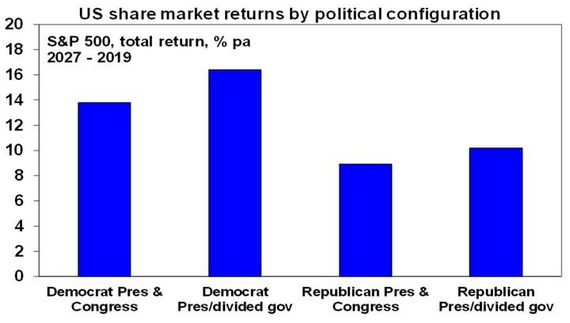
For those worried about “left wing” Democrats, it’s worth noting that US shares have done best under Democrat presidents with an average return of 14.6% pa since 1927 compared to an average return under Republican presidents of 9.8% pa. However, the best average result has actually occurred when there has been a Democrat president and Republican control of the House, the Senate or both. This has seen an average return of 16.4% pa. By contrast the return has only averaged 8.9% pa when the Republicans controlled the presidency and Congress.


Source: Bloomberg, AMP Capital

How would a Democrat Senate change things?

In the unlikely event that the Democrats get control of the Senate via Georgia it would clear the way for significantly more US expansionary fiscal policy and action on climate change but it would likely also mean higher corporate tax in the US and more regulation. Global shares would likely benefit more than US shares and the US dollar would likely fall more. Historically this has been the second-best outcome for share markets. It would probably be the best outcome for Australian shares and the $A as Australia would benefit from more US stimulus, our companies would be relatively more attractive with a higher tax rate in the US and we would likely see less tensions with China.

Implications for Australia

The main positive implications from a Biden Presidency for Australia are likely to be: ultimately a stronger US economy which will benefit the Australian economy; a stronger more consistent relationship with the US; a toning down of the trade war with China in favour of a more diplomatic and engaged approach to resolving trade issues which will be less negative for Australia; and US re-entry into the TPP. More aggressive action on climate change in US may also force Australia and Australian companies (that engage with the US) down a more aggressive response to climate change too. Beyond short term uncertainties around US civil tensions in the aftermath of the election and when US fiscal stimulus will come, overall, we see it as benefitting Australian shares and the Australian dollar.


Source: AMP Capital 9th November 2020


Important notes: While every care has been taken in the preparation of this article, AMP Capital Investors Limited (ABN 59 001 777 591, AFSL 232497) and AMP Capital Funds Management Limited (ABN 15 159 557 721, AFSL 426455) (AMP Capital) makes no representations or warranties as to the accuracy or completeness of any statement in it including, without limitation, any forecasts. Past performance is not a reliable indicator of future performance. This article has been prepared for the purpose of providing general information, without taking account of any particular investor’s objectives, financial situation or needs. An investor should, before making any investment decisions, consider the appropriateness of the information in this article, and seek professional advice, having regard to the investor’s objectives, financial situation and needs. This article is solely for the use of the party to whom it is provided and must not be provided to any other person or entity without the express written consent of AMP Capital.

This article is not intended for distribution or use in any jurisdiction where it would be contrary to applicable laws, regulations or directives and does not constitute a recommendation, offer, solicitation or invitation to invest.

Salary sacrificing, which is also called salary packaging, allows an employee to forgo some of their future entitlement to salary and wages in return for a benefit of a similar value, such as superannuation contributions, a car or other expenses. From 1 January 2020, the law was amended to stop employers from offsetting an employee’s salary sacrificed superannuation guarantee contributions against the employer’s superannuation guarantee liabilities. This may increase the amount of super an employer is now required to make for an employee.

Effective salary sacrifice arrangements

For a salary sacrifice arrangement to be effective, an agreement must be made between an employee and an employer before the employee earns the income or an allowance accrues for the work undertaken. If the agreement is not made until after the income has been earned, then the salary sacrifice agreement is usually ineffective. This will include any salary and wages, leave entitlements, bonuses or commissions that were accrued or earned before an employee has entered into the arrangement.

The salary sacrifice agreement should clearly set out the terms of what has been agreed and it should be in writing. The agreement should include a degree of flexibility to allow the employee or employer to renegotiate the arrangement if required. An example requiring renegotiation may include a change to the law, which may increase or decrease the tax-deductible amount for super contributions. Any amendment to the agreement should take place prior to earning the income or allowance and undertaking the work.

Once the salary sacrifice agreement has been made, the employee permanently give up the right to the salary that has been sacrificed as agreed. If the fringe benefit has not been provided during the period or the benefit ends up being less than the agreed value and it is cashed out it, will be treated as salary and taxed as normal income. This may occur if the employer has not made the total contribution to super as agreed due to changes in the maximum deductible contribution and refunds the difference to the employee.

Some payments made by your employer at your direction are not considered to form part of your salary sacrifice arrangement. The payments include amounts deducted from your salary after you have earned it and tax has been deducted. They can include amounts deducted for health insurance premiums, loan repayments, union fees or credit card repayments.

Salary sacrificing towards super

Salary sacrificed super contributions made to a complying superannuation fund are treated as employer contributions made for an employee and are not fringe benefits. However, contributions paid to a non-complying super fund are treated as a fringe benefit. And, if an employer makes a super contribution for an associate of an employee such as their spouse, the contribution is treated as a fringe benefit.

From 1 January 2020, salary sacrificed contributions to super are no longer counted against an employer’s super guarantee contributions. For example, if an employee elects to salary sacrifice 5% into their super, the employer will still be required to pay super guarantee contributions. This is currently 9.5% of an employee’s ordinary time earnings base, which includes the amount salary sacrificed into super. If an employer does not pay the required amount of superannuation guarantee contributions, an employer will be liable for the super guarantee charge which is calculated on the total salary and wages paid to the employee.

Case Study

In this simplistic case study, let’s assume Wendy is on a remuneration package of $100,000 p.a. and decides to sacrifice $10,000 of her salary into her super. Until 31 December 2019, employer contributions would have been calculated on Wendy’s earnings for ordinary hours of work, which would be $90,000. The employer’s super guarantee liability would have been calculated on $90,000 (9.5%) which is $8,550.

From 1 January 2020, Wendy’s employer will be required to calculate her super on her employment package prior to the reduction of the amount she salary sacrificed to super. The employer’s superannuation guarantee liability will now be $9,500 calculated as 9.5% of the net salary of $90,000, plus the amount she salary sacrificed $10,000 which equals $100,000.

Limitations on salary sacrifice to super

Unless there are limits in your employment agreement to the amount that can be salary sacrificed to super, there’s no restriction on what can be paid. However, there are a number of things that should be considered when considering to salary sacrifice to super.

The amount salary sacrificed may:

  • result in any excess salary scarified contributions being counted against an employee’s concessional (before-tax) contributions cap and attract additional tax. The concessional contributions cap limits the amounts that can be contributed to a super fund and be taxed at a concessional rate of 15%.

  • attract Division 293 tax which is an additional tax that applies when a person’s adjusted taxable income. This includes concessional super contributions and other amounts is more than $250,000 in the financial year.

Benefits of salary sacrifice

The main benefit of salary sacrifice is that it can contribute towards an individual’s retirement savings over time through compounding returns. At the same time, it may reduce the overall amount of tax being paid on super contributions as well on a person’s pre-tax salary. This is because the amount salary sacrificed to superannuation is taxed at 15%, compared to if the amount was paid as salary and wages, the personal income tax rate would usually be higher. Since 1 July 2020, an additional benefit has come into play as employers who were using an employee’s salary sacrifice contributions to offset their superannuation guarantee liability will now have to pay those contributions, which will be based on an employee’s ordinary time earnings.

Please contact us onPhone: 07 5641 4134 if you seek further assistance on this topic.

Source : AMP Capital September 2020 

Reproduced with the permission of the AMP Capital. This article was originally published at https://www.ampcapital.com/au/en/insights-hub/articles/2020/september/salary-sacrificing-and-superannuation

While every care has been taken in the preparation of these articles, AMP Capital Investors Limited (ABN 59 001 777 591, AFSL 232497) makes no representation or warranty as to the accuracy or completeness of any statement in them including, without limitation, any forecasts. Past performance is not a reliable indicator of future performance. Performance goals are merely goals. There is no guarantee that the strategy will achieve that level of performance. The information in this document contains statements that are the author’s beliefs and/or opinions. Any beliefs and/or opinions shared are as at the date shown and are subject to change without notice. These articles have been prepared for the purpose of providing general information, without taking account of any particular investor’s objectives, financial situation or needs. They should not be construed as investment advice or investment recommendations. An investor should, before making any investment decisions, consider the appropriateness of the information in this document, and seek professional advice, having regard to the investor’s objectives, financial situation and needs.

This document is solely for the use of the party to whom it is provided and must not be provided to any other person or entity without the express written consent of AMP Capital.


Are you buying more to perk yourself up? You aren’t alone. Since the start of COVID, there’s been an increase in online shopping1. But, if you want to get a handle on your add-to-cart habit, understanding why you spend money, can help bring your purchasing patterns in line with your financial goals.

We often talk about money in terms of dollars and cents, but the subject can sometimes run deeper than just numbers. Frivolous spending as a result of your emotional state is more common than you might think: one study found that more than 81 % of Australians spend in order to seek comfort2, suggesting that our spending patterns are created by more than needs alone.

Having an uncontrollable urge to spend can have a negative impact on your finances – especially if it’s putting a dent in your financial goals. One way to curb this spending habit is to understand your triggers and put some specific steps in place to regain control. 

What is unconscious spending?

Unconscious spending is the act of spending money without careful thought; sometimes it may even be done on impulse. Whether it’s the latest pair of designer shoes or a new set of golf clubs, it’s the type of spending that seems to happen almost outside of your control – and often, outside of your budget. But unconscious spending doesn’t only happen with expensive, big-ticket or one-off items.

“Unconscious spending can quite often be [due to] a lot of those daily activities that people are completely unaware of and [they underestimate] the impact it can have on their budget,” explains Daniel O’Rourke, an AMP financial adviser. “It could be inadvertently buying a muffin when you pick up your morning coffee. You could be buying lunch from a local cafe, even if you’re working from home because it’s easy and convenient to do so. It’s spending where people may not even think twice about the cost associated with it because it might seem immaterial, but collectively, it adds up.”

Common triggers for unconscious spending habits

There’s a range of emotional triggers that may tempt us into spending more than we intend to. Research has found that some people spend money when they’re feeling sad3 and will pay more for an item if they’re feeling this way.

Boredom can also be a significant trigger: a study into comfort spending found that 47% of Australians admit to purchasing because they’re bored4. The monotony of COVID-19, coupled with a need to delay many plans for travel and other experiences, could be a perfect storm for boredom-induced spending.

Pinpoint your spending patterns and triggers

Still unsure why you spend the way you do? These pointers may help you to identify your triggers…

Uncover your spending habits

Looking for a routine or pattern in your spending can offer some valuable clues and help you control your spending. What things do you typically purchase on impulse: is it clothing or kombucha? Does your unconscious spending usually represent big amounts or small amounts of money? Is it frequent, or more likely to be done in a short burst? Asking yourself these questions could uncover a few commonalities.

Look closely for emotional spending cues

Are there certain times of the day that you’re more likely to spend? Does it often happen during times of boredom or is it more likely to happen when you’re stressed or distracted? Do you tend to spend on credit as opposed to dipping into your savings or using cash?

By isolating some of the key behaviours that surround your unconscious spending, you can better understand your personal purchasing triggers.

Ask yourself: why do I feel like spending money?

The way we feel when we spend money may be different for everyone, but knowing the reasons why you’re partial to purchasing at a certain time, or as a result of a certain feeling, can help you gain more clarity around your triggers.

“A lot of it comes down to the ‘why’,” O’Rourke explains. “If you have a propensity to just go off and spend frivolously, the question to ask would be, ‘Why does this give me joy?’ I guess the questions then are: ‘How does this impact my budget?’, ‘How does this impact my long-term goals?’, ‘Is this within budget?’ and ‘Do I really need this?’”

If you get closer to understanding the feeling you get when purchasing, you can try to replicate that feeling elsewhere, without needing to spend.

Getting on top of unconscious spending

Pinpointing your personal spending triggers is the first step towards doing something about unconscious spending. These two approaches can help you get on top of the habit:

Become more money-mindful

O’Rourke explains that setting specific and achievable financial goals is a great way to gain more mindfulness around your money. Without a clear end point to aim for, when it comes to spending, it’s difficult to know how much is too much. By creating an endpoint – or goal – for your money, you’re more likely to focus your aim.

To stay on track, create and stick to a successful budget. If you have a clear understanding of how much is coming in and going out, you’ll have a greater sense of control over your spending decisions.

Put your money where you can see it

For some, the ease of online transactions is exactly what allows them to overlook the fact that they’re actually spending money.

“There’s a tendency now to use things like Zip and Afterpay,” O’Rourke says. “We’re a cashless society and it’s as easy as tap-and-go.”

If you tend to spend without thinking, you might revert to cash or direct debit payments where possible to remind yourself that your money is real and tangible.

According to the research…

81%  of Australians spend in order to seek comfort

47%  admit to purchasing because they’re bored  

$25.5 billion  the amount Australians spend annually to stave off boredom  


1 https://www.ampcapital.com/au/en/insights-hub/articles/2020/august/econosights-the-outlook-for-consumers

2 Mozo: Mozo’s Comfort Spending Report – 2019
3 NCBI: Misery is Not Miserly: Sad and Self-Focused Individuals Spend More
4 Mozo: Mozo’s Comfort Spending Report – 2019

Source: AMP September 2020 

Important: This information is provided by AMP Life Limited. It is general information only and hasn’t taken your circumstances into account. It’s important to consider your particular circumstances and the relevant Product Disclosure Statement or Terms and Conditions, available by calling Phone: 07 5641 4134, before deciding what’s right for you.

All information in this article is subject to change without notice. Although the information is from sources considered reliable, AMP and our company do not guarantee that it is accurate or complete. You should not rely upon it and should seek professional advice before making any financial decision. Except where liability under any statute cannot be excluded, AMP and our company do not accept any liability for any resulting loss or damage of the reader or any other person. Any links have been provided for information purposes only and will take you to external websites. Note: Our company does not endorse and is not responsible for the accuracy of the contents/information contained within the linked site(s) accessible from this page.

Diversification is an investment strategy that lowers your portfolio’s risk and helps you get more stable returns.

You diversify by investing your money across different asset classes such as shares, property, bonds and private equity. Then you diversify across the different options within each asset class. For example, if you buy shares, you buy across a range of different sectors such as financials, resources, healthcare and energy. You can also diversify by investing your money across different fund managers and product issuers. 

Diversification lowers your portfolio’s risk because different asset classes do well at different times. If one business or sector fails or performs badly, you won’t lose all your money. Having a variety of investments with different risks will balance out the overall risk of a portfolio. 

It’s worth taking the time to review your investments and look for opportunities to diversify.

How diversification benefits you

Diversification is your best defence against a single investment failing or one asset class performing poorly (for example, the share market falling or one fund manager failing).

If you diversify your investments, when some fall in value, others may rise and balance out the fall. Diversification lowers your portfolio risk because, no matter what the economy does, some investments are likely to benefit. For example, when interest rates fall, bond prices rise, while shares generally do poorly at this time.

How to diversify

To diversify well you need to invest across different asset classes and within different options in an asset class. You can also diversify by investing in different fund managers or product issuers. 

Review your investments

List all of your investments and what they’re worth. This could include:

  • cash in a savings account

  • shares

  • managed funds

  • an investment property

  • your home

  • your super

This will show you which asset classes you’re investing in and where you could diversify.

Identify gaps and research other asset classes

If most of your money is in one or two asset classes, research other asset classes. For example, if you own a house, an investment property won’t help you diversify. If property prices fall, you won’t have any other investments to balance out the fall. To diversify, you could invest in different asset classes such as shares or bonds.

Then within each asset class, make sure your money is invested across the different options available. For example, if you’re mainly invested in one sector such as financials, you should research other sectors such as mining, materials, health care, capital goods and commercial and professional services.

See choose your investments for information about different asset classes.

The way your super fund invests is a good example of diversification. Check your fund’s website or annual statement to see how they invest. See super investment options for more information.

Invest overseas

Australia has a small share of the world’s investment opportunities. Investing some of your money overseas will lower the risk of investing in a single market. For example, investments in Asian and European markets may perform well when the Australian markets falls.

If you invest overseas you’ll be exposed to exchange rate risk. Read more about investment risks on develop an investing plan.

Invest through a managed fund, managed account, ETF or LIC

A simple way to diversify is to invest through a managed fund, managed account, exchange-traded fund (ETF) or listed investment company (LIC).

Managed funds and managed accounts

Managed funds and managed accounts can help you invest across a range of asset classes. Some managed funds and managed accounts offer pre-made diversified portfolios. These usually have the labels of conservative, growth or high growth depending on their asset allocation.

See choosing a managed fund for tips on how to choose and buy units in a managed fund.

ETFs and LICs

ETFs and LICs provide a low cost way to invest in an asset class or diversify within an asset class.

Most ETFs in Australia are passive funds. These track an asset price or market index, such as the ASX200 or S&P500. See exchange traded funds (ETFs) for more on how these can help you diversify.

Most LICs are actively managed funds and invest in one asset class, such as Australian shares or private equity. See listed investment companies (LICs) for more information.

Before you invest in a managed fund, managed account, ETF or LIC read the product disclosure statement (PDS). This shows you where the fund invests, key features and benefits of the fund, the expected return, risks, fees and how to complain.

Keep your investments diversified

Over time, some of your investments will rise in value and others will fall. This means you could have more money in one asset class than when you started investing. You could also be less diversified. For example, if your shares go up and your bonds fall in price, you’ll have a greater portion of money invested in shares. As shares are higher risk, your portfolio will also be higher risk. If you’re not comfortable with this risk, it’s time to re balance.

See keep track of your investments for how and when to review your investments.

How to rebalance

You can rebalance your portfolio by:

  • Investing some extra money, such as a tax refund, in an investment you want more exposure to.

  • Selling some investments and putting your money in other types of investments.

Selling investments will lead to a capital gain or a capital loss. See investing and tax to find out the tax impact of selling an investment.

Get help with diversification

Finding the right investments can be challenging. If you need some help to build a diversified portfolio, talk to a financial adviser. Please contact us on Phone: 07 5641 4134. 

Case Study  

Eva diversifies her investments

Eva has $15,000 savings and just inherited $50,000. Her goal is to grow her money so she has $80,000 in five years, for a house deposit.

Eva does her research and decides to build a diversified portfolio.

She decides to invest:

  • 60% of her money in Australian and US shares through an ASX200 ETF and an S&P500 ETF

  • 20% in a listed property trust that invests in Australian and overseas property, and

  • 20% through a bond ETF

Eva has diversified across three asset classes. Within each, she’s invested in a range of investments so if one fails she won’t lose too much.

She estimates she’ll get a return of 5% per year. This will give her around $83,000 in five years for her house deposit.

Please contact us on Phone: 07 5641 4134 if you seek further discussion on this topic.

Source : Moneysmart.gov.au October 2020 


Reproduced with the permission of ASIC’s MoneySmart Team. This article was originally published at https://moneysmart.gov.au/how-to-invest/diversification

Important note: This provides general information and hasn’t taken your circumstances into account.  It’s important to consider your particular circumstances before deciding what’s right for you. Although the information is from sources considered reliable, we do not guarantee that it is accurate or complete. You should not rely upon it and should seek qualified advice before making any investment decision. Except where liability under any statute cannot be excluded, we do not accept any liability (whether under contract, tort or otherwise) for any resulting loss or damage of the reader or any other person.  Past performance is not a reliable guide to future returns.

Important Any information provided by the author detailed above is separate and external to our business and our Licensee. Neither our business nor our Licensee takes any responsibility for any action or any service provided by the author. Any links have been provided with permission for information purposes only and will take you to external websites, which are not connected to our company in any way. Note: Our company does not endorse and is not responsible for the accuracy of the contents/information contained within the linked site(s) accessible from this page.

 

Broad based additional easing from the RBA

As had been well flagged, the RBA announced significant further monetary easing at its November meeting. This entails:

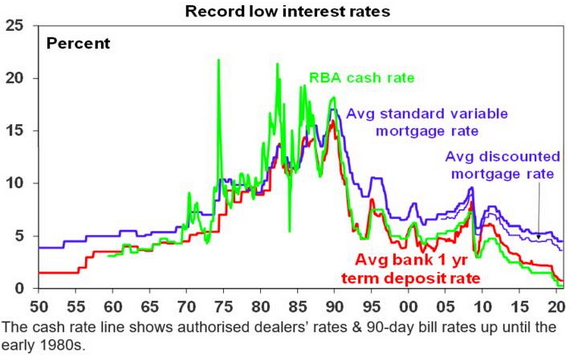
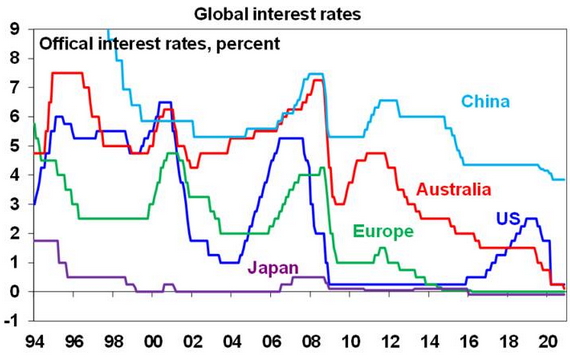
  • A cut in the cash rate, the Term Funding Facility rate (ie, the rate at which the RBA provides cheap funding to the banks for three years) and the three-year bond yield target to 0.1% (all from 0.25%). This takes the cash rate to a new record low. This leaves Australia’s official interest rate broadly consistent with rates in comparable countries around zero.


Source: Bloomberg, AMP Capital

  • An additional bond buying (or quantitative easing) program, beyond what would occur for maintaining the three-year bond yield at 0.1%, of $100bn of five to ten-year bonds over the next six months, with an 80%/20% split across Federal/state bonds. This a bit faster than the market had expected where most saw it spread out to end next year and the RBA has said it will keep it under review which means that it could be increased. It involves the RBA using newly printed money to buy already issued government bonds which has the effect of injecting cash into the economy, increasing the supply of Australian dollars and pushing down bond yields and long-term borrowing costs. It makes it easier for the Government to finance its $214bn budget deficit as the RBA will be indirectly buying the equivalent of nearly half the value of bonds to be issued to finance it. 

  • A formal revision to forward guidance for monetary policy to now say the RBA “will not increase the cash rate until actual inflation is sustainably within the 2 to 3 percent target range. For this to occur, wages growth will have to be materially higher than it is currently. This will require significant gains in employment and a return to a tight labour market.” This means the RBA will take longer to raise interest rates compared to the old forward guidance that just required “progress” towards full employment and confidence that inflation will be sustainably in the target band. The RBA said that it is not expecting to increase rates for at least three years but I suspect it won’t be till 2024 at the earliest. This basically means that borrowers can be confident that the borrowing costs will stay down for several years to come.

What’s driving the latest easing?

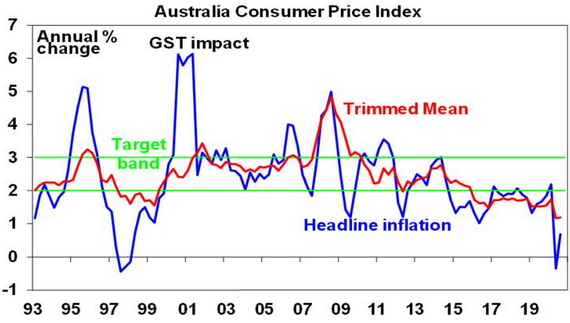
Put simply, the RBA’s economic forecasts show that it does not expect to meet its inflation and employment objectives over the next two years and it sees the recovery as being bumpy and drawn out. It has been undershooting its 2-3 percent inflation objective for the last five years now.


Source: ABS, AMP Capital

More importantly the coronavirus hit to the economy has taken us further away from full employment and the RBA sees addressing the high rate of unemployment as an “important national priority.” Of course, fiscal policy is likely more powerful in terms of driving actual spending. But the RBA remains committed to do what it can and is under pressure to act when it’s not expecting to meet its objectives. It feels that monetary easing is likely to gain more traction now the economy is reopening and can’t ignore the faster pace of quantitative easing in other major countries. The latter has the effect of pushing up the $A relative to what it otherwise would be which in turn slows the economic recovery.

Why not just lower the inflation target?

Surely low price rises or falling prices are good. So, why not just lower the inflation target. This would be crazy. First, the whole point of having an inflation target is to anchor inflation expectations. If the target is just moved whenever it’s breached, it won’t be taken seriously & there would be no point having it.

Second, statistical measures of inflation tend to overstate actual inflation and targeting too low inflation could mean we are knocked into deflation in an economic downturn.

Third, deflation is not good if it means falling wages, high unemployment, falling asset prices and rising real debt burdens.

Fourth, low inflation is synonymous with low wages growth and this contributes to a sense of dissatisfaction in the community.

Finally, it’s not just about below target inflation but also about reducing high levels of unemployment and underemployment.

But will the banks pass on the RBA rate cuts?

Passing all of the 0.15% cut on will mean some downwards pressure on bank profit margins as a significant chunk of deposits are already at or near zero rates – and the banks won’t want to cut those negative. But I think the banks will pass most of it on under pressure from the RBA and Government who have been providing them with a lot of support (including cheap funding which is now 0.15% cheaper) and if they don’t they will face a public backlash. One way around it is to cut their standard variable rates by say 0.1% and then cut their fixed rates by say 0.2%, as the latter only benefits new customers but gains publicity brownie points (made possible by lower funding costs on the back of lower bond yields due to RBA bond buying). This is what happened in March. Three-year fixed rate mortgages are already averaging around a very low 2.35%.


Source: RBA

But will the further easing help anyway?

While the further easing announced by the RBA won’t have a huge impact compared to say the boost from the Budget, it will have a positive impact on the economy at the margin. First, even just a 0.1% reduction in mortgage rates will mean roughly a $400 a year reduction in interest costs on a $450,000 mortgage. Note that the level of household debt in Australia is more than double the level of household bank deposits so the household sector is a net beneficiary of lower interest rates. Second, a further reduction in fixed rates will further spur new home demand. Third, further rate cuts and an increase in the supply of Australian dollars on the back of expanded quantitative easing will help keep the $A lower than otherwise which helps exporters and companies competing with imports. Finally, extra RBA bond buying will make it easier for the Government to run its large budget deficit.

What about the risk of financial instability?

There is certainly a risk that the combination of even lower mortgage rates combined with a notable easing in lending standards (with the removal of responsible lending obligations and the First Home Loan Deposit Scheme) will drive household debt levels even higher, posing the risk of increased financial instability in the years ahead, particularly if house prices ultimately correct in the face of substantially lower immigration. Right now though, the RBA is more focused on helping people get jobs and avoiding debt servicing problems.

Will the RBA take rates negative?

This is unlikely as the evidence as to whether they have worked in Europe and Japan is mixed and they confuse people which may depress confidence. As a result, the RBA has regularly said that negative rates are “extraordinarily unlikely” in Australia. That said with central banks in the UK, Canada and NZ considering them, negative rates can’t be ruled out entirely to the extent that if other central banks go down that path, it may put more pressure on the RBA to do so too. As long as the Fed doesn’t go negative though I think it’s unlikely.

Is the RBA now out of bullets?

The RBA has now hit the bottom of the barrel in terms of conventional interest rate cuts, but as other major central banks have shown since the GFC, there is still plenty it can do in terms of ongoing quantitative easing.

Implications for investors?

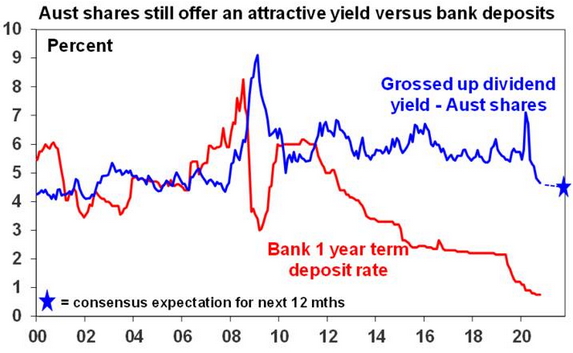
There are a number of implications for investors from the latest easing by the RBA. First, ultra-low interest rates will likely be with us for several more years, keeping bank deposit rates unattractive so it’s important for investors in bank deposits to assess alternative options. Second, the low interest rate environment means the chase for yield is likely to continue supporting assets offering relatively high sustainable yields. This is likely to include Australian shares where despite sharp cuts to dividends, the grossed-up for franking credits dividend yield on shares remains far superior to the now even lower yield on bank term deposits. Investors need to consider what is most important – getting a decent income flow from their investment or absolute stability in the capital value of that investment. Of course, the equation will turn less favourable if economic activity deteriorates again.


Source: RBA, Bloomberg, AMP Capital

Third, the ongoing decline in mortgage rates along with easing lending standards will help boost house prices but bear in mind that high unemployment and the hit to immigration will likely impact in the year ahead. The housing outlook also varies dramatically between cities & within them given rising demand for outer suburban and regional houses over inner city units.

Finally, lower rates and increased quantitative easing will help keep the $A lower than otherwise but it’s still likely to rise over the year ahead if global recovery continues and this pushes up commodity prices.


Source: AMP Capital 03 November 2020

Important notes: While every care has been taken in the preparation of this article, AMP Capital Investors Limited (ABN 59 001 777 591, AFSL 232497) and AMP Capital Funds Management Limited (ABN 15 159 557 721, AFSL 426455) (AMP Capital) makes no representations or warranties as to the accuracy or completeness of any statement in it including, without limitation, any forecasts. Past performance is not a reliable indicator of future performance. This article has been prepared for the purpose of providing general information, without taking account of any particular investor’s objectives, financial situation or needs. An investor should, before making any investment decisions, consider the appropriateness of the information in this article, and seek professional advice, having regard to the investor’s objectives, financial situation and needs. This article is solely for the use of the party to whom it is provided and must not be provided to any other person or entity without the express written consent of AMP Capital.

This article is not intended for distribution or use in any jurisdiction where it would be contrary to applicable laws, regulations or directives and does not constitute a recommendation, offer, solicitation or invitation to invest.

As your working life draws to a close, your social life and recreational activities don’t have to. If you’re anxious about money still owing, here are some helpful hints.

Ahh retirement! You may have been dreaming about it for decades. You see yourself hanging up the work boots, putting away the laptop, swinging in a hammock by the ocean somewhere (the Croatian coast sounds nice – please let us board a plane again soon COVID-19!).


As the dream teeters on reality, your tummy churns as you contemplate the debt you’re yet to pay off, and how it might create roadblocks for the things you still want to do – the family barbecues, the mini getaways with mates, maybe helping the kids out with some of the things they have on the horizon.

Carrying debt into retirement is something many Aussies will face1, but the good news is there are a number of things you can do now while you’ve still got time on your side and earning an income.

Take simple steps to minimise what you owe

  • Work out your debts and what they total

  • Do a comparison of what you earn, owe and spend

  • Look into whether you might benefit from rolling your debts into one

  • Pay your debts on time to avoid additional charges

  • Try to pay the full amount rather than the minimum owing

  • Look at whether you can afford to make extra repayments

  • Shop around for providers with lower interest rates and no annual fee 

  • Have a contingency plan, such as an emergency fund, if you can afford to

  • If you’re experiencing financial hardship, talk to your providers, as most can assess your situation and help you find alternative payment plans.

Get serious about having a budget

If you’re approaching retirement, you may be prioritising things such as living costs, utility bills, health care and even helping the kids out. With many Aussies looking at a retirement (which in reality, could span a few decades), another thing to give some thought to is recreation and your social life.

A good starting point when it comes to setting up a workable budget, so you can manage these things, is figuring out what money you have coming in, what expenses you have and what you might be able to put aside. You can use our budget calculator if you want a hand.

Meanwhile, if you’re wondering how much money you’ll need generally, the Association of Superannuation Funds of Australia (ASFA) benchmarks the annual budget needed to fund different retirement lifestyles, based on an assumption people own their home and are relatively healthy2.

June 2020 figures show individuals and couples, around age 65, looking to retire today would need an annual budget of $43,687 and $61,909 respectively to fund a comfortable lifestyle, or $27,902 and $40,380 respectively to live a modest lifestyle3.

Consider what money you might have access to

The money you use to fund your life in retirement will likely come from a range of different sources, including the following:

Super – Generally you can start accessing super when you reach your preservation age, which will be between 55 and 60, depending on when you were born. Knowing your super balance is a crucial part of planning for retirement, as it’s likely to form a substantial part of your savings.

If you’ve got more than one super account, there may also be advantages to rolling your accounts into one, such as paying one set of fees, which could save you hundreds of dollars each year. However, there could be other fees and features lost in the process, so make sure you’re across everything before you consolidate.

Investments, savings, inheritance – You may be planning to sell shares or an investment property, or use money you’ve saved in a savings account or term deposit to contribute to your retirement. An inheritance or proceeds from your family’s estate may also help in your later years.

The government’s Age Pension – Depending on your circumstances and assets, you could be eligible for a full or part Age Pension from age 65 to 67 onwards (depending on when you were born), or you may not be eligible for government assistance at all.

Know where your money is sitting and what it’s doing

Having spare money sitting in the one place mightn’t be the best thing. For instance, if you’ve got cash in a transaction account, could you be earning more if it was invested elsewhere, or even placed in an offset account linked to your home loan to reduce what you pay in interest?

Looking at different investment options inside your super could also potentially generate more income. Do keep in mind though that a more conservative approach may be a better option as you get older, as when you’re younger, you generally have more time to ride out market highs and lows.

Consider downsizing your home or refinancing

Find out what you need to know about downsizing your home as this could help you top up your retirement savings.

You might also be interested to know that when you reach age 65, you can make a tax-free contribution to your super of up to $300,000 using the proceeds from the sale of your main residence. There will however be potential advantages and rules that you’ll want to be across.

Refinancing, whereby you replace your existing home loan with a new one, could also create cost benefits and more financial flexibility.

Remember, your living arrangements in retirement should be based on more than just your finances. Your health, partner, family and what activities you want to pursue once you stop work will play a part.

Think about working a bit longer

This could help you to boost your savings as well as your super balance, so that you have a more comfortable lifestyle in retirement. In fact, the main reason most older Aussies said they wanted to stay in the workforce was financial security4.

It’s also interesting to note, retirement isn’t necessarily a one-time event, particularly when it comes to the 45 to 54 and 55 to 59 age groups, with as many as 26.7% returning to employment annually5.

If you need some assistance, on this topic talk to us on Phone: 07 5641 4134


Reserve Bank of Australia – Demographic Trends, Household Finances and Spending
2, 3 ASFA Retirement Standard – June 2020 figures
Australian Bureau of Statistics – Retirement and Retirement Intentions
The Household, Income and Labour Dynamics in Australia (HILDA) Survey 2017 pages 65, 67

Source : AMP September 2020 

Important: This information is provided by AMP Life Limited. It is general information only and hasn’t taken your circumstances into account. It’s important to consider your particular circumstances and the relevant Product Disclosure Statement or Terms and Conditions, available by calling Phone: 07 5641 4134, before deciding what’s right for you.

All information in this article is subject to change without notice. Although the information is from sources considered reliable, AMP and our company do not guarantee that it is accurate or complete. You should not rely upon it and should seek professional advice before making any financial decision. Except where liability under any statute cannot be excluded, AMP and our company do not accept any liability for any resulting loss or damage of the reader or any other person. Any links have been provided for information purposes only and will take you to external websites. Note: Our company does not endorse and is not responsible for the accuracy of the contents/information contained within the linked site(s) accessible from this page.

 

The promise of open banking is big; a new, simpler way to share your personal financial data between banks, lenders and financial companies. It started on July 1. Here’s how it works and what it means to take back control of your data to get the best rates and offers.

Switching banks has long been something that Australians put in the ‘too hard basket.’ More than 40 per cent of Australians are with the same bank they started with as a kid, and switching often involves the arduous task of collecting paperwork and transaction history, then applying at a bank online or over the phone.

This means there’s little incentive for banks to offer you a competitive deal to remain a customer, and you miss out on other offers because switching is so difficult.

With open banking, that procedure and many others become a lot simpler, as ownership of that data is transferred from the banks to you. You can share your information with other banks and financial institutions to get better deals, service tailored to your circumstances, and control of your savings.

So, what exactly is open banking?

Open banking gives you what’s known as a Consumer Data Right (CDR). This gives you the right to share your banking data – like credit information, transaction history and account balances – with third parties accredited by the Australian Competition and Consumer Commission (ACCC).

These parties includes banks, financial institutions, fintechs and neobanks. You can ask for your data to be sent to these institutions whenever you want or need it to be, and you control who can access it – and for what purpose.

Instead of having to hunt down your data, it will be transferred to other companies, so you can compare products or sign up for them more easily.”

Open banking legislation was passed by the federal parliament in August 2019. And from July 1, consumers have been able to direct the big four banks to share various elements of their financial data with accredited parties. 

Why is it being introduced?

The simple reason is to put the power over banking data back into the hands of consumers that generated the data, rather than their financial institutions. Instead of consumers having to go through the process of tracking down transaction histories and other account details, the onus is now on banks to provide them to third parties.

This level of openness is designed to drive competition within the financial services sector, because customers will now find it easier to switch between banks and financial institutions. CDR is first being implemented in banking, before being introduced to other industries, such as energy and telecommunications . 

How can I use open banking?

From July 1, the big four banks are now required by law to share your transaction account, deposit account, credit card and debit card data with any accredited third party – if you ask them.

For other data including home loans, investment loans, personal loans, joint accounts, closed accounts, direct debits, scheduled payments and payee data, you’ll need to wait until November. For data with other financial institutions outside the big four, you’ll be waiting until July next year.

Some of the uses of open banking include:

  • Better control over financial products. Instead of having to hunt down your data, it will be transferred to other companies, so you can compare products or sign up for them more easily. Banks can assess your credit risk more simply because it’s easier to show credit history and account balances to prove your position for mortgages and loans.

  • Better convenience over budgeting, saving and account visibility. You will be able to feed your banking data from a range of providers directly into budgeting and financial planning apps to help you manage your money.

  • Better choice by making switching accounts simpler. Your bank is required to find and share your data, not you. It will be as simple as using an app or online banking platform. And direct debits – like streaming services or gyms – will not have to be switched over once direct debit details become shareable in November.

As more and more customers are reviewing their financial positions in light of COVID-19 and the low interest rate environment, many will find it useful to be able to compare financial products with greater control over their data.

How does it work?

The process requires your full consent and will take only a couple of minutes. The CDR website outlines five steps:

  1. Consent: Using the website or app of the company you want to share your data with, you’ll allow them to access your data.

  2. Identity check: Your bank will verify your identity.

  3. Confirm data: What data you want to share, how to share it, and for what period.

  4. Share data: Your data is transferred electronically from the bank to the recipients. This uses an API – a kind of software go-between that allows two applications to talk to each other.

  5. Use the provider’s service: You’ll then be directed back to the recipient’s app or platform, and you’ll be able to use it with your data,

Is the process safe?

The government is overseeing open banking as part of Australia’s CDR initiative, so it is regulated by the Australian Competition and Consumer Commission (ACCC) and the Office of the Australian Information Commissioner (OAIC). Only accredited institutions can take part, they were rigorously screened, and they are subject to strict standards. The processes were designed by CSIRO’s data standards body, Data61.

All data sharing is based on customer consent, and data recipients will need to delete any data after 12 months. Sharing is subject to the Privacy Act as well.

What can we expect next?

Only two data recipients have been accredited so far – personal financing fintech Frollo and the customer-owned Regional Australia Bank. As more are accredited in the coming months, customer use of open banking will continue to grow.

Source : Your Loan Hub October 2020 


(C) Advantedge Financial Services Holdings Pty Ltd ABN 57 095 300 502. This article provides general information only and may not reflect the publisher’s opinion. None of the authors, the publisher or their employees are liable for any inaccuracies, errors or omissions in the publication or any change to information in the publication. This publication or any part of it may be reproduced only with the publisher’s prior permission. It was prepared without taking into account your objectives, financial situation or needs. Please consult your financial adviser, broker or accountant before acting on information in this publication.

Important: Any links have been provided with permission for information purposes only and will take you to external websites, which are not connected to our company in any way. Note: Our company does not endorse and is not responsible for the accuracy of the contents/information contained within the linked site(s) accessible from this page.
 

Superannuation fund members have experienced a rollercoaster ride this year as extreme volatility on financial markets has seen investment returns rise and fall, often quite acutely, on an ongoing basis.

The sharp falls on markets in the first quarter of 2020 eroded the gains made by many super fund members over the preceding nine months, resulting in negative returns for some by the end of June.

Then, since the start of the latest financial year, super investment returns have largely been on an upwards trajectory, despite being regularly punctuated by bouts of volatility.

Comparing super returns

In such volatile conditions it’s obviously useful to know how your selected super fund product has performed against the broader industry on a returns basis. But that’s easier said than done.

There are regular updates from different sources giving a helicopter view of average super investment returns.

They will typically compare the returns from super products that are aligned to investment asset allocation labels, such as “high growth”, “growth”, “balanced” and “conservative”.

The problem is, these labels are generic and because there’s such a wide variation in how different super funds are allocating their investment assets, it’s virtually impossible to compare products against each other.

Percentage returns analysis is also generally net of investment fees, but before administration fees and other costs.

APRA’s data collection program

The Australian Prudential Regulation Authority (APRA) has just released the final consultation package for phase 1 of a major project to expand the breadth, depth and consistency of its superannuation data collection from regulated super funds.

This is part of a multi-year project to make it much easier to examine and reliably compare fund and product performance, especially in the choice segment of the super market.

A particular pain point for APRA has been the ongoing issue of being able to reliably compare super fund investment strategies.

“A lack of industry agreement in areas such as asset class definitions is also hampering the ability to make meaningful industry-wide comparisons, and this consultation seeks to provide clarity and consistency in these areas,” APRA notes.

Last week the regulator published a draft reporting standard on asset allocation, which it said will assist it in assessing the investment risks and exposures undertaken by super funds in meeting their strategic objectives.

The standard would require super funds to report on their strategic asset allocations, broken down by asset class, domicile, whether investments are listed or unlisted, and their benchmark allocation percentages.

“It will also improve the comparability and consistency of asset allocation data, to better enable APRA to identify and monitor emerging investment trends and risks across the superannuation industry and the broader financial services sector,” APRA says.

Another draft reporting standard has been released around insurance arrangements, where APRA wants to collect more data on insurance policies including premiums, claims payments and processing stages.

APRA has also released a draft reporting standard on expenses, to capture data on how members’ funds are being used to pay for costs such as accounting, actuarial fees, advertising and marketing, technology, consultants and head-office expenses.

Separately, at the end of August, APRA released a draft reporting standard on super fund fees and costs that would require super funds to report investment, administration, transaction, advice and member activity fees and costs.

APRA currently collects fee and cost disclosures for MySuper and lifecycle fund products but it wants to extend this to all super products, ultimately supporting its initiatives to improve outcomes for superannuation members.

Next steps

The first tranche of data collected under Phase 1 is due to be published in late 2020.

APRA will use the insights gained from a more complete and granular data collection process to sharpen its supervision priorities and drive better industry practices.

That can only be a good thing, and the regulator says heightened transparency will intensify the pressure on underperformers to lift their game.

Having good transparency around performance, asset allocations, fees, costs and other expenses are all essential elements for every investor in making informed investment decisions, whether inside or outside of the super regime.

Please contact us on Phone: 07 5641 4134 if you need further assistance on this topic.

Source : Vanguard September 2020 

Reproduced with permission of Vanguard Investments Australia Ltd

Vanguard Investments Australia Ltd (ABN 72 072 881 086 / AFS Licence 227263) is the product issuer. We have not taken yours and your clients’ circumstances into account when preparing this material so it may not be applicable to the particular situation you are considering. You should consider your circumstances and our Product Disclosure Statement (PDS) or Prospectus before making any investment decision. You can access our PDS or Prospectus online or by calling us. This material was prepared in good faith and we accept no liability for any errors or omissions. Past performance is not an indication of future performance.

© 2020 Vanguard Investments Australia Ltd. All rights reserved.

Important: Any information provided by the author detailed above is separate and external to our business and our Licensee. Neither our business nor our Licensee takes any responsibility for any action or any service provided by the author. Any links have been provided with permission for information purposes only and will take you to external websites, which are not connected to our company in any way. Note: Our company does not endorse and is not responsible for the accuracy of the contents/information contained within the linked site(s) accessible from this page.
 

From the get-go back in March, as coronavirus lockdowns hit, there has been much debate about what this recession would be like: how deep and long would it be? Was it going to be a recession like those in decades past or more like the Great Depression of the 1930s? Would it look like a V, a U, a W or an L? Or even a K, square root or a swoosh? These questions gained added currency when actual data showed a bigger hit to economies than what was seen at the end of WW2 or the Great Depression and then confusion reigned as much data showed very steep rebounds. But one thing that seemed clear at the start was that it would be very different to past downturns and this is now even more apparent.

Five reasons why this time is a bit different

There are basically five reasons why this downturn and subsequent recovery is different to those of the past:

  • First, it was caused by government mandated shutdowns and changed individual behaviour to control the spread of coronavirus. This contrasts to normal economic downturns that are preceded by a period of excess (in investment, consumer spending, private debt and inflation) that have to be unwound often with the help of monetary tightening. 

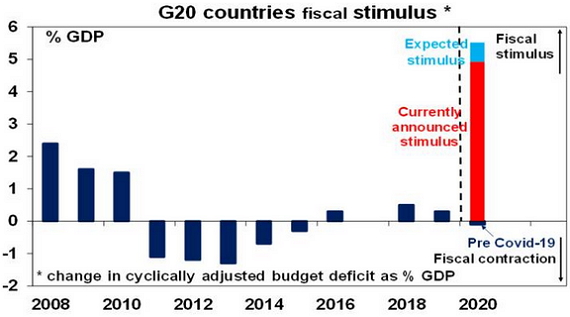
  • Second, we have seen massive upfront monetary and fiscal easing which has propped up businesses, jobs, incomes and the flow of credit relative to what otherwise would have occurred. Interest rates have gone to record lows, quantitative easing has become the norm and most importantly fiscal stimulus as a share of GDP in developed countries has been at a record levels. This is in stark contrast to most post war recessions that have seen policy response come with a lag as it’s taken longer to realise the economy needs help. And in the Great Depression, monetary and fiscal policy was first tightened.


Source: IMF, AMP Capital

  • Third, debt payment holidays, rent moratoriums and a relaxation of insolvency rules have been put in place to avoid the sort of business failures, distressed asset sales, layoffs and hardship that normally occurs in recessions. This has seen for example, company insolvencies in Australia run at around half the level of prior years since April. And the lack of forced sales and income protection partly explain why home prices have held up relatively well.

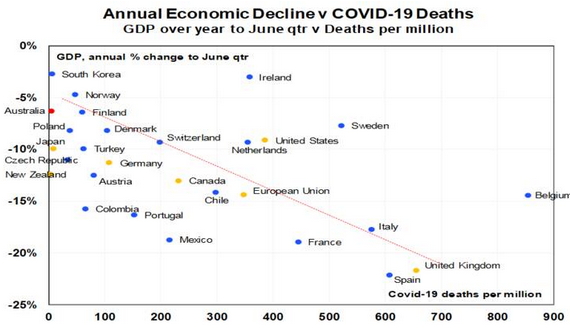
  • Fourth, it’s dependent on containing the virus. This was seen in terms of the severity of the economic downturn in the first half being less in countries with less deaths from the virus, like Australia. Likewise getting it under control will play a big role in determining the recovery. There are good prospects for vaccines but assuming a reasonable degree of efficacy, it may take 6-12 months before enough people have had it to develop herd immunity. In the meantime, much will depend on social controls, tracing & quarantining.


Source: ourworldindata.org, Bloomberg, AMP Capital

  • Finally, the coronavirus shock is likely to have accelerated structural change by more than is normal by driving an even faster embrace of technology in terms of online retailing, working from home, digital meetings, etc. This is not all negative and could mean faster productivity (less time commuting, less time in meetings, less time travelling) but it could result in higher than otherwise structural unemployment (e.g. less jobs associated with commuting and offices, less jobs associated with business travel and less jobs in retailing).

The outworking of all this is likely to be:

  • A sharp initial rebound in economic activity as businesses reopen and people return to work.

  • Followed by the remainder of the recovery being slower and bumpy reflecting periodic outbreaks of the virus and renewed restrictions, some sectors taking longer to recover (eg, travel jobs) & as structural change impacts some jobs.

The Australian recession and recovery

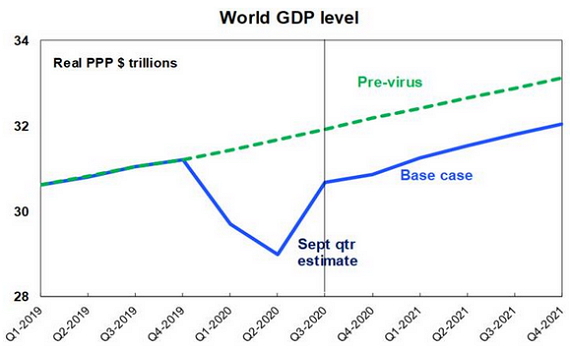
This pattern looks to have been what we have seen so far globally with very sharp falls in GDP in the first half followed by a strong rebound in the September quarter (with GDP data for the US and Europe to be released later this week likely to show an 8% or so rebound), followed by a more uncertain and gradual recovery going forward – particularly as the resurgence of the virus leads to tightening restrictions in Europe (as we are now seeing in France and Germany) and possibly the US. This can be seen in our projections for the level of real global GDP in the next chart. In particular, global GDP will take years to get back to its pre-coronavirus level which means a long period of spare capacity and low inflation/low interest rates.


Source: AMP Capital

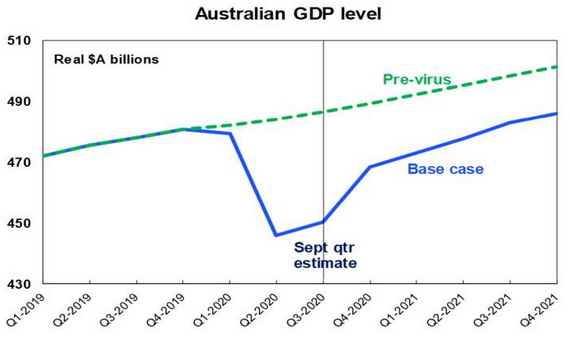
The Australian economy looks to be following a similar pattern, although the initial recovery has been slowed through the September quarter by Victoria’s hard lockdown. As a result, we only expect 1% or so growth in the September quarter, but a stronger rebound in the December quarter as Victoria reopens. Our forecasts for the level of real Australian GDP are shown in the next chart. Note that while a return to growth in the September quarter will mean that technically the recession is over – this really is just a technicality because the level of activity will still be a long way below its pre-coronavirus level.


Source: AMP Capital

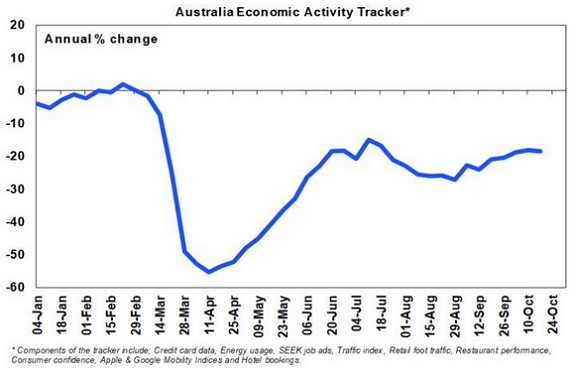
Because most traditional economic data is infrequent, we have constructed Economic Activity Trackers for the US and Australia which track weekly data releases for things like traffic, direction requests from phones, confidence and spending. This clearly shows the initial hard decline in the economy into mid-April, followed by a strong bounce into July on reopening. The recovery then faltered a bit and now seems to be getting back on track with Victoria reopening.


Source: AMP Capital

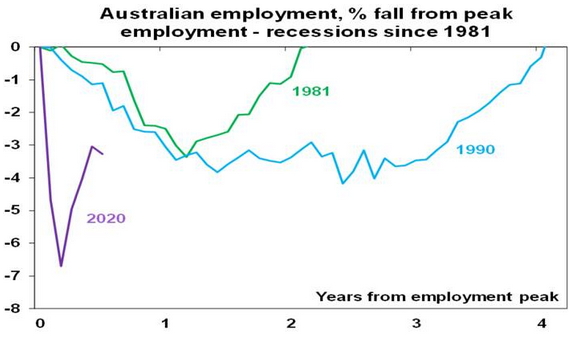
A sharp hit followed by an initial “deep V” rebound can also be seen in Australian employment, which has now recovered about half the job losses seen in April and May.


Source: ABS, AMP Capital

Both our Australian Economic Activity Tracker and employment have seen a sharp rebound but remain a long way below pre-coronavirus levels. In terms of the jobs market, this is reflected in “effective unemployment” (ie, adjusting for JobKeeper and reduced participation) of 9.6% and underemployment of 11.4%. So, while Australia has seen some “recovery,” we have a long way go yet to say that we have “recovered”. Our assessment is that the recovery will continue but beyond a December quarter bounce fuelled by reopening, this will be more gradual and bumpy for the reasons noted earlier as some jobs take longer to recover and some won’t come back at all due to structural change and so will need to be replaced by new jobs which will take time, as government supports wind down and as the hit to immigration impacts the property market.

Concluding comment

As we noted back in May in The Lucky Country, Australia has performed far better than many comparable countries in controlling coronavirus, it has seen a stronger economic policy response and its major trading partner in China is well into economic recovery. This along with a bit of luck should result in a stronger, more assured recovery in the Australian economy compared to many other comparable countries which should ultimately benefit Australian assets relative to global assets.


Source: AMP Capital 29 October 2020

Important notes: While every care has been taken in the preparation of this article, AMP Capital Investors Limited (ABN 59 001 777 591, AFSL 232497) and AMP Capital Funds Management Limited (ABN 15 159 557 721, AFSL 426455) (AMP Capital) makes no representations or warranties as to the accuracy or completeness of any statement in it including, without limitation, any forecasts. Past performance is not a reliable indicator of future performance. This article has been prepared for the purpose of providing general information, without taking account of any particular investor’s objectives, financial situation or needs. An investor should, before making any investment decisions, consider the appropriateness of the information in this article, and seek professional advice, having regard to the investor’s objectives, financial situation and needs. This article is solely for the use of the party to whom it is provided and must not be provided to any other person or entity without the express written consent of AMP Capital.