Have you considered what’s on the agenda, such as how often you see yourself eating out and whether you want to travel domestically or afar?

If you’re in or approaching retirement, you may be prioritising things such as living costs, utility bills, health care and even potentially helping the kids out with their future financial goals.

With many Australians looking at a retirement (which in reality, could span a few decades), another thing to give some thought to is keeping some money aside for your own recreation and social life.

What activities are on your to-do list?

Think about what you enjoy doing, what you’re likely to want to do more of, or even get into with more time on your hands.

  • Eating out – restaurants, beach barbecues, picnics, food fairs

  • Travel – interstate breaks, overseas holidays, road trips, caravanning

  • Entertainment – cinemas, concerts, events, stage shows

  • Sport – golf, tennis, cycling, yoga, pilates

  • Hobbies – fishing, sailing, photography, drawing, woodwork

  • Volunteering – hospitals, soup kitchens, animal shelters

  • Club associations – Rotary, Leagues, Surf Life Saving

  • Tournaments – trivia, bridge, chess.

How can you budget for the things you enjoy?

If you need a guide, the Association of Superannuation Funds of Australia (ASFA) benchmarks the annual budget needed to fund a comfortable and modest standard of living in retirement, with figures based on an assumption people own their home outright and are relatively healthy.

According to June 2020 figures, individuals and couples around age 65, looking to retire today, would need an annual budget of $43,687 and $61,909 respectively to fund a comfortable lifestyle, or $27,902 and $40,380 respectively to live a modest lifestyle1.

According to ASFA, a comfortable retirement lifestyle would enable an older, healthy retiree to be involved in a broad range of leisure and recreational activities, whereas a modest retirement lifestyle would enable an older healthy retiree to afford more basic activities2.

How much are you likely to spend on recreation anyway?

According to research, singles and couples (aged 65 to 85) living a comfortable lifestyle in retirement would spend about $184 and $277 of their weekly budget respectively on leisure and recreation3.

This takes into account a broad range of recreational activities, including4:

  • Lunches and dinners out

  • Domestic and international holidays

  • Movies, plays, sports and day trips

  • Things like streaming services

  • Club memberships.

Making your money go further for the fun stuff

  • Make use of your Senior’s Card for transport concessions and other discounts

  • If going overseas isn’t in your budget, you could consider a road trip interstate

  • If you enjoy dining out, find two-for-one deals nationally via sites like TheHappiestHour

  • Pack a rug, food basket and esky, and head to the park or beach for a picnic

  • Swap a visit to the day spa with a DIY manicure and candle-lit bubble bath

  • Have the troops over for a poker night or take turns hosting dinner parties

  • Find cheap accommodation on Airbnb or consider listing your own place to earn money while you’re away.

Meanwhile, if you’re looking for other money tips, or discuss future planning please contact us on Phone: 07 5641 4134.


1, 2 ASFA Retirement Standard table 1
3, 4 ASFA Retirement Standard – Detailed budget breakdowns – June  quarter 2020 page 4

Source : AMP August 2020 

Important: This information is provided by AMP Life Limited. It is general information only and hasn’t taken your circumstances into account. It’s important to consider your particular circumstances and the relevant Product Disclosure Statement or Terms and Conditions, available by calling Phone: 07 5641 4134, before deciding what’s right for you.

All information in this article is subject to change without notice. Although the information is from sources considered reliable, AMP and our company do not guarantee that it is accurate or complete. You should not rely upon it and should seek professional advice before making any financial decision. Except where liability under any statute cannot be excluded, AMP and our company do not accept any liability for any resulting loss or damage of the reader or any other person. Any links have been provided for information purposes only and will take you to external websites. Note: Our company does not endorse and is not responsible for the accuracy of the contents/information contained within the linked site(s) accessible from this page.


COVID-19 has impacted many of the big, fundamental drivers of property markets in Australia. There is potential for this to have a lasting impact, which could be good news for the chronic affordability issues in the residential market.

A history of housing affordability in Australia

For years Australia has suffered from poor housing affordability. According to the 2020 Demographia Housing Affordability Survey, the multiple of median house prices to median annual incomes is 5.9 times in Australia compared to 3.9 times in Canada, 4.5 times in the UK and 3.6 times in the US. Consistent with this the ratio of house prices to incomes relative to its long-term average is at the high end of OECD countries.

It wasn’t always so – Australia was once seen as a country with relatively cheap and affordable housing. Having a house on a quarter acre block was an essential part of the “Aussie dream”. But that changed last decade as average house prices went higher and higher relative to average incomes and this went hand in hand with a surge in household debt relative to income. There have been several cyclical downswings in property prices that have brought short term relief in terms of affordability – around the GFC when average capital city dwelling prices fell 7.6% based on CoreLogic data, around 2011 when prices fell 6.2% and in 2017-19 when prices dipped 10.2% – but they have been short-lived with prices quickly bouncing back.

The fundamentals driving property prices in Australia

There are a range of factors that contribute to the price and the price cycles in the Australian property market. It’s often easy to blame tax concessions or foreign buying for poor affordability – but factors such as those can’t be held accountable for a long, sustained pattern of unaffordability.

Rather the basic problem has been a surge in population growth from mid-last decade and an inadequate supply response (thanks partly to tight development controls and lagging infrastructure). Since 2006, annual population growth averaged about 150,000 people above what it was over the decade to the mid-2000s. This required the supply of an extra 50,000 new homes per year. Unfortunately, this was slow in coming. But with an insufficient supply response to surging demand, prices were able to stay elevated. And so poor housing affordability got locked in.

Each cyclical downturn in house prices has brought hope of a solution, but it was invariably dashed as the fundamental supply demand imbalance remained or re-established itself. The same looked to be applying more recently with average house prices surging 10% between June last year.

Reasons we may see housing affordability impacted in the long run

Knowing what the fundamental drivers of the Australian property market are, as well as the sustained patterns of unaffordability, you can see why the COVID-19 shock may change markets for the long run:

  1. The hit to economy from coronavirus is bigger than anything seen in the post war period. While most of the activity hit by lockdowns should bounce back once the virus is brought under control some things will take longer to recover (eg, travel and tourism), some will be permanently changed for ever (with eg, a big shift to on-line shopping, education, health care and watching sports) and businesses will use the uncertainty to accelerate cost savings. All of which will mean a long tail of unemployment. JobKeeper has shielded Australia from what otherwise would have been 15% unemployment in April and 11% unemployment now. But officially measured unemployment is still likely to hit 10% by year end and will probably have only fallen to around 9% by end 2021. This will likely result in more forced property sales and act as a drag on home prices, as income support measures and the bank payment holiday gradually wind down.

  2. Immigration has been a big driver of property prices and it’s taken a huge hit and may take a long while to recover. Thanks to travel bans, net immigration is likely to have fallen to just below 170,000 in 2019-20 and to around 35,000 this financial year from 240,000 in 2018-19. This is a huge hit which will take population growth in 2020-21 to just 0.7%, its lowest since 1917. This will reduce annual underlying demand for homes to around 120,000 dwellings, compared to underlying demand last year of around 200,000. This could result in a significant oversupply of dwellings, and in turn could reverse the years of undersupply that has maintained very high house prices since mid-last decade. A big cut to immigration is not something many other countries have to deal with, so their experience is not directly translatable to Australia. Of course, if the slump in immigration is just for a year, it wouldn’t have much lasting impact. And the return of expat Australians may provide a short-term offset. But with unemployment likely to remain very high for some time, it will be hard politically for the Government to quickly ramp up immigration to previous levels, even once it is safe to do so from a coronavirus perspective. After the early 1990s recession net immigration stayed low at around 90,000 p.a. until the mid-2000s. All of which points to a long period of constrained housing demand and hence more constrained house prices.

  3. A mass shift to working from home potentially has huge implications for residential property prices. Prior to coronavirus, working from home was only slowly creeping in. Now coronavirus driven lockdowns and social distancing has shown that its feasible for most white-collar workers and can be good for productivity. Of course, full time working from home does come with costs in terms of team cohesion, corporate culture, the development of younger workers and less opportunities for spontaneously exchanging ideas. And to be successful it does require children to be separately cared for as opposed to being at home. So, some sort of hybrid may become the norm – some at home all the time, some in the office all the time, but most doing half and half. And working from home works best in houses where there’s lots of room as opposed to apartments. All of which could revolutionise residential property demand – and from what I am hearing anecdotally maybe already is. Which will mean less demand for property close to the CBD, greater demand for property in suburbs, with a decent community and environment and increased property demand in regional centres. All of which could break down the dominance of the city with its expensive property. This would turn the trend of recent decades favouring more condensed living close to the city on its head. Some office property (and possibly also some retail property impacted by the shift to online retailing) could be repurposed for residential use, thereby boosting housing supply. By fostering decentralisation, a shift away from cities to regional communities could dramatically improve housing affordability over time.

We don’t expect the worst

The COVID-19 situation is ever-changing, and as everyone keeps saying – unprecedented. However, it’s important to remember we will go back to a semblance of normality at some stage. Not everything will be as it once was, and housing could be one of those things, but it’s not our base case that an outcome of this period in our history is a house price crash. Softer price gains over time, after an initial moderate hit, seems a more likely scenario.

By Dr Shane Oliver Head of Investment Strategy and Economics and Chief Economist, AMP Capital

Source : AMP Capital August 2020 

Important notes

While every care has been taken in the preparation of these articles, AMP Capital Investors Limited (ABN 59 001 777 591, AFSL 232497) makes no representation or warranty as to the accuracy or completeness of any statement in them including, without limitation, any forecasts. Past performance is not a reliable indicator of future performance. Performance goals are merely goals. There is no guarantee that the strategy will achieve that level of performance. The information in this document contains statements that are the author’s beliefs and/or opinions. Any beliefs and/or opinions shared are as at the date shown and are subject to change without notice. These articles have been prepared for the purpose of providing general information, without taking account of any particular investor’s objectives, financial situation or needs. They should not be construed as investment advice or investment recommendations. An investor should, before making any investment decisions, consider the appropriateness of the information in this document, and seek professional advice, having regard to the investor’s objectives, financial situation and needs.

This document is solely for the use of the party to whom it is provided and must not be provided to any other person or entity without the express written consent of AMP Capital.

.

Choice is inherently regarded as a good thing, particularly in these COVID-affected times when some of our basic choices have had to be suspended for the greater community good.

So last week’s passage through parliament of a Bill expanding the amount of choice in the superannuation system ought to be reason for a small celebration.

The Treasury Laws Amendment (Your Superannuation, Your Choice) Bill 2019 finally provides near universal choice of super fund by breaking the nexus between certain industrial relations agreements and the ability of an individual worker to select their own fund to receive their superannuation contributions.

The superannuation system has much to thank the industrial relations system for. The foresight of key union officials back in the 1980s lead to the creation of today’s industry super funds. But with superannuation now holding around $3 trillion of Australians’ retirement savings the focus has shifted to improving the system’s efficiency and competitiveness as called out by a range of reviews from the Financial System Inquiry and the Productivity Commission.

The legislative changes made last week introduce a fundamental choice for some 800,000 working Australians – the right to choose the fund their hard-earned contributions are paid to.

Small decisions in superannuation can have big long-term impacts.

Choosing which fund to hitch your retirement savings wagon to is one of those decisions. Choosing to consolidate your multiple superannuation accounts into one is another.

While most workers already have the ability to elect which fund your employer pays your superannuation contributions into this piece of legislation applies to those who are under an enterprise agreement or workplace determination where their employer designates their fund.

The intention of this change is to give employees more control and choice over their superannuation and to encourage more engagement, with the hope that the number of individuals with multiple funds having their accounts eroded by two lots of fees will reduce over time.

Superannuation may not be deemed the most pressing issue on the agenda for those who are still far from retirement, but it has good reason to make the list. To ensure you can later live the lifestyle you want, paying attention to your superannuation now is vital.

One of the simplest ways to get on top of your superannuation is to choose to consolidate it all into the one account. Many of us will change jobs several times in our lifetime and may have already accumulated a few default accounts selected by our past employers. By sticking to just one super fund or consolidating your accounts regularly, you avoid paying multiple account fees and insurance premiums. These fees may not seem costly at first, but over time, they will inevitably eat away at your superannuation balance. Consolidating your superannuation also allows you to know exactly how much you have in your fund at any given time.

When consolidating super funds take the time to understand the insurance benefits and options offered by each fund to make sure you are not walking away from valuable insurance cover.

For those people who have not had the ability to choose funds previously it is also worth reframing the way we view superannuation in our minds. Because we cannot usually access it until retirement and contributions are generally paid directly into our accounts by our employer, there is a tendency to view it as money we don’t yet own or control – particularly in our younger years when the account balance is building slowly.

There is a lot of discussion in the superannuation industry about member engagement. Being engaged with your super is smart but it doesn’t mean you have to suddenly have a view on investment markets or to directly control where your money is invested.

This is where an abundance of choice can work against you. Vanguard has produced a research report titled How Australia Saves and one of the key findings was that fund members who exercised investment choice over a 10 year period actually underperformed those members in the default MySuper portfolio offered by the funds in the survey.

So when exercising choice of fund understand that there are many well-diversified default superannuation options on the market so letting the professionals manage the portfolio is usually the best option for most fund members.

The bottom line is that superannuation is simply a concessional tax structure wrapped around your retirement savings where the federal government is offering tax concessions as the trade-off for locking those savings away until the time of retirement.

So mentally put it in the long-term savings bucket by all means but give it the same amount of attention you normally pay to your other investments. This means understanding your retirement goals, the costs you’re paying, and the investment strategy you’ve selected so that your money is being utilised in a way that best suits you.

Please contact us on Phone: 07 5641 4134 if you seek further assistance on this topic .

Written by Robin Bowerman, Head of Corporate Affairs at Vanguard.

Source : Vanguard September 2020 

Reproduced with permission of Vanguard Investments Australia Ltd

Vanguard Investments Australia Ltd (ABN 72 072 881 086 / AFS Licence 227263) is the product issuer. We have not taken yours and your clients’ circumstances into account when preparing this material so it may not be applicable to the particular situation you are considering. You should consider your circumstances and our Product Disclosure Statement (PDS) or Prospectus before making any investment decision. You can access our PDS or Prospectus online or by calling us. This material was prepared in good faith and we accept no liability for any errors or omissions. Past performance is not an indication of future performance.

© 2020 Vanguard Investments Australia Ltd. All rights reserved.

Important: Any information provided by the author detailed above is separate and external to our business and our Licensee. Neither our business nor our Licensee takes any responsibility for any action or any service provided by the author. Any links have been provided with permission for information purposes only and will take you to external websites, which are not connected to our company in any way. Note: Our company does not endorse and is not responsible for the accuracy of the contents/information contained within the linked site(s) accessible from this page.

Despite a 35% or so plunge in share markets earlier this year; on the back of the pandemic and rough patches in 2018, 2015 and 2011, well diversified Australian investors have seen pretty good returns over the last 10 years. The median balanced growth superannuation fund returned 5.8% pa over the five years to August and 7.3% pa over 10 years and that’s after fees and taxes. While that’s dull compared to the double digit returns of the higher inflation world of the 1980s and 1990s, it’s pretty good once low inflation of 2% pa or less is allowed for.  


Source: Mercer Investment Consulting, Morningstar, AMP Capital

However, investors need to allow that past returns have been boosted by a search for yield as interest rates have collapsed, which has pushed down yields and pushed up values for most assets. But this in turn points to eventually constrained returns.

Investing 101: lower yields = lower return potential

It’s pretty obvious that investment returns have two components: yield (or income flow) and capital growth. Also, the price of an asset moves inversely to its yield all other things being equal. For example, suppose an asset pays $10 a year in income and its price is $100 – this means an income flow or yield of 10%. If interest rates on bank term deposits are cut this will likely encourage increased investor interest in the asset as investors will like its high yield. Its price will then be pushed up – to say $120, which given the $10 annual income flow means that its yield will have fallen to 8.3% (i.e. $10 divided by $120). This is great for investors who were already in the asset as its value has gone up by 20%. But its yield is now pointing to lower potential returns going forward, unless the yield continues to fall, further boosting capital growth – but there is a limit to this.

The plunge in yields since the early 1980s

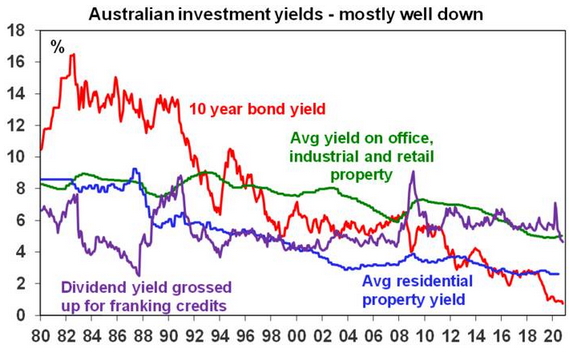
In the early 1980s, the RBA’s “cash rate” was around 14%, 1-year term deposit rates were nearly 14%, 10-year bond yields were around 13.5%, commercial and residential property yields were around 8-9% and dividend yields on shares were around 6.5% in Australia and 5% globally. This meant investments were already providing very high income so only modest capital growth was needed for growth assets to generate good returns. So, most assets had very strong returns and balanced growth; super fund returns averaged 14.1% in nominal terms and 9.4% in real terms between 1982 and 1999 (after taxes and fees).

But with the shift from very high inflation to very low inflation, the last 40 years has seen a collapse in yields. This was led by falling interest rates and bond yields and then yields on other assets were pushed down too as investors searched out higher yields which pushed their prices up and their yields down. Just as the GFC gave this a push along so has the coronavirus pandemic’s hit to the global economy. See the next chart.


Source: Bloomberg, REIA, JLL, AMP Capital

Today the cash rate is 0.25% (and likely to fall to 0.1% next month), 1-year bank term deposit rates are 0.75%, 10-year bond yields are 0.75%, gross residential property yields are around 3%, commercial property yields are around 5%, dividend yields are around 4.5% for Australian shares (with franking credits) but they are 2.25% for global shares. This points to a lower return potential for a diversified mix of assets.

More constrained capital growth

What’s more, the capital growth potential from growth assets is likely to be constrained relative to the past, reflecting a number of megatrends, some of which have been reinforced by the coronavirus pandemic:

  • An increasing reluctance by households to take on more debt. 

  • An ongoing retreat from globalisation, deregulation and small government in favour of populist, less market friendly policies.

  • Rising geopolitical tensions – notably as the US attempts to constrain the rising power of China.

  • Aging populations and slowing population growth – resulting in slowing labour force growth.

  • Growing online retail sales and “work from home” will impact retail and office property space demand but I suspect this will see spending diverted to show up elsewhere in the economy.

Of course, continuing technological innovation and automation as well as rapid growth in Asia and China’s middle class will likely work to boost growth. But the net impact is likely to be more constrained global economic growth.

Medium-term (ie, 5 to 10 year) return projections

Our approach to get a handle on medium-term return potential of major asset classes is to start with current yields for each and apply simple and consistent assumptions regarding capital growth allowing for the above-mentioned megatrends. We also prefer to avoid forecasting and like to keep the analysis simple.

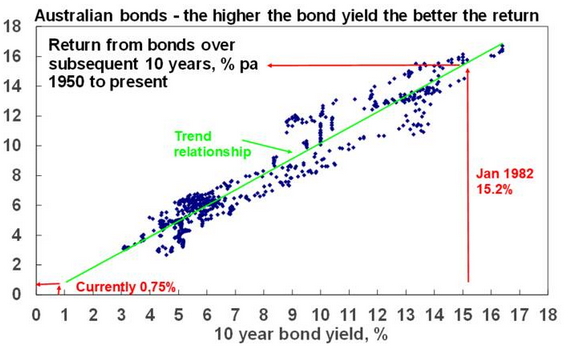
  • For bonds, the best predictor of future medium-term returns is current bond yields – as can be seen historically in the next chart. If a 10-year bond is held to maturity its initial yield (0.75% right now in Australia) will be its return over 10 years. We use 5-year bond yields as they more closely match the maturity of bond indexes.  


Source: Global Financial Data, Bloomberg, AMP Capital

  • For equities, current dividend yields plus trend nominal GDP growth (a proxy for capital growth) does a good job of predicting medium-term returns1.

  • For property, we use current rental yields and likely trend inflation as a proxy for rental and capital growth. The surge in online spending and “work from home” means greater than normal uncertainty around these returns at present.

  • For unlisted infrastructure, we use current average yields and capital growth just ahead of inflation.

  • In the case of cash, the current rate is of no value in assessing its medium-term return. So, we allow for some rise in cash rates after 2023.

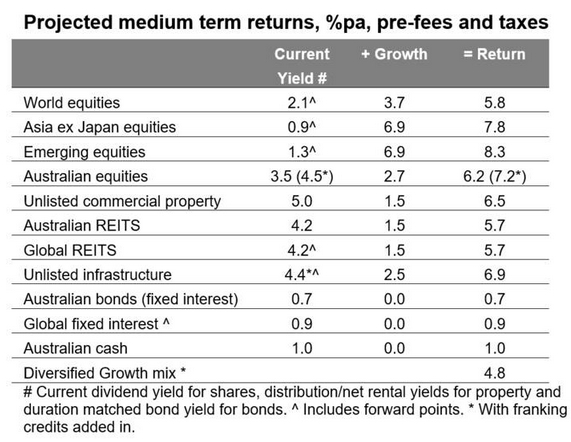
Our latest return projections are shown in the next table. The second column shows each asset’s current income yield, the third shows their 5-10 year growth potential, and the final column their total return potential. Note that:

  • We assume inflation averages around 1.5% p.a.

  • For Australia we have adopted a relatively conservative growth assumption reflecting slower productivity growth.


Source: AMP Capital

Key observations

Several things are worth noting from these projections.

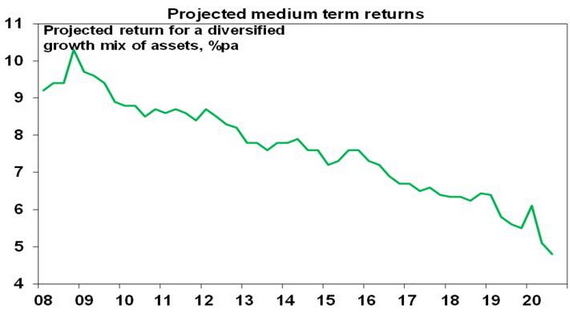
  • The medium-term return potential has continued to fall due falling yields and reduced capital growth prospects. For a diversified growth mix of assets, it has fallen from 10.3% pa in March 2009 and 5.6% a year ago, to now just 4.8%.


Source: AMP Capital

  • While past bond returns have been ok as yields fell pushing up bond prices, ultra-low yields now point to low returns.

  • Commercial property and infrastructure come out relatively well, but face greater than normal uncertainty in the demand for retail and office space & human transport infrastructure.

  • Australian shares stack up well on the basis of yield, but it’s still hard to beat Asian/emerging shares for growth potential.

  • The downside risks to our medium-term projections are that economies stay in recession longer driving another plunge in shares or that yields are pushed up to more normal levels as inflation rebounds causing large capital losses. 

  • The upside risks are less obvious but could occur if we see improving global growth but inflation remaining very low.

Implications for investors

  • First, have reasonable return expectations. With low yields, low inflation and constrained growth it’s unreasonable to expect sustained double-digit or high single digit returns.

  • Second, remember that allocating more to growth assets to boost overall returns does mean taking on more risk.

  • Third, bear markets are painful and are hard to predict, but they do push up the medium-term return potential of shares and so provide opportunities for investors.

  • Fourth, some of the decline in return potential reflects very low inflation – real returns haven’t fallen as much – and 4.8% pa is still well above sub 1% bank term deposit rates. 

  • Finally, focus on assets with decent sustainable income flow as they provide confidence regarding future returns.


1 Adjustments can be made for: dividend payout ratios (but history shows retained earnings often don’t lead to higher returns so the dividend yield is the best guide); the potential for PEs to move to some equilibrium level (but forecasting the equilibrium PE can be difficult and dividend yields send valuation signals anyway); and adjusting the capital growth assumption for some assessment regarding profit margins (but this is hard to get right). So, we avoid forecasting these things.


Source: AMP Capital 21 October 2020

Important notes: While every care has been taken in the preparation of this article, AMP Capital Investors Limited (ABN 59 001 777 591, AFSL 232497) and AMP Capital Funds Management Limited (ABN 15 159 557 721, AFSL 426455) (AMP Capital) makes no representations or warranties as to the accuracy or completeness of any statement in it including, without limitation, any forecasts. Past performance is not a reliable indicator of future performance. This article has been prepared for the purpose of providing general information, without taking account of any particular investor’s objectives, financial situation or needs. An investor should, before making any investment decisions, consider the appropriateness of the information in this article, and seek professional advice, having regard to the investor’s objectives, financial situation and needs. This article is solely for the use of the party to whom it is provided and must not be provided to any other person or entity without the express written consent of AMP Capital.

by Dermot Ryan

The government has signalled that business will be a driving force behind Australia’s recovery efforts, and we think this will be good news for domestic shares as we charge towards 2021.

This year has been wild for share markets globally, but the world is learning how to cope with COVID-19 and business is learning how to manage through. Though nothing is set in stone, the Australian Federal Budget adds to our understanding of the pathway to recovery. So far, there are four key signals that the Aussie equities market is likely to benefit from what the government has handed down:

1. So far, so good on the ASX

The ASX 200 has been up every day this week after some pre-released policies over the weekend. This is an indication that markets are responding favourably to the intentions of the Federal Budget. Despite a weak lead from overseas markets, we have a flourishing rally today that has seen most sectors up and in particular those with domestic exposure.

2. Some business barometers are rising

Business spending stocks – like auto and equipment exposed sectors are all up strongly this week so far, again indicating a favourable response to the Budget plans. The asset write off will bring forward capital spending, carry-over provisions for losses will help marginal businesses push on, and we expect private capital formation and expenditure to increase on the back of this budget.

3. Business is front and centre of the Budget documents

Business and middle income packages accounted for half the $100bn spend in the Morrison government’s recovery budget. This is a big win for real businesses with a domestic focus. Further, business is getting fired up across all sectors with spending, tax and hiring incentives, which will help those who can to grow and prosper again.

4. There is room for more measures

There were a few sectors that weren’t heavily addressed in the Budget, indicating room to do more. There is possibly room for stimulus measures to support tourism, migration and mobility, once the path is clearer on a vaccine/containment strategy. But this is a great first budgetary step in the recovery and a giant leap forward in our push for recovery.

Please note this piece was first published on 7 October 2020, following the release of the Federal Budget.

https://vimeo.com/465620142


Author: Dermot Ryan, Sydney, Australia

Source: AMP Capital 07 Oct 2020

Reproduced with the permission of the AMP Capital. This article was originally published at AMP Capital


Important notes: While every care has been taken in the preparation of these articles, AMP Capital Investors Limited (ABN 59 001 777 591, AFSL 232497) makes no representation or warranty as to the accuracy or completeness of any statement in them including, without limitation, any forecasts. Past performance is not a reliable indicator of future performance. Performance goals are merely goals. There is no guarantee that the strategy will achieve that level of performance. The information in this document contains statements that are the author’s beliefs and/or opinions. Any beliefs and/or opinions shared are as at the date shown and are subject to change without notice. These articles have been prepared for the purpose of providing general information, without taking account of any particular investor’s objectives, financial situation or needs. They should not be construed as investment advice or investment recommendations. An investor should, before making any investment decisions, consider the appropriateness of the information in this document, and seek professional advice, having regard to the investor’s objectives, financial situation and needs.

This document is solely for the use of the party to whom it is provided and must not be provided to any other person or entity without the express written consent of AMP Capital.

by Nathan Boon & Sonia Baillie

Bonds have been strong performers over more than a decade in the lead-up to the current crisis1, and we believe they could play an important part in defensively positioned portfolios going forward. Their popularity is affected to a certain extent by a lack of understanding on the part of investors, relative to equities, but the principles are really quite simple. Here are a few things we bear in mind when considering a role for bonds in a portfolio:

1. Income = defensive positioning

An important part of building a defensive position into a portfolio is the inclusion of securities with cash flows that are resistant to market downturns. Taking into account the credit risk of the issuer, bonds can offer an opportunity to harvest regular and reliable income streams with lower risk of capital instability.

2. Bond returns are typically driven by interest rate sensitivity

As interest rates fall, the discount factor used to value the income streams they generate is reduced, increasing the value of those cash streams today. The yield on issued bonds becomes more attractive, driving up prices and returns.

The sensitivity of a fixed income security’s price to changes in yield increases the further a bond is from its maturity. When measuring how sensitive a bond’s price is to changes in interest rates, we refer to its duration, a term which refers to the amount of time it will take for the bond’s principal to be repaid to the investor. The higher the duration, the more interest rate sensitivity is embedded in the security.

The strong performance of bond markets over the past decade has been mostly due to a falling interest rate environment, fuelled by a series of financial crises and the lack of ability on the part of most major economies to generate significant inflation, in turn necessitating monetary stimulus in the form of lower interest rates. In this environment, portfolios with higher duration have tended to perform strongest.

The gains on offer from interest rate risk have plateaued in recent years as interest rates across most of the developed world have effectively bottomed out, and it’s important for investors holding these assets to understand the specific role they play in their portfolio structure.

3. Investment grade credit can play a defensive income role

Credit spreads are the difference between yields on corporate bonds and government bonds, and represent the additional credit risk premium allocated to the issuer of the bond. They are negatively associated with pricing, as they imply a lower return relative to the risk-free rate.

Credit spreads widened dramatically during the first stages of COVID-19, as passive bond funds underwent forced selling and introduced excess liquidity into the market. Over the past few months, however, spreads have largely stabilised towards pre-COVID levels, particularly in investment-grade bonds.

Despite this, investment-grade credit spreads tend to have a fairly low volatility, and well-constructed portfolios may provide access to this credit risk premium for a low level of downside risk. We find that through the cycle, investors in Australian investment-grade tend to be overcompensated for the credit risk they are taking. By investing into a diversified portfolio of stable investment-grade bond issuers, investors may earn superior risk-adjusted returns, and do so without seeing undue volatility in the total returns they earn from these investments. In an environment of very low yields globally and where investors are being tempted down the quality spectrum to earn moderate returns, we view this as a key means of earning defensively-oriented income in an uncertain environment.

4. The outlook for Australian investment grade bonds remains positive

Australian companies were, as a whole, better prepared for this crisis than their counterparts in countries such as the US. We believe Australian corporates entered the recession with stronger and much more conservatively positioned balance sheets2, and were very quick to raise equity where they faced uncertainty. This supportive attitude to creditors has been reflected in ratings, and our corporate sector has for the most part avoided the ballooning leverage witnessed in other markets.

That said, there are still considerable downside risks ahead relating to the future evolution of the pandemic and the capacity for our economy to recover within that constraint. We consider that uncertainty is likely to persist for some time, especially with the risk of further waves and lockdown.

Despite this potential volatility, we believe inflation and interest rates are likely to remain low in the short to medium term, and future stimulus programs should remain highly supportive of credit markets. Because of this we hold a positive outlook for Australian investment-grade credit, and view a well-constructed portfolio of defensive income in this space as being a critical component for weathering what is likely to continue to be an uncertain economic environment for some time to come.


Bloomberg
Bank of International Settlements (BIS), AMP Capital


Author: Nathan Boon, Head of credit portfolio management | Co-portfolio manager AMP Capital Sydney, Australia

Source: AMP Capital 13 Oct 2020

Reproduced with the permission of the AMP Capital. This article was originally published at AMP Capital

 
Important notes: While every care has been taken in the preparation of this article, AMP Capital Investors Limited (ABN 59 001 777 591, AFSL 232497) and AMP Capital Funds Management Limited (ABN 15 159 557 721, AFSL 426455) (AMP Capital) makes no representations or warranties as to the accuracy or completeness of any statement in it including, without limitation, any forecasts. Past performance is not a reliable indicator of future performance. This article has been prepared for the purpose of providing general information, without taking account of any particular investor’s objectives, financial situation or needs. An investor should, before making any investment decisions, consider the appropriateness of the information in this article, and seek professional advice, having regard to the investor’s objectives, financial situation and needs. This article is solely for the use of the party to whom it is provided and must not be provided to any other person or entity without the express written consent of AMP Capital.

by Joseph Titmus

Listed infrastructure has historically delivered very dependable returns through a variety of market conditions and has proved remarkably independent to the performance of the broader equities market.1

This is understandable, given the unique risk-return character of the asset class. The stability that attracts investors to infrastructure is generated by cash flows which are typically supported by regulation or long-term contracts. The essential nature of many of the basic assets owned by infrastructure companies also tends to provide resilience to the economic cycle.

A different story through 2020

Those defensive attributes haven’t been strongly on display through 2020, however. In our view, listed infrastructure fell and recovered in line with equities through the first two quarters of the year, but in recent months has started to tread water, underperforming stock markets as they surged through to September.

The reasons behind this pattern become clear if we examine the various components of listed infrastructure at a sector level.

Listed infrastructure portfolios can generally be broken up into four components: the more cyclical communications and energy sectors, and the more defensive transportation and utility sectors. This categorisation may have held true in previous financial crises, but it completely defies what we’ve experienced during the pandemic. Dramatically lowered patronage has impacted demand for transportation in particular, whilst on the other hand the way in which we employ communications technology has been altered fundamentally, and the sector has held up exceptionally well over the course of the year. Energy stock performance has been hit hard by the pandemic, but also by other factors leading to the oil price crash through the first five months of the year.2

Why invest in global listed infrastructure now?

In a word, value. In recent months value has been harder to obtain across the broader stock markets, but you’ll find it in abundance in listed infrastructure. This is mostly related to the fact that prices have substantially over-reacted to the downside of COVID-19.3 We estimate, for example that two-thirds of the decline in share prices from December 2019 to March 2020 was due to valuation, rather than reduced cash flows.

A perfect case in point are companies that own key oil storage assets, where demand for tank space has actually increased due to falling spot oil prices yet stock prices have fallen in line with the broader energy sector.

Our valuations for a range of infrastructure assets we consider are now more attractive than they were pre-COVID, whilst fundamentals remain robust, and opportunities for investors still exist.

Our outlook for infrastructure

We currently see returns from the listed infrastructure asset class as slightly below their historical levels but respectable, given the wider context affecting markets. Within the asset class, our view is that energy infrastructure offers the greatest opportunities, and should provide total returns in the high single-digits to low double digits, with 6-8% of that coming from dividend yields.

With regards to the other sectors, we believe there is strong value to be found in transportation for those willing to focus on long-term value rather than short-term multiples, but little left in communications. The advent of COVID-19 has obviously accelerated expectations in this sector dramatically, but in our view cash flows aren’t keeping pace with increasing market valuations. Utilities may not have been as resilient as many expected to a crisis of this nature, particularly in the US, but we think there is still value to be found here post the COVID-19 market correction.

We believe the bottom line for investors is the need to shift focus from the effects of COVID-19, which should largely be factored in, to the opportunities provided by this disruption.


1. Bloomberg, AMP Capital
2. Bloomberg, AMP Capital
3. Bloomberg

Author: Joseph Titmus, Portfolio Manager/Analyst, Global Listed Infrastructure Sydney, Australia

Source: AMP Capital 14 Oct 2020

Reproduced with the permission of the AMP Capital. This article was originally published at AMP Capital


Important notes: While every care has been taken in the preparation of this article, AMP Capital Investors Limited (ABN 59 001 777 591, AFSL 232497) and AMP Capital Funds Management Limited (ABN 15 159 557 721, AFSL 426455)  (AMP Capital) makes no representations or warranties as to the accuracy or completeness of any statement in it including, without limitation, any forecasts. Past performance is not a reliable indicator of future performance. This article has been prepared for the purpose of providing general information, without taking account of any particular investor’s objectives, financial situation or needs. An investor should, before making any investment decisions, consider the appropriateness of the information in this article, and seek professional advice, having regard to the investor’s objectives, financial situation and needs. This article is solely for the use of the party to whom it is provided and must not be provided to any other person or entity without the express written consent of AMP Capital.


by Graeme Colley

This year’s Federal Budget was unexpected good news for anyone with a self-managed superannuation fund as there were no changes to the taxation of superannuation funds or contributions as many expected. The increase in the maximum number of members of SMSFs from four to six members; and a deferral of the start date for exempt current pension income methods to 1 July 2021 was confirmed in the 2020-21 Budget.

Reform Announcements to MySuper

The main reform announcements in the Budget were designed to reduce the number of duplicate employee accounts as a result in changes in employment and to provide information about underperforming funds. As part of these reforms the Australian Tax Office (ATO) would develop systems so that new employees are able to select superannuation products which would:

  • Provide a table of simple super products (MySuper) through a ‘YourSuper’ portal.

  • Rank MySuper funds by fees and investment returns.

  • Establish links to MySuper websites to choose a suitable product.

  • Help anyone to consolidate multiple superannuation fund accounts.

Anyone with existing superannuation will have their account linked when changing employment to avoid the creation of new multiple accounts. This would occur where an employee does not nominate a fund at the time of changing employment. The employer would make contributions to the employee’s existing fund which is made available via the ATO’s website. For anyone without a superannuation account, the employer would make the employee’s contributions to the employer’s nominated default superannuation fund.

As part of the reform package the Australian Prudential Regulation Authority (APRA) will benchmark the net investment of MySuper products and any funds underperforming over two consecutive annual tests will not be permitted to admit new members until the performance improves. From 1 July 2022, non-MySuper funds will be added to the performance benchmarking review lists.

Another component of the reform package is greater transparency and accountability of superannuation funds to ensure the actions of trustees are consistent with the maximisation of members’ retirement savings.

Other Super Announcements

There was no or little change in some of the previously announced superannuation measures. These included:

  • no further mention of the proposed change to increase the age for non-concessional contribution (NCC) bring-forward purposes to 67 years of age. The bill to enact this previously announced measure is still currently before parliament.

  • no change to the COVID-19 temporary early release of super measure. Eligible Australian and New Zealand citizens and permanent residents continue to be allowed just one withdrawal opportunity of up to $10,000 from 1 July 2020. The application must be made for release by 31 December 2020.

  • confirmation of the deferred start date for a number of previously announced SMSF measures:

    • Increasing the maximum number allowed members in an SMSF (or Small APRA funds) from four to six – start date deferred to the date of Royal Assent of the enabling legislation. This bill has been referred to the Senate Economics Legislation Committee, due to report on 4 November 2020.

    • Changes to the calculation of exempt current pension income have also been deferred from 1 July 2020 to 1 July 2021, to apply for the 2021/22 financial year. 

It will be interesting to see how these changes are implemented for new employees and anyone who finds themselves a member of an underperforming fund. One thing is for certain, self-managed funds have been at the end of the superannuation sector where members are considered engaged and interested. This includes the performance of their fund, a considered choice that provides a competitive advantage to other funds and provides transparency in investment selection. 


Author:  Graeme Colley, Executive Manager, SMSF Technical and Private Wealth – SuperConcepts Sydney, Australia

Source: AMP Capital 09 Oct 2020

Reproduced with the permission of the AMP Capital. This article was originally published at AMP Capital


Important notes:
While every care has been taken in the preparation of these articles, AMP Capital Investors Limited (ABN 59 001 777 591, AFSL 232497) makes no representation or warranty as to the accuracy or completeness of any statement in them including, without limitation, any forecasts. Past performance is not a reliable indicator of future performance. Performance goals are merely goals. There is no guarantee that the strategy will achieve that level of performance. The information in this document contains statements that are the author’s beliefs and/or opinions. Any beliefs and/or opinions shared are as at the date shown and are subject to change without notice. These articles have been prepared for the purpose of providing general information, without taking account of any particular investor’s objectives, financial situation or needs. They should not be construed as investment advice or investment recommendations. An investor should, before making any investment decisions, consider the appropriateness of the information in this document, and seek professional advice, having regard to the investor’s objectives, financial situation and needs.


This document is solely for the use of the party to whom it is provided and must not be provided to any other person or entity without the express written consent of AMP Capital.


It’s often said that starting out early on one’s investing journey will deliver good long-term results.

But in light of recent volatility on investment markets, you may be thinking, is this the right time to start off?

Taking your first step is often daunting, but the reality is that investment markets have shown consistent growth over many decades.

And what’s clear is those investors who stay the course over time, riding through the regular ups and downs of the markets, have a much better chance of achieving investment success than those who try to cherry pick when to buy and sell.

What’s more, it’s also clear that because the returns from different types of assets always vary from year to year, spreading your money across a broad range of investments will enhance returns and help reduce your overall risk.

The power of compounding returns

Renowned scientist Albert Einstein famously described compound interest as “the eighth wonder of the world”.

Which is where starting out early really comes into play. By following a strategy of reinvesting investment distributions such as dividends, and by making additional contributions over a long period of time, the combination of market growth and compounding returns will likely deliver strong results.

In other words, it’s about time in the markets rather than timing the markets.

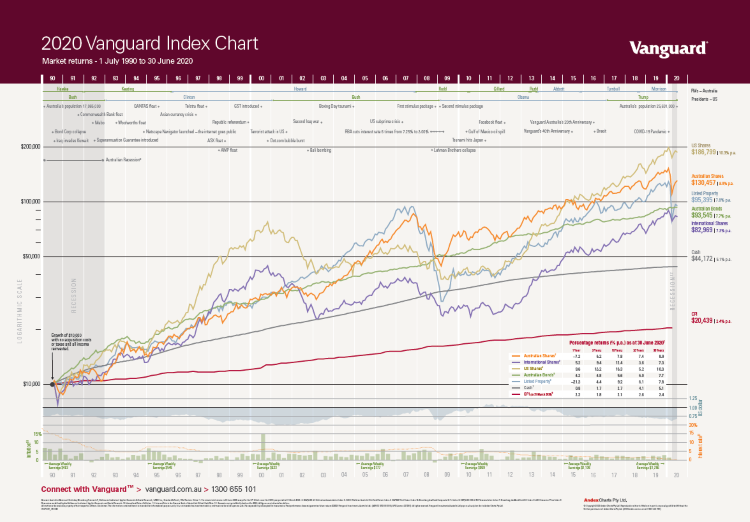
The 2020 Vanguard Index Chart below shows that a $10,000 investment made into Australian shares in 1990 would have achieved an 8.9 per cent total return per annum over 30 years, with the reinvestment of all distributions, and grown to $130,457 by 30 June 2020.


Over the same time frame and using the same strategy, a $10,000 investment into the broad US share market would have delivered a 10.3 per cent per annum return, and now be worth $186,799.

There is no minimum amount that one needs to make as an investment. However, even a low initial balance will grow substantially over time when combined with compounding investment returns.

Make ongoing investments

But imagine how your wealth could grow if you put in even more. An initial contribution combined with a regular investment savings strategy and the reinvestment of distributions will deliver even higher long-term results.

Investing the same amount of money at set intervals over a long period is known as dollar-cost averaging. That means you’re averaging out the cost of your investments through incremental investing – regardless of whether market prices are up or down.

The easiest way to illustrate a dollar-cost averaging strategy is to calculate how investment balances can build up over time, using a combination of regular contributions, the reinvestment of distributions and compounding returns.

How extra investments add up over time


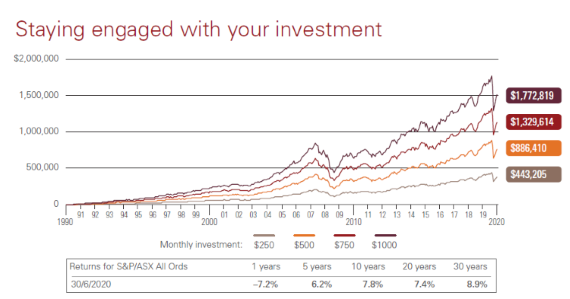
The chart above is based on actual market returns and follows someone who started out investing on 30 June 1990 and who continued making set monthly contributions over the last 30 years.

If they’d stuck to a strategy of investing $250 a month into Australian shares, irrespective of market movements, they would now have a balance of more than $443,000.

If they’d had the financial capacity and discipline to invest $1,000 a month over the same period of time, their balance would now be more than $1.77 million. That’s despite the sharp fall in markets in early 2020.

Of course, a more realistic pattern for most people is to increase their investment contributions over time as they earn higher wages and other expenses fall.

The bottom line

If you’re just starting out, or quite early on in your investment journey, these are all factors to consider – even if you’re many years away from retiring.

Successful investing revolves around having a well-planned and diversified strategy that’s aligned to your specific goals, and the discipline and resolve to stay the course, even during the most volatile investment times.

And, make no mistake, the earlier you start off investing the more money you’re likely to have to enjoy the things you want to do when you do eventually stop work.

With many of us living longer, having the ability to live a financially comfortable lifestyle without fear of running out of money is definitely a long-term goal worth pursuing.

Please contact us on Phone: 07 5641 4134 if you seek further discussion on this topic.

Source :  Vanguard August 2020 

Reproduced with permission of Vanguard Investments Australia Ltd

Vanguard Investments Australia Ltd (ABN 72 072 881 086 / AFS Licence 227263) is the product issuer. We have not taken yours and your clients’ circumstances into account when preparing this material so it may not be applicable to the particular situation you are considering. You should consider your circumstances and our Product Disclosure Statement (PDS) or Prospectus before making any investment decision. You can access our PDS or Prospectus online or by calling us. This material was prepared in good faith and we accept no liability for any errors or omissions. Past performance is not an indication of future performance.

© 2020 Vanguard Investments Australia Ltd. All rights reserved.

Important: Any information provided by the author detailed above is separate and external to our business and our Licensee. Neither our business nor our Licensee takes any responsibility for any action or any service provided by the author. Any links have been provided with permission for information purposes only and will take you to external websites, which are not connected to our company in any way. Note: Our company does not endorse and is not responsible for the accuracy of the contents/information contained within the linked site(s) accessible from this page.
This has been a difficult year, and your business may have made a tax loss.

A tax loss is when the total deductions you can claim, excluding gifts and donations, are greater than your total income for an income year.

If your business makes a tax loss, you may be able to:

  • offset the loss in the same income year against other assessable income, or

  • carry forward the loss and claim it as a business deduction in a later year.

If you’re a sole trader or in a partnership and want to offset a tax loss, first check if you meet at least one of the non-commercial losses requirements.

If you do meet the requirements, then you can offset the loss against other assessable income (such as salary or investment income) in the same income year.

If you don’t meet the requirements, you can defer the loss or carry it forward to future years. For example, you can offset it when you next make a profit.

If your business is a company, you can generally choose the year you want to claim a deduction.

Remember, registered tax agents can help you with your tax.

Please contact us on Phone: 07 5641 4134 if you need further assistance on this topic.


Source : ATO Small business newsroom August 2020 

Reproduced with the permission of the Australian Tax Office. This article was originally published on https://www.ato.gov.au/Newsroom/smallbusiness/General/Has-your-business-made-a-tax-loss-this-year-/

Important: This provides general information and hasn’t taken your circumstances into account.  It’s important to consider your particular circumstances before deciding what’s right for you. Although the information is from sources considered reliable, we do not guarantee that it is accurate or complete. You should not rely upon it and should seek qualified advice before making any investment decision. Except where liability under any statute cannot be excluded, we do not accept any liability (whether under contract, tort or otherwise) for any resulting loss or damage of the reader or any other person. 


Any information provided by the author detailed above is separate and external to our business and our Licensee. Neither our business nor our Licensee takes any responsibility for any action or any service provided by the author. Any links have been provided with permission for information purposes only and will take you to external websites, which are not connected to our company in any way. Note: Our company does not endorse and is not responsible for the accuracy of the contents/information contained within the linked site(s) accessible from this page.