When moving into a new home it’s important to make yourself familiar with your new environment. Get to know how your facility runs, spend some time with your new neighbours and develop strong relationships with staff and carers at the nursing home.

Building close relationships in aged care is crucial to enjoying your stay, says Nino DiSisto, Chief Executive Officer (CEO) of Clayton Church Homes (CCH) in South Australia.

He adds it is also important that staff and carers do the same when they have a new resident move into a facility.

“We understand that each of our residents has different needs. Listening, spending time with residents and their families creates understanding that carers genuinely want the best for them,” says Mr DiSisto.

“By having this bond with residents, our carers feel comforted they are making a real difference to the quality of their lives, which is a rewarding experience.”

Tips for developing relationships at a new home

When moving into a new facility, the staff and carers should have measures in place to make your transition into the facility as smooth as possible.

At CCH, new residents are welcomed by Pastoral Care and Lifestyle staff, and they have a “Key to Me” form, which allows residents to describe their interests and lifestyle, Mr DiSisto explains. This allows for the facility to customise the care, activities and programs residents receive or request.

So it is vital you are open and honest about your likes and dislikes when you move into a new facility.

“If your provider doesn’t have anything like this, we suggest you make your interests known so you can continue to enjoy the things you love,” says Mr DiSisto.

It’s a good idea to introduce yourself to your new neighbours and also inquire about any clubs and groups that you have an interest in, so you can meet new people in the facility.

Mr DiSisto adds that new residents should share their stories with staff and carers to create a strong bond with them.

This includes engaging in conversations when staff are free to assist in forming these strong connections quickly.

Mr DiSisto says every resident should feel like they are treated well by their staff, so making friendships at their new facility with both residents and carers can really make an aged care facility feel like home.

“The comfort and welfare of our residents is at the heart of everything we do. We are committed to providing personal, high quality care to all our residents and treat our residents with dignity and respect,” says Mr DiSisto.

Trust and respect is important for everyone

Older people moving into aged care for health-related reasons, particularly after a hospital stay, can feel a massive loss in independence, whether that means they require more personal care or assistance doing minor tasks.

It is important this care is provided by a carer or staff member you can trust and feel that they respect you. 

In the new 2019 Aged Care Quality Standards, it is mandated that all people in aged care must be respected while receiving aged care services.

The same can be said for aged care workers who should also be respected while providing services and may be working with multiple residents throughout the day. Remember that aged care staff are there to help you through whatever personal issues or health-related problems you may have.

It is vital that there is mutual respect and trust between aged care workers and their residents so care can be provided and received in the best way possible.

Mr DiSisto says, “We absolutely agree that trust, honesty and respect are crucial to developing the bonds and relationships between residents and carers. These qualities are needed to develop a meaningful connection.

“When residents receive personal, genuine care and are treated with dignity and respect, they feel supported, secure and comfortable being themselves in a loving environment.  

“By nurturing a relationship and showing sensitivity, aged care staff can support not only residents’ physical needs, but importantly also their emotional needs and wellbeing.”

Aged care homes fostering good relationships

From the first entry of a resident into a new home, your aged care provider should be making the effort to develop connections with you and the care you require.

An aged care provider would normally sit down with you and get to know your personality and your likes and dislikes, which can help inform how they provide you care.

Mr DiSisto says that CCH makes sure that from the first enquiry to admission, potential or new residents feel like they will be safe and respected within their facility.

Your aged care facility should be taking steps to make sure you have regular communication with staff, particularly face to face, so you don’t feel isolated and have a good relationship with the carers around you. This could be popping in to see how you are doing or joining you for lunch.

Additionally, aged care staff at CCH also make regular contact with residents in pastoral care programs, monthly meetings, and at the café and coffee sessions.

Many aged care facilities also keep their residents informed about any new updates through regular newsletter communications that list any events, changes and new developments.

What if I have a complaint or concern?

If you’ve developed a good relationship with your provider you should be able to provide feedback about the care you are receiving, whether this is good or bad.

Many older people, and families, worry about bringing up complaints about quality of care or other matters. Especially older residents, may be concerned that there will be consequences if they speak out.

However, Mr DiSisto says all aged care facilities should accept and take on board all complaints from residents and families, and aged care residents should never feel worried about bringing up any concerns.

“We welcome residents and their families to come to us to openly talk about any concerns they may have,” says Mr DiSisto.

“We offer various options to residents and their families to have these conversations, depending on what they feel comfortable with.

“They can discuss with the senior Registered Nurse on-site, clinical Nurse, site manager or with the administration team.

“Every conversation is treated sensitively and confidentially.”

If you have any concerns you should try to address this with your provider first. If you believe your complaint has not been heard, you can contact the Aged Care Quality and Safety Commission, or the Older Persons Advocacy Network, for assistance.

Source : Aged Care Guide November 2020 

This article was originally published on agedcareguide.com.au https://www.agedcareguide.com.au/information/how-to-create-a-good-relationship-with-your-new-aged-care-facility. Reproduced with permission of DPS Publishing

Important: This provides general information and hasn’t taken your circumstances into account.  It’s important to consider your particular circumstances before deciding what’s right for you. Although the information is from sources considered reliable, we do not guarantee that it is accurate or complete. You should not rely upon it and should seek qualified advice before making any investment decision. Except where liability under any statute cannot be excluded, we do not accept any liability (whether under contract, tort or otherwise) for any resulting loss or damage of the reader or any other person.


Any information provided by the author detailed above is separate and external to our business and our Licensee. Neither our business nor our Licensee takes any responsibility for any action or any service provided by the author. Any links have been provided with permission for information purposes only and will take you to external websites, which are not connected to our company in any way. Note: Our company does not endorse and is not responsible for the accuracy of the contents/information contained within the linked site(s) accessible from this page.


In the absence of retail, hospitality, cultural centres and sporting outlets, many of us have gravitated towards new activities to occupy our time during lockdown. For some, this has meant a foray into the world of sourdough and slow cooking, or a deeper dive into the abyss that is the Netflix catalogue.

For others, as ASIC recently pointed out, the lure of making money off short-term sharemarket opportunities all from the comfort of the couch has instead taken centre stage.

Over the past few months, the Australian share market has seen a surge in retail trading activity, particularly among those who are either new to investing or of a younger demographic. And it makes sense – with less spending avenues, more time on our hands and a stable wifi connection, downloading an online brokerage app and opening an account within minutes seems like a pretty productive use of available resources.

Perhaps you have been meaning to get into investing but had not got around to it and suddenly COVID has provided both the opportunity and the motivation.

The issue however lies in the motive. Are we jumping into the market with a realistic plan and the view that we are investing for the long-term? Or are we essentially downloading an app to try our luck on some shares, where the behaviour is akin to some ubiquitous sports gambling apps?

Many might not recognise what they’re doing as akin to the latter; surely buying and selling reputable blue-chip shares is different to betting on which football team or horse will win next week.

In reality though, the two activities can blur, with day trading perhaps closer in costs and outcomes to gambling than it is to investing.

Unpredictability of the game

Day trading and watching your portfolio value rise and fall by the minute can be addictive. In some ways, it’s not too dissimilar to watching and betting on a sports game. It’s only natural that when our shares flash green and the price goes up, we get a bit of an emotional kick. Similarly, when a goal is scored or a ball well batted, we feel closer to our desired result – a win.

What links the two is the unpredictability of the game and the often impulsive, and perhaps not always obvious, risks we take.

Volatility is a fact of life in markets and an extremely difficult concept to capitalise on. As ASIC notes, retail investors are not very good at predicting short-term market movements which more often than not, leads to significant losses for most.

A key reason for this is that timing markets is extremely difficult given the wide range of things that can influence a company’s share price on a given day. Day traders don’t get the benefits of volatility smoothing out over the long run and the resulting underlying market growth. Instead, they have to rely solely on timing the trade. For the average investor who just wants a quick gain, you need to ask yourself whether you are feeling lucky today because the outcome is more likely to flow from luck than skill. It is the difference between investing and speculation.

Every investment decision comes with risk, the level however sharply increases when unplanned for and when a short time horizon is involved. The record rush into global share markets during the COVID-19 outbreak suggests not every investor had a plan. And in such cases, it’s unlikely the investor was adhering to a well-diversified asset allocation which would have built in the necessary consideration of the investor’s risk tolerance.

Past performance is no guarantee

No matter how well a particular share has performed that year, month or even day, there is no certainty that prices will continue to rise after you buy. Going off past performance or a ‘good feeling’ over a planned, methodical investment approach doesn’t always fare well.

As Vanguard long advocates, the key to successful investing depends predominantly on four core principles, none of which includes timing the market or simply taking a gamble.

Instead, what give investors the best chance for investment success is having clear, realistic investment goals, a well-diversified portfolio, keeping a keen eye on costs and ultimately, tuning out the market noise and focusing on the long-term.

Please contact us on Phone: 07 5641 4134 if you seek further assistance on this topic .

Source ; Vanguard October 2020 

Reproduced with permission of Vanguard Investments Australia Ltd

Vanguard Investments Australia Ltd (ABN 72 072 881 086 / AFS Licence 227263) is the product issuer. We have not taken yours and your clients’ circumstances into account when preparing this material so it may not be applicable to the particular situation you are considering. You should consider your circumstances and our Product Disclosure Statement (PDS) or Prospectus before making any investment decision. You can access our PDS or Prospectus online or by calling us. This material was prepared in good faith and we accept no liability for any errors or omissions. Past performance is not an indication of future performance.

© 2020 Vanguard Investments Australia Ltd. All rights reserved.

Important: Any information provided by the author detailed above is separate and external to our business and our Licensee. Neither our business nor our Licensee takes any responsibility for any action or any service provided by the author. Any links have been provided with permission for information purposes only and will take you to external websites, which are not connected to our company in any way. Note: Our company does not endorse and is not responsible for the accuracy of the contents/information contained within the linked site(s) accessible from this page.

Whether you need funds to get a new enterprise off the ground or are looking for capital to take things to the next level, it’s important to understand if a business loan is right for you, what types of business loans are available, and what’s involved in the application process.

Step 1: Explore the alternatives

Before you decide that a business loan is a right option, it’s worth considering any other funding sources available to your business. 

Some lenders – especially the big banks – offer business-specific credit cards that can be used to manage cash flow, control spending and earn rewards on business purchases.

Perhaps there’s a government grant or funding program available to your industry – especially if you’re doing work related to research and development, innovation or exporting.

Or there may be people out there looking to invest in a business just like yours. Just remember, investors will be looking for equity and profit-sharing in return. 

“Many lenders offer both secured and unsecured loans. Each type comes with benefits and important things to consider, so make sure you understand the differences before you apply.”

Lastly, you may be able to tap into what’s known as “crowdfunding” to raise funds for a business or project. You can set up a crowdfunding page online, and offer equity in return for large investments, or exclusive products, services or other rewards for smaller investments.

Step 2: Understand the types of business loans available

If you’re looking to manage your cash flow in the short term, an overdraft or line of credit might be right for you. These types of loans give you access to money when you need to cover a shortfall due to unexpected expenses or late payments from clients or customers. 

Overdrafts are linked to an existing business bank account, while lines of credit allow you to access funding from a preset pool of money. These types of loans are designed to cover short term expenses, not used for capital purchases or long-term business needs.

Upfront loans provide the entire loan amount all at once and are designed for those looking to buy a new business or expand an existing business, buy stock, assets or business property, or have a source of available working capital. Like residential property loans, they vary in the amounts available, repayment terms, fixed or variable interest rates, fees and security required.

Variable-rate loans are subject to changes in interest rates, which means your business could benefit from rate cuts, or pay more when rates rise. With fixed-rate loans, you’ll know what is due every time you make a repayment, and will avoid paying more when rates rise – or miss out on savings when rates are cut. Fixed rates vary depending on the length of time of the fixed-rate period.

Many lenders offer both secured and unsecured loans, too. Each type comes with benefits and important things to consider, so make sure you understand the differences before you apply. 

With a secured loan, your ability to repay is ‘secured’ by a major asset – like real estate, equipment or vehicles, or your accounts receivable. If you’re unable to pay the loan back, that asset will become the property of your lender. Secured loans usually come with lower interest rates, longer terms and higher loan amounts available – and are best for established businesses with strong credit histories.

Unsecured loans don’t require an asset to be placed as collateral, but the trade-off comes in the form of lower amounts available to borrow, significantly higher interest rates, and much shorter terms of repayment. While the application process for these types of loans is often quicker than with secured business loans, it’s often more difficult to be approved due to the lack of collateral. 

The other most common type of business loan is designed for the purchasing of equipment or vehicles. While these can also be purchased through lease-to-buy arrangements, buying means owning important assets for your business in one step. And an equipment or vehicle loan is perfect for those businesses without the cash flow available to buy outright, right now.

Business vehicle and equipment financing loans are typically fixed-rate and don’t require any security except for the vehicle or equipment itself.

Step 3: Make sure you’re set up for success

As with residential property loans, different lenders use different rules and criteria to assess a borrower’s eligibility. But there are a few things that are important to have ready when you put in an application.

You’ll most likely need to provide financial statements that outline assets and liabilities, and the net worth of your business, as well as detailing income and expenses. And it’s recommended you have these put together by an accountant. You may need to provide recent tax returns and business activity (BAS) statements, too.

If you’re the director or a shareholder in the business, most lenders will want to see your recent tax returns and an Australian Tax Office notice of assessment. Information regarding income you receive from outside the business can aid in your application, too. You’ll also need bank statements to verify personal income, as well as sources of identification – like a driver’s license or passport.

Remember, if you’re applying for a loan to start a new business or if you’ve been trading for less than a year, there are a few extra things you may need to provide. You’ll need a business plan that includes at least 12 months of cash flow projections, a business contract of sale, and a lease agreement for the place your business calls (or will call) home.

Ready to roll? To begin your application for a business loan, speak to a qualified mortgage broker today.

Please contact us on Phone: 07 5641 4134 if you seek further discussion on this topic.

Source : Your Loan Hub October 2020 

(C) Advantedge Financial Services Holdings Pty Ltd ABN 57 095 300 502. This article provides general information only and may not reflect the publisher’s opinion. None of the authors, the publisher or their employees are liable for any inaccuracies, errors or omissions in the publication or any change to information in the publication. This publication or any part of it may be reproduced only with the publisher’s prior permission. It was prepared without taking into account your objectives, financial situation or needs. Please consult your financial adviser, broker or accountant before acting on information in this publication.

Important: Any links have been provided with permission for information purposes only and will take you to external websites, which are not connected to our company in any way. Note: Our company does not endorse and is not responsible for the accuracy of the contents/information contained within the linked site(s) accessible from this page


What is refinancing?

Refinancing is the process of replacing an existing loan with a new one. When it comes to home loans, it means your existing home loan is paid off and replaced with a new one. This is different from a second mortgage, where you draw on the equity you have built up in your home.

How can it help me save?

If you were paying 5.37 per cent interest on a principal and interest home loan of $600,000 for a 25 year term. Your monthly principal and interest payments per month will total $3,648.00. If you swapped to a mortgage at a lesser rate of 5.24 per cent, however, you’d pay just $3,602 a month. Over 25 years, that saving each month would add up to $13,800 in total savings.

Calculated via : https://www.moneysmart.gov.au/tools-and-resources/calculators-and-apps/mortgage-calculator#!how-much-will-my-repayments-be

Another savings option when refinancing is to choose a loan with a lower interest rate but continue with the same monthly payments as you were making on the higher rate. This approach will see you pay less interest and pay your mortgage off faster.

Alternatively, refinancing can help save money by consolidating debt from high-interest credit cards or personal loans into a single home loan with a lower rate of interest.

https://www.fool.com/mortgages/2016/10/30/how-much-could-you-save-by-refinancing-your-mortga.aspx

 Features to consider

Most mortgages offer a number of features and benefits. If you’re considering refinancing, it’s a good idea to think about which features are important to you before starting a search for a lower interest rate.

  • Variable rate or fixed rate. A fixed rate gives you more certainty over the longer term. A variable rate fluctuates with the market, so you’ll save when it’s down but there’s always a risk it will rise. (In January 1990, for example, the Australian home loan interest rate reached an all-time high of 17.5 per cent.)

  • Offset account. Cash in hand can be offset against your loan balance until you need to spend it, potentially saving interest.

  • A line of credit. If you have a lot of equity in your home, a lender might be prepared to offer you a relatively inexpensive line of credit secured against the property.

  • Repayment flexibility. Repaying a loan fortnightly rather than monthly can make it easier to fit in your budgeting plans.

  • Early pay out. You may want the option of paying a loan out early with minimal penalty.

Weighing up the costs

There can be costs associated with refinancing and it’s important to factor these in to your decision-making. For example, if you took out your loan before 30 June 2011, the lender might be able to charge you an exit fee for terminating the loan ahead of schedule. If yours is a fixed-rate mortgage, you might have to pay a break fee.

For a new mortgage, you may have to pay an establishment fee and the ongoing administration fees could be higher than you’re currently paying. And if your loan has redraw facilities, there may be a charge each time you take money out of your account.

Do the maths

You can use an online mortgage calculator to work out what repayments will be for different loan amounts at different interest rates.

You can also compare fees and charges to ensure they won’t offset any savings in interest over the life of a loan. The Australian Security & Investment Commission’s MoneySmart website has a useful mortgage switching calculator that can help you assess overall costs. 

We can help

Refinancing can be a serious financial decision with a number of variables to consider. We can research the type of loan that may work best for you, how much you can borrow and any extra features you want. We can then gather information from many different lenders and help assess the costs and benefits associated with each loan.

As well as doing the legwork for you, we can guide you through the refinancing process and apply our knowledge and understanding of mortgages to help you achieve the best outcome if you decide to go ahead.

Please contact us on Phone: 07 5641 4134 if you seek further discussion on this topic.

Links:

https://www.fool.com/mortgages/2016/10/30/how-much-could-you-save-by-refinancing-your-mortga.aspx

https://www.moneysmart.gov.au/tools-and-resources/calculators-and-apps/mortgage-switching-calculator

Source : Your Loan Hub October 2020 

(C) Advantedge Financial Services Holdings Pty Ltd ABN 57 095 300 502. This article provides general information only and may not reflect the publisher’s opinion. None of the authors, the publisher or their employees are liable for any inaccuracies, errors or omissions in the publication or any change to information in the publication. This publication or any part of it may be reproduced only with the publisher’s prior permission. It was prepared without taking into account your objectives, financial situation or needs. Please consult your financial adviser, broker or accountant before acting on information in this publication.

Important: Any links have been provided with permission for information purposes only and will take you to external websites, which are not connected to our company in any way. Note: Our company does not endorse and is not responsible for the accuracy of the contents/information contained within the linked site(s) accessible from this page.

If your personal information falls into the wrong hands, it can be used to steal your identity.

If you think your identity has been stolen, report it to your local police and your bank, and change your passwords.

Signs of identity theft

If your identity has been stolen, you may not realise for some time. These are some signs to look out for:

  • Unusual bills or charges that you don’t recognise appear on your bank statement.

  • Mail that you’re expecting doesn’t arrive.

  • You get calls following up about products and services that you’ve never used.

  • Strange emails appear in your inbox.

Act fast if your identity is stolen

What to do if you think your identity has been stolen.

Report it to the police

Report it to your local police department. Ask for the police report number so you can give it to your bank.

Contact your bank

Contact your bank so they can block the account. This will stop a scammer from accessing your money. You may also need to cancel any credit or debit cards linked to your accounts.

Change your passwords

If someone has stolen your identity, they may know your passwords. Change your passwords straight away. Think about all of your online accounts, including social media and other bank accounts.

Report it to the relevant websites

If you think someone has hacked into your online accounts, report it to the relevant websites.

Alert family and friends

If someone has taken over your social media accounts or your email address, alert your family and friends. Tell them to block the account.

Report it to the ACCC

The ACCC’s Scamwatch collects data about scams in Australia. Your report helps Scamwatch create scam alerts to warn the community.

Contact IDCARE

IDCARE is a free service that will work with you to develop a plan to limit the damage of identity theft. 

Protect yourself from identity fraud

Simple steps you can take to avoid identity theft.

Secure your mail

Put a lock on your street mailbox so that people can’t steal your mail.

Shred your documents

Letters from your bank, super fund and employer can all contain personal details scammers can use to steal your identity. Shred these kinds of letters before you throw them out.

Use public computers with caution

If you use a public computer, for example, at a library, make sure you clear your internet history and log out of your accounts.

Be careful on social media

Be aware of what you post on social media, particularly if your profile is public. Scammers can find out where you live, work and visit through your posts.

Use strong passwords

Make sure your passwords are long and contain a mix of numbers, symbols, capital letters and lowercase letters. Strong passwords make it harder for people to hack into your accounts. Stay Smart Online have some useful tips on creating a strong password.

Use security software on your computer

Use virus protection software to help stop hackers from accessing your information. This software can help protect you if you click on a suspicious link or visit a fake website.

Monitor your bank transactions

Check your bank statements and online accounts regularly for unusual transactions. If you spot something unusual, check it with your bank and find out if you need to act.

Request a copy of your credit report

Check your credit report for any unusual or incorrect debts. Find out how to get a free copy of your credit report

Source : Moneysmart.gov.au October 2020 

Reproduced with the permission of ASIC’s MoneySmart Team. This article was originally published at https://moneysmart.gov.au/banking/identity-theft

Important note: This provides general information and hasn’t taken your circumstances into account.  It’s important to consider your particular circumstances before deciding what’s right for you. Although the information is from sources considered reliable, we do not guarantee that it is accurate or complete. You should not rely upon it and should seek qualified advice before making any investment decision. Except where liability under any statute cannot be excluded, we do not accept any liability (whether under contract, tort or otherwise) for any resulting loss or damage of the reader or any other person.  Past performance is not a reliable guide to future returns.


Important Any information provided by the author detailed above is separate and external to our business and our Licensee. Neither our business nor our Licensee takes any responsibility for any action or any service provided by the author. Any links have been provided with permission for information purposes only and will take you to external websites, which are not connected to our company in any way. Note: Our company does not endorse and is not responsible for the accuracy of the contents/information contained within the linked site(s) accessible from this page.

At its meeting today, the Board decided to maintain the current policy settings, including the targets of 10 basis points for the cash rate and the yield on 3-year Australian Government bonds, as well as the parameters of the Term Funding Facility and the government bond purchase program.

Globally, the news has been mixed recently. On the one hand, infection rates have risen sharply in Europe and the United States and the recoveries in these economies have lost momentum. On the other hand, there has been positive news on the vaccine front, which should support the recovery of the global economy. The recovery is also dependent on ongoing support from both fiscal and monetary policy. Hours worked in most countries remain noticeably below pre-pandemic levels and inflation is low and below central bank targets.

Financial conditions remain accommodative around the world, with bond yields near historically low levels. The positive news on vaccines has boosted equity markets, lowered risk premiums and supported further increases in some commodity prices. The improvement in risk sentiment has also been associated with a depreciation of the US dollar and an appreciation of the Australian dollar.

In Australia, the economic recovery is under way and recent data have generally been better than expected. This is good news, but the recovery is still expected to be uneven and drawn out and it remains dependent on significant policy support. In the RBA’s central scenario, it will not be until the end of 2021 that the level of GDP reaches the level attained at the end of 2019. In the central scenario, GDP is expected to grow by around 5 per cent next year and 4 per cent over 2022.

Employment growth was again strong in October, although the unemployment rate increased to 7 per cent as more people rejoined the workforce. A further rise in the unemployment rate is still expected, as businesses restructure in response to the pandemic and more people rejoin the workforce. The unemployment rate is forecast to decline next year, but only slowly and still to be around 6 per cent at the end of 2022.

The extended period of high unemployment and excess capacity is expected to result in subdued increases in wages and prices over coming years. In the September quarter, the Wage Price Index increased by just 0.1 per cent, to be 1.4 per cent higher over the year. In underlying terms, inflation is forecast to be 1 per cent in 2021 and 1½ per cent in 2022.

The Board views addressing the high rate of unemployment as an important national priority. Its policy decisions over recent months will help here. These decisions are complementary to the significant steps taken by Australian governments to support jobs and economic growth.

The Bank’s policy response has lowered interest rates across the yield curve, which will assist the recovery by: lowering financing costs for borrowers; contributing to a lower exchange rate than otherwise; and supporting asset prices and balance sheets. The Term Funding Facility is also supporting the supply of credit to businesses. To date, authorised deposit-taking institutions have drawn down $84 billion under this facility and have access to a further $105 billion. Over the past month, the Bank has bought $19 billion of government bonds under the bond purchase program and a further $5 billion of Australian government securities in support of the 3-year yield target. Since the start of this year, the RBA’s balance sheet has increased by around $130 billion.

Given the outlook for both employment and inflation, monetary and fiscal support will be required for some time. For its part, the Board will not increase the cash rate until actual inflation is sustainably within the 2 to 3 per cent target range. For this to occur, wages growth will have to be materially higher than it is currently. This will require significant gains in employment and a return to a tight labour market. Given the outlook, the Board is not expecting to increase the cash rate for at least 3 years. The Board will keep the size of the bond purchase program under review, particularly in light of the evolving outlook for jobs and inflation. The Board is prepared to do more if necessary.

Source: Reserve Bank of Australia, December 1st, 2020

Enquiries

Media and Communications
Secretary’s Department
Reserve Bank of Australia
SYDNEY

Phone: +61 2 9551 9720
Email: rbainfo@rba.gov.au

If, like Ben Paul, you’ve recently started a new business, you’ll be hungry for sales. But have you created a practical sales and marketing strategy to help get the ball rolling?

If you’re in the process of starting a business, or still in the planning phase, there’s plenty to do beyond writing a business plan.

Hopefully by now you’ll have thought about how much you need to charge for your products and services. You may have carried out some research to find out what competitors are doing and what they’re charging.

You may even have considered what your target market is. But, if you dedicated time to developing your sales and marketing strategy, now’s the time.

Every business owner will at some stage need to pause, reflect, then spend some time putting an actionable sales and marketing plan in place. Let’s start with the four steps I’ve identified below.

1. Who are your potential customers/clients?


My business, The BD Ladder, is aimed at advising people who provide B2B (business-to-business) services, but whether you offer products or B2C (business-to-consumer) services, the basics here still apply.

You’ll need to understand who your target market is. The key here is to narrow it down to a handful of specific groups at most. Yes, do be specific.

As an example, saying your target market is ‘small-to-medium businesses’ is simply too broad an audience to begin with. It makes it hard to communicate with such a wide and diverse group.

What sectors within that group do you have the most experience with? Which sectors have the most pressing need for what you are offering?

Answering questions like this will give you clarity on who your audience is.


2. How do you align what you do to the target market you’ve defined?


Now you understand your customers, you can now begin to think about how what you offer will meet their needs. What is it that you do, that they want?

When I designed my new business plan, I really thought about this. It was clear that I would be targeting professional services firms in the main, so I needed to understand what their needs might be in the next six months. I have really focused on this, as post-lockdown, everyone’s business plans have changed, and they will be purchasing new products and services for different reasons.

Some of this will be good news if you’re starting out as a sole trader providing services. Many firms will be looking to employ contractors or those in the gig economy rather than having the costly overheads of a fully employed member of staff. So, like I did, really think about how your service (or product) offering meets new market expectations.


3. Create your new value proposition(s)


If you have a target client/market and you understand how what you do aligns to that market, the next step is how you express it.

You will need to be able to articulate your value proposition in a way that appeals to your target clients. Having this written down, perhaps for each service you offer, will help provide clarity going forward.

When asked, you’ll be able to answer succinctly and to the point. It should tell a compelling story to your clients. This will help you to communicate your value within your market, at the appropriate time. It will also help you to have clear messaging in your marketing efforts.


4. Plan your ‘go to market’ strategy


Finally, it is vitally important to plan how you will make sales. To do this you will need to market your new business.

As a sole-trader or new small business owner you’ll be short on one very valuable business commodity, which is time. So, knowing how you will perform your sales and marketing activities is key. If you are going to use referrals, have a plan on how you will actively ask for them.

If you’re going to make cold calls or use emails to get meetings, know that this is your sales tactic and plan the time to make these calls. This article provides more detail on how to develop a sales pipeline.

Finally, think about what marketing you will use. Does your business need a website? Which social media channels will you use? This takes a lot of thought and planning. That’s why, in the next article in this series, I’ll be looking at some tactics to “Get your digital presence right, for little cash.”


Getting started on your sales and marketing plan


Make sure you write down and record the steps above. Incorporate them into your business plan.

If you don’t have a business plan already, there are many available for free. And MYOB provides a number of resources to assist.

Thinking about your sales and marketing strategy early, really does help. I formed my plan during lockdown in NZ and had started initial conversations before we could physically all meet up. These led to my first clients coming on board, which was not only very pleasing, but a huge relief!

Source : MYOB September 2020 


Reproduced with the permission of MYOB. This article by Ben Paul was originally published at https://www.myob.com/au/blog/sales-and-marketing-for-sole-traders-and-new-businesses/

Important: This provides general information and hasn’t taken your circumstances into account. It’s important to consider your particular circumstances before deciding what’s right for you. Although the information is from sources considered reliable, we do not guarantee that it is accurate or complete. You should not rely upon it and should seek qualified advice before making any investment decision. Except where liability under any statute cannot be excluded, we do not accept any liability (whether under contract, tort or otherwise) for any resulting loss or damage of the reader or any other person.


Any information provided by the author detailed above is separate and external to our business and our Licensee. Neither our business nor our Licensee takes any responsibility for any action or any service provided by the author. Any links have been provided with permission for information purposes only and will take you to external websites, which are not connected to our company in any way. Note: Our company does not endorse and is not responsible for the accuracy of the contents/information contained within the linked site(s) accessible from this page.

Key points:

  • If you have been allocated a Home Care Package, the Government will subsidy the cost of home care services for you

  • The rates are usually adjusted in March and September with the age pension

  • You cannot receive Government funding for any home care services that are provided by a private organisation

No matter the level of your Home Care Package (HCP), the Government will pay your approved provider a subsidy to go towards the cost of your care.

Of course, this can depend on your current income and assets, which will be calculated when you have an assessment with an Aged Care Assessment Team/Service (ACAT/S).

If you are ineligible for a Government funded aged care service, private home care services may be your next best option.

Who pays for CHSP services?

The Commonwealth Home Support Programme (CHSP) is subsidised by the Federal Government. But similar to Home Care Packages, you are expected to pay towards the cost of your care if you can afford to do so.

There is a fee for each service delivered under the CHSP and the amount you contribute depends on your income and the type and number of services you require.

You and your service provider will discuss and agree on the rate before you receive any services. So the amount you pay can differ from provider to provider.

Depending on the provider you approach, you may be charged a set fee for any services they provide you or some organisations may ask for a voluntary donation or charge a membership or subscription fee.

If you have one or more service providers that you receive multiple services from and those services overlap, you may be able to ‘bundle’ the cost of these services.

Contact your service provider to find out specific costs. It can be a good idea to get a quote from a few different providers you are interested in.

How much will it cost for care?

The Government covers most of the cost of care but depending on your income, your provider may ask you to contribute towards the cost of delivering your services.

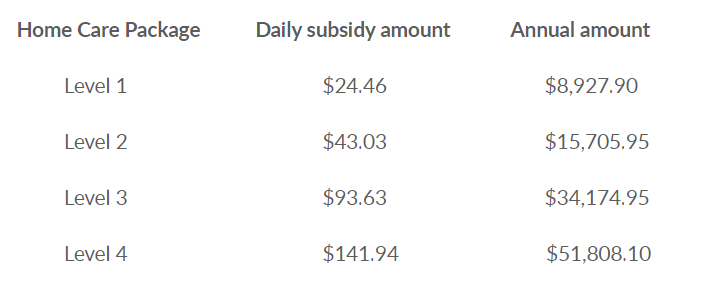
Recently, the Government changed the HCP daily subsidy and maximum basic daily fee system. Now, the higher the package level, the higher the subsidy from the Commonwealth.

The Government contributes the following amounts to each person receiving a Home Care Package (20 September 2020 rates):

Rates are reviewed in March and September each year in line with changes to the Age Pension. This applies to each person receiving a Home Care Package, even if you are part of a couple.

If you require high care or have specialised support needs, you may be eligible for additional supplements, like Veteran’s, dementia or housing supplement, this will be added to your subsidy amount.

The funding from the Government will go directly to your provider, who will then spend your funding on services you agreed to in your Care Recipient Agreement.

Once you start receiving services, you will receive a monthly statement from your provider of income, expenditure and the balance of your Home Care Package funds.

How much should I expect to pay?

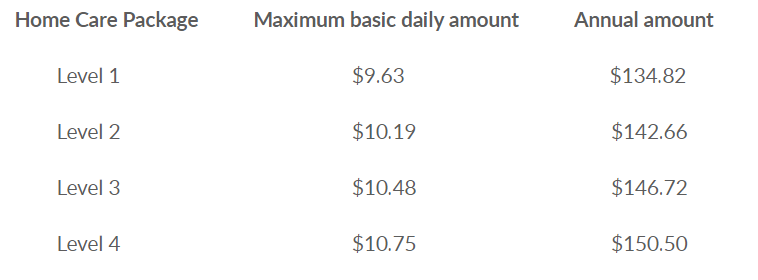
A provider may charge the maximum basic fee for a Home Care Package, which depends upon what level HCP you received (20 September 2020 rates):

People on higher incomes than the Age Pension may be required to pay extra.

The maximum amount you may be asked to pay above the basic fee is up to 50 percent of your income above the Age Pension amount of $860.60 per fortnight for a single person (as of 20 September 2020).

The maximum amount you may be required to pay depends on your income and unavoidable expenses, such as pharmaceutical bills, rent, utilities and other living expenses.

You need to negotiate the costs with your provider. These costs will be agreed upon and fixed in your agreement before you receive any aged care services. This is your legal agreement with your service provider.

No full pensioner will pay an income tested care fee and no part pensioner will pay an income tested care fee greater than $5,617.47 per annum (20 September 2020 rates).

If you have an income of more than $53,731.60, you will pay an income tested care fee on a sliding scale up to a total of $11,234.96 per annum.

However, no one will pay more than $67,409.85 in an income tested care fee over their lifetime (20 September 2020 rates).

Your assets, including the family home, are excluded from the means testing arrangements for home care.

Use our home care package fee estimator to help you work out how much you may be asked to contribute to your Home Care Package. Or search on the AgedCareGuide.com.au directory for a home care service that meets your needs.

It can be a good idea to contact My Aged Care on 1800 200 422 to see if you are eligible for additional benefits depending on your personal circumstances.

​Private home care and costs

Some people decide to utilise private home care providers rather than a Government funded home care service.

This could be for a number of reasons, for example, you may not be eligible for a HCP or you don’t want to wait for care.

However, if you decide to approach a private home care provider, you will not be able to receive a Government subsidy for the care services.

It’s important you understand the costs and fees involved with engaging a private home care provider before you make a decision.

Source: Aged Care Guide

This article was originally published on AgedCareGuide.com.au  Reproduced with permission of DPS Publishing.

Important: This provides general information and hasn’t taken your circumstances into account.  It’s important to consider your particular circumstances before deciding what’s right for you. Although the information is from sources considered reliable, we do not guarantee that it is accurate or complete. You should not rely upon it and should seek qualified advice before making any investment decision. Except where liability under any statute cannot be excluded, we do not accept any liability (whether under contract, tort or otherwise) for any resulting loss or damage of the reader or any other person. 

Any information provided by the author detailed above is separate and external to our business and our Licensee. Neither our business nor our Licensee takes any responsibility for any action or any service provided by the author. Any links have been provided with permission for information purposes only and will take you to external websites, which are not connected to our company in any way. Note: Our company does not endorse and is not responsible for the accuracy of the contents/information contained within the linked site(s) accessible from this page.

Currently, there are two tax offsets for low and middle income earners, which could see you pay less in tax, and you might be eligible for both.

Paying tax is something most of us are familiar with, but probably something very few of us are excited about. For many low and middle income earners however, there’s a silver lining called a tax offset, which could see you get a bigger return at tax time if you’ve paid more in tax than you have to.

If you’re an Aussie resident paying tax on your income, you might be eligible for not just one, but two offsets, being the low income tax offset (LITO) and the low and middle income tax offset (LMITO).

In other good news, you don’t need to do any extra paperwork to get these offsets, as the Australian Taxation Office (ATO) will do this for you once you lodge your tax return.

Below we explain who’s eligible and a few other bits and pieces you may want to know.


What is a tax offset and how does it work?

Each year, your income is taxed at a rate based on the amount of money you earn. However, the amount of tax you pay may be reduced by tax offsets, and if you’re a low and middle income earner, you may be eligible.

As tax offsets reduce the total amount of tax you owe, if you’ve paid more in tax than you needed to over the financial year, your tax return may be slightly higher.

As low income tax offsets can only reduce tax owing, this means they can’t be used to reduce your Medicare levy, which is 2% of your taxable income, or Medicare Levy Surcharge (where one might apply)1.

Am I eligible for one or both tax offsets?

Check out the tables below to see where you may be eligible for a full or partial tax offset, and in which cases you may be eligible for two tax offsets2.

Current eligibility for the low income tax offset (LITO)

The maximum low income tax offset is now $700. This was recently increased from $445, as a result of changes made by the government.

Your taxable income

LITO amount from 1 July 2020

$37,500 or less

$700

$37,501 – $45,000

$700 minus 5 cents for every dollar your taxable income is above $37,500

$45,001 – $66,667

$325 minus 1.5 cents for every dollar your taxable income is above $45,000

$66,668 or more

You receive no offset

Current eligibility for the low and middle income tax offset (LMITO)

This offset was introduced as a temporary measure and is available for the 2018–19, 2019–20 and 2020–21 financial years3.

Your taxable income

 LMITO amount

 $37,000 or less

  Up to $255

$37,001 – $48,000

$255 plus 7.5 cents for every dollar your taxable income is over $37,000, up to a maximum of $1,080

$48,001 – $90,000

$1,080

$90,001 – $126,000

$1,080 minus 3 cents for every dollar your taxable income is above $90,000

> $126,000

You receive no offset

What do I need to do to get the tax offset or offsets that apply to me?

As mentioned, the great part about these tax offsets is they don’t require you to do any paperwork.

The ATO will work out your tax offset after you lodge your tax return and if you’re eligible you’ll see it when you receive your notice of assessment in the ‘less non-refundable tax offsets’ section4.

What if I’m not eligible for these tax offsets?

If you’re not eligible for either of these tax offsets it’s not all bad news, as the government recently changed the income tax rates applied to taxable incomes, which has seen a reduction in personal income tax rates6.

Are there any other offsets out there I should be aware of?

There are also a few offsets you might be interested in when it comes to your super.

The low income super tax offset (LISTO)

If you earn up to $37,000 a year, you may be eligible for a low income super tax offset (LISTO) of up to $500 per year.

You don’t need to do anything except make sure your super fund has your tax file number. Meanwhile, the ATO will work out your eligibility and pay the money into your super account.

The LISTO effectively refunds the tax that low-income earners pay on their before-tax super contributions.

The spouse contributions tax offset

If your spouse (husband, wife or de facto) is earning between $37,000 and $40,000 or not working at the moment, chances are they’re accumulating little or no super at all to fund their retirement.

If you’d like to help them by putting money into their super, you might also be eligible for a spouse contributions tax offset of up to $540 depending on eligibility requirements.

Please contact us on Phone: 07 5641 4134 if you seek further discussion on this topic.

1,4ATO – Low and middle income earner tax offsets
2,3,5,6ATO – JobMaker Plan – bringing forward the Personal Income Tax Plan

Source : AMP October 2020 

Important: This information is provided by AMP Life Limited. It is general information only and hasn’t taken your circumstances into account. It’s important to consider your particular circumstances and the relevant Product Disclosure Statement or Terms and Conditions, available by calling Phone: 07 5641 4134, before deciding what’s right for you.

All information in this article is subject to change without notice. Although the information is from sources considered reliable, AMP and our company do not guarantee that it is accurate or complete. You should not rely upon it and should seek professional advice before making any financial decision. Except where liability under any statute cannot be excluded, AMP and our company do not accept any liability for any resulting loss or damage of the reader or any other person. Any links have been provided for information purposes only and will take you to external websites. Note: Our company does not endorse and is not responsible for the accuracy of the contents/information contained within the linked site(s) accessible from this page.
 

For some years now Modern Monetary Theory (MMT) has been gaining prominence as a solution to the perceived failure of traditional economic policies to achieve full employment & meet inflation targets, despite at or near zero interest rates. MMT has been given added impetus by the hit to economic activity from coronavirus. And with even Reserve Bank of Australia Governor Philip Lowe referring to it in question time after an address last week, it’s clearly hit the big time. Its supporters seem to claim it will solve many of our economic problems. But its detractors see it as just another simplistic economic theory with plenty of problems. In fact, Governor Lowe said, “there’s actually not much monetary, not much modern and not much theory in it. It’s really a series of propositions about fiscal policy.” So can it help or is it just another fad like monetary targeting? Its easy to get bogged down in the details of MMT, so I will keep it simple.

What is MMT?

Modern Monetary Policy has a number of key propositions:

  1. The government can just keep spending until it meets its objectives – whether that’s traditional macroeconomic objectives like boosting inflation or full employment, or conceivably everything else including reducing inequality, dealing with climate change and more affordable housing. 

  2. Many MMT supporters advocate a government job guarantee in the form of community work programs that are paid at the minimum wage which can be dialled down once full employment is reached and then dialled up again if needed.

  3. Rather than raising taxes or issuing debt, government spending can be financed by the government directing its central bank, eg, the RBA in Australia, to print the money and give it to the government to spend, subsuming monetary policy into fiscal policy.

  4. As long as there is spare capacity in the economy in the form of unemployment and underutilised factories, monetary financing of government spending should not be inflationary.

  5. Worries about budget deficits and sovereign debt are overblown if the government borrows in its own currency – so the government can just print more money to finance itself and service its debts and there is no risk of a currency crisis.

  6. It also contends that a government that issues its own currency can borrow at any interest rate it wants and that all government spending can be financed by debt or money printing – but these are a bit way too whacky for me!

Monetary financing of government is not new

So MMT basically advocates using printed money from the central bank to directly finance government to spending, which boosts the economy. This concept is not new. From university economics in the early 1980s, I remember the equation that:

Government spending = Tax + bonds + money printing

Which basically means that government spending can be financed by taxes, the issuance of more debt or the printing of more money. Of course, in the early 1980s in developed countries, the financing of government spending by printing money (beyond growth in the money supply consistent with growth in the economy) was and has remained out of fashion because it was seen as inflationary following the hyperinflation in the Weimar Republic in 1920s Germany, the experience of the late 1960s and early 1970s where expanded welfare and Vietnam War spending was partly financed by money printing and given the experience in many South American countries with money printing and hyperinflation. At the back of most economists’ minds is the Quantity Theory of Money that states:

M times V = P times T

where M = money supply, V = its velocity of circulation in the economy, P = prices and T = transactions or real GDP. V and T were thought to be constant in the short term so an increase in money supply would lead to an increase in prices, ie, inflation.

So given this and the experience with high inflation at various times, the monetary financing of government spending has been seen as a no no! And this has been reinforced by the separation of monetary and fiscal policy in Australia and many countries, with central banks being made independent.

MMT does provide some useful insights or reminders

Of course, the experience over the last decade has highlighted the already well-known failings of the quantity theory of money – put simply there are different forms of money and its speed of circulation in the economy (or V) is not constant. For example, quantitative easing (QE) led to an increase in the money supply in Europe, the US and Japan last decade but it was narrow money (like cash and bank reserves) not credit and the circulation of money through the economy slowed so there was not much, if any, increase in inflation. This was contrary to some hard money fanatics who claimed that QE would lead to hyperinflation. But it didn’t even get us back to most central banks’ inflation targets of around 2% p.a.

MMT reminds us, via Proposition 4 above that, as long as there is spare capacity in the economy, using printed money to finance public spending should not be inflationary. This is consistent with the experience of last decade which was characterised by spare capacity globally and taken together with a fall in the velocity of circulation of money in the economy explains why inflation did not take off despite QE boosting the money supply.

But it also explains why Zimbabwe and Venezuela have had a different experience – they boosted their money supply to finance government spending but as there was no spare capacity this just led to hyperinflation as too much money chased too few goods.

Moreover, budget deficits and public debt has blown out dramatically from where they were at the time of the budget austerity obsession early last decade (the deficit blow out seemed to be the central issue in Australia’s 2013 election!) without major consequences. This seems to line up with the MMT assertion that worries about budget deficits and public debt are overblown for countries that borrow in their own currency.

And using government spending to employ unemployed workers also has merit. In fact, it’s standard Keynesian economics.

But what are the problems with MMT?

But while MMT provides some useful insights it has big problems:

  • First, it gives the impression there is always some sort of free lunch. That the central bank can just print money – like some sort of Magic Money Tree – and all economic problems can be solved. But as an old friend of mine used to repeatedly remind me, “you can’t make something out of nothing.” Of course, in the current environment of high unemployment and inflation below target, there perhaps is a bit of a free lunch if more government spending financed by money printing can result in full employment and boost inflation back to target. But contrary to what some MMT supporters imply, the economy is not always in a position of spare capacity.

  • Second, the traditional concern about budget deficits and rising public debt is not always overblown. When the economy is strong, it can cause overheating as the competition for workers and funding can push up wages, prices and interest rates “crowding out” more productive private sector activity. Budget deficits and high public debt are not a problem now as there is spare capacity, economies are not overheating and interest rates are low but this won’t always be the case. 

  • Third, MMT underestimates the costs and low productivity associated with large scale public employment programs. This has been evident in the failure of “work for the dole” schemes in Australia to make much headway.

  • The more fundamental problem with MMT is that governments may have trouble turning off the monetary and fiscal stimulus when spare capacity is used up and inflation hots up. Not only is it hard to get the timing right economically, but it’s compounded by politicians in government having an incentive to keep the stimulus going to get re-elected. Politicians risk becoming addicted to the flow of money from the central bank’s Magic Money Tree, resulting in wasteful government spending and eventually high inflation or hyperinflation. And once the inflation genie gets out of the bottle, it’s hard to get it back in as we saw in the 1970s.

This is precisely why central banks are independent of politicians.

What’s the difference between QE and MMT?

Normally central banks implement monetary policy by changing interest rates. But when interest rates have fallen to zero, central banks have been turning to boosting the quantity of money. And this is called quantitative easing (or QE). QE involves a central bank printing money and using that money to buy government and private sector securities that have already been issued or to lend directly or via banks to pump cash into the economy.

Quantitative easing is more indirect than what is advocated by MMT as it involves using printed money to buy bonds that have already been issued into the secondary market. It can help the economy by lowering long term borrowing costs (as the bond buying pushes up bond prices which pushes down their yield and so pulls down fixed mortgage rates as well), by pushing down the currency (as its supply goes up) and by forcing investors in government bonds into more risky assets like shares, which increases the availability of funds in the economy and pushes up asset prices resulting in a positive wealth effect.

Some would say it’s the same thing as monetary financing as the bond holders who have sold their bonds to the central bank then have more scope to directly buy bonds off the government. But central banks and MMT supporters would say it’s not the same as the central bank is not being directed in doing this by the government and it’s not directly financing the government as the bonds held by the central bank still have to be paid back at maturity just as if the bonds were held by say a bank.

So QE as currently practiced is not really MMT or helicopter money – which would see a central bank directly give money to the government to spend.

But of course, QE is aiding the government’s stimulus program by helping to keep bond yields down. And unlike in the period of quantitative easing seen in the US and Europe last decade, which was accompanied by fiscal austerity, exploding budget deficits today provide a vehicle for the increased money supply to add to spending in the economy. So QE today is likely to be more potent than last decade when it occurred at a time of fiscal austerity which led to an environment akin to driving a car with one foot on the accelerator and the other on the brake.

In this sense, despite all the differences, QE may achieve the same thing as MMT – but because it’s controlled by an independent central bank, it avoids the pitfalls of MMT which sees politicians left in charge and at greater risk of leaving the punchbowl at the party for too long for political reasons.

What does it all mean for investors?

For now, spare capacity is massive which is keeping inflation is below target and so there is plenty of room for big budget deficits and this may remain the case for a while – so interest rates could remain low for several years. This has the effect of bidding up the value of other assets as investors continue to search for more attractive yields than what’s offered by bank deposits and bonds.

But the combination of massive quantitative easing and fiscal spending along with increasing talk of MMT highlights that policy makers are increasingly focussed on taking more risks with inflation. This has also been highlighted by the recent move by the Fed and RBA to shift from raising rates pre-emptively ahead of a forecast rise in inflation – to only raising them when actual inflation is back at target. Inflation has moved in decades long cycles and so too have attitudes to it. After the deflation of the 1930s, the focus was on full employment and taking risks with inflation. But after inflation got out of hand in the 1970s, the focus was on keeping it down with inflation targeting and independent central banks. Now the inflation of the 1970s is long forgotten and so the focus is shifting back to full employment. Ultimately the combination of ultra-easy monetary policy, huge budget deficits and a retreat from globalisation will add to the risk of an eventual pick-up in inflation – but at this stage this looks like something to be wary of on a five to ten-year horizon, but not right now.


Source: AMP Capital 26th Nov 2020

Important notes: While every care has been taken in the preparation of this article, AMP Capital Investors Limited (ABN 59 001 777 591, AFSL 232497) and AMP Capital Funds Management Limited (ABN 15 159 557 721, AFSL 426455) (AMP Capital) makes no representations or warranties as to the accuracy or completeness of any statement in it including, without limitation, any forecasts. Past performance is not a reliable indicator of future performance. This article has been prepared for the purpose of providing general information, without taking account of any particular investor’s objectives, financial situation or needs. An investor should, before making any investment decisions, consider the appropriateness of the information in this article, and seek professional advice, having regard to the investor’s objectives, financial situation and needs. This article is solely for the use of the party to whom it is provided and must not be provided to any other person or entity without the express written consent of AMP Capital.

This article is not intended for distribution or use in any jurisdiction where it would be contrary to applicable laws, regulations or directives and does not constitute a recommendation, offer, solicitation or invitation to invest.