Before you decide to purchase your first property there are a number of things to consider, including your current personal circumstances and financial status.

1. Think about why you want to buy a home

Do you want to live in it or will it be an investment property? This can help determine the kind of loan you apply for and home you buy, depending on your short and long-term plans.

2. Research potential properties and loans

Knowing the market is crucial, so do some research on the areas you are targeting, check out auction clearance rates and recent sales, as well as price trends in the area. Once you are aware of what you are looking for and the approximate price, the next step is saving a deposit.

While some lenders will offer loans if you have saved less than the usual 20 per cent deposit, being able to show a record of good saving habits will aid in getting your loan approved.

Then, when you talk to your local MFAA Approved Finance Broker about applying for pre-approval on the right type of loan, ask for their help to work out what you can afford in terms of repayments.

 3. Factor in other costs involved

Depending on the property, there can be a number of additional costs, so ask your finance broker what other payments you will face. This can include, but isn’t limited to, stamp duty, loan establishment fees, legal and conveyance services, utilities, property insurance, maintenance and lenders mortgage insurance .

 4. Think about your future

Just because your current situation allows you to get a home loan, that doesn’t automatically guarantee that you will still be able to service it in five years’ time. Is there a possibility your role at work will change? Are you considering going back to study and reducing your working hours?

 5. Get professional help

With so many things to consider, getting professional help is highly recommended. There are many experts in the industry and it is in your interest to use them for tasks such as property checks, pest checks and any other legal queries. Going it alone can prove costly. Avoid nasty surprises down the track by getting the right people to do the appropriate checks for you from the beginning.

Please contact us on Phone: 07 5641 4134 if you seek further assistance on this topic.

Source : Mortgage Finance Help November 2020

Reproduced with the permission of the Mortgage and Finance Association of Australia (MFAA)

Important: This provides general information and hasn’t taken your circumstances into account.  It’s important to consider your particular circumstances before deciding what’s right for you. Although the information is from sources considered reliable, we do not guarantee that it is accurate or complete. You should not rely upon it and should seek qualified advice before making any investment decision. Except where liability under any statute cannot be excluded, we do not accept any liability (whether under contract, tort or otherwise) for any resulting loss or damage of the reader or any other person.  Past performance is not a reliable guide to future returns.

Any information provided by the author detailed above is separate and external to our business and our Licensee. Neither our business nor our Licensee takes any responsibility for any action or any service provided by the author.

Any links have been provided with permission for information purposes only and will take you to external websites, which are not connected to our company in any way. Note: Our company does not endorse and is not responsible for the accuracy of the contents/information contained within the linked site(s) accessible from this page.  

Investment in real property, such as residential real estate, is likely to be a lengthy process and one that usually involves a plan for the long term. To ensure you have considered what is required before making the big purchase, we’ve outlined steps you need to take in that process.

1. Make the commitment

A property investment must be a long term commitment in order for it to be worthwhile, so the very first step is to ‘do the numbers’ in order to evaluate your budget, potential constraints and future financial and personal obligations including the potential impact on family members.

“Consider your future as far ahead as you can,” says an MFAA broker. “You need to assess your ability to maintain or improve personal income as well as your commitment and ongoing financial capability to continue to service the financial impact of the investment for a minimum of five to ten years, as that’s what generally brings premium results.” You need to also make the commitment to ‘manage’ the investment – even if you outsource the day-to-day tasks involved including locating suitable tenants, collecting rents, paying relevant costs in rates and taxes as well as ensuring that the property’s repairs and maintenance are kept up to date.

2. Obtain Professional advice

You now need to obtain professional advice. An investment in real estate is likely to be significant in relation to your current financial position. If you have already discussed the investment with a licensed financial planner or investment adviser and residential real estate is considered the most appropriate in your current circumstances, you will have considered aspects including rental return, maximum capital growth and/or tax effectiveness.

You next need to locate a suitable property. There are buyers agents now available who can assist you in this process – potentially saving you money by disregarding inappropriate properties and concentrating on those that are more likely to deliver the highest return and capital increase to you over time.

Following that, unless you have cash or other investments that can be converted to cash to make your property investment, the next step is to contact a mortgage broker to help you to secure finance to enable purchase.

This will give you the opportunity to ask the broker as many questions needed to alleviate any uncertainty you may have about securing that finance.

These days, brokers who assist consumers to secure finance for residential property are heavily regulated and must be licensed (or appointed by a licensee). They must also hold membership of the external dispute resolution scheme and must hold appropriate qualifications including maintaining continuing professional development. The broker should also hold membership of an industry body, like the Mortgage & Finance Association of Australia (MFAA) which triggers a requirement of an additional layer of obligations through compliance with its Code of Practice.

Using the services of an accountant, financial planner, solicitor/conveyancer and property manager on your team will also assist you in coming to your decision.

3. Assistance from relatives & friends

Talking to friends, family and acquaintances who have already made such an investment, or are currently considering one, can help your awareness of stumbling blocks and potential issues that you might otherwise miss. While any issues you face may seem new, it can help to bounce these off a trusted friend or relative who has been there before.

4. Collate your information

In order to apply for finance, you will need proof of your current income, employment and your assets as well as all liabilities including debts, loans, rental payment, outstanding credit card obligations and any other due payments, for example, buy now pay later commitments. Collate these and also any paperwork that helps support your personal position. For example, if you have been a long-term tenant, get a 12 month tenancy statement that proves your capacity to make regular repayments. Before applying for a loan, minimise your current debt load, and if possible, reduce the limit on, or cancel any credit cards you have, as this is perceived by lenders as potential for debt.

It is strongly recommended that you have a fully assessed pre-approval before you start your search. This will allow you to know what your financial limits are so that you can make an offer when you’ve found a property you like.

5. Other things to consider

An investment property purchase should not be an emotional decision. It is a business decision. If the property isn’t as clean as you would like, don’t assume that it hasn’t been maintained unless there are other clues to demonstrate that. Cleaning and even simple maintenance tasks are things you can do yourself or have done for you that you can include in your budget.

“Consider choosing a property based on whether you feel like you could live in it. While it’s still a business decision, you also have to adopt the mindset that you could be selling to an owner/occupier down the track, which could be an emotional purchase for the buyer,” says the broker. If however you plan to rent the property, your decision should be based on what would appeal to the type of individual who wants to reside in the area.

Please contact us on Phone: 07 5641 4134 if you seek further assistance on this topic.

Source : Mortgage Finance Help November 2020 

Reproduced with the permission of the Mortgage and Finance Association of Australia (MFAA)

Important: This provides general information and hasn’t taken your circumstances into account.  It’s important to consider your particular circumstances before deciding what’s right for you. Although the information is from sources considered reliable, we do not guarantee that it is accurate or complete. You should not rely upon it and should seek qualified advice before making any investment decision. Except where liability under any statute cannot be excluded, we do not accept any liability (whether under contract, tort or otherwise) for any resulting loss or damage of the reader or any other person.  Past performance is not a reliable guide to future returns.

Any information provided by the author detailed above is separate and external to our business and our Licensee. Neither our business nor our Licensee takes any responsibility for any action or any service provided by the author.

Any links have been provided with permission for information purposes only and will take you to external websites, which are not connected to our company in any way. Note: Our company does not endorse and is not responsible for the accuracy of the contents/information contained within the linked site(s) accessible from this page


Home insurance covers the cost of repairing or replacing your house when something goes wrong. When buying home insurance, price is important, but not everything. Focus on what you need, and what is (and isn’t) covered by different policies.

Home insurance covers the building itself and the fixtures, for example, plumbing and built-in cabinetry. It can also cover legal costs if someone is injured on your property.

Contents insurance covers household items and personal belongings, such as furniture, televisions, clothes and jewellery. This can be bundled as home and contents insurance.

If you’re renting, or own an apartment or unit under a strata title, you only need contents insurance. The landlord or body corporate is responsible for insuring the building.

Getting the right cover with home insurance

When choosing home insurance, understand what the policy covers. This will help you compare policies and get the home insurance that best suits your needs.

Cover the cost of rebuilding your house

There are two main types of home insurance:

  • Sum-insured cover — an estimate of how much it would cost to rebuild your home if it was totally destroyed.

  • Total replacement cover — what it would cost to repair or rebuild your home to the same standard.

You’re less likely to be underinsured with total replacement cover. However, not many insurers offer it and it’s often more expensive.

To avoid being underinsured with sum-insured cover, check if your insurer offers a ‘safeguard’ or ‘safety net’. This means they add up to 30% to your sum-insured amount in the event of a total loss.

Calculate the cost of rebuilding your house

Work out an accurate sum-insured amount to avoid being underinsured. Most insurers have calculators on their websites to help you do this.

Find a calculator that uses ‘elemental estimating’. It will ask you for lots of details about your home, like:

  • if your home is built on a slope

  • the quality of internal fixtures and fittings

  • when your house was built

Elemental estimating is more accurate than ‘cost per square metre’, which is a rough estimate based on the size of your house and the materials used.

Check if other expenses for rebuilding your house are covered, called ‘supplementary costs’. For example, accommodation during rebuilding, and removing debris from the site.

Check the exclusions

Home insurance covers loss and damage caused by defined or insured events. These can include fire, flood, storm, theft and vandalism.

Check what events aren’t covered. This could include damage caused by the sea, smoke, landslides or power failures.

Even if flood is included, damage to some parts of your house may not be covered. See storm, flood and fire insurance.

Adjust your excess

Most insurers allow you to adjust your excess. Weigh up the difference between having a low excess with a higher premium, versus the opposite. You may be able to save on your premium by increasing your excess.

Comparing home insurance

Get quotes from more than one insurer to find the best value and a policy that suits your needs. Compare the Key Fact Sheets of different policies. If you want more detail, read the product disclosure statement.

Comparison websites can be useful, but they are businesses and may make money through promoted links. They may not cover all your options. See what to keep in mind when using comparison websites.

Compare these features:

Premium

  • cost for the same type of cover

Excess

  • amount you pay to make a claim

  • option to reduce your premium by paying a higher excess

Exclusions

  • items and events not covered

  • check for exclusions, caps, limits or other conditions

Legal liability cover

  • cover for injury to other people and their property at your home

Extended cover

  • adds extra to the sum-insured so you’re not underinsured if there’s a total loss

Cover limits

  • maximum limit on how much you can claim for certain items

Renewing your home insurance

When it’s time to renew your policy, check your level of cover. Take into account any changes you’ve made to your property. For example, landscaping, renovations, or a new pool may increase the cost of rebuilding.

Get quotes from a few other insurers to check you’re getting the best deal. You may end up paying more by staying with your current insurer.

Case Study 

Pablo has a sum-insured policy with extended cover

Pablo has sum insurance of $500,000 for his house. When his house was destroyed by a storm, he was told it would cost $600,000 to rebuild because of high building costs. This is more than the sum insured on his policy.

Pablo’s policy has extended cover of 25% of the sum insured. He’s relieved to know this means he’s covered for the full rebuild cost of $600,000.

Source : Moneysmart .gov.au November 2020 

Reproduced with the permission of ASIC’s MoneySmart Team. This article was originally published at https://moneysmart.gov.au/home-insurance/choosing-home-insurance

Important note: This provides general information and hasn’t taken your circumstances into account.  It’s important to consider your particular circumstances before deciding what’s right for you. Although the information is from sources considered reliable, we do not guarantee that it is accurate or complete. You should not rely upon it and should seek qualified advice before making any investment decision. Except where liability under any statute cannot be excluded, we do not accept any liability (whether under contract, tort or otherwise) for any resulting loss or damage of the reader or any other person.  Past performance is not a reliable guide to future returns.

Important Any information provided by the author detailed above is separate and external to our business and our Licensee. Neither our business nor our Licensee takes any responsibility for any action or any service provided by the author. Any links have been provided with permission for information purposes only and will take you to external websites, which are not connected to our company in any way. Note: Our company does not endorse and is not responsible for the accuracy of the contents/information contained within the linked site(s) accessible from this page.




During these uncertain times, you might be nervous about your investments. It’s important to consider your long-term goals and make well-informed decisions.

Here are some steps to take with your super or investments in shares to ride out ups and downs in the investment markets.

1. Avoid focusing on market volatility 

When investment markets are volatile, it can be a good time to review your investment strategy. But don’t make any rash decisions based on recent falls and gains.

Some investors panic when markets fall and decide to convert all their investments to cash. However this means you lock in your losses and you miss out on any investment market recovery. Markets typically recover over the long-term.

Diversification across a broad range of asset classes is the best defence to ride out the ups and downs in the markets at any time. 

Super in an uncertain investment market

If you’re concerned about your super balance taking a hit, remember super is a long-term investment. Over time it will recover from the ups and downs in investment markets.

If you’re close (5 years or less) to retirement, understand your retirement income options, take your time and avoid hasty decisions.

Consider getting financial information and guidance from:

2. Don’t try to time the market

It’s not a good idea to sell shares or other investments based on daily headlines.

Even the most skilled and experienced investors have difficulty predicting the best time to buy and sell. You might sell your investments only for markets to recover soon after.

Holding onto your investments, even during downturns, can be an effective strategy if your financial goals and situation haven’t changed.

3. Review your financial goals

Unexpected events can impact your financial goals.

Talk it over with your family, consider your long-term goals and only mSource : ake well-informed decisions.

If you’ve become unemployed, for example, you might need to cash out some of your investments for short-term expenses. Only do this if you have no savings to draw on and have explored all other options such government support and applying for financial hardship.

If you do have to draw on your investments, only cash out some of them, if you can. That way you can minimise your losses and still have some money invested when the market begins to recover.

If you’re using a financial adviser, now is a good time to ask them to review your financial plan.

4. Beware of investment scams

Beware of cold-calls and unsolicited investment offers and the promise of big returns. If it sounds too good to be true, it usually is.

Making hasty decisions, like panic selling or buying shares, can make you more vulnerable to investment scams.

Scammers exploit fear with fake investment offers promising to recover your losses. 

Please contact us on Phone: 07 5641 4134 if you seek further assistance on this topic.

Source : Moneysmart .gov.au November 2020 

Reproduced with the permission of ASIC’s MoneySmart Team. This article was originally published at https://moneysmart.gov.au/covid-19/super-and-shares

Important note: This provides general information and hasn’t taken your circumstances into account.  It’s important to consider your particular circumstances before deciding what’s right for you. Although the information is from sources considered reliable, we do not guarantee that it is accurate or complete. You should not rely upon it and should seek qualified advice before making any investment decision. Except where liability under any statute cannot be excluded, we do not accept any liability (whether under contract, tort or otherwise) for any resulting loss or damage of the reader or any other person.  Past performance is not a reliable guide to future returns.

Important Any information provided by the author detailed above is separate and external to our business and our Licensee. Neither our business nor our Licensee takes any responsibility for any action or any service provided by the author. Any links have been provided with permission for information purposes only and will take you to external websites, which are not connected to our company in any way. Note: Our company does not endorse and is not responsible for the accuracy of the contents/information contained within the linked site(s) accessible from this page.



Depreciation is a key element of your investment property strategy. While depreciation tax breaks are higher on newer properties, they’re available for all types of investment properties. ‘The Successful Investor’s’ Michael Sloan explains how.

How Do They Work?

In our first story, we detailed the depreciation tax breaks you can claim on a new investment property. But many investors miss out on tax breaks in the mistaken belief they don’t apply to older properties. They do – and here’s why.

Capital Works Deductions

If a property was built after 15 September 1987 you’d be able to claim 2.5% depreciation each year until it was 40 years old.

So, if a property originally cost $100,000 to build in 1990, you could claim $2,500 each year until 2030.

Depreciating Assets 

You can claim tax breaks on depreciating assets no matter how old the property is.

Things like carpets, curtains, bathroom fittings, dishwasher and washing machines all qualify for depreciation as they age. The Australian Tax Office (ATO) lists all the items you can claim on and how long they should last – referred to by the ATO as the item’s ‘effective life’. For instance, a carpet should last 10 years while a kitchen stove should last 12.

As announced in the 2017 Budget, your entitlement to depreciation will depend on when you acquired the property.

For properties that were acquired before 9 May 2017 (including contracts entered into before that date), and plant and equipment that form part of the property, investors can claim depreciation based on a surveyor’s assessment of the asset’s remaining life and value.

For properties acquired after 9 May 2017, depreciation only applies for:

  • costs on plant and equipment you paid for (e.g. new carpets or fridge); or

  • plant and equipment included as part of the new property.

Subsequent owners of the property won’t be able to claim deductions for plant and equipment bought by the property’s previous owner.

Prime Cost vs Diminishing Value 

You have two options if you claim this tax break:

  • prime cost method

  • diminishing value method.

While both result in the same claimable amount, when you get it will differ.

Prime cost method

This gives you the same annual tax deduction for the item’s effective life.

Diminishing value method

This is where you get higher claims earlier in the item’s effective life, and lower ones later. Most investors choose this as they receive higher tax breaks sooner. Your accountant will advise which method is best for you.

For more information, the ATO has a guide to what you claim on rental property expenses.

Please contact us on Phone: 07 5641 4134 if you seek further discussion on this topic.

Source : Nab October 2020

Reproduced with permission of National Australia Bank (‘NAB’). This article was original published at https://business.nab.com.au/

National Australia Bank Limited. ABN 12 004 044 937 AFSL and Australian Credit Licence 230686. The information contained in this article is intended to be of a general nature only. Any advice contained in this article has been prepared without taking into account your objectives, financial situation or needs. Before acting on any advice on this website, NAB recommends that you consider whether it is appropriate for your circumstances.


© 2020 National Australia Bank Limited (“NAB”). All rights reserved.

Important: Any information provided by the author detailed above is separate and external to our business and our Licensee. Neither our business nor our Licensee takes any responsibility for any action or any service provided by the author. Any links have been provided with permission for information purposes only and will take you to external websites, which are not connected to our company in any way. Note: Our company does not endorse and is not responsible for the accuracy of the contents/information contained within the linked site(s) accessible from this page. 



A sudden death can place financial stress on those who depend on you. If this happens, life cover can help them pay the bills and other living expenses.

What is life cover

Life cover is also called ‘term life insurance’ or ‘death cover’. It pays a lump sum amount of money when you die. The money goes to the people you nominate as beneficiaries on the policy. If you haven’t named a beneficiary, the super trustee or your estate decides where the money goes.

Life cover may also come with terminal illness cover. This pays a lump sum if you’re diagnosed with a terminal illness with a limited life expectancy.

Accidental death insurance is different from life cover. It will only pay out if you die from an accident. It will not provide cover if you die from an illness, disease or suicide. This type of cover often has a lot of exclusions.

To understand what’s covered under a policy and the exclusions, read the product disclosure statement 

Decide if you need life cover

If you have a partner or dependants  life insurance can help repay debt and cover living costs if you die.

If you don’t have a partner, or people who depend on you financially, you may not need life cover. But consider getting trauma insuranceincome protection insurance or total and permanent disability (TPD) insurance in case you get sick or injured.

How much life cover you might need

To decide how much life cover to get, consider how much money you or your family would:

  • need — to pay the mortgage, credit cards and any other debts, child care, school fees and ongoing living expenses

  • receive — from super, savings, the sale of any investments, your paid leave balance, and support from your extended family

The difference between these is the amount of cover you should get.

If you need help deciding if you need life cover, and how much, speak to a financial adviser.

Please contact us on Phone: 07 5641 4134 for aasistance .

How to buy life cover

Check if you already hold life insurance through super. Most super funds offer default life cover that’s cheaper than buying it directly. You can increase your level of cover through your super fund if you need to.

You can also buy life cover from:

  • a financial adviser

  • an insurance broker

  • an insurance company

Life cover can be bought on its own or packaged with trauma, TPD or income protection insurance. If it’s packaged, your life cover may be reduced by any amount paid on other claims in the package. Check the PDS or ask your insurer.

Before buying, renewing or switching insurance, check if the policy will cover you for claims associated with COVID-19.

Life cover premiums

You can generally choose to pay for life cover with either:

  • stepped premiums — recalculated at each policy renewal, usually increasing each year based on the higher chance of a claim as you age

  • level premiums — charge a higher premium at the start of the policy, but changes to cost aren’t based on your age so increases happen more slowly over time

Your choice of stepped or level premiums has a large impact on how much your premiums will cost now and in the future.

Compare life cover

Once you know how much life cover you need, shop around and compare:

  • benefits and policy features

  • exclusions

  • waiting periods before you can claim

  • limits on cover

  • the cost of the premiums — now and in the future

A cheaper policy may have more exclusions, or it may become more expensive in the future. You can find information about the policy on the insurer’s website or in the product disclosure statement 

What you need to tell your insurer

You need to tell your insurer anything that could affect their decision to insure you. You need to give them this information when you apply, renew or change your level of cover.

Insurers usually ask for information about your:

  • age

  • job

  • medical history

  • family history, such as a history of disease

  • lifestyle (for example, if you’re a smoker)

  • high risk sports or hobbies (such as skydiving)

If an insurer doesn’t ask for your medical history, it may mean that the policy has more exclusions.

The information you provide will help the insurer to decide:

  • if they should insure you

  • how much your premiums will be

  • terms and conditions for your policy

It is important that you answer the questions honestly. Providing misleading answers could lead an insurer to deny a claim you make.

Making a life cover claim

If someone close to you dies and you need to make a claim, or if you need to make a terminal illness claim, see how to make a life insurance claim

Source : Moneysmart .gov.au November 2020 

Reproduced with the permission of ASIC’s MoneySmart Team. This article was originally published at https://moneysmart.gov.au/how-life-insurance-works/life-cover

Important note: This provides general information and hasn’t taken your circumstances into account.  It’s important to consider your particular circumstances before deciding what’s right for you. Although the information is from sources considered reliable, we do not guarantee that it is accurate or complete. You should not rely upon it and should seek qualified advice before making any investment decision. Except where liability under any statute cannot be excluded, we do not accept any liability (whether under contract, tort or otherwise) for any resulting loss or damage of the reader or any other person.  Past performance is not a reliable guide to future returns.

Important Any information provided by the author detailed above is separate and external to our business and our Licensee. Neither our business nor our Licensee takes any responsibility for any action or any service provided by the author. Any links have been provided with permission for information purposes only and will take you to external websites, which are not connected to our company in any way. Note: Our company does not endorse and is not responsible for the accuracy of the contents/information contained within the linked site(s) accessible from this page.

For many businesses, invoice payments are a source of ongoing cost and headache. In this article, Graham Bowers discusses ways to improve your situation.

Your business growth and success depend on the health of your cash flow. The more cash reserves you have, the more confident you can be in exploring new opportunities, scaling your business, or paying off debts.
Overdue invoices are one of the key factors that can hamper the health of your cash flow.

In fact, cash flow was reported among the top three reasons for 51 percent of failed business in the 2018-19 financial year, according to ASIC.

And in the June 2020 quarter, debtor days increased by 7.7 percent year-on-year, the sharpest increase in 10 years according to Illion (previously Dun & Bradstreet).

While invoicing terms and eInvoicing have become an increasingly frequent part of the discussion at industry level, there is yet to be a holistic framework offered. Instead, business owners should consider how to best integrate the systems at their disposal.

This article discusses the common ways businesses currently approach invoice payments as ‘best practice’ before offering three ways in we can all do better.

Invoice payments and credit terms: Risk vs reward


Business owners or CFOs are typically engaged in a balancing act between managing the risk of late payments and offering credit to loyal customers that can help increase sales and retention.

To add to the complexity, the ongoing economic and social climate has brought fresh challenges in the business sphere where late payments are compounding the problem of reduced sales volumes.

While businesses have traditionally deployed email reminders, dunning letters and phone calls to get their invoices paid, these have yielded less than optimum results.


A sale’s not a sale until the cash is in the till


General practice considers customers only to be overdue 90-days after the invoice date. But, at the end of the day, unless the cash in the bank, an invoice unpaid is an invoice overdue.

Averaging across the payment trends of over 200,000 businesses that use ezyCollect, we found that over 40 percent of ledgers are overdue and outside terms.

For an average-sized business with a monthly turnover of a million dollars, this can represent $400,000+ of cash tied up in receivables.

What could you do with an extra $400,000 in your business bank account?


Write-off writing off bad debt


Credit references — which, to be honest, are little more than hearsay — are subjective and unreliable. Obtaining credit reports, which are based on verified data, are expensive and are costly on administrative resources. Yet we rely on these ‘best practices’ before issuing credit terms.

We should no longer have to accept that a proportion of our ledger will end up as bad debt.

3 ways to be better than ‘best practice’

  1. Tailored, polite (and persistent) reminders — After 45-days end-of-month terms, people genuinely forget. In FY21Q1, just over 50 percent of overdue receivables were collected when customers were sent a reminder, averaging across the payment trends of over 1,000 Australian and New Zealand businesses.

  2. Provide a variety of self-service methods for payment — 22 percent of B2B credit card payments are made after 5pm and before 9am. Make it easy for customers to give you money by allowing them to make payments at any time in a method convenient to them.

  3. Utilise smart data to understand how customers will pay you — Even if you leverage credit reports, these only reflect how a customer has paid the industry in general. It doesn’t look at their payment behaviour towards you specifically. Take into consideration company events such as a change in directors or penalty notices as well as your rapport and relationship with them.

Please contact us on Phone: 07 5641 4134 if you seek further discussion on this topic.

Source : MYOB October 2020 

Reproduced with the permission of MYOB. This article by Graham Bowers was originally published at https://www.myob.com/au/blog/3-ways-to-better-manage-invoice-payments-in-2020/

Important: This provides general information and hasn’t taken your circumstances into account. It’s important to consider your particular circumstances before deciding what’s right for you. Although the information is from sources considered reliable, we do not guarantee that it is accurate or complete. You should not rely upon it and should seek qualified advice before making any investment decision. Except where liability under any statute cannot be excluded, we do not accept any liability (whether under contract, tort or otherwise) for any resulting loss or damage of the reader or any other person.

Any information provided by the author detailed above is separate and external to our business and our Licensee. Neither our business nor our Licensee takes any responsibility for any action or any service provided by the author. Any links have been provided with permission for information purposes only and will take you to external websites, which are not connected to our company in any way. Note: Our company does not endorse and is not responsible for the accuracy of the contents/information contained within the linked site(s) accessible from this page.



A way for retirees to unlock the equity in their homes.

The reverse mortgage or equity release loan is a relatively new mortgage product that has been created for retirees who are asset-rich but cash-poor.

Reverse mortgage or equity release loan – what is it?

If you’re a retiree, a reverse mortgage or equity release loan lets you unlock the equity in your home. It is effectively a loan against the value of your home that gives you either a lump sum, line-of-credit or in regular instalments.

No monthly repayments with a reverse mortgage

Unlike traditional mortgages, with a reverse mortgage you don’t make regular loan repayments. This suits many retirees because they have a reduced income.

No need to sell up with a reverse mortgage

Another advantage of reverse mortgages or equity release loans is that you can access the equity in your home without having to sell up and downsize. You can turn the equity into cash and continue to live in your home and neighbourhood.

Reverse mortgages: When do repayments start?

The lender will only seek repayment on a reverse mortgage when you permanently vacate the property. Then the borrower or the estate will repay the lender in a lump sump or from the proceeds of the property’s sale.

No negative equity guarantee

In seeking a reverse mortgage or equity release loan, look for a lender which has a no negative equity guarantee. This ensures the full repayment won’t exceed the value of the home. It also means you’ll be able to live in the property for as long as you choose.

Seek specialist advice

Equity release loans or reverse mortgages are specialist products and should be carefully considered. Deal with someone who has been accredited to distribute these products: an MFAA member. They are the Essentials of Borrowing. Talk to us on Phone: 07 5641 4134.

Source : Mortgage finance help November 2020 

Reproduced with the permission of the Mortgage and Finance Association of Australia (MFAA)

Important: This provides general information and hasn’t taken your circumstances into account.  It’s important to consider your particular circumstances before deciding what’s right for you. Although the information is from sources considered reliable, we do not guarantee that it is accurate or complete. You should not rely upon it and should seek qualified advice before making any investment decision. Except where liability under any statute cannot be excluded, we do not accept any liability (whether under contract, tort or otherwise) for any resulting loss or damage of the reader or any other person.  Past performance is not a reliable guide to future returns.

Any information provided by the author detailed above is separate and external to our business and our Licensee. Neither our business nor our Licensee takes any responsibility for any action or any service provided by the author.

Any links have been provided with permission for information purposes only and will take you to external websites, which are not connected to our company in any way. Note: Our company does not endorse and is not responsible for the accuracy of the contents/information contained within the linked site(s) accessible from this page.

People often make unwise or hasty decisions when they’re under stress. And a growing number of Australian households have found themselves under stress, both financially and non-financially, during the COVID-19 pandemic. It’s at these times the value of professional advice really comes to the fore.


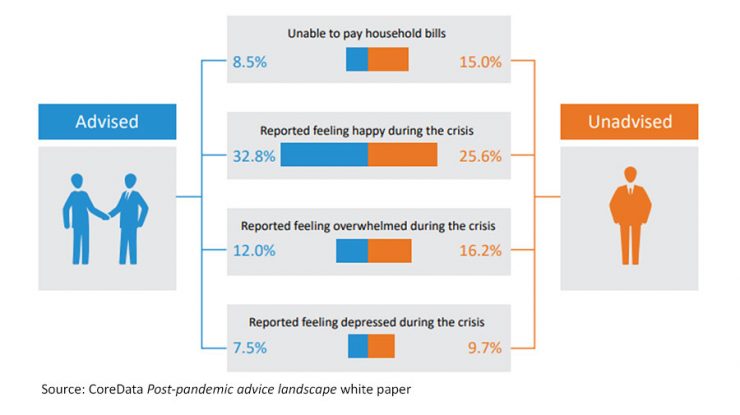
CoreData recently published a white paper, The post-pandemic advice landscape. It’s a free download, and you can get your copy here. One of the findings of the research underpinning the paper that really stands out is the difference that exists between households that receive financial advice and those that do not. 

CoreData’s quarterly COVID-19 Pulse Check surveys were conducted regularly during the pandemic and they paint a picture … For example, around 15 per cent of unadvised households reported being unable to pay household bills, a figure just less than double the 8.5 per cent of advised households reporting the same issue. 

About 16 per cent of unadvised households report feeling overwhelmed during the pandemic, compared to 12 per cent of advised households. And feelings of depression were reported more often in unadvised households than in advised households.

We know from other work that people who receive financial advice report being demonstrably financially better off, and report lower levels of stress and worry about financial issues. Better financial wellbeing flows into better overall wellbeing – people who receive financial advice sleep better, and they don’t have financial worries spilling over and affecting their personal relationships.

Demand up, but supply down

As reported by New Model Adviser last week, just when it looks like demand for financial advice is set to grow, accessibility is diminishing as more advisers leave the industry. CoreData’s latest analysis shows more than 7000 advisers have left the industry since a peak of more than 28,000 at the end of 2018, and numbers continue to decline.There’s a high chance that a client or a family member of a client has been affected adversely by the pandemic.

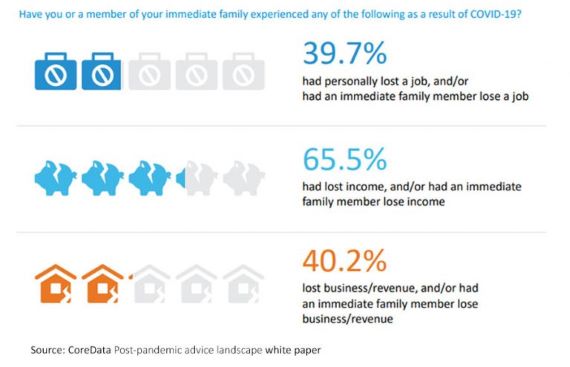
CoreData’s research shows that almost four in 10 (39.7%) people have personally lost their job or had an immediate family member lose their job. Furthermore, almost two-thirds (65.5%) of people have personally lost income or had an immediate family member lose income. And four in 10 (40.2%) people who run a business have personally seen it lose revenue, or had an immediate family running a business that has lost revenue.

There will be some short-term pain within the industry itself, as well, with the research finding that average loss of revenue within the 12 months since the pandemic started is expected to be about $90,000 per practice. Some practices will be able to cope with the loss; some will find the loss more difficult to deal with; and for some practices, it could be the difference between profitability and a loss for the year.

The post-pandemic white paper points out that the value of advice is being proven even as we speak, and the future for the profession looks bright. Some of the changes wrought by COVID-19 will have permanent and far-reaching consequences for how advice firms are structured and how they operate – mostly for the better.

And the impact on adviser-client relationships is likely to be strengthened as well as advisers prove the value of their services through some of the most difficult economic and social conditions in living memory. 

The post-pandemic advice landscape white paper: Key points

1. Trust in advisers is on the rise as client relationships strengthen: 

Advised Australians are faring markedly better throughout the crisis, and many advisers are reporting notable increases in the strength and quality of their client relationships. 

2. COVID-19 is expected to drive demand for advice

Advisers predicting an increase in demand for advice post COVID-19 see it as an opportunity to grow client bases by demonstrating value. However, many acknowledge that the virus has widened the “advice gap”. 

3. Digital and remote working is creating efficiencies

Advice businesses have been forced to adapt at lightning speed to conducting business digitally. Advisers and practices alike are already seeing the operational efficiencies that these tools bring; many shifting to flexible working arrangements. 

4. Advisers have adapted well to FASEA

The majority have already taken the FASEA exam, achieving a self-reported pass rate of more than 80 per cent. most advisers already hold, or expect to hold, an approved bachelor’s degree or equivalent or higher before the January 2026 deadline.

5. The future is bright

While many advisers are pessimistic about the outlook for the economy, they remain upbeat about the prospects for business. 

Please contact us on Phone: 07 5641 4134 if you seek further assistance on this topic. 

Source : Coredata November 2020 

By Simon Hoyle Head of market insight at CoreData Group

Reproduced with the permission of CoreData Research. This article was originally published on New Model Adviser , a website powered by CoreData Research, showcasing its research and insights on financial advice: the profession, advisers, advice practices, licensees, legislation and more.

Important: This provides general information and hasn’t taken your circumstances into account. It’s important to consider your particular circumstances before deciding what’s right for you. Although the information is from sources considered reliable, we do not guarantee that it is accurate or complete. You should not rely upon it and should seek qualified advice before making any investment decision. Except where liability under any statute cannot be excluded, we do not accept any liability (whether under contract, tort or otherwise) for any resulting loss or damage of the reader or any other person. Any information provided by the author detailed above is separate and external to our business and our Licensee. Neither our business nor our Licensee takes any responsibility for any action or any service provided by the author. Any links have been provided with permission for information purposes only and will take you to external websites, which are not connected to our company in any way. Note: Our company does not endorse and is not responsible for the accuracy of the contents/information contained within the linked site(s) accessible from this page.

From its COVID-inspired low point in late March, the Australian share market – as measured by the performance of the S&P/ASX 300 Index – has surged more than 40 per cent.

It’s an impressive rebound in such a short period of time, delivering strong returns to equity investors, especially to those who have broad exposure to the Australian share market through low-cost index-tracking exchange traded funds (ETF) and managed funds.

But it seems many of Australia’s roughly 600,000 self-managed super funds (SMSFs), covering more than 1.1 million members, have failed to capitalise on the share market’s robust growth.

Data only just released by the Australian Tax Office, detailing the asset allocations for all SMSFs in the quarter to the end of June, shows there was still a large investment weighting at that time towards cash and term deposits.

In fact, cash still remains the second-biggest holding for SMSFs behind ASX-listed shares.

At 30 June 2020 SMSF trustees were holding around $191.5 billion in Australian shares and $156.3 billion in cash, representing 26.1 per cent and 21.3 per cent respectively of the $705.4 billion in total SMSF assets.

Total SMSF cash holdings were largely unchanged on the March quarter number of $156.6 billion.

While the value of holdings in Australian shares at the end of June was actually up considerably on the $165.3 billion total value at the end of the March quarter, that’s largely explained by the 16.5 per cent rise on the local share market between 1 April and 30 June.

By contrast, the average returns from term deposit accounts were below 1 per cent in the June quarter, and remain so.

Small SMSFs have even more cash

The stubbornly high percentage of SMSF assets in low-yielding cash is even more evident in the ATO’s data breakdown of asset distributions by fund size.

Its latest data has only recently been extracted, but relates to the 2018-19 financial year.

It shows that, on average, super funds with $1 million to $2 million had around 30 per cent of their total assets in Australian listed shares, and 23 per cent in cash and term deposits.

The next-largest holdings in this subset were unlisted trusts (10 per cent) and non-residential real property (8 per cent).

SMSFs with $500,000 to $1 million were holding around 25 per cent in listed shares and 24 per cent in cash.

Interestingly, the numbers started turning the other way in smaller SMSFs. Those with between $200,000 and $500,000 in assets were holding around 23 per cent in listed Australian shares and an even larger 29 per cent in cash.

The smaller the amount of assets, the higher amount of cash.

For SMSFs between $100,000 and $200,000, the average holdings were 23 per cent in Australian-listed shares and 42 per cent in cash. And, for funds holding between $50,000 and $100,000 in super assets, the numbers were 23 per cent in Australian-listed shares and 45 per cent in cash.

Lack of diversification

Another observation from the ATO’s data is that many SMSFs are generally not well diversified into other major asset classes, including international equities and fixed interest.

Unlisted trusts, which by and large represent unitised unlisted property securities, are third-highest in terms of total SMSF assets, accounting for around $86 billion of capital (11.7 per cent).

Commercial properties account for more than $73 billion in SMSF assets.

Overseas shares, which accounted for $7.7 billion of total SMSF assets at the end of June, rank outside of the top 10.

The table below shows the top 10 holdings represent almost 100 per cent of the assets held by SMSFs.

Top 10 SMSF Asset Allocations at 30 June 2020

Asset class

Amount ($m)

% of total SMSF assets

Listed shares

191,464

26.1

Cash and term deposits

156,278

21.3

Unlisted trusts

85,752

11.7

Non-residential real property

73,493

10.0

Limited recourse borrowing arrangements

50,234

6.8

Listed trusts

43,330

5.9

Residential real property

39,100

5.3

Other managed investments

37,700

5.1

Other assets

19,352

2.6

Debt securities

11,525

1.6

Total

708,228

96.4

Source: Australian Tax Office

The ATO’s crackdown on SMSF strategies

The overweighting by SMSF trustees into Australian shares, cash and illiquid assets such as property has been on the ATO’s radar for some time.

In late February the SMSF regulator released new guidance for trustees around what should be detailed in their fund’s written investment strategy.

The ATO specifically wants to know from trustees how the asset allocations they make from their super fund assets supports their investment approach towards achieving their retirement goals.

For funds with too much asset concentration risk, trustees must justify their lack of diversification and how they believe this will achieve their overall goals.

Taking a broader view

While share markets have rebounded since March, ongoing uncertainty over COVID, the US election and other situations will ensure equity markets remain volatile over the short-to-medium term.

At the same time record low interest rates will ensure ongoing poor yields from cash holdings, meaning those with large cash balances needing to generate income may need to consider other types of investment assets.

Diversification to offset risks across different asset classes is one of the key elements of every investment strategy.

The latest ATO asset allocation data once again illustrates that many SMSF trustees should be taking a broader investment approach.

It may be prudent for some SMSFs trustees, especially those with large cash balances earning near-zero per cent returns, to consider consulting a licensed financial adviser to discuss their investment strategy.

Please contact us on Phone: 07 5641 4134 if you seek further discussion on this topic.

Source : Vanguard October 2020 

Reproduced with permission of Vanguard Investments Australia Ltd

Vanguard Investments Australia Ltd (ABN 72 072 881 086 / AFS Licence 227263) is the product issuer. We have not taken yours and your clients’ circumstances into account when preparing this material so it may not be applicable to the particular situation you are considering. You should consider your circumstances and our Product Disclosure Statement (PDS) or Prospectus before making any investment decision. You can access our PDS or Prospectus online or by calling us. This material was prepared in good faith and we accept no liability for any errors or omissions. Past performance is not an indication of future performance

© 2020 Vanguard Investments Australia Ltd. All rights reserved.

Important: Any information provided by the author detailed above is separate and external to our business and our Licensee. Neither our business nor our Licensee takes any responsibility for any action or any service provided by the author. Any links have been provided with permission for information purposes only and will take you to external websites, which are not connected to our company in any way. Note: Our company does not endorse and is not responsible for the accuracy of the contents/information contained within the linked site(s) accessible from this page.