
An annuity, also known as a lifetime or fixed-term pension, gives you a guaranteed income for a number of years. Or the rest of your life.

An annuity is less flexible than an account-based pension, but you can be sure about your future income.

How an annuity works

You can use your super or savings to buy an annuity from a super fund or life insurance company.

When you buy an annuity, you choose whether you want the payments to last for:

  • a fixed number of years

  • your life expectancy, or

  • the rest of your life

Preservation age

If you are using super money to buy an annuity, you must have reached preservation age (between 55 and 60).

You must also meet a condition of release , such as permanently retiring.

Joint or individual annuity

You can use savings to buy an annuity in joint names. This allows income splitting for tax purposes. If you or your partner dies, the survivor has ownership and access to the funds.

If you use a super lump sum to buy an annuity, it can only be in the name of the person who ‘owns’ the super.

Income from an annuity

You decide the payment amount you receive when you buy the annuity. Your annuity income can increase each year by a fixed percentage, or indexed with inflation.

You can choose to be paid monthly, quarterly, half-yearly or yearly.

An annuity bought with super money must pay you a certain percentage of the balance, based on your age. The Australian Taxation Office website has more information about minimum annual payments.

Your annuity if you die

When you buy an annuity you can either nominate a reversionary beneficiary or choose a guaranteed period option.

  • Reversionary beneficiary — Your nominated beneficiary (usually your partner or a dependant) will get your income payments for the rest of their life. This is usually at a reduced level, for example, 60% of your income stream.

  • Guaranteed period — A minimum payment period is set when you buy the annuity. If you die, your beneficiary will get your payments, either as a lump sum or income stream. The income payments will not reduce.

How an annuity affects the Age Pension

An annuity forms part of the income and assets tests to determine your eligibility for the Age Pension.

A Services Australia Financial Information Service (FIS) officer can help you work out how an annuity will affect your Age Pension entitlement.

The difference between an annuity and an account-based pension

Share market performance doesn’t affect annuity returns. This makes an annuity one of the more stable retiree investment options.

With an account-based pension, your money is invested in a range of investments, including shares, property and bonds. This gives potential for better growth and investment performance. Share market performance does affect returns, making an account-based pension riskier than an annuity.

Pros and cons of an annuity

Consider the pros and cons to decide if an annuity is right for you. Get financial advice from your super fund or a licensed financial adviser if you need more information. Please contact us on Phone: 07 5641 4134 if you seek further assistance. 

Pros

  • A regular guaranteed income regardless of how share markets perform.

  • Suitable for someone who doesn’t want to bear investment risk.

  • An annuity bought with super money is tax-free from age 60.

  • An indexed annuity protects you from the rising cost of living.

  • Payments from a lifetime annuity will last as long as you do.

  • If you nominate a reversionary beneficiary, a spouse or dependent will receive some income if you die.

  • If you choose a fixed-term guarantee period, your estate gets some money if you die during that time.

Cons

  • You cannot choose how your money is invested.

  • Income payments will be low if the annuity starts in a period with low interest rates.

  • You can’t change the amount you receive in income once payments start.

  • You lock your money away until the term of the annuity ends.

  • You cannot withdraw your money as a lump sum.

Using a mix of retirement income options

You don’t have to take an all or nothing approach to your retirement income. You may benefit from a mix of options, such as an annuity, account-based pension or lump sum.

Consider your personal needs and circumstances before making a decision. Your super fund, a licensed financial adviser or a Financial Information Service (FIS) officer can help.

Please contact us on Phone: 07 5641 4134 if you seek further assistance.

Source : Moneysmart .gov.au 


By Tony Kaye, Senior Personal Finance Writer, Vanguard Australia

Having enough superannuation to enjoy a financially comfortable lifestyle in retirement is the aspiration of most Australians.

As the super system continues to mature, and with the benefit of compounding investment returns, average retirement savings balances are rising.

But an interesting finding in the federal government’s just-released Retirement Income Review final report is that many Australians are dying with the majority of the wealth they had when they retired.

Concerned about outliving their superannuation savings, the report found that the majority of retirees tend to spend less rather than use financial products to better manage their longevity risk.

In other words, rather than wanting to spend up, many retirees are keen to watch their savings balance grow.

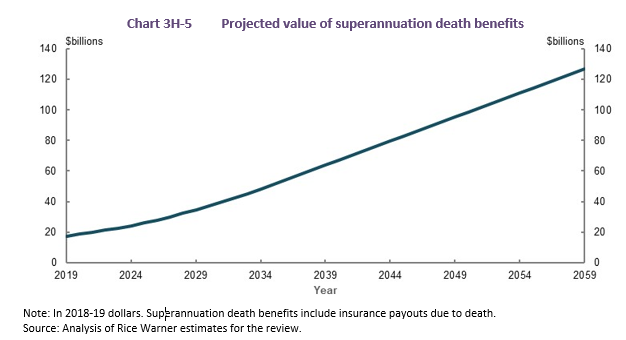
And that’s pointing towards a huge blow-out in the payment of super death benefits, which actuarial firm Rice Warner projects in the Retirement Income Review report will rise from the current level of around $17 billion per annum to just under $130 billion by 2059.


Unintended consequences

When there’s superannuation still left over at the end of your life, it’s most commonly inherited by your surviving spouse or children, or bequeathed to other nominated beneficiaries.

If you don’t have a spouse, and intend to leave your super to your adult children, there may be serious tax consequences for them.

It all comes down to whether your beneficiaries are entitled to access your super funds tax free or not after you’re deceased.

So, having an understanding of the tax rules around super death benefits is extremely useful. With proper estate planning before you die, it may be possible to reduce your after-death super tax liabilities.

The tax rules around super death benefits

While there is no formal inheritance tax in Australia, super death benefits are taxed in some cases.

Essentially, superannuation can only be passed on tax-free when it is left to a spouse or dependant children under the age of 18.

A death benefit dependant, as determined by the Tax Act, can also include de factos, former spouses, those with whom you have shared an interdependency relationship immediately prior to death, and others who were financially dependent on you just before you died.

Beneficiaries who fall outside of these parameters, such as adult children, are often caught up in the ATO’s tax dragnet.

Superannuation benefits are generally comprised of both taxable and tax-free funds, based on the nature of contributions that have been made over time.

Those contributions made by your employer at the concessional tax rate of 15 per cent form part of the taxable component, while after-tax contributions made by you separately as non-concessional contributions make up the tax-free component.

It’s the taxable component – usually where the bulk of an individual’s super funds reside – that will carry the tax liability for any adult children receiving your super payout on your death.

Avoiding an after-death tax experience

Transferring super wealth is a non-issue from a tax perspective if you have a spouse or dependant children to leave it to.

If you don’t, there are ways to reduce your potential super tax burden for non-dependent beneficiaries.

One of them is through the use of what’s known as a super recontribution strategy.

If you’ve reached an age where you can legally access your funds, this enables you to draw out the taxable component of your super as a lump sum and then recontribute it back into your super fund in the form of after-tax contributions.

Any taxable super withdrawn will be liable for tax at your marginal tax rate, however if you are aged over 60 and have stopped working (are retired) then your marginal tax rate is effectively zero.

Current laws allow individuals to contribute up to $100,000 per financial year as non-concessional (tax-paid) contributions, or up to $300,000 in one year using what’s known as the three-year bring forward rule.

Keep in mind however that there are restrictions on personal super contributions for those aged 67 and above.

Using a recontribution strategy can effectively reduce or eliminate the taxable portion of your super, meaning non-dependant beneficiaries of your super may not have to pay any tax if it’s received as a lump sum after your death.

Careful planning

When you’re looking at who you want to leave your super to, it’s very important you consider things carefully as some proper planning needs to be done.

Without planning there could be some unexpected and significant taxes bestowed upon your heirs, which could be exacerbated if any life insurance payout from your super fund is made to someone who is not a spouse or dependant.

To discuss your estate planning needs, including around your super death benefits and potential tax liabilities, it’s important to consult a licensed financial adviser.

Please contact us on Phone: 07 5641 4134 if you seek further assistance on this topic.

Source : Vanguard December 2020 

Reproduced with permission of Vanguard Investments Australia Ltd

Vanguard Investments Australia Ltd (ABN 72 072 881 086 / AFS Licence 227263) is the product issuer. We have not taken yours and your clients’ circumstances into account when preparing this material so it may not be applicable to the particular situation you are considering. You should consider your circumstances and our Product Disclosure Statement (PDS) or Prospectus before making any investment decision. You can access our PDS or Prospectus online or by calling us. This material was prepared in good faith and we accept no liability for any errors or omissions. Past performance is not an indication of future performance.

© 2020 Vanguard Investments Australia Ltd. All rights reserved.

Important: Any information provided by the author detailed above is separate and external to our business and our Licensee. Neither our business nor our Licensee takes any responsibility for any action or any service provided by the author. Any links have been provided with permission for information purposes only and will take you to external websites, which are not connected to our company in any way. Note: Our company does not endorse and is not responsible for the accuracy of the contents/information contained within the linked site(s) accessible from this page.

In this modern age travelling is a lot more accessible, we are now able to become those very adventurers we read about.

However during difficult times, like unexpected illness, or problems outside of your control, like the 2019/20 COVID pandemic, you may not be able to travel around the world or visit your favourite museum. 

Luckily, there are a lot of innovative options utilising technology that can transport you to the other side of the world for free from the comfort of your own home.

​Live feeds

Many companies have recently been utilising live feeds of natural wonders and travel journeys to encourage people to interact and see a different part of the world.

Katmai National Park in Alaska, USA, broadcasts live video every now and then of Brown Bears fishing for salmon at Brooks Falls in their park. 

The Ghan, a well known Australian train service travelling between Darwin and Adelaide, released a 17 hour train journey “Slow TV’ series on SBS, which was a huge hit with Australian audiences.

People were able to sit at home and feel as if they were taking the huge trip through Australia’s outback in real time.

Many zoos and aquariums offer live streams or videos of events or performances they have on during the week.

For instance, the Zoos South Australia website has multiple live webcams of animals at different zoos across the state. You can view the Giant Panda Cam at Adelaide Zoo or watch the Chimpanzee Habitat Cam at Monarto Safari Park. The Sydney Aquarium has live streams throughout the week of different events they host, plus a 24 hour live stream of their penguin colony!

Even Nature Conservancy Australia has a Reef Cam based in Port Phillip Bay at Pope’s Eye in Victoria, that showcases the underwater life to people across the world.

If you are more about sunsets and sunrises or real life animals, you can view the Northern Lights and other delights on Explore’s Zen Den, which shows everything from live pipeline surfing in Hawaii to footage of an International Wolf Centre in Ely, Minnesota, USA.

The International Space Station cam is another great gem if you want to view otherworldly experiences or to see if you can spot your house from space!

Or if you are looking for something a bit exotic and on your own planet, you can watch the Costa Rica Volcano Cam.

For something a bit more interactive, some live streams can keep you entertained by knowing you had an effect on somewhere else in the world.

Drive Me Insane is one such webcam, where the whole point is to drive the occupant of the house insane by turning on lights or music in their house!

Virtual tours

Going on a virtual tour can almost make you feel like you are there while you are actually sitting comfortably on your couch in your pyjamas!

Many different organisations offer virtual tours, including some guided tours, on their own websites. 

For instance, the National Gallery of Victoria has a fantastic content library of self-guided tours which are able to show the descriptions next to the artwork very clearly. There are also voice-over elements that can provide more in-depth understanding behind what you are viewing.

Whereas the Vatican City provides 360 virtual tours of their buildings and museums. You can even view the Sistine Chapel without any tourists in sight!

Another surprising contributor to supporting virtual travel is Google. While they are commonly known for providing directions or maps, the Google Maps function has been utilised to provide virtual tours which can take you to the best monuments and icons around the world.

Google Arts & Culture has over 2,000 museums and galleries around the world to visit and more than 10,000 travel sites you can view as if you were right there.

Why not visit the Smithsonian Air and Space Museum in America or view the art showcased in the Louvre in France. 

Alternatively, you can have a birds eye view of the Taj Mahal in India or “stroll” around the Pyramids of Giza in Cairo, Egypt.

Not only can you visit locations, Google Arts & Culture has an extensive visual library showing you how different cultural and traditional arts and crafts are made.

One other unique option is to explore nearby planets through artist impressions of what they look like. The Exoplanet Exploration project by NASA is like choosing a unique holiday destination to visit before you could be plonked on top of a lava covered planet such as 55 Cancri e, which is 44 light years away from Earth.

What are you interested in?

Even though you may not be able to travel at the moment, it doesn’t mean you can’t visit other places.

Virtual tours and live streams are widely available, but there are also many documentaries and tv shows that can let you experience a little of what it is like to be in another country.

Besides looking at your own computer or tablet to see these places, you could use VR technology or cardboard virtual reality devices that can really envelop and enhance your sensors and make you feel like you are really in another location than your own living room. 

There is so much live stream content or virtual tours available. You just need to decide on what interests you and you should be able to find something to entertain!

Source : Aged Care Guide January 2021 

This article was originally published on https://www.agedcareguide.com.au/information/virtual-trips-from-your-couch. Reproduced with permission of DPS Publishing.

Important: This provides general information and hasn’t taken your circumstances into account.  It’s important to consider your particular circumstances before deciding what’s right for you. Although the information is from sources considered reliable, we do not guarantee that it is accurate or complete. You should not rely upon it and should seek qualified advice before making any investment decision. Except where liability under any statute cannot be excluded, we do not accept any liability (whether under contract, tort or otherwise) for any resulting loss or damage of the reader or any other person. 

Any information provided by the author detailed above is separate and external to our business and our Licensee. Neither our business nor our Licensee takes any responsibility for any action or any service provided by the author. Any links have been provided with permission for information purposes only and will take you to external websites, which are not connected to our company in any way. Note: Our company does not endorse and is not responsible for the accuracy of the contents/information contained within the linked site(s) accessible from this page.

 

Budgeting for a holiday or saving for a deposit? Even the best budget can unravel if the right tools are not in place. In this article, we look beyond the basics and focus more on what it takes to stick to your budget.

Start with the basics

In our first budgeting story, we looked at the basics – how to create a decent, detailed budget. But this is only half the job.

Now the hard work begins. Here are five tips to help you stick to your budget.

1. Stocktake. Spending more than you earn?

Subtract your total weekly expenses from your total weekly income. How’s it looking? Ideally, you’ll have more coming in than going out. Over time you’ll be able to save and build up your reserves.

First, you want a buffer in case things go wrong. Financial advisors used to talk of having six month’s spare cash in the bank. When this seemed out of reach for most, they talked instead of having three months in reserve—but many people struggle to even have one.

Living month to month is stressful enough; living week to week even more so. Getting your finances into a stable and sustainable place is the goal. Properly accounting for income and outgoings is the first step.

2. Cut costs

Realistically, the quickest way to improve your personal bottom line is to cut costs – to curb unnecessary spending.

Go through your expenditure. You’ll find there are fixed costs (e.g. rent or mortgage payments) you can do little about, and other areas where you could cut but it’d be unwise to do so (e.g. insurance).

Unfortunately, the areas where you can make the greatest savings (your discretionary spending) are often the things that are most fun – like going to the movies, or big Friday nights out.

Once more, the crucial consideration is ‘balance’. You can draft an extreme austerity plan, but you’d be unlikely to stick to it.

Be realistic. Don’t introduce cuts across the board or take $20 off food without knowing what you can (and will) give up or change.

3. Have a plan

It’s easier to keep to a budget if you have a goal you’re working towards. It might be something humble like a pair of shoes or cast-iron wok.

It could be bigger ticket items like a car, an overseas trip, or your first home deposit. Perhaps you’ve just got debts you want to pay off.

Whatever it is, having a plan is the best way to keep focused and ensure spend-ups and blowouts don’t happen too often.

4. Sort your day-to-day money management

Set up a system that makes saving automatic—and limits your ability to spend more than you’ve budgeted. It’s a good idea to set up several bank accounts, with direct debits into (or out) of each.

For instance, you might have a general account where your wages are paid into. Each week, money is diverted from here into a designated ‘House’ savings account (for your home deposit).

Don’t touch this. You might have another couple of accounts—a smaller one where you trickle money in for that trip to New Zealand, another to fund big, occasional bills (e.g. vehicle maintenance).

Your goal? Each month your overall financial position should be stronger than the month before.

You may also want to consider a Term Deposit to help you reach your savings goal.

5. Track your progress

Check your finances each month to see if your savings and spending plans are on track. If you’re extra organised, fill out your own Statement of Financial Position in Excel.

Don’t just look at the bottom line. Where are you over? Where are you under? What little fixes could bring things back into line? Are your targets realistic?

Remember, the best budgets are regularly reviewed and refined – and evolve over time.

Please contact us on Phone: 07 5641 4134 if you seek further assistance on this topic.

Source : Nab January 2021 

Reproduced with permission of National Australia Bank (‘NAB’). This article was original published at https://www.nab.com.au/personal/life-moments/manage-money/budget-saving/stick-to-budget

National Australia Bank Limited. ABN 12 004 044 937 AFSL and Australian Credit Licence 230686. The information contained in this article is intended to be of a general nature only. Any advice contained in this article has been prepared without taking into account your objectives, financial situation or needs. Before acting on any advice on this website, NAB recommends that you consider whether it is appropriate for your circumstances

© 2020 National Australia Bank Limited (“NAB”). All rights reserved.

Important: Any information provided by the author detailed above is separate and external to our business and our Licensee. Neither our business nor our Licensee takes any responsibility for any action or any service provided by the author. Any links have been provided with permission for information purposes only and will take you to external websites, which are not connected to our company in any way. Note: Our company does not endorse and is not responsible for the accuracy of the contents/information contained within the linked site(s) accessible from this page.

 

Cryptocurrencies and initial coin offerings (ICOs) have emerged over the last 10 years as investments. You could lose a lot of money if you invest without doing your research first.

How cryptocurrencies work

Cryptocurrencies, also known as virtual currencies or digital currencies, are a form of electronic money. They do not physically exist as coins or notes. A cryptocurrency unit, such as a bitcoin or ether, is a digital token. These digital tokens are created from code using an encrypted string of data blocks, known as a blockchain.

The Reserve Bank of Australia’s website explains how cryptocurrency and blockchain technology works.

Cryptocurrencies are used as payment systems to execute contracts and run programs. Anyone can create a digital currency, so at any given time there can be thousands of cryptocurrencies in circulation.

Scam alert: an increased number of Australians have reported losing money through crypto-asset or cryptocurrency scams.

Types of cryptocurrencies

Each cryptocurrency has different capabilities. Most were not created to be investments.

Bitcoin

Bitcoin is a digital currency. Users in the Bitcoin network (bitcoin miners) use computer-intensive software to validate transactions that pass through the network. They earn new bitcoins in the process. Bitcoin is a decentralised global payment system, but it’s bought and sold in large volumes as a speculative investment.

Ethereum 

Ethereum uses blockchain technology to run an open source platform. It can process transactions, contracts and run other programs. This allows developers to create and run any program, in any programming language, on a single decentralised platform. In the Ethereum blockchain, miners work to earn ‘ether’, which is a crypto token. Ether can pay for fees and services within the network.

Litecoin

Litecoin is an electronic payment system. Litecoin transactions process faster than Bitcoin. There are also more Litecoins in circulation than there are Bitcoins. Some users see Litecoin as a ‘lighter’ version of, or backup for, Bitcoin.

Ripple

Ripple is a transaction protocol designed to complement Bitcoin. It allows real-time transfers between users in any currency, including other cryptocurrencies. Ripple is a database in which users can store and transfer value in any currency on a protected network. Ripple uses tokens developers create, rather than mined or earned like other digital currencies. Some users don’t see Ripple as a true cryptocurrency, but the technology has been popular with financial institutions.

Stablecoin

Stablecoin is a marketing term for a crypto-asset that is ‘supposedly’ less volatile than standard cryptocurrency. Stablecoin tries to stabilise its market value by:

  • attaching it to an external asset, such as government-issued currency

  • maintaining a reserve of the backing asset

  • using algorithms to control the supply of available tokens

Using cryptocurrencies

You can buy or sell cryptocurrencies on an exchange platform using traditional money. The cryptocurrencies are kept in a digital wallet and some stores accept cryptocurrencies are payment for goods and services. But, they are not legal tender and not widely accepted.

You can withdraw some popular digital currencies like Bitcoin as cash through special ATMs. Cryptocurrency networks generally have no or low transaction fees.

How initial coin offerings (ICOs) work

An ICO is a way a project can raise money over the internet. You invest in an ICO by sending money or cryptocurrency to a blockchain project. In return you receive digital tokens related to that project.

ICOs are speculative, high-risk investments. Many ICOs are for projects that:

  • are experimental

  • are at a very early stage of development

  • may not have even started yet

Some projects may take years before they become commercially viable, if at all. A large number of ICOs fail or do not increase in value.

ICOs sound similar to initial public offerings (IPOs). But ICOs usually don’t offer any legal rights and protections. Investing in an IPO means you are investing in an established company or asset, rather than a project.

While ICOs use the internet to raise money they are not the same as crowd-sourced funding. Crowd-sourced funding offers basic investor protections under Australian law.

ICO white papers

There will usually be a ‘white paper’ that contains information about the ICO and the project it’s funding. The white paper should provide:

  • the names and contact details of the people behind the scheme

  • information on what they are planning to do with your money

The information in the white paper isn’t always accurate. Sometimes the information can be unbalanced or misleading. The white paper may overestimate how profitable the project will be to convince you to invest.

If the white paper claims the ICO is not a financial product, they may be trying to avoid regulation. If the promoter avoids regulation, you may have no consumer protection.

The white papers can be very technical. This can make it difficult to understand what your rights and obligations will be after you’ve bought the ICO tokens.

The risks of investing in cryptocurrencies and ICOs

You could lose a lot of money if you buy into an ICO or cryptocurrency without doing your research first.

Fewer safeguards

The platforms where you buy and sell cryptocurrencies and ICOs are not regulated. You’re not protected if the platform fails or is hacked.

ICOs are highly speculative investments and many have turned out to be scams. It’s even harder to get your money back if it turns out to be a scam and the ICO is from an overseas entity.

Cryptocurrency failures in the past have lost investors significant amounts of real money. In most countries cryptocurrencies are not recognised as legal tender. You’re only protected to the extent that they fit within existing laws, such as tax laws.

Values fluctuate

Investing in virtual currencies and ICOs is highly speculative. Values can fluctuate significantly over short periods of time.

The value of cryptocurrencies and ICOs depends on:

  • its popularity at a given time (which can depend on factors like the number of people using it)

  • how easy it is to trade or use it

  • the perceived value of the currency

  • its underlying blockchain technology

Scammers can use social media and messaging apps to push up the price of ICO tokens. They sell the tokens to other buyers at falsely inflated prices. This is known as a ‘pump and dump’ scheme.

Your money could be stolen

A computer hacker can steal the contents of your digital wallet.

Your digital wallet has a public key and a private key, like a password or a PIN. However, digital currency systems allow users to remain relatively anonymous and there is no central data bank. If hackers steal your digital currency or ICO tokens, you have little hope of getting it back.

You also have no protection against unauthorised or incorrect debits from your digital wallet.

Cryptocurrency scams

Scammers trick people into investing in fake opportunities to buy cryptocurrency. Watch out for these tactics:

  • false promises of very high returns

  • fake support from celebrities or government agencies

  • people who contact you through social media

  • using dating apps to establish a romantic connection and gain trust

  • multiple or constantly changing bank accounts used for transfers

ICO scams

It can be difficult for regulators to make sure proper investor protections are in place because ICOs are:

  • sold internationally

  • available online

  • usually paid for with cryptocurrencies

It’s often unclear where the entity’s incorporated and what laws and regulations apply to it. See ASIC’s media release on misleading ICO statements.

Some issuers disappear as soon as they’ve finished fundraising, which may indicate that it is actually a scam. When this happens, investors have very little or no chance of getting their money back.

Case Study 

Rhett is scammed $97,000 by a fake endorsement

Rhett saw an article on a news website about ‘The biggest deal in Shark Tank history, that can make YOU rich in just 7 days! (Seriously)’

The news article was really an advertisement. It took Rhett to a website that included endorsements from Shark Tank judges for Bitcoin trading software. The endorsements were fake.

Rhett was interested in trading Bitcoin, so he provided his contact details. Soon, an Account Manager named Max began calling Rhett. Max called often, pressuring Rhett to open a trading account and make a deposit. By depositing between $40,000 and $50,000 upfront, Max promised Rhett he could earn at least $15,000 per month.

Max promised Rhett that the money he deposited would be safe because he would have total control of the account. “It’s more or less moving your money in your left pocket from your right pocket,” Max said. Max promised Rhett that he could withdraw his money whenever he wanted to.

Max eventually convinced Rhett to open an account and deposit $40,000. Rhett started trading Bitcoin, but things didn’t go to plan. Rhett started losing money. Max encouraged Rhett to deposit more money so they could fix the situation. Max promised that in a week Rhett able to withdraw the money that he needed.

Rhett deposited more money in the hope he could recoup his losses. Rhett ended up depositing and losing a total of $97,000.

Please contact us on Phone: 07 5641 4134 if you seek further assistance on this topic.

Source : Moneysmart.gov.au January 2021 

Reproduced with the permission of ASIC’s MoneySmart Team. This article was originally published at https://moneysmart.gov.au/investment-warnings/cryptocurrencies-and-icos

Important note: This provides general information and hasn’t taken your circumstances into account.  It’s important to consider your particular circumstances before deciding what’s right for you. Although the information is from sources considered reliable, we do not guarantee that it is accurate or complete. You should not rely upon it and should seek qualified advice before making any investment decision. Except where liability under any statute cannot be excluded, we do not accept any liability (whether under contract, tort or otherwise) for any resulting loss or damage of the reader or any other person.  Past performance is not a reliable guide to future returns.

Important Any information provided by the author detailed above is separate and external to our business and our Licensee. Neither our business nor our Licensee takes any responsibility for any action or any service provided by the author. Any links have been provided with permission for information purposes only and will take you to external websites, which are not connected to our company in any way. Note: Our company does not endorse and is not responsible for the accuracy of the contents/information contained within the linked site(s) accessible from this page.



You already know the importance of maintaining consistent cash flow. Did you know that your business’s assets can be the solution?

If your business’s cash flow is stifling its success, it’s time to look for a solution. Simple steps such as negotiating longer payment terms with suppliers and shorter terms with debtors can help.

If both of these steps have been taken but cash flow is still not cutting it, leveraging existing assets for credit may be the answer.

There are several options, and the terms ‘asset’ applies fairly broadly, taking in physical equipment, raw materials and stock, as well as a business’s existing debtors.

But there’s a bit of groundwork that needs to be done first, and business owners need a good understanding of their requirements before taking out a loan.

“They need to talk to their accountant or prepare their own cash flows to see the level of funding they need and for how long they’ll need it,” says an MFAA accredited finance broker.

Business owners considering accessing credit as a cash flow solution should approach an experienced commercial broker to assist them.

“A broker who specialises in commercial and business finance with particular emphasis on cash flow solutions would be able to help,” says the broker. “It’s important to partner with experienced finance brokers who do know what is available in the market.”

Please contact us on Phone: 07 5641 4134 if you seek further assistance on this topic.

Source : Mortgage Finance Help January 2021

Reproduced with the permission of the Mortgage and Finance Association of Australia (MFAA)

Important: This provides general information and hasn’t taken your circumstances into account.  It’s important to consider your particular circumstances before deciding what’s right for you. Although the information is from sources considered reliable, we do not guarantee that it is accurate or complete. You should not rely upon it and should seek qualified advice before making any investment decision. Except where liability under any statute cannot be excluded, we do not accept any liability (whether under contract, tort or otherwise) for any resulting loss or damage of the reader or any other person.  Past performance is not a reliable guide to future returns.

Any information provided by the author detailed above is separate and external to our business and our Licensee. Neither our business nor our Licensee takes any responsibility for any action or any service provided by the author.

Any links have been provided with permission for information purposes only and will take you to external websites, which are not connected to our company in any way. Note: Our company does not endorse and is not responsible for the accuracy of the contents/information contained within the linked site(s) accessible from this page.

 

When you retire, you may be eligible for government benefits such as the Age Pension or a concession card.

The kind of pension and benefits you’re entitled to generally depends on your age, assets and income.

Proposed changes to some payments and support were announced in the 2020 federal budget. This content does not reflect those announcements yet.

Age Pension

Generally, to be eligible for the Age Pension, you must:

  • be age 66 or over, depending on when you were born

  • be an Australian resident and have lived in Australia for at least 10 years

  • meet the income and asset tests

Income and assets tests

These tests measure your income (how much money you get) and the value of your assets (what you own, for example, any investment properties).

If your income or assets are above certain limits, your pension payment will be reduced, or you may not be eligible at all.

Your income includes money from:

  • employment

  • pensions

  • annuities

  • investments

  • earnings outside Australia

  • salary packaging

See income test for pensions on the Services Australia website.

Your assets include things like:

  • investment properties

  • caravans, cars and boats

  • business assets

Your family home, if you live in it, isn’t counted as an asset. However, if you decide to sell, it could affect your pension.

If you have any assets overseas, their value will be converted into the equivalent Australian dollar amount.

See assets on the Services Australia website.

To talk to someone about the Age Pension income and assets tests, contact the Services Australia Financial Information Service.

How much the Age Pension pays

How much you get depends on your income and assets tests, and whether you’re single or in a couple.

The maximum Age Pension for:

  • singles is $860.60 a fortnight or $22,375 a year

  • couples is $1,297.40 a fortnight or $33,732 a year

These amounts do not include any supplements.

See Age Pension on the Services Australia website for more information.

Age Pension benefits

If you get the Age Pension, you may be eligible for other, related benefits:

  • Centrepay — a free direct bill paying service available as a regular deduction from your Centrelink payments.

  • Work Bonus — a payment that helps you earn more without reducing your pension.

  • Pensioner Concession Card — see Concession cards, below.

Other types of pensions

For information about veterans pensions, see income support on the Department of Veterans’ Affairs (DVA) website.

For other types of payments, including carers allowance, use Centrelink’s Payment finder.

Concession cards

The following cards provide seniors, retirees and pensioners with discounts on things like health care, transport and utilities.

Pensioner Concession Card

Gives you access to cheaper utility and medical bills, and discounts on public transport in some states. You must:

  • be aged 60 or over, and

  • get the Age Pension or other payments from Centrelink

See Pensioner Concession Card on the Services Australia website.

Seniors cards

Offers a discount on public transport and some goods and services. Generally, you must:

  • be aged 60 or over, and

  • work less than 20 hours per week

Check eligibility in your state or territory:

Commonwealth Seniors Health Card

Gets you cheaper prescriptions and medical appointments. You must:

  • be of Age Pension age,

  • meet an income test, and

  • not receive Centrelink payments

See Commonwealth Seniors Health Card on the Services Australia website.

Government loans

If you’re on or qualify for the Age Pension, you may be eligible for Services Australia loans:

  • Pension Loans Scheme — use real estate as security for a fortnightly loan to top up your retirement income.

  • Advance payment — get part of your pension payment in advance to help cover immediate expenses.

Health care benefits

These government benefits can help you save on your health expenses.

  • Medicare Safety Net — reduces your out-of-pocket expenses for seeing doctors after you’ve spent a certain amount.

  • PBS Safety Net — helps you pay less for medicines after you’ve reached a certain amount.

  • Free vaccinations — free vaccinations for flu and pneumococcal disease.

  • Cancer screening — free early detection screenings for breast cancer and bowel cancer.

  • Free annual health assessment — if you’re 75 or over (or 55 for Aboriginal and Torres Strait Islander peoples). If your doctor doesn’t bulk bill, you may have to pay the gap. Ask your GP.

  • Free home medication review — help with using medicines at home if you use more than 5 medications per day. Ask your GP or pharmacist.

Tax offsets

You may be eligible for additional tax offsets, depending on your:

  • age

  • income, and

  • eligibility for government pensions

See seniors and pensioners tax offset on the Australian Taxation Office (ATO) website.

Low cost banking

If you have a Pensioner Concession Card or Commonwealth Seniors Health Card, you may be eligible for a low cost, basic bank account.

See reducing fees on the Australian Banking Association (ABA) website.


Case Study 

Lorenzo and Sophia apply for the Age Pension

Lorenzo and Sophia have both reached retirement age. They provide their tax returns and bank and financial statements to Centrelink for assessment. Their combined assets are worth $200,000 and their joint income is $45,000 a year. Their assets are modest, so they don’t affect their pension. However, as their joint income exceeds the minimum, they will only receive a part pension.

Source : Moneysmart .gov.au 

Reproduced with the permission of ASIC’s MoneySmart Team. This article was originally published at https://moneysmart.gov.au/retirement-income/age-pension-and-government-benefits

Important note: This provides general information and hasn’t taken your circumstances into account.  It’s important to consider your particular circumstances before deciding what’s right for you. Although the information is from sources considered reliable, we do not guarantee that it is accurate or complete. You should not rely upon it and should seek qualified advice before making any investment decision. Except where liability under any statute cannot be excluded, we do not accept any liability (whether under contract, tort or otherwise) for any resulting loss or damage of the reader or any other person.  Past performance is not a reliable guide to future returns.

Important Any information provided by the author detailed above is separate and external to our business and our Licensee. Neither our business nor our Licensee takes any responsibility for any action or any service provided by the author. Any links have been provided with permission for information purposes only and will take you to external websites, which are not connected to our company in any way. Note: Our company does not endorse and is not responsible for the accuracy of the contents/information contained within the linked site(s) accessible from this page.



Did you know it’s likely you’ll spend up to two decades or more in retirement? It’s a long time, so will you be able to afford all the things you’ve thought of doing in retirement, before your savings run out?

By starting now and making small changes to how you approach your super savings, you can get closer to the retirement you’d like – and hopefully make your savings last longer.

Note: Some of the strategies explained below are subject to your total super balance cap (combined value of your accumulation and pension accounts). For more information visit the ATO website or contact your financial adviser. In the meantime, here are five strategies to help you build a bigger super balance.

1. Consider consolidating your super funds

If you’ve moved jobs or done casual work over the years, you might have money in several super funds. One super account means less paper work and not having to manage multiple super accounts.

There are a few things to think about before you consolidate your super:

  • Weigh up the benefits and features of your other super funds against your chosen super account.

  • Check the tax implications and see if your tax and preservation components will be impacted. Speak to your financial adviser for further information.

  • Compare the fees of your funds and check for exit or termination fees.

  • Don’t forget your insurance. Check if your chosen super account will give you appropriate cover to replace any cancellation of insurance cover that will occur by consolidating your accounts. Appropriate insurance can include level and types of cover as well as policy terms. If you have a pre-existing medical condition, consider whether you’ll be eligible for the same level of cover if you cancel your existing insurance policy.

  • If you intend to claim a tax deduction for personal contributions made into your other fund, there’s something you need to do first. Ensure your “Notice of intent to claim a deduction for personal contributions” is made and acknowledged by that fund. For more information about eligibility and/or to obtain this form please visit the ATO website.

  • If you consolidate your super, you’ll have fewer funds to manage and it’ll be easier to keep track of your retirement savings.

2. Make personal contributions

By making a personal super contribution and claiming the amount as a tax deduction, you may be able to pay less tax and invest more in super. The contribution will generally be taxed in the fund at the concessional rate of up to 15 per cent instead of your marginal tax rate which could be up to 47 per cent, including the Medicare Levy. Additional 15 per cent tax applies to concessional super contributions if your combined income and concessional contributions exceed $250,000. Visit the ATO website to check the latest tax rates.

This strategy could result in a tax saving and enable you to increase your super balance.

To claim the super contribution as a tax deduction, you need to submit a valid ‘Notice of Intent’ form. You’ll also need to receive an acknowledgement from the super fund. You’ll need this before you complete your tax return, start a pension or withdraw or rollover money from the fund you made your personal contribution to. It’s generally not tax-effective to claim a tax deduction for an amount that reduces your taxable income below the threshold at which the 19 per cent marginal tax rate is payable. This is because you would end up paying more tax on the super contribution than you would save from claiming the deduction.

We recommend you see a financial adviser or tax consultant to get the right advice for you.

3. Salary sacrificing

You might also be able to reduce your tax and boost your super balance through salary sacrifice. This is an agreement with your employer to contribute a certain amount of your pre-tax salary or potential bonus into your super. The word sacrifice doesn’t really make this strategy sound appealing, but it has some great benefits.

Instead of being taxed at your marginal tax rate, these contributions are generally taxed at the concessional rate of up to 15 per cent (an additional 15 per cent tax applies to concessional super contributions if your combined income and concessional contributions exceed $250,000). For example, if you earn $95,000 a year, you could save up to 24c in every dollar sacrificed.

If you’re a high income earner, you’ll be taxed an extra 15 per cent on your before-tax contributions (30 per cent in total). However, this is still lower than your marginal tax rate of 47 per cent (including the Medicare Levy).

Making before tax contributions to super can be a tax effective way of building wealth. Before tax (or concessional) contributions also include mandatory contributions made by your employer and are capped at $25,000 per year regardless of your age. Penalties apply for exceeding the cap.

The Government’s MoneySmart website has a great super contributions optimiser calculator that can give you an idea of how salary sacrificing can affect your super and take home pay.

If you like the idea of salary sacrificing, it’s a good idea to discuss it with your employer and see if you can make an arrangement with them to do this.

You should also seek advice from a tax agent or speak to your financial adviser to determine if this strategy suits your financial situation.

4. Make after-tax super contributions

Maybe you’ve received an inheritance, a bonus, or sold an asset? If you are considering making non-concessional (after-tax) contributions to your super, there are important things to consider. The after-tax contributions cap is $100,000 pa, or up to $300,000, if you bring forward two years’ worth of contributions. To be eligible to make non-concessional contributions, certain requirements must be met. For more information visit the ATO website or contact your financial adviser.

Government super co-contributions also help eligible people boost their retirement savings. If you’re a low income earner and you make personal (after-tax) contributions to your super fund, the government also makes a contribution (called a co-contribution) up to a maximum amount of $500.

The amount of government co-contribution you receive depends on your income and how much you contribute. When you lodge a tax return, the ATO will work out if you’re eligible. If the super fund has your tax file number (TFN) they’ll pay it to your super account automatically. The way your co-contribution is calculated depends on the financial year in which you made your personal super contributions. You can visit the ATO website for specific income levels and amounts.

You may be able to make after-tax contributions to your super before you turn 65 even if you’re not working. After 65, you’ll need to meet a ‘work test’ each financial year to be able to make after-tax contributions (you’ll need to have worked 40 hours over a consecutive 30 day period), or are eligible for the work test exemption.View Disclaimer 1 And you can’t make after-tax contributions once you’re 75.

5. Top up your spouse’s super

Is your spouse working part-time, earning a low income or currently not working (but not retired)? If so, you may both be able to benefit by making a ‘spouse contribution’ to their super account. In the 2017/18 financial year, if your spouse’s assessable income is less than $40,000 and you make a spouse contribution on their behalf into their super account, you’ll receive a tax offset of up to $540 a year. Other eligibility criteria apply.

You should also seek advice from a tax agent or speak to your financial adviser to determine if this strategy suits your financial situation.

Seek professional advice

Remember the tax and super systems are complex and subject to change, and everyone’s financial situation is different. So before making any major changes make sure you speak to your financial planner.

Please contact us on Phone: 07 5641 4134 if you seek further assistance on this topic. 

1 An exemption from the work test is available from 1 July 2019. The exemption allows you to make voluntary contributions to your super without the need to satisfy the work test, for one financial year only. This is available to recently retired individuals aged 65 – 74, who have a total super balance less than $300,000 (prior to the most recent 30 June), and met the work test for the previous financial year. Also, this can only be applied once in your lifetime.

Source : Nab Januaury 2021 

Reproduced with permission of National Australia Bank (‘NAB’). This article was original published at https://www.nab.com.au/personal/life-moments/work/plan-retirement/boost-super

National Australia Bank Limited. ABN 12 004 044 937 AFSL and Australian Credit Licence 230686. The information contained in this article is intended to be of a general nature only. Any advice contained in this article has been prepared without taking into account your objectives, financial situation or needs. Before acting on any advice on this website, NAB recommends that you consider whether it is appropriate for your circumstances

© 2020 National Australia Bank Limited (“NAB”). All rights reserved.

Important: Any information provided by the author detailed above is separate and external to our business and our Licensee. Neither our business nor our Licensee takes any responsibility for any action or any service provided by the author. Any links have been provided with permission for information purposes only and will take you to external websites, which are not connected to our company in any way. Note: Our company does not endorse and is not responsible for the accuracy of the contents/information contained within the linked site(s) accessible from this page.

 

Just like you, banks are in business – and they don’t succeed by making bad deals. When they consider your loan application, they’re calculating the financial risk of entering into an arrangement with you. 

Let’s break it down.

What the bank considers

For the bank, financial risk comes down to whether you can repay your commercial loan and the interest in the agreed time.

According to the Australian Bureau of Statistics, as of June 2016, the exit rate across all Australian businesses was 12.3% (percentage of businesses that ceased trading). To protect itself, the bank is looking for evidence that your business won’t fall among these statistics and fail to repay the principal amount.

When assessing financial risk, one of the main factors the bank looks at is you, the business owner. What skills and experience do you have? Do you understand your business and have a clear and realistic plan for developing it? Importantly, they’ll also be looking at your credit history, and any debt you may have.

Banks also consider:

  • Security: The bank will evaluate what you’re offering as security against your loan – this might be a family home or other assets such as stocks and shares.

  • Industry: Lenders view some industries as riskier than others, because of conditions such as competition, profitability and the economic climate. If your industry is seasonal, such as tourism or agriculture, they’ll want to know how you’ll manage repayments in the off season.

  • Cash flow: ASIC reports inadequate cash flow among the top reasons why companies become unable to repay debt. The bank will want to see what revenue you have coming in, and be assured you can pay wages, keep the business ticking and make your loan payments on time – even if something unexpected happens.

Show the bank you’re managing risk

Having higher risk doesn’t mean you won’t get a loan. But you need to show the bank you’re aware of the risks and are taking the necessary steps to manage them. 

Start by making a risk management plan that documents your business’s specific (financial and other) risks and identifies the steps needed to reduce or manage them. 

Regularly review and act on your plan. No matter the size of your business, that’s an essential part of good business management. 

Next, when preparing your loan application, think about what will convince the bank you’re on top of your business risks. Here are some ways to do just that: 

  • Provide all the documentation the bank asks for.

  • Use a business plan to succinctly explain what your goals, objectives and target markets are with any forecasts that might help.

  • Supply solid evidence of your personal experience and credentials.

  • Make sure your financial records and forecasts are in good order (poor financial control and lack of financial records also rate highly among ASIC’s top reasons for company insolvencies.

Convincing the bank that you’re on top of risk management doesn’t involve smoke and mirrors. It’s about understanding your business, having robust practices, planning for the future and demonstrating you’re on top of any present or potential risk.

Please contact us on Phone: 07 5641 4134 if you seek further assistance on this topic.

Source : Your Loan Hub December 2020

(C) Advantedge Financial Services Holdings Pty Ltd ABN 57 095 300 502. This article provides general information only and may not reflect the publisher’s opinion. None of the authors, the publisher or their employees are liable for any inaccuracies, errors or omissions in the publication or any change to information in the publication. This publication or any part of it may be reproduced only with the publisher’s prior permission. It was prepared without taking into account your objectives, financial situation or needs. Please consult your financial adviser, broker or accountant before acting on information in this publication.

Important: Any links have been provided with permission for information purposes only and will take you to external websites, which are not connected to our company in any way. Note: Our company does not endorse and is not responsible for the accuracy of the contents/information contained within the linked site(s) accessible from this page. 

When people think of buying an investment property, many only think locally. Investing in a property interstate could possibly be a smarter idea, potentially resulting in a better return on your investment. it may also be a potential way to snaffle a bargain. You could be buying into an area with greater potential capital growth compared to your home state – as each state reaches different stages of the property cycle at different points.

2015 figures from LJ Hooker’s Investor/Tenant Survey indicated only 14 per cent of Australian investors surveyed own an interstate investment property.

Some of the key issues to keep in mind include:

The logistics of property management

Some may find it hard to manage their investment property from another state. It can be costly maintaining a property and finding tenants if you regularly need to travel between states. Although employing a property management service may be able to help here.

Property managers undertake several jobs that can be difficult for an interstate investor to do. They can screen your tenants, source the best local tradespeople for repairs and, by inspecting the property on your behalf; can save you the expense of flights for site visits.

While you may be recommended a property manager by your real estate agent, it’s a good idea to shop around, given there’s usually some variation in the nature and quality of the service that managers provide.

Some, for example, might provide an annual market rent review but others might go to the next level and give you feedback on how you can optimise the rental income on your interstate investment. Not all property managers will be as effective at managing the property or screening tenants – while others could be better qualified and so the fee they charge for their services could vary.

Get a pre-approval

Pre-approval is important because it informs you about barriers you can encounter when you seek to arrange finance for an interstate investment.

Certain lenders can be restrictive in the terms and conditions they attach to loan approvals in different parts of the country.

The location of the property could impact the amount you can borrow from a lender – and it’s important to remember different states have different fees and taxes.

Getting a pre-approval can give you the confidence you need to make a sound investment decision.

Visiting the property

Visiting the property and seeing it is more telling than simply viewing pictures. But the travel and cost associated with investing in interstate property obviously imposes limits on the time you can spend seeing the property.

A buyer’s agent is one potential fix, but it’s costly to pay a buyer’s agent to tell you a property is potentially a poor investment once, let alone several times. Likewise, it’s expensive to make the discovery yourself after you shell out for flights and associated travel expenses, so it pays to research the property and area as diligently as possible prior to undertaking closer physical checks.

The internet is a great source of valuable information, including property guides and market updates.

As with any property, local or interstate, there are pros and cons and you need to conduct your due diligence to ensure you make a good decision.

To decide if interstate property is a suitable investment for you, it’s worthwhile consulting with us on Phone: 07 5641 4134 about the considerations to be mindful of before applying for finance.

When you’re confident you’ve identified a suitable interstate investment property, a broker will be on hand to support you to get an appropriate loan for your needs.


Reproduced with the permission of the Mortgage and Finance Association of Australia (MFAA). 

Important: This provides general information and hasn’t taken your circumstances into account.  It’s important to consider your particular circumstances before deciding what’s right for you. Although the information is from sources considered reliable, we do not guarantee that it is accurate or complete. You should not rely upon it and should seek qualified advice before making any investment decision. Except where liability under any statute cannot be excluded, we do not accept any liability (whether under contract, tort or otherwise) for any resulting loss or damage of the reader or any other person.  Past performance is not a reliable guide to future returns.

Any information provided by the author detailed above is separate and external to our business and our Licensee. Neither our business nor our Licensee takes any responsibility for any action or any service provided by the author.

Any links have been provided with permission for information purposes only and will take you to external websites, which are not connected to our company in any way. Note: Our company does not endorse and is not responsible for the accuracy of the contents/information contained within the linked site(s) accessible from this page.