Here’s a critical question for retirees and those nearing retirement: How much are you intending to drawdown and spend each year from your retirement savings?

Historically-low yields, expected muted portfolio returns and growing life expectancies can make this a particularly challenging question.

Many retirees try to balance the competing priorities of maintaining a relatively consistent level of annual spending while increasing or preserving value of their portfolios to finance future income and perhaps other goals such as bequests.

The recently-published Vanguard research paper, From assets to income: A goals-based approach to retirement spending, proposes that retirees consider a dynamic approach to retirement spending and drawdowns.

This is a hybrid of two popular rules-of-thumb – the dollar-plus-inflation rule and the percentage-of-portfolio rule – designed to allow retirees to spend a higher portion of their returns after good market performance while weathering poor markets without significantly cutting spending.

In summary, this dynamic strategy provides for retirees to set flexible ceilings and floors on withdrawals for their annual spending that reflects the performance of the markets and their unique goals.

Popular rules-of-thumb

It’s worth briefly discussing the most popular withdrawal and spending rules and their potential drawbacks:

  • The dollar-plus-inflation rule. This involves setting a dollar amount to withdraw and spend in the first year of retirement and then increasing that amount annually by the rate of inflation.

  • The percentage-of-portfolio rule. This involves withdrawing and spending a set percentage of a portfolio’s value each year.

Both rules provide options for retirees to withdraw set percentages or set dollar amounts each year, regardless of how markets are performing.

When markets are poorly performing, retirees using the dollar-plus-inflation rule face a higher risk of spending more than they can afford and depleting their savings. And when markets are performed strongly, these retirees may spend less than they can afford.

With the percentage-of-portfolio rule, a retiree’s spending may significantly fluctuate depending on the changing value of a portfolio. This can make budgeting hard, especially for retirees who spend a high proportion of their income on non-discretionary spending such as food and housing.

Floors and ceilings

With the dynamic spending strategy, annual spending is allowed to fluctuate based on market performance. This involves annually calculating a ceiling (a maximum amount) and a floor (a minimum amount) that spending can fluctuate.

For instance, a retiree might set a ceiling of a 5 per cent increase and a floor of a 2.5 per cent decrease in spending from the previous year.

The ceiling is the maximum amount that you are willing to spend while the floor is minimum amount you can tolerate spending.

Of course, many retirees receive a superannuation pension with a mandatory, aged-based minimum withdrawal rate. A dynamic approach will help such retirees calculate how much to reinvest, if any, each year.

Please contact us on Phone: 07 5641 4134 if you seek further assistance 

Source : Vanguard September 2018 

Written by Robin Bowerman, Head of Corporate Affairs at Vanguard.

Reproduced with permission of Vanguard Investments Australia Ltd

Vanguard Investments Australia Ltd (ABN 72 072 881 086 / AFS Licence 227263) is the product issuer. We have not taken yours and your clients’ circumstances into account when preparing this material so it may not be applicable to the particular situation you are considering. You should consider your circumstances and our Product Disclosure Statement (PDS) or Prospectus before making any investment decision. You can access our PDS or Prospectus online or by calling us. This material was prepared in good faith and we accept no liability for any errors or omissions. Past performance is not an indication of future performance.

© 2018 Vanguard Investments Australia Ltd. All rights reserved.

Important:
Any information provided by the author detailed above is separate and external to our business and our Licensee. Neither our business, nor our Licensee take any responsibility for any action or any service provided by the author.

Any links have been provided with permission for information purposes only and will take you to external websites, which are not connected to our company in any way. Note: Our company does not endorse and is not responsible for the accuracy of the contents/information contained within the linked site(s) accessible from this page


You don’t have to be a landlord, deal with tenants or put a deposit down on a home to get your foot in the property market

While investing in property may be a dream of yours, saving for a deposit, dealing with tenants and paying off a mortgage mightn’t be.

The good news is there are opportunities where you can invest in property without actually buying one, with two options you may have heard of including real estate investment trusts (REITs) and real estate crowdfunding.

While these investment options provide different avenues to get your foot in the door (as well as pros and cons you’ll need to weigh up), both offer a piece of the pie without some of the risks that may come if you decide to buy a property yourself.

What are real estate investment trusts (REITs) and how do they work?

A REIT is a type of property fund that you can purchase units in. You can generally access REITs via managed funds, super funds, or public markets, such as the Australian Securities Exchange (ASX).

The money you invest in a REIT is pooled and usually invested in a range of properties, which can focus on a specific property type or a mix of property types. This might include commercial, retail, or industrial properties (so anything from office buildings to shopping centres).

For this reason, REITs can provide investors with exposure to the property market in a way that is more diversified, and which will generally be more cost-effective than buying a single property, as you won’t have the upfront and ongoing costs that come with buying your own home.

While you don’t have the duties you would as a landlord managing your own property, when you invest in a REIT, you also don’t have control over the assets held in the trust, as an investment manager will be making the investment decisions (and property maintenance and development decisions), with returns also dependent on property markets.

What’s real estate crowdfunding and how does it work?

Crowdfunding websites enable people to raise funds for various projects, ideas and business ventures, without necessarily the need of a lender, with real estate investment opportunities no exception.

Real estate crowdfunding, which is a newcomer to the space, is a type of direct real estate investment that allows multiple people to invest smaller amounts of capital to fund a purchase collectively.

Essentially it enables you to become a shareholder in a piece of real estate through a crowdfunding company without owning or having to maintain the actual building, with any profits that the real estate venture sees (profits that come from rental income for instance) passed on to the investor.

How crowdfunding is different to a REIT, is it provides investors with stakes in a specific property or project, while REITs give investors shares in a fund that invests across multiple properties and property sectors.

It should be noted that regulation around real estate crowdfunding is still in its infancy in Australia.

What to look out for

When deciding what’s right for you, some things to note down might include upfront costs, associated fees, minimum and maximum investment amounts, and considerations around potential returns.

Choosing the most suitable investment for you will also come down to your goals, your attitude to risk and the time you have available to invest.

Different options may suit you at different ages and will depend on what responsibilities and other financial commitments you have currently.

Other things to think about

When you’re thinking about investing, it’s important to look into any potential legal and tax implications, as these can vary depending on the type of investment you’re looking at.

You may also want to consider a mix of investments as this could reduce your risk and help smooth out short-term ups and downs when it comes to the potential returns you may be able to make.

You might want to chat to us on Phone: 07 5641 4134 before making any decisions and like with any investment, always be sure to read and understand the fine print.

 Source : AMP October 2018 


Important:
This provides general information and hasn’t taken your circumstances into account.  It’s important to consider your particular circumstances before deciding what’s right for you. Although the information is from sources considered reliable, we do not guarantee that it is accurate or complete. You should not rely upon it and should seek qualified advice before making any investment decision. Except where liability under any statute cannot be excluded, we do not accept any liability (whether under contract, tort or otherwise) for any resulting loss or damage of the reader or any other person. 

Any information provided by the author detailed above is separate and external to our business and our Licensee. Neither our business, nor our Licensee take any responsibility for any action or any service provided by the author.

Any links have been provided with permission for information purposes only and will take you to external websites, which are not connected to our company in any way. Note: Our company does not endorse and is not responsible for the accuracy of the contents/information contained within the linked site(s) accessible from this page.

October was a bad month for shares with global shares losing 6.8% in local currency terms and Australian shares losing 6.1%. It’s possible that following top to bottom falls of 9% for global shares, 11% for Australian shares, 21% in emerging markets and 31% in Chinese shares we have now seen the low in the share market rout. Shares were due a bounce and from their October lows and Australian shares have risen around 4% since. But it’s impossible to be definitive and with the worry list around US interest rates, trade, politics, etc, there could still be another leg down. However, our view remains that recent turbulence in share markets is a correction or a mild bear market at worst (like 2015-16) rather than the start of a deep bear market like the global financial crisis. This note reviews the key recent worries for shares and why they are unlikely to be terminal.

US inflation & interest rates

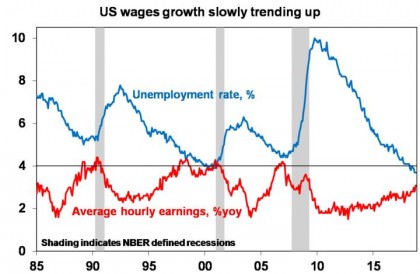
The US economy is very strong as evidenced by consumer confidence at an 18-year high, unemployment at a 49-year low and strong economic growth. With spare capacity being used up wages growth is edging higher as shown in the next chart.

US wage growth slowly trending up
Source: Bloomberg, AMP Capital

Against this backdrop it makes sense for the Fed to continue the process of returning monetary policy and interest rates to something more normal. Naturally, the ongoing removal of monetary stimulus in the US creates consternation and has been periodically occurring ever since former Fed Chair Bernanke started talking about slowing or “tapering” quantitative easing in 2013. In short, investors continue to fear a return to the GFC and so any move to remove monetary support creates periodic bouts of fear. Several points are worth noting about this though. First, the Fed can afford to remain gradual in raising rates. Inflation is at the 2% target, wages growth is a long way from the 4% plus level that preceded past recessions and productivity growth is rising so this will keep growth in unit labour costs down. Meanwhile, intense competition and technological innovation are also continuing to help keep inflation constrained.

Second, on any measure US monetary policy is a long way from being tight. The Fed Funds rate is zero in real terms, it’s well below nominal growth and the yield curve is still positive.

Finally, a return to more normal interest rates is a good thing because it reflects a stronger, more normal economy.

In short, expect gradual 0.25% Fed rate hikes to continue, with the next hike coming in December, and this will cause bouts of market volatility but it’s a long way from crunching the economy in a way that would bring on a deep bear market in shares.

The US/China trade conflict

This issue has been periodically worrying markets since around March. It stepped up a notch after last month’s speech by US Vice President Mike Pence indicating that US gripes with China extend beyond trade which led many to talk of a new Cold War – the implication of which is less trade and occasional military tensions which implies lower economic growth and lower price to earnings multiples. However, it’s still not as bad as it looks.

First, so far only 12% of US imports have been subject to a tariff hike averaging 15%, which is equivalent to an average tariff hike of 1.8% across all imports. So it’s a non-event compared to 1930 which saw a 20% tariff hike on all imports.

Second, while initially the US seemed to be picking trade fights with all major countries it has since renegotiated trade agreements with South Korea and Canada/Mexico and is negotiating with Europe and Japan. This tells us Trump is not interested in trade wars with everyone and that he is not anti-trade per se but wants “fairer trade” for the US.

Third, while Trump has threatened more tariff hikes on China if it retaliates it’s noteworthy that China has not fully retaliated and has been cutting tariffs and announcing more protections for intellectual property. This may help defuse the tensions a bit.

Fourth, while Trump’s comments expressing optimism about a deal with China should be treated with scepticism as they came just before the US midterm elections, they do highlight cause for optimism that a deal will be reached eventually. At least Trump and Xi are talking and Trump’s optimistic comments ahead of the midterms effectively tells us that he is aware that the trade issue is harming the stock market and potentially the economy. The latter in turn suggests that he wants a deal well before he faces re-election in 2020. So, while it may be premature to expect a deal when Xi and Trump meet later this month, a deal is likely well ahead of the 2020 elections. With China already lowering tariffs, improving intellectual property protections and softening joint venture requirements the outlines of a deal are starting to become apparent and Chinese Vice President Wang has indicated China is ready to negotiate with the US.

The US midterm elections – no surprises

The US midterm elections saw the Democrats win control of the House and Republicans retain the Senate which was what had been indicated by the polls and betting markets. So, it provided no surprises – in contrast to Brexit and Trump’s 2016 win! While the Democrat House is likely to prevent Trump from cutting taxes any further it won’t be able wind back last year’s tax cuts, reverse Trump’s deregulation of the economy or change his trade policy. But there is some chance that Trump and the Democrats may agree on infrastructure spending. While the Democrat House will likely set up committees to investigate Trump and consider impeachment charges, it’s very unlikely to get the required 67 out of 100 senate votes to remove him from office unless he is shown to have done something really bad. All up, while there may be some skirmishes around shutdowns and debt ceilings, the midterm outcome could be positive because it means less policy uncertainty.

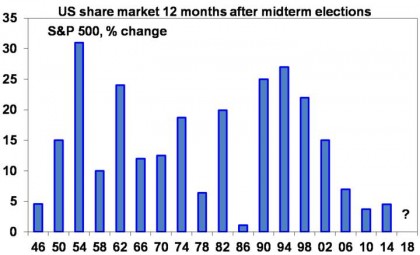
On average, US Presidents have lost 29 House seats in their first midterm election. Clinton lost 54 and Obama lost 63. Trump looks to have lost around 34 but only needed to lose 23 to lose control of the House so what has happened is not unusual. What’s more the Republicans look to have increased their Senate majority so it’s not all bad for Trump. More broadly, it should be noted that “divided government” is the norm in the US. Perhaps the biggest risk is that Trump takes it personally and ramps up the populism, but if he wants to get re-elected in 2020 (which he does) then he won’t want to do anything that damages the economy and amongst other things this points to cutting a deal with China and getting the tariffs removed. Since 1946 the US S&P 500 has risen in the 12 months after all midterm elections – probably because the president starts to focus on re-election and so tries to boost the economy.


Source: Bloomberg, AMP Capital

US tech stocks

Having accounted for a big chunk of US share market gains this year the US tech sector has corrected around 13%, but that still leaves it vulnerable to relatively high valuations (Nasdaq is on a PE of 42 times), sales growth slowing down for some of them and the prospect of increasing regulation. However, we have not seen anything like the tech boom euphoria of around 1999/2000 so a crash like back then is unlikely. Our base case is that the US share market will start to see a rotation from expensive tech to cheap cyclical stocks (with many trading on forward PE’s of less than ten times).

Eurozone worries – German and Italy

Fears that the Eurozone is about to blow apart causing financial mayhem and threatening global growth have been with us since the Eurozone crisis that started in 2010. Lately the fear is that populist governments will take countries out of the Euro. This started with Greece in 2015. It was an issue last year but then pro-Euro parties and candidates won in various elections. This year it’s been an issue with Italy particularly, as its populist government sought a wider budget deficit, and Germany with Angela Merkel indicating she will step down as Chancellor in 2021. In terms of Italy, there will no doubt be a conflict between the European Commission and Italy over the size of its planned budget deficit but don’t expect it to go too far as the deficit is not outlandish and German and France won’t want to embolden the Eurosceptics in Italy by pushing back too hard.

In terms of Germany, the poor performances of the governing German grand coalition parties the Christian Democratic Union (CDU), the Christian Social Union and the Social Democrat Party (SPD) at state elections do not signal a threat to the Euro. First, comments by SPD leader Nahles indicate the grand coalition is not under imminent threat. Second, Germany’s budget surplus and falling public debt indicate plenty of scope to provide fiscal stimulus, which would be positive for Germany and the Eurozone and provide an electoral boost for the grand coalition partners. Thirdly, German Euroscepticism is not on the rise. In fact, support for the Euro in Germany has risen to 83% and it was support for the pro-Euro Greens that surprised in Bavaria and Hesse, not support for the Alternative for Deutschland. Finally, a new election is unlikely as both the CDU and SPD have seen a loss of support, so they aren’t going to back an early election. So those looking for a breakup of the Euro can keep looking.

Oil prices – back down again

In early October world oil prices reached their highest since 2014 with West Texas Intermediate topping $US76/barrel with talk it was on its way to $US100 on the back of strong demand and supply threats including impending US sanctions on Iran. This in turn was adding to concerns about the impact on global economic growth and rising inflation. However, since then the oil price has fallen by nearly 19%. US sanctions on Iran have started but with little new impact as Iranian oil exports had already fallen and the US granted waivers to allow eight countries – including Japan, China, India, Taiwan and South Korea – to continuing importing Iranian oil. The Iranian export cutbacks at a time of threats to production from Venezuela and Libya leaves a now-tight global oil market at risk of higher prices, but for now the threat has receded a bit.


Source: AMP Capital 8 November 2018

Important notes: While every care has been taken in the preparation of this article, AMP Capital Investors Limited (ABN 59 001 777 591, AFSL 232497) and AMP Capital Funds Management Limited (ABN 15 159 557 721, AFSL 426455) makes no representations or warranties as to the accuracy or completeness of any statement in it including, without limitation, any forecasts. Past performance is not a reliable indicator of future performance. This article has been prepared for the purpose of providing general information, without taking account of any particular investor’s objectives, financial situation or needs. An investor should, before making any investment decisions, consider the appropriateness of the information in this article, and seek professional advice, having regard to the investor’s objectives, financial situation and needs. This article is solely for the use of the party to whom it is provided.

At its meeting today, the Board decided to leave the cash rate unchanged at 1.50 per cent.

The global economic expansion is continuing. A number of advanced economies are growing at an above-trend rate and unemployment rates are low. Growth in China has slowed a little, with the authorities easing policy while continuing to pay close attention to the risks in the financial sector. Globally, inflation remains low, although it has increased due to both higher oil prices and some lift in wages growth. A further pick-up in inflation is expected given the tight labour markets and, in the United States, the sizeable fiscal stimulus. One ongoing uncertainty regarding the global outlook stems from the direction of international trade policy in the United States.

Financial conditions in the advanced economies remain expansionary but have tightened somewhat recently. Equity prices have declined and yields on government bonds in some economies have increased, although they remain low. There has also been a broad-based appreciation of the US dollar this year. In Australia, money-market interest rates have declined recently, after increasing earlier in the year. Standard variable mortgage rates are a little higher than a few months ago and the rates charged to new borrowers for housing are generally lower than for outstanding loans.

The Australian economy is performing well. Over the past year, GDP increased by 3.4 per cent and the unemployment rate declined to 5 per cent, the lowest in six years. The forecasts for economic growth in 2018 and 2019 have been revised up a little. The central scenario is for GDP growth to average around 3½ per cent over these two years, before slowing in 2020 due to slower growth in exports of resources. Business conditions are positive and non-mining business investment is expected to increase. Higher levels of public infrastructure investment are also supporting the economy, as is growth in resource exports. One continuing source of uncertainty is the outlook for household consumption. Growth in household income remains low, debt levels are high and some asset prices have declined. The drought has led to difficult conditions in parts of the farm sector.

Australia’s terms of trade have increased over the past couple of years and have been stronger than earlier expected. This has helped boost national income. While the terms of trade are expected to decline over time, they are likely to stay at a relatively high level. The Australian dollar remains within the range that it has been in over the past two years on a trade-weighted basis, although it is currently in the lower part of that range.

The outlook for the labour market remains positive. With the economy growing above trend, a further reduction in the unemployment rate is expected to around 4¾ per cent in 2020. The vacancy rate is high and there are reports of skills shortages in some areas. Wages growth remains low, although it has picked up a little. The improvement in the economy should see some further lift in wages growth over time, although this is still expected to be a gradual process.

Inflation remains low and stable. Over the past year, CPI inflation was 1.9 per cent and, in underlying terms, inflation was 1¾ per cent. These outcomes were in line with the Bank’s expectations and were influenced by declines in some administered prices due to changes in government policies. Inflation is expected to pick up over the next couple of years, with the pick-up likely to be gradual. The central scenario is for inflation to be 2¼ per cent in 2019 and a bit higher in the following year.

Conditions in the Sydney and Melbourne housing markets have continued to ease and nationwide measures of rent inflation remain low. Growth in credit extended to owner-occupiers has eased but remains robust, while demand by investors has slowed noticeably as the dynamics of the housing market have changed. Credit conditions are tighter than they have been for some time, although mortgage rates remain low and there is strong competition for borrowers of high credit quality.

The low level of interest rates is continuing to support the Australian economy. Further progress in reducing unemployment and having inflation return to target is expected, although this progress is likely to be gradual. Taking account of the available information, the Board judged that holding the stance of monetary policy unchanged at this meeting would be consistent with sustainable growth in the economy and achieving the inflation target over time.

Source: Reserve Bank of Australia, November 2nd, 2018

Enquiries

Media and Communications
Secretary’s Department
Reserve Bank of Australia
SYDNEY

Phone: +61 2 9551 9720
Fax: +61 2 9551 8033

Email: rbainfo@rba.gov.au

If you’re interested in living a low waste lifestyle, the best place to start is your kitchen. We waste food every day, but there are easy ways to lessen that impact without having to become a totally different person.

Simple shifts in daily habits can make all the difference later down the line. Store your food properly so you don’t have to throw it away so quickly. Only buy what you need – make lists, plan meals, measure ingredients. Understand how expiration dates work so you don’t throw away food that’s still good to eat. Most importantly, look for little moments in your cooking process to revise. Below we’re sharing a few ways to reduce food waste…

10 Ways to Reduce Food Waste Daily

STOCK UP ON STOCK

Keep veggie scraps and trimmings in a bag in the freezer when you cook. You can use this later as the base for a flavorful stock. Follow this simple recipe. You can incorporate the stock into various dishes — like grains and sauces — or you can sip it on its own.

DON’T STOP AT THE STEM

Make sure you use as much of your fresh ingredients as possible when cooking. Broccoli stems taste great roasted. Beet leaves make for an excellent salad. Carrot tops can be used to make pesto. Even celery leaves can be candied for a sophisticated garnish.

MAKE FRIENDS WITH THE FREEZER

There are so many things can be kept in the freezer so they stay fresh longer. Freeze pantry items like flour and nuts, wedges of hard cheese, pre-chopped veggies, and even soup saved in single serving portions.

SAVE CITRUS PEELS

Use the peels to make homemade countertop cleaner. The peels can also be candied and saved in the freezer to use later in baking, cocktails or as a flavorful homemade snack.

WHEN ALL ELSE FAILS, FRITATTA

Basically, every restaurant leftover can be thrown into a frittata. Use leftover veggies or veggie scraps, wilting herbs, and uneaten dinner remnants to add texture and flavor. Learn how to make a frittata here.

HANDLE YOUR HERBS

When fresh herbs start to wilt, chop them up and blend them with grass-fed butter, roll it into a tube with reusable wax paper and slice off pieces when you cook. You can also mix them with oil and make an infusion that doesn’t really go bad (because oil is a natural preservative), or make a pesto or chimichurri and freeze the sauce in an ice cube tray to have single-serving portions available to cook with.

REPURPOSE YOUR FRUITS

If you bought too much at the farmers market don’t wait for them to go bad; instead, find another way to use them. Make jam with berries, get into canning, or freeze them at peak ripeness and use in a smoothie. Frozen fruit can easily be taken from freezer to baking dish for a summery cobbler at any part of the year.

PICKLE IT

Use your extra veggies and pickle them, done right they will last a long time. The fermentation process makes pickles prime food for a healthy gut. Learn how to make quick pickles here.

USE THOSE COFFEE GROUNDS

If you make coffee every morning, save the brewed coffee grounds in the freezer and make into a homemade body scrub. This recipe only requires two ingredients.

DONATE WHAT YOU DON’T USE

If kitchen DIY isn’t your thing, save your fruit and veggie scraps in a bag in the freezer, when it’s full donate to a community compost.

Source : Foodmatters September 2018 

Reproduced with the permission of the Food Matters team. This article by THE CHALKBOARD MAG  was originally published at www.foodmatters.com/article/10-brilliant-ways-to-reduce-food-waste-daily


Important:
This provides general information and hasn’t taken your circumstances into account.  It’s important to consider your particular circumstances before deciding what’s right for you. Although the information is from sources considered reliable, we do not guarantee that it is accurate or complete. You should not rely upon it and should seek qualified advice before making any investment decision. Except where liability under any statute cannot be excluded, we do not accept any liability (whether under contract, tort or otherwise) for any resulting loss or damage of the reader or any other person. 

Any information provided by the author detailed above is separate and external to our business and our Licensee. Neither our business, nor our Licensee take any responsibility for any action or any service provided by the author.

Any links have been provided with permission for information purposes only and will take you to external websites, which are not connected to our company in any way. Note: Our company does not endorse and is not responsible for the accuracy of the contents/information contained within the linked site(s) accessible from this page.

Residential property has long been a major store of wealth for average Australians.

The home remains the primary assets for the majority of people and the property market – particularly in major cities – has generally been kind for those who were in the market over the past decade or so.

But with the ageing of the population, the percentage of wealth locked up in residential property ($500 billion in home equity is held by people over 65) is both a blessing and a challenge.

According to the last Intergenerational Report in 2015, the number of people in Australia aged between 65 and 84 is forecast to double by 2054 to around 7 million, while the number of people over 85 is expected to more than quadruple.

There is no disputing that owning your own home is a foundational step on the pathway to providing for a comfortable retirement. But the problem is perfectly captured for older Australians with the expression “asset rich but income poor”.

The challenge for many in the post-war, baby boomer generation, is that while the house value may have risen well beyond their expectations, you can’t use it to pay for the groceries, house repairs or a car that needs replacing.

Downsizing has its advocates but comes with lifestyle challenges such as forming new friends and community contacts. So it is no surprise that there is considerable interest in developing a viable suite of products to release the equity locked up in the family home.

While the need is obvious, the solution less so, and products like reverse mortgages do not enjoy good reputations. A recent review by ASIC of reverse mortgage products acknowledged that a common view amongst retirees, and even among finance brokers and lenders, tends to be that equity release products take advantage of vulnerable elderly people.

That certainly accords with a personal experience of reverse mortgages courtesy of a family friend who, with her husband, took out a small ($50,000) reverse mortgage against the equity of their mortgage-free home.

It certainly helped provide some short-term cash and lifestyle enjoyment, but after the husband developed cancer and passed away, an early exit condition was triggered resulting in a massive bill that wiped out almost all their household savings, and left the wife wholly dependent on the age pension to live.

The ASIC review of the reverse mortgage market came after government changes in 2012 to strengthen consumer protections, including the provision of a no negative equity guarantee – that is the borrower cannot be required to repay more than the value of the secured property at the end of the loan.

The ASIC report is interesting in that it found reverse mortgages were satisfying the immediate or short-term needs of borrowers, as did the case study above, and often provided for an improved standard of living while letting people “age in place”.

Where ASIC found challenges in the market was with the long-term impacts on the borrower’s asset position and, in particular, the impact of the cost of the reverse mortgage products that only became fully understood when potentially the home needed to be sold to provide a bond for entry into an aged care facility.

That was highlighted by many of the borrowers surveyed for the ASIC report who indicated that they had not seriously considered their possible future needs.

Reverse mortgages are complex and expensive products for both the borrower and the product provider, and the ASIC report does a good job at explaining the short-term benefits and the long-term risks and lifestyle implications that comes with it.

The ASIC study tested the impact on the remaining home equity by the age of 84 (the average age of entering into aged care) if interest rates on the loan rises and if property prices grew more slowly than expected.

What the ASIC modelling showed was that 63 per cent of borrowers may end up with less equity than the average upfront cost of aged care ($380,000) for one person by the time they reach 84.

The long-term risk for borrowers is that, because of the impact of compound interest, they may seriously compromise their future retirement lifestyle and ability to afford future expenses such as aged care accommodation, medical treatment and day to day living expenses.

To illustrate the costs over the long-term ASIC says the interest charges on an average loan ($118,000) came with an interest bill of $100,963 over 10 years and $180,269 over 15 years.

One of the major warnings ASIC has for borrowers is the focus on short-term objectives with “limited or no attention” being paid to their possible future needs. The review of loan files ASIC did as part of the report found “approximately 92 per cent of the loan files we reviewed did not record the possible future needs of the borrower in sufficient detail and contained no evidence that the broker or lender had discussed how a loan may affect the borrower’s ability to afford future needs”.

The bottom line is that there are no silver bullets that can magically solve the income in retirement question but a clear message from the ASIC report is that you need to carefully balance both today’s needs and your likely future requirements.

The ASIC Moneysmart website provides a comprehensive guide to the risks of reverse mortgages.

Written by Robin Bowerman, Head of Corporate Affairs at Vanguard.

Source : Vanguard September 2018 

Reproduced with permission of Vanguard Investments Australia Ltd

Vanguard Investments Australia Ltd (ABN 72 072 881 086 / AFS Licence 227263) is the product issuer. We have not taken yours and your clients’ circumstances into account when preparing this material so it may not be applicable to the particular situation you are considering. You should consider your circumstances and our Product Disclosure Statement (PDS) or Prospectus before making any investment decision. You can access our PDS or Prospectus online or by calling us. This material was prepared in good faith and we accept no liability for any errors or omissions. Past performance is not an indication of future performance.

© 2018 Vanguard Investments Australia Ltd. All rights reserved.

Important:
Any information provided by the author detailed above is separate and external to our business and our Licensee. Neither our business, nor our Licensee take any responsibility for any action or any service provided by the author.

Any links have been provided with permission for information purposes only and will take you to external websites, which are not connected to our company in any way. Note: Our company does not endorse and is not responsible for the accuracy of the contents/information contained within the linked site(s) accessible from this page.

Your kid may not have listened to anything you’ve said over the past umpteen years, particularly when it came to their dating preferences, coming home on time and cleaning up after themselves.

However, now they’ve landed their first full-time job, there’s a possibility that could change, which might be music to your ears, particularly if you wish you’d had greater guidance around what to do when you started earning a salary.

With that in mind, here are some things you may want to cover off with them (which you could also text to them using shorter bullet points, or screenshot and tag them on Insta, followed by #parentsknowbest).

Things your child needs to know

1.    Your bank account details and tax file number

Your kid will need to give their bank account details to their employer if they want to get paid, so this will no doubt be high on their list of things to do.

On top of that, they’ll need to provide their tax file number as well, because if they don’t, they may end up paying a lot more tax on the income they earn1.

If your child needs a tax file number, they can contact the Australian Taxation Office (ATO) about applying for one.

2.    Whether you can choose your super fund

Super is money set aside during your kid’s working life to support them in retirement. It’s deposited into a fund, where it’s invested to potentially earn interest and grow over time.

Most employees can choose their own super fund but your kid will need to check with their employer or the ATO. If they can choose their fund, they’ll typically have a choice between their employer’s fund or a fund they select themselves.

There are things they’ll need to consider though, such as any fees they might pay, how the fund performs and their super investment preferences. 

In addition, super funds generally offer a few types of insurance cover as well, which your kid can pay for using their super money, so it’s worth them looking into whether it’s something they want.

3.    What tax you’re going to pay on the income you earn

Your kid may not be pleased, but they’ll have to pay income tax on every dollar over $18,200 that they earn. And, on top of that, many taxpayers are also charged a Medicare levy of 2%.

The amount of tax they pay will depend on how much they earn. If they’re not sure how much they’ll fork out, the below table includes income tax rates for the 2018/19 financial year2.

Taxable income

Tax they’ll pay on this income

0 – $18,200

No tax

$18,201 – $37,000

19c for each $1 over $18,200

$37,001 – $90,000

$3,572 plus 32.5c for each $1 over $37,000

$90,001 – $180,000

$20,797 plus 37c for each $1 over $90,000

$180,001 and over

$54,097 plus 45c for each $1 over $180,000

You might also want to point out that if they’re lucky enough to receive an annual bonus, they’ll also pay tax on this (yes, we know, life isn’t fair).

4.    What tax you can claim back when tax time rolls around

If your kid spends some of their own money on work-related expenses (work uniforms, safety equipment, or travel costs to attend training for instance), there is some good news. At the end of the financial year, they may be able to claim some of this money back when they do their tax return.

Remind them that they’ll need to have a record of these expenses, such as receipts, but in some instances if the total amount they’re claiming is $300 or less, they may not need receipts.

Meanwhile, if their expenses are for both work and personal use, they’ll only be able to claim a deduction for the work-related portion. Perhaps point your kid to the myDeductions tool in the ATO app to save records throughout the year, so they don’t have a bag full of receipts to go through.

Meanwhile, tell them if they’re lodging their own tax return, that they have until 31 October to lodge it each year, or maybe longer if they would prefer to use a tax agent.

5.    What’s in your contract and what you’re entitled to

An employment contract (which can be in writing or verbal) is an agreement between your kid and their employer which sets out the terms and conditions of their employment. It’s a good idea to know what’s in their contract should questions ever arise around what they’re actually entitled to.

Regardless of whether your kid signs something or not, their contract cannot provide for less than the legal minimum, set out in Australia’s National Employment Standards, which covers things such as3:

  • Maximum weekly hours of work

  • Requests for flexible working arrangements

  • Parental leave and related entitlements

  • Annual leave

  • Personal/carer’s leave and compassionate leave

  • Community service leave

  • Long service leave

  • Public holidays

  • Notice of termination and redundancy pay.

While National Employment Standards apply to all employees covered by the national workplace relations system, only certain entitlements will apply to casual employees. For more information, check out the Australian Government Fair Work Ombudsman website.

6.    How to read your payslip so you’re across potential errors

Pay slips have to cover details of an employee’s pay for each pay period. Below is a list of what a pay slip typically includes:

  • Your kid’s before-tax pay (also known as gross pay)

  • Your kid’s after-tax or take-home pay (also known as net pay)

  • What amount of money your kid has paid in tax

  • The amount of super their employer has taken out of their pay and put into their super fund

  • HELP/HECS debt repayments (if they have an education loan).

Meanwhile, mistakes can happen, so if anything doesn’t look right, tell them to chat to their employer and if your kid has raised an issue they’re not satisfied with, they can also contact the Fair Work Ombudsman.

7.    How much super is coming out of your pay and if it’s correct

If your kid is earning over $450 (before tax) a month, no less than 9.5% of their before-tax salary should generally be going into their super under the Superannuation Guarantee scheme.

If they’re under 18 and work a minimum of 30 hours per week, they may still be owed super. For this reason, it’s important that they check their payslip and if something doesn’t look right, that they speak to their boss or contact the ATO.

Another thing to note, is if your kid does change jobs, this is when super accounts can start to multiply. It might not sound like a big deal, but multiple accounts can often mean multiple sets of fees, so they may want to ensure that they only have one account rather than many.

8.    How to budget and save so you can get what you want in life

Budgeting may be another point that makes your kid’s eyes glaze over but jotting down into three categories – what money is coming in, what cash is required for the mandatory stuff and what dough might be left over for their social life (or saving for their future), could really go a long way.

If they’re paying off debts, or on a more exciting note, want to buy a car or go on a holiday, getting a grip on their money habits early on could see them get a lot more out of life.

Please contact us on Phone: 07 5641 4134 if we can be of further assistance .

Source : AMP October 2018 

Money Smart – Starting work (Get a tax file number)
Australian Taxation Office – Individual income tax rates
Australian Government Fair Work Ombudsman – Introduction to the National Employment Standards

Important:
This provides general information and hasn’t taken your circumstances into account.  It’s important to consider your particular circumstances before deciding what’s right for you. Although the information is from sources considered reliable, we do not guarantee that it is accurate or complete. You should not rely upon it and should seek qualified advice before making any investment decision. Except where liability under any statute cannot be excluded, we do not accept any liability (whether under contract, tort or otherwise) for any resulting loss or damage of the reader or any other person. 

Any information provided by the author detailed above is separate and external to our business and our Licensee. Neither our business, nor our Licensee take any responsibility for any action or any service provided by the author.

Any links have been provided with permission for information purposes only and will take you to external websites, which are not connected to our company in any way. Note: Our company does not endorse and is not responsible for the accuracy of the contents/information contained within the linked site(s) accessible from this page.


Like many kids growing up in the 1970s I was taught to eat everything on my plate. It was good advice, particularly as an active kid living in a rural setting. Through my teenage years, I had more discretion and the choices I made left a lot to be desired. Now, with a recognition that my metabolism isn’t that of an active teenager, I’m making more healthy decisions about what I choose to eat and what I choose to leave on the plate.

A similar discussion has been evolving around environmental, social and governance (ESG) investing. Is it better to ‘eat everything’ or can leaving out undesirable exposures improve investment outcomes?

Here’s a four-step approach that can help investors navigate the options.

  1. Define your goals

    Approaches to ESG investing can vary widely depending on investors’ age and background. CFA Institute research suggests that women are more interested in ESG issues than men. And millennials are more interested than baby boomers.

    Some investors may take a purely financial approach by targeting companies with favourable ESG practices to enhance returns or reduce risks.

    Other investors may make a values-based judgement to exclude exposures to industries like tobacco, alcohol, gambling or munitions.

  2. Understand your options

    Portfolio screening can take two main forms—’exclusionary’, which removes stocks or sectors or ‘inclusionary’, which up-weights ‘good actors’ and down-weights ‘bad actors’. It’s the difference between removing all the unhealthy food from your plate or reducing the portion size. Many investors may be driven by a values-based judgement to divest from companies whose activities they disagree with, even if it means suffering a penalty in the form of a more concentrated portfolio and performance deviations.

    Advocacy seeks to influence positive change through the power of voting rights, rather than removing yourself from the conversation by divesting. One of the big ESG debates is whether it’s better for asset owners to ‘vote with their feet’, or ‘vote with their vote’. Advocacy can be an effective way of maximising financial returns without compromising diversification.

    ESG integration incorporates risk exposure into the investment process. A company may be subject to a high degree of ESG risk, but if the price reflects that, then it may still form part of an investment portfolio. Many super and managed funds follow a similar approach.

    Impact investing involves allocating capital to generate both a social or environmental impact and a financial return. Also referred to as triple-bottom line investing, it remains a small component of the ESG universe, and carries more complexity in the form of niche funds accessed through private investment vehicles.

  3. Decide a course of action

    Informed investors can then choose a portfolio solution that best aligns with their ESG goals and the available options.

  4. Assess your strategy regularly

    The ESG investment landscape is far from static. Not only are investor preferences changing, investment options are rapidly evolving, supported by a growing recognition that it’s possible to do well while doing good.

    Much like my changing approach to healthy eating, a systematic approach to assessing your strategy can keep your goals in close alignment with your investment portfolio.

Please contact us on Phone: 07 5641 4134 if you seek further assistance on this topic .


Written by Aidan Geysen, Head of Investment Strategy Group at Vanguard.

Source : Vanguard August 2018 

Reproduced with permission of Vanguard Investments Australia Ltd

Vanguard Investments Australia Ltd (ABN 72 072 881 086 / AFS Licence 227263) is the product issuer. We have not taken yours and your clients’ circumstances into account when preparing this material so it may not be applicable to the particular situation you are considering. You should consider your circumstances and our Product Disclosure Statement (PDS) or Prospectus before making any investment decision. You can access our PDS or Prospectus online or by calling us. This material was prepared in good faith and we accept no liability for any errors or omissions. Past performance is not an indication of future performance.

© 2018 Vanguard Investments Australia Ltd. All rights reserved.

Important:
Any information provided by the author detailed above is separate and external to our business and our Licensee. Neither our business, nor our Licensee take any responsibility for any action or any service provided by the author.

Any links have been provided with permission for information purposes only and will take you to external websites, which are not connected to our company in any way. Note: Our company does not endorse and is not responsible for the accuracy of the contents/information contained within the linked site(s) accessible from this page.


How do you behave in the face of fear? Do you run towards danger, or turn and flee? Knowing how you and others react to extreme situations might seem remote from the world of investment, but could have a lot to do with what separates the great investors from the rest of us.

Humans have a tendency to be more scared of the things they cannot control. For example, you are statistically much more likely to die in a road accident in Australia than you are in a plane crash anywhere in the world. But it is most unlikely that you feel the same apprehension pulling away from the kerb as you do when your flight gathers pace on the runway.

In the same way, we fear losing our money in an uncontrolled market crash even though this is actually rather less likely than losing it through poor decisions or even simply inertia.
Before anyone makes an investment, they should consider what type of investor they are, how they cope with their emotions and what kind of appetite they have for risk. The conventional approach to doing this is often a box-ticking exercise which asks anodyne questions like; “are you prepared to take a little more risk for the possibility of a little more return?”

What a basic box-ticking exercise fails to take account of is the messy humanity of investors. We are all prone to changing our minds, inconsistency and a general propensity to react more to emotions than rational analysis when making investment decisions.

Novice investors need to understand that there are different types of risk and that not all of them are bad. In many people’s minds, risk is now associated with the reckless behaviour caricatured in movies like the ‘Margin Call or ‘The Wolf of Wall street’. We tend to assume that vivid disasters, like the financial crisis, are more likely than mundane slow-motion catastrophes like the value of our investments being eroded over time by inflation. They are not.

An inexperienced or apprehensive investor should overcome this aversion to risk and be prepared to embrace the risks they can control. They should understand that being too cautious with their investments is a risk in itself and could mean they fail to achieve their financial goals. Investing money in what are perceived to be riskier assets might actually be safer than putting it in the bank.

To make matters worse, humans are inconsistent in their inconsistency. This can make it near impossible to pigeon-hole investors into neat high, medium and low-risk categories. Most people would immediately recognise themselves as a glass-half-empty, or glass-half-full type of person. But consider this study. One group of people is shown an empty glass which is then half filled. The majority describe the glass as half full. Another random group of people is shown a full glass from which half the contents are subsequently poured. The majority of these people describe the glass as half empty.

The way a question is phrased and the context in which it is asked clearly influences our perception of it and therefore our response. On tackling your first profiling questionnaire, you might feel apprehensive and therefore more cautious, or perhaps more bold than usual. This could influence your responses to the risk-profiling questions you are asked.

The same instinct that made early man run from a sabre-toothed tiger thousands of years ago, gives professional investors sweaty palms today. What else explains the instant market reaction whenever a company reports disappointing results, or when a negative rumour circulates? How can these well-trained, highly-professional investors suddenly panic and sell a carefully-researched investment that moments before they believed in implicitly?

It is clear that we cannot reverse thousands of year of evolution so it’s better to understand the power of these instincts and take account of them at those crucial moments when decisions are made.

Source : Fidelity September 2018

Reproduced with permission of Fidelity Australia. This article was originally published at https://www.fidelity.com.au/insights/investment-articles/how-do-you-behave-in-the-face-of-fear/

This document has been prepared without taking into account your objectives, financial situation or needs. You should consider these matters before acting on the information. You should also consider the relevant Product Disclosure Statements (“PDS”) for any Fidelity Australia product mentioned in this document before making any decision about whether to acquire the product. The PDS can be obtained by contacting Fidelity Australia on 1800 119 270 or by downloading it from our website at www.fidelity.com.au. This document may include general commentary on market activity, sector trends or other broad-based economic or political conditions that should not be taken as investment advice. Information stated herein about specific securities is subject to change. Any reference to specific securities should not be taken as a recommendation to buy, sell or hold these securities. While the information contained in this document has been prepared with reasonable care, no responsibility or liability is accepted for any errors or omissions or misstatements however caused. This document is intended as general information only. The document may not be reproduced or transmitted without prior written permission of Fidelity Australia. The issuer of Fidelity Australia’s managed investment schemes is FIL Responsible Entity (Australia) Limited ABN 33 148 059 009. Reference to ($) are in Australian dollars unless stated otherwise.
© 2018. FIL Responsible Entity (Australia) Limited.

Important:
This provides general information and hasn’t taken your circumstances into account. It’s important to consider your particular circumstances before deciding what’s right for you. Any information provided by the author detailed above is separate and external to our business and our Licensee. Neither our business, nor our Licensee take any responsibility for any action or any service provided by the author.

Any links have been provided with permission for information purposes only and will take you to external websites, which are not connected to our company in any way. Note: Our company does not endorse and is not responsible for the accuracy of the contents/information contained within the linked site(s) accessible from this page
Introduction

Some commentators claim shares are way overvalued and so a crash is inevitable. As always, it’s a lot more complicated, but given the current turbulence in share markets it’s worth having a look at whether share markets are expensive or not as a guide to how vulnerable we are to further falls. More broadly, valuation measures provide a guide to future return potential.

Why valuation matters – the cheaper the better

First a bit of background on valuation. A valuation measure for an asset is basically a guide to whether it’s expensive or cheap compared to the income it generates. Simple valuation measures are price to earnings ratios (PEs) for shares (the lower the better) and yields, ie the ratio of dividends, rents or interest payments to the value of the asset (the higher the better). An obvious example of where the starting point valuation matters critically is cash. For some years now, bank term deposit rates have been historically low meaning returns are low and value is poor.

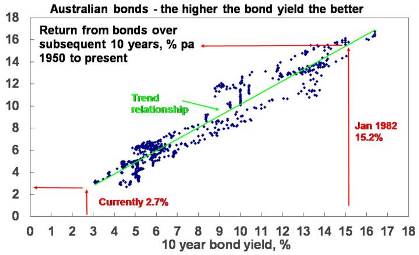
For government bonds the yield is similarly a good guide to value. Over the medium term the main driver of the return a bond investor will get is what bond yields were when they invested. While the relationship is not perfect, it can be seen in the next chart – which shows a scatter plot of Australian 10-year bond yields (horizontal axis) against subsequent 10-year returns from Australian bonds based on the Composite All Maturities Bond index (vertical axis) – that the higher the bond yield, the higher the subsequent 10-year return from bonds.

View larger image

Source: Global Financial Data, Bloomberg, AMP Capital

Again, despite rising a bit in the last two years, bond yields remain low so low returns should be expected from bonds.

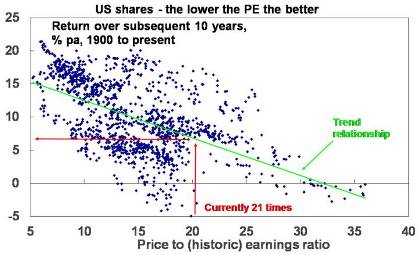
For shares a similar relationship holds. The following chart shows a scatter plot of the PE ratio for US shares since 1900 (horizontal axis) against subsequent 10-year total returns (ie dividends and capital growth) from shares. While it is not as smooth as with bonds as there is more involved in shares, it indicates a negative relationship, ie when share prices are relatively high compared to earnings subsequent returns tend to be relatively low.

View larger image

   Source: Global Financial Data, Bloomberg, AMP Capital

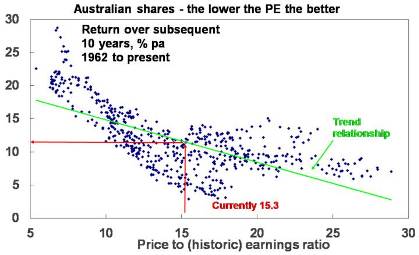
The next chart shows the same for Australian shares. Again, there is the expected negative relationship between the level of the PE and subsequent total returns (based on the All Ords Accumulation index).

View larger image

   Source: RBA, Global Financial Data, AMP Capital

The key is that the starting point valuation matters. The higher the yield (or the lower the PE) the better.

Complications to be aware of

Of course, there are several pitfalls with valuation measures that investors should be aware of:

  • Sometimes assets are cheap for a reason (value traps). This is more often associated with individual shares, eg, a tobacco company subject to an impending law suit. These traps can really only be picked up by thorough research. 

  • Valuation measures are a poor guide to timing. Eg, if an investor sold shares short in 1996 when Fed Chair Greenspan warned of “irrational exuberance” they would have lost out as shares rose for another four years. Australian residential property has been overvalued for almost 15 years but that’s been no guide to timing a fall in home prices. The key is to have a thorough investment process that depends on more than just valuations. 

  • There is a huge range of share market valuation measures. For example, the “earnings” in the PE calculation can be earnings reported over the last 12 months, consensus earnings expectations for the year ahead or earnings that have been smoothed to remove cyclical distortions. All have their pros and cons. For example, the historic PE is based on actual data with no forecasting, but it can give the wrong signal during a recession as earnings may collapse more than share prices and so the PE may not give a buy signal. 

  • Finally, the appropriate level of valuation can vary depending on the environment. For example, in a period of low inflation and low interest rates it’s well-known that assets can trade on lower yields as the interest rate/yield structure in the economy falls. This in turn means higher PEs. So low inflation, say down to around 2%, can be good for shares via higher PEs. But if inflation goes from “low” to deflation it can be bad as it tends to be associated with poor growth and so shares trade on lower PEs. 

The message from all this is that share market valuation is important, but you ideally need to assess it along with other indicators if you are trying to time market moves. The key is to acknowledge that when a range of valuations measures are at an extreme then they are probably providing a signal that should not be ignored.

So what are current share market valuations signalling?

Let’s start with price to earnings ratios using historic earnings, ie, earnings reported for the last 12 months. In the US, this PE is currently around 21 times which is consistent with subdued medium-term returns going by the second scatter plot on the previous page. But in Australia at around 15.3 times it’s consistent with reasonable medium term returns according to the third scatter plot on the previous page. Of course, current levels for historic PEs in the US and Australia have both been associated with a very wide range in terms of subsequent returns historically. Furthermore, PEs based on historic earnings are not totally reliable given the cyclical volatility in reported earnings.

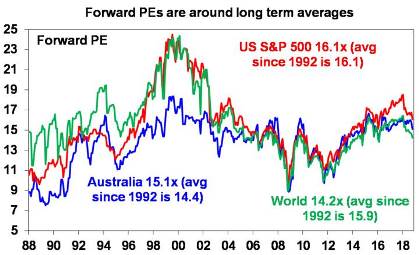
Given this, calculating the price to earnings ratio using 12 month ahead projected earnings are arguably more useful. These are shown in the next chart for global shares, the US and Australia. None are way out of line with their averages since the early 1990s but in a relative sense US shares on a forward PE of 16.1 times remain a bit expensive albeit less so than earlier this year, and global shares are a bit cheap trading on a forward PE of 14.2 times thanks to cheap markets outside the US.

View larger image

   Source: Thomson Reuters, AMP Capital

In emerging countries, the average forward PE is quite low at around 10 times.

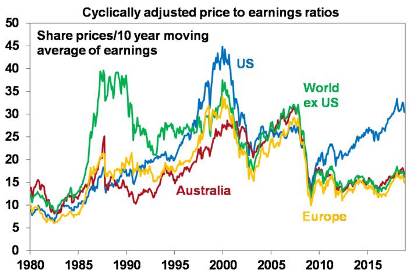
The next chart looks at price to earnings ratios calculated using a 10-year moving average of earnings, which is often referred to as the Shiller PE (after economist Robert Shiller) or the cyclically adjusted PE. On this measure US shares are clearly more expensive than since the tech boom. However, markets outside the US, including Europe and Australia, are not expensive at all. It should also be allowed that the 10-year moving average earnings calculation is distorted by the earnings slump a decade ago. As the 2008 and 2009 earnings slump starts to fall out of the calculation, the US Shiller PE will start to fall. But still there is better value elsewhere.

View larger image

   Source: Global Financial Data, AMP Capital

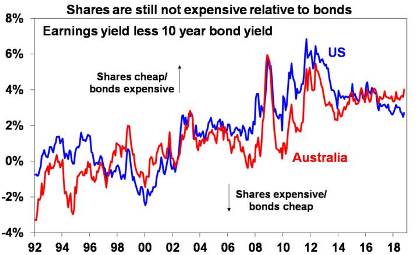
Finally, it’s worth looking at share market valuations that allow for the fact we are still in an environment of relatively low interest rates and bond yields. The next chart subtracts the 10-year bond yield for the US and Australia from their earnings yield (using forward earnings). This basically gives a sort of a proxy for the equity risk premium – the higher the better. While this gap is well down from its post GFC highs, it’s still reasonable, suggesting shares are still more attractive than bonds. Of course, this will change as bond yields drift higher, but as we have seen over the last two years since bond yields bottomed, this is likely to remain a relatively slow process.

View larger image

   Source: Thomson Reuters, AMP Capital

The overall impression is that measured against their own history developed country share markets are not dirt cheap, but they haven’t been for several years now and they are not at overvalued extremes. The main risk relates to the US share market, but other markets’ valuations are reasonable. So while the pull back in shares we have seen over the last few weeks could go further yet – as worries around the US interest rates, US/China trade, rising oil prices, problems in the emerging world, President Trump and the US mid-term elections and the Italian budget remain – at least most share markets are not trading at overvalued extremes which would potentially accentuate downside risks.


Source: AMP Capital 24 October 2018

Important notes: While every care has been taken in the preparation of this article, AMP Capital Investors Limited (ABN 59 001 777 591, AFSL 232497) and AMP Capital Funds Management Limited (ABN 15 159 557 721, AFSL 426455) makes no representations or warranties as to the accuracy or completeness of any statement in it including, without limitation, any forecasts. Past performance is not a reliable indicator of future performance. This article has been prepared for the purpose of providing general information, without taking account of any particular investor’s objectives, financial situation or needs. An investor should, before making any investment decisions, consider the appropriateness of the information in this article, and seek professional advice, having regard to the investor’s objectives, financial situation and needs. This article is solely for the use of the party to whom it is provided.