While interest rates in the US are rising, Australia’s interest rates remain stubbornly low. That flows through to subdued returns from term deposits and government bonds, and many investors continue to be faced with the question of where to invest for income in a low yield environment.

Corporate bonds – debt securities issued by companies – can diversify portfolios and generate a higher income return than term deposits and government bonds. Those are just two of four reasons investors looking for stable income might want to consider them as part of a diversified portfolio.

1. A strong buffer against share market volatility

Corporate bonds can be a lower-risk way to gain exposure to corporates than equities because they pay investors relatively stable cash flows. Corporate bonds and Australian equities are also often negatively correlated: when share values increase corporate bonds fall, and vice versa. So, when investors allocate a part of their portfolio to corporate bonds, it can make their portfolio more ‘defensive’ – returns will be smoother and less volatile, particularly during times of equity market turmoil.

2. Higher income than term deposits and government bonds

Corporate bonds are expected to provide investors with a relatively high excess yield over term deposits and government bonds in the medium term, as illustrated by the chart below, which shows the historical excess yield of the AMP Capital Corporate Bond Fund over term deposits and government debt. However, it should be noted that the AMP Corporate Bond Fund is a managed investment scheme, which has a different risk profile to a bank term deposit. In addition, given sound company fundamentals, corporate bonds are well positioned to benefit from continued recovery in the global economy.
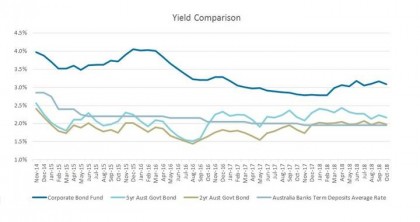

Past performance is not a reliable indicator of future performance.

Source: AMP Capital, Bloomberg. As at October 2018.

3. Risk of capital loss is reduced

Active bond managers use multiple levers to manage downside risk, particularly in a rising interest rate environment. Primary amongst these is the ability of a manager to adjust the bond portfolio’s ‘duration’. Duration measures the sensitivity of a bond’s capital value to a change in interest rates in years.

For example, if a bond has a duration of five years, its price will rise about 5% if interest rates drop by 1%, and its price will fall by about 5% if interest rates rise by 1%. Given this multiplicative outcome, corporate bonds with higher durations carry more risk and have higher price volatility than bonds with lower durations.

Subsequently, when interest rates rise, portfolios with higher duration suffer bigger losses. By managing the fund’s duration – or shortening the fund’s duration – an investment manager can aim to limit the risk of capital loss in a rising interest rate environment.

4. Access to the benefits of diversification

Investors in an actively managed corporate bond fund can spread their portfolio risk by being exposed to a range of issuers, industries and geographies. Typically, when investors have exposure to a large number (upwards of 100) of securities it minimises the impact of a default or systemic event on the portfolio.

Other considerations

Corporate bonds are traditionally considered lower down the risk spectrum than shares. Nevertheless, when investors explore investing in corporate bonds it is prudent to have a focus on investment-grade credit.

It is important to invest in companies with strong or improving corporate fundamentals, a solid management team with a bondholder focus, and where a normalisation of global growth could translate into revenue and earnings growth.


Important note: AMP Capital Funds Management Limited (ABN 15 159 557 721, AFSL 426455) (AMPCFM) is the responsible entity of the AMP Capital Corporate Bond Fund (Fund) and the issuer of the units in the Fund. To invest in the Fund, investors will need to obtain the current Product Disclosure Statement (PDS) from AMP Capital Investors Limited (ABN 59 001 777 591, AFSL 232 497) (AMP Capital). The PDS contains important information about investing in the Fund and it is important that investors read the PDS before making a decision about whether to acquire, or continue to hold or dispose of units in the Fund. Neither AMP Capital, AMPCFM nor any other company in the AMP Group guarantees the repayment of capital or the performance of any product or any particular rate of return referred to in this document. Past performance is not a reliable indicator of future performance. While every care has been taken in the preparation of this document, AMP Capital makes no representation or warranty as to the accuracy or completeness of any statement in it including without limitation, any forecasts. This document has been prepared for the purpose of providing general information, without taking account of any particular investor’s objectives, financial situation or needs. Investors should, before making any investment decisions, consider the appropriateness of the information in this document, and seek professional advice, having regard to their objectives, financial situation and needs.

Author: Steven Hur

Source: AMP Capital 3 December 2018


Important notes: While every care has been taken in the preparation of this article, AMP Capital Investors Limited (ABN 59 001 777 591, AFSL 232497) and AMP Capital Funds Management Limited (ABN 15 159 557 721, AFSL 426455) makes no representations or warranties as to the accuracy or completeness of any statement in it including, without limitation, any forecasts. Past performance is not a reliable indicator of future performance. This article has been prepared for the purpose of providing general information, without taking account of any particular investor’s objectives, financial situation or needs. An investor should, before making any investment decisions, consider the appropriateness of the information in this article, and seek professional advice, having regard to the investor’s objectives, financial situation and needs. This article is solely for the use of the party to whom it is provided.

 

After solid returns and relatively low volatility in 2017, many investors entered 2018 fairly optimistic, however we expected returns would be more constrained and more volatile than they were last year.

Looking at the big picture, global growth was good, we saw relatively low inflation globally and the Australian economy grew at a reasonable rate.

Five big fears

But five big concerns came together to deliver a surprisingly tough year and rough ride for investors in 2018.

  1. Fear of the Fed. The first was what I’ve coined ‘fear of the Fed’. From around February, investors began to fear that the US Federal Reserve would keep raising interest rates until it caused the US economy to fall into recession. The impact was a lot of market volatility. 

  2. President Trump’s trade war: We had the ongoing US-China trade war which started fairly calmly but escalated as the year continued. We recently had a bit of good news on that front with China and the US agreeing at the recent G20 meeting to pause tariff increases until March 1 next year as they continue to negotiate. But fears about the trade war caused a lot of volatility and angst amongst investors and this continues despite the truce.

  3. China slowdown: Chinese growth slowed to 6.5% because of tighter credit, but investors also worried the trade war with the US would slow it further. Concerns around China added to worries about global growth.

  4. Global desynchronisation: Investors became concerned that while the US economy was strong, the rest of the world, including Europe, Japan, China and emerging markets, have slowed down.

  5. US dollar strength: Finally, while a rising US dollar wasn’t that surprising – and it didn’t eclipse its 2016 highs – it has put a lot of pressure on parts of the world that are sensitive to a stronger US dollar, such as emerging market and Asian shares (because of their US dollar-denominated debt).

Muted returns

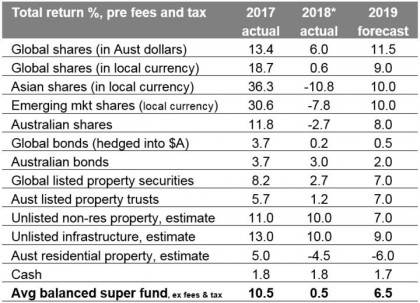
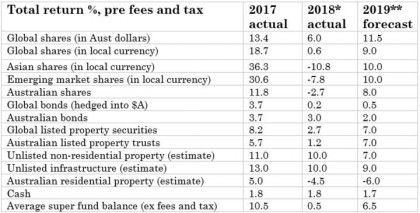
Those five factors came together to give us quite constrained returns out of the major asset classes over 2018 for the year to date to November, as illustrated by the table below.


**Warning: These forecasts are prospective financial information based on various assumptions. The forecasts are predictive in nature, may be affected by inaccurate assumptions or by known or unknown risks and uncertainties, and may differ materially from results ultimately achieved. Source: Thomson Reuters, Morningstar, REIA, AMP Capital

While the table shows global shares rose, this was mainly because the Australian dollar fell. Other share markets had a pretty rough ride. Australian shares fell 2.7%. Emerging markets and Asian shares fell well into negative territory, with declines of 7.8% and 10.8% respectively.

Investors also received restrained returns from bonds, with bond yields rising as the US Federal Reserve raised interest rates. Rising rates and yields, of course, also impacted interest-sensitive parts of the share market like Real Estate Investment Trusts (REITs), which returned just 1.2% for the year (shown in the table as Australian listed property trusts).

The only areas providing good returns were unlisted commercial property and unlisted infrastructure which saw another year of strong returns.

If we come back to Australia, the big drag for property investors was quite sharp falls in Sydney and Melbourne property prices.

Some cause of optimism

Add all that together and it’s been a volatile and pretty constrained environment for investors in 2018.

But to end on a note of optimism, I think there is some light at the end of the tunnel. Despite Australia posting GDP growth of just 0.3% in the September quarter I don’t see us falling into recession, and I believe global growth will hold up, and investment returns should bounce back in 2019.


Author: Dr Shane Oliver, Head of Investment Strategy and Economics and Chief Economist, AMP Capital

Source: AMP Capital 12 December 2018

Important notes: While every care has been taken in the preparation of this article, AMP Capital Investors Limited (ABN 59 001 777 591, AFSL 232497) and AMP Capital Funds Management Limited (ABN 15 159 557 721, AFSL 426455) makes no representations or warranties as to the accuracy or completeness of any statement in it including, without limitation, any forecasts. Past performance is not a reliable indicator of future performance. This article has been prepared for the purpose of providing general information, without taking account of any particular investor’s objectives, financial situation or needs. An investor should, before making any investment decisions, consider the appropriateness of the information in this article, and seek professional advice, having regard to the investor’s objectives, financial situation and needs. This article is solely for the use of the party to whom it is provided.

There may be ways you could adjust your budget to help pay the bills

As living costs continue to rise, many Australians are finding it tough to make ends meet. Here are five red flags that mean you may need to review your personal finances.

1. You find it hard to pay for emergencies

The car breaks down. The hot water system starts leaking. A few roof tiles come down in a storm. Without an emergency fund you could find yourself high and dry if an unexpected problem arises.

If you have any slack in your home loan you could redraw to pay for emergency repairs. But then you’d be using borrowed money, not to mention putting yourself behind on your repayments.

Ideally, as a rough rule of thumb the minimum emergency fund should be around three months of your salary. Don’t forget, if you need to draw on your emergency fund, you’ll need to top it back up again. It’s even easier if you’ve already set up automatic payments. And if you set up your emergency fund in an offset bank account, it will help to reduce the interest you pay on your home loan.

2. You pay interest on an unpaid credit card bill every month

If you can pay off your credit card bill in time, fine. But credit card limits represent temptation that can be hard to resist. One option is simply to get rid of your credit cards and use a debit card instead. But if that’s too extreme, set yourself strict spending limits and make sure you pay off the card before interest starts to accrue.

3. You spend a high proportion of your income on paying your rent or servicing your home loan

If this sounds like you, you’re not alone. An estimated one in five Australians are experiencing mortgage stress1. If you have a home loan, it might be worth talking to your provider about whether you can refinance. And if you’re paying rent, it might be worth looking at solutions like renegotiating your terms or looking at moving to a more affordable area. Either way, professional financial advice can help you look at ways to juggle the family finances.

4. You run out of money before your next pay cheque

It may sound obvious, but the rising cost of living means many Australians are finding it difficult to make their money last the month. If you’re finding yourself in this position, see if there are any savings you can make. If possible, try setting a strict budget and stick to it—taking it one day at a time. 

5. You find it difficult to meet everyday expenses

Putting food on the table. Getting to and from work. Heating and cooling your home. If you’re finding it hard to meet the basic necessities of life it can be easy to feel overwhelmed.

Take a deep breath and start by asking yourself a few questions.

  • Could you save money by shopping around for a better deal from utility and other service providers?

  • Are there any savings you can make elsewhere in your family budget?

  • Are you taking full advantage of any government or employer benefits you’re entitled to?

  • Can you divide your expenditure into essentials and discretionary and set strict limits to help you get back on your feet?

Getting your spending under control…

Unfortunately, illness, redundancy and bereavement can happen at any time, leaving you in financial hardship through no fault of your own.

If you’re an AMP customer we offer support through periods of financial difficulty.

But if you recognise that excessive spending is putting you in a tricky position despite a regular income, there are ways to get your expenditure under control.

  • Instead of continuing with your normal routine, why not try a no-spend challenge — you might be surprised to discover what you learn about how to save money.

  • Instead of going out to the cinema or the new restaurant down the road, why not have a movie night in and invite friends and family?

  • Instead of buying a daily takeaway coffee, why not take a plunger to work and make your own?

  • Instead of using credit, why not think about using a debit card so you’re not spending money you don’t have?

  • Instead of driving to work or taking the train, why not consider cycling or walking part of the way to save money and get fit?

  • Instead of giving in to impulse buys, why not divide your expenses into essential and discretionary—you might be surprised at how much you can save by setting a strict limit on non-essentials.

…and getting the most out of your income

Once you’ve got your spending more under control, you might want to consider looking at ways to maximise your income, such as:

  • claiming all the government benefits you’re entitled to

  • including all your work expenses in your tax return

  • making money on the side of your usual job.

There’s no time like the present to start getting your finances in order and turning those red flags green.

Please contact us on Phone: 07 5641 4134 if you seek further discussion.


Roy Morgan Single Source (Australia)

Source: www.amp.com.au 27 November 2018

Important information: This information is provided by AMP Life Limited. It is general information only and hasn’t taken your circumstances into account. It’s important to consider your particular circumstances before deciding what’s right for you. Read our Financial Services Guide for information about our services, including the fees and other benefits that AMP companies and their representatives may receive in relation to products and services provided to you.

AMP Bett3r Account is issued by AMP Bank Limited ABN 15 081 596 009, AFSL 234517. Consider the terms and conditions available on request by calling 13 30 30 or at amp.com.au/bett3r and whether this product is appropriate for you. Fees and charges apply.

Although the information is from sources considered reliable, AMP does not guarantee that it is accurate or complete. You should not rely upon it and should seek qualified advice before making any financial decision. Except where liability under any statute cannot be excluded, AMP does not accept any liability (whether under contract, tort or otherwise) for any resulting loss or damage of the reader or any other person.

2019 is likely to be an interesting year for the Australian economy. Some of the big drags of recent years are receding but housing is turning down, uncertainty is high around the global outlook and it’s an election year, which will add to uncertainty. This note looks at the main issues around the housing downturn and what it means for the economy and investors.

Australian growth has slowed again

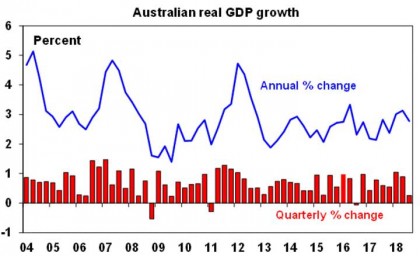
September quarter GDP growth was just 0.3% quarter on quarter or 2.8% year on year and was well below expectations. 


Source: ABS, AMP Capital

It was concerning for two reasons. Firstly, it suggests that the pickup in growth seen in the first half of the year was an aberration. And secondly it highlighted that the fears around consumer spending as housing slows may be starting to be realised as consumer spending was the big downside surprise.

Housing downturn…

For years we have felt that the combination of surging household debt and surging house prices was Australia’s Achilles heel in that it posed the greatest domestic threat to Australian growth should it all unravel. But we also felt that in the absence of a trigger it was hard to see it causing a major problem. However, over the last year a combination of factors have come together to turn the housing cycle down and create a perfect storm for house prices in Sydney and Melbourne.

These include: poor affordability; tight credit conditions; a surge in the supply of units; a collapse in foreign demand; borrowers switching from interest only to principle and interest loans; fears by investors now that changes to negative gearing and capital gains tax if there is a change of government (assuming Labor can get it through the Senate) will reduce future demand for their property investment; all of this is seeing the positive feedback loop of recent years (of rising prices > rising demand > rising prices etc) give way to a negative feedback loop (of falling prices > falling demand > falling prices etc). This could all be made worse if immigration levels are cut sharply.

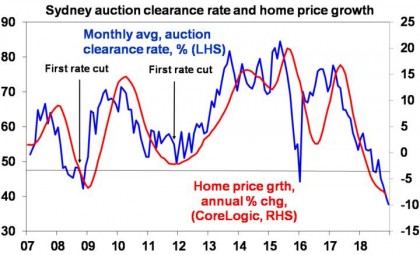
Auction clearance rates have fallen to record lows (in terms of my records!) – which for Sydney and Melbourne are consistent with further price falls running around 8-10% pa – and housing credit continues to slow.


Source: Domain; AMP Capital

House prices in Sydney and Melbourne will likely have a top to bottom fall of around 20% (10% in 2019) and national average prices will likely have a top to bottom fall of around 10%.

…leading to a drag on growth

While not on the scale of the property crashes seen during the Global Financial Crisis (GFC) in the US and parts of Europe, the Australian property downturn will have a significant negative economic impact. The main impacts are expected to be:

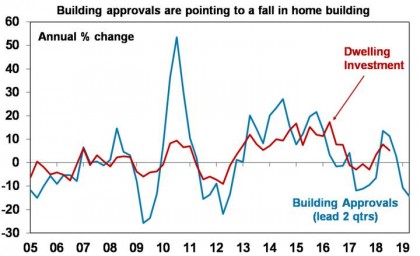
  • a direct detraction from growth as the housing construction cycle turns down. This is likely to amount to around 0.4 percentage points per annum (which was what it added on average during the construction boom).


Source: ABS, AMP Capital

  • reduced demand for household equipment retail sales as dwelling completions top out and decline.

  • a negative wealth effect on consumer spending of around 1% pa. Rising housing wealth helped drive decent growth in consumer spending in NSW and Victoria as households reduced the amount they saved as their housing wealth rose. This is now likely to go in reverse detracting around 0.6 percentage points from GDP growth.

  • there could also be a feedback loop into further bank credit tightening if non-performing loans and defaults rise.

Taken together these could detract 1-1.2 percentage points from growth over the next year.

No recession, but constrained growth

Clearly a deeper slump in national property prices – say a 25% top to bottom fall rather than the 10% we are expecting – would cause severe economic damage but in the absence of much higher interest rates or unemployment causing mass defaults this is unlikely. Australia hasn’t seen the sort of deterioration in lending standards seen in the US prior to the GFC that saw people with “no income, no job, no assets (NINJA’s)” get loans and where the Fed raised rates 17 times over two years! And unlike in the US, Australian mortgages are full recourse loans so there is no “jingle mail”. So, a US GFC style surge in defaults adding to downwards pressure on prices is unlikely.
Barring a deeper property slump, a recession is unlikely:

  • The drag on growth from slumping mining investment (which was averaging around 1.5 percentage points per annum) is fading as mining investment is getting close to the bottom.

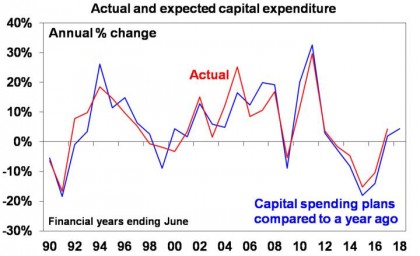
  • Surveys point to a recovery in non-mining investment. Business investment plans for this financial year are pointing to a 4% gain and 7% for non-mining investment.


Source: ABS, AMP Capital

  • Public infrastructure spending is rising and has further to go.

  • Net exports are likely to continue adding to growth, although the US/China trade war is a threat here. 

  • And there are even a couple of positives for consumer spending in the form of lower petrol prices (saving around $10 a week for a typical household) and likely pre-election tax cuts or handouts although these may not kick in until July 2019. Under a Labor Government this looks likely to be more skewed to low and middle income earners with high income earners facing tax hikes.

Given the cross currents, our assessment is that growth is likely to be around 2.5-3% going forward. This is not the recession some fear but it’s well down from the 3.5% pace the RBA expects.

Inflation to stay lower for longer

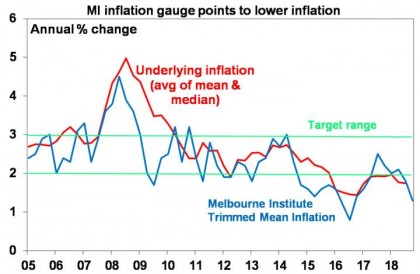
Growth around 2.5-3% won’t be enough to further eat into spare labour market capacity so the decline in unemployment is likely to stall (job vacancies appear to be slowing) and underemployment is likely to remain high at 8.3%. This in turn points to wages growth remaining weak. Meanwhile, it’s hard to see much uptick in other sources of inflationary pressure: competition and pressure for price discounting remains intense and commodity prices have fallen this year with the oil price falling over 30% from its recent high feeding through to lower petrol prices and the link between moves in the $A and inflation has been weak for years now. The latest Melbourne Institute Inflation Gauge points to a further fall in inflation into this quarter with its trimmed mean measure of underlying inflation up just 1.3% year on year in November.


Source: ABS, Melbourne Institute, AMP Capital

RBA to cut in 2019

Against the backdrop of falling house prices, tight credit conditions and constrained growth, which will keep wages growth weak and inflation below target for longer we see the next move by the RBA being a rate cut. However, it will take a while to change the RBA’s thinking, so we don’t see rates being cut until second half next year but won’t rule out an earlier move if things are weaker earlier than we are expecting. By end 2019 the cash rate is likely to have fallen to 1%.

Rate cuts won’t be aimed at reinflating the property market but supporting households with a mortgage to offset the negative wealth impact on spending. A 0.25% rate cut roughly saves a household with a $400,000 mortgage $1000 a year in interest costs. And banks will likely have no choice to pass the cuts on given the bad publicity not passing them on will generate.

Implications for investors

There are several implications for Australian investors.

First, bank deposits rates will remain poor.

Second, with the RBA likely to cut rates and the Fed hiking (albeit slowing) the $A is likely to fall into the high $US0.60s.

Third, Australian bonds are likely to outperform global bonds.

Finally, while Australian shares are still great for income, global shares are likely to remain outperformers for capital growth. The housing downturn will weigh on retailers, retail property, banks and building material stocks.


Source: AMP Capital 12 December 2018

Important notes: While every care has been taken in the preparation of this article, AMP Capital Investors Limited (ABN 59 001 777 591, AFSL 232497) and AMP Capital Funds Management Limited (ABN 15 159 557 721, AFSL 426455) makes no representations or warranties as to the accuracy or completeness of any statement in it including, without limitation, any forecasts. Past performance is not a reliable indicator of future performance. This article has been prepared for the purpose of providing general information, without taking account of any particular investor’s objectives, financial situation or needs. An investor should, before making any investment decisions, consider the appropriateness of the information in this article, and seek professional advice, having regard to the investor’s objectives, financial situation and needs. This article is solely for the use of the party to whom it is provided.

It’s important to prepare for unexpected illness that could throw your retirement plans off course.

When you close your eyes and think about retirement, what comes into your mind?

Lounging on a pristine beach in the Whitsundays? Enjoying a croissant in a café on the Champs Elysees? Kitesurfing on the bay?

If you’re approaching the finish line, chances are that you’re getting proactive and eagerly preparing for life after work, with holidays, projects, hobbies and activities to fill your days of freedom.

Whether it’s new destinations, new hobbies or new experiences, your dreams need funding.

By working hard, investing wisely and taking full advantage of any government tax breaks along the way, you’ll give yourself every chance of making your dream retirement a reality.

But along the way you’ll need to think about planning for the unplanned in retirement.

Spending needs can fluctuate in retirement

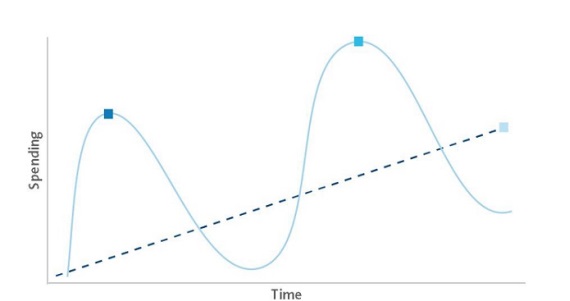
Your spending is unlikely to stay the same throughout retirement. For many Australians spending is U-shaped—greater when you start retirement, then reduces, then peaks again.

This is because:

  • you tend to spend more when you’re healthy, active and celebrating the end of work

  • your spending slows down during a consolidation period in the middle

  • your spending spikes later in life as health care and aged care costs pick up.

But some people in retirement don’t experience a consolidation period, as unexpected illness takes them straight from spending on hobbies to spending on health care.

The reality of getting older means that you need to react and be prepared for unexpected hurdles. While it’s difficult to think about, health problems can throw your retirement plans off course.

And with Australian grandparents contributing the equivalent of $3.94 billion a year in childcare costs, unexpected illness can have a severe impact on your extended family too.

Claire’s story

Claire1 works at AMP. This is her family’s story.

“My parents were all set up to enjoy their dream retirement. They were enjoying spending time with their grandchildren, they were actively pursuing new hobbies and they had an overseas trip planned.

And then everything changed when Mum was diagnosed with breast cancer. She was only 61 years old. She’s now on chemo. Meanwhile, Dad is going through a second bout of cancer at 68.

In many ways we’re lucky.

I have three brothers and sisters to help look after Mum and Dad.

My job is flexible so I can work from home once a week to help Mum with her medication and drive her to appointments.

And Mum and Dad were always prudent with their money so they have a good savings buffer as well as insurance in place.

But life has certainly changed. We’ve gone from a situation where Mum and Dad helped look after the kids twice a week to looking after them instead.

It’s a tough time and we’re pulling together as a family to help Mum and Dad get through it. But it’s certainly not the retirement we all envisaged for them.”

Planning for every stage of retirement

So what does this mean for your retirement plans?

It’s important not only to budget for the initial active period of retirement, but also for when you may need to spend more on aged care and health care.

Please contact us on Phone: 07 5641 4134 we can guide you to.

  • Find out how much you might need in retirement.

  • Learn how to manage your money in retirement.

  • Discover your retirement career.

And it’s not just about the money…it’s about your overall quality of life.

  • What happens if your health deteriorates? You may need to think about whether you have enough health cover and life insurance.

  • What happens if you lose your mobility? You may need to look at renovating your home to help you get around or even relocating to be closer to services or family.

  • What happens if you become isolated? Unfortunately it’s easy to lose touch with friends after leaving the workforce so it’s important to stay connectedand active.

After a lifetime of hard work and finally reaching the finishing line, it’s tempting to go hard early and spend up big in the first few years.

But if you’re properly prepared with a sound financial buffer and a prudent retirement spending plan then it makes it easier to navigate uncharted waters.

[1] Names have been changed.

Source : AMP November 2018 

Important:

This provides general information and hasn’t taken your circumstances into account. It’s important to consider your particular circumstances before deciding what’s right for you. Although the information is from sources considered reliable, we do not guarantee that it is accurate or complete. You should not rely upon it and should seek qualified advice before making any investment decision. Except where liability under any statute cannot be excluded, we do not accept any liability (whether under contract, tort or otherwise) for any resulting loss or damage of the reader or any other person.

Any information provided by the author detailed above is separate and external to our business and our Licensee. Neither our business, nor our Licensee take any responsibility for their action or any service they provide.

Any links have been provided with permission for information purposes only and will take you to external websites, which are not connected to our company in any way. Note: Our company does not endorse and is not responsible for the accuracy of the contents/information contained within the linked site(s) accessible from this page.


The latest fall in share prices close to the 10-year anniversary of the global financial crisis (GFC) is likely to prompt more retirees and near-retirees to think about creating a volatility-and-downturn cash bucket.

This is a straightforward strategy intended to reduce the possibility of retirees – particularly those with many years of retirement ahead – having to sell investments at depressed prices to maintain their income in the event of an extended future downturn .

What is a volatility-and-downturn cash bucket?

Retirees and investors approaching retirement often set aside about two to three years of living expenses if possible in a volatility-and-downturn cash bucket. This provides a buffer against being forced to sell assets at the wrong time, which may cut the expected longevity of a portfolio and its ability to produce enough future growth.

In a recent commentary, actuaries Rice Warner emphasises how disciplined investor behaviour is critical to handling a sharp fall in share prices and how a cash bucket can assist them to remain disciplined.

There is typically a close link to market behaviour and investor behaviour. (Regular Smart Investing readers may have read our past discussions of these buckets.)

“The behaviour of stock markets is unpredictable as sentiment big part in short-term price movements,” Rice Warner comments. “When people are upbeat about the economy, prices often rise exuberantly; when the market turns down significantly, it is usually fast and without notice.

“So, while we can say that investment markets,” Rice Warner adds, “follow a cyclical pattern, no one can predict when the market will rise or fall. We also know that markets usually recover their losses over time, sometimes quite quickly.”

And as the commentary says, the impact of a market downturn could be magnified for investors who “lock in losses by moving into more defensive strategies [such as switching to all-cash portfolios] at an inopportune time”.

When and how can I create a cash bucket?

Investors often begin to build-up a cash bucket or buffer in their last few years before their planned retirement. For instance, some investors direct a proportion of their super contributions from their last few years in the workforce into a cash bucket within their super funds.

Other opportunities may arise to create a cash bucket including, say, an inheritance or the sale of an investment property. Some investors will simply increase the asset allocation to cash in their super funds – perhaps when periodically rebalancing their portfolios.

How big should I make my cash bucket?

While investors often set aside two to three years of living expenses in their volatility-and-downturn bucket, the size of the buffer and how it is built-up will depend on such personal circumstances as the size of an individual’s retirement savings, age, investment timeframe and perhaps professional advice. When determining the size of your cash bucket, keep the age pension in mind if applicable.

How can I top-up my cash bucket?

Some investors direct a proportion of unspent income from their main diversified portfolio, such as a balanced or growth super fund, to top-up their cash bucket from time to time – particularly during stronger-performing years. And proceeds from regular rebalancing of an investor’s main diversified portfolio can provide top-up money.

 Please contact us on Phone: 07 5641 4134 if you would like to discuss.

Source : Vanguard October 2018 

Reproduced with permission of Vanguard Investments Australia Ltd

Vanguard Investments Australia Ltd (ABN 72 072 881 086 / AFS Licence 227263) is the product issuer. We have not taken yours and your clients’ circumstances into account when preparing this material so it may not be applicable to the particular situation you are considering. You should consider your circumstances and our Product Disclosure Statement (PDS) or Prospectus before making any investment decision. You can access our PDS or Prospectus online or by calling us. This material was prepared in good faith and we accept no liability for any errors or omissions. Past performance is not an indication of future performance.

© 2018 Vanguard Investments Australia Ltd. All rights reserved.

Important:
Any information provided by the author detailed above is separate and external to our business and our Licensee. Neither our business, nor our Licensee take any responsibility for any action or any service provided by the author.

Any links have been provided with permission for information purposes only and will take you to external websites, which are not connected to our company in any way. Note: Our company does not endorse and is not responsible for the accuracy of the contents/information contained within the linked site(s) accessible from this page


Torndirrup National Park near Albany, WA is astounding.

Credit: Tourism Western Australia 

In the words of Captain Obvious, Australia provides some amazing experiences.

What the captain fails to mention, though, is that this wealth of remarkable attractions means some truly incredible experiences are often overlooked.

We thought it was high time to change that, so we put together this superb line-up of underrated Australian activities.

From the easily reached and the inexpensive to the once in a lifetime, exciting adventures await.


Impressive: Umpherston Sinkhole, Mt Gambier, SA.

Credit: SATC/Adam Bruzzone

Exploring Torndirrup National Park, Albany, WA

Sure, Australia teems with treasure-rich national parks that all jostle for attention, but Torndirrup clearly deserves far more footprints than it receives.

It’s massively mesmering: rugged and windswept and crammed with eye-popping, funky features. Among the most impressive is The Gap where the full force of the ocean’s wild fury is laid bare in dramatic fashion. And it’s all easily admired from a raised viewing platform.

Book now: BIG4 Emu Beach Holiday Park or BIG4 Middleton Beach Holiday Park.

The Gap reveals the ocean’s full fury, which not even this picture adequately demonstrates.

Credit: Tourism Western Australia

Climbing the Shot Tower, Hobart, TAS

Found 10km south of the CBD, the Shot Tower was once tasked with manufacturing ammunition. Today, it’s in the firing line of visitors seeking spectacular panoramic vistas.

The structure has a few quirks that enhance the interest, including a sign that proclaims it took eight months to build when the actual figure is more like eight years. Its height is another point of contention.

Book now: BIG4 Hobart Airport Tourist Park.

Fake news? The sign heralding the eight-month completion of the Shot Tower.

Credit: Tourism Tasmania/Kathryn Leahy

Wandering around Umpherston Sinkhole, Mt Gambier, SA

Nature has moulded a wonderful creation, with a little help from humanity. In a former life the sinkhole was a limestone cave before relentless corrosion from seawater resulted in its roof collapsing.

It has since become a spectacular sunken garden with a size and scale that is only truly appreciated with a first-hand visit. Better yet, it’s centrally located and open day and night.

Book now: BIG4 Blue Lake Holiday Park.

Sinking feeling: descend into the depths of Umpherston Sinkhole to appreciate its mammoth size and scale.

An airboat tour of Mary River wetlands, NT

Spotted on the fringes of Kakadu National Park, the wetlands of Mary River are home to a feast of fascinating flora and fauna, including crocs. And witnessing it all while on an airboat is unbeatable.

It’s an exhilarating experience that provides unparalleled access to a mind-blowing section of the Top End. If you’re lucky, your friendly guide will be armed with intimate knowledge of these action-packed surrounds.

Book now: BIG4 Howard Springs Holiday Park.

Strap in for a thrilling ride aboard an airboat.

Swimming at Blue Pool, Bermagui, NSW

Move over Bondi Beach’s Iceberg Pool; Bermagui’s Blue Pool is every bit as alluring. Found in the South Coast NSW region, this natural pool (well, sort of natural) is a prized place for a refreshing swim.

The backdrop of craggy, towering cliffs only adds to the occasion, while the sparkling coastal views afforded from this vantage point are worth a visit alone. Best of all, this experience won’t cost you a cent.

Book now: BIG4 Wallaga Lake Holiday Park.

Blue Pool is a gem of the South Coast NSW region.

Credit: Destination NSW

Delving into the SS Yongala wreck, Ayr, QLD

Admittedly, this site earns much attention – thousands head underwater each year for a diving experience regarded as one of Australia’s best. Yet how many of us can honestly say we know the doomed ship’s backstory? It’s not exactly Titanic like, but details of how the SS Yongala ended up on the sea floor are thoroughly captivating.

Dive tours depart from Ayr and provide an eerie, incredible experience where you’ll be joined by a wealth of magical marine life. Or relive the fascinating yarn at the Townsville Maritime Museum.

Book now: BIG4 Ayr Silver Link Caravan Village or BIG4 Townsville Woodlands Holiday Park.

The backstory of SS Yongala is captivating.

Credit: Yongala Dive

Wander around historical Clunes, Goldfields region, VIC

Although this isn’t the only place in Australia that could claim to be forgotten by time, it certainly seems to be overlooked by the masses. A wander along this old gold-mining town’s main street is like a trip down memory lane – ignore the modern cars – with a streetscape that appears untouched since its creation.

In fact, Clunes is regarded as having the finest collection of 19th century buildings anywhere in Australia, which helps to easily evoke thoughts that you’ve travelled back a century or so. Charming.

Book now: BIG4 parks in the Goldfields region.

Clunes generally only bustles like this for its annual Booktown Festival, held in May.

Touring Coober Pedy, SA

The opal-mining town is hardly a spotlight avoider, but you get the feeling its unique nature warrants more attention. Simply put, Coober Pedy is absolutely mesmerising and a destination that every Australian should experience at least once.

It’s well-known that much of its infrastructure has been built underground so locals can avoid the heat, and it makes for a super interesting and incomparable visit from the moment you enter town. The incredible landscapes in and around Coober Pedy only add to an extremely memorable experience.

Book now: BIG4 Stuart Range Outback Resort.


The landscapes in and around Coober Pedy are jaw-dropping.

Source : BIG4 Holiday Park November 2018

Reproduced with the permission of BIG4 Holiday Parks. This article first appeared on BIG4.com.au  and was republished with permission.

Important:
Any information provided by the author detailed above is separate and external to our business and our Licensee. Neither our business, nor our Licensee take any responsibility for any action or any service provided by the author.

Any links have been provided with permission for information purposes only and will take you to external websites, which are not connected to our company in any way. Note: Our company does not endorse and is not responsible for the accuracy of the contents/information contained within the linked site(s) accessible from this page.

2018 – a lot weaker than expected

After the relatively low volatility and solid returns of 2017, the past year has seen almost the complete opposite with high volatility and poor returns. It started strongly in January but started to get messy from February. At a big picture level things were fine: global growth looks to have held solid at around 3.7%, inflation rose in the US but only to target and it remained low elsewhere, the Fed raised interest rates but rates generally remain low and profits rose solidly. But it was the risks below the surface that came together to give a rough ride. There were five big negatives:

  • Fear of the Fed. The Fed provided no real surprises and nor did US inflation, but investors became increasingly nervous that Fed hikes would crush US growth and profits.

  • US dollar strength. While the US dollar did not rise above its 2016 high it caused problems in the emerging world where US dollar denominated debt is high.

  • President Trump’s trade war. This was always a high risk for 2018 and once it got underway it weighed on share markets. While the initial focus seemed to be the US versus everyone it morphed into fears of a new Cold War with China adding to fears about growth and profits.

  • China slowdown. This was as expected to around 6.5% as a result of credit tightening but fears that it will combine with the trade war and get worse added to global growth angst.

  • Global desynchronisation. US growth was strong, but it slowed in Europe, Japan, China and the emerging world.


Australia saw growth around trend and made it through 27 years without a recession, as infrastructure spending, improving business investment and strong exports helped support growth and this in turn drove strong employment growth, a fall in unemployment and the Federal budget closer to a surplus. Against this though credit conditions tightened significantly with the Royal Commission adding to regulatory pressure on the banks, house prices fell, wages growth edged up but remained weak and inflation remained below target, all of which saw the RBA leave rates on hold.

Overall this drove a volatile and messy investment environment.

Investment returns for major asset classes


* Yr to date to Nov. Source: Thomson Reuters, Morningstar, REIA, AMP Capital

  • Global shares saw weak returns in local currency terms with significant corrections around February and October. But this masked positive returns from US shares but weakness elsewhere. Global share returns were boosted on and unhedged basis because the $A fell. 

  • Asian and emerging market shares paid the price for being star performers in 2017 with losses thanks to a rising $US causing debt servicing fears, the US trade war posing a threat to growth and political problems in some countries. 

  • Australian shares were hit by worries about the banks, consumer spending in the face of falling house prices and weakness in yield-sensitive telcos and utilities offsetting okay profit growth and low interest rates. 

  • Government bonds yet again had mediocre returns reflecting low yields and capital losses from rising yields in the US as the Fed hiked. Australian bonds outperformed. 

  • Real estate investment trusts remained constrained on the back of Fed tightening and higher bond yields.

  • Unlisted commercial property and infrastructure continued to do well as investors sought their still relatively high yields.

  • Commodity prices were weak on global growth worries and the oil price had a roller coaster ride, first surging ahead of US sanctions on Iran then crashing as demand fell. 

  • Australian house prices fell led by Sydney and Melbourne. 

  • Cash and bank term deposit returns were poor reflecting record low RBA interest rates. 

  • Reflecting US dollar strength, the $A fell not helped by a falling interest rate differential and lower commodity prices. 

  • Reflecting soft returns from most assets, balanced superannuation fund returns were soft.

2019 – better, but volatility to remain high

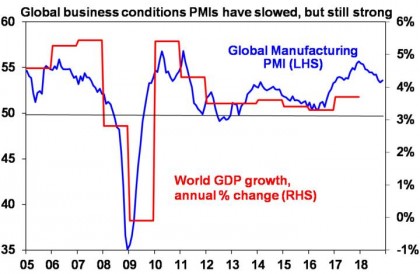
In a big picture sense, the global economy looks to be going through a mini slowdown like we saw around 2011-12 and 2015-16. This is most evident in business conditions indicators that have slowed but remain okay. See the next chart.  


Source: Bloomberg, IMF, AMP Capital

Like then, this has not been good for listed risk assets like shares but it’s unlikely to be signalling the start of a recession, baring a major external shock. Monetary conditions have tightened globally but they are far from tight unlike prior to the GFC and the normal excesses in the form of high inflation, rapid growth in debt or excessive investment that precede recessions in the US or globally are absent. In fact, to the extent that the softening in growth now underway takes pressure off inflation and results in easier monetary conditions than would otherwise have been the case it’s likely to extend the cycle, ie delay the next recession. The slump in oil prices is a key example of this in that it will take some pressure off inflation and provide a boost to consumer spending. Against this background the key global themes for the year ahead are likely to be:

  • Global growth to stabilise and then resynchronise. Global growth is likely to average around 3.5% which is down from 2018 but this is likely to mask slower growth in the first half of the year ahead of some improvement in the second half as China provides a bit more policy stimulus, the Fed pauses in raising interest rates, the fall in currencies against the $US dollar provides a boost to growth outside the US and trade war fears settle down (hopefully). Overall, this should support reasonable global profit growth.

  • Global inflation to remain low. With growth dipping back to around or just below trend in the short term and commodity prices down inflation is likely to remain low. The US remains most at risk of higher inflation due to its tight labour market, but various business surveys suggest that US inflation may have peaked for now at around 2%.

  • Monetary policy to remain relatively easy. The Fed is likely to have a pause on rate hikes during the first half and maybe hike only twice in 2019 as it gets into the zone that it regards a neutral. Rate hikes from other central banks are a long way away. In fact, further monetary easing is likely in China and the European Central Bank may provide more cheap funding to its banks.

  • Geopolitical risk will remain high causing bouts of volatility. The main focus is likely to remain on the US/China relationship and trade will likely be the big one. While Trump is likely to want to find a solution on the trade front before tariffs impact the US economy significantly & threaten his re-election in 2020, it’s not clear that this will occur before the March 1 deadline from the Trump/Xi meeting in Buenos Aires so expect more volatility on this issue. Wider issues including the South China Sea could also flare up along with negotiations around Italy’s budget.

In Australia, strength in infrastructure spending, business investment and export values will help keep the economy growing but it’s likely to be constrained to around 2.5-3% by the housing downturn and a negative wealth effect on consumer spending from falling house prices. This in turn will keep wages growth slow and inflation below target for longer. Against this backdrop the RBA is expected to cut the official cash rate to 1% with two cuts in the second half of 2019.

Implications for investors

With uncertainty likely to remain high around US interest rates, trade and growth, volatility is likely to remain high in 2019 but ultimately reasonable global growth & still easy global monetary policy should drive stronger overall returns than in 2018:

  • Global shares could still make new lows early in 2019 (much as occurred in 2016) and volatility is likely to remain high but valuations are now improved and reasonable growth and profits should see a recovery through 2019. 

  • Emerging markets are likely to outperform if the $US is more constrained as we expect.

  • Australian shares are likely to do okay but with returns constrained to around 8% with moderate earnings growth. Expect the ASX 200 to reach around 6000 by end 2019.

  • Low yields are likely to see low returns from bonds.

  • Unlisted commercial property and infrastructure are likely to continue benefitting from the search for yield but it’s slowing. 

  • National capital city house prices are expected to fall another 5% led again by 10% or so price falls in Sydney and Melbourne as tighter credit, rising supply, reduced foreign demand and potential tax changes under a Labor Government impact. 

  • Cash and bank deposits are likely to provide poor returns.

  • The $A is likely to see more downside into the high $US0.60s, as the gap between the RBA’s cash rate and the Fed Funds rate goes further into negative.

What to watch?

After the turmoil of 2018, the outlook for 2019 comes with greater than normal uncertainty. The main things to keep an eye on in 2019 are as follows:

  • US inflation and the Fed – our base case is that US inflation stabilises around 2% enabling the Fed to pause/go slower, but if it accelerates then it will mean more aggressive tightening, a sharp rebound in bond yields and a much stronger $US which would be bad for emerging markets.

  • The US trade war – while it may now be on hold thanks to negotiations with China, Europe and Japan these could go wrong and see it flare up again. US/China tensions generally pose a significant risk for markets.

  • Global growth indicators – if we are right growth indicators like the PMI shown in the chart above need to stabilise in the next six months.

  • Chinese growth – a continued slowing in China would be a major concern for global growth and commodity prices.

  • The property price downturn in Australia – how deep it gets and whether non-mining investment, infrastructure spending and export earnings are able to offset the drag from housing construction and consumer spending.


Source: AMP Capital 6 December 2018

Important notes: While every care has been taken in the preparation of this article, AMP Capital Investors Limited (ABN 59 001 777 591, AFSL 232497) and AMP Capital Funds Management Limited (ABN 15 159 557 721, AFSL 426455) makes no representations or warranties as to the accuracy or completeness of any statement in it including, without limitation, any forecasts. Past performance is not a reliable indicator of future performance. This article has been prepared for the purpose of providing general information, without taking account of any particular investor’s objectives, financial situation or needs. An investor should, before making any investment decisions, consider the appropriateness of the information in this article, and seek professional advice, having regard to the investor’s objectives, financial situation and needs. This article is solely for the use of the party to whom it is provided.
We check out the three largest contributors to household spending in Australia and where people would source additional cash if living expenses rose.

If you worked a full-time job in Australia in 1975, the average amount you would’ve earned a year was about $7,600, whereas today, that figure would be closer to $72,0001, according to research by McCrindle.

That’s welcome news, but while we’re earning more than what we did in 1975, things are also costing us more. A loaf of bread is 10 times the price, a litre of milk is three times the price, a newspaper is 20 times the price, not to mention petrol has doubled, with house prices in some capital cities up thirtyfold2.

We check out the largest contributors to household spending today and where people say they would source additional money if day-to-day expenses increased further.

Housing, food and transport

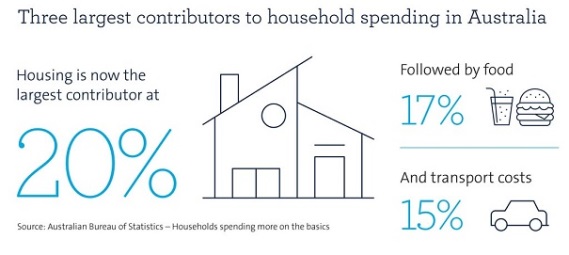
The three largest contributors to household spending in Australia have been the same for many years, according to the Australian Bureau of Statistics (ABS).


ABS figures reveal three-and-a-half decades ago the largest contributors to household spending were food (20%), transport (16%) and housing (13%), with housing now at the top of that list (20%), followed by food (17%) and transport (15%) respectively3.

A separate report by Deloitte highlighted that around 37% of Aussies were concerned about their ability to cover expenses, with more than 50% indicating that they expected to pay even more on housing and energy costs going forward4.

What people would do if costs rose further

When asked, if your day-to-day living expenses increased, where do you think you’d source additional money from, here was the top eight responses in a survey of Australians5:

  1. Reduce luxury spending – 20%

  2. Buy fewer groceries – 12%

  3. Spend less on transport – 12%

  4. Borrow money via a loan or credit card – 10%

  5. Draw on savings – 5%

  6. Spend less on food delivery and eating out – 5%

  7. Cancel subscription services – 4%

  8. Cancel streaming services – 3%.

Now that you’re aware that housing, food and transport are generally the biggest expenses for Aussie households, you may be looking at ways you could cut back and save in these areas.

If you seek further discussion please contact us on Phone: 07 5641 4134 .

1, 2 McCrindle Research – 40 years of change: 1975 to today – table 2 and 3
Australian Bureau of Statistics – Households spending more on the basics – paragraph 5 and 6
4, 5 Deloitte Access Economics – ALDI household expenditure report  – page 9 and 23

Source : AMP October 2018 

Important:
This provides general information and hasn’t taken your circumstances into account.  It’s important to consider your particular circumstances before deciding what’s right for you. Although the information is from sources considered reliable, we do not guarantee that it is accurate or complete. You should not rely upon it and should seek qualified advice before making any investment decision. Except where liability under any statute cannot be excluded, we do not accept any liability (whether under contract, tort or otherwise) for any resulting loss or damage of the reader or any other person.  
Any information provided by the author detailed above is separate and external to our business and our Licensee. Neither our business, nor our Licensee take any responsibility for any action or any service provided by the author.
Any links have been provided with permission for information purposes only and will take you to external websites, which are not connected to our company in any way. Note: Our company does not endorse and is not responsible for the accuracy of the contents/information contained within the linked site(s) accessible from this page.


Lenders look at your credit score or credit rating, which appears in your credit report, to work out if they should lend you money or give you credit. Here we explain how your credit score works and what you can do to improve it.

What is a credit score?

Your credit score is a number based on an analysis of your credit file, at a particular point in time, that helps a lender determine your credit worthiness. It is used by credit providers, such as banks and credit unions, to help them decide whether to lend you money, how much they will lend you and may sometimes influence what interest rate is offered to you.

Comprehensive credit reporting and how it’s changing your credit report

From September 2018, the major banks and various credit providers will be putting additional information about the credit products you hold on your credit report. This will give a more complete picture of your credit history.

The new information will include:

  • the type of credit products you have held in the last 2 years

  • your usual repayment amount

  • how often you make your repayments and if you make them by the due date.

You may find that your credit score has changed as a result. See how to get a good credit score for tips on improving your score. 

How is your credit score calculated?

Credit reporting agencies collect your financial and personal information and document it on your credit report. This information is then used to calculate your credit score, which includes:

  • Your personal details (such as age and where you live)

  • The type of credit providers you have used (e.g. bank or utility company)

  • The amount of credit you have borrowed

  • The number of credit applications and enquiries you have made

  • Any unpaid or overdue loans or credit

  • Any debt agreements or personal insolvency agreements relating to bankruptcy

What does my credit rating mean?

Depending on the credit reporting agency used to calculate your score, it will be a number between zero and 1,200 or zero and 1,000.

The number is rated on a five-point scale (excellent, very good, good, average and below average). The position of your credit score on this scale helps lenders work out how risky it is for them to lend to you: 

  • Excellent – you are highly unlikely to have any adverse events harming your credit score in the next 12 months

  • Very good – you are unlikely to have an adverse event in the next 12 months

  • Good – you are less likely to experience an adverse event on your credit report in the next year

  • Average – you are likely to experience an adverse event in the next year

  • Below average – you are more likely to have an adverse event being listed on your credit report in the next year

How to find out your credit score for free

You can get a free credit score from a number of online providers. The results may vary depending on which credit reporting agency is used. The following websites offer a free credit rating:

You may need to check with more than one credit score provider to get a consistent and reliable measure of your credit rating.

Your credit score is dynamic, meaning it may change from month to month as your financial circumstances change. 

Protecting your personal information

By obtaining your free credit score you may be agreeing to allow your personal information to be disclosed to third parties for marketing purposes. Ensure you read all terms and conditions and consider whether you want your personal information passed on for marketing purposes. You can opt out or unsubscribe where you do not want these details passed on.

 Checking your credit rating can protect you from fraud

You should check your credit rating and report to ensure your information is correct and that all the enquiries and listings on the report have been made by you. Criminals can steal your identity and take out credit in your name so checking the accuracy of your credit report is important. See credit reports for more information on how to check your credit history. 

Case study: Jessica gets her credit rating

Jessica wanted to be able to negotiate a better deal on her loans and credit card so she decided to find out her credit score. She found two providers offering a free credit rating online. She decided to compare the two and see how she rated with both.

The first website placed Jessica in the ‘very good’ category with a score of 726 out of 1000. The second website placed her in the ‘good’ category with a score of 699 out of 1200.

Jessica did some further research and found that each website used data from a different credit reporting agency to calculate her credit score. She requested a copy of her credit report from each of these agencies to see what the difference was.

It turned out not all her credit history was listed with the reporting agency the first website used so her score came out higher. The scoring system was also different across both sites.

Jessica decided to keep an eye on her credit rating in future to ensure it stayed high.

How to get a good credit score

Your credit score can increase or decrease over time depending on the information contained in your credit report. Your score can change even if your financial habits haven’t. This could be due to a number of factors including:

  • applying for a new loan or credit card

  • a listing on your credit report expiring

  • a change to your credit limit on an existing loan or credit account

  • new information from a creditor

  • closing a loan or credit card account

  • late repayments

Improving your credit rating starts with looking at your current financial situation and looking for ways to improve it. As your financial circumstances improve your credit rating will improve. Getting into a good credit position before you next apply for a loan can help increase the likelihood of you getting approved.

You can improve your credit score by:

  • lowering your credit card limits

  • consolidating multiple personal loans and/or credit cards

  • limiting your applications for credit 

  • making your repayments on time

  • paying your rent and bills on time

  • paying your mortgage and other loans on time

  • paying your credit card off in full each month

Credit scores help lenders decide if they should lend money to you. Knowing your credit score can help you to negotiate a better deal with your bank or find an alternative lender that will reward your good credit history.

Please contact us on Phone: 07 5641 4134 if you seek  further discussion on this topic. 

Source : ASIC’s MoneySmart November 2018 

Reproduced with the permission of ASIC’s MoneySmart Team. This article was originally published at https://www.moneysmart.gov.au/borrowing-and-credit/borrowing-basics/credit-scores

Important note: This provides general information and hasn’t taken your circumstances into account.  It’s important to consider your particular circumstances before deciding what’s right for you. Although the information is from sources considered reliable, we do not guarantee that it is accurate or complete. You should not rely upon it and should seek qualified advice before making any investment decision. Except where liability under any statute cannot be excluded, we do not accept any liability (whether under contract, tort or otherwise) for any resulting loss or damage of the reader or any other person.  Past performance is not a reliable guide to future returns.

Important
Any information provided by the author detailed above is separate and external to our business and our Licensee. Neither our business, nor our Licensee take any responsibility for any action or any service provided by the author.

Any links have been provided with permission for information purposes only and will take you to external websites, which are not connected to our company in any way. Note: Our company does not endorse and is not responsible for the accuracy of the contents/information contained within the linked site(s) accessible from this page.