2017 was a great year for well diversified investors – returns were solid (balanced super funds returned around 10%) and volatility was low. So optimism was high going into 2018 but it turned out to be anything but great for investors who saw poor returns (average balanced super funds look to have lost around 1-2%) and volatile markets. As a result, and in contrast to a year ago, there is much trepidation about the year ahead. Having just written lists for Christmas presents and New Year resolutions, I was again motivated to provide a summary of key insights and views on the investment outlook in simple point form. In other words, a list of lists. So here goes.

Five key things that went wrong in 2018

In 2018 global growth was good, profits were up, inflation was benign and monetary conditions were relatively easy. It should have been good for markets. There were five reasons it wasn’t:

  • Fear of the Fed – the Fed didn’t really surprise but investors became increasingly concerned that it would overtighten. This reached a crescendo in late December.

  • US dollar strength – a rising US dollar is a defacto global monetary tightening and this weighed particularly on emerging countries and US earnings expectations.

  • Geopolitics – President Trump’s trade war hit confidence from March and morphed into fears of a broader Cold War with China. Other worries around Trump (with ongoing turmoil in his team, fears of impeachment as the Mueller inquiry progresses and a return to divided government) along with the populist government in Italy also weighed.

  • Global desynchronisation – US growth was strong, but it slowed everywhere else.

  • In Australia, tightening credit conditions (with fears of a credit crunch due to the Royal Commission) and falling house prices weighed on banks & growth expectations.

Five lessons from 2018

  • Global growth remains fragile with post GFC caution lingering. This and technological change are helping to keep inflation down. Trade war fears didn’t help. Amongst other things this means central banks need to tread carefully in normalising monetary policy.

  • Investors continue to find it easy to fear the worst – this has been evident in three major circa 20% sharemarket declines since the GFC – in 2011, 2015-16 and now 2018.

  • Geopolitics remains a significant driver of markets and economic conditions.

  • Government bonds remain a great diversifier – they rallied when shares plunged.

  • Stuff happens – history tells us markets have periodic setbacks. 2018 was just another example.

Five big picture themes for 2019

  • Policy pause and stimulus – the turmoil in markets and threat to global growth is likely to drive a policy response early this year with the Fed pausing, China providing more stimulus and the ECB providing cheap bank financing. There may also be some fiscal easing in Europe.

  • While global growth is likely to weaken a bit further in the coming months, it’s likely to stabilise and resynchronise as the year progresses helped by policy stimulus, an easing in the $US and by the late 2018 plunge in energy costs.

  • Global inflation is likely to remain benign helped by the 2018 growth slowdown and fall in energy costs. In this sense the malaise of 2018 by forestalling inflation and hence monetary tightening has arguably helped extend the economic cycle. The US remains most at risk on the inflation front though given its still tight labour market. 

  • But expect volatility to remain high given the lower level of spare capacity in the US and ongoing political risk.

  • Australian growth is expected to be sub-par as the housing downturn detracts 1-1.5 percentage points or so off growth.

Key views on markets for 2019

  • Global shares could still make new lows early in 2019 (much as occurred in 2016) and volatility is likely to remain high but valuations are now improved and reasonable growth and profits should see a recovery through 2019 helped by more policy stimulus.

  • Emerging markets are likely to outperform if the $US is more constrained as we expect.

  • After a low early in the year, Australian shares are likely to do okay, recovering to around 6000 or so by year end.

  • Low yields are likely to see low returns from bonds, but they continue to provide an excellent portfolio diversifier.

  • Unlisted commercial property and infrastructure are likely to see slower returns over the year ahead. This is likely to be particularly the case for Australian retail property.

  • National capital city house prices are likely to fall roughly 5% led again by 10% or so price falls in Sydney and Melbourne off the back of tight credit, rising supply, reduced foreign demand & possible tax changes under a Labor Government.

  • Cash and bank deposits are likely to provide poor returns as the RBA cuts the official cash rate to 1% by end 2019.

  • Beyond any near-term bounce as the Fed moves towards a pause on rate hikes next year, the $A is likely to fall into the $US0.60s as the gap between the RBA’s cash rate and the US Fed Funds rate will still likely push further into negative territory as the RBA moves to cut rates.

Six things to watch

  • The US trade war – while it may now be on hold thanks to negotiations with China, Europe and Japan these could go wrong and see it flare up again. US/China tensions generally pose a significant risk for markets.

  • US inflation and the Fed – our base case is that US inflation remains around 2% enabling the Fed to pause/go slower, but if it accelerates then it will mean more aggressive tightening, a sharp rebound in bond yields and a much stronger $US which would be bad for emerging markets.

  • Global growth indicators – if we are to be right, growth indicators need to stabilise in the next six months.

  • Chinese growth – a continued slowing in China would be a major concern for global growth and commodity prices.

  • Politics – political risks abound in the US with the Mueller inquiry getting ever closer to President Trump and a return to divided government leading to risks around raising the debt ceiling and Trump adopting more populist policies. In Europe the main risks are around Brexit, Italy and the EU parliamentary elections in May. Australia’s election risks are more interventionist government policy and tax changes.

  • The property price downturn in Australia – how deep it gets and whether non-mining investment, infrastructure spending and export earnings are able to offset the drag from housing construction and consumer spending.

Three reasons why global growth is likely to be okay

Global growth indicators are likely to weaken further in the next few months but then stabilise, resulting in okay global growth of around 3.5% this year:

  • Global monetary conditions are still easy. While the flattening US yield curve is a concern all other measures of monetary policy show it to be easy – particularly globally.

  • Market volatility and associated uncertainty are likely to drive a policy response with the Fed pausing, other central banks easing and possible fiscal stimulus in Europe.

  • We still have not seen the excesses – massive debt growth, overinvestment, capacity constraints or excessive inflation – that normally precede recessions.

Three reasons why Chinese growth won’t slow much

  • The Chinese Government’s tolerance for a sharp slowing in growth is low given the risk of social instability it may bring. 

  • Monetary and fiscal policy is being eased.

  • In the absence of much lower savings (the main driver of debt growth), rapid deleveraging would be dangerous, and the Chinese Government knows this.

Four reasons Australia still won’t have a recession

A downturn in the housing cycle and its flow on to consumer spending will detract around 1 to 1.5 percentage points from growth, and growth is likely to be constrained to around 2.5-3%, but recession is still unlikely:

  • The growth drag from falling mining investment (which was up to 2 percentage points) has faded.

  • Non-mining investment & infrastructure spending are rising.

  • Interest rates can still fall further, and the RBA is expected to cut the cash rate to 1%.

  • The $A will likely fall further providing a support to growth.

Three reasons why the RBA will cut rates this year

  • The housing downturn will constrain growth to at or below potential.

  • This will keep underemployment high, wages growth weak and inflation lower for longer.

  • The RBA may ultimately want to prevent the decline in house prices getting so deep it threatens financial instability.

Three reasons why a grizzly bear market is unlikely

Shares could still fall further in the short term given various uncertainties resulting in a brief (“gummy”) bear market before recovering. But a deep (or “grizzly”) bear (where shares fall 20% and a year after are a lot lower again) is unlikely:

  • A recession is unlikely. Most deep grizzly bear markets are associated with recession.

  • Measures of investor sentiment suggest investors are cautious, which is positive from a contrarian perspective.

  • The liquidity backdrop for shares is still positive. For example, bank term deposit rates in Australia are around 2% (and likely to fall) compared to a grossed-up dividend yield of around 6% making shares relatively attractive.

Seven things investors should allow for in rough times

Times like the present are stressful for investors. No one likes to see their wealth fall and uncertainty seems very high. I don’t have a perfect crystal ball, so from the point of sensible long-term investing the following points are worth bearing in mind.

  • First, periodic sharp setbacks in share markets are healthy and normal. Shares literally climb a wall of worry over many years with periodic setbacks, but with the long-term trend providing higher returns than more stable assets. The setbacks are the price we pay for the higher long-term return from shares.

  • Second, selling shares or switching to a more conservative strategy after a major fall just locks in a loss. The best way to guard against selling on the basis of emotion is to adopt a well thought out, long-term investment strategy.

  • Third, when growth assets fall they are cheaper and offer higher long-term return prospects. So, the key is to look for opportunities that pullbacks provide. 

  • Fourth, while shares may have fallen in value, the dividends from the market haven’t. The income flow you are receiving from a diversified portfolio of shares remains attractive.

  • Fifth, shares often bottom at the point of maximum bearishness. So, when everyone is negative and cautious it’s often time to buy.

  • Sixth, turn down the noise on financial news. In periods of market turmoil, the flow of negative news reaches fever pitch, which makes it very hard to stick to a well-considered, long-term strategy let alone see the opportunities. 

  • Finally, accept that it’s a low nominal return world – low nominal growth and low bond yields and earnings yields mean lower long-term returns. This means that periods of relative high returns like in 2017 are often followed by weaker years.


Source: AMP Capital 15 Jan 2019

Important notes: While every care has been taken in the preparation of this article, AMP Capital Investors Limited (ABN 59 001 777 591, AFSL 232497) and AMP Capital Funds Management Limited (ABN 15 159 557 721, AFSL 426455) makes no representations or warranties as to the accuracy or completeness of any statement in it including, without limitation, any forecasts. Past performance is not a reliable indicator of future performance. This article has been prepared for the purpose of providing general information, without taking account of any particular investor’s objectives, financial situation or needs. An investor should, before making any investment decisions, consider the appropriateness of the information in this article, and seek professional advice, having regard to the investor’s objectives, financial situation and needs. This article is solely for the use of the party to whom it is provided.


At AMP’s recent Amplify event, Mark Moore, Uber’s engineering director of aviation and Nick Earle from Hyperloop One, spoke about how innovation is likely to change the face of public transport. Emerging public transport systems are poised to free up road and rail systems, leading to less congestion and better use of infrastructure.

As an example, Uber’s vision for the future of commuting involves a self-driving electric car picking up a passenger and taking them to a nearby teleport, from which an unmanned air taxi would take them to their destination teleport, where another Uber car would pick them up and take them to their final destination.

Hyperloop One’s vision is different but likely to be complementary. They envisage ‘packetised transportation’ that can carry both passengers and cargo in a pod which travels at high speed through a tube using magnetic levitation. It’s energy agnostic and has the ability to draw power from various sources including renewable sources such as solar. The target speed is just below the speed of sound, so a Sydney to Melbourne trip could take just 60 minutes.

Both visions will slash trip times and take cars off the road, and also provide new infrastructure investment opportunities.

The future of infrastructure

Any reduction in the number of vehicles on roads will have further flow on effects to related infrastructure and this is a major trend of which infrastructure investors need to be aware. For instance, there will be less need for big CBD parking stations, which may be able to be repurposed, for example as logistics hubs or as electric vehicle charging stations.

These changes may also impact the nature of our cities. They may allow for even larger cities, possibly incorporating several centralised hubs, and larger population densities.

Given competition will be fierce among technology providers, one strategy for infrastructure investors may be to back the facilities and systems needed to support new transport modes.

For example, an electric-vehicle future may require an amplification of renewable generation and distribution capacity. This will require construction of many battery charging or swap stations in major built up areas. This is an opportunity for investors.

Ultimately, it will take time, new regulations and substantial public education to switch to a new model for public transport. While it’s impossible to predict the future, given how gridlocked Australia’s road and rail networks are, it’s only a matter of time before new approaches make practical and economic sense.


Author: John Julian, Investment Director Sydney, Australia

Source: AMP Capital 31 July 2018

Important notes: While every care has been taken in the preparation of this article, AMP Capital Investors Limited (ABN 59 001 777 591, AFSL 232497) and AMP Capital Funds Management Limited (ABN 15 159 557 721, AFSL 426455) makes no representations or warranties as to the accuracy or completeness of any statement in it including, without limitation, any forecasts. Past performance is not a reliable indicator of future performance. This article has been prepared for the purpose of providing general information, without taking account of any particular investor’s objectives, financial situation or needs. An investor should, before making any investment decisions, consider the appropriateness of the information in this article, and seek professional advice, having regard to the investor’s objectives, financial situation and needs. This article is solely for the use of the party to whom it is provided.

https://vimeo.com/291021827

The long-term rise in Australian home prices has led to a huge inter-generational transfer of wealth from the young to the old. A material reversal in property values will go some way to unwinding this, creating winners and losers amongst the generations.

Australia has long had a love affair with home ownership, which is illustrated by the strong growth in residential prices over the past two decades. Prices accelerated particularly strongly over the five years to 2017 amid a strong domestic economy, low mortgage rates, tax-breaks for domestic investors and sustained interest from overseas buyers, especially from China.

These factors were supported by ongoing immigration, a widespread cultural desire in Australia to own property and a highly limited supply of new land available in the capital cities in which most Australians live and work. A flood of virtual reality tv shows based on home ownership and renovations struck a chord with aspirational Australians. A political consensus in favour of measures supportive of property owners came to be established.

This included borrowers being able to take advantage of historically low interest rates to purchase more expensive homes.

However, 2017 saw the peak in prices as lenders came under regulatory pressure to constrain lending multiples, review prospective borrowers’ spending commitments more closely and limit interest-only loans.

Furthermore, rising global interest rates have pushed up Australian mortgage rates despite domestic interest rates remaining at their historic low of 1.5%.

The withdrawal of investment buyers from the market has been followed by a more hesitant mood amongst owner-occupiers, who are either unable or unwilling to borrow the funds and provide the deposits necessary to maintain the housing market’s momentum.

Australians are likely to find themselves in very different situations depending on their home ownership history. They may be grouped into three distinct demographic cohorts, many of whose members share some broad characteristics.

Millennials

Most Australians under the age of 35 have struggled to gain a foothold on the housing ladder. By the time they had found settled jobs and saved deposits, they found that house prices had risen beyond their reach.

Sometimes characterised as the ‘smashed-avocado generation’, this group has tended to prioritise experiential spending over property acquisition. This may be partly due to a cultural shift in society, but undoubtedly at least partly reflects the low possibility of purchasing even a very modest home within reasonable proximity to work.

Property purchases have tended to be restricted to those either on the highest incomes and/or those who have enjoyed the good fortune of parents or grandparents willing and able to help fund ever increasing deposit and stamp duty payments.

There are signs that some millennials on more typical income levels have simply given up on the Aussie dream of home ownership – at least until they become beneficiaries of a future inheritance.

Families

Australians in the 35-55 age group are much more likely to be property owners. However, the 20-year upward trend in home prices has left this generation suffering varying degrees of financial stress. This has been caused by the need to take on oversized mortgages to buy their first home, typically some years after their parents would have taken the plunge into the housing market.

They are now faced with increasing mortgage rates just at the time that living costs, such as utility bills, insurance and school fees are also rising.

Accordingly, this group faces the biggest challenge as they manage their spending in the face of rising demands on their lean layer of discretionary spending.

Baby boomers

This group comprises the retired and soon-to-retire, who in Australia have been the principle beneficiaries of the long-term boom in house prices, built on low interest rates and tax benefits, such as negative gearing.

Having entered the market at much lower price levels relative to incomes, members of this group are now largely mortgage-free and sit on valuable capital gains that some have realised as they retire, re-locate and downsize.

Some members of this demographic have used gains from the property boom to help their off-spring gather the deposits necessary to get onto the housing ladder. This trend is often described as the ‘Bank of Mum and Dad’, with some analysts referring to it as the fifth biggest bank in Australia.

The boom has led to a massive intergenerational transfer of wealth from the young to old as prolonged low interest rates led to massive asset inflation, which especially affected residential housing in Australia.

However, any decline in home prices will affect these three groups in significantly different ways.

Millennials

The cohort that remains largely outside the housing market is likely to have the most to gain and least to lose from a period of falling home prices in Australia.

A significant fall in home values is not the base case of most analysts, however the more extended the correction, the more millennials will find themselves coming into reach of home ownership. Therefore, this group is viewing any extended downward trend in prices relatively positively.

Such a market correction could focus on the sale of investment properties, which could reduce the supply of rental properties and put upwards pressure on rental levels. This would be a negative for millennials not able to take advantage of falling values to buy a first home, at least in the earlier stages of a slump.

A relatively small number of this group have managed to enter the market by taking on excessively large mortgages or have bought in secondary locations where selling could become challenging. Such buyers could well face financial stress, however, these are likely to be a minority of this group.

Families

These are the people who are most exposed to a slide in home prices in Australia. This group includes the most recent entrants to the property market and thus are likely to have bought at higher price levels with larger mortgages. Unlike those who are long established in the market, many in this group will not have benefitted from much of the rise in values and thus enjoy less protection from price falls.

They are already facing the financial stress described earlier and hence are much more careful with their spending, focusing on essentials and taking advantage of cost savings found online or in discount bricks and mortar stores. This is illustrated by the high numbers of baby and kids-focussed stores closing in Australia over the last few years.

This group stands to be further impacted if a significant fall in house prices leads to them receiving lower inheritances or post-downsizing gifts from their parents.

Baby boomers

This demographic is generally mortgage-free and unlikely to move home other than to downsize to a more suitable retirement property. Thus, they are unlikely to suffer the same stress faced by families.

Their ability to make lifetime gifts and leave bequests could well be affected though, however the real impact of this will be felt by younger demographics.

Baby boomers have been the principle beneficiaries of the buy-to-let boom, and hence some members who are heavily invested in residential property will be impacted by price falls. However, even these will be affected more in terms of their ability to make gifts from reduced capital, rather than falls in the achievable rental values that provide their income.

The housing market has appeared to be a one-way bet for a long time, and the wealth level of most Australians depends largely on the point in time at which they were able to enter the market.

Younger Australians stand to gain the most from lower housing prices but will inherit less. Families will likely experience increasing financial stress from this trend, especially the more recent home purchasers or those with less certain incomes in the face of rising living costs. Most older Australians will be less affected on a day-to-day basis but the ‘Bank of Mum and Dad’ may turn out to be less liquid than had been hoped by some anticipating sizeable withdrawals.


Author: Dermot Ryan, Sydney, Australia

Source: AMP Capital 20 Sept 2018

Important notes: While every care has been taken in the preparation of this article, AMP Capital Investors Limited (ABN 59 001 777 591, AFSL 232497) and AMP Capital Funds Management Limited (ABN 15 159 557 721, AFSL 426455) makes no representations or warranties as to the accuracy or completeness of any statement in it including, without limitation, any forecasts. Past performance is not a reliable indicator of future performance. This article has been prepared for the purpose of providing general information, without taking account of any particular investor’s objectives, financial situation or needs. An investor should, before making any investment decisions, consider the appropriateness of the information in this article, and seek professional advice, having regard to the investor’s objectives, financial situation and needs. This article is solely for the use of the party to whom it is provided.

Investor uncertainty and market volatility appear to be increasing as the economy continues to strengthen, leading to higher bond yields and eventual interest rate rises.

Australian equity investors trying to navigate the choppy waters that lie ahead should ignore the day-to-day ‘noise’ of the markets and instead focus on seven key questions. The answers to these will help investors better understand the approaching dangers and opportunities.

Will Aussie banks keep paying out big dividends?

Banking has been the principle beneficiary of the 25-year bull market in residential mortgages that has followed in the wake of Australia’s housing boom.

Bank share prices have powered ahead over recent years, fueled by the sustained and predictable earnings that strong mortgage lending delivered. Retail investors in particular have been drawn to the strong growth in (franking credit-enhanced) bank dividends.

Banks have been able to capture generous mortgage lending margins because the regulatory environment has prioritised banking solvency. The banks’ balance sheets further benefitted from the 30-year decline in bond yields.

However, regulatory focus may now shift from institutional stability towards promoting customer interests, following the Royal Commission.

Meanwhile, global bond markets are now moving into a period of rising yields, even if Australian interest rates are unlikely to increase for some time yet. These trends will not be positive for bank valuations.

Moreover, personal debt in Australia has reached historically high levels, leaving many recent homebuyers looking vulnerable. The most highly indebted are now worryingly exposed to a downside shock.

Credit conditions for borrowers are continuing to tighten, as maximum earnings multiples fall and living expenses are considered more cautiously by loan officers. Buy-to-let investors and first-time buyers with modest deposits appear to be withdrawing from the market now that home prices are falling in Sydney and Melbourne.

Why are Aussie consumers looking so glum?

The high level of indebtedness is having a significant impact on consumer spending in Australia. Under-employment remains high and wage growth for large parts of the labour force remains fairly stagnant.

Families who bought their home more recently at elevated price levels and now face increasing mortgage payments are especially impacted.

This is leading many families to look much more closely at their weekly spending, especially those seeking to pay down debt.

The retail sector is seeing shoppers switch their spending to market challengers such as Aldi, where private labels are priced at a significant discount to the major grocery stores, which is forcing down pricing on the majors’ own goods.

Investing in price cutting is not expected to be sustainable over the long-term and could detract from the major supermarkets’ earnings.

A wider range of businesses that depend on such price-sensitive shoppers will struggle to grow earnings as real wage growth remains subdued and debt servicing costs rise.

When will the next capex boom ride to the economy’s rescue?

The end of the mining investment boom led to resources companies taking an extended capex holiday that has been a major drag on the Australian economy. However the depletion of older mines is now leading to investment in new facilities.

Meanwhile Federal and State governments are continuing to support infrastructure investment, often as part of asset recycling programs in an attempt to grow productivity levels.

Australia’s growing population faces energy supply limitations as many base load power generation assets need upgrading or replacement and renewable energy targets loom large. This will require a capital investment uplift in power generation and transmission assets.

Finally Australia’s LNG market is moving from a period of oversupply during which capex was highly restricted, to one of undersupply. This is leading to a renewed surge of investments in brownfield sites.

This is likely to present the opportunity for well-positioned developers and contractors to grow earnings over the next phase of the capex cycle.

How can Australia make beautiful returns from a Beautiful China?

President Xi recently announced the intention to build a “Beautiful China” that would reduce the country’s toxic levels of air, water and soil pollution.

Older polluting coal power stations are likely to be shut. However, while the country is expected to continue importing high volumes of Australian coal, cleaner fuels such as LNG may grow in relative importance. Australian companies are expected to continue to benefit throughout this shift as they begin to invest in new LNG projects again.

In addition to ongoing demand for high-grade seaborne commodities, Australian companies exposed to China’s growing demand for clean energy, electric vehicles and batteries have the opportunity to grow earnings.

How will regulatory change impact companies?

The Federal Government in Canberra is now intervening much more actively across a number of areas of the economy. This is motivated by a desire to bring down those costs to voters and companies that threaten the economic recovery and the government’s political fortunes.

This is especially impacting regulated infrastructure companies, where some have been assigned especially low rates of return by regulators. Consequently, the less attractive earnings outlook may start to be reflected in companies’ market valuations.

Therefore, investors should be cautious about the wider regulated utility market, especially transmission assets facing government pricing decisions. The implementation of the National Energy Guarantee by the end of 2018 is likely to influence the returns and valuations of a range of energy businesses.

Meanwhile, gaming reform that impacts margin bets, advertising and taxation poses a potential threat to companies in the sector.

However media deregulation may well permit increased consolidation in the industry, which will potentially be supportive of earnings and valuations.

Which companies will be bitten by rising bond yields?

Rising global bond yields have been signaling the start of the return to more normal levels of interest rates for some time now. The rate-hiking cycle is well advanced in the US and has now started in the UK and some other markets.

Such an environment is generally considered to be negative for the market valuations of companies whose earnings are relatively stable and predictable. These include those in the infrastructure, listed real estate and telecommunications sectors. This is because as bond yields rise, investors apply a higher discount rate to their expected earnings, which reduces the implied valuation levels.

Therefore a cautious approach to these sectors is likely to be appropriate during the next phase of the business cycle.

However, certain companies in these markets are nonetheless able to grow earnings independently of the business cycle. These include real estate companies exposed to the growth of data centres and e-commerce, which are poised to outperform the market even during a period of rising interest rates.

Should I be investing in growth or income companies?

Australian growth companies have strongly outperformed value/income stocks since the last round of Chinese economic stimulus. This is to be expected during a stage of the economic cycle when earnings growth is generally positive and interest rates remain at historically low levels

However, the valuations of growth companies are now notably high, trading at large premiums to their 10-year average price/earnings ratio and relative to the wider Australian equity market.

Such lofty valuation levels require very strong and sustained earnings growth in order to justify the present market premiums. Therefore many growth companies appear to be highly vulnerable to any events that slow the upward path of corporate earnings.

Hence investors may now find more attractive opportunities in companies that are characterised by sustainable dividend payouts and/or more attractive valuation levels.


Author: Dermot Ryan, Sydney, Australia

Source: AMP Capital 22 July 2018

Important notes: While every care has been taken in the preparation of this article, AMP Capital Investors Limited (ABN 59 001 777 591, AFSL 232497) and AMP Capital Funds Management Limited (ABN 15 159 557 721, AFSL 426455) makes no representations or warranties as to the accuracy or completeness of any statement in it including, without limitation, any forecasts. Past performance is not a reliable indicator of future performance. This article has been prepared for the purpose of providing general information, without taking account of any particular investor’s objectives, financial situation or needs. An investor should, before making any investment decisions, consider the appropriateness of the information in this article, and seek professional advice, having regard to the investor’s objectives, financial situation and needs. This article is solely for the use of the party to whom it is provided.

You’ll never look at the humble banana the same way again after discovering the many health benefits and reasons to add them to your diet.

They can help to combat depression, make you smarter, cure hangovers, relieve morning sickness, protect against kidney cancer, diabetes, osteoporosis, and blindness. Plus they can even cure the itch of a mosquito bite and put a great shine on your shoes.

Here are 25 reasons to eat bananas you might have never considered before.

If You Think Bananas Are Just For Monkeys, Think Again

These 25 ways to use and eat bananas will blow your mind!

  1. Bananas help overcome depression due to high levels of tryptophan, which is converted into serotonin — the happy-mood brain neurotransmitter.

  2. Eat two bananas before a strenuous workout to pack an energy punch and sustain your blood sugar.

  3. Protect against muscle cramps during workouts and night time leg cramps by eating a banana.

  4. Counteract calcium loss during urination and build strong bones by supplementing with a banana.

  5. Improve your mood and reduce PMS symptoms by eating a banana, which regulates blood sugar and produces stress-relieving relaxation.

  6. Bananas reduce swelling, protect against type II diabetes, aid weight loss, strengthen the nervous system, and help with the production of white blood cells, all due to high levels of vitamin B-6.

  7. Strengthen your blood and relieve anemia with the added iron from bananas.

  8. High in potassium and low in salt, bananas are officially recognized by the FDA as being able to lower blood pressure and protect against heart attack and stroke.

    Eating Bananas For Digestion

  9. Rich in pectin, bananas aid digestion and gently chelate toxins and heavy metals from the body.

  10. Bananas act as a prebiotic, stimulating the growth of friendly bacteria in the bowel. They also produce digestive enzymes to assist in absorbing nutrients.

  11. Constipated? High fiber in bananas can help normalize bowel motility.

  12. Got the runs? Bananas are soothing to the digestive tract and help restore lost electrolytes after diarrhea.

  13. Bananas are a natural antacid, providing relief from acid reflux, heartburn, and GERD.

  14. Bananas are the only raw fruit that can be consumed without distress to relieve stomach ulcers by coating the lining of the stomach against corrosive acids.

    For Natural Healing From A Simple Banana

  15. Eating bananas will help prevent kidney cancer, protects the eyes against macular degeneration and builds strong bones by increasing calcium absorption.

  16. Bananas make you smarter and help with learning by making you more alert. Eat a banana before an exam to benefit from the high levels of potassium.

  17. Bananas are high in antioxidants, providing protection from free radicals and chronic disease.

  18. Eating a banana between meals helps stabilize blood sugar and reduce nausea from morning sickness.

  19. Rub a bug bite or hives with the inside of the banana peel to relieve itching and irritation.

  20. Control blood sugar and avoid binging between meals by eating a banana.

  21. Eating a banana can lower the body temperature and cool you during a fever or on a hot day.

  22. The natural mood-enhancer tryptophan helps to relieve Seasonal Affective Disorder (SAD).

  23. Quitting smoking? Bananas contain high levels of B-vitamins as well as potassium and magnesium to speed recovery from the effects of withdrawal.

  24. Remove a wart by placing the inside of a piece of banana peel against the wart and taping it in place.

  25. Rub the inside of a banana peel on your leather shoes or handbag and polish with a dry cloth for a quick shine.

Oh, and remember — bananas make great snacks and delicious smoothies.

Delicious Creamy Banana & Avocado Smoothie Recipe!


Serves 2 

Ingredients

(use organic ingredients where possible)

  • 2 bananas (fresh or frozen)

  • 1/2 avocado, stone and skin removed

  • 1 1/2 cups almond milk (or any other milk)

  • 1/2 – 1 tsp ground cinnamon

  • 1/2 tsp vanilla paste

  • 1 tbsp raw honey

  • 1 tbsp chia seeds

  • 1 tbsp bee pollen

  • 1 tbsp peanut butter (optional)

  • 1 tbsp of Superfood Protein (optional)

  • Handful of ice

Method

Place all ingredients in a blender. Blend on high speed for half a minute until you reach a smooth consistency. Enjoy! 

Now You Know Why Monkeys Are So Happy. Eat A Banana!

Source : Foodmatters

Reproduced with the permission of the Food Matters team. This article by  JAMES COLQUHOUN  was originally published at www.foodmatters.com

Important:
This provides general information and hasn’t taken your circumstances into account.  It’s important to consider your particular circumstances before deciding what’s right for you. Although the information is from sources considered reliable, we do not guarantee that it is accurate or complete. You should not rely upon it and should seek qualified advice before making any investment decision. Except where liability under any statute cannot be excluded, we do not accept any liability (whether under contract, tort or otherwise) for any resulting loss or damage of the reader or any other person. 

Any information provided by the author detailed above is separate and external to our business and our Licensee. Neither our business, nor our Licensee take any responsibility for any action or any service provided by the author.

Any links have been provided with permission for information purposes only and will take you to external websites, which are not connected to our company in any way. Note: Our company does not endorse and is not responsible for the accuracy of the contents/information contained within the linked site(s) accessible from this page.

Whatever your age, if you’re thinking of dabbling in investments like shares, managed funds or cryptocurrencies, here are a few things to steer clear of.

You might be looking to invest your money in something (whether it be shares, manage funds or cryptocurrencies, such as bitcoin) for a variety of reasons.

You may have money in savings and property, and want to diversify, or you might simply be looking to invest in something affordable, should investing in things like real estate be a bit out of your reach.

If your goal is to get rich quick (wouldn’t that be nice), spoiler alert – that’s probably not going to happen, as more often than not things like time in the market, compound interest and avoiding unnecessary risk will be the keys to success (I know, sorry to burst your bubble).

Meanwhile, if you are very close to dipping your toe in the water, here’s a list of common mistakes newbie investors tend to make which are generally worth steering clear of.

Investment mistakes beginners make

1. They fail to plan

When looking to invest, it’s generally wise to think about:

  • your current position and how much you can realistically afford to invest (consider what other financial priorities you have or existing debts you may be paying off?)

  • your goals and when you want to achieve them

  • implications for the short/medium and long term

  • whether you understand what you’re actually investing in

  • whether you know how to track performance and make adjustments

  • if you want to invest yourself, or with the help of a broker or adviser.

2. They don’t know their risk tolerance

As a general rule, investments that carry more risk are better suited to long-term timeframes, as investment performance can change rapidly and unpredictably. However, being too conservative with your investments may make it harder for you to reach your financial goals.

  • Low-risk (or conservative) investment options tend to have lower returns over the long term but can be less likely to lose you money if markets perform badly.

  • Medium-risk (or balanced) investment options tend to contain a mix of both low and high-risk assets. These options could be suitable for someone who wants to see their investments grow over time but is still wary of risk.

  • High-growth (or aggressive) investment options tend to provide higher returns over the long term but can experience significant losses during market downturns. These types of investments are generally better suited to investors with longer term horizons who can wait out volatile economic cycles.

Try our ‘What style of investor am I?’ tool to help understand what level of risk you might be comfortable with.

3. They think investment returns are always guaranteed

The idea of guaranteed returns sounds wonderful, but the truth when it comes to investing is returns are generally not guaranteed.

There are risks attached to investing, which means while you could make money, you might break even, or even lose money should your investments decrease in value.

On top of that, liquidity, which refers to how quickly your assets can be converted into cash, may be an issue. Depending on what type of investment you hold or what may happen in markets at any point in time, you mightn’t be able to cash in certain investments when you need to.

4. They put all their eggs in one basket

Investment diversification can be achieved by investing in a mix of:

  • asset classes (cash, fixed interest, bonds, property and shares)

  • industries (e.g. finance, mining, health care)

  • markets (e.g. Australia, Asia, the United States).

The reason diversifying may be a good thing is it could help you to level out volatility and risk, as you may be less exposed to a single financial event.

5. They believe the opinions of every Tom, Dick and Harry

Changing your strategy on the basis of market news may or may not be a good idea. After all, people have made all sorts of market predictions over the years, all of which haven’t necessarily come true.

On top of that, we all have that one friend that likes to pretend they’re a property, share or general investment guru, who while may come across as persuasive in their market commentary, does not have the qualifications to be giving people advice.

With that in mind, if you’re looking for guidance, you’re probably better off consulting your financial adviser who may be able to give you a more well-rounded picture of the current climate and the potential advantages and disadvantages you should be across.

6. They make rash decisions based on fear or excitement

Many investors get caught up in media hype and or fear and buy or sell investments at the top and bottom of the market.

Like with anything in life, it is easy to get stressed and concerned about the future and act impulsively but like with other things this may not be a smart thing to do.

While there may be times when active and emotional investing could be profitable, generally a solid strategy and staying on course through market peaks and troughs will result in more positive returns.

Contact us on Phone: 07 5641 4134 for more information.


Source: www.amp.com.au

Important information:This information is provided by AMP Life Limited. It is general information only and hasn’t taken your circumstances into account. It’s important to consider your particular circumstances and the relevant Product Disclosure Statement or Terms and Conditions, available by calling 13 30 30, before deciding what’s right for you. Read our Financial Services Guide for information about our services, including the fees and other benefits that AMP companies and their representatives may receive in relation to products and services provided to you. All information on this website is subject to change without notice. Although the information is from sources considered reliable, AMP does not guarantee that it is accurate or complete. You should not rely upon it and should seek professional advice before making any financial decision. Except where liability under any statute cannot be excluded, AMP does not accept any liability for any resulting loss or damage of the reader or any other person.

From Port Stephens to Port Hedland, Australia teems with beautiful golf courses. Better still, most are easily accessible to the general public.

For some travellers, golf clubs are the first item to be packed when taking a break. The accessibility and wide variety of Australian courses ensures that playing golf when on holidays is a popular pastime.

Rather than compile yet another list of Australia’s best golf courses, we wanted to highlight for you those layouts that provide the average player with an interesting yarn that can be shared when returning to their BIG4 accommodation.

Whether unique, quirky, novel, or ancient, we introduce you to eight Australian golf courses that you must play.


1. Coober Pedy Opal Fields Golf Club, SA

This is one of the best golf courses to play when on holidays in Australia owing to a couple of quirks that make for great conversation. Firstly, the course is completely grassless, which makes you think you’re playing on another planet. To hit the ball, you simply carry with you a piece of artificial turf to place on the ground. The course’s second quirk is that it claims to be the only golf club in the world with reciprocal playing rights with the famous St Andrews Links in Scotland.

More information can be found on the BIG4 Stuart Range Outback Resort website.


Coober Pedy Opal Fields Golf Club really is like no other course on the planet.

2. Ratho Farm, Bothwell, TAS

There is some contention to this claim, but Ratho Farm bills itself as the oldest golf course in Australia. That alone makes it worthy of gracing these fairways. Ratho Farm traces its roots to 1822 and is likened to playing golf in Scotland. There are even sheep that act as greenkeepers. It all makes sense – the course’s founders were Scottish and modelled the layout on those in their former homeland. Bothwell is one hour’s drive northwest of Hobart.

Playing a round at historical Ratho Farm is like golfing in Scotland. 

Credit: Tourism Tasmania, supplied courtesy Ratho Farm.

3. Bonville Golf Resort, NSW

When it comes to the prettiest golf courses in Australia, Bonville is right up there. The outstanding beauty of this course means you’re more likely to want to reach for the camera than the putter. With massive trees lining the fairways and abundant wildlife and bird life to see or hear, strolling these fairways is like taking a walk in a national park. If your game isn’t up to scratch you’ll at least be able to blame it on the constant distraction of remarkable views. Bonville is a short drive from Coffs Harbour.

Strolling the fairways of Bonville is likened to walking within a national park.

Credit: Wildlight;Destination_NSW

4. Barnbougle (The Dunes), Bridport, TAS

Although there are many reasons to play the original of two layouts at Barnbougle – including the fact the Dunes is one of Australia’s greatest golf courses – it makes our list for having the largest sand bunker in the southern hemisphere. If you find yourself stuck in the sand on the fourth hole of this links course, you’ll end up feeling as though you spent a day at the beach. And your mates are likely to get a chuckle from your attempt (or attempts) to negotiate this massive sand trap. This breathtaking course is an essential stop when touring the St Helens and the North East region.

Barnbougle has two incredible courses – the Dunes and Lost Farm (pictured). 

5. Nullarbor Links, SA and WA

Welcome to the world’s longest golf course and an idea that is pure genius. Nullarbor Links breathes life into the massively long stretch of road it’s named after and creates the ultimate road trip adventure. An 18-hole course, it covers a whopping 1365km, with holes found in towns or roadhouses stretching from Ceduna in SA all the way to Kalgoorlie in WA.
 

6. Narooma Golf Club, NSW

This is another course that ranks highly when it comes to Australia’s best golf courses, but we’ve put a circle around it for the sheer beauty of its signature third hole. A testing par three, it is one of the most awe-inspiring golf holes you’ll ever come across. Witness incredible coastal views from this vantage point as you attempt to navigate your shot over water and onto a small green. It’s one of several holes that offer remarkable views of the coast, which contrasts massively with those fairways that are surrounded by tall treesPlay the course when staying at a BIG4 park in Narooma
 

7. Anglesea Golf Club, VIC

If travelling with international guests who like golf, this is the course to take them to. Play a round at Anglesea Golf Club and expect to share the fairways with a huge population of kangaroos. We’re not just talking about the occasional ‘roo hopping past every so often – the course is literally packed with dozens upon dozens of these native animals. It might just be the biggest crowd you ever play in front of, although it’s doubtful you’ll receive much applause when you drain that 20m putt. Play here when staying at BIG4 Anglesea Holiday Park.

There are a few hazards to negotiate at Anglesea Golf Club. 

8. Yarrawonga Mulwala Golf Club Resort, NSW

Billed as Australia’s largest public access golf resort, with a mammoth 45 holes, this is a must-visit for those who want variety from their golfing holiday. Two 18-hole layouts as well as a nine-hole course ensure there’s plenty of opportunity to indulge. It’s not just quantity; these quality courses offer great views of Lake Mulwala. It’s well worth a stop when travelling along the Follow the Murray touring route.


Source : BIG4 Holiday Parks 

Reproduced with the permission of BIG4 Holiday Parks. This article first appeared on www.big4.com.au

Important:
Any information provided by the author detailed above is separate and external to our business and our Licensee. Neither our business, nor our Licensee take any responsibility for any action or any service provided by the author.

Any links have been provided with permission for information purposes only and will take you to external websites, which are not connected to our company in any way. Note: Our company does not endorse and is not responsible for the accuracy of the contents/information contained within the linked site(s) accessible from this page.


If you look at the statistics, it takes the majority of Australians a little over three and a half years on average to save for a deposit on a first home1

If you’re thinking about, or aren’t far away from, putting some money down on that place of your dreams, we look at some of the financial and non-financial considerations you’ll want to be across.

1. Figure out how much money you have to play with

The most common loan terms in Australia are generally 25 and 30 years2, and as a mortgage is likely to be the biggest debt you’ll ever take on, it’s important to prioritise any other financial goals you may have and figure out where a home purchase ranks on that list.

The price of the property you’re looking to buy will also play a big part as it will often determine the deposit you need, so it’s worth figuring out how much you can realistically afford early on.

If your family is willing to help, it’s a good idea to discuss how they plan to do this. And, keep in mind there could be risks, benefits and tax implications if financial help is given.

Meanwhile, if you’re buying property with a partner, it’s important to be upfront about your financial past and plans, and whether you’ll put something in writing should the unexpected happen.

Check out AMP’s cost of home loan calculator if you’d like help crunching the numbers, or alternatively speak to a bank or mortgage broker.

2. Find out if there are black marks on your credit report

A credit report, which details your repayment history, could affect your ability to get approval on a loan if it doesn’t read well.

As each lender will assess your credit file against their own policies, there may be instances where some approve your application, while others reject it or delay the process.

The main credit reporting agencies in Australia are Veda, Dun & Bradstreet, Experian and the Tasmanian Collection Service, and you can request a copy if you’d like to see what yours says.

3. Know what you’re going to fork out

Here’s a snapshot of some of the costs you’re likely to come across early on and on an ongoing basis.

The upfront costs

  • Purchase price – This is the actual cost of the property. And, unless you’re able to pay for it outright, you’ll generally need to take out a loan, noting that lenders will generally ask for a minimum deposit of 10% to 20%.

  • Loan application fee – This is a one-off payment to your lender when your loan commences. Fees may vary depending on your provider and will cover things such as credit checks, property appraisals and basic admin.

  • Lender’s mortgage insurance – If you have a deposit that’s less than 20%, you may be required to pay lender’s mortgage insurance which is there to protect your lender in the instance you’re unable to repay your loan.

  • Government fees – Stamp duty is a land/property transfer tax applied by all Australian state and territory governments, which can vary greatly depending on where your dream home is located. Mortgage registration and transfer fees also apply and differ from state to state.

  • Legal and conveyancing fees – These cover the services of a real estate conveyancer or solicitor, who’ll prepare the necessary documentation and conduct the settlement process.

  • Building, pest and strata inspections – Payment for these services or reports will identify structural concerns, as well as maintenance and financial issues (if you’re in a body corporate).

  • Moving costs – This will come down to how much you do yourself, whether you rent a truck, or hire professionals to move your stuff for you.

The ongoing costs

  • Loan repayments – What you pay back and how often you make repayments will generally have a big impact on the length of time it takes you to pay off your home loan.

  • Interest charges – You can generally choose a fixed or variable rate, or a combination of the two, which is worth some research, particularly as interest rates can go up and down.

  • Other ongoing expenses – This might include strata fees for communal properties, council rates, utility costs, building and contents insurance, and things like home improvements.

4. Ensure the locations you’re looking at stack up

To ensure you buy something you love and for the right price, consider:

  • How much properties are going for in the suburbs you’re interested in

  • How far you’re willing to live from family, friends and work

  • Whether there’s off-street parking and local amenities, such as schools, shops and transport

  • Whether you’ll need to renovate and if you have the extra funds available to do so

  • If there is price growth potential in the suburbs you’ve shortlisted

  • If there are proposed developments in the area that may impact the value of your home

  • What the crime rate is like in the areas you’re keen on

  • If you’re moving far away, how the local job market fares and what the weather is like.

If you need help gathering some of this information, speak to real estate agents who work in the area, or look at real estate companies online.

Meanwhile, different features will appeal to different people when looking for a home to live in, so consider what works for you.

5. Research whether you’re eligible for assistance

The First Home Owner Grant

The First Home Owner Grant is a national scheme. If you’re unsure about eligibility, contact your state revenue office and be sure you apply with enough time.

Stamp duty concessions

Certain state and territory governments offer additional incentives to first home buyers, some which involve stamp duty concessions, so research what’s on offer in the area where you’re buying.

The First Home Super Saver Scheme

Eligible first home buyers can withdraw voluntary super contributions (which they’ve made since 1 July 2017), to put toward a home deposit.

Under the First Home Super Saver Scheme (FHSSS), first home buyers who make voluntary contributions into their super can withdraw these amounts, up to certain limits, in addition to associated earnings, from their super fund to help with a deposit on their first home.

If eligible, the maximum amount of contributions that can be withdrawn under the scheme is $30,000 for individuals or $60,000 for couples.

6. Familiarise yourself with different types of loans

Depending on whether you’re after a basic package or one with added features, home loans can vary a lot when it comes to interest rates and fees.

To get a better idea of costs, when you see a home loan advertised, you’ll notice two rates displayed—the interest rate and the comparison rate.

The comparison rate will incorporate the annual interest rate as well as most upfront and ongoing fees. Some home loans, with lower interest rates, are laden with fees, so while they appear cheap, they aren’t. The comparison rate can help you identify this and compare loans more accurately.

Some other things worth exploring when you’re looking at different loans is the potential advantages and disadvantages of various features, which may allow you to make extra repayments, redraw funds, or use an offset account which could reduce the interest you pay.

If you’re looking for the best deal, remember to shop around and don’t be afraid to ask your lender if they can do better than the rate that they’re currently advertising.

7. Get your finances in order so you’re ready to go

It’s a good idea to have your loan pre-approved so you know exactly what you can borrow. You’ll also need formal approval closer to purchasing and to have your deposit ready, or you may miss out.

This may mean having your cheque book or a bank cheque ready to go if you’re buying your first home at auction.

As part of the process your lender will also advise if lender’s mortgage insurance is required.

8. Don’t forgot your last chance for an inspection

Inspections will alert you to serious issues that may not be visible to the eye—asbestos, termites, electrical, ventilation and serious plumbing faults, which could in the long run cost you a whole lot more than the building inspection itself.

Meanwhile, strata reports, if you’re buying a townhouse or apartment, can tell you whether the property is well run, well maintained and adequately financed.

Please contact us on Phone: 07 5641 4134 if you seek further discussion.


1 Finder – 1 in 3 first home buyers stuck saving for a deposit for over 5 years press release
2 Finder – How long should my home loan be? paragraph 12

Source: www.amp.com.au

Important information: This information is provided by AMP Life Limited. It is general information only and hasn’t taken your circumstances into account. It’s important to consider your particular circumstances and the relevant Product Disclosure Statement or Terms and Conditions, available by calling 13 30 30, before deciding what’s right for you. Read our Financial Services Guide for information about our services, including the fees and other benefits that AMP companies and their representatives may receive in relation to products and services provided to you.

All information on this website is subject to change without notice. Although the information is from sources considered reliable, AMP does not guarantee that it is accurate or complete. You should not rely upon it and should seek professional advice before making any financial decision. Except where liability under any statute cannot be excluded, AMP does not accept any liability for any resulting loss or damage of the reader or any other person.

Three years after it first started raising interest rates in this cycle the Fed has increased rates for the ninth time, raising the Fed Funds rate another 0.25% to a target range of 2.25-2.5%. While this was largely anticipated by markets, the Fed was less dovish than expected and so shares sold off in response. That said it does appear that the Fed has got to a point where it can now pause or at least raise rates more slowly.

Fed hikes and market turmoil

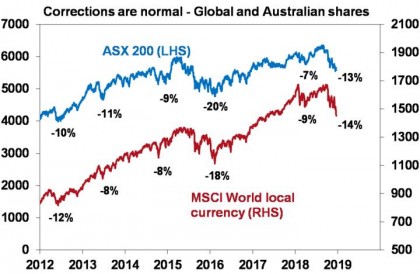
After some initial ructions after the first Fed hike in December 2015 into early 2016, markets generally were not too fussed about Fed hikes in 2016 and 2017 as tightening was “gradual” and we were only going from very easy monetary policy to less easy. However, this year markets have become fearful that the Fed will go too far and push the US into recession. In fact, fears about the Fed were the main initial trigger for falls in shares back in February and more recently since October. Of course, lately they have combined with worries around trade, US technology stocks, slowing growth indicators globally, worries around President Trump and the Mueller inquiry and US politics to accentuate share market falls. This has all combined to push global shares down 14% from their September high and Australian shares down 13% from their August high.

The Fed blinks, but not enough yet

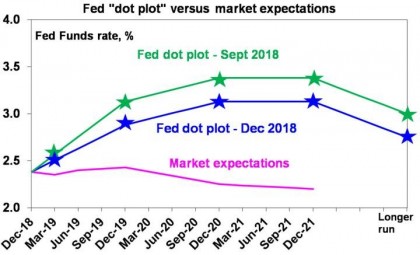
In raising the target range for the Fed Funds rate by another 0.25%, the Fed remains upbeat on the outlook for the US economy and noted the continuing strength in the US labour market and solid growth. However, it has added the word “some” in reference to “further gradual” increases in interest rates going forward. It has also indicated it’s monitoring global economic and financial developments. And it has lowered the “dot plot” median of Fed meeting participants interest rate expectations from three hikes next year to two – albeit it’s still above market expectations – and edged down the long run estimate for the Fed Funds rate to 2.75%. While it’s not enough to satisfy share markets just yet, the Fed is moving dovish.


Source: US Federal Reserve, AMP Capital

Basically, with the Fed Funds rate getting close to neutral, US core inflation stabilising around the 2% target, interest sensitive sectors like housing and autos slowing and various headwinds to the US economy next year the Fed can afford to pause or at least go more slowly in raising interest rates. Our base case is that the Fed will hold the Fed Funds rate flat during the first half of next year and only raise rates once in the second half. So, to the extent that fear of the Fed has been a big factor driving share markets lower and volatility up this year, a more cautious Fed next year should help start to allay the fears around it.

It could be a gummy, but is still unlikely to be a grizzly

As I have pointed out in recent notes, there are three types of significant share market falls:

  • Corrections with falls around 10%;

  • “gummy” bear markets with falls around 20% meeting the technical definition many apply for a bear market but where a year after falling 20% the market is up (like in 1998 in the US, 2011 and 2015-16 for Australian & global shares); and

  • “grizzly” bear markets where shares fall 20% and then a year later are down another 20% or so (like in 1973-74, US and global shares through the tech wreck or the GFC).

Grizzly bears maul investors but gummy bears leave a nicer taste. Corrections are quite normal and healthy as they enable the sharemarket to let off steam. Excluding the present episode since 2012 there have been four corrections and one gummy bear market (2015-16) in global and Australian shares. Bear markets generally are a lot less common, but what we saw in 2015-16 was a gummy bear market.


Source: Bloomberg, AMP Capital

Gummy bear markets are shorter and see smaller declines than grizzly bear markets. And the deeper grizzly bear markets are invariably associated with recession, whereas the milder gummy bear markets including the 1987 share market crash tend not to be. (The Australian experience is discussed here.)

With uncertainty around trade, global growth and President Trump remaining high shares could still have more downside into early next year, particularly after having broken below their October/November lows. In other words the further break down in share markets seen in December may be signalling a shift from a simple correction to a gummy bear market. However, our view remains that a grizzly bear market is unlikely because a US, global or Australian recession is not imminent. Put simply:

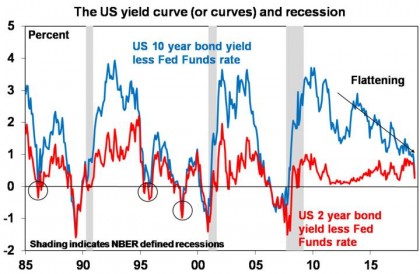
  • Monetary conditions are still not tight in the US and they are still very easy globally. While there has been much fretting about the US yield curve flattening and in some cases inverting (with long term bond yields falling below short-term interest rates) the two yield curves we have found most reliable are still positive albeit less so. The gap between the 10-year bond yield and the Fed Funds rate has flattened dramatically but is still positive at 39 basis points. And the gap between 2-year bond yields and the Fed Funds rate has also flattened a lot but is still positive. As can be seen in the next chart, prior to the last three US recessions both of these yield curves inverted – but there were several false signals and the gap between the initial inversion and recession can be around 15 months. So even if they both invert now recession may not occur until 2020 and yet historically share markets only precede recessions by around 3-6 months so it would be too far away for markets to anticipate. And past recessions in the US have also been preceded by the Fed Funds rate being well above inflation and nominal growth and it’s a long way from that.  


Source: Bloomberg, AMP Capital

  • Fiscal stimulus will continue to boost US growth in 2019.

  • We have not seen the sort of excesses – in terms of debt growth, overinvestment, capacity constraints and inflation – that normal precede recessions in the US or globally. While the housing downturn is an issue in Australia its negative impact on the economy is likely to be offset by business investment albeit growth will still be constrained.

A more dovish Fed, the US and China starting to work through their differences on trade and the positive impact of the 40% fall in oil prices since their October high (which is bad for energy producers but takes pressure off inflation and helps boost consumer spending) add to confidence that we are not heading towards a US/global recession. Which in turn would mean we are not heading into a grizzly bear market.

However, our expected road map for share looks like this: shares possibly have more downside into early next year into a gummy bear market (hopefully at least after a Santa rally!) as global growth indicators remain softish in the near term. This in turn is likely to prompt more stimulus in China, the ECB to provide more cheap bank funding and a bit of fiscal stimulus out of Europe (was Macron’s concession to the “yellow shirts” a sign of things to come for fiscal stimulus in Europe?) at a time when the Fed pauses. This combines with signs that US/China trade negotiations are making make progress. Shares then bottom around March. Economic data starts to improve, and it looks like 2015-16 all over again (albeit a bit more compressed in time). In this context a further leg down in shares turning the correction we have seen so far into a “gummy bear” market (down 20% or so from top to bottom but up a year later) is a high risk. But a grizzly bear market is unlikely.

What should investors do?

Of course, sharp market falls are stressful for investors as no one likes to see their wealth decline. I don’t have a perfect crystal ball so from the point of sensible long-term investing the following points are worth bearing in mind.

First, periodic sharp setbacks in share markets are healthy and normal. Shares literally climb a wall of worry over many years with numerous periodic setbacks, but with the long-term trend providing higher returns than other more stable assets.

Second, selling shares or switching to a more conservative strategy after a major fall just locks in a loss. The best way to guard against selling on the basis of emotion is to adopt a well thought out, long-term investment strategy and stick to it.

Third, when shares and growth assets fall they are cheaper and offer higher long-term return prospects. So, the key is to look for opportunities that pullbacks provide.

Fourth, while shares may have fallen in value the dividends from the market haven’t. So, the income flow you are receiving from a well-diversified portfolio of shares remains attractive.

Fifth, shares often bottom at the point of maximum bearishness. So, when everyone is warning of disaster it’s often time to buy.


Source: AMP Capital 20 December 2018

Important notes: While every care has been taken in the preparation of this article, AMP Capital Investors Limited (ABN 59 001 777 591, AFSL 232497) and AMP Capital Funds Management Limited (ABN 15 159 557 721, AFSL 426455) makes no representations or warranties as to the accuracy or completeness of any statement in it including, without limitation, any forecasts. Past performance is not a reliable indicator of future performance. This article has been prepared for the purpose of providing general information, without taking account of any particular investor’s objectives, financial situation or needs. An investor should, before making any investment decisions, consider the appropriateness of the information in this article, and seek professional advice, having regard to the investor’s objectives, financial situation and needs. This article is solely for the use of the party to whom it is provided.

The impact of global economic trends on the demand for new infrastructure assets and the growth of existing ones cannot be underestimated.

On this front, the World Bank 2018 Global Economic Prospects – which provides economic forecasts out to 2020 and insights on the prospects of both developed and emerging economies – provides both good and bad news. The good news is that the global economy may at last be returning to sustainable global growth following the global financial crisis (GFC). As the World Bank notes:

“About half the world’s countries are experiencing an increase in growth. This synchronised recovery may lead to even faster growth in the near term, as stronger growth in, say, China or the United States spills over to other parts of the world. All the consensus forecasts for 2018 and 2019 reflect optimism. And this growth is occurring for the right reasons – investment and trade growth.” 1

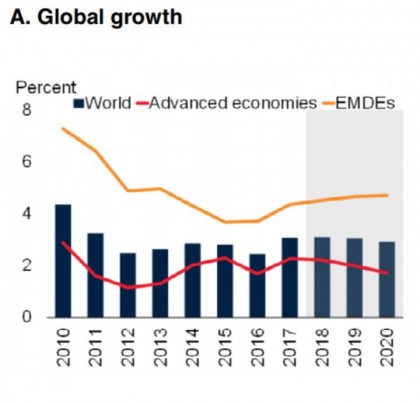
This optimism is reflected in their forecast of world growth over the next few years as shown in  Figure A below.


Source: World Bank Group, Global Economic Prospects, TH eTurning of the Tide? 2018.

This forecast highlights the growing contribution of emerging markets and developing economies (EMDEs) on future global growth.  Growth in developed (or advanced) economies is projected to moderate gradually as current stimulus initiatives are withdrawn and labour market slack  decreases, before a moderate level of sustainable growth is reached.

However, the bad news is that the World Bank also highlights forecast growth is highly sensitive to two factors:

  1. Continuing access to reasonably priced debt to allow ongoing investment. The wind down in stimulus packages in developed economies will reduce liquidity and cause rising interest rates globally which may affect investment in highly leveraged EMDE economies.

  2. The rise of geopolitical risk, particularly popularism and protectionism in developed economies. This has the potential to hurt growth in both developed and EMDE economies.

The impact on infrastructure

Future economic growth is important for infrastructure investors.  An understanding of likely economic trends allows us to estimate the potential demand for new infrastructure and effects on existing infrastructure asset performance and valuations.

Historically, the performance of a nation’s infrastructure has been a key determinant of that nation’s economic performance. For example, US studies on the benefit-cost ratio of highways in Texas show that it could exceed 6:1.2 More locally, recently benefit-cost analysis on Sydney’s West Connex F6 motorway indicates a benefit cost ratio of 2:1.3

Conversely, inadequate transport, communications and energy infrastructures are often limitations to growth in emerging and developing economies. High interest rates can also dampen investment and subsequently slow growth. 

Infrastructure investment characteristics

Infrastructure offers a range of very diverse investments which can broadly be categorised as shown in the following table.

Infrastructure category

Risk return profile 

Growth/Yield

Comments 

Cash flows linked to GDP growth (eg: airports, ports, communications, logistics, toll roads)

Higher risk/higher returns 

Predominantly capital growth

Equity type returns (not a bond proxy)

Economically regulated

(eg: energy and water utilities)

Medium risk/medium returns

Predominantly yield

Good bond proxy

Public Private Partnerships

(eg: hospitals, schools and courts) 

Lower risk/lower returns

Highest yielding including return of capital

Better bond proxy. Fixed term development and operational concession under contract to government.

Most risks, including demand and inflation passed through to government.

From this table, it is apparent that cash flows of different types of infrastructure assets may respond differently in a sustained, moderate growth, post-GFC environment.

  • In a gross domestic product (GDP)-linked asset, a return to sustained growth would result in sustained growth in future cash flows and give investors the confidence to invest for future growth. Bond rates could also be expected to rise in a sustained growth environment, increasing debt costs. However, as cash flows are also likely to increase, the net impact on valuations should be positive with moderate economic growth and prudent gearing levels.

  • For economically regulated assets, most economic risks are passed through to consumers over the longer term. That is, over the longer term, net cash flows should be largely indifferent to the changing economic circumstances, although the regulatory cycle may impose delays. Utility-style infrastructure has traditionally been a ‘go to’ investment in times of market uncertainty, as infrastructure cash flows may, in large part, be decoupled from market and economic cycles. This characteristic led to many investors using utilities as a bond proxy as a consequence of the post-GFC erosion of bond yields. 

  • Public Private Partnerships (PPP) enjoy many of the protections of economically regulated assets, with minimal regulatory risk. They are, however, exposed to limited operational risk (e.g. an obligation to maintain facilities in a fit-for-purpose condition) and debt financing risk. Pass through of consumer price index (CPI) and debt hedges protect against interest rate increases. However, as PPP’s are effectively a bond proxy, improving bond yields may reduce demand for such assets.

Unlisted/Listed infrastructure investments 

Infrastructure equity investments can be accessed either through unlisted or listed markets. While the operational results for listed and unlisted assets tend to be are similar, the difference in market access has important effects on the characteristics of the investments, as summarised in the table below. These differences can be exploited to increase diversity and reduce volatility in an infrastructure portfolio.

For most retail investors, an investment in a specialist fund is the most practical way to invest in both unlisted and listed assets as this brings down the minimum investment size to reasonable levels, while also enabling access to well diversified portfolios. For example, while there are some high-quality infrastructure companies listed on the Australian stock exchange, there is only a small handful of them. This means investing directly in these stocks makes it hard to implement a well-diversified infrastructure portfolio. Investing through a specialist fund typically provides exposure to a well-diversified global infrastructure portfolio.

The following table summarises the characteristics of both unlisted and listed infrastructure investments and is based on AMP Capital’s more than 20 years of experience of infrastructure investing. 

 Factor

Unlisted 

Listed

Comments 

Typical retail investor minimum investment size

+$10,0004

+$10,0005

As noted above, for most retail investors, an investment in a specialist fund is the most practical way to access both unlisted and listed assets.

Valuations

Fundamental Discounted Cash Flow

Market Caps

Listed assets are exposed to public market sentiment. 

Total return range (% per annum)6

7%~12%

8%~12%

Over the longer term returns for similar types of assets tend to be similar.

Yield range (% per annum)6

3%~9%

3%~5%

Listed PPP assets tend to trade at high multiples to net asset backing reducing yield in comparison to unlisted PPPs.

Risk (% annum volatility)6

5%~10%

10%~15%

Listed market sentiment causes higher volatility.

Liquidity

Limited

Daily

Specialist hybrid funds (which include both listed and unlisted assets) can offer improved liquidity.

Dept of market

$US1 tr.

$US2.5 tr.

Listed markets have greater depth, primarily through access to US utility assets.

Considerations for portfolio construction

The above considerations highlight the benefits of maintaining a well-diversified infrastructure portfolio. For example, if the World Bank forecasts prove to be substantially correct, we would expect to see some softening demand for bond proxy-type assets, while growth-linked assets would prosper.

If the risk factors highlighted by the World Bank dominate, producing a lower growth outcome, we expect demand for bond proxy assets would still remain high while valuation growth for growth assets would remain at current levels.

Additionally, a mix of listed and unlisted assets in a portfolio provides further diversification opportunities such as:

  • The different basis for unlisted and listed valuations means that the movement in valuations is largely uncorrelated (that is, they don’t necessarily move in the same direction at the same time). For example, listed markets usually respond negatively to an interest rate movement. As discussed above, interest increases may have very little impact on the fundamental valuation of unlisted assets, or may even be positive in the case of a growth-linked asset. This means that the movement in valuations in a combined listed/unlisted infrastructure portfolio can cancel each other out to a degree, effectively reducing overall portfolio risk.

  • Listed markets provide access to assets which are not generally available as unlisted investments, for example, US utilities. This allows greater geographic and sector diversification.

Final thoughts

The World Bank forecasts clearly show the increasing reliance global growth has on EMDE performance. Growth in EMDEs will drive the need for additional infrastructure in those economies, which in turn will lead to an expanded set of infrastructure investment opportunities for investors over the medium term. At the same time, while growth in developed economies is not expected to be as strong as in the EMDEs, there will still be a need for substantial infrastructure spend in those markets due to themes such as replacing existing ageing infrastructure, the advent of disruptive technologies, and the ageing demographic.


Author: Greg Maclean, Global Head of Research, Infrastructure

Source: AMP Capital 4 December 2018


1 World Bank Group, Global Economic Prospects, The Turning of the Tide? 2018. 

2 McFarland, W and Memmott, J. Ranking Highway Construction Projects: Comparison of Benefit-Cost Analysis with Other Techniques.

3 Infrastructure Australia, Project Business Case Evaluation, West Connex, 2016.

4 AMP Capital Core Infrastructure Fund

5 AMP Capital Global Infrastructure Securities Fund (Hedged)

6 Based on observed long-term historical performance. Performance may vary according to a range of factors including economic conditions, the type of asset and market cycles. Past performance is not an indicator of future returns.


Important notes:
While every care has been taken in the preparation of this article, AMP Capital Investors Limited (ABN 59 001 777 591, AFSL 232497) and AMP Capital Funds Management Limited (ABN 15 159 557 721, AFSL 426455) makes no representations or warranties as to the accuracy or completeness of any statement in it including, without limitation, any forecasts. Past performance is not a reliable indicator of future performance. This article has been prepared for the purpose of providing general information, without taking account of any particular investor’s objectives, financial situation or needs. An investor should, before making any investment decisions, consider the appropriateness of the information in this article, and seek professional advice, having regard to the investor’s objectives, financial situation and needs. This article is solely for the use of the party to whom it is provided.