You may have read about the latest ranking of Australia as one of the best countries for retirees in terms of lifestyle and retirement-income systems. And you may have wondered what such rankings personally mean for you – apart from perhaps making you feel fortunate about where you live.

After all, you are unlikely to move to, say, the Netherlands because it’s retirement-income system ranks as the world’s best.

However, the rankings may prompt you to take measures to improve your chances of a successful retirement lifestyle.

Retirement incomes

First, let’s look at the Melbourne Mercer global pension index 2018, published by Mercer and the Australian Centre for Financial Services. This ranks Australia’s retirement-income system fourth out of the 34 countries assessed, based on adequacy, sustainability and integrity. Australia was given a B while the Netherlands and Denmark received A grades.

A B-rated retirement-income system is described as having a “sound structure with many good features” but, in the words of many school reports, says: There’s room for improvement.

Irrespective of each country’s social, political, historical and economic influences, this report stresses that many of their challenges in dealing with an ageing population are similar. These include encouraging people to work until older ages, setting the level of retirement funding and reducing the” leakage” of retirement savings before retirement.

Although the suggestions of the Global Pension Index are directed mainly at government and the pension/retirement sectors, individuals may pick up useful personal pointers from most of its suggestions. In short, consider taking a personal perspective on this global retirement-income challenge.

Personal pointers may include:

  • Think about whether to work until an older age than planned. A longer working life may provide a chance to save more for a shorter, and, therefore, less-costly retirement. And as the report says, working until an older age will limit the impact on retirement savings of increasing longevity. In reality, your ability to work past traditional retirement ages will much depend your personal circumstances including health and employment opportunities.

  • Save more in super within Australia’s annual contribution caps. This can include making higher salary-sacrificed contributions if employed. If self-employed, consider making voluntary super contributions, which are not compulsory for the self-employed.

  • Aim to repay your debts before retirement. Otherwise, you face repaying that debt with your retirement savings. One of the reasons why Australia has achieved a lower score this year (down from B-plus to B) for its retirement-income system is that the latest Global Pension Index includes pre-retirement household debt in its calculations for the first time.

  • Take your super as pension rather than a lump sum upon retirement. This will keep your savings in the concessionally-tax or tax-free super system for longer and, most importantly, make your retirement lifestyle as comfortable as possible for as long as possible. The Global Pension Index suggests that a way to improve Australia’s retirement-income system is to compel super members to take part of their super as a pension.  

As Dr David Knox, a senior partner of Mercer in Australia, comments in the report, retirement income systems around the world are under pressure from ageing populations; low growth and low interest from investments reducing long-term compounding interest; and lack of “easy access” to pension plans (superannuation in Australia) in the gig economy; high government debt in some countries; and high household debt.

In this environment, individuals have more of an incentive to take matters into their own hands to maximise their retirement savings.

Best countries for retirees

The 2018 Best Countries report once again ranks Australia as the world’s second-best country for a comfortable retirement – behind New Zealand and ahead of Switzerland, Spain and Portugal in the top five. This is an annual survey and analysis by US News & World Report, BAV Consulting and the Wharton School at the University of Pennsylvania.

Survey respondents aged over 45 ranked the best countries for retirement on seven attributes: affordability, favourable tax environment, friendliness, “a place I would live”, pleasant climate, respect of property rights and a well-developed public health system. (The survey did not seek views about the adequacy of a country’s retirement-income systems.)

For the main report, more than 21,000 survey participants from around the world were asked to grade 80 countries on a range of factors from quality of life to economic potential. It aims to gauge global perceptions of the countries.

Australia came seventh overall with Switzerland again taking first place. Specific areas where Australia ranks in the top five are: quality of life (Australia fifth), best countries to invest in (Australia sixth – up from 22nd last year) and best countries for a comfortable retirement (Australia second).

Now think about what these findings may mean for you personally. 

Source : Vanguard November 2018 

Written by Robin Bowerman, Head of Corporate Affairs at Vanguard

Reproduced with permission of Vanguard Investments Australia Ltd

Vanguard Investments Australia Ltd (ABN 72 072 881 086 / AFS Licence 227263) is the product issuer. We have not taken yours and your clients’ circumstances into account when preparing this material so it may not be applicable to the particular situation you are considering. You should consider your circumstances and our Product Disclosure Statement (PDS) or Prospectus before making any investment decision. You can access our PDS or Prospectus online or by calling us. This material was prepared in good faith and we accept no liability for any errors or omissions. Past performance is not an indication of future performance.

© 2018 Vanguard Investments Australia Ltd. All rights reserved.

Important:
Any information provided by the author detailed above is separate and external to our business and our Licensee. Neither our business, nor our Licensee take any responsibility for any action or any service provided by the author.

Any links have been provided with permission for information purposes only and will take you to external websites, which are not connected to our company in any way. Note: Our company does not endorse and is not responsible for the accuracy of the contents/information contained within the linked site(s) accessible from this page.

While global and Australian shares had a nice bounce from their late October lows – rallying about 5%, partly reversing their 10% or so top to bottom fall, they have since fallen back to their lows as the worries about US rates, bond yields, trade, tech stocks, etc, have morphed into broader concerns about global growth and profits. Fears of a credit crunch and falling home prices are probably not helping Australian shares either, which this week dipped below their October low. Our assessment remains that it’s too early to say we have seen the lows, but we remain of the view that it’s not the start of major bear market.

The three bears – correction, gummy & grizzly

Very simply there are 3 types of significant share market falls:

  • corrections with falls around 10% (of course these aren’t really bear markets – but some might feel that they are!); 

  • “gummy” bear markets with falls around 20% meeting the technical definition many apply for a bear market but where a year after falling 20% the market is up (like in 1998 in the US, 2011 and 2015-16 for Australian & global shares); and

  • “grizzly” bear markets where falls are a lot deeper and usually longer lived (like in 1973-74, US and global shares through the tech wreck or the GFC).

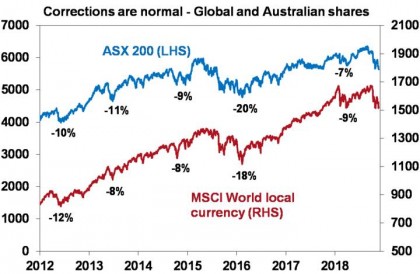
I can’t claim the terms “gummy bear” and “grizzly bear” as I first saw them applied by stockbroker Credit Suisse a few years ago. But they are a good way to conceptualise them. Grizzly bears maul investors but gummy bears eventually leave a nicer taste (like the lollies). Corrections are quite normal and healthy as they enable the sharemarket to let off steam and not get too overheated. As can be seen in the next chart, excluding the present episode since 2012 there have been four corrections and one gummy bear market (2015-16) in global and Australian shares. Bear markets generally are a lot less common, but arguably what we saw in 2015-16 was a gummy bear market.


Source: Bloomberg, AMP Capital

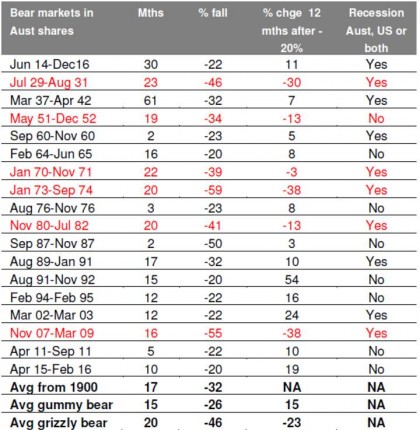
The next table shows conventionally defined bear markets in Australian shares since 1900 – where a bear market is a 20% decline that is not fully reversed within 12 months. The first column shows bear markets, the second shows the duration of their falls and the third shows the size of the falls. The fourth shows the percentage change in share prices 12 months after the initial 20% decline. The final column shows whether they are associated with a recession in the US, Australia or both.

Bear markets in Australian shares since 1900 


Based on the All Ords, excepting the ASX 200 for 2015-16. I have defined a bear market as a 20% or greater fall in shares that is not fully reversed within 12 months. Source: Global Financial Data, Bloomberg, AMP Capital

If a gummy bear market is defined by a 20% decline after which the market is higher 12 months later whereas as grizzly bear market sees a continuing decline over the subsequent 12 months after the first 20% decline, then since 1900 there have been 12 gummy bear markets (these are highlighted in black) and there have been six grizzly bear markets (highlighted in red). Several points stand out. First, the gummy bear markets tend to be a bit shorter and see much smaller declines averaging 26% compared to 46% for the grizzly bear markets.

Second, the average rally over 12 months after the initial 20% fall is 15% for the gummy bear markets but it’s a 23% decline for the grizzly bear markets.

Finally, and perhaps most importantly the deeper grizzly bear markets are invariably associated with recession, whereas the milder gummy bear markets including the 1987 share market crash tend not to be. Five of the six grizzly bear markets saw either a US or Australian recession or both whereas less than half of the gummy bear markets saw recession.

It’s also the case that US share market falls are much deeper and longer when there is a US recession.

What’s it likely to be this time?
Our view remains that a grizzly bear market is unlikely because, short of some unforeseeable external shock, a US, global or Australian recession is not imminent. In relation to the US:

  • Business and consumer confidence are very high.

  • While US monetary conditions have tightened they are not tight and they are still very easy globally and in Australia (with monetary tightening still a fair way off in Europe, Japan and Australia). We are a long way from the sort of monetary tightening that leads into recession.

  • Fiscal stimulus is continuing to boost US growth.

  • We have not seen the excesses – in terms of debt growth, overinvestment, capacity constraints and inflation – that normally precede recessions in the US, globally or Australia.

Reflecting this, global earnings growth is likely to remain reasonable – albeit slower than it has been – providing underlying support for shares. In relation to Australia – yes housing is turning down and this will weigh on consumer spending, but it will be offset by a lessening drag from mining investment, strengthening non-mining investment, booming infrastructure spending and solid growth in export earnings. Growth is unlikely to be as strong as the RBA is assuming but it’s unlikely to slide into recession either.

So, for all these reasons it’s unlikely the current pull back in shares is the start of a grizzly bear market. However, we have already had a correction in mainstream global shares and Australian shares (with circa 10% falls) and with markets falling again it could turn into gummy bear market, where markets have another 10% or so leg down – a lot of technical damage was done by the October fall that has left investors nervous, the rebound from late October was not particularly convincing and many of the drivers of the October fall are yet to be resolved.

Some positives

However, there are three developments that help add to our conviction that we are not going into a grizzly bear market. First, recent comments by Fed Chair Powell and Vice Chair Clarida indicate that the Fed remains upbeat on the US economy and a December hike looks assured (for now), but it is aware of the risks to US growth from slowing global growth, declining fiscal stimulus next year, the lagged impact of eight interest rate hikes and stock market volatility and appears open to slowing the pace of interest rate hikes or pausing at some point next year. The stabilisation in core inflation around 2% seen lately may support this. Past gummy bear markets (1987, 1998, 2011, 2015-16) all saw some pause or relaxation by the Fed.

Second, while it’s messy after the US/China standoff at the recent APEC forum there have been some positive signs on trade. Talks between the US and China on trade have reportedly resumed ahead of a meeting between President Trump and President Xi at the G20 summit next week and President Trump has repeated that he is optimistic of a trade deal with China and that the US might put any further tariff increases on China on hold if there is progress. The US/China trade dispute is unlikely to be resolved quickly when Trump and Xi meet. Perhaps the best that can be hoped for is agreement to have formal trade talks with the aim of resolving the issues and the US agreeing to delay any further tariff increases. With Trump wanting to get re-elected I remain of the view that some sort of deal will be agreed before the tariffs cause too much damage to the US economy. Rising unemployment (as fiscal stimulus will turn to contraction next year if current and proposed tariffs/taxes on China go ahead) and higher prices at Walmart will sink Trump’s re-election prospects in 2020. Of course, investors are now highly sceptical of any progress on the trade front. So any breakthrough in the next six months could be a big positive.

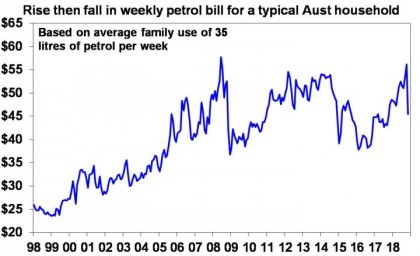
Finally, while the 30% plunge in the oil price since its October high is a short-term negative for share markets via energy producers, it has the potential to extend the economic cycle as the 2014-16 oil price plunge did. The main drivers of the fall in the oil price are slower global demand growth, US waivers on Iranian sanctions allowing various countries to continue importing Iranian oil, rising US inventories, the rising $US and the cutting of long oil positions. While oil prices are unlikely to fall as much as in 2014-16 when they fell 75% (as OPEC spare capacity is less now) they may stay lower for longer. This is bad for energy companies but maybe not as bad for shale producers as in 2015 as they are now less indebted and their break-even oil price has already been pushed down to $50/barrel or less. It will depress headline inflation (monthly US inflation could be zero in November and December) and if oil stays down long enough it could dampen underlying inflation. All of which may keep rates lower for longer. And its good news for motorists who see rising spending power. For example, Australian petrol prices have plunged from over $1.60 a litre a few weeks ago to below $1.30 in some cities. That’s a saving in the average weekly household petrol bill of around $10.


Source: Bloomberg, MotorMouth, AMP Capital


Source: AMP Capital 22 November 2018


Important notes: While every care has been taken in the preparation of this article, AMP Capital Investors Limited (ABN 59 001 777 591, AFSL 232497) and AMP Capital Funds Management Limited (ABN 15 159 557 721, AFSL 426455) makes no representations or warranties as to the accuracy or completeness of any statement in it including, without limitation, any forecasts. Past performance is not a reliable indicator of future performance. This article has been prepared for the purpose of providing general information, without taking account of any particular investor’s objectives, financial situation or needs. An investor should, before making any investment decisions, consider the appropriateness of the information in this article, and seek professional advice, having regard to the investor’s objectives, financial situation and needs. This article is solely for the use of the party to whom it is provided.


While “digital offices” continually offer new opportunities for efficiency and communication, they may actually harm the health of their employees. A recent study added to evidence that sitting for long periods of time leads to a higher mortality risk; this is especially true if an individual sits for hours without getting up to move.

“We tend to think of sedentary behavior as just the sheer volume of how much we sit around each day,” said study author Keith M. Diaz, PhD, certified exercise physiologist and Assistant Professor of Behavioral Medicine at Columbia University Medical Center. “But previous studies have suggested that sedentary patterns—whether an individual accrues sedentary time through several short stretches or fewer long stretches of time—may have an impact on health.”

Unfortunately, for many professionals, sitting during the day is inevitable. So, how can you control your risk?

Diaz suggests getting up every half hour to move around.

Sounds simple, right?

Despite your best intentions, when you sit down at your desk and log on to your computer, you’re likely to get comfortable and forget about your resolution to be more active during the workday.

This guide gives you some pointers on how to set yourself up to be more active when you’re in a sedentary job (particularly when you’re in an environment that doesn’t energize you or inspire you to get up and move around).

Prepare Your Workspace

Before you plan your new routine, it’s important to make your office space an energizing environment. Here are some ways that you can revamp your office area to serve your fitness goals.

  • Create incentives to move. If you’ve got your coffee and a supply of snacks within arms reach, you can settle in for quite a while. Put your food and drinks (healthy ones of course!) in the kitchen if possible, so you have to get up to get that “reward”.

  • Dress comfortably. Even if you have to wear traditional office attire to work, you can find pieces that are made from fabrics that allow you to move. The key is to wear things that allow you to stretch and move comfortably. If you need help figuring out how to pull together an office appropriate “flexible” outfit, many retailers provide personal shopping services and can help you find outfits that accommodate both your style and your company’s dress code. If you are concerned about footwear specifically, stash a comfortable pair of shoes under your desk.

  • Bring the right gear. You might consider using an exercise ball, yoga mat, or other fitness gear during your movement breaks. Bring these in ahead of time so you can be ready to go.

  • Set reminders to get up. If you are worried about getting caught in your work zone and forgetting to move, set calendar reminders. By scheduling in your breaks, and setting up an “alarm” you’ll be less inclined to skip them.

  • Add energizing elements. You might be unmotivated to move at work because your workspace is not supporting your energy. Add plants, photos that bring you joy, and other decorative elements that make you feel happy.

  • Go toward the light. Office lighting is often harsh and debilitating. Natural light is energizing. If you aren’t seated close to a window, be sure to spend time near a window or get outdoors as much as possible during your workday.

Once you make your desk a more supportive environment for your energy and wellness goals, you can begin experimenting with different types of exercise.

Let’s Go!

Remember that there is no perfect formula for incorporating exercise into your workday. Your ideal routine will depend on what suits you. Start small and build up to more strenuous activities. If on day one you plan to go for a long run or to a killer class at a gym, there probably won’t be a day two.

  1. Any time you’re sitting at your desk you can do desk yoga. Pay particular attention to your hips, neck, wrists, shoulders, and back, since these parts of your body tend to stiffen up while you sit at a desk. You can find ideas for office yoga here.   If you don’t have time to do an entire sequence, that’s OK! Just a simple stretch can be enough to give you a little burst of energy.

  2. When you have longer periods of time to move, take a brisk walk around the office, walk or jog in the office stairwell if you have one, or walk outside. Better yet, invite your colleagues to have a “walking meeting” instead of meeting in a conference room or at a table. That requires a bit of planning, so read up on how to do walking meetings right.

  3. Some of the moves in this thing called “deskercise” might be a little difficult to pull off in an office setting, particularly high intensity moves like split squat jumps and the fist pump. Perhaps you can find an empty conference room or a space away from your office mates. OR! Be the leader of your office fitness crusade. Rally your office mates and get them to join you in a round of “deskercise.” Use your judgment on this one though (i.e., not appropriate for all office settings).

  4. If you have time and want a more strenuous workout, go for a run or to a nearby gym. That may seem like too much to handle on any given workday but with some pre-planning, you might be able to do it. Pack your gym bag the night before, dress in clothing that’s easy to change, and pack a lunch that you can eat at your desk. If you don’t have access to shower facilities, or time to shower, pack baby wipes, deodorant, and dry shampoo.

No matter how you choose to move at work, be sure to hold yourself accountable. This is why getting your co-workers on board is beneficial—you can remind each other to take periodic breaks or workout sessions. Don’t wait for someone else to be the office fitness cheerleader— you’re it!  

Source : Foodmatters September 2018

Reproduced with the permission of the Food Matters team. This article by  MARIANNE WELLS  was originally published at www.foodmatters.com/article/how-to-make-exercise-fit-into-your-workday

Important:
This provides general information and hasn’t taken your circumstances into account.  It’s important to consider your particular circumstances before deciding what’s right for you. Although the information is from sources considered reliable, we do not guarantee that it is accurate or complete. You should not rely upon it and should seek qualified advice before making any investment decision. Except where liability under any statute cannot be excluded, we do not accept any liability (whether under contract, tort or otherwise) for any resulting loss or damage of the reader or any other person. 

Any information provided by the author detailed above is separate and external to our business and our Licensee. Neither our business, nor our Licensee take any responsibility for any action or any service provided by the author.

Any links have been provided with permission for information purposes only and will take you to external websites, which are not connected to our company in any way. Note: Our company does not endorse and is not responsible for the accuracy of the contents/information contained within the linked site(s) accessible from this page.
If you’re going to balance the future of your own home or property on your child’s reliability to pay their mortgage, make sure you’re across the risks.

The majority of Aussies take about 3.7 years to save for a deposit on a first home, with a third of the nation taking just over five years1.

If you’ve got a kid who wants to get into the market sooner rather than later, you may have discussed whether you’d be willing to up their ability to borrow (if you’re in a position to) by going guarantor.

This is where you use the equity in your own property as security for the loan being taken out by your child. Meaning, you promise the lender your child will make the necessary repayments and if they don’t, or are unable to, that you’ll repay the loan for them.

While there may be benefits for your kid, things can still go wrong, so here is a list of things to avoid.

1. You don’t really know what your signing up for

Depending on the lender, you can use your property as security on your child’s entire home loan, the entire loan amount plus additional costs, or limit the guarantee to a portion of the loan.

How long you act as guarantor will depend, but once your child’s loan has reduced beyond a certain level, you can ask to be removed as guarantor, but this will have to be approved and fees may apply.

You also may be required to get legal advice before a lender will accept the arrangement.

2. You haven’t considered what’d happen if your kid was without an income

You always want to hope for the best, but in reality, over the term of your child’s loan, there could be a point where they lose their job or become injured or ill and be unable to make repayments for a while.

For this reason, you may want to find out if they have a back-up plan, any emergency cash stashed away or personal insurance (what type and how much).

If things don’t go as expected, the loan does become your responsibility, so unless you have additional capital, worse-case scenario, you may have to sell your home to clear your child’s debt.

3. You haven’t really thought how this could affect what’s on your bucket list

Going guarantor reduces your ability to borrow funds, so it’s important to think about whether you have other plans that could be affected – holidays or other big purchases.

You may also want to give some thought to your retirement. June 2018 figures show individuals and couples, around age 65, who are looking to retire today, need an annual budget of $42,953 and $60,604 respectively to fund a comfortable lifestyle2. This assumes you own your home outright and are in relatively good health3.

4. You haven’t chatted with your kid about any expectations you have

Having an agreement in place could go a long way to ensuring everyone is on the same page. You may even consider writing down what you’ve agreed to so there are ground rules in place.

It’s also worth discussing how long you intend to act as guarantor and what your exit strategy is, as you may only be required to do it for the first few years as they pay down their loan.

5. You haven’t explored other financial avenues that may work better for you

  • Could you gift a deposit?

If you can afford it, gifting a deposit might be something you’d prefer to do. A good deposit will reduce the amount your child needs to borrow, and the interest paid over the life of their loan.

Bear in mind, if you happen to receive Centrelink payments, you’ll need to consider that a gift of this nature could impact your benefits so do your research.

  • Could you go in as a co-owner?

When you buy a home with your kids you share responsibility for the costs involved while receiving the benefits of investing in property.

It’s important to understand that as a co-owner you are included on the loan and you’d technically own only half of the property.

If you sign as a joint borrower, you’re equally responsible for the home loan and must repay the entire debt with the principal borrower—your child—whether they default or not.

This is also a big commitment and you’ll need to understand the risks and get the right advice.

  • Could you let them save money by staying at home for longer?

Nearly one in three adults aged 19 to 34 still live with their parents, with financial reasons dominating why people said they stayed at home4.

With that in mind, you may prefer offering your kid their old room for a while for low or no rent to help them get some more savings behind them.

Please contact us on Phone: 07 5641 4134 to discuss any potential risks, benefits and tax implications.

Source : AMP October 2018 

1 Finder – one in three first home buyers stuck saving for a deposit for over five years – press release
2, 3 ASFA Retirement standard – table 1
4 Mozo – The cost of stay at home children – press release

 
Important:
This provides general information and hasn’t taken your circumstances into account. It’s important to consider your particular circumstances before deciding what’s right for you. Although the information is from sources considered reliable, we do not guarantee that it is accurate or complete. You should not rely upon it and should seek qualified advice before making any investment decision. Except where liability under any statute cannot be excluded, we do not accept any liability (whether under contract, tort or otherwise) for any resulting loss or damage of the reader or any other person.
Any information provided by the author detailed above is separate and external to our business and our Licensee. Neither our business, nor our Licensee take any responsibility for any action or any service provided by the author.
Any links have been provided with permission for information purposes only and will take you to external websites, which are not connected to our company in any way. Note: Our company does not endorse and is not responsible for the accuracy of the contents/information contained within the linked site(s) accessible from this page. 
 

It’s probably not the sexiest thing the two of you have on the to-do list but putting it off could see you butting heads.

Whether or not money issues got in the way of past relationships, you may be thinking, there’s no way you’re going to pull back on that long passionate kiss you might get after work today to drop the f bomb (I’m talking your ‘financial expectations’ going forward).

If you’re still in the honeymoon period, the idea might sound ludicrous, particularly if everything has been champagne and lingerie up until this point, or sport and beer (each to their own).

If you’re only a couple of months into the relationship, not wanting to have this conversation may make total sense (unless you’re about to wire some overseas lover you’ve never met your life savings).

If you have been together for a while though or are edging on making a big financial decision together, having the money talk could make a big difference to whether you go the distance.

Understandably, it may not be the easiest topic to broach, so feel free to use this article as a bit of a conversation starter, depending on what the two of you have planned going forward.

Talk about where you’re at and what you (really!) think

Here is a list of things worth discussing with your partner before you consider merging your money, moving in together, or buying any big-ticket items in both your names.

1. Your views on cash management

Talk to your partner about your views around spending and saving. Kicking off with a light-hearted conversation, without judgement, can often be a good place to start for couples. And, you might even want to share some examples of things in the past that may have influenced your current views and behaviours.

2. Sneaky spending habits if you have any

While around seven in 10 Aussies, who are in a relationship, say they don’t hide transactions from their other half, about three in 10 do, with fashion and beauty items topping the list, followed by gambling and money spent on junk food1.

With that in mind, if there are a couple of common transactions you make that you know you haven’t always been forthcoming about (how many times do you really go to Maccas rather than pack your lunch?), now may be a good time to get that out in the open.

3. Your income, expenses, assets and debts

Your financial situation is an important one to talk about because even if you’re both earning a decent income (and potentially have some assets behind you), big expenses and potentially thousands of dollars of debt between you may impact any plans you have in the short and longer term.

To throw a few figures at you for context, 24% of generation X Aussies, 22% of generation Y Aussies and 12% of Baby Boomer Aussies have more than $5,000 worth of credit card debt alone2.

4. Whether you’ve been paying your bills on time

If you’ve got a credit card, personal loan, mobile phone plan or utility account, there’s more than likely a credit reporting agency out there that has a file with your name on it. This file, also known as a credit report, will summarise how good you’ve been at paying your bills and making your repayments on time.

If you have a chequered history, your report mightn’t read particularly well, and this could affect your ability to borrow money. If you’re unsure how your report reads, consider requesting a copy from one of the reporting agencies (Veda, Dun & Bradstreet, Experian or the Tasmanian Collection Service).

5. What’s on your bucket list now and down the track

If one of you has plans to travel, buy property, get married or have children and the other doesn’t, this could raise issues or perhaps opportunities for further discussion and compromise.

Depending on how important these things are to you or your partner, it may be worth nutting this out early on, or if you don’t come to a solution straight away, knowing that it’s something you’d like to raise again at a later date.

6. What a joint budget and savings plan might look like to you

Committing to something that you both think is fair could go a really long way here. If you’re not sure where to start, a good first step might be drawing up what money is coming in, what money is needed for the mandatory stuff and what may be left over for your social life and savings.

While not everything has to be shared, if one person’s saving more and the other’s spending more, arguments may arise, so try to come to an agreement that works for both of you.

7. Your job security and whether you see a change on the cards

If you’re on the verge of quitting your job or are aware of redundancies happening at work, this is probably worth flagging with your partner as well.

Speaking up so the other isn’t caught off guard could make a big difference to the holiday, wedding or new-car plan that you’re working on as a team.

8. Your contingency plan if one of you isn’t earning an income

One in five Australians doesn’t have enough money set aside to cover a $500 emergency3, so it’s probably worth talking about whether either of you have an emergency stash of cash, personal insurance, or anything that may help you get by through a tough period.

If you don’t have a plan b, now might be the time to talk about how you might be able to create one together. Plus, it may reduce the need to rely on high-interest borrowing options, such as credit cards or payday loans, which can often be an expensive way to borrow and create unwanted debt.

9. How you’ll divide costs and or repayments

You may decide to tackle this 50/50 or proportionate to each other’s income. That is something you’ll want to nut out before you take on a big financial commitment together. And, you may also want to take into consideration anything additional you might be bringing to the table, like money or assets.

10. The potential risks that may arise if you merge your money

If your partner defaults on a repayment, you may be liable for the amount owing, even if your relationship ends. On top of that, ignorance isn’t an excuse, so if you sign papers you don’t understand, you’re no less liable for any loans or guarantees you may have signed off on.

With that in mind, it’s important both of you understand your responsibilities and consider whether you want to put anything you might agree to in writing.

Please contact us on Phone: 07 5641 4134 if we can be of further assistance .

1 Finder – Out of sight, out of mind: One in three Aussies spend secretly
2 Finder – State of the Credit Card Market Report page 21
3 Finder How a $500 emergency could spell financial ruin for millions of cash-strapped Aussies

Source : AMP Novemeber 2018 

 Important:
This provides general information and hasn’t taken your circumstances into account.  It’s important to consider your particular circumstances before deciding what’s right for you. Although the information is from sources considered reliable, we do not guarantee that it is accurate or complete. You should not rely upon it and should seek qualified advice before making any investment decision. Except where liability under any statute cannot be excluded, we do not accept any liability (whether under contract, tort or otherwise) for any resulting loss or damage of the reader or any other person.  
Any information provided by the author detailed above is separate and external to our business and our Licensee. Neither our business, nor our Licensee take any responsibility for any action or any service provided by the author.
Any links have been provided with permission for information purposes only and will take you to external websites, which are not connected to our company in any way. Note: Our company does not endorse and is not responsible for the accuracy of the contents/information contained within the linked site(s) accessible from this page.

 

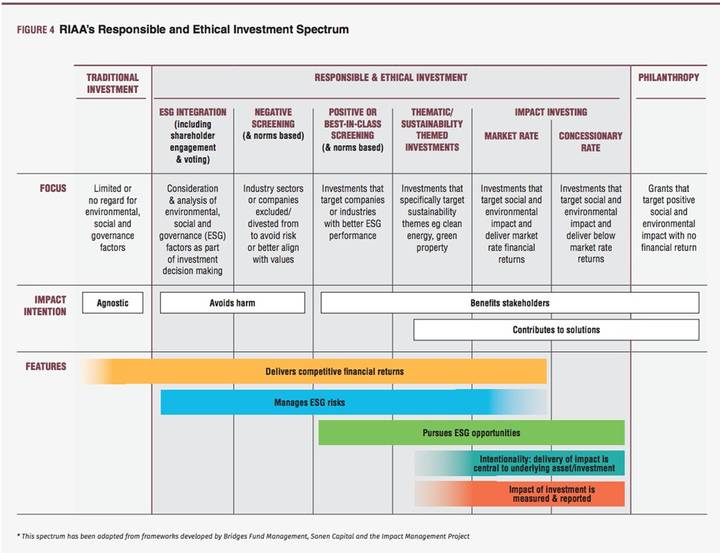
“How well aligned are ESG managers and ESG investors?”

The ongoing growth in environmental, social and governance (ESG) investing has been driven by investors who may share certain common characteristics, but who have different concerns and commitment levels towards ethical investing.

This growth has unsurprisingly been accompanied by a proliferation of ESG product offerings from an increasing number of fund managers. However, they may take significantly different approaches in balancing the need for market performance alongside delivering positive and sustainable social and environmental outcomes.

Investors should recognise that not all ESG managers are created equal. Investors who genuinely wish their savings to be invested within a values-driven framework should identify a manager whose values align with their own, rather than one who merely acknowledges ESG risk management as a hygiene factor.

Sensitivity to performance

ESG investor behaviour is characterised by a sliding scale of commitment amongst investors and consequently the level of priority that they accord it differs.
At one end of the scale are investors who are sometimes described as philanthropic investors and are highly committed to allocating funds within a clearly defined ethical framework. They prioritise making a positive impact ahead of making portfolio returns, especially in the shorter-term.

Further along the scale, many institutions remain focussed on delivering long-term performance to their underlying investors but genuinely take ESG oversight seriously. They may well engage with the fund manager every quarter and pay close attention to the ESG credentials of all stocks within the portfolio.

At the other end of the ESG commitment scale are investors for whom ESG is perceived as a hygiene factor while their primary focus is firmly on maximising returns. The expectation is that controls are in place to manage the most significant ESG risks and ensure that the governance requirements of the mandate are being met.


Source: Responsible Investment Association Australasia – https://responsibleinvestment.org/wp-content/uploads/2018/08/RIAA_RI_Renchmark_Report_AUS_2018v8.pdf

It is perhaps unsurprising that investment managers adopt differing approaches to managing ESG risks in their portfolios. Some see this as a hygiene factor reflected in a page on their website that sets out a policy reflecting a broad approach to regulatory compliance and managing the risk of ESG impacts. However, others view it as an opportunity to build their entire investment process around an ethical framework. Instead of a mere marketing tool, they see a way to achieve environmental or social outcomes while delivering long-term value to investors.

This variety of approaches was reflected in the recent Global Impact Investor Network survey that showed 66% of impact investment managers principally target risk-adjusted market rate returns. This implies that they are unwilling to accept a below-market return while pursuing ESG focussed investments. However, investment opportunities are available that deliver positive environmental and social outcomes alongside return expectations; hence impact investors can be values driven whilst also seeking positive investment outcomes.

Making a positive impact

The traditional approach to ESG investing has been based upon excluding from the investable universe those companies that fail a screening process. In practice such companies are those whose activities are likely to cause harm to society or the environment, calling into question the long-term sustainability of their business model and earnings stream.

Such businesses might rely on the sale of tobacco or weaponry, pollute the environment, make an unacceptable contribution to climate change or carelessly manage their supply chain at the cost of vulnerable workers.

Such an approach represents progress upon traditional standard investing techniques, but investor thinking in this area has since progressed further. Some investors now increasingly expect their investments to make a positive impact on the wider world.

Impact investing might include equity investment in a developer of green energy technology, private equity investment in educational services, green bonds that finance wind farms or real estate investments that are both low energy and serve a social purpose such as aged care or social housing.

Real estate managers can go further and make a positive impact by investing in solar power. Shopping centres that use most of their energy during the day – when it is typically sunny – represent a solar power opportunity. However industrial premises, such as warehouses, tend to have more modest energy requirements and currently have limited solar generation potential. This is because exporting excess solar power into the grid is not remunerated at the same rate as drawing it down from the grid. Hence solar systems are generally sized to meet the energy demand of the building, rather than the maximum generation potential.

Managing ethical issues

A particular challenge of ESG investing is the divergence in thinking across institutions when considering the societal and environmental impacts of their investment activities. It is uncommon for two different investment policies to contain identical exclusions or even philosophies towards investing.

In particular, ESG investors may focus on a narrow or broad range of issues. Viewing the investment universe through a narrow lens is less common, however investors with a broader range of concerns are likely to hold different levels of concern and different priorities.

Carbon emission minimization for example, is typically a key feature of ESG investing, however policies vary significantly from those institutions that screen out only the most egregious emitters of CO2 to those that demand zero carbon emissions from all companies in which they invest.

Issues that tend to enjoy a high level of investor consensus include tobacco and prohibited weapons, such as chemical, biological, cluster munitions and land mines. There is widespread agreement amongst ESG investors that such products do unacceptable harm and that they should not invest in businesses whose primary purpose centres on their production.

However, there is greater ambiguity when businesses engage in excluded activities, but only as an incidental part of their overall business operations. An example might be a diversified mining company that provides essential raw products that are widely used, such as iron ore, aluminium and copper, but also engages in coal mining. It is now widely accepted that coal mining and its subsequent burning in power generation contributes to harmful climate change. Whereas a committed ethical investor would screen out such companies, an ESG risk focussed investor might consider them further if they had overall strong ESG characteristics. These might include mining efficiently and remediating mine sites upon the completion of operations.

Other areas where investors are likely to adopt differing positions are in the fields of animal rights or human rights. Investor attitudes towards such issues depend on values, which are likely to vary materially from one investor to another. Whereas ESG investing is based on scientific evidence correlating environmental or social harm with a business activity, an ethical approach rests upon a values framework which might be driven by a desire to avoid all harm to animals.

Managing supply chains in a responsible way has been a key ESG priority since the 2013 Rana Plaza disaster when 1,134 garment workers were killed in a building collapse in Bangladesh. The expectation that companies source supplies ethically is widely held. Most well governed companies understand the risks to their business in the form of operational disruption and reputational damage, which may occur if something goes wrong in the supply chain. However, investors do expect fund managers to engage with companies and to endeavor to hold them accountable for their supply chain practices.

Governance is another area of ESG investing where investor expectations and manager priorities vary. Diversity, executive pay, shareholder rights and board independence are all key areas which require engagement by investment managers. However, the relative importance that investors attach to different aspects of the governance process will depend on perceptions of long-term value that can be created through such a focus.


1 The Global Impact Investment Network (GIIN): Global Impact Investor Survey 2017, (2018), p3 https://thegiin.org/research/publication/annualsurvey2017

Source: AMP Capital 25 October 2018

Important notes: While every care has been taken in the preparation of this article, AMP Capital Investors Limited (ABN 59 001 777 591, AFSL 232497) and AMP Capital Funds Management Limited (ABN 15 159 557 721, AFSL 426455) makes no representations or warranties as to the accuracy or completeness of any statement in it including, without limitation, any forecasts. Past performance is not a reliable indicator of future performance. This article has been prepared for the purpose of providing general information, without taking account of any particular investor’s objectives, financial situation or needs. An investor should, before making any investment decisions, consider the appropriateness of the information in this article, and seek professional advice, having regard to the investor’s objectives, financial situation and needs. This article is solely for the use of the party to whom it is provided.

In a time of market uncertainty with concerns around rising US interest rates and overvalued equities it can be difficult to find investment opportunities and it’s of little surprise that investors are asking where they should allocate their funds.

But the good news is that recent developments have highlighted and reinforced a number of investment opportunities around the world that we believe investors should be exploring. Four of our picks are detailed below.

1. Latin American and emerging markets

The first is Latin American and emerging markets.

Based on forward price to earnings ratios, the relative valuation of emerging markets equities versus US equities is reaching lows not seen since 2008. The US market is also showing signs of running out of breath, so we are selectively adding to our emerging markets allocations through Latin American equities, emerging market bonds, and certain currencies, including the Mexican Peso and the Chilean Peso.

Many Latin American currencies and markets have been under pressure thanks to uncertainty around the North American Free Trade Agreement (NAFTA), which creates a trade bloc between the US, Canada and Mexico. Latin American markets should have been benefiting from rising commodity prices but concerns that US President Donald Trump would dump the trade pact outweighed this.

The recently revised North American trade deal, now known as the United States Mexico Canada Agreement (USMCA), has removed that uncertainty. It comes shortly after the US revised its free trade agreement with South Korea (known as KORUS) and bodes well for upcoming US-Japan bilateral trade talks.

These recent agreements suggest that Washington seems happy to accept some minor modifications to existing free trade deals, declare victory and get ready for the midterm elections. This seems to be a win for free-trade ‘globalists’ and a loss for protectionists who want to restrict free trade and as a result, emerging markets, which are heavily exposed to trade and have borne the brunt of concerns around rising US protectionism, should benefit.

2. Chinese consumer stocks

The second opportunity is in Chinese consumer stocks.

The recent positive developments around US trade may point to the possibility of a deal being achieved with China, but I’m not so hopeful. It seems the US-China trade tension is a symptom of a much bigger problem: the Trump administration’s unease with the rising power of China.

I don’t expect to see a US-China trade deal soon but to offset weakening US exports, the Chinese will likely stimulate domestic demand through co-ordinated fiscal and monetary support which will benefit listed Chinese companies that are exposed to domestic consumer demand.

As a result, we are increasing our exposure to shares in mainland China-based companies that are traded in Renminbi on its domestic stock exchanges (China A shares) which are undervalued and should benefit from any monetary policy easing.

3. Energy

The third opportunity is in US and global energy, with oil likely to push higher towards $US80 a barrel before a brief pause.

On the supply side, Donald Trump has called on Saudi Arabia to lift production, but the reality is the Saudis have very little spare production. Supply from Iran is also likely to leave the market as the US wants all oil imports from Iran to end by November. In support of this, India (the second largest buyer of Iran’s oil after China) is reducing its intake of Iranian oil, cutting its purchases to zero in November. Meanwhile in the US, shale oil productivity has been declining and capital expenditure has collapsed after the 2015/16 energy crisis.

On the demand side, global growth is running at a solid pace despite the recent non-US softness. Chinese growth should see a rebound as the impact of recent policy easing comes through.

4. Japanese equities and banks

The final opportunity is in Japanese equities, and in particular Japanese banks.

The Japanese Government Pension Investment Fund (GPIF), which is the world’s largest retirement savings pool, recently announced it wouldn’t automatically reinvest redemptions into Japanese Government Bonds (JGBs).

We believe this is important because it indicates a cautious stance towards holding JGBs. The bond bubble is slowly deflating and the GPIF is rightly looking for flexibility rather than blindly adding bonds to its portfolio. Basically, demand for bonds is waning which suggests bond yields are likely to rise (when bond prices fall, yields rise).

At the same time, the Bank of Japan’s (BoJ) balance sheet will soon be as large as Japan’s GDP. The BoJ – Japan’s central bank – will have to taper or reduce purchases of JGBs to avoid further serious market distortions.

We believe Japanese banks are likely to be significant winners from this situation, with a flow-on effect to global banks.

A world of opportunity

In summary, for investors willing to explore global opportunities and consider different asset classes, there are a significant number of possibilities to diversify their portfolios, protect against the mature US bull market, and enhance returns so they can reach their investment objectives and goals.


Author: Nader Naeimi, Head of Dynamic Markets and Portfolio Manager of Dynamic Markets Fund

Source: AMP Capital 01 November, 2018

Important notes: While every care has been taken in the preparation of this article, AMP Capital Investors Limited (ABN 59 001 777 591, AFSL 232497) and AMP Capital Funds Management Limited (ABN 15 159 557 721, AFSL 426455) makes no representations or warranties as to the accuracy or completeness of any statement in it including, without limitation, any forecasts. Past performance is not a reliable indicator of future performance. This article has been prepared for the purpose of providing general information, without taking account of any particular investor’s objectives, financial situation or needs. An investor should, before making any investment decisions, consider the appropriateness of the information in this article, and seek professional advice, having regard to the investor’s objectives, financial situation and needs. This article is solely for the use of the party to whom it is provided.

https://vimeo.com/299367257

October was certainly a volatile month for investors. Share markets globally fell between 6% and 7% in total return terms. Australia had the worst monthly outcome since August 2015.

But if you measure the falls from highs this year to recent lows the retreat has been even bigger. The average decline for global shares has been around 10%.

From its peak in late August, the S&PASX200 fell almost 11%. Emerging markets were hard hit, down around 20%, with China’s stock market slumping 30%.

Thankfully a bit of good news at the end of the month meant share markets have bounced around 3%.

The question now is, have we seen the bottom in markets?

We think it’s too early to say given various risks and so another bout of volatility remains possible. However, there are several reasons to believe that there is a good chance that markets will be higher in two months, six months or 12 months. In other words, I think the recent rout is likely a correction or a minor bear market within an ongoing bull market.

1. A bull market correction

The first reason is that for a major bear market to develop, where markets fall 20%, and the following year are down another 20% – as happened in the global financial crisis – you really need to see the US economy going into recession and dragging the rest of the world down with it. At the moment there is no sign of that happening.

2. Rates remain low

The second reason is that we’re in a world of relatively low interest rates. Yes, the US Federal Reserve is raising interest rates, but they have a long way to go before you could say interest rates are painful. And other countries are still a long, long way from raising interest rates. If anything, countries like Australia may still engage in monetary stimulus.

3. Normal volatility

The final reason is purely technical. We often see weakness around October. It is known as a volatile month. The good news is we typically rally into the end of the year and that strength continues into the early New Year. So, what we have seen in October is typical of seasonal volatility we get around this time of the year. It usually starts around August and September, but this year it started a little bit later in October.

Not the start of a major bear market

A number of worries triggered the recent sell-off, including US inflation, rising US rates, the China/US trade war, and concerns about emerging markets and Europe.

A lot of those worries still exist and markets could still have another leg down, retesting the lows we saw a few weeks ago. But I don’t think the recent sell-off represents the start of a major bear market. For that to develop we’d need to get a bit more negativity on the US economy and at this stage the US economy still remains pretty strong.


Source: AMP Capital 08 November, 2018

Important notes: While every care has been taken in the preparation of this article, AMP Capital Investors Limited (ABN 59 001 777 591, AFSL 232497) and AMP Capital Funds Management Limited (ABN 15 159 557 721, AFSL 426455) makes no representations or warranties as to the accuracy or completeness of any statement in it including, without limitation, any forecasts. Past performance is not a reliable indicator of future performance. This article has been prepared for the purpose of providing general information, without taking account of any particular investor’s objectives, financial situation or needs. An investor should, before making any investment decisions, consider the appropriateness of the information in this article, and seek professional advice, having regard to the investor’s objectives, financial situation and needs. This article is solely for the use of the party to whom it is provided.

A few months ago Reserve Bank Governor Phillip Lowe provided four common sense points we should all keep in mind regarding borrowing to finance a home. (The Governor’s speech can be found here). I thought they made sense and so summarised them in a tweet to which someone replied that every checkout operator knows them. Which got me thinking that maybe many do know them, but a lot don’t, otherwise Australians would never have trouble with their finances. So I thought it would be useful to expand Governor Lowe’s list to cover broader financing and investment decisions we make. I have deliberately kept it simple and in many cases this draws on personal experience. I won’t tell you to have a budget though because that’s like telling you to suck eggs.

1. Shop around

We often shop around to get the best deal when it comes to consumer items but the same should apply to financial services. As Governor Lowe points out “don’t be shy to ask for a better deal whether for your mortgage, your electricity contract or your phone plan”. The same applies to your insurance, banking, superannuation, etc. It’s a highly-competitive world out there and financial companies want to get and keep your business. So when getting a new financial service it makes sense to look around. And when it comes time to renew a service – say your home and contents insurance – and you find that the annual charge has gone up way in excess of inflation (which is currently around 2%) it makes sense to call your provider to ask what gives. I have often done this to then be offered a better deal on the grounds that I am a long-term loyal customer.

2. Don’t take on too much debt

Debt is great, up too a point. It helps you have today what you would otherwise have to wait till tomorrow for. It enables you to spread the costs associated with long term “assets” like a home over the years you get the benefit of it and it enables you to enhance your underlying investment returns. But as with everything you can have too much of it. Someone wise once said “it’s not what you own that will send you bust but what you owe.” So always make sure that you don’t take on so much debt that it may force you to sell all your investments just at the time you should be adding to them or worse still potentially send you bust. Or to sell your house when it has fallen in value. A rough guide may be that when debt servicing costs exceed 30% of your income then maybe you have too much debt – but it depends on your income and expenses. A higher income person could manage a higher debt servicing to income ratio simply because living expenses take up less of their income.

3. Allow that interest rates can go up as well as down

Yeah, I know that it’s a long time since offical interest rates were last raised in Australia – in fact it was way back in 2010. So as Governor Lowe observes “many borrowers have never experienced a rise in official interest rates”. But don’t be fooled by the recent history of falling or low rates. My view is that an increase in rates is still a long way off (and they may even fall further first) – but that’s just a view and views can be wrong. History tells us that eventually the interest rate cycle will turn up. Just look at the US where after six years of near zero interest rates, official US interest rates have risen 2% over the last three years. So, the key is to make sure you can afford higher interest payments at some point. And when official rates move up the moves tend to be a lot larger than the small out of cycle moves from banks that have caused much angst lately.

4. Allow for rainy days

This is another one raised by Governor Lowe who said: “things don’t always turn out as we expect. So for most of us having a buffer against the unexpected makes a lot of sense.” The rainy day could come as a result of higher interest rates, job loss or an unexpected expense. This basically means not taking all the debt offered to you, trying to stay ahead of your payments and making sure that when you draw down your loan you can withstand at least a 2% rise in interest rates.

5. Credit cards are great, but they deserve respect

I love my credit cards. They provide me with free credit for up to around 6-7 weeks and they attract points that can really mount up (just convert the points into gift cards and they make optimal Christmas presents!). So, it makes sense to put as much of my expenses as I can on them. But they charge usurious interest rates of around 20-21% if I get a cash advance or don’t pay the full balance by the due date. So never get a cash advance unless it’s an absolute emergency and always pay by the due date. Sure the 20-21% rate sounds a rip-off but don’t forget that credit card debt is not secured by your house and at least the high rate provides that extra incentive to pay by the due date.

6. Use your mortgage for longer term debt

Credit cards are not for long term debt, but your mortgage is. And partly because it’s secured by your house, mortgage rates are low compared to other borrowing rates – at around 4-5% for most. So if you have any debt that may take longer than the due date on your credit card to pay off then it should be on your mortgage if you have one.

7. Start saving and investing early

If you want to build your wealth to get a deposit for a house or save for retirement the best way to do that is to take advantage of compound interest – where returns build on returns. Obviously, this works best with assets that provide high returns on average over long periods. But to make the most of it you have to start as early as possible. Which is why those piggy banks that banks periodically hand out to children have such merit in getting us into the habit of saving early.

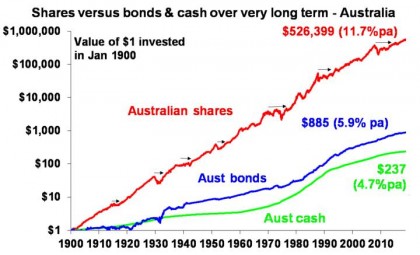
Of course, this gives me an opportunity to again show my favourite chart on investing which tracks the value of $1 invested in Australian shares, bonds and cash since 1900 with dividends and interest reinvested along the way. Cash is safe but has low returns and that $1 will have only grown to $237 today. Shares are volatile (& so have rough periods highlighted by arrows) but if you can look through that they will grow your wealth and that $1 will have grown to $526,399 by today.


Source: Global Financial Data, AMP Capital

8. Allow that asset prices go up and down

It’s well known that the share market goes through rough patches. The volatility seen in the share market is the price we pay for higher returns than most other asset classes over the long term. But when it comes to property there seems to be an urban myth that it never goes down in value. Of course property prices will always be smoother than share prices because it’s not traded daily and so is not subject to daily swings in sentiment. But history tells home prices do go down as well as up. Japanese property prices fell for almost two decades after the 1980s bubble years, US and some European countries’ property values fell sharply in the GFC and the Australian residential property market has seen several episodes of falls over the years and of course we are going through one right now. So the key is to allow that asset prices don’t always go up – even when the population and the economy are growing.

9. Try and see big financial events in their long-term context

Hearing that $50bn was wiped off the share market in one day sounda scary – but it tells you little about how much the market actually fell and you have only lost something if you actually sell out after the fall. Scarier was the roughly 20% fall in share markets through 2015-16 and worse still the GFC that saw roughly 50% falls. But such events happen every so often in share markets – the 1987 crash saw a 50% in a few months & Australian shares fell 59% over 1973-74. And after each the market has gone back up. So, we have seen it all before even though the details may differ. The trick is to allow for periodic sharp falls in your investment strategy and when they do happen remind yourself that we have seen it all before and the market will find a base and resume its long-term rising trend.

10. Know your risk tolerance

When embarking on investing it’s worth thinking about how you might respond if you found out that market movements had just wiped 20% off the value of your investments. If your response is likely to be: “I don’t like it, but this sometimes happens in markets and history tells me that if I stick to my strategy I will see a recovery in time” then no problem. But if your response might be: “I can’t sleep at night because of this, get me out of here” then maybe you should rethink your strategy as you will just end up selling at market bottoms and buying tops. So try and match your investment strategy to your risk tolerance.

11. Make the most of the Mum and Dad bank

The housing boom in Australia that got underway in the mid-1990s and reached fever pitch in Sydney & Melbourne last year has left housing very unaffordable for many. This contributed to a huge wealth transfer from Millennials to Baby Boomers and some Gen Xers. Hopefully the current home price correction underway will help in starting to correct that. But for Millennials in the meantime, if you can it makes sense to make the most of the “Mum and Dad bank”. There are two ways to do this. First stay at home with Mum and Dad as long as you can and use the cheap rent to get a foot hold in the property market via a property investment and then using the benefits of being able to deduct interest costs from your income to reduce your tax bill to pay down your debt as quickly as you can so that you may be able to ultimately buy something you really want. (Of course, changes to negative gearing if there is a change to a Labor Government could affect this.) Second consider leaning on your parents for help with a deposit. Just don’t tell my kids this!

12. Be wary of what you hear at parties

A year ago Bitcoin was all the rage. Even my dog was asking about it – but piling in at around $US19,000 a coin just when everyone was talking about it back then would not have been wise (its now below $US6500) even though many saw it as the best thing since sliced bread. Often when the crowd is dead set on some investment it’s best to do the opposite.

13. There is no free lunch

When it comes to borrowing & investing there is no free lunch – if something looks too good to be true (whether it’s ultra-low fees or interest rates or investment products claiming ultra-high returns & low risk) then it probably is and it’s best to stay away.

Concluding comment

I have focussed here mainly on personal finance and investing at a very high level, as opposed to drilling into things like diversification and taking a long-term view to your investments. An earlier note entitled “Nine keys to successful investing” focussed in more detail on investing and can be found here.


Source: AMP Capital 15 November 2018

Important notes: While every care has been taken in the preparation of this article, AMP Capital Investors Limited (ABN 59 001 777 591, AFSL 232497) and AMP Capital Funds Management Limited (ABN 15 159 557 721, AFSL 426455) makes no representations or warranties as to the accuracy or completeness of any statement in it including, without limitation, any forecasts. Past performance is not a reliable indicator of future performance. This article has been prepared for the purpose of providing general information, without taking account of any particular investor’s objectives, financial situation or needs. An investor should, before making any investment decisions, consider the appropriateness of the information in this article, and seek professional advice, having regard to the investor’s objectives, financial situation and needs. This article is solely for the use of the party to whom it is provided.

Do you feel like ‘stressed’ is your new normal state of being? Can you remember the last time you went to bed without a care in your mind and woke up the next morning energized and excited for the day? Our modern lives, though full of opportunity, have us anxious, stressed and exhausted, and it’s almost at the point where if you’re not constantly stressed about work, finances or relationships, you might just stress about not being stressed enough!  

While a stress response is a normal function for our bodies and we definitely do need it in certain circumstances, being constantly stressed is not healthy and it’s making us sick. In fact, according to the World Health Organisation, stress is the health epidemic of the 21st Century.


How We’re Stressed 

There are three ways our bodies can be stressed:

  1. Physical: this can be a trauma, injury, accident or fall

  2. Chemical: this includes flu, bacterial infection, hangovers and unbalanced blood sugar levels

  3. Emotional: this is the fear-inducing situations, perceived pressure at work or financially, family tragedies. 

Joe Dispenza explains that when our bodies experience physical, chemical or emotional stress, it knocks the brain and body out of balance and activates the Sympathetic Nervous System. This is the fight or flight system that helps us deal with perceived threats in our external environment. When this system is activated, other systems in the body are affected, including the way in which the body sources and burns energy to give the body a rush of adrenaline. 

This activation and mobilization of energy and particular body function is great in situations where we need to be able to react quickly – jump out of the way of speeding car or falling object – situations that are short-lived but require immediate response. However, when the perceived threat to us is ongoing – say mortgage and financial stress – the body stays on high alert for prolonged periods, using up enormous amounts of energy and leaving the body unable to return to its normal state.  

What’s The Problem With Prolonged Stressed?

“Over 90% of disease and illness today is based on lifestyle and stress, not genetics,” – Bruce Lipton 

Stress hormones shut down the immune system making us vulnerable to disease, infection and cancer. 

What does that mean for the average person living with constant stress? Bruce explains that by always being stressed “we are inhibiting our immune system every day.” This creates an environment for disease to develop… and that’s serious.  

Consider this: people produce cancer cells every day, but healthy immune systems can get rid of it. If you’re constantly stressed, creating a weakened immune system, your body will be less likely to protect you against cancer cells.  

Additionally, Dr. Josh Axe has shared that our emotions can impact our health with specific feelings driving disease in specific organs. He believes that managing our emotions is just as, if not more, important than fixing your diet for your health.  

The impact of emotions on the organs:

  • Fear: reproductive organs, kidneys, and adrenals

  • Frustration: liver

  • Grief, sadness, depression: colon, lungs, immune function

  • Anxiety: heart, small intestines

  • Worry: spleen, pancreas, stomach

Techniques Proven to Reduce Stress 

By acknowledging your stress you can start to reverse its presence and impact on your life. There are a number of techniques you can implement to reduce stress and improve your health, and it starts with making a commitment to change your lifestyle.

Dr. Libby says that ‘stressed’ is the busy person’s word for fear. She shared with us that most of the time, people who are stressed at work have a fear of disappointing others or letting down the team, or a fear of failure. If you can understand the source of your fear, you can start to overcome the issue and reduce the stress.  

Dr. Libby also explains that it takes time to change the way we respond to stressful events. “We understand that for physical fitness, we need to train our body – we can’t just get up one day and run a marathon. The same is true for our mind – it requires a daily practice of ‘training’.” 

8 Ways to Reduce Stress 

  1. Reducing your caffeine consumption

  2. Talking to yourself about the source of your stress, try to change fear into fascination and learn more about yourself. Catch negative thoughts as they appear and replace them with thoughts of gratitude and positivity.

  3. Considering your perceived pressure – most of the time we’re putting deadlines and pressure on ourselves that aren’t necessary.

  4. Meditating to calm your mind and bring your thoughts internal, rather than being worried about everything external. If you like guided meditations, we’ve got plenty!

  5. Working on improving your diet. We know that when people are stressed their diet decisions are generally very poor and limited to things that are convenient. Make healthy food a priority and read our article 9 Foods You Should Eat The Moment You Feel Stressed.

  6. Reducing your technology use… and turning those email notifications off when you finish your work day!

  7. Conscious breathing. Yes we all breathe, but being conscious about your breath and making time to take nice deep breathes will change your mood and your body’s interpretation of what’s happening in your environment.

  8. Finding a practice that relaxes you and do it often. Whether it’s yoga, surfing, painting or running, whatever it is that you enjoy and enables you to take your mind off things that stress you, make it a priority and enjoy it often. 

 Stress, overwhelm, depression, anxiety, autoimmune disease, obesity, suicide, cancer, a midlife crisis, wondering what direction to take in your life… These are some of the biggest challenges of our time.

Source : Foodmatters October 2018

Reproduced with the permission of the Food Matters team. This article by JAMES COLQUHOUN  was originally published at www.foodmatters.comcom/article/stress-epidemic

Important:
This provides general information and hasn’t taken your circumstances into account.  It’s important to consider your particular circumstances before deciding what’s right for you. Although the information is from sources considered reliable, we do not guarantee that it is accurate or complete. You should not rely upon it and should seek qualified advice before making any investment decision. Except where liability under any statute cannot be excluded, we do not accept any liability (whether under contract, tort or otherwise) for any resulting loss or damage of the reader or any other person. 

Any information provided by the author detailed above is separate and external to our business and our Licensee. Neither our business, nor our Licensee take any responsibility for any action or any service provided by the author.

Any links have been provided with permission for information purposes only and will take you to external websites, which are not connected to our company in any way. Note: Our company does not endorse and is not responsible for the accuracy of the contents/information contained within the linked site(s) accessible from this page.