Spouses have clear motivations to at least consider the potential benefits of taking a co-ordinated approach to savings and investing – as well as in dealing with their day-to-day budgeting.

The motivations for couples to think about a harmonised approach to family finances are rising. This is, in part, because of the lowering of super contribution caps, the new $1.6 million pension transfer cap and a proposal to increase the maximum number of members in a self-managed super fund (SMSF).

Wealth management

Whether a joint approach to money works in the interest of both spouses much depends, of course, on personal circumstances.

In a few words, the potential benefits of such an approach are that couples are working together to achieve mutually set financial and personal goals.

By contrast, spouses with an uncoordinated approach may be unintentionally pulling in different directions. They may not be making the most of opportunities to save and invest, and perhaps have no realistic impression of how far their savings will stretch in retirement.

Consider making a list of at least the fundamental ways that you and your spouse can harmonise your finances and then perhaps discuss the list with an adviser.

Your list may include: budgeting together, setting shared long-term goals, co-ordinating investment and saving strategies to achieve those goals, and setting appropriate asset allocations and diversification for portfolios held jointly and individually.

Other critical matters to add to your list include: deciding whether your family has enough life, disability, income-protection and medical insurance; minimising investment costs that handicap investment success; and undertaking co-ordinated estate planning.

An estimated two-thirds of Australian couples are in a marital relationship at typical retirement ages. As actuaries Rice Warner comments in a research paper, it “simply makes sense” for them to take a synchronised stance to managing their wealth.

Age pension eligibility and payments are based, of course, on “singles” or “couples”, adding to the case for couples to take a co-ordinated approach.

Raising a family

Couples with a co-ordinated stance to managing their money typically improve their chances of catching up on their super contributions while one takes a few years off work to raise children. For instance, the partner remaining in the workforce could increase their super contributions if possible or split their contributions with a spouse taking time out of the workforce.

Super caps

The lowering of the contribution caps and the introduction of the $1.6 million pension transfer cap provide a further incentive for a couple to combine and co-ordinate their savings efforts.

The indexed $1.6 million pension transfer cap is the maximum transferrable from an accumulation to a pension super account from 1 July 2017. Further, members with total super balances (in accumulation and pension accounts) greater or equal to the transfer cap can no longer make non-concessional (after-tax) contributions without overshooting the contributions cap.

SMSFs

Rice Warner has observed in the past that most SMSFs are set up by spouses who then mostly “co-mingle the assets” in what is “effectively a joint superannuation account with each partner’s share identified”.

From July next year, the Government proposes to increase the maximum number of members in an SMSF from four to six. As the Australian Superannuation Handbook 2018-19, published by Thomson Reuters, comments, the proposal seeks to provide greater flexibility for large families to jointly manage their super.

Finally, a core benefit for spouses taking a joint approach to family finances is that both should gain a better understanding of family finances.

Please contact us on Phone: 07 5641 4134 if you seek further discussion .

 Source : Vanguard August 2018 

Written by Robin Bowerman, Head of Corporate Affairs at Vanguard.

Reproduced with permission of Vanguard Investments Australia Ltd

Vanguard Investments Australia Ltd (ABN 72 072 881 086 / AFS Licence 227263) is the product issuer. We have not taken yours and your clients’ circumstances into account when preparing this material so it may not be applicable to the particular situation you are considering. You should consider your circumstances and our Product Disclosure Statement (PDS) or Prospectus before making any investment decision. You can access our PDS or Prospectus online or by calling us. This material was prepared in good faith and we accept no liability for any errors or omissions. Past performance is not an indication of future performance.

© 2018 Vanguard Investments Australia Ltd. All rights reserved.

Important:
Any information provided by the author detailed above is separate and external to our business and our Licensee. Neither our business, nor our Licensee take any responsibility for any action or any service provided by the author.

Any links have been provided with permission for information purposes only and will take you to external websites, which are not connected to our company in any way. Note: Our company does not endorse and is not responsible for the accuracy of the contents/information contained within the linked site(s) accessible from this page.

At its meeting today, the Board decided to leave the cash rate unchanged at 1.50 per cent.

The global economic expansion is continuing. A number of advanced economies are growing at an above-trend rate and unemployment rates are low. Growth in China has slowed a little, with the authorities easing policy while continuing to pay close attention to the risks in the financial sector. Globally, inflation remains low, although it has increased due to both higher oil prices and some lift in wages growth. A further pick-up in inflation is expected given the tight labour markets, and in the United States, the sizeable fiscal stimulus. One ongoing uncertainty regarding the global outlook stems from the direction of international trade policy in the United States.

Financial conditions in the advanced economies remain expansionary, although they are gradually becoming less so in some countries. Yields on government bonds have moved a little higher, but credit spreads generally remain low. There has been a broad-based appreciation of the US dollar this year. In Australia, money-market interest rates are higher than they were at the start of the year, although they have declined since the end of June. In response, some lenders have increased their standard variable mortgage rates by small amounts, while at the same time reducing mortgage rates for some new loans.

The latest national accounts confirmed that the Australian economy grew strongly over the past year, with GDP increasing by 3.4 per cent. The Bank’s central forecast remains for growth to average a bit above 3 per cent in 2018 and 2019. Business conditions are positive and non-mining business investment is expected to increase. Higher levels of public infrastructure investment are also supporting the economy, as is growth in resource exports. One continuing source of uncertainty is the outlook for household consumption. Growth in household income remains low and debt levels are high. The drought has led to difficult conditions in parts of the farm sector.

Australia’s terms of trade have increased over the past couple of years due to rises in some commodity prices. While the terms of trade are expected to decline over time, they are likely to stay at a relatively high level. The Australian dollar remains within the range that it has been in over the past two years on a trade-weighted basis, but it has depreciated against the US dollar along with most other currencies.

The outlook for the labour market remains positive. The unemployment rate is trending lower and, at 5.3 per cent, is the lowest in almost six years. The vacancy rate is high and there are reports of skills shortages in some areas. A further gradual decline in the unemployment rate is expected over the next couple of years to around 5 per cent. Wages growth remains low, although it has picked up a little. The improvement in the economy should see some further lift in wages growth over time, although this is likely to be a gradual process.

Inflation is around 2 per cent. The central forecast is for inflation to be higher in 2019 and 2020 than it is currently. In the interim, once-off declines in some administered prices in the September quarter are expected to result in inflation in 2018 being a little lower than otherwise.

Conditions in the Sydney and Melbourne housing markets have continued to ease and nationwide measures of rent inflation remain low. Growth in credit extended to owner-occupiers remains robust, but demand by investors has slowed noticeably as the dynamics of the housing market have changed. Credit conditions are tighter than they have been for some time, although mortgage rates remain low and there is strong competition for borrowers of high credit quality.

The low level of interest rates is continuing to support the Australian economy. Further progress in reducing unemployment and having inflation return to target is expected, although this progress is likely to be gradual. Taking account of the available information, the Board judged that holding the stance of monetary policy unchanged at this meeting would be consistent with sustainable growth in the economy and achieving the inflation target over time.

Source: Reserve Bank of Australia, October 2nd, 2018

Enquiries

Media and Communications
Secretary’s Department
Reserve Bank of Australia
SYDNEY

Phone: +61 2 9551 9720
Fax: +61 2 9551 8033

Email: rbainfo@rba.gov.au

With thousands of charities competing for your donation, it’s important to do some research to make sure your money is being used for the cause you want to support. It is also essential to make sure the charity is actually receiving your donation.

Here are some things to think about before you donate.

Choosing a charity

Your decision to support one charity over another is usually based on your interest in the cause the charity supports. You may also choose a charity as a way of remembering a deceased relative or friend. Whatever your motivation, it’s important to make sure you are comfortable with the charity’s activities and how it plans to use the donations it receives. 

Donating directly to an overseas-based charity can be risky as it may be difficult to verify the information found on websites or social media sites. 

You may prefer to donate to an Australian charity that supports the cause or project you’re interested in. Many Australian charities operate overseas but are based in Australia.

Ways to donate

There are a number of ways you can donate.

One-off or ongoing

You may decide to make a regular, set donation or you may prefer making a one-off donation following a particular fundraising campaign or an urgent need, like a natural disaster. Sometimes a charity will approach you directly for a cash donation or to participate in a fundraiser such as a raffle. This can happen on the street, over the phone or at your front door. 

Smart tip

If you’ve donated to a charity before, the charity will keep your contact details for future campaigns. If you want to stop being contacted you can ask to be removed from their list. 

Workplace giving

You can also support a charity through automatic deductions from your salary. If your employer has a workplace giving scheme your donation can be deducted from your pay and sent directly to your preferred charity. 

You will gain tax benefits at the time of donation and receive a summary of payment at the end of the year.

To participate in any workplace giving program, the charity must have deductible gift recipient (DGR) status. 

For more information about setting up a workplace giving program, see the Australian Taxation Office’s information on setting up a workplace giving program

Bequest in your will

Another way of donating is to leave a bequest in your will. Contact the charity directly to discuss your plans. 

Get involved

Donating to charity doesn’t necessarily mean a cash donation. You can contribute to your favourite charity by making a donation of goods, your time or even your skills or expertise.

Check it’s a legitimate charity

Questions to ask

If the name of the charity is unfamiliar, you should ask for more information about the charity, for example:

  • What cause do you support?

  • Where is the charity based?

  • What are donations used for?

  • Are you affiliated with any other charities or organisations?

  • Are donations tax deductible?

It pays to be careful, even if you get a satisfactory response to these questions.

Even if you’ve heard of the charity, you should check that the person who contacts you is authorised to represent the charity.

If you’ve been approached face-to-face, ask to see some identification and a copy of the charity’s pledge form. These should contain:

  • the full name of the organisation

  • the corporate registration number such as an Australian Business Number

  • the business address

  • the organisation’s logo

You should also call the charity directly to verify their contact details. Be sure to cross check their phone number in the telephone directory.

Charities must also be registered with the Australian Charities and Not-for-profits Commission (ACNC). You can check the ACNC website, to see if the charity is registered. Alternatively, the charity may display a Tick of Charity Registration (from the ACNC) to show they are a registered charity. 

Be wary of giving credit card details

If you’ve been contacted by phone do not give out your credit card or banking details. There will be other ways of donating if it’s a reputable charity. 

Ask about these options and make sure you check the validity of any website or social media page you’re directed to. 

To find out about the latest charity scams see the ACCC’s SCAM watch charity scams webpage.

Check if it’s tax deductible

A donation is only tax deductible if it is given to a charity that has been endorsed by the Australian Taxation Office (ATO) as a deductible gift recipient (DGR) organisation. 

To receive a deduction the donation must be two dollars or more and must be claimed in your tax return for the income year in which the donation was made. In some circumstances, you can elect to spread the tax deduction over five income years. For more information visit the ATO’s gifts and donations webpage. 

You can check if an organisation is a DGR by visiting the Australian Business Register or phoning the ATO on 13 28 61.

Complain if you have a problem

You can complain about a charity to the relevant state or territory regulator. To find the regulator in your state visit the ATO: State and territory government requirements – fundraising. You can also complain to the Australian Charities and Not-for-Profits Commission if the charity is registered, see the ACNC: Raise a concern about a charity webpage.

Australian charities working in the area of overseas aid, who get funding from AusAID, are required to be members of the Australian Council for International Development (ACFID), and must adhere to the ACFID Code of Conduct. For more information about the code, including its signatories and how to register a complaint, see the ACFID: Code of Conductwebpage. 

Donating is a great thing to do but you should always check the legitimacy of a charity before you donate.

Source: ASIC’s Moneysmart September 2018 


Reproduced with the permission of ASIC’s MoneySmart Team. This article was originally published at https://www.moneysmart.gov.au/managing-your-money/donating

Important note: This provides general information and hasn’t taken your circumstances into account.  It’s important to consider your particular circumstances before deciding what’s right for you. Although the information is from sources considered reliable, we do not guarantee that it is accurate or complete. You should not rely upon it and should seek qualified advice before making any investment decision. Except where liability under any statute cannot be excluded, we do not accept any liability (whether under contract, tort or otherwise) for any resulting loss or damage of the reader or any other person.  Past performance is not a reliable guide to future returns.

Important
Any information provided by the author detailed above is separate and external to our business and our Licensee. Neither our business, nor our Licensee take any responsibility for any action or any service provided by the author.

Any links have been provided with permission for information purposes only and will take you to external websites, which are not connected to our company in any way. Note: Our company does not endorse and is not responsible for the accuracy of the contents/information contained within the linked site(s) accessible from this page.

By Health Ambition contributor, Helen Sanders

As a writer, there is nothing more important to me than a good keyboard. Seeing as I spend all of my time typing, a keyboard with crisp action makes my life a lot easier.

Yesterday, I was typing at my usual hectic pace when my “S” key got stuck. It required too much pressure to hit the key as I typed, so I removed the key to try and fix it. I found what had to be a hairball underneath the key, which was surprising because I don’t have a cat.

It took me a minute or two to remove all of the keys from my keyboard, and I was absolutely disgusted when I saw all of the stuff that had fallen between the cracks of the keys. It took me half an hour to clean, and I was amazed by the 101 things that made my keyboard dirty.

What Causes Your Keyboard to Get Dirty?

Using the bathroom at work? If you forget to wash your hands, all those germs are getting on your keyboard as you sit down to type.

Having a quick bite to eat at your desk? Be careful not to splash anything or drop any crumbs, as they’ll get stuck under your keys.

Got long hair, a beard, or a goatee? If so, the hairs that fall out are likely getting stuck under your keyboard (hence the hairball under my “S” key).

Eating a snack while watching TV or a movie on your computer? If you don’t wash your hands once 

you finish eating — but just lick your fingers clean like so many people do — you’re getting your keyboard dirty.

Which? Computing, a British magazine on computers, hired a microbiologist to test out a number of keyboards for germs. The germs were compared to those found on toilet seats, door handles, and other germ-populated things. Not surprisingly, keyboards earned the title as “The Most Bacteria Infested” items on the list.

A study was done on 25 computers taken from UNC’s medical care center, and the results were amazing — and gross! All of the keyboards tested positive for the presence of coagulase-negative staphylococci — a staph bacteria that is commonly the cause of blood infections in hospitals. As many as 80% of the devices contained bacteria called diptheroids, which can be a threat to those with weak immune systems. [1]

The most common causes of keyboard germs: not washing your hands after visiting the bathroom and eating at your desk. Unfortunately,

Did You Know: This is absolutely disgusting — The average keyboard was shown to have five times as many bacteria as a toilet seat, and it was 150 times over the acceptable bacteria limit. Keyboards that are used by dirty people can have as much as 60 times the germs that are found on a toilet. That means that your keyboard is about as dirty as a gas station bathroom — a very, very dirty device indeed!

The Cleaning Keyboard Guide

Did You Know — Less than 50% of people clean their keyboards more often than once every 30 days, and 10% never take the time to clean it at all. [2]

So, the keyboard can be a pretty filthy little device, as you can see. But what can you do about it?

Make it a Point to Clean It

Make sure to clean your computer keyboard at least once a month, if not more often. It takes time to remove all of the keys, get into the cracks with a brush or compressed air, and wipe down each of the keys individually, but that’s just the best way to clean it. Spend an hour doing it every few weeks, and you can avoid the germs.

Use Compressed Air

All computer supplies stores will sell compressed air cans, which makes one of the best cleaning tools for your keyboard. The air will blow between the keys, and will help to blow out all of the crumbs, dirt, dust, and hair balls trapped in your keyboard. Make sure to clean out the fans and vents at the same time to keep your computer running properly.

Use Anti-Bacterial Wipes

Check your computer supplies store to find special antibacterial wipes for your computer keyboard. These wipes will allow you to clean the keyboard without risking getting the device wet, and it will clean off all the germs easily. Use these wipes every week or so, as the 

antibacterial treatment on the wipes will be the germ-killer you need.

Keep Those Paws Clean

No more snacking at your desk, and no more scratching your beard over your keyboard either. Make sure that your hands stay nice and clean, so wash up after using the bathroom and stop eating those Cheetos while watching movies on your computer. Always wash your hands, and use Purell to get your hands clean right before sitting down to type.

Lifehack: If you are worried about germs, get yourself a waterproof keyboard. That way, you’ll be able to wash it in the sink regularly to get rid of germs.

Treat it With UV Light

There is an interesting device that you can use to clean your keyboard of germs, a UV lamp that shines on your device for about 20 seconds to kill off the germs. It will get rid of up to 99% of the bacteria living comfortably on the surface of your keys, and it can be quite effective — if a bit costly.

Conclusion

If you don’t want to be typing on something resembling a gas station bathroom store, keep those hands clean and take time to clean off your keyboard!


[1] http://www.sixwise.com/newsletters/06/05/10/computer-keyboard-germs-your-fingers-arent-the-only-things-dancing-all-over-your-computer-keyboard.htm

[2] https://www.informationweek.com/desktop/your-computer-keyboard-is-covered-with-germs/d/d-id/1067479?


Source : Health Ambition September 2017

Reproduced with the permission of www.healthambition.com

Important:
Any information provided by the author detailed above is separate and external to our business and our Licensee. Neither our business, nor our Licensee take any responsibility for any action or any service provided by the author.

Any links have been provided with permission for information purposes only and will take you to external websites, which are not connected to our company in any way. Note: Our company does not endorse and is not responsible for the accuracy of the contents/information contained within the linked site(s) accessible from this page.

As the US bull market enters its 10th year and reaches new record highs, more investors may be tempted to try their hands at market-timing.

However, the reality is that even seasoned investment professionals rarely succeed in consistently choosing the best times to buy or sell stock.

A few years ago, Vanguard’s founder Jack Bogle colourfully summed up the difficulty with market-timing.

“Sure,” commented Bogle, “it would be great to get out of the market at the high and back in at the low. But in 55 years in the business [at that point], I not only have never met anybody that knew how to do it, I’ve never met anybody who met anybody that knew how to do it.”

Given the long-running US bull market, some investors are inevitably asking themselves (and perhaps their advisers) such questions as:

  • Should I reduce my exposure to shares?

  • Or should I allocate more of my portfolio to shares in anticipation that the market may keep rising?

Fortunately, disciplined investors holding appropriately-diversified, long-term portfolios with exposure across asset classes are much less likely to concern themselves with such market-timing questions.

A portfolio’s strategic asset allocation – its targeted exposure to different investment asset classes – should reflect an investor’s tolerance to risk and expectations for returns.

Repeated research, including by Vanguard, has shown that a broadly diversified portfolio’s strategic asset allocation is the primary driver of its return variability over time. Asset allocation matters much more than the selection of individual investments.

And it is critical for investors to follow a disciplined strategy of periodically rebalancing a portfolio back to its strategic asset allocation. Certainly, rebalancing can seem counter-intuitive, requiring the selling of currently outperforming assets to buy currently underperforming assets.

Yet without periodic rebalancing, a portfolio can become increasingly volatile and risky. Rebalancing should recapture a portfolio’s intended risk-and-return characteristics.

One way that some investors help avoid a temptation to time the market and to keep investing is to practice a dollar-cost averaging strategy.

Dollar-cost averaging involves investing the same amount of money into, say, shares or broadly-diversified funds at regular intervals over a long period – whether market prices are up or down.

Investors practising dollar-cost averaging automatically buy more, say, shares when prices are lower and fewer when prices are higher. This averages the purchase prices over the period that an investor keeps investing.

Yet the core benefit of dollar-cost averaging is not so much the price paid for securities; it is the following of a disciplined, non-emotional strategy that is not thrown off course by prevailing market sentiment and temptations to time the market.

Please contact us on Phone: 07 5641 4134 if you seek further assistance .

 Source: Vanguard September 2018 

Written by Robin Bowerman, Head of Corporate Affairs at Vanguard.

Reproduced with permission of Vanguard Investments Australia Ltd

Vanguard Investments Australia Ltd (ABN 72 072 881 086 / AFS Licence 227263) is the product issuer. We have not taken yours and your clients’ circumstances into account when preparing this material so it may not be applicable to the particular situation you are considering. You should consider your circumstances and our Product Disclosure Statement (PDS) or Prospectus before making any investment decision. You can access our PDS or Prospectus online or by calling us. This material was prepared in good faith and we accept no liability for any errors or omissions. Past performance is not an indication of future performance.

© 2018 Vanguard Investments Australia Ltd. All rights reserved.

Important:
Any information provided by the author detailed above is separate and external to our business and our Licensee. Neither our business, nor our Licensee take any responsibility for any action or any service provided by the author.

Any links have been provided with permission for information purposes only and will take you to external websites, which are not connected to our company in any way. Note: Our company does not endorse and is not responsible for the accuracy of the contents/information contained within the linked site(s) accessible from this page.

“Information is not knowledge, knowledge is not wisdom – Frank Zappa (and maybe some others)”

It may seem that the worry list for investors is bigger and more confusing than ever before. Some of this may relate to US President Trump’s disruptive and “open mouth” approach as highlighted by the “trade war” and his frequent and sometimes contradictory tweets. For example, on 24th July Trump tweeted “Tariffs are the greatest!” But 12 hours later he tweeted “The European Union is coming to Washington tomorrow to negotiate a deal on Trade. I have an idea for them. Both the U.S. and the E.U. drop all Tariffs, Barriers and Subsidies!”

Now I think I know where he was coming from, but all this noise can create a lot of uncertainty for investors. But noise around Trump is part of a broader issue around information overload and broader again in terms of what a report by the RAND Corporation – a US non-partisan research organisation – has called Truth Decay. As we have observed in recent years there seems to be a never-ending worry list for investors that is receiving greater prominence as the information age enables the ready and rapid dissemination of news and opinion. But we need to recognise that much of this is just noise and ill-informed and that there is a big difference between information and wisdom when it comes to investing. The danger is that information and opinion overload is making us all worse investors as we lurch from one worry to the next resulting in ever shorter investment horizons in the process.

“Just remember: What you’re seeing and what you’re reading is not what’s happening.” – President Donald Trump

Truth Decay – what is it & what are its consequences?

Truth Decay as analysed by the RAND Corporation report is characterised by: disagreement about facts and their analytical interpretation; a blurring between fact and opinion; an increase in the volume and influence of opinion and personal experience over fact; and declining trust in traditional sources of facts such as government and newspapers. It’s evident in: declining support for getting children vaccinated despite medical evidence supporting it; perceptions crime has increased when it’s actually declined; and a lack of respect for scientific evidence around global warming. Elements of Truth Decay were evident in past periods like the 60s & 70s, but increasing disagreement about facts makes the current period different.

The causes of Truth Decay include: behavioural biases that leave people susceptible to information and opinion that confirms their views and aligns with their personal experience; the information revolution and social media that have led to a surge in the availability of information and opinion and the rise of partisan news channels; educational systems that have not taught us to be critical thinkers; social polarisation with rising inequality and division attracting people to opposing sides that are reinforced by participating in social media echo chambers. The consequences include a deterioration in civil debate as people simply can’t agree on the facts, political paralysis, disengagement from societies’ institutions and uncertainty.

Why is Truth Decay relevant for investors?

Truth Decay is relevant for investors because: it could lead to less favourable economic policy decisions which could weigh on investment returns; and investors are subject to the same forces driving Truth Decay such that it explains why the worry list for investors seems more worrying and distracting. The first is a topic for another day, but in terms of the heightened worry list facing investors there are three key drivers.

First, just as with the broader concept of Truth Decay various behavioural biases leave investors vulnerable in the way they process information. In particular, they can be biased to information and particularly opinions that confirm their own views. People are also known to suffer from a behavioural trait known as “loss aversion” in that a loss in financial wealth is felt much more distastefully than the beneficial impact of the same sized gain. This likely owes to evolution which has led to much more space in the human brain devoted to threat than reward. As a result, we are more predisposed to bad news stories that alert us to threat as opposed to good news stories. In other words bad news and doom and gloom find a more ready market than good news or balanced commentary as it appeals to our instinct to look for risks. Hence the old saying “bad new sells”.

Secondly, thanks to the information revolution we are now exposed to more information than ever on both how our investments are going and everything around them. This has particularly been the case since the GFC – the first iPhone was only released in 2007! In some ways this is great as we can check facts and analyse things very easily. But the downside is that we have no way of assessing all the extra information and less time to do so. So, it can become noise at best, distracting at worst. If we don’t have a process to filter it and focus on what matters we can simply suffer from information overload. This can be bad for investors as when faced with too much information we can become more uncertain, freeze up and make the wrong investment decisions as our natural “loss aversion” combines with what is called the “recency bias” that sees people give more weight to recent events which can see investors project bad news into the future and so sell after a fall.

But the explosion in digital/social media means we are bombarded with economic and financial news and opinions with 24/7 coverage by multiple web sites, subscription services, finance updates, TV channels, social media feeds, etc. And in competing for your attention, bad news and gloom trumps good news and balanced commentary as “bad news sells.” And the more entertaining it is the more attention it gets, which means less focus on balanced quality analysis. An outworking of all this is that the bad news seems “badder” and the worries more worrying. Google the words “the coming financial crisis” and you get 115 million search results with titles such as:

  • a vicious Fed-fuelled economic crisis is coming

  • coming financial crisis: a look behind the wizard’s curtain

  • here comes another global financial crisis

  • coming financial crisis will be much worse than Great Depression

  • another financial crisis is imminent, four reasons why

  • Japanese whales and the next financial crisis – I knew there was a connection!

In the pre-social media/pre-internet days it was much harder for ordinary investors to be exposed to such disaster stories on a regular basis. The obvious concern is that the combination of a massive ramp up in information and opinion combined with our natural inclination to zoom in on negative news is making us worse investors: more distracted, fearful, reactive and short-term focussed and less reflective and long-term focussed.

Five ways to manage information & opinion overload

To be a successful investor you need to make the most of the power of compound interest and to do that you need to invest for the long term and not get blown around by each new worry. And the only way to do that is to turn down the noise on the worry list. This is getting harder given the distractions on social media. But here are five suggestions as to how to do so:

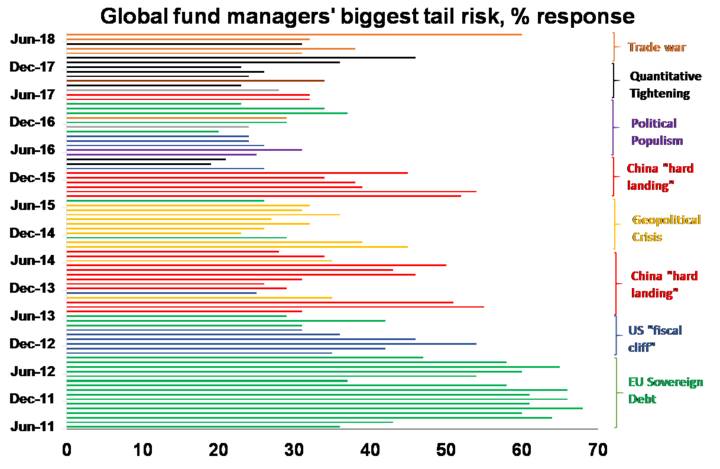
First, put the latest worry in context. There is always an endless stream of worries. Here’s a list of the main worries of the last five years: Fed tapering; the US Government shutdown; Ukraine; IS terror threat; Ebola; deflation; Greece & Eurozone debt; China worries; Australian recession fears, property & banks; Brazil and Russia in recession; oil price collapse; manufacturing slump; Fed raising rates; falling profits; Brexit; Trump; North Korea; South China Sea tensions; Italy; and trade wars. Even fund managers go from one worry to another as evident in the next chart that tracks what they nominate as the biggest risk over time.

click to enlarge
Source: BofA Merrill Lynch Global Fund Manager Survey, AMP Capital

Yet despite all the worries, investment returns have been good with, eg, average balanced superannuation funds returning 8.5% pa over the last five years. The global economy has had plenty of worries over the last century, but Australian shares still returned 11.8% pa since 1900 and US shares 9.8% pa.
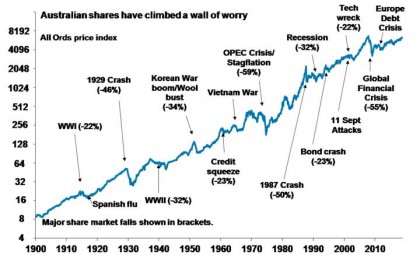

Source: ASX, AMP Capital

Some of the worries we hear much about come to something big, but most of the time they don’t with US and Australian shares rising seven and eight years out of 10 respectively since 1900. So is the latest worry is any more threatening than the last one?

Second, recognise how markets work. Shares return more than cash in the long term because they can lose money in the short term. So, while the share market is highly volatile in the short term – often in response to loss-averse investors projecting recent bad news and worries into the future – it has strong returns over rolling 20-year periods. Short-term volatility is the price wise investors pay for higher long-term returns.

Third, find a way to filter news so that it doesn’t distort your investment decisions. For example, this could involve building your own investment process or choosing a few good investment subscription services and relying on them.

Fourth, don’t check your investments so much. On a day to day basis the Australian All Ords price index and the US S&P 500 price index are down almost as much as they are up. See the next chart. So, it’s a coin toss as to whether you will get good news or bad on a day to day basis. By contrast if you only look at how the share market has gone each month and allow for dividends the historical experience tells us you will only get bad news about 35% of the time. And if you stretch it out to each decade, since 1900 positive returns have been seen 100% of the time for Australian shares and 82% for US shares. 
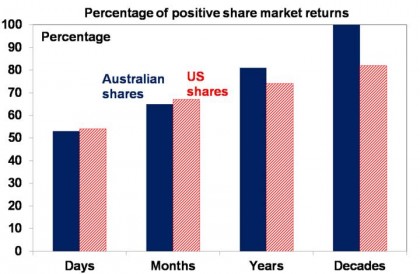

Data from 1995 and 1900. Source: Global Financial Data, AMP Capital

So, the less you look the less you will be disappointed and so the lower the chance that a bout of “loss aversion” will be triggered which leads you to sell at the wrong time.

Finally, look for opportunities that bad news and investor worries throw up. Periods of share market turbulence after bad news provide opportunities for smart investors as such periods push shares into cheap territory.


Source: AMP Capital 28 September 2018

Important notes: While every care has been taken in the preparation of this article, AMP Capital Investors Limited (ABN 59 001 777 591, AFSL 232497) and AMP Capital Funds Management Limited (ABN 15 159 557 721, AFSL 426455) makes no representations or warranties as to the accuracy or completeness of any statement in it including, without limitation, any forecasts. Past performance is not a reliable indicator of future performance. This article has been prepared for the purpose of providing general information, without taking account of any particular investor’s objectives, financial situation or needs. An investor should, before making any investment decisions, consider the appropriateness of the information in this article, and seek professional advice, having regard to the investor’s objectives, financial situation and needs. This article is solely for the use of the party to whom it is provided.


Many of us dream of being our own boss and, with hard work and careful planning, self-employment can bring financial and lifestyle rewards – along with enormous personal satisfaction. But, without the backup of a regular wage or salary, running your own show calls for careful money management.

Manage your cash flow

Many self-employed Australians earn a good living. But, while your overall annual income may be strong, the flow of money is not always regular. It can be weeks and even months between pay cheques.

Smart tip

If you buy second-hand equipment, machinery or vehicles for your business, check the Australian Government’s Personal Property Securities Register (PPSR) to make sure there’s no money still owing on it.

So it’s very important to manage your money carefully. Running out of cash before you get paid again could mean living on credit cards, which charge high interest rates.

Pay yourself a wage

Rather than treating all the income you earn from your business as your personal spending money, pay yourself a weekly wage. You should also maintain separate bank accounts for business receipts and personal spending.

Deposit or transfer your business revenue into a high-interest savings account, and only draw on this account to pay yourself a set amount as a wage, or to pay actual business expenses. Putting your business earnings in a high interest account is a simple way of earning extra income through interest.

Set a personal budget to help you live within your wage, and so that you don’t dip into business receipts too often.

Compare your wages to your spending.

Use the budget planner

Plan ahead for holidays

As a self-employed worker you won’t enjoy the benefit of paid holidays: it’s up to you to set aside funds. Saving a little extra on a regular basis will help you manage through any quiet business periods, as well as funding a well-deserved break.

First Business app

Thinking about going into business for yourself? ASIC’s First Business app can help you as you move towards starting your own business. The app provides tips and things to think about, checklists, case studies and links to additional small business information.

Set aside money for tax

A common pitfall for small business is failing to set aside money for income tax. As you become more established, the Australian Taxation Office (ATO) might also require you to make quarterly pay as you go (PAYG) tax instalments. Use the ATO’s PAYG instalment calculator to estimate how much tax you’ll have to pay.

If you don’t meet your tax obligations each year, you could pay hefty penalties. Talk to your accountant and read ATO: Due dates for lodging and paying your BAS. At worst, the ATO can take legal action, including winding up your company or bankrupting you to recover unpaid taxes.

Unless you plan ahead for tax, it can be difficult to pay tax bills when they fall due. So it’s worth making this a priority for your business.

Work out how to set aside money for your upcoming bills.

Use the savings goals calculator

Divide your cash takings

Keep on top of your tax obligations by opening a separate savings account and regularly deposit part of your takings into this account. It can take discipline not to dip into the account, but a good incentive to leave the money aside until you need to pay tax is to remember that the ATO can charge high penalties for late tax payments.

Don’t forget GST

If your business is registered for Goods and Services Tax (GST), you will also need to set aside money for that.

Self-employment and super

Self-employed people often earn a decent income while working, but without the benefit of employer-paid superannuation contributions, find they have very little money to live on in retirement. Almost a quarter of self-employed Australians had no superannuation at all in 2016, according to research by the Australian Super Funds Association (ASFA).

Don’t rely on selling your business to fund your retirement. Without your involvement, your business may be worth less than you think. Many business ventures can also be hard to sell. Instead, think about building a separate pool of retirement savings. You may also be eligible for the government super co-contribution. For more information see super for self-employed people.

Save for retirement, save on tax

Superannuation is a tax-effective investment for retirement savings. Adding to your super can also reduce the tax on your current income.

As a guide, you or your business may be able to claim a tax deduction of up to $25,000 annually for contributions to your superannuation fund. It’s an easy way to trim your tax today while building a nest egg for the future.

Be sure to make your contributions before 30 June to claim them as tax deductions, but be careful not to go over the contribution caps so that the penalty tax does not apply.

Protect your income

One hazard of running your own business is being unable to work due to illness or injury. Without sick leave, your financial situation could take a turn for the worse if you become sick or injured.

Income protection insurance protects you financially if you can’t work because of illness or injury. It’s worth thinking about when you run your own show because bills don’t stop if you’re unable to work.

Premiums for income protection insurance are usually tax-deductible, which helps reduce the cost. Most large insurance companies offer income protection insurance, or you might be able to buy it through your superannuation fund. Do an internet search to compare different income protection insurance products and prices.

Keep control your cash, and draw a line between your personal and business’ money, to help you make the most of self-employment.


Please contact us on Phone: 07 5641 4134 if we can be of assistance .


Source : ASIC’s Moneysmart September 2018 

Reproduced with the permission of ASIC’s MoneySmart Team. This article was originally published at www.moneysmart.gov.au/life-events-and-you/self-employed-people

Important:

This provides general information and hasn’t taken your circumstances into account.  It’s important to consider your particular circumstances before deciding what’s right for you. Although the information is from sources considered reliable, we do not guarantee that it is accurate or complete. You should not rely upon it and should seek qualified advice before making any investment decision. Except where liability under any statute cannot be excluded, we do not accept any liability (whether under contract, tort or otherwise) for any resulting loss or damage of the reader or any other person.  Past performance is not a reliable guide to future returns.

Any information provided by the author detailed above is separate and external to our business and our Licensee. Neither our business, nor our Licensee take any responsibility for any action or any service provided by the author.

Any links have been provided with permission for information purposes only and will take you to external websites, which are not connected to our company in any way. Note: Our company does not endorse and is not responsible for the accuracy of the contents/information contained within the linked site(s) accessible from this page.

Almost 58 years ago, Action Comics published a look into the future of the then 22-year-old Superman as a senior citizen. The cover illustration shows a grey-haired Superman – still wearing his red cape yet with a walking stick – sitting on a park bench with an also grey-haired Lois Lane.

The rather poignant comic strip, The old man of the metropolis, depicts an ageing hero who is trying to come to terms with the weakening of his super powers.

When Superman finally turned 80 this year, he was still working as a superhero on a clearly part-time basis, yet had retired from his Daily Planet reporting job in the guise of the mild-mannered reporter Clark Kent.

Hopefully, Superman had the foresight to make the most of the Daily Planet’s retirement plan or super fund. And his decision to keep working provides an interest, and perhaps a little income, to subsidise his retirement lifestyle.

A fifth of Australia’s workforce over 45 plans to keep working long past traditional retirement ages, according to the Australian Bureau of Statistics (ABS). Just like Superman.

As well, Superman is unlikely to become bored as he ages. Apart from money, boredom is the main reason why 5 per cent of Australian retirees want to return to work, another ABS finding.

Besides the satisfaction that many people find in working into old age if possible given such considerations as health and employment opportunities, there’s the money side of it.

As Smart Investing comments from time to time, a longer working life if possible may provide an opportunity to save more for what will be a shorter and, therefore, less-costly retirement.

An Economist magazine special report, The new old, on the economics of ageing, opens with a few words from Mick Jagger, who has just turned 75. “No age jokes tonight, all right,” says Jagger as he opens a Rolling Stone performance.

The Economist argues that the world’s rapidly ageing population can provide a valuable “longevity dividend” in such ways as making the most of older employees, often part-time, workers and older entrepreneurs and improving retirement products.

“The pessimism about ageing populations is based on the idea that the moment people turn 65, they move from being net contributors to the economy to net recipients of benefits,” the magazine comments. “But if many more of them remain economically active, the process will become much more gradual and nuanced.”

“The most important way of making retirement financially sustainable will be to postpone it by working longer,” the report’s authors add. “But much can be gained, too, by improving retirement products.”

Think about your personal position and those of your family. Pleases contact us on Phone: 07 5641 4134 perhaps we can turn the so-called “grey tsunami” to your advantage.


Source : Vanguard August 2018 

Written by Robin Bowerman Head of Corporate Affairs at Vanguard.

Reproduced with permission of Vanguard Investments Australia Ltd

Vanguard Investments Australia Ltd (ABN 72 072 881 086 / AFS Licence 227263) is the product issuer. We have not taken yours and your clients’ circumstances into account when preparing this material so it may not be applicable to the particular situation you are considering. You should consider your circumstances and our Product Disclosure Statement (PDS) or Prospectus before making any investment decision. You can access our PDS or Prospectus online or by calling us. This material was prepared in good faith and we accept no liability for any errors or omissions. Past performance is not an indication of future performance.

© 2018 Vanguard Investments Australia Ltd. All rights reserved.

Important:
Any information provided by the author detailed above is separate and external to our business and our Licensee. Neither our business, nor our Licensee take any responsibility for any action or any service provided by the author.

Any links have been provided with permission for information purposes only and will take you to external websites, which are not connected to our company in any way. Note: Our company does not endorse and is not responsible for the accuracy of the contents/information contained within the linked site(s) accessible from this page.

Sonia Baillie, Head of Credit and Portfolio Manager of the AMP Corporate Bond Fund, shares how investing in fixed income can benefit investors and what her investment philosophy is.


Source: AMP Capital September 2018

Important notes: While every care has been taken in the preparation of this article, AMP Capital Investors Limited (ABN 59 001 777 591, AFSL 232497) and AMP Capital Funds Management Limited (ABN 15 159 557 721, AFSL 426455) makes no representations or warranties as to the accuracy or completeness of any statement in it including, without limitation, any forecasts. Past performance is not a reliable indicator of future performance. This article has been prepared for the purpose of providing general information, without taking account of any particular investor’s objectives, financial situation or needs. An investor should, before making any investment decisions, consider the appropriateness of the information in this article, and seek professional advice, having regard to the investor’s objectives, financial situation and needs. This article is solely for the use of the party to whom it is provided.

In the first of our two-part analysis of the changing face of retail, our team of experts look at some longer-term social trends and explain how these are changing the way that we shop and visit malls.

Q. What changes are impacting commercial real estate?

Commercial real estate is going through rapid change as people become consumers of space, not just of products and services.

This is being driven by three macro trends that are transforming the way in which societies utilise space:

  1. Urbanisation – Between 75% – 80% of the world’s population will live in cities within the next 30 years, according to studies by the UN and IMF. This will raise accessibility issues when pressure on transport infrastructure increases as people move closer to work in order to reduce commute times.

    The implication of this is that building design will become more agile and be more sustainable. More mixed-use buildings are being completed; these are already common in major Asian commercial centres but are now starting to appear more in Australia. Previously an office block might have some ground-floor retail space, however new designs increasingly include hotels, apartments, leisure facilities and co-working spaces.

  2. Flexible working – The second trend is the changing nature of office work. Baby boomers entered the workforce at a time when a closed individual office provided solitude and status. By the time they reached management positions, open-plan working was the norm. Now this demographic sets the tone of businesses, the focus is switching to flexible working, home working and co-working spaces.

    A more agile approach aligns well with millennials whose embrace of hierarchy and structure is rather less than previous cohorts – and also with employees who place a high priority on family life.

    This shift coincides with a period when office rental levels are at historic highs in some Australian cities. 

  3. Technology – The final trend driving change is the consumer’s higher expectations of the accessibility of instant and relevant information via mobile technology. Retail and other commercial centres in Australia have traditionally not managed customer information well. However, it is expected they will increasingly focus on integrating the analysis of data into their operating models.

Q. What shops and other facilities do shoppers expect to see in centres?

Customers want to be able to do more than just buy something when they visit a shopping centre. Now, they expect a space in which they can connect with friends and family; simply providing a food court will no longer suffice. Successful shopping centres now offer a mix of higher-range casual dining venues, trendy bars and cinema complexes.

Families are attracted by children’s play areas and high-quality baby changing facilities; this may extend to childcare and even educational facilities. Fitness centres, spas, wellness outlets and medical services drive further footfall.

The unifying feature is that consumers are more likely to be attracted to sources of value that cannot easily be reproduced and disrupted online. This even includes the more humble and longer-established dry cleaner, mobile phone repair or key-cutting kiosks. Once established as a destination that successfully attracts the target demographic, a centre and its retail tenants are then much better positioned to profitably transact physical goods.

Consumers are demanding an experience that is exciting or surprising and based upon a human element.

Q. When do people shop online and when do they want to visit a shopping centre?

For most consumers in Australia this is not an either/ or question as people transact through both channels at different times. However, the experience for the online or physical shopper is likely to determine whether the market proposition is a success.

Commentary on the trends in retail sometimes suggests that e-commerce is a recent evolution, however online shopping sites have now been transacting in Australia for 20 years. During this time there has been no fall in annual mall visits, however the challenge for those in the wider retail environment is to persuade these visitors to part with their money.

In Australia the market is structured in such a way that scope for product differentiation is somewhat limited and hence it is the quality and nature of the experience that represents the point of difference. In order to attract visitors, a shopping centre must be seen as a place of gathering as much as a place of commerce. It must be about an experience that is valued beyond the sum of any transactions, in which the opening of our wallets is a mere by-product of an engaging and sociable experience.

In the second article our team analyse how shopping centres might adapt to this changing environment and consider ways in which investors might best position their portfolios to take advantage of evolving consumer preferences.


Source: AMP Capital September 2018

Important notes: While every care has been taken in the preparation of this article, AMP Capital Investors Limited (ABN 59 001 777 591, AFSL 232497) and AMP Capital Funds Management Limited (ABN 15 159 557 721, AFSL 426455) makes no representations or warranties as to the accuracy or completeness of any statement in it including, without limitation, any forecasts. Past performance is not a reliable indicator of future performance. This article has been prepared for the purpose of providing general information, without taking account of any particular investor’s objectives, financial situation or needs. An investor should, before making any investment decisions, consider the appropriateness of the information in this article, and seek professional advice, having regard to the investor’s objectives, financial situation and needs. This article is solely for the use of the party to whom it is provided.