Imagine a baby is born in Europe at the very moment you finish this article. That child can expect to live for two minutes longer than one born as you finish this sentence. Increasing lifespans threaten to topple the current pensions model. But, then again, maybe it’s time for a change.

Global pension assets now stand at $45 trillion, equal to around half global GDP. But retirement is a recent concept. Germany introduced the first state-funded income in old age in 1889 for those over 70, at a time when the average life expectancy was just 45. Britain and Australia followed suit in 1908 with similar gaps between pensionable age and life expectancy. Such pensions were never designed to support decades of gardening and leisure for all. They were reserved for those living much longer than expected, to an age almost certainly past the ability to perform useful work given health conditions at the time.
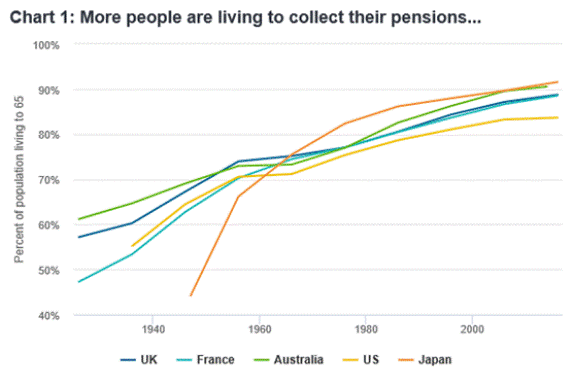
 

Source: The Human Mortality Database, Fidelity International, October 2018.
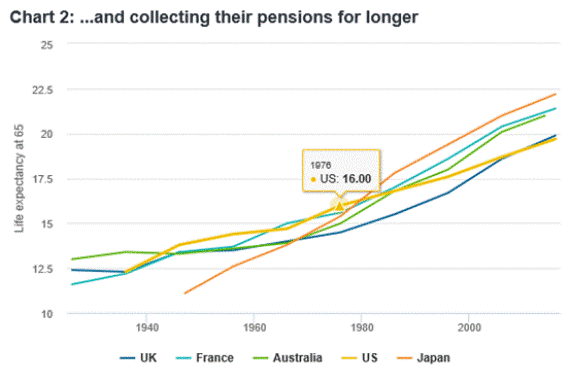


Source: The Human Mortality Database, Fidelity International, October 2018.

Since then life expectancies have increased dramatically in the rich world. But the pension age has remained virtually unchanged. In 1922, only 42 per cent of the UK population made it to age 70 to collect their pension. Those who did lived for another nine years on average. Now, only 11 per cent don’t make it to their 65th birthday, the current pensionable age in the UK, and those who do can expect to live another 20 years.

Younger for longer

Retirement is no longer the reserve of the frail and invalid, forced to withdraw from public life as the name originally implied. Advances in healthcare mean that pensioners are more physically and mentally able than ever before. Retirement is now seen as an important stage of life, a deserved reward for years of dutiful service.

All these extra years need to be funded. But a simultaneous fall in fertility rates has pushed old age dependency ratios in advanced economies to levels unable to sustain retirement as we know it today. However, the necessary changes might be driven by the choices of retirees rather than government intervention.
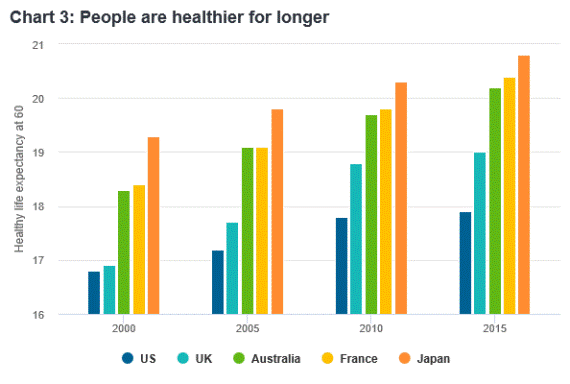
 

Source: World Health Organisation, Fidelity International, October 2018.

Our relationship with work has changed for the better

People in advanced economies are working for longer, not just because they have to, but also because they want to.

The work-leisure payoff from classical economics has transformed in the last 100 years. The shift from largely algorithmic work in manufacturing to more heuristic work in services has led to an increase in the intrinsic value people derive from work. Where previously geography or a lack of education restricted workers’ options, now they are free to choose and spoilt for choice. Your line of work is seen as an important part of your identity, akin to the way you dress or which football club you support, rather than which factory happened to be located in your home town. Work is no longer what you do but who you are.

The other upside of the shift to services from manufacturing is that working into old age is not the backbreaking endeavour of the past. People are no longer counting down the days to the salvation of retirement when one fine Friday afternoon they can down tools, straighten their crooked backs, and emerge from the darkness joyously wiping the grime from their faces for the last time. Social and technological changes have played their part too. Improvements in work-life balances, the rise of working from home, and a reduced need for business travel have all lowered the physical and mental stress related to employment.

The current crop of retirees is the last to be comfortably covered with defined benefit schemes. But not content to sit back, they are increasingly mixing leisure with part-time work, education, charity activities or starting a new venture. Cliff-edge retirements are out.

Diversification will happen earlier

This trend will continue in the future but will begin at an earlier age, spurred on by a fragmenting labour market and a generation of millennials inspired by tech entrepreneurs with many varied projects.

Career breaks earlier in life will also become more common as the risk of ‘getting back in’ falls. Those who plan to work longer anyway can afford to take a year or two out when they are younger to travel, start a business or help raise a family. The beneficial impact this will have on gender equality will be welcome.

The pensions industry has been slow to react to the breakdown of the traditional three-stage life model of education-work-retirement. But it is starting to respond with options that reflect the reality that very few retirements will be alike in future, with each evolving over its own lifecycle. Moving to a personalised service with customers able to choose when and how to mix income from annuities and pension pots depending on work prospects, travel plans or medical expenses will give extra flexibility to those with money saved away.

Technology will increase self-provision

It’s not just demographic trends that are altering the notion of retirement as a point in time. Technology is playing its part too. Online education has gained in acceptance and is now regarded as almost on a par with attending a classroom in person. This suits older people who can retrain in their spare time without the possibility of energy-sapping commutes. As work stretches out for longer, retraining and changing careers several times will become more common. A growing culture of education in later life will be a particular boost for industries needing a high number of technical roles, where the skills of older workers become obsolete faster. Many more will choose to refresh skills rather than retire.

Technology is also impacting healthcare. A more personalised healthcare service that technology enables means people will increasingly be able to schedule medical procedures at times and places that suit them, and plan career breaks around them. That knee operation requiring months of rehab may no longer make early retirement look like the only option. On an extended time-horizon, advances in technology will help older generations stay more mobile for longer.

Work will continue to evolve

The nature of work is evolving. Technology has enabled the gig economy to flourish. The pattern of on-demand work that allows employees to choose when and how much to work to perform with little pre-commitment suits many older workers. Accumulated assets such as houses and cars can now be put to use on platforms such as Airbnb and Uber. In the UK, the number of 65-year-olds who were self-employed increased by 66 per cent between 2010 and 2016, comfortably the fastest growth of any age group. Most gig economy jobs are low-skilled at present but this will change as millennials become the driving economic force. They are more comfortable recruiting the services of architects, consultants or lawyers through an app.
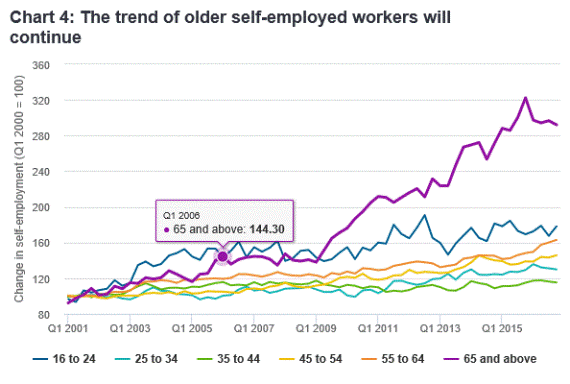


Data for UK citizens. Source: Office of National Statistics, Fidelity International, October 2018.

If we consider things on a grander scale, the very nature of work will be different in future. The spread of AI and advances in computer intelligence will make a range of jobs obsolete. But this will increase the value of skills that require empathetic human intelligence such as people management and relationship building. Skills that often improve with experience. So we may see older workers in higher demand than today, with the notion of peak earnings at age 45 a thing of the past.

Not all doom and gloom as we all get older

As a result, an older population won’t necessarily act as a drag on economic growth. Rising education later in life, falling age discrimination and increased flexibility around work will increase labour market efficiency by bringing more people, especially women, into the workforce on terms they want.

People generally accumulate wisdom as they age. The economy would benefit if this resource were put to good use. A recent study of new US companies that found that 50-year-old entrepreneurs were almost twice as likely to start a successful company as 30-year-olds.

The key is keeping older citizens economically active for as long as possible, both earning and consuming. The standard model of consumption, which shows a sharp fall as people leave work, will have to be rethought. But there is little guidance on how to fund consumption in old age. Almost everyone worries whether they will have enough assets to live on until they die. But many people are overly cautious.

By our estimates, around 10 per cent of Japan’s GDP is passed on as inheritance each year. And often this money is passed from 90-year olds to 60-year olds, who promptly save it as they too are worried about saving enough for retirement. In this way, a sizable proportion of assets is perpetually sitting on the sidelines. Encouraging those who have enough to live on to spend a little more in their later years would be a huge boost to the economy, not to mention quality of life in old age.

In a sense, the concept of retirement will cease to exist. Everyone will still go past an inflection point where expenditures begin to outweigh income. But it will be a personal milestone reached gradually rather than a sudden fanfare of leaving drinks and handshakes. Old age will inevitably get the better of all of us, but this will come later and later, after increasingly fulfilling preceding decades.

We might also see an end to pensions. A pot that you can only access at a certain age or in a certain way does not fit with a future of more flexible work and greater choice. Those entering the workforce today might instead prefer other tax-efficient savings vehicles that give greater control over their futures.

That people are living longer and healthier lives is something that should be celebrated rather than feared. We just need to make sure all those extra two minutes are put to good use.

So What?

Pensions were never designed for long enjoyment, and are even less sustainable with longer lifespans, healthier lives and falling fertility rates

There is good news too: our relationship with work has changed for the better, new technologies make flexible working easier, and age brings valuable experience

This means the retirement of the future won’t be a cliff-edge goodbye to work, but a gradual shift towards expenditure outweighing income, with more financial choice.

Please contact us on Phone: 07 5641 4134 if you seek further assitance on this topic .

Source : Fidelity January 2019

Reproduced with permission of Fidelity Australia. This article was originally published at https://www.fidelity.com.au/insights/investment-articles/the-future-of-retirement-wont-be-a-cliff-edge-goodbye-to-work/

This document has been prepared without taking into account your objectives, financial situation or needs. You should consider these matters before acting on the information. You should also consider the relevant Product Disclosure Statements (“PDS”) for any Fidelity Australia product mentioned in this document before making any decision about whether to acquire the product. The PDS can be obtained by contacting Fidelity Australia on 1800 119 270 or by downloading it from our website at www.fidelity.com.au. This document may include general commentary on market activity, sector trends or other broad-based economic or political conditions that should not be taken as investment advice. Information stated herein about specific securities is subject to change. Any reference to specific securities should not be taken as a recommendation to buy, sell or hold these securities. While the information contained in this document has been prepared with reasonable care, no responsibility or liability is accepted for any errors or omissions or misstatements however caused. This document is intended as general information only. The document may not be reproduced or transmitted without prior written permission of Fidelity Australia. The issuer of Fidelity Australia’s managed investment schemes is FIL Responsible Entity (Australia) Limited ABN 33 148 059 009. Reference to ($) are in Australian dollars unless stated otherwise.
© 2019. FIL Responsible Entity (Australia) Limited.

Important:
This provides general information and hasn’t taken your circumstances into account. It’s important to consider your particular circumstances before deciding what’s right for you. Any information provided by the author detailed above is separate and external to our business and our Licensee. Neither our business, nor our Licensee take any responsibility for any action or any service provided by the author.

Any links have been provided with permission for information purposes only and will take you to external websites, which are not connected to our company in any way. Note: Our company does not endorse and is not responsible for the accuracy of the contents/information contained within the linked site(s) accessible from this page. 

Here’s some good news for investors. With a few straightforward New Year resolutions and strategies, they can become better investors and better managers of their personal finances.

Key aims should be to save more, become better at handling inevitable market volatility, overcome investment inertia, reduce your debt and make sure you are following the fundamentals of sound investment practice.

Here are six New Year resolutions and strategies to think about:

Become a more disciplined, volatility-resilient investor: The higher share market volatility marking the final few months of last year and the beginning of 2019, highlights once again why investors should develop strategies to cope with volatility.

Block out market “noise”. Make sure you don’t overreact to daily market commentary and news, ignore short-term fluctuations in share prices and don’t get distracted by the rollercoaster emotions of the investment “herd”. Critically, set and adhere to an appropriately diversified asset allocation for your long-term portfolio – and monitor regularly particularly if your circumstances change.

And don’t try to time the market by attempting to pick the best times to buy or sell shares – typically market-timers sell after prices have fallen only to buy back after prices have risen.

When share prices sharply fall, investors often feel a hard-to-resist urge to do something when the best course is often to do nothing.

Increase your super contributions: Are you making the highest salary-sacrificed and tax-deductible contributions that you can afford? If not, consider increasing contributions from the beginning of 2019. The concessional (before-tax) contributions cap for all eligible super fund members is $25,000. Increasing your super contributions is a great beginning to breaking through the investment inertia that often gets in the way of investment success. (Concessional contributions are compulsory, salary-sacrificed and personally-deductible contributions.)

Cut your investment costs: This is one of the most straightforward ways to improve your chances of investment success in 2019 and beyond. Every dollar less paid in investment costs, including investment management fees, is a dollar more to invest.

Cut your debt: With Australia’s household debt at a record high, most of us have a powerful motivation to reduce our debts. In short, the more you are spending on paying back personal debt and on loan interest, the less you have left to invest and reach other goals such as eventually owning a debt-free home.

Control your credit card: A fundamental way to reduce debt in 2019 is to keep your credit card under tighter control. Aim to pay off your total credit card bill each month to avoid any interest and think about reducing your card’s credit limit. The typical Christmas splurge on credit provides an extra incentive to rein in credit card debt from early in in 2019. And consider the increasingly-popular alternative of having a debit card instead of a credit card. With a debit card, you can spend only your own money.

Boost your mortgage buffer: By making higher repayments on your home loan than required, you can build a mortgage buffer to help handle possible future financial setbacks and rate rises. And a mortgage buffer may enable you to pay off your home sooner. The Reserve Bank has noted in the past that many mortgages have taken advantage of low interest rates to build their mortgage buffers.

Be sure you are not being unrealistically ambitious with your resolutions, and not setting yourself up to fall short.

Have a prosperous New Year.

If you seek further assistance on this topic pease contact us on Phone: 07 5641 4134

Source : Vanguard January 2019 

Reproduced with permission of Vanguard Investments Australia Ltd

Vanguard Investments Australia Ltd (ABN 72 072 881 086 / AFS Licence 227263) is the product issuer. We have not taken yours and your clients’ circumstances into account when preparing this material so it may not be applicable to the particular situation you are considering. You should consider your circumstances and our Product Disclosure Statement (PDS) or Prospectus before making any investment decision. You can access our PDS or Prospectus online or by calling us. This material was prepared in good faith and we accept no liability for any errors or omissions. Past performance is not an indication of future performance.

© 2019 Vanguard Investments Australia Ltd. All rights reserved.

Important:
Any information provided by the author detailed above is separate and external to our business and our Licensee. Neither our business, nor our Licensee take any responsibility for any action or any service provided by the author.

Any links have been provided with permission for information purposes only and will take you to external websites, which are not connected to our company in any way. Note: Our company does not endorse and is not responsible for the accuracy of the contents/information contained within the linked site(s) accessible from this page.


 

Aussies are throwing out a massive $8 billion worth of edible food every year.

Did you know approximately one in every five bags of groceries bought in Australia gets tossed out, with $8 billion worth of edible food ending up in landfill every year1?

We check out the cost of food waste for the average Aussie household and how you could save thousands of dollars a year just by reducing what you throw out.

Fast facts: What’s happening around the country?

  • Sources say food wastage is leaving the average Aussie household out of pocket by anywhere from $1,0362 to over $3,5003 per annum.

  • Out of the $8 billion worth of food Aussies waste every year, fresh food accounts for 33%, left overs 27%, packaged and long-life products 15%, drinks 9% and frozen food 9%4.

  • Over a 12-month period, it is said Aussies will waste more than four million tonnes of food, which is enough to bridge the gap between Australia and New Zealand three times.5

  • About 20-40% of fruit and vegetables are rejected before they reach grocery stores because they don’t match supermarket or consumer cosmetic standards.6

  • Reducing food wastage can have a big impact on the environment. This is because when food rots in landfill, it creates a gas that is 25 times more potent than the pollution that comes out of the average car exhaust.7

How to reduce waste and pocket more cash

1. Know what’s in your cupboard

By knowing what’s in your cupboard—fresh produce, canned food, ingredients—the less likely you are to return from the shops and realise you’ve already got one of those and two of them.

2. Abide by your shopping list

Writing a shopping list based on what’s at home and what you plan to cook during the week means you can avoid buying more than what you need and purchasing items you can go without.

3. Take note of the expiry date

Checking expiry dates when you’re shopping and positioning older items at the front of the fridge or cupboard, so they get eaten first, is a good place to start. If fruit and vegetables start to go a bit soft, also look at ways to incorporate them into soups, sauces and desserts.

4. Exercise portion control

If your meal plan for one looks more like something for a family of five, you might end up throwing quite a lot of uneaten food away. Try to buy and cook only what you need, and if you are making extra that it’s something that can be frozen or put away for a later date.

5. Store food properly

Airtight containers, snap-lock bags, fridges and freezers all play a part in prolonging the shelf life of certain foods. So, if you’ve got meat in the fridge that you’re not going to eat this week, put it in the freezer for when you do.

6. Eat the leftovers

If you’re making more food than what you can consume, rather than throw it out, pack it for lunch or save it for dinner the following night. The bonus is you won’t cook twice.

7. Say yes to a doggy bag

If you find yourself unable to finish your next restaurant meal, ask to take it with you so you can cook it up the following day. If you can stretch one meal into two – you reduce waste and the second’s free.

8. Turn scraps into compost

Compost bins and worm farms allow you to break down food scraps and at the same time create natural fertiliser for plantation you might have around the home.

9. Grow your own garden

Cost savings is one of the greatest drivers for Aussie households to grow their own food8. Having your own stash of herbs and vegetables means you always have access to fresh ingredients and just the right amount.


1, 2, 4, 5, 6, 7 Foodwise – Fast facts on food waste
3 ABC TV program – War On Waste – Series 1 Ep 1
The Australian Institute – Grow your own paragraph 3

Source : AMP December 2018 

 Important information:This information is provided by AMP Life Limited. It is general information only and hasn’t taken your circumstances into account. It’s important to consider your particular circumstances and the relevant Product Disclosure Statement or Terms and Conditions, available by calling 13 30 30, before deciding what’s right for you. Read our Financial Services Guide for information about our services, including the fees and other benefits that AMP companies and their representatives may receive in relation to products and services provided to you. All information on this website is subject to change without notice. Although the information is from sources considered reliable, AMP does not guarantee that it is accurate or complete. You should not rely upon it and should seek professional advice before making any financial decision. Except where liability under any statute cannot be excluded, AMP does not accept any liability for any resulting loss or damage of the reader or any other person.

If your bank balance is looking a bit dreary, chances are what’s in your super fund could come as welcome news. See how you fare against others your age.

If you’re like 56% of young Aussies, you probably couldn’t say exactly how much money you have in super, but according to the Association of Superannuation Funds of Australia, what you’ve got saved may easily outweigh what’s in your everyday bank account1 (now, that’s welcome news).

Meanwhile, before your eyes glaze over and you think, well that’s money I generally won’t be able to touch for another couple of decades (true that!), below is some info you may like to know now, including how you fare against others your age when it comes to what you’ve saved in super to date.

How much do other young people have in super?

Here is the average super balance by age, looking across the board and breaking it down by gender2.

Age

Across the board

Men

Women

20 to 24

$5,501

$5,924

$5,022

25 to 29

$21,372

$23,712

$19,107

30 to 34

$38,386

$43,583

$33,748

35 to 39

$56,715

$64,590

$48,874


How much money will I need anyway?

According to September 2018 industry figures3, here’s what money you’d need each year to fund a comfortable or modest lifestyle if you were 65 and looking to retire today.

Comfortable lifestyle

Individuals would need an annual budget of $43,200 and couples an annual budget of $60,843 to fund a comfortable lifestyle, assuming they own their home outright and are relatively healthy.

A comfortable lifestyle in this instance assumes a retiree would be involved in a broad range of leisure and recreational activities and have a good standard of living.

Modest lifestyle

To live a modest lifestyle (which is considered better than living off the government’s Age Pension, but still only able to afford fairly basic activities), individuals and couples would need an annual budget of $27,595 and $39,666 respectively, assuming they own their home outright and are relatively healthy.

If you’re wondering how that actually compares to the government’s Age Pension, the maximum Age Pension rate is currently $23,824 annually for individuals and $35,916 annually for couples4.

Quick tips to help maximise what you’ve got

While you may be prioritising putting any additional money you have toward other things (and understandably if holidays, getting your own place or buying a new car is on the horizon), here are some other things you could do to ensure what you have already saved in super doesn’t dwindle.

1. Check your balance and your investment options

Even if you’re not part of the small percentage of young Aussies, who check their super balance daily5, it’s still worth a look every now and then to ensure you’re across what (don’t forget) is your money.

As for what investment options you’re invested in, this is also worth looking into as it could make a huge difference to your balance at the end of the day, as generally you’ve got the power to say what level of risk you’re willing to take on to potentially generate a higher profit.


2. Find your lost super (or let us do it for you)

You might have lost track of some of your super if you’ve changed jobs, particularly if your employer has put contributions into a new fund and you haven’t carried over what you saved in an old one.


3. Consolidate your funds into one if you have many

More than 60% of young Aussies have multiple super accounts6, and while you might be thinking, so what?, multiple accounts often mean multiple sets of fees and charges.

With that in mind, rolling your accounts into one could be worthwhile as it may save you hundreds of dollars a year or thousands over many years. Just be sure to look into any exit and withdrawal fees, and if there are any features and benefits you might lose if closing a particular account.

4. See if you’re paying for insurance

Having insurance inside super may be beneficial for you, but you should review what you’ve got, as more than 25% of people under age 29 are unsure whether they have cover, let alone the right type7.

While there may be benefits (for instance, insurance cover may be cheaper, and you won’t be dipping into your take-home pay as insurance premiums are deducted from your super savings), cover may be limited and paying premiums out of your super could decrease your balance if your super is not being offset by contributions.

Keep in mind

While retirement might seem like a lifetime away, remember – the more informed you are about super from a young age, the better off you may be down the track.

If you seek further assistance please contact us on Phone: 07 5641 4134

 1, 5, 6, 7 ASFA Media Release: More money in super than in the bank – young Australians’ hidden super wealth
ASFA Report: Superannuation account balances by age and gender 2017 page 9,10
ASFA retirement standard table 1
Department of Human Services – Payment rates for Age Pension table 1

Source : AMP December 2018 

 Important information:This information is provided by AMP Life Limited. It is general information only and hasn’t taken your circumstances into account. It’s important to consider your particular circumstances and the relevant Product Disclosure Statement or Terms and Conditions, available by calling 13 30 30, before deciding what’s right for you. Read our Financial Services Guide for information about our services, including the fees and other benefits that AMP companies and their representatives may receive in relation to products and services provided to you. All information on this website is subject to change without notice. Although the information is from sources considered reliable, AMP does not guarantee that it is accurate or complete. You should not rely upon it and should seek professional advice before making any financial decision. Except where liability under any statute cannot be excluded, AMP does not accept any liability for any resulting loss or damage of the reader or any other person.


You’ll find no shortage of celebrities endorsing various superfoods all over the world wide web and their social media accounts; which is all well and good until you get a closer look at the price of these super-expensive life enhancers!

You don’t need to burn a hole in your wallet to achieve a healthy and balanced diet.Keep reading for some delicious, healthy, and very affordable alternatives to so called superfoods! I like to call them Supercharged Foods.

Many of you may be wondering, what makes a food a ‘superfood’? Well, to be honest, there’s no concrete definition; however, the name ‘superfood’ is actually a marketing term, not a scientific one. A superfood is described as being any food that contains high levels of antioxidants, flavonoids, vitamins and minerals. Antioxidants are well known for their ability to strengthen the immune system, thereby warding off diseases, such as heart disease and diabetes.

The health benefits of these ‘superfoods’ are the result of studies done on specific essential nutrients that are known to prevent disease and improve immunity, and the foods that they can be found in, in large amounts. If studies show that a specific food contains high concentrations of antioxidants, trace minerals and vitamins, such as Vitamin C, K and B, it can then be referred to as a superfood.

Each time a new study is released shedding light on the health benefits of a specific food, the media runs with this information, publishing their own news stories about these newly researched superfoods.

In 2014 kale farmers struggled to keep up with the new demand for kale after several studies reported that kale contained high levels of antioxidants and other essential nutrients, leaving many supermarkets out of stock.

The media has a lot of influence over consumers, and with consumers becoming increasingly aware of the benefits of eating healthy, wholesome foods, it’s no surprise that supermarkets take advantage of this by drastically increasing the price of these foods!

However, some studies can be misleading, and the results reported can be misinterpreted by the media and consumers. 

Just because studies have reported that a specific food, such as blueberries, contain large amounts of antioxidants, it doesn’t mean that you have to start eating blueberries every day to maintain vibrant health.

Superfoods Aren’t The Only Foods That Contain Essential Nutrients.

And by eating a balanced diet that is full of variety, you can guarantee that you’re eating enough essential nutrients without even picking up a superfood. 

It’s safe to say that the superfoods market is booming, and supermarkets and pharmaceutical companies are taking full advantage of it. But the hype of superfoods tends to shine a negative light on many other beneficial wholefoods. 

Apples and oranges are neglected for berries, rice and pasta are replaced with teff and ancient grains… But why should superfoods be thought of as healthier than other unprocessed foods or Supercharged Foods? Is it because they cost more in the supermarket? Or maybe it’s because the local news reported a story about kale, but not English spinach.

The take home message here is fill your shopping cart with good, unprocessed healthy foods and try to buy what’s in season…. Those are usually the fruits and vegetables on special, by the way.

Here’s A Snapshot Of Well-Known Superfoods And Their Nutrients:

  • Kale: contains large amounts of Vitamin A, K and C.

  • Avocado: contains monounsaturated fats, fiber and Vitamin C.

  • Acai Berries: contain fiber, antioxidants, essential amino acids, vitamins and minerals.

  • Goji Berries: contain fiber, antioxidants, valuable trace minerals and vitamins, phytosterols.

  • Blueberries: contain antioxidants, manganese, polyphenols and Vitamin C and K.

  • Chia Seeds: contain omega-3 essential fatty acids.

  • Quinoa: contains large amounts of protein, iron, zinc and Vitamin B.

  • Coconut Water: contains natural sugars and electrolytes.If you’re on a budget and want to experiment with more affordable alternatives, look for these key Supercharged Foods and enjoy their associated health benefits:

  • Broccoli: contains high amounts of Vitamin C, calcium and fiber.

  • Spinach: contains folate, fiber, Vitamin C and iron.

  • Sweet Potato: contain niacin, Vitamin A and C.

  • Kiwi Fruit: contains fiber, Vitamin C, Vitamin E, potassium, magnesium and phytochemicals

  • Buckwheat: contains fiber, folate, thiamine, riboflavin, niacin, iron, Vitamin E, zinc, magnesium and phosphorus.

  • Sardines, Salmon and Mackerel: contain high levels of protein and omega 3 unsaturated fats.

  • Nuts: contain zinc, iron and unsaturated fat.

  • Water: needed to help carry nutrients and oxygen to cells, both of which, if are in low supply, can lead to fatigue and nausea.


Source : Food Matters September 2018

Reproduced with the permission of the Food Matters team. This article by Lee Holmes was originally published at https://www.foodmatters.com

Important:
This provides general information and hasn’t taken your circumstances into account.  It’s important to consider your particular circumstances before deciding what’s right for you. Although the information is from sources considered reliable, we do not guarantee that it is accurate or complete. You should not rely upon it and should seek qualified advice before making any investment decision. Except where liability under any statute cannot be excluded, we do not accept any liability (whether under contract, tort or otherwise) for any resulting loss or damage of the reader or any other person. 

Any information provided by the author detailed above is separate and external to our business and our Licensee. Neither our business, nor our Licensee take any responsibility for any action or any service provided by the author.

Any links have been provided with permission for information purposes only and will take you to external websites, which are not connected to our company in any way. Note: Our company does not endorse and is not responsible for the accuracy of the contents/information contained within the linked site(s) accessible from this page. 

The housing cycle and house prices always incite high interest in Australia. Until recently it was all about surging prices and poor affordability – particularly in Sydney and Melbourne. Over the last year it’s turned into how far prices will fall and what’s the impact on the economy. Global issues and the election aside, the housing downturn is likely to be the main issue for Australia in 2019. This note provides a Q&A on the main issues.

How far have home prices fallen?

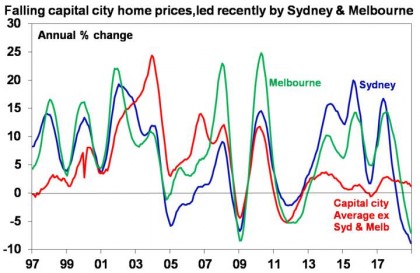
According to CoreLogic data, up until December capital city dwelling prices are down 7% from their September 2017 high. This masks a wide range though with Sydney down 11% from its July 2017 high, Melbourne down 7% from its November 2017 high, Perth down 16% and Darwin down 25% from their mid 2014 mining investment boom highs but other cities continuing to trend up to varying degrees. Recently the declines have been led by Sydney and Melbourne. House prices are on average down more than unit prices and prices in regional centres have generally held up better than capital cities.  


Source: CoreLogic, AMP Capital

What is driving the falls?

The fall in property prices comes after a boom – most recently over the five years to 2017 that in particular saw Sydney prices rise 72% and Melbourne prices gain 56%. This, on top of gains since the mid-1990s, saw a sharp deterioration in affordability, prices become overvalued relative to income, rents and their long-term trend and reach expensive levels by global standards. The surge in home prices went hand in hand with a surge in debt that has seen the ratio of household debt to income go from the low end of OECD countries to the top end. High prices and high debt left Australian housing very vulnerable. What has changed in the last two years is that:

  • It’s become harder to get a loan as regulators forced banks to tighten lending standards and the Royal Commission seems to have made banks even more cautious. 

  • A big pool of interest only borrowers are switching to principal and interest driving higher debt servicing costs.

  • Banks have cut lending to SMSF funds to invest in property.

  • The supply of units has surged to record levels.

  • Foreign demand has fallen sharply.

  • As rising prices fed on themselves by driving expectations for more price gains (FOMO – fear of missing out), falling prices are driving reduced price expectations and leading to reduced demand and FONGO (fear of not getting out).

  • Investors are starting to factor in less favourable negative gearing and capital gains tax arrangements if there is a change of government.

  • Problems regarding the Lacrosse and Opal buildings have dented confidence around building standards. 

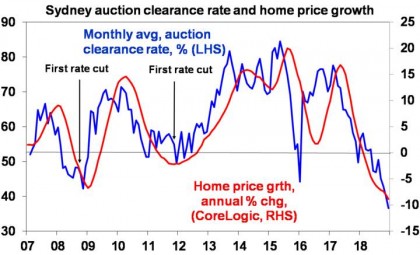
  • Its unlikely interest rate cuts will quickly end this property cycle downturn as occurred in the 2008 and 2010-12 downswings. Rates are already low & debt is much higher.

What will be the impact of tax changes?

The Australian Labor Party’s policy since the last election has been to limit negative gearing to new property and double capital gains tax on investments held for more than 12 months. This is aimed at improving housing affordability which means lower prices. Put simply, such changes would make it less attractive for investors to invest in residential property which would be negative for prices. A study by Riskwise Property Research and Wargent Advisory found that this would lower property prices ranging from 2 to 3% in Tasmania to around 9% in Sydney. While the tax changes are proposed to be grandfathered, it’s likely it’s already reducing investor demand as investors worry that when it comes time to sell their property if the tax changes occur then there will be less demand.

How far will home prices fall?

For Sydney and Melbourne our base case has been that prices would have a top to bottom fall of around 20% out to 2020. However, the further plunge in auction clearance rates and acceleration in price falls late last year suggest a deeper fall possibly of around 25% (although it’s impossible to be precise). This suggests around another 15% fall in Sydney and more in Melbourne. A 25% top to bottom drop would take prices back to where they were in late 2014/early 2015.  


Source: Domain, AMP Capital

While prices in other cities are being affected by credit tightening they were less speculative and so are less vulnerable. Perth and Darwin have already seen prices fall back to decade ago levels. Other capital cities and regional centres generally didn’t have a boom and so are unlikely to have a bust. So for the rest of Australia flat prices to modest gains are likely. Taken together this suggests a top to bottom fall in national average prices of 10 to 15%, with another 5 to 10% this year.

Will home prices crash?

This is a bit of an unhelpful question like the “are we in a property bubble” questions of a few years ago as it’s hard to define and implies a degree of inevitability in terms of the implications. A 25% plunge in Sydney and Melbourne may seem like a crash but given the extent of the prior gains it’s arguably not. But a 25% national average fall would probably be interpreted as a crash. Our assessment is that this is unlikely unless we see much higher interest rates or unemployment (neither of which are expected) driving a sharp rise in defaults and forced property sales or a collapse in immigration (which would collapse demand). Strong population growth is still driving strong underlying demand for housing. While mortgage stress is a risk, it tends to be overstated, and is unlikely to be a generalised issue unless interest rates or unemployment shoot higher. And, while Sydney and Melbourne are at risk, other cities have not seen the same boom & so are unlikely to crash.

Although many like to make comparisons to the US at the time of the GFC, there are two big differences. Australia has not seen the surge in sub-prime loans where money was lent to home owners who often had “no income, no job, no asset” (NINJA loans). Secondly, our mortgages are full recourse meaning we won’t see “jingle mail”, where home owners can send back the keys just because the house value falls below their debt, which then saw the bank put the property back on the market pushing home prices even lower.

However, the risk of a crash cannot be ignored given the danger that banks may become too tight and that investors decide to exit in the face of falling returns.

Have home prices fallen before?

A common property myth is that prices only ever go up and never fall. But a simple look at history tells us this is not so. Real house prices (ie prices after the impact of inflation) in Sydney fell 36% in 1934-35, 32% in 1937-41, 41% in 1942-43, 12% in 1947-48, 14% in 1951-53, 12% in 1961-62 and 22% in 1974-77. In nominal terms based on CoreLogic data Sydney dwelling prices fell 25% in 1980-83, 10% in 1989-91, 8% in 2004-06 and 7% in 2008-09. So a 25% fall this time around would be similar to that seen in the early 1980s.

What will be the impact on the economy?

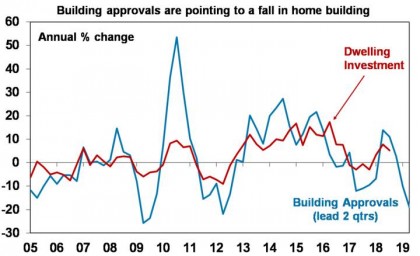
The housing downturn will affect the broader economy via slowing dwelling construction, negative wealth effects on consumer spending (ie, our wealth goes down, we feel poorer, we spend less than otherwise) and if rising defaults drive a further slowing in bank lending. The first two will detract 1 to 1.5 percentage points from economic growth. Growth in infrastructure spending and business investment should help keep the economy growing but its likely to be constrained to around 2.7% which in turn will keep wages and inflation low.  


Source: ABS, AMP Capital

What is the impact on banks?

The main risk for banks is that the property downturn drives a rise in defaults. However, full recourse loans mean that just because home prices fall resulting in negative equity, defaults won’t necessarily rise. In the absence of much higher interest rates or unemployment making it harder for people to service their loans, a big rise in defaults is unlikely. However, it’s still a risk and the housing downturn will likely mean slower bank lending which will constrain bank profits.

What will it mean for interest rates?

Constrained growth due to the housing downturn resulting in lower for longer inflation will likely drive the RBA to cut interest rates this year, with two cuts taking the cash rate to 1% by year end. Our base case is that this will occur in August and November (giving the RBA chance to assess the election and tax cuts), but soft data could see it come earlier. Tax cuts from July are unlikely to be big enough (the Government is allowing for just $3bn pa in tax cuts which is just 0.1% of GDP) to head off the need for rate cuts.

Is the house price downturn good or bad?

This depends on who you are. For baby boomers who got in years ago, have paid off their debt and saw the value of their home rise to levels they never believed sustainable, a fall back to 2014/15 levels may be no big deal. For those who got in more recently and have a big mortgage price falls are more of a downer and its this group for whom negative wealth effects will be greatest. For millennials trying to get in its great news – assuming the housing downturn is not so great that it knocks the economy for six and they lose their jobs. For investors…

What does it mean for investors?

Over the very long-term, residential property adjusted for costs has similar returns to Australian shares. So, there is a role for it in investors’ portfolios. However, right now the slump in property prices in some cities is bad news for investors given that rental yields are often just 1-2% after costs. Falling rents in Sydney are a double whammy. Add to this uncertainty about tax and it’s not a great time for a property investor. That said, other cities and regional centres offer more attractive rental yields than Sydney and Melbourne and falling prices in Sydney and Melbourne will throw up opportunities at some point.


Source: AMP Capital 23 January 2019

Important notes: While every care has been taken in the preparation of this article, AMP Capital Investors Limited (ABN 59 001 777 591, AFSL 232497) and AMP Capital Funds Management Limited (ABN 15 159 557 721, AFSL 426455) makes no representations or warranties as to the accuracy or completeness of any statement in it including, without limitation, any forecasts. Past performance is not a reliable indicator of future performance. This article has been prepared for the purpose of providing general information, without taking account of any particular investor’s objectives, financial situation or needs. An investor should, before making any investment decisions, consider the appropriateness of the information in this article, and seek professional advice, having regard to the investor’s objectives, financial situation and needs. This article is solely for the use of the party to whom it is provided.

Get up to speed with the government subsidies you may be able to claim in 2019 before the kids go back to school.

With 2019 now in motion, many parents and carers are probably looking at how they’ll cover school fees for the year ahead, not to mention other costs, which might include things like uniforms, shoes, stationery, excursions and transport.

The good news is, you may be eligible for some financial assistance through subsidies in your state or territory, which may be means tested or require you to hold a concession card1.

State and territory allowances

According to figures from ASG, for a child born today, the total cost of schooling in a capital city (from ages 0 to 17) is estimated to be around2:

  • $68,007 if they attend government schools

  • $252,085 if they attend systemic/catholic schools

  • $499,593 if they attend private schools.

With that in mind, it’s worth exploring some of the rebates and tax breaks you as a parent or guardian may be eligible for.

New South Wales

Children in Kindergarten through to Year 12, who are aged between four and a half and 18 (including those that are home-schooled), are eligible for an Active Kids Voucher, providing parents and guardians with $100 to put toward registration and participation costs for sport and fitness activities.

This year, the Creative Kids program was also launched, providing one $100 voucher each year to all school-aged children to help with the cost of creative classes and activities, such as music, dance and drama lessons, language classes, coding and design.

In addition, if you drive the kids to school because there’s no public transport where you live, you may be eligible for the School Drive Subsidy

There are also two financial support programs for eligible families who have children boarding away from home to complete their secondary education. To find out more, check out information on the Living Away from Home Allowance and Boarding Scholarship for Isolated Students.

Queensland

If you have secondary-school-age students who are attending state and approved non-state schools, you may be able to receive financial assistance to help with the cost of textbooks and other learning resources. For more details, check out the Queensland state government website.

Living Away from Home Allowance Scheme is also available, while talented students from regional and remote areas, who aren’t eligible, may apply for Queensland Academies Isolated Students Bursary.

On top of that, a voucher of up to $150 under the Get Started Vouchers program may also be available for children who can least afford, or may otherwise benefit from joining a sport or recreation club, while there are additional funding sources that aim to support young athletes.

Victoria

Depending on your situation, your family may be eligible to receive free or discounted uniforms, shoes, textbooks, stationery and more through the State Schools’ Relief.

The Camps, Sports and Excursions Fund may also provide payments so eligible students can take part in school trips and various sporting activities.

South Australia

The School Card scheme assists with expenses, such as school fees, uniforms, camps and excursions. This is available for eligible students attending government schools.

The State Education Allowance is also available to geographically isolated parents with children at secondary level, who board away from home to attend school. The allowance assists with travel, boarding and other education-related expenses.

Western Australia

The Secondary Assistance Scheme is available to parents who hold eligible concession cards. It provides an education program allowance, which is paid to the school, and a clothing allowance that can be paid to the school or parent.

Boarding Away from Home Allowance also assists geographically isolated families with boarding and education costs for primary and secondary-school-age children.

Tasmania

The Student Assistance Scheme assists with the cost of school levies. It provides support to low-income families to help with the cost of students in kindergarten through to year 12.

Northern Territory

The Back to School Payment Scheme provides financial assistance to parents and guardians of children enrolled in a Northern Territory school, or who are registered for home-schooling. The entitlement can be used towards things like uniforms, books and school camps.

There’s also a Sport Voucher Scheme that assists with sport, recreation and cultural-activity costs. And, you may be eligible for financial help if your child has to live away from home or travel long distances to go to school. Check out info on the Northern Territory state government website.

Australian Capital Territory

The Secondary Bursary Scheme and Student Support Fund programs provide assistance to eligible low-income earners in the state with dependent full-time students in years seven to 10.

Commonwealth Government assistance

Commonwealth Government assistance may also be available for eligible young people through Youth Allowance and various Assistance for Isolated Children programs.

There’s also a Child Care Subsidy (which replaced the Child Care Benefit and Child Care Rebate in July 2018) which may help with the cost of child care if you meet certain criteria. 

Another initiative the Australian Department of Social Services is involved in is Saver Plus – a program that’s delivered in 60 communities across the country. It delivers up to $500 in matched savings for education costs and provides free financial education workshops and support.

Other considerations

The cost of kids doesn’t come cheap, so it’s worthwhile making the most of the subsidies available to you.

In the meantime, if you need further help, speak to your school about what financial support is available. It might also worth talking to other parents who have children at the same school or schools nearby.

For further tips around budgeting and how to take control of debts, please contact us on Phone: 07 5641 4134

Source : AMP January 2019 

Money Smart – Reducing back to school costs (Government assistance with school costs)
ASG – supporting children’s education (Table: Calculate the cost of your child’s education)

 Important information:This information is provided by AMP Life Limited. It is general information only and hasn’t taken your circumstances into account. It’s important to consider your particular circumstances and the relevant Product Disclosure Statement or Terms and Conditions, available by calling 13 30 30, before deciding what’s right for you. Read our Financial Services Guide for information about our services, including the fees and other benefits that AMP companies and their representatives may receive in relation to products and services provided to you. All information on this website is subject to change without notice. Although the information is from sources considered reliable, AMP does not guarantee that it is accurate or complete. You should not rely upon it and should seek professional advice before making any financial decision. Except where liability under any statute cannot be excluded, AMP does not accept any liability for any resulting loss or damage of the reader or any other person.

What impact do factors like your weight, age and smoking status have on your ability to buy life insurance?

‘Sneaky smokers’ can breathe a sigh of relief – just because you’ve got an unhealthy habit or two, it doesn’t necessarily mean you can’t get insurance.

This list reveals the answers to those awkward questions you might have – but are afraid to ask – about your ability to buy life insurance.

1. Am I too overweight to buy life insurance?

Life insurance applications generally ask for your height and weight, and insurers typically use a measure known as Body Mass Index (BMI) – which is calculated by dividing your weight in kilograms by your height in metres squared – to assess whether you are overweight.

A BMI of less than 18.5 is considered underweight, with 18.5-24.9 classified as a healthy weight range. Anything over 25 is considered overweight.1  

People who are overweight have higher rates of death and illness than people of healthy weight and are more susceptible to conditions such as cardiovascular disease, high blood pressure and type 2 diabetes.2

But having a BMI of over 25 will usually not prevent you from buying life insurance, as insurers also take other weight-related factors into account such as your waist circumference, medical history and pre-existing medical conditions. 

Depending how high your BMI is, you might be required to have a medical assessment, and based on your perceived risk, may be offered cover at a higher premium or with exclusions applied. Only in extreme cases is it likely that cover would be denied.

2. Am I too old to buy life insurance?

All life insurers have a maximum entry age, which in Australia typically ranges from 59 to 79 years old.3. The oldest age at which you can buy life insurance from AMP is 70.

However, older applicants may not be eligible for all the benefits included in the cover, or for the maximum levels of cover.

All policies also have an expiry age, after which you’re no longer covered. In Australia, this typically ranges from 85 to 100 years old.4 The expiry age for AMP’s stand-alone life insurance is 99 and if your life insurance is held through your super the expiry age will be lower.

But given the purpose of life insurance is to ensure the financial security of your dependents and provide a payment which will cover your debts, it’s possible that some older people may no longer need life insurance.

3. Can I get life insurance with a history of mental illness?

With almost a fifth of all Australians reporting having suffered from a mental or behavioural condition, mental illness is a relatively common occurrence and will not necessarily prevent you from buying life insurance.5

When assessing your application, insurance companies will consider a range of factors including the seriousness of your mental health condition, its impact on your employment and lifestyle, the success of any treatment, management strategies and any ongoing symptoms.6

In severe cases, you may be declined insurance, although different companies have different underwriting criteria, so it pays to shop around.

4. Can I apply as a non-smoker if I sneak a cigarette now and then?

The short answer to this question is no. Life insurers consider anyone who smokes cigarettes – regardless of the quantity – a smoker. This definition also extends to people who smoke cigars, chew tobacco or use nicotine patches.7

Smokers can be charged much higher premiums than non-smokers, and your premiums can be impacted by how much you smoke and how long you’ve been smoking, as these factors increase your risk of serious illness or death.8

In order to be classified a non-smoker, you need to have not used any nicotine product in the past year. The good news is that if you’re able to do this, you could qualify for a reduction in your premiums.9

It’s important not to lie about your smoking status as, in the event of a claim, your insurer could deny your claim if they can prove you’ve lied.

5. Can I leave my insurance money to someone other than my spouse?

As long as they’re aged over 18, you can generally nominate whoever you like as your life insurance beneficiary.10

You can also nominate more than one beneficiary if you choose and specify what percentage of the payment you want each person to receive.

Depending on whether your insurance is held inside or outside of super may affect who you can chose as your beneficiary.

Other considerations

The life insurance available through super is typically bought on a group basis meaning it usually guarantees you cover without taking into account your specific circumstances.11

So if one or more of the situations above applies to you, opting for life insurance through your super may be the easiest and most cost-effective way to get cover.

Please contact us on Phone: 07 5641 4134 if you seek further advice .


1 Australian Institute of Health and Welfare, Overweight and obesity, paragraph 4.

2 Australian Institute of Health and Welfare, Overweight and obesity paragraph 1.

3, 4 Finder, Life insurance for over 70’s, table.

5 Australian Bureau of Statistics, National Health Survey: First Results, 2014-15, mental and behavioural conditions, paragraph 3.

6 Lifewise, Mental illness and life insurance, what you need to know – a brief guide, paragraph 6.

7, Finder,  Regular smokers and life insurance, paragraph 1.

8, Finder,  Regular smokers and life insurance, paragraph 6.

9, Finder,  Regular smokers and life insurance, paragraph 9.

10 Finder, Updating life insurance beneficiaries, paragraph 6.

11 Moneysmart, Insurance through super, paragraph 4.

Source : AMP January 2019 

 Important information:This information is provided by AMP Life Limited. It is general information only and hasn’t taken your circumstances into account. It’s important to consider your particular circumstances and the relevant Product Disclosure Statement or Terms and Conditions, available by calling 13 30 30, before deciding what’s right for you. Read our Financial Services Guide for information about our services, including the fees and other benefits that AMP companies and their representatives may receive in relation to products and services provided to you. All information on this website is subject to change without notice. Although the information is from sources considered reliable, AMP does not guarantee that it is accurate or complete. You should not rely upon it and should seek professional advice before making any financial decision. Except where liability under any statute cannot be excluded, AMP does not accept any liability for any resulting loss or damage of the reader or any other person

Make a plan for your money

What are your money goals for this year? To give yourself the best chance at achieving them, your goals need to be SMART: specific, measurable, achievable, realistic and timely. Setting timely goals means giving yourself a timeframe to achieve them.

With a SMART goal in mind, you now need to set up a plan for how you’ll achieve it. For example, if you want to save $5,000 by the end of the year, work out how much you can allocate to that goal each pay day. 

Start with a budget

A budget will help you to map out your finances and work out where your money is going. Start with the essential costs like rent or mortgage, food, bills and transport, then allocate money for any debts you’re paying off. Anything left over can go towards your other money goals. 

Home in on your savings

Having savings set aside will help cover you in case of an emergency and will also help you reach your bigger money goals. Set up an automatic recurring payment to regularly transfer money into a high-interest savings account that is easy to deposit into but hard to withdraw from.

We have lots of tips to help you zero in on your savings if you’re:

Check out our savings infographic to see what other people are saving for and how they are reaching their savings goals.

Knock out your debts

If you want to get on top of your debt in 2019, break down what you owe into manageable chunks by prioritising what you can pay first.

You could start by making extra repayments on your smallest debt first. Once you have paid that off, move on to the next smallest, and so on. If you start small, by the time you get to your biggest debts you will be well equipped to knock them out.

Another option is to pay off the debt with the highest interest first.

Financial counselling is a free service you can use if you need help sorting out your debts. Financial counsellors are independent and confidential. 

Smart tip

Stay on top of your credit health by getting a free copy of your credit report and correcting any details that are wrong.

Take charge of your super

Make 2019 the year you get on top of your super. If your super is spread out across multiple funds, you are paying multiple sets of fees that are reducing your balance. Your super is your nest egg for your future, so why not start the year by consolidating your super into one fund so you pay less fees and grow your lump sum faster

You might also think about contributing extra to your super to grow your balance. See our page on super contributions for more on how to do this. 

Smart tip

Get to know your super by checking your investment options and what, if any, life insurance your super covers.

our page on super contributions for more on how to do this. 

See how much extra contributions could grow your super. 

super contributions optimiser

Invest in your future

If your debts are under control and you’ve built up some savings, 2019 could be the year to start investing.

Boost your investment knowledge

Never invest in something you don’t fully understand; take the time to read up on the types of investment options you’re interested in. Follow the golden rules and invest smarter.

You might also consider reading money or investing magazines, or following finance and investing experts on social media.

Invest for your time frame

It’s best to choose an investment based on how long you are prepared to have your money tied up. Growth assets like shares and property that usually have better long-term returns, can be more volatile in the short term. We have guidance to help you choose your investments.

Setting and reaching your money goals will help you achieve financial freedom. By putting a good plan in place and committing to keeping your money on the right course, you’ll hit your target. 

If you seek further assistance on this topic please contact us on Phone: 07 5641 4134

Source : MoneySmart January 2019 

Reproduced with the permission of ASIC’s MoneySmart Team. This article was originally published at https://www.moneysmart.gov.au/tools-and-resources/news/new-years-resolutions

Important note: This provides general information and hasn’t taken your circumstances into account.  It’s important to consider your particular circumstances before deciding what’s right for you. Although the information is from sources considered reliable, we do not guarantee that it is accurate or complete. You should not rely upon it and should seek qualified advice before making any investment decision. Except where liability under any statute cannot be excluded, we do not accept any liability (whether under contract, tort or otherwise) for any resulting loss or damage of the reader or any other person.  Past performance is not a reliable guide to future returns.

Important
Any information provided by the author detailed above is separate and external to our business and our Licensee. Neither our business, nor our Licensee take any responsibility for any action or any service provided by the author.

Any links have been provided with permission for information purposes only and will take you to external websites, which are not connected to our company in any way. Note: Our company does not endorse and is not responsible for the accuracy of the contents/information contained within the linked site(s) accessible from this page

Many investors have been rattled by falls in share markets and are fretting about what the new year may hold.

But there are a number of reasons to suggest that after a weak 2018, 2019 will be better, and that a well-diversified portfolio should deliver reasonable returns.

1. This is a “mid-cycle” correction

Firstly, while some investors fear a recession and full-blown bear market, when you look at the global economy, what you see is not a major recession, but yet another “mid-cycle” correction. As the timeline below illustrates, the recovery since the global financial crisis has been anything but straightforward with several mid-cycle slowdowns along the way including around 2011 and 2015-16.

2. No full-blown recession

But while we are in a growth slowdown globally, I don’t see the conditions being in place to drive that into a full-blown recession. I don’t see excess investment; I don’t see lots of interest rate hikes around the world; I don’t see tight monetary policy; and I don’t see a major inflation problem.

My feeling is that growth might be a little bit subdued in the first part of 2019, but as we go through the year, we will see another pick-up in growth and that will keep the global economic growth going.

3. Oil prices falling

Another reason I have for optimism is that oil prices have fallen 30-odd per cent. That takes pressure off inflation and also puts money in the hands of consumers – a bit like a tax cut.

It’s a classic example of the benefits of these mini-downturns. It’s not so good for share markets, but ultimately lower oil prices help extend the cycle and therefore are likely to drive a recovery in share markets as we go in 2019.

4. Modest rate hikes or even cuts

The fourth reason is that interest rate rises should be constrained in 2019. The US Federal Reserve will probably raise interest rates a bit more through 2019, but I think it’s going to be at a slower pace, and it wouldn’t surprise me at all if they have a pause through the first part of 2019.

That’s reflecting the slower pace of growth that we have seen and signs that US inflation in the very short term may be constrained around the Federal Reserve’s 2% target. Other major countries are very unlikely to raise rates and some (such as China) are likely to cut them.

The impact on investment returns

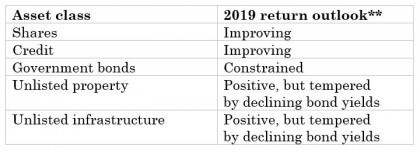
Despite the concerns of investors, the four reasons above mean I don’t believe we are headed for a deep bear market or major recession and therefore I anticipate better returns in 2019, albeit things could still get worse before they get better.


** Warning: These forecasts are prospective financial information based on various assumptions. The forecasts are predictive in nature, may be affected by inaccurate assumptions or by known or unknown risks and uncertainties, and may differ materially from results ultimately achieved. Source: AMP Capital

Australia’s outlook

The local outlook is ok, but returns will be constrained.

On the one hand, there’s strength in infrastructure spending, business investment looks healthier, and export values should hold up; on the other hand, there’s the housing slowdown, which will constrain things, all of which should keep Australian interest rates on hold, or if, as we expect, ultimately drive a rate cut. So the return outlook for bank deposits will remain very low as we go through 2019.

What to watch

There are, as always, some areas to keep an eye on through 2019.

  • Australian housing

    I expect Australian housing is going to remain weak. With credit tightening and rising supply, expectations are a lot weaker which is attracting fewer buyers into the property market. There’s also reduced foreign demand and a potential change of government on the horizon – all of those things are going to lead to more downside in Australian property prices, though that will be concentrated in Sydney and Melbourne.

  • The US Federal Reserve

    Globally, watch to see what the US Federal Reserve are doing – but as mentioned I don’t expect dramatic US rate rises in 2019.

  • The Trump trade war

    The trade issue between the US and China will bubble along periodically as we go through 2019, particularly in the first part of the year. To see whether the war flares up again, investors need to monitor what happens with the trade truce struck on the sidelines of the recent G20 summit that saw China and the US put tariff increases on hold for 90 days.

To learn more about our predictions for 2019, watch our recent webinar.

https://vimeo.com/304496565


Author: Dr Shane Oliver, Head of Investment Strategy and Economics and Chief Economist, AMP Capital

Source: AMP Capital 15 Jan 2019

Important notes: While every care has been taken in the preparation of this article, AMP Capital Investors Limited (ABN 59 001 777 591, AFSL 232497) and AMP Capital Funds Management Limited (ABN 15 159 557 721, AFSL 426455) makes no representations or warranties as to the accuracy or completeness of any statement in it including, without limitation, any forecasts. Past performance is not a reliable indicator of future performance. This article has been prepared for the purpose of providing general information, without taking account of any particular investor’s objectives, financial situation or needs. An investor should, before making any investment decisions, consider the appropriateness of the information in this article, and seek professional advice, having regard to the investor’s objectives, financial situation and needs. This article is solely for the use of the party to whom it is provided.