How to keep your finances on track once you leave the workforce

When you’ve worked hard all your life to build up your nest egg, the last thing you want to do is fritter it away too quickly. In this article, we look at the common money mistakes people in retirement make, and how you can do your best to avoid them.

1. Not taking control of your super

It’s important to know what your options are for getting access to your superannuation when you retire. You can take it as a lump sum, an allocated pension or an annuity. Learn more about accessing your super and then speak to a financial adviser to find out what’s right for you.

2. Not knowing your entitlements

Don’t make the mistake of not knowing what payments you’re eligible for in retirement. This may include government benefits, such as the Age Pension, carer’s allowance or disability support through to concessions on health and travel.

3. Spending like you’re still working

Dipping into your savings or your super money regularly will soon whittle away your hard-earned savings. Find out about ways to manage your money in retirement to help you free up your cash flow and keep an eye on your expenses.

4. Not managing your investments

Just because you’re retired, doesn’t mean you should be complacent about your investments. It’s important to consider your personal situation.

5. Not managing your debts

Consider all your options for reducing your debts, as you may not have enough funds to last you through your retirement. Be careful about paying too much interest on your debts. If you need to pay off your home loan, make sure you’re aware of how selling your home or investment property affects your entitlements.

6. Spending your retirement savings on the kids

If you plan to give money to your children (or grandchildren) to help them out financially, be aware of how gifting or going guarantor might affect your tax and your lifestyle in retirement.

7. Letting your insurance lapse

It’s tempting to reduce your outgoings in retirement by cutting back on things like insurance. But before you do, consider that almost 62% of AMP insurance claims were made by people over age 50 in 20171.

8. Taking expensive holidays

Make sure your choice of destination fits within your overall budget, bearing in mind you need your money to last the distance in retirement.

9. Buying a new vehicle

When you retire it’s very tempting to use your super to buy a new car to last you through your retirement. If you’re serious about watching where your money goes, you might want to think about making your current vehicle last a bit longer, but you’ll need to weigh up the maintenance costs versus buying another one.

Your retirement is in your hands, so try to make the most of the money you’ve got and invest wisely to make it last. But don’t forget to take care of your health to give yourself the best chance of going the distance in retirement.

Please contact us on Phone: 07 5641 4134 if you seek further assistance .

Source : AMP January 2019

1 AMP claims paid 2017.

Important information:This information is provided by AMP Life Limited. It is general information only and hasn’t taken your circumstances into account. It’s important to consider your particular circumstances and the relevant Product Disclosure Statement or Terms and Conditions, available by calling 13 30 30, before deciding what’s right for you. Read our Financial Services Guide for information about our services, including the fees and other benefits that AMP companies and their representatives may receive in relation to products and services provided to you. All information on this website is subject to change without notice. Although the information is from sources considered reliable, AMP does not guarantee that it is accurate or complete. You should not rely upon it and should seek professional advice before making any financial decision. Except where liability under any statute cannot be excluded, AMP does not accept any liability for any resulting loss or damage of the reader or any other person 

Aussie parents admit to withdrawing a total of $1.3 billion from accounts that have been set up for their children.

While more than 50% of Aussie parents have set up savings accounts to help their kids get ahead financially, four in 10 admit to taking money out of these accounts (a total of $1.3 billion in fact)1.

At first glance, the figures are perhaps a little gobsmacking, but the main reasons parents said they were doing this were to cover everyday expenses, like buying groceries and meeting rent and mortgage obligations2 (so, rarely to fund a visit to the pub or nail salon in other words).

We look at what else came out of the 2018 Mozo survey and what potential things parents could do as an alternative to taking from their kids’ future funds.

What are parents spending their kids’ money on?

Some of the stats revealed the following3:

  • Around 50% were using kids’ savings on necessities (groceries, rent and mortgage)

  • Around 40% were spending this money on unexpected costs (hospital, vet, mechanical bills)

  • Around 30% were using the cash on big-ticket items (family holiday, TV, computer, new car)

  • Around 20% were using the money to renovate, with 10% using it to invest.

The research indicated that while parents were thinking ahead and recognising the importance of building up a savings fund to cover things like their children’s education, first car or even home deposit, parents were struggling with the rising costs of living4.

On top of that, one in five parents wasn’t putting the money back, creating a $268 million hole in the savings set aside for kids, which emphasised savingwas a struggle for many families5.

Handy hints that may help on the money front

Here are some possible tips that may assist on the money front if you’re not across them already.

1. Create a budget

If you’re looking for somewhere to start when it comes to creating a budget, try jotting down into three categories – what money is coming in, what cash is required for bills and what might be left over for the fun stuff. This will help you identify where there may be room for movement.

2. Avoid using your credit card where you can

Sure, credit cards can be convenient, but they’re often more expensive than other forms of credit as they usually charge higher interest rates, which means you could end up potentially paying back a lot more than what you initially borrowed.

3. Write yourself a grocery list

Writing a shopping list based on what’s at home and what you plan to cook during the week means you can avoid buying more than what you need and purchasing items you can probably go without.

With food wastage leaving the average Aussie household out of pocket by anywhere from $1,0366 to over $3,5007 every year, it’s worth some thought.

3. Take public transport

Estimates show that catching public transport may be up to four times cheaper than travelling by car, and it reduces the cost of buying, maintaining and running your own vehicle8.

4. Call your providers’ competitors

Research shows a typical household could save over $1,000 on their electricity bill every year just by switching from the highest priced plan to the most competitive on the market9.

Now apply that thinking to your mobile, internet, gas, car and credit card as well, and you realise the potential savings you could make annually, simply by shopping around.

5. Roll your debts into one

Multiple debts can mean multiple fees and interest charges, which is why consolidating debts into a single loan with a lower interest rate may save you a lot of money, depending on what you owe.

6. Sell your unwanted stuff online

According to the annual Second-Hand Economy Report, commissioned by Gumtree, 89% of Aussies have around $5,000 worth of unwanted goods just lying around the home10.

7. Change your light bulbs

Energy-efficient light bulbs use about 25% to 80% less energy than traditional incandescent light bulbs and generally last three to 25 times longer11.

Not only that, energy efficient appliances across the board—fridges, washing machines, microwaves and air conditioners—can literally save households hundreds of dollars a year in running costs, with such appliances accounting for up to 33% of people’s home energy use12.

8. Take your own food and drinks

If you’ve been to the cinema or a football game recently, you’ll probably agree, this is a sure way to reduce what you fork out on snacks and beverages.

Similarly, making your own coffee, buying a reusable drink bottle and taking lunch from home each day can make a huge difference to what you spend when you’re at work.

9. Cut down on the sneaky spending

If you wore a new outfit Saturday that you insisted you bought ages ago, you’re not alone—Aussies fork out nearly $3,000 a year on purchases they hide from their other half13.

Topping the list for hidden purchases are clothing, followed by gambling, junk food and cigarettes14.

10. Look for dining out specials

If you like to go out and don’t see that changing anytime soon, the good news is there are plenty of places where you can find two-for-one offers and other cheap deals.

Apps like TheHappiestHour could give you ideas and you may even find some new venues you haven’t tried along the way.

11. Turn to fashionable friends

If you’ve got a special event coming up and want to wear something no one has seen you in before, raid your mate’s closet or go online where you can hire designer label outfits for a fraction of the cost. Accessories can also do a great job of making the old look new again.

12. Establish an emergency fund

You don’t want a busted phone or car tyre, let alone a bad landlord leaving you financially stranded, so try putting aside a little amount each week or where you can to create yourself an emergency stash of cash.

You may want to work toward having three months’ worth of your salary stashed away, but see what works for you.

13. Forget about the Joneses

The pressure to stay up-to-date with your friends (and even celebrities if you’re spending too much time on Instagram) can be a subconscious motivation behind many poor financial decisions.

Try to keep in mind the old adage—too often we buy things we don’t need with money we don’t have to impress people we don’t like.

Please contact us on Phone: 07 5641 4134 if you seek further assistance on this topic.

Source : AMP February 2019  


1 – 5 Mozo: Cradle Raiders: Aussie parents take $1.3 billion from savings accounts set up for kids
Foodwise – Fast facts on food waste
7 ABC TV program – War On Waste – Series 1 Ep 1
TRANSLink – Benefits of public transport
9 Sick of high energy bills? Aussies willing to change providers could be saving over $1,000 a year
10 Gumtree – How much would you earn if you sold all your possessions, to travel?
11 How Energy-Efficient Light Bulbs Compare with Traditional Incandescents
12 Your Home – Australia’s guide to environmentally sustainable homes
13, 14 Finder: Australia’s hidden spending: The country’s $11 billion dirty secret  


Important:
This provides general information and hasn’t taken your circumstances into account. It’s important to consider your particular circumstances before deciding what’s right for you. Although the information is from sources considered reliable, we do not guarantee that it is accurate or complete. You should not rely upon it and should seek qualified advice before making any investment decision. Except where liability under any statute cannot be excluded, we do not accept any liability (whether under contract, tort or otherwise) for any resulting loss or damage of the reader or any other person.

Any information provided by the author detailed above is separate and external to our business and our Licensee. Neither our business, nor our Licensee take any responsibility for any action or any service provided by the author.

Any links have been provided with permission for information purposes only and will take you to external websites, which are not connected to our company in any way. Note: Our company does not endorse and is not responsible for the accuracy of the contents/information contained within the linked site(s) accessible from this page


When I was in my early 20s I thought socialism might be the way to go. Two things happened. One I studied economics which led me to the conclusion that socialism/heavy state intervention doesn’t lead to the best outcome in terms of living standards for most. Second, I had the benefit of a trip to the USSR before it and the eastern bloc disintegrated. It must have been Paul McCartney’s faux Beach Boys’, “Back in the USSR” that got me interested! Sure the history and scenery were fantastic and I like the fact that I saw it before the wall came down – but economically it was a mess. And trying to spend excess roubles before we left the USSR was a struggle (nothing but off chocolate to spend them on). “Socialism” seemed to work a bit better in the Deutsche Democratic Republic – but not really and it was a relief to come through Checkpoint Charlie knowing decent food (McDonald’s) was waiting.

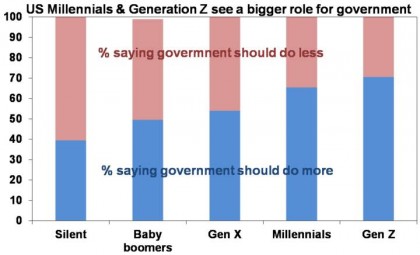
So I ended up gravitating to the centre with the view that the best approach is to allow a market economy with the government providing a good safety net, education and intervening where there are market failures. But a wise man told me when I was young that it’s best to start off on the left when you are young otherwise you will end being like Attila the Hun, as you move to the right as you age. Given the tendency for the young to start off on the left its no surprise to see younger generations favour a bigger role for government in what The Economist magazine has dubbed “millennial socialism”. 


Source: Pew Research Center

If the millennials and Gen Z follow the normal pattern they will shift to the right as they age like their forebears. So nothing new! Well maybe but there is a big difference now compared to the 1980s. Back in the 1980s the political pendulum (or technically the median voter) was moving to the right. So my ageing was in tune with a big picture political cycle. Now the pendulum is swinging left. We first looked at this three years ago (see “The political pendulum swings to the left”, Oliver’s Insights, June 2016). Since then it’s become more evident. This note looks at what’s driving it and what it means for investors.

Political cycles beyond elections

Just as the weather, economies and financial markets go in cycles so it is with politics, even beyond standard electoral cycles. This has been clearly evident over the last century:

1930s-1970s – the Great Depression gave rise to a fear of deflation and high unemployment and a scepticism of free markets. The political pendulum swung to the left and culminated in the economic disaster of the high tax, protectionism, growing state intervention and the welfare state of the late 1960s and 1970s that gave rise to stagflation.

1980s-2000s – stagflation and the failure of heavy government intervention gave rise to popular support for the economic rationalist/right of centre policies of the 1980s. Thatcher, Reagan and Hawke and Keating ushered in a period of deregulation, freer trade, privatisation, lower marginal tax rates, tougher restrictions on access to welfare, measures to reign in budget deficits and other supply side economic reforms designed to boost productivity. The middle class didn’t support higher taxes on the rich because they aspired to be rich. This was all helped along by the collapse of communism and the integration of the old USSR and China into global trade. The political pendulum swung to the right and there was talk of “The End of History” with general agreement that free market democracies were the way to go.

2010 – ? – but post the global financial crisis (GFC) it seems the pendulum is swinging to the left again and support for economic rationalist policies seems to be fading if not reversing.

What’s pushing the political pendulum to the left?

This reflects a range of factors, in particular: 

  • the feeling that the GFC indicated financial de-regulation had gone too far; 

  • constrained and fragile economic growth in recent years; 

  • stagnant real wages and incomes for median households;

  • high household debt levels preventing individuals from taking on more debt as a way to boost living standards; 

  • rising levels of inequality and perceptions that “it’s unfair”;

  • the perceived failure of the baby boomer generation of political leaders to do much about climate change;

  • examples of big business doing the wrong thing;

  • a backlash against immigration in some countries; and 

  • a backlash against globalisation.

Of course, it’s being aided by a dimming of memories of stagflation of the 1970s and its causes and the failures of socialism as highlighted by the USSR (although Venezuela provides a current example). So government related solutions or socialism seem more attractive. Allied to this are economic theories like Modern Monetary Theory (or rather, Magic Mushroom Theory) that contends governments can borrow and spend freely in the current environment of spare capacity globally spurred along by the crazy argument that quantitative easing did not cause hyper inflation and higher interest rates so why should bigger budget deficits.

Of these rising inequality and perceptions of stagnant living standards are the big ones. The next chart shows the Gini coefficient, which is about the best measure of income inequality, calculated on incomes after taxes and transfers. It ranges from zero or perfect equality to one indicating perfect inequality with one household/individual, receiving all income.


Source: OECD, Standardised World Income Inequality Database, AMP Capital

The key point is that there has been a general trend higher in inequality during the past 30 years. This is particularly evident in the emerging world but also the US, UK and Australia. Rising levels of income inequality also appears to have come with increase in wealth inequality. Rising inequality may have been more bearable or “masked” in the 1990s and 2000s as nominal income was rising faster and households took on debt to boost their living standards. But in recent times this has become harder and so rising inequality is leading to a backlash.

The political response

In this environment (often populist) politicians have been able to easily tap into voter anger and argue the case for greater public sector involvement in the economy.

  • This was evident in support for self-declared socialist Bernie Sanders and Donald Trump in the US in 2016 (although Trump’s focus on deregulation and tax cuts look like a temporary deviation right). It’s now even more evident in the Democrats with the Green New Deal (that plans to rid the US of carbon emissions – and planes & cows – in a decade) and 2020 Democrat presidential aspirants adopting variations of Bernie Sanders’ policies, with proposals for wealth taxes and a 70% tax rate for income above $10 million (which is supported by 59% of Americans). It’s also evident in less US public concern about rising public debt.

  • It’s been evident in the Brexit vote in the UK which represented a backlash against globalisation and the left wing turn in the British Labour Party under Jeremy Corbin. 

  • In Australia, we are seeing an intensification of the left right divide not seen since 1970s. The ALP is far from the economic rationalist policies of Hawke and Keating. Policies of higher taxes for the “big end of town” (bringing back the Budget Repair Levy and winding back various tax concessions), significantly increased spending on health and education, some reregulation of the labour market and talk of raising the minimum wage to become a “living wage” all suggest a populist focus reflecting a change in voter preferences. The same pressures are also evident in some ways in proposed intervention in the energy sector. 

Qualifications

Of course, there are various qualifications to this leftward shift. First, it’s most evident in Anglo countries because it’s here that the swing to the right and economic rationalism was most pronounced in the 1980s and 90s and where inequality is more of an issue. Europe never fully bought into the supply side revolution of Thatcher and Reagan and inequality has not risen much. In fact, France under Macron looks to be embarking on its own version of Thatcherism (with the yellow jacket protests proving nothing more than that Macron is actually doing something) which should augur well for its long-term prospects if Macron stays the course. Second, it’s arguable that if the Democrats are to win the US presidential election next year they have to win the mid-west and a socialist presidential candidate may not cut it there. Third, even many on the left are sceptical of ever larger budget deficits – eg in Australia the ALP has been talking of a stronger budgetary position. Finally, there is an argument that a modest move left is necessary to curb the rise in inequality and so save capitalism – much as Keynesian economics “saved” it after the Great Depression.

But what does it all mean for investors?

The risk over time is that a more left leaning electorate will mean a tendency towards bigger government, bigger budget deficits, more regulation, higher effective top marginal tax rates, less globalisation and tougher rules on immigration in some countries. Or it may just mean a stalling in economic reforms. The risk is that it will act as another constraint on productivity and economic growth and eventually see higher inflation if the supply side of the economy suffers.

It’s worth putting this in context. The swing in the political pendulum to the right and the economic rationalist/supply side policies – of deregulation, privatisation, smaller government, tax cuts, low inflation, globalisation – that followed along with the peace dividend from the collapse of communism and attractively high starting point dividend yields and bond yields created a powerful tail wind that drove strong returns in shares and bonds starting in the early 1980s.

Now the environment is very different. Starting point investment yields are ultra-low for most assets and a reversal of economic rationalist policies in favour re-regulation, higher taxes and more government risk slowing productivity growth and eventually resulting in higher inflation.

The key point is that the powerful tailwind from the economic rationalist policies (deregulation, smaller government and globalisation) is now behind us and is contributing along with a range of other factors to a much more constrained return environment for investors. Our medium-term projection for the investment return from a balanced mix of assets have been steadily declining in recent years and is now running around 6.4% pa, which is down from over 10% a decade ago.

In this environment, there is a strong case to focus on investment strategies targeting the achievement over time of goals defined in terms of returns, investment income or whatever is required and using a flexible approach to do so as opposed to relying solely on set and forget strategies that depend heavily on market-based returns. There is also a case to look out for assets that may buck the trend of constrained returns as support for economic rationalist policies recede. French shares may be worth looking at!


Source: AMP Capital 14 March 2019

Important notes: While every care has been taken in the preparation of this article, AMP Capital Investors Limited (ABN 59 001 777 591, AFSL 232497) and AMP Capital Funds Management Limited (ABN 15 159 557 721, AFSL 426455) (AMP Capital) makes no representations or warranties as to the accuracy or completeness of any statement in it including, without limitation, any forecasts. Past performance is not a reliable indicator of future performance. This article has been prepared for the purpose of providing general information, without taking account of any particular investor’s objectives, financial situation or needs. An investor should, before making any investment decisions, consider the appropriateness of the information in this article, and seek professional advice, having regard to the investor’s objectives, financial situation and needs. This article is solely for the use of the party to whom it is provided and must not be provided to any other person or entity without the express written consent of AMP Capital.

 If you could add $61,000 to your super fund in 10 years, would you do it?

Of course you would, however by choosing, or defaulting into, funds that underperform and charge high fees, you may be leaving money like that on the table.

Super is the biggest investment most Australians will ever make, yet too many unknowingly behave as if they are starring in the TV show, “Married at First Sight.” They commit to something they haven’t gotten to know or understand.

It can be a very expensive error. The recent Productivity Commission estimated that super investors would gain $3.9 billion yearly by choosing better-performing funds and reducing fees by consolidating accounts. That would give a 55-year-old today an additional $61,000 by retirement, and a new job entrant an additional $407,000 when they retire in 2064.

Here’s a few ideas on how to send some of that money your way:

  • Match your investment option to your goals. If you’re young and have many years until retirement, a growth fund may make sense for you. On the other hand, your age may not matter if you have difficulty watching wild market swings. In that case, you may prefer a more conservative option.

  • Once you know how you want to invest, compare the long-term performance (five years or more) of funds in that category. Compare growth funds to growth funds, balanced funds to balanced funds, etc, and be aware of differences between funds in the same investment category. Some funds labeled “growth” may have higher allocations to growth assets such as shares and property, compared to another super funds “growth” option, for example. What is important, however, is that you select an asset allocation that matches your financial goals and risk tolerance.

  • If you have more than one super fund, consolidate them to eliminate redundant and high fees. This is actually a very easy and profitable move. In most cases, the super fund you decide to consolidate to will have a ‘find my super’ option, and will do all the hard work for you. If you need to know more, the Australian Securities & Investments Commission (ASIC) shows you how here.Be sure to review how switching your super affects any insurance you have with it.

  • As we all know from watching the daily gyrations of the share market, you can’t control everything. But you can control your costs, and that will make a huge difference to your super fund over time. According to Canstar, the average cost on an $80,000 super balance ranges from $466 to more than $2,000 – a year. While you cannot control future performance, you can control costs. This ASIC calculator helps you compare funds, including fees.

Finally, don’t make yourself crazy. Constant tinkering is more likely to hurt than help, but do get to know your super and increase your odds of a decades-long blissful union.

Please contact us on Phone: 07 5641 4134 if you seek further assistance on this topic.


Source : Vanguard January 2019 

By Robin Bowerman, Head of Corporate Affairs at Vanguard

Reproduced with permission of Vanguard Investments Australia Ltd

Vanguard Investments Australia Ltd (ABN 72 072 881 086 / AFS Licence 227263) is the product issuer. We have not taken yours and your clients’ circumstances into account when preparing this material so it may not be applicable to the particular situation you are considering. You should consider your circumstances and our Product Disclosure Statement (PDS) or Prospectus before making any investment decision. You can access our PDS or Prospectus online or by calling us. This material was prepared in good faith and we accept no liability for any errors or omissions. Past performance is not an indication of future performance.

© 2019 Vanguard Investments Australia Ltd. All rights reserved.

Important:
Any information provided by the author detailed above is separate and external to our business and our Licensee. Neither our business, nor our Licensee take any responsibility for any action or any service provided by the author.

Any links have been provided with permission for information purposes only and will take you to external websites, which are not connected to our company in any way. Note: Our company does not endorse and is not responsible for the accuracy of the contents/information contained within the linked site(s) accessible from this page.

What you need to know about buy now pay later services

Buy now pay later payment services allow you to delay payment or pay by instalments (often fortnightly) over a period of time. Here we explain how these payment services work, what fees you’ll pay and how to avoid getting into financial trouble if you’re using these services.

What is buy now pay later?

Buy now pay later services are offered by providers such as:

  • Afterpay

  • Certegy Ezi-Pay

  • zipPay

  • Oxipay

  • BrightePay

  • Openpay.

Buy now pay later services are offered by retailers and service providers so you can buy a product immediately and delay payment. You then pay off the product in instalments over several weeks or, with some high-value purchases, over a longer period of time.

Buy now pay later isn’t only offered for low-value purchases, like clothes and beauty products. Solar panels and health services can also be bought using buy now pay later.

How do these payment services work?

Buy now pay later services are offered when you shop online or in-store as another payment option at the time of checkout.

You can apply for and set up a purchase plan through the provider’s app or website when shopping online.

If you’re shopping in-store, a shop assistant will set up the buy now pay later application on your behalf. The buy now pay later provider will contact you when your application is approved. This is usually a quick process.   

You will need to provide your bank or credit card details the first time you use these services so your payments can be deducted. You may also be required to pay either a deposit or the first instalment up-front.

Refunds and returns

If you have a problem with the product or service you’ve bought, the shop or service provider’s returns policy will apply, so contact them first. 

Are buy now pay later services worth it?

Buy now pay later services are often advertised as ‘interest-free’ or ‘0% interest’, but the cost will add up if you can’t make the repayments on time.

Smart tip

Always check the terms and conditions before you sign up, as they can be different for each buy now pay later service.

Here are some things to look out for before using these services.

  • Late fees – There’s usually a late fee every time you miss a payment or pay late. These fees can add up over time.

  • Monthly account-keeping fees – Some of these services charge you a fixed amount for every month you continue to use their service.

  • Payment processing fees – You may be required to pay a fee for each payment, on top of your set repayment.


Case study: Mai struggles to make ends meet after using buy now pay later services

In the lead-up to Christmas, Mai decided to take advantage of some markdowns by buying a couple of items online.

She found a new pair of designer sneakers worth $150. As Mai was a bit tight on money, she signed up to a buy now pay later service to split her repayments. She then found a hair straightener at a reduced price of $300 at another online store. Mai used a different buy now pay later service to buy the hair straightener and stretch out her repayments.

A fortnight later, Mai discovered that her bank account was overdrawn. She then realised she had not checked before buying the items if she would have enough money in her account to make both repayments.

Mai was not only charged default fees by both buy now pay later providers, but her bank also charged her an overdrawn fee.

Is your credit history or ability to repay checked?

Most buy now pay later providers do not check your ability to make repayments or your credit history. This means you could end up taking on more credit than you can afford and could have trouble making your repayments.

This can affect your credit score as some providers report late payments to credit reporting agencies

Managing your buy now pay later payments

Stay in control when you use a buy now pay later service by following these tips: 

  • Plan ahead: Make sure you can afford the full price and that the repayments fit into your budget. Consider any other bills or financial commitments due at the same time as your buy now pay later payments.

  • Don’t get into debt: Consider linking your buy now pay later account to your debit card instead of your credit card. That way you’re using your own money and avoid credit card interest.

  • Don’t overcommit: Stick to a limit and aim to have only one buy now pay later at a time.

  • Ask for help: If you’re having trouble making repayments, contact your provider straight away. 


Taking on too much debt?

An ASIC review of the buy now pay later industry found that 1 in 6 users had become overdrawn, delayed other bill payments or borrowed money so they could make their buy now pay later payments.

Making a complaint about buy now pay later services

Most buy now pay later providers have dedicated complaints and hardship services. Contact your provider to discuss your complaint, or if you are having difficulty making repayments. 

A free financial counsellor can also help if you’re struggling financially.

Using buy now pay later when you shop can be a convenient way to pay for things, but you need to be careful not to overcommit financially or buy more expensive items than you usually would. 

Please contact us on Phone: 07 5641 4134 if you seek further assistance .

Source : ASIC’s Moneysmart February 2019 

Reproduced with the permission of ASIC’s MoneySmart Team. This article was originally published at https://www.moneysmart.gov.au/borrowing-and-credit/other-types-of-credit/buy-now-pay-later-services
Important note: This provides general information and hasn’t taken your circumstances into account.  It’s important to consider your particular circumstances before deciding what’s right for you. Although the information is from sources considered reliable, we do not guarantee that it is accurate or complete. You should not rely upon it and should seek qualified advice before making any investment decision. Except where liability under any statute cannot be excluded, we do not accept any liability (whether under contract, tort or otherwise) for any resulting loss or damage of the reader or any other person.  Past performance is not a reliable guide to future returns.

Important
Any information provided by the author detailed above is separate and external to our business and our Licensee. Neither our business, nor our Licensee take any responsibility for any action or any service provided by the author.

Any links have been provided with permission for information purposes only and will take you to external websites, which are not connected to our company in any way. Note: Our company does not endorse and is not responsible for the accuracy of the contents/information contained within the linked site(s) accessible from this page.

A quick guide to organising your financial paperwork

With Marie Kondo’s books and TV shows riding high in the charts, it feels as though everyone’s talking about the joys of decluttering and tidying up.

But when you’re drowning in a sea of old bank statements, utility bills and receipts, it can be difficult to know where to make a start.

The good news is that you don’t have to be a global lifestyle guru to make a positive change. Even making some simple changes can put you on track to taming your paperwork and:

  • make it easier to find what you need at tax time

  • help your loved ones find documents easily if something happens

  • find important documents in an emergency.

What financial records and paperwork do you need to keep?

This is the fun bit…it’s time to start throwing stuff away.

So be ruthless. But there are some bits of paper that you should hang on to. 

Anything you need for your tax return…

  • Payments you’ve received such as wages, interest, dividends and rental income

  • Expenses related to income such as work-related outgoings or rental repairs

  • Sale or purchase of assets such as property or shares

  • Donations, contributions or gifts to charities

  • Private health insurance

  • Medical expenses, both your own and those of any dependants.

You need to keep these documents for five years after you lodge your tax return in case you’re asked to substantiate your claims. And it’s a good idea to keep your Notice of Tax Assessments for five years as well.

…anything related to property you own…

  • Property deeds

  • Mortgage papers

  • Renovation approvals

  • Warranties relating to work undertaken. 

…and some other important bits of paper

  • Wills

  • Tax file numbers

  • Powers of attorney

  • Birth certificates

  • Death certificates

  • Marriage certificates

  • Immunisation records

  • Passports

  • Current insurance policies

  • Current superannuation documents

  • Loan documents

  • Vehicle registration

  • Vehicle service history

  • Business registrations

  • Qualifications.

What financial records and paperwork can you throw away?

There are some documents you can toss. As a rule, once a document has been replaced by a newer version, it’s safe to dispose of the older copy. And let’s face it, do you really need that electricity bill from your old house back in 2014?

There’s also no need to hang on to credit card receipts once you’ve reconciled them against your bank statements, unless they’re needed for warranties.

You should probably keep hold of credit card and bank statements for a year but you can throw away other household paperwork like utility bills.

Four quick steps to organising your paperwork

Congratulations! You’ve finally taken a wrecking ball to the mountain of paperwork, the shredder bin is full and you’re feeling pretty good.

But you’re only halfway there. You need to put a system in place to avoid creating yet another mountain.

1. Protect yourself

Financial documents can contain sensitive personal information so it’s not a good idea to simply throw them in the bin. Buying a shredder or using a document disposal company should keep your details safe against identity theft.

2. Go digital

Many companies are moving towards electronic statements to help you reduce your paperwork and give the environment a boost at the same time! You can also make electronic versions of your old documents with a scanning app such as CamScanner, Genius Scan or Scannable.

3. Think files and folders

Whether you choose to keep paper or electronic copies, it’s a good idea to have a filing system with physical or electronic folders and labels to remind you how long to keep them for. Record-keeping apps like Evernote or Sign-N-Send can help.

4. Back it up

Think about storing important documents in a fireproof safe or offsite in a safety deposit box. For extra security, you can back up online files on an external hard drive or a cloud-based solution.

While you’re at it…

Organising your paperwork also presents the ideal opportunity to review your financial commitments.

So why not take a look at your budget, check you have enough insurance cover and shop around for a better deal on your utilities?

Please contact us on Phone: 07 5641 4134 we can help you find ways to get on top of your finances.

Source : AMP February 2019 

This information is provided by AMP Life Limited. It is general information only and hasn’t taken your circumstances into account. It’s important to consider your particular circumstances and the relevant Product Disclosure Statement or Terms and Conditions. Read our Financial Services Guide for information about our services, including the fees and other benefits that AMP companies and their representatives may receive in relation to products and services provided to you.

All information on this website is subject to change without notice. Although the information is from sources considered reliable, AMP does not guarantee that it is accurate or complete. You should not rely upon it and should seek professional advice before making any financial decision. Except where liability under any statute cannot be excluded, AMP does not accept any liability for any resulting loss or damage of the reader or any other person.

Important:
This provides general information and hasn’t taken your circumstances into account. It’s important to consider your particular circumstances before deciding what’s right for you. Although the information is from sources considered reliable, we do not guarantee that it is accurate or complete. You should not rely upon it and should seek qualified advice before making any investment decision. Except where liability under any statute cannot be excluded, we do not accept any liability (whether under contract, tort or otherwise) for any resulting loss or damage of the reader or any other person. 

Any information provided by the author detailed above is separate and external to our business and our Licensee. Neither our business, nor our Licensee take any responsibility for any action or any service provided by the author.

Any links have been provided with permission for information purposes only and will take you to external websites, which are not connected to our company in any way. Note: Our company does not endorse and is not responsible for the accuracy of the contents/information contained within the linked site(s) accessible from this page

 

Much has been made of Australia’s nearly 28 years without a recession. Despite many seeing recession as inevitable in response to the 1997 Asian crisis, the 2000-2003 tech wreck, the GFC and the “end” of the mining boom Australia has seemingly sailed on through each of these regardless. This has been thanks to a combination of economic reforms in the 1980s and 90s, the floating $A that falls whenever there is a major global problem providing a shock absorber, strong growth in China, desynchronised cycles across industry sectors and states, strong population growth and good luck. The question now is whether Australia’s luck has run out with housing turning down (and less economic reform in recent times)? While we see a constrained period for Australia as housing turns down, we still don’t see recession (albeit it’s a risk).

Australian growth has slowed again

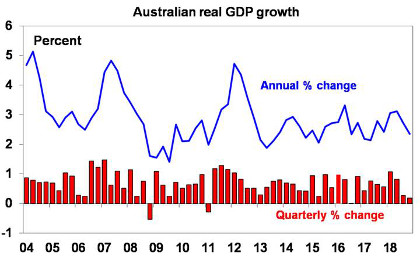
December quarter GDP growth was just 0.2% quarter on quarter, with a fall in housing investment, weak consumer spending and business investment and a detraction from trade only partly offset by solid public demand.

Australian real GDP growth
Source: ABS, AMP Capital

Coming on the back of just 0.3% growth in the September quarter this is not good news. It means growth has slowed to 2.3% over the year to December and, even worse, annualised growth over the last six months has slumped to just 1%. It also means Australia has slipped into a “per capita” recession with GDP per person now falling for two quarters in a row, for the first time since 2006.

Housing downturn to be a significant drag on growth

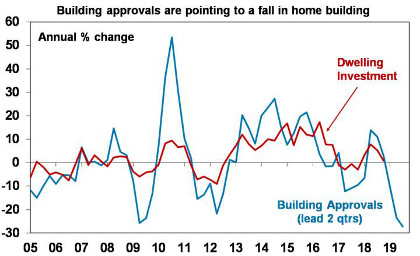
The bad news is that growth is likely to remain under pressure as the housing downturn intensifies. Approvals to build new homes have fallen sharply. And while auction clearance rates have bounced at the start of the year we doubt this is the start of a recovery in house prices given the long list of negatives for house prices including: tight credit; the switch from interest only to principle and interest loans; record unit supply; issues around new building quality; an 80% or so collapse in foreign demand; fears that negative gearing and capital gains tax arrangements will be made less favourable if there is a change of government; and falling prices feeding on themselves. We see Sydney and Melbourne home prices falling another 15% or so as part of a total top to bottom fall of around 25% out to next year, which will see national average home prices have a top to bottom fall of around 15%. So far we are only about half way there.

We estimate that the housing downturn will detract around 1 to 1.5 percentage points from growth this year with:

  • a direct detraction from growth as the housing construction cycle turns down. This is likely to amount to around 0.4 percentage points per annum (which was what it added on average during the construction boom).

Building approvals are pointing to a fall in home building
Source: ABS, AMP Capital

  • reduced demand for household equipment retail sales as dwelling completions top out and decline.

  • a negative wealth effect on consumer spending of around 1-1.2% pa. Rising housing wealth helped drive decent growth in consumer spending in NSW and Victoria as households reduced the amount they saved as their housing wealth rose. This is now likely to go in reverse detracting around 0.7 percentage points from GDP growth.

  • there could also be a feedback loop into further bank credit tightening if non-performing loans and defaults rise as unemployment starts to rise.

The east coast drought could also act as an ongoing drag on growth with a “mild” El Nino hanging around although this may be mild at around a 0.2 percentage point growth detraction.

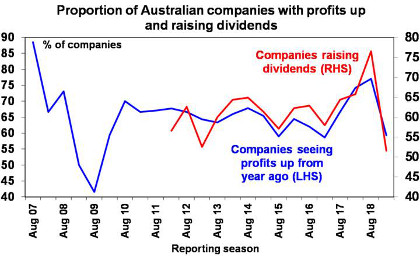
The weakness in relation to the domestic economy is evident in in weak profit results for domestically exposed companies in the recent December half year profit reporting season. While results were better than feared enabling shares to rise, the ratio of upside surprise to downside was its weakest since 2009, only 59% saw profits rise from a year ago and only 52% raised their dividends from a year ago which (notwithstanding “special” dividends from a few companies) indicates a lack of confidence in the outlook. While consensus expectations for profit growth for this financial year held at 4%, this was only because of an upgrade to resources profit growth to 14% with profit growth in the rest of the market falling to just 1%.

Proportion of Australian companies with profits up and raising dividends
Source: AMP Capital

Five sources of support for the economy

The risks to the economy from the property downturn are significant – particularly if unemployment rises sharply driving mortgage defaults and forced selling. However, there are five sources of support for the economy which should mean that a traditional (as opposed to a per capita) recession is unlikely:

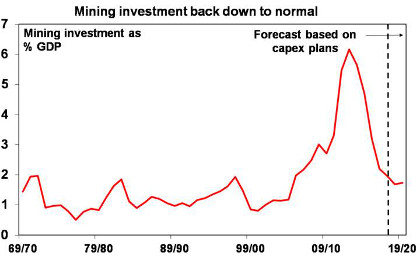
  • First, the drag on growth from slumping mining investment (which averaged around 1.5 percentage points per annum) is fading as mining investment is close to the bottom.

Mining investment back down to normal
Source: ABS, AMP Capital

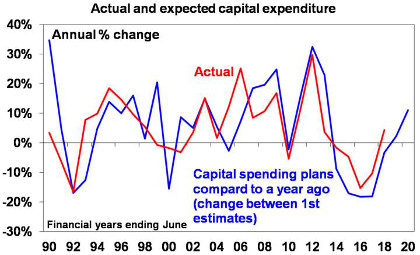
  • Second, surveys point to a recovery in non-mining investment. Business investment plans for next financial year are well up on plans a year ago.

Actual and expected capital expendature
Source: ABS, AMP Capital

  • Third, public infrastructure spending is rising solidly.

  • Fourth, demand for our exports is likely to improve through this year as global growth picks up led by China in response to stimulus measures and a likely fading of trade war risks. 

  • Finally, policy stimulus is likely to help with the April Budget and election outcome likely to see some combination of tax cuts or increased spending (under Labor) from July and the RBA likely to cut interest rates. 

Given the cross currents, we have revised our growth forecasts down to around 2-2.5% over the next year or so. So we see some pick up from the dismal second half 2018 pace and no recession but growth will still be well below potential and RBA forecasts.

Implications – higher unemployment/lower inflation

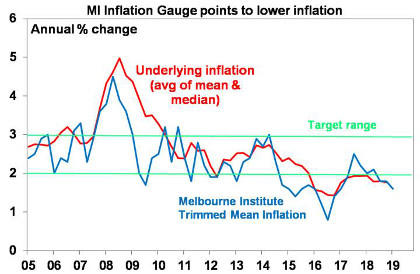
Growth around 2-2.5% won’t be enough to further eat into spare labour market capacity let alone absorb new entrants to the workforce so we see unemployment rising to around 5.5% by year end. This is consistent with slowing job vacancies already becoming evident. This in turn points to wages growth remaining weak. Meanwhile, it’s hard to see much uptick in inflationary pressure. The latest Melbourne Institute Inflation Gauge points to ongoing weakness in underlying inflation.

MI inflation gauge points to lower inflation
Source: ABS, Melbourne Institute, AMP Capital

RBA on track to cut rates

Against the backdrop of soft growth and inflation we continue to see the RBA cutting the cash rate to 1% this year. Rate cuts won’t be aimed at reinflating the property market but supporting households with a mortgage to offset the negative wealth effect. And banks will likely have no choice but to pass the cuts on given the bad publicity of not doing so.

Implications for investors

For investors this all means: bank deposit rates will remain poor; Australian bonds will continue outperforming global bonds; Australian shares are likely to remain relative underperformers compared to global shares as the housing downturn weighs; and with the RBA likely to cut and the Fed on hold the $A is likely to fall into the high $US0.60s.


Source: AMP Capital 6 March 2019

Important notes: While every care has been taken in the preparation of this article, AMP Capital Investors Limited (ABN 59 001 777 591, AFSL 232497) and AMP Capital Funds Management Limited (ABN 15 159 557 721, AFSL 426455)  (AMP Capital) makes no representations or warranties as to the accuracy or completeness of any statement in it including, without limitation, any forecasts. Past performance is not a reliable indicator of future performance. This article has been prepared for the purpose of providing general information, without taking account of any particular investor’s objectives, financial situation or needs. An investor should, before making any investment decisions, consider the appropriateness of the information in this article, and seek professional advice, having regard to the investor’s objectives, financial situation and needs. This article is solely for the use of the party to whom it is provided and must not be provided to any other person or entity without the express written consent of AMP Capital.

At its meeting today, the Board decided to leave the cash rate unchanged at 1.50 per cent.

The global economy grew above trend in 2018, although it slowed in the second half of the year. The slower pace of growth has continued into 2019. The outlook for the global economy remains reasonable, although downside risks have increased. The trade tensions remain a source of uncertainty. In China, the authorities have taken further steps to ease financing conditions, partly in response to slower growth in the economy. Globally, headline inflation rates have moved lower following the earlier decline in oil prices, although core inflation has picked up in a number of economies. In most advanced economies, unemployment rates are low and wages growth has picked up.

Overall, global financial conditions remain accommodative. They have eased recently after tightening around the turn of year. Long-term bond yields have declined, consistent with the subdued outlook for inflation and lower expectations for future policy rates in a number of advanced economies. Also, equity markets have risen, supported by growth in corporate earnings. In Australia, short-term bank funding costs have moderated, although they remain a little higher than a few years ago. The Australian dollar has remained within the narrow range of recent times. While the terms of trade have increased over the past couple of years, they are expected to decline over time.

The Australian labour market remains strong. There has been a significant increase in employment and the unemployment rate is at 5 per cent. A further decline in the unemployment rate to 4¾ per cent is expected over the next couple of years. The vacancy rate is high and there are reports of skills shortages in some areas. The stronger labour market has led to some pick-up in wages growth, which is a welcome development. The improvement in the labour market should see some further lift in wages growth over time, although this is still expected to be a gradual process.

Other indicators suggest growth in the Australian economy slowed over the second half of 2018. The central scenario is still for the Australian economy to grow by around 3 per cent this year. The growth outlook is being supported by rising business investment, higher levels of spending on public infrastructure and increased employment. The main domestic uncertainty continues to be the strength of household consumption in the context of weak growth in household income and falling housing prices in some cities. A pick-up in growth in household income is nonetheless expected to support household spending over the next year.

The adjustment in the Sydney and Melbourne housing markets is continuing, after the earlier large run-up in prices. Conditions remain soft in both markets and rent inflation remains low. Credit conditions for some borrowers have tightened a little further over the past year or so. At the same time, the demand for credit by investors in the housing market has slowed noticeably as the dynamics of the housing market have changed. Growth in credit extended to owner-occupiers has eased further. Mortgage rates remain low and there is strong competition for borrowers of high credit quality.

Inflation remains low and stable. Underlying inflation is expected to pick up over the next couple of years, with the pick-up likely to be gradual and to take a little longer than earlier expected. The central scenario is for underlying inflation to be 2 per cent this year and 2¼ per cent in 2020. Headline inflation is expected to decline in the near term because of lower petrol prices.

The low level of interest rates is continuing to support the Australian economy. Further progress in reducing unemployment and having inflation return to target is expected, although this progress is likely to be gradual. Taking account of the available information, the Board judged that holding the stance of monetary policy unchanged at this meeting would be consistent with sustainable growth in the economy and achieving the inflation target over time.

Source: Reserve Bank of Australia, March 5th, 2019

Enquiries

Media and Communications
Secretary’s Department
Reserve Bank of Australia
SYDNEY

Phone: +61 2 9551 9720
Fax: +61 2 9551 8033

Email: rbainfo@rba.gov.au

Have you considered what’s on the agenda, such as how often you see yourself eating out and whether you want to travel domestically or afar?

If you’re in or approaching retirement, you may be prioritising things such as living costs, utility bills, health care and even potentially helping the kids out with their future financial goals.

With many Australians looking at a retirement (which in reality, could span a few decades), another thing to give some thought to is keeping some money aside for your own recreation and social life.

What activities are on your to-do list?

Think about what you enjoy doing, what you’re likely to want to do more of, or even get into with more time on your hands.

  • Eating out  restaurants, beach barbecues, picnics, food fairs

  • Travel – interstate breaks, overseas holidays, road trips, caravanning

  • Entertainment  cinemas, concerts, events, stage shows

  • Sport  golf, tennis, cycling, yoga, pilates

  • Hobbies  fishing, sailing, photography, drawing, woodwork

  • Volunteering  hospitals, soup kitchens, animal shelters

  • Club associations  Rotary, Leagues, Surf Life Saving

  • Tournaments – trivia, bridge, chess.

How can you budget for the things I enjoy?

If you need a guide, the Association of Superannuation Funds of Australia (ASFA) benchmarks the annual budget needed to fund a comfortable and modest standard of living in retirement, with figures based on an assumption people own their home outright and are relatively healthy.

According to September 2018 figures, individuals and couples around age 65, looking to retire today, would need an annual budget of $43,200 and $60,843 respectively to fund a comfortable lifestyle, or $27,595 and $39,666 respectively to live a modest lifestyle1.

According to ASFA, a comfortable retirement lifestyle would enable an older, healthy retiree to be involved in a broad range of leisure and recreational activities, whereas a modest retirement lifestyle would enable an older healthy retiree to afford more basic activities2.

How much are you likely to spend on recreation anyway?

According to research, singles and couples (aged 65 to 85) living a comfortable lifestyle in retirement would spend about $180 and $270 of their weekly budget respectively on leisure and recreation3.

This takes into account a broad range of recreational activities, including4:

  • Lunches and dinners out

  • Domestic and international holidays

  • Movies, plays, sports and day trips

  • Things like streaming services

  • Club memberships.

Making your money go further for the fun stuff

  • Make use of your Senior’s Card for transport concessions and other discounts

  • If going overseas isn’t in your budget, you could consider a road trip interstate

  • If you enjoy dining out, find two-for-one deals nationally via sites like TheHappiestHour

  • Pack a rug, food basket and esky, and head to the park or beach for a picnic

  • Swap a visit to the day spa with a DIY manicure and candle-lit bubble bath

  • Have the troops over for a poker night or take turns hosting dinner parties

  • Find cheap accommodation on Airbnb or consider listing your own place to earn money while you’re away.

Meanwhile if your seeking further assistance on this topic , please contact us on Phone: 07 5641 4134 

Source : AMP January 2109 

1, 2 ASFA Retirement Standard table 1
3, 4 ASFA Retirement Standard – Detailed budget breakdowns – September quarter 2018 page 4


Important information:

This information is provided by AMP Life Limited. It is general information only and hasn’t taken your circumstances into account. It’s important to consider your particular circumstances and the relevant Product Disclosure Statement or Terms and Conditions, available by calling 13 30 30, before deciding what’s right for you. Read our Financial Services Guide for information about our services, including the fees and other benefits that AMP companies and their representatives may receive in relation to products and services provided to you. All information on this website is subject to change without notice. Although the information is from sources considered reliable, AMP does not guarantee that it is accurate or complete. You should not rely upon it and should seek professional advice before making any financial decision. Except where liability under any statute cannot be excluded, AMP does not accept any liability for any resulting loss or damage of the reader or any other person


By Flying Solo contributor John Refalo

For many people starting a business is a dream but, at the same time, a significant risk when not done properly.

While we see a number of clients citing issues with the Tax Office as the catalyst for problems that upend them, there’s many reasons why a business can fail.

Let’s now explore what I believe are the five most common reasons why businesses fail.

1. You had poor planning

We may be sick of that saying “Businesses don’t plan to fail, they fail to plan” but this rings true. This is why we need a business plan—a good start is the template found on www.business.gov.au. To summarise quickly, a business plan is a document that goes through every aspect of your business, from establishing your vision and mission statement, to industry analysis and all the way to specifics like budgeting, employees, and expenses.

Spending adequate time creating a business plan will give you complete understanding of your business. You may be reading this now thinking “I am the owner … of course I know my business”. That may be true but a business plan forces you to:

  • Consider your capital requirements;

  • Define the direction that your business is going to take (vision, mission statement);

  • Examine how your business is perceived in the market (quality, cost);

  • Consider how you set yourself apart from your competitors (unique attributes);

  • Deal with current and future threats to your business;

  • Manage your income and expenses through budgeting;

  • Consider finance arrangements to fund your part or all of your business;

  • Consider opportunities in the industry/economy; and

  • Define the employees’ roles and who is responsible for helping you achieve your direction.

This document is so important that even the banks require it when providing finance!

And while it’s up to you if you adopt one to this extent, or at all, spending some time looking at this (at least once a year) will hopefully change your focus on the ‘what’ you do in business to ‘why’ and ‘how’ you do business.

2. You failed to budget

Simply put, a budget will quickly tell you if you should be in business or not. It maps out your income and expenditure over a period of time which is especially crucial for those businesses that have cyclical or seasonal fluctuations (i.e. hospitality, agriculture, etc). By estimating the amount of revenue, or the peak periods when revenue is generated, businesses can see how much revenue is needed to keep the business alive during the slower months. On the flip side, focus on expenses is just as important (paying employees, meeting financial obligations, paying taxes) because it highlights what a business can afford.

3. You forgot to collect your cash!

Unless you are a ‘Not-for-Profit’, you are in business to make money. So when you complete a job, you expect to be paid for it … right?

These days, a lot of businesses operate on credit terms – sometimes necessary to secure customers. But when payment is due, a number of businesses are not doing enough, if anything, when collecting their debts!

I recently worked on the administration of a plumber that had a majority of ‘mum and dad’ customers on credit terms on its books accounting for $60,000 which was overdue. Had the owner followed up his customers and collected this amount, a lot of his short-term cash flow problems  could have reduced.

4.  You took (a big) wage

Business owners usually have a lot of sentimental attachment to their business, and for good reason. Some people pour their blood, sweat and tears into it. It’s for this reason that some business owners will use their business’ money as if it was their personal bank account.

This can have pretty serious consequences. For example I have seen businesses been used to pay for personal holidays, lavish lifestyles, mistresses, mortgage repayments and even a burial plot!

Diverting money from the business’ needs and focusing it on your own, limits the money available to grow your business, let alone to trade it! So next time, take a (reasonable) wage and once it hits your bank account, do whatever you want. We will revisit the seriousness of these personal transactions using a business’ funds in a future article.

5.  You didn’t set your price appropriately

A tricky question for business owners is: how can I price my product or service so I cover my costs but at the same time stay competitive? This is important because properly pricing your product or service determines how much profit you can make.

Specific budgets can help here on project-focused work where materials and labour are estimated, a percentage of meeting overheads (those costs not directly attributable to the job), provisions, and then applying a margin (a formal way of saying “the cream on top”).

If business owners take the time to price appropriately, they can see where their costs are being incurred and, more importantly, if they are undercutting themselves. There is no shame in walking away from a job because it is not profitable.

While there are many other issues that can be attributable to business failure, the above issues are what I believe are common for business owners, especially those starting out.

Source :Flying Solo  February 2019 

This article by John Refalo is reproduced with the permission of Flying Solo – Australia’s micro business community. Find out more and join over 100k others.


Important:
This provides general information and hasn’t taken your circumstances into account. It’s important to consider your particular circumstances before deciding what’s right for you. Any information provided by the author detailed above is separate and external to our business and our Licensee. Any information provided by the author detailed above is separate and external to our business and our Licensee. Neither our business, nor our Licensee take any responsibility for any action or any service provided by the author.

Any links have been provided with permission for information purposes only and will take you to external websites, which are not connected to our company in any way. Note: Our company does not endorse and is not responsible for the accuracy of the contents/information contained within the linked site(s) accessible from this page.