A state-of-the-nation report on the barriers to women investing.

The research underlying this white paper was carried out via an online survey developed by CoreData, in conjunction with Fidelity International. The survey was sent out to CoreData’s proprietary panel of consumers with a minimum of $20,000 in investable assets outside of super. The survey was sent out between 14 January and 25 January 2019 and a total of 1,222 respondents, including 815 females and 407 males, completed the survey and these responses formed the basis of the analysis.

Click here to download the report


Source:
Reproduced with permission of Fidelity Australia. This article was originally published at https://www.fidelity.com.au

This document has been prepared without taking into account your objectives, financial situation or needs. You should consider these matters before acting on the information. You should also consider the relevant Product Disclosure Statements (“PDS”) for any Fidelity Australia product mentioned in this document before making any decision about whether to acquire the product. The PDS can be obtained by contacting Fidelity Australia on 1800 119 270 or by downloading it from our website at www.fidelity.com.au. This document may include general commentary on market activity, sector trends or other broad-based economic or political conditions that should not be taken as investment advice. Information stated herein about specific securities is subject to change. Any reference to specific securities should not be taken as a recommendation to buy, sell or hold these securities. While the information contained in this document has been prepared with reasonable care, no responsibility or liability is accepted for any errors or omissions or misstatements however caused. This document is intended as general information only. The document may not be reproduced or transmitted without prior written permission of Fidelity Australia. The issuer of Fidelity Australia’s managed investment schemes is FIL Responsible Entity (Australia) Limited ABN 33 148 059 009. Reference to ($) are in Australian dollars unless stated otherwise.
© 2019. FIL Responsible Entity (Australia) Limited.

Important:
This provides general information and hasn’t taken your circumstances into account. It’s important to consider your particular circumstances before deciding what’s right for you. Any information provided by the author detailed above is separate and external to our business and our Licensee. Neither our business, nor our Licensee take any responsibility for any action or any service provided by the author.

Any links have been provided with permission for information purposes only and will take you to external websites, which are not connected to our company in any way. Note: Our company does not endorse and is not responsible for the accuracy of the contents/information contained within the linked site(s) accessible from this page.


Older Aussies can put up to $300,000 into their super using the money from the sale of their main residence, regardless of caps and restrictions that otherwise apply.

If you’re aged 65 or over and are looking to boost your retirement savings, you can make a tax-free contribution to your super of up to $300,000 using the proceeds from the sale of your main residence.

Take a look at the potential advantages, rules and other things you’ll want to be aware of.

Benefits if you make a downsizer contribution

Downsizer contributions provide a way to top up your super balance

Older Aussies, who haven’t had the chance to save enough funds for retirement, may find that tax-free downsizer contributions provide a good opportunity to top up what they’ve saved to date.

No work test or age limits apply to downsizer contributions

Usually, people aged 65 to 74 need to satisfy a work test (where you have to work 40 hours over a period of no more than 30 consecutive days) to make voluntary super contributions, while people aged 75 and over are generally ineligible to make any voluntary contributions to their super.

Annual contributions caps also do not apply

Annual concessional and non-concessional contributions caps, which are $25,000 and $100,000 a year respectively (bearing in mind there may be instances where you can also carry forward any unused amounts from previous years), don’t apply to downsizer contributions.

In fact, downsizer contributions can be made in addition to any concessional and non-concessional super contributions you may be eligible to make.

Downsizer contributions aren’t subject to the $1.6m total super balance restriction

While you can’t make non-concessional contributions into your super at all if your total super balance is $1.6 million or above as at 30 June of the previous financial year, this rule doesn’t apply to downsizer contributions.

There’s no requirement to buy a new home

If you sell your main residence and make a downsizer contribution into your super, you’re not required to buy a new home with money you might make on the sale.

Both members of a couple can take advantage

For couples, both spouses can make the most of the downsizer contribution opportunity, which means up to $600,000 per couple can be contributed toward super.

Rules and other considerations to be aware of

  1. You must be aged 65 or older to make a downsizer contribution

  2. The property that’s sold needs to have been your (or your spouse’s) main place of residence at some point in time, and you need to have owned the home for at least 10 years

  3. The sold property must be in Australia and excludes caravans, mobile homes and houseboats

  4. A downsizer contribution must be made within 90 days of receiving the sale proceeds

  5. downsizer contribution form must be submitted to your super fund before, or at the time of making your contribution

  6. You can’t have previously made a downsizer contribution to super

  7. You can only transfer a maximum of $1.6 million in super savings (not including subsequent earnings) into a tax-free pension account

  8. Downsizing your home may impact Age Pension eligibility. There is no special Centrelink means test exemption for making downsizer contributions

  9. The costs involved in selling a property and buying another one (if that’s also on the agenda) can be considerable, so you’ll need to take into account any additional property-related costs

  10. Downsizer contributions are not tax deductible.

Where to go for more information

Depending on your situation, other rules may apply, so do your research and contact us on Phone: 07 5641 4134 about any possible implications.


Source: AMP 17 April 2019


Important:
This information is provided by AMP Life Limited. It is general information only and hasn’t taken your circumstances into account. It’s important to consider your particular circumstances and the relevant Product Disclosure Statement or Terms and Conditions, available by calling Phone: 07 5641 4134, before deciding what’s right for you.

All information in this article is subject to change without notice. Although the information is from sources considered reliable, AMP and our company do not guarantee that it is accurate or complete. You should not rely upon it and should seek professional advice before making any financial decision. Except where liability under any statute cannot be excluded, AMP and our company do not accept any liability for any resulting loss or damage of the reader or any other person.


Since late last year share markets have rebounded with US shares up 25% to their recent high, global shares up 22% and Australian shares up 17% as last year’s worries about tightening monetary policy led by the Fed, global growth and trade wars have faded to varying degrees. Following such a strong rebound some have said that maybe it’s now time to “sell in May and go away” given the old share market saying. Of course, this is a reference to seasonal pattern in shares.

It’s all seasonal

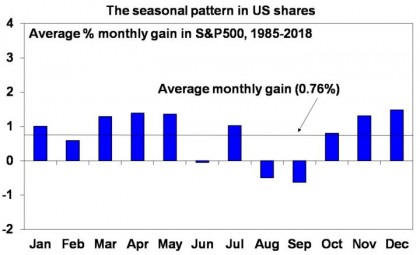
Seasonal patterns have long been observed in equity markets. Yet, despite the potential they provide for astute investors to profit from them – and in so doing arbitrage them away – they seem to persist. The “January effect” has perhaps been the most famous, where January typically provides the best gains for US stocks, but anticipation of it in recent years has seen it morph into December such that it has become the strongest month of the year for US shares. However, it is part of a broader seasonal pattern, which is positive for shares from around October/November to around May and then weaker from May. This can be seen in the seasonal pattern of average monthly changes in US share prices (using the S&P 500 index) shown in the next chart.

Source: Thomson Reuters, AMP Capital

The key factor behind the seasonal pattern is the regular ebb and flow of investor demand for shares relative to their supply through the course of the year. In the case of US shares the principal drivers of the seasonal pattern are:

  • investors and mutual funds selling losing stocks to realise tax losses (to offset against capital gains) towards the end of the US tax year in September. This is also normally at a time when capital raisings are solid; 

  • investors buying back in November and December at a time when capital raisings wind down into year-end; 

  • which then combines with the tendency for investors to invest bonuses early in the new year, new year optimism as investors refocus on the future, put any disappointments of the past year behind them and down play bad news all at a time when capital raisings are relatively low. The illiquid nature of investment markets around late December and January (due to holidays) makes these effects all the more marked.

The net effect has been that the US share market is relatively weak around the September quarter, strengthens into the new year with January often being the strongest month and then remains solid out to around May by which point new year optimism starts to fade a bit. As noted earlier, in recent years anticipation of the “January effect” has caused buying to pull it forward into December. Calendar year end window dressing by fund managers may have also added to this tendency. Since 1985 US share prices for December have had an average monthly gain of 1.5% monthly gain. This compares to an average monthly gain across all months of 0.76%. By contrast August and September are the weakest months with falls on average.

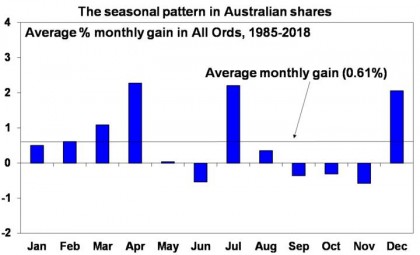
Consistent with the influence of the US share market on global markets generally, along with specific local influences, this seasonal pattern is also discernible in other countries, including Europe, Asia and Australia. In Australia the January or now December effect is not as dominant as in the US, possibly because tax effects are not relevant in Australia around that time of year. The seasonal pattern for the Australian stock market is shown in the next chart. While the strongest months of the year in the Australian market are April and July, December also tends to provide above average gains. Since 1985, Australian share price gains in December have averaged 2.1%, with April averaging 2.3% and July 2.2%. This compares to an average monthly gain for all months of 0.61%. (Note that the lower average monthly gain for all months in Australia compared to the US partly reflects the fact that a greater proportion of the return from Australian shares comes from a higher dividend yield compared to the US.)

Source: Thomson Reuters, AMP Capital

In Australia, tax loss selling may explain the weakness often observed in May and June and the strength often seen in July, given that the Australian tax year ends in June.

“Sell in May & go away, buy again on St Leger’s Day”

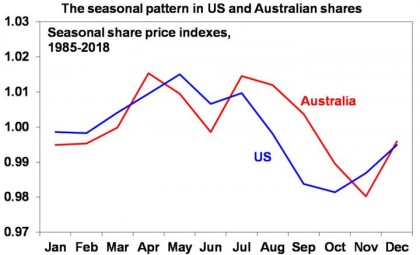
As a result of this monthly behaviour a typical pattern through the year is for stocks to strengthen from around October/November until around May (or July in Australia’s case) of the next year and then weaken into September/October (and November for Australian shares). This seasonal pattern can clearly be seen in the following chart which shows an index for US and Australian shares and the month to month pattern of share prices after the longer term fundamentally driven trend is removed.

Source: Thomson Reuters, AMP Capital

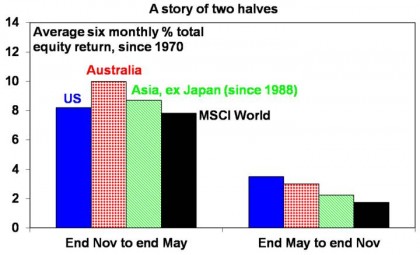
Breaking the year into two six-month periods also reflects this pattern. Since 1970, the average total return (ie, from price gains and dividends) from US shares from end November to end May is more than double that from end May to end November. A similar pattern exists in Australia, Asia and for global shares as shown in the next chart.


Source: Thomson Reuters, AMP Capital

While the US influence may be playing a big role in the continuation of this seasonal pattern in shares, the old saying in its full form of “sell in May and go away, buy again on St Leger’s Day” has its origins in the UK as St Leger’s Day is a UK horse race on the second Saturday in September suggesting that the seasonal pattern in shares dates back to the UK. In fact it may have its origins in crop cycles with grain merchants having to sell their shares at the end of the northern summer to buy the summer crop (which depresses shares around August/September) and they then bought back in after they sold the crop on to mills. Of course, that’s not so relevant to today. So, the explanation discussed earlier explains why it likely persists.

Qualifications

There is no guarantee that seasonal patterns will always prevail. They can be overwhelmed when contrary fundamental influences are strong, so they don’t apply in all years. For example, while Decembers are on average strong months in the US and Australia that wasn’t the case last December and not all years see weakness in the May to October/November period. However, they nevertheless provide a reasonable guide to the monthly rhythm of markets that investors should ideally be aware of. In simplistic terms, around May (and July in Australia) is perhaps not the best time to be piling into shares and around September to November is not the best time to be selling them.

What about now?

For the year as a whole we see shares doing okay. Valuations are okay helped in part by very low bond yields, global growth is expected to improve into the second half of the year and monetary and fiscal policy has become more supportive of markets all of which should support decent gains for share markets through 2019 as a whole.

However, from their December lows, shares – globally and in Australia – have run hard and fast and so are vulnerable to a short-term correction. Still soft global growth indicators and the latest flare up regarding US and China trade could provide triggers.

President Trump’s latest threat to increase the tariff on $US200bn of imports from China from 10% to 25% (delayed from January) and his threat to look at taxing remaining imports from China too suggest that the latest round of US/China trade talks in China did not go as well as planned and looks aimed at putting pressure on China to resolve the talks. Ultimately, we remain of the view that there will be a resolution given the economic damage not doing so would cause, particularly ahead of Trump’s re-election bid next year (US presidents don’t get re-elected when unemployment is rising). But the latest threat adds to the risk of market weakness in the short term, particularly if China delays a trip to the US to continue the negotiations in response to Trump’s threat.

In Australia, uncertainty around the impact of various tax increases if there is a change of Government in the upcoming Federal election could cause short-term nervousness for the Australian share market.

Of course, long term investors should look through all this.

Please call us on Phone: 07 5641 4134 if you would like to discuss.


Source: AMP Capital 06 April 2019

Important notes: While every care has been taken in the preparation of this article, AMP Capital Investors Limited (ABN 59 001 777 591, AFSL 232497) and AMP Capital Funds Management Limited (ABN 15 159 557 721, AFSL 426455)  (AMP Capital) makes no representations or warranties as to the accuracy or completeness of any statement in it including, without limitation, any forecasts. Past performance is not a reliable indicator of future performance. This article has been prepared for the purpose of providing general information, without taking account of any particular investor’s objectives, financial situation or needs. An investor should, before making any investment decisions, consider the appropriateness of the information in this article, and seek professional advice, having regard to the investor’s objectives, financial situation and needs. This article is solely for the use of the party to whom it is provided and must not be provided to any other person or entity without the express written consent of AMP Capital.

Surprisingly weak Australian inflation has led to expectations the Reserve Bank will soon cut rates. But what’s driving low inflation? Is it really that bad? Why not just lower the inflation target? Will rate cuts help?And what does it mean for investors?

Inflation surprises on the downside again

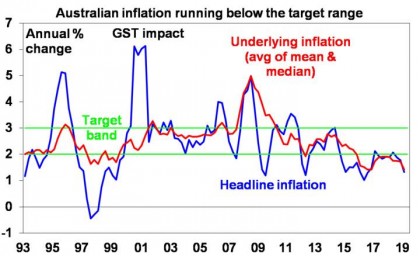
Australian inflation as measured by the CPI was flat in the March quarter and up just 1.3% over the last year. Sure, the zero outcome in the quarter was partly due to a nearly 9% decline in petrol prices and they have since rebounded to some degree. And high-profile items like food, health and education are up 2.3%, 3.1% and 2.9% respectively from a year ago. But against this price weakness is widespread in areas like clothing, rents, household equipment & services and communications.


Source: ABS, AMP Capital

But why the focus on “underlying inflation”?

The increase in the CPI is the best measure of changes in the cost of living. But it can be distorted in the short term by often volatile moves in some items that are due to things like world oil prices, the weather and government administered prices that are unrelated to supply and demand pressures in the economy. So, economists and policy makers like the RBA focus on what is called underlying inflation to get a handle on underlying price pressures in the economy so as not to jump at shadows. There are various ways of measuring this ranging from excluding items like food and energy as in the US version of core inflation, to excluding items whose prices are largely government administered to statistical measures that exclude items that have volatile moves in each quarter (as with the trimmed mean and weighed median measures of inflation). Right now they all show the same thing ie that underlying inflation is low ranging between 1.2% to 1.6% year on year. The average of the trimmed mean and weighted median measures is shown in the previous chart and is averaging 1.4%. The common criticism of underlying inflation that “if you exclude everything there is no inflation” is funny but irrelevant. The point is that both headline and underlying inflation are below the RBA’s 2-3% target and this has been the case for almost four years now.

What is driving low inflation?

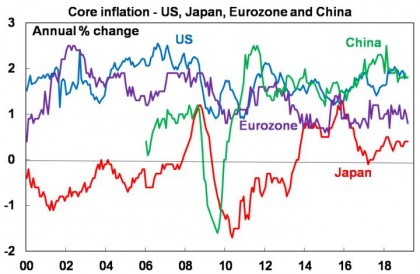
The weakness in inflation is evident globally. Using the US definition, core (ex food & energy) inflation is just 1.8% in the US, 0.8% in the Eurozone, 0.4% in Japan and 1.8% in China.


Sources: Bloomberg, AMP Capital

Several factors have driven the ongoing softness in inflation including: the sub-par recovery in global demand since the GFC which has left high levels of spare capacity in product markets and underutilisation of labour; intense competition exacerbated by technological innovation (online sales, Uber, Airbnb, etc); and softish commodity prices. All of which has meant that companies lack pricing power & workers lack bargaining power.

Why not just lower the inflation target?

Some suggest that the RBA should just lower its inflation target. This reminds me of a similar argument back in 2007-08, when inflation had pushed above 4%, that the RBA should just raise its inflation target. Such arguments are nonsense. First, the whole point of having an inflation target is to anchor inflation expectations. If the target is just raised or lowered each time it’s breached for a while then those expectations – which workers use to form wage demands and companies use in setting wages and prices – will simply move up or down depending on which way inflation and the target moves. And so inflationary or deflationary shocks will turn into permanent shifts up or down in inflation. Inflation targeting would just lose all credibility.

Second, there are problems with allowing too-low inflation. Most central bank inflation targets are set at 2% or so because statistical measures of inflation tend to overstate actual inflation by 1-2% because statisticians have trouble actually adjusting for quality improvements and so some measured price rises often reflect quality improvements. In other words, 1.3% inflation as currently measured could mean we are actually in deflation. And there are problems with deflation.

What’s wrong with falling prices (deflation) anyway?

Deflation refers to persistent and generalised price falls. It occurred in the 1800s, 1930s and the last 20 years in Japan. Most people would see falling prices as good because they can buy more with their income. However, deflation can be good or bad. In the period 1870-1895 in the US, deflation occurred against a background of strong growth, reflecting rapid technological innovation. This can be called “good deflation”. However, falling prices are not good if they are associated with falling wages, rising unemployment, falling asset prices and rising real debt burdens. For example, in the 1930s and more recently in Japan. This is “bad deflation”. Given high debt levels, sustained deflation could cause big problems. Falling wages and prices would make it harder to service debts. Lower nominal growth will make high public debt levels harder to pay off. And when prices fall people put off decisions to spend and invest, which could threaten economic growth. This could risk a debt deflation spiral of falling asset prices and falling incomes leading to rising debt burdens, increasing defaults, spurring more falls in asset prices, etc.

The problem for RBA credibility?

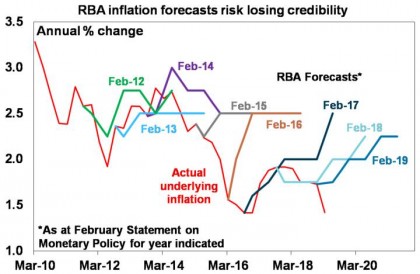
The problem for the RBA is that inflation has been undershooting its forecasts and the target for several years now. The longer this persists the more the RBA will lose credibility, seeing low inflation expectations become entrenched making it harder to get inflation back to target and leaving Australia vulnerable to deflation in the next economic downturn.


Source: RBA, Bloomberg, AMP Capital

Due to the slowdown in economic growth flowing partly from the housing downturn we have been looking for two rate cuts this year since last December. We had thought that the RBA would prefer to wait till after the election is out of the way before starting to move and coming fiscal stimulus from July also supports the case to wait as does the still strong labour market. However, with underlying inflation coming in much weaker than expected the RBA its arguably too risky to wait until unemployment starts to trend up. And the RBA has moved in both the 2007 and 2013 election campaigns. So, while it’s a close call our base case is now for the first rate cut to occur at the RBA’s May meeting. Failing that, then in June.

Will the banks pass on RBA rate cuts?

This has been an issue with all rate cuts since the GFC due to a rise in bank funding costs. But most cuts have been passed on largely or in full (the average pass through since the Nov 2011 cut has been 89%), notwithstanding out of cycle hikes. Short term funding costs have fallen lately pointing to a reversal of last year’s 0.1 to 0.15% mortgage rate hikes or at least the banks having little excuse not to pass on any RBA cuts in full.

But will more rate cuts help anyway?

Some worry that rate cuts won’t help as they cut the spending power of retirees and many of those with a mortgage just maintain their payments when rates fall. However, there are several points to note regarding this. First, the level of household deposits in Australia at $1.1 trillion is swamped by the level of household debt at $2.4 trillion. So the household sector is a net beneficiary of lower interest rates. Second, the responsiveness to changes in spending power for a family with a mortgage is far greater than for retirees. Third, even if many with a mortgage just let their debt get paid off faster in response to falling rates this still provides an offset to the negative wealth effect of falling house prices, reducing pressure to cut spending. Fourth, the fall in rates since 2011 has helped the economy keep growing as mining investment collapsed. And of course, RBA rate cuts help push the $A lower. So, while rate cuts may not be as potent with higher household debt levels today and tighter bank lending standards, they should provide some help.

Is the RBA out of ammo?

This is a common concern around major central banks. However, they are a long way from being unable to do anything: the Fed can reverse the 9 rate hikes seen since December 2015 and start quantitative easing again if needed; and both the ECB and Bank of Japan could expand their QE programs. The ultimate option is for central banks to provide direct financing of government spending or tax cuts using printed money. This is often referred to as “helicopter money”. Fortunately, non-traditional monetary policy has worked in the US and so at least these concerns are unlikely to need to be tested. Of course, the RBA still has plenty of scope to cut interest rates if needed (there is 150 basis points to zero) and it could still do quantitative easing if needed so it’s a long way from being out of ammo (not that we think it needs to do a lot more anyway).

Implications for investors?

There are a number of implications for investors. First, low interest rates will remain in place for some time keeping bank deposit rates unattractive. Second, given the absence of inflationary pressure, a 1994-style bond crash remains distant.

Third, the low interest rate environment means the chase for yield is likely to continue supporting commercial property, infrastructure and shares offering sustainable high dividends.

Fourth, an earlier RBA rate cut may bring forward the timing of the bottom in Australian house prices.

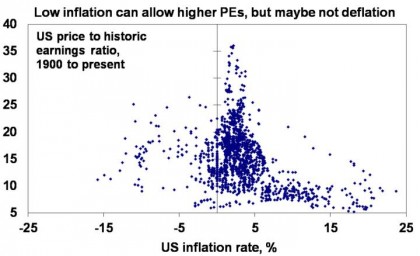
Finally, as can be seen in the next chart, low inflation is generally good for shares as it allows shares to trade on higher price to earnings multiples. But deflation tends to be bad for shares as it tends to go with poor growth and profits and as a result shares trade on lower PEs. The same would apply to assets like commercial property and infrastructure.


Source: Global Financial Data, Bloomberg, AMP Capita
l


Source: AMP Capital 29 April 2019

Important notes: While every care has been taken in the preparation of this article, AMP Capital Investors Limited (ABN 59 001 777 591, AFSL 232497) and AMP Capital Funds Management Limited (ABN 15 159 557 721, AFSL 426455)  (AMP Capital) makes no representations or warranties as to the accuracy or completeness of any statement in it including, without limitation, any forecasts. Past performance is not a reliable indicator of future performance. This article has been prepared for the purpose of providing general information, without taking account of any particular investor’s objectives, financial situation or needs. An investor should, before making any investment decisions, consider the appropriateness of the information in this article, and seek professional advice, having regard to the investor’s objectives, financial situation and needs. This article is solely for the use of the party to whom it is provided and must not be provided to any other person or entity without the express written consent of AMP Capital.

Investors should be realistic. This means being realistic in setting their long-term goals, being realistic in their expectations for investment returns and being realistic in their spending habits.

Critically, the reasons for being realistic with your goals, return expectations and spending are indelibly linked. Being unrealistic in any of three may throw the others off course.

The case for investors to take a realistic approach is particularly worth highlighting given widespread expectations for subdued returns over the medium-to-long term from diversified portfolios together with the likelihood of higher volatility.

A Vanguard research paper* published several years ago – Required or desired returns? That is the question – closely examines the need for investor realism.

Realistic goal-setting

As this research paper discusses, financial planning should result in an estimate of the return needed to achieve investors’ realistic objectives given such factors as their investment time horizon, current assets, savings pattern, tax position and risk tolerance.

Realistic return expectations

This thorough financial planning process should provide an estimate of an investor’s required return from their portfolios as opposed to a desired return.

“The required return is the return necessary to accomplish the goals that the investor has determined to be most important while bearing the level of risk that the investor feels is most palatable, “the researchers explain.

Key points to help understand the often-overlooked difference between required and desired returns include:

  • A desired return usually originates from factors that are unrelated to an investor’s objectives and constraints. These may include an investor’s past experiences, recent market returns, historic market returns, media reports, fund advertising, best-performing fund lists and tips from friends.

  • Many investors would already have a target investment return in mind – their desired return – before fully examining their particular circumstances.

  • Desired returns are typically, but not always, higher than an investor’s required return. “Higher returns are associated with higher risk in the long run,” the paper stresses. “Other investors may insist they don’t want no risk at all, ignoring the potential threat to their future wealth.

Realistic spending

Investors who keep their personal spending within their means are less likely to chase unrealistic investment returns. This is particularly relevant for retirees relying on their investment returns to pay their living costs. In other words, your spending habits should realistically reflect your income.

Understanding the difference between desired and required returns should help investors set appropriate asset allocations for their portfolios. And by being properly diversified, investors are well placed to reduce the level of short-term volatility in their portfolios.

*Required or desired returns? That is the question by Vanguard investment analysts Donald Bennyhoff and Colleen Jaconetti.

Please contact us on Phone: 07 5641 4134 if you seek further discussion.


Source : Vanguard 

Written by Robin Bowerman, Head of Corporate Affairs at Vanguard.

Reproduced with permission of Vanguard Investments Australia Ltd. 

Vanguard Investments Australia Ltd (ABN 72 072 881 086 / AFS Licence 227263) is the product issuer. We have not taken yours and your clients’ circumstances into account when preparing this material so it may not be applicable to the particular situation you are considering. You should consider your circumstances and our Product Disclosure Statement (PDS) or Prospectus before making any investment decision. You can access our PDS or Prospectus online or by calling us. This material was prepared in good faith and we accept no liability for any errors or omissions. Past performance is not an indication of future performance.

© 2019 Vanguard Investments Australia Ltd. All rights reserved. 

Important:
Any information provided by the author detailed above is separate and external to our business and our Licensee. Neither our business, nor our Licensee take any responsibility for any action or any service provided by the author.

Any links have been provided with permission for information purposes only and will take you to external websites, which are not connected to our company in any way. Note: Our company does not endorse and is not responsible for the accuracy of the contents/information contained within the linked site(s) accessible from this page.

By Flying Solo contributor Fiona Adler

Lots of us walk around knowing inside that we have untapped potential and ideas for what might be possible in the future, but turning these thoughts into a reality is where we fall down. We know goal-setting is important, but how do we actually set goals so that we’ll achieve them?

Thinking ‘short term’ seems, well short-termed. We’ve put so much emphasis on being strategic and thinking long-term, that we’ve overlooked the importance of short term goals. Today I want to encourage you to put your focus back onto short term goals – it’s one of the most powerful techniques to be more productive.

Why you should focus on short term goals

There are lots of reasons short-term goals are more effective than long-term goals, but for me, the top ones are:

1. Short term goals are more relatable

Having a big vision for our lives or our businesses is great and can be very inspiring, but often there’s a huge disconnect between that vision and our current reality. Imagine setting a goal to be a top-selling author when you haven’t written a single book. Or imagine setting a goal for your business to be number one in your industry while you’re still barely profitable. The jump is too big.

Even if we can convince our conscious minds that all this is possible, goals like these cause cognitive dissonance as there is always a part of us that doesn’t believe they are achievable. A series of short-term goals, that inevitably lead to the long-term goal or vision, is much more effective.

2. Achieving short term goals sets up positive reinforcing patterns

By definition, short-term goals are easier to achieve than long-term goals – and this is a good thing! When we achieve the goals we set ourselves, our confidence in our ability to achieve bigger goals grows.

Although it sounds simplistic, don’t under-estimate the power of this reinforcement loop! As humans, we’re all wired to stay in our comfort zones and we need all the help we can get to push ourselves to do things that are outside of our normal frame of operating.

Success breeds success so the more goals you can achieve, the more you are likely to achieve in the future.

3. Short term goals lead to action

For me, this is the most important reason to focus on the short-term. Goals written with a very near deadline create a sense of urgency. They tell you what to do now and how to take action so that you can actually achieve them.

Imagine you have a long-term goal to hit $1 million in sales. What should you be doing today to get there? Who knows.

But imagine instead that your goal is to make 3 sales this week. You’d better start making some phone calls and sending out some proposals!

This is the same for all types of goals. If you want to run a marathon next year, of course you know you should be training now, but it’s difficult to make the connection and generate a sense of urgency. However, if you have a goal to run 20 miles this week, you now know exactly what you should do.

How to set short term goals

So how do you actually set short term goals so that you’ll achieve them?

Connect with your vision

Firstly, connect with your big vision. The thing that pulls you forward, inspires and excites you. Think about where you want to be in the longer-term. How would your business look in three years? What would your life be like in three years. You might want to write down some ideas or even create a vision board. But your vision is not the goal – it’s too big to be relevant to you today.

Choose a 30 day milestone as your short term goal

Instead, your goal needs to be the next milestone towards this vision. Ideally, something that you can achieve in 30 days, or 90 at the most. You need to figure out the next step in your journey and use that as a goal. You might think of this as a milestone towards a bigger goal, but in my opinion, naming this as the goal itself is more helpful.

Make your goal SMART

I’m sure you’ve heard about SMART goals before – that is to say they should be Specific, Measurable, Actionable, Realistic and Time-Framed. I never used to like this framework because I wanted to focus on really big goals. But now, I understand the difference between a goal and a vision and this framework makes perfect sense for short term goals.

Once you’ve chosen a goal, you need to phrase it in a way that ensures it meets all of these criteria. In particular, pay attention to it being Actionable – it should be something you can directly control.

Short term goals for business teams

Setting shot term goals for business units or business teams is exactly the same. As a team, you need to first connect with the bigger vision – either for the business, or for the team – and then brainstorm what that means for the next 30-90 days. What goals are you aiming to hit in this timeframe?

Beware of choosing too many goals as the more you have, the more diluted they become. In fact, many would argue that having one, single goals is the most powerful. Even if you do choose several goals, be clear on which is the most important. When it comes to making decisions, this should be used as a decision reference point, and every effort should be made to achieve that most-important goal (even at the expense of the others).

Examples of short term goals

A lot of people know about writing goals, but still, they are confused as to what a goal should look like. Here are some examples:

Short term personal goal examples

  • Run 20 kilometres a week

  • Do 30 minutes of yoga 6 days a week

  • Read each night for 30 minutes

  • Practice piano for 10 minutes every day this month

  • Organise a family reunion party

  • Book a family trip before x date

  • Go out with friends twice this month

  • Clean out the garage by the end of the month

  • Organise all Christmas presents before x date

  • Eat vegetarian 4 nights a week for the next month

  • Order a new computer and set up my office by x date

Short term business goal examples

  • Have x customers using y new feature by z date

  • Grow subscriptions to monthly revenue of x by y date

  • Sell x of product y by z date

  • Hire a new account manager by x date

  • Submit taxes by x date

  • Re-do website by x date

  • Create a new lead magnet by x date

  • Document x number of processes by y date

  • Collect x customer testimonials by y date

  • Release new feature x by y date

  • Migrate to new software x by y date

Putting your short term goal into action

So now you have a great short-term goal, it’s time to figure out what you need to do to get there. In particular, what do you need to do today? And what do you need to do for the next few days. In reality, it’s pretty hard to plan more than a few days out, but if you keep asking yourself what you need to do today and tomorrow, it’s amazing how much you can achieve.

Put an action plan together with all the mini-steps involved in achieving this goal.  It could be something like make five phone calls a day, or find three web designers, or choose colours. Make each step tiny so that it is easy to achieve. Breaking down your goals (which are already small), into tiny parts is what leads to success.

Then do what it takes each day to get those things done! Get into the habit of actually doing each thing on your action plan. Remember, you decided this is the most important goal for you, so doing this action is the most important thing to focus on. Don’t let your brain trick you into getting distracted or fall into the habit of procrastinating. This is the most important thing for you – so treat it that way!

All this is simple in theory, and it can be easy to do – providing you don’t overthink it. Instead, just focus on doing the actions you need to achieve your short-term goal.

Good luck!


Source : FlyingSolo April 2019 

This article by Fiona Adler is reproduced with the permission of Flying Solo – Australia’s micro business community. Find out more and join over 100k others.

 

Important:
This provides general information and hasn’t taken your circumstances into account. It’s important to consider your particular circumstances before deciding what’s right for you. Any information provided by the author detailed above is separate and external to our business and our Licensee. Any information provided by the author detailed above is separate and external to our business and our Licensee. Neither our business, nor our Licensee take any responsibility for any action or any service provided by the author.

Any links have been provided with permission for information purposes only and will take you to external websites, which are not connected to our company in any way. Note: Our company does not endorse and is not responsible for the accuracy of the contents/information contained within the linked site(s) accessible from this page.


If your other half is a stay-at-home parent, working part-time or out of work, find out how adding to their super could benefit you both financially.

If your spouse (husband, wife, de facto or same-sex partner) is a low-income earner or not working at the moment, chances are they’re accumulating little or no super at all to fund their retirement.

The good news is, if you’d like to help them by putting money into their super, you might be eligible for a tax offset, while potentially creating additional future planning opportunities for both of you.

If you want to know more, we explain how the spouse contributions tax offset works, in addition to what contributions splitting is (and how it differs).

The spouse contributions tax offset

How do you know if you’re eligible?

To be entitled to the spouse contributions tax offset:

  • You must make a contribution to your spouse’s super. This is a contribution made using after-tax dollars, which you haven’t claimed as a tax deduction

  • You must be married or in a de facto relationship (this includes same-sex couples)

  • You must both be Australian residents

  • The receiving spouse has to be under the age of 65, or if they’re between 65 and 69 they must meet work test requirements, meaning they were gainfully employed during the financial year for at least 40 hours over a period of no more than 30 consecutive days

  • The receiving spouse’s income must be $37,000 or less for you to qualify for the full tax offset and less than $40,000 for you to receive a partial tax offset.

What are the actual benefits?

If eligible, you can generally make a contribution to your spouse’s super fund and claim an 18% tax offset on up to $3,000 through your tax return.

To be eligible for the maximum tax offset, which works out to be $540, you need to contribute a minimum of $3,000 and your partner’s annual income needs to be $37,000 or less.

If their income exceeds $37,000, you’re still eligible for a partial offset. However, once their income reaches $40,000, you’ll no longer be eligible, but can still make contributions on their behalf.

Are there limits to what can be contributed?

You can’t contribute more than your partner’s non-concessional contributions cap, which is $100,000 per year for everyone. However, if your partner is under 65, they may be able to contribute up to three financial years of this cap in the one year (under bring-forward rules) which would allow a maximum contribution of up to $300,000.

Another thing to be aware of is that non-concessional contributions can’t be made once someone’s super balance reaches $1.6 million or above as at 30 June of the previous financial year. So, you won’t be able to make a spouse contribution if your partner’s balance reaches that amount.

How contributions splitting differs

Another way to increase your partner’s super is by splitting up to 85% of your concessional super contributions with them, which you either made or received in the previous financial year.

Concessional super contributions can include employer and or salary-sacrifice contributions, as well as contributions you may have claimed as a personal tax deduction.

What rules apply?

To be eligible for contributions splitting, your partner must be less than their preservation age, or between their preservation age and 65 (and not retired).

If you’re not sure what your partner’s preservation is, check the table below.

Date of birth

Preservation age

Before 1 July 1960

55

1 July 1960 – 30 June 1961

56

1 July 1961 – 30 June 1962

57

1 July 1962 – 30 June 1963

58

1 July 1963 – 30 June 1964

59

From 1 July 1964

60

Are there limits to what can be contributed?

Amounts that you split from your super into your partner’s super will count toward your concessional contributions cap, which is $25,000 per year.

Do all super funds allow for this type of arrangement?

You’ll need to talk to your super fund to find out whether it offers contributions splitting, and it’s also worth asking whether there are any fees..

What else you and your partner should know

  • If either of you exceed the super contribution caps, additional tax and penalties may apply.

  • The value of your partner’s investment in super, like yours, can go up and down, so before making contributions, make sure you both understand any potential risks

  • The government sets rules about when you can access your super. Generally, you can access it when you’ve reached your preservation age (which will be between the ages of 55 and 60 depending on when you were born) and you retire.

  • While you can’t personally make further non-concessional contributions into your super once you have a total super balance of $1.6 million or above (as at 30 June of the previous financial year), it’s still possible to make contributions to your partner’s super (noting the caps).

Where to go for more information

Your circumstances will play a big part in what you both decide to do. And, as the rules around spouse contributions and contributions splitting can be complex, it’s a good idea to contact us on Phone: 07 5641 4134 to ensure the approach you and your partner take is the right one.

Source: AMP 16 April 2019

Important:
This information is provided by AMP Life Limited. It is general information only and hasn’t taken your circumstances into account. It’s important to consider your particular circumstances and the relevant Product Disclosure Statement or Terms and Conditions, available by calling Phone: 07 5641 4134, before deciding what’s right for you.

All information in this article is subject to change without notice. Although the information is from sources considered reliable, AMP and our company do not guarantee that it is accurate or complete. You should not rely upon it and should seek professional advice before making any financial decision. Except where liability under any statute cannot be excluded, AMP and our company do not accept any liability for any resulting loss or damage of the reader or any other person.


It is usually taught or passed down to us through our parents and families and is as commonplace and unacknowledged as the kitchen sink. This inherited gem is the ability to feel and express gratitude.

While we may think this is simply polite behavior, studies have found that gratitude goes far, far deeper and has an incredible impact on the way we feel and perceive our world. Feeling and expressing gratitude has been found to allow people to experience more optimism, joy, enthusiasm and other positive emotions. It does this through lowering levels of cortisolincreasing positive relationships and reducing instances of anxiety and depression.

Some hypotheses on the physiological and psychological impact of expressing gratitude find links to feelings of higher levels of social support; in acknowledging and being thankful for the relationships we have we are more aware of our friendships and communities. Gratitude has also been associated with lower blood pressure, improved immunity, better sleep and even increasing engagement in exercise. Expressing this emotion has a significant effect on our ability to cope with various difficult situations, and alters biases and perspectives to the positive. For this reason practicing gratitude has become adopted in clinical psychology and is used in prescribed exercises to improve patients’ well-being.

What exactly is gratitude? 

“Gratitude bestows reverence, allowing us to encounter everyday epiphanies, those transcendent moments of awe that change forever how we experience life and the world.”
~ John Milton

Robert Emmons, regarded as a leading scientific expert on gratitude, sees it as a relationship-strengthening emotion which is both an affirmation of goodness in the world and the acknowledgement that there are sources of goodness outside of ourselves. In other words, gratitude is a conscious focus on and appreciation of the positive aspects of life and in this sense allows us to experience a sense of hopefulness and view the world with optimism. 

The Yale Center for Emotional Intelligence views gratitude as “a state of mind that arises when you affirm a good thing in your life that comes from outside yourself, or when you notice and relish little pleasures” which can be cultivated in anyone by acknowledging the lessons and impact of both the good and the bad. 

Practicing Gratitude

Gratitude can be expressed in almost every situation in your life; for example when you wake up in the morning and acknowledge the house that sheltered you, the bed you slept on, the sheets that kept you warm and the body you live in that has allowed you to wake and perceive the world. To get to the point where you are automatically and more frequently experiencing gratitude for simple moments in life, it can be beneficial to practice expressing gratitude through simple routine exercises. 

The benefits of practicing gratitude has been examined in multiple studies, one of which was a 21-day gratitude intervention which resulted in greater amounts of high energy positive moods, increased social connectedness, increased optimism, and improved sleep in comparison to a control group. Here are some science-based and general activities for incorporating more gratitude into your day: 

  • Keep a gratitude journal: record three to five things for which you’re grateful every day or week. Routinely writing in your gratitude journal will help you realize there is more and more to be grateful for each day, week and month. You will also have the benefit of looking back over previous notes and sensing just how lovely your life is and can be.

  • Keep a gratitude jar:  A cute twist on the gratitude journal, see this as a bank you can continuously contribute to of lovely reminders that things aren’t always so bad! Use special note paper or a particular ink pen to create special notes for yourself.

  • Gratitude letter:  Write a letter to someone else thanking them for something that you really valued or thanking them for just being them. See it as a pass-it-forward activity in gratitude!

  • Meditation and yoga:  Meditating or engaging in yoga are two ways in which we can express gratitude to our own minds and bodies, reminding ourselves of our inherent worth and capability and being thankful for the ability to think and be present in the world. Thank your body from head to toe, focusing on each joint, muscle, and hair – there is no better way to compliment yourself!

  • Imagine your life without:  Sometimes we don’t know what we have until it’s gone. To appreciate more people and parts of your life, imagine your life without something you may take for granted and you may find greater joy and appreciation of your everyday. You can even go a step further and take a break from something that is giving you less joy than it used to; this can help you renew your ability to see its value.

  • Simply say thanks:  Say it out of the blue and really mean it. Send a text, make a phone call, knock on the door, pop your head around the office divider…think about and acknowledge how people can go out of their way to be helpful and kind.

  • Savor meals:  Before and during eating, consider where the food on your plate has come from and how fortunate you are to be able to nourish yourself and others. Think about how your body will absorb vitamins and minerals to keep you alive and healthy. 

  • Be mindful in the mundane:  gratitude can and is best practiced in mundane everyday tasks. Take a moment to thank the people that you work with or serve you throughout the day.

  • Notice your environment:  The weather, the grass, the trees, strangers on the street, stillness in the air…It may surprise you how focusing briefly on what’s around you can make you feel a sense of appreciation and joy. 

  • Breathe:  Another meditative practice but one that is also incredibly powerful, notice your breath and the sheer brilliance of the body’s ability to keep you alive. 

  • Donate: There are most likely numerous causes that align with your personal values and charities working hard to impact social change. Express your gratitude and support by donating to a group or charity. Selfless acts are another version of the expression of gratitude. 

We hope you can take some of these tips and put them into practice in your everyday to realign yourself with what is important and what is valuable to you. 

Source : Food Matters March 2018 

Reproduced with the permission of the Food Matters team. This article by  LAURENTINE TEN BOSCH  was originally published at www.foodmatters.com/article/the-method-scientifically-proven-to-make-you-happy


Important:
This provides general information and hasn’t taken your circumstances into account.  It’s important to consider your particular circumstances before deciding what’s right for you. Although the information is from sources considered reliable, we do not guarantee that it is accurate or complete. You should not rely upon it and should seek qualified advice before making any investment decision. Except where liability under any statute cannot be excluded, we do not accept any liability (whether under contract, tort or otherwise) for any resulting loss or damage of the reader or any other person. 

Any information provided by the author detailed above is separate and external to our business and our Licensee. Neither our business, nor our Licensee take any responsibility for any action or any service provided by the author.

Any links have been provided with permission for information purposes only and will take you to external websites, which are not connected to our company in any way. Note: Our company does not endorse and is not responsible for the accuracy of the contents/information contained within the linked site(s) accessible from this page.

Whenever market volatility rises, the benefits of treating a good financial adviser as an investor’s behavioural coach are truly highlighted.

Higher share-market volatility – whether prices are rising or falling – can tempt an investor to make emotionally-driven investment decisions that are often damaging to their portfolios.

Fortunately, a good financial adviser acting as an investor’s behavioural coach or guide can help keep potentially wealth-destructive traits in check.

A recently-published research paper, The Vanguard adviser’s alpha guide to proactive behavioural coaching, revisits the contributions that a good adviser can make as an investor’s behavioural coach – a long-favoured topic of Smart Investing.

As the paper’s author, senior investment analyst Donald Bennyhoff, writes: “Investing is an emotionally-charged effort that challenges people to contend with uncertainty and doubt”.

Behavioural coaching from an investment perspective has been defined as encouraging investors to change elements of their behaviour that would otherwise prevent them from achieving their goals.

As behavioural coaches, good advisers may warn investors about such damaging behavioural traits as over-confidence, inertia (getting in the way of saving), panicking when markets are falling, becoming greedy when markets are rising, and dwelling excessively on past losses.

A good adviser acting as a behavioural coach can:

  • Reinforce how a financial plan modifies an investor’s behaviour: Bennyhoff describes a written financial plan as “the foundation of behavioural coaching” for investors. It should take into account investors’ short and long-term goals, their tolerance to risk, and such other factors as their tax positions. More generally, Bennyhoff emphasises that a written plan helps ensure that investors “understand that investing requires them to intentionally bear risk while seeking rewards”. It provides a backbone for investment decisions and, in turn, discourages emotional decisions.

  • Remind investors to keep up their wealth-creating habits: This includes reminding investors to regularly rebalance their portfolios back to their strategic or target allocations. And advisers can keep reminding investors about the rewards of such investment fundamentals as long-term compounding (as returns are earned on past returns as well as invested capital), trying to save more, minimising investment costs and personal budgeting. These reminders are particularly valuable during times of higher market volatility and uncertainty.

Think about whether you can take more advantage of an adviser’s skills in ways that have nothing to do with trying to beat the markets – including acting as a behavioural coach and a personal wealth manager.

Please contact us pn Phone: 07 5641 4134 if we can be of assistance .

Source : Vanguard 

Written by Robin Bowerman, Head of Corporate Affairs at Vanguard.

Reproduced with permission of Vanguard Investments Australia Ltd

Vanguard Investments Australia Ltd (ABN 72 072 881 086 / AFS Licence 227263) is the product issuer. We have not taken yours and your clients’ circumstances into account when preparing this material so it may not be applicable to the particular situation you are considering. You should consider your circumstances and our Product Disclosure Statement (PDS) or Prospectus before making any investment decision. You can access our PDS or Prospectus online or by calling us. This material was prepared in good faith and we accept no liability for any errors or omissions. Past performance is not an indication of future performance.

© 2019 Vanguard Investments Australia Ltd. All rights reserved.

Important:
Any information provided by the author detailed above is separate and external to our business and our Licensee. Neither our business, nor our Licensee take any responsibility for any action or any service provided by the author.

Any links have been provided with permission for information purposes only and will take you to external websites, which are not connected to our company in any way. Note: Our company does not endorse and is not responsible for the accuracy of the contents/information contained within the linked site(s) accessible from this page.

Why you might be finding it difficult to save and what to do about it

Whether it’s uploading mindfulness apps, calling out unconscious bias at work or watching Todd Sampson redesigning his brain on the ABC, we’ve never been more interested in how we tick.

And that’s especially the case when it comes to money—how we spend and how we save.

But you don’t have to go to quite such extremes as Todd—there’s no need to escape from underwater shackles or skywalk between two high-rise buildings to investigate how the brain works.

Knowledge is power. The more you’re aware of how your mind works the more you can adjust your attitude towards money.

Six cognitive biases that influence how we save, spend and invest money

We like to think we’re rational beings. But the reality is that a lot of our daily behaviour is influenced by our subconscious.

Behavioural scientists have looked at the way human beings are wired and discovered some ‘cognitive biases’ that influence our everyday behaviour1.

So if you find yourself clicking on that Amazon special or buying lunch at the same expensive cafe near work every day, they could explain why it’s so difficult to stick to your spending limits or saving plan.

Here are a few of their insights into how our minds work.

  1. We tend to discount the future.

    We value immediate rewards over rewards in the distant future. This tendency to want instant gratification is hard wired from birth. Studies have shown that children find it hard to stop themselves eating a treat even when a bigger and better treat is offered for those who wait for a few minutes. And ‘discounting the future’ doesn’t stop when you reach adulthood. It could explain why it’s hard to get too excited about saving for your retirement in your 20s. But the earlier you start planning, the more you’ll be able to put away.

  2. We tend to feel the pain of a loss more than the pleasure of a gain.

    You can see an extreme example of this sort of behaviour at the casino when gamblers chase their losses. This ‘loss aversion’ can also manifest itself in continuing to commit to a poor investment because you’ve already put a lot of money into it. It can help to think long term and avoid focusing on short-term fluctuations in the value of your investments.

  3. We tend to follow the herd.

    Much as we like to think of ourselves as independent human beings, we tend to look to others for affirmation. Think about the rush to secure seats for the concert when you know that everyone else is using the online booking system. It’s all about FOMO. This sort of ‘herd mentality’ can work in a positive way. Just a generation or two ago it was socially acceptable to smoke in restaurants or to drive without a seatbelt. Now it’s unthinkable. When it comes to money, this ‘herd mentality’ can manifest itself after stock market downturns, when investors start panicking and selling up, even though rationally this will crystallise their losses. It can help to shut out daily market noise and focus on long-term goals.

  4. We tend to think things are more likely to happen than they are.

    You can see this in the popularity of lotteries around the world. While the chances of winning are infinitesimal, the winners get a lot of publicity, which makes us think it’s more likely to happen. But at least the lottery is relatively harmless. Thanks to the global mass media, this ‘availability bias’ often focuses on bad events like kidnapping, plane crashes or stock market downturns. Investors who experience a market crash like the GFC over-estimate the chances of the same thing happening again, even though statistically it’s unlikely. It can lead to people saving for retirement changing their investment preferences to lower risk investments, even though this may not be in their best interests as their long-term returns struggle to keep pace with inflation.

  5. We tend to favour recent reference points when making decisions.

    This ‘anchoring bias’ can make it easy to overspend in shopping malls. When you first see a pair of shoes for $200 and then a similar pair for $150 it’s easy to anchor on the first amount and perceive $150 as a great bargain. And these days it doesn’t stop when you leave the mall—online shopping means plenty more opportunities for that anchor to embed itself and end up in an unwanted purchase. To counter this, try setting your own ‘base price’ before you set out shopping and stick to it. You can also see anchoring in practice when investors rush in to buy stocks that have just plunged in value without looking at the underlying performance of the company. They have made the mistake of anchoring the recent high point in their mind.

  6. We tend to be a bit lazy.

    We tend to stick with current plans rather than change if it’s too much hassle. This is probably why so many of us stay with our utility providers rather than shopping around for a better deal. If you find yourself suffering from ‘status quo bias’, try making a start with one area of the household finances—say, your electricity bill—to make it more manageable, rather than trying to tackle everything at once.

1 If you’d like to know more about how our unconscious mind affects our decision making when it comes to saving and spending money, here’s some bedtime reading: Thinking, Fast and Slow by Daniel Kahneman; Nudge: Improving Decisions About Health, Wealth, and Happiness by Richard Thaler and Cass Sunstein; Predictably Irrational: The Hidden Forces That Shape Our Decisions by Dan Ariely.

Source : AMP March 2019

Important:
This information is provided by AMP Life Limited. It is general information only and hasn’t taken your circumstances into account. It’s important to consider your particular circumstances and the relevant Product Disclosure Statement or Terms and Conditions, available by calling Phone: 07 5641 4134, before deciding what’s right for you.

All information in this article is subject to change without notice. Although the information is from sources considered reliable, AMP and our company do not guarantee that it is accurate or complete. You should not rely upon it and should seek professional advice before making any financial decision. Except where liability under any statute cannot be excluded, AMP and our company do not accept any liability for any resulting loss or damage of the reader or any other person.