The 2019-20 Budget had three aims: to cement the Government’s fiscal credentials by delivering the long-awaited return to budget surplus; to provide fiscal stimulus to an ailing economy; and to help get the Government re-elected. It looks on track for the first thanks to a revenue windfall, this has provided room for fiscal stimulus and of course time will tell whether it makes a difference in the May election. Of course, while whoever wins the election will provide stimulus next financial year its timing and precise makeup won’t really be known for some time which makes the Budget a bit academic.

Key budget measures

The goodies include:

  • Income tax cuts from July focussed on low to middle income earners of an additional $10 a week (following last year’s announced tax cut of around $10/week) which is mainly achieved by doubling the Low & Middle Income Tax Offset.

  • More generous tax stimulus in later years especially for higher income earners (which builds on the tax changes announced in last year’s budget), starting in 2022 with an expansion in the 19% rate tax bracket and a reduction in the 32.5% rate to 30% in 2024.

  • Expansion of the small business instant asset write off by $5,000 to $30,000 until 2020 (which is also now extended to medium-sized businesses) and a drop in small business company tax to 25% earlier than expected.

  • A $75 to $125 cash payment to 3.9 million pensioners and other welfare recipients.

  • Greater flexibility for 65 & 66 year olds to top up their super.

  • Spending on energy efficiency measures including an equity injection of $1.4bn on the Snowy Hydro project.

  • An extra $25bn in infrastructure spending over the next decade including $2bn for a rail from Geelong to Melbourne, and a large allocation to NSW transport projects.

Stronger revenue, but tax cuts

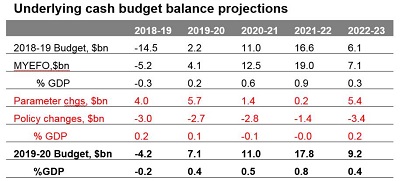
Thanks to stronger corporate revenue, better personal tax revenue thanks to higher employment and reduced spending the 2018-19 budget deficit is projected to come in at $4.2bn compared to $5.2bn in the Mid-Year review. The Government has assumed that this revenue boost is only temporary (see the “parameter changes” line in the table below) and has only used some of it to fund tax cuts and other measures. The net result is that the budget is projected to continue to reach a surplus in the next financial year, albeit its still only small at $7.1bn or 0.4% of GDP. The move to higher surpluses is slowed slightly by the fiscal easing from policy changes (predominately tax cuts).

However, note that the fiscal stimulus proposed for 2019-20 is actually bigger than that shown in the table below under “policy changes” as $3bn in tax cuts were already allowed for in the Mid-Year Review and if the already legislated tax cuts are allowed for in total its around $9bn or 0.5% of GDP. That said this is still relatively small and not enough to offset low wages growth and the negative wealth effect from falling house prices.
Source: Australian Treasury, AMP Capital

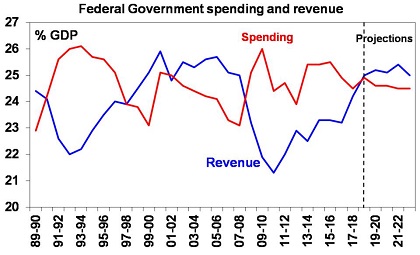
The already legislated tax cuts for higher income earners next decade are designed to satisfy the Government’s commitment from the 2014 Budget to cap tax revenue at 23.9% of GDP (or total revenue with dividends at 25.4% of GDP) on the grounds that this is around the historic highs. This cap is now projected to be reached in 2021-22.
Source: Australian Treasury, AMP Capital

Economic assumptions

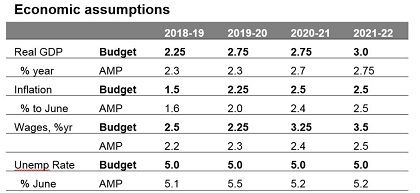
The Government’s growth forecasts look a little bit on the optimistic side, particularly the assumptions for wages growth. It remains hard to see wages growth rising significantly over the next few years given unemployment is not expected to fall and on our forecasts is expected to rise to 5.5%.
Source: Australian Treasury, AMP Capital

Assessment and risks

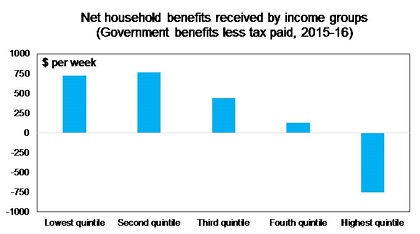
Like last year’s this is an upbeat Budget. First the near-term tax cuts for low to middle income earners will help households at a time of soft wages growth, falling home prices and tightening lending standards. But while roughly two times bigger than planned a year ago, this will still be relatively small though at around $20 a week (enough for 3 rounds of coffee and a muffin!). Second, the Budget continues to recognise that we cannot rely on bracket creep to cut public debt. The Australian tax system is already highly progressive and is becoming more so with the top 10% of earners accounting for roughly 45% of income tax revenue, up from 36% two decades ago. Compared to other comparable countries the top marginal tax rate is both relatively high and kicks in at a relatively low multiple of average earnings. In fact only the top 20% of income earners pay more tax than they receive in government benefits. If this is not limited it risks dampening incentive and productivity. Third, the continuing focus on infrastructure is good for short term growth, productivity and “crowding in” private investment. It will help to keep the economy growing.
Source: ATO, AMP Capital

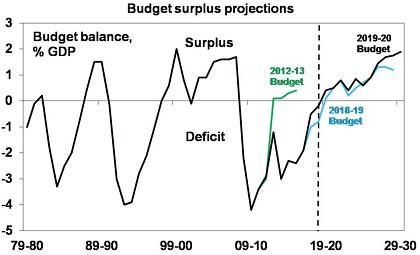
Finally, thanks to constrained spending growth and the surge in revenue in recent years the outlook for surpluses is positive.
Source: Australian Treasury, AMP Capital

However, we have still seen a record run of 11 years of budget deficits. While our net public debt to GDP ratio is low at 19% compared to 78% in the US, 70% in the Eurozone and 156% in Japan, comparing ourselves to a bad bunch is dangerous. The run of deficits swamps those of the 1980s and 1990s and this was without a deep recession! Rather we have achieved this thanks to a combination of ramping up spending at the time of the GFC and then not reining it in again. Unlike prior to the GFC we have nothing put aside for a rainy day and there is a risk that the revenue surprise will prove temporary if global growth slows or more likely Australian growth and employment disappoints.

While the Government’s revenue growth assumptions for the years ahead are modest partly due to tax cuts and they are relatively conservative in assuming that the iron ore price falls back to $US55 a tonne, a big risk remains that wages don’t accelerate as assumed leading to a resumption of poor personal tax collections.

Finally, the budget strategy and fiscal stimulus comes with greater than normal uncertainty given the coming election in May and whether the tax measures pass parliament. A Labor Government would likely also undertake a similar sized stimulus but there may be a greater focus on government spending and the timing may be delayed as a new government would likely have a mini-budget in the second half of the year.

Implications for the RBA

While this Budget should provide some boost to household finances and confidence – the fiscal boost to the economy and household income is still relatively modest and uncertainty around its timing and details may dampen any positive announcement effect. So while it will help the economy it’s not enough to change our view that the RBA will cut interest rates twice by year end taking the cash rate to 1%.

Implications for Australian assets

Cash and term deposits – with interest rates set to fall, returns from cash and bank term deposits will remain low.

Bonds – a major impact on the bond market from the Budget is unlikely. With Australian five-year bond yields at 1.4%, it’s hard to see great returns from bonds over the next few years albeit Australian bonds will likely outperform US/global bonds.

Shares – the boost to household spending power could be a small positive for the Australian share market (via consumer stocks) and there is an ongoing boost for construction companies. But it’s hard to see much impact on shares.

Property – the Budget is unlikely to have much impact on the property market. We expect Sydney and Melbourne home prices to fall further.

Infrastructure – continuing strong infrastructure spending should in time provide more opportunities for private investors as many of the resultant assets are ultimately privatised.

The $A – the Budget alone won’t have much impact on the $A. With the interest rate differential in favour of Australia continuing to narrow the downtrend in the $A has further to go.

Concluding comments

The 2019-20 Budget has a sensible focus on providing support to households at the same time as returning the budget to surplus. However, the actual fiscal stimulus is pretty modest – particularly for a pre-election budget – and comes with greater than normal uncertainty given the upcoming election.

Source: AMP Capital

Important notes

While every care has been taken in the preparation of this article, AMP Capital Investors Limited (ABN 59 001 777 591, AFSL 232497) and AMP Capital Funds Management Limited (ABN 15 159 557 721, AFSL 426455) (AMP Capital) makes no representations or warranties as to the accuracy or completeness of any statement in it including, without limitation, any forecasts. Past performance is not a reliable indicator of future performance. This article has been prepared for the purpose of providing general information, without taking account of any particular investor’s objectives, financial situation or needs. An investor should, before making any investment decisions, consider the appropriateness of the information in this article, and seek professional advice, having regard to the investor’s objectives, financial situation and needs. This article is solely for the use of the party to whom it is provided and must not be provided to any other person or entity without the express written consent of AMP Capital.


At its meeting today, the Board decided to leave the cash rate unchanged at 1.50 per cent.

The outlook for the global economy remains reasonable, although growth has slowed and downside risks have increased. Growth in international trade has declined and investment intentions have softened in a number of countries. In China, the authorities have taken steps to ease financing conditions, partly in response to slower growth in the economy. Globally, headline inflation rates have moved lower following the earlier decline in oil prices, although core inflation has picked up in a number of economies. In most advanced economies, unemployment rates are low and wages growth has picked up.

Global financial conditions remain accommodative and have eased recently. Long-term bond yields have declined further, consistent with the subdued outlook for inflation and lower expectations for future policy rates in a number of advanced economies. Across a range of markets, risk premiums remain low. Equity markets have also risen and are being supported by growth in corporate earnings. In Australia, long-term bond yields have fallen to historically low levels and short-term bank funding costs have moderated further. The Australian dollar has remained within its narrow range of recent times. While the terms of trade have increased over the past couple of years, they are expected to decline over time.

The Australian labour market remains strong. There has been a significant increase in employment and the unemployment rate is at 4.9 per cent. The vacancy rate remains high and there are reports of skills shortages in some areas. The stronger labour market has led to some pick-up in wages growth, which is a welcome development. Continued improvement in the labour market is expected to see some further lift in wages growth over time, although this is still expected to be a gradual process.

The GDP data paint a softer picture of the economy than do the labour market data. GDP rose by just 0.2 per cent in the December quarter to be 2.3 per cent higher over 2018. Growth in household consumption is being affected by the protracted period of weakness in real household disposable income and the adjustment in housing markets. The drought in parts of the country has also affected farm output. Offsetting these factors, higher levels of spending on public infrastructure and an upswing in private investment are supporting the growth outlook, as is the steady growth in employment.

The adjustment in established housing markets is continuing, after the earlier large run-up in prices in some cities. Conditions remain soft and rent inflation remains low. Credit conditions for some borrowers have tightened a little further over the past year or so. At the same time, the demand for credit by investors in the housing market has slowed noticeably as the dynamics of the housing market have changed. Growth in credit extended to owner-occupiers has eased. Mortgage rates remain low and there is strong competition for borrowers of high credit quality.

Inflation remains low and stable. Underlying inflation is expected to pick up gradually over the next couple of years, although this has been taking a little longer than earlier expected. The central scenario is for underlying inflation to be 2 per cent this year and 2¼ per cent in 2020. In the near term, headline inflation is expected to decline because of lower petrol prices earlier in the year, while underlying inflation is expected to remain broadly stable.

The low level of interest rates is continuing to support the Australian economy. Further progress in reducing unemployment and having inflation return to target is expected, although this progress is likely to be gradual. Taking account of the available information, the Board judged that it was appropriate to hold the stance of policy unchanged at this meeting. The Board will continue to monitor developments and set monetary policy to support sustainable growth in the economy and achieve the inflation target over time.

Source: Reserve Bank of Australia, April 2nd, 2019

Enquiries

Media and Communications
Secretary’s Department
Reserve Bank of Australia
SYDNEY

Phone: +61 2 9551 9720
Fax: +61 2 9551 8033

Email: rbainfo@rba.gov.au

Until recently, Australian house prices have marched upward so steadily that buying a house, while pricey, was rather predictable. That perception changed over the last year, as house prices fell 8.1 per cent in Sydney and 5.3 per cent in capital cities. It’s a healthy reminder that whether you are buying or selling, real estate, like any investment, can be volatile.

Australians have been conditioned to think of a house as an investment, but for most people buying somewhere to live is more of a practicality and an expense. We often forget that because rising property markets have the same effect as rising share markets, they focus people’s minds on gains and can cause them to overlook costs. Costs, however, always matter. It’s an eternal truth, whether you’re talking about your super fund or that charming cottage overlooking the bay.

Of course, charming cottages overlooking the bay have an emotional pull that, say the ASX 200, does not, so before diving in, take a step back to consider what you really want out of a home.

Owning property should perhaps not be your goal in and of itself. Having shelter that meets your needs within your budget is perhaps more sensible. Buying a house you can barely afford may only achieve the goal of keeping you up at night.

So before you go surfing on real-estate sites, take some time to plan how you want to live. How much space do you need? Owning may make more sense than renting for a family with children because large rental options can be hard to find, for example. How do you prefer to commute? If you don’t like to drive, getting a smaller place that costs more but is near your city job may be the way to go.

As you think about costs, some consideration should be given to the things that are hard to quantify in your decision. For example what is the lack of maintenance costs on a property worth, versus the peace of mind you might gain from not having to worry about a landlord moving you out of your rental property.  

Most costs, however, are more concrete. Australians are fond of saying that rent money is dead money, but so is mortgage interest paid to the bank. Just 4.5 per cent interest paid over 25 years on a $400,000 loan adds up to about $267,000.

A host of other one-time fees — stamp duty, conveyancing fees, legal costs, search fees, pest and building reports — add up to tens of thousands of dollars, although first–home buyers get a break on some of them.

And then there are the ongoing costs, such as maintenance, council and water rates, insurance and, in some cases, body corporate fees. If you rent and have the discipline to invest the deposit you would have put towards the house and the cost savings, you could well generate a higher return than you would buying a house, according to Morningstar.

If you don’t have the discipline to invest the difference, maybe the forced savings of owning a home is the right option for you. The key is to chart a path toward your own individual goals rather than slavishly follow the ups and downs of the housing market.

Please contact us on Phone: 07 5641 4134 if we can be of assistance .

Source : Vanguard January 2019 

Reproduced with permission of Vanguard Investments Australia Ltd

Vanguard Investments Australia Ltd (ABN 72 072 881 086 / AFS Licence 227263) is the product issuer. We have not taken yours and your clients’ circumstances into account when preparing this material so it may not be applicable to the particular situation you are considering. You should consider your circumstances and our Product Disclosure Statement (PDS) or Prospectus before making any investment decision. You can access our PDS or Prospectus online or by calling us. This material was prepared in good faith and we accept no liability for any errors or omissions. Past performance is not an indication of future performance.

© 2019 Vanguard Investments Australia Ltd. All rights reserved.

Important:
Any information provided by the author detailed above is separate and external to our business and our Licensee. Neither our business, nor our Licensee take any responsibility for any action or any service provided by the author.

Any links have been provided with permission for information purposes only and will take you to external websites, which are not connected to our company in any way. Note: Our company does not endorse and is not responsible for the accuracy of the contents/information contained within the linked site(s) accessible from this page.

Many parents approach the topic of money differently, but could your way of doing things influence your kids’ success?

The majority of Aussie mums and dads recognise that they’re accountable when it comes to shaping their children’s perspective around money matters.

A recent report published by the Financial Planning Association of Australia (FPA), revealed parents listed themselves (95%), followed by grandparents (63%) and teachers or coaches (59%) as the top three biggest influencers when it came to instilling money values in their kids1.

What money conversations are parents having?

As part of the research, parents said they mainly concentrated on day-to-day issues when talking money with their children, admitting that more contemporary issues, such as making transactions digitally, were sometimes overlooked2.

What parents said they discussed3:

  • 52% – how to spend and save

  • 43% – how to earn money

  • 32% – how household budgeting works

  • 24% – how much people earn

  • 19% – making online purchases

  • 13% – in-game app purchases

  • 5% – buy now, pay later services, such as Afterpay.

What approach do you take with your kids?

The research undertaken indicated that there were four prominent personalities parents assumed when discussing money with their children, with some parents initiating conversations more frequently, while others were sometimes a little more hesitant4.

The four distinct personalities that came out of the research included5:

The engaging parent

Common traits:

  • You have the most conversations around money with your kids and feel comfortable doing so

  • You tend to have a higher household income

  • You’re more likely to use money to encourage good behaviour in your children

  • Due to high engagement, your kids are often more financially prepared than other kids

  • Your kids have a greater interest in learning about all types of money matters.

The side-stepping parent

Common traits:

  • You are less comfortable talking to your kids about money so have fewer conversations

  • You may have less money coming in as a household

  • You’re less transparent about what you earn and money matters in general

  • You tend to provide the least amount of pocket money and as a result your children may be less interested in learning about money and how to make transactions.

The relaxed parent

Common traits:

  • You’re comfortable talking to your kids about money but don’t do so too often

  • You take a relaxed approach to money matters and are transparent about money issues

  • There is little financial stress in your home

  • Your relaxed nature may lead to your children missing out on opportunities to learn about money, which means your kids may need to explore money matters on their own.

The do-it-anyway parent

Common traits:

  • You’re not always comfortable talking about money but still have frequent conversations

  • You’re mainly concerned your child will worry about money if you talk about it

  • Despite your discomfort, your perseverance generally pays off

  • Your teenage children are more likely to have a job than the average child.

What approach is best according to the research?

Engaging parents were more likely to report that their children were more curious, confident, and financially literate than they were at their age6.

According to parents who fell into this category, their children were the most equipped to understand and transact in today’s digital world and their teenagers were the most likely to have a job and make online purchases for themselves or their family7.

In addition, the research found children with a paid job outside of the family home were more financially prepared to engage with money8.

They were also used to transacting digitally and showed greater interest in learning about paying taxes and superannuation than those who didn’t have a job9.

1-9 Financial Planning Association of Australia: Share the Dream – Research into raising the invisible-money generation 2018 page 6, 14, 15, 13

Source : AMP February 2019 

Important:
This information is provided by AMP Life Limited. It is general information only and hasn’t taken your circumstances into account. It’s important to consider your particular circumstances and the relevant Product Disclosure Statement or Terms and Conditions, available by calling Phone: 07 5641 4134, before deciding what’s right for you.

All information in this article is subject to change without notice. Although the information is from sources considered reliable, AMP and our company do not guarantee that it is accurate or complete. You should not rely upon it and should seek professional advice before making any financial decision. Except where liability under any statute cannot be excluded, AMP and our company do not accept any liability for any resulting loss or damage of the reader or any other person.

By Flying Solo contributor Karen Valadares

All praise to the internet for making it easier to work on the go! It still amazes me that carrying around a laptop and a phone allows us to manage our businesses while travelling long term.

But adopting this dreamy lifestyle needs a bit of planning to make it work.

I know this because I worked as a freelance digital nomad from May 2015 to September 2016, while I travelled to 25 countries with my husband.

From January 2018 to September 2018, we hit the road again. This time, I ran my new business while witnessing Carnival in Brazil, the World Cup in Russia, and the Romantic Road in Germany.

From these experiences I’ve collected five steps to help you keep your sense of adventure as you discover the world, with your business in tow.

“Traditional travel industry information may not apply to you.”

1. Travel slooooow

Getting to new places always comes with a period of adjustment. You have to learn your way around a new town and keep control of your desire to go about as if you were only there on holiday.

If you have only five days in one city, it is really hard to control that desire, but if you are spending one month there, you do have time to focus on work as well as visit new places. And you can do both really well.

When you travel slow you allow yourself time to work AND time to get to know the surroundings and experience the culture.

My recommendation: plan one-month minimum stay in each place.

2. Choose suitable places to work from

I’ve worked from coffee shops, restaurants, and hotel rooms. As cool as it might seem at first, working from places like these becomes hard over time. Sometimes the internet might be slow or, shockingly, not available. The surroundings may be distracting, or too lonely. These interferences will negatively affect your productivity.

Over the last months, I worked from co-working offices and even tried a co-living space. The stable internet connection, nice chairs and air conditioning were the highlights for me in these spaces. The added benefit was meeting people who have the same challenges and dreams as I do, as they work and run their business remotely.

My recommendation: look into co-working and co-living spaces.

3. Get online tools to do the heavy lifting for you

Saving a few hours every week is certainly a goal when you run your business. Add the extra challenges of being on the road and you will soon realise some online tools become lifesavers.

Here are my recommended tools to get you started. Be careful not to get a bunch of online tools all at once. There is always a bit of a learning curve at first, even with the easiest ones. And over time juggling too many tools becomes a challenge.

My recommendations:

  • Worldclock to make sure you are on the same page of your clients and team when you set meetings and agree on deliverables.

  • Skype and Google Hangouts for online meetings (these are my favourite ones, but there is also Zoom and Whatsapp).

  • Google Drive to store and share files (there is also WeTransfer).

  • Trello to manage project phases, create to do lists and checklists, and assign tasks in a collaborative environment.

  • Avaza to create invoices and request payments.

  • Skype Number to have a local phone number your clients can call (alternatively, you can register for a local business phone number at a co-working office in your hometown; some offices even offer receptionists to screen your calls. Also, you can secure an official business address with these offices)

4. Go to meet-ups around the world

Sometimes managing your business while travelling long-term makes you disconnected from people. The combination of working hours and new places with zero acquaintances might isolate you.

Avoid this by attending meet-ups in the places you visit. Co-working and co-living spaces are a great starting point for meeting people. These spaces usually schedule networking and training events as well. And if you can’t attend these types of events, check the available meet-ups along your way.

My recommendation: check local meet ups to network and understand how people in your field are working worldwide.

5. Get involved in digital nomad communities

When you travel long term, and manage a business at the same time, you have specific needs. You are not a regular tourist or a worry-free backpacker, so the traditional travel industry information may not apply to you.

Digital nomad communities, on the other hand, can provide you with the specific info you need, as these travellers have hands-on experience of working on-the-go. They can make your life easier regarding the travel planning side of things.

My recommendation: join social media groups, such as Global Digital Nomads FB Group & Digital Nomads Girls FB Group. Check out the info and forum on https://nomadlist.com/.

Being a business owner is never easy, but you will have extra energy to succeed if, in your free time, you are hanging out with like-minded people. Like having a beer while overlooking the Seine river in Paris, or doing your daily exercise at the beachside in Rio de Janeiro. These fulfilling experiences boost your motivation to keep remote work as a long-term decision.

Source : FlyingSolo

This article by By Karen Valadares is reproduced with the permission of Flying Solo – Australia’s micro business community. Find out more and join over 100k others.


Important:
This provides general information and hasn’t taken your circumstances into account. It’s important to consider your particular circumstances before deciding what’s right for you. Any information provided by the author detailed above is separate and external to our business and our Licensee. Any information provided by the author detailed above is separate and external to our business and our Licensee. Neither our business, nor our Licensee take any responsibility for any action or any service provided by the author.

Any links have been provided with permission for information purposes only and will take you to external websites, which are not connected to our company in any way. Note: Our company does not endorse and is not responsible for the accuracy of the contents/information contained within the linked site(s) accessible from this page.

The past week has seen a renewed intensification of concerns about global growth. Bond yields have plunged and associated growth worries have weighed on share markets. This note looks at the global growth outlook, why shares are vulnerable to a pullback and why it’s unlikely to be a resumption of last year’s downtrend.

Background

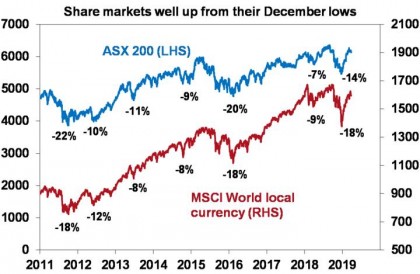
But first some perspective. At their lows back in December global shares had fallen 18% from their highs with US shares down 20% and Australian shares down 14% and many were convinced that recession was around the corner. Since then share markets have staged an impressive rebound with global shares rising 18%, US shares up 21% and Australian shares up 14%. So the 2% or so fall in shares seen in the past few days is a bit of a non-event.


Source: Bloomberg, AMP Capital

Late last year investor sentiment had become very negative and since then many of the fears that had depressed shares have faded: the Fed has become more dovish and less threatening to the US growth outlook; other central banks have actually eased notably in China and Europe; the Chinese authorities have shifted from cutting debt to stimulating growth; the US partial government shutdown has ended; the US and China look to be heading towards a trade deal; and fears around recession faded. And so shares rebounded.

However, after a 20% plunge as seen in US shares last year it’s unusual to have a deep V rebound like that since December, shares had become technically overbought & some measures of investor sentiment have become complacent. More fundamentally, there are several “worries” that could impact share markets – notably around growth. And this is being reflected in plunging bond yields & an inverted US yield curve. This has all left shares vulnerable to a short term pull back.

Growth worries and plunging bond yields

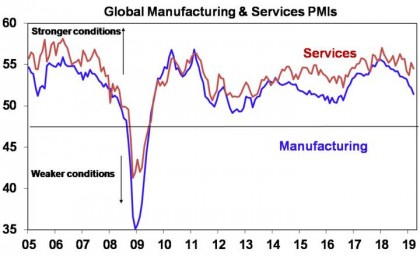
The problem now is that while some of the worries from last year have faded, global growth looks to be continuing to slow. Particularly disappointing in this regard were March business conditions PMIs which showed falls in the US and Europe and continuing weakness in Japan (and Australia).


Source: Bloomberg, AMP Capital

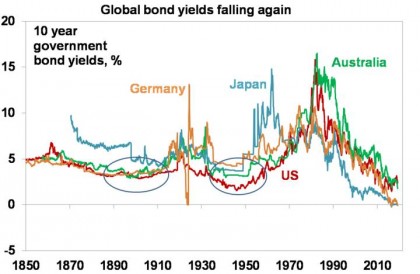
The weakness in growth indicators along with the “great retreat” back to dovishness and monetary easing by central banks aided by falling inflation has seen a renewed plunge in bond yields.


Source: Global Financial Data, AMP Capital

This has seen US yields fall to levels not seen since 2017, German and Japanese bond yields go negative again and Australian bond yields fall to a record low.

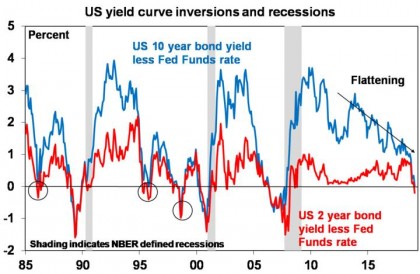
The decline in US bond yields has added to growth fears by pushing various measures of the yield curve to flat or negative. A negative, or inverted, US yield curve – ie when long-term bond yields fall below short-term rates – has preceded US recessions so it’s natural for investors to be concerned. The gap between the US 10-year bond yield and the 2-year bond yield has now fallen to just 0.22%, the gap between the 10-year bond yield and the Fed Funds rate has fallen to just 0.02% and the gap between the 2-year bond yield and the Fed Funds rate has fallen to -0.02%.


Source: NBER, Bloomberg, AMP Capital

But there are several things to allow for before getting sucked into the current frenzy around an inverted yield curve. First, the yield curve can give false signals (circled on the chart).

Second, the lag from an inverted curve to a recession has been around 15 months. So even if it becomes decisively inverted now recession may not come till mid next year. Historically the share market has peaked 3-6 months before recessions, so it’s too far away for markets to anticipate. After US yield curve inversions in 1989, 1998 and 2006 US shares first rallied more than 20%.

Third, various factors may be flattening the US yield curve which may not be indicative of an approaching US recession including the Fed’s new-found dovishness, negative German and Japanese bond yields holding down US yields, the realisation that central banks won’t be dumping their bond holdings and high investor demand for bonds post the GFC as they have proven to be a good diversifier – rallying every time shares have a major fall.
Fourth, other indicators suggest that US monetary policy is far from tight – the real Fed Fund rate is barely positive, and the nominal Fed Funds rate is well below nominal GDP growth and both are far from levels that have preceded US recessions.

Finally, we are yet to see the sort of excesses that precede US recessions: wages growth is still moderate, inflation is benign, there has been no boom in consumer spending, investment or housing construction, and private debt growth overall has been modest. It may also be argued that President Trump will do whatever he can to avoid recession next year as US presidents don’t get re-elected when unemployment is rising.

So while the US yield curve may be flashing a warning sign and should be watched its short comings need to be allowed for and other indicators are not foreshadowing a US recession. This is important because the historical experience tells us that what happens in the US is critical to how deep share market falls get. Deep (“grizzly”) bear markets are invariably associated with US recession. Our view remains that US recession is not imminent and last year’s share market falls are unlikely to be the start of a deep bear market.

More broadly, global growth is likely to pick up into the second half reflecting policy stimulus & reduced trade war fears. Signs of green shoots in terms of global growth include Chinese credit and investment, US data for retail sales, capital goods orders and consumer confidence and Eurozone industrial production.

But what about the risks around global trade, Brexit and the Mueller inquiry?

These could cause a share market pullback but none look significant enough to cause a resumption of last year’s falls:

  • US and China trade negotiations continue to see argy bargy but look to be on track to a significant deal in terms of reducing trade barriers and protecting intellectual property as it’s in both sides’ interests (particularly Trump’s who doesn’t want a trade war depressing the economy and shares and ruining his 2020 re-election prospects). But a deal with China would beg the question of whether Trump will then turn his attention to trade with Europe starting with auto tariffs. However, our assessment is that he probably won’t: America’s trade deficit with Europe is small compared to that with China; public and Congressional support for a trade war with Europe is low; most of Trump’s advisers are against it; the EU would retaliate and this would badly affect states that support Trump that export to Europe; it would be a new blow to confidence and share markets ahead of Trump’s 2020 re-election campaign.

  • The Brexit soap opera continues to create huge risks for the UK but it’s a second order issue globally. 46% of UK exports go to the EU but only 6% of EU exports go to the UK, so Brexit means far more for the UK economy that it does to the EU! Given the threat to the UK economy, the issue around the Irish border and that the 2016 Brexit vote was around immigration and sovereignty but not free trade with the EU, a soft Brexit or no Brexit (after another referendum) is more likely than a hard or no deal Brexit. What happens in the Eurozone though is far more significant than Brexit.

  • Finally, despite the hopes of Democrats it looks like the Mueller inquiry has failed to come up a smoking gun significant enough to see Trump removed from office. 

What about Australian bond yields at a record low?

The plunge in Australian bond yields to a record low of 1.78% (below 2016’s low of 1.81%) reflects a combination of weak economic data locally causing the fixed interest market to price in RBA rate cuts and falling bond yields globally. We remain of the view that Australian bonds will outperform global bonds (reflecting RBA easing at a time of the Fed holding) and that the Australian share market will continue to underperform global shares (as earnings growth locally lags that globally in response to weaker economic conditions in Australia). We continue to see the RBA cutting rates twice this year.

Concluding comments

Share markets are due a correction or pullback after rallying strongly since their December lows and worries about inverted yields curves and the growth outlook could provide the trigger. But US and global recession still looks to be a fair way off and we continue to see this being a reasonably good year for shares. The continuing fall in bond yields is not necessarily inconsistent with rising share markets (in 2016 shares bottomed in February and bond yields didn’t bottom till July/August!) but it does highlight that the post GFC environment of constrained growth and inflation and low rates remains alive and well.


Author: Dr Shane Oliver, Head of Investment Strategy and Economics and Chief Economist, AMP Capital Sydney, Australia

Source: AMP Capital 26 March 2019

Important notes: While every care has been taken in the preparation of this article, AMP Capital Investors Limited (ABN 59 001 777 591, AFSL 232497) and AMP Capital Funds Management Limited (ABN 15 159 557 721, AFSL 426455) (AMP Capital) makes no representations or warranties as to the accuracy or completeness of any statement in it including, without limitation, any forecasts. Past performance is not a reliable indicator of future performance. This article has been prepared for the purpose of providing general information, without taking account of any particular investor’s objectives, financial situation or needs. An investor should, before making any investment decisions, consider the appropriateness of the information in this article, and seek professional advice, having regard to the investor’s objectives, financial situation and needs. This article is solely for the use of the party to whom it is provided and must not be provided to any other person or entity without the express written consent of AMP Capital.

A year may not seem like a long time, but a lot can happen in 365 days. Since last February, you may have changed jobs, received a raise, gotten married or divorced, brought home a baby or had one of your kids move out of home.

A yearly financial checkup can ensure that your financial plans are in tune with your life. It doesn’t need to take long. You can do a big-picture review quickly and save follow-up tasks for later, start now if you have 15 or 30 minutes, or pin this list on your fridge or at the top of your to-do file to get 2019 off to a profitable start: 

  • Add up your assets, including your super and other investment and savings accounts, and your liabilities such as your mortgage or car loan. Can you access all those accounts easily? That is, do you know the account numbers for each and where the password is if you have online access?

  • Figure out whether your net worth (assets minus liabilities) is growing or shrinking. Ideally, your assets should be growing and your liabilities shrinking. If that’s not the case, figure out why. You may have a good reason, such as making a down payment for a house with a mortgage that increased your liabilities. But if the reason is not positive, decide whether you need to change anything to get those numbers heading in the right direction.

  • Review big changes in the last year that may affect your finances. For example, if you got a raise, consider directing some or all of it into your super or another investment. If you had a child, you may want to start saving for university or review your insurance to determine whether your coverage is still appropriate. Do you need to change beneficiary designations on any accounts?

  • Consider rebalancing your portfolio to make sure your investments continue to be aligned with your financial goals. Your asset allocation – the amount of your portfolio dedicated to shares, bonds and cash – should be diversified according to your goals, age and risk tolerance. The ups and downs of financial markets may put your allocations out of whack. Selling assets that have appreciated and reinvesting in those that have fallen in proportion to your overall portfolio can restore your desired allocation and reduce your vulnerability to a decline in a single asset class.

  • Take a look at your budget. Is your spending aligned with your income and your personal goals? If you don’t have a budget, create one. You don’t have to track every gold coin unless you want to, just be sure you capture the majority of your expenditures. If you want help, you could try out some popular budgeting apps.

Now, make a list of follow up tasks, and you’re on your way.

Please contact us on Phone: 07 5641 4134 if you seek further assistance .


Source : Vanguard February 2019 

Written by Robin Bowerman, Head of Corporate Affairs at Vanguard.

Reproduced with permission of Vanguard Investments Australia Ltd

Vanguard Investments Australia Ltd (ABN 72 072 881 086 / AFS Licence 227263) is the product issuer. We have not taken yours and your clients’ circumstances into account when preparing this material so it may not be applicable to the particular situation you are considering. You should consider your circumstances and our Product Disclosure Statement (PDS) or Prospectus before making any investment decision. You can access our PDS or Prospectus online or by calling us. This material was prepared in good faith and we accept no liability for any errors or omissions. Past performance is not an indication of future performance.

© 2019 Vanguard Investments Australia Ltd. All rights reserved.

Important:
Any information provided by the author detailed above is separate and external to our business and our Licensee. Neither our business, nor our Licensee take any responsibility for any action or any service provided by the author.

Any links have been provided with permission for information purposes only and will take you to external websites, which are not connected to our company in any way. Note: Our company does not endorse and is not responsible for the accuracy of the contents/information contained within the linked site(s) accessible from this page.


Getting married is an exciting time but, with so many things to think about, it can be easy to put off thinking about how you will manage your money together after your wedding day.  Taking time before you say “I do” to agree on how you will deal with your finances as a married couple will pay off in the long run.

Plan your wedding

Weddings can be very expensive. Our wedding infographic shows the average Australian wedding costs over $36,000. But there are lots of ways to keeps the costs of your wedding down without spoiling the magic of the day.

Follow these steps to keep the wedding costs under control:

  • Work out how much money you need – decide how much you want to spend on each item – including food and drinks, venue, cake, cars and music – and come up with a total cost.

  • Start saving for your wedding now – open a savings account or a term deposit to earn a high interest rate on your savings. Use the savings goals calculator to work out how much you’ll need to save each week.

  • Look for ways to cut costs – research online or ask around and find out how other people have saved money on their weddings.

  • Avoid using your credit card wherever possible – try to pay for big items, like the wedding dress or reception venue, in instalments so you aren’t left with huge debts that can take years to pay off.

    Organise your finances

Relationships can run into trouble if people have different saving and spending habits, so it’s important to decide whether you want to share a joint account, keep separate accounts, or have both.

Having a joint account can make it easier to pay shared bills, but there are risks with pooling all of your money into one account.

Smart tip

Work out who is going to pay which bills. Being clear about this means you won’t incur late fees or accidentally pay the same bill twice.

Some couples prefer to keep their own separate bank accounts and transfer a set amount each payday into a joint account to cover shared bills. This can be a good option if you have very different incomes or if you just want your own spending money.

Some people simply keep their own separate bank accounts and work out who is responsible for each type of payment, rather than setting up a joint account. Every couple is different, so talk to each other about which system will work best for you.

See our page on joint bank accounts for more information.


Discuss your financial goals

People sometimes don’t realise that their partner has completely different financial goals. For example, one person may think paying off the mortgage as soon as possible is the most important goal, while the other wants to save money for an overseas holiday.

The best thing to do is sit down and work out the goals you want to save for together. Whatever your plans are for the future, talk about them with your partner so you are both clear on what you want and when. Then you can work together to achieve your goals.

Organise your will, insurance and superannuation

Now that you’re officially a family, anything that happens to you will directly affect your partner. So it is important to update your will, insurance policies and superannuation to reflect your new married status.

The single best thing you can do to keep your finances on track as a couple is to keep talking to each other. By having regular conversations about your bills and your savings, you will both know whether you’re on track to achieve your goals, or if you need to adjust your plans.

Please contact us on Phone: 07 5641 4134 if you seek further assistance on this topic .

Source : ASIC’s Moneysmart February 2019 

Reproduced with the permission of ASIC’s MoneySmart Team. This article was originally published at https://www.moneysmart.gov.au/life-events-and-you/life-events/getting-married
Important note: This provides general information and hasn’t taken your circumstances into account.  It’s important to consider your particular circumstances before deciding what’s right for you. Although the information is from sources considered reliable, we do not guarantee that it is accurate or complete. You should not rely upon it and should seek qualified advice before making any investment decision. Except where liability under any statute cannot be excluded, we do not accept any liability (whether under contract, tort or otherwise) for any resulting loss or damage of the reader or any other person.  Past performance is not a reliable guide to future returns.

Important
Any information provided by the author detailed above is separate and external to our business and our Licensee. Neither our business, nor our Licensee take any responsibility for any action or any service provided by the author.

Any links have been provided with permission for information purposes only and will take you to external websites, which are not connected to our company in any way. Note: Our company does not endorse and is not responsible for the accuracy of the contents/information contained within the linked site(s) accessible from this page.

Billions of dollars in super contributions go unpaid every year, so if you’ve never checked your super account before, now might be a good time.

Recently a girlfriend posted on social media that she was owed over $10,000 in super from a former boss, who had since shut up shop (money she may never see when she does eventually retire).

Responses from her circle of mates revealed she wasn’t alone, with one person commenting that, like her, they still hadn’t received their unpaid super money, with situations where an employer goes out of business sometimes harder to chase up.

Good news – the last analysis by the Australian Taxation Office (ATO) revealed about 95% of super contributions were being paid by employers. The bad news – that left $2.79 billion in unpaid super1!

If you want to make sure you’re getting paid what you’re owed, here’s what you need to know and what you can do if something doesn’t look right (keeping in mind, the sooner you act, the better).

Who’s most at risk?

The ATO previously indicated that about 50% of super debts it deals with relate to insolvency (in other words, companies that don’t have the cash to meet their obligations)2.

On top of that, data from the Australian Securities and Investments Commission indicated non-payment of super was more likely to happen in certain industries (hospitality, construction and retail to name a few)3.

What your employer should be paying you

If you’re earning over $450 (before tax) a month, no less than 9.5% of your before-tax salary should generally be going into your super under the Superannuation Guarantee scheme.

If you’d like help crunching the numbers, give the ATO’s Estimate my super tool a go. It can provide you with an estimate of how much super your employer should have paid into your super account.

How can I check if I’m getting paid the super I’m owed?

  1. Start by looking at your payslips and know that while super contributions may be listed on your payslip, this doesn’t always mean money has been deposited into your super account.

  2. With that in mind, also check your super statements, call your super fund or log into your online account to see exactly what has been paid into your super. Note, super contributions are paid quarterly (at a minimum) even if your wages are paid weekly, fortnightly or monthly, which means super contributions paid by your employer might only be deposited into your account four times a year.

What should I do if something doesn’t look right?

  1. If it looks like you haven’t been paid what you should’ve, speak to the person who handles the payroll at your work, as there may be a simple explanation.

  2. If you’re not satisfied with what they tell you, you can lodge an unpaid super enquiry with the ATO. You’ll need to give your personal details, including your tax file number, the period relating to your enquiry and your employer’s details. You can also call the ATO on 13 10 20.

  3. It’s worth contacting your super fund too, as your employer may have a contractual arrangement with your super fund, which means your super fund may be able to follow up any unpaid super on your behalf.

Please contact us on Phone: 07 5641 4134if you seek further assistance.

Australian Taxation Office (ATO) – Superannuation guarantee gap (figures related to 2015-16)
2, 3 The Association of Superannuation Funds of Australia (ASFA) media release – Unpaid super – workers deserve better

Source: AMP February 2019 

This information is provided by AMP Life Limited. It is general information only and hasn’t taken your circumstances into account. It’s important to consider your particular circumstances and the relevant Product Disclosure Statement or Terms and Conditions,  before deciding what’s right for you. Read our Financial Services Guide for information about our services, including the fees and other benefits that AMP companies and their representatives may receive in relation to products and services provided to you.

All information on this website is subject to change without notice. Although the information is from sources considered reliable, AMP does not guarantee that it is accurate or complete. You should not rely upon it and should seek professional advice before making any financial decision. Except where liability under any statute cannot be excluded, AMP does not accept any liability for any resulting loss or damage of the reader or any other person.

 Important:
This provides general information and hasn’t taken your circumstances into account. It’s important to consider your particular circumstances before deciding what’s right for you. Although the information is from sources considered reliable, we do not guarantee that it is accurate or complete. You should not rely upon it and should seek qualified advice before making any investment decision. Except where liability under any statute cannot be excluded, we do not accept any liability (whether under contract, tort or otherwise) for any resulting loss or damage of the reader or any other person. 

Any information provided by the author detailed above is separate and external to our business and our Licensee. Neither our business, nor our Licensee take any responsibility for any action or any service provided by the author.

Any links have been provided with permission for information purposes only and will take you to external websites, which are not connected to our company in any way. Note: Our company does not endorse and is not responsible for the accuracy of the contents/information contained within the linked site(s) accessible from this page


Ever wondered what retired Australians wish they’d done differently earlier in life? Find out more here.

Life is a series of moments. The day you get married. The day you take the keys to your first home. The day your child comes into the world. The day you wake up retired for the first time.

When it comes to something as big as retiring after a lifetime of hard work, it’s hard to get all the decisions right. So it’s natural to want your time over again. After all, hindsight is a wonderful thing.

Investment Trends put together a regular Retirement Income Report that gives a fascinating insight into how Australians are getting ready for life after work.

The top three changes people would make are all about saving more and saving for longer.

1.   44% said they should have made extra (or earlier) super contributions.

2.   25% said they should have started investing earlier in life.

3.   And 24% said they should have saved more outside super.

Here are some of the other changes people would make about their planning and saving for retirement if they were starting their working life again.

4.   Learn more about my finances

5.   Retire later

6.   Buy an investment property sooner

7.   Learn more about how much I need in retirement

8.   Get financial advice from a financial adviser

9.   Buy a home sooner

10. Leave more money in super when I retire

11.  Invest in safer assets

12.  Learn more about how much I could receive in retirement

13.  Consolidate my super funds earlier

14.  Change investment options within super

15.  Buy insurance sooner

16.  Get financial advice from my super fund

17.  Change super funds

18.  Invest in riskier assets1.

Postcards from retirement

On the face of it, the good news for those of us approaching retirement is that just over half the people surveyed said they ended up retiring earlier than they had expected. But unfortunately, this wasn’t necessarily a planned choice, with health issues and redundancy cited by many respondents.

It shows that your retirement planning needs to be flexible enough to take into account unexpected illness or a change in your job situation before your intended retirement age.

And what about the rest of the survey respondents who ended up retiring later than they expected? A slim majority (55%) actively wanted to stay in the workforce, either full-time or part-time, while others cited financial reasons.

  • 20% said they didn’t have enough money to live comfortably

  • 10% said they wanted to save more and rely less on the age pension

  • 8% said their investments hadn’t performed as they expected

  • 6% said they still had debt to pay off

  • And 4% needed to support their children financially for longer.

Retirement worries

AMP recently asked retired Australians what worried them the most in retirement. Again, the responses were varied—everyone has their own individual story. But what shone through were three overriding concerns—health, family and money.

  • “Lack of purpose.”

  • “Children and security and old age and health.”

  • “Will my accumulated saving last?”

  • “If I will outlive my money…in particular cost of electricity and health costs.”

  • “Having enough income to live the lifestyle I live at present.”

  • “Making sure we have sufficient means to live with dignity.”

  • “Losing my independence.”

  • “Having to balance risk and return with investments.”

  • “Ensuring we have enough money to live on and ensuring the family is looked after.”

  • “Running out of money too soon.”

What do I need to know before I retire?

The Retirement Income Report highlights the fact that Australians who feel better informed about their retirement tend to feel better prepared for it.

There were four main areas that people were keen to get more information on how to better prepare for life after work.

1.  General retirement adequacy—how much money they’ll need to retire on

2.  How to manage their finances in retirement

3.  Old age issues

4.  Using their home to fund retirement and insurance.

The most common sources people are turning to for expert assistance are financial advisers (35%), super funds (28%) and accountants (13%).

Ways to plan for retirement

Like any new chapter in your life, preparation can go a long way, so there’s no time like the present to start planning for your retirement. Here are some tips to get you started:

  • Read a quick checklist to help you get ready for retirement.

  • Work out how much money you might have and how long it will last in retirement 

  • And if you’re looking for some inspiration about how to approach retirement, watch Adam Spencer travel around Australia to hear some valuable words of wisdom .

Mind you, with all this looking back, it’s heartening to know from the Retirement Income Report that one in four Australians wouldn’t change a thing…even with the benefit of hindsight2.

Please contact us on Phone: 07 5641 4134 if we can be of assistance on this topic. 

Source : AMP January 2019 

1 Investment Trends. Retirement Income Report, October 2016.

2 Investment Trends. Retirement Income Report, October 2016.

 Important information:This information is provided by AMP Life Limited. It is general information only and hasn’t taken your circumstances into account. It’s important to consider your particular circumstances and the relevant Product Disclosure Statement or Terms and Conditions, available by calling 13 30 30, before deciding what’s right for you. Read our Financial Services Guide for information about our services, including the fees and other benefits that AMP companies and their representatives may receive in relation to products and services provided to you. All information on this website is subject to change without notice. Although the information is from sources considered reliable, AMP does not guarantee that it is accurate or complete. You should not rely upon it and should seek professional advice before making any financial decision. Except where liability under any statute cannot be excluded, AMP does not accept any liability for any resulting loss or damage of the reader or any other person