Invest in a corporate bond fund or put your money in a term deposit? It’s a question more pertinent now than ever, as market interest rates push towards new lows.

Both term deposits and managed bond funds are suitable for investors who want a reliable income stream, liquidity and capital preservation. But they have different risk and reward outlooks. We consider each in detail below.

Corporate bond funds

Corporate bond funds can provide an attractive, low-risk alternative for investors seeking a reliable, consistent income stream with returns typically higher than cash, while also providing investors with a return stream which has historically protected against falling equity prices.

They typically suit investors with a longer-term investment horizon willing to take on slightly more risk.

A corporate bond fund will typically generate income above cash and term-deposit levels, as owning the bonds issued by banks and corporates earns investors an additional premium over cash to compensate for the additional risk of not being repaid. It may be structured to have sensitivity to changes in interest rates (typically measured as ‘duration’), and so the returns earned by owning units in a fund may be impacted by this.

An actively-managed corporate bond fund may provide additional returns to investors by increasing or decreasing the sensitivity to credit spreads and interest rates based on the manager’s views on whether these markets are over or under-pricing the associated risks. This may mean changing exposures to certain sectors like banks, utilities or telecommunications, and by focusing investments in key issuers that are expected to improve in credit quality.

An actively-managed corporate bond fund may also reduce the sensitivity to changes in interest rates by managing the duration of the fund. If the portfolio manager’s expectation of future changes in interest rates differs from that of the market, then they may choose to position the portfolio to potentially profit from this. For instance, if the portfolio manager expects yields to rise by more than the market is currently pricing, then they may choose to reduce the fund’s sensitivity to higher yields (which cause bond prices to fall). Conversely, if the expectation is for interest rates to fall, the portfolio manager may choose to increase the fund’s sensitivity to interest rates, to benefit from falling bond yields (which lead to higher bond prices).

Bonds can help reduce risk within an investment portfolio by providing a buffer in times of market stress. They provide a diversification benefit to an investor’s overall portfolio and historically, bond returns have been negatively correlated with riskier assets such as equities. This has meant that bond prices have usually risen in value when share prices are falling (and vice versa).

Most investment-grade corporate bond funds publish unit prices every day, unlike term deposits which do not. This provides the appearance that there is greater volatility in the unit price of a bond fund, relative to cash or term deposits. However, an investor with a longer-term investment horizon should achieve better returns over time when compared with a term deposit or an exposure to cash.

Term deposits

Term deposits are popular with investors wanting security in the return that they will receive over a period of time, and certainty that their capital will be returned at this time. They are a good option for those with investment horizons of less than 12 months, provided that investors do not wish to access their investment before the end of the term, as additional fees can apply for early access.

Term deposits typically generate a higher rate of return for an investor compared to leaving their money in a transaction account. Investors in term deposits also benefit from the government guarantee on deposits (which protects deposits up to $250,000), which can provide comfort to an investor if the viability of the bank the term deposit is with were to ever come into question.

Investors also need to be aware that term deposits come with their own set of risks. Primary amongst these is the risk for investors that when they come to roll their investment at maturity, the interest rate may have fallen. This is called re-investment risk. In recent years, the returns offered on term deposits have been relatively stable, and re-investment risk has not been an issue. This is because the market’s expectation for the future path of interest rates has been reasonably stable. However, sustained falls in bond yields may mean banks choose to offer lower term deposit rates in future periods, as those banks may be able to finance themselves at better interest rates elsewhere. This can have a substantial impact on the returns generated from a term deposit roll-over strategy, if subsequent term deposit rates materially fall.

Ready access to a term deposit is also restricted through the term of the contract. If an investor requires access to their funds – for whatever reason – this can take up to 31 days from the date of request. The issuing bank will also usually charge an “interest adjustment”, which is a penalty charge for breaking the conditions of the term deposit prior to maturity and may reflect a combination of fees and forgone interest.

Conclusion

Investors in an actively-managed corporate bond fund may reap the benefits of combining a portfolio of bonds to achieve a stable, diversified income stream to longer-term investors during different market cycles. A skilled active bond manager may deliver above-average returns through the market and interest rate cycle while lowering overall portfolio risk. Term deposits also remain a viable investment strategy for shorter-term investors, depending on their role within a broader portfolio allocation, though investors need to be mindful of the risks.


 Corporate bond funds

 Term deposit


Typical investor type

 Longer-term investors

  Shorter-term investors


Main pros

Monthly income

Daily liquidity

Diversification

Defensiveness

Professional management

Deposits up to $250,000 are guaranteed by government

Guaranteed interest rate

Security

Higher rate of return than a transaction account


Main cons

Investment value changes alongside yields

Volatility in daily price movements

Higher level of risk compared to term deposits

Illiquid asset; normally need 31 days’ notice to access funds

Penalties may apply for accessing money early

Reinvestment risk if yields fall


Please call us on Phone: 07 5641 4134 if you would like to discuss.


Author:  Nathan Boon, Sydney, Australia

Source: AMP Capital 11 April 2019

Important notes: While every care has been taken in the preparation of this article, AMP Capital Investors Limited (ABN 59 001 777 591, AFSL 232497) and AMP Capital Funds Management Limited (ABN 15 159 557 721, AFSL 426455)  (AMP Capital) makes no representations or warranties as to the accuracy or completeness of any statement in it including, without limitation, any forecasts. Past performance is not a reliable indicator of future performance. This article has been prepared for the purpose of providing general information, without taking account of any particular investor’s objectives, financial situation or needs. An investor should, before making any investment decisions, consider the appropriateness of the information in this article, and seek professional advice, having regard to the investor’s objectives, financial situation and needs. This article is solely for the use of the party to whom it is provided and must not be provided to any other person or entity without the express written consent of AMP Capital.


Moving towards the end of the business cycle, investors are increasingly seeking exposure to assets with defensive attributes. Australian real estate investment trusts (AREITs) is a defensive asset class that has shown its ability to deliver strong returns over a variety of market conditions, having outperformed equities over the past one and five-year periods, by 11.81 per cent and 5.7 per cent respectively1. And as the Australian 10-year bond yield hits new all-time lows, the demand for long duration assets like real estate are likely to be well bid.

The influence of positive global trends and long-term contractual income streams, usually in the form of rental income, means that a well-constructed property portfolio can offer stable cash flows even through periods of high volatility and weak economic growth.

Rise of the boomers

Some of the trends responsible for this strong performance are as fundamental as the profound demographic shift affecting western society, as retiring baby boomers re-allocate their not-inconsiderable resources to better suit their changing needs.

Given the swelling population of over 65s and their increasing need for health-care services that will inevitably follow, there is a substantial tailwind for property offering high-quality health care facilities that cater to this demand, such as aged care facilities.

Digital disruption

Some of the other opportunities appearing in property are less intuitive, such as those afforded by digital disruption – the replacement of old ways of doing business, of communicating, of storing information – with new online platforms.

Historically commercial property has benefited from the physical presence of businesses and it might seem counter-intuitive to think that it might profit in some way from the forces that are disrupting those traditional models. However, the drive to online and cloud solutions are providing opportunities for listed real estate investors to capture some of the positive value from that disruption through stakes in the real estate and infrastructure required to support it.

Datacentres

With the Internet of Things making its way into fridges and kettles across the globe, the ever-increasing uptake of data-hungry streaming services such as Netflix and YouTube and corporate servers continuing their relentless transition to the cloud, demand for data storage will continue to grow for the foreseeable future. Whilst the term “cloud” conjures images of an esoteric, intangible repository, the space it now occupies is no less real (if somewhat more compact) than the mountains of DVDs, CDs, hard drives and server stacks it has replaced.

Between 2016-2021 global datacentre workloads are set to increase by 27 per cent compound annual growth rate2, more than tripling over that period, and demand for the real estate and infrastructure to support this extra volume will grow in tandem.

As landlords to the internet and the cloud, datacentres will profoundly benefit from this fundamental shift in our society, in a way that should prove resistant to cyclical influences in the wider economy. The highly-specialised nature of the properties involved also presents high barriers to entry, insulating existing investments from oversupply, and typically long-term lease arrangements for big tenants offer consistent cash flows that are largely independent of cyclical factors.

E-commerce

Much in the same way as we discount the bricks-and-mortar implications of sending our data to the cloud, it can be easy to forget that the disruption of physical stores by e-commerce retailers has positive implications for real property as well.

Consumption trends have been shifting for many years from retail stores to online platforms, spearheaded by the rise of e-commerce titans Amazon and Alibaba.

But while the storefronts have moved online, physical storerooms have taken on a new significance. Logistics facilities have been nicknamed ‘cheap malls’ in certain real estate circles, for the way in which they have taken over the role of shopping malls in e-commerce transactions, providing storage and access to goods. Online retailers are investing heavily in their logistics centres, with automation and proximity to transport hubs such as airports and intermodal rail becoming vital assets in their quest to beat their competitors on price and delivery speed.

The resulting improvements in cost and convenience are only increasing the trend to online. The UK is one of the leaders of this structural trend, with e-commerce penetration (excluding food) approaching 40 per cent and forecast to move towards 50 per cent in the coming three to five years3. This is driven in part by the proliferation of mobile technology, with 47 per cent growth in online sales via mobile devices in 20164.

Concurrently, industrial floor space in major cities now comes at a premium, as industrial property has been re-zoned over the last twenty years to higher-value land use, such as residential. This is causing an inflection point today in the logistics market, squeezing rents, capital values and occupancy to all-time highs in modern facilities located close to the consumer.

Conclusion

Despite broader market fluctuations, the relentless march to online services will continue to create value in selected real estate sectors into the foreseeable future, even as it disrupts real-estate business models in other sectors. High-performing REITs are able to identify these trends at an early stage and use them to capture the crucial defensive positioning sought by investors at times of uncertainty and late in the business cycle.

If central banks further loosen monetary policy over the next twelve months, lowering bond yields, the case for investment in those AREITs which are taking advantage of global tailwinds and which offer the security of long-term income streams will become even more compelling.

Please call us on Phone: 07 5641 4134 if you would like to discuss.


1 AMP Capital, 2019
2 Cisco, Global Cloud Index, 2018
3 CBRE Global Research, 2016 (data represents non-food shopping)
4 IMRG Capgemini, eRetail Sales Index, 2016

Author:  James Maydew, Head of Global Listed Real Estate Sydney, Australia

Source: AMP Capital 27 March 2019

Important notes: While every care has been taken in the preparation of this article, AMP Capital Investors Limited (ABN 59 001 777 591, AFSL 232497) and AMP Capital Funds Management Limited (ABN 15 159 557 721, AFSL 426455)  (AMP Capital) makes no representations or warranties as to the accuracy or completeness of any statement in it including, without limitation, any forecasts. Past performance is not a reliable indicator of future performance. This article has been prepared for the purpose of providing general information, without taking account of any particular investor’s objectives, financial situation or needs. An investor should, before making any investment decisions, consider the appropriateness of the information in this article, and seek professional advice, having regard to the investor’s objectives, financial situation and needs. This article is solely for the use of the party to whom it is provided and must not be provided to any other person or entity without the express written consent of AMP Capital.

Benchmark-aware and index investing will likely always have a role to play in the investment world, but as markets have evolved and diversification has become progressively more important, investors are increasingly looking for approaches that are benchmark unaware.

The background to benchmarks

A benchmark is any definable market cross-section. Most are weighted by market capitalisation, but they can also be equal-weighted or fundamentally-weighted, among other measures.

Australia’s first share price index was established in 1938. But it wasn’t until December 31, 1979 the All Ordinaries was created as Australia’s first national index. It soon became the default instrument against which fund performance or individual stock performance was measured, however this was never its intent.

To address this, almost 20 years ago, the S&P/ASX 200 equity benchmark index was created, which focussed on addressing the investability of the index
reflecting both the size and liquidity of the top 200 stocks in the Australian market.

Equity benchmarks help explain the risks and returns that stem from equity investments. They also help investors understand fundamental factors such as profitability when trying to figure out average corporate performance. They provide context for investors to help judge fund manager success and compare their performance. Given they are published and highly rules-based, they can be easily tracked.

Challenges with benchmarks

Of course, benchmark-aware investing is only one approach. This is important, as large parts of a benchmark may be inappropriate to meet an investor’s requirements. Income is one example.

In the run up to the global financial crisis of 2007/2008, the banking sector produced more than a third of the total dividend income for the UK’s FTSE 100 index. An income investor following a benchmark strategy would have lost 35 per cent of their income as the share market fell following the financial crisis. As a result, this strategy would have been inappropriate for an investor seeking income security.

Additionally, smaller, evolving sectors tend to have a lower weighting in benchmark indices versus mature industries such as banking, energy and mining. Compared to smaller businesses, companies in these sectors may be relatively more cyclical, competitive and capital-hungry, and the ability to generate value (and therefore future market returns) may be more limited.

Benchmark unawareness

As a result, some investors are seeking alternatives to benchmarks. Becoming benchmark unaware does require a shift in mindset and in the focus of an investment team. In contrast to benchmark investing, fund managers are tasked with finding stocks they believe will deliver the outcome clients are seeking.

In this approach, analysis is focussed almost entirely upon the stocks that are likely to meet the client’s needs, since the need to “cover” a stock because it is in a benchmark is removed. This typically increases the depth of research and insights on stocks that are potential investments for the fund.

Importantly, becoming benchmark unaware is liberating. It offers a freedom to find great ideas for clients with a flexible approach. Often teams work within a more generalist model, rather than as sector specialists, which can lead to more collaboration on investment decisions, aiding objective decision making.

Tracking performance

Being benchmark unaware is, however, no excuse for failing to outperform an index over time. But ignoring the benchmark in the near-term in some circumstances may to lead to stronger performance longer term versus the benchmark.

The key is to be clear about the investment process and what’s needed to drive an asset’s long-term performance. For an income fund, that may be cash flow and dividend cover. For a fund seeking capital growth, earnings and cash flow growth may be the salient factors to measure.

Teams can track these underlying drivers for clients and demonstrate they are moving in line with the client proposition. This will help provide comfort that the outcome they are seeking – income or capital growth, for instance – should be delivered over time.

Ultimately what matters to clients is absolute outcomes after all costs. Research suggests that this is often more often achieved via less benchmark awareness – it seems clear that our industry is increasingly heading this way.

Please call us on Phone: 07 5641 4134 if you would like to discuss.


Author: David Allen – Meng (Chemical Engineering) Global Chief Investment Officer, Equities London, United Kingdom

Source: AMP Capital 29 March 2019

Important notes: While every care has been taken in the preparation of this article, AMP Capital Investors Limited (ABN 59 001 777 591, AFSL 232497) and AMP Capital Funds Management Limited (ABN 15 159 557 721, AFSL 426455)  (AMP Capital) makes no representations or warranties as to the accuracy or completeness of any statement in it including, without limitation, any forecasts. Past performance is not a reliable indicator of future performance. This article has been prepared for the purpose of providing general information, without taking account of any particular investor’s objectives, financial situation or needs. An investor should, before making any investment decisions, consider the appropriateness of the information in this article, and seek professional advice, having regard to the investor’s objectives, financial situation and needs. This article is solely for the use of the party to whom it is provided and must not be provided to any other person or entity without the express written consent of AMP Capital.

In retirement, an Australian couple needs from $4,700 to $9,400 a year to pay for health care , according to the Association of Superannuation Funds of Australia, and the average cost of private health insurance rose 4.8 per cent in 2017, far outpacing inflation.

This high and ever-increasing cost of health care, combined with longer life spans, has elevated the need to plan for paying for doctor visits, prescriptions and other medical costs in retirement.

Vanguard’s Roadmap to Financial Security identifies health risk as one of five risks that you need to understand and evaluate when you plan for retirement. The others are:

  • Market risk

  • Longevity and mortality risk

  • Event risk, the risk that large and unexpected expenses, such as property damage, will punch a hole in retirement funds

  • Tax and policy risk, the risk that a change in a government rule or policy will affect your financial plans

Vanguard defines health risk as both the risk of needing care because of deteriorating health and the risk of not being able to afford it because of a lack of insurance coverage, government benefits, or financial resources.

Accounting for health risk is complicated because it encompasses so many uncertainties. Retirement may be many years in the future, outlays vary wildly depending on the length and type of care, and few people can predict how aging will affect their health.

In addition, health risk is intertwined with other risks. Women, for example, face greater longevity risk, but that makes them more likely to require more expensive care in later years. Australia’s aging population may put pressure on government budgets, potentially changing health-care and other funding.

If you are approaching or in retirement, start by calculating your risk in three areas:

  • Overall health. Assessing your current health is a good starting point. If you have good health, you may not need to worry as much about higher costs in retirement. But if you have a chronic illness or know you will have to take a certain medication for the rest of your life, tally up your out-of-pocket expenditures to estimate potential retirement costs. You should also take lifestyle and genetics into account.

  • Available coverage Establishing the level of coverage provided by Medicare and other sources can help clarify which types and what portion of expenses will have to be paid from other assets or private insurance.

  • Level of desired care. Consider what kind of care you want and determine how to pay for it. You may choose private insurance, for example, if it offers access to preferred doctors. The level of care you desire can increase or decrease total health-care costs and the amount of assets needed to pay for them. After you take these the factors into account, you can better estimate overall health risk and decide how to cover it. You can then match resources such as personal assets in a contingency reserve, public coverage, insurance, or any combination of the three to your needs. 

 Please call us on Phone: 07 5641 4134 if you would like to discuss.


Source : Vanguard

Written by Robin Bowerman, Head of Corporate Affairs at Vanguard.

Reproduced with permission of Vanguard Investments Australia Ltd.

Vanguard Investments Australia Ltd (ABN 72 072 881 086 / AFS Licence 227263) is the product issuer. We have not taken yours and your clients’ circumstances into account when preparing this material so it may not be applicable to the particular situation you are considering. You should consider your circumstances and our Product Disclosure Statement (PDS) or Prospectus before making any investment decision. You can access our PDS or Prospectus online or by calling us. This material was prepared in good faith and we accept no liability for any errors or omissions. Past performance is not an indication of future performance.


© 2019 Vanguard Investments Australia Ltd. All rights reserved. 

Important:
Any information provided by the author detailed above is separate and external to our business and our Licensee. Neither our business, nor our Licensee take any responsibility for any action or any service provided by the author.

Any links have been provided with permission for information purposes only and will take you to external websites, which are not connected to our company in any way. Note: Our company does not endorse and is not responsible for the accuracy of the contents/information contained within the linked site(s) accessible from this page.

By Flying Solo contributor Andrew Griffiths

One of the most common challenges facing many of us in business is getting stuff done. It feels like there are more tasks continually being added to our day, resulting in working more hours. And when it comes to those bigger projects that are really important to us, the time lines seem to keep getting moved, leading to a sense of frustration and a lack of progress. What to do?

This year I’ve adopted a new approach that is working really well for me. Rather than doing a 12 month plan (or for that matter a two or three year plan – something that was common a few years back but now seems crazy), I work to a 100 day plan. This simple shift is surprisingly powerful and easy to do.

At the beginning of the year I set up my first 100 day plan – with the key projects I had to get done in that time. This covered projects I’m doing for clients as well as projects I’m doing for myself. There is something about the 100 day time frame that is both long enough and short enough to make it work.

I use my plan for my bigger projects (writing that next book, developing that new programme) as well as implementing smaller but important changes into my day to day routine (things like eating better, exercising more etc).

“If you’re getting frustrated by not getting enough done, you need to read this.

Our 100 day plan can have three simple parts:

  1. Your specific goals and objectives for the next 100 days.

  2. A list of the key projects to be undertaken in that period (allowing some room for the unexpected projects that will always turn up).

  3. A day-by-day planner for the 100 days.

One of the nicest and most practical things about the 100 day plan is the fact that it can start tomorrow. It doesn’t have to be tied into the start of the year, or some other auspicious date. And when the 100 days is close to being done, you simply map out your next 100 day plan.

I have to say, I’m surprised at how effective this simple planning tool actually is. It’s not a new idea, I’ve certainly come across it over the years in various places, but I never tried it – preferring to do a 12 month plan. But it works, and it works really well.

If you are feeling frustrated because you’re not getting enough done, try doing a 100 day plan and see how it works for you. I think you’re going to be as surprised as I was at the results you achieve. It’s exciting to think of what you will get done in this period. It’s achievable, it feels more immediate and measuring progress by ticking of the days is kinda cool.

For me, the 100 day plan is the tool I was missing. I love them and I’m telling everyone about them. Give it I a go and see how it works for you. The simplest of ideas in business tend to be the ones that provide the best results.

Source : FlyingSolo

This article by Andrew Griffiths is reproduced with the permission of Flying Solo – Australia’s micro business community. Find out more and join over 100k others. 
 

Important:
This provides general information and hasn’t taken your circumstances into account. It’s important to consider your particular circumstances before deciding what’s right for you. Any information provided by the author detailed above is separate and external to our business and our Licensee. Any information provided by the author detailed above is separate and external to our business and our Licensee. Neither our business, nor our Licensee take any responsibility for any action or any service provided by the author.

Any links have been provided with permission for information purposes only and will take you to external websites, which are not connected to our company in any way. Note: Our company does not endorse and is not responsible for the accuracy of the contents/information contained within the linked site(s) accessible from this page.

If your partner has expressed that you’re a bit of a letdown when it comes to managing money, here are some pointers for when financial opposites attract.

Depending on what stage of life you’re at, you and your other half may be in talks about moving in together, adopting a pet, buying a property, or the day the two of you may be able to retire.

If your partner is on point when it comes to managing their finances, whereas you don’t have the faintest (do you even know how much cash is in your account right now, or how much money you owe?), it’s a chat that mightn’t end well.

If the thought had crossed your mind (after all, financial stress has a negative influence on many relationships), but you don’t know where to start, here are some ways you can demonstrate to that special someone, you don’t need financial babysitting no more.

How to flex your financial muscle

1. Create a budget

How much money you have in your back pocket will often come down to what you earn, but sometimes it’ll also come down to smarts – and creating a budget can play a big part.

It doesn’t have to be too hard of a task either. Start by writing down what money you’ve got coming in (from your job and/or elsewhere), what cash you need for the mandatory stuff (don’t forget any repayments owing), and what you’d like to have left over for the fun stuff.

Once you’ve got a good visual of these three aspects of your finances, you’ll more easily be able to identify where you may be able to cut back and where money might be saved.

2. Keep in mind you can still have fun on a budget

If you’re ready to chuck the towel in after giving point one a go, keep in mind there are a number of inexpensive ways to still have a social life with a little less money. Here are just a few:

  • Eat at home but make it an event. Invite friends over and take turns hosting dinner parties

  • Pack an esky for a date at the park. You’ll save on food and drinks, and may get an A for effort

  • Go where the specials are at and look for two-for-one deals via sites like TheHappiestHour

  • Swap a flight with a road trip and research cost-effective accommodation on Stayz or Airbnb

  • Do a movie night at home and deck out the kitchen bench with your own selection of popcorn, drinks and candy bar options.

3. Pay your debts to avoid problems borrowing down the track

Did you know late payments can impact your credit report, which means the next time you go to borrow money, you might not actually be able to? If the money you owe is mounting, check out our info page on 9 ways to manage your debts.

Meanwhile, if you’re struggling to make repayments, you may be able to seek assistance from your providers and you can also talk to a financial counsellor (free of charge) at the National Debt Helpline on 1800 007 007.

4. Call around to see if you can get a better deal

Research shows Aussie households could save up to $1,086 on their electricity bill every year just by switching from the highest priced plan to the most competitive on the market1.

Now apply that thinking to your phone, wi-fi, credit card and other providers, and you might be pleasantly surprised by the savings you could make over a 12-month period.

If you want some help, comparison sites, such as CanstarCompare the MarketFinder and Mozo, may be able to do some of the legwork for you.

5. Kick your vices or try to cut down

Aussies spent $10.7 billion on smokes, $6.7 billion on gambling and lotteries, and $5.8 billion on drinks at the bar in one year alone2, so cutting back where you can might be worth a thought and reduce people in your life nagging you about it.

Easier said than done? Sure, but if you consider the other things you could put your money toward (an overseas trip might be nice) and that findings reveal those who persist in these areas could save more than $20,000 a year3, healthier choices might not sound like too bad an alternative.

6. Put an end to borrowing cash from your other half

When you’re in a bind, it might be tempting to ask for a hand-out, but it can put strain on relationships, particularly if it’s a regular occurrence and you don’t pay things back on time, or at all.

The person you’ve borrowed from might need the money back before you can repay it, start to judge your spending habits, or even end the relationship, because they’re over you asking for cash (point one should be able to help here).

7. Cut out the sneaky spending habits

Nearly one third of Aussies in relationships spend money they don’t tell their other half about4. And, with financial problems and dishonesty having the potential to push couples apart, putting an end to secret purchases, which you may be hiding in your car right now, might be a game changer.

8. Have an emergency stash for the unexpected stuff

An emergency fund can give you (and your partner) peace of mind, as you’ve got a bit of savings up your sleeve to pay for unexpected bills in the event of a financial dilemma – car troubles, medical or dental treatment, parking fine – you get the gist.

It also reduces the need to rely on your partner, family or high-interest options, such as credit cards or payday loans, which could see you pay back more than what you borrowed.

9. Show you care about the future

If you’ve put thinking about super on the backburner, you might want to think again, particularly depending on how you and your partner hope to spend your years after you finish working.

With over $17 billion worth of super waiting to be claimed by Aussies right across the country5 (you may have changed jobs and opened new super funds along the way that you’ve lost track of), you might discover super you didn’t know you had. If you’re with AMP, we can even help locate it for you.

Meanwhile, you might also be interested to know that according to the last analysis by the Australian Taxation Office (ATO), $2.75 billion dollars in super wasn’t paid to employees by their employers6, so it’s worth taking a moment to also check you’re getting what you’re owed.


Important:
This information is provided by AMP Life Limited. It is general information only and hasn’t taken your circumstances into account. It’s important to consider your particular circumstances and the relevant Product Disclosure Statement or Terms and Conditions, available by calling Phone: 07 5641 4134, before deciding what’s right for you.

All information in this article is subject to change without notice. Although the information is from sources considered reliable, AMP and our company do not guarantee that it is accurate or complete. You should not rely upon it and should seek professional advice before making any financial decision. Except where liability under any statute cannot be excluded, AMP and our company do not accept any liability for any resulting loss or damage of the reader or any other person.

The Federal Election

Some might be forgiven for thinking the wheels have fallen off Australian politics over the past decade with the same number of PM changes as Italy, a fractured Senate and “minority government” at times making sensible visionary long-term policy making hard. With the May 18 Federal Election offering a starker than normal choice political uncertainty may see another leg up. Polls give Labor a clear lead, albeit it’s narrowed a bit.

Elections, the economy & markets in the short term

There is anecdotal evidence that uncertainty around elections causes households and businesses to put some spending decisions on hold – the longer the campaign the greater the risk. Fortunately, this time around it’s a relatively short campaign at five weeks. However, hard evidence regarding the impact of elections on economic indicators is mixed and there is no clear evidence that election uncertainty effects economic growth in election years as a whole. In fact, since 1980 economic growth through election years averaged 3.6% which is greater than average growth of 3.1% over the period as a whole.

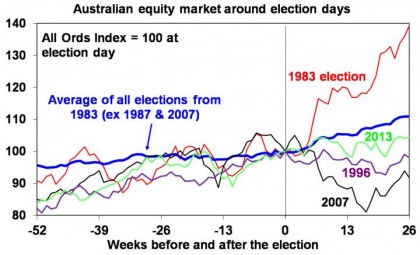
In terms of the share market, there is some evidence of it tracking sideways in the run up to elections, which may be because investors don’t like the uncertainty associated with the prospect of a change in policies. The next chart shows Australian share prices from one year prior to six months after federal elections since 1983. This is shown as an average for all elections (but excludes the 1987 and 2007 elections given the global share crash in late 1987 and the start of the global financial crisis (GFC) in 2007), and the periods around the 1983 and 2007 elections, which saw a change of government to Labor, and the 1996 and 2013 elections, which saw a change of government to the Coalition. The chart suggests some evidence of a period of flat lining in the run up to elections, possibly reflecting investor uncertainty, followed by a relief rally.


Source: Thomson Reuters, AMP Capital

However, the elections resulting in a change of government have seen a mixed picture. Shares rose sharply after the 1983 Labor victory but fell sharply after the 2007 Labor win, with global developments playing a role in both. After the 1996 and 2013 Coalition victories shares were flat to down. So based on historical experience it’s not obvious that a victory by any one party is best for shares in the immediate aftermath, and historically the impact of swings in global shares arguably played a bigger role than the outcomes of federal elections.

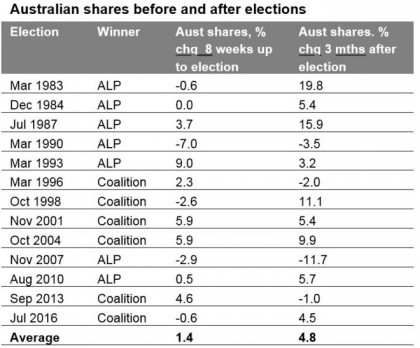
The next table shows that 9 out of the 13 elections since 1983 saw shares up 3 months later with an average gain of 4.8%.


(Based on All Ords index.) Source: Bloomberg, AMP Capital

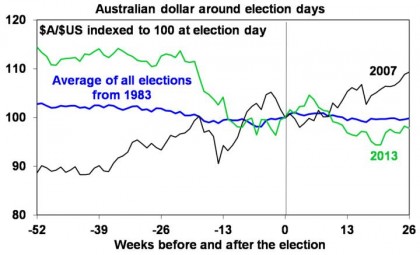
The next chart shows the same analysis for the Australian dollar. In the six months prior to Federal elections there is some evidence the $A experiences a period of softness and choppiness, which is consistent with policy uncertainty, but the magnitude of change is small. On average, the $A has drifted sideways to down slightly after elections.


Source: Thomson Reuters, AMP Capital

Political parties and shares

Over the post-war period shares have returned 12.7% pa under Coalition governments and 10.7% pa under Labor governments. It may be argued that the Labor governments led by Whitlam in the 1970s and Rudd and Gillard more recently had the misfortune of severe global bear markets and, if these periods are excluded, the Labor average obviously rises to 15.8% pa, although that may be taking things a bit too far. But certainly, the Hawke/Keating government defied conventional perceptions that conservative governments are always better for shares. Over the Hawke/Keating period from 1983 to 1996 Australian shares returned 17.3% pa, the strongest pace for any post-war Australian government.

Once in government, political parties are usually forced to adopt sensible macro-economic policies if they wish to ensure rising living standards and arguably there has been broad consensus on both sides of politics in recent decades regarding key macro-economic fundamentals – eg, low inflation and free markets.

Policy differences starker than since the 1970s

However, after narrowing in the 80s and 90s with the rationalist reform oriented agenda kicked off by Hawke and Keating, in recent years the policy differences between the Coalition and Labor have been intensifying again to the point that they are now arguably starker than they have been since the 1970s (when there used to be more of a focus around “class warfare”). In part this is consistent with rising interest in populist policies globally which in turn reflects angst over low wages growth, widening inequality, globalisation and automation. Each side of politics is now offering very different visions on the role and size of government. And so the policy uncertainty around this election is greater than usual.

The Coalition is focussed on containing government spending and encouraging economic growth via infrastructure spending, significant personal tax cuts (to return bracket creep and cap taxation revenue at its long term high of around 24% of GDP) and mild economic reforms.

By contrast Labor is focussed on spending more on health and education and in the process allowing the size of the public sector to increase. This is proposed to be funded by “tax increases” including:

  • cancelling the Coalition’s middle and upper income personal tax cuts scheduled for next decade and reimposing the 2% Deficit Repair Levy on incomes above $180,000;

  • restricting negative gearing to new residential property (and no other assets) and halving the capital gains tax discount from January 1 2020;

  • stopping cash refunds for excess franking credits;

  • and a 30% tax rate on distributions from discretionary trusts;

It’s not proposing to spend all the extra revenue this will raise with some earmarked for higher budget surpluses (ie paying down public debt). It’s also promising a sharp lift in the minimum wage towards being a “living wage”, some labour market re-regulation, far more aggressive climate policy (with a 45% reduction in emissions on 2005 levels by 2030, which is almost double the Coalition’s policy) and in relation to superannuation key changes are likely to include a resumption of the increase in the Super Guarantee, lower non-concessional contributions and a lower income threshold for the application of the 30% tax rate on super contributions. Intervention in the economy is likely to be higher under a Labor government.

Perceptions that a more left leaning Labor government will mean bigger government, more regulation and higher taxes and hence act as a drag on productivity and be less business friendly may contribute to more nervousness in shares and the $A than usual around this election. More specifically there are a number of risks:

  • There is a danger that relying on tax hikes on the “top end of town” will dampen incentive in that Australia’s top marginal tax rate of 47% is already high – particularly compared to our neighbours: 33% in NZ; 20% in Singapore; and 15% in HK. Australia’s income tax system is already highly progressive: 1% of taxpayers pay 17% of the total personal income tax take (with an average tax rate of 42%) & the top 10% pay 45% of tax compared to the bottom 50% who pay around 12% (with an average tax rate around 11%).

  • The proposed changes to franking credits even though they only impact around 8% of taxpayers are potentially a negative for stocks with high-franked dividends.

  • The proposed changes to capital gains tax and negative gearing have been estimated to cause a 5 to 12% decline in home prices & a boost to rents of 7 to 12%. This is risky as the property market is already weak. This could further impact construction/property stocks, banks & retail shares.

  • Higher minimum wages and some labour market re-regulation risk higher unemployment, a less flexible labour market and are a negative for hospitality and retail stocks.

  • The focus on economic reform needed to boost productivity looks to have fallen by the wayside in the face of populism – eg, why aren’t we considering injecting more competition into the health sector along with spending more on it?

That said there are some offsets in relation to ALP policies that investors need to allow for:

  • Some ALP policies may not pass the Senate, including those around negative gearing and repealing the middle & upper income tax cuts that have already passed into law.

  • Labor is planning bigger budget surpluses which is positive.

  • Labor policies encouraging “build to rent/affordable housing” are positive, but it’s unclear how much impact they will have.

  • Labor policies focussed on greater spending and tax cuts more targeted to lower saving low income earners may provide more of a short-term boost to economic growth.

  • Labor has a track record of taking sensible advice & responding quickly to help the economy in a crisis (think 1983 and in the GFC). In the short term, this could include a First Home Buyer grant to mute the property downturn.

Concluding comment

The now wider left right divide in Australian politics suggests greater uncertainty going into this election potentially affecting all asset Australian classes. But the bigger concern is the dwindling prospects for productivity enhancing reform, which could be an ongoing dampener on growth in living standards.


Source: AMP Capital 11 April 2019

Important notes: While every care has been taken in the preparation of this article, AMP Capital Investors Limited (ABN 59 001 777 591, AFSL 232497) and AMP Capital Funds Management Limited (ABN 15 159 557 721, AFSL 426455)  (AMP Capital) makes no representations or warranties as to the accuracy or completeness of any statement in it including, without limitation, any forecasts. Past performance is not a reliable indicator of future performance. This article has been prepared for the purpose of providing general information, without taking account of any particular investor’s objectives, financial situation or needs. An investor should, before making any investment decisions, consider the appropriateness of the information in this article, and seek professional advice, having regard to the investor’s objectives, financial situation and needs. This article is solely for the use of the party to whom it is provided and must not be provided to any other person or entity without the express written consent of AMP Capital.

My alarm is set to the song “Happy” by Pharrell Williams. It’s impossible to not smile when this song plays. This, combined with the other habits below, set the tone for a productive, happy and healthy day.

1. Drink A Glass Of Water As Soon As You Wake Up

This rehydrates your body, revs up your digestive system, and gets things flowing. You may notice positive changes like clearer skin and better digestion. Bonus points if you add a squeeze of fresh lemon juice or a teaspoon of apple cider vinegar.

2. Do Not Check Your Email Or Phone For At Least An Hour

Do you sleep with your cell phone next to you and grab for it first thing when you wake? This is not a good habit. If you choose to resist the temptation to check your email and Facebook feed until at least an hour after waking up, you’ll find that your mind is more clear, focused and happy.

3. Think Of One Thing For Which You Have Gratitude

This sets the stage for positivity throughout the day. If you come up with three or five things, even better.

4. Step Outside And Take A Deep Breath

Fill your lungs with fresh air. Even if it’s cold outside. This only takes 10 seconds! It reminds you that you are alive and breathing.

5. Move Your Body

You don’t necessarily have to do an intense workout before breakfast, but moving your body even a little is a great way to get the blood flowing and shake the body into wake-up mode. Simply doing a few stretches is a great option. Or turn on your favorite song and dance like no one is watching.

6. Take Time To Eat A Healthy Breakfast

Rather than reaching for a box of cereal, focus on getting real foods in your body. Eggs, soaked oats, and smoothies are all great options. (And they really don’t take that much time to prepare.) Try it out.

7. Say Your Affirmations

Look into the mirror and say something positive to yourself. Some ideas:

  • I radiate beauty, confidence and grace.

  • Every cell in my body is healthy and vibrant.

  • I feel great when I take care of myself.

Source : Foodmatters 2018 

Reproduced with the permission of the Food Matters team. This article was originally published at www.foodmatters.com/article/7-things-healthy-people-do-every-morning

Important:
This provides general information and hasn’t taken your circumstances into account.  It’s important to consider your particular circumstances before deciding what’s right for you. Although the information is from sources considered reliable, we do not guarantee that it is accurate or complete. You should not rely upon it and should seek qualified advice before making any investment decision. Except where liability under any statute cannot be excluded, we do not accept any liability (whether under contract, tort or otherwise) for any resulting loss or damage of the reader or any other person. 

Any information provided by the author detailed above is separate and external to our business and our Licensee. Neither our business, nor our Licensee take any responsibility for any action or any service provided by the author.

Any links have been provided with permission for information purposes only and will take you to external websites, which are not connected to our company in any way. Note: Our company does not endorse and is not responsible for the accuracy of the contents/information contained within the linked site(s) accessible from this page.

When share market volatility rises, more investors would make the mistake of concentrating too much on short-term movements in share prices.

Yet investors should never overlook that share-market returns are from both capital growth and dividends. Historically, dividends have made up a large proportion of the total returns from Australian shares.

Post-GFC dividend rewards

An illustration of how much dividends can contribute to total share returns is the performance of the Australian share market since the global financial crisis (GFC).

Once reinvested dividends are taken into account, the performance of the Australian share market following the GFC looks much stronger – even before allowing for franking credits on dividends:

  • The S&P/ASX 200 index (prices only) closed on March 13 this year almost 10 per cent below its pre-GFC closing high (reached in November 2007) yet 96 per cent above its GFC closing low.

  • By contrast, the S&P/ASX 200 total-return index (share prices plus reinvested dividends) closed on March 13 this year 50 per cent higher than its pre-GFC high.Critically, this total-return index is 205 per cent above its GFC low.

Grossed-up dividends

Franking credits – tax credits for corporate tax already paid by companies – make a valuable contribution to returns from Australian shares that investors may sometimes overlook. A fully-franked dividend of, say, 4 per cent grosses up for franking credits to 5.71 per cent.

Compounding dividends

The disciplined reinvestment of dividends – if possible, given an investor’s financial circumstances – magnifies their rewards. As Smart Investor regularly discusses, compounding occurs as returns are earned on past returns as well as your original investment.

Dividends as a volatility cushion

Your dividends can act as a volatility cushion. This is because dividends keep flowing from a diversified share portfolio as share prices fluctuate.

Dividends and your long-term focus

A way to help block out the distraction of daily movements in share prices is to remind yourself about the two sides to share-market returns, dividends and capital gains. This should assist you to remain focused on your long-term goals.

Dividend-chasing trap

While recognising the contribution that dividends make to an investor’s share-market returns, don’t fall into the trap of abandoning a carefully-constructed, well-diversified share portfolio in the pursuit of higher dividends. Being a dividend-chaser often involves investing in higher-risk, more-concentrated share portfolios.

Total-return investing

Finally, think about taking a total-return approach to investing for your overall investment portfolio. Total-return investing focuses on both the income and capital growth generated by an overall portfolio.

This approach should help maintain a portfolio’s diversification, allow more control over the size and timing of eventual portfolio withdrawals upon retirement, and increase a portfolio’s longevity.

Please contact us on Phone: 07 5641 4134 if you seek further discussion on this topic


Source : Vanguard 

Written by Robin Bowerman, Head of Corporate Affairs at Vanguard. 

Reproduced with permission of Vanguard Investments Australia Ltd.

Vanguard Investments Australia Ltd (ABN 72 072 881 086 / AFS Licence 227263) is the product issuer. We have not taken yours and your clients’ circumstances into account when preparing this material so it may not be applicable to the particular situation you are considering. You should consider your circumstances and our Product Disclosure Statement (PDS) or Prospectus before making any investment decision. You can access our PDS or Prospectus online or by calling us. This material was prepared in good faith and we accept no liability for any errors or omissions. Past performance is not an indication of future performance.

© 2019 Vanguard Investments Australia Ltd. All rights reserved. 

Important:
Any information provided by the author detailed above is separate and external to our business and our Licensee. Neither our business, nor our Licensee take any responsibility for any action or any service provided by the author.

Any links have been provided with permission for information purposes only and will take you to external websites, which are not connected to our company in any way. Note: Our company does not endorse and is not responsible for the accuracy of the contents/information contained within the linked site(s) accessible from this page.

While nearly half are sad to see their children move out, nine in 10 say they’re travelling more, with some even making cash from the extra space at home.

It’s usually inevitable your kids are going to grow up and one day move out of home. And, while research shows that women are generally more upset at the prospect of this than men are, the good news is many people report that once they come to terms with it, there are a number of upsides1.

These were the findings from The Empty Nesters report (the 14th instalment of The Australian Seniors Series), which revealed the best thing about kids leaving the nest, according to those who’d said goodbye, was parents had the place to themselves and (hooray) there was less cleaning up to do2.

Out of those surveyed, nearly 75% said they were also loving the extra time they had, while almost 70% said their financial position had changed for the better3.

If you’re still getting your head around the situation (maybe you’re one of the four in 10 feeling a bit sad or would’ve loved if your kids stayed at home for longer4), we explore the upsides more closely.

The financial benefits

According to the research, 70% of those whose kids had left home said they had more disposable income, with 68% saying they were in a better financial position and 56% saying they felt less guilty when it came to splashing out and spending a bit of money on themselves5.

Almost a third also said they had turned their children’s rooms into a space for short-term accommodation (earning an average of $1,632 in the last 12 months)6, or a place where they could indulge in their own hobbies or interests, which was also helping a number of seniors to make extra cash on the side (specifically $2,584 on average in the last 12 months)7. This extra money generally came from offering services on a freelance basis or selling collectibles and creations8.

The lifestyle benefits

In terms of the lifestyle benefits, about 41% of seniors whose children had left home were finding more time to exercise, with walking, going to the gym and golfing topping the list of people’s favourites, followed by swimming and yoga9.

Seniors’ social lives were also peaking, with nearly half of those surveyed saying they were spending more time hanging with mates, eating out and going to the movies10.

On top of that, over 90% of empty nesters were travelling more often and for longer periods of time in comparison to when their kids were living at home11.


1-11 Australian Seniors Series: Empty Nesters Data Report – September 2018 page 8, 11, 24, 14, 38, 35, 37, 37, 27, 28, 29

Source : AMP March 2019 

Important:
This information is provided by AMP Life Limited. It is general information only and hasn’t taken your circumstances into account. It’s important to consider your particular circumstances and the relevant Product Disclosure Statement or Terms and Conditions, available by calling Phone: 07 5641 4134, before deciding what’s right for you.

All information in this article is subject to change without notice. Although the information is from sources considered reliable, AMP and our company do not guarantee that it is accurate or complete. You should not rely upon it and should seek professional advice before making any financial decision. Except where liability under any statute cannot be excluded, AMP and our company do not accept any liability for any resulting loss or damage of the reader or any other person.