
About two-thirds of Australians are entitled to at least a partial age pension1, so most of us need to understand how it works and determine what role we want it to play in our retirement plan.

The age pension provides key benefits to retirees. It pays an income stream until death that is adjusted for inflation, providing a bulwark against poverty and higher prices in our later years.

Even though age pension benefits may sometimes be quite small, the fact that they continue until death can help manage the risk that you may live longer than planned for in retirement. For example, a male/female couple both aged 67 today has a 50 per cent chance that at least one of the couple makes it to age 90 and a 5 per cent (1 in 20) chance that one of them makes it to age 992.

Because the age pension is means tested and personal situations and goals vary so much, this is one of the occasions when it makes sense to consider using a financial advisor to help understand the rules and factor the age pension into your broader retirement financial plan.

To decide how much age pension you are entitled to receive, the government considers your assets and your income. The level of pension received is based on which of those means tests produces the lower benefit.

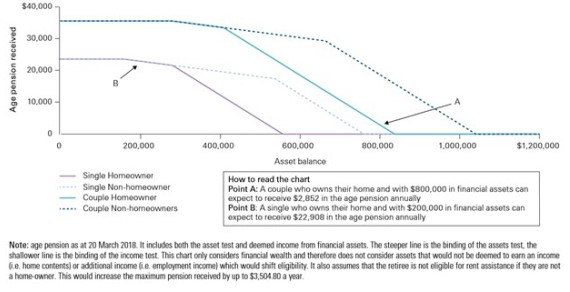
On a basic level, the lower your assets and income, the more age pension you will be entitled to as its role as a safety net kicks in up to the maximum amount of $843.60 a fortnight for a single pensioner and $635.90 each for a couple, as at March 2019.

A financial advisor experienced in the interaction of the social security and superannuation systems can help you understand how these rules work and in particular the key break points where benefits reduce.

As you can see from this chart, the benefits drop off quite steeply at certain asset levels.

Understanding the impact of wealth on the age pension received
An advisor can also help you make decisions about how these breakpoints interact with your financial goals.

For example, consider the couple at Point A in the chart. If they start drawing down their assets to increase their annual spending or make a one-off purchase, they will also increase their yearly age pension benefit. This might be a wise move for some couples but not for others. Let’s say this couple had identified leaving money to their children or setting aside funds for aged care as a financial goal. In those cases, the couple might do best to preserve and possibly grow, rather than spend, their assets, to achieve the goal.

Financial advisors can also guide you through other key considerations, including:

  • Rules on the treatment of annuities for means testing

  • Pension loan schemes to increase age pension using home equity

  • Links between age pension and related benefits, such as the Commonwealth Seniors Health Card

To learn more on the age pension and on creating financial security in retirement, check out our latest research on the topic.

Please contact us on Phone: 07 5641 4134 if you seek further assistance on this topic. 


1 According to the Australian Institute for Health and Welfare 
2 “The role of the Age Pension in your Retirement Plan,” p. 3.

Source : Vanguard April 2019

Source:

By Robin Bowerman, Head of Corporate Affairs at Vanguard.
Reproduced with permission of Vanguard Investments Australia Ltd

Vanguard Investments Australia Ltd (ABN 72 072 881 086 / AFS Licence 227263) is the product issuer. We have not taken yours and your clients’ circumstances into account when preparing this material so it may not be applicable to the particular situation you are considering. You should consider your circumstances and our Product Disclosure Statement (PDS) or Prospectus before making any investment decision. You can access our PDS or Prospectus online or by calling us. This material was prepared in good faith and we accept no liability for any errors or omissions. Past performance is not an indication of future performance.

© 2019 Vanguard Investments Australia Ltd. All rights reserved.

Important:
Any information provided by the author detailed above is separate and external to our business and our Licensee. Neither our business, nor our Licensee take any responsibility for any action or any service provided by the author.

Any links have been provided with permission for information purposes only and will take you to external websites, which are not connected to our company in any way. Note: Our company does not endorse and is not responsible for the accuracy of the contents/information contained within the linked site(s) accessible from this page.


If you’re looking for one of the easiest morning rituals to transform your health, look no further than a glass of filtered water with freshly squeezed lemon juice.

In addition to it being a delightfully refreshing drink, there’s a myriad of health benefits you’ll receive from this simple daily dose, whether you drink it warm or cold. Here are our top 9 life-changing health benefits of drinking lemon juice and water daily.

9 Health Benefits of Lemon Water

1. It’s Full of Antioxidants and Antibacterial Properties

Lemon water is a great source of plant compounds known as flavonoids, many of which have antioxidant properties. Consuming this wonder drink each morning can help protect your cells from damage, support your blood circulation, insulin sensitivity and other aspects of metabolic health.

2. Supports the Immune System

Rich in vitamins and minerals including Vitamin C and B-complex, riboflavin, iron, calcium, magnesium, copper, folate and potassium, lemon water supports immune function, allergy alleviation and stopping free radical damage.  With an extremely high level of Vitamin C (187% of the daily value) it’s also a superinfection fighter.

Taking a glass of lemon water every day can protect you from falling ill and can help you more quickly recover from colds, coughs, sore throats, ear infections and even more serious conditions such as arthritis, heart disease, diabetes, autoimmune disorders, and cancer.

3. Reduces Inflammation

Lemons contain hesperidin, which inhibits inflammation and the production of reactive oxygen species (ROS), according to a study from Mediators of Inflammation.

The reason we want to keep inflammation low is due to the potential havoc it can cause in our body. Inflammation is associated with most diseases, including diabetes, obesity, cardiovascular, neurogenic, arthritis and macular degeneration, inflammation reduction should be a priority for most people.

4. It Contains Anti-Cancer Properties

Studies have shown that lemons could potentially be beneficial in the treatment of cancer and breast cancer patients undergoing chemotherapy.  

Limonene, found in lemons, is effective in blocking both the initiation of cancer as well as progression and induced regression of existing tumors according to studies of animal models.

5. A Great Detoxing Tonic

Lemon juice is a wonderful tonic that can help to cleanse the entire body by gently detoxing the liver and supporting bile production and flow for better removal of neutralized toxins and waste. This can improve many functions in the body but can also deliver glowing skin.

A more intense detox that involves halting the consumption of all solid food for a few days and solely consuming lemon water has been observed to trigger an anti-aging mode in cells and can jumpstart the system to improve insulin sensitivity.

6. It Helps The Body Maintain a Balanced pH

Although acidic in taste, lemon juice becomes alkaline inside the body, and an alkaline body is important to good health.

Excess acids lead to inflammation, an over-active immune system, candida overgrowth, chronic fatigue, poor digestion, weight gain and more.  By fuelling our body with pH balancing foods we give it those nutrients it needs to thrive, and in return, it will make you feel amazing.

7. Contains Beneficial Acids

The body often needs compounds that can only be derived from foods, such as pantothenic acid (Vitamin B5) and folates which lemons provide.  Pantothenic acid is very important as it helps to convert the food you eat into energy.

Lemons also provide citric acid that aids in digestion as well as dissolving kidney stones, and of course ascorbic acid (Vitamin C) which boosts the immune system.

8. Can Improve Blood Pressure Control

A 2014 study found researchers linking regular lemon intake in conjunction with walking with better blood pressure regulation.

Results are thought to be linked with the citric acid found in lemons and their impact on magnesium absorption and improvement of calcium.

9. Supports Fresh Breath and Fights Bacteria

The citric acid in lemons encourages the salivary glands to produce more saliva, which is the mouth’s natural defense against bacteria and bad breath, it also supports better digestion!

Lemons are known to help destroy putrefactive bacteria in the mouth and intestines which can help alleviate flatulence, indigestion, and constipation.

How Do I Make Lemon Water?

The amount of lemon you put in your lemon water is up to your personal preference and you may wish to add some mint, cucumber slices or honey for added flavor. Some people use cold water, room temperature or even hot water, all of which produce great health benefits.

Personally, I have the juice of one lemon in 500mL of lukewarm filtered water first thing in the morning on an empty stomach. This is when you’ll feel the most benefits. Here’s a simple recipe to get you started if you are just a beginning to lemon water: 

INGREDIENTS

  • 1/2 lemon 

  • 16 ounces room temperature or warm filtered water 

METHOD 

  1. Squeeze half a lemon into 16 ounces of water and drink in the morning. You can also drink more throughout the day to flush and hydrate the body.

Source : Food Matters

Reproduced with the permission of the Food Matters team. This article by James Colquhoun was originally published at www.foodmatters.com

Important:
This provides general information and hasn’t taken your circumstances into account.  It’s important to consider your particular circumstances before deciding what’s right for you. Although the information is from sources considered reliable, we do not guarantee that it is accurate or complete. You should not rely upon it and should seek qualified advice before making any investment decision. Except where liability under any statute cannot be excluded, we do not accept any liability (whether under contract, tort or otherwise) for any resulting loss or damage of the reader or any other person. 

Any information provided by the author detailed above is separate and external to our business and our Licensee. Neither our business, nor our Licensee take any responsibility for any action or any service provided by the author.

Any links have been provided with permission for information purposes only and will take you to external websites, which are not connected to our company in any way. Note: Our company does not endorse and is not responsible for the accuracy of the contents/information contained within the linked site(s) accessible from this page.

There are ways you can help your children by encouraging positive behaviour when it comes to their personal finances.

We all love our children. So it can be tough to admit they may not be great with money. But be honest, do any of these ring a bell?

  • They keep running out of money before their pay cheque comes in.

  • They keep ‘borrowing’ money from you and others, and failing to pay it back.

  • They have maxed out a bunch of credit cards.

  • They have a bad credit history as a result of not paying back loans.

  • They keep getting involved with ‘get rich quick’ schemes that end up losing them money.

If any of these seem familiar, is there anything you can do to help your children develop healthier financial habits?

How to turn off the money tap

It’s only natural to want to help your kids with big ticket items to give them a good start in life—particularly in an era when tuition fees and house prices make higher education and owning a home less affordable than in previous generations.

But it can be difficult to know when to start turning off the tap. If you have an adult child who isn’t very good with money, then giving them funds with no strings attached might not be the best approach. You might end up enabling their behaviour rather than encouraging better money habits.

Regardless of whether your adult kids still live at home, have moved out or are boomeranging back and forth, it’s never too late to start encouraging positive money habits that will help them save, spend and invest more wisely.

Here are some things you could consider to change the money dynamic in your family.

1. Start with the difficult conversation

If you’re determined to change the dynamic, it’s important to make this clear from the get-go. Sit down in a neutral venue and have an honest discussion. Explain what you’re going to do differently and why. It might not be an easy conversation. But in the long run it could help to clear the air and encourage a fresh approach. If your children are still living at home you’ve got the opportunity to set new ground rules like agreeing on a set amount out of their pay cheque every week for bed and board.

2. Ditch the gifts

If you’ve found in the past that gifting money doesn’t solve their problems long term, then you could try another approach. One option could be loaning them money in instalments, with future amounts dependent on achieving specific goals like saving for their first home, perhaps through the First Home Super Saver Scheme. Another approach could be matching their savings when they reach a pre-determined amount.

3. Focus on goals (short and long-term)

Talk to your children about their life goals. What do they want to do…travel the world? Buy a new car? Save up for a new home? Be open about money and talk about ways to save and invest. Short-term, an everyday bank accounts can help them set aside money to help them reach their goals.

You can also get your kids thinking long term about how their savings could be working better for them. These days if you want to invest, you don’t necessarily need a hefty starting figure or to fill in tedious reams of paperwork. From exchange traded funds to micro-investing platforms, there are plenty of online, digital ways to start small but think big.

4. Focus on the basics like debt

Like many of us in Australia, your kids may not have received a great education about finance. So when they think about borrowing money, they may not have much of a grasp of the difference between ‘good debt’ and ‘bad debt’. It could be worth explaining the difference between borrowing money for a car and for a house—once you’ve paid it back, what are you left with? A car that may have shed 75% of its value or a house that’s probably improved its value and most importantly provided a home to retire in?

5. Walk the walk

Your approach to your own finances can make a difference. If your kids see you splurging money without a real budget then they may feel it’s OK to do the same. Creating a budget doesn’t need to be time consuming .

Please contact us on Phone: 07 5641 4134 if you seek further assistance on this topic .

Source : AMP May 2019 

Important:
This information is provided by AMP Life Limited. It is general information only and hasn’t taken your circumstances into account. It’s important to consider your particular circumstances and the relevant Product Disclosure Statement or Terms and Conditions, available by calling Phone: 07 5641 4134, before deciding what’s right for you.

All information in this article is subject to change without notice. Although the information is from sources considered reliable, AMP and our company do not guarantee that it is accurate or complete. You should not rely upon it and should seek professional advice before making any financial decision. Except where liability under any statute cannot be excluded, AMP and our company do not accept any liability for any resulting loss or damage of the reader or any other person.

Despite falling business and consumer confidence since the start of the year, the Australian economy remains in positive territory and moderating economic conditions notwithstanding, commercial real estate assets should continue to perform this year and into the future, buoyed by strong underlying fundamentals.

On a state-by-state basis, economic growth is no longer confined to the service-led economies of Melbourne and Sydney. Recovery is now beginning in the mining states, with Brisbane entering a sustained period of recovery, although economic growth in Perth remains low. This dynamic should now start to flow through to real estate assets.

Different strokes for different states

The new economy states of Victoria and New South Wales are being powered by high-value services and migration-driven population growth. This will continue to underscore demand for office and logistics real estate.

It’s early days for Queensland and Western Australia’s economic recovery. But the office and retail sectors should benefit as the economic backdrop improves, with industrial real estate assets already enjoying the uptick in mining export volumes, which is creating renewed demand for storage and transport space.

However, lack of supply is driving investors to alternative real estate assets. For instance, more investors are interested in real estate debt. The move by investors up the risk curve into alternative assets suggests we are in a new cycle, one in which markets are more focused on how assets perform versus capital inflows.

Technology a game-changer

New business models, for instance the rise of flexible working, have challenged the way real estate is valued and managed. In this environment, owners of older assets must consider how they may need to be repositioned in light of trends such as co-working and omni-channel marketing shaping the way businesses use offices and other commercial buildings.

The average Australian office asset is 30 years’ old, and buildings constructed in the 1990s were not designed to support flexible working spaces and wellbeing initiatives, which place new demands on buildings. Next-generation assets, which are designed for more agile use, will provide new opportunities for investors in the medium-to-long term.

Economic conditions suggest sufficient demand to support the increasing pipeline of developments – particularly in the office and industrial sectors. However, there are risks to retail assets, especially those with limited scope for redevelopment and centres in secondary locations. Based on our analysis of markets such as the US, successful retail performance in a period of increased competition rests on providing customer value through experience and convenience.

The short-to-medium term outlook for total returns will favour assets that can generate strong income returns, which are less reliant on capital expenditure and are attuned to changing trends in technology, demographics and urbanisation.

Markets showing income growth potential

Growth cycles typically favour core markets, but these rules don’t necessarily apply during times of technological disruption and global economic transition. As such, the definition of what constitutes a core asset will need to change to take a more inclusive view on flexibility, amenity and technology infrastructure, as tenants’ needs evolve.

Online retailing is generating significant upside for the industrial sector, which is seeing heightened investor interest from long-term, institutional investors. 
In tandem, retail tenants that have been associated with Australia’s highly stabilised retail sector in non-discretionary categories such as fresh food are now shifting more of their sales online via distribution centres, creating the potential for long term, stable, recession-proof cash flows for investors. This follows a similar trend in the US and Europe, where online spending is more than double the Australian spending rate.

Office assets are benefitting from strong demand from the technology sector, as these businesses increase their workforce and as international entrants look for locations in Australia and landlords can expect attractive conditions in the local commercial real estate sector for some time to come.

Source : AMP CAPITAL May 2019

Important notes

While every care has been taken in the preparation of this article, AMP Capital Investors Limited (ABN 59 001 777 591, AFSL 232497) and AMP Capital Funds Management Limited (ABN 15 159 557 721, AFSL 426455)  (AMP Capital) makes no representations or warranties as to the accuracy or completeness of any statement in it including, without limitation, any forecasts. Past performance is not a reliable indicator of future performance. This article has been prepared for the purpose of providing general information, without taking account of any particular investor’s objectives, financial situation or needs. An investor should, before making any investment decisions, consider the appropriateness of the information in this article, and seek professional advice, having regard to the investor’s objectives, financial situation and needs. This article is solely for the use of the party to whom it is provided and must not be provided to any other person or entity without the express written consent of AMP Capital.

After taking a back seat over the last six months as negotiations appeared to make progress the US/China trade war is back on with the President Trump – “tariff man” – ramping up tariffs on Chinese imports again and threatening more and China moving to retaliate. This note takes a simple Q & A approach to the key issues.


What is a trade war?

A trade war is where countries raise barriers to trade with each other (such as tariffs or quotas on imports or subsidies to domestic industries) usually motivated by a desire to “protect” domestic jobs often overlaid with (or dressed up by) “national security” motivations. To be a “trade war” the barriers need to be significant in terms of their size and the proportion of imports covered. The best known global trade war was that of 1930 where average 20% tariff hikes on US imports led to retaliation by other countries and contributed to a plunge in world trade.

What is so good about free trade and wrong with protectionism?

A basic concept in economics is comparative advantage: that if Country A and B are both equally good at making Product X but Country B is best at making Product Y then they will be best off if A makes X and B makes Y. Put simply free trade leads to higher living standards and lower prices whereas restrictions on trade lead to lower living standards and higher prices.

It often strikes me as perverse that some want to protect local industry, but they don’t buy local themselves. The experience of heavily protecting Australian industry in the post WW2 period was that it was just leading to higher prices and lower quality products and Australians were voting with their wallets to buy better value foreign made goods anyway. We and many other countries started to realise this in the 1980s and so cut protection. We might have protected lots of manufacturing jobs if we stayed at the levels of protection of 45 years ago, but we would have become a museum piece as would the US.

Fortunately, despite the loss of jobs in manufacturing (from 25% of the workforce in 1960 to around 8% now) other jobs have come along in the services sector where Australia’s and America’s relatively highly-skilled but highly-paid workforce have a comparative advantage compared to workers in less developed countries.

In short, if you want to support your country’s products buy them, but trade barriers don’t work.

Why is President Trump raising tariffs then?

It’s basically about fulfilling a presidential campaign commitment to “protect” American workers from what he regards as unfair trading practices in countries that the US has a trade deficit with – notably China. And he knows this is popular with his supporters but there is also some degree of bi-partisan support for taking on China.

What does President Trump want?

While it’s been feared at times that Trump was willing to get into trade wars with any country that the US has a trade deficit with his main focus is China. Basically he wants China to lower its tariffs, allow better access for US companies, end US companies being forced to hand over their technologies and protect intellectual property of US companies. At a high level he wants a reduction in America’s trade deficit with China. Along the way he has renegotiated the NAFTA free trade agreement with Mexico and Canada and the free trade deal with South Korea and is in talks with Europe and Japan.

Where are we now?

Fears of a global trade war were kicked off in March last year with Trump’s announcement of a 10% tariff on aluminium imports and a 25% tariff on steel imports. US allies were subsequently exempted but China was not. On March 22 Trump announced 25% tariffs on $US50bn of US imports from China. These were implemented in July and August. After Chinese retaliation Trump announced a 10% tariff on another $US200bn of imports from China (implemented in September) which would increase to 25% on January 1 this year. The latter was delayed to March 1 in response to trade talks and then was delayed further as the talks made progress.

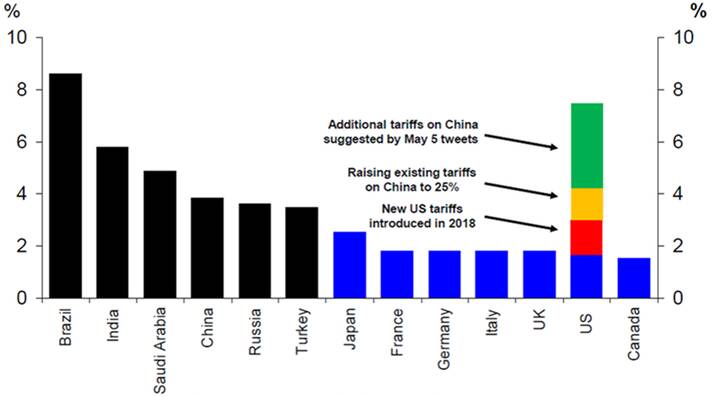
Last year’s tariff increases took the weighted average tariff across all imports to the US from around 1.8% to around 3% which took the US above the developed country average of around 2% but not dramatically so.

However, on May 10 the delayed tariff hike from 10% to 25% on $US200bn of imports from China was put in place and the US kicked off a process to tariff the remaining roughly $US300bn of imports from China at 25%. If fully implemented this would take the average US tariff rate on imports to around 7.5%, which is significant (albeit minor compared to the 20% tariff hikes of 1930.) See the next chart.

Average weighted tariff rate across all products


click to enlarge

Source: World Bank, Deutsche Bank Research

Along the way China has retaliated with a 10% tariff on $US60bn of imports from the US and in response to the latest move has announced this will be raised to as high as 25%. Its retaliation has been less than proportional partly reflecting lower imports from the US but it has also so far refrained from retaliating via other means such as selling US bonds (possibly because it could just depress the $US) and making life tougher for US companies.

At the same time the US is considering auto tariffs after a report lodged in February. A decision is due by May 18 but could be delayed given talks with the US and Japan.

What happened to the US/China trade talks?

Up until a week or so ago the trade talks were reportedly going well – with key elements reportedly agreed and only disagreement remaining about when tariffs would be removed and enforcement. But President Trump’s May 5 tweets announcing a resumption of tariff hikes with more to come was supposedly in response to China back tracking on what had been agreed. There has been much speculation about what happened: maybe negotiators agreed more than was politically acceptable to China’s leadership, maybe China saw it as two big a step down given Trump’s often perceived insulting approach, maybe they misjudged what he would agree to, maybe Trump’s resort to threats is just more “Art of the Deal” stuff to get what he wants and to prove that he is standing up for his base. Who knows for sure! But it’s likely that both sides may have become emboldened by better economic data and share markets this year, and so have decided to take risks again. Ongoing or rising tensions around Huawei, North Korea, Iran (with the US ending sanction waivers on China importing Iranian oil) and Taiwan are probably not helping the issue either.

What will be the economic impact?

Contrary to President Trump’s assertions China is not paying the tariffs being collected on imports from China. China will ultimately suffer if there is less demand for its exports but most of the cost is borne by US businesses or passed on to consumers. Taxing all US imports from China at 25% would be a big deal compared to last year’s tariffs and see the impact shift to largely consumer goods as opposed to industrial and intermediate goods in the first tariff rounds. Which in turn could add around 0.2% to core inflation and detract up to 0.75% from US GDP particularly as investment gets hit in response to uncertainty about supply chains. Given the flow on to slower global growth (which is where Australia could be impacted), hopefully the latest tariff hikes will be short-lived and the extra tariffs will be avoided.

What is the most likely outcome?

Our base case remains that the US and China will ultimately reach a deal to resolve the issue before too much damage is caused – once both sides refocus on the economic costs of slower growth, higher consumer prices and potentially rising unemployment. This is particularly relevant for President Trump given his desire to get re-elected next year as rising prices at Walmart and rising unemployment will drive a backlash. However, things could still get worse before they get better.

Why have share markets reacted relatively calmly? Can it last?

Since President Trump’s tweets announcing a resumption of the trade war, US and global shares have fallen about 4.5% and Australian shares have lost 1.7%. Chinese shares have been hit harder reflecting their greater vulnerability. But overall the falls have been benign compared to last year’s sharp falls (and they followed a sharp rebound so far this year). This likely reflects a combination of: investor optimism of a deal to resolve the issue; last years’ experience where the worst case fears of tariff hikes did not come to pass; hopes for more Chinese economic stimulus to offset the negative impact; and perceptions that the Fed is more supportive of growth now compared to last year when it was more worried about inflation. Australian shares have also been helped by their high exposure to defensive high yield stocks and ongoing strength in the iron ore price.

While our view remains that a deal will ultimately be reached and that this will see shares end the year higher than they are now, the risks have ramped up again after the setback in the talks and the associated loss of trust on both sides so investors need to allow that the trade war could again get worse before it gets better risking further short-term weakness in share markets. In fact, sharper share market falls may be needed to remind the US and China of the need for a deal.

What does it all mean for Australia?

Fortunately, Australian’s aren’t having to pay higher taxes on imports like Americans, but the main risk is that we are indirectly affected if the trade war is not quickly resolved and this drags down global growth weighing on demand for our exports leading to unemployment pushing higher than our 5.5% forecast for year end. The risk of this adds in turn to pressure on the RBA to cut interest rates, although we think they will do that anyway.

What to watch?

Key to watch for will be a continuation of trade talks. So far, the indications are mixed. The June 28 G20 meeting in Tokyo may be critical in terms of providing an opportunity for Trump and Xi to get negotiations back on track, with Trump saying that they will meet.

Please call us on |PHONE if you would like to discuss.


Source: AMP Capital 13 May 2019

Important notes: While every care has been taken in the preparation of this article, AMP Capital Investors Limited (ABN 59 001 777 591, AFSL 232497) and AMP Capital Funds Management Limited (ABN 15 159 557 721, AFSL 426455)  (AMP Capital) makes no representations or warranties as to the accuracy or completeness of any statement in it including, without limitation, any forecasts. Past performance is not a reliable indicator of future performance. This article has been prepared for the purpose of providing general information, without taking account of any particular investor’s objectives, financial situation or needs. An investor should, before making any investment decisions, consider the appropriateness of the information in this article, and seek professional advice, having regard to the investor’s objectives, financial situation and needs. This article is solely for the use of the party to whom it is provided and must not be provided to any other person or entity without the express written consent of AMP Capital.

Are you contributing enough to super? Recent research highlights the reality that most members of large super funds do not make voluntary contributions.

How Australia Saves 2019, a collaboration between Vanguard and three major funds – First State Super, Sunsuper and VicSuper – examines how over 2.3 million members of these funds managed their super, including contributions, over the three years to June 2018.

In 2017-18, just 12 per cent of members receiving compulsory superannuation guarantee (SG) contributions made additional voluntary contributions – an almost identical percentage over the three years covered by the research.

This underlines the importance of Australia’s SG contributions to retirement savings as well as the need for members to consider making voluntary contributions when possible. (The current SG rate, payable by employers, is 9.5 per cent of salaries.)

How Australia Saves reports that 8 per cent of working members receiving compulsory contributions into these funds during 2017-18 made salary-sacrificed contributions. Just 3 per cent of members also made non-concessional (after-tax) contributions while 1 per cent made both non-concessional and salary-sacrificed contributions.

Members making voluntary contributions in addition to compulsory contributions had a much higher median age, income and length of fund membership than members relying solely on compulsory contributions.

A message from this research is that super fund members should understand what steps they can take to boost their super savings – depending upon their personal circumstances.

Salary-sacrificed contributions

For most employees, perhaps the most straightforward way to save more in super is to begin making salary-sacrificed contributions. And members already making these contributions can consider whether to “sacrifice” more into super each pay day if affordable.

As with all concessional (before-tax) contributions, salary-sacrificed contributions are not taxed at a member’s personal tax rate but are taxed at 15 per cent upon entering a super fund. Typically, this is a valuable tax savings.

Making salary-sacrificed super contributions is a simple and disciplined way to save. First confirm the impact of salary sacrificing with your employer (in some instances, it may reduce the amount of SG your employer is obligated to pay on your behalf) and if it suits, tell your employer how much you want to regularly contribute. And think about increasing the amount of the regular contribution at least once a year or whenever you get a pay rise.

Keep in mind that the annual concessional contributions cap for all eligible super fund members is currently $25,000. (This cap covers compulsory SG contributions, salary-sacrificed contributions, and personally-deductible contributions by eligible self-employed individuals and investors.)

After-tax contributions (including inheritances)

Astute super members look for opportunities to contribute more to super as non-concessional (after-tax) contributions – may be after they receive an inheritance or sell a non-super investment such as a rental property.

Being ready to make extra personal contributions whenever extra money becomes available is a smart approach to quickly increasing retirement savings.

Again, take care not to overshoot the contribution caps. (The standard annual non-concessional contributions cap is $100,000 for 2018-19. Fund members under 65 have the option of bringing forward non-concessional contributions to $300,000 over three years, depending upon their total super balance. The latest Federal Budget proposes to increase the age limit for bring-forward contributions from 2020-21.)

Please contact us on Phone: 07 5641 4134 if you seek further assistance on this topic.


Source:

By Robin Bowerman, Head of Corporate Affairs at Vanguard.

Reproduced with permission of Vanguard Investments Australia Ltd

Vanguard Investments Australia Ltd (ABN 72 072 881 086 / AFS Licence 227263) is the product issuer. We have not taken yours and your clients’ circumstances into account when preparing this material so it may not be applicable to the particular situation you are considering. You should consider your circumstances and our Product Disclosure Statement (PDS) or Prospectus before making any investment decision. You can access our PDS or Prospectus online or by calling us. This material was prepared in good faith and we accept no liability for any errors or omissions. Past performance is not an indication of future performance.

© 2019 Vanguard Investments Australia Ltd. All rights reserved.

Important:
Any information provided by the author detailed above is separate and external to our business and our Licensee. Neither our business, nor our Licensee take any responsibility for any action or any service provided by the author.

Any links have been provided with permission for information purposes only and will take you to external websites, which are not connected to our company in any way. Note: Our company does not endorse and is not responsible for the accuracy of the contents/information contained within the linked site(s) accessible from this page.

Dividends but no real investment

One of the simplest yet most effective investment scams is the ponzi scheme. The promoter promises investors a return on investment and says it is secure, but there is no real ‘investment’.

The promoter convinces people to invest with their scheme. They then use the money deposited by early investors to pay the first ‘dividend’ until investors feel comfortable and decide to invest more. Some investors then encourage their family and friends to join. Eventually the scheme falls apart because the promoter starts to spend the money too quickly or the pool of investors dries up.

Here are tips on how to pick a ponzi scheme from a real investment.

Warning signs of a ponzi scheme

  • The rate of return is sometimes suspiciously high (maybe as high as 10% per month or 120% per year)  – but it can also be just the usual rate of return

  • The person who tries to recruit you is someone you think is trustworthy, like a neighbour or someone in your church or community group

  • The recruiter may have already invested in the scheme and received great dividends

Read ASIC’s media releases about the conviction of ponzi operator Chartwell Enterprises, and a penalty and ban issued to ponzi ‘mastermind’ David Hobbs

Case study: Maria invests through a friend

First-time investors Maria and Jason borrowed $70,000 to invest in the overseas money market after a recommendation by their friend of 40 years, Steve.

Steve told them their investment would involve no risk at all, as it was guaranteed by the Bank of America. He said they could withdraw their capital at any time after the first 12 months. The return promised on the investment was fantastic (26% per year on their initial investment). Steve helped the couple arrange to borrow the $70,000 they would invest.

But the scheme was not real – they were caught up in a ponzi scheme. Part of the money they and other early investors deposited was used to pay their first dividend cheques. When the money for dividends dried up, Steve said that it was due to the interference of ASIC. This was one of many false stories fed to the investors by Steve, to keep them onside.

Jason and Maria were angry with ASIC as they thought the organisation was ruining their chances of making money from their investment. They wanted to believe Steve, as they didn’t want to think they had lost all their money, and he was an old friend.

When the truth eventually came out that the scheme wasn’t real, Maria and Jason, along with the other investors, assisted ASIC’s investigation and prosecution of Steve and his business partner — who spent more than 2 years in jail.

Maria and Jason lost their $70,000 and ended up having to pay off the loan. When Jason’s mother died, his inheritance was completely swallowed up by the $70,000 debt plus interest. 

Jason and Maria are now very wary, and warn others to get a second opinion from a licensed financial adviser before investing in anything.

This is a true story – only the names of the investors have been changed at their request.

Where do ponzi schemes operate?

Operators of unlawful investment schemes sometimes target community groups, like churches, to find victims. In some cases, members of the community group innocently encourage others to put money into the illegal scheme.

This means that when the scheme collapses, not only do the investors lose their money, but relationships break down between friends, neighbours or community group members.

Ponzi schemes targeting Thai communities

ASIC Victorian Regional Commissioner Warren Day talks to SBS about how members of the Australian Thai community are falling victim to Ponzi scams operated through Facebook.

Warren Day interview on SBS (23 mins)

How long can the scheme last?

If the promoter of the scheme is disciplined about how much money is left in the account to pay ‘dividends’, the scam can go on for many years. Ponzi schemes only require a few people in their early stages to be successful.

How ponzi schemes work

An example of how a ponzi scheme works is shown in the table below. In January, the promoter convinces Katie to invest $100,000 in his scheme. The promoter then pays Katie $10,000 each month using Katie’s own money.

As Katie receives $10,000 each month she doesn’t suspect anything is wrong, and happily recruits friends and work colleagues to invest, too. After 3 months, Katie’s neighbour Adam decides to invest $100,000 after hearing about Katie’s great returns.

After both Katie and Adam have invested their savings, the returns continue to come in April. But in May they don’t hear anything from the promoter. They try to contact him but his number has been disconnected.

The promoter has taken off leaving two devastated people in his wake. Katie lost $70,000 and Adam lost $90,000. The promoter got $160,000 out of the scheme.

This is example has only two victims but in reality these schemes can have dozens or even hundreds of victims.

Katie and Adam invest in a ponzi scheme

Month Katie Adam
January Invests $100,000
February $10,000 returned
March $10,000 returned Invests $100,000
April $10,000 returned $10,000 returned
May No contact No contact

What to do if you have invested in a ponzi scheme

  1. Stop investing any more money

  2. Check if the company is on our list of companies you should not deal with

  3. Check the company’s licence number on ASIC Connect’s Professional Registers.

  4. Report the scam to ASIC

ASIC may be able to prosecute the ponzi scheme operators if they are operating in Australia. ASIC may also be able to issue an alert about the scheme. You should also warn your family and friends, to stop them from becoming victims.

The biggest telltale sign of a ponzi scheme is the suspiciously high rate of return. That old saying applies here: if it sounds too good to be true, it probably is.

Before you invest in any scheme, do independent checks to see how the returns are really going to be made. Don’t just trust the word of the person selling you the scheme.

 Please contact us on Phone: 07 5641 4134 if you seek futher assistance .  

Source:

Reproduced with the permission of ASIC’s MoneySmart Team. This article was originally published at www.moneysmart.gov.au

Important note: This provides general information and hasn’t taken your circumstances into account.  It’s important to consider your particular circumstances before deciding what’s right for you. Although the information is from sources considered reliable, we do not guarantee that it is accurate or complete. You should not rely upon it and should seek qualified advice before making any investment decision. Except where liability under any statute cannot be excluded, we do not accept any liability (whether under contract, tort or otherwise) for any resulting loss or damage of the reader or any other person.  Past performance is not a reliable guide to future returns.

Important
Any information provided by the author detailed above is separate and external to our business and our Licensee. Neither our business, nor our Licensee take any responsibility for any action or any service provided by the author.

Any links have been provided with permission for information purposes only and will take you to external websites, which are not connected to our company in any way. Note: Our company does not endorse and is not responsible for the accuracy of the contents/information contained within the linked site(s) accessible from this page.
If you’re moving out of the family home for the first time, here’s what you need to think about.

So the time has come to think about moving out of the family home.

It’s a big step…take a second to imagine what it will feel like. Playing your music as loud as you want. House guests who can come and go as you please. Your very own remote control.

But hang on…there’s the washing to consider. And cooking dinner every night. And the bills to pay.

Moving out of home for the first time is exciting. But with freedom comes responsibility. You’re on the hook for a lot of stuff your parents might have been covering, from your nightly entertainment on the goggle box to simply paying for the water that comes out of the taps.

And as well as going solo with all the drudge work like cooking, washing and cleaning, the financial implications of independent living can come as a bit of a shock.

You might be surprised at the number of essentials your parents subsidised over the years. It’s not just keeping them sweet with $50 towards the weekly groceries. It’s everything from the electricity bill to home repairs to running a car.

Checklist when you’re moving out of your parents’ home

If you’re looking to fly the nest, here’s a quick checklist to help you get to grips with life in the big wide world.

1. You might need to land your first full-time job.

To secure an interview, it could be a good idea to review your resume (CV) to make sure it accurately reflects and presents your experience and potential. Check out this helpful guide to grabbing the reader’s attention in six seconds. And as always, be sensible with social media and don’t upload anything that is going to cruel your chances with future employers. Once you’re at the interview you’d be amazed at how much difference the simple things make.

  • Arrive with plenty of time to sit down and prepare for what you’re going to say.

  • Add some colour to what you plan to wear to stand out—but not too much so you’re over-dressing.

  • Prepare a few answers to the most important topics as interviewers often repeat the same question1.

2. You might need to find your first apartment.

If you’re looking to rent, make sure you read the small print of your contract so that you know your rights and obligations.

  • How much notice does your landlord need to give to turf you out?

  • And how much notice do you need to give if you want to move on?

  • Have you met your prospective housemates if you’re looking at a shared house?

  • What are your rights – will the landlord cover repairs and maintenance?

  • Can you move your pet cat in or redo the bedroom colour scheme?

  • What’s the process for paying the rent and what happens if you’re late?

3. You might need to furnish your pad.

Maybe your parents or other family members are keen to get rid of some old furniture. Alternatively, it’s amazing what you can find on eBay and Gumtree at knockdown prices. It doesn’t need to be in mint condition…you’re furnishing your first pad, not auditioning for The Block.

4. You might need to set up a broadband contract.

Until now you might have benefited from your parents’ telco setup. But now you might need to open your own home internet and telco account for the first time. While a landline might be a bit old school, super-fast broadband these days is seen as a necessity and doesn’t always come cheap. Try shopping around and seeing if you can bundle your broadband with your existing mobile phone plan. And it doesn’t stop at broadband. You might need to work out if Netflix, Stan or Foxtel is a necessity or a luxury you can live without…or share the costs with your housemates or partner.

5. You might need to own a car for the first time.

It’s great if you can commute to work by public transport but not everyone is near a train station, a bus stop or a bike path. The reality is that you may need to get around in your own car. If you’re buying a car, make sure the vehicle is roadworthy so you don’t have any nasty surprises. You can always negotiate on price or walk away so don’t feel rushed into buying a lemon. And running a car doesn’t come cheap. Rego, insurance, fuel, repairs, maintenance…it all needs to be paid for so make sure you factor it into your budget.

6. You might need to connect and pay for utilities.

It could depend on your rental contract but you may have to cover utilities like water, gas and electricity – all the boring stuff but kinda necessary for a functioning household. In your parents’ day, there was generally one option for utilities…it wasn’t the Soviet Union but it was close. These days there are plenty of plans out there so there’s no excuse for not shopping around for the best deal.

7. You might need to budget for groceries for the first time.

Even if you’ve been helping the olds with the weekly shopping, it could come as a shock to cover your entire grocery bill for the first time. Look out for specials at the supermarket and stock up on staples when they’re cheap. You might want to think about cutting down on takeaways and having friends round to eat in rather than eating out.

8. You might need to think about how much you spend, how much you save and even how much you invest.

Now you’ve moved out of the parents’ home, there’s probably even less excuse to blow your monthly savings on a round of cocktails at the local dive bar. But flying solo financially involves a bit more than just avoiding excess. It sounds basic, but if you can get a handle on the three areas—what’s coming in, what’s going out and what you can save—it’s the key to developing healthy money habits throughout your working life. 

Please contact us on on Phone: 07 5641 4134 if we can be of assistance 

Source : April 2019 

Important:
This information is provided by AMP Life Limited. It is general information only and hasn’t taken your circumstances into account. It’s important to consider your particular circumstances and the relevant Product Disclosure Statement or Terms and Conditions, available by calling Phone: 07 5641 4134, before deciding what’s right for you.

All information in this article is subject to change without notice. Although the information is from sources considered reliable, AMP and our company do not guarantee that it is accurate or complete. You should not rely upon it and should seek professional advice before making any financial decision. Except where liability under any statute cannot be excluded, AMP and our company do not accept any liability for any resulting loss or damage of the reader or any other person.

At its meeting today, the Board decided to leave the cash rate unchanged at 1.50 per cent.

The outlook for the global economy remains reasonable, although the risks are tilted to the downside. Growth in international trade has declined and investment intentions have softened in a number of countries. In China, the authorities have taken steps to support the economy, while addressing risks in the financial system. In most advanced economies, inflation remains subdued, unemployment rates are low and wages growth has picked up.

Global financial conditions remain accommodative. Long-term bond yields are low, consistent with the subdued outlook for inflation, and equity markets have strengthened. Risk premiums also remain low. In Australia, long-term bond yields are at historically low levels and short-term bank funding costs have declined further. Some lending rates have declined recently, although the average mortgage rate paid is unchanged. The Australian dollar is at the low end of its narrow range of recent times.

The central scenario is for the Australian economy to grow by around 2¾ per cent in 2019 and 2020. This outlook is supported by increased investment in infrastructure and a pick-up in activity in the resources sector, partly in response to an increase in the prices of Australia’s exports. The main domestic uncertainty continues to be the outlook for household consumption, which is being affected by a protracted period of low income growth and declining housing prices. Some pick-up in growth in household disposable income is expected and this should support consumption.

The Australian labour market remains strong. There has been a significant increase in employment, the vacancy rate remains high and there are reports of skills shortages in some areas. Despite these positive developments, there has been little further progress in reducing unemployment over the past six months. The unemployment rate has been broadly steady at around 5 per cent over this time and is expected to remain around this level over the next year or so, before declining a little to 4¾ per cent in 2021. The strong employment growth over the past year or so has led to some pick-up in wages growth, which is a welcome development. Some further lift in wages growth is expected, although this is likely to be a gradual process.

The adjustment in established housing markets is continuing, after the earlier large run-up in prices in some cities. Conditions remain soft and rent inflation remains low. Credit conditions for some borrowers have tightened over the past year or so. At the same time, the demand for credit by investors in the housing market has slowed noticeably as the dynamics of the housing market have changed. Growth in credit extended to owner-occupiers has eased over the past year. Mortgage rates remain low and there is strong competition for borrowers of high credit quality.

The inflation data for the March quarter were noticeably lower than expected and suggest subdued inflationary pressures across much of the economy. Over the year, inflation was 1.3 per cent and, in underlying terms, was 1.6 per cent. Lower housing-related costs and a range of policy decisions affecting administered prices both contributed to this outcome. Looking forward, inflation is expected to pick up, but to do so only gradually. The central scenario is for underlying inflation to be 1¾ per cent this year, 2 per cent in 2020 and a little higher after that. In headline terms, inflation is expected to be around 2 per cent this year, boosted by the recent increase in petrol prices.

The Board judged that it was appropriate to hold the stance of policy unchanged at this meeting. In doing so, it recognised that there was still spare capacity in the economy and that a further improvement in the labour market was likely to be needed for inflation to be consistent with the target. Given this assessment, the Board will be paying close attention to developments in the labour market at its upcoming meetings.

Source: Reserve Bank of Australia, May 7th, 2019

Enquiries

Media and Communications
Secretary’s Department
Reserve Bank of Australia
SYDNEY

Phone: +61 2 9551 9720
Fax: +61 2 9551 8033

Email: rbainfo@rba.gov.au

In the financial services industry, advising people to spend money is like being a doctor encouraging ice-cream consumption. There is a good reason why investment firms recommend setting aside as much as possible for retirement: many people in or approaching retirement fall short of what they need to be comfortable, according to the Association of Superannuation Funds of Australia standard for a comfortable retirement, so the adequacy question is real enough.

But it is a discussion with two sides, and increasingly data and research is pointing towards an unexpected issue which is that people in retirement appear to be being unnecessarily frugal.

While it is generally not smart (or sustainable for most people) to go out and spend at will (or to eat nothing but ice cream), a good way to view the spend / save relationship is through an “everything in balance” approach.

A comfortable retirement is a long-term goal, and you need a plan to achieve it. Consistent contributions via a diversified, low-cost portfolio are a good place to start. Ideally start young so that compound interest can help you across the finish line. Avoid unnecessary debt. Do all these things, but if you also love model railroads, crave a baking career, or just want to visit Coober Pedy before you die, isn’t that part of the reason you are saving today?

Ideas for matching your financial planning to your personality abound. You are no longer locked into logging every dollar you spend into a spreadsheet, unless you like doing it that way. There are lots of neat new online tools to help with budgeting, saving and keeping track of spending that can work for you.

One of the strengths of the Australian super system is its mandatory contribution regime but when it comes to drawing down those hard-earned savings in retirement the system is still immature, so it is not surprising that people are conservative about drawing down from super when they (a) don’t know how long they will live for (b) what investment performance they can expect or (c) what provision they need to make for health and aged care costs as they grow older.

Government regulations dictate that we have to withdraw minimum amounts from our super pensions each year – for those aged under 65 that starts at 4% a year, rising to 5% for those between 65 and 74 and so on until it reaches a maximum withdrawal amount of 14% for those over 95.

The government rules are designed to ensure that savings that benefited from super’s tax concessions eventually come out of the system. So these rules are driven by tax policy and were never intended to be the recommended way for retirees to spend their super.

But in the absence of any other guidance, it is hardly surprising that many people treat these as recommendations and only withdraw the minimums, just as many people only save the mandatory 9.5% in the savings phase.

So while there is understandably a lot of focus on saving enough in super to pay for retirement, perhaps the next focus needs to be helping people develop lifestyle spending plans.

Remember too, that many of the personal finance numbers you see are averages and may not be relevant to your situation. Some of you may inherit a portion of the estimated $2.4 trillion in wealth expected to be transferred from Baby Boomers to the next generation. Longer lifespans also may mean you can work and earn for more years than previous generations did.

Now, sit down, scoop yourself a healthy-sized portion of ice-cream, and start planning.

Please contact us on Phone: 07 5641 4134 if you seek further discussion on this topic.

Source : Vanguard March 2019

By Robin Bowerman, Head of Corporate Affairs at Vanguard.

Reproduced with permission of Vanguard Investments Australia Ltd

Vanguard Investments Australia Ltd (ABN 72 072 881 086 / AFS Licence 227263) is the product issuer. We have not taken yours and your clients’ circumstances into account when preparing this material so it may not be applicable to the particular situation you are considering. You should consider your circumstances and our Product Disclosure Statement (PDS) or Prospectus before making any investment decision. You can access our PDS or Prospectus online or by calling us. This material was prepared in good faith and we accept no liability for any errors or omissions. Past performance is not an indication of future performance.

© 2019 Vanguard Investments Australia Ltd. All rights reserved.

Important:
Any information provided by the author detailed above is separate and external to our business and our Licensee. Neither our business,nor our Licensee take any responsibility for any action or any service provided by the author.

Any links have been provided with permission for information purposes only and will take you to external websites, which are not connected to our company in any way. Note: Our company does not endorse and is not responsible for the accuracy of the contents/information contained within the linked site(s) accessible from this page.