As had become widely expected in the past two weeks the Reserve Bank of Australia has cut the official cash rate by 0.25% which takes it to 1.25%.

This is the first move in official interest rates since August 2016 but is the 13th rate cut in this rate cutting cycle that started back in November 2011 when rates were 4.75%. (It’s not a new rate cutting cycle as rates have not been raised since they started to fall in 2011.) This takes the cash rate to a record low 1.25% in the longest easing cycle on record. Assuming banks cut their rates by 0.25% it will take deposit rates to their lowest since the mid-1950s and headline mortgage rates to their lowest since the early 1950s, although some mortgage rates are already at record lows. 
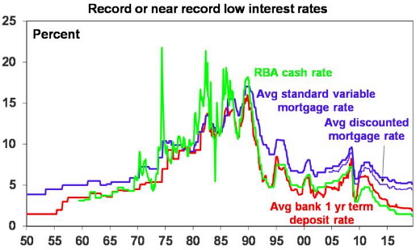

The cash rate line shows authorised dealers’ rates & 90-day bill rates up until the early 1980s. The chart assumes all rates fall 0.25% in May. Source: RBA

So what’s driven this? Will it help the economy? How low might rates go? And what does it mean for investors?

What drove the rate cut?

Put simply economic growth has slowed sharply below its long-term potential reflecting the housing downturn, but other factors from drought to the threat to global growth from the US trade wars cloud the outlook. This in turn has seen the outlook for unemployment deteriorate – at a time when there is still a high combined level of unemployed and underemployed (at 13.7% of the workforce). Which in turn threatens to keep wages growth low and inflation below the RBA’s 2-3% inflation target for even longer. Reflecting this the RBA has revised down sharply its growth and inflation forecasts over the past six months and now doesn’t see inflation rising above 2% out to 2021 even with the technical assumption of two rate cuts. The RBA has concluded that it needs much lower unemployment than the 5% or so recently seen to get inflation back to target. But recent indicators point to rising unemployment. Hence the RBA has returned to cutting the cash rate to help boost growth.

What’s driving low inflation?

Inflation was just 1.3% over the year to the March quarter. Abstracting from volatile items, underlying inflation is just 1.4%. This reflects a combination of weak demand, high levels of spare capacity & underutilised workers, intense competition, technological innovation & softish commodity prices. The problem is that inflation has been undershooting RBA forecasts and the inflation target for some time, threatening its credibility.
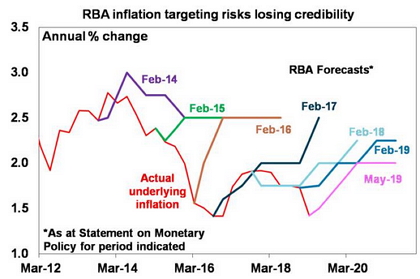

Source: RBA, Bloomberg, AMP Capital

What’s wrong with low inflation anyway?

Surely low price rises or falling prices are good. So, many have suggested the RBA should just lower its inflation target. Such arguments are nonsense. First, the whole point of having an inflation target is to anchor inflation expectations. If the target is just moved each time it’s breached then those expectations will blow around. There would be no point having an inflation target.

Second, there are problems with allowing too-low inflation. Statistical measures of inflation tend to overstate actual inflation by 1-2% because statisticians have trouble adjusting for quality improvements. And targeting too low an inflation rate could mean we are knocked into deflation in an economic downturn.

Third, deflation is not good if its associated with falling wages, rising unemployment, falling asset prices and rising real debt burdens – particularly when debt levels are high. It risks a debt deflation spiral of falling asset prices & incomes leading to rising debt burdens and defaults, and more falls in asset prices, etc.

Finally, targeting very low inflation gives central bankers less flexibility to achieve easy monetary policy in downturns as they have limited ability to achieve negative real interest rates.

More simply, low inflation is synonymous with low wages growth and this is contributing to a sense of dissatisfaction in the community. Getting both up to more normal levels is desirable.

It’s global not just local

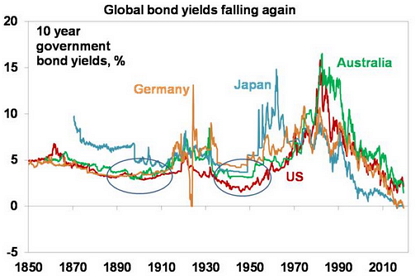
While its natural to assess the RBA in isolation it’s clear that it is being caught up in global forces. The weakness in inflation is evident globally and reflects the same drivers as in Australia. Combine this ongoing softness in inflation with the latest threat to global growth – from Trump’s trade wars – and bond yields have pushed to new record lows globally. Reflecting this Australia bond yields have also been pushed to a new record low. So, the RBA is really just ratifying global market forces!

Source: Global Financial Data, AMP Capital

How far will the RBA cut rates?

Rate cuts are a bit like cockroaches. If you see one there is normally another nearby. We expect another 0.25% rate cut in July or August and two more rate cuts by mid next year taking the cash rate to 0.5%. We had thought 1% would mark the low and positive signs regarding residential property prices are helpful in this regard. But the flow of weak economic data and increasing risks to the global outlook with Trump’s trade wars and the slowing jobs market pointing to unemployment rising to 5.5% by year end make it hard to see just two rates cuts being enough, given that the RBA really needs to see unemployment fall to 4% or below to get inflation back to target.

But will the banks pass on RBA rate cuts?

With the recent reduction in bank funding costs meaning that last year’s 0.1-0.15% mortgage rate hikes should now be reversed and nearly 90% of bank deposits on interest rates above 0.5% (and hence able to be cut) we expect most banks to pass on all or the bulk of the RBA’s cut to customers. Short of a funding cost blow out, the interest rate structure on deposits should allow the bulk of subsequent cuts to be passed through but this may diminish as the cash rate reaches 0.5%.

But will more rate cuts help anyway?

Various arguments have been put up against RBA rate cuts: it should “preserve its fire power till it’s really needed”; “rate cuts haven’t helped so far so why should more cuts help”; “low rates won’t help as they cut the spending power of retirees and many of those with a mortgage just maintain their payments when rates fall”. However, looking at these in turn:

First, waiting till rate cuts are “really needed” risks leaving it too late as by then the economy will be in recession – monetary policy needs to be forward looking.

Second, rate cuts have helped the economy rebalance after the end of the mining investment boom by supporting non-mining spending. If the cash rate was still 4.75% and mortgage rates 7.5% the economy would have long ago gone into recession.

Finally, the level of household debt is more than double that of household deposits, so the household sector is a net beneficiary of lower interest rates. The responsiveness to changes in spending power for a family with a mortgage is far greater than for retirees. And, even if many with a mortgage just let their debt get paid off faster in response to falling rates this provides an offset to the negative wealth effect of the fall in house prices, reducing pressure to cut spending. And RBA rate cuts help keep the $A lower. So, while rate cuts may not be as potent with higher household debt levels and tighter lending standards, they should provide some help for households with a mortgage and for businesses that compete internationally.

Should the RBA do quantitative easing?

As the cash rate falls, we are likely to see an increasing debate around whether the RBA will use quantitative easing – ie using printed money to buy bonds to inject cash into the economy. QE is not our base – as we don’t think things are that bad – but as has been the case at other major central banks the RBA is likely to prefer exhausting cash rate cuts before considering QE and this is unlikely until it gets the cash rate down to 0.5% (beyond which lower rates will be a negative for the banks). QE is an option but to the extent that it lowers 10-year bond yields it may not help much in Australia as most household borrowing is on short term rates. It’s also debatable as to whether QE was the best approach globally. A more efficient and fairer option may be for the RBA to work with the Federal Government to provide direct financing of government spending or “cheques in the mail” to households with use by dates. This is often referred to as “helicopter money”. Such stimulus would be guaranteed to boost inflation! Hopefully, it won’t come that, and we don’t think it will but it’s an option. In the meantime, more fiscal stimulus could take some pressure off the RBA.

Implications for investors?

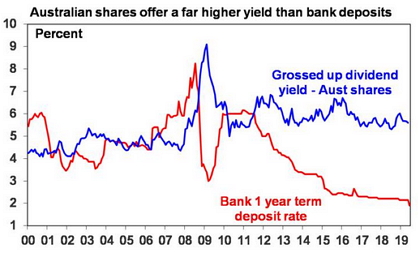
There are a number of implications for investors from the continuing fall in interest rates. First, low interest rates will remain in place for some time keeping bank deposit rates unattractive so it’s important for investors in bank deposits to assess alternative options. Second, the low interest rate environment means the chase for yield is likely to continue supporting commercial property, infrastructure and shares offering sustainable high dividends. Eg, the grossed-up yield on shares remains far superior to the yield on bank deposits. Investors need to consider what is most important – getting a decent income flow from their investment or absolute stability in the capital value of that investment. Of course, the equation will turn less favourable if economic growth weakens too much.

Source: RBA, Bloomberg, AMP Capital

Third, the earlier than expected rate cut will likely contribute along with the election result and other recent moves to an earlier bottom in Australian house prices. However, with still high debt levels, tight lending conditions and rising unemployment it’s unlikely to set off another property boom.

Finally, RBA rate cuts will help keep the $A down in the face of already high short $A positions, strong iron ore prices and rising risks that the Fed will cut rates this year.

If you would like to discuss any of the issues raised by Dr Oliver, please call on Phone: 07 5641 4134 or email martin@wtfp.com.au.


Source: AMP Capital 4 June 2019

Important notes: While every care has been taken in the preparation of this article, AMP Capital Investors Limited (ABN 59 001 777 591, AFSL 232497) and AMP Capital Funds Management Limited (ABN 15 159 557 721, AFSL 426455) (AMP Capital) makes no representations or warranties as to the accuracy or completeness of any statement in it including, without limitation, any forecasts. Past performance is not a reliable indicator of future performance. This article has been prepared for the purpose of providing general information, without taking account of any particular investor’s objectives, financial situation or needs. An investor should, before making any investment decisions, consider the appropriateness of the information in this article, and seek professional advice, having regard to the investor’s objectives, financial situation and needs. This article is solely for the use of the party to whom it is provided and must not be provided to any other person or entity without the express written consent of AMP Capital.


At its meeting today, the Board decided to lower the cash rate by 25 basis points to 1.25 per cent. The Board took this decision to support employment growth and provide greater confidence that inflation will be consistent with the medium-term target.

The outlook for the global economy remains reasonable, although the downside risks stemming from the trade disputes have increased. Growth in international trade remains weak and the increased uncertainty is affecting investment intentions in a number of countries. In China, the authorities have taken steps to support the economy, while addressing risks in the financial system. In most advanced economies, inflation remains subdued, unemployment rates are low and wages growth has picked up.

Global financial conditions remain accommodative. Long-term bond yields and risk premiums are low. In Australia, long-term bond yields are at historically low levels. Bank funding costs have also declined further, with money-market spreads having fully reversed the increases that took place last year. The Australian dollar has depreciated a little over the past few months and is at the low end of its narrow range of recent times.

The central scenario remains for the Australian economy to grow by around 2¾ per cent in 2019 and 2020. This outlook is supported by increased investment in infrastructure and a pick-up in activity in the resources sector, partly in response to an increase in the prices of Australia’s exports. The main domestic uncertainty continues to be the outlook for household consumption, which is being affected by a protracted period of low income growth and declining housing prices. Some pick-up in growth in household disposable income is expected and this should support consumption.

Employment growth has been strong over the past year, labour force participation has been increasing, the vacancy rate remains high and there are reports of skills shortages in some areas. Despite these developments, there has been little further inroads into the spare capacity in the labour market of late. The unemployment rate had been steady at around 5 per cent for some months, but ticked up to 5.2 per cent in April. The strong employment growth over the past year or so has led to a pick-up in wages growth in the private sector, although overall wages growth remains low. A further gradual lift in wages growth is expected and this would be a welcome development. Taken together, these labour market outcomes suggest that the Australian economy can sustain a lower rate of unemployment.

The recent inflation outcomes have been lower than expected and suggest subdued inflationary pressures across much of the economy. Inflation is still however anticipated to pick up, and will be boosted in the June quarter by increases in petrol prices. The central scenario remains for underlying inflation to be 1¾ per cent this year, 2 per cent in 2020 and a little higher after that.

The adjustment in established housing markets is continuing, after the earlier large run-up in prices in some cities. Conditions remain soft, although in some markets the rate of price decline has slowed and auction clearance rates have increased. Growth in housing credit has also stabilised recently. Credit conditions have been tightened and the demand for credit by investors has been subdued for some time. Mortgage rates remain low and there is strong competition for borrowers of high credit quality.

Today’s decision to lower the cash rate will help make further inroads into the spare capacity in the economy. It will assist with faster progress in reducing unemployment and achieve more assured progress towards the inflation target. The Board will continue to monitor developments in the labour market closely and adjust monetary policy to support sustainable growth in the economy and the achievement of the inflation target over time.

Source: Reserve Bank of Australia, June 4th, 2019

Enquiries

Media and Communications
Secretary’s Department
Reserve Bank of Australia
SYDNEY

Phone: +61 2 9551 9720
Fax: +61 2 9551 8033

Email: rbainfo@rba.gov.au

Is your portfolio suffering from what is sometimes called portfolio drift?

This occurs when a broadly-diversified portfolio drifts away from its strategic or target asset allocation with movements in investment markets and diverging returns from lower-risk and higher-risk assets.

Your diversified portfolio’s strategic asset allocation to different asset classes should be set with the aim of reaching your goals without exceeding your tolerance to risk. (See Goodbye to ad-hoc portfoliosSmart Investing, April 15.)

And then regular rebalancing of your portfolio back to that asset allocation will regain its intended risk-and-return characteristics. The primary benefit of rebalancing is to keep a portfolio’s risk profile, not to maximise returns.

In today’s low-interest, lower-return investment environment, investors may be more tempted to delay rebalancing their portfolios. This is a trap because a portfolio usually becomes progressively more volatile and riskier without rebalancing.

Repeated research* over more than 30 years, including by Vanguard, has concluded that a diversified portfolio’s strategic asset allocation is the main cause of variations in its long-term returns.

A recent Vanguard research paper, Getting back on track: A guide to smart rebalancing**, suggests three straightforward practices for portfolio rebalancing:

  • Rebalance to manage your risks and emotions: A disciplined, easy-to-follow rebalancing strategy helps remove emotions from your investment decisions. And as discussed, rebalancing reduces the likelihood of your portfolio becoming riskier with movements in investment markets.

  • Set rebalancing trigger: Most investors following a rebalancing strategy use either a “time trigger” or a “threshold trigger”. With a time trigger, you rebalance your portfolio at set intervals of, say, once a year or more frequently. And with a threshold trigger, you rebalance when your portfolio drifts from its asset allocation targets by a predetermined percentage.

  • Minimise rebalancing costs: Keep potential tax and transaction costs of rebalancing to a minimum. Some investors use cash where possible – perhaps from dividends and savings accounts – to replenish asset classes that have become underweight over time. Those with investments inside and outside superannuation should keep in mind when rebalancing that their super savings are either concessionally-taxed or exempt from tax.

The rebalancing of a portfolio can seem counter-intuitive. This is because rebalancing requires the selling of currently outperforming assets to buy currently underperforming assets.

Please contact us on Phone: 07 5641 4134 if you seek further assistance .

*The global case for strategic asset allocation and an examination of home bias, Vanguard 2017.
**Getting back on track: A guide to smart rebalancing, Vanguard 2019.

Source : Vanguard April 2019

By Robin Bowerman, Head of Corporate Affairs at Vanguard.

Reproduced with permission of Vanguard Investments Australia Ltd.

Vanguard Investments Australia Ltd (ABN 72 072 881 086 / AFS Licence 227263) is the product issuer. We have not taken yours and your clients’ circumstances into account when preparing this material so it may not be applicable to the particular situation you are considering. You should consider your circumstances and our Product Disclosure Statement (PDS) or Prospectus before making any investment decision. You can access our PDS or Prospectus online or by calling us. This material was prepared in good faith and we accept no liability for any errors or omissions. Past performance is not an indication of future performance.
© 2019 Vanguard Investments Australia Ltd. All rights reserved.

Important:
Any information provided by the author detailed above is separate and external to our business and our Licensee. Neither our business, nor our Licensee take any responsibility for any action or any service provided by the author.
Any links have been provided with permission for information purposes only and will take you to external websites, which are not connected to our company in any way. Note: Our company does not endorse and is not responsible for the accuracy of the contents/information contained within the linked site(s) accessible from this page.

By Flying Solo contributor Nick Brogden

Have you ever wondered why some people are able to skyrocket their personal brand more than others?

Quite often it can come down to leveraging your network, branding yourself as an expert, and thinking outside of the box by doing things that others don’t do. Here’s a fresh look at some creative things you can do to skyrocket your personal brand.

Leverage your personal network

Over the years, I’ve built up a considerable network from working as a principal consultant in one of Australia’s leading marketing companies. But my plan was always to go back to working for myself. As much as I loved the fast-paced agency life it was hard to justify dedicating so much time to an agency I had no ownership in.

But, as you can imagine, the switch from full-time employee back to business owner was quite challenging, and I can account a lot of my success to the skills that I have built up over the years and also the connections that I’ve made.

Reid Hoffman, the founder of LinkedIn says, “One of the challenges in networking is everybody thinks it’s making cold calls to strangers. Actually, it’s the people who already have strong trust relationships with you, who know you’re dedicated, smart, a team player, who can help you.”

I couldn’t agree more with Hoffman’s statement, and the interesting thing here is that as soon as I quit my full-time job to be a solo “business owner,” I’ve had a considerable amount of local SEO job offers come in, with the bulk of these coming via my personal network.

Brand yourself as an expert

Personal branding is all about how you present yourself online and offline. It’s about displaying your expertise in a professional manner that isn’t “screaming self-promotion” but rather identifies you as a knowledgeable person that is backed up by social proof and your connections.

I now use my personal brand as one of my major marketing tools. Take my website for instance, it shows a picture of me speaking at an event. This shot is actually of me speaking at the Powerhouse Museum for a guest lecture I delivered on the fundamentals of SEO and content marketing for a large group of marketing students at the University of Technology Sydney (UTS).

The benefits of guest lecturing are priceless, that’s because they can add new dimensions to your personal brand that simultaneously solidifies your expert status and credibility. Guest lecturing can also lead to other things like being invited to be a panel judge or even being interviewed by journalists on TV.

“Nothing positions you as an authority anymore clearly than being a lecturer at somewhere of the calibre,” says IT Expert Stewart Marshall, a guest lecturer at Sydney University and best-selling author of “Doing IT for Money.”

Think outside of the box

A friend of mine who is a writer for Forbes recently ran a strategic PR experiment on “his own content.” He recently published an article that, he felt didn’t get the attention that it really deserved. So, what did he do? He thought, “how can I turn this into an opportunity.”

So, he emailed approximately 300 journalists from major publications telling them about the article that he had just written, and asked just 2 things:

  1. If you were to republish this, it would not only make my day but my entire year.

  2. And, if you are looking for contributors, I’d love to be considered 

The results: The article went from approximately 500 views and grew to almost 5,000. It was re-published 7 times, and he was offered around 10 opportunities to write for other publications. And, this helped him to grow his personal brand by getting creative and thinking outside of the box.


Source : FlyingSolo April 2019 

This article by Nick Brogden is reproduced with the permission of Flying Solo – Australia’s micro business community. Find out more and join over 100k others.


Important:
This provides general information and hasn’t taken your circumstances into account. It’s important to consider your particular circumstances before deciding what’s right for you. Any information provided by the author detailed above is separate and external to our business and our Licensee. Any information provided by the author detailed above is separate and external to our business and our Licensee. Neither our business, nor our Licensee take any responsibility for any action or any service provided by the author.

Any links have been provided with permission for information purposes only and will take you to external websites, which are not connected to our company in any way. Note: Our company does not endorse and is not responsible for the accuracy of the contents/information contained within the linked site(s) accessible from this page.

If you’re relocating to a new city, it’s a good idea to do your homework about living costs…particularly if it’s Sydney.

When you’re moving interstate it’s natural to focus on the costs and logistics of the actual move—removalists, storage, rental bonds.

But what about the costs of living in a new city?

It’s important to crunch the numbers beforehand to avoid any nasty surprises, particularly if you’re heading to Sydney.

One of our former prime ministers famously said that if you don’t live in Sydney you’re just camping out.

And whether you believe Paul Keating or not, it’s fair to say that the harbour city’s popularity comes at a price.

A tale of two cities

Natalija and Melissa recently moved in opposite directions along the Hume. Here are their first impressions of their new homes.

Natalija moved from Sydney to Melbourne

  • What’s cheaper than you expected? I was surprised by how much more affordable Melbourne was than Sydney. I wasn’t expecting to pay less rent in an area that was relatively the same distance to the CBD. In Sydney I paid $200 more per week to live in an inner city suburb (Darlinghurst). And it took me longer to get to work as I walked because I couldn’t spend any money on transport! Where I live in Melbourne (Prahran), I pay less rent and I live in a great spot, close to restaurants, bars and parks. I can walk everywhere and still afford to catch public transport to work. And I can still save money for my mortgage and holidays! I just love the Melbourne vibe.

  • And what’s more expensive? Perhaps car insurance and registration are slightly higher than Sydney but everything in Melbourne is nominally more affordable.

  • What tips you would give anyone moving to a new city? Do your research, particularly on sought-after areas in proximity to work and schools. This will ultimately affect how much you spend on buying/renting a house, contents, insurances and bills. Also consider your lifestyle choices (restaurants, bars, gym etc). It’s all dependent on your own situation.

…and Melissa moved from Melbourne to Sydney…

  • Is anything cheaper than you expected? $2.50 all day travel on Sunday with the Opal card.

  • And what’s more expensive? Rent! You a pay a lot a more in Sydney and you typically get a lot less. I am paying an extra $130 per week in rent compared to Melbourne, and for a space that is smaller than what I had. Melbourne is better value when it comes to rent, but that’s Sydney for you.

6 living costs that vary around Australia

Here are some things that could be more expensive (or cheaper) in your new city, whether you’re thinking of joining Melissa and five million other Sydneysiders or Natalija and the 20 million other Australians just camping out.

1. Buying groceries and clothes

As a general rule if you’re leaving Sydney you’ll save money—for example, consumer prices are 13.24% lower in Brisbane than in Sydney1.

But economies of scale mean that if you’re moving to a more remote or smaller city you could find yourself paying more for the basics. So anyone moving from Sydney to Darwin or Hobart would be pleasantly surprised by housing and transport costs but not as excited by the fact they could be paying a little more for the weekly grocery shop2.

And if you’re moving to a bigger city it could all depend on where you’re based. If you’re in an inner-suburban apartment you might have limited choice with grocery shopping. If you’re in an outer suburb you may have bigger—and cheaper—supermarkets nearby.

Clothes are another matter. If you’ve been living in subtropical Queensland and you’re moving south, you might need to adjust to a very different weather, as well as a whole new wardrobe.

In Melbourne you’ll need an outfit for every season—often in the same day. In Townsville on the other hand you could save money…just stock up on thongs and singlets and you should be right.

2. Eating out and socialising

Eating out in your new city could set you back more than you bargain for.

The average cost of a daily cappuccino is $4.01 in Sydney, $4.48 in Perth and a whopping $4.78 in Darwin3.

For anyone moving north from Sydney or Melbourne, a three-course meal for two at a mid-range restaurant is cheaper in the Gold Coast ($70) and even cheaper in Darwin ($65).

But a McMeal is a bit more in the Top End—$12 at Maccas compared with $10 in most of the rest of Australia4.

3. Commuting to work

Your monthly pass on public transport is another cost of living that varies widely across Australia—$99 in Adelaide, $130.43 in Perth, $140 in Brisbane, $147 in Melbourne and…wait for it…$217.39 in Sydney. So perhaps follow Melissa’s advice and stick with Sunday travel if you’re in Sydney!

And of course, public transport can vary widely depending on where you live in a particular city, both in terms of cost and comfort. A short ferry ride from the north shore to Circular Quay in Sydney is a very different commuting experience to the train from Parramatta. Equally, if you’re moving to a regional or more remote capital city you may find you need to rely on the car more as public transport can be patchy at best and non-existent at worst.

4. Renting an apartment

In terms of our state capitals, no prizes for guessing that Sydney is the more expensive state capital with a median weekly rent of $583. The most affordable? Adelaide just beats Perth, with the average apartment in the city of churches costing you $375 a week5.

5. Buying a house

It won’t surprise anyone to know that Sydney tops the charts when it comes to buying a house, with a median house price of $1,027,962 for the March 2019 quarter. For anyone prepared to camp out, head to Tassie where a house in Hobart will set you back $478,2476.

6. Sending the kids to school

For anyone with school-age kids, education options are going to be at the top of your list when you decide to move. So it’s important to do your research on how things work in your new city. New Melbournians might be surprised to find that the Victorian capital has a very distinct split between public and private schools, with very few selective schools compared to Sydney.

If you’re set on educating the kids privately through high school then costs can vary widely, from $373,421 in Darwin to $543,334 (yes, Sydney again). Parents of kids at Catholic schools get the best deal in Canberra and the most expensive in Brisbane. And even government school costs vary considerably, from nearly $70,000 in Sydney and Melbourne to less than $50,000 in Adelaide and Hobart7.

New city, new you?

Moving cities isn’t just about money. It’s about setting up a whole new life in a whole new place. Ask yourself some questions about how you’ll go in a new environment.

  • Think connections. If there’s someone you went to school with or used to work with in the area, why not look them up and reconnect? They could be an invaluable source of local knowledge and introduce you to their local network of friends.

  • Think demographics. If you’re retired and moving to a city dominated by twentysomethings, or if you’re a young parent and moving to a suburb full of retirees, you might find it difficult to meet like-minded people.

  • Think jobs. If you work in the creative industries and you’re moving to an area dominated by finance, you might find it hard to secure a job in your preferred field and might need to think a bit laterally about job opportunities.

  • Think sport. If the kids barrack for their local league side in Sydney and you’re planning to move across the Nullarbor, you might need to broaden their sporting horizons to include AFL or soccer.

  • Think atmosphere. If you’re used to the excitement and buzz of living in a big city on the east coast and you’re planning to move to somewhere quieter like Hobart, you might need to adjust to a different pace of life.

If you’re planning a move, check out this great cost of living comparison tool.

Source : AMP May 2019 

Important:
This information is provided by AMP Life Limited. It is general information only and hasn’t taken your circumstances into account. It’s important to consider your particular circumstances and the relevant Product Disclosure Statement or Terms and Conditions, available by calling Phone: 07 5641 4134, before deciding what’s right for you.

All information in this article is subject to change without notice. Although the information is from sources considered reliable, AMP and our company do not guarantee that it is accurate or complete. You should not rely upon it and should seek professional advice before making any financial decision. Except where liability under any statute cannot be excluded, AMP and our company do not accept any liability for any resulting loss or damage of the reader or any other person.

Your superannuation savings should be a key part of your conversation about joint finances.

Picture the scene.

You’ve moved past the honeymoon period of a new relationship and you think this could finally be the one.

You’re starting to think about the medium-term future and setting up your lives together.

So you’re at your favourite restaurant discussing joint finances when your partner drops a bombshell by revealing they hardly have any superannuation saved up.

Time to smash up the breadsticks, pour your glass of wine over them and storm out never to return?

Probably not. Ditching the love of your life for a lack of super could be a slight over-reaction. After all, there could be a number of entirely legitimate reasons their super is a bit low.

  • They could have been out of the paid workforce studying or volunteering for an extended period.

  • They could have been self-employed for a while and not got around to topping up their super.

  • They could have missed payments from a previous employer through no fault of their own.

But while a lack of super is probably not a very good reason to break up, it could give an indication of your partner’s overall attitude towards money.

The last thing you want is for any super secrets to fester. So even if one or both of you haven’t given super much thought up until now, if you’re getting serious it should be an important part of your discussion on joint finances.

With employer and salary sacrificed contributions (up to set limits) typically taxed at 15%, investment earnings taxed at a maximum rate of 15% and tax-free withdrawals once you’re aged 60 or over, super can be an effective tax-friendly way to save and invest your money compared with most people’s marginal tax rate.

7 questions to ask your partner about superannuation

Here are some of the super-related questions you might want to ask yourselves as part of your conversation on joint finances.

1. Should you think about putting money into super to save for your first home together?

If you’re looking at setting up home together and you haven’t bought a property before, you could be eligible for the First Home Super Saver Scheme. You can contribute up to $30,000 each ($15,000 in any one financial year) into your tax-friendly super account and then withdraw it, along with a set earning amount, at a later date to pay for a deposit.

2. Should you think about contribution splitting with your partner?

If you’re looking at boosting super for a spouse with a low super balance, a pretty easy way to get started is contribution splitting. If you’re living together in a de facto or married relationship, this stategy enables the spouse with a higher super balance to effectively transfer amounts of concessional contributions (inclusing super guarantee payments) that they have received into the account of the spouse with a low super balance on an annual basis. And better still it won’t impact either partner’s cash flow.

3. Should you think about making contributions to your partner’s super and claiming a tax offset?

If you’re living together—whether married or de facto—you can potentially benefit from the spouse contributions tax offset. This is where the higher-earning partner contributes towards the lower-earning partner’s super using after-tax dollars and claim a tax offset of up to $540. Of course, you’ll probably want to be in a serious long-term relationship before you consider this, but it’s potentially a way of reducing your tax bill and boosting your partner’s super at the same time.

4. Should you think about taking advantage of government co-contributions?

If one of you is a low-to-middle income earner and they make an after-tax contribution to their super fund, they might be eligible for a government co-contribution of up to $500.

5. Should you think about contributing more into your super?

If you’re thinking long term, super can be an effective tax-friendly vehicle to save for retirement. The current limit on concessional contributions is $25,000 a year (including super guarantee payments from your employer) so unless you’re a very high earner there could be more leeway to top up your super and save on tax each year.

And there’s also now an opportunity to claim a tax deduction for personal contributions made to super (regardless of whether you’re employed or self-employed). These contributions would be concessional contributions, taxed at 15% on entry, and would enable the person contributing to claim a tax deduction up to the balance of their remaining $25,000 concessional contribution cap.

Plus you can also put up to $100,000 a year (or $300,000 over a three-year period under bring-forward rules) in non-concessional contributions.

6. Should you think about changing your investment options within super?

Your super savings are likely to become your biggest pot of money outside the family home. So it’s important to get up to speed with how your money is being invested. Depending on your super fund, you can usually choose between a basic set of options ranging from conservative (less risky assets like cash and bonds that have less potential for growth) all the way through to high growth (more risky assets like shares and property that have more potential for growth).

Your appetite for risk can change as you get older and your life changes so it’s important to revisit your options regularly to make sure they still match your circumstances. Some super funds offer a MySuper lifecycle investment strategy that automatically adjusts your investment options from more growth assets when you’re younger to more defensive assets when you’re older.

7. Should you think about making sure your partner receives your super benefits?

It’s important to make sure the right people receive your super if you die. So if you want to include your partner you’ll need to make the necessary arrangements with your super fund, nominate your beneficiaries and ensure your will is up to date.

For further assistance on this topic please contact us on Phone: 07 5641 4134.

Source : AMP May 2019 

Important:
This information is provided by AMP Life Limited. It is general information only and hasn’t taken your circumstances into account. It’s important to consider your particular circumstances and the relevant Product Disclosure Statement or Terms and Conditions, available by calling Phone: 07 5641 4134, before deciding what’s right for you.

All information in this article is subject to change without notice. Although the information is from sources considered reliable, AMP and our company do not guarantee that it is accurate or complete. You should not rely upon it and should seek professional advice before making any financial decision. Except where liability under any statute cannot be excluded, AMP and our company do not accept any liability for any resulting loss or damage of the reader or any other person

What’s the value of $20 per month?

It’s not a trick question. Obviously, the simple answer is $20. But if you’re talking about a 21-year-old earning $50,000 who salary sacrifices $20 per month to her super, the value is $10,077, the extra amount she would have in her super at retirement age, according to the Australian Securities & Investment Commission retirement planner.

But the real value of that $20 is that it establishes the habit of saving. It’s that first step that makes the next one easier to take. The study of habit — how to break bad ones, build good ones and leverage them to achieve goals — is flourishing.

Much of what habit researchers are discovering runs counter to conventional wisdom about getting things done.

Many people believe they must set big goals and work tirelessly to achieve them. That can work, but may instead lead to failure. Big goals are rarely achieved quickly, and it’s easy to lose interest and commitment along the way.

The new science of habit advises the opposite strategy. As the Stanford University behaviorist BJ Fogg explains, “Only three things will change behavior in the long term.

Option A. Have an epiphany
Option B. Change your environment (what surrounds you)
Option C. Take baby steps”

Using this way of thinking, economists have discovered that putting healthy choices such as carrots at eye level in school cafeterias will do more to get children to eat vegetables than a million lectures on the evils of junk food. By focusing on habits, instead of goals, you set up systems that dramatically increase your odds of achieving the goal.

How can you apply habit research to your financial life? Start by identifying money habits you want to change, then implement a system to get there by changing your environment and taking baby steps.

Here are few ideas to get started:

Let’s say you are spending too much on your credit cards. You can tackle this in a number of ways.

One principle of breaking habits is to make the activity harder. Someone trying to kick the sugar habit, for example, might start by keeping it out of the house, so that it’s an occasional treat that requires going somewhere to indulge in.

You could try leaving your credit cards at home, or spend only cash on purchases. Some researchers believe that because cash is such a tactile experience, the brain pays more attention to it, making people less likely to spend. But even a baby step, such as wrapping your credit cards in a piece of paper, may be enough to remind you to walk away from the purchase.

A more tech-oriented person might benefit from an app that regularly updates you on how much you are spending on sneaky expenses such as eating out. The key here is to figure out what works for you.

Scheduling activities also can work. If you want to save money on eating out, start with a goal so small that you will be able to achieve it no matter what. You could commit to taking your lunch once a week. Then, add the required items to your grocery list and schedule time in your calendar to pack it.

Automating a habit also pays big dividends. People have written books by deciding to write, say, 1,000 words every day at a certain time.

Many ways to automate the saving habit exist. One of the best is dollar-cost averaging, which involves investing the same amount of money into, say, shares or managed funds at regular intervals over a long period – whether market prices are up or down. This takes the emotion out of investing, minimising the risk that you will panic and sell when share prices fall. From a habit point of view, it keeps you on track even when motivation flags. That’s worth a lot.

Please contact us on Phone: 07 5641 4134 if we can be of any assistance on this topic.

Source : Vanguard April 2019

By Robin Bowerman, Head of Corporate Affairs at Vanguard.

Reproduced with permission of Vanguard Investments Australia Ltd.

Vanguard Investments Australia Ltd (ABN 72 072 881 086 / AFS Licence 227263) is the product issuer. We have not taken yours and your clients’ circumstances into account when preparing this material so it may not be applicable to the particular situation you are considering. You should consider your circumstances and our Product Disclosure Statement (PDS) or Prospectus before making any investment decision. You can access our PDS or Prospectus online or by calling us. This material was prepared in good faith and we accept no liability for any errors or omissions. Past performance is not an indication of future performance.
© 2019 Vanguard Investments Australia Ltd. All rights reserved.

Important:
Any information provided by the author detailed above is separate and external to our business and our Licensee. Neither our business, nor our Licensee take any responsibility for any action or any service provided by the author.
Any links have been provided with permission for information purposes only and will take you to external websites, which are not connected to our company in any way. Note: Our company does not endorse and is not responsible for the accuracy of the contents/information contained within the linked site(s) accessible from this page.

As we find ourselves in the midst of the war on plastic, we are seeing some (slow) progress in our own home towns, but there are inspiring countries across the globe that are going the extra mile to rid our planet of the mountains of unnecessary waste.

Just how much waste are we talking? Well, there’s around 8 million metric tons of plastic that end up in our oceans each year, the equivalent of dumping a garbage truck full of plastic in the water every minute, plus there’s all the waste in the landfill to consider!

It is truly a significant problem that we are all responsible for fixing.

Leading the way in the reduction of plastic consumption are the people of Vanuatu who are taking massive strides in reducing single-use plastic items. The original announcement of their progressive plan, to ban all plastic bags and bottles that cannot be reused, was made on the Vanuatu Independence Day, 30th July 2017. As of July 2018, they have already put much of this into effect, banning single-use plastic bags, drinking straws, and styrofoam food containers, all of which had been known to make their way into Vanuatu’s pristine ocean. Thankfully, that has already begun to clear.  So what will they tackle next?

Vanuatu has been working towards their target of a complete ban, forbidding single-use plastic bottles from being imported into and used in the country. This will be yet another step in their plan to ban. The Prime Minister has recently released a statement, including the many other single-use plastic items they plan to ban within the year. It’s inspiring to see such powerful and swift action made by this small Pacific island nation in order to save our planet.

The other countries and cities following suit with notable initiatives and alternatives for plastic are:

1. Kenya

Though extremely harsh, Kenya’s penalty for using, producing or selling a plastic bag is proving effective, with most people choosing a creative bag solution rather than face four years in jail or a $38,000 fine since the law was put in place in August 2017.

2. United Kingdom

From January 2018 the UK has been working towards setting the ‘global gold standard’ on eliminating plastic waste, working through their 25-year plan that started with eliminating plastic microbeads from rinse-off cosmetic products. They’ve continued their plan with taxing single-use plastic bags, banning plastic straws, stirrers, and cotton buds, and the Queen herself even put a complete ban on these products in the Royal Estate since February 2018.

3. Taiwan

Taiwan has begun implementing their wide-reaching ban on all single-use plastics, building on existing recycling programmes and charges for plastic bags, building up to their blanket ban by 2030 restricting single-use plastic bags, straws, utensils, and cups.

4. Zimbabwe

Since July 2017 anyone caught violating the ban on expanded polystyrene in Zimbabwe could face a fine of between $30 and $500.

5. Canada

Montreal and Victoria have banned single-use plastic bags with large fines in place for individuals and corporations caught violating the ban. Across the country, microbeads are completely banned following research that revealed there were 1.1 million microbeads per square kilometre infamous Lake Ontario. 

6, Malibu

It was voted that from June 1, 2018, Malibu would implement a ban on the sale, distribution, and use of single-use plastic straws, stirrers, and cutlery to keep this pollution from reaching the beaches and ocean.  

7. Seattle

September 2017 saw the ‘Strawless in Seattle’ campaign enacted, involving more than 100 restaurants, sports, airports, and aquariums banning straws. Now it’s a city-wide common practice to go without plastic straws.

8. Australia

The 2nd largest waste producer in the world, Australia has now phased out single-use plastic bags across most of the country with the support of major supermarket chains now only providing reusable bags for sale.

9. Hamburg

Non-recyclable plastic coffee pods have been banned in the German city of Hamburg since February 2016 as they found billions of the plastic coffee shells were dumped in landfill each year.

10. France

There’s been a total ban on plastic bags in France since 2015, and following an announcement in 2016, there will be a ban on plastic cups, plates, and cutlery coming into effect in 2020.

Source : FoodMatters May 2019

Reproduced with the permission of the Food Matters team. This article by Laurentine ten Bosch was originally published at https://www.foodmatters.com/article/vanuatu-become-first-country-world-ban-plastic-bottles

Important:
This provides general information and hasn’t taken your circumstances into account.  It’s important to consider your particular circumstances before deciding what’s right for you. Although the information is from sources considered reliable, we do not guarantee that it is accurate or complete. You should not rely upon it and should seek qualified advice before making any investment decision. Except where liability under any statute cannot be excluded, we do not accept any liability (whether under contract, tort or otherwise) for any resulting loss or damage of the reader or any other person. 

Any information provided by the author detailed above is separate and external to our business and our Licensee. Neither our business nor our Licensee takes any responsibility for any action or any service provided by the author.

Any links have been provided with permission for information purposes only and will take you to external websites, which are not connected to our company in any way. Note: Our company does not endorse and is not responsible for the accuracy of the contents/information contained within the linked site(s) accessible from this page. 

Manufactured housing is a very resilient asset class – as showcased by the largest US operator Equity LifeStyle Properties growing its net operating income every single quarter going back to the late 1990s, including during the global financial crisis1, and today the investment proposition is even more attractive.

Shipments of new manufactured houses have grown by 60 per cent over the past five years, and prices rose sharply through the first three quarters of 2018 whilst prices for site-built homes remained stagnant2.

Affordability is a key factor in this resurgence. Ten years ago, 75 per cent of American houses sold for less than US$300,000. Today less than half of sales fall under that benchmark3. In contrast, the average price for a new manufactured home is less than US$80,0004. This is especially attractive to so-called ‘snowbirds’ looking to migrate from Canada and the northern states and relocate to warmer climates, a phenomenon that is accelerating as the population ages.

And as baby boomers continue to retire over the next twenty years, the manufactured housing market that focuses on age-restricted parks is set for unprecedented strong demand.

Recent developments in the financing of manufactured homes have the potential to drive this growth even further. Traditionally, borrowing for manufactured housing has been considerably more difficult and expensive than for site-built homes, with buyers forced to take chattel loans rather than mortgages to fund their purchases. The widely-held presumption was that these assets would depreciate, rather than appreciate in value.

Source: United States Census Bureau, July 2018; United States Census Bureau, December 2017. Charts: Sun Communities, November 2018.

However, continually improving offerings from manufacturers and a change in policy direction by the US Government have turned that model on its head. In December 2016, the Federal Housing Financing Agency (FHFA) issued Fannie Mae and Freddie Mac with a “duty to serve under-served markets”, including manufactured housing, and the two government-sponsored mortgage buyers have begun to expand their reach into the manufactured housing market, driving down interest rates for borrowers. At the same time, new analysis of repeat-transaction prices by the FHFA indicates that manufactured housing may actually appreciate in a similar manner to site-built homes5.

While demand for shipments remains high, so too will demand for land and facilities to accommodate them. REITs with assets concentrated in residential parks, like the AMP Capital Global Property Securities Fund, which is an active ETF trading on the Australian Stock Exchange, gain from exposure to market upside with low overheads, such as maintenance and customer turnover, compared to traditional property assets. In addition, the reluctance of local authorities to approve new residential park developments (only ten were approved nation-wide in the US in 2017) means that constrained supply is likely to preserve or increase the value of these investments for some time to come.

With options like vaulted ceilings, walk-in wardrobes and built-in fireplaces widespread across the industry, manufactured homes have well and truly shed any lingering association with the trailer park and have become a solid option for first home buyers and retirees alike. There’s a reason Warren Buffet has a large stake in the sector and why the legendary real estate investor Sam Zell continues to promote the view that this truly is an institutional real estate sector – put it down as one to watch over the next few years.

Source : AMP CAPITAL May 2109 

1 Equity LifeStyle Properties, Investor relations presentation, February 2019.
2 United States Census Bureau, Manufactured Housing Survey Data, February 2019.
3 United States Census Bureau, New Residential Sales
4 United States Census Bureau, Average sales price of new manufactures homes, June 2018.
5 Federal Housing Finance Agency, House Price Index, August 2018.

Important notes

This advertisement has been prepared by AMP Capital Investors Ltd (ABN 59 001 777 591, AFSL 232497) (“AMP Capital”). BetaShares Capital Ltd (ACN 139 566 868, AFSL 341181 (“BetaShares”) is the responsible entity and the issuer of units in the AMP CAPITAL GLOBAL PROPERTY SECURITIES FUND (UNHEDGED) (MANAGED FUND), (each a “Fund”). AMP Capital is the investment manager of the Funds and has been appointed by the responsible entity to provide investment management and associated services in respect of the Funds. Investors should consider the Product Disclosure Statement (PDS) for the relevant Fund before making any decision regarding the Fund. The PDS contains important information about investing in each Fund and it is important investors read the PDS before making a decision about whether to acquire, continue to hold or dispose of units in the Funds. Past performance is not a reliable indicator of future performance. Neither BetaShares, AMP Capital, nor any other company in the AMP Group guarantees the repayment of capital or the performance of any product or any particular rate of return referred to in this information. This information has been prepared for the purpose of providing general information, without taking account of any particular investor’s objectives, financial situation or needs. Investors should, before making any investment decisions, consider the appropriateness of this information, and seek professional advice, having regard to their objectives, financial situation and needs.


Listed infrastructure is an asset class that just a decade ago was poorly understood by many investors. It is now a diverse $3 trillion investment opportunity1. More and more investors are allocating to the asset class due to the differentiated return/risk characteristics we believe it offers. As infrastructure assets often have their profits guaranteed by long-term contracts or regulation, returns tend to be relatively predictable over the long term. For investors, this provides extremely good visibility for cash flows and ultimately, dividends.

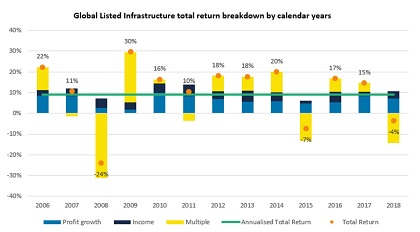
Long-term infrastructure investors should appreciate that the majority of short-term returns are driven by multiple expansion and contraction, but over the long term this has little impact. As seen in the chart below, profit growth for infrastructure companies has been consistently positive year on year. Years with negative total return have primarily been driven by multiple compression, despite positive profit growth.

Past performance is not a reliable indicator of future performance. Source: AMP Capital, Bloomberg as at 31 December 2018. Data frequency: quarterly. Data based on the AMP Capital’s Global Listed Infrastructure universe.

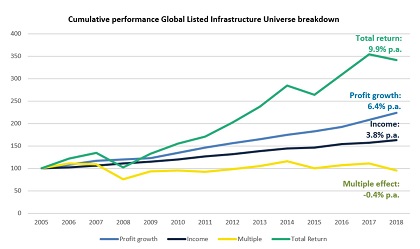
However, over the long term, the multiples effect has been neutral. We believe cash flow growth is ultimately what drives returns. This is why our investment process has a stringent focus on cash flows, compared to the more generalist investor, and short-term volatility creates opportunities for us to generate alpha for our clients.

Past performance is not a reliable indicator of future performance. Source: AMP Capital, Bloomberg as at 31 December 2018. Data frequency: quarterly. Data based on the AMP Capital’s Global Listed Infrastructure universe.

By investing in listed infrastructure, investors can access a broad set of liquid investment opportunities across geographies and sectors. However, not all infrastructure is the same. At AMP Capital, we have a strict focus on long-term cashflow stability and filter the broader infrastructure universe for the following characteristics.

Characteristics we look for

Unfavourable characteristics

  • Monopolistic characteristics

  • High barriers to entry

  • Highly regulated

  • Long-term guaranteed contracts

  • Mature assets

  • Inflation protection

  • Competitive industries

  • Low barriers to entry

  • Short-term/ no contracts

  • Low visibility

  • Greenfield developments

  • Cyclical industries

As a result, we believe that most of the infrastructure opportunities lies outside of Australia, which only holds approximately two percent of the global share. North America accounts for more than half of all infrastructure assets, with a third in Europe and the remaining located in Asia Pacific and Latin America. We also categorise these assets in four main sectors: energy infrastructure, utilities, transportation and communications.

Regulatory frameworks and contract structures vary greatly from sector to sector and from region to region, as they are based on and exposed to macro variables in different ways. This highlights the importance of diversification to help mitigate risks in concentrated exposure to regional economic downturns and regulations.

The quality of core infrastructure assets on the listed market is high and there are sectors where listed companies lead private companies in terms of operational excellence. In many instances, assets are co-owned by listed infrastructure companies and direct investors. Listed infrastructure is generally considered alongside unlisted funds or buying directly into assets. Each has it benefits and drawbacks, as the table below shows.


Listed Manager

Unlisted Fund

Direct Asset

Geographic diversity

Very high

Low/medium

Low

Asset diversity

Very high

Low/medium

Low

Liquidity

Very high

Low

Low

Daily valuations

Yes

No

No

Control

Low

Low to very high

Very high

Volatility of valuation

High

Very low

Very low

Transaction cost

Low

High

High

Portfolio turnover

High

Low

Low

Investment horizon

Medium (~5 years)

Long term (~10 years)

Long term (~10 years)


Notably the liquidity of listed infrastructure makes it accessible to a wider range of investors than the direct approach. We believe that returns between listed and unlisted assets are very similar over a full market cycle as ultimately the underlying asset, rather than the capital structure, determines returns.

Additionally, as demand for infrastructure assets have grown exponentially, we have also seen a corresponding spike in undeployed capital within unlisted infrastructure funds. While the capital flowing into the sector enables many new projects, competition for high quality assets will be fiercer and valuations will rise. Therefore, it is only natural that listed companies with access to high quality infrastructure assets and trading at attractive valuations to become potential targets for unlisted infrastructure funds under pressure to put capital to work.

These dynamics, alongside the growing numbers of investors awakening to the attractiveness of the listed infrastructure, mean that positive supply/demand drivers should add support to the strong fundamentals of high-quality infrastructure businesses.

Please contct us on Phone: 07 5641 4134 if you would like to discuss.

1 Total market capitalisation of the AMP Capital Global Listed Infrastructure Universe of over 250 stocks.

Author : Giuseppe Corona, Head of Global Listed Infrastructure, London, United Kingdom

Source : AMP Capital


Important notes
While every care has been taken in the preparation of this document, AMP Capital Investors Limited (ABN 59 001 777 591, AFSL 232497) (AMP Capital) makes no representation or warranty as to the accuracy or completeness of any statement in it including, without limitation, any forecasts. Past performance is not a reliable indicator of future performance. This document has been prepared for the purpose of providing general information, without taking account of any particular investor’s objectives, financial situation or needs. An investor should, before making any investment decisions, consider the appropriateness of the information in this document, and seek professional advice, having regard to the investor’s objectives, financial situation and needs.