Infrastructure is vital to economic growth. It creates a virtuous, never-ending cycle: investment in infrastructure helps stimulate sustainable long-term economic growth which then creates a further need for infrastructure. One of the current developments that is driving further infrastructure investment is the global trend towards decarbonisation to reduce CO2 emissions, and the role of energy infrastructure in fulfilling future global energy needs.

 

The world is moving towards a low-carbon economy. Countries around the world such as Canada, France, Germany and the UK, have announced coal phase-out plans, and the pipeline of new build coal plants has been shrinking worldwide. However, as the world economy continues to grow, with billions of people shifting into the growing middle class in the developing world, naturally global energy demand is expected to rise as well.

Meeting China’s natural gas demand

China represents a great case study, as their focus on reducing carbon emissions has seen them become the world’s largest gas importer according to Shell1.

Coal-to-gas switching has resulted in

  • 78% improvement in Beijing winter air quality in the last five years

  • 176 million tonne reduction in CO2 emitted by Beijing and surrounding areas (to put this into context, this is equivalent to 37 million cars off the road!)

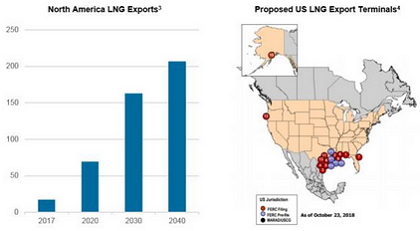
However, growth in domestic production and pipeline gas appears to be insufficient to keep pace with demand, and LNG imports are expected to increase by more than 11% per annum to 2025 according to a J.P Morgan report2. We believe this growth to be a key driver of natural gas infrastructure development in North America as LNG exports are forecasted triple over the next two decades.
Additionally, given the intermittency of renewable energy sources and the relative clean attributes of natural gas among fast-start fuel sources, the two are viewed as important and complementary components of the energy mix going forward. As the chart below depicts, in California natural gas electric generation quickly responds to the rapid changes in renewable energy generation in order to meet demand.


Source: Sempra Energy, California Independent System Operator (CAISO) as at Feb 2019

In fact, California has recently announced an ambitious goal to only rely on zero-emission energy sources for its electricity by 2045. In order to reach this target critical infrastructure upgrades for electric utilities are required, such as increasing deployment of energy storage to enable a carbon-free future and modernising the grid to manage increasingly complex power flows.

Other states in the US and countries around the world also have ambitious carbon reduction targets and as a result we expect renewables to play an increasingly significant role in the global energy system. According to BP5  it is set to grow faster than any fuel in history. Further investment in electric utility infrastructure will be required, but also further gas infrastructure to meet the challenge of providing low carbon energy that is reliable.

If you would like to discuss any of the issues raised in this article, please call on Phone: 07 5641 4134 or email martin@wtfp.com.au.


1 Shell LNG Outlook 2019 https://www.shell.com/energy-and-innovation/natural-gas/liquefied-natural-gas-lng/lng-outlook-2019.html

2 J.P. Morgan 2018 Global LNG Analyzer report

3 Source: BP Energy Outlook 2019

4 Source: FERC as at 23 October 2018. PROPOSED TO FERC Pending Applications: 1. Pascagoula, MS: 1.5 Bcfd (Gulf LNG Liquefaction) (CP15-521) 2. Cameron Parish, LA: 1.41 Bcfd (Venture Global Calcasieu Pass) (CP15-550) 3. Brownsville, TX: 0.55 Bcfd (Texas LNG Brownsville) (CP16-116) 4. Brownsville, TX: 3.6 Bcfd (Rio Grande LNG – NextDecade) (CP16-454) 5. Brownsville, TX: 0.9 Bcfd (Annova LNG Brownsville) (CP16-480) 6. Port Arthur, TX: 1.86 Bcfd (Port Arthur LNG) (CP17-20) 7. Jacksonville, FL: 0.132 Bcf/d (Eagle LNG Partners) (CP17-41) 8. Plaquemines Parish, LA: 3.40 Bcfd (Venture Global LNG) (CP17-66) 9. Calcasieu Parish, LA: 4.0 Bcfd (Driftwood LNG) (CP17-117) 10. Nikiski, AK: 2.63 Bcfd (Alaska Gasline) (CP17-178) 11. Freeport, TX: 0.72 Bcfd (Freeport LNG Dev) (CP17-470) 12. Coos Bay, OR: 1.08 Bcfd (Jordan Cove) (CP17-494) 13. Corpus Christi, TX: 1.86 Bcfd (Cheniere – Corpus Christi LNG) (CP18-512). Projects in Pre-filing: PF1. Cameron Parish, LA: 1.18 Bcfd (Commonwealth, LNG) (PF17-8) PF2. LaFourche Parish, LA: 0.65 Bcfd (Port Fourchon LNG) (PF17-9). PF3. Sabine Pass, LA: NA Bcfd (Sabine Pass Liquefaction) (PF18-3). PF4. Galveston Bay, TX: 1.2 Bcfd (Galveston Bay LNG) (PF18-7). PF5. Plaquemines Parish, LA: 0.9 Bcfd (Pointe LNG) (PF18-8)

5 BP Energy Outlook https://www.bp.com/en/global/corporate/energy-economics/energy-outlook/demand-by-fuel/renewables.html


Author: Joseph Titmus, Portfolio Manager/Analyst, Global Listed Infrastructure, Sydney, Australia

Source: AMP Capital 17 June 2019

Important notes: While every care has been taken in the preparation of this document, AMP Capital Investors Limited (ABN 59 001 777 591, AFSL 232497) (AMP Capital) makes no representation or warranty as to the accuracy or completeness of any statement in it including, without limitation, any forecasts. Past performance is not a reliable indicator of future performance. This document has been prepared for the purpose of providing general information, without taking account of any particular investor’s objectives, financial situation or needs. An investor should, before making any investment decisions, consider the appropriateness of the information in this document, and seek professional advice, having regard to the investor’s objectives, financial situation and needs.
This document is solely for the use of the party to whom it is provided and must not be provided to any other person or entity without the express written consent of AMP Capital.

If you look around the world, we face unprecedented risks. The US-China trade war, Brexit, and slowing global growth are among the spot fires that could flare up and engulf portfolios.

The risks were obviously highlighted by the strong sell-off in markets at the end of 2018. Investors and advisers are no doubt looking to insure against those portfolio risks by using natural hedges like diversification and defensive assets.

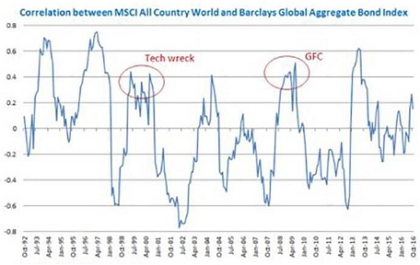
But as you can see in the chart below, two big market events in recent memory – the 2000 tech wreck and the 2008 global financial crisis (GFC) – highlighted the limitations of diversification.


Source: Bloomberg, AMP Capital 2017

Bonds were meant to provide a ballast against falling equities. But just when we needed protection the most, both bonds and equities fell at the same time (positive correlation). It was as if we’d bought insurance for our house and the insurer didn’t pay up.

In this risky market environment, therefore, in our view, investors and advisers need to look beyond diversification and defensive assets, and consider other forms of portfolio insurance and protection, such as options. But it is also our view that they need to learn how to use those options properly, so they protect portfolios but don’t drag down performance.

A simple contract

Options may seem complex, but essentially, they’re a contract that is sold by an option ‘writer’ to an option ‘holder’. That contract gives the holder the right (but not the obligation) to buy or sell a security, such as shares, at an agreed price on or before a specified date.

A ‘call’ option gives the holder the right to buy the underlying security; a ‘put’ option gives the holder the right to sell the underlying security. 

You can limit your trading to options themselves; you don’t have to trade the underlying security. If the underlying shares fall, for example, your put options become more valuable. 

But like any insurance, there is a cost involved. The holder must pay the option seller a ‘premium’.

Protection from puts

In our view, put options are a great way to provide protection against market falls.

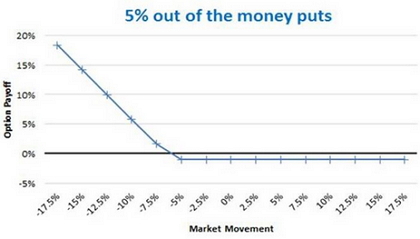
Buying protective put options in our view hold similar traits to buying classic insurance – you pay a premium upfront and it pays a positive return when the market declines.


Source: Bloomberg, AMP Capital 2017

The put contract illustrated in the chart above has a strike price that is 5% below the market level. If the market falls by 10%, on the basis of the graph above, you will get a 6%return. The premium is 1.5%. If the market goes up or falls less than 5%, the option will expire worthless and you lose the premium.

The cost of options

Consumers buy insurance on their houses all the time. Similarly, consumers could also hold protective puts to protect portfolios.

However, because options cost money (the premium you pay to the option seller) they can drag on performance.  


Source: Bloomberg, AMP Capital 2017

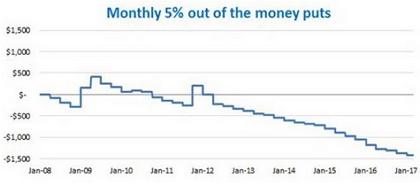
In the chart above, you can see the impact on a notional $10,000 of rolling put options at 5% below the money on the S&P500 in the US. There were positive payoffs to the left towards the GFC. But, generally, they are a drag on performance.

In our view, most investors and clients are in accumulation phase. They can handle short-term volatility, but we would say that most don’t want this drag on performance.

Prudent protection

The good news is that by using options selectively and dynamically, in our view, you can get portfolio protection without major performance drag. 

There are three cost-effective ways to use options according to our analysis.

1. When it’s time

The first method is to only use options when your process or methodology says to reduce risk. For example, AMP Capital uses a Sentiment Score for its dynamic asset allocation (DAA) process, which informs us when to use options.

2. When they’re cheap

Another is to buy options when they are cheap. Premiums you pay for options change depending on what the market expects volatility will be. If the market expects higher volatility in the future, people buy more options which pushes their price up. The VIX index measures the implied level of volatility. If the VIX is low, options are cheap.

3. Other markets

Another way to keep costs low is to buy options in countries outside the US. Put options are expensive in the US. Regulations give insurance companies a big incentive to buy put options on market exposures, mostly the S&P500. That pushes up the price of put options. So, it may be beneficial to look at other markets, such as Europe and China, to buy protective puts.

Successful protection again presidential uncertainty

At AMP Capital we have successfully used options to protect against worrying market events. 

In September 2016, for example, we were particularly concerned about the US Presidential election triggering a market correction. Our DAA process also showed added risks from record low yields and high valuations in the S&P500.

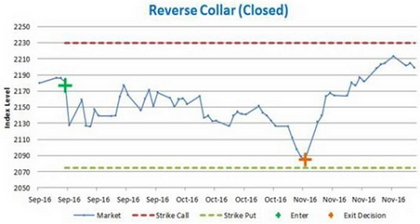
So, for relevant portfolios we entered into a more complex options strategy, called a ‘reverse collar’ to protect against a possible correction.*


Source: Bloomberg, AMP Capital 2017

As shown in the chart above, we entered the position in early September, a good time. The market continued to be volatile along with the polling of the candidates. The market fell almost 5 per cent (close to the maximum payoff) and we exited the position when most of the potential gain from the strategy had been captured.

This example also highlights one of our key rules: each option must have pre-defined exit triggers, so we crystallise the benefit (or loss) in a disciplined manner.

Incorporating options into strategies and decisions

Portfolios that hold different types of assets, such as multi-asset funds, obviously have an inherent level of risk protection because they have a diversified range of assets.

But as we’ve seen, diversification doesn’t always deliver portfolio protection, particularly during extreme market events. Sometimes we need to turn to other forms of insurance and protection, such as options.

With the world facing significant geopolitical, economic and market risks, in our view advisers and investors should be considering incorporating options as an insurance strategy.

It is also our view that advisers and investors should also be seeking out investment managers who have the skills to use options in a cost-effective and disciplined manner so they can maximise protection and minimise performance drag.

If you would like to discuss any of the issues raised in this article, please call on Phone: 07 5641 4134 or email martin@wtfp.com.au.


*A reverse collar is selling (short/writing) a put option and buying (long) the call option on the same index. At the same time, to cover any negative market movement and therefore the short put, we sell the same face value of the contracts short, with futures contracts in the S&P500 market.

A reverse collar takes advantage of skew in the US options market. Because of the previously mentioned insurance regulations, puts are more expensive than calls. The skew means we get protection (positive payoff) for the first 5 per cent of the market decline. And we only give up around 2.3 per cent of the upside if the market rallies.


Author: Heath Palos, Portfolio Manager, Multi-Asset Group

Source: AMP Capital 17 June 2019

Important notes: While every care has been taken in the preparation of this document, AMP Capital Investors Limited (ABN 59 001 777 591, AFSL 232497) (AMP Capital) makes no representation or warranty as to the accuracy or completeness of any statement in it including, without limitation, any forecasts. Past performance is not a reliable indicator of future performance. This document has been prepared for the purpose of providing general information, without taking account of any particular investor’s objectives, financial situation or needs. An investor should, before making any investment decisions, consider the appropriateness of the information in this document, and seek professional advice, having regard to the investor’s objectives, financial situation and needs.
This document is solely for the use of the party to whom it is provided and must not be provided to any other person or entity without the express written consent of AMP Capital.
If you’re looking to invest in the Aussie property market, here are some key points to consider at any age.

If you’ve been saving for a while and feel you’re ready to purchase your first investment property, it’s worth ensuring you’re across some important points so you can make a well-informed decision.

Remember, property prices can go through major swings that can occur with little warning, so while property values might go up, keep in mind they might also go down, which could see you breakeven or even incur a loss depending on how long you hold on to the property for.

1. Have you set a budget within your means?

You may be looking at an investment loan term of 25 or 30 years, depending on the size of the deposit you’ve saved. And, as this may be one of the biggest debts you’ll ever take on, it’s important to prioritise any other financial goals you might have before jumping into anything.

If you already own a property, it may also be possible to access the equity you have in it to secure additional finance from your lender. Check out some of the pros and cons in our article – How to build equity in your home and use it to invest.

Meanwhile, here’s a snapshot of some of the upfront and ongoing costs you may come across.

Upfront costs

  • Deposit (generally around 10% to 20% of the purchase price) unless you’re paying outright

  • Loan application fee (a one-off payment to your lender covering basic admin)

  • Lender’s mortgage insurance (which you may need if your deposit is less than 20%)

  • Government charges (stamp duty, mortgage registration and transfer fees)

  • Legal and conveyancing costs (which will vary depending on the solicitor or conveyancer)

  • Building, pest and strata inspection fees.

Ongoing costs

  • Loan repayments and interest charges

  • Strata fees (for communal properties)

  • Council rates

  • Water rates

  • Insurance (for the building, contents and you as a landlord)

  • Repairs and maintenance costs

  • Property management fees

  • Vacancy costs if you don’t have tenants for a period of time

  • Other charges, such as land tax.

2. Have you looked at your credit report lately?

If you’ve got a credit card, mobile phone plan or utility account, there’s probably a credit reporting agency out there that has a file with your name on it.

Credit providers give information about you to credit reporting agencies and they also access this information to determine whether they want to lend to you.

With that in mind, before you start inspecting properties, be sure to check your credit history, as a tarnished credit report could affect your ability to get approval on a loan.

3. Have you researched where to buy and what to buy?

What you decide here will impact the money you could make in both the short and long term.

When you’re doing your research, things to investigate might include:

  • What properties are selling for in the suburbs you’re looking at

  • Whether these suburbs have price growth potential

  • If there are proposed developments nearby that could affect prices

  • Whether you’ll need to renovate and if you have the extra funds to do so

  • What average rental returns and vacancy rates are like in these areas

  • Whether there are local amenities, such as schools, shops and transport nearby.

4. Have you thought about who’ll manage the property?

If you’re time poor or located a long distance from your investment property, another thing you’ll need to think about is appointing a property manager. Note, this this will come at a cost of approximately 7% to 10% of your total rental income each week1.

Some of the things a property manager will take care of include:

  • Advertising the property

  • The screening of potential tenants

  • Before and after property condition reports

  • Routine inspections

  • How and when tenants pay the rent

  • Maintenance and repair issues

  • Responding to complaints/evictions.

Websites like Local Agent Finder can help you locate property managers in the area you’re looking at and compare fees, services and experience.

5. Are you across your legal obligations?

While property managers can help out in a variety of areas, as a landlord you will still need to be aware of your legal obligations.

There are various responsibilities that apply to landlords before, during and when ending a tenancy. These can differ depending on which state in Australia the investment property is located.

For details, check out the appropriate state government or Fair Trading website where your investment property is based.

6. Have you investigated potential tax deductions?

When you own an investment property, you can often claim a tax deduction on a variety of expenses related to the property during the time that it’s rented out, or available for rent.

Such items include but aren’t limited to things like:

  • Advertising costs

  • Property management fees

  • Borrowing expenses, including loan interest charges and fees

  • Council rates, land tax and strata fees

  • Building depreciation and the loss of value over time in fittings and fixtures like ovens, dishwashers, carpets and hot water systems

  • Repairs, maintenance, pest control, cleaning and gardening costs

  • Building and landlord insurance

  • Phone costs and stationery

  • Accounting and bookkeeping fees.

Note, travel undertaken to inspect the property is generally no longer a claimable expense in Australia. See other things you can claim on the ATO website.

7. Are you across other tax implications?

How negative gearing can reduce what you pay in income tax

If your property is negatively geared (which means the interest and other costs you incur are more than the income your investment property produces), the loss can reduce the amount of tax you pay on your earnings (i.e. your salary) at tax time.

To give you an example, say you earn a salary of $70,000 and a rental income of $20,000 over a 12-month period. If your net rental property expenses are $35,000, your rental property loss will equal $15,000 for the year, which means you’ll only pay tax on $55,000 of your salary.

If your property is positively geared on the other hand (meaning the rent you’re generating is more than the cost of owning the property) you’ll have to pay tax on the net income the property generates.

When capital gains tax is payable

If you sell your investment property down the track and make a profit, capital gains tax may be payable.

The good news is, the price you paid for the property (including buying and selling costs, like stamp duty, legal fees and the real estate agent’s commission) will reduce the amount considered as ‘profit’.

In addition, if you’ve owned the property for at least 12 months, 50% (rather than 100%) of the profit you make will be subject to capital gains tax.

Other hints to ensure tax entitlements are received

From the get-go, keep any relevant documentation so you’re able to claim everything you’re entitled to, and ensure you declare all your rental-related income in your tax return each year.

You’ll also need to keep records of the date and costs of buying the property for capital-gains-tax purposes, and anything regarding significant changes that may take place, such as repairs, improvements or should you decide to subdivide and sell part or all of the property down the track.

Remember that keeping these records will help make sure you don’t pay more tax than you need to.

Where to go for more information

Like most big investments, planning can play a big part in the returns you generate.

In the meantime, it may be worth speaking to us on Phone: 07 5641 4134

Source : AMP May 2019 

Important:
This information is provided by AMP Life Limited. It is general information only and hasn’t taken your circumstances into account. It’s important to consider your particular circumstances and the relevant Product Disclosure Statement or Terms and Conditions, available by calling Phone: 07 5641 4134, before deciding what’s right for you.

All information in this article is subject to change without notice. Although the information is from sources considered reliable, AMP and our company do not guarantee that it is accurate or complete. You should not rely upon it and should seek professional advice before making any financial decision. Except where liability under any statute cannot be excluded, AMP and our company do not accept any liability for any resulting loss or damage of the reader or any other person.

As an employer you have to select a default super fund to make super guarantee payments for your employees who have not chosen their own fund.

Here we explain how to choose a super fund for your employees.

What the super fund you choose must offer

The fund you choose needs to be a fund that is authorised to offer a MySuper product – these are known as ’employer-nominated’ or ‘default funds’.

For more detail on your super obligations as an employer see the Australian Taxation Office’s article on setting up super.

Comparing super funds for your employees

Industrial awards

When selecting a super fund start by checking the industrial awards applicable to your employees. There may be particular funds listed as default funds for your industry under an award.

Fees

Check the fees your employees will be charged by the fund. Low fees are generally good, but you should look at what your employees will get for their money.

Investment options

MySuper products must have a diversified investment strategy. Risks, returns and fees can vary. For example, a MySuper product that has high fees and high performance might offer a very aggressive asset allocation and take risks to get those returns.

Consider the types of employees you have in the business. For example, if the average age of your employees is under 30 you might look for a more aggressive fund.

A fund that offers a MySuper product may also offer a range of other different investment options, such as cash or shares. Your employees may find it helpful to have access to these options if they want to change their investment mix at a later stage. Some MySuper products provide a lifecycle approach to super where the investment mix changes as members get older.

See our MySuper webpage to understand the difference between a single diversified investment strategy and a lifecycle approach.

Performance

Pick a fund that has performed well over (at least) the last 5 years. Do not chase last year’s best performer. The fund may have higher fees but strong performance might justify the expense.

Insurance

MySuper products must offer insurance on an ‘opt -out’ basis. Consider the cost and what your employees get for their money. Cheap insurance cover may have significant exclusions. For example, casual or part-time workers may not be adequately covered. Conversely, paying more for insurance can affect super balances. You need to weigh up the pros and cons.

Extra benefits

What else does the fund offer? Some super funds offer educational seminars and advice. Does the super fund have a good website that helps you find information easily?

Beware super funds offering incentives

Superannuation legislation prohibits incentives being offered to employers on condition that their employees join that fund. Inducements may take any form, and include corporate hospitality, holidays, or discounted rates on products or services.

For example, a super fund cannot offer you tickets to a sporting event or discounted rates on loans on the condition you sign up new employees to their fund.

Case study: Jane’s super fund offers tickets to events

Jane has just started a small business and is considering what default 
fund is appropriate for her staff. Jane makes some enquiries with an industry fund about what they offer. The fund tells Jane they will send her tickets to a major sporting event if she agrees to sign up new employees to their default fund.

Jane is worried that she shouldn’t be accepting these gifts and selects another fund for her sales team.

Case study: Michael’s super fund offers discounts

Michael runs a small manufacturing business. He is considering selecting a new default super fund for his staff. Michael is a long term customer of ABC Bank that also offers a super fund. In conversations with the bank, they tell Michael that if he signs up some of his employees to their super fund, the bank will reduce the interest rate on Michael’s business loan and offer him a new overdraft facility.

This raises alarm bells for Michael because even though he has a good relationship with the bank, he knows the bank is not allowed to offer him this type of inducement. Michael decides not to go with ABC Bank’s super fund.

If you think you’ve been offered unlawful inducements by a super fund you can report it to ASIC.

Make sure any incentives do not distract you from making an informed decision. Focus on what’s best for your employees.

You may also be contacted by funds telling you about their MySuper product. Some advertising from super funds say that one fund is better with insurance, returns or fees than another. Be wary about these comparisons as they may not be comparing like with like.

Always take time to carefully consider information from super funds and seek a professional opinion if you need to.

Picking a super fund for your staff is an important decision. Take the time to do your research and seek help if you need it. 

Please contact us on Phone: 07 5641 4134 if we can be of assistance on this topic .

Source : ASIC MoneySmart

Reproduced with the permission of ASIC’s MoneySmart Team. This article was originally published at www.moneysmart.gov.au.

Important:
This provides general information and hasn’t taken your circumstances into account.  It’s important to consider your particular circumstances before deciding what’s right for you. Although the information is from sources considered reliable, we do not guarantee that it is accurate or complete. You should not rely upon it and should seek qualified advice before making any investment decision. Except where liability under any statute cannot be excluded, we do not accept any liability (whether under contract, tort or otherwise) for any resulting loss or damage of the reader or any other person.  Past performance is not a reliable guide to future returns.

Any information provided by the author detailed above is separate and external to our business and our Licensee. Neither our business, nor our Licensee take any responsibility for any action or any service provided by the author.

Any links have been provided with permission for information purposes only and will take you to external websites, which are not connected to our company in any way. Note: Our company does not endorse and is not responsible for the accuracy of the contents/information contained within the linked site(s) accessible from this page.

By Flying Solo contributor Lucy Kippist.

Stop “outsourcing” your memory to Google and start investing in the power of your own mind. Organisational psychologist Adam Grant has discovered the secret to remembering absolutely anything.

Habitual forgetting of passwords is my biggest work productivity sin. I can easily lose 15 minutes (to say nothing of my sanity) successfully firing up all the accounts I use.  

So I devoured this episode of Adam Grant’s Work Life podcast “How to remember anything.”

Adam is a very clever organisational psychologist who has created a very clever podcast, interviewing people who do what they love for a living.  He also uncovers some fascinating stuff about our brains and how to make them tick more efficiently, especially when it comes to our work.

He says having a good memory has been a valuable tool since caveman times, and that’s largely because of three things:  

The 3 most important things a good memory brings to your work

  1.  A good memory helps you to establish expertise in uncertainty
    “If a car salesperson knows safety specs at top of head you’ll assume she knows what she’s talking about.”

  2. A good memory is essential for making fast decisions:  “An emergency doctor doesn’t have time to run a Google search before treating a cardiac arrest.”

  3. A good memory helps you build and maintain relationships: “You want your therapist to recall your world view was shaped by your weird family and that your boss hasn’t forgotten all the good work you’ve done prior to a performance review.”

“A great memory gives you an edge to make quick decisions because you have an entire library of successes and mistakes at your fingertips…  You can strengthen your memory like a muscle, and when you do it will pump up creativity and boost sales,” says Adam.

Who doesn’t want more of that stuff in their life?  

The real “secret” to having a good memory

Helpfully, Adam doesn’t just leave us with that thought; the rest of the episode is spent uncovering a solution via the work of American journalist and author, Joshua Poer.

Joshua was sent by Slate Magazine to cover the United States Memory Championships where he spent time with people with remarkable abilities, ie they could repeat the sequence of a whole deck of cards after looking at them for just five minutes. Or remember the names of 100 strangers after meeting them the day before.

The experience not only left Joshua with fascinating insights, he learnt how to cure his only bad memory in less than a year, and then wrote a book about it. Not a bad outcome for a junket, eh?

‘People have done this for 2500 years’

As Joshua told Adam, the “secret” to a good memory wasn’t natural genius, but commitment to ancient mind-training practices. Some of which had been around for 2500 years.

“Incredible memory is latent inside all of us if we use the right techniques to awaken them,” Joshua says.

The process is relatively simple and requires some imagination;  Joshua describes it as creating a memory palace.

“Pick a place you know well and mentally attach things/words you want to remember to each image in that place,” says Josh.

“The more memories and time and experiences spent in [our memory palace] the far more  sticky they become, because they’re attached to all the other memories you have about that place.” 

Designing your own memory palace

Joshua’s memory palace is his childhood home. So every time he wanted to remember a speech or a word, he’d picture that word or phrase as existing inside a room of his childhood house.

“When you close your eyes and walk back through each room of your house (or memory palace) the words you want to remember will be inside each room where you left them.”

Here is how Joshua explains remembering tp buy items on his shopping list: 

“Say I have a shopping list, I will picture myself inside my childhood house pouring a gallon of milk over my mum’s head. I really picture that image of her, and how angry she would be. Because the more emotion and colour you attach to that image, the more likely you will be to remember it.”

Sound too good to be true? Well, here is the real kicker, Joshua says the results are almost instantaneous;

“You can almost immediately after earning this trick memorize really long strings of information,” he says.

It’s bound to be worth a shot.

Source : Flying Solo

This article by Lucy Kippist is reproduced with the permission of Flying Solo – Australia’s micro business community. Find out more and join over 100k others.


Important:
This provides general information and hasn’t taken your circumstances into account. It’s important to consider your particular circumstances before deciding what’s right for you. Any information provided by the author detailed above is separate and external to our business and our Licensee. Any information provided by the author detailed above is separate and external to our business and our Licensee. Neither our business, nor our Licensee take any responsibility for any action or any service provided by the author.

Any links have been provided with permission for information purposes only and will take you to external websites, which are not connected to our company in any way. Note: Our company does not endorse and is not responsible for the accuracy of the contents/information contained within the linked site(s) accessible from this page.

While some have expressed surprise at the recent resilience in the value of the Australian dollar around the $US0.69-0.70 level despite weak Australian growth and Reserve Bank rate cuts, from a big picture sense it has already fallen a long way. It’s down 37% from a multi-decade high of $US1.10 in 2011 and it’s down 15% from a high in January last year of $US0.81. So, having met our long-held expectation for a fall to around or just below $US0.70 and given its recent resilience now is an appropriate time to take a look at its outlook.


The $A is slightly undervalued long term

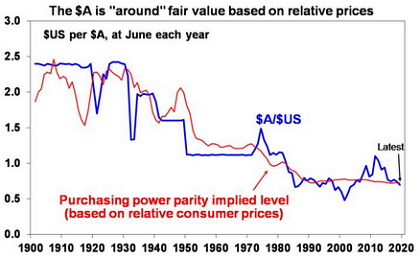
The first thing to note is that from a very long-term perspective the Australian dollar is around or just below fair value. This contrasts to the situation back in 2011 when it was well above long-term fair value. The best guide to this is what is called purchasing power parity (PPP) according to which exchange rates should equilibrate the price of a basket of goods and services across countries – see the next chart.


Source: RBA, ABS, AMP Capital

If over time Australian inflation and costs rise relative to the US, then the value of the $A should fall to maintain its real purchasing power and competitiveness. And vice versa if Australian inflation falls relative to the US. Consistent with this the Australian dollar tends to move in line with relative price differentials – or its purchasing power parity implied level – over the long term. And right now, it’s around or just below fair value.

But as can be seen in the last chart, it rarely spends much time at the purchasing power parity level. Cyclical swings in the $A are largely driven by swings in the prices of Australia’s key commodity exports and relative interest rates, such that a fall in Australian rates relative to US rates makes it more attractive to park money in the US and hence pushes the $A down. “Investor” sentiment and positioning also impacts – such that if the $A is over-loved with a lot of long positions then it becomes vulnerable to a fall and vice versa if it’s under-loved.

The negatives for the $A…

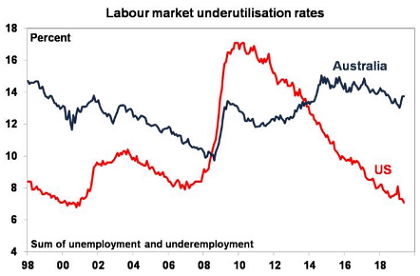
For some time, our view has been that the $A would fall into the high $US0.60s and this has happened. But notwithstanding this and that the $A has already fallen a long way from its 2011 high, it could still face a bit more downside over the next six to 12 months. The main reason is that Australian growth is weaker than US growth and spare capacity is much higher in Australia. For example, labour market underutilisation is 13.7% in Australia versus just 7.1% in the US, growth in Australia is running at 1.8% year on year compared to 3.2% in the US and the drag on growth from the housing downturn is likely to keep growth relatively weak in Australia for the next year or so.


Source: Bloomberg, AMP Capital

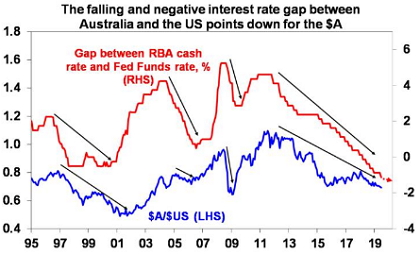
This will keep inflation lower in Australia than in the US and so we see the RBA cutting rates more than the Fed. And the RBA is much closer to having to do quantitative easing or some variant of it (ie using printed money to boost growth) than the Fed. This will continue to make it relatively less attractive to park money in Australia. As can be seen in the next chart, periods of a low and falling interest rate differential between Australia and the US usually see a low and falling $A.


Source: Bloomberg, AMP Capital

So this all points to more downside for the Australian dollar.

…and the positives

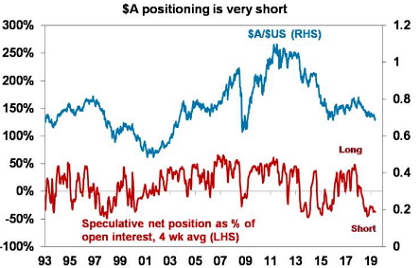
Against this there are a bunch of forces acting to support the $A, and this has been evident in its relative resilience despite bad news in recent weeks. Firstly, global sentiment towards the Australian dollar has been negative for some time and this has been reflected in short or underweight positions in the $A being at extreme levels – see the next chart. In other words, many of those who want to sell the $A have already done so and this leaves it vulnerable to a rally if there is any good news.


Source: Bloomberg, AMP Capital

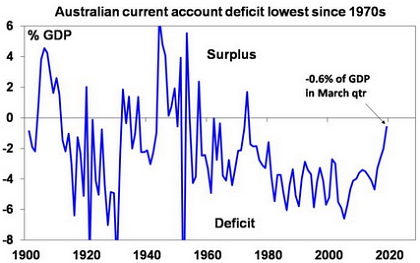
Secondly, there has been good news with the iron ore price pushing above $US100 a tonne and this combined with solid growth in export volumes has pushed the trade balance into a record surplus which has shrunk the current account deficit as a share of GDP to its lowest since the 1970s. Of course, the iron ore price will likely fall back somewhat when Vale gets production back to normal after its dam disaster, but Chinese economic stimulus may help keep it and other commodity prices supported. The smaller current account surplus means Australia has become less dependent on foreign capital inflows.


Source: ABS, AMP Capital

Finally, in response to the threat to growth from President Trump’s trade wars, mixed economic data and weak inflation, investors have moved to price in rate cuts from the Fed over the next year. And this is negative for the $US generally after a multi-year bull market since 2008.

So where to from here?

Overall, we expect that the weaker growth outlook in Australia relative to the US and the likely continuing decline in the interest rate differential versus the US will dominate and push the $A still lower. But with the $A having already had a big fall, short $A positions running high, the current account deficit having shrunk and the US dollar looking toppy we see the $A falling to around $US0.65 on a six to 12 month horizon as opposed to crashing down to say the 2001 low of $US0.48. Of course, if the global economy falls apart, causing a surge in unemployment in Australia as export demand and confidence collapses and another big leg down in house prices then all bets are off and the Aussie will fall a lot more…but that’s not our base case.

What does it mean for investors?

With the risks skewed towards more downside in the value of the $A, albeit less so than say a year ago, there are several implications for investors.

First, there remains a case – albeit not as strong as it was when the Australia dollar was much higher – to maintain a decent exposure to offshore assets that are not hedged back to Australian dollars. A decline in the value of the $A will boost the value of an investment in offshore assets denominated in foreign currency one for one. Meanwhile, the fall in Australian interest rates relative to global interest rates has reduced the incentive to hedge because when Australian rates are above global rates investors are “paid” to hedge.

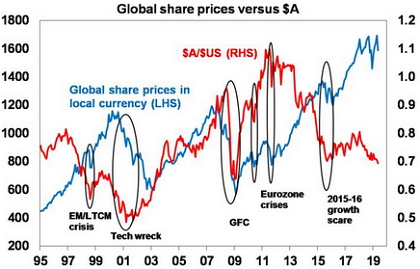
Second, if the global outlook turns sour due to say Trump’s trade wars, having an exposure to foreign currency provides protection for Australian investors as the $A usually falls in response to threats to global growth. As can be seen in the next chart there is a rough positive correlation between changes in global shares in their local currency terms and the $A. Major falls in global shares associated with the emerging market/LTCM crisis in 1998, the tech wreck into 2001, the GFC, the Eurozone crises and the 2015-16 global growth scare saw sharp falls in the $A. So being short the $A and long foreign exchange provides good protection against threats to the global outlook.


Source: Bloomberg, AMP Capital

Finally, continuing softness in the $A will be positive for Australian industry sectors that compete internationally like tourism, higher education, manufacturing, agriculture and mining and this will benefit shares exposed to these areas.

If you would like to discuss any of the issues raised by Dr Oliver, please call on Phone: 07 5641 4134 or email martin@wtfp.com.au.


Source: AMP Capital 14 June 2019

Important notes: While every care has been taken in the preparation of this article, AMP Capital Investors Limited (ABN 59 001 777 591, AFSL 232497) and AMP Capital Funds Management Limited (ABN 15 159 557 721, AFSL 426455)  (AMP Capital) makes no representations or warranties as to the accuracy or completeness of any statement in it including, without limitation, any forecasts. Past performance is not a reliable indicator of future performance. This article has been prepared for the purpose of providing general information, without taking account of any particular investor’s objectives, financial situation or needs. An investor should, before making any investment decisions, consider the appropriateness of the information in this article, and seek professional advice, having regard to the investor’s objectives, financial situation and needs. This article is solely for the use of the party to whom it is provided and must not be provided to any other person or entity without the express written consent of AMP Capital.
By Lucinda Lions, Flying Solo contributor

Think you’re great at multitasking? So did these people, until studies revealed some unsettling data.

On three different occasions over the years, something terrible has nearly happened to me as a result of multitasking.

I work from home, and if my home-office door is closed, my partner and son rarely disturb me. But sometimes they need to ask a quick question or tell me something important. When they do, I usually stop what I’m doing, listen, speak, and get back to work once they leave. But on a few occasions I’ve kept tapping away at emails while they talk.

The problem is, on each occasion where I’ve split my focus, at the end of every email, I’ve typed, ‘I love you’.

Yes, I love you.

“When you struggle to pay attention, make mistakes, forget information and switch ineffectively from task to task, it will invariably lead to poor performance.”

One time it was to a complete stranger who simply wanted a copywriting quote, but who could’ve ended up with so much more.

Thankfully, each time I immediately realised my mistake and frantically deleted the offending sentence, promising never to multitask like that again. 

Studies say multitasking sucks

Deep down, most of us realise that doing two or more tasks at once is ineffective and many studies prove this.

Still, some select individuals seem to be particularly gifted in the art of multitasking, particularly media multitasking, which involves flitting between social media and emails, or messenger apps and websites, or text messages and YouTube; or a combination of several.

So Stanford researchers decided to conduct a study to find out exactly how and why they’ve become so good at media multitasking.

The studies told a curious story

Clifford Nass, Eyal Ophir and Anthony Wagner put 100 students through their paces in an effort to find out what gave the gifted media multitaskers their juggling edge.

For each test, the researchers split the students into two groups. One group regularly multitasked, while the others didn’t.

The first test involved flashing up configurations of images, and asking the participants questions about those configurations. The participants were also asked to ignore such things as random, blue rectangles that would appear near the configurations. The low multitaskers ignored them just fine, but the high multitaskers were constantly distracted. Their performance in that test was considered quite poor.

Not perturbed, the researchers assumed that because the high multitaskers couldn’t ignore distractions, they must have sharper memories, allowing them to better store and organise information.

Wrong.

In the second test, the participants were shown a series of alphabetical letters. The high multitaskers performed poorly again, not remembering when a letter was repeated.

‘The low multitaskers did great,’ Ophir said. ‘The high multitaskers were doing worse and worse the further they went along because they kept seeing more letters and had difficulty keeping them sorted in their brains.’

The researchers figured that if the high-multitaskers couldn’t filter out irrelevant information or organise their memories, they’d have to be better at switching effectively from one task to another.

Nope!

The third test involved the participants seeing simultaneous images of letters and numbers, and having to focus on one or the other. When looking at the digits, they were asked to determine whether they were odd or even. When looking at the letters, they were asked to determine whether they were vowels or consonants.

Again, the light multitaskers performed better. Ophir said of the high multitaskers: ‘They couldn’t help thinking about the task they weren’t doing. The high multitaskers are always drawing from all the information in front of them. They can’t keep things separate in their minds.’

If that isn’t bad enough, Wagner went on to explain one of the reasons why they performed the tasks slower: ‘When they’re in situations where there are multiple sources of information coming from the external world or emerging out of memory, they’re not able to filter out what’s not relevant to their current goal. That failure to filter means they’re slowed down by that irrelevant information.’

Poor performance. A lack of productivity.

A different study showed that when participants were asked to do three tasks, it led to three times the rate of errors, than when completing two.

All this data paints a worrying picture. When you struggle to pay attention, make mistakes, forget information and switch ineffectively from task to task, it will invariably lead to poor performance and a lack of productivity.

Does multitasking also damage your thinking?

While researchers are convinced that the minds of multitaskers aren’t working as effectively as they could, they’re still researching whether chronic media multitaskers are born with poor concentration, or if multitasking is actually damaging their cognitive control.

Some articles cite research that suggests multitasking actually lowers your IQ. This particular article reads: ‘A study at the University of London found that participants who multitasked during cognitive tasks experienced IQ score declines that were similar to what they’d expect if they had smoked marijuana or stayed up all night. IQ drops of 15 points for multitasking men lowered their scores to the average range of an 8-year-old child.’

Yikes!

Studies say it sucks. But so does common sense.

The reality is, for every study that proves multitasking sucks, there’s probably one that proves it increases your output while reducing fine lines around your eyes. So forget studies and let’s consider common sense.

Can doing two tasks at once (tasks that require deep thinking or attention), really be more effective than giving 100% attention to one task at a time?

Honestly, my gut says no.

Light multitasking has its place, and most of us do it at home and work. But if heavy multitasking becomes your constant, go-to way of existence, particularly in the area of media multitasking, you could be paying a big mental and productivity price. So boost performance and productivity by focusing on a single task. You’ll do it better, faster and with far less mistakes.

I love you.


Source:

Source : Flyingsolo

This article by Lucinda Lyons is reproduced with the permission of Flying Solo – Australia’s micro business community 
Find out more and join over 100k others.


Important:
This provides general information and hasn’t taken your circumstances into account. It’s important to consider your particular circumstances before deciding what’s right for you. Any information provided by the author detailed above is separate and external to our business and our Licensee. Any information provided by the author detailed above is separate and external to our business and our Licensee. Neither our business, nor our Licensee take any responsibility for any action or any service provided by the author.

Any links have been provided with permission for information purposes only and will take you to external websites, which are not connected to our company in any way. Note: Our company does not endorse and is not responsible for the accuracy of the contents/information contained within the linked site(s) accessible from this page.


How your super is taxed differs depending on your age, contributions and other factors, so it’s important to understand the different tax implications that could apply to your nest egg.

Super can be a tax-effective way of saving for retirement. Generally, money invested in super is taxed at a lower rate than your personal income tax rate. It’s structured in this way to encourage workers to save for their retirement.

The money you invest in super can be taxed at four different stages: when the money goes in (super contributions), while it’s in your super fund (investment earnings), when you withdraw it (super benefits) and when you die (super death benefits).

But the ATO’s tax treatment of your super savings is different at each of these stages. Below we explain the tax implications of each stage.

Tax on super contributions

The amount of tax you’ll pay on money going into your fund (super contributions) depends on the type of super contribution and your circumstances. Here are some of the key factors to consider.

How concessional contributions are taxed

Concessional (before tax) super contributions include employer super contributions made on your behalf, any salary sacrifice contributions you make, or any personal contributions that you claim a tax deduction on in your tax return. These contributions are taxed at 15% when they are received by your super fund (up to a cap of $25,000 per year), provided you earn less than $250,000 annually.

How non-concessional contributions are taxed

Non-concessional (after tax) super contributions aren’t subject to tax as they are made with money you’ve already paid tax on (such as a regular salary payment). Types of non-concessional contributions include contributions your spouse makes to your super or personal contributions that you don’t claim as a tax deduction.

How low-income earners are taxed

If you’re a low-income earner (earning up to $37,000 per year), the low-income superannuation tax offset ensures that you don’t pay a higher rate of tax on your super contributions than your income tax rate. The offset will be paid directly to your super account and the payment will be equal to 15% of your concessional contributions for the year, capped at a maximum of $500.

Those who earn between $37,697 and $52,697 during the 2018/2019 financial year may also be eligible for super co-contributions from the government of 50 cents for each dollar, up to a maximum of $1000 in non-concessional (after tax) contributions.

How high-income earners are taxed

If you earn more than $250,000 a year (including super), your concessional contributions are taxed at an additional 15%, bringing the total tax on these contributions to 30%; however, this is still less than your marginal income tax rate of 45%. This extra 15% is known as Division 293 tax.  Only the concessional contributions which make your total income exceed $250,000 are subject to the additional tax.

If your concessional contributions exceed the concessional contributions cap of $25,000 per year, the excess is included in your tax return and taxed at your marginal tax rate (less an allowance for the 15% already withheld by your super fund). You can choose to withdraw some of the excess contributions to pay the additional tax.

Tax on super investment earnings

The tax that applies to super investment earnings varies depending on whether your super is in accumulation phase or pension phase.

How super investment earnings in accumulation phase are taxed

When you are still working and growing your super, the investment earnings generated by your super are taxed at a maximum rate of 15%.

But if the earnings are capital gains from an asset owned through your super for more than 12 months and then sold, the tax on the gain is reduced to 10%.

The amount of tax your fund pays may also be reduced by tax deductions or tax credits that apply to some types of investments.

How super investment earnings in pension phase are taxed

If you’re retired and drawing a retirement income stream from your super, then the investment earnings are exempt from tax, including capital gains, regardless of your age. A limit of $1.6 million (in 2018-19) applies to the amount that you can transfer to the tax-exempt retirement pension phase. This tax exemption on investment earnings also applies if you commenced the income stream due to permanent incapacity.

Tax on super withdrawals

Tax when you withdraw your super as an income stream

If you’ve reached your preservation age, have retired and are aged 60 or over – or if you are aged 65 and over regardless of your work status – you can access your super as an income stream (such as a pension or annuity) tax free. This is known as a ‘retirement phase’ income stream. If you are classified as ‘permanently incapacitated’ you may also be able to access your super as a retirement phase income stream, regardless of your age, but some tax may be payable on the income payments if you are below age 60.

If you’ve reached your preservation age and retired but are under age 60, no tax is payable on the tax-free component of your super (which is made up of your non-concessional contributions and any government co-contributions) but tax is payable on the taxable component of your super (which is made up of your concessional contributions and investment earnings). This taxable component will be added to your income and taxed at your income tax rate less a tax offset equal to 15% of the taxable portion of the payment.

Tax when you take a transition to retirement income stream

Income payments from transition to retirement (TTR) income streams (where you can draw down from your super if you’ve reached preservation age but are still working) are taxed in the same way as other retirement income streams depending on your age, as explained above. The returns on the assets supporting a TTR income stream are taxed at a maximum of 15%, the same as super investment earnings. The earnings on the TTR income stream become tax exempt as explained above when you advise the super fund of your retirement or reach age 65.

Tax when you withdraw your super as a lump sum

If you’ve reached your preservation age, have retired and are aged 60 or over, or if you are aged 65 and over regardless of your work status, you can access your super as a lump sum tax free.

If you’ve reached your preservation age and retired but are under age 60, you can withdraw up to $205,000 tax free  in 2018-19 (this is known as the low rate threshold amount). This is a lifetime limit and is adjusted annually to take into account the rising costs of living. The threshold doesn’t include the tax-free portion of your super (which is made up of your non-concessional contributions and any government co-contributions) as you can withdraw these tax free anyway. Any amount you withdraw over the low rate threshold will be taxed at 17% (including the Medicare levy) or your income tax rate, whichever is lower.

Tax when you withdraw your super in other circumstances

Under some limited circumstances, you can withdraw a lump sum from your super before preservation age. In these cases, withdrawals are taxed at 22% (including the Medicare levy) or your income tax rate, whichever is lower.

Tax on super death benefits

Different tax rates apply to super death benefits depending on whether they are paid as a lump sum, income stream (or mixture of both), and if the beneficiary (or beneficiaries) who receive your super death benefits are classified as tax dependants.

Tax dependants include a current or former spouse or defacto, any children you have under age 18 or any other financial dependants.

It’s also important to understand that different tax treatments apply to the taxed and untaxed element of your super.

The taxed element refers to the portion of your super death benefit that has been accumulated through concessional contributions and your super investment earnings.

The untaxed element typically refers to a portion of your super death benefit that comes from a life insurance policy held by your super fund, or where the death benefit is being paid from an untaxed super fund, such as certain government sector super funds.

Paying super death benefits as a lump sum

Type of beneficiary

Tax rate on taxed super element

Tax rate on untaxed super element

Tax dependant

Tax-free

Tax-free

Non-tax dependant

Maximum tax rate of 15% (plus the Medicare levy)

Maximum tax rate of 30% (plus the Medicare levy)

Paying super death benefits as an income stream

Age of beneficiary and deceased at time of death

Tax rate on taxed super element

Tax rate on untaxed super element(1)

Beneficiary is 60 or older or the deceased was 60 or older

Tax free

Your marginal tax rate minus a 10% tax offset

Beneficiary is under 60 and the deceased is under 60

Your marginal tax rate minus a 15% tax offset(2)

Your marginal tax rate


1 Refers to (unfunded) government/public sector super funds only.
2 When the beneficiary turns age 60 the income stream becomes tax free.

Source: AMP 11 April 2019

Important:

This information is provided by AMP Life Limited. It is general information only and hasn’t taken your circumstances into account. It’s important to consider your particular circumstances and the relevant Product Disclosure Statement or Terms and Conditions, available by calling Phone: 07 5641 4134, before deciding what’s right for you.

All information in this article is subject to change without notice. Although the information is from sources considered reliable, AMP and our company do not guarantee that it is accurate or complete. You should not rely upon it and should seek professional advice before making any financial decision. Except where liability under any statute cannot be excluded, AMP and our company do not accept any liability for any resulting loss or damage of the reader or any other person.

Ideally, investors should begin investing as early as possible in their lives, invest more whenever possible and remain in investment markets for as long as possible.

These fundamentals of sound investment practice should increase your chances of investing success.

Yet super fund members who attempt to illegally gain access to super savings before being eligible are doing the opposite.

And they are reducing their opportunities to save for a satisfactory standard of living in retirement. It is difficult to later rebuild super savings spent on paying pre-retirement expenses.

The tax office, the regulator of self-managed super funds (SMSFs), recently reinforced its warning about participating in illegal early-access schemes. These relentless schemes typically use new SMSFs as a means to obtain super savings initially held in large super funds.

Preservation rules

With limited exceptions, super fund members cannot legally gain access their super savings before turning 65 or reaching their preservation age (55-60) and retiring (or taking a transition-to-retirement pension).

Members can seek to legally gain early access to their super on various compassionate grounds or in such circumstances as severe financial hardship, terminal illness or incapacity.

And other ways that fund members can legally gain early access to some of their super are through the First home super saver scheme and transition-to-retirement pensions. (Members taking a transition-to-retirement pension can receive up to 10 per cent a year of the balance in their super pension accounts as a pension upon reaching their preservation age yet before retiring.)

Promoters misuse of SMSFs

Typically, promoters of early-access schemes try to convince members of large super funds to transfer their super into a new SMSF before taking the savings out of super. In such cases, the members wanting to withdraw their super become trustees of the new SMSFs.

Scheme promoters try to convince fund members to use their super money to pay for new cars, holidays and financial help to their families, and to reduce credit-card debt. High fees or commissions paid to promoters further dilute super savings.

Promoters tend to target individuals who are in financial difficulties, perhaps with a poor understanding of super. In some cases, the targeted members may have been eligible to legally gain early access to their super on financial hardship or other limited grounds.

Implications for SMSF trustees

Possible consequences for SMSF trustees allowing early access to super include: disqualification as trustees, personal liability to pay penalties, and prosecution. As well, an SMSF may be declared non-complying, leading to the loss of valuable tax concessions.

Dipping into super

Some members gaining early access to their super do not participate in early-access schemes pushed by promoters. Instead, they illegally dip into their SMSFs from time to time with the hope of not to being detected.

In the past, the tax office has warned, for example, about the use of super to prop up small businesses with financial difficulties. Unfortunately, super saving can be a temptation for owners of a business with cash-flow problems.

Please contact us on Phone: 07 5641 4134 if we can be of further assistance.

Source : Vanguard April 2019 

By Robin Bowerman, Head of Corporate Affairs at Vanguard.

Reproduced with permission of Vanguard Investments Australia Ltd

Vanguard Investments Australia Ltd (ABN 72 072 881 086 / AFS Licence 227263) is the product issuer. We have not taken yours and your clients’ circumstances into account when preparing this material so it may not be applicable to the particular situation you are considering. You should consider your circumstances and our Product Disclosure Statement (PDS) or Prospectus before making any investment decision. You can access our PDS or Prospectus online or by calling us. This material was prepared in good faith and we accept no liability for any errors or omissions. Past performance is not an indication of future performance.
© 2019 Vanguard Investments Australia Ltd. All rights reserved.

Important:
Any information provided by the author detailed above is separate and external to our business and our Licensee. Neither our business, nor our Licensee take any responsibility for any action or any service provided by the author. Any links have been provided with permission for information purposes only and will take you to external websites, which are not connected to our company in any way. Note: Our company does not endorse and is not responsible for the accuracy of the contents/information contained within the linked site(s) accessible from this page.

I have been working in and around investment markets for 35 years now. A lot has happened over that time. The 1987 crash, the recession Australia had to have, the Asian crisis, the tech boom/tech wreck, the mining boom, the Global Financial Crisis, the Eurozone crisis. Financial deregulation, financial reregulation. The end of the cold war, US domination, the rise of Asia and then China. And so on. But as someone once observed the more things change the more they stay the same. And this is particularly true in relation to investing. So, what I have done here is put some thought into the nine most important things I have learned over the past 35 years.

# 1 There is always a cycle

Droll as it sounds, the one big thing I have seen over and over in the past 35 years is that investment markets constantly go through cyclical phases of good times and bad. Some are short term, such as those that relate to the 3 to 5 year business cycle. Some are longer, such as the secular swings seen over 10 to 20 year periods in shares. Some get stuck in certain phases for long periods. Debate is endless about what drives cycles, but they continue. But all eventually contain the seeds of their own reversal. Ultimately there is no such thing as new eras, new paradigms and new normal as all things must pass. What’s more share markets often lead economic cycles, so economic data is often of no use in timing turning points in shares.

# 2 The crowd gets it wrong at extremes

What’s more is that these cycles in markets get magnified by bouts of investor irrationality that take them well away from fundamentally justified levels. This is rooted in investor psychology and flows from a range of behavioural biases investors suffer from. These include the tendency to project the current state of the world into the future, the tendency to look for evidence that confirms your views, overconfidence and a lower tolerance for losses than gains. So, while fundamentals may be at the core of cyclical swings in markets, they are often magnified by investor psychology if enough people suffer from the same irrational biases at the same time. From this it follows that what the investor crowd is doing is often not good for you to do too. We often feel safest when investing in an asset when neighbours and friends are doing the same and media commentary is reinforcing the message that it’s the right thing to do. This “safety in numbers” approach is often doomed to failure. Whether its investors piling into Japanese shares at the end of the 1980s, Asian shares into the mid 1990s, IT stocks in the late 1990s, US housing and dodgy credit in the mid 2000s or Bitcoin in 2017. The problem is that when everyone is bullish and has bought into an asset in euphoria there is no one left to buy but lots of people who can sell on bad news. So, the point of maximum opportunity is when the crowd is pessimistic, and the point of maximum risk is when the crowd is euphoric.

# 3 What you pay for an investment matters a lot

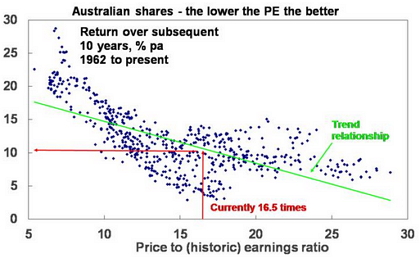
The cheaper you buy an asset the higher its prospective return. Guides to this are price to earnings ratios for share markets (the lower the better – see the next chart) and yields, ie the ratio of dividends, rents or interest payments to the value of the asset (the higher the better). Flowing from this it follows that yesterdays winners are often tomorrows losers – because they became overvalued and over loved and vice versa. But while this seems obvious, the reality is that many find it easier to buy after shares have had a strong run because confidence is high and sell when they have had a big fall because confidence is low. But the key point is that the more you pay for an asset the lower its potential return and vice versa.


Source: Global Financial Data, AMP Capital

# 4 Getting markets right is not as easy as you think

In hindsight it all looks easy. Looking back, it always looks obvious that a particular boom would go bust when it did. But that’s just Harry hindsight talking! Looking forward no-one has a perfect crystal ball. As JK Galbraith observed “there are two kinds of forecasters: those who don’t know, and those who don’t know they don’t know.” Usually the grander the forecast – calls for “great booms” or “great crashes ahead” – the greater the need for scepticism as such calls invariably get the timing wrong (in which case you lose before it comes right) or are dead wrong. Market prognosticators suffer from the same psychological biases as everyone else. If getting markets right were easy, then the prognosticators would be mega rich and would have stopped doing it long ago. Related to this many get it wrong by letting blind faith – “there is too much debt”, “house prices are too high and are guaranteed to crash”, “the Eurozone will break up” – get in the way of good investment decisions. They may be right one day, but an investor can lose a lot of money in the interim. The problem for ordinary investors is that it’s not getting easier as the world is getting noisier as the flow of information and opinion has turned from a trickle to a flood and the prognosticators have had to get shriller to get heard.

# 5 Investment markets don’t learn

A key lesson from the history of investment markets is that they don’t seem to learn. The same mistakes are repeated over and over as markets lurch from one extreme to another. This is even though after each bust many say it will never happen again and the regulators move in to try and make sure it doesn’t. But it does! Often just somewhere else. Sure, the details change but the pattern doesn’t. As Mark Twain is said to have said: “history doesn’t repeat, but it rhymes.” Sure, individuals learn and the bigger the blow up the longer the learning lasts. But there’s always a fresh stream of newcomers to markets and in time collective memory dims.

# 6 Compound interest is like magic

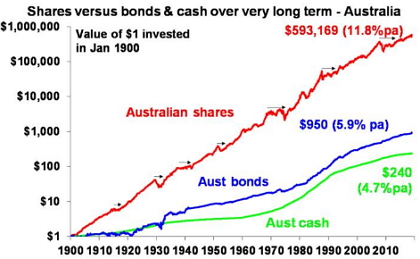
This one goes way back to my good friend Dr Don Stammer. One dollar invested in Australian cash in 1900 would today be worth $240 and if it had been invested in bonds it would be worth $950, but if it was allocated to Australian shares it would be worth $593,169. Although the average annual return on Australian shares (11.8% pa) is just double that on Australian bonds (5.9% pa) over the last 119 years, the magic of compounding higher returns leads to a substantially higher balance over long periods. Yes, there were lots of rough periods along the way for shares as highlighted by arrows on the chart, but the impact of compounding at a higher long-term return is huge over long periods of time. The same applies to other growth-related assets such as property.


Source: Global Financial Data, AMP Capital

# 7 It pays to be optimistic

The well-known advocate of value investing Benjamin Graham observed that “To be an investor you must be a believer in a better tomorrow.” If you don’t believe the bank will look after your deposits, that most borrowers will pay their debts, that most companies will grow their profits, that properties will earn rents, etc then you should not invest. Since 1900 the Australian share market has had a positive return in roughly eight years out of ten and for the US share market it’s roughly seven years out of 10. So getting too hung up worrying about the next two or three years in 10 that the market will fall risks missing out on the seven or eight years out of 10 when it rises.

# 8 Keep it simple stupid

Investing should be simple, but we have a knack for overcomplicating it. And it’s getting worse with more options, more information, more apps and platforms, more opportunities for gearing and more rules & regulations around investing. But when we overcomplicate investments we can’t see the wood for the trees. You spend too much time on second order issues like this share versus that share or this fund manager versus that fund manager, so you end up ignoring the key driver of your portfolio’s performance – which is its high-level asset allocation across shares, bonds, property, etc. Or you have investments you don’t understand or get too highly geared. So, it’s best to keep it simple, don’t fret the small stuff, keep the gearing manageable and don’t invest in products you don’t understand.

# 9 You need to know yourself to succeed at investing

We all suffer from the psychological weaknesses referred to earlier. But smart investors are aware of them and seek to manage them. One way to do this is to take a long-term approach to investing. But this is also about knowing what you want to do. If you want to take a day to day role in managing your investments then regular trading and/or a self managed super fund (SMSF) may work, but you need to recognise that will require a lot of effort to get right and will need a rigorous process. If you don’t have the time and would rather do other things like sailing, working at your day job, or having fun with the kids then it may be best to use managed funds. It’s also about knowing how you would react if your investment suddenly dropped 20% in value. If your reaction were to be to want to get out then you will either have to find a way to avoid that as you would just be selling low and locking in a loss or if you can’t then you may have to consider an investment strategy offering greater stability over time (which would probably mean accepting lower returns).

So what does all this mean for investors?

All of this underpins what I call the Nine Keys to Successful Investing which are:

  1. Make the most of the power of compound interest. This is one of the best ways to build wealth and this means making sure you have the right asset mix. 

  2. Don’t get thrown off by the cycle. The trouble is that cycles can throw investors out of a well thought out investment strategy. But they also create opportunities. 

  3. Invest for the long term. Given the difficulty in getting market and stock moves right in the short-term, for most it’s best to get a long-term plan that suits your level of wealth, age, tolerance of volatility, etc, and stick to it. 

  4. Diversify. Don’t put all your eggs in one basket. But also, don’t over diversify as this will just complicate for no benefit.

  5. Turn down the noise. After having worked out a strategy thats right for you, it’s important to turn down the noise on the information flow and prognosticating babble now surrounding investment markets and stay focussed. In the digital world we now live in this is getting harder.

  6. Buy low, sell high. The cheaper you buy an asset, the higher its prospective return will likely be and vice versa. 

  7. Beware the crowd at extremes. Don’t get sucked into the euphoria or doom and gloom around an asset.

  8. Focus on investments that you understand and that offer sustainable cash flow. If it looks dodgy, hard to understand or has to be based on odd valuation measures or lots of debt to stack up then it’s best to stay away. 

  9. Seek advice. Given the psychological traps we are all susceptible too and the fact that investing is not easy, a good approach is to seek advice.


Source: AMP Capital 6 June 2019

Important notes: While every care has been taken in the preparation of this article, AMP Capital Investors Limited (ABN 59 001 777 591, AFSL 232497) and AMP Capital Funds Management Limited (ABN 15 159 557 721, AFSL 426455)  (AMP Capital) makes no representations or warranties as to the accuracy or completeness of any statement in it including, without limitation, any forecasts. Past performance is not a reliable indicator of future performance. This article has been prepared for the purpose of providing general information, without taking account of any particular investor’s objectives, financial situation or needs. An investor should, before making any investment decisions, consider the appropriateness of the information in this article, and seek professional advice, having regard to the investor’s objectives, financial situation and needs. This article is solely for the use of the party to whom it is provided and must not be provided to any other person or entity without the express written consent of AMP Capital.