The past financial year saw a roller coaster ride for investors. Share markets plunged into Christmas only to rebound over the last six months. This note reviews the last financial year and takes a look at the investment outlook for 2019-20.

 

A volatile but good year for diversified investors

The past financial year saw pretty good returns for investors. But it didn’t feel so good around Christmas as a combination of worries – President Trump’s trade war with China, a slowdown in China, Fed rate hikes, an end to quantitative easing in the Eurozone, falling property prices and election fears in Australia saw share markets fall sharply. In fact, from its September high to Christmas Eve US shares plunged 20%. But in the last six months share markets have rebounded as while the trade threat has run hot and cold and tensions in the Middle East have escalated central banks have turned dovish with many either easing (like the RBA and PBOC) or signalling that monetary easing is likely (such as the Fed and ECB). This has seen global share markets rebound sharply with Australian shares having their best June half since the early 1990s – helped along by the return of the Coalition Government.

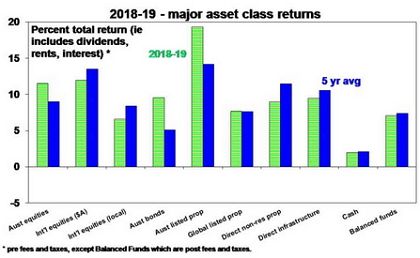
So for the financial year as a whole global shares returned 6.6% in local currency terms and thanks to a fall in the Australian dollar they returned 12% in Australian dollar terms. Australian shares returned 11.6% touching an 11-year high.

Cash and bank deposits had poor returns not helped by the RBA cutting the cash rate to a new record low in June. But bonds had a spectacular turnaround as rising bond yields on the back of Fed tightening a year ago gave way to plunging yields – to record lows in many countries – as inflation subsided and central banks turned dovish resulting in Australian bonds returning 9.6%. The plunge in bond yields reinvigorated the search for yield and so helped yield-sensitive listed property and infrastructure have strong returns. Unlisted property and infrastructure continued to do well, despite a rougher ride for retail property. Balanced growth superannuation funds are estimated to have returned around 7% after taxes and fees. For the last five years their returns have averaged around 7.4% pa, which is not bad given sub 2% inflation.

Source: Thomson Reuters, AMP Capital

Australian residential property fared poorly though with average capital city prices down 8%, but signs of stabilisation have emerged recently helped by the election result and rate cuts.

Key lessons for investors from the last financial year

These include:

  • Turn down the noise – despite the endless predictions of financial disaster it turned out okay again.

  • Maintain a well-diversified portfolio – while shares had a rough ride, bonds, unlisted assets and exposure to foreign currency for Australian investors provided some stability. 

  • Cash is still not king – while cash and bank deposits provided safe steady returns, they remain very low.

The negatives which will likely constrain returns…

There are a bunch of threats which are likely to lead to bouts of volatility and constrain returns.

  • First, President Trump’s trade war with China and threats against other countries is adversely affecting business confidence and investment. Trade talks with China have resumed and both sides have a strong incentive to resolve the issue but there is a risk that they may not.

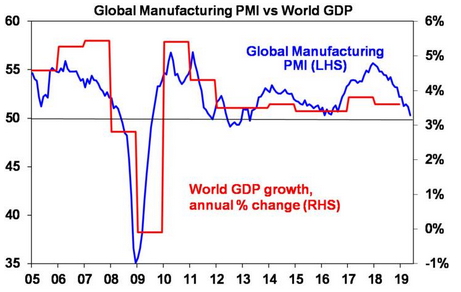
  • Second, global growth indicators are well down from their highs at the start of last year. And the yield curve in the US is flashing a recession warning.

Source: Bloomberg, AMP Capital

  • Third, the risk of conflict with Iran has escalated after the US ditched its commitment to the 2015 Iran nuclear agreement. As roughly 20% of global oil demand flows through the Strait of Hormuz its disruption would threaten sharply higher oil prices.

  • Fourth, US political risk is likely to ramp up with the debt ceiling needed to be increased around September (remember the debt ceiling/US ratings downgrade of 2011!) and Democratic presidential debates highlighting a sharp leftward lurch at a time when the top Democrat nominees are polling ahead of Trump.

  • Fifth, Eurozone risks remains with an increased risk of a no deal Brexit which would be a big drag on the UK economy as 46% of its exports go to the EU and a small drag on European growth as 6% of its exports go to the UK. More important for the Eurozone is the ongoing tensions around the still worsening Italian budget deficit.

  • Finally, in Australia while house prices are showing signs of being at or near the bottom, rising unemployment risks resulting in a negative feedback loop and another leg down, which in turn would further weigh on economic growth.

…but a bunch of things should keep returns positive

  • However, there are a bunch of positives providing an offset.

  • First, while global growth indicators are soft, there has been a loss of downwards momentum in the Eurozone and globally it still looks like the growth slowdowns of 2011-12 and 2015-16.

  • Second, the fall in global inflation has seen central banks move from tightening to easing to various degrees, providing a renewed stimulus to growth. This is a big difference to a year ago when it was thought that the hurdle for central bank easing was high.

  • Third, while the US yield curve is flashing red it’s not always reliable, it may be distorted by central bank quantitative easing and it has long lead times. What’s more there is still little sign of the sort of excess that normally precedes recessions – there is still spare capacity globally, growth in private debt remains moderate, investment as a share of GDP is around average or below, wages growth and inflation remain low and we are yet to see a generalised euphoria in asset prices. The current growth slowdown globally maybe seen as extending the investment cycle by delaying the build up of recession driving excesses.

  • Fourth, while Trump’s trade wars and maximum pressure on Iran may reflect the pursuit of international relevance at a time when his ability to do anything in the US is constrained (having lost Congress) it is in his interest to resolve both in a non-disruptive way as American’s don’t re-elect presidents when unemployment is rising and oil prices are surging.

  • Fifth, share valuations are not excessive. While price to earnings ratios are moderately above long-term averages in developed countries, this is to be expected in a world of low inflation. Valuation measures that allow for low interest rates and bond yields show shares to be fair value or cheap.

  • Finally, while unemployment is expected rise to 5.5% this year in Australia it should be limited as infrastructure spending remains strong, mining investment bottoms out, export demand holds up with overall growth helped by monetary and fiscal stimulus and the low Australian dollar.

What about the return outlook?

The threats around trade and geopolitical risks along with the tendency for seasonal weakness out to September/October could see a pull back in share markets and returns are likely to be constrained. But easy money and the absence of large-scale economic excess should help extend the cycle and keep returns positive at around 6% over the next 12 months from a well diversified portfolio. Looking at the major asset classes:

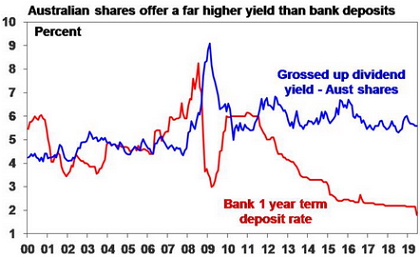
  • Cash and bank deposit returns are likely to be poor at around 1% as the RBA is expected to cut the cash rate to 0.5% by early next year. Investors still need to think about what they really want: if it’s capital stability then stick with cash but if it’s a decent stable income flow then consider the alternatives with Australian shares and unlisted commercial property and infrastructure still offering attractive yields. 

Source: RBA; AMP Capital

  • Sovereign bond investors benefit from falling yields but once they stop falling expect returns to slow again as yields are now very low. Bonds are good portfolio diversifiers though. 

  • Listed and unlisted commercial property and infrastructure are likely to benefit from the ongoing “search for yield” and okay economic growth.

  • Residential property still has a bit more short-term downside risk but expect flattish prices through calendar 2020 as an upwards drift in unemployment constrains returns.

  • Shares are at risk of a correction into the seasonally weak September/October period, but okay valuations, reasonable economic growth and profits and even easier monetary conditions should see the broad trend in shares remain up. 

  • Finally, the $A is likely to fall to around $US0.65 by year end as the RBA eases, but with significant short positions, the Fed easing too and the sharp 39% $A fall already seen since 2011 it has become a closer call.

Things to keep an eye on

The key things to keep an eye are: global business conditions PMIs for any deeper slowing; the trade war – this needs to be resolved soon; Middle East tensions around Iran; US political risks; risks around Chinese growth; and Australian unemployment and house prices.

Concluding comments

Returns are likely to be okay over 2019-20 as conditions are not in place for recession. But expect constrained returns – say around 6% for a diversified fund – and bouts of volatility.


Source: AMP Capital 2 July 2019

Important notes: While every care has been taken in the preparation of this article, AMP Capital Investors Limited (ABN 59 001 777 591, AFSL 232497) and AMP Capital Funds Management Limited (ABN 15 159 557 721, AFSL 426455) (AMP Capital) makes no representations or warranties as to the accuracy or completeness of any statement in it including, without limitation, any forecasts. Past performance is not a reliable indicator of future performance. This article has been prepared for the purpose of providing general information, without taking account of any particular investor’s objectives, financial situation or needs. An investor should, before making any investment decisions, consider the appropriateness of the information in this article, and seek professional advice, having regard to the investor’s objectives, financial situation and needs. This article is solely for the use of the party to whom it is provided and must not be provided to any other person or entity without the express written consent of AMP Capital.


The increased focus on ESG issues is transforming approaches to investing. Companies and asset managers are changing the way they engage with each other, resulting in a positive outcome both for investors and society as a whole.

For years, meetings between a corporation’s executive team and active investment managers have followed the same format. Investors sit down with the chief financial officer, or chief executive officer, and discuss the outlook for the company.

But the trend towards sustainable investing is finally driving a change to this formula. Now a CFO might bring seven or eight directors to talk about how their respective departments are addressing concerns from gender inequality to carbon emissions and supply chain risks.

Such a trend illustrates the seriousness with which corporate managers are taking environmental, social and governance (ESG) concerns, integrating it into decision-making at all levels of the business. We believe it also shows that the forum for driving real change is in the boardroom rather than from solely behind a computer screen.

Money talks

Corporate engagement forms a central pillar of the active approach to sustainable investing, and a policy of regularly talking to and meeting corporate decision makers has some advantages over other approaches.

Firstly, and perhaps most importantly from the viewpoint of sustainable investing, a strategy of engagement provides a setting in which to raise concerns about how a company manages the impact it has on the society or environment in which it operates.

This can take several forms. Engagement often starts with questions submitted to a company’s investor relations team. These concerns can be escalated to discussions with management, and ultimately be expressed in voting patterns and shareholder resolutions.

For example, in discussions with executives at luxury goods firm LVMH, the company committed to targeted improvements in key areas such as recycling and monitoring potential weaknesses in its supply chain, such as slaughterhouses. As investors, we are now in a position to follow the company’s progress on these commitments.

Beyond the balance sheet

Secondly, an engaged asset manager is more likely to spot the sort of risks and opportunities that don’t show up on the balance sheet. These non-financial risks can have a real financial impact on a firm over time.

Interacting with corporate managers gives a good sense of the culture of a company. A poor culture giving rise to issues such as employment discrimination or product safety is a source of risk that is likely to materialise in the form of fines or recall costs later on.

There are important qualitative, as well as quantitative impacts. For example, companies that ignore the importance of a diverse board and workforce may find it harder to recruit and retain the most talented employees. Similarly, a leadership whose values are at odds with their employees’ risks harming morale and motivation among their staff, hampering the company’s ability to innovate and outperform its competitors.

Meanwhile, companies with poor governance face increased reputational risk, which, when realised, can severely depress stock prices in the short and medium term. Active asset managers have a role to play in holding corporate management to account and minimising these risks.

We firmly believe engagement ultimately delivers benchmark-beating returns. According to an academic study1, ESG engagements generate an excess return of 1.8 per cent over the year following the initial engagement. Engagement on corporate governance and climate change themes was found to be the most profitable, generating excess returns of 8.6 per cent and 10.3 per cent respectively.

The report found that interactions with investors on ESG issues focused the minds of corporate managers. “After successful engagements, companies experience improvements in operating performance, profitability, efficiency, and governance,” the study, published in the Review of Financial Studies in 2015, said.

Engagement is a two-way street, and it provides a forum for collaboration between asset managers and executives where they can discuss how best to realise their ESG objectives.

For example, now-nationalised Dutch bank ABN Amro capped the salary of its CEO at around €700,000, and with zero bonus, to limit expenses and curb risk-taking behaviour following the 2008 financial crisis. Engaged asset managers were able to help the company realise how important it was to promote the cap publicly as a best practice and make it more likely to be kept in place in the future. This was a long-term benefit to shareholders in that by amending the remuneration scheme it reduced the executive’s incentive to pursue risky business strategies that have the potential to undermine the financial strength of the firm.

We note that around a quarter of companies we engage with ask us to give advice on how to improve their communication or disclosure on specific topics. Working together, we have a better chance of sustaining positive momentum.

Conclusion

There are several ways to approach sustainable investing, but the paths share the same aim: to combine the investor’s ESG priorities with maximised investment returns.

At Fidelity, we take an active ownership approach and strongly believe that fostering change through engagement is the most effective and lasting way to positively influence corporate behaviour.

This approach includes direct dialogue with management and directors; collaborating in coalition with stakeholders for greater impact; and the effective use of proxy voting. Through regular engagement we can create value, manage risk and help to improve outcomes for both the investor and society as a whole.

1: Dimson, E., Karakas, O., Li, X.: “Active Ownership” The Review of Financial Studies, Volume 28, Issue 12, December 2015, Pages 3225–3268

Source : Fidelity June 2019

Reproduced with permission of Fidelity Australia. This article was originally published at www.fidelity.com.au

This document has been prepared without taking into account your objectives, financial situation or needs. You should consider these matters before acting on the information. You should also consider the relevant Product Disclosure Statements (“PDS”) for any Fidelity Australia product mentioned in this document before making any decision about whether to acquire the product. The PDS can be obtained by contacting Fidelity Australia on 1800 119 270 or by downloading it from our website at www.fidelity.com.au. This document may include general commentary on market activity, sector trends or other broad-based economic or political conditions that should not be taken as investment advice. Information stated herein about specific securities is subject to change. Any reference to specific securities should not be taken as a recommendation to buy, sell or hold these securities. While the information contained in this document has been prepared with reasonable care, no responsibility or liability is accepted for any errors or omissions or misstatements however caused. This document is intended as general information only. The document may not be reproduced or transmitted without prior written permission of Fidelity Australia. The issuer of Fidelity Australia’s managed investment schemes is FIL Responsible Entity (Australia) Limited ABN 33 148 059 009. Reference to ($) are in Australian dollars unless stated otherwise.
© 2019. FIL Responsible Entity (Australia) Limited.

Important:
This provides general information and hasn’t taken your circumstances into account. It’s important to consider your particular circumstances before deciding what’s right for you. Any information provided by the author detailed above is separate and external to our business and our Licensee. Neither our business, nor our Licensee take any responsibility for any action or any service provided by the author.

Any links have been provided with permission for information purposes only and will take you to external websites, which are not connected to our company in any way. Note: Our company does not endorse and is not responsible for the accuracy of the contents/information contained within the linked site(s) accessible from this page.

By Luke Mitchell, Dooley & Associates Solicitors

The opportunity to purchase an established business promises a future of freedom and financial gain, however the ultimate decision is not one to be taken lightly.

You’ll need to decide whether the move is the right one in the first place – then have the confidence and know-how to undertake due diligence, negotiate the deal and follow through with the transaction. The same goes for those looking to sell their business and move onto their next challenge.

Manage these factors poorly and you can risk what you’ve worked so hard to achieve.

Get them right and you’ll enjoy immense personal reward and satisfaction for your hard work.

Before you sign on the dotted line, it’s critically important that you really understand the sale and purchase process and ensure that you avoid the most common potential pitfalls.

Snapshot Of A Typical Sale/Purchase Process

  1. Information Memorandum issued;

  2. Confidentiality Agreement/NDA executed;

  3. Due diligence and disclosure documents;

  4. Negotiation of sale and purchase documentation;

  5. Execute sale/purchase documentation;

  6. Satisfaction of conditions precedent, preparation for settlement, including items such as

  7. offers of employment and settlement adjustments;

  8. Attend to ASIC and other regulatory filings;
  9. Calculate any relevant post completion price adjustments;

  10. Integration into the business.

We suggest that you start considering and addressing these issues as early on as possible, so that you are aware of all issues from the outset. This will help to ensure that you’re making a fully informed decision and allow the process to flow as smoothly as possible, should you proceed with the transaction.

Dooley & Associates Solicitors ebook Buying & Selling Businesses covers all of the most important issues that should be considered before your sign on the dotted line, from understanding the sale and purchase process to avoiding the most common potential pitfalls.

For further clarification on any of the information we provide, simply contact the team at Dooley & Associates at any time.

Source: Dooley & Associates Solicitors

Reproduced with the permission of Dooley & Associates Solicitors. This article by Luke Mitchell was originally published at www.dooley.com.au/blog

Important:
This provides general information and hasn’t taken your circumstances into account. It’s important to consider your particular circumstances before deciding what’s right for you. Although the information is from sources considered reliable, we do not guarantee that it is accurate or complete. You should not rely upon it and should seek qualified advice before making any investment decision. Except where liability under any statute cannot be excluded, we do not accept any liability (whether under contract, tort or otherwise) for any resulting loss or damage of the reader or any other person.

Any information provided by the author detailed above is separate and external to our business and our Licensee. Neither our business nor our Licensee takes any responsibility for any action or any service provided by the author.

Any links have been provided with permission for information purposes only and will take you to external websites, which are not connected to our company in any way. Note: Our company does not endorse and is not responsible for the accuracy of the contents/information contained within the linked site(s) accessible from this page.

If your goal is to save for the future, or perhaps start putting away for your children’s education – then unless you plan on putting your savings under your mattress, the sooner you start the better.

That’s because you could be missing out on earning compound interest along the way that could make a stark difference to the overall amount you save.

The difference between simple interest and compound interest

There are two main types of interest:

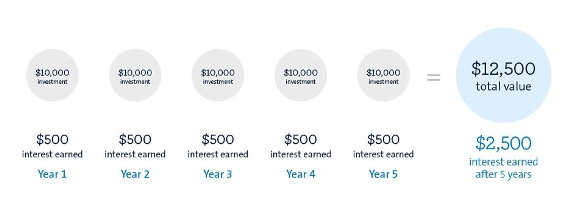
Simple interest is where a one-off interest payment is made at the end of an agreed, set period of time.

For example: if you invest $10,000 in a term deposit at 5% interest per annum, and don’t withdraw any money, then you’ll have $12,500 at the end of 5 years. That’s because the 5% annual interest rate is worked out based on the value of the initial investment and paid in full at the end.

Simple interest earnings over five year

Compound interest is where interest is paid in regular intervals, building on top of earlier interest paid. The result is a snowball effect of interest earning interest.

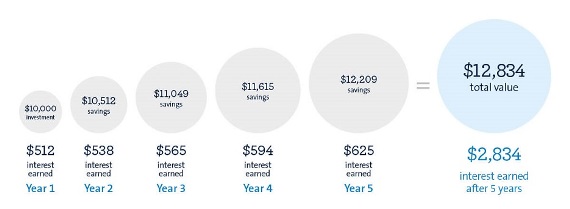
For example, (using the same figures as the simple interest example above), an initial investment of $10,000, earning 5% interest per annum with compound interest paid monthly, will give you $12,834 after five years. That’s because every month the interest earned was earning more interest.

Compound interest earnings over five years

Compound interest will continue to build on itself in this way, assuming nothing changes. How quickly it grows will depend on when you start your savings plan, what the interest rate is, and whether you make contributions (or withdrawals).

How to work out compound interest on your savings

The easiest way to work out how much compound interest you could earn on your savings, is to use an online compound interest calculator, that can do it for you.

Saving for the future

If you’re interested in using compound interest to help your savings grow, then the sooner you start, the better. That’s because, like any good snowball, the earlier it starts rolling, the more snow it will collect along the way.

For example, if you were keen to put aside money for your child’s education, and from the day your child was born, you put $10 per week into a bank account paying 6.25% pa, then by the time they turned 25, their savings would be $31,259. Of that, the interest earned would be $18,372 – outweighing the overall deposits made along the way.

If you started saving later, when your child turned 10, with a first deposit of $5,000, then by the time your child turned 25, they would have savings of $25,611. Of that, the interst earned would be about equal to the overal deposits made, and your savings would be about $6,000 less than if you’d started earlier, without an initial deposit.

This example uses the ASIC Money Smart Calculator1 featuring an effective interest rate of 6.43%. It’s important to remember that a model is not a prediction and uses assumptions. Results are only estimates, the actual amounts may be higher or lower.

Tax on compound interest

It’s worth remembering that like any income, compound interest earnings must be declared to the tax office, even if it’s savings for a child.

Who declares the interest earned, depends on who owns or uses the funds of that account. You can find out more about the tax requirements from the Australian Tax Office.

If you seek further discussion on this topic please contact us on Phone: 07 5641 4134.

1ASIC Money Smart Compound Interest Calculator –  https://www.moneysmart.gov.au/tools-and-resources/calculators-and-apps/compound-interest-calculator

Source : AMP June 2019

Important:
This information is provided by AMP Life Limited. It is general information only and hasn’t taken your circumstances into account. It’s important to consider your particular circumstances and the relevant Product Disclosure Statement or Terms and Conditions, available by calling Phone: 07 5641 4134, before deciding what’s right for you.

All information in this article is subject to change without notice. Although the information is from sources considered reliable, AMP and our company do not guarantee that it is accurate or complete. You should not rely upon it and should seek professional advice before making any financial decision. Except where liability under any statute cannot be excluded, AMP and our company do not accept any liability for any resulting loss or damage of the reader or any other person.


Like any new chapter in your life, preparation can go a long way in ensuring you’re emotionally and financially ready for the road ahead.

Despite the obvious benefits, only 44% of Australians over age 40 feel prepared for retirement1. That’s why we’ve pulled together a nine-point retirement planning checklist to help make sure you’re on the front foot when it comes to financial planning for retirement.

1. Do I have to retire by a certain age?

The retirement age in Australia isn’t set in stone. You can retire whenever you want to, but your health, financial situation, employment opportunities, individual preferences, superannuation plans and partner’s needs could play a big part.

2. How much money will I need for retirement and where will I get it?

Saving for retirement can help you prepare financially for the future. Industry figures show that individuals and couples around age 65 who are looking to retire today need an annual budget of $43,317 and $60,977 respectively to fund a comfortable lifestyle (assuming they own their home outright and are in relatively good health)2.

To live a modest lifestyle in retirement, which is considered better than living on the age pension, an individual would need an annual budget of $27,648, and a couple an annual budget of $39,7753.

These figures are helpful when thinking of retirement planning strategies. Think about how you want to live your life in retirement and add up any potential income sources you may have to support yourself. This could include things such as a superannuation fund, government entitlements, investments, savings or an expected inheritance.

3. What recreational activities are on my to-do list?

When you retire, you’ll likely have more time for the things you enjoy most. Australians are living and remaining active for a lot longer – in your financial planning for retirement,  spare a thought for your physical and mental wellbeing, and whether you’ll need a bit of extra money to do the things you enjoy, such as various sports and hobbies, travel and eating out.

4. How and when will I access my super?

Your superannuation plan can make a big difference to your financial planning for retirement, so it’s handy to have an idea of when you can (and will) access your super.

Generally, you can start accessing super when you reach your preservation age, which will be between 55 and 60, depending on when you were born. As for what you do with your super—which from age 60 is typically accessible tax free—you’ll have a few options.

If you want more financial flexibility, you could access a portion of your super balance via a transition to retirement pension (TTR), while continuing to work full-time, part-time or casually.

Alternatively, if you want to retire, you can choose to take your super as a lump sum, or move it into an account-based pension or annuity, if you want a regular income stream. There will be different tax implications for different people, and your super doesn’t guarantee an income for life, so it can be valuable to seek professional advice on superannuation.

5. Will I be eligible for government entitlements?

If you’re thinking about retirement planning in Australia, there are some government payments that you may be eligible for. Along with your savings, government benefits, such as the age pensionCarer’s Allowance and Disability Support Pension, could be an important part of your retirement income.

6. Will I be entering retirement debt-free?

An AMP.NATSEM report found nearly four in five people aged 50 to 65 have household debt4. When planning retirement, you may want to consider if you’ll be carrying debt into retirement, and think about ways to reduce it sooner rather than later.

Some things that could help reduce debt:

  1. Work out your debts and what they total

  2. Do a comparison of what you earn, owe and spend

  3. Look into whether you might benefit from rolling your debts into one

  4. Pay your debts on time to avoid additional charges

  5. Try to pay the full amount rather than the minimum owing

  6. Look at whether you can afford to make extra repayments

  7. Shop around for providers with lower interest rates and no annual fee.

7. Do I have other matters that need addressing?

  • Insurance – You might have insurance, but it’s worth checking you have the right type and enough of it for your retirement planning. After all, what you require in retirement could be quite different to when you are working.

  • Investment preferences – Investments are part of many retirement planning strategies, and when you’re retiring, it’s worth reviewing your investment style and the options you’ve chosen. In retirement, you might also consider a more conservative approach, as when you’re younger you generally have more time to ride out market highs and lows.

  • Estate planning – On top of that, think about your estate planning needs. Have you documented how you want your assets to be distributed after you’re gone and how you want to be looked after if you can’t make decisions later in life?

8. Will I relocate or downsize?

Your living arrangements in retirement should be based on more than just your finances. Your health, partner, family and what activities you decide to pursue once you stop work will all play a part.

If you’re thinking of downsizing to release money from your property, planning ahead can help you feel more in control and provide greater peace of mind as you can assess any out-of-pocket costs in advance.

9. Do I want to make any final super contributions?

The more you can put into super before retiring, the more money you’re likely to have when you retire. And, if you invest some of your before-tax income into super (known as salary sacrifice), these amounts will generally be taxed at 15%, which is lower than the tax most people pay on their employment income. Keep in mind that even if you’re 65 or over, you may still be able to continue to make contributions to your super to fund your future retirement as well.

Whatever your goals and future plans happen to be, remember that even a little bit of planning today could go a long way tomorrow.

Please contact us on Phone: 07 5641 4134 if you seek further assistance on this topic .

Source : AMP May 2019

Important:
This information is provided by AMP Life Limited. It is general information only and hasn’t taken your circumstances into account. It’s important to consider your particular circumstances and the relevant Product Disclosure Statement or Terms and Conditions, available by calling Phone: 07 5641 4134, before deciding what’s right for you.

All information in this article is subject to change without notice. Although the information is from sources considered reliable, AMP and our company do not guarantee that it is accurate or complete. You should not rely upon it and should seek professional advice before making any financial decision. Except where liability under any statute cannot be excluded, AMP and our company do not accept any liability for any resulting loss or damage of the reader or any other person

We know that life can get busy at times with pickups, drop-offs, work, to-do lists… no wonder it sometimes feels impossible to eat healthy.

We often get asked for recipes that are healthy, inexpensive, and easy to throw together, so we’ve gathered 11 of our favorite go-to recipes below.

But first, we want to share with you our best tips to help you through your busy week because without a little bit of prepping and planning things are going to seem a whole lot harder. With these tips below, it doesn’t have to be stressful…

Our rapid-fire hacks to help you get the most out of your week:

  • Plan your menu before you hit the shops 

  • Empower the kids to help with the weekly menu 

  • Pre-cook your favorite grains to have ready in the fridge for quick meals 

  • Opt for one-pan wonders; less fussing and less washing

  • Get the kids involved in the kitchen with prepping 

  • Sneak in extra vegetables by grating or baking them into recipes 

  • Try batch cooking a vegetable pasta sauce that you can use for multiple dishes 

11 Healthy Family Recipes That Won’t Break the Budget 

1. Vegetarian Shepherd’s Pie

 A meal like this vegetarian shepherd’s pie makes a great family meal that is also cost effective! You can make the filling ahead of time a throw together mid-week to save you time on those days where you just seem to run out of time! 

2. Simple Ginger One-Pan Stir Fry

The key to a delicious stir-fry that the whole family will love has to be in the sauce! This stir-fry uses tamari, ginger and some coconut sugar to sweeten without refined sugar to make the perfect and simple sauce. Pack it with as many veggies or simplify it to use your families favorites.

3. Mushroom & Lentil Bolognese With Zucchini Spaghetti

Remember the Hidden Veggie Tomato sauce from the beginning of our list? This recipe is the perfect time to use from your pre-made sauce. Plus, this recipe will come in under budget! Using ingredients like mushrooms and lentils help bring the cost of meals down, while still providing a hearty and nourishing meal for your family. 

4. One-Pan Baked Eggplant Bruschetta

Nothing sounds better than only having to wash up one pan after cooking dinner! This fast dinner provides exactly that. Try this recipe with the Veggie Tomato Sauce to sneak in some extra veggies! 

5. Quick & Easy Tempeh Roll-Ups

This recipe comes from our Kids in the Kitchen series on FMTV and is an absolute favorite of Hugo’s and Rangi’s! Fresh and flavorsome, this recipe is loaded with living foods that your kids will enjoy making and eating, plus it can be made in minutes!

6. Hidden Veggie Tomato Sauce with Gluten-Free Pasta 

Making a big batch of veggie tomato sauce might be one of the best hacks you could do for quick, hassle-free dinners. This recipe will make a large batch that you can freeze into smaller serves for meals like pasta, pizza bases, curries. You’ll find recipes for our shepherd’s pie, lentil bolognese, eggplant bruschetta and more below which this sauce would make the perfect addition to. 

7. One-Pan Wonder: Coconut Fish Curry

This one-pan wonder packs a flavor punch! We’ve used fish but you could easily swap for your choice of protein or keep it plant-based by adding in extra vegetables like potato, sweet potato or pumpkin, and some chickpeas! 

8. Roast Vegetable Frittata

Don’t overlook the humble frittata when it comes to feeding the family healthy and budget-friendly meals! Easily bulked up with your families favorite roast-vegetables. 

9. Vegetarian San Choy Bow

Fast to whip up, using mushrooms to give a hearty flavor and texture! You’ll be surprised how filling this simple dish can be for a family. Plus eating with lettuce cups saves you time with washing up! 

10. Throw Together Baked Chicken

When all you want to do is wash up one dish after cooking dinner. This recipe you can literally throw it together in one dish and let it bake. The house will smell amazing! 

 11. Veggie Curry

A curry like this can be so simple to throw together in those times when you are short on time. The beauty is, you can swap ingredients for whatever you have and if you are feeling super lazy, why not throw it all in the crockpot, switch on for 4-6 hours and walk away! 


Source : Foodmatters 

Reproduced with the permission of the Food Matters team. This article by  LAURENTINE TEN BOSCH  was originally published at www.foodmatters.com/recipe/healthy-family-meals-under-15

Important:
This provides general information and hasn’t taken your circumstances into account.  It’s important to consider your particular circumstances before deciding what’s right for you. Although the information is from sources considered reliable, we do not guarantee that it is accurate or complete. You should not rely upon it and should seek qualified advice before making any investment decision. Except where liability under any statute cannot be excluded, we do not accept any liability (whether under contract, tort or otherwise) for any resulting loss or damage of the reader or any other person. 

Any information provided by the author detailed above is separate and external to our business and our Licensee. Neither our business, nor our Licensee take any responsibility for any action or any service provided by the author.

Any links have been provided with permission for information purposes only and will take you to external websites, which are not connected to our company in any way. Note: Our company does not endorse and is not responsible for the accuracy of the contents/information contained within the linked site(s) accessible from this page.

Have you written a personal financial register, listing your super and non-super investments, your other assets, your income and any debts?

This fundamental task for managing your personal finances, investing and saving for retirement would often be left on a must-do-tomorrow list – and perhaps never done.

Behavioural economists typically rank investor inertia and procrastination high among behavioural traits that are enemies of investment success. And never getting around to preparing a personal financial register would often be part of that inertia.

A personal financial register – updated as your circumstances change – is critical for a range of personal financial issues. These include saving for retirement, preparing a personal financial plan, setting your portfolio’s asset allocation, controlling your spending and estate planning:

  • Preparing a financial plan: A good starting point for preparing a comprehensive financial plan, perhaps with the guidance of an adviser, is to prepare a personal financial register. You can then make more informed and realistic decisions – including about your long-term goals, targeted returns and tolerance to risk – for your financial plan.

  • Setting your portfolio’s asset allocation: An up-to-date list of your super and non-super investments is necessary to set an appropriate asset allocation for your portfolio. Repeated research, including by Vanguard, shows that a diversified portfolio’s strategic asset allocation – the proportions of its assets in different asset classes – is the main cause of variations in its long-term returns.

  • Keeping your personal spending under control: A basic rule for investment success is to try to spend less than you make so as to have money left over to invest. An accurate personal financial register should help you to take a realistic approach to spending given your income and assets.

  • Saving for retirement: A financial register is necessary for estimating how much you will need to save for retirement. You can then plan how to save to meet your savings goals.

  • Spending in retirement: Without a personal financial register in place at the eve of retirement, retirees may have a poor understanding of how far their financial resources will stretch. This may lead to overspending or being too frugal given the state of your finances. And you may miss opportunities to more efficiently manage your investments and spending in retirement.

  • Estate planning: Having an up-to-date personal financial register is a central part of estate planning together with such tasks as making a Will and nominating beneficiaries for your super savings. A financial register should give you and, eventually, your intended beneficiaries a better understanding of your finances.

As Smart Investing has discussed, the last baby boomers celebrate their 70th birthday within the next 15 years as a growing proportion of the population reaches old age. This should underline the need to save for retirement and for estate planning – and that should include having a personal financial register.

Please contact us on Phone: 07 5641 4134 if we can assist you on this topic .

Source : Vanguard

By Robin Bowerman, Head of Corporate Affairs at Vanguard.

Reproduced with permission of Vanguard Investments Australia Ltd

Vanguard Investments Australia Ltd (ABN 72 072 881 086 / AFS Licence 227263) is the product issuer. We have not taken yours and your clients’ circumstances into account when preparing this material so it may not be applicable to the particular situation you are considering. You should consider your circumstances and our Product Disclosure Statement (PDS) or Prospectus before making any investment decision. You can access our PDS or Prospectus online or by calling us. This material was prepared in good faith and we accept no liability for any errors or omissions. Past performance is not an indication of future performance.

© 2019 Vanguard Investments Australia Ltd. All rights reserved.

Important:
Any information provided by the author detailed above is separate and external to our business and our Licensee. Neither our business, nor our Licensee take any responsibility for any action or any service provided by the author.

Any links have been provided with permission for information purposes only and will take you to external websites, which are not connected to our company in any way. Note: Our company does not endorse and is not responsible for the accuracy of the contents/information contained within the linked site(s) accessible from this page

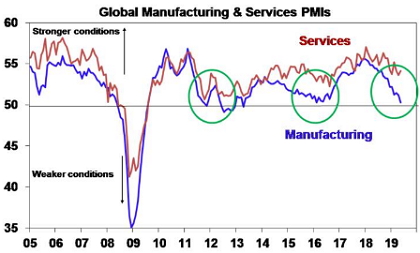
This decade has now seen three global growth scares – around 2011-12, 2015-16 and now since last year. Each have been associated with softening business conditions indicators (or PMIs) as indicated in the next chart – see the circled areas.


Source: Bloomberg, AMP Capital

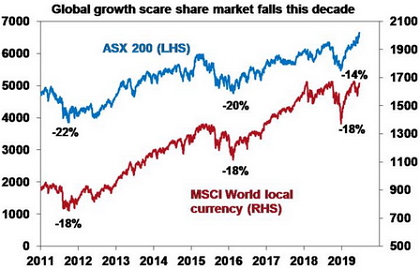
And each have been associated with roughly 20% falls in share markets.


Source: Bloomberg, AMP Capital

All have seen central banks shift towards easing to varying degrees. And in the first two this saw growth indicators pick up again and share markets rebound and clearly move on to new highs. We now seem to be seeing a re-run – at least with respect to central banks.

Central banks go from tightening to neutral to easing

It had looked like a shift from a tightening bias to a neutral/slight easing bias – the US Federal Reserve’s “patient” “pause” and end to quantitative tightening and the European Central Bank’s new round of cheap bank financing (what they call TLTRO) and pushing out its guidance on how long it won’t be raising interest rates for – would do it for the Fed and the ECB this time.

But then the trade war resumed in May adding to a new round of fears about global growth and inflation. And so the ECB and Fed look to be going beyond neutral and back to “whatever it takes”, joining central banks in China, India, Australia, New Zealand and other countries in easing:

  • ECB President Mario Draghi has indicated this week that “in the absence of improvement…additional stimulus will be required” and that it “will use all the flexibility within our mandate to fulfil our mandate”. Further ECB easing could include more rate cuts (taking them further into negative territory) and a return to quantitative easing. ECB easing in July or September is looking very likely.

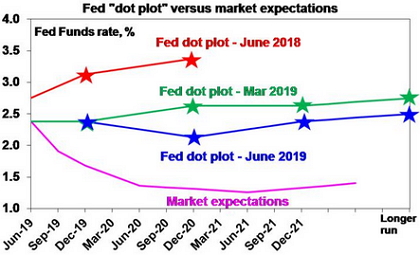
  • The US Federal Reserve at its June meeting has clearly shifted in a very dovish direction strongly hinting at interest rate cuts ahead. It downgraded its economic activity assessment from “solid” to “moderate”, it noted falling inflation expectations, it dropped the reference to being “patient” in raising rates, it noted that uncertainties have risen, it lowered its inflation forecasts to below the 2% target and it said it will “closely monitor” the economy, which is often code for moving to easing. While its dot plot of Fed officials’ interest rate expectations still sees rates on hold this year, it’s now line ball with 8 out of 17 officials now seeing a cut of which 7 see two cuts and many of those who have rates on hold see an increased case for a cut and it only requires one of those to shift for the dot plot to move to a cut this year. What’s more, the dot plot now sees a cut next year and it has lowered the long run rate to 2.5%. The dot plot is well down from a year ago when three rate hikes were indicated for this year and one for next year. Overall, absent a clear move towards resolution of trade issues and much better data the Fed looks on track for a cut in July and we continue to see two Fed rate cuts this year.


Source: US Federal Reserve, Bloomberg, AMP Capital

The shift towards monetary easing by the Fed and ECB risks ramping up currency wars again – at least in the minds of commentators – but as we have seen in the past this is just a means of spreading easing globally. And many central banks are already easing anyway.

This is of relevance to the Reserve Bank of Australia, which would prefer to see a lower Australian dollar. The Fed now moving towards easing does make the RBA’s job a little bit harder on this front. However, we still see the RBA easing more than the Fed as the Australian economy is weaker than the US economy and has much higher labour market underutilisation than the US (13.7% of the workforce in Australia versus 7.1% in the US). So, we still see the Australian dollar heading down to around $US0.65 by year end. But Fed easing which will weigh on the $US generally is one reason why the $A is unlikely to crash to past lows.

Presidents Trump and Xi to meet

In the meantime, Presidents Trump and Xi will meet at the G20 meeting in Japan next week. This could lead to a delay in the next round of tariff hikes on China – on the roughly $US300bn of remaining Chinese imports. Ultimately, I expect a deal to resolve the trade dispute because of the threat to growth in both countries (and the risks this poses to Trump’s 2020 re-election prospects). But given the false starts so far it’s not clear this round of meetings will do it just yet.

But it looks like we will get some combination of a trade deal/easier monetary policy or no trade deal and even easier monetary policy.

Implications for investors

The risks are higher this time around given the trade war mess and with the US yield curve inverting – although it does give false signals, has long lags and may be distorted by the threat of more quantitative easing, recently it may more reflect a plunge in inflation expectations as opposed to growth expectations and the normal excesses that precede US recessions aren’t present to the same degree now.

And there will be bumps along the way, i.e.) shares could still go down in response to weak economic data and trade upsets before they go up and we are in a seasonally weak part of the year.

However, for investors it’s always worth remembering the old line “don’t fight the Fed”…or the ECB or RBA, etc. This is because low rates make shares cheaper and can help boost earnings.

While there is scepticism that central banks with the ultra low/negative rates and QE will do the trick, an investor would have made a huge mistake over the last decade betting against them!

So while the risks are higher this time around, my inclination is still to see the current period as just another global growth scare like those in 2011-12 and 2015-16 which will give way to somewhat stronger growth globally and higher share markets on a six to 12 month view.

If you would like to discuss any of the issues raised by Dr Oliver, please call on Phone: 07 5641 4134 or email martin@wtfp.com.au.


Source: AMP Capital 20 June 2019

Important notes: While every care has been taken in the preparation of this article, AMP Capital Investors Limited (ABN 59 001 777 591, AFSL 232497) and AMP Capital Funds Management Limited (ABN 15 159 557 721, AFSL 426455) (AMP Capital) makes no representations or warranties as to the accuracy or completeness of any statement in it including, without limitation, any forecasts. Past performance is not a reliable indicator of future performance. This article has been prepared for the purpose of providing general information, without taking account of any particular investor’s objectives, financial situation or needs. An investor should, before making any investment decisions, consider the appropriateness of the information in this article, and seek professional advice, having regard to the investor’s objectives, financial situation and needs. This article is solely for the use of the party to whom it is provided and must not be provided to any other person or entity without the express written consent of AMP Capital.

For some time our view has been a less upbeat on the Australian economy than the consensus and notably the RBA. The reasons were simple. The housing cycle has turned down and this is weighing on consumer spending. And this is at a time when the risks to the global economy have increased as the trade war threat has ramped up again. All at a time when high levels of underemployment are keeping a lid on wages growth and, along with technology and competition, inflation. Consequently we have been expecting rate cuts this year which have now commenced and have further to go. We see a strong case for more fiscal stimulus to help the RBA in boosting growth and see an increasing risk that the RBA may have to use some form of quantitative easing to achieve its inflation target.

But the gloom around the Australian economy seems to have gone over the top lately with all the talk around rate cuts adding to the sense of malaise and more and more talk about a recession being inevitable. Surely it can’t be that bad! And why despite all this doom and gloom is the share market at an 11-year high, up 16% year to date and just 4% shy of its 2007 resources-boom high. There must be some positives around. And there are! So, to inject some balance into the debate around Australia here is a list of positives. They are partly why we don’t see Australia as being about to plunge into recession.

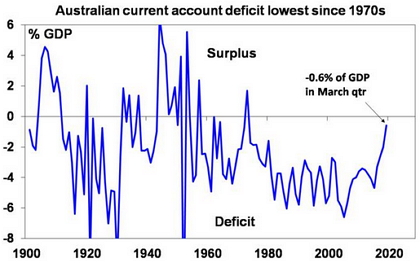
1. Australia’s current accounts deficit has collapsed

As a share of GDP, it’s the lowest since the 1970s as high iron ore prices have combined with solid growth in export volumes and pushed the trade balance into a record surplus. The current account deficit is the gap between what we spend as a nation and what we earn – so its near disappearance means we are less dependent on foreign capital. This is a big one given that a big scare of the 1980s in Australia was that the large current account deficit and rising foreign debt would lead to a major crisis, collapse the economy and require an IMF bailout. Like with most doomster stories on Australia, we are still waiting!


Source: ABS, AMP Capital

2. The Australian dollar helps stabilise the economy

The $A is down 38% from its 2011 high and is likely to fall further and this provides a shock absorber for the Australian economy as a lower $A makes Australian businesses that compete internationally more competitive – eg higher education, tourism, mining, manufacturing, agriculture.

3. The drag from falling mining investment is over

The big drag on growth (which was up to around 2 percentage points at one stage) as mining investment fell back to more normal levels as a share of GDP is likely over and mining investment plans look to be moving up again.

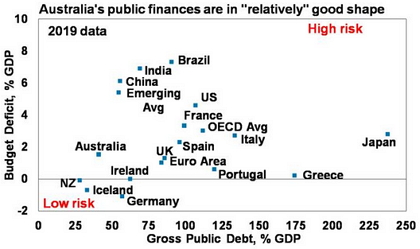
4. There is scope for extra fiscal stimulus

The Federal budget is nearly back in surplus and while we have had a long run of deficits our public finances are in good shape compared to the US, Europe and Japan.


Source: IMF, AMP Capital

Some fiscal stimulus is already on the way with tax refunds for low and middle income earners. While the Government is focussed on achieving a surplus it seems to be recognising the case to do more to help the economy with talk of bringing forward infrastructure spending.

5. Infrastructure spending is booming

Infrastructure spending is booming. While growth in public capex may peak this year, NSW has flagged another round of asset sales to fund new infrastructure spending and suggestions to bring back Joe Hockey’s asset recycling program (that saw the Federal Government provide a financial incentive to states to sell existing assets and use the proceeds to plough back into new infrastructure spending).

6. There is no sign of panic property selling

Despite the falls in property prices we have seen no sign of a “crash”. Non-performing loans are still relatively low even in Perth where prices are down nearly 20%. There has been no significant panic selling. The switch for many from interest only loans to principle and interest has not seen mass defaults or mass selling. And the combination of the removal of the threat to negative gearing and the capital gains tax discount along with rate cuts has seen buyer interest return.

7. The political environment remains sensible

While the Federal election has been analysed to death, the bottom line is that Australians as a whole were not prepared to support a populist agenda of higher taxes on the “top end of town”, substantially increased public spending and redistribution. Just like they weren’t prepared to support a more right-wing free market agenda in 1993. Australia is not immune to the populism seemingly sweeping the world, but it seems to be limited to a relatively minor influence. Maybe it’s the moderate climate, maybe it’s the lack of extreme inequality, maybe it’s the compulsory voting system that keeps motivated extremists in their place in favour of a sensible centre.

Whatever it is – economic policy making in Australia could always be better (economists would love to see a greater focus on economic reform) but it’s generally pretty sensible.

8. Population growth remains strong

Australia’s population growth at around 1.5% pa is strong and supported by a high fertility rate and high levels of immigration. While it’s far from a world beater – with the top 10 countries by population growth seeing growth of between 3 to 5% pa – it is at the high end of comparable countries and roughly double the OECD average and of the US and UK and is faster than India.

Of course, strong population growth is not without issues –around integration, congestion, the environment, adequate housing and infrastructure. And ultimately in terms of living standards it is economic growth per person (or per capita) that matters not total growth and lately per capita GDP has gone backwards. But solid population growth also has significant benefits in terms of supporting demand growth in the economy, preventing lingering oversupply (as today’s excess – say Sydney apartments – can quickly turn into tomorrow’s shortfall) and keeping the economy dynamic. It also means that while Australia’s population is ageing, the problem is far less challenging than in most advanced countries as by comparison Australia with a median age of 37 is relatively young and it has a relatively low old age dependency ratio.

9. The RBA can still do more

While the official cash rate is at a record low of 1.25%, it can still go lower and we think it will, whereas in Europe and Japan rates are already at zero (or just below). Our view remains that the RBA will cut the cash rate to 0.5% beyond which it will probably conclude it’s of little benefit as it will make it harder for banks to pass on rate cuts as they will have more bank deposits at zero and so cutting mortgage rates would mean reduced profit margins and probably less lending.

But the RBA can still do quantitative easing – if needed. This basically involves seeking to boost the economy by injecting more cash into the economy using printed money. The lesson from the US, Europe and Japan was to go early and go hard. Japan and then Europe left it a bit too late, but the US went early and has achieved more success with QE.

QE as practiced there – using printed money to buy assets on the hope that banks would use the cash to lend, people would borrow and investors would help the economy by taking on more risky investments – may help. But it may not be the most efficient approach (as much of the cash just ended up in bank reserves) or the most equitable (to the extent it boosted prices for shares and other risky assets that are disproportionately held by high income/wealthier people).

A better option in terms of QE may be to use printed money to finance fiscal stimulus – maybe by directly buying bonds issued by the government. This is a radical step. The Austrian economists would scream hyperinflation! But they did with QE in the US a decade ago too and we are still waiting. In any case the problem is a lack of inflation and the risk of deflation. But it would work in terms of boosting spending in a fair way. It could involve either government spending on things like infrastructure (which both adds to demand and the economy’s productive potential) or tax cuts or “cheques in the mail” with use by dates.

But bear in mind Australia is a long way from needing to do this – we are not in recession so it’s really a debate about what can be done ahead of time which is actually healthy. Better this than wait for a crisis to hit then scramble on what to do.

Australian shares – what’s going on?

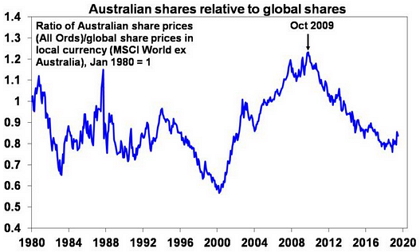
Which brings us to the strong Australian share market. Much of the recent surge in the Australian share market reflects strong gains in mining stocks on the back of the strong iron ore price, strong demand for high yielding stocks as bond yields have plunged and the post-election bounce. And if global shares have a further setback on the back of trade fears then Australian shares will be impacted too. But it’s also worth noting that the Australian share price index has underperformed global share markets for almost a decade now reflecting tighter monetary policy from October 2009, the surge in the $A into 2011, the end of the commodity price boom, worries about a property crash and a mean reversion after Australia’s 2000 to 2009 outperformance. Many of these factors have run their course, have reversed or have been factored in by the share market so maybe the decade-long underperformance by Australian shares is coming close to an end.


Source: Thomson Reuters, AMP Capital

Concluding comment

The point about all this is that while Australian growth may be going through a rough patch and this could go on for a while yet, there is a bunch of things going well for the Australian economy and there is plenty of scope for more monetary and fiscal stimulus. So – barring a significant global downturn threatening our export earnings big time – recession is unlikely, and it would be wrong to get too gloomy on Australia.

If you would like to discuss any of the issues raised by Dr Oliver, please call on Phone: 07 5641 4134 or email martin@wtfp.com.au.


Source: AMP Capital 18 June 2019

Important notes: While every care has been taken in the preparation of this article, AMP Capital Investors Limited (ABN 59 001 777 591, AFSL 232497) and AMP Capital Funds Management Limited (ABN 15 159 557 721, AFSL 426455)  (AMP Capital) makes no representations or warranties as to the accuracy or completeness of any statement in it including, without limitation, any forecasts. Past performance is not a reliable indicator of future performance. This article has been prepared for the purpose of providing general information, without taking account of any particular investor’s objectives, financial situation or needs. An investor should, before making any investment decisions, consider the appropriateness of the information in this article, and seek professional advice, having regard to the investor’s objectives, financial situation and needs. This article is solely for the use of the party to whom it is provided and must not be provided to any other person or entity without the express written consent of AMP Capital.
The proliferation of online shopping has heralded a structural shift in the marketplace. With it comes challenges for investors, particularly passive investors whose portfolio returns depend, in part, on history repeating itself.

This new environment raises a number of questions for investors including:

  • What are the prospects for other property options, particularly industrial real estate?

  • How should investors think about property investing as this structural shift occurs?

  • What are the consequences for remaining a passive investor and the billions of dollars allocated that way?

  • How much of an investor’s portfolio should be in retail property? Should it be the 48 per cent that it is today when passively invested? (62 per cent when leverage is removed)

  • What role does active investing have?


Read the Whitepaper

The following paper considers these questions and concludes that the best opportunities for property investors lay in sectors away from areas that have worked over the past decade, and that there are lessons that can be learnt from other global markets.


DOWNLOAD


 If you would like to discuss any of the issues raised in this white paper, please call on Phone: 07 5641 4134 or email martin@wtfp.com.au


Author: James Maydew BSc (Hons), MRICS Head of Global Listed Real Estate Sydney, Australia

Source: AMP Capital 17 June 2019

Important notes: While every care has been taken in the preparation of this article, AMP Capital Investors Limited (ABN 59 001 777 591, AFSL 232497) and AMP Capital Funds Management Limited (ABN 15 159 557 721, AFSL 426455)  (AMP Capital) makes no representations or warranties as to the accuracy or completeness of any statement in it including, without limitation, any forecasts. Past performance is not a reliable indicator of future performance. This article has been prepared for the purpose of providing general information, without taking account of any particular investor’s objectives, financial situation or needs. An investor should, before making any investment decisions, consider the appropriateness of the information in this article, and seek professional advice, having regard to the investor’s objectives, financial situation and needs. This article is solely for the use of the party to whom it is provided and must not be provided to any other person or entity without the express written consent of AMP Capital.