Australia’s love of home ownership can lead real estate investors to overlook the potential benefits of global listed real estate and owning a share of some of the best real estate assets in the world.

 

Most investors understand the benefits of listed real estate. It has higher liquidity and lower transaction costs than direct property.

But there are three lesser known benefits of listed real estate that may make it suitable for investors seeking income.

1. Attractive risk-adjusted returns

The first is attractive risk-adjusted returns. Given close to 60% of the asset class is in North America, therefore using US data as a proxy, for investors in that jurisdiction willing to hold listed real estate for five years or more1 , listed real estate has the potential to generate similar returns, and the same diversification benefits to a portfolio over time, as physically owning the actual buildings. However we’d note that there may be more shorter term volatility as shown in Figure 1, but that is to be expected as you can find daily liquidity for an illiquid asset class.

Many investors equate listed real estate with equities and view it as a short-term investment. But the asset class hits its stride when held over time. Real estate, both listed and direct, is a long-term investment by the very nature of the leasing contracts and the longevity of the physical assets.

The correlation of returns between listed and unlisted increases significantly as the investment horizon lengthens. Indeed, the correlation between the two is 0.9 of listed share prices and the underlying real estate valuations of the assets they own on a rolling three year basis (figure 1 is the US)2, if you remove leveraging differences from both asset classes and control them for the industry practice of appraisal smoothing.


Figure 1 – Rolling Three Year Annualised Total Return: Listed Shares & Underlying Real Estate Assets – USA
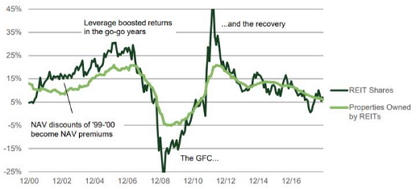
 

Source: Green Street Advisors – December 2018

2. Direct property beacon

We believe that listed real estate trusts (REITS) can also be used by investors to determine what the direct market is likely to do. Again using the US as a proxy, when analysing US data of whether REITs are trading at a premium or discount to net asset value (NAV) – the value of the trust’s holdings at a given time — has historically been an indicator in that jurisdiction of how the direct market will move in the coming 12 -18 months, although future performance can never be guaranteed.

Put very simply, if a REIT trades at a premium to its NAV, the market believes its assets will appreciate above levels indicated by market pricing of the underlying direct real estate. The inverse occurs when trading at discounts.

When REITs in the US have traded at NAV discounts greater than 10 per cent, historically they have subsequently outperformed the unlisted market by more than 1200 bps per annum over the next three years. Observed NAV premium/discounts in the public market provide a strong signal as to the appropriate mix of listed vs unlisted real estate, and there have been times in the past when investors with no listed exposure have experienced suboptimal performance.

Figure 2 – Listed Premiums/Discount and unlisted returns
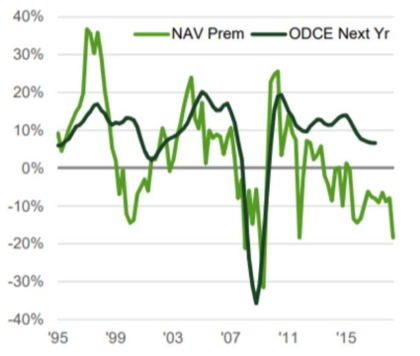
 

Source: Green Street Advisors – March 2018

Figure 3 – Listed Returns minus unlisted returns, next 3 years (Ann.) 
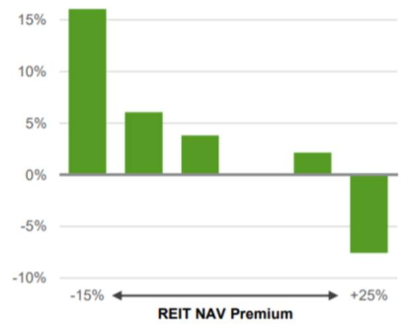
 

Source: Green Street Advisors – March 2018

3. Global Appeal

The third characteristic is the growing global appeal of listed real estate.

Listed real estate was once the poster child of leverage, particularly in Australia during the financial crisis. But that was now a decade ago and many lessons have been learned and now listed real estate has resumed the role for which it was intended: a proxy for direct real estate at a point in time when allocations to real estate as an asset class are rising.

Globally, in many markets, listed real estate is trading at a discount to NAV. The biggest discounts are in Japan developers, retail and the UK and New York office markets. Australian REITs, with the exception of retail malls, are trading at a premium, with larger premiums ascribed to fund managers, industrial and datacentre landlords.

In individual markets where listed real estate is trading at a discount to NAV, the best management teams have been taking advantage of strong pricing in direct real estate markets, selling core assets and using the proceeds to either pay down debt or return capital to investors.

Listed real estate can be a complement to unlisted property or a useful proxy for unlisted property. This is particularly the case for investors who want to establish an allocation to real estate but are struggling amid global competition for quality assets and don’t want the headache or complexity of managing direct property assets. The AMP Capital Core Property Fund has allocations to both listed and unlisted real estate.

Greater diversification

On top of these benefits, global listed real estate typically has deep and unrivalled access to a greater diversity of institutional quality real estate sectors than the unlisted market. These sectors may include (but are not limited to) last mile logistics, datacentres, healthcare, aged care and manufactured housing.

These different sectors perform under varying economic conditions and their relevance and portfolio sizing should be assessed on what role they play in the underlying economy of the future. Given many of them are intertwined with long-term secular economic trends, having exposure to these assets is more logical to us than owning a retail dominated fund or a residential apartment investment.

Risks of investing in listed real estate

As with all investments there are associated risks to be aware of. Risks specific to real estate investments include the risks of investing in share markets, property and international markets, as well as the risks associated with interest rates, gearing and the cost of debt, derivatives, investment management, co-ownership of assets, fluctuations in rental income, rental demand and fund termination risks. For more information of the risks of investing in these types of assets, investors should consult the offer documents for the fund.


1Source: Green Street Advisors (Feb 2016)
2Source: Green Street Advisors (Dec 2018)

Investors should consider the Product Disclosure Statement (PDS) available from AMP Capital Investors Limited (ABN 59 001 777 591, AFSL 232497) (AMP Capital) for the AMP Capital Core Property Fund (Fund)) before making any decision regarding the Fund. The PDS contains important information about investing in the Fund and it’s important investors read the PDS before making a decision about whether to acquire, continue to hold or dispose of units in the Fund. The Trust Company (RE Services) Limited (ABN 45 003 278 831, AFSL 235150) (The Trust Company), a wholly owned subsidiary of The Trust Company Limited (ABN 59 004 027 749), is the responsible entity of the Fund and the issuer of units in the Fund. The Trust Company has not prepared this information and makes no representation or warranty as to the accuracy or completeness of any statement in it. Neither The Trust Company nor any company in the AMP Group (which includes AMP Capital and AMPCFM) guarantees the repayment of capital or the performance of any product or any particular rate of return referred to in this document. Past performance is not a reliable indicator of future performance. While every care has been taken in the preparation of this document, AMP Capital makes no representation or warranty as to the accuracy or completeness of any statement in it including without limitation, any forecasts. This information has been prepared for the purpose of providing general information, without taking account of any particular investor’s objectives, financial situation or needs. Investors should, before making any investment decisions, consider the appropriateness of the information in this document, and seek professional advice, having regard to the investor’s objectives, financial situation and needs. This document is solely for the use of the party to whom it is provided and must not be provided to any other person or entity without the express written consent of AMP Capital.


Author: James Maydew, BSc (Hons), MRICS, Head of Global Listed Real Estate, Sydney, Australia

Source: AMP Capital 11 July 2019

Important notes: While every care has been taken in the preparation of this article, AMP Capital Investors Limited (ABN 59 001 777 591, AFSL 232497) and AMP Capital Funds Management Limited (ABN 15 159 557 721, AFSL 426455) (AMP Capital) makes no representations or warranties as to the accuracy or completeness of any statement in it including, without limitation, any forecasts. Past performance is not a reliable indicator of future performance. This article has been prepared for the purpose of providing general information, without taking account of any particular investor’s objectives, financial situation or needs. An investor should, before making any investment decisions, consider the appropriateness of the information in this article, and seek professional advice, having regard to the investor’s objectives, financial situation and needs. This article is solely for the use of the party to whom it is provided and must not be provided to any other person or entity without the express written consent of AMP Capital.

Investors have profited from strong returns, backed by central bank liquidity and falling interest rates. But with rates seemingly at rock-bottom levels and global economic recovery maturing, returns could fall and markets could become more volatile. Investors may benefit from looking to use Dynamic Asset Allocation (DAA) to profit from shorter market cycles if they are to keep generating wealth.


Investors have enjoyed strong returns from markets in recent years, fuelled by Central Bank quantitative easing and record-low interest rates. Things have been so good and returns so smooth that many investors may have forgotten that financial markets are cyclical.

However, because we are now entering late cycle and rates are already so low, any change in interest rate direction could potentially challenge valuations and trigger greater market volatility.

If investors are to seize opportunities and generate wealth in this new environment, they will need to be flexible and adjust their portfolio to the market’s ebbs and flows.

We believe investors should increasingly turn to Dynamic Asset Allocation (DAA), a strategy that allows investors to regularly adjust their allocations to markets and asset classes based on what the market is doing and what they believe it is likely to do.

But how do investors implement DAA?

The principles of DAA

To successfully use DAA, investors must first understand the principles that underpin it. At AMP Capital we have engraved four key principles into our DAA investment process that will help any investor considering implementing such a strategy:

1. Risk is not the same as volatility

The first principle is that ‘volatility’ is not ‘risk’. Volatility is backward looking and measures an asset’s variability (how much its price moves around). Risk, however, is the potential to lose money and not recover. Investors using DAA should focus more on price ‘risk’ than on backward looking analysis like volatility.

2. Factor in investor expectations

Investors must also understand the critical role of investor expectations. High-performing companies with low volatility can have more downside risk than low-performing companies with high volatility. High-performance companies can find it increasingly hard to meet investors’ big expectations. When they disappoint, their shares fall. But low-performing companies’ expectations are typically lower and easier to beat. If they beat low expectations, their shares are can be strongly re-rated.

3. Diversification based on historical correlation is destructive

The third principle is that investors shouldn’t rely on historical correlations. Correlations can change, and they typically increase during economic instability. We often see high-priced popular investments become overcrowded. But when the economy turns, investors all decide to sell at the same time. Investors should consider diversifying based on asset valuations and how crowded a position is, rather than using historical correlations.

4. The market cycle leads the economic cycle

The final principle is that history has shown us that weak economic conditions don’t always lead to weak future share market returns. If you aim to buy assets when the economic cycle is strong and sell them when it’s weak, you may inevitably miss out on opportunities and be exposed to risks. It would, however, also be unreasonable to assume that the macroeconomics and earnings have an insignificant impact on future market returns. Indeed, a sustained and durable move higher in shares requires strong support from earnings growth and a healthy macro backdrop.

Cycles

DAA recognises that markets are driven by cycles. Those cycles range from multi-year ‘secular’ cycles to multi-month periods called ‘cyclical’ cycles. The secular cycle drives the primary trend in the share market; but the shorter cyclical cycles can also impact on investors’ financial goals. Secular cycles are driven by valuations; cyclical moves are driven by investor sentiment and central bank actions.

In the new market environment investors are facing now, it’s safe to assume the secular market cycle will deliver low returns. Shorter-term business cycles will therefore become critical, and to keep generating returns, investors should consider using DAA in attempting to lock in profits during upswings and protect returns during downswings.


Author: Nader Naeimi – Head of Dynamic Markets and Portfolio Manager of Dynamic Markets Fund Sydney, Australia

Source: AMP Capital 26 June 2019

Important notes: While every care has been taken in the preparation of this article, AMP Capital Investors Limited (ABN 59 001 777 591, AFSL 232497) and AMP Capital Funds Management Limited (ABN 15 159 557 721, AFSL 426455) (AMP Capital) makes no representations or warranties as to the accuracy or completeness of any statement in it including, without limitation, any forecasts. Past performance is not a reliable indicator of future performance. This article has been prepared for the purpose of providing general information, without taking account of any particular investor’s objectives, financial situation or needs. An investor should, before making any investment decisions, consider the appropriateness of the information in this article, and seek professional advice, having regard to the investor’s objectives, financial situation and needs. This article is solely for the use of the party to whom it is provided and must not be provided to any other person or entity without the express written consent of AMP Capital.

A year ago, we published a paper on the challenges of transitioning to autonomous vehicles. It focused not just on the technology required, but also on the infrastructure challenges it presented – such as the need for large investments and tough socio-political choices – in order to facilitate widespread adoption.


We have come across a number of interesting anecdotes of late, which highlight the continued infrastructure challenges related to this mega-trend.

1. Transurban recently released videos from the various autonomous vehicle trials it conducted, which demonstrate that camera technology is still prone to basic errors, including line-following issues and being confused by scuff marks on roads. In general, the road furniture (signs, markings) in Australia is better than elsewhere in the world, but there is still much room for improvement. The results can be seen here.

2. A persistent issue among politicians is how to bridge the revenue shortfall from gasoline that will inevitably occur with widespread adoption of electric vehicles.

In Europe, for example, fuel taxes currently comprise, in aggregate, 3.2 per cent1 of total tax income for governments (and as high as 7 per cent in some countries), so there is a sizeable amount of tax revenue at risk from electric vehicle adoption. In Illinois, there’s been furore around proposals that electric vehicle owners (who benefit from extensive subsidies), should pay for the shortfall in gas tax revenue, at a higher level than existing gasoline cars are asked to pay.

This tax conundrum has raised its head at several forums we have attended on autonomous vehicles. We’ll be sure to provide an update when we hear a workable solution.

3. Bank of America Merrill Lynch analysts recently halved their estimate of the penetration of electric vehicles in 2030 from 30 per cent to 15 per cent2  of vehicle sales. This is largely due to an expectation that cost parity between electric and gasoline vehicles will take longer than initially thought. China has also recently announced it is to cut subsidies available to electric vehicle purchasers by around 50 per cent, which could put further pressure on the rate of adoption in a market which is moving faster than most.

Are there other impacts?

For toll road operators, the likely impact of autonomous vehicles may be quite varied, depending on the type of road and the length of concession. For inter-urban roads, autonomous vehicles could increase demand, while intra-urban roads could see reduced demand from multiple vehicle occupancy and lower congestion.

In either case, we believe this is only likely to have a meaningful impact on the present value of cash flows in the concession from the mid-2030s onwards. During this timeframe all major listed European concessions will have already expired and have been retendered (allowing owners to price-in this risk).

For newer concessions, such as Westconnex, the long remaining life of the asset means that Transurban managers have needed to ‘take a view’ on the likely impacts at the time of the bid – not an enviable task.

However, we believe the largest issue in getting autonomous vehicles on the road will be the social impact. It will inevitably favour urban citizens over rural and those with high disposable incomes versus low, which are exactly the types of trends society is pushing back against today.

If governments decide to tax their way to paying for the required infrastructure rather than following a fully-allocated ‘user pays’ model (on which we believe the unit cost economics barely reach what public transport can already be delivered for today), autonomous vehicles could simply be a tool to further push on social pressure points.


1Taxation Trends in Europe 2019: DG Taxation and Customs Union
2Can’t buy EV’s love (yet) … in the US. Bank of America Merrill Lynch. 31st May 2019

Content sourced from Cuffelinks and Livewire does not represent the views of AMP Capital or any member of the AMP Group. All information on this website is subject to change without notice.

Author: Andy Jones – MBA, MEng and MA (Cantab.), Portfolio Manager/Analyst, London, United Kingdom

Source: AMP Capital 9 July 2019

Important notes: While every care has been taken in the preparation of this article, AMP Capital Investors Limited (ABN 59 001 777 591, AFSL 232497) and AMP Capital Funds Management Limited (ABN 15 159 557 721, AFSL 426455)  (AMP Capital) makes no representations or warranties as to the accuracy or completeness of any statement in it including, without limitation, any forecasts. Past performance is not a reliable indicator of future performance. This article has been prepared for the purpose of providing general information, without taking account of any particular investor’s objectives, financial situation or needs. An investor should, before making any investment decisions, consider the appropriateness of the information in this article, and seek professional advice, having regard to the investor’s objectives, financial situation and needs. This article is solely for the use of the party to whom it is provided and must not be provided to any other person or entity without the express written consent of AMP Capital.

https://vimeo.com/345828633

Investors worried about the US/China trade war have another geopolitical concern with tensions rising between President Trump and Iran.

It does seem President Trump and the US has a predilection for getting into conflicts or issues around the world.

Investors are right to worry about the situation in the Middle East. It could be a source of volatility in the short term at a time when global markets are already vulnerable. But ultimately, like the trade war, we believe that the US will seek to negotiate a solution.

Unwinding a deal

Back in 2015 various countries around the world signed a deal with Iran to limit Iran’s nuclear capabilities in return for Iran being able to export its oil. In other words, sanctions were removed from Iran.

That helped push oil prices down and petrol prices at the bowser in Australia down.

But last year, President Trump said America was going to leave the 2015 deal because he believes Iran is building a nuclear program. American sanctions kicked in against anyone who trades oil with Iran.

That of course has led to a sharp reduction in Iranian oil exports and some rise in world oil prices.

War fears

Of course, Iran isn’t very happy about this. That has created tension in the Middle East and prompted fears of a military confrontation. After initially approving a military strike after Iran downed a US drone, President Trump pulled back from launching the strike.

Trump has also announced more sanctions and in response Iran has closed diplomatic channels.

The tension obviously threatens the flow of oil through the Strait of Hormuz through which 20% of the world’s oil production flows daily.

Trump’s interests

This is a major flash point and major issue.

Ultimately, however, I do think it’s again in President Trump’s interest to resolve this issue through negotiation rather than military action.

Americans do support America being tough particularly when it comes to the Middle East. But when it gets bogged down and it results in much higher oil prices, as presidents found in the 1970s, it doesn’t go down so well with the American electorate.

Support from many traditional US allies like Europe is also weak because they didn’t support Trump’s decision to break off from the 2015 nuclear deal with Iran.

Source of volatility

So, we believe it is in Trump’s interests to resolve this issue in a negotiated fashion that avoids a sharp rise in oil prices.

But obviously the tension is a source of uncertainty, along with trade. And both of those issues – the trade war and Middle East tension – are potential sources of volatility for investment markets over the next few months.

Author: Dr Shane Oliver, Head of Investment Strategy and Economics and Chief Economist, AMP Capital Sydney, Australia

Source: AMP Capital 11 July 2019

Important notes: While every care has been taken in the preparation of this article, AMP Capital Investors Limited (ABN 59 001 777 591, AFSL 232497) and AMP Capital Funds Management Limited (ABN 15 159 557 721, AFSL 426455)  (AMP Capital) makes no representations or warranties as to the accuracy or completeness of any statement in it including, without limitation, any forecasts. Past performance is not a reliable indicator of future performance. This article has been prepared for the purpose of providing general information, without taking account of any particular investor’s objectives, financial situation or needs. An investor should, before making any investment decisions, consider the appropriateness of the information in this article, and seek professional advice, having regard to the investor’s objectives, financial situation and needs. This article is solely for the use of the party to whom it is provided and must not be provided to any other person or entity without the express written consent of AMP Capital.

With thousands of charities competing for your donation, it’s important to do some research to make sure your money is being used for the cause you want to support. It is also essential to make sure the charity is actually receiving your donation.

Here are some things to think about before you donate.

Choosing a charity

Your decision to support one charity over another is usually based on your interest in the cause the charity supports. You may also choose a charity as a way of remembering a deceased relative or friend. Whatever your motivation, it’s important to make sure you are comfortable with the charity’s activities and how it plans to use the donations it receives. 

Donating directly to an overseas-based charity can be risky as it may be difficult to verify the information found on websites or social media sites. 

You may prefer to donate to an Australian charity that supports the cause or project you’re interested in. Many Australian charities operate overseas but are based in Australia.

Ways to donate

There are a number of ways you can donate.

One-off or ongoing

You may decide to make a regular, set donation or you may prefer making a one-off donation following a particular fundraising campaign or an urgent need, like a natural disaster. Sometimes a charity will approach you directly for a cash donation or to participate in a fundraiser such as a raffle. This can happen on the street, over the phone or at your front door. 

Smart tip

If you’ve donated to a charity before, the charity will keep your contact details for future campaigns. If you want to stop being contacted you can ask to be removed from their list. 

Workplace giving

You can also support a charity through automatic deductions from your salary. If your employer has a workplace giving scheme your donation can be deducted from your pay and sent directly to your preferred charity. 

You will gain tax benefits at the time of donation and receive a summary of payment at the end of the year.

To participate in any workplace giving program, the charity must have deductible gift recipient (DGR) status. 

For more information about setting up a workplace giving program, see the Australian Taxation Office’s information on setting up a workplace giving program

Bequest in your will

Another way of donating is to leave a bequest in your will. Contact the charity directly to discuss your plans. 

Get involved

Donating to charity doesn’t necessarily mean a cash donation. You can contribute to your favourite charity by making a donation of goods, your time or even your skills or expertise.

Check it’s a legitimate charity

Questions to ask

If the name of the charity is unfamiliar, you should ask for more information about the charity, for example:

  • What cause do you support?

  • Where is the charity based?

  • What are donations used for?

  • Are you affiliated with any other charities or organisations?

  • Are donations tax deductible?

It pays to be careful, even if you get a satisfactory response to these questions.

Even if you’ve heard of the charity, you should check that the person who contacts you is authorised to represent the charity.

If you’ve been approached face-to-face, ask to see some identification and a copy of the charity’s pledge form. These should contain:

  • the full name of the organisation

  • the corporate registration number such as an Australian Business Number

  • the business address

  • the organisation’s logo

You should also call the charity directly to verify their contact details. Be sure to cross check their phone number in the telephone directory.

Charities must also be registered with the Australian Charities and Not-for-profits Commission (ACNC). You can check the ACNC website, to see if the charity is registered. Alternatively, the charity may display a Tick of Charity Registration (from the ACNC) to show they are a registered charity. 

Be wary of giving credit card details

If you’ve been contacted by phone do not give out your credit card or banking details. There will be other ways of donating if it’s a reputable charity. 

Ask about these options and make sure you check the validity of any website or social media page you’re directed to. 

To find out about the latest charity scams see the ACCC’s SCAM watch charity scams webpage.

Check if it’s tax deductible

A donation is only tax deductible if it is given to a charity that has been endorsed by the Australian Taxation Office (ATO) as a deductible gift recipient (DGR) organisation. 

To receive a deduction the donation must be two dollars or more and must be claimed in your tax return for the income year in which the donation was made. In some circumstances, you can elect to spread the tax deduction over five income years. For more information visit the ATO’s gifts and donations webpage. 

You can check if an organisation is a DGR by visiting the Australian Business Register or phoning the ATO on 13 28 61.

Complain if you have a problem

You can complain about a charity to the relevant state or territory regulator. To find the regulator in your state visit the ATO: State and territory government requirements – fundraising. You can also complain to the Australian Charities and Not-for-Profits Commission if the charity is registered, see the ACNC: Raise a concern about a charity webpage.

Australian charities working in the area of overseas aid, who get funding from AusAID, are required to be members of the Australian Council for International Development (ACFID), and must adhere to the ACFID Code of Conduct. For more information about the code, including its signatories and how to register a complaint, see the ACFID: Code of Conduct webpage. 

Donating is a great thing to do but you should always check the legitimacy of a charity before you donate.

Source: ASIC’s Moneysmart


Reproduced with the permission of ASIC’s MoneySmart Team. This article was originally published at https://www.moneysmart.gov.au/managing-your-money/donating

Important note: This provides general information and hasn’t taken your circumstances into account.  It’s important to consider your particular circumstances before deciding what’s right for you. Although the information is from sources considered reliable, we do not guarantee that it is accurate or complete. You should not rely upon it and should seek qualified advice before making any investment decision. Except where liability under any statute cannot be excluded, we do not accept any liability (whether under contract, tort or otherwise) for any resulting loss or damage of the reader or any other person.  Past performance is not a reliable guide to future returns.

Important
Any information provided by the author detailed above is separate and external to our business and our Licensee. Neither our business, nor our Licensee take any responsibility for any action or any service provided by the author.

Any links have been provided with permission for information purposes only and will take you to external websites, which are not connected to our company in any way. Note: Our company does not endorse and is not responsible for the accuracy of the contents/information contained within the linked site(s) accessible from this page.

Hiring independent contractors may be an effective way to get more work done without onboarding new, full-time resources, but there are a few things small business owners should be aware of before taking the plunge.

If you need to start delegating tasks in your business or don’t have the necessary expertise in-house to complete certain jobs, you may want to hire a contractor.

Here is the rundown on everything small business owners need to know about working with independent contractors.

What is the difference between an employee and a contractor?

Employees, whether part-time, full-time, or casual, are hired to work within someone else’s business.

They’re paid a wage and receive entitlements during the year, such as annual and sick leave.

Their work is performed on site, in most cases, and there are other controls about how, where, and when they do their job.

Independent contractors, on the other hand, differ in a variety of ways.

READ: Employee or contractor? Know your obligations

Although there is no one factor or combination of factors that determine a worker’s status, usually contractors:

  • Are their own boss, working for themselves but selling their services to others

  • Control their working times and work as many hours as are needed to complete a job

  • Work from home or other premises of their choice, or complete work on business premises for a short amount of time

  • Provide their own equipment and tools

  • Create their own processes to complete tasks

  • Accept or refuse work as they see fit

  • Work for many clients at once

Also called ‘sub-contractors’ or ‘subbies’, independent contractors are hired to complete a set task or project based on terms set within a contract.

They’re paid per hour, per day, per task completed, or via another agreed calculation.

Contractors can choose to delegate or subcontract some of their work if they want to, too, unless this has been specifically forbidden in their contract.

Businesses often hire contractors for their specialised skills, when such skills are required for a short, or pre-determined, amount of time.

The rights and responsibilities of businesses hiring contractors

If you decide to hire a contractor for a project, be aware that your rights and responsibilities are different from those when dealing with employees.

Unlike with in-house staff, when you use contractors, you don’t have to pay them sick leave, annual leave, superannuation, or other related benefits.

You don’t have to take tax out of your payments to contractors, either (although contractors may request this in rare cases). Tax matters are up to independent contractors to sort out.

READ: Changes to Taxable Payments Reporting in 2019

Businesses negotiate a set price for the work contractors are to perform and pay them accordingly.

Independent contractors supply an invoice for the work. Businesses must make payment within the agreed-upon timeframe noted in the contract and/or on the invoice.

If unhappy with the work done by a contractor, entrepreneurs should read the contract to understand payment terms and conditions.

Contractors usually bear the responsibility and liability for poor work, but not always.

Try to resolve payment issues amicably, or make use of a mediator. You may need to get legal advice, too.

Don’t just withhold payment if you’re not pleased with a contractor’s work. Doing this can give them the right to terminate the contract because you failed to meet payment obligations. Contractors might then claim damages from you for that breach.

Contractors are not entitled to a minimum wage, but they’re after an acceptable rate for their work. They typically always bear the financial risk for making a profit or loss for each job.

Under the Fair Work Act, contractors are protected from various adverse situations, though.

For example, as a business owner or manager, you can’t terminate a contract because a contractor made a complaint to a regulator about their workplace rights.

Businesses must not threaten to take action against contractors as a means of coercing them not to exercise their workplace rights, either. Nor can they force contractors to join (or exclude themselves from) a trade group or other relevant association.

The Independent Contractors Actalso protects self-employed workers in the matter of contracts.

Contractors can ask a court to review contracts they see as harsh or unfair.

If a case goes to court, factors considered include contract terms, bargaining strengths of each party, unfair tactics used against any party, and the comparison of the total remuneration against standard industry rates.

Be aware that if courts deem a contract to be harsh or unfair, they have the power to order contract terms to be changed (e.g. added, removed, or edited), to nullify certain terms of the contract, or to set aside the entire contract so it no longer has any effect.

Since contractors typically work off-site, businesses aren’t usually responsible for keeping contractors safe.

Contractors need to take out their own insurance and legal covers to protect themselves and others, as applicable.

But, if a contractor does have to work at your business site or use your equipment, your firm could be liable if harm comes to the contractor as a result of your dangerous workspace or equipment.

Contractors are usually liable for any defects or other problems with their work, too, although again, this can vary from contract to contract.

The pros and cons of hiring contractors

There are numerous reasons to hire a contractor. Benefits include:

  • Quick access to the additional skills, experience, or technology your business needs, particularly during growth stages or periods of uncertainty

  • Organisational flexibility, since you hire contractors only when you need them

  • Ease of termination, as you can end most contracts with just a few weeks’

    notice

  • Lower overheads due to the fact you don’t need to pay superannuation, holiday pay, sick leave, and other benefits

  • Reduced legal liability as contractors provide their own insurance

There are also some potential downsides to be considered when hiring contractors rather than employing people in-house. For example:

  • Lack of stability in your business, because contractors come and go

  • Time wasted training contractors how to do tasks to your liking; contractors take knowledge with them once a contract finishes

  • Less team cohesion, since contractors work independently and usually don’t get involved in team discussions or events

  • When you use contractors, you don’t end up adding value to your core business. Over the long term, investing in employees often pays better dividends than spending money on contractors year after year

  • While you will likely get a contractor to sign a non-disclosure agreement, there are risks in giving them access to sensitive information

Utilising contractors in your small or medium business can be a smart tactic in many circumstances. But, always do your research, be careful about which contractors you hire, and get advice from accountants and lawyers to ensure adequate protection before going ahead.

The information provided here is of a general nature for Australia and should not be your only source of information. Please consult an experienced and registered business advisor, as well as professional legal advisor, as each individual’s circumstances will vary.

Source: MYOB

Reproduced with the permission of MYOB. This article by Kellie Byrnes was originally published at www.myob.com/au/blog/.

Important:

This provides general information and hasn’t taken your circumstances into account. It’s important to consider your particular circumstances before deciding what’s right for you. Although the information is from sources considered reliable, we do not guarantee that it is accurate or complete. You should not rely upon it and should seek qualified advice before making any investment decision. Except where liability under any statute cannot be excluded, we do not accept any liability (whether under contract, tort or otherwise) for any resulting loss or damage of the reader or any other person.

Any information provided by the author detailed above is separate and external to our business and our Licensee. Neither our business nor our Licensee takes any responsibility for any action or any service provided by the author.

Any links have been provided with permission for information purposes only and will take you to external websites, which are not connected to our company in any way. Note: Our company does not endorse and is not responsible for the accuracy of the contents/information contained within the linked site(s) accessible from this page.

Rental payments can make a real dent in your bottom line so it’s a good idea to find a balance between location and lifestyle

So you’ve found the apartment of your dreams.

It’s a stone’s throw from the CBD’s trendiest shopping street, boasts fabulous views of the sea and comes with a fully-equipped kitchen boasting European appliances plus luxury spa bathroom. OK, it’s a bit pricey but it ticks all the boxes, and you can worry about the rental payments later. Meanwhile you need to make a decision as there are plenty of willing buyers in line behind you.

Now where do you sign…

STOP! You might end up living in a palace but if you can’t afford to buy a bagel in the local artisan bakery then maybe it’s time to rethink your priorities. If you’re spending a high percentage of your salary on rent then you might be leaving yourself short and unable to enjoy any kind of social life, let alone save up for goals like holidays, a new car or buying a place. Equally, if you’re living in a cockroach-infested dive miles from anywhere then you’re unlikely to be happy even if you’re saving loads of money.

So how much rent is right for you?

If you’re looking to other Australians for a guide, the cost of renting varies enormously around the country – the percentage of our income going on rent ranges from 37.9% of average weekly earnings in Sydney to 25.2% in Hobart1.

Anyone looking for a central one-bedroom apartment in one of our state capitals could pay from $1,035 a month in Hobart to $2,681 in Sydney, as in the table below.

City

Monthly cost of renting one-bedroom apartment (city centre) $

Monthly cost of renting one-bedroom apartment (outside city centre) $

Potential saving of moving to ‘burbs $

Sydney

2,680.93

1,956.54

724.39

Melbourne

1,817.34

1,399.96

417.38

Brisbane

1,772.04

1,285.84

486.20

Perth

1,513.61

1,028.86

484.75

Adelaide

1,411.16

1,043.36

367.80

Hobart

1,035.20

1,041.75

-5.55

Source: https://www.budgetdirect.com.au/interactives/costofliving/

If you’re happy to live in the ‘burbs you’ll save money, with a one-bedroom apartment ranging from $1,029 a month in suburban Perth to $1,957 in…yes…greater Sydney.

Of course, in Tassie they do things a bit differently and you’ll actually save the price of a latte by moving into the city centre from the burbs.

But everywhere else you could potentially save on rent by living in a slightly less trendy area—anywhere from $368 in Adelaide to $725 in…no prizes for guessing…Sydney again.

Finding ways to spend less and save more

The reality is you may not be able to up sticks and relocate so easily. If you’re like most Australians, you probably have family and work commitments that tie you to your local area.

So there may be other ways you could find a better balance between rent and lifestyle and save money—whether you’re just off Bourke Street or ensconced in the ‘burbs.

  • There could be some ways you could save on nights out by taking advantage of deals or making more clear-headed late-night choices.

  • There could be some ways you could save on essentials by being a bit more disciplined with your budgeting.

  • There could be some ways you could save on weekend family activities – a great lifestyle doesn’t need to be expensive, and if you’re within a stroll or ride of a fantastic beach or bushland then you’ve got regular afternoon entertainment on your doorstep, free of charge.

Making sense of your finances

Meanwhile, finding the sweet spot with your rental costs all depends on your personal circumstances and financial goals. We can help you make sense of your outgoings and draw up a long-term plan to build your wealth. Please contact us on Phone: 07 5641 4134 for assistance .

https://www.finder.com.au/how-much-of-our-wages-do-we-spend-on-rent-in-australia

Source : AMP June 2019  

Important:
This information is provided by AMP Life Limited. It is general information only and hasn’t taken your circumstances into account. It’s important to consider your particular circumstances and the relevant Product Disclosure Statement or Terms and Conditions, available by calling Phone: 07 5641 4134, before deciding what’s right for you.

All information in this article is subject to change without notice. Although the information is from sources considered reliable, AMP and our company do not guarantee that it is accurate or complete. You should not rely upon it and should seek professional advice before making any financial decision. Except where liability under any statute cannot be excluded, AMP and our company do not accept any liability for any resulting loss or damage of the reader or any other person.

Now that the election is over, we know that refundable dividend franking credits will continue to be available to investors.

No matter where you stand on that issue, the debate was a healthy reminder that shifting government policy is a risk that can upend a financial plan. Nearly every election, the parties propose changes to the tax code, super, health care, or the age pension to attract certain voters. And that means that nearly every election, investment decisions based on the desire for a tax deduction or any other policy may become more or less appealing.

The potential for these changes is known as tax, policy or regulatory risk.

You can never predict what the government may choose to do, so minimising regulation risk requires not letting the bright lights of tax deductions or other lures dazzle you into making a financial decision you would not otherwise make.

Which is not to say how you structure your portfolio is not important, as long as you bear in mind the core principles of investment success; identify your financial goals, select a diversified, low-cost portfolio to achieve them and stay the course, no matter what financial markets do.

With those principles guiding you, if an investment has the added benefit of a tax incentive, then it makes sense. Tax incentives, however, can’t save a bad investment. If an investment is sold primarily as a way to avoid or minimise taxes, keep your money in your wallet.

History provides all too many examples of tax-driven investments gone bad. A change to tax rules in 2007, revealed the weaknesses of certain agricultural investments (avocado and olive farms, to name two) propelled by tax breaks and hefty commissions for those who sold them.

Tax or policy-driven investments also can increase the risk of your portfolio in ways that may not be obvious. If you put money in certain shares based primarily on the desire for franked dividends, for example, you may inadvertently overexpose your portfolio to certain companies or industries.

The franking policy was designed to prevent dividends from being taxed twice — once at the company level and again when they are paid out to investors. It’s important to understand that managed funds, including exchange-traded funds, pass through franking credits to investors via end of year tax statements, something that, as the franking credit debate was raging in the run up to the election, was not well understood by investors in public seminars.

Tax and policy considerations are not irrelevant, it is important to take them into account, however it’s more important not to put them in charge. Tax deductions provide healthy additional return only if an investment helps you achieve your goals in a diversified portfolio. If not, step away from the bright lights, and enjoy the warm, enduring glow of a financial plan chosen for the right reasons.

 Please contact us on Phone: 07 5641 4134 if you seek further discussion on this topic.

Source : Vanguard

By Robin Bowerman, Head of Corporate Affairs at Vanguard

Reproduced with permission of Vanguard Investments Australia Ltd

Vanguard Investments Australia Ltd (ABN 72 072 881 086 / AFS Licence 227263) is the product issuer. We have not taken yours and your clients’ circumstances into account when preparing this material so it may not be applicable to the particular situation you are considering. You should consider your circumstances and our Product Disclosure Statement (PDS) or Prospectus before making any investment decision. You can access our PDS or Prospectus online or by calling us. This material was prepared in good faith and we accept no liability for any errors or omissions. Past performance is not an indication of future performance.

© 2019 Vanguard Investments Australia Ltd. All rights reserved.

Important:
Any information provided by the author detailed above is separate and external to our business and our Licensee. Neither our business, nor our Licensee take any responsibility for any action or any service provided by the author.

Any links have been provided with permission for information purposes only and will take you to external websites, which are not connected to our company in any way. Note: Our company does not endorse and is not responsible for the accuracy of the contents/information contained within the linked site(s) accessible from this page.

Two years ago, 22,000 festival goers in England unknowingly agreed to clean public toilets and scrape chewing gum off the streets by ignoring the terms and conditions when signing up to two weeks of free Wi-Fi.

These individuals are hardly the exception to the rule, chances are you’ve also skipped right past the terms and conditions when entering a new phone contract, upgrading phone or computer software, setting up a bank account or in countless other situations, keen to complete the deal and sign your name on the dotted line.

You wouldn’t be the first to ignore all the warranties, disclaimers and special clauses that accompany so many products and services these days, and you certainly won’t be the last.

The world of investment and personal finance is no different. There are more pages than ever that hold important, and often legal, information about the specifics of financial products and services.

While we should all take care to understand the implications of our investment and personal finance decisions, how many of us can honestly say that we read through each page and took the time to decipher and understand the fine print?

Now, while skimming the Ts&Cs of an investment product disclosure statement is unlikely to wind up with you cleaning toilets, amongst the important information that can help inform your decisions, there is also one of the most valuable lines of financial wisdom:

‘Past performance is not an indication of future performance.’

If you’ve read the disclosure statement at the bottom of any Smart Investing article, or any financial document for that matter, you may have already spotted it.

At Vanguard, we often talk about how a sound investment strategy starts with an asset allocation suitable for the portfolio’s objective, and just as important as the combination of assets that are used to construct a portfolio, are the assumptions that are used to arrive at the asset allocation decision. By this we mean using realistic expectations for both returns and volatility of returns.

While this is sound portfolio construction advice, it doesn’t remove the temptation to be led by the recent performance of any given asset class. The challenge that comes with that is it is almost impossible to select the asset class that is going to be next year’s winner.

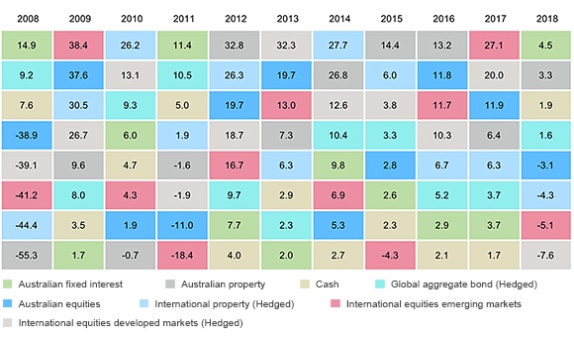
Annual asset class return for the year ended December 2018


Source: Vanguard Investment Strategy Group analysis using index data from Bloomberg, Barclays, FTSE, MSCI, S&P & UBS.
Notes: Australian equities is the S&P/ASX 300 Index; Australian Property is the S&P/ASX 300 A-REIT Index; International Property Hedged = FTSE EPRA/NAREIT Dev x Au Hedged into $A from 2013 and UBS Global Investors ex Australia AUD hedged Index proir to this; International Shares Hedged is the MSCI World ex-Australia Index Hedged into $A; Emerging Markets Shares is the MSCI Emerging Markets Index; Australian Bonds is the Bloomberg Ausbond Composite Bond Index; Global Aggregate Bonds = Bloomberg Barclays Global Aggregate Index Hedged into $A; Cash = Bloomberg AusBond Bank Bill Index.

If you had looked at the performance of International Equities in 2017 and on that basis switched your portfolio to overweight that asset class, you may have been sorely disappointed – at least in the short term – at the end of 2018 to see it finish second last.

The same way as if you had of avoided Australian Fixed Interest because of its low performance in 2016 and 2017, you would have missed out on it being a strong performer – and more importantly a diversifier of risk – in 2018.

The chart above may look like a patchwork quilt of colours but the randomness of the best and worst performance results illustrates the point that short-term past performance is both hard to get right and not a reliable predictor of future performance.

Indeed if you use it to drive your portfolio construction decisions you are likely to find yourself buying in at the top of a particular cycle only to ride it down as markets move.

The only real certainty is that performance leadership among market segments changes constantly over time, so it is important for investors to understand the role of diversification to both mitigate losses and to participate in gains. If you feel the need to alter your asset allocation when markets experience inevitable turbulence, it is worth taking heed of the wisdom found within the fine print.

Source : Vanguard

By Robin Bowerman, Head of Corporate Affairs at Vanguard.

Reproduced with permission of Vanguard Investments Australia Ltd

Vanguard Investments Australia Ltd (ABN 72 072 881 086 / AFS Licence 227263) is the product issuer. We have not taken yours and your clients’ circumstances into account when preparing this material so it may not be applicable to the particular situation you are considering. You should consider your circumstances and our Product Disclosure Statement (PDS) or Prospectus before making any investment decision. You can access our PDS or Prospectus online or by calling us. This material was prepared in good faith and we accept no liability for any errors or omissions. Past performance is not an indication of future performance.

© 2019 Vanguard Investments Australia Ltd. All rights reserved.

Important:
Any information provided by the author detailed above is separate and external to our business and our Licensee. Neither our business, nor our Licensee take any responsibility for any action or any service provided by the author.

Any links have been provided with permission for information purposes only and will take you to external websites, which are not connected to our company in any way. Note: Our company does not endorse and is not responsible for the accuracy of the contents/information contained within the linked site(s) accessible from this page.


When you access your super at retirement your super fund may ask you to sign a declaration stating that you intend to never be employed again. But there may be compelling reasons why someone would subsequently return to work.

According to the Australian Bureau of Statistics (ABS) the most common reasons retirees return to full or part-time employment are financial necessity and boredom1. Regardless of your reason for returning to work, there are certain rules you should be aware of.

What are the superannuation retirement rules?

You generally will only be able to access your super if you’ve reached your preservation age and retired, ceased an employment arrangement after age 60, or turned 65. If you’re thinking about returning to work after retirement there are rules about super you may need to be aware of depending on your circumstances.

We look at some of the common situations below.

I have reached my preservation age but am less than age 60

If you’ve reached your preservation age and wish to access your super, you would usually be required to declare that you’re no longer in paid employment and have permanently retired.

If your personal circumstances have since changed, it is possible for you to return to the workforce, however your intention to retire must have been genuine at the time, which is why your super fund may have asked you to sign a declaration previously stating your intent.

I ceased an employment arrangement after age 60

From age 60, you can cease an employment arrangement and don’t have to make any declaration about your future employment intentions.

If you happen to be working more than one job, ceasing just one will meet the requirement and you can continue working in the other.  You can choose to access your super as a lump sum or in periodic payments (which you may receive via an account-based pension).

If you’re in this situation, you can return to work whenever you like as you wouldn’t have needed to declare permanent retirement before accessing your super.

I’m 65 or older

When you turn 65, you don’t have to be retired or satisfy any special conditions to get full access to your super savings. This means you can continue working or return to work if you have previously retired.

What happens to your super if you return to work?

Regardless of which of the groups above you fall into, if you have begun drawing a regular income stream from your super savings, you can continue to access your income stream payments whether you return to full or part-time employment.

If you haven’t actually accessed your super but have met one of the retirement conditions of release (and advised your fund of this) then your super will generally remain accessible if you return to work.

Meanwhile, it’s important to note that any subsequent super contributions made after you return to work will generally be ‘preserved’ until you meet another condition of release (unless you are aged 65 or over).

Can I access my super at 55 and still work?

In the past, Australians could access their super from as young as 55, but the preservation age is gradually increasing to age 60 and only people born before 1 July 1960 reached their preservation age at 55.

Regardless of your preservation age, you must meet certain criteria before you can access your super, as outlined above. However, if you’re age 60 or over, these criteria simply mean you need to end an arrangement under which you’re gainfully employed.

Rules around future super contributions

Your employer is broadly required to make super contributions to a fund on your behalf at the rate of 9.5% of your earnings, once you earn more than $450 in a calendar month.

This means you can continue to build your retirement savings via compulsory contributions paid by your employer and/or voluntary contributions you make yourself.

However, if you’re aged 65 or over, and intend on making voluntary contributions, you must first satisfy a work test requirement showing that you have worked for at least 40 hours within a 30-day period before you are eligible to make voluntary contributions in a financial year. Voluntary contributions can’t be made once you turn 75 and the last opportunity is 28 days after the end of the month where you turn age 75.

Effects of withdrawing super on your age pension

If you’re receiving a full or part age pension, you’d know that Centrelink applies an income test and an assets test to determine what you get paid. Your super or pension account will be included as part of your age pension eligibility assessment.

Any employment income will also be taken into account as part of this assessment, so make sure you’re aware of whether your earnings could impact your age pension entitlements.

For those eligible for the Work Bonus scheme, Centrelink will apply a discount to the amount of employment income otherwise assessed.

Where to go for assistance

For information and tips around re-entering the workforce, check out the Department of Employment website. It includes details about the government’s jobactive service and the New Enterprise Incentive Scheme for those looking to become self-employed.

There are also websites like Older Workers and BeNext, which focus specifically on mature-age candidates, if you’re looking for job opportunities.

If you have further questions about how a return to work could impact your ability to access your super, speak to us on Phone: 07 5641 4134 .


1https://www.abs.gov.au/ausstats/abs@.nsf/mf/6238.0

Source : AMP June 2019 

Important:
This information is provided by AMP Life Limited. It is general information only and hasn’t taken your circumstances into account. It’s important to consider your particular circumstances and the relevant Product Disclosure Statement or Terms and Conditions, available by calling Phone: 07 5641 4134, before deciding what’s right for you.

All information in this article is subject to change without notice. Although the information is from sources considered reliable, AMP and our company do not guarantee that it is accurate or complete. You should not rely upon it and should seek professional advice before making any financial decision. Except where liability under any statute cannot be excluded, AMP and our company do not accept any liability for any resulting loss or damage of the reader or any other person.