Self-managed super funds (SMSFs) have increasing unmet needs for advice about having a regular retirement income, investing in retirement and estate planning.

The 2019 Vanguard/Investment Trends SMSF Report estimates that 145,000 SMSFs have unmet needs for advice on post-retirement planning while 80,000 SMSFs have unmet needs for estate-planning advice.

This equates to almost a quarter of SMSFs having unmet needs for post-retirement advice – based on the number of funds in existence at the time at the time of surveys by specialist researcher Investment Trends. And 13 per cent of SMSFs have unmet needs for estate-planning advice. These percentages would be higher among funds with older members.

Further, the research found that 11 per cent of SMSF trustees had concerns about the ability of other members to manage their super funds following their death or serious illness.

The recognition by so many SMSF trustees that they need professional guidance with their post-retirement and estate planning is driven by an array of factors. These include the waves of baby boomers nearing or already in retirement, the large proportion of super retirement assets held by SMSFs and greater longevity.

While almost half of SMSF members were aged over 60 at June 2018, more than a fifth were over 70, according to tax office statistics.

And SMSFs hold 56 per cent of overall superannuation assets invested in retirement products, reports the Superannuation Market Projections Report 2018, published earlier this year by consultants and actuaries Rice Warner. Estate planning

A starting point for super estate planning for SMSF members (as with members of any type of super fund) is to understand who is eligible to receive their superannuation death benefits. Another fundamental is to understand how different eligible beneficiaries may be taxed differently.

Superannuation benefits cannot be left indefinitely in an SMSF following death – even if the beneficiary is a surviving spouse and a member of the same SMSF. The amount must be paid out as a lump sum or continue to be paid as reversionary pension.

As part of their estate planning, many SMSF trustees prepare for the possibility that the most active member of a fund dies first. This is particularly an issue for two-person SMSFs where one member may be much more involved with their super.

‘Hardest aspects’

Surveys for the 2019 Vanguard/Investment Trends SMSF Report included asking SMSF trustees to name the “hardest aspects” of running an SMSF. Their responses – most being relevant for post-retirement planning – include:

  • Choosing investments (34 per cent of respondents).

  • Keeping track of changes in rules and regulations (29 per cent).

  • Managing accounting fees and charges (20 per cent).

  • Handling paperwork and administration (19 per cent).

  • Finding time to research investments (16 per cent).

  • Building sufficient wealth to not outlive retirement savings (11 per cent).

The most positive finding was that a fifth of SMSF trustees do not find any aspect of running their fund hard.


Please contact us on Phone: 07 5641 4134 if you seek further discussion on this topic.

Source : Vanguard July 2019 

Written by Robin Bowerman, Head of Corporate Affairs at Vanguard.

Reproduced with permission of Vanguard Investments Australia Ltd

Vanguard Investments Australia Ltd (ABN 72 072 881 086 / AFS Licence 227263) is the product issuer. We have not taken yours and your clients’ circumstances into account when preparing this material so it may not be applicable to the particular situation you are considering. You should consider your circumstances and our Product Disclosure Statement (PDS) or Prospectus before making any investment decision. You can access our PDS or Prospectus online or by calling us. This material was prepared in good faith and we accept no liability for any errors or omissions. Past performance is not an indication of future performance.

© 2019 Vanguard Investments Australia Ltd. All rights reserved.

Important:
Any information provided by the author detailed above is separate and external to our business and our Licensee. Neither our business nor our Licensee takes any responsibility for any action or any service provided by the author.

Any links have been provided with permission for information purposes only and will take you to external websites, which are not connected to our company in any way. Note: Our company does not endorse and is not responsible for the accuracy of the contents/information contained within the linked site(s) accessible from this page.

How the move to electronic payments could be making it easier to spend…and what to do about it.

It’s Thursday morning and almost the end of the working week. You’re walking to the train station and you realise you’ve forgotten to top up your public transport card. No matter…a few clicks later and you’ve transferred $50 over.

At the station you grab a takeaway flat white before the train arrives…tap and go, too easy. At lunchtime you jump online and scroll through your newsfeed. Wow, there’s a pretty good one-day special from your local department store. You end up buying a new pair of pants, a replacement for your old wok and a couple of books.

After work you’ve got a few drinks organised with colleagues before heading home. When it’s your round you tap to pay with your smartphone. That night there’s nothing on TV. A few clicks from the comfort of your couch later and you’re settled in to watch a new movie you’ve downloaded.

Over the day you’ve spent close to $400 without touching a coin or banknote. It’s so effortless online, and the ease of tapping your card or phone at the supermarket or café beats the hassle of carrying coins and notes hands down. Plus with every transaction recorded it makes it easier to track your spending, budgeting and investments. What’s not to like?

Winners and losers

Cash payments in Australia are declining rapidly. Cash accounted for just 10% of all payments in 2017 and by 2022 this will fall to 2%. For all intents and purposes, Australia will be a virtually cashless society1.

It’s a trend that certainly has government backing. From an official perspective the notes and coins we were happily using for centuries have a lot to answer for. Banknotes and coins cost money to produce, they help to facilitate criminal transactions and they make it easier to avoid paying tax.

So the move to a cashless society dominated by electronic transactions, contactless payments and tap-and-go smartphones can only be a good thing for everyone, right?

Not necessarily. Like any technological development, there are winners and losers. In a cashless society the poor and elderly can find it difficult to access funds and pay for essential services.

Recent research in the UK highlights how much cash is still relied upon by older and poorer citizens. While only 4% of adults rely on cash, that includes some of the most vulnerable members of society. When you look at people who rely on cash day in day out, 39% are aged 65 or over and 62% have an income of less than 9,000 pounds (around $16,170)2.

How cashless impacts your spending

In the dash to cash we could be in danger of leaving more vulnerable sections of society behind. And the concerns about a cashless society don’t end there.

  • What implications are there for privacy when every transaction can be logged and monitored?

  • What protections are there against hacking and cybercrime in our electronic world?

  • What backup plan is in place if the technology fails during an outage?

But one of the major concerns about going cashless is how easy it makes it to spend money online or with the touch of a card or smartphone.

And you don’t even have to pay for the goods upfront, with AfterPay letting you order online and receive your goods before deciding whether you want them.

Managing our spending has got a whole lot more complex without the tangible reminder of dollar notes and coins in our wallets and purses.

And what about the next generation? It can be difficult to teach kids about money when they see us paying for goods so effortlessly without handing over any cash. Are they equating swiping a card with paying a physical dollar?

5 tips to control your spending in an electronic world

  1. Try going out without your credit card to remove temptation—you can still pay for essentials, but you’ll need to use notes and coins.

  2. Think about moving from a credit card to a debit card so that you’re not spending money you don’t have—even if it is tap and go.

  3. Teach your kids about money by giving them a list of things to buy with a specific amount of cash—if they run out, they’ll need to adjust their budget rather than access easy credit.

  4. Embrace the online advantages of monitoring your spending .

  5. Ringfence some of your income from temptation by setting up an automatic transfer to a higher interest savings .

The digital revolution is no different to past innovations in its capacity for good and bad. While your smartphone certainly makes it easier to rack up a pretty big bill without too much trouble, it also makes it easier to track your spending and set up a budget.

As the move to a cashless society changes our money habits, our challenge is to harness the power of the new technology to make a positive difference to the way we spend and the way we save.

Source : AMP August 2019 

1 Finder.com.au, The humble cheque to be extinct by 2019, 1 February 2018.
2 RSA Action and Research Centre, Cashing out: The hidden costs and consequences of moving to a cashless society, January 2019

Important:
This information is provided by AMP Life Limited. It is general information only and hasn’t taken your circumstances into account. It’s important to consider your particular circumstances and the relevant Product Disclosure Statement or Terms and Conditions, available by calling Phone: 07 5641 4134, before deciding what’s right for you.

All information in this article is subject to change without notice. Although the information is from sources considered reliable, AMP and our company do not guarantee that it is accurate or complete. You should not rely upon it and should seek professional advice before making any financial decision. Except where liability under any statute cannot be excluded, AMP and our company do not accept any liability for any resulting loss or damage of the reader or any other person.

Introduction

Only last month share markets in the US and Australia were at record highs. But ever since President Trump ramped up the US-China trade war again at the start of August, financial markets have seen a significant increase in volatility. Share markets have had 6% or so falls from their highs to recent lows and bond yields have plunged to new record lows in many countries. This note takes a looks at what is driving the market turmoil, the risk of recession and what it all means for investors.

 

Market turmoil – what’s driving it

The bout of market turmoil we have been seeing this month basically has three inter-related drivers. First, President Trump ramped up the US-China trade war again with another round of tariffs on China. (See Escalating US-China trade war).

Second, Chinese economic data slowed more than expected in July and the manufacturing heavy German economy contracted in the June quarter. This is on the back of weak global data.

Third, economic uncertainty drove more money into bonds pushing bond yields down and driving a further “inversion” of bond yield curves – which is when long-term bond yields fall below short-term yields – leading to more talk of recession.

This all drove share markets down. Of course, the turmoil in Hong Kong, Brexit, tensions with Iran, political uncertainty in Italy and increasing risks that a Peronist government will return in Argentina aren’t helping. Talk of policy stimulus has provided some relief though with occasional sharp rallies in shares.

Australia is not in the trade war but anything that weakens global growth threatens our exports and confidence, so we are naturally seeing bouts of weakness in Australian shares and bond yields just like we did last year when the trade war started.

Reasons for concern

There are several reasons for concern. First, the trade war still shows no sign of letting up. Optimism on US trade talks with China have been dashed several times now, the threat of tariffs on autos remains and maybe China has decided to wait till after next year’s US elections.

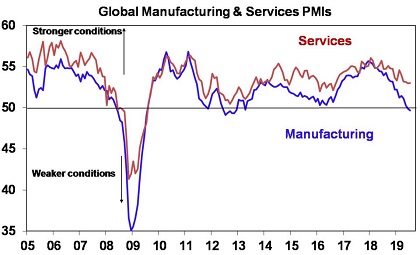
Second, the trade war and the twists and turns it takes is weighing on business confidence and it’s hard to make firm investment plans when they may be rendered uneconomic by a tweet from Trump. This is particularly evident in a slump in manufacturing conditions PMIs worldwide. See the next chart.
View larger image

Source: Bloomberg, AMP Capital

Third, it’s been hoped Chinese policy stimulus will offset the trade war for the last year now, but China has continued to slow.

Fourth, inverted yield curves have preceded post-war US recessions so the recent inversion can’t be ignored.

Finally, global and Australian share markets are vulnerable to weakness after roughly 25% gains from their December lows to their July highs left them overbought and vulnerable to a correction. This risk is accentuated as the August to October period often sees share market weakness.

Reasons for optimism

However, while the risks have increased there are several reasons not to get too concerned. First, President Trump is getting twitchy about the negative economic effects of the trade war: he delayed some tariffs last week after sharp share market falls and had a meeting with major US bank heads on share market falls. The historical record shows that US presidents get re-elected after a first term (think Nixon, Reagan, Clinton, Bush junior and Obama) except when there were recessions in the two years before the election and unemployment is rising (think Ford, Carter and Bush senior). Trump would be aware of this. Share markets have regular corrections but major bear markets are invariably associated with recession and so Trump is wary whenever shares take a sharp lurch lower. As a result, our view remains that at some point Trump will seek more seriously to resolve the trade issue.

Second, policy stimulus is being ramped up: with numerous central banks now cutting interest rates and indicating that more cuts are on the way including from the Fed; the ECB looks like it will soon return to quantitative easing; Chinese economic policy meetings indicate that more policy easing is on the way; Germany is reportedly thinking about some sort of fiscal stimulus; and there is talk of more US tax cuts. This is very different to last year when the Fed was tightening, the ECB ended QE and other central banks including the RBA looked to be edging towards tightening.

Third, while the risks have increased, a US or global recession remains unlikely: services indicators have held up well (see the first chart) and the services sector is the dominant part of most major economies; we have not seen the sort of excesses that precede global and notably US recessions – there has been no investment boom, private sector debt growth has been modest and inflation is low such that central bankers have not slammed the brakes on; & monetary & fiscal stimulus will provide support.

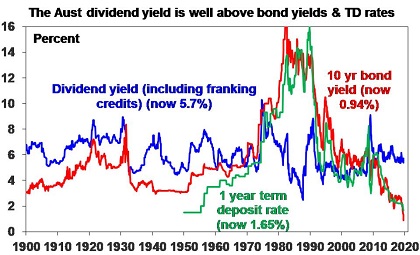
Finally, the decline in bond yields is making shares relatively cheap. The gap of 4.8% between the grossed-up dividend yield on Australian shares of 5.7% and the Australian 10-year bond yield of 0.94% is at a record high. Similarly, the gap between the grossed-up dividend yield and bank term deposit rates of less than 2% is very wide. In other words, relative to bonds and bank deposits shares are very cheap which should see them attract investor flows providing we are right and recession is avoided.
View larger image

Source: Global Financial Data, Bloomberg, AMP Capital

But what about inverted yield curves?

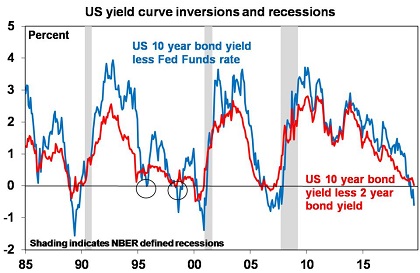
Long-term bond yields should normally be above short-term bond yields because investors demand a higher return to have their money locked away for longer periods. But sometimes long-term rates may fall below short rates. This happened briefly in the US in the last week in relation to the gap between 10-year and 2-year bond yields but had already happened a few months ago in relation to the gap between the 10-year yield and the Fed Funds rate. See the next chart.
View larger image

Source: NBER, Bloomberg, AMP Capital

This so-called “inversion” is causing increasing consternation as an inverted US yield curve has preceded US recessions so it’s natural for investors to be concerned. But the yield curve is not necessarily a reliable recession indicator at present: it can give false signals (circled on the next chart); the lags from an inverted curve to a US recession averaged around 18 months in relation to the last three recessions so any recession may be some time off; various factors unrelated to US recession risk may be inverting the curve such as increasing prospects for more quantitative easing pushing down bond yields, negative German bond yields dragging down US yields and investor demand for bonds as a safe haven from shares; yield curves may be more inclined to be flat or negative when rates are low; and as noted earlier we have not seen other signs of an imminent US recession such as over-investment, rapid debt growth, excessive inflation and tight monetary policy. So our base case remains that a US recession is not imminent.

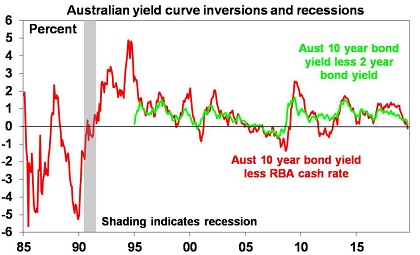
The Australian yield curve has also gone negative with 10-year bond yields of 0.94% below the cash rate of 1% but the gap between the 10 and 2-year bond yields only just positive. But it’s worth noting that Australian yield curve inversions around 1985, 2000, 2005-2008 and in 2012 were useless recession indicators.
View larger image

Source: RBA, Bloomberg, AMP Capital

What does this all mean for investment markets?

In the short-term share markets could still fall further as trade and growth uncertainties remain and as we go through the seasonally weak months ahead. This could be associated with further falls in bond yields. In fact, further share market weakness may be needed to get Trump to seriously resolve the trade issue (as opposed to just go through another trade talks/ breakdown cycle again).

However, providing we are right and recession is avoided, a major bear market in shares (ie where shares fall 20% and a year later are down another 20% or so) is unlikely and given that shares are cheap relative to bonds we continue to see share markets as being higher on a 6-12 month horizon.

What should investors do?

Since I don’t have a perfect crystal ball, from the perspective of sensible long-term investing the following points are repeating.

  • First, periodic sharp setbacks in share markets are healthy and normal. This volatility is the price we pay for the higher long-term return from shares. After 25% or so gains from their lows last December shares were at risk of a correction.

  • Second, selling shares or switching to a more conservative strategy after falls just locks in a loss. The best way to guard against selling on the basis of emotion is to adopt a well thought out, long-term investment strategy.

  • Third, when growth assets fall they are cheaper and offer higher long-term return prospects. So, the key is to look for opportunities that pullbacks provide.

  • Fourth, while shares may have fallen in value, the dividends from the market haven’t. The income flow you are receiving from a diversified portfolio of shares remains attractive. So for those close to or in retirement the key is to assess what is most import – absolute stability in the value of your investments or a decent sustainable income flow.

  • Fifth, shares often bottom at the point of maximum bearishness. So, when everyone is negative and cautious it’s often time to buy.

  • Finally, turn down the noise. In times of crisis the negative news reaches fever pitch, which makes it very hard to stick to a long-term strategy, let alone see the opportunities.

If you would like to discuss any of the issues raised by Dr Oliver, please call on Phone: 07 5641 4134 or email martin@wtfp.com.au


Author: Dr Shane Oliver, Head of Investment Strategy and Chief Economist

Source: AMP Capital 20th August 2019

Important notes: While every care has been taken in the preparation of this article, AMP Capital Investors Limited (ABN 59 001 777 591, AFSL 232497) and AMP Capital Funds Management Limited (ABN 15 159 557 721, AFSL 426455)  (AMP Capital) makes no representations or warranties as to the accuracy or completeness of any statement in it including, without limitation, any forecasts. Past performance is not a reliable indicator of future performance. This article has been prepared for the purpose of providing general information, without taking account of any particular investor’s objectives, financial situation or needs. An investor should, before making any investment decisions, consider the appropriateness of the information in this article, and seek professional advice, having regard to the investor’s objectives, financial situation and needs. This article is solely for the use of the party to whom it is provided and must not be provided to any other person or entity without the express written consent of AMP Capital.

There’s a lot of talk about in how to close the super gap between men and women, with women often retiring with far less than men.

The main drivers of this are due to women both earning less and  taking time out of the workforce to care for children and other family members.

In a previous column, I discussed steps women and their partners can take to close this gap.

A new report from Women in Super and research firm Rice Warner reinforces the risks that the gender gap poses for women and offers data on the roots of the problem.

Previous research showed that because women have less in super and rely more heavily on the age pension, they are more likely than men to face financial insecurity and poverty in retirement.

As you can see from the Rice Warner data in the chart below, the super gap starts to widen when women are in their 30s, suggesting that taking time out of the workforce to rear children diminishes income and super contributions.

The research also demonstrates that women start out their careers with pay that is close to their male counterparts, only to see a gap emerge as women enter their 20s and 30s. The source of this divergence is not clear, but one likely cause is that women are more likely to leave work to take care of children or family members, missing out on years in the workforce when promotions and pay raises are most likely.


Investment research shows that men tend to invest more aggressively than women, but Rice Warner said this difference did not contribute significantly to the super gap.

The positive news is that women are taking action to close the gap. They contribute more to super, especially as they approach retirement, which boosts their balances at a crucial stage.

Many women don’t earn enough to make extra contributions, however, and those who do likely can’t compensate enough for years of reduced earnings and super guarantee payments. The roots of the super pay gap are many — gender inequality, the challenges and costs of child care and super policy. Fixing the problem will require changes on all those fronts.

Source : Vanguard

By Robin Bowerman, Head of Corporate Affairs at Vanguard.

Reproduced with permission of Vanguard Investments Australia Ltd

Vanguard Investments Australia Ltd (ABN 72 072 881 086 / AFS Licence 227263) is the product issuer. We have not taken yours and your clients’ circumstances into account when preparing this material so it may not be applicable to the particular situation you are considering. You should consider your circumstances and our Product Disclosure Statement (PDS) or Prospectus before making any investment decision. You can access our PDS or Prospectus online or by calling us. This material was prepared in good faith and we accept no liability for any errors or omissions. Past performance is not an indication of future performance.

© 2019 Vanguard Investments Australia Ltd. All rights reserved.

Important:
Any information provided by the author detailed above is separate and external to our business and our Licensee. Neither our business, nor our Licensee take any responsibility for any action or any service provided by the author.

Any links have been provided with permission for information purposes only and will take you to external websites, which are not connected to our company in any way. Note: Our company does not endorse and is not responsible for the accuracy of the contents/information contained within the linked site(s) accessible from this page.

Some of the best business ideas are crazy. Others are plain boring. There aren’t any magic rules for finding the good ones. Your best shot at picking the right idea is to make sure it’s a good fit for your personality and your skills.

About the idea

Maybe you already have a lot of business ideas but you can’t pick one. Or perhaps you want to start brainstorming. There are just two things to remember about business ideas.

They’re allowed to be crazy

  • Amazon started selling books online when everyone was perfectly happy going to the store and keeping their credit card details off the internet.

  • Airbnb invited users to let their homes to complete strangers – people they might never meet.

They’re allowed to be mundane

  • You might take an existing product or service and do your own version of it at a lower price, or in a different location, or with some other minor tweak. 

  • Or you might find a weird little niche that no one else has explored yet. Throx did that. They sell socks in threes so people don’t need to worry about losing one in the laundry. 

Tips for landing on the best business ideas

As you come up with ideas, you need a way to pick the good ones. It’s an important choice because your next step is to invest time, energy and possibly cash exploring that idea. These three tests will help you decide on the best ones for you.

  1. Find ideas you’re passionate about
    Does the idea excite you? If you’re wildly passionate about your business then you’ll have much more energy and focus.

  2. Choose a business idea that fits with your skills
    Do you have years of experience, qualifications, contacts, or a special talent to use to your advantage? The more you do, the greater your chances of success and the less you have to pay someone else.

  3. Make sure you can make money from your idea
    You’ll need a plan for turning your idea into revenue. Some ideas can be monetised in many different ways.

Find a small business idea you’re passionate about 

Examine the ideas circling your mind. Do a few stand out as something you’d really like to try? Bring those to the top of your list. If you’re only just starting to brainstorm small business ideas, then focus first on areas where you have a passion.

If you’re passionate about what you’re doing, business will be much more fun. You’ll also find it easier to get up early, work late, and battle through obstacles. Plus your mind is better at absorbing information that genuinely interests you, which could help you learn faster.

Choose an idea that fits with your skills

It’s much easier to get a business off the ground if you can do a lot of the early work yourself. Otherwise you’ll have to hire a lot of professionals, and that’s going to get expensive.

Idea for an app? You should be able to develop a minimum viable product on your own. Want to open a hospitality business? You should know a thing or two about the service industry.

Relevant skills and experience will also be a big plus when it comes to getting finance. Lenders won’t even consider backing you unless your CV convinces them you know what you’re doing.

You don’t have to be a total expert before you start. It’s okay to learn on the job. But when you look at all the steps required to start your business, make sure you can take responsibility for a good chunk of them yourself.

How to make money from your small business idea

Once you’ve chosen your best business ideas, you need to figure out how to turn them into cash. That’s what a business model is for. It’s your plan for making money.

Business models are many and varied. Some types of business make money by selling goods to consumers (retail), others by selling goods to shops (wholesale), and others by leasing goods. Some businesses make money by charging clients an hourly fee for a service, while others charge a flat fee. These are just basic examples of business models. There are all sorts of creative variations.

Business models generally fall into broad categories like retail, manufacturing, software-as-a-service, professional services, and so on. Many categories have general rules about:

  • what customers are charged for

  • average markups on products or services

  • reasonable operating costs

Mixing business models

Your small business idea might lock you into a particular business model. If you open a shop, you’re going to operate pretty much the way other retailers do. But your business might allow you to mix up a bunch of business models.

If you’ve invented a product, for example, you might manufacture it, supply it to retailers, and sell it direct to customers through your own store. Try to investigate the business models that apply to you. An accountant familiar with your type of industry can give you great insights. 

Remember that you’re just choosing between business ideas at this stage. You don’t need a full financial plan yet. But make sure you ask yourself:

  • can I realistically make money from this idea?

  • do I need special expertise (such as wholesale experience) to make the business work?  

Once you’ve picked an idea to explore further, you should get a financial advisor to help work out the business model in more detail.

The best business idea is the one that fits you

When deciding on a business idea to pursue, make sure:

  • you’re genuinely excited by it, because you’ll spend a lot of time on it

  • you can carry it out (while doing a lot of the work yourself)

  • you have a plan for monetising it

Once you’re satisfied you can pour energy and skill into it, and you can see a financial return for those efforts, you’re ready to move to the next step. Start thinking about how to start a small business.


Source: Xero

Reproduced with the permission of Xero.

Xero is software designed to make life better for small businesses and their advisors. Its online accounting platform provides the foundation on which businesses can build a complete business solution. It connects businesses with their bank, accounting tools, their accountant, payment services and third-party apps, so everything is securely available at any time, on any device.

Important:
This provides general information and hasn’t taken your circumstances into account. It’s important to consider your particular circumstances before deciding what’s right for you. Any information provided by the author detailed above is separate and external to our business and our Licensee. Neither our business nor our Licensee takes any responsibility for any action or any service provided by the author.

Any links have been provided with permission for information purposes only and will take you to external websites, which are not connected to our company in any way. Note: Our company does not endorse and is not responsible for the accuracy of the contents/information contained within the linked site(s) accessible from this page. “

With protests in Hong Kong and an unresolved trade war between the United States and China, this may not seem like a wise time to invest abroad.

Looking beyond current events however, a sound investment strategy starts with an asset allocation, aligned to an individual’s goals, that is built upon reasonable expectations for risk and returns over the long-term. Well diversified investments can help investors avoid being overly exposed to unnecessary risks.

Sticking with Australian companies whose names you know may provide a comfort factor, but there’s a chance you could be leaving yourself open to some risk. As my colleague Aidan Geysen wrote recently, the portfolios of Australian investors are often highly concentrated in a small number of Australian-based companies, a risk known as home-country bias.

Underweighting international assets could cause investors to miss opportunities to temper market swings. Politics, industries and consumer sentiment vary widely by country, generating different rates of national and regional economic growth. These variations can make your portfolio less vulnerable to downturns. During the 1990s to 2000s, for example, global equities outperformed Australian equities, so investors who owned both asset classes benefitted. At other times, Australian assets have outperformed.

While investors can choose funds that focus on a single country, constructing a portfolio that is well-diversified geographically will provide additional protection against volatility related to individual economies. For example, investors could choose to add to an Australian-centric equities portfolio through a global equity fund that tracks the MSCI World (ex-Australia) Index can achieve broad geographic exposure providing investors access to about 1,600 large and medium-sized companies across 22 of 23 developed countries. Top holdings include Nestle, Johnson & Johnson and Facebook, global brands that derive revenue from around the world.

Australians are increasingly using exchange traded funds (ETFs) to increase their exposure to international assets potentially due to their accessibility and diversification at low cost.

When you travel, currency fluctuations influence how much you get for your Australian dollar. Currency fluctuations affect international investments in a similar way, so you will need to consider whether you want to invest in a fund that hedges against that risk.

It’s important to remember that while international exposure is a great way to increase balance and diversification within a portfolio, it should be done in line with investors’ long term goals, rather than as a reaction to market events or cycles.

Sticking with an asset allocation strategy aimed at achieving your financial goals in a low-cost, diversified portfolio is more likely to lead to investment success than buying and selling in response to fear or volatility.


Please contact us on Phone: 07 5641 4134 if you seek further assitance on this topic .

Source : Vanguard July 2019 

Written by Robin Bowerman, Head of Corporate Affairs at Vanguard.

Reproduced with permission of Vanguard Investments Australia Ltd

Vanguard Investments Australia Ltd (ABN 72 072 881 086 / AFS Licence 227263) is the product issuer. We have not taken yours and your clients’ circumstances into account when preparing this material so it may not be applicable to the particular situation you are considering. You should consider your circumstances and our Product Disclosure Statement (PDS) or Prospectus before making any investment decision. You can access our PDS or Prospectus online or by calling us. This material was prepared in good faith and we accept no liability for any errors or omissions. Past performance is not an indication of future performance.

© 2019 Vanguard Investments Australia Ltd. All rights reserved.

Important:
Any information provided by the author detailed above is separate and external to our business and our Licensee. Neither our business nor our Licensee takes any responsibility for any action or any service provided by the author.

Any links have been provided with permission for information purposes only and will take you to external websites, which are not connected to our company in any way. Note: Our company does not endorse and is not responsible for the accuracy of the contents/information contained within the linked site(s) accessible from this page

Finding motivation for starting a new business can be easy to come by, but as time passes these feelings may begin to fade. So what do you do when motivation is lacking?

The buzz and excitement of all the things a new business owner discovers each day, coupled with the joy of being your own boss can make it easy to bounce out of bed while things are getting underway.

At this stage, motivation for your business is high – but chances are it won’t remain this way forever.

For many business owners, the buzz and drive may remain for years, but then one day you no longer have that level of excitement in your belly and you may begin finding it hard to jump out of bed.

It happens to all us at different times and for different reasons. So the skill we need to develop is to identify when our motivation is lacking and take steps to build it back up.

A simple definition of motivation

Issues with motivation can’t be solved without first coming to terms with what motivation is, versus what it isn’t.

In short, motivation is your reason for doing what you do. It isn’t your energy levels as such, but rather the ‘why’ behind that energy.

For new business owners, that ‘why’ should be obvious to you. But there are circumstances when it can start to slip.

Why do we lose motivation?

Let’s first look at some of the reasons why we lose motivation.

From my experience, there are three main reasons:

  • No challenge – Doing the same thing, while exciting when you first started your business, has now lost its excitement or edge. As business owners we need challenges to keep it stimulating for us. As we gain experience, the challenges we had before become part of everyday business and the ‘same old, same old’.

  • Exhaustion – The stress of worrying about business 24/7 and all the things that have to be done can take its toll, particularly if you are unable to have a break from work. There are some great aspects about building business, but it can also grow the workload and cause you to feel overwhelmed. For others juggling the priorities of the business with life priorities can sap motivation.

  • Unexpected setbacks – Those surprises that can derail you, such as that job you thought you had not eventuating, or a customer complaint that you didn’t see coming or believe was justified. Ouch! That can take the wind out of your sails. For other business owners it might be the lack of appreciation from clients, an unexpected bill or hurdle with money that makes them lose their motivation.

How can we find motivation once it’s lost?

The longer you have been in business the more likely you are to have experienced some of these motivation-sapping feelings.

The good news is that as business owners we are a resilient bunch and we always find ways to get our motivation back.

So here are six ideas for you to try next time you’re feeling demotivated.

READ: Should you throw out your business plan?

1. Revisit your goals

Understanding why you are in business and what you want to achieve can be a great source of motivation and sometimes we can forget.

Getting reacquainted with your purpose for being in business may be enough to reignite motivation.

Revisit those goals and throw any out that aren’t serving you or the business anymore. Set short term goals such as daily, weekly and monthly goals as well as long term goals.

2. Mix it up

Doing something differently can get your engines running again.

It could be as simple as cleaning your workspace or mixing your boring tasks with some of the more fun tasks.

For more inspiration, consider visiting your competitors or going interstate or overseas for new ideas.

Book in to a conference or training workshop. Or, if that’s something you do every year, then maybe consider not doing that this year and go on a holiday instead.

3. Get support

Have a chat about how you are feeling with friends or other business colleagues.

Every business owner at some point in their business journey would have felt the same and talking about it can make you feel better.

READ: 4 signs that your startup needs to hire

4. Reconnect with hobbies

Our business may be our life and where we put most of our energy, but we do need outlets other than business.

Shifting the focus from work for a day or on a regular basis can help you put things in perspective.

Choose a hobby that you love and that brings you joy and spend a little time doing that. It might be taking a day off to play golf, play music, read a book, catch a movie, bushwalk, surf, yoga, shop, gardening or going for a bike ride. Whatever helps you feel accomplished and takes your mind of work.

5. Have a holiday

Take some time out.

If you can’t take a holiday this year, then book one for next year. Knowing you have a holiday coming up can be extremely motivating. We all need to recharge our batteries.

READ: Why you need to start planning your next holiday today

6. Challenge yourself

Identify ways you can improve your business.

Seek feedback from customers or a business coach and make a plan for improvement. You might also consider setting a new business stretch goal that is achievable but challenging.

Throughout your business lifecycle you will have times when your motivation is low. The key to being successful in business is to be able to identify when you need a boost.

Try one of these six suggestions and I’m sure your motivation will be back before your next BAS is due.

Tags mentor productivity small business tips starting out work life balance

Source : MYOB April 2019

Reproduced with the permission of MYOB. This article by Ailsa Page was originally published at https://www.myob.com/au/blog/six-tips-stay-motivated-new-business-owner/

Important:
This provides general information and hasn’t taken your circumstances into account. It’s important to consider your particular circumstances before deciding what’s right for you. Although the information is from sources considered reliable, we do not guarantee that it is accurate or complete. You should not rely upon it and should seek qualified advice before making any investment decision. Except where liability under any statute cannot be excluded, we do not accept any liability (whether under contract, tort or otherwise) for any resulting loss or damage of the reader or any other person.

Any information provided by the author detailed above is separate and external to our business and our Licensee. Neither our business nor our Licensee takes any responsibility for any action or any service provided by the author.

Any links have been provided with permission for information purposes only and will take you to external websites, which are not connected to our company in any way. Note: Our company does not endorse and is not responsible for the accuracy of the contents/information contained within the linked site(s) accessible from this page.

By Flying Solo contributor Fiona Adler

If you think of the truly impactful, amazing people you know, that are operating 10x above their peers, chances are they have an uncanny ability to prioritise. They might work hard, yet they are not rushing and not particularly stressed. But somehow they achieve amazing results. In fact, they often have an enviable calmness and a sense of clarity around them.

These could be entrepreneurs, business leaders, people climbing the corporate ladder, or people excelling in their field, whatever it is. In fact, you can find them in all kinds of professions – developers, marketers, customer service consultants, sales professionals, human resources, finance, legal, etc. There are also incredible examples who are full-time parents, volunteers, or students.

So what’s the secret of these high performers? How do they achieve so much more than the rest of us without even breaking a sweat?

The answer is simple – they decide what’s important, and then they do the important things.

These two distinctions are equally important, but here we’re looking at prioritisation – the act of deciding, or choosing, what’s most important. If you’re wondering how to be more productive, start with prioritisation.

Why prioritisation matters

Prioritisation is effectively about making choices. It’s seeing all of the options available to you and honing in on what is really going to move the needle. It’s having the maturity to know that you can’t do everything now. It’s an acknowledgement of the reality that the fewer things you choose to do, the better you’ll be able to do them.

Right now, prioritisation is more important than ever. Never before have we had access to so many ideas implanting thoughts about other things we should be doing and access to resources on how to do it. If I get an idea to do something, chances are I can delve into it, find examples of others doing that thing, learn how to do it, and next thing you know, I’ve added something completely new to my day. This is an amazing time we’re living in! But equally, we can so easily get side-tracked (and before you know it I’ve spent half a day on something I didn’t even know existed at the start of the day!).

To prioritise, you need a clear goal

In order to prioritise and use our time wisely, we need to have a clear understanding of where we’re headed – something we’re aiming towards. This can be a vision or even your values, but the more concrete it is the better – which is why I prefer to focus on a goal.

Knowing your goal gives you a frame of reference against which you can judge all the possible things you could be doing.

Will this thing move me closer to my goal? Which option is more likely to get me closer to my goal? What is the most impactful thing I could do to move closer to my goal?

These are the questions that high performers are constantly asking themselves.

Don’t make the mistake of having too many goals either – these need to be prioritised too! Yes it might be nice to increase customer satisfaction, reduce costs, have a record sales month, and expand your product line, but it’s not realistic to do these things at the same time (especially as these are somewhat conflicting).

You need to choose which one to focus on now. Which goal will give you the best results? Choose one for now and you can switch to another once you’ve made progress against that one.

Prioritisation connects your daily actions to your goals

With a clear goal in mind, you can prioritise how you spend your time. The key is to take action towards your goals each day. Which also means that you say ‘No’ to a whole lot of other options and refuse to get sidetracked.

The foundational habit here is starting each day with a clear set of high priority actions.

By proactively planning your day, it’s you who decides what’s really important and you who creates your day.

Remember, it’s not the quantity of things you get done, it’s all about doing the right things.

Don’t think you’re being lazy by refusing to do other tasks that are not in alignment with your goal. We’re actually being lazy when we don’t force ourselves to decide what’s the most important!

How to use prioritisation in practise…

Almost all of the top thinkers on prioritisation theories and frameworks agree that being highly effective, comes down to how well you prioritise your day.

Here’s how to prioritise so that you accomplish more of the important things.

1. Plan your day

Don’t just let the day happen. Deliberately take 5 minutes to plan – either first thing in the morning or the night before. Here’s how to write an effective daily action list.

2. Be intentional and proactively decide how your day will unfold.

Think about how you want to feel when the day ends. What do you want to have accomplished?

3. Choose 3-5 small, but meaningful actions to do that day.

Aim low – yes, seriously! Instead of coming up with a shopping list of things you’d like to do, restrict yourself to 3-5 things. Then get into the habit of actually doing them! Attack the day with laser focus and stick with it until those things are done.

4. Each action should be achievable in under an hour.

Break your items into small actions. They should each be quite small so keep breaking them down until you think you could do it in less than an hour. (It could be just a draft of the first paragraph, some sketches, writing an email, etc.)

If you get into the daily prioritisation habit you’ll be amazed at the results you’ll achieve. The cumulative effect of consistently taking the right actions (instead of floundering around doing thousands of unprioritisated tasks), makes a huge difference to your productivity. Soon, others will be wondering how you get so much done without working like a crazy person!

Source : Flying Solo July 2019 

This article by Fiona Adler is reproduced with the permission of Flying Solo – Australia’s micro business community.Find out more and join over 100K others.


Important:
This provides general information and hasn’t taken your circumstances into account. It’s important to consider your particular circumstances before deciding what’s right for you. Any information provided by the author detailed above is separate and external to our business and our Licensee. Any information provided by the author detailed above is separate and external to our business and our Licensee. Neither our business, nor our Licensee take any responsibility for any action or any service provided by the author.

Any links have been provided with permission for information purposes only and will take you to external websites, which are not connected to our company in any way. Note: Our company does not endorse and is not responsible for the accuracy of the contents/information contained within the linked site(s) accessible from this page.

Given the attention on the size of Australia’s super savings, it may surprise you that personal investors in total have almost as much outside super as inside super.

The latest Personal Investments Market Projections report, recently published by consultants Rice Warner, calculates that the total value of super* and non-super personal investments was $5.5 trillion at June 2018. Non-super investments make up almost half or $2.7 trillion of this total.

Taking a whole-of-portfolio approach

Depending upon their circumstances, it can be critical for investors to co-ordinate their super and non-super investment portfolios. This includes for their retirement and investment strategies, strategic asset allocations for portfolios, periodic rebalancing of portfolios, tax planning and estate planning.

And when assessing the adequacy of your retirement savings, consider taking account of all of your investments, inside and outside super, in your calculations.

Defining a non-super personal investment

Rice Warner defines the personal non-super investments market broadly, including all investments outside super held by individuals – directly or through trusts and companies. Family homes and personal possessions are not counted.

Directly-held property together with directly-held cash and term deposits make up a huge slice of non-super personal investments in dollar terms.

While the value of direct property (excluding mortgages) accounts for 42 per cent of the assets, directly-held cash and term deposits account for more than 41 per cent. By contrast, direct shares make up 8 per cent of personal non-super investments.

Individuals hold 92 per cent of personal non-super personal investments directly rather than through investment products and investment platforms. (In this research, exchange traded funds are classified as directly-held investments.)

Many investors, of course, choose to hold geared and non-geared direct property in their own names – often dominating their non-super portfolios – while having more widely-diversified super portfolios.

Looking ahead

The report’s expectations for the short-to-medium term for the non-super personal investment market include:

  • Exchange traded funds (ETFs) will continue to grow in popularity as investors seek to improve portfolio returns by investing more in low-cost, index-tracking investments.

  • Direct property will remain a major personal investment, driven mainly by low interest rates and its tax treatment. However, the growth in the popularity of direct property investments is “likely to be constrained” over the short-to-medium term because of less investment from overseas and tighter lending standards.

  • Demand for share investments through investment platforms will increase as investors pursue higher returns in a low-interest environment.

  • Low interest rates will further encourage investors to reduce their fixed-interest investments and seek higher returns in other asset classes.

  • Pressure will continue for lower investment management fees.

  • Technological developments will continue the growth of self-directed online advice, “increasing allowing investors to make more sophisticated decisions”.

Personal non-super investments are becoming more important to wealthier, higher-income investors with the introduction two years ago of the superannuation pension cap and tighter contribution limits.

Over the next 15 years, Rice Warner projects that our personal non-super investments will grow in value to $4.8 trillion in 2018 dollars against $5 trillion for the superannuation sector.

How does the value of your non-super savings compare with the value of your super savings? And do you take both into account when setting the most-appropriate asset allocations and assessing the adequacy of your retirement savings?

*Super calculations include unfunded public-sector liabilities and government pensions.


Please contact us on Phone: 07 5641 4134 if yiu seek further asssitance on this topic.

Source : Vanguard July 2019

Written by Robin Bowerman, Head of Corporate Affairs at Vanguard.

Reproduced with permission of Vanguard Investments Australia Ltd

Vanguard Investments Australia Ltd (ABN 72 072 881 086 / AFS Licence 227263) is the product issuer. We have not taken yours and your clients’ circumstances into account when preparing this material so it may not be applicable to the particular situation you are considering. You should consider your circumstances and our Product Disclosure Statement (PDS) or Prospectus before making any investment decision. You can access our PDS or Prospectus online or by calling us. This material was prepared in good faith and we accept no liability for any errors or omissions. Past performance is not an indication of future performance.

© 2019 Vanguard Investments Australia Ltd. All rights reserved.

Important:
Any information provided by the author detailed above is separate and external to our business and our Licensee. Neither our business nor our Licensee takes any responsibility for any action or any service provided by the author.

Any links have been provided with permission for information purposes only and will take you to external websites, which are not connected to our company in any way. Note: Our company does not endorse and is not responsible for the accuracy of the contents/information contained within the linked site(s) accessible from this page.

Introduction

After a third round of talks made little progress last week, the US/China trade war has escalated badly with tit for tat moves on an almost daily basis by each side. This has seen share markets fall sharply with US, global and Australian shares down about 5-6% from recent highs and safe haven assets like bonds and gold benefiting on the back of worries about the global growth outlook. This note looks at the key issues.


What is a trade war?

A trade war is where countries raise barriers to trade with each other usually motivated by a desire to “protect” jobs often overlaid with “national security” motivations. To be a “trade war”, the barriers need to be significant in terms of their size and the proportion of imports covered. The best-known global trade war was that in 1930 which saw average 20% tariff hikes on US imports.

What is so good about free trade?

A basic concept in economics is comparative advantage: that if Country A and B are both equally good at making Product X but Country B is best at making Product Y then they will be best off if A makes X and B makes Y. Put simply, free trade leads to higher living standards and lower prices whereas restrictions on trade lead to lower living standards and higher prices.

So why is President Trump raising tariffs then?

It’s basically about fulfilling a presidential campaign commitment to “protect” American workers from what he regards as unfair trading practices in countries that the US has a trade deficit with – notably China. And he knows this is popular with his supporters but there is also some degree of bi-partisan support for taking on China.

What does President Trump want?

Basically, he wants China to lower its tariffs, allow better access for US companies, end US companies being forced to hand over their technologies and protect intellectual property of US companies. At a high level he wants a reduction in America’s trade deficit with China. Along the way he has renegotiated the NAFTA free trade agreement with Mexico and Canada and the free trade deal with South Korea and is in talks with Europe and Japan. In recent times he has also used the threat of tariffs to get what he wants from countries (eg Mexico in relation to border protection).

Where are we now?

Fears of a global trade war kicked off in March last year with Trump’s announcement of a 10% tariff on aluminium imports and a 25% tariff on steel imports. US allies were subsequently exempted but China was not. On March 22 Trump announced 25% tariffs on $US50bn of US imports from China. These were implemented in July and August. After Chinese retaliation Trump announced a 10% tariff on another $US200bn of imports from China (implemented in September) which would increase to 25% on January 1 this year. The latter was delayed as the talks made progress.

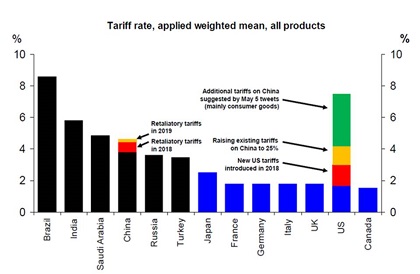
However, following May 5 tweets by Trump, on May 10 the delayed tariff hike from 10% to 25% on $US200bn of imports from China was put in place and the US kicked off a process to tariff the remaining roughly $US300bn of imports from China at 25%. If fully implemented this would take the average US tariff rate on imports to around 7.5%, which is significant (albeit minor compared to the 20% 1930 tariff hikes). See next chart.

Average weighted tariff rate across all products

View larger image

Source: World Bank, Deutsche Bank Research

Along the way, China’s retaliation has been less than proportional, partly reflecting lower imports from the US. The US has also put in place restrictions on dealing with Chinese tech companies like Huawei.

Following a meeting in late June between Presidents Trump and Xi the trade war was put on hold pending a third round of talks. These look to have made little progress and Trump announced last week that from September 1 the remaining $US300bn of imports from China will be taxed at 10% and this may go beyond 25%.

China has responded by allowing the Renminbi to fall below 7 to the $US and reportedly ordering state-owned enterprises to halt imports of agricultural products from the US. The US then named China a currency manipulator (even though basic economics pointed to a fall in the Renminbi in response to the tariffs on its good) which opens the door to possibly further action by the US (eg intervention to lower the $US versus the Renminbi) and potentially a further escalation in the trade war.

At the same time, the US is still considering auto tariffs after a report lodged in February.

What happened to the US/China trade talks?

This has been the third round of trade talks that look to have failed. The timing of the announcement of the latest round of tariffs may also reflect a desire by Trump to force the Fed to ease more as he wasn’t happy with its 0.25% cut last week and to show that he is tougher on trade than far-left Democrat presidential candidates Sanders and Warren. Whatever it is, there is likely to have been a further breakdown in trust between China and the US and China may have decided to wait till after the election.

Ongoing tensions around North Korea, Iran, Hong Kong, Taiwan and the South China sea are probably not helping the issue either.

What will be the economic impact?

The latest round of tariff increases from September 1 would be a big deal compared to last year’s tariffs and see the impact shift to largely consumer goods as opposed to intermediate goods in the first tariff rounds. The 10% tariff could knock around 0.3% from US and Chinese GDP particularly as investment gets hit in response to uncertainty about supply chains. The full 25% tariff could take that to around 0.75% with roughly a 0.2% boost to US core inflation (albeit this would be temporary and looked through by the Fed). This would flow on to slower global growth and lead to less demand for Australia’s exports even though we are not directly affected.

What is the most likely outcome?

At this point, it’s hard to see a way out of the escalating trade war and it risks flowing into other issues as well including around HK, Taiwan, and the South China sea as the US and China slip further towards some sort of “cold war”. However, as the economic impact in the US mounts – so far it’s just been impacting business confidence and investment plans but risks impacting consumer spending too – President Trump is likely to become more concerned. Recessions and rising unemployment have historically killed the re-election of sitting presidents (Hoover, Ford, Carter and Bush senior) and for this reason, we remain of the view that a deal will be reached before the election. President Trump showed late last year that he was sensitive to the impact of the trade conflict on the US share market (as after sharp falls he called President Xi to set up a new meeting). So sharp share market falls may be needed again to get the US and China negotiating. But this means it could still get worse before it gets better – the US share market had a top to bottom fall last year of 20%!

It’s also worth noting that policy stimulus by the Fed and the Chinese government will offset some of negative impact which along with the absence of the sort of excesses (like in cyclical spending, inflation and private debt) that normally precede recessions in the US is why we are not predicting a recession.

What does it mean for investment markets?

Basically, the uncertainty around the escalating trade war is bad for listed growth assets like shares as it threatens the outlook for growth and profits, but positive for safe-haven assets which is why bond yields in many countries including Australia have pushed further into record low territory and gold has increased in value.

Following last week’s highs, global and Australian shares have fallen roughly 5-6%, mainly reflecting concern about the impact on growth from the escalating trade war. Further downside is likely in the short term as the trade war continues to escalate and we are also in a seasonally weak part of the year for shares. This is likely to be associated with further falls in bond yields.

However, providing we are right and recession is avoided, a major bear market in shares (ie where shares fall 20% and a year later are down another 20% or so) is unlikely.

What does it all mean for Australia?

Fortunately, Australians aren’t having to pay higher taxes on imports like Americans, but the main risk is that we are indirectly affected as the US/China trade war drags down global growth, weighing on demand for our exports and leading to unemployment pushing higher than our 5.5% forecast for year end. This all adds to the case for further easing by the RBA (we expect the cash rate to fall to 0.5% by February) and for further fiscal stimulus.

What should investors do?

Times like the present are stressful for investors. No one likes to see their wealth fall and uncertainty seems very high. I don’t have a perfect crystal ball, so from the point of sensible long-term investing the following points are worth bearing in mind.

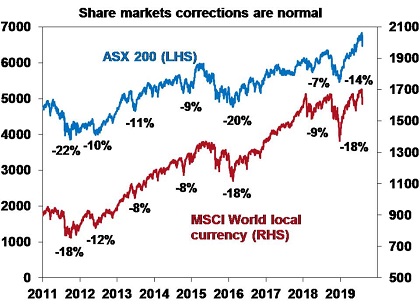
  • First, periodic sharp setbacks in share markets are healthy and normal as can be seen in the next chart. The setbacks are the price we pay for the higher long-term return from shares. After 25% or so gains from their lows, last December shares were at risk of a correction.

View larger image

Source: Bloomberg, AMP Capital

  • Second, selling shares or switching to a more conservative strategy after a major fall just locks in a loss. The best way to guard against selling on the basis of emotion is to adopt a well thought out, long-term investment strategy.

  • Third, when growth assets fall they are cheaper and offer higher long-term return prospects. So, the key is to look for opportunities that pullbacks provide.

  • Fourth, while shares may be falling in value, the dividends from the market aren’t. The income flow you are receiving from a diversified portfolio of shares remains attractive.

  • Fifth, shares often bottom at the point of maximum bearishness. So, when everyone is negative and cautious it’s often time to buy.

  • Finally, turn down the noise on financial news. In periods of market turmoil, the flow of negative news reaches fever pitch, which makes it very hard to stick to a well-considered, long-term strategy, let alone see the opportunities.

If you would like to discuss any of the issues raised by Dr Oliver, please call on Phone: 07 5641 4134 or email martin@wtfp.com.au


Author: Dr Shane Oliver, Head of Investment Strategy and Chief Economist

Source: AMP Capital 7th August 2019

Important notes: While every care has been taken in the preparation of this article, AMP Capital Investors Limited (ABN 59 001 777 591, AFSL 232497) and AMP Capital Funds Management Limited (ABN 15 159 557 721, AFSL 426455)  (AMP Capital) makes no representations or warranties as to the accuracy or completeness of any statement in it including, without limitation, any forecasts. Past performance is not a reliable indicator of future performance. This article has been prepared for the purpose of providing general information, without taking account of any particular investor’s objectives, financial situation or needs. An investor should, before making any investment decisions, consider the appropriateness of the information in this article, and seek professional advice, having regard to the investor’s objectives, financial situation and needs. This article is solely for the use of the party to whom it is provided and must not be provided to any other person or entity without the express written consent of AMP Capital.