Having a solid business idea is a far cry from having a successful business. In this article, Benjamin Kluwgant discusses the best ways to approach turning your concept into a reality.

Have you ever been working your day job and all of a sudden experienced a light bulb moment with a genius business idea?

Well, if you have, you’re certainly not alone. These days, anyone with even the slightest drop of entrepreneurial spirit in their blood tends to come up with an idea every now and again that they consider taking on.

Unfortunately, these ideas don’t often come to fruition due to obstacles such as limited access to funding, lack of know-how or readiness to leave a full-time and secure job. Other times, a simple lack of follow through can be the culprit. The idea then goes begging and joins millions of others in an ocean of missed opportunities.

In the small percentage of instances that such an idea is taken seriously though, moving from the idea phase into the creation of an actual business is nothing short of an uphill battle with an endless amount of challenges.

But, if the right strategies are used and if the idea is approached with a disciplined attitude, these unavoidable challenges can play a huge part in setting up a long-lasting business with strong foundations.

In order to get some insight from an experienced, early-stage business mentor, I reached out to Alan Tsen, Melbourne general manager of Stone and Chalk and chair of Fintech Australia, asking for his take on how to approach this delicate transition from idea to business.

 

1. Setting realistic expectations

According to Tsen, before even beginning the journey from idea to full-fledged business, it is important to align your expectations with the reality of the situation, which is: starting a business is far closer to tip-toeing through a minefield than it is to a stroll in the park.

READ: 10 mistakes entrepreneurs make

“Building a company is hard,” Tsen told The Pulse. “In fact, in many ways it’s an impossible task that requires super human levels of focus and determination. It’s a grinding process that takes years of relentless work with many pitfalls and landmines.”

2. Stay focused – keep your eye on the prize

Assuming you can come to terms with the ‘mission-impossible’ type of venture that lies ahead, there are a number of important strategies that Tsen outlined that can help make the transition more manageable.

The first strategy is simple: avoid distraction at all costs.

Based on Tsen’s experience in watching early-stage business founders undergo this transition, he said that it’s “easy to get distracted” by the next “shiny thing” that looks like it’ll make your business more successful.

While ‘shiny objects’ are often tempting, they can be very dangerous. In the competitive world of startups and innovation that we live in today, it is of paramount importance to stay focused on building the solution to the problem you originally identified.

According to Tsen, in order to play in the league of “great startups”, the focus needs to be in creating one solution that is “a magnitude of order better” than any other pre-existing solution.

“Being maniacally focused on what your customers need and solving their problem is the key early on.”

3. Validate and answer hard questions early

It doesn’t matter how good your business idea might be – when you start out, there are always going to be fundamental questions that need to be answered.

Tsen encouraged those starting out with their business ideas to “test the hard ones early” and not to be afraid to face those challenges head on.

“For example,” explained Tsen, “will a customer actually pay you money for the product? Is this product really 10 times better? If it isn’t (which is fine early on), what is your proposed pathway to get there?”

Don’t shrug off the fundamentals or assume you ‘just know’ whether or not something will work. If you launch your business without answering those questions first, you’ll end up scrambling for answers when it’s too late.

4. Balance the company vision with customer input

Another strategy Tsen implored people to implement at the early stages of proving a business concept is to effectively balance your mission statement with the input you receive from potential customers.

When you’re in the validation phase, you have no choice but to consider the feedback offered by those within your target market. Often that feedback can lead to distractions which compromise your vision for the business’ direction.

READ: When should you begin paying yourself?

“Have a view and vision for the company and then augment that with what your customers tell you,” said Tsen.

“If you can do that well, you’ll end up in the sweet spot of being both valuable and unique.”

5. Don’t let failure scare you

At the early stage of a business venture, risk of failure is extremely high. Entering the unknown, testing and tweaking your offering and keeping up with industry trends are all things that invite enough challenge to cause even the most ambitious of people to fail harshly.

As we saw from SpaceIL’s failed attempt to land on the moon earlier this year, successful stories are all filled with plenty of turbulent times and failures.

If you can maintain focus, find the courage to answer the hard questions, balance your vision with customer input and be ready to accept failure, there isn’t much that can stop you from building a high-quality business.

Source : MYOB June 2019

Reproduced with the permission of MYOB. This article by  was originally published at https://www.myob.com/au/blog/business-idea-startup-tips/?

Important:
This provides general information and hasn’t taken your circumstances into account. It’s important to consider your particular circumstances before deciding what’s right for you. Although the information is from sources considered reliable, we do not guarantee that it is accurate or complete. You should not rely upon it and should seek qualified advice before making any investment decision. Except where liability under any statute cannot be excluded, we do not accept any liability (whether under contract, tort or otherwise) for any resulting loss or damage of the reader or any other person.

Any information provided by the author detailed above is separate and external to our business and our Licensee. Neither our business nor our Licensee takes any responsibility for any action or any service provided by the author.

Any links have been provided with permission for information purposes only and will take you to external websites, which are not connected to our company in any way. Note: Our company does not endorse and is not responsible for the accuracy of the contents/information contained within the linked site(s) accessible from this page.


The vision for ethical investing is simple: invest for the long term while making the world a better place. It’s noble and hard to argue with.

Implementing the vision, however, is not so easy.

The investing world is seldom black and white. Investors often face a decision choosing the lesser of two evils, or the better of two goods, rather than between good and evil. Every investment decision has consequences. Responsible investors think about the direct and indirect ramifications of every buy and sell recommendation.

For example, withdrawing money from a resources project on the back of political concerns has the potential to decimate a rural village in an under-privileged part of the world, condemning hundreds or thousands of people to poverty. Quitting investing in coal fired power generation and putting everything into renewables would, in the short term, literally result in the lights going out.

These are the sorts of conundrums ethical investors face every day. They have to balance the goal of making the world a better place with achieving acceptable returns. (Investing, by definition, includes achieving a return and when people put money into an investment, they expect the return to be financial.)

The best ethical investors have clear guidelines on how to work towards making the world a better place while also achieving a financial return. The AMP Capital Responsible Investment Leaders (RIL) funds are guided by three principles.

  1. We invest in companies and managers at the better end of the spectrum on environmental, social and governance issues.

  2. We believe part of our job is to lobby for change and expect all of our managers in Australia and overseas to share our philosophy.

  3. We exclude companies and assets that have a significant negative social impact.

Environment, social and governance (ESG)

The environment, and specifically climate change, is arguably the biggest challenge facing the world today and we are committed to invest to help find solutions. But there is no quick fix or easy answer.

The AMP Capital RIL funds think about climate change using some key parameters.

Our first parameter is that we exclude all companies that make a material amount of money – more than ten per cent of sales – from the most carbon intensive fossil fuels. These are thermal coal, oil sands, brown-coal coal-fired power and the conversion of coal to liquid fuels or feedstock.

The second is that we do not invest in infrastructure companies that facilitate the most emissions intensive fossil fuels. For example, it means we do not invest in companies that own oil sands pipelines.

This approach to exclusion and divestment means that the Socially Responsible Investment Balanced option at AMP Capital has a significantly smaller carbon footprint than the markets we invest in. For example, in Australia, its carbon footprint is 50 per cent less than the ASX2001.

Our approach is to support the transition needed to address climate change. So, we still invest in some oil and gas companies which are best of breed in terms of environmental, social and governance impacts. This is the third parameter. It is not practical to stop investing in all energy and resource companies, even as we ramp up investments in companies that are helping economies transition to a renewable basis.

Gas in particular, is also expected to play a much more important role in providing energy to the world under a two degree temperature rise scenario (a two degree temperature rise by 2040 is the current goal contained in the Paris Agreement).

For example, the International Energy Agency2 expects that demand for natural gas will increase by 11 per cent under its most ambitious scenario, known as the Sustainable Development Scenario. Coal is likely to need to be replaced by renewables but natural gas will remain an important part of the global energy mix.

There are some fossil fuels that do not yet have a natural alternative. An example is the type of coal used to make steel (metallurgical coal) and oil used for transportation. Developing economies like China and India, who have not benefited from the full spectrum of fossil fuels like we have, will need some fossil fuels as they develop, bringing millions of people out of poverty.

Away from the environment (though often these issues are inextricably linked) are other important social and governance issues which ethical investors consider.

Rates of pay for labour in factories in parts of Asia remains an issue as does deforestation. Access to medicines – something Australians almost take for granted – is a major barrier for millions of people in both the developed and underdeveloped world. The use of plastics, the prevalence of antibiotics in the food supply and the rights and wrongs of investing in social media are all issues ethical investors, including AMP Capital, grapple with.

Lobbying for change

The biggest difference a fund manager can make in helping make the world a better place is to lobby for change and influence countries and companies to do things differently.

Large fund managers such as AMP Capital are in the privileged position of being able to encourage change. We do this by meeting with the executives and boards of the companies that we own and asking them to do things differently.

We have asked retailers to map and publish their supply chains and pay factory workers a living wage. We have asked banks to lift their game on responsible lending, address sales-based cultures and compensate customers who have been treated poorly. We have asked the world’s largest resource and utilities companies to map and disclose their path to a lower carbon economy.

Just as importantly, we appoint investment managers who ascribe to our philosophy and we take part in investor coalitions that call for change. This includes Climate Action 100+, a five-year global initiative designed to bring together the world’s largest investors and the world’s largest greenhouse gas emitters. To date, 320 investors responsible for more than US$33 trillion of assets under management have committed to the initiative.

Negative and positive social impact

While the environment garners much of the attention, there are other companies and sectors which many ethical investors avoid because they are inherently destructive and cause harm to people.

For example, the AMP Capital Responsible Investment Leaders Balanced fund does not invest in any companies that manufacture or produce:

  • tobacco;

  • nuclear weapons;

  • cluster munitions;

  • land mines; or

  • other biological or chemical weapons manufacturers.

Nor does it invest in companies that make more than 10 per cent of their sales from alcohol, gambling and/or pornography. This is because of the social harm that the use of these products can cause.

Our position on nuclear power is clear: we exclude companies that make 10% or more of their sales from the production of nuclear power. The main reasons are; the potential for significant accidents, such as the Fukushima Daiichi nuclear reactors in Japan; and the unsolved problem of safe long-term nuclear waste disposal. (As we’ve seen in much of the western world there are also serious questions about the financial viability of nuclear power).

The flip side is the many opportunities to invest in assets that improve society and are constructive to people. Investing in schools and higher educational facilities, hospitals, water treatment and desalinisation plants, and even prisons focused on rehabilitation all fall into that category of ethical investing which will make the world a better place.

Green bonds

One of the most important ways we support companies and assets that are developing solutions to ESG challenges is by investing in green bonds. These are essentially loans, made by investors such as the World Bank or governments, for green projects all over the world. Projects that the Socially Responsible Investment Balanced option are funding right now include solar energy farms, energy efficient technology, energy storage solutions, sustainable transport, cycleways, recycling research and development and forestry plantations.

In Australia, one of the green bonds we bought in 2018 is funding a water recycling plant in New South Wales that is expected to save 18 billion litres of drinking water each year.

Another way we finance renewables is by investing in cleantech private equity. This way we provide early stage capital for companies developing the next generation of clean energy.

Conclusion

There are no easy solutions to the myriad of questions raised by investing ethically. A set of clear principles to guide investment decisions is the most practical and effective way of facilitating change. It is an evolutionary process, not a revolution, that will make the world a better place.

By Kristen Le Mesurier

Portfolio Manager, Multi Asset GroupSydney, Australia

1 Calculated at 30 June 2018 by AMP Capital. 
2 The IEA is an intergovernmental agency started by the OECD

Source : AMP Capital May 2019 

 Important notes: While every care has been taken in the preparation of this article, AMP Capital Investors Limited (ABN 59 001 777 591, AFSL 232497) and AMP Capital Funds Management Limited (ABN 15 159 557 721, AFSL 426455)  (AMP Capital) makes no representations or warranties as to the accuracy or completeness of any statement in it including, without limitation, any forecasts. Past performance is not a reliable indicator of future performance. This article has been prepared for the purpose of providing general information, without taking account of any particular investor’s objectives, financial situation or needs. An investor should, before making any investment decisions, consider the appropriateness of the information in this article, and seek professional advice, having regard to the investor’s objectives, financial situation and needs. This article is solely for the use of the party to whom it is provided and must not be provided to any other person or entity without the express written consent of AMP Capital.

From wildlife-filled jungles to some of the world’s most spectacular beaches, sustainable travel is on the rise across the globe. While there’s nothing like swaying in a hammock with a cocktail or two, it’s even better when you know your holiday dollars help to support communities and environmentally-friendly practices, while protecting cultural and natural heritage.

Sink into that hammock at one of these sustainable travel destinations.

Republic of Palau

Turquoise lagoons, volcanic landscapes and magical underwater worlds await in Palau. This diver’s paradise in the Western Pacific not only captivates holiday-makers with an adventurous spirit, it’s one of this year’s winners in the Green Destinations Sustainable Top 100 Destination Awards

Innovative approaches include the ‘Palau Pledge’, which you sign upon entering the country as a vow to protect natural and cultural heritage. New regulations will ban the use of reef-toxic sunscreens in 2020 and it’s also home to the world’s first shark sanctuary. Don’t miss out on kayaking around the Rock Islands and stay on Koror for a blend of tourist facilities and island-hopping fun.

Fraser Island, Australia

When you want to get off-road in a 4WD, float in shimmering, freshwater lakes and camp under the stars, Queensland’s Fraser Island is calling your name. The world’s largest sand island is an irresistible blend of towering rainforests, wild surf beaches and natural wonders, like deep green Lake Wabby and The Cathedrals coloured sand dunes.

Eco-friendly initiatives abound, with Kingfisher Bay Resort leading the way. Designed to integrate with the island, it holds nine Advanced Ecotourism Certifications and has been credited as a Green Travel Leader by Ecotourism Australia. From ranger-led walks to canoeing and bush tucker education, a holiday on Fraser Island means total immersion in nature.

Galapagos Islands, Ecuador

The human footprint is most certainly kept to a minimum on the Galapagos Islands, which is evident in the abundance of wildlife that barely blinks an eye at people in their midst. Around this archipelago of 19 islands, volcanic rocks and islets, expect to see playful sea lions, gigantic tortoises, sun-loving lizards and penguins galore.

Tourism activities in the Galapagos Islands are subject to conserving natural resources, recycling, sourcing local produce and hiring local employees. Different institutions govern sustainable development and ongoing conservation projects help to ensure the pristine state of this incredibly unique destination.

Ljubljana, Slovenia

If you’re looking for an eco-friendly city trip, pop the capital of Slovenia on your European itinerary. Described as a ‘city with a green soul’, it’s been globally recognised for measures including waste management and sustainable development. In 2012, the inner city centre was closed to traffic and free bicycle sharing is the preferred mode of transport.

Along with exploring lush, green pedestrian ways along the picturesque Ljubljanica River, launch into museum-hopping across cobbled streets, coffee-sipping in quaint cafes and foodie trips to local markets.

Petra Archaeological Park, Jordan

Carved into dramatic desert canyons, Petra holds the secrets to the mysterious ancient civilisation of the Nabateans. The sprawling site encompasses the Petra Archaeological Park, with majestic caves, tombs and temples carved into rose-coloured sandstone.

From regional to international collaborations and the formation of the Petra National Natural Protected Area, sustainable travel here has a strong focus on preserving rich culture and otherworldly landscapes.

Whether it’s ancient wonders or sparkling coastlines that beckon this year, sustainable travel destinations offer the best of all worlds.


Important:
This provides general information and hasn’t taken your circumstances into account. It’s important to consider your particular circumstances before deciding what’s right for you. Any information provided by the author detailed above is separate and external to our business and our Licensee. Neither our business nor our Licensee takes any responsibility for any action or any service provided by the author.

Any links have been provided with permission for information purposes only and will take you to external websites, which are not connected to our company in any way. Note: Our company does not endorse and is not responsible for the accuracy of the contents/information contained within the linked site(s) accessible from this page.

Australian economic growth has slowed to the weakest since the GFC. Talk of recession remains all the rage. And economists don’t have a great track record in predicting recessions globally – with an IMF study finding that of 153 recessions seen in 63 countries around the world between 1992 and 2014, economic forecasters only predicted five in April of the year before they started – so why should they pick one this time? As someone who forecast two of the last one recessions in Australia I am a bit wary. Perhaps the best way to predict recessions would be to forecast one every year and then you would have a perfect track record in predicting them! Some actually do this. But they are totally useless because they miss out on the 90% or so of the time that countries are not in recession and the positive lead this provides for share markets and other growth assets.


Recessions come along when there is a shock to the system (usually high interest rates), invariably at a time when the economy is vulnerable after a period of excess (such as rapid growth in spending, debt or inflation). The shock causes a loss of confidence, lots of little spending decisions are delayed and excesses are unwound. But given the natural tendency of most economies to grow given population growth and new innovations, increasing economic diversity, counter cyclical economic policies and the rise of the more stable services sector recessions are relatively rare at around 10-12% of the time globally. In Australia the last one was 28 years ago.

Why there has been no recession for 28 years

The absence of an Australian recession – whether defined by two quarterly GDP contractions in a row or negative annual growth – for 28 years is instructive. Many forecast recessions at the time of the 1997-98 Asian crisis, 2000-2002 tech wreck, the GFC and from around 2012 as the mining investment boom ended. But it didn’t happen. There are seven reasons why:

  • economic reforms made the economy more flexible;

  • the floating of the $A has seen it fall whenever there is a major economic problem providing a shock absorber;

  • desynchronised cycles across industry sectors;

  • strong growth in China that helped through the GFC;

  • strong population growth; 

  • counter cyclical economic policy – like stimulus payments and monetary easing that helped in the GFC; and

  • good luck – which can never be ignored lest hubris set in!

But is our luck running out?

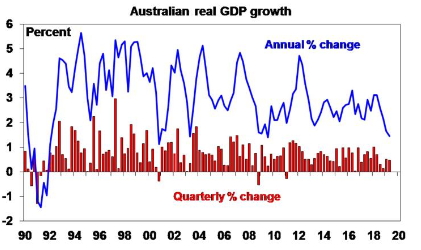
June quarter GDP growth was just 0.5%. And annual growth has fallen to 1.4% which is the slowest since the GFC and below population growth of 1.6%. Housing and business investment fell, and consumer spending remains very weak. Were it not for public spending and net exports the economy would have gone backwards in the June quarter. 


Source: ABS, AMP Capital

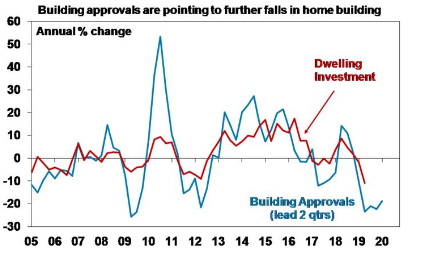
Going forward, the housing downturn has further to run with building approvals pointing to a further fall in home building.


Source: ABS, AMP Capital

This is likely to amount to a 0.5-0.6 percentage point pa direct detraction from growth. This along with low property turnover (less people moving) and lagged negative wealth effects from the earlier fall in house prices will all act as drags on consumer spending. In total the housing downturn is likely to detract around 1-1.2 percentage points from growth in the year ahead.

The drought will likely also act as an ongoing drag on growth with a “mild” El Nino hanging around although this may be modest at around a 0.2 percentage point growth detraction. The threats to global growth from trade wars also suggests downside risks to export growth.

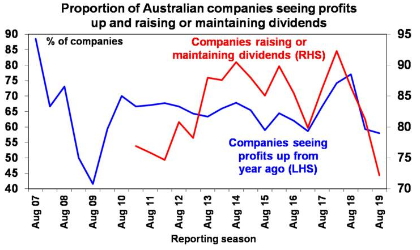
The weakness in relation to the economy is clearly evident in soft profit results in the recent June half year profit reporting season. The ratio of upside surprise to downside was the weakest since 2009, only 58% of companies saw profits rise from a year ago and the proportion of companies raising or maintaining their dividends fell to the lowest since 2011 suggesting a lack of confidence. Earnings growth slowed to 1.3% and excluding resources stocks was around -2.4%.


Source: AMP Capital

Slow growth but probably not recession

Since last year our view has been less upbeat on growth than the consensus and notably the RBA. This remains the case as the housing construction cycle turns down and weighs on consumer spending. As a result, it’s hard to see much progress in reducing high combined levels of unemployment and underemployment, and hence wages growth and inflation are likely to remain low. But there remains a bunch of positives that should help the economy avoid a recession even though growth will remain weak for a while yet. Here are nine.

  • Rate cuts and tax cuts should provide some growth boost – while July retail sales were disappointing, the experience from the GFC stimulus payments is that the tax cuts will provide some lift to growth in the months ahead and various retailers have expressed optimism about this recently.

  • The threat of crashing property prices looks to be receding – while it’s so far been on low volumes, buyer interest has returned to the Sydney and Melbourne markets and we never saw the much-feared surge in non-performing loans or forced selling. This has helped remove the threat of a debilitating negative wealth effect on consumer spending.

  • Infrastructure spending is booming – recent state budgets saw the projected peak in infrastructure spending pushed out yet another year to 2020. And it’s likely states will seek to take even greater advantage of ultra-low long-term borrowing costs to further push out the peak in infrastructure spending.

  • The low $A is helping to support the economy – the $A is down 39% from its 2011 high and is likely to fall further and this provides a boost to Australian businesses that compete internationally by making them more competitive.

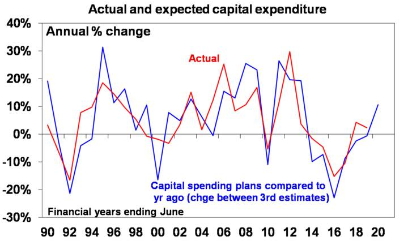
  • The business investment outlook is slowly improving – the big drag on growth as mining investment fell back to more normal levels as a share of GDP is over and mining investment plans are rising. This is driving some pick-up in the outlook for overall business investment.


Source: ABS, AMP Capital

  • Australia has a current account surplus – the June quarter saw the first current account surplus since 1975. The slide since then in iron ore and coal prices suggests it may not be sustained, but the reasons for the improvement are more than just commodity prices so the deficit is likely to be well below the norm of recent decades going forward. What’s more there has been a significant improvement in our foreign liabilities with a less short-term debt and a growing net equity position. This all means that our reliance on foreign capital inflow has declined. So much for the boiling frog!

  • There is scope for extra fiscal stimulus – the Federal budget is nearly back in surplus and while we have had a long run of deficits our public finances are in good shape compared to the US, Europe and Japan. As a result, there is scope to provide more fiscal stimulus and this is probably more important than a narrow focus on the surplus.

  • Population growth remains strong – Australia’s population growth at around 1.6% pa remains strong. Of course, strong population growth is not without issues and in terms of living standards it is economic growth per person (or per capita) that matters. But solid population growth also has significant benefits in terms of supporting demand growth, preventing lingering oversupply and keeping the economy dynamic. 

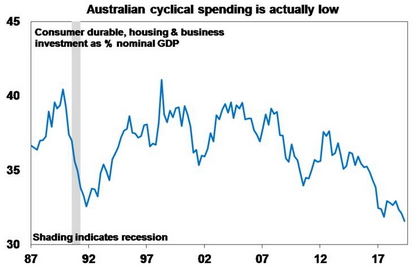
  • Finally, cyclical spending (consumer durables, housing and business investment) as a share of GDP remains low – suggesting that apart from bits of the housing market there’s not a lot of excess in the economy that needs to be unwound.


Source: Bloomberg, ABS, AMP Capital

Concluding comment

Our assessment remains that growth will remain soft and that the RBA will have to provide more stimulus – by taking the cash rate to around 0.5% and possibly consider unconventional monetary policy like quantitative easing. Ideally the latter should be combined with fiscal stimulus which would be fairer and more effective. While Australian growth is going through a rough patch with likely further to go, recession remains unlikely barring a significant global downturn.

If you would like to discuss any of the issues raised by Dr Oliver, please call on Phone: 07 5641 4134 or email martin@wtfp.com.au.


Source: AMP Capital 5 September 2019

Important notes: While every care has been taken in the preparation of this article, AMP Capital Investors Limited (ABN 59 001 777 591, AFSL 232497) and AMP Capital Funds Management Limited (ABN 15 159 557 721, AFSL 426455) (AMP Capital) makes no representations or warranties as to the accuracy or completeness of any statement in it including, without limitation, any forecasts. Past performance is not a reliable indicator of future performance. This article has been prepared for the purpose of providing general information, without taking account of any particular investor’s objectives, financial situation or needs. An investor should, before making any investment decisions, consider the appropriateness of the information in this article, and seek professional advice, having regard to the investor’s objectives, financial situation and needs. This article is solely for the use of the party to whom it is provided and must not be provided to any other person or entity without the express written consent of AMP Capital.

At its meeting today, the Board decided to leave the cash rate unchanged at 1.00 per cent.


The outlook for the global economy remains reasonable, although the risks are tilted to the downside. The trade and technology disputes are affecting international trade flows and investment as businesses scale back spending plans due to the increased uncertainty. At the same time, in most advanced economies, unemployment rates are low and wages growth has picked up, although inflation remains low. In China, the authorities have taken further steps to support the economy, while continuing to address risks in the financial system.

Global financial conditions remain accommodative. The persistent downside risks to the global economy combined with subdued inflation have led a number of central banks to reduce interest rates this year and further monetary easing is widely expected. Long-term government bond yields have declined and are at record lows in many countries, including Australia. Borrowing rates for both businesses and households are also at historically low levels. The Australian dollar is at its lowest level of recent times.

Economic growth in Australia over the first half of this year has been lower than earlier expected, with household consumption weighed down by a protracted period of low income growth and declining housing prices and turnover. Looking forward, growth in Australia is expected to strengthen gradually to be around trend over the next couple of years. The outlook is being supported by the low level of interest rates, recent tax cuts, ongoing spending on infrastructure, signs of stabilisation in some established housing markets and a brighter outlook for the resources sector. The main domestic uncertainty continues to be the outlook for consumption, although a pick-up in growth in household disposable income and a stabilisation of the housing market are expected to support spending.

Employment has grown strongly over recent years and labour force participation is at a record high. The unemployment rate has, however, remained steady at 5.2 per cent over recent months. Wages growth remains subdued and there is little upward pressure at present, with strong labour demand being met by more supply. Caps on wages growth are also affecting public-sector pay outcomes across the country. A further gradual lift in wages growth would be a welcome development. Taken together, recent labour market outcomes suggest that the Australian economy can sustain lower rates of unemployment and underemployment.

Inflation pressures remain subdued and this is likely to be the case for some time yet. In both headline and underlying terms, inflation is expected to be a little under 2 per cent over 2020 and a little above 2 per cent over 2021.

There are further signs of a turnaround in established housing markets, especially in Sydney and Melbourne. In contrast, new dwelling activity has weakened. Growth in housing credit remains low. Demand for credit by investors continues to be subdued and credit conditions, especially for small and medium-sized businesses, remain tight. Mortgage rates are at record lows and there is strong competition for borrowers of high credit quality.

It is reasonable to expect that an extended period of low interest rates will be required in Australia to make progress in reducing unemployment and achieve more assured progress towards the inflation target. The Board will continue to monitor developments, including in the labour market, and ease monetary policy further if needed to support sustainable growth in the economy and the achievement of the inflation target over time.


Source: Reserve Bank of Australia, September 3rd, 2019

Enquiries

Media and Communications
Secretary’s Department
Reserve Bank of Australia
SYDNEY

Phone: +61 2 9551 9720
Fax: +61 2 9551 8033

Email: rbainfo@rba.gov.au

Investors increasingly care about ESG. Traditionally we could rely on authorities to take our concerns into account and update the regulatory framework accordingly. But, with political polarisation increasing, this mechanism is coming undone. As a community of companies and investors, the onus is on us to step in and co-operate to develop an ESG structure that works for all of us.

Until recently, community expectations in Western democracies were translated into rules through a bipartisan legislative approach. That meant investors could reasonably expect environmental, social and governance (ESG) factors to be incorporated into investment guidelines over time. But that’s no longer the case.

Political polarisation is increasing, and community expectations are not being effectively synthesised through the political process. Of course, many issues are partisan, and political impasses around them can reflect genuine disagreements. However, some expectations are either broadly held across the community or rooted in rigorous science and analysis. It’s these consensus and evidence-based expectations which, if they do not flow through political channels, lead to regulatory stagnation.

The investment community is finding it increasingly difficult to have its preferences preserved in regulation, and is seeking alternative routes to achieve that outcome. One way is for large investors to use their clout to influence companies into more ESG-aware behaviours.

The theory of regulation

Economic theory frames regulation in terms of externalities. Companies already efficiently manage what is in their direct interests, but many of their activities create externalities where the benefits of their actions accrue to them, but the costs are paid by the environment and society.

Historically, regulation has been used to force companies to internalise their externalities. Under this framework, companies had to comply with the rules so they could claim they had met community expectations. Importantly, companies only have to meet a threshold to be in compliance; they do not need to go beyond the requirements. This means that the rules must be continually revised and updated to reflect the changing community expectations. When regulations fail to be adequately updated, they stop meeting the needs of the community.

A useful analogy is a ‘tragedy of the commons’ type scenario. Imagine a park where people enjoy having picnics. Once park-goers finish they have little incentive to collect their litter, which spoils the enjoyment of other visitors. The park ranger steps in and enforces a rule that everyone pick up their own litter, restoring the satisfaction people derive from the park. However, over time, the park pavilion suffers wear and tear and needs a new coat of paint, while the turf needs resurfacing. If the community cannot get the ranger to update the rules or charge an admissions fee to pay for the upkeep, the community’s expectations will be unfulfilled and everyone loses out.

In a similar way, what should companies do if regulations are not keeping up with what is in the interests of all stakeholders? They could follow the requirements and go no further in order to maximise profits, but that may prove perilously short-sighted. While companies used to compete with other companies on all fronts, there is now cause for industries to co-ordinate among themselves, if necessary, to achieve outcomes which are mutually beneficial. Competition will always drive some firms to free-ride on the efforts of others, but this does not negate the need to try. If governments are not providing the co-ordinating mechanisms, industry groups may need to fill in the gaps.

The role of investors

Some companies will be slow to adapt to the new reality, but they risk being increasingly shunned by consumers and investors, resulting in a higher cost of capital. Management teams and boards should engage with asset-owners and investment managers to understand what their interpretations of the requirements are.

Investment analysts should cultivate a deep and long-term understanding of the fundamental characteristics of the companies under their coverage, and not exclusively rely on formulaic applications of principles or a narrow perspective from merely speaking with the company.

These two competencies of companies and investors engaging and intimate familiarity with corporate fundamentals, should complement each other and form the basis of an active ESG approach. The worthwhile prize is that ESG outcomes are achieved for each company, at each point in time. And that’s in all of our interests.

By Kate Howitt

Portfolio Manager Fidelity Australian Opportunities Fund

Source : Fidelity July 2019 

Reproduced with permission of Fidelity Australia. This article was originally published at https://www.fidelity.com.au/insights/investment-articles/why-esg-has-moved-from-nice-to-do-to-must-do/

This document has been prepared without taking into account your objectives, financial situation or needs. You should consider these matters before acting on the information. You should also consider the relevant Product Disclosure Statements (“PDS”) for any Fidelity Australia product mentioned in this document before making any decision about whether to acquire the product. The PDS can be obtained by contacting Fidelity Australia on 1800 119 270 or by downloading it from our website at www.fidelity.com.au. This document may include general commentary on market activity, sector trends or other broad-based economic or political conditions that should not be taken as investment advice. Information stated herein about specific securities is subject to change. Any reference to specific securities should not be taken as a recommendation to buy, sell or hold these securities. While the information contained in this document has been prepared with reasonable care, no responsibility or liability is accepted for any errors or omissions or misstatements however caused. This document is intended as general information only. The document may not be reproduced or transmitted without prior written permission of Fidelity Australia. The issuer of Fidelity Australia’s managed investment schemes is FIL Responsible Entity (Australia) Limited ABN 33 148 059 009. Reference to ($) are in Australian dollars unless stated otherwise.
© 2019. FIL Responsible Entity (Australia) Limited.

Important:
This provides general information and hasn’t taken your circumstances into account. It’s important to consider your particular circumstances before deciding what’s right for you. Any information provided by the author detailed above is separate and external to our business and our Licensee. Neither our business nor our Licensee takes any responsibility for any action or any service provided by the author.

Any links have been provided with permission for information purposes only and will take you to external websites, which are not connected to our company in any way. Note: Our company does not endorse and is not responsible for the accuracy of the contents/information contained within the linked site(s) accessible from this page.

When’s the last time you used cash? New technologies are changing the way we transact

Two sheep for an axe? A pigskin coat for a sack of grain? Three bushels of wheat for a goat?

We’ve come a long way as a species. Back in the day, bartering was the only way to conduct transactions. It was time consuming, unsophisticated and inefficient—every transaction had to be conducted afresh.

Ever since King Alyattes of Lydia minted the first coin in 600BC, humanity’s relationship with money has been constantly evolving.

Coins actually go further back, with the Chinese pioneering the use of small bronze replicas for transactions as far back as 1100BC and paper money a few centuries later. Europeans finally caught on to paper notes in the 17th century and it was a few hundred years more before the first electronic funds transfer (via telegram) in 1860. The first credit card followed just after the Second World War in 1946.

Fast forward to more recent developments and mobile banking was offered to European consumers as early as 1999, with contactless payment cards appearing in the UK in 2008.

When it comes to money, fashions come and go. But perhaps the best illustration of the changing trends is the lifecycle of the humble cheque.

Cheques—the decline and fall

At one time, the ability to pay for goods and services by signing an authorised slip of paper from your banking institution was cutting edge technology.

Picture the scene. It’s the middle of the 18th century in Britain. You’re a merchant looking to settle an account with a business partner. They present you with a signed note from their bank essentially promising to transfer the payment to your bank.

The idea isn’t completely new…but this is the first time anyone’s thought to print cheques with serial numbers so that customers could pay for goods and services against their bank account.

These signed pieces of paper took days to process, the signatures were easy to forge and settling the transaction involved a complex network of clearinghouses. But at the time they would have seemed the height of sophistication and ease. The concept caught on quickly and so the humble cheque was born.

A couple of hundred years later it’s the early 21st century and cheques have had their day. By January 2012 the number of cheques processed in Australia had declined to 45,900. And by October 2017 there were just 6,5491.

Until quite recently it would have seemed unthinkable that you couldn’t use a cheque. But many Australians under the age of 40 have never even seen a cheque book, let alone used one.

The cheque is predicted to die out completely by the end of 20192.

Back to the future

The moral of the story is, things change. Technology finds a way to facilitate quicker, easier payments. One day it was notes and coins replacing barter payments…the next day signed cheques and telegrams…the next it’s tap-and-go contactless cards.

As for the next big thing, who knows? Virtual cryptocurrencies like Bitcoin, wearable contactless wristbands from Barclaycard or perhaps even back to the future with Bartercard, an online bartering system that would have resonated with our distant ancestors.

In the space of a few thousand years, we’ve gone from resource exchanges based on the need for survival to quick, instant and virtual money exchanges, driving mass consumption and instant gratification.

And the pace of change is increasing. It took hundreds of years for paper currency to spread from China to Europe. These days, innovations like contactless payments can spread around the world within a decade. And virtual currencies can catch on instantaneously thanks to the world wide web.

Cash is no longer king

So is cash on the way out? It would seem so if we look at overseas trends. Over in Europe, Sweden is moving to a completely cashless society, with cash payments due to be phased out by 20233. It’s not only about convenience. Among the mooted benefits of a cash-free society are reducing crime, fighting tax avoidance and helping businesses feel more secure.

And it’s not just small Nordic economies going electronic. The world’s most populous country is also moving away from cash. Chinese consumers have embraced mobile payments via QR codes, and spend 90 times more using their smartphones than their American counterparts4.

Back here in Australia cards have overtaken cash as the most frequently used payment method, according to the Reserve Bank’s Consumer Payments Survey. Electronic transactions more than doubled to around 480 per person in the 10 years to 2018. And paper-based payment methods such as cash and cheques declined from 320 per person in 2007 to 210 in 20165.

What the future holds for cash

So if we look forward 20 or 30 years into the future—assuming current trends continue—it’s possible that the only place our children will see notes and coins is in the museum.

The implications are profound:

  • What does a cashless society mean for people on the margins who don’t have access to credit and rely on physical money to survive?

  • What does a cashless society mean for our spending and saving habits?

  • What does a cashless society mean for privacy when every transaction we make is logged, tracked and analysed?

Whatever the future holds, we’re living through interesting times as our relationship with money evolves at a pace unmatched in human history.


1 Finder.com.au, The humble cheque to be extinct by 2019, 1 February 2018.

2 Finder.com.au, The humble cheque to be extinct by 2019, 1 February 2018.

https://interestingengineering.com/sweden-how-to-live-in-the-worlds-first-cashless-society

https://www.smartpay.com.au/alipay-wechat/why-accept-alipay-and-wechat-pay/

Source: RBA Payments System Board 2018 Annual Report: Trends in Payments, Clearing and Settlement Systems

Important:
This information is provided by AMP Life Limited. It is general information only and hasn’t taken your circumstances into account. It’s important to consider your particular circumstances and the relevant Product Disclosure Statement or Terms and Conditions, available by calling Phone: 07 5641 4134, before deciding what’s right for you.

All information in this article is subject to change without notice. Although the information is from sources considered reliable, AMP and our company do not guarantee that it is accurate or complete. You should not rely upon it and should seek professional advice before making any financial decision. Except where liability under any statute cannot be excluded, AMP and our company do not accept any liability for any resulting loss or damage of the reader or any other person.

By Emily Connell Nutritional Medicine

Self-care – it’s a bit of a ‘buzz’ word. Everyone is telling us we need more of it – can’t pour from an empty cup and all that. But it’s harder than it sounds! It’s so much more than pedicures and massages (don’t get me wrong – these are great!), but it’s actually about scheduling in regular time for YOU.

As a mum, dad, daughter, son, business owner, partner, colleague, volunteer, retiree…whatever combination it may be for you, there are some common conversations we have with ourselves when it comes to self-care:

#1 “I don’t have time for this self-care business” and
#2 “How can I even justify putting me first when so many others need my help?”

Newsflash! It is exactly these thought patterns and belief systems that get us into trouble in the first place, leading to burnout and fatigue, that ironically means we can’t help anyone, despite the best of our intentions.

We can’t truly understand self-care without first providing context and explaining this concept of ‘burnout’. Burnout, another popular saying, especially in the corporate sector, can be a term thrown around the office or home flippantly – but it is a real thing.

It is now recognised officially by the World Health Organisation, so it is about time we took it seriously! Here are some burnout signs:

  • Feeling tired all the time?

  • Lacking motivation where you were once so driven?

  • Struggling to find joy in the everyday?

  • Not sleeping and mind racing?

  • Gaining weight, health niggles starting to surface mixed with a good splash of coffee and sugar cravings?

  • Moods that mean you answer every question with your middle finger?

  • You just know that you are not feeling like your best self.

Welcome to the world of burnout!

But how did we even get here? We have relentless schedules and can’t say no. Or we dread the thought that we might have a spare 5 minutes of unscheduled time in a day where we can allow ourselves to sit down and have a cup of tea. God forbid – we might fall asleep in the chair, or even worse, breathe! Guilt and ‘shoulds’ (“I should be more”, “I should do more”, “I should do better” – I know you hear me) are our closest friends. But let’s face it, it’s really nice to have some friends because our relentless schedule doesn’t allow for any real-life catch-ups. Most of all, we are reluctant to admit we’re struggling – because vulnerability is the enemy! But the reality is, as humans, we are not made for this, and burnout is the inevitable consequence.

Self-care is not a luxury – scrap that! It’s an essential practice, critical in being able to serve those we love and care for in the best way we can. It’s about taking a pause, making an appointment with yourself, and discovering the little acts of self-care that work for you in each day, in each moment. It is these daily intentional acts that have such a profound impact on our health and wellness – mentally, physically, spiritually and emotionally.

Ultimately, it’s about knowing what works for you, scheduling it in, and then making a commitment to making it happen. I’ll repeat – MAKING A COMMITMENT to yourself! Is it about going to bed a bit earlier because those hours before midnight are the most restorative? Is it about moving your body each day? Is it about having an extra glass of water? Is it about eating less out of a packet and enjoying some ‘real’ food? Is it about challenging those negative thoughts and perfectionist tendencies that keep us on the hamster wheel of burnout? Is it about breaking up with the ‘guilt’ of ‘I should be everything to everyone’ and stopping to connect with a friend in real life? Is it actually about accepting the care of others – because we need to receive support to give support?

Your self-care challenge right now – write down a list of what brings you joy and schedule one thing in. We all know, if it’s not in the diary, it doesn’t happen so get out your calendars! Be kind to yourself so you can be well enough to be kind to the world. Live your best life.


Source: Emily Connell Nutritional Medicine

Emily is a Nutritional Medicine practitioner, writer, speaker, facilitator & trainer. Emily combines her skills in Nutritional Medicine with her background in Occupational Therapy, mental health & management to support people to achieve health, inspire wellness and banish burnout. Emily facilitates wellness workshops and is available for online clinical consultations and corporate speaking events.


Important:
This provides general information and hasn’t taken your circumstances into account. It’s important to consider your particular circumstances before deciding what’s right for you. Any information provided by the author detailed above is separate and external to our business and our Licensee. Neither our business nor our Licensee takes any responsibility for any action or any service provided by the author.

Any links have been provided with permission for information purposes only and will take you to external websites, which are not connected to our company in any way. Note: Our company does not endorse and is not responsible for the accuracy of the contents/information contained within the linked site(s) accessible from this page.

Introduction

Since the RBA started cutting interest rates again back in June and in the process taking them closer to zero there has been increasing debate that it will deploy so-called “unconventional monetary policy measures” such as negative interest rates and quantitative easing. This debate has hotted up in recent weeks after the escalation in the US-China trade war posing a rising threat to global growth, numerous central banks cutting interest rates this month in a so-called “race to zero”, the Governor of Reserve Bank of New Zealand saying that negative rates are possible and RBA Governor Lowe saying that its “prepared to do unconventional things if the circumstances warranted it” even though he also said that QE was “unlikely”. News of a Danish lender offering negative mortgage rates has only added interest to the issue. But what exactly are these unconventional monetary policy measures? Do they work? Would they work in Australia? Are there better options? Will they be deployed and when? What will it all mean for investors?


What’s behind talk of unconventional monetary policy

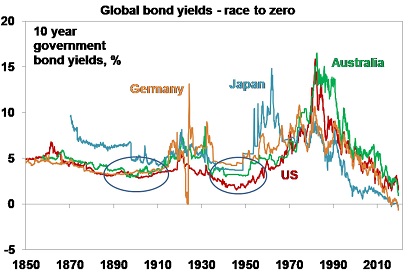
Put simply Australian economic growth has slowed sharply below its long-term potential reflecting the housing downturn and weak consumer spending. While house prices may be bouncing back in Sydney and Melbourne and there are anecdotes that the tax cuts are helping retailers, the downturn in housing construction has further to go and other factors from drought to the threat from the US trade wars cloud the outlook with increasing talk of recession globally. Slower growth has seen the outlook for unemployment deteriorate – at a time when there is still a high level of unemployed and underemployed (at 13.6% of the workforce). Which in turn threatens to keep wages growth and inflation lower for longer. So, with the cash rate approaching zero the question naturally arises of what to do next? Of course, Australia is not alone – with talk of recession globally, other central banks ramping up or considering the use of unconventional monetary policies and all of this being reflected in record low bond yields. Basically, there is an excess of global savings and this is driving ultra-low interest rates.

View larger image

Source: Global Financial Data, AMP Capital

What are unconventional monetary policy measures>

They refer to a bunch of policies which have been deployed by major central banks in the aftermath of the GFC. They are:

  • explicit forward guidance – where the central bank indicates the cash rate is not expected to rise for some time period;

  • very low and negative policy interest rates;

  • quantitative easing (QE) – which has involved using printed money to purchase public and private securities;

  • providing cheap funding to banks to support lending; and

  • intervening to push the Australian dollar lower.

But do they work?

A common comment is that “QE etc hasn’t worked in the major economies so why should it work here?”. In reality such policies do appear to have helped notably in the US and Europe where they were progressively deployed from the time of the GFC once interest rates hit zero and then became the lone stimulus measures as fiscal austerity took hold. Since its high in 2013 unemployment in the Eurozone has fallen from 12% to 7.5% and in the US it fell from 9% in 2011 to 4% in 2017 enabling the Fed to start unwinding unconventional monetary policy. Inflation has not been returned to 2% targets, but wages growth has lifted and at the start of last year it looked like the global economy was getting back to normal. So unconventional measures have helped. Of course, Trump’s trade wars have provided a big threat since then.

The main lessons look to have been that different measures are appropriate depending on the issues facing a country, that a range of measures are preferable to just one and that central banks need to go early unlike Japan which left it too late.

Will it work in Australia?

Our assessment is that unconventional monetary policy measures may help in Australia, but it will depend on the measure deployed and their impact will be limited particularly compared to overseas. We now look at the issues around each.

Explicit forward guidance – the RBA has already started this with its comment this month that “it is reasonable to expect that an extended period of low interest rates will be required”. If the US and ECB are any guide this is likely to morph into a specific time period through which rates will remain low. This can help keep bond yields low, but the low yields in other countries dragging our yields down will arguably do this anyway.

Zero or negative interest rates – while the Fed stopped cutting rates in the GFC and its aftermath at 0-0.25% and the Bank of England stopped at 0.25%, the Bank of Japan and several European banks led by the ECB have taken rates negative. This negative rate applied to the deposit rate banks get for leaving deposits at the central bank and was motivated to encourage them to lend out cash which was building up as reserves due to quantitative easing. There is some evidence that negative rates in Europe have boosted bank lending but cut into bank profits because banks are reluctant to take interest rates on bank deposits (which are used to fund lending) below zero and so further falls in lending rates lead to reduced profit margins which may crimp lending. The thought of negative rates may also scare people. Sure a 10% bank deposit rate and 12% inflation is really no different to a -1% deposit rate and 1% inflation – but the former would feel a lot better!

For these reasons it would make sense for the RBA to call a halt to cash rate cuts around 0.5% (which we expect to see by year end) or maybe 0.25%. There would be little point in going to zero or negative as the banks will be unlikely to pass it on in lower mortgage rates as they won’t want to take deposit rates negative. So negative interest rates will hopefully be avoided.

Asset purchases under quantitative easing – QE in the US, Europe and Japan involved pumping printed money into the economy by central banks buying government bonds, high-rated private debt and, in Japan’s case, some shares. This was aimed at pushing long-term bond yields and hence borrowing costs even lower, boosting narrow money in the economy with the hope that it will be lent out, pushing investors into more risky assets to make more capital available for investing and (although they don’t admit it) pushing their currencies down. It tends to be what you do once interest rates have hit zero.

In Australia, QE may provide less help because there are less Government bonds for the RBA to buy given relatively low public debt in Australia, bond yields are already low anyway and in any case 85% of mortgage borrowing is linked to short-term interest rates and so there would be little benefit to the household sector from lower long-term bond yields.

What’s more it’s not clear that QE as practiced in other countries is the most efficient or fairest way to boost growth. There is no guarantee that the cash pumped into the economy is lent out and spent and a lot of it has just helped share markets (which is good for the better off) at a time when interest rates are low (which is not so good for lower income earners who rely more on bank deposits). More on this later.

Cheap funding for banks – the RBA did this around the time of the GFC and the ECB and the Bank of England have provided cheap financing to banks tied to them boosting lending. It’s not really an issue at present in Australia as banks are not facing difficulties in terms of funding and the recent slowdown in credit growth in Australia owes more to tighter regulatory oversight around “responsible lending”. However, following the UK experience the provision of cheap funding to banks may be a way for the RBA to ensure that cash rate cuts are continued to be passed on to lower mortgage rates and that lending holds up as the cash rate gets closer to zero.

FX intervention – this is a return to old fashioned RBA intervention in the foreign exchange market to push the $A down by selling Australian dollars and adding to its foreign exchange reserves with the aim of helping growth. It seems unlikely though as it would be criticised by other countries as competitive devaluation and the $A is already low anyway.

A better option – helicopter money?

Given the issues with some of the unconventional monetary policy measures – notably negative interest rates and quantitative easing – there may be a better way. This would be for the RBA to work with the Federal Government to use printed money to provide direct financing of government spending or “cheques in the mail” to households with use by dates. While some might say this is just “Modern Monetary Theory” in reality there is nothing “modern” about it at all (although support for MMT may help clear a path toward it). Such an approach was referred to decades ago as a “helicopter drop” by Milton Friedman. I was taught at university that government spending can be financed by tax, issuing bonds or printing money. So it’s nothing new. It’s been eschewed because of the worry that politicians will misuse it and cause hyper-inflation. But a lack of inflation is the issue now. Such an approach would be guaranteed to boost demand and eventually inflation and the spending could be targeted in a way that is seen as fair. To provide a lasting boost to inflation without running out of control it could be set up to continue until certain objectives are met then gradually phased down. Hopefully, it won’t come that, but it’s a preferable option to the hit and miss of just relying on alternative monetary policy measures. In the meantime, more fiscal stimulus could take some pressure off the RBA.

Will the RBA deploy unconventional policies?

The RBA is likely to exhaust conventional easing by cutting the cash rate to 0.25-0.5% before doing unconventional measures beyond forward guidance. The probability of other measures next year is rising. Negative interest rates are unlikely but quantitative easing would likely be included. Ideally this would involve working with the Government to provide a fiscal boost.

Implications for investors?

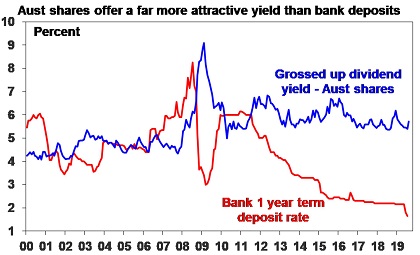
There are a number of implications for investors. First, bank deposit rates are likely to fall even further and remain unattractive for a lengthy period yet. Second, the low interest rate environment means the chase for yield is likely to continue supporting commercial property, infrastructure and shares offering sustainable high dividends. The grossed-up yield on shares remains far superior to the yield on bank deposits. Investors need to consider what is most important – getting a decent income flow from their investment or absolute stability in the capital value of that investment.

View larger image

Source: RBA, Bloomberg, AMP Capital

Third, the continuing low interest rate environment will support Australian residential property prices, but still high debt levels, tight lending conditions and rising unemployment mean that it’s unlikely to set off another full-blown property boom.

Finally, easy monetary policy in Australia will likely help keep the $A lower than it otherwise would be.

If you would like to discuss any of the issues raised by Dr Oliver, please call on Phone: 07 5641 4134 or email martin@wtfp.com.au


Author: Dr Shane Oliver, Head of Investment Strategy and Chief Economist

Source: AMP Capital 28th August 2019

Important notes: While every care has been taken in the preparation of this article, AMP Capital Investors Limited (ABN 59 001 777 591, AFSL 232497) and AMP Capital Funds Management Limited (ABN 15 159 557 721, AFSL 426455)  (AMP Capital) makes no representations or warranties as to the accuracy or completeness of any statement in it including, without limitation, any forecasts. Past performance is not a reliable indicator of future performance. This article has been prepared for the purpose of providing general information, without taking account of any particular investor’s objectives, financial situation or needs. An investor should, before making any investment decisions, consider the appropriateness of the information in this article, and seek professional advice, having regard to the investor’s objectives, financial situation and needs. This article is solely for the use of the party to whom it is provided and must not be provided to any other person or entity without the express written consent of AMP Capital.

By Flying Solo contributor Cath Connell

We live in exciting times! New technologies have made it so easy to grow your dream business by providing low-cost and potentially powerful ways to connect with your audience – often without having to leave the comfort of your office (or dining table)! No longer do we have to rely on expensive, broadcast advertising, nor make those dreaded cold calls.

But the rise of social media as a marketing solution can also lure the unwary business owner into a bit of trap… relying solely on these platforms to create the vital connections that will help them build a healthy business.

Offering a low cost, highly-targeted marketing solution, social media has become a key focus in the majority of today’s business marketing plans. But it comes with its risks. Not only is the potential effect on your productivity (who hasn’t fallen into a social media time-sucking vortex every so often?), most platforms have sophisticated algorithms designed to maximise their profits and keep you coming back – which leaves you very much in the hands of their ever-evolving whims. Analysing your data to optimise your reach, navigating the latest changes to their ad platform, and creating a gazzilion different forms of content to keep up with new algorithm preferences, is a full-time job in itself. And if they suddenly shut up shop, what do you do then? (Anyone remember MySpace??) 

So what should you do instead?

Here are few marketing basics that will ensure your business has a strong foundation for growth, no matter what our beloved social media platforms throw at us!

Love your referral network

Word-of-mouth marketing is still the most effective form of marketing there is. In fact, I know plenty of businesses who survive almost solely on it – no live videos, no pretty Instagram feeds, often no website! A successful “tradie” friend of mine doesn’t even have a business card! As a marketing specialist, I don’t particularly recommend this approach, but it’s worth remembering that it IS possible to run a successful business without being across every new marketing trend.

Tell EVERYONE you know what you do, even if it’s just a basic outline. Some of my best referrals have come from personal friends, not just my business network. 

Network strategically. Going to a big networking event might give you the opportunity to meet new people and exchange a lot of business cards, but good referrals tend to come from closer relationships. Personally I prefer smaller community-type networking groups where we move regularly between in-person and online interactions. Give your time and expertise freely with your chosen community and be absolutely genuine in your referrals of others – not just because there is an expectation for cross-referrals. 

Take the time to build a few key connections and regularly touch base with them, so you have a good understanding of how you can help build each others’ businesses. You’ll probably develop some close friendships in the process! 

ALWAYS look after your existing customers. Follow up their enquiries promptly and be kind and courteous when dealing with any problems or challenges that arise. If appropriate, include them in your process of developing new products or services. Let them know if you can help them with other products or solutions that they are not currently buying from you, and remember to ask them for referrals too. If you would like them to write a testimonial, give them a helping hand by letting them know what areas you would like them to highlight. In short, love them to bits… after all, it’s much easier to keep an existing customer than find a new one.

Make sure you thank your referral partners when you secure new business. You could consider set up a formal arrangement where you take a finder’s fee or affiliate payment. Personally I prefer to send (and receive) a phone call, card or small gift. It feels more warm and personal and helps build our long-term relationship, rather than being just a business transaction.  

Create great content and use it to drive traffic to your website

As we well know, people buy from brands they know, like and trust. A great way to cover all these bases is to provide your community with useful and relevant content – an answer to their most basic problems, a new way to experience your product, or something that brightens their day. If you’re active on social media, you are probably already doing this.

However, it’s very easy for people to scroll through Instagram liking the pretty pictures, watch a video or live post, or throw in a few comments on Facebook, but it’s fairly low involvement. If you’re spending all this time and energy creating quality content, you want to get a return on your investment.

If you’re not linking your content back to your website, you are missing out on giving people the opportunity to get to know you better, find out what you do, and more importantly, buy from you! So whenever possible include a call to action on your posts – whether that be a “read more” link to a blog post on the subject, a button at the end of your video, an invitation to find out more about your product or service, or a promotion for your opt-in offer. You won’t always get a response, but it will be far more likely if you ASK.

Own your list

Building your social media following and communicating with them in a closed group is a perfect way to build a strong connection with your audience, but this data doesn’t belong to you – the platform has all the control and YOU are their product. 

So it’s important to make sure that you regularly invite your followers to join your mailing list, perhaps enticing them with a suitable opt-in freebie, competition or an exclusive offer with a traceable discount code. 

Ensure you keep good records of your existing and potential customers, so that you can contact them on YOUR terms. You don’t have to set up a complex Customer Relationship Management (CRM) tool, at least not to start with. Often a simple spreadsheet will do, so long as you have the information you need stored where it is easily accessible.

When you meet new people at networking events, ask them if they’d like to keep in touch with you through your e-newsletter, in addition to following you on social media. If an event attendee list is provided, NEVER bulk-add them to your list – this is not only spammy – it’s illegal! 

Also remember that even if someone agrees to be added to your list, this is not permission to constantly blast them with promotional messages. Email marketing is a great way to build TRUST, so it needs to be relevant, helpful and considerate of your audience’s time. Being invited into a person’s Inbox is a special privilege, and while most people will tolerate a little bit of promotion, they will quickly lose trust in you if you’re constantly in their faces. And once someone unsubscribes, they’re gone!

We are fortunate today that there are many ways to connect with our audiences. In fact there so many options, they can feel overwhelming. This is often the reason why small business owners spend all their marketing energy using only one or two options. 

The most important thing to keep in mind is that somewhere out there, there are people who are DESPERATE to know that you can solve their problem, but don’t yet know you exist… you don’t want to let them down, do you?

Source : Flying Solo July 2019 

This article by Cath Connell is reproduced with the permission of Flying Solo – Australia’s micro business community. Find out more and join over 100K others.


Important:
This provides general information and hasn’t taken your circumstances into account. It’s important to consider your particular circumstances before deciding what’s right for you. Any information provided by the author detailed above is separate and external to our business and our Licensee. Any information provided by the author detailed above is separate and external to our business and our Licensee. Neither our business, nor our Licensee take any responsibility for any action or any service provided by the author.

Any links have been provided with permission for information purposes only and will take you to external websites, which are not connected to our company in any way. Note: Our company does not endorse and is not responsible for the accuracy of the contents/information contained within the linked site(s) accessible from this page.