Having studied my own habits – in between randomly browsing infographics, social media and videos of classic newsreader bloopers – I’ve compiled a set of sure-fire principles on how to get less done in more time.

1. Hit the inbox first thing every morning, definitely

Unquestionably, an hour attending to random promotions, LinkedIn requests and Facebook photo alerts will be more important than anything else on your to-do list. Treat your inbox like your boss – it knows exactly what’s important for you to do all day and every day.

2. Answer the phone, always

It doesn’t matter who you are with or what you are doing, never forget that the sound of your ring tone supersedes ALL else in terms of priority – treat it like a fire alarm.

3. Relax, you’ll have a clear day tomorrow

Despite the fact that this has never ever happened before, you can rest easy knowing that you’ll definitely have an empty mind and clear schedule tomorrow, so you can put off tackling that important proposal until then.

“Treat your inbox like your boss – it knows exactly what’s important for you to do all day and every day.”

4. Respond to everything immediately

Make sure that other people’s priorities become your own. Constantly reacting to ‘urgent’ yet ‘unimportant’ tasks is how visionary people achieve great things. Pretty sure it’s how the Pyramids were built for example.

5. It’s got to be 100% perfect

Firstly, don’t start anything until you have absolutely everything you need. Secondly, understand that you can never do too much tinkering around the edges. It’s not done unless it’s a masterpiece.

6. Never miss a news story

It is proven by business owners globally that it is crucial to read all breaking news, viral stories, industry insider blogs and photo galleries with titillating headlines. That old 2009 political gossip will come in handy one day. Tip: set your local news site as your browser home page.

7. If in doubt, set up a meeting or conference call

8. Final checklist of things to do before starting any project:

  • Make a fresh cup of tea

  • Check the inbox

  • Get the clothes off the line

  • Clear the desk of clutter

  • Get the mince out of the freezer

  • Check the phone for texts

  • Get the bins out

  • Quickly see if there’s any action on Facebook

  • Did you check your email?

9. Multitask

Now you’re ready to start. All that’s left to do is write 15 things on today’s list and get cracking on all of them at the same time. Write a blog while returning a call, research a new supplier while doing the books – don’t forget the inbox.

Damn! Time for school pick up – gotta run! Let’s tee up a call or coffee in a week or so.

Source : Flying Solo

This article by Peter Crocker is reproduced with the permission of Flying Solo – Australia’s micro business community. Find out more and join over 100K others.


Important:
This provides general information and hasn’t taken your circumstances into account. It’s important to consider your particular circumstances before deciding what’s right for you. Any information provided by the author detailed above is separate and external to our business and our Licensee. Any information provided by the author detailed above is separate and external to our business and our Licensee. Neither our business, nor our Licensee take any responsibility for any action or any service provided by the author.

Any links have been provided with permission for information purposes only and will take you to external websites, which are not connected to our company in any way. Note: Our company does not endorse and is not responsible for the accuracy of the contents/information contained within the linked site(s) accessible from this page.


When you look back at a big stock-market downturn, it can be hard to remember why everyone was convinced that the end had finally come. With the benefit of hindsight, it becomes clear that what appeared to be catastrophe was simply a large dip in a long-term upward path.

In the moment, the fear that the market will never recover holds such a strong grip that it can cause you to overreact and damage your long-term returns. The share market has been bouncing around a bit lately, so this may be a smart time to prepare yourself with a few ideas on how to stay the course through the next share slide, no matter when it comes.

The first and most important step, as always, is to design a diversified, low-cost portfolio that aligns with your goals, timeframe and risk tolerance. Then, sticking with your plan regardless of financial-market weather gives you the best chance for investment success.

Here are three ideas that may strengthen your resolve the next time share markets grow stormy:

Ignore the daily ups and downs

No one likes to see the value of their super or other investment fall. For that reason, some experts advise that you avoid checking your portfolio’s value frequently because day-to-day changes are meaningless, whether they are up or down.

If you do check, remember that those losses are only on paper. They become real only if you overreact and sell shares when prices are low. But that’s behaving like a driver who swerves to avoid hitting a piece of rubbish only to plow into a tree. It’s an overcorrection.

Over the long run, staying the course leads to significant gains. Vanguard research shows that over the last 30 years ending 30 June 2019, $10,000 would have grown to $146,337, $105,787 and $80,382 if invested in Australian Shares, Australian Bonds and International Shares respectively.

Consider saving more

At Vanguard, we believe investors should control what they can. You can’t control financial markets, but you can control costs and how much you invest. If you’re worried about predictions that financial-market returns will be below average in the next several years, you may want to set aside more. You may want to start by analysing whether you should salary sacrifice additional funds into your super. The more you save, the bigger your cushion against a fall.

Think about hiring an adviser

If you’ve ever hired a tradie to complete a home repair, or a coach to get you across the line in a marathon, you understand the value of professional help. A financial adviser can help you identify goals, create a plan to achieve them and be available to keep you on track when markets go haywire.

Please contact us in Phone: 07 5641 4134 if you seek assistance on this topic.

Source : Vanguard September 2019

Written by Robin Bowerman, Head of Corporate Affairs at Vanguard.

Reproduced with permission of Vanguard Investments Australia Ltd

Vanguard Investments Australia Ltd (ABN 72 072 881 086 / AFS Licence 227263) is the product issuer. We have not taken yours and your clients’ circumstances into account when preparing this material so it may not be applicable to the particular situation you are considering. You should consider your circumstances and our Product Disclosure Statement (PDS) or Prospectus before making any investment decision. You can access our PDS or Prospectus online or by calling us. This material was prepared in good faith and we accept no liability for any errors or omissions. Past performance is not an indication of future performance.

© 2019 Vanguard Investments Australia Ltd. All rights reserved.

Important:
Any information provided by the author detailed above is separate and external to our business and our Licensee. Neither our business nor our Licensee takes any responsibility for any action or any service provided by the author.

Any links have been provided with permission for information purposes only and will take you to external websites, which are not connected to our company in any way. Note: Our company does not endorse and is not responsible for the accuracy of the contents/information contained within the linked site(s) accessible from this page.


Time flies when you’re running your own business. Days can quickly turn into weeks as you focus on the day-to-day work. And sometimes you can work so hard it’s easy to lose sight of the big picture. Our monthly checklist will ensure you keep your business on track.

This monthly checklist will help you assess the health of your business and stay in control.

1. Step back and do a financial overview

Your business won’t survive unless you have a tight grip on your finances. Make sure you carefully manage:

  • expenses and bills – pay quickly to ensure goodwill

  • invoices – chase all late payers

  • payroll – ensure all staff records are up to date

  • taxes – file your returns and pay on time, every time.

2. Review account statements from suppliers

Are your suppliers charging a price that’s fair? Are you still getting good value for money? If not, it might be time to look for new suppliers.

3. Review annual sales

Look at your year-on-year sales. Are you doing better than the same time last year? Are costs and profit levels where they should be? Refer to your business plan and make changes if necessary.

4. Keep a close eye on stock

If you’re running a retail or manufacturing business then stock is your lifeblood. You should:

  • carefully match stock levels to sales forecasts

  • make special provision for perishable goods

  • ensure storage is safe and secure

  • work with your accountant or bookkeeper to find the optimum stock levels.

5. Make sure your customers remember you

In a crowded marketplace, customers are likely to forget your service or product, so help them remember:

  • Use a CRM (Customer Relationship Management) or MAS (Marketing Automation System) tool. This will help keep your customers and partners up to date with news about your business.

  • Use all available communication methods. For example, email newsletters are a highly effective way of keeping in touch with customers – as long as they’re well written.

6. Spread the word about your business on social media

Social media can be a very effective marketing channel if you use it regularly. Make sure your blog always has fresh content, send new tweets and post on Facebook and LinkedIn.

7. Review your website traffic

Google Analytics is a tool that makes it easier to understand your website traffic. It will identify pages that are performing poorly and pages that are doing well. Ask a web developer to help you if necessary.

8. Keep on top of industry news

Set aside two hours a month to review industry news. Sign up for Google Alerts and set an alert so that the news comes to your inbox. If you are a consultant in the medical industry, you could set one up for ‘medical trends’ or ‘new technologies in medicine’.

9. Keep your data safe

Use cloud-based applications to store data and ensure your information is always available and automatically backed up. Relying on your hard drive leaves you vulnerable in the face of burglary, fire or natural disasters. If you use your hard drive to store data, make sure you do at least one monthly backup online or to an external device.

10. Talk to your advisors

Arrange meetings with your accountant or bookkeeper, board of directors and investors. Meet them at the office or a cafe for a half-hour chat over coffee. Review business performance for the last 30 days and last quarter to check you’re on track.

Please contact us on Phone: 07 5641 4134 if you seek further assistance on this topic.

Successful business owners have great habits

Set yourself up for success and get into the habit of setting aside time for monthly tasks. Business can move at a rapid pace, especially in the first year. So make this checklist a priority to ensure your business is going in the right direction. This will keep things on track and in control – which can make all the difference.

Source: Xero

Reproduced with the permission of Xero.

Xero is software designed to make life better for small businesses and their advisors. Its online accounting platform provides the foundation on which businesses can build a complete business solution. It connects businesses with their bank, accounting tools, their accountant, payment services and third-party apps, so everything is securely available at any time, on any device.

Important:
This provides general information and hasn’t taken your circumstances into account.  It’s important to consider your particular circumstances before deciding what’s right for you. Any information provided by the author detailed above is separate and external to our business and our Licensee. Neither our business nor our Licensee takes any responsibility for any action or any service provided by the author.

Any links have been provided with permission for information purposes only and will take you to external websites, which are not connected to our company in any way. Note: Our company does not endorse and is not responsible for the accuracy of the contents/information contained within the linked site(s) accessible from this page.

These tips are a good starting point to become acquainted with van life.

You’re going on your first caravanning trip? Excellent! It’s an exciting time of freedom, fun, and the thrill of a new experience. It’s also a big step…

Towing a caravan adds a whole new dimension to any holiday. Factors such as what to bring, time spent on the road, and where to park suddenly have much greater importance.

To help, we have a bunch of great tips for first-time caravan users to allow a smooth journey and an enjoyable holiday.


Caravanning can have many rewards. Location: BIG4 Rollingstone Beach Front Resort, QLD.

1. Make a checklist

You’ll need a comprehensive array of items when holidaying with a caravan. Obviously, a towing aid is required, but you need to select one that is right for your vehicle.

Other essential caravanning items include a fire extinguisher, wheel chocks, caravan jack, sway control device, towing mirrors, extra coolant and oil, a spare fan belt, and insulation tape.

As with any hobby, some items are essential for newbies, while others can be purchased over time for extra comfort and convenience.


2. Ensure your van is safe and secure

Once armed with the essentials, you’ll need to make sure your caravan (and vehicle) is safe to be on the open road. It’s best to write a checklist well before you depart and keep it within your caravan for easy referral.

Among necessary checks are that the towing aid is fitted correctly, drawers and other loose items are secure, and windows and doors are locked. Also, remove wheel chocks and the jockey wheel (or secure it), and raise the caravan’s steps. It is also essential that the lights of both your vehicle and caravan are operational and all tyres are inflated correctly.


Nail the routine of completing necessary checks and you’ll be cooking with gas in no time. Location: BIG4 Moruya Heads, NSW.

3. Take it easy

No doubt you’ve been stuck behind a slow-moving caravan. Now it’s your turn to irritate other motorists! Naturally, towing something the size of a bloated elephant takes getting used to – and you should take extra care anyway – yet there is another important consideration: fuel consumption.

Travelling at high speed drains your vehicle’s fuel as it is, let alone when you are towing a caravan. And it’s even more pronounced when driving into the wind.

If towing a caravan at a reduced speed, be mindful of traffic behind you, and use slow vehicle turnouts where possible.

When on the road, other important tips for caravanners include avoiding the desire to swerve if wildlife strays onto the road and being aware of side winds caused by large vehicles.


Slow down. There’s plenty of time to enjoy your stay. Location: BIG4 Caloundra Holiday Park, QLD.

4. Have an early start

Following on from the tip above, it pays to rise early and hit the road before the crowds join the party. This is especially so when towing a caravan for the first time, as you’ll feel much more confident driving in light traffic.

5. Be prepared for confined spaces

No matter the strength of your relationship, a caravanning trip can be a test for you and your partner. One of the top tips for caravanning is to be prepared for the fact that you will be travelling in confined surrounds. Give each other space, where allowable.


6. Work as a team

When it comes to tips for using a caravan for the first time, one of the biggest of all is how to reverse the darn thing. Practice makes perfect: put in training runs before facing an audience at your BIG4 park.

When at your site, choose the shortest path necessary for reversing (if you want to challenge yourself on holidays, bring along a Rubik’s cube). From here, parking a caravan requires you to work as a team.

Ensure you and your partner’s communication is sound and you can hear each other loud and clear. However, consider using hand signals – or even two-way radios – as it might be difficult to hear instructions over a loud engine. Use your mirrors, be patient, and don’t panic.


7. Have a set-up routine

If you’ve spent considerable time on the road, the last thing you’ll want to do is spend hours setting up your site. Once again, a practice run is worthwhile, as the process will become more efficient over time.

As each caravan differs, so too does the setting-up process. However, here’s a brief rundown: start by unhitching the caravan, putting on its handbrake, and clearing your vehicle away.

Once done, level the caravan, lower all four corner steadies until they are touching the ground, set up the gas and water systems, and connect the power. From here, head inside the caravan and check the power and water supplies: heating, taps, oven, fridge, etc.


It’s a great life once the caravan is set up. Location: BIG4 Beachlands Holiday Park, Busselton, WA.

8. Don’t take opinions as gospel

Having a rig makes you a target to cop advice of fellow caravanners, and there’s every chance you’ll be hit with more opinions than a talkback radio host. In no time, you’ll be informed about the best bakery, the cheapest beer, and alternative routes that are ‘so much quicker’.

We’re not suggesting that some advice isn’t useful, but if it gets too much, simply nod and smile.


9. Pack up properly

For this tip, it’s best to refer to point number three: follow your checklist. However, there will be additional factors to consider, such as turning off the gas, disconnecting electrics, and removing water and waste water supplies.


The more you practise your pack-up routine, the easier it will be. Location: BIG4 Phillip Island Caravan Park, VIC.

10. Take a course

If you’re serious about caravanning, you should do it properly. While they might seem excessive, the various ‘caravanning for beginners’ courses on offer will provide great theoretical and practical advice and boost your confidence. Alternatively, arrange for a caravan specialist to check your rig before you set off.

At the very least, have a trial run with your caravan before beginning an epic journey. It’s important to familiarise yourself with your new ‘home away from home’.


A trial run is advised before tackling the bigger, more challenging routes.

Source : BIG4 Holiday Parks

Reproduced with the permission of BIG4 Holiday Parks. This article first appeared on BIG4.com.au  and was republished with permission.

Important:
Any information provided by the author detailed above is separate and external to our business and our Licensee. Neither our business nor our Licensee takes any responsibility for any action or any service provided by the author.

Any links have been provided with permission for information purposes only and will take you to external websites, which are not connected to our company in any way. Note: Our company does not endorse and is not responsible for the accuracy of the contents/information contained within the linked site(s) accessible from this page. 

At its meeting today, the Board decided to lower the cash rate by 25 basis points to 0.75 per cent.


While the outlook for the global economy remains reasonable, the risks are tilted to the downside. The US–China trade and technology disputes are affecting international trade flows and investment as businesses scale back spending plans because of the increased uncertainty. At the same time, in most advanced economies, unemployment rates are low and wages growth has picked up, although inflation remains low. In China, the authorities have taken further steps to support the economy, while continuing to address risks in the financial system.

Interest rates are very low around the world and further monetary easing is widely expected, as central banks respond to the persistent downside risks to the global economy and subdued inflation. Long-term government bond yields are around record lows in many countries, including Australia. Borrowing rates for both businesses and households are also at historically low levels. The Australian dollar is at its lowest level of recent times.

The Australian economy expanded by 1.4 per cent over the year to the June quarter, which was a weaker-than-expected outcome. A gentle turning point, however, appears to have been reached with economic growth a little higher over the first half of this year than over the second half of 2018. The low level of interest rates, recent tax cuts, ongoing spending on infrastructure, signs of stabilisation in some established housing markets and a brighter outlook for the resources sector should all support growth. The main domestic uncertainty continues to be the outlook for consumption, with the sustained period of only modest increases in household disposable income continuing to weigh on consumer spending.

Employment has continued to grow strongly and labour force participation is at a record high. The unemployment rate has, however, remained steady at around 5¼ per cent over recent months. Forward-looking indicators of labour demand indicate that employment growth is likely to slow from its recent fast rate. Wages growth remains subdued and there is little upward pressure at present, with increased labour demand being met by more supply. Caps on wages growth are also affecting public-sector pay outcomes across the country. A further gradual lift in wages growth would be a welcome development. Taken together, recent outcomes suggest that the Australian economy can sustain lower rates of unemployment and underemployment.

Inflation pressures remain subdued and this is likely to be the case for some time yet. In both headline and underlying terms, inflation is expected to be a little under 2 per cent over 2020 and a little above 2 per cent over 2021.

There are further signs of a turnaround in established housing markets, especially in Sydney and Melbourne. In contrast, new dwelling activity has weakened and growth in housing credit remains low. Demand for credit by investors is subdued and credit conditions, especially for small and medium-sized businesses, remain tight. Mortgage rates are at record lows and there is strong competition for borrowers of high credit quality.

The Board took the decision to lower interest rates further today to support employment and income growth and to provide greater confidence that inflation will be consistent with the medium-term target. The economy still has spare capacity and lower interest rates will help make inroads into that. The Board also took account of the forces leading to the trend to lower interest rates globally and the effects this trend is having on the Australian economy and inflation outcomes.

It is reasonable to expect that an extended period of low interest rates will be required in Australia to reach full employment and achieve the inflation target. The Board will continue to monitor developments, including in the labour market, and is prepared to ease monetary policy further if needed to support sustainable growth in the economy, full employment and the achievement of the inflation target over time.


Source: Reserve Bank of Australia, October 1st, 2019

Enquiries

Media and Communications
Secretary’s Department
Reserve Bank of Australia
SYDNEY

Phone: +61 2 9551 9720
Fax: +61 2 9551 8033

Email: rbainfo@rba.gov.au

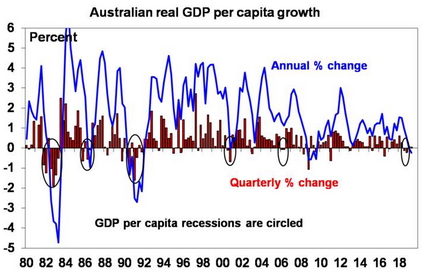
The claim that Australia has gone 28 years without a recession since the early 1990s recession ended in 1991 has been subject to some criticism in recent times with the economy sliding into a “per capita recession” where economic growth has been below population growth. Some have latched on to a recent Federal Reserve Bank of St Louis analysis that noted the 28 year claim should be “taken with a grain of salt” because “Australia has had three recessions since 1991 when looking at GDP per capita, the most recent one being from the second quarter of 2018 to the first quarter of 2019.”

GDP per capita

It’s true that Australia’s relatively strong population growth helps grow the economy. And in terms of living standards it’s GDP per person or per capita that really matters and the recent slowdown in GDP growth to 1.4% year on year which is below 1.6% population growth is a big concern. I even wrote a note after the release of the December quarter GDP data entitled “Australia enters a per capita recession” (which can be found here). But it does not measure up as a conventional recession.

Recession definitions

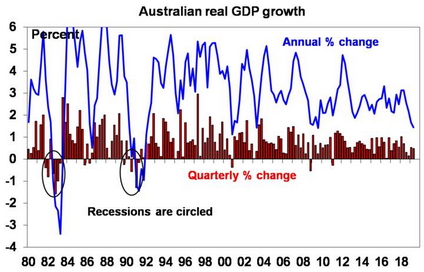
The conventional definition of recession is two or more consecutive quarters of falling real GDP. 


Source: ABS, AMP Capital

On this basis Australia’s last recession ended back in 1991, ie 28 years ago.

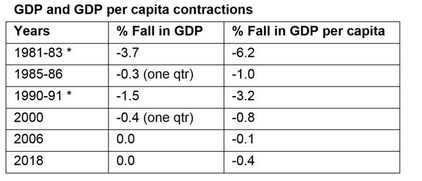
However, if GDP per capita is looked at then Australia has had three per capita recessions since 1991 using the two or more consecutive quarters of decline approach – in the September and December quarters of 2000, the March and June quarters of 2006 and the September and December quarters of 2018. There was also a per capita recession in 1985-86.


Source: ABS, AMP Capital

However, while it may be reasonable to call them “per capita recessions” they don’t compare at all to the scale of the conventional recessions in 1981-83 and 1990-91 that saw far deeper and longer falls in GDP and per capita GDP.

* Because there were two periods of consecutive quarterly declines in per capita GDP in each of the 1981-83 and 1990-1991 periods broken by one quarterly rise the Fed Reserve Bank of St Louis note ascribes two per capita recessions in each period although for all intents and purposes they were really each just one big recession. Source: ABS

Wider definitions of recession

Nor would the per capita recessions of 1985-86, 2000, 2006 and 2018 comply with wider definitions of recession such as that of the US National Bureau of Economic Research that defines a recession as “a significant decline in economic activity spread across the economy, lasting more than a few months, normally visible in real GDP, real income, employment, industrial production, and wholesale-retail sales.

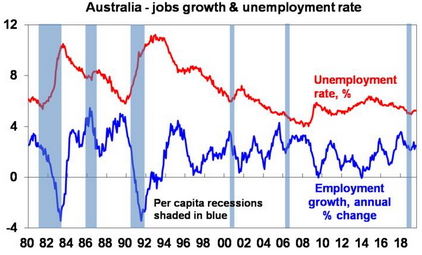
For example, the next chart shows employment growth and unemployment since 1980 with per capita recessions shaded.  


Source: ABS, AMP Capital

Only the per capita recessions of 1981-83 and 1990-91 which were also conventional recessions saw a significant slump in employment (both of around 4%) and sharp rises in unemployment (with both seeing around a 5 percentage point rise). The other per capita recessions saw very little or no fall in employment and only small or no rises in unemployment. In fact, through the last per capita recession of 2006 jobs growth remained solid and unemployment fell, which makes a non-sense of calling it a recession particularly given it was in the midst of the mining boom! The recessions of the early 1980s and 1990s were horrendous events in terms of mass job losses, corporate collapses and financial failures. The per capita recessions of 2000, 2006 and more recently do not compare.

Which brings us to the smell test. For Australians like myself who lived through the early 1980s and early 1990s recessions it’s doubtful that they would recall the per capita recessions of 1985-86, 2000 or 2006 as real recessions. Which is why they are often just referred to as slowdowns. The 2000 slowdown occurred because of the pull forward of spending due to the start up of the GST and also the end of the Olympics and the 2006 per capita recession can hardly be seen as a recession given it was in one of the biggest booms in Australian history, ie the mining boom. And a common question in relation to the recent episode is “things aren’t that bad, so why is the RBA cutting?” (The answer being that waiting for a real recession is likely leaving it too late.)

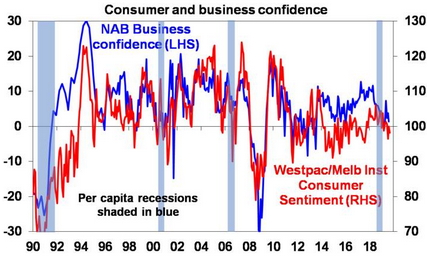
Consistent with this, consumer and business confidence was bouncing around average levels in 2000, 2006 and more recently in contrast to the slump of the early 1990s.


Source: NAB, Westpac/MI, AMP Capital

It’s not just strong population growth

While strong population growth helps grow the Australian economy as the Fed Reserve Bank of St Louis notes, it didn’t stop real recessions in 1981-83 and 1990-91. Going into the early 1980s recession population growth was 1.8% year on year and going into the early 1990s recession it was 1.5% year on year. So, if strong population growth didn’t stop conventional recessions in the past, other factors must have been playing a roll in heading off conventional recessions over the last 28 years. These include:

  • economic reforms of the 1980s and 1990s that made the economy more flexible;

  • the floating of the $A that has seen it fall whenever there is a major economic problem providing a shock absorber for the economy;

  • desynchronised cycles across industry sectors and states;

  • strong growth in China that helped export demand through the GFC;

  • counter cyclical economic policy – like stimulus payments and monetary easing that helped in the GFC; and

  • good luck – which can never be ignored lest hubris set in!

But what about through the GFC?

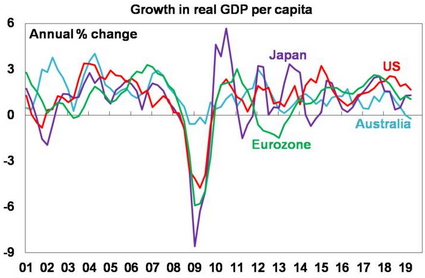
To be sure, Australian confidence had a recession-like fall through the global financial crisis (GFC) reflecting the dyer global news at the time and annual growth in GDP per capita fell, but there was only one quarter of contraction in both GDP and GDP per capita and there was no recession like slump in employment or rise in unemployment. What’s more the fall in per capita GDP at the time of the GFC was trivial compared to that in the US, Europe and Japan suggesting again that other things must have helped Australia beyond strong population growth.


Source: ABS, Bloomberg, AMP Capital

Concluding comment

The slowdown in Australian growth to below the level of population growth at a time of weak wages growth and high underemployment is a real concern and highlights the need to boost growth and productivity. However, a per capita recession on its own is not the same as a real recession, and the three seen over the last 28 years do not compare to the recessions of the early 1980s and early 1990s in terms of their impact on jobs, economic welfare and confidence. Which is why they are normally just referred to as growth slowdowns as opposed to being recessions. To be sure the risk of conventional recession in Australia has increased – although for the reasons noted here I think it remains unlikely. But there is clearly more to Australia’s 28 years without a conventional recession than just strong population growth.


Source: AMP Capital 30 September 2019

Important notes: While every care has been taken in the preparation of this article, AMP Capital Investors Limited (ABN 59 001 777 591, AFSL 232497) and AMP Capital Funds Management Limited (ABN 15 159 557 721, AFSL 426455)  (AMP Capital) makes no representations or warranties as to the accuracy or completeness of any statement in it including, without limitation, any forecasts. Past performance is not a reliable indicator of future performance. This article has been prepared for the purpose of providing general information, without taking account of any particular investor’s objectives, financial situation or needs. An investor should, before making any investment decisions, consider the appropriateness of the information in this article, and seek professional advice, having regard to the investor’s objectives, financial situation and needs. This article is solely for the use of the party to whom it is provided and must not be provided to any other person or entity without the express written consent of AMP Capital.

In this article, we look at three possible scenarios that could unfold in global equity markets over the next five years – are the roaring 20’s upon us, or is there reason to tread more carefully as we head into the next decade?

Key points:

  1. There are three main possible outcomes in markets over the next few years: a recession, the bull-market continues or the status quo.

  2. Money supply and the cost of money is a big driver of equity markets – and this is one reason why they made such strong progress in the first half of 2019.

  3. Assuming no major recession in the next five years, the most sensible prediction for equities is that they perform in line with company profits growth; modest but positive.

Looking backwards to move forwards

Past performance is not indicative of future returns, but lessons can be learned from historic market events to help investors to take a forward-looking view. The last few years have been good for equity investors – It’s been a bull market and one that has been led by the US.

Since the start of 2012, the US market (S&P 500 Index) has more than doubled (up approximately 170%, including dividends), while the MSCI All Countries World Index is up 75% (around 110% on a total return basis) in US dollar terms1. Valuations have not changed that much, which means that the world, as a whole, is valued (against the current earnings base) at roughly the same level as it was five years ago. Technology has produced the best earnings and the best performance but has become more expensive. Conversely, slower growth areas (financials, industrials and materials) have become cheaper.

More recently, fears of impending recession have caused more money to move into perceived lower-risk high quality companies. The premium for “quality” has risen to levels never seen before, particularly in Europe.

What does the next five years hold for equity markets?

Given that markets are not that far from long-run average valuation levels in relation to current earnings (and are cheaper than 30-year averages on free cash flow valuation), probably the most sensible prediction s is that equity markets perform in line with company profits growth. This will be fairly modest but should be positive if we assume no major recession in the next few years.

The longer one’s time horizon, the more important earnings growth is in explaining market moves. However, over shorter periods, other factors introduce greater volatility that overwhelms the impetus from earnings (in either direction). In particular, money supply and the cost of money is a big driver – and this is one reason why markets made such strong progress in the first half of 2019.

It is helpful to consider three possible world scenarios for the next five years.

Under the first, we see recession and a fall in corporate profits. Under the second, markets rise significantly on a combination of higher earnings and higher valuations. Under the third, there is little if any earnings growth and markets stay roughly where they are. Whilst the middle path is the one that seems to make most sense to plan for, it appears that the “melt up” scenario is more plausible than the “collapse” case.

Scenario 1: Recession?

Although it is difficult to quantify the risks of a major geopolitical incident, a significant economic downturn seems unlikely in the next few years. In the past, classic recessions were caused by overinvestment and declining industrial returns but there is no evidence that economies have been adding too much capacity. (Indeed, healthy profit margins in many industries are evidence of this.)

Equally, a recession caused by a stressed banking system seems also highly unlikely given that around the developed world banks have rebuilt capital and a large part of the riskier assets have been removed from balance sheets and are now held by hedge funds and other investors.

A more likely recession scenario is the “Japanese style” recession that we have seen a number of times in the past 30 years. These are short-term downturns, often caused by industrial inventory cycles, that are met with monetary stimulus and government spending initiatives. This can lead to opportunities to pick up oversold stocks at the gloomiest moments.

Scenario 2: The Bull market continues?

As monetary policy remains loose (and may ease further) and it is highly likely that governments will step up spending to mitigate economic softness, there is a reasonable chance that markets rise to higher valuations. After all, the last five years have seen markets rise despite investors taking money out of equity mutual funds.

Now that equities provide a dividend yield that is significantly higher than government bonds and offer some potential inflationary protection, maybe investors will allocate more to equities in the next five years. A major “melt up” in markets cannot be a central case but could be argued to be at least as likely as a major correction.

Scenario 3: Status quo?

In the more likely scenario of low global growth (lower than the past few years due to geopolitical and trade uncertainty), earnings can be expected to grow at a modest pace. Free cash flow is a positive and should continue to drive share buybacks which in turn augments underlying growth in earnings-per-share.

In this relatively low growth scenario, we should also expect periods of volatility in markets. Rather than trying to avoid them entirely, we should be ready to look for opportunities that will be thrown up along the way.

In part two of this piece we outline six key themes that we believe investors need to consider over the next five years and discuss how these issues could shape and impact market leadership from here.

Source : Fidelity August 2019 

Reproduced with permission of Fidelity Australia. This article was originally published at https://www.fidelity.com.auinsights/investment-articles/rumble-or-roar-the-future-for-global-equity-markets/

This document has been prepared without taking into account your objectives, financial situation or needs. You should consider these matters before acting on the information. You should also consider the relevant Product Disclosure Statements (“PDS”) for any Fidelity Australia product mentioned in this document before making any decision about whether to acquire the product. The PDS can be obtained by contacting Fidelity Australia on 1800 119 270 or by downloading it from our website at www.fidelity.com.au. This document may include general commentary on market activity, sector trends or other broad-based economic or political conditions that should not be taken as investment advice. Information stated herein about specific securities is subject to change. Any reference to specific securities should not be taken as a recommendation to buy, sell or hold these securities. While the information contained in this document has been prepared with reasonable care, no responsibility or liability is accepted for any errors or omissions or misstatements however caused. This document is intended as general information only. The document may not be reproduced or transmitted without prior written permission of Fidelity Australia. The issuer of Fidelity Australia’s managed investment schemes is FIL Responsible Entity (Australia) Limited ABN 33 148 059 009. Reference to ($) are in Australian dollars unless stated otherwise.
© 2019. FIL Responsible Entity (Australia) Limited.

Important:
This provides general information and hasn’t taken your circumstances into account. It’s important to consider your particular circumstances before deciding what’s right for you. Any information provided by the author detailed above is separate and external to our business and our Licensee. Neither our business nor our Licensee takes any responsibility for any action or any service provided by the author.

Any links have been provided with permission for information purposes only and will take you to external websites, which are not connected to our company in any way. Note: Our company does not endorse and is not responsible for the accuracy of the contents/information contained within the linked site(s) accessible from this page.

Love it or hate it, outsourcing work to a third party presents obvious benefits for businesses. So if you’re wondering why companies outsource a specific element of their activity, the following article paints the picture.

Often a business owner may think they can do it all, especially founders of small businesses and taking such a standpoint can literally make or break a company’s growth potential.

For those that recognise that there are only so many hours in a day, it stands to reason that outsourcing should be viewed as a bread-and-butter strategy for businesses today.

What do the numbers on outsourcing reveal?

According to Microsourcing.com, the progress of technology has given businesses a monumental edge when it comes to remote workers. This has increased the offshore outsourcing industry astronomically in nearly every category.

Respondents to a survey from Microsourcing gave the following as reasons for outsourcing:

  • 59 percent said it was cost-cutting tool

  • 57 percent said it enables them to focus more on their core business

  • 47 percent said it helps to solve capacity issues

  • 31 percent said outsourcing enhances their quality of service

  • 28 percent described it as critical to business needs

  • 17 percent said outsourcing is used to manage the business environment

  • 17 percent indicated it drives broader transformational change

Further studies disclose, as reported by the site, that for every four jobs forfeited another automaton management position is created. What’s more, outsourcing of higher level positions is on the increase.

Adding to the trend are innovative software alternatives that provide superior time-tracking features. These features effortlessly bestow businesses with a hands-on approach even when miles away.

6 key benefits of outsourcing for businesses in a nutshell

1. It delivers a competitive edge

This advantage applies particularly to small business owners.

With the help of a remote working techniques, in-house and outsourced roles can be brought together though they may be scattered across different cities, states, or countries. When managed well, this allows a small organisation the same level of access to talent as a much larger one.

2. It helps businesses manage capital expenditures

Instead of paying a fixed monthly wage to a full-time worker, outsourcing offers a business the benefit of spending only where and when needed, thereby leveraging more control over business assets. The added revenue stockpile can be directed towards marketing or investing in supplementary services.

Research has also shown outsourcing is particularly cost effective for small business owners as they are relieved of the need to pay operating costs associated with worker’s compensation schemes, health insurance, payroll taxes, and office space (although you’ll want to ensure you’re complying with the letter of the law for your region).

3. Outsourcing frees up capacity for increased undertakings

Another upside of outsourcing is the opportunity for businesses to innovate and kick-off projects more frequently.

This is mainly derived from the on-the-spot expertise outsourced help provides. For example, a company can manage time better by outsourcing right away as opposed to employing, hiring, and instructing a new, full-time employee.

READ: What I’ve learnt from outsourcing payroll

4. Third party providers are often highly motivated

If a worker lacks the expertise required for a specific job, a company can outsource the task with an added bonus by default. This means a contracted worker will probably be more enthusiastic and motivated to do a superb job with the hopes of getting commissioned for future assignments.

5. It gives greater access to core competencies

Another great benefit to outsourcing is the advantage of accessing others’ core competencies as well as a better ability to focus on your own.

Core competence concentrates on targeted skills that make a company unique in itself. It’s that “something” that makes it stand out from its competitors.

READ: Why you should stick to your strengths in business

Investopedia defines core competence as:

‘The resources and/or strategic advantages of a business, including the combination of pooled knowledge and technical capacities, that allow it to be competitive in the marketplace. They are what the company does best and consist of the combined activities, operations, and resources that distinguish the company from competitors.

6. Outsourcing gives small businesses a step up

Rarely do small businesses carry the clout of larger companies. Despite that, outsourcing gives small businesses a step up by leveling the playing field due to access to highly-skilled labour and expertise that bigger companies favour.

When’s the best time to outsource?

The perfect time to outsource varies with each company.

A business may maintain a limited staff and only require outside assistance for specific tasks. Another company may have adequate staff but require help when taking on additional projects.

When day-to-day operations of a business becomes overwhelming, outsourcing is the ideal solution.

The sticky issue of finance

Finances are an unavoidable sticking point when it comes to managing a business. Hiring the services of a competent financial adviser is the best way to allocate finances when outsourcing.

Additionally, making such a decision allows businesses to focus on other important areas like development and customer service. Business owners should “concentrate on what they are good at.”

If not, precious time will be taken from the company that could be better invested in other crucial business endeavors.

A final word on outsourcing

Both large and small businesses are increasingly outsourcing work due to the innovation of technology.

The ability to hire workers from anywhere in the world with the click of a mouse is quite impressive. In fact, many professionals like marketing directors, paralegals, virtual executive assistants, IT professionals, and so on, are leaving the nine-to-five workday in order to enjoy more time with their families or pursue other interests while maintaining a decent salary.

When business owners can invest more time and energy in growth opportunities instead of stressing about tasks better suited to others, then outsourcing has achieved its goal.


Source : MYOB

Reproduced with the permission of MYOB. This article by  was originally published at www.myob.com/au/blog/ outsourcing-key-benefits-small-business/

Important:
This provides general information and hasn’t taken your circumstances into account. It’s important to consider your particular circumstances before deciding what’s right for you. Although the information is from sources considered reliable, we do not guarantee that it is accurate or complete. You should not rely upon it and should seek qualified advice before making any investment decision. Except where liability under any statute cannot be excluded, we do not accept any liability (whether under contract, tort or otherwise) for any resulting loss or damage of the reader or any other person.

Any information provided by the author detailed above is separate and external to our business and our Licensee. Neither our business nor our Licensee takes any responsibility for any action or any service provided by the author.

Any links have been provided with permission for information purposes only and will take you to external websites, which are not connected to our company in any way. Note: Our company does not endorse and is not responsible for the accuracy of the contents/information contained within the linked site(s) accessible from this page.

If you’re prone to procrastination, you’re certainly not alone. When there’s so much to do, it’s all too easy to postpone action because you can’t quite bring yourself to get started. Most things feel like overwhelming hurdles, until you take the first step towards completion. It’s this first step that gets the ball rolling, so all you need to do, is find the motivation to take it.

Here’s how to do it, quickly. 

Change your body language

Do you often slump over the laptop, amble reluctantly to your next meeting or sit with your arms and legs crossed? Postures and gestures you use not only communicate something to everyone around you, but affect your mood and productivity levels. As soon as you feel procrastination taking over, check in with your body to see how you’re sitting, standing or walking. 

Instead of any posture that makes you look and feel small, slumped and tightly crossed, open up and stretch confidently, by extending your chest, arms and legs. Walk briskly and with purpose, while taking deep breaths. Smile, even if it’s just to yourself. These small changes tell your brain to get going, in a mere matter of minutes. 

Become aware of your thoughts

Like most things, motivation is a skill that takes practice to cultivate. When you’re constantly telling yourself you can’t achieve goals, finish projects or even get out of bed, your putting yourself into a pessimistic state that blocks action. To change this, it’s crucial to remain aware of your thought patterns. This is the easy part, because the signs of negative thinking are starkly obvious, via the associated negative feelings. 

As soon as you feel yourself succumbing to non-productive thoughts, whip them into shape by reframing them in a positive light. Mentally debate them if you need to, by acknowledging that they’re not necessarily true. For example, while today’s ‘to-do’ list might seem overwhelming, is it true that it’s entirely unachievable? Not likely. If it is, adjust your thinking by focusing on proactive solutions, rather than the feeling of being overwhelmed. 

Simplify your goals

No matter how motivated you are when you start the day, if your goals aren’t measurable it’s far too easy to sink into non-action. Let’s say your goal is to get fit, which is something that’s not going to happen overnight. Without specific, measurable steps to take each day, it’s not going to happen at all. 

While it’s fantastic to have long term goals and even better to reach high, it’s these very aspirations that can hold you back by projecting too far into the future. It’s in this ‘future thinking’ space that goals seem unattainable, thereby squashing your motivation to get started. 

When you find yourself procrastinating, give your motivation a boost in minutes by kicking one, simple goal that puts you one step further on the path. In this case, get up and go for a quick jog, and pat yourself on the back for it afterwards. 

Practice taking small steps and rewarding yourself for them, changing your body language and reframing your thoughts towards positivity every day. You’ll soon find your motivation muscles growing stronger, in order to propel you towards successful action and working smarter, not harder. 

This provides general information and hasn’t taken your circumstances into account. Any links have been provided with permission for information purposes only and will take you to external websites, which are not connected to our company in any way. Note: Our company does not endorse and is not responsible for the accuracy of the contents/information contained within the linked site(s) accessible from this page

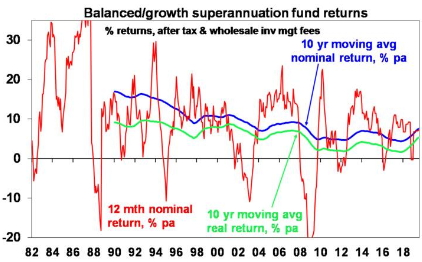
The past 10 years have seen pretty good returns for well-diversified investors. The median balanced growth superannuation fund returned 7.3% pa over the five years to July and 8.2% pa over 10 years and that’s after fees and taxes. This is impressive given that inflation has been around 2%. 


Source: Mercer Investment Consulting, Morningstar, AMP Capital

Shares and growth assets have literally climbed a wall of worry this decade with a revolving door list of worries around public debt, the Eurozone, deflation, inflation, rate hikes, Trump, North Korea, China, trade wars, growth, house prices, etc. But returns benefitted from the recovery after the GFC and a search for yield as interest rates have collapsed depressing yields on most assets. But – while it sounds like a broken record – the decline in yields points to eventually more constrained returns ahead.

Declining yields = falling medium-term return potential

Investment returns have two components: yield (or income flow) and capital growth. Looking at both of these components points to lower average investment returns over the next five years compared to the last five years. It’s basic to investing that the price of an asset moves inversely to its yield all other things being equal. Suppose an asset pays $10 a year in income and suppose its price is $100, which means an income flow or yield of 10%. If interest rates are cut resulting in increased demand for the asset, as investors search for a higher yield, such that its price rises to $120 given the $10 annual income flow its yield will have fallen to 8.3% (ie $10 divided by $120) as its price has gone up by 20%. So, yield moves inversely to price. But as yields decline it means a lower return potential going forward.

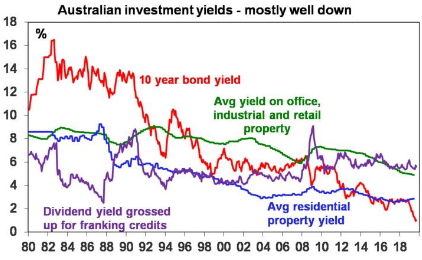
Since the early 1980s investment yields have collapsed. Back then the RBA’s “cash rate” was around 14%, 1-year bank term deposit rates were nearly 14%, 10-year bond yields were around 13.5%, commercial and residential property yields were around 8-9% and dividend yields on shares were around 6.5% in Australia and 5% globally. This meant that investments were already providing very high income so only modest capital growth was needed for growth assets to generate good returns. So, most assets had very strong returns and balanced growth super fund returns averaged 14.1% in nominal terms and 9.4% in real terms between 1982 and 1999 (after taxes and fees).

Over the last four decades, investment yields have mostly fallen quite sharply. See the next chart.


Source: Bloomberg, REIA, JLL, AMP Capital

Today the cash rate is 1%, 1-year bank term deposit rates are 1.5%, 10-year bond yields are 0.9%, gross residential property yields are around 3%, commercial property yields are just below 5%, dividend yields are still around 5.5% for Australian shares (with franking credits) but they are 2.5% for global shares. This points to a lower return potential for a diversified mix of assets.

What’s more, the capital growth potential from growth assets is likely to be constrained relative to the past reflecting more constrained nominal economic growth. Several megatrends are likely to impact growth over the medium term. These include:

  • Continued slower growth in household debt. 

  • An ongoing retreat from globalisation, deregulation and small government in favour of populist, less market friendly policies.

  • A shift in corporate focus from profit to “balanced scorecards”.

  • Rising geopolitical tensions – notably as the US attempts to constrain the rising power of China as evident in the trade war.

  • Aging and slowing populations – resulting in slowing labour force growth and rising pressure on public sector budgets.

  • Technological innovation and automation.

  • Continuing rapid growth in Asia and China’s middle class. 

  • Pressure to slow emissions & the impact of global warning.

  • A large shift to sustainable energy as its cost continues to fall.

Most of these will constrain economic growth & hence returns.

Medium-term return projections

Our approach to get a handle on medium-term return potential is to start with current yields for each asset class and apply simple and consistent assumptions regarding capital growth reflecting the above-mentioned megatrends. We also prefer to avoid forecasting and like to keep the analysis simple.

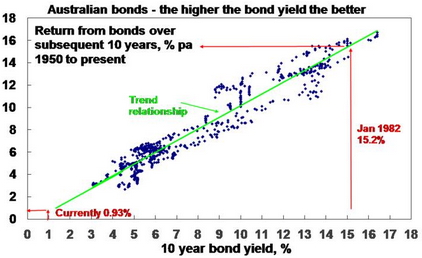
  • For bonds, the best predictor of future medium-term returns is current bond yields as can be seen historically in the next chart. If a 10-year bond yield is held to maturity its initial yield (0.93% right now in Australia) will be its return over 10 years (ie 0.93%). We use 5-year bond yields as they more closely match the maturity of bond indexes.


Source: Global Financial Data, Bloomberg, AMP Capital

  • For equities, current dividend yields plus trend nominal GDP growth (a proxy for capital growth) does a good job of predicting medium-term returns.1

  • For property, we use current rental yields and likely trend inflation as a proxy for rental and capital growth.

  • For unlisted infrastructure, we use current average yields and capital growth just ahead of inflation.

  • In the case of cash, the current rate is of no value in assessing its medium-term return. So we allow for some rise in cash rates over time.

Our latest return projections are shown in the next table.

Projected medium term returns, %pa, pre-fees and taxes


Current
Yield #

+ Growth

= Return

 World equities

2.6^

4.1

6.6

 Asia ex Japan equities

1.6^

6.9

8.5

 Emerging equities

1.9^

6.9

8.9

 Australian equities

4.3 (5.7*)

3.2

7.5 (8.9*)

 Unlisted commercial property

4.9

1.7

6.6

 Australian REITS

4.6

2.3

6.7

 Global REITS

3.6^

1.6

5.5

 Unlisted infrastructure

4.6^^

3.0

7.6

 Australian bonds (fixed interest)

1.1

0.0

1.1

 Global fixed interest ^

1.3

0.0

1.3

 Australian cash

2.0

0.0

2.0

 Diversified Growth mix *


5.6

# Current dividend yield for shares, distribution/net rental yields for property and duration matched bond yield for bonds. ^ Includes forward points. * With franking credits added in. Source: AMP Capital.

The second column shows each asset’s current income yield, the third shows their 5-10 year growth potential, and the final column their total return potential. Note that:

  • We assume inflation averages around or just below central bank targets.

  • For Australia we have adopted a relatively conservative growth assumption reflecting slower productivity growth.

  • We allow for forward points in the return projections for global assets based around current market pricing.

Key observations

Several things are worth noting from these projections.

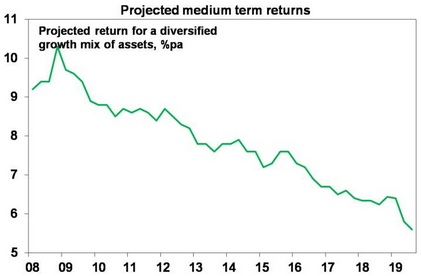
  • The medium-term return potential has continued to fall due largely to the rally in most assets and fall in investment yields. Projected returns using this approach for a diversified growth mix of assets have fallen from 10.3% pa at the low point of the GFC in March 2009, to 8.6% five years ago, to 6.2% a year ago and to now just 5.6%.


Source: AMP Capital

  • Government bonds offer low returns due to ultra-low yields. Yes, bond returns have been strong lately as yields have collapsed pushing up bond prices. But this is no guide to future returns, particularly if bond yields stop falling.

  • Unlisted commercial property and infrastructure continue to come out relatively well, reflecting their higher yields.

  • Australian shares stack up well on the basis of yield, but it’s still hard to beat Asian/emerging shares for growth potential.

  • The downside risks to our medium-term return projections are that: the world plunges into a recession driving another major bear market in shares or that investment yields are pushed up to more normal levels as inflation rebounds causing large capital losses. Just allow that drawdowns in returns tend to be infrequent but concentrated and it’s been a while since the last big one. See the first chart. 

  • The upside risks are (always) less obvious but could occur if we see improving global growth but inflation remaining low.

Implications for investors

  • First, have reasonable return expectations. Low yields & constrained GDP growth indicate it’s not reasonable to expect sustained double-digit or even high single digit returns. In fact, the trend decline in the rolling 10-year average of both nominal and real super fund returns since the 1990s indicates we have been in a lower-return world for many years – it’s just that it only becomes clear every so often with bear markets and then strong returns in between.

  • Second, remember that responding to a lower return potential from major asset classes by allocating more to growth assets does mean taking on more risk.

  • Third, bear markets are painful, but they do push up the medium-term return potential of investment markets to higher levels and so provide opportunities for investors.

  • Fourth, some of the decline in return potential reflects very low inflation – real returns haven’t fallen as much. 

  • Finally, focus on assets with decent sustainable income flow as they provide confidence regarding future returns.


Source: AMP Capital 25 September 2019

1Adjustments can be made for: dividend payout ratios (but history shows retained earnings often don’t lead to higher returns so the dividend yield is the best guide); the potential for PEs to move to some equilibrium level (but forecasting the equilibrium PE can be difficult and dividend yields send valuation signals anyway); and adjusting the capital growth assumption for some assessment regarding profit margins (but this is hard to get right). So, we avoid forecasting these things.

Important notes: While every care has been taken in the preparation of this article, AMP Capital Investors Limited (ABN 59 001 777 591, AFSL 232497) and AMP Capital Funds Management Limited (ABN 15 159 557 721, AFSL 426455) (AMP Capital) makes no representations or warranties as to the accuracy or completeness of any statement in it including, without limitation, any forecasts. Past performance is not a reliable indicator of future performance. This article has been prepared for the purpose of providing general information, without taking account of any particular investor’s objectives, financial situation or needs. An investor should, before making any investment decisions, consider the appropriateness of the information in this article, and seek professional advice, having regard to the investor’s objectives, financial situation and needs. This article is solely for the use of the party to whom it is provided and must not be provided to any other person or entity without the express written consent of AMP Capital.