For the first-time business owner, your ability to control costs is a critical success factor. But have you factored in these often-overlooked costs of running a business?

What could be more cost-effective than starting your own small business from home?

No mandatory commute means money saved. No managers or investors to keep most of the profit for themselves and no (additional) rental overheads.

For many, it sounds like the perfect antidote to a busy, expensive lifestyle. But is it?

Truth is, running a business carries various costs that are easy to overlook, even if you’re operating it out of your parents’ garage. And if you don’t prepare for all eventualities, you can find your dream business has become a financial nightmare.

To help you get prepared for running your own startup, here are five hidden costs of running a business from home.

1. Your working time

The irony is many entrepreneurs begin working for themselves to better value their time, but most of them completely fail to do so.

Instead, they fall into the habit of trying to do everything themselves, assuming their effort is innately productive – but that isn’t the case.

Part of the reason for this is that it’s possible to value your time in an abstract sense (recognising that you have useful skills) without monetarily valuing it.

As a business owner, you need to understand what every hour of your time is worth and use that as a yardstick to figure out what you should (and shouldn’t) be spending your time doing.

READ: How to price services when starting a business

2. Staff (full-time or freelance)

The dream of flying solo isn’t sustainable if you have any ambition to scale your offering.

There’s only so much a person can accomplish in a day, no matter how skilled or dedicated they are. Sooner or later you need to start building a team.

Why is this a hidden cost? Because however inevitable it may be, it’s all too easy to ‘kick the can down the road’ and treat it as something that might happen one day but isn’t an immediate priority.

But, if you know you’ll need employees worth investing in some day, you need the funds to offer competitive salaries, and that requires preparation and saving.

READ: Freelance of full-time? Here’s a simple formula for hiring talent

3. Business software subscriptions

Without the advent of software-as-a-service (SaaS), or cloud-based software, it wouldn’t be possible for a lone entrepreneur to build a scalable online business.

From your word processor to your website, if it’s digital then it can be delivered over the internet for a relatively low monthly rate.

One obvious example of a business-critical solution is your online accounting software. Incorporating this type of software early on makes it easier to get paid faster with automated invoices, capture your receipts and prepare cash flow forecasts.

Many new business starters figure they can do all this manually, but your time is valuable, and much better spent on other things. Furthermore, the introduction of Single Touch Payroll in Australia and Payday Filing in New Zealand means that, if you intend to employ staff, you will need to acquire this kind of software to report salaries and super with each pay run.

There can be also be hidden costs in choosing between SaaS utilities. What you think is the best deal might work out as more expensive in the long run. I follow e-commerce closely, and both Shopify and BigCommerce are great website hosting solutions, with the latter being nominally cheaper – but the former’s native multichannel selling, automation options and higher growth rate may justify the higher and ultimately make it cheaper as your business scales.

READ: Understanding business systems

Ultimately, the right software solution for your business will come down to your individual circumstances, so be sure to consider your options carefully.

4. Industry memberships

These costs can really take people by surprise, because many people don’t know they exist.

Industry memberships are sometimes mandatory, but more often simply recommended, and involve businesses joining governing bodies (of sorts) that oversee their industries – whether regionally or internationally. The ACCC lists a number of these industry associations on its website, while New Zealand also have an array of industry and trade associations.

For instance, if you ran a decorating business, you may need to join a regulatory body tasked with making sure all decorators are working safely and correctly (depending on the country). And even if you require no such membership at the moment, are you certain that you won’t pivot your business down the line?

5. Insurance policies

When you start running your business, you’re riding on a wave of optimism. Finally, everything’s going to go your way. You’ll make the money you were previously denied, have the freedom you always craved, and be able to truly express yourself – but things won’t always go your way, and unless you want to hit a bump in the road and crash, you need business insurance.

READ: Considering insurance for a new business? Start here

Depending on the type, breadth and level of insurance you go for, this can be a modest cost or a massive one. Either way, it’s not something that any business owner should ignore.

The long-term survival of your fledgling business is more important than your early profit levels, so take it seriously, shop around to find the best insurance deal, and get your operation covered.

These costs can sneak up on you if you’re not careful, so pay close attention. Running your own business can be hugely rewarding, but it will turn into a negative experience if you hit financial troubles.


Source : MYOB

Reproduced with the permission of MYOB. This article by  was originally published at https://www.myob.com/au/blog/hidden-costs-running-business/

Important:
This provides general information and hasn’t taken your circumstances into account. It’s important to consider your particular circumstances before deciding what’s right for you. Although the information is from sources considered reliable, we do not guarantee that it is accurate or complete. You should not rely upon it and should seek qualified advice before making any investment decision. Except where liability under any statute cannot be excluded, we do not accept any liability (whether under contract, tort or otherwise) for any resulting loss or damage of the reader or any other person.

Any information provided by the author detailed above is separate and external to our business and our Licensee. Neither our business nor our Licensee takes any responsibility for any action or any service provided by the author.

Any links have been provided with permission for information purposes only and will take you to external websites, which are not connected to our company in any way. Note: Our company does not endorse and is not responsible for the accuracy of the contents/information contained within the linked site(s) accessible from this page.


There’s nothing quite like jetting off for a holiday, but wouldn’t it be great to do so without stretching the budget too far? With great-value accommodation, cheap cuisine and spectacular attractions galore, these top spots are easy on the wallet without compromising on incredible experiences. 

Hoi An, Vietnam

The calm waters of the South China Sea, villages in the midst of rice fields and a UNESCO-listed ancient town combine to make Hoi An a dream holiday destination. Although Vietnam is becoming more popular by the second, finding cheap homestays, hotels and resorts is a breeze, and you’ll dine on delicious local dishes for small change. 

In terms of budget activities, it’s easy to cycle around town to explore rice paddies, sundrenched An Bang Beach, charming canals and French-Colonial architecture. Hoi An’s master tailors are famous for original or recreated designs, so you can pick up a new wardrobe too, for a fraction of the price at home. 

Tasmania, Australia

If it’s a camping holiday you’re looking for, head to Tasmania for an array of free spots smack bang in the heart of nature. Mayfield Bay Coastal Reserve is a short drive from Swansea, with a sandy beach and views over Great Oyster Bay to Freycinet Peninsula. 

For breathtaking ocean views, Bay of Fires offers campsites in the conservation reserve, which is home to orange granite boulders on a backdrop of turquoise seas. 

Only small fees apply for camping in National Parks, giving you access to astounding natural wonders on a shoestring budget. 

Lisbon, Portugal

With its scenic seven hills, charming cobbled streets, ancient ruins and delectable cuisine, a Lisbon holiday offers a perfect slice of sundrenched Europe. Best of all, it happens to be one of the continent’s most affordable cities, with great-value hostels and guesthouses, along with tasty, cheap treats like healthy Caldo Verdi (soup) and the obligatory Portuguese custard tarts. 

Just strolling around the colourful districts is enough to fill delightful days, however there are plenty of cheap things to do. See the works of Picasso, Andy Warhol and Dali at the Museu Colecao Berardo for free on Saturdays, hop on the train for a short ride to dazzling beaches and navigate the labyrinth of narrow streets in historic Alfama. 

Kuala Lumpur, Malaysia

KL is a popular stopover destination for longer flights. However, this dazzling city of glittering highrises, exquisite street food and endless shopping opportunities deserves much more than a glimpse. Accommodation in the heart of the city is fantastic value and it’s a very walkable place, though there’s also the free GO KL bus to get you around the main sites. 

The incredible Petronas Towers act as a signpost no matter where you are, so you can get happily lost throughout unique districts. Explore the old fashioned shop houses of Chinatown, sip on cheap cocktails in Bukit Butang and pick up bargains to stuff your suitcase with, at Central Market. 

For cheap flights to any of these destinations, it pays to be flexible in order to snap up sales. If that’s not possible, travelling during shoulder or off seasons is the way to go, for fantastic holidays that don’t break the bank.

This provides general information and hasn’t taken your circumstances into account. Any links have been provided with permission for information purposes only and will take you to external websites, which are not connected to our company in any way. Note: Our company does not endorse and is not responsible for the accuracy of the contents/information contained within the linked site(s) accessible from this page. 

Has a family member or friend asked you to be a ‘co-borrower’ or guarantee a loan for them? Before you say yes, think carefully – you could lose not only your money, but valuable assets such as your house or car.

What is a guarantor or co-borrower?

Co-borrower

You are a co-borrower if you sign a loan with someone else.

In most instances both you and the other co-borrower are jointly and individually liable for the debt. If the person you borrow the money with is unable to pay their share of the loan, you will be responsible for repaying the full amount outstanding.

Guarantor

If a credit provider is not willing to give a loan to a person on their own, they may ask for a guarantee. If you sign a guarantee for a friend or family member, you are known as the ‘guarantor’ of the loan.

When you sign your name as a guarantor, you are legally responsible for paying back the entire loan if the other person cannot or will not make the repayments. You will also have to pay any fees, charges and interest.

As a guarantor you don’t have the right to own the property or items bought with the loan.

Reasons you might have to say no

Think very carefully before guaranteeing a loan. Is there another way you could help without becoming a guarantor? For example, could you contribute to a deposit so that a guarantee is not needed?

Consider how you will pay back the loan if your friend or family member can’t. Can you afford the repayments? Do you have savings you can use or assets you can sell to pay the debt? If you do have to use your own money or assets to pay off someone else’s loan, you could be risking your financial future.

What about your relationship with the borrower if something goes wrong? It may be better to say ‘no’ now and avoid damaging your friendship.

The effect on your future loans and credit report

You will need to tell your credit provider about any loans you are a guarantor for, when you apply for credit. They may take into account the loan repayments on the loan you have guaranteed when they assess your ability to repay a new loan. This may stop you getting a new loan even if the person who’s loan you are guaranteeing is making the repayments.

You may end up with a bad credit record if you and the borrower can’t pay back the guaranteed loan. The loan will be listed as a default or non-payment on your credit report, making it hard for you to borrow money for several years.

You may also affect your credit score, a number based on an analysis of your credit file, at a particular point in time, that helps a lender determine your credit worthiness.

If you provide security, such as a mortgage on your home, to guarantee someone else’s loan, you may not be able to use your home as security for your own loan. You may even end up losing your home if you don’t pay out the guaranteed loan.

You may also be made bankrupt by the credit provider. Even assets you haven’t offered as security for a guarantee may then be sold to pay the outstanding debt.

Case study: Connie guarantees a business loan for her son

Connie’s family ran cafes for years until her late husband became too ill to work. Her son Leo grew up working for the family business, and Connie thought he could make a go of it. But she didn’t know he had a gambling problem.

A few months after Connie guaranteed a business loan for him, Leo fell behind in his repayments. Then he was evicted from the cafe for not paying rent. She asked relatives to contribute to Leo’s repayments but even with their help, there was not enough money to pay off the debts.

The bank and landlord contacted Connie to pay back what was owed. Connie is talking to the bank about repayment arrangements, including postponing enforcement proceedings, but is resigned to the fact she may have to sell the family home to pay off Leo’s debts.

Questions you must ask before you sign the loan

Before you guarantee a loan, ask the credit provider the following questions.

Q. What type of loan am I guaranteeing?

Be very careful about guaranteeing a loan that has no specific payback time, such as an overdraft. This kind of loan could potentially go on forever.

Q. What should I check if I am asked to guarantee a business loan?

Find out everything you can about the business. Ask for a copy of the business plan to understand how it will operate. It’s also important to look at the business’ financial state. For example, check past financial statements and speak to the business’ accountant to make sure the company is in good financial health and has good prospects.

Q. Is the guarantee for a fixed amount of money, or is it for the total amount owing?

You are better off guaranteeing a fixed amount because you will know exactly what you owe. If you sign a guarantee for the total amount owing, you will be legally responsible for what the borrower owes now and in the future. This could include interest, fees, charges and penalties. If you think there has been an increase in the amount you agreed to guarantee without your consent, seek legal advice straight away.

Q. Exactly how much am I guaranteeing?

The guarantee should clearly describe how the amount of money you owe will be calculated if the worst happens and the borrower does not pay. If you are not comfortable with the amount, ask if you can reduce it.

Q. Do I have to put up assets as security?

If the loan is not for personal, household or domestic purposes, you may be asked to put up an asset, such as your house, as security. This means the credit provider can sell your house to pay the debt if the borrower defaults on their loan.

Q. What should the loan contract tell me?

Get a copy of the loan contract from the credit provider. It should tell you:

  • The amount of the loan

  • The interest rate, fees and charges

  • Whether the loan is secured (where the borrower has to put up an asset, such as their house, as security)

  • How long the borrower has to repay the loan

  • The amount of the repayments

How to get help and free legal advice

Never let a family member pressure or force you into signing anything.If you’re feeling pressured, seek financial counselling – it’s a free and confidential service.

You can also visit our webpage on financial abuse for some red flags to watch out for, as well as the contact details of organisations that can help you.

If a large amount of money is involved, talk with a lawyer or get free legal advice so you understand the risks you are taking on.

Challenging a claim

In certain situations, guarantors may be able to challenge a claim even though they have signed contracts.

You should get advice immediately if you:

  • Only agreed to sign through pressure or fear

  • Suffered from a disability or mental illness at the time of signing

  • Did not receive legal advice before signing and did not understand the documents or the extent of the risk you were taking on; for example, you thought you were guaranteeing a certain amount but a much larger amount is now being claimed

  • Believe the credit provider or broker used unfair tactics, or tricked or misled you

What to do if a personal relationship breaks down

A breakdown in your personal relationships affects every part of your life, including your finances. If you were a guarantor or co-borrower for your ex-partner, you may be liable for their debts if they can’t or won’t repay their loan.

In most cases, you won’t be able to get out of loan contracts you made in the past, but speak to a lawyer or get free legal advice about where you stand. Also see divorce and separation and relationships and money for more information.

Stop and think before agreeing to be a co-borrower or to guarantee someone’s loan. If they cannot or will not pay off the loan, you will be responsible for the debt. Take the same care that you would if you were taking a loan out for yourself.

Please contact us on Phone: 07 5641 4134 if you seek further assistance on this topic.

Source : ASIC MoneySmart

Reproduced with the permission of ASIC’s MoneySmart Team. This article was originally published at https://www.moneysmart.gov.au/borrowing-and-credit/borrowing-basics/loans-involving-family-and-friends

Important note: This provides general information and hasn’t taken your circumstances into account.  It’s important to consider your particular circumstances before deciding what’s right for you. Although the information is from sources considered reliable, we do not guarantee that it is accurate or complete. You should not rely upon it and should seek qualified advice before making any investment decision. Except where liability under any statute cannot be excluded, we do not accept any liability (whether under contract, tort or otherwise) for any resulting loss or damage of the reader or any other person.  Past performance is not a reliable guide to future returns.

Important
Any information provided by the author detailed above is separate and external to our business and our Licensee. Neither our business nor our Licensee takes any responsibility for any action or any service provided by the author.

Any links have been provided with permission for information purposes only and will take you to external websites, which are not connected to our company in any way. Note: Our company does not endorse and is not responsible for the accuracy of the contents/information contained within the linked site(s) accessible from this page. 

 

The return environment in commercial real estate has become more challenged, with pockets of outperformance matched by underperformance, not only across the sectors but, more frequently, within the same sector.

Against this backdrop, passive portfolio management pegged to a benchmark has begun to look outdated.

By shifting our focus to one of active management with the freedom of a benchmark-unaware approach we now have more levers to pull in terms of portfolio construction and risk management.

This means we can take a more holistic approach to the construction and management of the portfolio, better capitalising on opportunities in the real estate market and managing the downside risks.

Sector selective

A great illustration of how we can better manage risk for our investors is how our active approach has allowed us to de-weight the portfolio’s exposure to the retail sector.

Over the course of the last 18-24 months our research had helped us identify that investments in the retail sector would be challenged from a returns perspective for the next few years due to the continued rise of online shopping and cyclical headwinds such as low wages growth and a more moderate housing market.

However, the Australian Real Estate Investment Trust (AREIT) index – in which we were previously invested – has a ‘look-through’ exposure to the retail sector of about 50 per cent.

By adopting an approach that means we are no longer constrained by this passively-managed AREIT exposure, we have instead been able to build a bespoke portfolio of retail assets, being selective about the type of assets that we are comfortable holding.

These include assets such as dominant regional shopping centres, as well as neighbourhood and convenience-based centres, which have a point of difference that means customers will continue to shop there, resulting in the asset continuing to be able to attract tenants throughout the market cycle.

Backing the winners

Conversely, active management has also allowed us to double down in areas that we see providing runways to growth.

Industrial real estate, and, in particular, logistics-related assets, has been a real outperformer as it is positioned as a beneficiary of the growth in e-commerce, and as a result of our active management approach we have been able to increase our exposure to this sector.

Similarly, in the office market, we are currently focused on the Sydney and Melbourne CBDs where there has been a significant withdrawal of stock over the last few years. As a result, there’s been limited new supply in the market and that has resulted in record low vacancy rates in both of those markets.

Another structural trend that we are looking to take advantage of is the global aging population. This translates into growth in healthcare real estate facilities and low-cost retirement housing assets, such as manufactured housing. We have been able to increase our weighting to these exposures, resulting in a well-diversified portfolio.

Conclusion

By having the flexibility to target growth sectors while being selective in our exposure to under performers, we feel confident we can deliver better diversification and risk-adjusted returns for our investors.

https://vimeo.com/355947376


Author: Claire Talbot, Fund Manager – Real Estate Sydney, Australia

Source: AMP Capital 11 Sept 2019

Important notes: While every care has been taken in the preparation of this information contained in this website, neither AMP Capital Investors Limited (ABN 59 001 777 591)(AFSL 232497) nor any member of the AMP Group make any representation or warranty as to the accuracy or completeness of any statement in it including without limitation, any forecasts. This content has been prepared for the purpose of providing general information only, without taking account of any particular investor’s objectives, financial situation or needs. Investors should, before making any investment decisions, consider the appropriateness of the information on this website, and seek professional advice, having regard to their objectives, financial situation and needs. Content sourced from Cuffelinks and Livewire does not represent the views of AMP Capital or any member of the AMP Group. All information on this website is subject to change without notice.

If you’re a celebrity in New York, an apartment in a Tribeca warehouse conversion is a prized accessory. Taylor Swift has a place there, as does Beyoncé. One apartment block on Greenwich Street recently boasted a roll-up of owners that included Justin Timberlake, Jennifer Lawrence, Harry Styles and Jake Gyllenhaal. Despite their exclusivity today, some of the most prized aspects of these conversions betray their more utilitarian origins – their high ceilings and large windows allowing for natural light and airflow through the crowded workspaces of yesteryear.

From the Embarcadero in San Francisco to Shoreditch in London, and closer to home in suburbs like Docklands in Melbourne, inner-city industrial suburbs across the globe have been transformed into sought-after residential postcodes. Emblematic of this trend was the announcement this year that the City of Sydney will rezone entire blocks of warehouse space in Alexandria to create a new cultural and entertainment precinct.

As residents and developers moved in, traditional industrial tenants have fled to the suburbs, into larger premises with cheaper rent. For retail logistics in particular, this made sense: the stores they were supplying were larger and increasingly located further away from traditional urban centres.

In an interesting reversal, however, the paradigms that forced industrial space out of our city centres and into the suburbs no longer hold true for retail logistics. As sales move online, and the time taken to span the “last mile” from warehouse to consumer becomes the critical metric for retailers, proximity is fast becoming king, and thanks to decades of competition from booming residential markets, space is at a premium.

This isn’t just about the more traditional, package-based model of online retail – It is true even for bulk retailers such as grocery stores – much of the demand for inner-city warehouse space is being driven in Australia by Australia’s largest super-market chains, responding to consumer demands which today require deliveries to be with the customer almost immediately. The trend may well be amplified by the increasingly refined power of retailers to predict purchasing behaviour, and transport and store products in proximity to their customers in anticipation of the purchasing decision, ensuring the right inventory product mix is being warehoused at the right location.

The result, in most major cities, would be a significant shortage of well-located, strategic industrial product. Returns for those who have held on to inner-city industrial space, or taken the time to invest strategically in infill urban logistics, are, in our opinion, likely to be sustained and substantial, further leveraged by trends towards inner-urban living, increasing pace of lifestyles and advances in technology.

Property values in these areas will likely be more resistant to any down-turn in the market than more remote sites, as investors continue to realise the benefit of strong cash flows from retailers who are prepared to pay a premium to get their products into the hands of consumers on shorter turn-arounds than their competitors.

There will be few better examples of these dynamics in action than in South Sydney, which is at the centre of a perfect e-commerce storm. Already located on the doorstep of Kingsford-Smith Airport, Australia’s busiest freight airport, and Port Botany, our second-largest container terminal, industrial property in places like Alexandria and Waterloo has long benefited from its location between these two hubs and the dense inner suburbs of Sydney. Today, this advantage has been super-charged by residential developments which have created Green Square, the densest urban area in Australia, right in the midst of these existing industrial holdings. Add in the completion of WestConnex, the Sydney Gateway project and the Port Botany Rail Duplication, and it’s not hard to comprehend that demand for logistics space in this neighbourhood is only likely to increase into the foreseeable future.


Author: James Maydew, BSc (Hons), MRICS Head of Global Listed Real Estate, Sydney, Australia

Source: AMP Capital 29 August 2019

Important notes: While every care has been taken in the preparation of this article, AMP Capital Investors Limited (ABN 59 001 777 591, AFSL 232497) and AMP Capital Funds Management Limited (ABN 15 159 557 721, AFSL 426455) (AMP Capital) makes no representations or warranties as to the accuracy or completeness of any statement in it including, without limitation, any forecasts. Past performance is not a reliable indicator of future performance. This article has been prepared for the purpose of providing general information, without taking account of any particular investor’s objectives, financial situation or needs. An investor should, before making any investment decisions, consider the appropriateness of the information in this article, and seek professional advice, having regard to the investor’s objectives, financial situation and needs. This article is solely for the use of the party to whom it is provided and must not be provided to any other person or entity without the express written consent of AMP Capital.

The holy grail of active investing has always been alpha, the excess return of active investing over passive investing. Research suggests the era of alpha is over, but it’s not as simple as it seems.

Earlier research claims two-thirds of active Australian equity managers are not delivering alpha, net of fees1.

The assertion might be right, but behind it is a much more complicated story.

Active Australian equity managers have performed below expectations over the past five years. It has led to significant mandates being pulled from active managers and a switch to passive and factor-based investing. Not helping is investor sentiment towards being underweight on Australian equities.

Considering the performance, it should come as no surprise then that ‘mega funds’ have pulled mandates. The market is sufficiently small that when you scale you quickly become the market. This means it is difficult to generate reliable alpha at this size while paying active fees to a number of core managers.

At AMP Capital, we believe there are strong pockets of alpha to be found in the Australian market for those managers that are looking in the right places and correctly tailoring their approaches.

Benchmark-aware strategies have struggled

Alpha does exist in the Australian market although it is not as broad-based as it once was.

Over the past five years, we have observed a noticeable decay in the alpha of benchmark-aware strategies of all styles. Long-only or long-short, growth or value, small-cap, large-cap and others; all have experienced the same fate. According to the MercerInsight® database, one-year alpha of the median Australian shares manager is at record low levels over the available history which almost stretches back as far as the formation of the Australian Securities Exchange which was in 1987.

On the upside, we are instead seeing strong pockets of alpha among concentrated managers that employ hybrid ex-50 strategies, which is how we manage the AMP Capital funds. These high alpha strategies typically have limits of around $3-$5 billion, due to the relatively small size of this asset pool.

High alpha for all sizes is a matter of technique

Alpha in the Australian market does not scale well.

This means that when managing larger assets, there is no effective ‘lift-and-shift’ or upsizing of investment strategies. High alpha strategies that work for smaller investments can’t be borrowed and applied to larger ones. They just don’t fit.

What that means for the mega super funds and industry funds out there is that there are limitations to extracting alpha from the market. When you are already such a large slice of the market, it is difficult to be in the pockets of the market that are conducive to alpha.

Instead, there is a technique to building specific high alpha strategies for larger assets. Typically done in increments of around $10 billion, they also come with nuances to avoid over-diversification while gaining access to top quartile managers at low fees.

The strategy we observed elsewhere in the marketplace was to employ a collection of benchmark-aware managers. The funds that did this are typically the ones that have underperformed in the last five years. Investors have subsequently replaced them and gone passive or terminated them.

At AMP Capital, our approach to managing large Australian equity funds is to have a high alpha bucket and an enhanced quant bucket. Such an approach avoids most core managers, instead selecting managers that take large active positions or have exposure to ex-50 companies diversified with enhanced quantitative strategies. In terms of the fee structure, this kind of ‘barbell’ approach avoids paying active fees for no alpha.

AMP Capital’s MySuper and Future Directions funds employ a style where we commonly have a 50-50 barbell setup of enhanced and high alpha strategies; 50% enhanced and 50% active. We only hold concentrated managers and have a sizeable exposure to the ex-50.

This approach offers a blend of long-horizon, high-conviction fundamental managers with short-horizon quantitative strategies. Further, by maximising active share, this balance of managers avoids the excessive diversification that comes with investing in a set of core managers.

In-house investing takes commitment

Another matter is that of large funds bringing some or all of their investment teams in-house. Industry super funds internalising their investment teams is a new territory that is largely untested, bringing additional operational complexity without the guarantee that they will deliver better performance.

The maturity of the operation has a lot to do with how resilient it will be when performance falls short; in particular, its governance capability to assess or replace internal investment teams and determine how the fund will recover. If you decide to wear both hats, you can’t fire yourself if something goes wrong.

AMP Capital employs internal and external investment teams. Most of our external managers are near capacity or closed and have not experienced major cash outflows, implying there is no threat to their business models from internalisation, and our internal managers are well positioned relative to internal super fund managers.

For us, mature governance means subjecting internal managers to the same scrutiny as external managers, which is where we have an advantage. We continually assess our internal managers to determine whether their capabilities are institutional quality and have established processes to manage the environment.

For instance, we have a multi-manager group that manages and researches funds. This includes our internal investment teams, which are assessed against long-term success factors to see whether they are appropriate at the multi-manager level. Once a manager is selected, they are continually monitored for any significant events including changes in the team or process. Such events would lead to the initiation of a formal manager review from which a course of actions is developed to avoid a deterioration in performance.

For large funds that may be thinking about internalising their investment teams, there’s an argument that the fund will be able to save cost and pass that on as reduced fees. By using our internal teams, we believe we bring the same advantage – cost advantage, the ability to customise mandates, and access to information and portfolio managers – plus the governance to deal with situations that arise from things not performing to plan.

Conclusion

While Australian equities are a narrow market, pockets of alpha still exist, but have become more difficult to extract.

Individuals are unable to directly access many of the top quartile managers that have had success and quickly become closed to new investment. These capacity constraints mean that alpha doesn’t scale well in the Australian equity market.

A team of professionals that have a process and track record of investing in top quartile managers before they close could assist an investor in finding the alpha in the Australian equity market.


1 Ronald N. Kahn & Michael Lemmon (2016) The Asset Manager’s Dilemma: How Smart Beta Is Disrupting the Investment Management Industry, Financial Analysts Journal, 72:1, 15-20, DOI: 10.2469/faj.v72.n1.1

Author: Duy To, Portfolio Manager Sydney, Australia

Source: AMP Capital 16 Sept 2019

Important notes: While every care has been taken in the preparation of this information contained in this website, neither AMP Capital Investors Limited (ABN 59 001 777 591)(AFSL 232497) nor any member of the AMP Group make any representation or warranty as to the accuracy or completeness of any statement in it including without limitation, any forecasts. This content has been prepared for the purpose of providing general information only, without taking account of any particular investor’s objectives, financial situation or needs. Investors should, before making any investment decisions, consider the appropriateness of the information on this website, and seek professional advice, having regard to their objectives, financial situation and needs. Content sourced from Cuffelinks and Livewire does not represent the views of AMP Capital or any member of the AMP Group. All information on this website is subject to change without notice.


One of the most common images associated with retirement is finishing work and walking away with a lump sum of super money to splurge on a new car, boat, caravan, holiday, or perhaps if you’re lucky, all of the above.

But it’s an outdated stereotype. Research shows that in the 10 years from 2004 to 2014, the payment of super as an income stream increased far more quickly than lump sum payments did, and by 2014 only around 16 per cent of retiring Australians took their super in the form of a lump sum.1

But are Australians right in their preference for income streams rather than lump sums? And is there another alternative?

When lump sums pay off

There are some benefits to taking lump sums.

Depending on the retiree’s circumstances taking a partial lump sum may be the best option if you have outstanding debts or health issues that require expensive treatment.

The Australians that do take lump sums mostly use them sensibly: they use the funds to pay off mortgages and debts. In fact, around one quarter of lump sums are used to pay off mortgages or make home improvements, while another 20 per cent are used to clear debts or buy a car.2

Lump sums can also be advantageous in the implementation of specific financial advice strategies, such as to manage cash flow from retirement accounts subject to the $1.6 million transfer balance cap.

And they can be useful where retirees are trying to reduce the impact of tax to be paid on death.

Growing future cashflows

But there are also some downsides to lump sum super withdrawals.

The biggest downside to taking a lump sum in cash is that it can then be harder to grow retirement savings into a much larger stream of cashflows in the future.

Even modest retirement savings, when invested appropriately and drawn down as an income stream, can make a big difference to the potential to live life comfortably and enjoy retirement.

For example, a single homeowning retiree with $200,000 in retirement savings may be surprised how that money, if sensibly invested, could significantly change their retirement lifestyle.

If invested to achieve an average annual return 3 per cent above the rate of inflation, they would receive $13,000 (a figure which would increase with inflation) per year for 20 years.

With the government Age Pension for a single homeowner currently worth $23,000 per year, that sum plus the cash flow from their investment increases their annual spending power to $36,000 per year – a significant 55 per cent increase in their annual income. This is illustrated in the chart below.


Source: AMP Capital, 2018

A third way

Ultimately, managing money in retirement is all about confidence, and it’s an unfortunate reality that many retirees are too uncertain about what the future may hold to enjoy their savings.

Uncertainty around investment returns, health costs and how long their money will need to last all combine to make most Australians ‘over-save’ throughout their retirement – to the benefit of the next generation, but at the cost of living retirement to its fullest.

But by segmenting their retirement savings early in retirement, retirees can invest their money in different ways to match their different needs, goals and the risks they face rather than simply investing their money in its entirety and drawing down an income.

A financial adviser can help you prioritise your goals, work out how much money to allocate to each goal and then choose an investment strategy that maximises the chances of reaching each goal.

Types of retirement goals

Retirement goals can be diverse, but most belong to one of three main categories: essential needs, lifestyle wants and legacy aspirations.  

Essential needs – include things such as food, housing, transport and bills. To meet these goals a steady cash flow, which keeps up with the cost of living is important.

Lifestyle wants – include things such as enjoying hobbies, holidays or new, big ticket items such as a car or caravan. To help fund these goals, investments should grow steadily over time and have a low probability of producing major losses.

Legacy aspirations – include leaving something for future generations which retirees with additional financial resources may aspire to do. Money allocated to these goals should be invested to deliver strong, long-term compound growth.

Taking a goals-based approach could give you the confidence to enjoy your retirement to the full.


1, 2 Australian Centre for Financial Studies, Funding Australia’s Future Financial Issues in Retirement: The Search for Post-Retirement Products, October 2015.


Author: Darren Beesley, BCom FIAA, Head of Retirement and Senior Portfolio Manager, Sydney, Australia

Source: AMP Capital 17 Jan 2019

Important notes: While every care has been taken in the preparation of this article, AMP Capital Investors Limited (ABN 59 001 777 591, AFSL 232497) and AMP Capital Funds Management Limited (ABN 15 159 557 721, AFSL 426455) (AMP Capital) makes no representations or warranties as to the accuracy or completeness of any statement in it including, without limitation, any forecasts. Past performance is not a reliable indicator of future performance. This article has been prepared for the purpose of providing general information, without taking account of any particular investor’s objectives, financial situation or needs. An investor should, before making any investment decisions, consider the appropriateness of the information in this article, and seek professional advice, having regard to the investor’s objectives, financial situation and needs. This article is solely for the use of the party to whom it is provided and must not be provided to any other person or entity without the express written consent of AMP Capital.

Introduction

World oil prices have spiked since last week following weekend drone attacks on oil production in Saudi Arabia. This has naturally raised questions about the threat to economic growth, particularly if oil prices spike further, flowing on to petrol prices.


Why the spike?

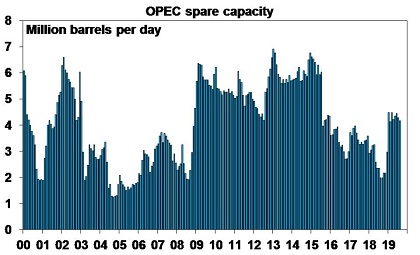
Since last Friday world oil prices are up by around 13%. Tensions have been escalating in the Middle East for a while now following President Trump’s decision to re-impose sanctions on Iran after the US withdrew from the nuclear deal with Iran. This has shown up in several attacks on oil shipments through the Strait of Hormuz, but the attack on Saudi oil production by drones takes it to a new level. Roughly 5.7 million barrels per day (mbd) of Saudi production is impacted and this is around 6% of global oil production. It also comes at a time when OPEC’s spare capacity of around 4mbd is reasonable but less than the outage from Saudi Arabia and there are ongoing issues in terms of supply from Venezuela and Libya.

View larger image

Source: Bloomberg, AMP Capital

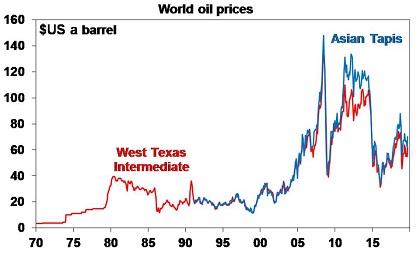
Of course, the 13% spike in the last few days needs to be seen in context and so far it’s a bit of a non-event with prices still below levels seen in April and a year ago.

View larger image

Source: Bloomberg, AMP Capital

However, the concern is that oil prices could go higher and listed here are the key uncertainties involving:

  • how long takes Saudi production to return to normal – latest indications are that it may take weeks and months;

  • the extent that the outage can be covered by stockpiles, reserves and spare capacity elsewhere – this should help but is unlikely to cover the full outage;

  • whether there might be more similar attacks – with drone attacks posing a new threat in multiple areas;

  • the retaliation Saudi Arabia and the US undertake with President Trump saying that the US is “locked and loaded” – which may worsen the conflict with Iran.

The 5.7mbd disruption makes it the worst in history – worse than the Iranian revolution (5.6mbd) that saw a roughly three-fold increase in oil prices and the Iraqi invasion of Kuwait (4.3mbd) that saw oil prices briefly double. So, a further spike in prices is likely if the threat continues to escalate.

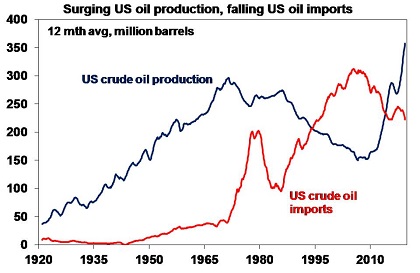
Working against this though: some of the disruption may be brief; OPEC’s share of world oil production has fallen from around 50% in the 1970s to below 40%; President Trump was elected after campaigning against never-ending wars in the Middle East and he may not want to risk further pushing up oil prices just over a year out from next year’s Presidential election so the US response may be limited to say taking out the drone bases where the attacks came from, albeit the risk of wider conflict has increased, and the US today is less reliant on global oil imports given a sharp spike in shale oil production. See the next chart.

View larger image

Source: Bloomberg, AMP Capital

Impact on global growth

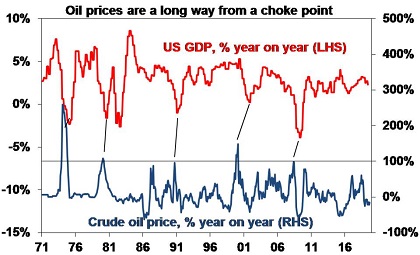
What happens if tensions in the Middle East between Iran & its proxies and Saudi Arabia & the US continue to escalate resulting in a further threat to supply and a further spike in oil prices? Past oil price surges have clearly played a role in US & global downturns – in the mid 1970s, the early 1980s, the early 1990s, early 2000s and even prior to the GFC. See the next chart. They weren’t necessarily the driver of these recessions as other factors (like interest rate hikes and the housing downturn prior to the GFC) often played a much bigger role. But they made things worse because a rise in oil and hence broader energy prices is effectively a tax on consumer spending which leads to lower growth in retail sales, car sales, etc.

View larger image

Source: Thomson Financial, AMP Capital

It’s not so much the oil price level that counts as its rate of change, as businesses and consumers get used to higher prices over time. Trouble normally ensues if the oil price doubles over 12 months. From where we were last week at around $US55 for West Texas Intermediate this would imply a rise to around $US110 a barrel (more for Brent and Tapis) and right now at around $US62 a barrel we are nowhere near that.

The situation in the US is also complicated because the surge in US oil production means that there is a huge boost to energy producers from higher prices providing some offset to the drag on consumers and businesses that use energy. Ultimately the negative impact on US consumers from rising oil prices would still dominate the positive impact on US energy producers so net its probably still a negative for US growth but just less so than in the past.

So, a further spike in oil prices that ultimately saw them double last week’s levels would be a significant threat to global growth. Particularly at a time when global growth has slowed, and trade wars pose an ongoing threat.

While higher oil prices boost inflation, central banks will ultimately look through this as it’s seen as a one off and ultimately less consumer spending power weighs on underlying or core (ie ex energy and food prices) inflation. So, a spike in oil prices is unlikely to stop further central bank easing as we saw in the early 1990s, early 2000s and through the GFC.

Impact on Australia

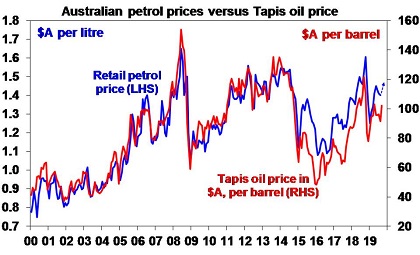
As can be seen in the next chart, Australian petrol prices track the Asian Tapis oil price in Australian dollars pretty closely because our prices are largely set globally (absent the GST, fuel excise, distribution costs and retailer margins). So spiking world oil prices will flow though to Australian motorists. Prior to the attacks in Saudi Arabia, Australian capital city petrol prices were around $1.40 a litre. The rise in oil prices since then implies a rise to around $1.46 a litre. This is not great for those of us who have cars, but would still see average petrol prices below the levels seen last October.

View larger image

Source: Thomson Financial, AMP Capital

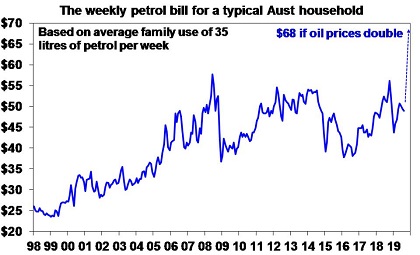
The real issue would come if world oil prices double as in past major Middle East crises. This would push petrol prices up to around $1.95 a litre. Such a rise in petrol prices would push the typical Australian family’s weekly petrol bill up to around $68 compared to $49 last month.

View larger image

Source: AMP Capital

This extra $19 a week impost would act as a significant tax on consumer spending and almost offset the recent tax refunds for low and middle income households. This in turn would act as an additional drag on consumer spending. Again, while higher energy prices would temporarily add to inflation the RBA with its focus on underlying inflation would look through this, particularly given the reduction in spending power – and hence underlying inflation pressures – that sharply higher petrol prices would result in. So, it would be another reason to expect further monetary easing from the RBA.

Implications for investors

The surge in oil prices is great for energy shares, but not good for the rest of the market given the impact on profit margins and consumer demand. It has also come at a time when global economic growth is fragile. Our base case is that tensions around Iran will be contained and the oil price won’t rise too far from here so it will be broadly neutral for global and Australian growth. But the risks have clearly increased and the situation regarding the Middle East and oil prices could trigger more volatility in the next month or so.

If you would like to discuss any of the issues raised by Dr Oliver, please call on Phone: 07 5641 4134 or email martin@wtfp.com.au.


Source: AMP Capital 17th September 2019

Important notes: While every care has been taken in the preparation of this article, AMP Capital Investors Limited (ABN 59 001 777 591, AFSL 232497) and AMP Capital Funds Management Limited (ABN 15 159 557 721, AFSL 426455) (AMP Capital) makes no representations or warranties as to the accuracy or completeness of any statement in it including, without limitation, any forecasts. Past performance is not a reliable indicator of future performance. This article has been prepared for the purpose of providing general information, without taking account of any particular investor’s objectives, financial situation or needs. An investor should, before making any investment decisions, consider the appropriateness of the information in this article, and seek professional advice, having regard to the investor’s objectives, financial situation and needs. This article is solely for the use of the party to whom it is provided and must not be provided to any other person or entity without the express written consent of AMP Capital.

How many other businesses are going after your target customers? What are they offering and how are they delivering it? Answering these questions will help you build a competitive strategy and make your business stronger. Here’s how to do it.

The benefits of a competitive strategy

Your competitors – the ones you worry about, anyway – have successful businesses. They have customers who like what they do, other businesses respect them, and they’re probably making money.

They’ve achieved all the things you want, while serving a similar market to yours. If you think of it that way, they’d make the perfect mentor. And while they probably won’t take you under their wing, you can make them your virtual mentor through competitor analysis. This kind of research can help you see:

  • what they’re doing better than you (so you can make improvements)

  • what marketing strategies and tactics are working for them

  • what mistakes they’ve made, so you can avoid them

  • what you’re doing better than them (so you can promote those things)

Taken together, all of these insights can feed into a competitive strategy. This doesn’t have to be a formal document. Your competitive strategy might simply exist within your overall business plan. But you should have one.

Who are your competitors?

There are two kinds of competitors to consider – those who have similar products or services as you, and those who have different products or services but which compete for the same dollar.

Consider the example of Netflix. They don’t just compete with other streaming services, they compete with cinemas, cable TV, YouTube, and other forms of on-screen entertainment like social media and gaming. Think broadly when you’re listing competitors. 

What to ask when doing competitor analysis?

Start with the big questions like:

  • Who are the major players serving this market?

  • Roughly how is the market split up between them?

Then dig a little deeper, with more specific questions like:

  • How does the market think about these competitors?
    Is someone the young person’s brand? Is someone else the cheap brand?

  • What sort of experience are they offering?
    How does their product or service look and feel? How does it work?

  • How are they delivering?
    What do they charge? How do customers order? What reviews do they get?

And for all of these questions, keep asking if your business could differentiate itself in some way.

Identify competitor strengths and weaknesses

As you learn more about your competitors, you’ll begin to see which ones will challenge you most. They might be in your region, or they might target the exact same market segment as you. List the strengths and weaknesses of these competitors.

Strengths might include things like:

  • great distribution – they’re in all kinds of shops, all over the place

  • huge brand awareness – they’ve been around forever and people trust them

  • really good networks – they’ve built lots of great relationships with buyers

  • low price point – it’s impossible for you to compete on price

Weaknesses might include things like:

  • a dull reputation – consumers don’t get a thrill buying from them

  • cheap packaging – their offering lacks polish

  • bad reviews – customers aren’t impressed with product quality

  • poor customer service – consumers don’t feel valued

By understanding your competitors’ strengths and weaknesses, you can figure out what differentiates you – and where you fit in the market.

What are your advantages?

When doing a competitor analysis, it’s important to consider your advantages. There may be things about your business that others can’t replicate, like:

  • Patents or licenses: Are you the only business that can produce a certain product?

  • Exclusive supply arrangements: You might be the only business in your area that can sell certain products.

  • Special processes: You might have a way of working that others don’t know about.

  • Lower costs: Maybe you can deliver products or services for less money.

It’s important to know where you have advantages like these. For example, you can play to these strengths in your marketing.

Will more competitors emerge?

Keep an eye on the future when doing your competitor analysis. If you’re in a hot industry, or you start doing really well, you might find a lot of new competitors enter the market. 

Ask yourself:

  • How hard would it be for someone new to come in with the exact same idea and take customers away from me?

  • How easy would it be for an established business to tweak their service or products to take away my competitive advantage?

The harder it is for competitors to replicate what you’re doing, the more comfortable you can feel.

Start your competitor analysis now

Competitor analysis will help with your business planning, your product or service development, and your marketing. An honest review of who’s out there and what they do well will help you find a part of the market you can own.

Find out who your competitors are, what niche they each serve, and where their strengths lie. Use the information to figure out where you fit in the market, and how you can maximise that position.

Whether you’re a new business or generations old, it’s never too soon to get a competitive strategy together.


Source: Xero 

Reproduced with the permission of Xero. 

Xero is software designed to make life better for small businesses and their advisors. Its online accounting platform provides the foundation on which businesses can build a complete business solution. It connects businesses with their bank, accounting tools, their accountant, payment services and third-party apps, so everything is securely available at any time, on any device. 

Important:
This provides general information and hasn’t taken your circumstances into account.  It’s important to consider your particular circumstances before deciding what’s right for you. Any information provided by the author detailed above is separate and external to our business and our Licensee. Neither our business nor our Licensee takes any responsibility for any action or any service provided by the author.

Any links have been provided with permission for information purposes only and will take you to external websites, which are not connected to our company in any way. Note: Our company does not endorse and is not responsible for the accuracy of the contents/information contained within the linked site(s) accessible from this page.

Introduction

After the biggest fall in at least 40 years – with a 10.2% top to bottom fall between September 2017 and June this year – average capital city home prices have turned up again. I thought prices would fall further with a 15% top to bottom fall led by around 25% falls in Sydney and Melbourne. But the facts changed from May – with the election removing the threat to negative gearing & the capital gains tax discount, earlier than expected interest rate cuts & a relaxation of APRA’s 7% interest rate test all pushing prices up again. So, where to from here?


Extreme property views

There are basically two extreme views amongst “property experts”. On the one hand, some real estate spruikers still wheel out the old “property will double every seven years” line. On the other hand, property doomsters say it’s hugely overvalued and overindebted with massive mortgage stress and so a 40% or so crash is inevitable. The trouble with the former is that implies home price growth of 10.3% pa, so even if wages growth picks up to 3.5% (a big ask!) it implies that the average price to income ratio of Australian housing will rise to around 9 times over the next 7 years from around 6 times now and in 14 years’ time it will be 14 times! The trouble with the doomsters is that they’ve been saying that for 15 years and we’re still waiting for the crash. In between, first home buyers are wondering why it’s so hard to do what my and my parent’s generation took for granted: be part of the Aussie dream with a quarter acre block. The reality is it’s far more complicated than these extremes. Here’s seven stylised “facts” regarding Australian property.

First – it’s expensive

This has been the case since early last decade and remains so despite the recent correction in prices:

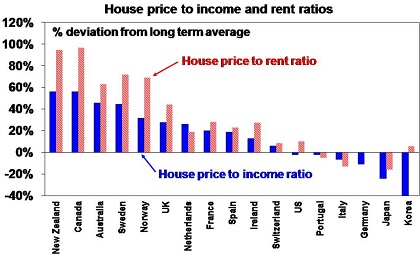
  • According to the 2019 Demographia Housing Affordability Survey the median multiple of house prices to income is 5.7 times in Australia versus 3.5 in the US and 4.8 in the UK. In Sydney, it’s 11.7 times & Melbourne is 9.7 times. 

  • The ratios of house prices to incomes and rents relative to their long-term averages are at the high end of OECD countries.


View larger image

Source: OECD, AMP Capital

  • The surge in prices relative to incomes has seen household debt relative to household income rise from the low end of OECD countries 25 years ago to the high end now.

These things arguably make residential property Australia’s Achilles heel. But that’s been the case for 15 years or so now.

Second – it’s diverse

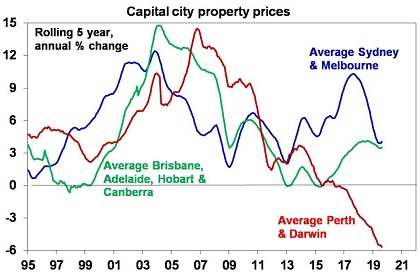
While it’s common to refer to “the Australian property market”, in reality there is significant divergence between cities. This divergence has been extreme over the last five years with Perth and Darwin seeing large price falls in response to the end of the mining investment boom, as other cities rose.

View larger image

Source: CoreLogic, AMP Capital

The divergence is also evident in gross rental yields that range from 8.7% in regional WA units to 3.1% in Sydney houses.

Third – talk of mortgage stress is overstated

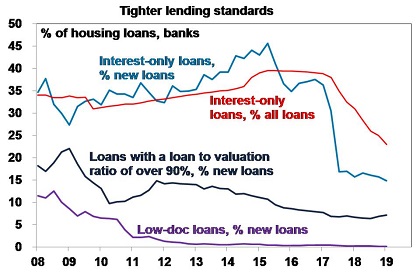
Headlines of excessive mortgage stress have been common for over a decade now. There is no denying housing affordability is poor, household debt is high and some households are suffering significant mortgage stress. But most borrowers appear to be able to service their mortgages. And despite some seeing negative equity and a significant proportion of borrowers switching from interest only to principle & interest loans (which has seen interest only loans drop from nearly 40% of all loans to 23%) there has been no surge in forced sales and non-performing loans. Non-performing mortgages have increased but remain low at around 0.9%. While Australia saw a deterioration in lending standards with the last boom, it was nothing like other countries saw prior to the GFC. Much of the increase in debt has gone to older, wealthier Australians, who are better able to service their loans. Low doc loans are trivial in Australia and the proportion of high loan to valuation ratio loans has fallen as has the proportion of interest only loans.

View larger image

Source: APRA, AMP Capital

Fourth – it’s been chronically undersupplied

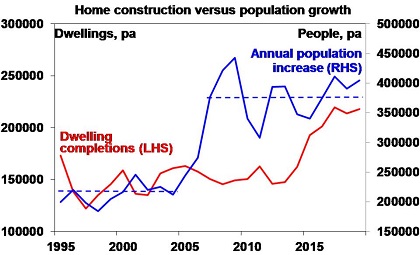
Annual population growth since mid-last decade has averaged 373,000 people compared to 217,000 over the decade to 2005, which requires roughly an extra 75,000 homes per year. Unfortunately, the supply of dwellings did not keep pace with the population surge (see the next chart) so a massive shortfall built up driving high home prices. Thanks to the surge in unit supply since 2015 this is now being worked off, but it follows more than a decade of accumulated undersupply which is the main reason why housing has remained relatively expensive in Australia. Not tax breaks or low rates – all of which exist in other countries with far more affordable housing!

View larger image

Source: APRA, AMP Capital

Fifth – house prices go up and down

After several episodes of price declines ranging from 5 to 10% across various cities over the last 15 years and 15%, 21% and 31% for Sydney, Perth and Darwin respectively in recent years home buyers should be under no illusion that prices only go up.

Sixth – the housing market remains rate sensitive

While it varies from city to city, despite much scepticism recent rate cuts have helped push up the property market again.

Finally – house price crashes are not easy to forecast

The expensive nature of Australian property and associated high debt levels have seen calls for a property crash pumped out repeatedly over the last 15 years. In 2004, The Economist magazine described Australia as “America’s ugly sister” thanks in part to soaring property prices. Property crash calls were wheeled out repeatedly after the Global Financial Crisis (GFC) with one commentator losing a high-profile bet that prices could fall up to 40%. In 2010, a US newspaper, The Philadelphia Trumpet, warned that “Los Angelification” (referring to a 40% slump in LA home prices around the GFC) will come to Australia. Similar calls were made a few years ago by a hedge fund researcher and a hedge fund: “The Australian property market is on the verge of blowing up on a spectacular scale.” Over the years these crash calls have often made it on to 60 Minutes and Four Corners.

But our view remains that to get a national housing crash – as opposed to periodic falls in some cities – we need much higher unemployment, much higher interest rates and/or a big oversupply. But while the risk of recession has increased it remains unlikely, aggressive rate hikes are most unlikely and while property supply still has more upside it’s unlikely to lead to a big oversupply as approvals to build new dwellings are now falling. As we have seen for years now overvaluation and high debt on their own are not enough to bring on a crash.

So where to now?

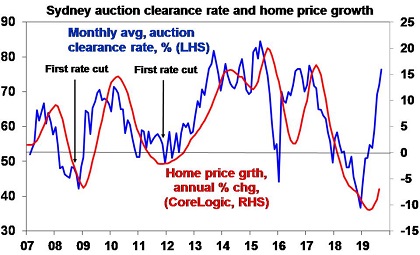
The rebound in buyer interest since May has seen auction clearance rates in Sydney and Melbourne rise to around 75% and prices lift nearly 2%, albeit other cities are mixed.  

View larger image

Source: Domain, CoreLogic, AMP Capital

This has so far come on low volumes, but they now look to be rising. Our base case is that house price gains will be far more constrained than the 10-15% implied by current auction clearance rates. Compared to past cycles debt to income ratios are much higher, bank lending standards are tighter, the supply of units has surged with more to come and this has already pushed Sydney’s rental vacancy rate above normal levels and unemployment is likely to drift up as economic growth remains soft. So, we don’t expect to see a return to boom time conditions and see constrained gains through 2020 – eg around 5% or so. There are three key things to watch:

  • The Spring selling season – if auction clearances remain elevated as listing pick up then it will be a positive sign that the pick-up in the property market has legs.

  • Housing finance commitments – these have bounced but will have to pick up a lot further to get 10-15% price rises. 

  • Unemployment – if it picks up significantly in response to slow economic growth then it will be a big constraint on house prices and could result in another leg down in prices.

We don’t see the rebound in the Sydney and Melbourne property markets as a barrier to further monetary easing, but it may reduce the need as it turns the wealth effect from negative to positive. And if it continues to gather pace then expect a tightening of the screws again from bank regulators.

Implications for investors

Over long periods of time residential property provides a similar return to shares (at around 11% pa) but it offers good diversification as it performs well at different times to shares so it has a role to play in investors’ portfolios. The pull back in prices in several cities in the last few years provides opportunities for investors, but just bear in mind that rental yields remain relatively low in Sydney and Melbourne and be wary of areas where there is still a lot of new units to hit. There is probably better value to be found in regional centres and Perth, and Brisbane looks attractive in offering reasonable yields, a low vacancy rate and improving population growth.

If you would like to discuss any of the issues raised by Dr Oliver, please call on Phone: 07 5641 4134 or email martin@wtfp.com.au.


Source: AMP Capital 11th September 2019

Important notes: While every care has been taken in the preparation of this article, AMP Capital Investors Limited (ABN 59 001 777 591, AFSL 232497) and AMP Capital Funds Management Limited (ABN 15 159 557 721, AFSL 426455) (AMP Capital) makes no representations or warranties as to the accuracy or completeness of any statement in it including, without limitation, any forecasts. Past performance is not a reliable indicator of future performance. This article has been prepared for the purpose of providing general information, without taking account of any particular investor’s objectives, financial situation or needs. An investor should, before making any investment decisions, consider the appropriateness of the information in this article, and seek professional advice, having regard to the investor’s objectives, financial situation and needs. This article is solely for the use of the party to whom it is provided and must not be provided to any other person or entity without the express written consent of AMP Capital.