As retirement comes into view, it’s time to imagine a new you for the post-work age.

You remember your first day at school, your first job, your first home. And now your final pay check is in sight. You’re nearly there. That’s quite an achievement.

How to be trigger happy

As with other big life events, retirement triggers choices that shape your future. Whether it’s moving to that dream cottage at the end of the peninsula or flexing that senior’s card for cheaper travel, it’s time to take stock and reboot your life.

You didn’t rock up at your first day of work without investing in appropriate clothes or checking out what kind of transport would get you there.

As you did when you started to invest, it makes sense to make sure you’re ready when the time comes so you can minimise surprises and maximise your new free time.

Dollars and sense

For instance, if you’re downsizing your house or vehicle, you might consider how shedding assets and acquiring new ones affect your tax position before you retire.

If you haven’t already, now’s the time to understand how your future will be financed. With the help of Adam Spencer, AMP explains how you can access your super via different types of pensions, and how these compare with the government’s age pension.

Whether you’re unsure about super, tax or dealing with Centrelink, a financial adviser might be able to help. Please contact us on Phone: 07 5641 4134 if you seek further assistance .

Having your finances in order is important, but there’s more than money to enjoying the fruits of your new phase of life. Here are five ways you can make sure retirement’s a milestone not a millstone.

1. Think mind and body

Without a clear idea of how you’ll spend your time, the initial euphoria of the untouched morning alarm can give way to anything from boredom to panic. Most of your 24 hours may be unstructured, so figure out how you’ll spend it wisely.

You might try something new. Perhaps now is the time to keep bees, join a choir or learn archery. If you have a partner, remember to involve them in the planning. Even if they don’t fancy joining you on a skydive, they may see a chance to learn how to take better action pictures.

Travel is near the top of many wish lists in retirement. If you don’t have the funds for a Caribbean cruise, there are a host of cheaper options around Australia and even beyond. And now you’ll have more time to spend, without worrying about annual leave quotas, or who’ll look after your business while you’re away.

2. Have a purpose

A rest is as good as a change. Recharging your batteries means getting them ready for your next challenge, rather than letting them go flat. Although it’s great to have unstructured time to think and dream, boredom can be a damaging state of mind, particularly if it’s prolonged. People who are no longer working can lose a sense of purpose, so make sure you have an idea of how you’ll use your extra hours to do something you love.

It’s OK to catch up on a few boxsets you missed out on along the way, but even Seinfeld only ran to 180 episodes, and most of them are only half an hour. If cocktail hour edges back before 5pm, that might be a sign you should join that book club or volunteer to widen your social circle.

It might mean doing more of what you love already, just more of it. Switching from sketching to watercolours. Thirty-six holes rather than eighteen.

If you’re already physically active, this can be a great time to extend yourself, embrace something new like yoga, or aqua aerobics. If you’re healthy but know you could improve, you might sign up for a sponsored cycle ride or walk to help a cause you care about.

3. Catch up on what you’ve missed

Many of us put off expanding our passions while we’re working because we don’t have time.

If you’ve always wanted to read the classics, now might be your chance to explore the jewels of world literature. Reading is brain expanding and inexpensive. Books older than 70 years from the death of the author are out of copyright and therefore cheap in print or even free on your Kindle. Plato and Charlotte Bronte take you to new lands without leaving your chair.

4. Follow your heart, not the herd

Just because the neighbours move to the beach house doesn’t mean you have to. You might prefer to be closer to the action of the city or just your favourite coffee shop.

Many people downsize coming up to retirement. A smaller property usually means lower utility bills and maintenance. Perhaps there’s an affordable unit close to your daughter’s place, or the first tee. If you’ve still got your long-gone kids’ stuff lying around the place, you could start the groundwork straight away, preparing your house for your new chapter.

But it’s not for everyone. If your spare bedroom has the right natural light for your artist’s studio or you just love your lemon trees, you might be better off staying where you are and saving yourself the real estate fees and hassles.

You’re facing a change in life, but you don’t have to change for change’s sake. Put yourself and your loved ones first.

5. Listen to the voice of experience

As with so many things in life, you can learn from experts . Talk to people you know who have already retired, and see what worked for them, and what they wish they’d put in place before they took the plunge.

Consider what will make you happy in the years beyond work, so you can live the life you want.

Finally, if you haven’t yet given these things serious thought yet, don’t panic. You’ve dealt with other changes in your life, this is just another one.

Think of it as a new adventure. Let’s face it, you’ve earned it.

Source : AMP October 2019 

This information is provided by AMP Life Limited. It is general information only and hasn’t taken your circumstances into account. It’s important to consider your particular circumstances and the relevant Product Disclosure Statement or Terms and Conditions, available by calling Phone: 07 5641 4134, before deciding what’s right for you.

All information in this article is subject to change without notice. Although the information is from sources considered reliable, AMP and our company do not guarantee that it is accurate or complete. You should not rely upon it and should seek professional advice before making any financial decision. Except where liability under any statute cannot be excluded, AMP and our company do not accept any liability for any resulting loss or damage of the reader or any other person.

Bad meme


There is always someone telling us that there is some sort of economic/financial disaster coming our way. However, there does seem to be a higher level of hand wringing now about the global economic outlook than normal. These concerns basically go something like this:

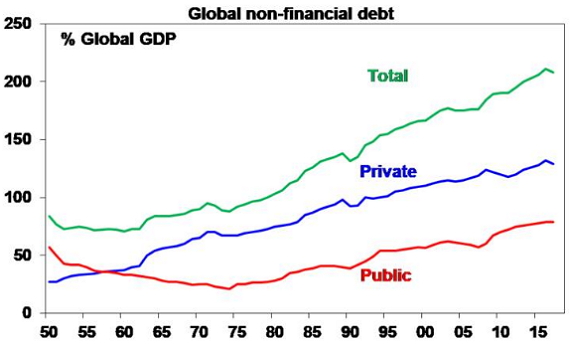
  • Global debt – both public and private – is at record levels relative to GDP and with public debt ratios so high there is no scope for fiscal stimulus should things go really bad.


Source: IMF, RBA, AMP Capital

  • Years of quantitative easing and other unconventional monetary policies like negative interest rates by central banks in major advanced countries haven’t worked and seem to have no end.

  • More and more debt globally is trading on negative interest rates – it’s now around $US14 trillion including around 25% of all government bonds – which is unnatural and causing distortions in valuing assets with risks of asset bubbles.

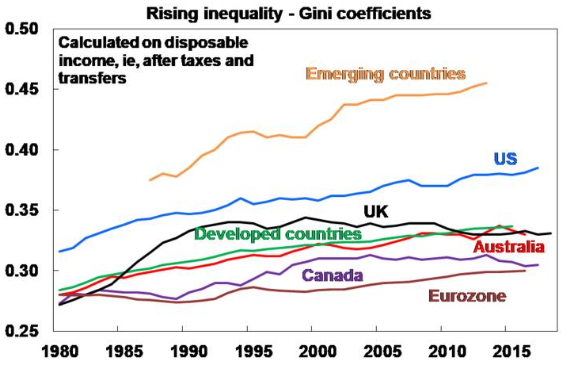
  • Inequality (as measured by Gini coefficients) is rising – particularly in the US – which is driving a populist backlash against rationalist market-friendly economic policies of globalisation/free trade (as evident in Trump’s trade wars), deregulation and privatisation.


Source: OECD, Standardised World Income Inequality Database, AMP Capital

  • This along with the relative decline of US economic and military power is contributing to geopolitical tensions as we move from a “unipolar world” (dominated by the US after the end of the Cold War) to a “multipolar world” as other countries (China, Russia, Iran/Saudi Arabia, etc) move in to fill the gap left by the US or even “challenge” the US.

This is all seen as being bad for global growth and hence growth assets, all of which is being heightened by the downturn in global growth seen over the last year or so.

Five reasons not to be too fussed.

There is no denying these concerns. Debt is at record levels globally. QE has been running in various iterations for more than a decade now in some countries. Inequality is up – albeit its mainly a US and emerging country issue. Support for market-friendly economic rationalist policies such as globalisation, deregulation and privatisation seems to have waned (except in France). And geopolitical risks are up. All these developments point to the risk of slower global growth and investment returns ahead and may figure in the next major bear market. But there is always something to worry about (otherwise shares would offer no return advantage over cash) and trying to time the next downturn is hard. Moreover, there are five reasons not to get too fussed about the global outlook.

1. Debt is more complicated than being at a record

History tells us that the next major crisis will involve debt problems of some sort. But what’s new – they all do! Just because global debt is at record levels does not mean that a crisis is imminent. There are several points to note here:

  • debt has been trending up ever since it was invented;

  • comparing debt to income (or GDP) is like comparing apples to oranges as debt is a stock and income is a flow – the key is to compare debt against assets and here the numbers are not so scary because debt and assets tend to rise together

  • debt interest burdens are low thanks to low interest rates

  • all of the rise in debt in developed countries since the GFC has come from public debt and the risk of default here is very low because governments can tax and print money.

While Modern Monetary Theory has its issues, it does remind us that as long as a government borrows in its own currency and inflation is not a problem, it has more flexibility to provide stimulus than high public debt to GDP ratios suggest.

2. QE’s end point is not necessarily negative

Quantitative easing and other unconventional monetary policies actually do appear to have helped. Since its high in 2013 unemployment in the Eurozone has fallen from 12% to 7.5% and in the US it fell from 9% in 2011 to 4% in 2017 enabling the Fed to start unwinding unconventional monetary policy. Inflation has not been returned to 2% targets, but wages growth has lifted and at the start of last year it looked like the global economy was getting back to normal. What kicked the global economy off the rails again was a combination of Trump’s trade wars, a debt squeeze in China and tougher auto emission controls. But this it wasn’t due to a failure of quantitative easing.

As to how quantitative easing is eventually unwound there is no easy answer, but there is no reason to believe that it will end with a calamity. First, in the absence of a surge in inflation necessitating a withdrawal of the money that has been pumped into the global economy there is no reason to withdraw it. And when inflation does start to rise it can be reversed gradually by central banks not replacing their bond holdings as they mature.

Second, the assets central banks purchased as part of QE have boosted the size of their balance sheets but the varied size of central bank balance sheets from one country to another as a share of their economy shows that there is no natural optimal level for them. In fact, the Fed is now resuming natural growth in its balance sheet as occurred prior to the GFC so its balance sheet may just stay high (as along as inflation is not a problem).

Finally, if push came to shove just consider what would happen if say the Bank of Japan told the Japanese government that it no longer expects payment at maturity for the 50% of Government bonds it holds? The BoJ would write down its bond holding and the Japanese Government would suffer a loss on its investment in the BoJ but that would be matched by a write down in its liabilities. Basically, nothing would happen except that Japanese government debt would fall dramatically!

3. Inflation and interest rates are low

The key thing that has caused many sceptics to miss out on good returns this decade is that they focussed on low inflation as reflecting low demand growth but missed out on the positive valuation boost to assets like shares and property that low inflation and low interest rates provides.

4. Rapid technological innovation and growth in middle income Asia is continuing

This is well known and has been done to death, so I won’t go over it suffice to say that there are still a lot of positives helping underpin the global outlook and these two remain big ones.

5. Global growth looks like it may pick up

While the slowdown in global growth over the last 18 months has been scary and associated with share market volatility, the conditions are not in place for a deeper slide into global recession like we saw at the time of the GFC – excesses like overspending, surging inflation, excessive monetary tightening are not present. In fact, various signs are pointing to a cyclical global pick up ahead:

  • Bond yields are up from their lows & look to be trending up

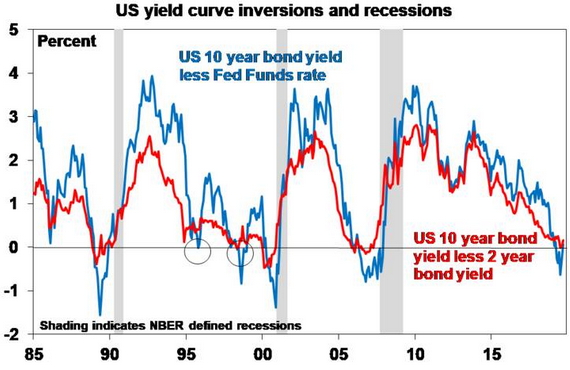
  • The US yield curve is now mostly positive – suggesting the inversion seen this year may have been another false recession signal like seen in 1996 and 1998


Source: NBER, Bloomberg, AMP Capital

  • European, Japanese & emerging shares are looking better

  • Cyclical sectors like consumer discretionary, industrials and banks are looking better

  • The US dollar looks like it might have peaked; and

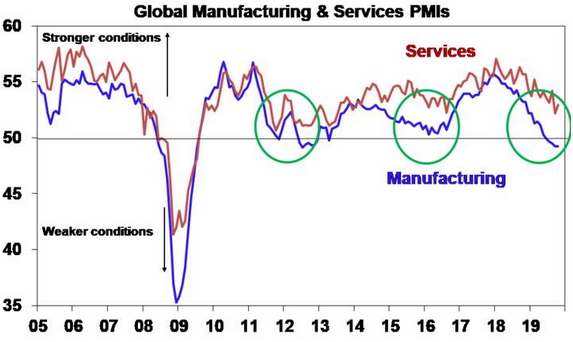
  • Business conditions PMIs for the US, Europe & China were flattish in October & may be stabilising. This saw the global manufacturing PMI go sideways and a rise in the services PMI and both still look like the 2012 and 2016 slowdowns.


Source: Markit, Bloomberg, AMP Capital

These could be pointers to global monetary easing getting traction. Of course, much depends on what happens to geopolitical risks. The US election next year will be a big one to keep an eye on and beyond that US/China tensions look likely to be with us for years. But there is reason to expect some respite in the short term on the geopolitical front:

First, the economic slowdown in both China and the US is pressuring both to defuse the trade dispute in the short term. This pressure is greater now as Trump wants to get re-elected next year and knows that he won’t if he lets the US slide into recession or unemployment rise. China may prefer to wait till after the election but is more likely to opt for the devil it knows.

Second, Trump’s avoidance of retaliation after the attack on Saudi’s oil production facilities in September shows a desire to avoid getting into military conflict in the Middle East.
Third, Brexit risks are on the back burner for now (although they could still come up again next year).

Concluding comment

There is good reason to expect the global economic cycle to turn up in the year ahead just as it did after the growth in 2012 and 2016. This should be positive for growth assets like shares. Finally, for those worried that more and more debt will trade at negative interest rates our view is that this is unlikely: many countries have already sworn off using rates including the US and RBA Governor Lowe says it’s extremely unlikely in Australia. And if growth picks up as we expect the proportion of global debt on negative rates will decline as it did after 2016.


Source: AMP Capital 7th November 2019

Important notes: While every care has been taken in the preparation of this article, AMP Capital Investors Limited (ABN 59 001 777 591, AFSL 232497) and AMP Capital Funds Management Limited (ABN 15 159 557 721, AFSL 426455) (AMP Capital) makes no representations or warranties as to the accuracy or completeness of any statement in it including, without limitation, any forecasts. Past performance is not a reliable indicator of future performance. This article has been prepared for the purpose of providing general information, without taking account of any particular investor’s objectives, financial situation or needs. An investor should, before making any investment decisions, consider the appropriateness of the information in this article, and seek professional advice, having regard to the investor’s objectives, financial situation and needs. This article is solely for the use of the party to whom it is provided and must not be provided to any other person or entity without the express written consent of AMP Capital.

At its meeting today, the Board decided to leave the cash rate unchanged at 0.75 per cent.

While the outlook for the global economy remains reasonable, the risks are tilted to the downside. The US–China trade and technology disputes continue to affect international trade flows and investment as businesses scale back spending plans because of the uncertainty. At the same time, in most advanced economies, unemployment rates are low and wages growth has picked up, although inflation remains low. In China, the authorities have taken steps to support the economy while continuing to address risks in the financial system.

Interest rates are very low around the world and a number of central banks have eased monetary policy in response to the persistent downside risks and subdued inflation. Expectations of further monetary easing have generally been scaled back over the past month and financial market sentiment has improved a little. Even so, long-term government bond yields are around record lows in many countries, including Australia. Borrowing rates for both businesses and households are also at historically low levels. The Australian dollar is at the lower end of its range over recent times.

The outlook for the Australian economy is little changed from three months ago. After a soft patch in the second half of last year, a gentle turning point appears to have been reached. The central scenario is for the Australian economy to grow by around 2¼ per cent this year and then for growth gradually to pick up to around 3 per cent in 2021. The low level of interest rates, recent tax cuts, ongoing spending on infrastructure, the upswing in housing prices in some markets and a brighter outlook for the resources sector should all support growth. The main domestic uncertainty continues to be the outlook for consumption, with the sustained period of only modest increases in household disposable income continuing to weigh on consumer spending. Other sources of uncertainty include the effects of the drought and the evolution of the housing construction cycle.

Employment has continued to grow strongly and has been matched by strong growth in labour supply, with labour force participation at a record high. The unemployment rate has remained steady at around 5¼ per cent over recent months. It is expected to remain around this level for some time, before gradually declining to a little below 5 per cent in 2021. Wages growth remains subdued and is expected to remain at around its current rate for some time yet. A further gradual lift in wages growth would be a welcome development and is needed for inflation to be sustainably within the 2–3 per cent target range. Taken together, recent outcomes suggest that the Australian economy can sustain lower rates of unemployment and underemployment.

The recent inflation data were broadly as expected, with headline inflation at 1.7 per cent over the year to the September quarter. The central scenario remains for inflation to pick up, but to do so only gradually. In both headline and underlying terms, inflation is expected to be close to 2 per cent in 2020 and 2021.

There are further signs of a turnaround in established housing markets, especially in Sydney and Melbourne. In contrast, new dwelling activity is still declining and growth in housing credit remains low. Demand for credit by investors is subdued and credit conditions, especially for small and medium-sized businesses, remain tight. Mortgage rates are at record lows and there is strong competition for borrowers of high credit quality.

The easing of monetary policy since June is supporting employment and income growth in Australia and a return of inflation to the medium-term target range. Given global developments and the evidence of the spare capacity in the Australian economy, it is reasonable to expect that an extended period of low interest rates will be required in Australia to reach full employment and achieve the inflation target. The Board will continue to monitor developments, including in the labour market, and is prepared to ease monetary policy further if needed to support sustainable growth in the economy, full employment and the achievement of the inflation target over time.

Source: Reserve Bank of Australia, November 5th, 2019

Enquiries

Media and Communications
Secretary’s Department
Reserve Bank of Australia
SYDNEY

Phone: +61 2 9551 9720
Fax: +61 2 9551 8033

Email: rbainfo@rba.gov.au

One thing that’s guaranteed to leave you feeling on top of the world, is a holiday. That’s until, along with the plane descending towards home, you sink into the beginnings of holiday debt regret. Even thinking about getting an Uber from the airport leaves you in a state of panic about dwindling your funds further.

We all fall into the trap of overspending on holidays and, really, why shouldn’t we? Holidays are an absolute necessity and we all thoroughly deserve to spoil ourselves. However, there’s a difference between splashing out occasionally and mindlessly blowing the whole budget in a state of freedom-induced spontaneity. 

Here’s how to avoid it in the future. 

Give your budget a head start

The time to avoid holiday debt regret is before you jump in the car or jet off to that exotic destination. Write down all the big expenses, including flights and accommodation, and aim to pay for those up front. While it’s still possible to get good deals at the last minute, you’ll find that most travel bargains appear well in advance, especially for flights. Doing this also gives you the time to do plenty of research to hunt them down, without needing to grab whatever’s available because you have to. 

To budget for food, activities, tours and transport while you’re there, really think about what you love doing best. For example, if scuba diving overseas is at the top of your list, tours to do so are likely to take a huge chunk out of the budget. To allow for it, figure out other ways to save, such as staying within close proximity to dive sites to avoid transport costs and booking an apartment with a kitchen to save on food. 

Use your own money and watch the fees

It’s pretty obvious that relying on credit cards to pay for holidays is a fast track to debt. Therefore, change your mindset about them and shove them very firmly into the ‘for emergency use only’ category, whether you stay at home or travel overseas. If you are heading across the pond, stay vigilant with regard to how much you’re paying for each transaction.

Make sure you’re fully informed about international transaction fees and exchange rates, with regard to your cards. Don’t withdraw money from ATMs constantly, as fees can add up astronomically before you know it. Speaking of which, it’s usually best to withdraw and pay in the local currency, rather than converting to the Australian dollar. Use travel money cards and preloaded credit cards, and get the maximum amount of cash out each time you withdraw. 

Don’t fall for tourist traps

No matter where you are in the world, it’s likely that tourist traps are out to get you. Those restaurants surrounding top attractions, more often than not, feature exorbitant prices and substandard food. Walk one or two streets away to find the real deal, at half the price. Avoid being sold on tours, activities or items by enthusiastic merchants, without doing your research first. If a deal sounds too good to be true, it usually is. So, rather than saving money, you’ll be throwing it away on something that doesn’t meet your expectations or breaks the second you get back to the hotel. 

With a bit of planning and awareness of what you’re actually opening your wallet for on holidays, you can avoid holiday debt regret and keep that stress-free feeling as a souvenir, long after you return home. 

Important:
Any information provided by the author detailed above is separate and external to our business and our Licensee. Neither our business nor our Licensee takes any responsibility for any action or any service provided by the author.

Any links have been provided with permission for information purposes only and will take you to external websites, which are not connected to our company in any way. Note: Our company does not endorse and is not responsible for the accuracy of the contents/information contained within the linked site(s) accessible from this page.

Can you recite the last line of Gone with the Wind? If not, you’ll find the answer at the end of this article.

If you scrolled down straight away, you might be too keen for your own good. We’ve all heard that patience is a virtue, and it can even save you money.

For people figuring out how to fund the lifestyle they’d like in retirement, now’s a good time to remember the benefits of delayed gratification.

That’s because instant gratification is the enemy of hitting your long-term goals, the things you’ve worked so hard to achieve. You might find that passing up something less important now will give you something more important when you retire.

Instead of deciding which new European car will make you the envy of your neighbours, you might imagine your grandkids running around with their own replica vehicles – or even a pony.

Why we want it now

It’s only human to want things straight away. Evolution has given us a desire for immediate rewards. We’ll eat the food in front of us if we’re not sure where the next meal’s coming from. Most other animals simply act on these impulses, they don’t know any other way. But we can imagine the future.

When it comes to finance, people don’t always make rational decisions, which is why some areas like house purchases usually have cooling-off periods. As you get closer to retirement, it’s good to think closely to make every buying decision count.

You have the power

Even if you think you’ve never been good at resisting temptation, it’s likely you’ve already practised some form of delayed gratification.

If you have kids, you’ll already know the challenges of unfiltered demands. Most parents teach the benefits of waiting and sacrificing something now for something more rewarding later.

None of us knows exactly how long we’ll be retired. Here are some ways you can resist the temptation to spend too much before your income changes.

Picture this

If you find it hard to respond to the urge to buy right now, it might be easier if you visualise what you want. Whether it’s that trip to Broome you’ve promised yourself or outings with your grandkids, pick one of your big goals and stick a picture of it under your fridge magnet.

A picture of a camel train on Cable Beach will look nicer than that unpaid invoice for that impulse extra bookshelf you didn’t really need.

Tell your friends

Your partner, family and friends can all help you get there. If you’re planning to renovate or downsize when you give up work, you might get some great tips for reliable tradies from those who have been there and done it.

Tell your family and friends your plans and see how your objective becomes theirs, bringing you useful advice and encouragement. You might also consider finding a financial adviser if you haven’t already done so. You don’t have to reach your goals all on your own. Even the solo round-the-world sailor has a support team. 

You might find it useful to talk to someone who is already retired about what they’d have done differently. Many people wish they’d put more aside to live more comfortably.

Shop around

There’s never been more choice than these days of online shopping. Although this means more temptation. it’s also never been easier to price check whatever you have your eye on. So, keep an eye on price comparison sites and discount codes to find the deal that’s right for something you really need now.

As advertisers get more and more personal data, they’re better at targeting what we want, and using techniques to persuade us to buy right now. Saving 10% off in the end-of-financial year sale still leaves 90% to pay, which might be worth several months of household bills down the line. Think of your other goals so you use the value scale that’s right for you.

What a difference a day makes

Taking time to reflect often changes the choices you make. Wait 24 hours and you might find you can do without that extra pair of shoes, when next day you come across three pairs you’ve hardly worn.

Many consumer goods are marketed to persuade you that you need something right now. Think of those shopping channel ads where they’ll throw in an extra mophead if you buy that new cleaner within the next 10 minutes. Make sure you really care about that mophead before you commit.

You can still pop the bubbly

Decide what you will keep doing. You might be able to do without your gym membership or trip to the symphony, but if you really love it, then it might be a false economy. Reaching your goals means you can still stay happy and healthy.

If you hit your plan you can reward yourself along the way. If you’ve cut out takeout coffee, then once a quarter you might have high tea at a smart hotel within your means. You’ll look forward to it more and celebrate reaching another milestone along the way.

And the last line of Gone with the wind?

Scarlett O’Hara says, “Tomorrow is another day.”

Please contact us on Phone: 07 5641 4134 if you seek further discussion on this topic.

Source: AMP October 2019 

Important:
This information is provided by AMP Life Limited. It is general information only and hasn’t taken your circumstances into account. It’s important to consider your particular circumstances and the relevant Product Disclosure Statement or Terms and Conditions, available by calling Phone: 07 5641 4134, before deciding what’s right for you.

All information in this article is subject to change without notice. Although the information is from sources considered reliable, AMP and our company do not guarantee that it is accurate or complete. You should not rely upon it and should seek professional advice before making any financial decision. Except where liability under any statute cannot be excluded, AMP and our company do not accept any liability for any resulting loss or damage of the reader or any other person.
 

Sidestep the negative effects of change with thorough succession planning and you’ll put your business ahead of the curve. Not only does this improve your company’s value, but it also provides something every good business manger strives for: your employees’ peace of mind.

You know this is true – succession planning is the cornerstone of any business that lasts. It smooths the way as one leader leaves and another takes over, creating an environment in which the new management – and your business – can be successful, while reducing the effects of the unavoidable turmoil of change.

Yet succession planning is so often overlooked.

According to Deloitte, 86 percent of leaders see leadership succession planning as ‘urgent’ or ‘important’, but only 14 percent believe they do it well.

This is something that I’ve seen regularly as the CEO of Star Business Solutions – an MYOB business partner.

Here it is in a nutshell:

  • Succession is inevitable

  • Planning is imperative to manage risk

  • It can affect your entire business

  • Consider the emotional aspects

  • Data provides objectivity during uncertainty

Succession planning for a family business is especially important, because the organisation is more than just a company – it’s a legacy, tied to the life’s work of just a couple of people. It’s so complex that there have been entire books written on the subject.

But even in traditional businesses, the process of letting go and handing over the reins to a successor can be surprisingly painful for the exiting leader.

Managed poorly, it’s not uncommon for the process of succession to stir up feelings of resentment, resistance and even hostility in otherwise level-headed business people.

In the middle of all that upheaval, the organisation and your team are left struggling to keep the doors open and the lights on.

A great succession plan doesn’t just create organisational stability, market confidence and value, it also comes with a raft of other benefits.

  • More diverse leadership – with the objectivity that comes from succession planning, you’ll be able to more clearly see what your company needs, rather than simply replacing leadership like for like.

  • A career pathway mapped for emerging leaders – this means you’ll be more able to attract and retain top talent with the promise of genuine opportunities to come.

  • A strong and healthy culture – panic-purchasing leaders is the fastest way to erode staff good will, and damage that intangible, yet utterly important element: culture. When you have time to consider your options, you’ll be able to choose leaders who will embody your company values and maintain a strong and healthy workplace culture.

Why succession planning will get you ahead

Having an eye on those inevitable future changes means you’ll transition more smoothly, and your new leadership will get fully operational faster. But that’s not all.

A succession plan is about more than just planning for the future – since so many businesses fail to do it, it actually gives you a competitive advantage.

You’ll be sidestepping the messiness, infighting and underperformance that so many of your competitors will deal with.

Systems ready for change

While software isn’t the be-all and end-all of business, an old or inefficient system can make a succession process far more difficult.

At the most basic level, when BAU relies too heavily on the knowledge of one leader, it creates risk – when that leader leaves, even with the best preparation, it’s likely they’ll be leaving gaps through which leak money, time and good will.

This is especially important if you’re replacing first-generation leaders, who’ve built the business almost from scratch. They may not even be aware of how much they know – the ratios, the leading indicators and warning signs, for example.

These can, and should, be taken out of leaders’ heads and embedded into the business intelligence reporting. This will mean the system plugs the knowledge gaps, and keeps everything ticking over, while staff and new leadership get their feet under them.

These systems should also enable leaders to track progress simply and quickly. This delivers much-needed oversight, allowing others in the leadership team, the board and any consultants to keep an eye on the business as the incoming leaders learn the ropes. This gives new leaders a safety net – they can trust that any major misses will be caught early by those in the business with more experience. Similarly, during a hand-over period, it allows the outgoing leadership to stay engaged with performance, without feeling like they’re breathing down their successor’s neck.

The data objectivity can also help minimise resistance and resentment. Planning for and finding a successor based on transparent, accessible data will let all management be engaged in the process, and more readily accept outcomes.

Plan for changes of leadership team, not just the CEO

Succession planning is so often focused on protecting the business when the CEO is replaced.

The reality is that this role, while truly critical, is only one piece of the management puzzle.

Any sudden or poorly planned exit of any of your senior leadership team can create problems. The new leaders, underprepared, could have gaping holes in their knowledge of your business systems and processes, and in their understanding of the new team.

At best, this will mean they take much longer to begin working at capacity. At worse, they’ll lose the respect and support of the people they’re leading, and make decisions that abjectly affect their department and the business as a whole.

A well-prepared leader will be equipped with the context and understanding needed to be successful in the role from day one – and for that they need to be entering the business under an agreed plan.

Establish long lead times

The ideal time to plan for succession of an organisation as a whole is when a business is established.

For senior leadership, preparing for their departure should begin as part of their induction process. Obviously, that rarely is the case, but it indicates how critical early preparation is.

With long enough lead time, preparing for this change becomes BAU for everyone in your business, rather than something that seems to come out of nowhere. It also gives you time to properly develop criteria for evaluating candidates and gives the outgoing leader a chance to prepare for the change – both practically and emotionally.

There can be huge problems with the outgoing CEO not letting go emotionally and practically. It can make the new leader’s job impossible and they’ll go elsewhere.

In a best-case scenario you’ll have five years to prepare for a change in CEO, with three years being the minimum. Succession plans for the remainder of the executive, and other management will need less time.

Establish accountability and advocacy

According to research from Deloitte, succession planning is often overlooked due to a lack of ownership – it’s not clear who bears responsibility for creating the plan or for finding top talent.

This means that while people acknowledge the importance of succession planning, they’ll assume it’s someone else’s job until told otherwise.

Similarly, having advocates at executive level will help build a succession culture into the organisation – staff at every level will expect succession planning as a normal part of growth and success.

Design for where you’re going

Most succession planning looks at what you need in order to maintain the status quo.

A moment’s pause will reveal the flaw here – succession planning should be about the future of the company, not its present.

Focusing on the needs of your business in the future won’t just better prepare your next leaders for the changing world but can help remove a barrier to successful planning itself: fear.

In most businesses, staff at all levels are incentivised to appear irreplaceable – and that butts up against the most basic goal of succession planning, which is, quite literally, to replace people. That often leads to leaders spending time protecting their patch and holding back from preparing people to take over.

If the goal is to build leaders for what the business is next, it removes the feeling that leaders are replaceable now.

This makes it easier for the outgoing leadership to accept that their replacement will – and should – do things differently. This can be particularly difficult if the outgoing leader still has an ongoing financial relationship

You might think, ‘It’s my money so I have a right to be involved here’, but it becomes counterproductive. You have to trust that you’ve made the right choice of leader, and then let them get on with their work.

Sidestep the messiness, smooth the transition

A successful business doesn’t stand still – it grows, innovates, maybe even diversifies. Meanwhile, your leadership can either stand still, or move forward with the future of the business.

A great succession plan, not just for the CEO but for all the individuals on the management team, creates an environment of stability, confidence and value in a business – definitely a competitive advantage. Not only that, but it diversifies the leadership, offers career paths for promising staff, keeps an eye on the future of your business, and maintains a healthy work culture for the present.

A smart leadership team will recognise the emotional and cultural risk of a poorly planned succession. You’ll manage a smoother transition by keeping software systems up to date (retaining specialist knowledge that’s currently in the heads of the Old Guard), assigning responsibility and advocacy for succession, and establishing clear future goals.

Most importantly, your plan will begin long before it’s needed, so when succession time happens, everyone is well prepared and ready for the inevitable.

Who knows? They might even look forward to the fresh air of change.

Source : MYOB 

Reproduced with the permission of MYOB. This article by  was originally published at https://www.myob.com/au/blog/succession-planning-competitive-advantage/


Important:
This provides general information and hasn’t taken your circumstances into account. It’s important to consider your particular circumstances before deciding what’s right for you. Although the information is from sources considered reliable, we do not guarantee that it is accurate or complete. You should not rely upon it and should seek qualified advice before making any investment decision. Except where liability under any statute cannot be excluded, we do not accept any liability (whether under contract, tort or otherwise) for any resulting loss or damage of the reader or any other person.

Any information provided by the author detailed above is separate and external to our business and our Licensee. Neither our business nor our Licensee takes any responsibility for any action or any service provided by the author.

Any links have been provided with permission for information purposes only and will take you to external websites, which are not connected to our company in any way. Note: Our company does not endorse and is not responsible for the accuracy of the contents/information contained within the linked site(s) accessible from this page. 

Planning can help you reach your savings goal sooner.

Do you want to save money for the future? Saving money is a process, and it helps to have a plan and budget to reach your financial goals. If you’re looking for ways to save money, these budgeting and money saving tips could help you reach your goals sooner.

How do Australians save?

Research by the Australian Securities and Investments Commission has found that almost three quarters of Australians save by putting spare money into a savings account, either by doing this themselves or by automatic transfer1.

Some of the other popular ways to save money include keeping money in an account that can’t be touched (like a term deposit), building up extra savings in a transaction account or depositing savings into a home loan offset account2.

What are you saving for?

The first step to save money is to figure out what your savings goal is. Recent research indicates that the most popular things Australians are saving for are a holiday, a rainy day and to buy or renovate a home2.

You could be saving for one of these goals, or something else, like having a baby, funding your kids’ education, or for retirement. No matter what your goal is, it helps to have it in mind—then you can work out how much you’d like to save to reach this goal, and by when.

Once you have your goal, write it down, tell a friend, or both. Research suggests that writing your goals down, sharing them and tracking them means you’re more likely to achieve them3.

What are some common tips to save money?

Once you’ve decided what you’d like to save for, how much you need to reach your goal, and when you need to reach it by, the next step to consider is where your money will come from. One of the most common ways to save money is to create a surplus between how much you earn and how much you spend each month.

If you’re spending every cent that comes in, you may need to identify extra income sources to help you earn more money, or think about reducing your spending to free up money for your savings goals.

When it comes to how to budget and save, these budgeting tips could be helpful to you get started:

1. Create and track your budget

Creating a money smart budget is often seen as the best way to save money. By tracking your income and your spending, you can identify where your money goes, and from this you can look into avoiding some non-essentials or reducing some expenses.

For example, if you buy your lunch every day at work, you could bring your lunch instead. If you spend on non-essentials like pay TV, gym memberships, entertainment and eating out, you could either cut back completely, or find more affordable options.

In the end, every bit adds up. It’s your lifestyle so you don’t need to deprive yourself of every bit of fun, but even cutting back a little bit here and there on expenses could make a difference.

2. Review your bill providers

Unfortunately, bills are a part of life, but it’s possible you may not be getting the best deals out there, especially if it’s been a while since you last contacted your providers.  Reach out to your gas, electricity, mobile phone and broadband providers, and see if they have better deals that you can switch to help you save more money, or get more from your provider.

Another option to consider could be shopping around for a new provider, especially if your contract is due to expire. There are plenty of product and service comparison sites available online which can help you make an informed decision that suits your lifestyle and your budget.

3. Think green and cut wastage

Thinking green doesn’t just help the environment— it can also be one of your ways to save money. For example, if you find you’re throwing out food at the end of every week, you might be able to reduce your grocery spending and your food waste. Likewise, instead of replacing household goods, you could consider repairing, reusing, or upcycling them for another purpose.

If you are a two-car household, it may help to think about whether you can do without the second car. While this may mean you spend more on public transport and taxis, the upside is that there are environmental benefits, plus you could save money on petrol, tolls, parking, registration, insurance and maintenance.

4. Consolidate your debts

If you have a number of debts, consolidating them into one may save you money and make budgeting and money management easier. Having multiple debts, such as credit card debt, personal loans and a home loan could mean you’re paying more in interest rates and fees than you have to, because you’re paying to different providers.

There are plenty of debt consolidation loans out there, so if you are considering this option then it may be beneficial to either speak to a financial adviser or look on a comparison website for the best deal.

What’s the best way to save money you’ve earned?

Once you’ve identified what you’re saving for and where you’re going to get money to save, you’ll need to work out the best way to save money.

The way you save money could be different, depending on whether your saving goals are for the long term or short term. For example, a separate savings account where your money is readily accessible might be useful for a short-term goal. On the other hand, a term deposit, where your money is tied up for a set period of time in return for higher interest, could be a more suitable option for a longer-term goal.

When you’re looking for a suitable savings product, you’ll need to factor in many things, such as the fees charged, interest rates, how accessible your money is, whether you can set up an automatic direct debit and whether there’s a minimum amount you need to deposit each month.

If you’re looking for ways to save money, here are some of the most common options out there:

Save money in a savings account

Most banks in Australia offer a variety of options for transaction and savings accounts. Standard savings accounts usually offer low fees and access to your money, but you may get a lower interest rate. High interest savings accounts typically have higher interest rates, but there may be penalties for withdrawing your money before a set period of time has passed, or if you don’t meet ongoing minimum deposit requirements.

Save money in an offset account

An offset account can help you save money by minimising the interest you pay on your home loan. Offset accounts allow you to put extra money into your account to offset your home loan balance, so you can save money and you only pay interest on the remaining portion of your loan.

Save money using a term deposit

As well as transaction, offset, and savings accounts, many banks also offer a term deposit option. Term deposits work by locking your money away for a certain timeframe (or ‘term’) in exchange for a guaranteed interest rate return during that time. A general rule of thumb is the longer the timeframe, the higher the interest rate.

Term deposits are generally low in fees, typically require a minimum initial deposit, and can sometimes require a minimum ongoing deposit. If you withdraw money from your term deposit account before the timeframe is over, you could pay additional fees.

Save money through investment bonds in Australia

Investment bonds are a tax-effective way of saving for the long term (longer than 10 years). Australian bonds typically require either a minimum deposit or minimum ongoing deposits, and you can choose how your money is invested.

Other options to save money

If you’re looking to save and grow your savings over the longer term, you could also consider putting your money into an investment. Some of the best ways to invest money in Australia include shares, property, exchange traded funds, and additional super contributions; however, this will depend on your lifestyle, the amount you have to save, and your risk tolerance.

Before investing your savings, it might be useful to speak to a financial adviser to help you make the right choice for your goals. Please contact us on Phone: 07 5641 4134 if you seek further assistance on this topic .

Source : AMP October 2019 

1 ASIC Moneysmart, How Australians save money.
2 ASIC Moneysmart, How Australians save money.
3 Dominican University, Goals Research, pg 3

Important:
This information is provided by AMP Life Limited. It is general information only and hasn’t taken your circumstances into account. It’s important to consider your particular circumstances and the relevant Product Disclosure Statement or Terms and Conditions, available by calling Phone: 07 5641 4134, before deciding what’s right for you.

All information in this article is subject to change without notice. Although the information is from sources considered reliable, AMP and our company do not guarantee that it is accurate or complete. You should not rely upon it and should seek professional advice before making any financial decision. Except where liability under any statute cannot be excluded, AMP and our company do not accept any liability for any resulting loss or damage of the reader or any other person.
The first rule of being a good public speaker is understanding it doesn’t come naturally, says public speaking coach Andrew Griffiths. Here’s how to overcome that.

According to this study people prefer the idea of death to speaking in front of a crowd of strangers.

Gulp. Seems a bit drastic, doesn’t it?

But as entrepreneur, author and public speaking coach, Andrew Griffiths told Flying Solo the  good news is that public speaking is something we can learn to excel at.

Lucky for us, he shares a stack of excellent tips in this video.

Here’s a sneak peek at the top 3:

1.Prepare, prepare, prepare

According to Andrew a big part of the reason we feel nervous about speaking is because we feel under prepared. He recommends doing your research and writing your speech well ahead of time so you can practice.

2.Remove the ‘unknowns’

Where possible try and Google the venue to find out what size the room is that you’ll be speaking at, and where in the room you’ll be standing.

3. Get to know your audience

Always arrive early to the event and use that time to chat to people in the audience. Andrew recommends telling them that you’ll speaking and if they have any thoughts on the topic, as this can be great addition to your intro.


Source : Flying Solo

This article by Lucy Kippist reproduced with the permission of Flying Solo – Australia’s micro business community. Find out more and join over 100K others.


Important:
This provides general information and hasn’t taken your circumstances into account. It’s important to consider your particular circumstances before deciding what’s right for you. Any information provided by the author detailed above is separate and external to our business and our Licensee. Any information provided by the author detailed above is separate and external to our business and our Licensee. Neither our business, nor our Licensee take any responsibility for any action or any service provided by the author.

Any links have been provided with permission for information purposes only and will take you to external websites, which are not connected to our company in any way. Note: Our company does not endorse and is not responsible for the accuracy of the contents/information contained within the linked site(s) accessible from this page.

How would you like to laze on one of the world’s best beaches for your next getaway? Voters in this year’s TripAdvisor Travellers’ Choice Awards ranked Australia’s Manly and Surfers Paradise beaches among the top 25. However, it’s these five dazzling stretches of sand that won the most sun-loving hearts.

5. Grace Bay Beach, Turks and Caicos

The poster child of the Turks and Caicos, Grace Bay often plays a starring role when it comes to the world’s best beaches. This tropical heaven is just a short flight from Florida and features easy access for boat trips to explore its barrier reef and incredible wall dives. Back on the beach, water sports take centre stage, with parasailing, banana boating and kayaking on a backdrop of pearly white sand and azure water. In terms of accommodation, take your pick of luxury resorts on the island of Providenciales, surrounded by world-class restaurants, shopping plazas and that all-important, easy-going vibe.

4. La Concha Beach, Spain

As far as city beaches go, San Sebastian’s La Concha certainly makes a sensory impact. The shell-shaped Concha Bay sets the scene for a diverse landscape including lush mountains and the city’s elegant architecture, like Miramar Palace. Find your own perch on the beach under a blue and white striped umbrella, to soak up the cosmopolitan atmosphere and indulge in people-watching. When hunger strikes, San Sebastian just happens to be one of the world’s foodie capitals, and nothing goes better with sun and sea than seafood tapas and sangria.

3. Eagle Beach, Aruba

With powder-soft sand that stretches on and on, Aruba’s Eagle Beach is often singled out as among the most beautiful in the Caribbean. Although you’ll find a holiday buzz along its sparkling shores, this is a low-rise hotel area with plenty of charming boutiques for a truly relaxing escape. Combine lazy days with turtle nest-spotting, photographing the iconic divi-divi trees and sipping cocktails at breezy beach bars. From here, it’s a quick taxi or bus ride to Oranjestad, the vibrant capital of the Dutch island.

2. Varadero Beach, Cuba

Varadero combines art galleries, markets, cigar shops and cabarets for a taste of Cuban culture, with the country’s premier beach destination. All-inclusive hotels, spas and restaurants line a spectacular, 20 kilometre stretch of uninterrupted white sand for a sun-drenched holiday. Sailing, glass-bottom boat rides and diving are at the top of the agenda, along with a round of golf or two. As the sun sets, a festive nightlife scene ensures you can get your fix of live music and salsa dancing.

1. Baia Do Sancho, Brazil

It’s not that easy to get to this year’s most-loved beach, which is perhaps part of the appeal for TripAdvisor voters. That and the fact that Baia do Sancho is a sheltered cove of glittering turquoise water and golden sand, wrapped in lush, forest-clad cliffs, on a paradise island. Keen beach-goers must traverse near-vertical ladders through a rock tunnel to feel that silky sand squishing underfoot, dive into the azure sea and enjoy the absence of crowds so often found on such slices of paradise.

You can count on it staying this way too, as the volcanic islands of Brazil’s Fernando de Noronha archipelago are part of a protected UNESCO World Heritage Site, with limited visitor access and an environmental fee to explore. To get there, the main island offers a small airport, with flights available from Recife and Natal.

Other beaches in the top 10 include Florida’s Clearwater, Spiaggia dei Conigli in Sicily, Grand Cayman’s Seven Mile Beach, Playa Norte on Mexico’s Isla Mujeres and that other famous Seven Mile Beach, in Jamaica. With so many inspirational shores to discover, it’s always a good time to pack the sunscreen and jet off to paradise.


Important:

This provides general information and hasn’t taken your circumstances into account. Any links have been provided with permission for information purposes only and will take you to external websites, which are not connected to our company in any way. Note: Our company does not endorse and is not responsible for the accuracy of the contents/information contained within the linked site(s) accessible from this page.

The world of investing can be confusing and scary at times. But fortunately, the basics of investing are timeless and some investors (often the best) have a knack of encapsulating these in a sentence or two that is insightful and easy to understand. In recent years I’ve written several insights highlighting investment quotes I find particularly useful. Here are some more.

The market

“Stock price movements actually begin to reflect new developments before its generally recognised they have taken place.” Arthur Zeikel

This goes to the nub of how share markets work – they are forward looking. Regularly I have seen share markets bottom and start moving higher even when the fundamental news is still terrible, only to see the news improve and vice versa. This is why many often get wrong footed – selling at bear market depths because the fundamental news is so bad and buying at the height of a bull market because the news is so good.

“It’s a basic fact of life that many things everybody knows turn out to be wrong.” Jim Rogers

This can’t apply to everything – eg if it’s raining outside then it is. But when it comes to investing this quote highlights how perverse it can be because when everyone is saying the same thing – like economic conditions are so bad shares can’t recover – then maybe the share market has already factored it in, the crowd has sold and the cycle will soon turn up.

“That men and women do not learn very much from the lessons of history is the most important of all the lessons of history.” Aldous Huxley

Which is partly why investment cycles perpetuate no matter how much regulators try and guard against a return to the behaviour which gave us the last boom and bust. The key for investors is to have an historical perspective, partly so they can filter the noise from what matters but also to help guard against being sucked up in periods of euphoria or pessimism.

“Cash is a fact, profit is an opinion.” Alfred Rappaport

This is one reason why dividends are great – providing they are not being paid for out of debt, they reflect that companies are actually generating cash and so can afford to pay the dividend.

Contrarian investing

“Even the intelligent investor is going to need considerable willpower to keep from following the crowd.” Ben Graham

When times are good the crowd is happy and fully invested. But it gets to a point where everyone who wants to buy has. This leaves the market vulnerable to bad news because there is no one left to buy. Similarly, after a sharp fall the crowd gets negative, sells their investments to the point that everyone who wants to sell has and so the market sets up for a rally when some good, or less bad, news comes along. So the point of maximum risk is when most are euphoric, and the point of maximum opportunity is when most are pessimistic. But for many investors trying to sell when the market is booming and all around you are euphoric is tough. As is trying to buy after the market has crashed and everyone is pessimistic.

Having a goal and a plan

“Compound interest is the eighth wonder of the world. He who understands it, earns it…he who doesn’t, pays it.” Albert Einstein

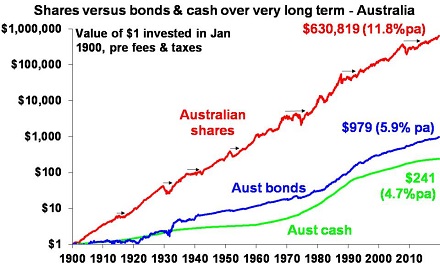
Some may argue it was Patsy Kensit! But when it comes to investing, your best friend is time and the earlier you start, the better. This is the best way to take advantage of the magic of compound interest. (And the worst way to experience its downside is letting credit card debt build up!) The next chart shows the value of $1 invested in various Australian asset classes since 1900 allowing for reinvesting any income along the way. That $1 would have grown to $241 if invested in cash, $979 in bonds but a whopping $630,819 in shares.


 View larger image

 Source: Global Financial Data, AMP Capital

While the average share return since 1900 is only double that of bonds, the huge gap in the end result between the two owes to the magic of compounding returns on top of returns. A growth asset like property is similar to shares over long periods. Short-term share returns bounce all over the place and they can go through lengthy bear markets (shown with arrows on the chart). But the longer the time period you allow to build your savings, the easier it is to look through short-term market fluctuations and the greater the time the compounding of higher returns from growth assets has to build on itself.

“Do not take yearly results so seriously. Instead focus on four or five year averages.” Benjamin Graham

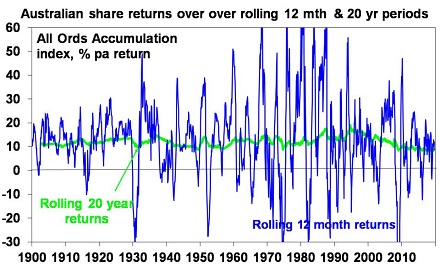
In the short-term, the share price for a company, asset class returns or returns from an investment product bounce around a lot. But this is mostly just noise and is no guide to the future and should be ignored. When it comes to share market returns the longer the investment horizon the better. As can be seen in the next chart while rolling 12 month share market returns are volatile rolling 20 year returns are solid and pretty stable.

Source: Global Financial Data, AMP Capital

Process

“No matter how good the science gets, there are problems that inevitably depend on judgement, on art, on a feel for financial markets.” Martin Feldstein

This is about having the right balance between science (to keep you disciplined and immune to market sentiment) and art (because quant models can be wrong too and won’t know about everything impacting markets) in your investment process.

“If you aren’t thinking about holding a stock for ten years, don’t even think about holding it for ten minutes.” Warren Buffett

Unless you really want to put a lot of time into trading, its best to only invest in assets you would be comfortable holding long term. This is less risky than constant tinkering.

“I have always told people who asked for a stock tip that unless they were prepared to ring me every week for a sell decision, a stock tip was useless.” Nikki Thomas

Stock tips are interesting but unless you get them as part of a process with regular updates (including when to buy and sell) they are of dubious value beyond possible entertainment.

“Diversification for investors, like celibacy for teenagers, is a concept both easy to understand and hard to practice.” James Gipson

But you gotta try because if you only have exposure to two or three shares in your portfolio you could be exposed to a very wild ride at times and even the risk of permanent capital loss.

Noise

“Based on personal experience – both as an investor & an expert witness – rarely do more than three or four variables really count. Everything else is noise.” Martin Whitman

The information revolution has given us an abundance of information and opinion about investing. The danger is that information overload adds to uncertainty resulting in excessive caution, an overreaction to news and a focus on things that are of little relevance. So turn down the noise!

Pessimism

“Anything that can go wrong and doesn’t go wrong is just waiting for a much worse time to go wrong.” Anon

Those perpetually forecasting a crash in Australian home prices are an example of this sort of thinking. The human brain evolved in a way that it leaves us hardwired to be on the lookout for risks. So, it’s easier to be sceptical and pessimistic. As a result, bad news sells and there seems to be a never-ending stream of warnings of the next disaster. But when it comes to investing, succumbing too much to pessimism doesn’t pay. Since 1900 shares have had positive returns seven years out of 10 in the US and eight years out of 10 in Australia.

Self-perception

“Everyone has the brain power to make money in stocks. Not everyone has the stomach. If you are susceptible to selling everything in a panic, you ought to avoid stocks and [investment] funds.” Peter Lynch

If you can’t handle volatility in financial markets without making rash decisions, then either they are not for you or you should just take a long-term approach and leave it to someone else.

“If you have trouble imagining a 20% loss in the stock market, you shouldn’t be in stocks.” John Bogle

Ditto. Successful investing is all about knowing yourself. Smart investors have an awareness of their weaknesses and seek to manage them. One way to do this is to take a long-term approach. If you want to trade day to day then you need to recognise that this requires a lot of effort, a rigorous process and a willingness to go against the crowd.

“A fanatic is one who can’t change his mind and won’t change the subject.” Winston Churchill

Many let blind faith in a strongly held view (“debt is too high”, “global oil production will soon peak”, “paper money will lead to economic disaster”, “Obamacare will destroy the US economy”, “the digital revolution means this time is different”) drive all their investment decisions. They could get lucky and be right at some point but end up losing a lot of money in the interim.

“If you don’t like something, change it. If you can’t change it, change your attitude.” Dr Mary Angelou

Following on from the last quote, to be a successful investor you need to humble, flexible and accepting of the reality of investment markets. Tilting at windmills doesn’t work.

Life balance

“Money is better than poverty if only for financial reasons.” Woody Allen

Classic Woody. But he’s definitely right.

“Money frees you from doing things you dislike. Since I dislike doing nearly everything, money is handy.” Groucho Marx

That may be true for him. But some of the best things in life are free (well, they don’t need money).

“Wealth consists not in having great possessions but in having few wants.” Epicetus

There is much more to being wealthy than just having money and possessions. We often focus on getting great possessions and hence the financial wealth to obtain them, but numerous studies show that beyond a certain level, more money won’t make you happier. And if we have fewer wants we are better able to focus on achieving those wants.

“Even right up to the end we found conflict with each other, which now means nothing. It just means nothing. If there is conflict in your lives – get rid of it.” Barry Gibb (on his relationship with Robin Gibb after Robin’s death)

Money often drives conflict. Try to make sure it doesn’t.


Author: Dr Shane Oliver, Head of Investment Strategy and Economics and Chief Economist, AMP Capital Sydney, Australia

Source: AMP Capital 24th Oct 2019

Important notes: While every care has been taken in the preparation of this article, AMP Capital Investors Limited (ABN 59 001 777 591, AFSL 232497) and AMP Capital Funds Management Limited (ABN 15 159 557 721, AFSL 426455) (AMP Capital) makes no representations or warranties as to the accuracy or completeness of any statement in it including, without limitation, any forecasts. Past performance is not a reliable indicator of future performance. This article has been prepared for the purpose of providing general information, without taking account of any particular investor’s objectives, financial situation or needs. An investor should, before making any investment decisions, consider the appropriateness of the information in this article, and seek professional advice, having regard to the investor’s objectives, financial situation and needs. This article is solely for the use of the party to whom it is provided and must not be provided to any other person or entity without the express written consent of AMP Capital.