
As most of us would be aware, Australia is prone to experiencing bushfires. And as BIG4 has parks dotted all over the country, it’s a given that we have a presence in regions where bushfires can hit.

Whether you’re travelling to, from, or within your holiday destination, we want you to have fun and enjoy your travels but to be safe at the same time. And while the safety of our guests is paramount at any time of year, the need to stress vigilance is heightened during bushfire season.

Yet there’s no need to be alarmed; rather, it’s about preparation and education. So we’ve put together a list of essential bushfire safety tips for you to follow, with important input from fire authorities.

1. Pack essential items

While there’s a lot to think about when packing for your holidays, it’s important to spare a couple of minutes to throw in a few essential items if travelling in a bushfire-prone area. The Western Australia Department of Fire and Emergency Services (DFES) recommends that during bushfire season you pack a survival kit with the following items:

  • AM/FM portable radio

  • Spare batteries

  • First aid kit

  • Woollen blankets

  • Drinking water

  • Protective clothing (long-sleeved cotton tops, pants, hats, and sturdy shoes)

  • A map of the local area


When checking the weather forecast, take a look for any fire warnings while you’re at it.

2. Monitor weather forecasts

Checking weather forecasts is something you’re likely to do in the lead up to and during your holiday anyway; probably to see if there’s any rain on the horizon that might jeopardise your outdoor plans. Yet in areas susceptible to bushfires, keeping an eye on weather forecasts takes on a more serious tone. Note any fire warnings, and be flexible with your travel plans if required.

Tasmania Fire Service spokesman Peter Middleton has some simple advice if you’re unsure what to do if you face a bushfire threat.

“Leaving early is always the safest option when a bushfire threatens. Fewer lives will be lost if people who choose to leave do so well before a bushfire threatens,” he said.

 

Make a note of the fire danger rating in the region or regions you are travelling in.

3. Be aware of fire danger ratings

Following the above point, it pays to know the fire danger rating in the region or regions you are travelling in.

Check the website of the country fire authority/service in the state or states applicable to your journey prior to and during travel, or watch for roadside signs. While the terminology of these fire danger ratings differs between states, generally there are six different ratings that range from ‘low moderate’ to ‘catastrophic’ or ‘code red’.

Country Fire Authority Victoria best outlines what each rating means to you when on your travels.

In addition, Western Australia DFES spokesman, Mark Graham, offers further advice if the higher ratings are in place.

“On these days, it is better to visit safe places such as cities and towns,” he said.
“If you plan to visit a place that is in a bushfire risk area, be prepared to change your travel plans at short notice should a fire start. And always advise your family of your travel plans.”

4. Fire bans

In addition, be aware of any fire bans – including total fire bans – in areas you are travelling through or staying in. In the case of a total fire ban, there are important restrictions regarding lighting of fires in open areas, among other limitations.

The Western Australia DFES has a great FAQs section that details what you can and can’t do during a total fire ban, including restrictions around the use of barbecues. The South Australian Country Fire Service also offers easy-to-follow FAQs.

In addition, ask BIG4 staff if there are any restrictions that apply within the park you are staying at.

5. Jot down bushfire information line numbers

It’s also worth noting the bushfire information line phone number that is applicable to the state or states you are travelling in. A call to these numbers provides general bushfire advice.

VIC: 1800 240 667

WA: 13 3337

SA: 1300 362 361

TAS: 1800 000 699

QLD: ruralfire.qld.gov.au (no general information line available)

NSW: 1800 679 737

ACT: 13 22 81

NT: www.lrm.nt.gov.au/corporate/contacts (find the region relevant to you)

Of course, in emergency situations simply dial 000.

 

Fire crews do a great job combatting bushfires each summer.

6. Don’t panic

If you do find yourself driving within a bushfire-affected area, it’s important to be as calm as possible. Western Australia DFES’s Mark Graham has sound advice if you are on the road and in the vicinity of a bushfire.

“If you see smoke and flames you should leave the area immediately by driving away from the fire. Do not wait to see what happens,” he said.

“If there is a lot of smoke, slow down and be aware. There could be people, vehicles, and livestock on the road. Turn your car headlights on and close windows and outside vents.”

Remember that being prepared rather than alarmed is the key to enjoying your break. We wish all BIG4 guests a happy and safe time when on the road during the bushfire season.


Source : BIG4 Holiday Parks 

Reproduced with the permission of BIG4 Holiday Parks. This article first appeared on BIG4.com.au  and was republished with permission.

Important:
Any information provided by the author detailed above is separate and external to our business and our Licensee. Neither our business nor our Licensee takes any responsibility for any action or any service provided by the author.

Any links have been provided with permission for information purposes only and will take you to external websites, which are not connected to our company in any way. Note: Our company does not endorse and is not responsible for the accuracy of the contents/information contained within the linked site(s) accessible from this page

Leading is tougher than managing

If you manage people, you’ll know it can be hard work. Every employee is different, with unique needs, desires and motivations. Each has their own strengths and weaknesses. And you have to figure those out if you want to get the best out of your staff.

But leading is even tougher than managing. Leading means:

  • bringing people with you on the journey

  • tapping into their emotions and engaging them with your vision

  • understanding their motivations and linking those to your organisation’s future

  • connecting all employees to a common goal.

To explore what this means in practical terms, we spoke to Chiquita Searle, General Manager of the League of Extraordinary Women. Her organisation relies on volunteers, female entrepreneurs, interns and remote staff. They’re all working towards a common goal, so we asked her to share her tips about leadership.

Being an effective leader is often easier said than done. But this guide will help you on your path to becoming one.

1. Lead from the front

If you want to be seen as a leader, you must act like one. You are accountable for your business. In simple terms, the buck stops with you.

Your employees will look to you for guidance. They will take their cues from you. Through inspiration, a good leader can change an entire organisation for the better.

As leader you are the heart of your business – you are its pulse. If you skip a beat, so does your organisation. So stand tall when leading your people, and lead from the front.

2. Make room for mistakes

Failure is part of learning. We know that’s true for children and it applies to adults too. Failure teaches lessons that success never can. Yet many workplaces don’t allow space for failure.

If you want to lead, be prepared for mistakes. Instead of reprimanding your employees when things go wrong, ask them what they learned. Then make sure they apply that new learning to their work.

Being lenient about genuine mistakes will encourage your employees to experiment with new ideas. Some of them will pay off for your business – big time.

3. Empower your team

If you’ve hired the right employees then you’ll know what your team members can do. That means you believe in their skills, experience and personalities.

So tell them that. Give them the gift of your belief in them. Your employees will blossom with the knowledge that you really value them. Their confidence will inspire them to achieve great things.

4. Temper criticism with praise

Sometimes things don’t go according to plan. You may have to steer your employees back onto the right course if they lose their way.

Try to do so without undermining their confidence. The ‘feedback sandwich’ is a good way to achieve this:

  • Start with a positive.

  • Deliver the negative, but do it constructively.

  • End with another positive.

5. Show your team the big picture

If your staff feel like small cogs in a giant machine, you won’t get the best out of them. So take the time to explain how each of them fits into your organisation.

Everyone likes to feel part of something big. Employment is about more than earning a wage – it’s about making a valuable contribution.

Helping others can be intrinsically rewarding in a way that money never can. Make every employee feel part of the big picture. Share your business plan with them.

6. Focus on development

Employment is a two-way street. Your employees are looking for more than financial reward. They need:

  • help achieving their career goals

  • the benefit of your wisdom and experience

  • the space and time to learn new skills

  • your guidance and advice.

The more time you spend actively helping your employees, the better they will feel. Your support and investment in their future will help motivate them.

They will repay you many times over – with commitment, hard work and good ideas.

Source : Xero

Reproduced with the permission of Xero.

Xero is software designed to make life better for small businesses and their advisors. Its online accounting platform provides the foundation on which businesses can build a complete business solution. It connects businesses with their bank, accounting tools, their accountant, payment services and third-party apps, so everything is securely available at any time, on any device.

Important:
This provides general information and hasn’t taken your circumstances into account.  It’s important to consider your particular circumstances before deciding what’s right for you. Any information provided by the author detailed above is separate and external to our business and our Licensee. Neither our business nor our Licensee takes any responsibility for any action or any service provided by the author.

Any links have been provided with permission for information purposes only and will take you to external websites, which are not connected to our company in any way. Note: Our company does not endorse and is not responsible for the accuracy of the contents/information contained within the linked site(s) accessible from this page.

Is there a special recipe equity investors can follow to outperform the returns from the broader market?

Based on the latest performance scorecard of Australian active investment managers released in September by S&P Dow Jones Indices, if that recipe does exist, most professional portfolio managers don’t have it.

The SPIVA Australia Scorecard covering the year to 30 June, 2019 shows that, on an absolute return basis, out of around 850 Australian active equity funds, only a small percentage outperformed the indices they use to benchmark their performance.

While it’s probably cold comfort for most investors, the Australian results were not isolated. In fact, they were just a microcosm of similar underperformance trends recorded by active portfolio managers around the world.

Heightened global market volatility, fuelled by rising geopolitical tensions and weaker economic and business conditions, made last year particularly difficult for many active managers.

But what about the active fund managers who did outperform in the face of adversity? Were they doing something different to the majority by following a special recipe?

To answer that, one would need to look at the specific portfolios and strategies of each manager. However, what’s more important to recognise is that, while it’s interesting to measure short-term investment performances, active management is a long-term process.

An investment manager who outperforms over one year can just as easily underperform over the next, depending on a whole raft of factors.

Yet, there are three key ingredients investors should add to their investment recipe to improve the probability of achieving outperformance from actively managed funds over the longer term.

Ingredient 1: Identify top talent

Finding the best investment managers is critical to enhance one’s prospects of better returns, but where should one start in the context that past performance should never be used to gauge future returns?

Here at Vanguard, we believe a firm and its people must demonstrate a culture of investment excellence, strong experience and stewardship, have a clear philosophy and sound processes that can be executed well and consistently over time.

It’s also important that an active fund’s historical portfolio holdings and characteristics align with the manager’s overriding philosophy and processes, and that the drivers of past performance are logical and sustainable over the long term.

Ingredient 2: Keep costs low

The biggest quantitative ingredient that investors can control and use to improve the likelihood of outperformance is costs.

In effect, every dollar spent on investment-related costs including management fees is a dollar less in net return. So, it stands to reason that a lower-cost active manager will deliver better relative performance against a like competitor manager charging higher fees.

Of course, that’s not the complete story on costs. On an active management level, costs by themselves do not lead to consistently identifying active funds that will outperform.

Instead, low costs need to be identified and blended with investment talent to give one the best chance of achieving success through managed funds.

Ingredient 3: Patience is key

As noted above, challenging market conditions can have a harmful impact on the performance of investment managers, irrespective of their past track record.

In fact, even the top-performing investment managers over longer periods are likely to underperform their benchmark at some stage due to unforeseen events.

While low costs and a rigorous, considered manager selection process can go a long way to improve your results using active management, those benefits can be eroded significantly if one fails to maintain a long-term perspective.

This is because there is inconsistency inherent in achieving excess returns. Returns will invariably differ from year to year.

Understanding this inconsistency is critical for those who may be tempted to use short-term past performance as a primary basis for entering and exiting active funds.

Conclusion

Successful active management needs to be driven by a combination of top talent, low costs, and patience.

While outperforming the broader market is the ongoing objective for all active fund managers, achieving outperformance consistently is full of challenges.

Vanguard has close to $2 trillion in active assets under management globally and, spanning back to our beginnings in 1975, our extensive research confirms that active funds that have shown better performance returns over time are those run by experienced and talented managers, have low cost structures, and take a patient rather than reactive investment approach.

Depending on one’s investment strategy and risk tolerance, actively managed funds remain a good complement and diversifier to other types of products such as index-tracking managed funds and exchange-traded funds.

Source : Vanguard October 2019 

Reproduced with permission of Vanguard Investments Australia Ltd

Vanguard Investments Australia Ltd (ABN 72 072 881 086 / AFS Licence 227263) is the product issuer. We have not taken yours and your clients’ circumstances into account when preparing this material so it may not be applicable to the particular situation you are considering. You should consider your circumstances and our Product Disclosure Statement (PDS) or Prospectus before making any investment decision. You can access our PDS or Prospectus online or by calling us. This material was prepared in good faith and we accept no liability for any errors or omissions. Past performance is not an indication of future performance.

© 2019 Vanguard Investments Australia Ltd. All rights reserved.

Important:
Any information provided by the author detailed above is separate and external to our business and our Licensee. Neither our business nor our Licensee takes any responsibility for any action or any service provided by the author.

Any links have been provided with permission for information purposes only and will take you to external websites, which are not connected to our company in any way. Note: Our company does not endorse and is not responsible for the accuracy of the contents/information contained within the linked site(s) accessible from this page.

Sometimes we don’t appreciate what we have in our own backyard.

This is despite the plethora of astounding natural attractions that are sprinkled all over the country.

Some of these fascinating wonders wouldn’t be out of place on another planet. Others are so ridiculously beautiful, you could stare at them all day.

It’s time to celebrate Mother Nature’s brilliance with this collection of mind-boggling natural attractions.

Sea cliffs, Tasman National Park, TAS

The enormous dolerite sea cliffs found at the bottom of the Tasman Peninsula are simply gob-smacking. Measuring up to 300m in height, these jutted creations are perfectly suited to the rugged, almost unworldly coastal surrounds. These are the southern hemisphere’s highest sea cliffs, and for the daring they are an abseilers’ mecca. For the rest of us, simply stare in amazement at what is hands down among the best attractions in Tasmania.

Visit on a daytrip from…BIG4 Hobart Airport Tourist Park.

The enormous sea cliffs in Tasman National Park are sure to astound you.

Umpherston Sinkhole, Mt Gambier, SA

The word ‘sinkhole’ seems to be all the rage these days but this mighty marvel was formed well before the term became fashionable. Once a limestone cave, the sinkhole is the result of corrosion from seawater that led to the cave’s roof collapsing. It’s since been transformed into a stunning sunken garden – not so natural, but hey – that you can admire day and night. Even more appealing is the sinkhole’s proximity to the Mt Gambier CBD.

Visit when staying at…BIG4 Blue Lake Holiday Park.

The Umpherston Sinkhole was once a limestone cave, but is now a surprisingly beautiful sunken garden.

The Pinnacles, Nambung National Park, WA

Prepare to encounter a scene widely regarded as being better suited to Mars. The Pinnacles is a mammoth collection of weathered limestone pillars that protrudes from desert-like surrounds and makes for an awe-inspiring sight. Adding to the peculiarity of the occasion is knowing just how close to the ocean you are – yet you’ll likely feel as far removed from water as you will from earth as you know it. Fascinating.

Visit on a daytrip from…BIG4 Ledge Point Holiday Park.

Stand amongst the limestone pillars that are the Pinnacles and you’ll feel as though you could be anywhere.

Grampians National Park, VIC

The Grampians receives loads of footprints each year, yet pay a visit to it and you’re likely to feel that still, somehow, this area is vastly underrated. Sure, there are tourists around but it’s easy to opine that the area should be swarming with them. Best not to wonder too long and instead enjoy the spine-tingling experience of standing directly underneath or atop the craggy, towering sandstone mountain ranges. The Grampians thoroughly deserves to be regarded as one of the best national parks in Australia

Visit when staying at…BIG4 NRMA Halls Gap Holiday Park.

Undara Lava Tubes, Undara Volcanic National Park, QLD

Once there was furious volcanic activity, now there is a series of remarkable tunnels and caves to explore. Lauded as among the largest and longest lava tubes on the globe, Undara is the result of volcanic spew that was generated almost 200,000 years ago. Lots and lots of spew. And vomit has never been so enticing: the results of this ancient fury is so captivating and intrinsic that it’s sure to feature prominently on your Instagram account.

Visit on a daytrip from…BIG4 NRMA Atherton Tablelands Holiday Park.

The Undara Lava Tubes experience is sure to provide some Instagram-worthy moments.

Bungle Bungles, Purnululu National Park, WA

When it comes to Australia’s most jaw-dropping attractions, the Bungle Bungles consistently earn a podium finish. This Kimberley icon consists of a cluster of beehive-like, cone-shaped towers that are simply dazzling, particularly when witnessed from the air. Found 290km south of Kununurra, this World Heritage wonder is colourful, spectacular, and absolute bucket-list material.  

Whether witnessed by air or by foot, the Bungle Bungles are spectacular. 

Stromatolites of Hamelin Pool, Shark Bay, WA

Stromatolites. Heard of them? Google the definition and you’ll find a description most of us won’t understand. All you really need to know is that stromatolites are regarded as living fossils; those at World Heritage-listed Shark Bay are regarded as the oldest and largest of their type; and they are amazing to look at. This funky photo subject is 225km south of Carnarvon and roughly 300km north of Geraldton.

You may not have heard of stromatolites, but they’re sure to amaze you when you see them.

Kata-Tjuta, Uluru- Kata-Tjuta National Park, NT

Move over, Uluru. We’re shining the spotlight on your less-hyped neighbour. Kata-Tjuta – also known as the Olgas – is a gathering of giant red sandstone domes that dominate the surrounding arid landscape. Thought to have once been a single rock, these three dozen domes make for some damn fine photo ops. And, interestingly, the highest point of Kata-Tjuta – Mt Olga – reaches a height of 546m above ground, making it roughly 200m higher than Uluru.

Visit on a daytrip from…BIG4 MacDonnell Range Holiday Park.

Snap a quintessential Aussie photo at Kata-Tjuta.

Wilpena Pound, Flinders Ranges, SA

How did that happen? is what you’ll find yourself thinking when viewing this incredible attraction. The most notable landmark in the famous Flinders Ranges, Wilpena Pound is a huge, sunken natural amphitheatre of such remarkable beauty that you can’t help but be astounded by it. Viewing it on a scenic flight and taking in the richness of the landscape’s colours is just about unbeatable.

A scenic flight is one of the best ways to view the amazing Wilpena Pound.

Australia’s pink lakes, various locations

We couldn’t just settle on one Australian lake to feature but we did narrow it down to a type: the pretty-in-pink lakes dotted around the country. These bright beauties easily rank among Australia’s best natural attractions. Pink Lake near Esperance in South West WA and Lake Hillier in the same pocket of the state are key examples, while the Pink Lakes of Murray-Sunset National Park in northwest Victoria are also outstanding.

There are a range of pink lakes across Australia, but this one near Esperance in WA is particularly stunning.

Kings Canyon, Watarrka National Park, NT

Wow. Just wow. The towering sandstone walls of Kings Canyon are quite simply astonishing. These walls contrast jaggedness with smoothness, all brightly coloured and beautiful and demanding more clicks of the camera than your average celebrity. Planted 470km from Alice Springs on sealed roads, this top attraction rewards whether you’re peering upwards or taking in all its glory on a rim walk.

Visit on a daytrip from…BIG4 MacDonnell Range Holiday Park.

Whether taken in from below or viewed in all its glory on a rim walk, Kings Canyon is well worth a visit.

Walls of China, Mungo National Park, NSW

When it comes to jaw-dropping Australian natural attractions, this crazy creation demands serious attention. Here, nature has carved out crescent-shaped sand and clay dunes so dramatic and mind boggling that you’ll be thoroughly absorbed. It’s a key feature of the World Heritage Willandra Lakes region, 125km from Mildura, which is famed for its immense cultural significance.

Visit on a daytrip from…BIG4 Golden River Holiday Park or BIG4 Mildura Getaway Holiday Park.

Explore the dramatic landscape around Mungo National Park.

Budj Bim National Park (Mount Eccles National Park), VIC

Largely flying under the radar, the stunning works of the dormant volcano Budj Bim make for engrossing exploration. Rocky outcrops dominate the surrounds and give way to a beautiful crater lake that can be spied from various vantage points. The park is rich with Aboriginal history and culture and warrants plenty more attention than it receives.

Visit on a daytrip from…BIG4 Port Fairy Holiday ParkBIG4 NRMA Warrnambool Riverside Holiday Park, or BIG4 Warrnambool Figtree Holiday Park.


Wave Rock, Hyden, WA

Ahhh, Mother Nature. Haven’t you had fun here? Welcome to one of Australia’s funkiest natural attractions. Without roadside signage, you could easily pass by this rocky phenomenon without realising you’re missing out on a must-visit attraction. Aptly named for its smooth, wave-like carving, this granite cliff stands an impressive 15m high and extends for 110m. It’s spotted 330km east of Perth.

It may not be near the beach, but don’t write off this quirky attraction – it will likely be the most interesting wave you’ve seen.


What is your favourite Australian natural attraction? Have you visited any of these sites and have a story to share? We’d love to get your thoughts in the comments section below.

Isn’t it time you enjoyed a nature-based escape? Book your next BIG4 break now.


Source : BIG4 Holiday Parks

Reproduced with the permission of BIG4 Holiday Parks. This article first appeared on BIG4.com.au  and was republished with permission.

Important:
Any information provided by the author detailed above is separate and external to our business and our Licensee. Neither our business nor our Licensee takes any responsibility for any action or any service provided by the author.

Any links have been provided with permission for information purposes only and will take you to external websites, which are not connected to our company in any way. Note: Our company does not endorse and is not responsible for the accuracy of the contents/information contained within the linked site(s) accessible from this page.

Introduction

After sharp share market falls when headlines scream about the billions wiped off the market the usual questions are: what caused the fall? what’s the outlook? and what does it mean for superannuation? The correct answer to the latter should be something like “nothing really, as super is a long-term investment and share market volatility is normal.” But that often sounds like marketing spin. However, the reality is that – except for those who are into trading or are at, or close to, retirement – shares and super really are long-term investments. Here’s why.

Super funds and shares

Superannuation is aimed (within reason) at providing maximum (risk-adjusted) funds for use in retirement. So typical Australian super funds have a bias towards shares and other growth assets, particularly for younger members, and some exposure to defensive assets like bonds and cash in order to avoid excessive short-term volatility in returns.

The power of compound interest

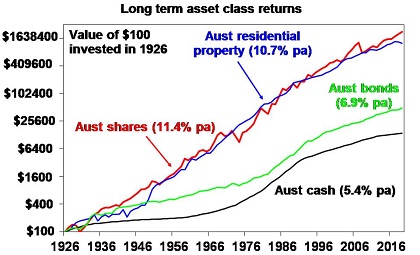
These approaches seek to take maximum advantage of the power of compound interest. The next chart shows the value of a $100 investment in each of Australian cash, bonds, shares, and residential property from 1926 assuming any interest, dividends and rents are reinvested along the way. As return series for commercial property and infrastructure only go back a few decades I have used residential property as a proxy.

View larger image

Source: ABS, REIA, Global Financial Data, AMP Capital

Because shares and property provide higher returns over long periods the value of an investment in them compounds to a much higher amount over long periods. So, it makes sense to have a decent exposure to them when saving for retirement. The higher return from shares and growth assets reflects compensation for the greater risk in investing in them – in terms of capital loss, volatility and illiquidity – relative to cash & bonds.

But investors don’t have 90 years?

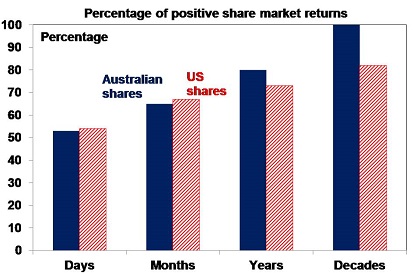
Of course, we don’t have ninety odd years to save for retirement. In fact, our natural tendency is to think very short term. And this is where the problem starts. On a day to day basis shares are down almost as much as they are up. See the next chart. So, day to day, it’s pretty much a coin toss as to whether you will get good news or bad. So, it’s understandable that many are skeptical of them. But if you just look monthly and allow for dividends, the historical experience tells us you will only get bad news around a third of the time. If you go out to once a decade, positive returns have been seen 100% of the time for Australian shares and 82% for US shares.

View larger image

Daily & mthly data from 1995,yrs & decades from 1900. GFD, AMP Capital

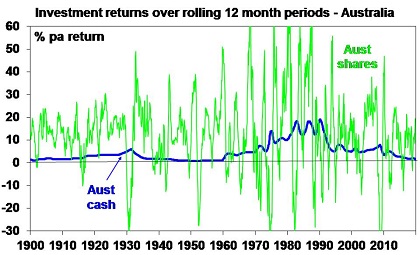
This can also be demonstrated in the following charts. On a rolling 12 month ended basis the returns from shares bounce around all over the place relative to cash and bonds.

View larger image

Source: Global Financial Data, AMP Capital

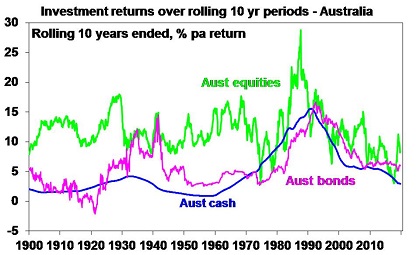
However, over rolling ten-year periods, shares have invariably done better, although there have been some periods where returns from bonds and cash have done better, albeit briefly.

View larger image

Source: Global Financial Data, AMP Capital

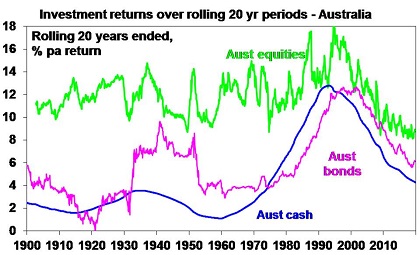
Pushing the horizon out to rolling 20-year returns has almost always seen shares do even better, although a surge in cash and bond returns from the 1970s/1980s (after high inflation pushed interest rates up) has seen the gap narrow.

View larger image

Source: Global Financial Data, AMP Capital

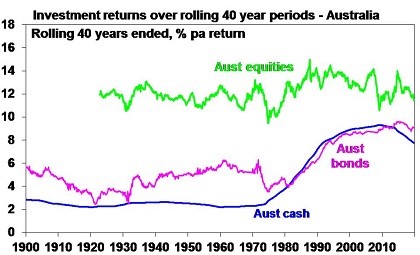
Over rolling 40-year periods – the working years of a typical person – shares have always done better.

View larger image

Source: Global Financial Data, AMP Capital

This is all consistent with the basic proposition that higher short-term volatility from shares (often reflecting exposure to periods of falling profits and a risk that companies go bust) is rewarded over the long term with higher returns.

But why not try and time short-term market moves?

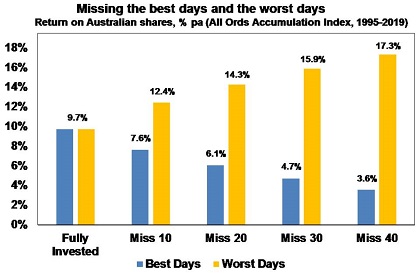
The temptation to do this is immense. With the benefit of hindsight many swings in markets like the tech boom and bust and the GFC look inevitable and hence forecastable and so it’s natural to think “why not give it a go?” by switching between say cash and shares within your super to anticipate market moves. Fair enough if you have a process and put the effort in. But without a tried and tested market timing process, trying to time the market is difficult. A good way to demonstrate this is with a comparison of returns if an investor is fully invested in shares versus missing out on the best (or worst) days. The next chart shows that if you were fully invested in Australian shares from January 1995, you would have returned 9.7% pa (with dividends but not allowing for franking credits, tax and fees).

View larger image

Source: Bloomberg, AMP Capital

If by trying to time the market you avoided the 10 worst days (yellow bars), you would have boosted your return to 12.4% pa. And if you avoided the 40 worst days, it would have been boosted to 17.3% pa! But this is very hard, and many investors only get out after the bad returns have occurred, just in time to miss some of the best days. For example, if by trying to time the market you miss the 10 best days (blue bars), the return falls to 7.6% pa. If you miss the 40 best days, it drops to just 3.6% pa.

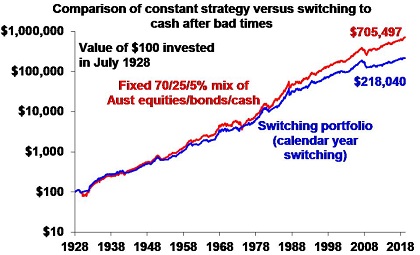
The following chart shows the difficulties of short-term timing in another way. It shows the cumulative return of two portfolios.

  • A fixed balanced mix of 70 per cent Australian equities, 25 per cent bonds and five per cent cash;

  • A “switching portfolio” which starts off with the above but moves 100 per cent into cash after any negative calendar year in the balanced portfolio and doesn’t move back until after the balanced portfolio has a calendar year of positive returns. We have assumed a two-month lag.

View larger image

Source: Global Financial Data, AMP Capital

Over the long run the switching portfolio produces an average return of 8.8% pa versus 10.2% pa for the balanced mix. From a $100 investment in 1928 the switching portfolio would have grown to $218,040 compared to $705,497 for the constant mix.

Key messages

First, while shares and other growth assets go through periods of short-term underperformance relative to bonds and cash they provide superior returns over the long term. As such it makes sense that superannuation has a high exposure to them.

Second, switching to cash after a bad patch is not the best strategy for maximising wealth over time.

Third, the less you look at your investments the less you will be disappointed. This reduces the chance of selling at the wrong time or adopting an overly cautious stance.

The best approach is to simply recognise that super and investing in shares is a long-term investment. The exceptions to this are if you are really into putting in the effort to getting short-term trading right and/or you are close to, or in, retirement.

Source: AMP Capital 14th November 2019

Important notes: While every care has been taken in the preparation of this article, AMP Capital Investors Limited (ABN 59 001 777 591, AFSL 232497) and AMP Capital Funds Management Limited (ABN 15 159 557 721, AFSL 426455) (AMP Capital) makes no representations or warranties as to the accuracy or completeness of any statement in it including, without limitation, any forecasts. Past performance is not a reliable indicator of future performance. This article has been prepared for the purpose of providing general information, without taking account of any particular investor’s objectives, financial situation or needs. An investor should, before making any investment decisions, consider the appropriateness of the information in this article, and seek professional advice, having regard to the investor’s objectives, financial situation and needs. This article is solely for the use of the party to whom it is provided and must not be provided to any other person or entity without the express written consent of AMP Capital.

In today’s environment of low interest rates, many investors are chasing income by moving into lower-quality high-yield bonds, but are they ignoring the downside risks?

While an overweight to high-yield credit may be an efficient way to boost a portfolio’s yield, investors need to be mindful of the additional risks they are taking on and how those risks will interact with other parts of their investment portfolio.

For example, for retirees seeking a stable income-generating portfolio, the addition of less-liquid bonds that have an increased risk of capital volatility might not be the right investment option, despite the income they produce.

Here, we explore the different types of fixed income securities and their associated risks.

Types of fixed income securities 

The types of fixed income securities investors can choose from include both publicly-traded debt securities (such as corporate bonds, sovereign and non-sovereign government bonds, supranational bonds, and commercial paper) and privately-traded instruments (such as loans and privately placed securities). The credit market also includes structured financial instruments, such as mortgage-backed securities, asset-backed securities, and collateralized debt obligations, which tend to exhibit higher yields (and lower liquidity) as the complexity increases.

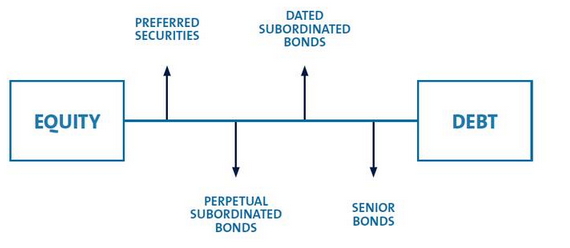
Within corporate bonds, there are several classes of debt, ranging from senior bonds to preferred securities. Senior bonds have greater security in the issuer’s capital structure than subordinated debt and preferred securities. In the event the issuer goes bankrupt, senior debt must be repaid before other creditors receive any payment. Senior debt is often secured by collateral on which the lender has put in place a ‘first lien’ or legal right to secure the payment of debt. The further down the capital structure a security is, the higher the risk of ultimate loss.

The importance of quality bonds

A bond issuer’s ability to pay its debts (i.e. to make all interest and principal payments in full and on schedule) is a critical concern for investors. Most corporate bonds are evaluated for credit quality by credit rating agencies, such as Standard & Poor’s, Fitch Ratings and Moody’s Investors Service, and result in a rating on a standard scale that can be compared across issuers. These ratings scales are broadly split into two categories to reflect safer securities – referred to as “investment-grade” – and riskier securities – referred to as either “speculative-grade” or “high-yield”.

The financial health of the company or government entity issuing a bond affects the bond’s yield and subsequently the price investors are willing to pay. If the issuer is financially strong and investors are confident that the issuer will be capable of paying the interest on the bond and pay off the bond at maturity, then the yield will be lower as the perceived risks are lower.

High-yield corporate bonds on the other hand have lower, speculative-grade credit ratings than their investment-grade brethren. The greater risk of loss implied by these lower ratings, leads to higher yields compared with those seen within investment-grade corporate bonds. This is because there is a higher probability that a borrower defaults or fails to meet its obligation to make full and timely payments of principal and interest. Historically, speculative-grade companies experience higher default rates throughout economic cycles – and particularly so during recessions – resulting in potentially significant losses to investors when these occur.

Liquidity and volatility

High-yield bond funds tend to invest in loans, corporate bonds and structured credit which are at the riskier end of the investment universe. These types of securities can be difficult to buy or sell as they do not trade frequently, making them less liquid than investment-grade bonds. Bond funds where the underlying investments are investment-grade rated typically provide investors with daily liquidity as the market for these assets is larger, better-known and therefore more liquid. This is most prevalent when markets are volatile and investors are searching for “safer” assets, and when market pricing tends to be very reactive to liquidity and volatility risks.

High-yield bond funds can often have returns that behave similarly to equity markets; in other words, their returns often move in the same direction as equity markets. This is due to the capital price impacts of movements wider in credit spreads; namely the size of the bond yield margin above a risk-free asset yield which compensates investors for the associated credit risk. Typically, a credit spread reflects the difference in yield between a treasury and corporate bond of the same maturity.1

When credit spreads widen, this is a reflection that the market for those securities is requiring higher compensation for the underlying risk of holding those securities – for instance, for a higher risk of default, or more compensation for liquidity risk.

In times of heightened volatility, these dynamics can become self-reinforcing, given the right conditions. For instance, investors observing the capital value of their investment falling (as risks are increasing) may attempt to sell their exposure. If enough investors attempt to sell the same assets into a liquidity-constrained environment, this can exacerbate the issue, causing further losses – and in extreme circumstances, can cause a fund to “lock-up”, or result in capital being unable to be returned to investors in a timely fashion.

All investors have a different risk-return appetite; however, investors need to be mindful that economic growth has been reasonably solid for much of the past decade, and an environment where yields have been pushing progressively lower creates an environment where liquidity and volatility risks may not be appropriately priced in some markets. Funds with larger exposures to credit investments of lower-quality or greater complexity are likely to exhibit a higher likelihood of drawdowns on capital, and the potential for negative returns.

The final word

The ‘lower-for-longer’ interest rate theme continues to dominate markets, and low yields are likely to see low returns from bonds for a period of time. Investors moving into lower-quality high-yield bonds, should consider whether the additional yields on such bonds adequately offset the higher capital volatility and liquidity risks that come with them.

A retiree, or someone heading into retirement typically needs an investment strategy designed to provide a predictable and reliable income stream throughout their retirement years so if you’re not comfortable with capital volatility, lack of liquidity and you require a regular reliable monthly income stream, then a high-yield bond fund may not be the best choice for you.

There are many options along the risk curve when it comes to fixed income, with cash at the least risky end and instruments such as hybrids that also have equity characteristics at the other end. In other words, there is a wide spectrum of fixed income investments and it pays to understand what these are, the risks they have and how they can help meet set goals when building the fixed income component of a portfolio.


1 https://www.investopedia.com/terms/c/creditspread.asp


Author:  Nathan Boon, Sydney, Australia

Source: AMP Capital 12th Nov 2019

Important notes: While every care has been taken in the preparation of this article, AMP Capital Investors Limited (ABN 59 001 777 591, AFSL 232497) and AMP Capital Funds Management Limited (ABN 15 159 557 721, AFSL 426455) (AMP Capital) makes no representations or warranties as to the accuracy or completeness of any statement in it including, without limitation, any forecasts. Past performance is not a reliable indicator of future performance. This article has been prepared for the purpose of providing general information, without taking account of any particular investor’s objectives, financial situation or needs. An investor should, before making any investment decisions, consider the appropriateness of the information in this article, and seek professional advice, having regard to the investor’s objectives, financial situation and needs. This article is solely for the use of the party to whom it is provided and must not be provided to any other person or entity without the express written consent of AMP Capital.

There are mechanisms to maximise returns in this lower-for-longer environment, and a green alpha strategy in real estate investment is one option on the table.

Against a global backdrop of lower interest rates, falling government bond yields and bank term deposit returns at or below 2 per cent, achieving higher, low risk returns is becoming more challenging for investors.

With the lower for longer trend seemingly entrenched as global economic uncertainty rises, investors are turning to green alpha strategies as one way to maximise returns, whilst improving the sustainability performance of Australia’s built environment at the same time.

How does this apply to real estate?

From a real estate perspective, maximising the returns you can generate in a portfolio is primarily linked to boosting the rental income and keeping operational costs down. Reducing the outgoings of an asset by cutting energy costs is an important, and relatively simple method to boost income yields and according to market evidence and international studies into green buildings, can make significant differences to the return an asset delivers over its life.

Asset valuations and returns are already starting to reflect a growing divergence between high-standard green buildings and their less green peers that can add as much as 50bps per annum to a total return.

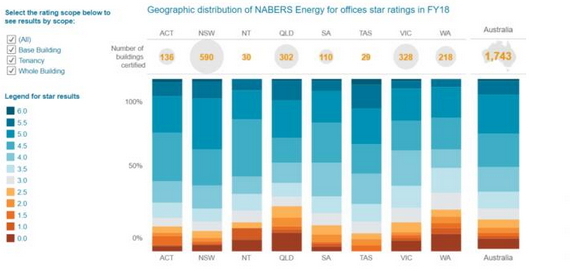
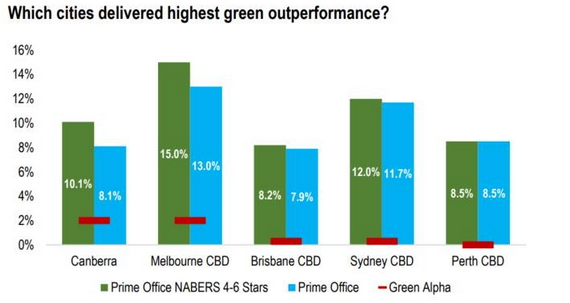
For example, according to the MSCI Green Property Investment Digest, over the past three years, Prime CBD Office buildings with a NABERS star rating higher than four stars (the maximum is six) have delivered a total return to their investors of 13.4%, versus 12.9% for all other assets in this category.


Source: NABERS.gov.au

Looking at a cities level, investors chasing green returns might do well to focus on the Melbourne market, which had the highest total returns for prime office buildings with a 4-6 star NABERS rating at 15% in the year to June 2019.

After Melbourne, investors in Canberra benefitted from the highest ‘green alpha’ with a 200 basis point boost in total returns, versus the average for the prime office market there. Government tenants in this market place a high priority on green credentials when leasing space, driving better income return outcomes for landlords who can offer 5 star plus opportunities in that market.


Source: MSCI/IPD, AMPCI RE Research

Thinking long term, and looking beyond cost savings, sustainability initiatives such as integrated solar in commercial assets can provide long term downside protection against spikes in electricity costs. These sort of initiatives could reduce the outgoings of an asset, a competitive advantage at a time where electricity prices have risen by over 20% in the past two years.1

Green alpha and the boost it provides to total returns has become a bigger part of an asset manager’s toolkit in maximising returns. Greener buildings, apart from delivering superior returns, tend to offer investors lower systemic risk with a more stable income profile, lower incentives and enhanced tenant “stickiness” which can reduce the vacancy of a portfolio.

The bottom line is, environmentally sustainable buildings offer both financial and environmental benefits to investors for the long term. In an increasingly challenging lower for longer returns environment, green alpha is a pathway to get ahead of the pack.


1 https://www.nabers.gov.au/publications/annual-report


Author: Luke Dixon, Head of Real Estate Research – Real Estate Sydney, Australia

Source: AMP Capital 28th Oct 2019

Important notes: While every care has been taken in the preparation of this article, AMP Capital Investors Limited (ABN 59 001 777 591, AFSL 232497) and AMP Capital Funds Management Limited (ABN 15 159 557 721, AFSL 426455) (AMP Capital) makes no representations or warranties as to the accuracy or completeness of any statement in it including, without limitation, any forecasts. Past performance is not a reliable indicator of future performance. This article has been prepared for the purpose of providing general information, without taking account of any particular investor’s objectives, financial situation or needs. An investor should, before making any investment decisions, consider the appropriateness of the information in this article, and seek professional advice, having regard to the investor’s objectives, financial situation and needs. This article is solely for the use of the party to whom it is provided and must not be provided to any other person or entity without the express written consent of AMP Capital.

Investors may be surprised to learn about the patterns which have formed in the small caps market since the Global Financial Crisis. Here, we take a closer look at recent data, and what is driving earnings and valuations.

Overview

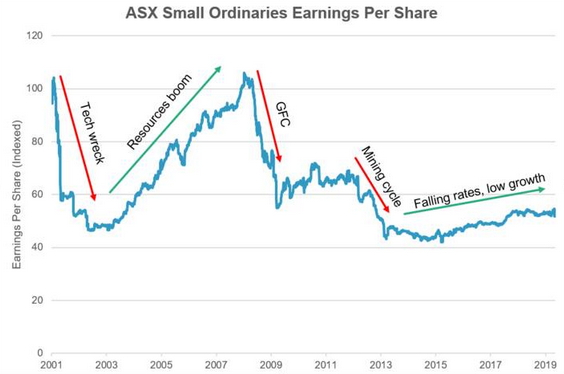
Australian small cap stocks have failed to live up to their potential in recent times. By definition, small cap companies are generally at an earlier stage of their life cycle with good growth opportunities ahead, and in an environment of record low interest rates and freely available money for companies to expand their operations, it would be expected that they are growing strongly and generating good returns. Some are doing just that, however it may surprise investors that the aggregate level of earnings generated by companies in the ASX Small Ordinaries Index has consistently declined since 2008 when the Global Financial Crisis (GFC) hit.


Source: AMP Capital, FactSet (2001-2019)

Earnings under pressure

There have been a few different factors driving the underperformance of earnings:

  • The end of the resources capex boom in 2012-13 resulted in large earnings downgrades in mining and mining services related stocks, which were significant components of the index at the time.

  • The domestic environment has been challenging for large parts of the economy with cyclical and structural factors affecting the earnings base of both consumer (subdued consumer confidence, e-commerce) and housing (new start declines, rising power prices) related companies.

  • A number of technology and other high growth stocks have gone through a significant cost investment program – investing heavily in sales, marketing, product development and offshore growth to capitalise on new market opportunities. This has the potential to raise the earnings profile in outer years but has resulted in downgraded earnings forecasts in the near term.

The overall market has delivered muted growth since 2014, which has reflected a stronger period of earnings growth in mining companies (notably gold stocks), while earnings for industrial companies have flat lined and are virtually unchanged since post-GFC lows 10 years ago.

Small caps versus large caps

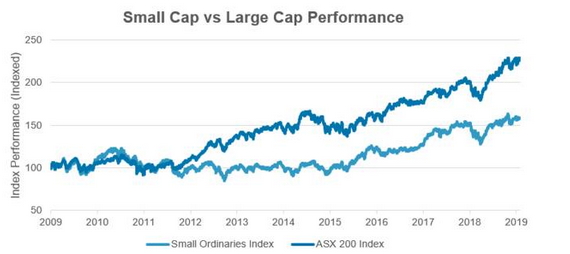
The factors highlighted above go a long way to explaining the underperformance of small caps stocks compared to their large cap counterparts over this time period. In fact, since small cap earnings bottomed after the GFC in September 2009, the Small Ordinaries Accumulation Index has underperformed the ASX 200 Accumulation Index by 70% in aggregate. It’s interesting that an index dominated by banks and diversified miners has substantially outperformed an index which has contained material exposure to stocks which have captured investor’s attention over the past few years including technology, Chinese consumer consumption (e.g. infant formula and vitamins), electric vehicles and gold.


Source: AMP Capital, FactSet (2009-2019)

Follow the earnings

The research we have undertaken into small cap returns and our experience in the market shows that earnings drive share prices. Valuation is an important consideration, however it is mean reverting and hard to predict, so we focus on our core strength – forecasting earnings. An earnings-based approach to valuing a stock is resilient to valuation changes and its serially correlated nature makes it more predictable.

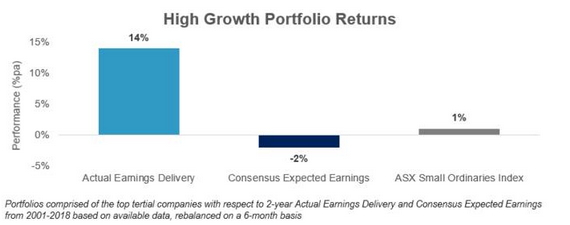
Since 2001, the ability to pick a portfolio of stocks that has actually delivered the highest level of earnings growth in the small caps market would have delivered a compound 14% annual return, or a cumulative return of 828% over this period. This compares to an index return of 1% per annum. Obviously forecasting earnings with perfect foresight is impossible, but this illustrates the potential opportunity for active managers in the space who can spend time undertaking detailed fundamental research on a company and get an edge on the market.


Source: AMP Capital, FactSet

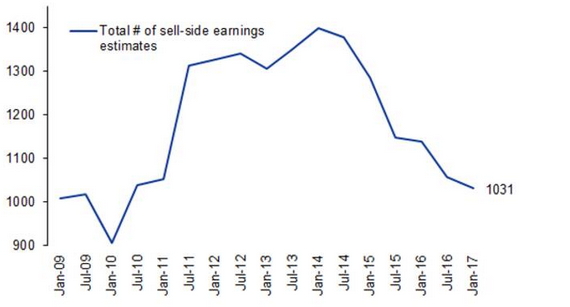
The above chart also shows that sell side analysts have added very little value when picking earnings over this period and investing by following consensus earnings leads to underperformance. In fact, since 2001 a portfolio of small cap stocks with the highest growth forecast by consensus has provided a return of -2% per annum, or -29% in aggregate. This isn’t a huge surprise given sell-side analyst forecasts are typically a lagging indicator. This is further exacerbated by the number and quality of earnings estimates in the Australian small cap market falling dramatically over the past few years. 


Source: Goldman Sachs Global Investment Research, Factset

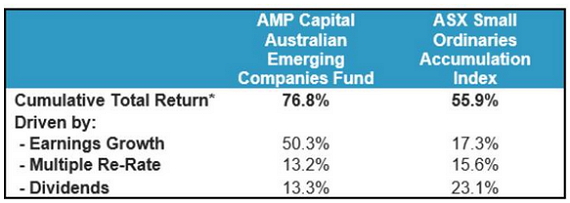
When analysing performance of the AMP Capital Australian Emerging Companies Fund since its inception in July 2014 to September 2019, the Small Ordinaries Index has been a solid performer despite the earnings headwinds, providing investors with a 8.9% per annum compound return (55.9% cumulative return). But when we dig into what has been driving this return, it’s clear this performance has been by dividends with muted earnings growth and a P/E multiple re-rate (or put simply, the stocks becoming more expensive). In a world of record low interest rates and rising asset values, the multiple re-rate is understandable and not out of sync with other asset classes, however it is unlikely to be sustainable unless investors start to see material earnings growth starting to come through in order to justify the higher valuations.

The AMP Capital Australian Emerging Companies Fund has returned 11.5% per annum (after-fees) over the same period (76.8% cumulative return), with earnings growth contributing the majority of returns, which is aligned to our investment philosophy and process. The ability to pick stocks which are growing earnings consistently has been the major driver of the Fund’s outperformance.


Past performance is not a reliable indicator of future performance Cumulative total returns from July 2014 to September 2019 are shown after fees and before tax

Bigger is better? Not necessarily…

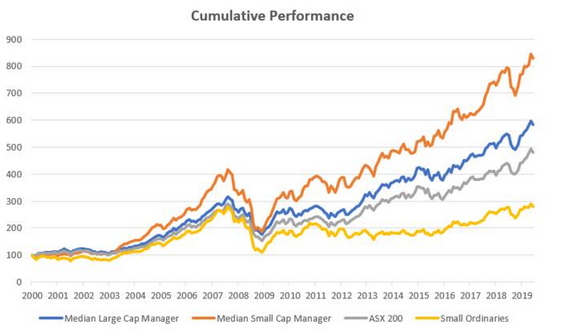
Despite the relatively gloomy picture we have presented for small cap earnings, there is one major reason for optimism in small caps. The median small cap manager has significantly outperformed not only the ASX Small Ordinaries Index, but also the ASX 200 Index and the median large cap manager over a long time period. Investors who have trusted their money with even a middle of the pack small cap manager have seen excellent compound returns over this period. The Australian small caps market is inefficient and not well researched, providing good managers with the opportunity to find new information which gives them an edge in picking stocks.


Source: AMP Capital, Mercer, FactSet (2000-2019)

Key take-aways:

  • An investment process which is focused on earnings can lead to significant outperformance.

  • The need for investors to be benchmark unaware – why invest in a stock just because it is in an index? It’s much better to construct a high-quality portfolio of stocks from all the available options in the investable universe.

  • The benefit of active management, especially in small caps, which have proven to generate excellent returns for investors over the long term.


Author: Matt Griffin, Co-portfolio Manager, Small Caps Sydney, Australia

Source: AMP Capital 8th Nov 2019

Important notes: AMP Capital Funds Management Limited (ABN 15 159 557 721, AFSL 426455) (AMPCFM) is the responsible entity of the AMP Capital Australian Emerging Companies Fund (Fund) and the issuer of the units in the Fund. To invest in the Fund, investors will need to obtain the current Product Disclosure Statement (PDS) from AMP Capital Investors Limited (ABN 59 001 777 591, AFSL 232 497) (AMP Capital). The PDS contains important information about investing in the Fund and it is important that investors read the PDS before making a decision about whether to acquire, or continue to hold or dispose of units in the Fund. Neither AMP Capital, AMPCFM nor any other company in the AMP Group guarantees the repayment of capital or the performance of any product or any particular rate of return referred to in this document. Past performance is not a reliable indicator of future performance. While every care has been taken in the preparation of this document, AMP Capital makes no representation or warranty as to the accuracy or completeness of any statement in it including without limitation, any forecasts. This document has been prepared for the purpose of providing general information, without taking account of any particular investor’s objectives, financial situation or needs. Investors should, before making any investment decisions, consider the appropriateness of the information in this document, and seek professional advice, having regard to their objectives, financial situation and needs. This document is solely for the use of the party to whom it is provided and must not be provided to any other person or entity without the express written consent of AMP Capital.

The first things we do each morning set the tone for the entire day ahead. If we awake tired and stressed, versus energized and ready to take on the day, most likely that feeling will stick with us throughout the rest of the day, affecting more than just our mood. That’s seven chances each week to create a new, productive, and life-changing routine. They say it takes two weeks to engrave an action as a habitual action. Change these 10 habits to reduce stress, change your health, and enhance your happiness, productivity, and intention for each day.

1) Checking Your Phone First Thing In The Morning

This one is one of the simplest tasks to change to restore our daily health and energy, yet it is also one of the hardest to adhere to. Most of us sleep with our phones on our bedside table, doubling as our midnight flashlight, clock, or alarm clock. (This alone is a wonderful habit to break! EMFs anyone?) It’s second nature to us, as we reach to silence the morning alarm, to continue to scan social media, check for missed messages, or respond to texts before we’ve even processed anything else. Instead, as you turn off your alarm, allow yourself to lay still for a couple minutes. Ease your eyes open, and take in the energy of the new day.

2) Hitting Snooze

Sound familiar? The alarm goes off and jolts us awake. We tell ourselves, “I’m so comfy…or I’m too tired. I can sleep for five more minutes.” So, we hit snooze to catch a few more z’s. Not only does the initial alarm sound pull us from our natural sleep cycle, but in trying to give our bodies a couple more minutes of rest we can actually end up doing the opposite. That few extra minutes can end up telling our bodies to change our internal clock as well as begin a new sleep cycle, leaving us ill-prepared for the next morning, wanting to sleep in even longer. Every time we hit snooze results in feeling more and more groggy as our bodies try to go deeper into a sleep cycle. Instead of a late night followed by a late morning, get those extra z’s in the night before. It’s actually more likely your body will feel rested and end up waking naturally before your alarm even goes off.

3) Skipping Breakfast

We’ve all heard it before – breakfast is the most important meal of the day, and there’s reason for this. I’m not saying we need a three course meal to start the day, but we certainly require some energizing brain food. Our bodies have been fasting all night since our last meal and require fuel. In our modern, fast-paced society, if we don’t eat something in the morning, many of us don’t eat a real meal until that afternoon when we feel starved and exhausted, and end up reaching for the nearest and often unhealthy options. This requires us to set the tone for the day ahead and begin the morning with a nutritious breakfast. Whether it’s an apple, banana, superfood smoothie, or a homemade omelette with sides and toast, take a conscious moment each morning to reflect on what your body needs to fuel itself. Even better, take the time to sit for at least ten minutes each morning to eat breakfast calmly and quietly before the hustle of the day begins.

4) Starting Off With Coffee

You slept through your alarm, missed breakfast, and are now late to work. There may not be time to stop for breakfast, but the day doesn’t start without caffeine, right? Sure, that jolt of coffee will stimulate the body first thing when we feel we don’t have any energy to spare, but in the long run it doesn’t do anything constructive for our health and will leave us with an energy crash mid-day, needing to refuel and start the cycle again. Not only does caffeine have a very acidic, dehydrating effect on the system first thing in the morning and on an empty stomach, it can also, over time, affect our adrenals and deplete our natural energy. Instead, first thing when we rise, consume at least one glass of room temperature or warm water with lemon. This will help to hydrate, energize, and detox the system naturally and caffeine-free. 

5) Rushing Through Your Morning

Whether we awoke on the wrong side of the bed or are stressing to get to work fast to prepare for a meeting or start that overwhelming task we’ve been putting off, starting the day off rushed and stressed sets the tone for the whole day. Rushing through the morning may get us to the office a few minutes faster, but it certainly won’t start us off on the right foot energetically or do anything to help us motivate for the day ahead. Take the the time to set a routine that cultivates the energy and lifestyle we want to live. Whether that means taking a few minutes of calm to set an intention for the day, meditate and breathe, spend a few extra moments with family, or cook up a fulfilling breakfast, make the time for it and do it with purpose.

6) Checking Mail

Still in bed, one eye still closed, we reach for our phones and scroll through our work email to see if so and so wrote us back or if there are any developments that require immediate attention. Instantly, our bodies tense as we see an email from our boss, a task that requires additional time, etc, etc. We become rushed and stressed before we are even out of bed as we decide to skip yoga, forget about breakfast and hurry to get to the office asap. Whether we have the option to work from home, practice unconventional work hours, or go to an office daily, creating a clear separation between work and homelife hours can help to reduce stress and work more efficiently. An email to a colleague, perhaps already at work, sends a message that you are also “at your desk”, and ready to work and communicate. If you don’t have conventional work hours or know, for instance, that you don’t focus well first thing in the morning, try to make your work day work for you by saving the major tasks until mid-morning or noon when you have gotten into a work flow.

7) Poor Dietary Choices

This one is a big one for us, as we are firm believers that you are what you eat and fuel your day with. Can poor morning dietary habits be just as bad as skipping breakfast? A day begun with a large coffee and a half a fast-food breakfast sandwich may provide calories, but doesn’t provide much in the sense of proper nutrition. A green smoothie, on the other hand, packed with raw, vibrant, natural produce, provides lasting energy that helps to fuel our bodies throughout the morning and replenishes it with the essential vitamins and minerals the ingredients contain. 

8) Going To Sleep Without A Plan

The intentions we set for the day ahead should begin the night before. When we go to sleep without a plan for the next day, we may go to sleep still thinking about work, how to resolve an issue, or planning the day to come. This doesn’t allow our minds or bodies to relax and reflect, but perpetuates that feeling into the next day, meaning we never stopped “working.” Before my workday is finished, I like to look over my agenda for the next day and plan out at least a loose schedule of the three largest tasks I have for the day. This helps me prioritize my time, have an understanding of my next day, and not have to worry or stress about what the next day will bring. Then I’m able to log off, shut my computer, and relax with family. 

9) Waking In A Dark Room

It may feel good to take it slow and get ready in a dark, cozy room, but we may be delaying our body’s natural ability to energize itself with the solar cycle. If we open the curtains, let the light in, and maybe even put some energizing music on, we, too, will become energized and motivated, ready to start the day.

10) Cold Start

When I wake up, the first thing I do is stretch, move and twist, to get my heart pumping and my energy flowing. Of course we’d all love to say we take the time to workout and move before we start our workday, but that may not be a realistic option for every schedule. We may have to squeeze our workouts in between lunch, after work, or every other day, making it that much more important to start your day off with some sort of movement, whether it be a good stretch or a couple sun salutations, before the daily grind to get the blood flowing, release endorphins, and energize the body and mind.

What Steps Do You Take To Improve Your Morning?

Source : Food Matters 

Reproduced with the permission of the Food Matters team. This article by Alle Weil was originally published at www.foodmatters.com/article/10-morning-habits-damaging-your-health

Important:
This provides general information and hasn’t taken your circumstances into account.  It’s important to consider your particular circumstances before deciding what’s right for you. Any information provided by the author detailed above is separate and external to our business and our Licensee. Neither our business nor our Licensee takes any responsibility for any action or any service provided by the author.

Any links have been provided with permission for information purposes only and will take you to external websites, which are not connected to our company in any way. Note: Our company does not endorse and is not responsible for the accuracy of the contents/information contained within the linked site(s) accessible from this page.

Understanding cash flow in the time it takes to play a game of solitaire.

In the time that it takes to go through your deck and figure out your game strategy, this article will help you understand what cash flow is and how to write a cash flow statement.

That’s only two minutes of reading time. Ace.

One of the biggest reasons businesses fail is because of “inadequate cash reserves”. That’s just a fancy way of saying they ran out of money.

Making sure you’ve got positive cash flow – meaning you’ve got more money coming into your business than going out of it – is the single biggest factor that will affect your financial health.

Cash flow is all about the liquidity of a business. That is, the amount of money flowing in and out of a business and how much cash you actually have on hand.

The state of your cash flow will change with your business. For example, you probably won’t have much cash flow when you launch your business, as you probably wouldn’t have made many sales.

But as your business grows, keeping on top of the cash coming in and out of your business will become more and more important.

How to write a cash flow statement

Cash flow statements are an overview of money a business has coming in (inflows), and how much it has going out (outflows).

It’s important to write up cash flow statements regularly so you know that there’s enough cash to keep the business functioning.

Cash flow statements are important for many reasons. These include:

  • To make sure business expenses, such as bills and wages, are paid on time

  • To apply for a business loan

  • To convince potential investors to invest in the business

Cash flow statements generally include three main parts:

1. Operating activities

How does your business make money on a day-to-day basis?

The ‘operating activities’ section of your cash flow statement covers how your business makes revenue.

The cash inflows in this section record whenever customers buy your product and services. The cash outflows record your everyday operational costs, such as wages, materials and other expenses.

2. Investing activities

This section of the cash flow statement relates to any long-term investments the business makes. This could include the purchase or sale of property, vehicles or other equipment, which are considered non-current assets.

The investing activities section could also include financial assets, such as securities purchased on the stock market.

3. Financing activities

This section of the cash flow statement includes information about any financial activities your business undertakes. This could include taking out business loans or issuing stocks.

This is also the part of the cash flow statement that records any debt that the business needs to repay.

Managing your cash flow

How you manage your cash flow depends on what your business does and how often you make sales.

For example, businesses that sell many low-cost products and services every day – such as grocery stores – will have inflows every day.
But a construction company that might only do one or two big jobs per year might have bigger chunks of money coming in only a few times per year.

As you can imagine, the cash flow statements of these two businesses would look very different. How they manage their cash flow and put together their statements will also be very different.

We’ve put together some general tips for managing your cash flow, as well as more specific tips for managing cash flow in a business with significant seasonal differences.

Top 3 takeaways

  1. Your cash flow is the amount of money coming in and out of your business.

  2. A cash flow statement helps you keep track of the movement of your business’ money. Update this regularly so you keep on top of your business’ finances.

  3. A cash flow statement includes information about operational activities, investing activities and financial activities.

Please contact us on Phone: 07 5641 4134 if you seek further assistance on this topic.


Source : MYOB 

Reproduced with the permission of MYOB. This article by MYOB Team was originally published at https://www.myob.com/au/blog/understanding-cash-flow/

Important:
This provides general information and hasn’t taken your circumstances into account. It’s important to consider your particular circumstances before deciding what’s right for you. Although the information is from sources considered reliable, we do not guarantee that it is accurate or complete. You should not rely upon it and should seek qualified advice before making any investment decision. Except where liability under any statute cannot be excluded, we do not accept any liability (whether under contract, tort or otherwise) for any resulting loss or damage of the reader or any other person.

Any information provided by the author detailed above is separate and external to our business and our Licensee. Neither our business nor our Licensee takes any responsibility for any action or any service provided by the author.

Any links have been provided with permission for information purposes only and will take you to external websites, which are not connected to our company in any way. Note: Our company does not endorse and is not responsible for the accuracy of the contents/information contained within the linked site(s) accessible from this page.