
Saving space makes for relaxed breaks.

Are you finding it a problem to fit everything you need into your caravan?

Not to worry – we have a bunch of nifty and easy caravan storage tips and space-saving solutions to help you out. Most are inexpensive, too.

In fact, these tips are so handy that soon you might not recognise the inside of your van. It’s time to save some space…

Read on for some handy space-saving tips.

1. Purchase collapsible products

Get your hands on collapsible, fold out, or pop-up products, sometimes for the price of a takeaway coffee. Items such as tabletop ironing boards, collapsible or pop-up laundry hampers, clotheshorses, and the like are great space-saving solutions for your caravan. Furthermore, drawer dividers and utensil trays are other handy products that will save you clutter.

Collapsible products, like pop-up laundry hampers, are handy space savers. Credit: www.thegreenhead.com

2. Buy loads of hooks

If you’re armed with a bunch of hooks, you are likely to discover room you didn’t know your van had. Hanging items from hooks, such as cooking utensils and keys, is not only great for saving space in your caravan but it’s a practical addition that allows you to easily locate items with ease. Alternatively, clips or suction caps are just as useful.

Hooks are extremely helpful for hanging items in your van, which proves beneficial in more ways than one.

3. Try hanging shoe racks

Take tip number two a step further and purchase a hanging shoe rack. As far as space-saving ideas go, this one falls into the so-simple-yet-so-effective category. Hanging shoe racks are ideal for storing small items such as cleaning supplies, toiletries, and food items.

Once again, this solution not only saves you space but ensures easy access to these products when needed. Hanging baskets and mini hammocks – for storing such things as fruit and vegetables – are also ideal for minimising clutter.

Hanging shoe racks are a genius idea for saving space. Source: Pinterest.

4. Use stackable storage tubs

These things are more versatile than you might give them credit for. Stackable storage tubs aren’t discriminatory – they’ll accommodate any item you can imagine, from clothing to children’s toys. Knowing your van’s dimensions helps for making the most of this handy hint, as you can choose a tub that is a snug fit for a particular section of your interior.

Keep items together by investing in storage tubs. Source: Pinterest.

5. Buy magnetic strips

Where are the scissors when you need them? On the wall. That’s right – they’re sticking really close to the wall-mounted magnet strips you have in your caravan. In addition to allowing you to know the whereabouts of these objects with the utmost of ease, magnetic strips are also great for keeping knives in a secure location.

Magnetic strips allow you to easily know the whereabouts of key items. Source: Pinterest.

6. Purchase nesting bowls and measuring spoons

Another simple-yet-effective trick – this one will save you cupboard space – is purchasing ‘nesting’ bowls and measuring spoons. They prevent you unnecessarily wasting space and, additionally, are convenient items to locate when it comes to cooking or baking

 

Nesting bowls are ideal for saving space.

7. Don’t overlook ceiling space

The ceiling of your caravan is a vital tool in providing protection but it’s about time it stepped up. Use your imagination (or simply keep reading) and you’ll discover there are plenty of uses for the trusty ceiling. Use it to hang shelves or even wardrobes (hanging wardrobes have to be one of the most inventive space-saving solutions going around). You can also attach brackets to ceilings to hang items such as a broom. Genius.

Take advantage of the space above you. Source: Pinterest.

8. Think about unused areas

Following the above tip, it really pays to think outside the square. Take a look around your van and you’ll discover there is abundant space just begging to be filled up with essential items. If you didn’t already know, underneath the bed is a great place to store odds and ends.
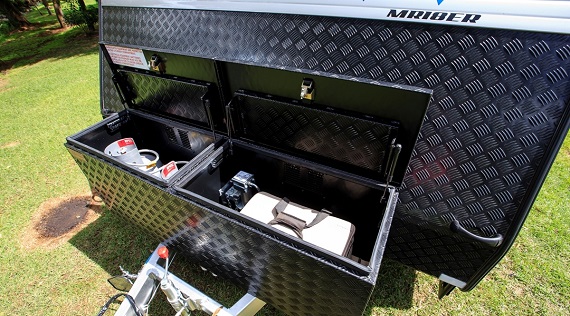
Room exists in so many areas of a caravan.

9. Use an annex or awning

Without wanting to sound like an ad for a plastic surgery company, this tip won’t help you on the inside, but it will help you on the outside. A caravan annex or awning are ideal for creating more space at your BIG4 park site and can be used to shield the sun, wind, or rain.

Create more space outside with the help of an annex or awning.

10. Avoid over-packing

If real estate is still at a premium after all these tips, you can always fall back on a guaranteed hint that will help you to save space: Avoid the tendency to over-pack. Think about what is really required for your break. In short, prepare a constructive list rather than reading straight from the Armageddon survival kit handbook.

Caravan or no caravan, over-packing is best avoided.


Source : BIG4 Holiday Parks 

Reproduced with the permission of BIG4 Holiday Parks. This article first appeared on BIG4.com.au and was republished with permission.

Important:
Any information provided by the author detailed above is separate and external to our business and our Licensee. Neither our business nor our Licensee takes any responsibility for any action or any service provided by the author.

Any links have been provided with permission for information purposes only and will take you to external websites, which are not connected to our company in any way. Note: Our company does not endorse and is not responsible for the accuracy of the contents/information contained within the linked site(s) accessible from this page 

Making an extra voluntary contribution now might improve your lifestyle once you retire.

A new year’s as good a time as any to make plans. How about a gift to your future self by maximising your retirement contributions?

It’s not as far-fetched or self-absorbed as it might seem.

If you think of this as investing in your future self or your loved ones, it could make good sense. We’re used to spending on education and training, which are also investments in tomorrow. And which really matters more, upgrading to a flashier car today, or buying a jetpack* a few years down the line?

There’s no time like tomorrow

There are a number of ways you can contribute more to your super, to take advantage of time and the magic of compound interest.

These include salary sacrificing, and a range of tax-deductible, spouse and downsizer contributions, as well as government co-contributions.

Things to keep in mind

What you do right now affects how well you can live in future. So, before you decide to gift your future self, think carefully about the right course for you.

If you’re thinking about making extra contributions towards your retirement, make sure you’re across the super contribution rules.

For instance, if you go over the super contribution limits, additional tax and penalties may apply.

Remember that the value of your investment in super can go up and down. Before making extra contributions, make sure you understand and are comfortable with any potential risks.

The government sets general rules about when you can access your super, which means you typically won’t be able to access your super until you retire. If you’re over 65 and making contributions, you generally need to satisfy work test requirements and be under age 75.

Extra contributions may also affect any rainy day savings you set aside for emergencies, so do your homework before you commit to your future self.

If you’re in a position to engage professional help, you might also talk to us on Phone: 07 5641 4134 about what’s right for you.

The not-so-silly season

Many of the presents we buy for ourselves and loved ones date quickly – that new smartphone isn’t new for long. Increasing retirement contributions may delay gratification but pay dividends down the line.

If you have some years to go before you retire, you may even be able to retire sooner if you increase your contributions now.

That gift of time might be the biggest reward of all.

Source : AMP November 2019

Important:
This information is provided by AMP Life Limited. It is general information only and hasn’t taken your circumstances into account. It’s important to consider your particular circumstances and the relevant Product Disclosure Statement or Terms and Conditions, available by calling Phone: 07 5641 4134, before deciding what’s right for you.

All information in this article is subject to change without notice. Although the information is from sources considered reliable, AMP and our company do not guarantee that it is accurate or complete. You should not rely upon it and should seek professional advice before making any financial decision. Except where liability under any statute cannot be excluded, AMP and our company do not accept any liability for any resulting loss or damage of the reader or any other person.


By the time we sit down for a sun-drenched lunch on Christmas Day, lounge rooms across the country are usually piled high with shreds of wrapping paper, screwed up gift tags and shattered plastic toys. Cue sunset and leftover prawns join soggy crackers, wilted salad and half-eaten lollies in the bin – all wrapped up on pictures of Santa in the plastic tablecloth. When you really think about it, that’s a whole lot of money thrown away as non-recyclable rubbish.

With a few simple tips, it’s possible to host a more eco-friendly Christmas that saves money and unnecessary waste, without skimping on festive cheer. 

1. Shop locally

Supporting local businesses helps to encourage a sustainable local economy. Best of all, you’ll often find eco-friendly, organic products in specialty stores that are unique and handmade with love. Before the big day, buy your fresh food from the farmers’ markets and stock up on homemade goodies – or make them – instead of packaged treats from the supermarket. 

2. Choose gifts that last

We’re all subject to that last-minute rush of buying gifts and the panic that comes with it. Plan a little earlier this year to avoid grabbing shiny things off the shelves to fill stockings. Instead, choose gifts that last or offer experiences. Consider items like houseplants, reusable coffee mugs, wooden games and puzzles or handmade gifts of food, natural beauty products and candles. Buy your loved ones tickets to a concert, lessons in a favourite hobby or make your own gift certificate for a service you’ll do for them. 

3. Rethink wrapping

Wrapping paper is one of the biggest sources of waste each year, so pop that sparkly new roll back down and consider other options. Start collecting reusable gift boxes, use festive scraps of old material, make brown recycled paper look fancy with your craft skills or wrap a gift inside another gift of a scarf or shirt. 

4. Decorate with nature

If you have toddlers, cats or even guests who’ve had one too many beers in the sun, plastic Christmas trees and fragile decorations may not survive to see the next one. Keep it green by sourcing a tree from sustainable forestry systems. Or, simply buy a potted shrub or tree with the aim to replant it after the celebrations. Use pine cones, frangipanis, nuts, fruit or twisty twigs for table displays. It’s amazing what you can find in the backyard when you look closely. 

5. Create a meal plan

There’s nothing worse than hosting a celebration and feeling like you won’t have enough food for everyone. But, seriously, has that ever happened on Christmas Day? To avoid wastage, write a list and allocate just one dish to each person or family, in categories so that everything’s covered but not repeated. That way, you won’t end up with five pavlovas.

6. Donate unwanted gifts

It’s hard to buy the perfect gift, and many of them end up in the back of the cupboard. Take the opportunity to give back by donating gifts to a charity or regifting them to someone who wants them (it’s not a social taboo, it’s a form of recycling!). 

Every little bit helps in the long run, towards a sustainable future. Plus, you’ll find there’s a lot less cleaning up and a lot more money left in your wallet heading into the new year. 

This provides general information and hasn’t taken your circumstances into account. Any links have been provided with permission for information purposes only and will take you to external websites, which are not connected to our company in any way. Note: Our company does not endorse and is not responsible for the accuracy of the contents/information contained within the linked site(s) accessible from this page. 


At its meeting today, the Board decided to leave the cash rate unchanged at 0.75 per cent.

The outlook for the global economy remains reasonable. While the risks are still tilted to the downside, some of these risks have lessened recently. The US–China trade and technology disputes continue to affect international trade flows and investment as businesses scale back spending plans because of the uncertainty. At the same time, in most advanced economies unemployment rates are low and wages growth has picked up, although inflation remains low. In China, the authorities have taken steps to support the economy while continuing to address risks in the financial system.

Interest rates are very low around the world and a number of central banks have eased monetary policy over recent months in response to the downside risks and subdued inflation. Expectations of further monetary easing have generally been scaled back. Financial market sentiment has continued to improve and long-term government bond yields are around record lows in many countries, including Australia. Borrowing rates for both businesses and households are at historically low levels. The Australian dollar is at the lower end of its range over recent times.

After a soft patch in the second half of last year, the Australian economy appears to have reached a gentle turning point. The central scenario is for growth to pick up gradually to around 3 per cent in 2021. The low level of interest rates, recent tax cuts, ongoing spending on infrastructure, the upswing in housing prices and a brighter outlook for the resources sector should all support growth. The main domestic uncertainty continues to be the outlook for consumption, with the sustained period of only modest increases in household disposable income continuing to weigh on consumer spending. Other sources of uncertainty include the effects of the drought and the evolution of the housing construction cycle.

The unemployment rate has been steady at around 5¼ per cent over recent months. It is expected to remain around this level for some time, before gradually declining to a little below 5 per cent in 2021. Wages growth is subdued and is expected to remain at around its current rate for some time yet. A further gradual lift in wages growth would be a welcome development and is needed for inflation to be sustainably within the 2–3 per cent target range. Taken together, recent outcomes suggest that the Australian economy can sustain lower rates of unemployment and underemployment.

Inflation is expected to pick up, but to do so only gradually. In both headline and underlying terms, inflation is expected to be close to 2 per cent in 2020 and 2021.

There are further signs of a turnaround in established housing markets. This is especially so in Sydney and Melbourne, but prices in some other markets have also increased recently. In contrast, new dwelling activity is still declining and growth in housing credit remains low. Demand for credit by investors is subdued and credit conditions, especially for small and medium-sized businesses, remain tight. Mortgage rates are at record lows and there is strong competition for borrowers of high credit quality.

The easing of monetary policy this year is supporting employment and income growth in Australia and a return of inflation to the medium-term target range. The lower cash rate has put downward pressure on the exchange rate, which is supporting activity across a range of industries. It has also boosted asset prices, which in time should lead to increased spending, including on residential construction. Lower mortgage rates are also boosting aggregate household disposable income, which, in time, will boost household spending.

Given these effects of lower interest rates and the long and variable lags in the transmission of monetary policy, the Board decided to hold the cash rate steady at this meeting while it continues to monitor developments, including in the labour market. The Board also agreed that due to both global and domestic factors, it was reasonable to expect that an extended period of low interest rates will be required in Australia to reach full employment and achieve the inflation target. The Board is prepared to ease monetary policy further if needed to support sustainable growth in the economy, full employment and the achievement of the inflation target over time.

Source: Reserve Bank of Australia, December 3rd, 2019

Enquiries

Media and Communications
Secretary’s Department
Reserve Bank of Australia
SYDNEY

Phone: +61 2 9551 9720
Fax: +61 2 9551 8033

Email: rbainfo@rba.gov.au

Growth isn’t always good

A lot of small business advice assumes that you intend to grow. You may be advised to hire more staff, open more stores and do more marketing to win customers.

But what if you’re happy with your current business size? Perhaps you:

  • launched your business for lifestyle reasons and don’t want to take on more work

  • feel you’re already at optimal business size

  • have other commitments that prevent you investing more time in your business

  • don’t want the stress of expanding your business

  • feel it’s less risky to stay small

It’s entirely possible to maintain a smaller business size while making a healthy profit.

Advantages of a lifestyle business

Choosing stability over never-ending growth can lead to big benefits for you and your business.

  • You don’t have to reinvest so much money
    Growth requires investment, but sometimes revenue doesn’t grow fast enough to repay it. The resulting cash flow crunch can be stressful. Non-growth businesses don’t have to worry so much about this.

  • Financial predictions will be simpler
    Revenue and expenses are simpler to forecast with a smaller lifestyle business. There are fewer building projects, equipment upgrades and new hires to budget for. That stability can make it easier to balance your bottom line, so you spend less time worrying about your financials.

  • You’ll feel less stressed
    It can be hard to relax when you keep pushing, growing and raising expectations. Ongoing expansion generally requires a lot of bandwidth. That might be good for your bank balance – but not for your blood pressure. Less aggressive targets can reduce stress and leave you more time to enjoy life.

  • The quality of your work may be higher
    Even with the best of intentions, business owners who are focused on growth and money can be distracted from the quality of their work. With a lifestyle business, you can focus on doing high quality work all the time.

  • You can build goodwill
    Non-growth businesses often spend more of their energy on non-financial goals like delighting customers and being best-in-class. The extra focus on serving the market can create goodwill and encourage greater customer loyalty.

  • You can adapt quickly to market conditions
    To chase growth, businesses often have to lock themselves into long-term strategies. But what if the market conditions change? When business size isn’t so important to you, you can stay nimble. With no fixed growth strategy, it can be easier to change direction.

You can take it slow, but don’t stand still

It’s been said that businesses are like sharks – if they don’t keep moving forward, they die. There’s some truth in this because of the twin forces of depreciation and inflation:

  • Depreciation eats into the value of the assets your business owns.

  • Inflation reduces the value of the money you earn (and causes suppliers to hike prices).

Chances are, your competitors are also working hard to take market share off you. With all this going on, you can’t afford to stand still. At zero growth, you’d actually drift backwards. But you can maintain a viable business size with just a few percent annual growth.

 Please contact us on Phone: 07 5641 4134.

Source : Xero 


Reproduced with the permission of Xero.

Xero is software designed to make life better for small businesses and their advisors. Its online accounting platform provides the foundation on which businesses can build a complete business solution. It connects businesses with their bank, accounting tools, their accountant, payment services and third-party apps, so everything is securely available at any time, on any device.

Important:
This provides general information and hasn’t taken your circumstances into account.  It’s important to consider your particular circumstances before deciding what’s right for you. Any information provided by the author detailed above is separate and external to our business and our Licensee. Neither our business nor our Licensee takes any responsibility for any action or any service provided by the author.

Any links have been provided with permission for information purposes only and will take you to external websites, which are not connected to our company in any way. Note: Our company does not endorse and is not responsible for the accuracy of the contents/information contained within the linked site(s) accessible from this page.

In a rural Spanish town, wolves outnumber children.

In the United States, carmakers are testing automated vehicles not in Silicon Valley, but in a Florida retirement community.

Closer to home, in Castlemaine, Victoria, a gym is encouraging people to lift weights to maintain muscle mass and prevent infirmity in later life.

These seemingly different stories spring from the same source: Around the world, populations are ageing.

Growing numbers of older people are dramatically reshaping places, cultures and economies.

Between 2015 and 2045, the number of people over 65 is expected to nearly double, to a record 15 per cent globally.

The increasing average age has generated concerns that global economic growth will slow and that share prices will fall significantly as retirees draw down their portfolios.

In Australia, most people understand the effect the baby boomers had on school construction in the 1970s, on household spending habits in the 1980s and on the sea-change impact in the 2000s. And with many of them entering retirement, how will they reshape our economy?

Recent Vanguard research, The Economics of a Graying World, has some positive, or at least counterintuitive, news about these investor concerns. Many of the assumptions about the impact of an ageing population don’t hold up to analysis:

  • Older people don’t spend less than younger people. They devote less of their budget to categories such as clothing and leisure and more to health care and housing.

  • A trend toward increasing the age required to receive retirement benefits will prompt many people to work longer.

  • A shrinking workforce will provide incentives for investments to offset higher labour costs, which may boost productivity.

  • A growing ageing population does not necessarily lead to lower investment returns.

The research reinforces the wisdom of diversifying portfolios globally to reduce the risk of exposure to downturns in a single country or region. The percentage of older people will be much higher in some of the world’s largest economies. In Australia, about 20 per cent of residents will be older than 65 by 2045, according to the Australian Institute of Health and Welfare. In Japan, as many as one in three residents will be older than 65 by then.

That doesn’t mean that you should reduce investments in countries that are ageing more quickly. Instead, it provides yet another reason to avoid over-concentrating your portfolio in the shares of a single country.

Home-country bias, a tendency to invest in the securities of the country where you live, often causes this over-concentration and creates unnecessary portfolio risk. A low-cost, globally diversified portfolio provides the best chance of investment success through exposure to a variety of growth and demographic outlooks.

Written by Robin Bowerman, Head of Corporate Affairs at Vanguard.

Source : Vanguard 

Reproduced with permission of Vanguard Investments Australia Ltd

Vanguard Investments Australia Ltd (ABN 72 072 881 086 / AFS Licence 227263) is the product issuer. We have not taken yours and your clients’ circumstances into account when preparing this material so it may not be applicable to the particular situation you are considering. You should consider your circumstances and our Product Disclosure Statement (PDS) or Prospectus before making any investment decision. You can access our PDS or Prospectus online or by calling us. This material was prepared in good faith and we accept no liability for any errors or omissions. Past performance is not an indication of future performance.

© 2019 Vanguard Investments Australia Ltd. All rights reserved.

Important:
Any information provided by the author detailed above is separate and external to our business and our Licensee. Neither our business nor our Licensee takes any responsibility for any action or any service provided by the author.

Any links have been provided with permission for information purposes only and will take you to external websites, which are not connected to our company in any way. Note: Our company does not endorse and is not responsible for the accuracy of the contents/information contained within the linked site(s) accessible from this page.

You’re trying so hard to eat a clean diet, right? Yet, you simply can’t resist the smell of fried food. Going for a jog every day should be easy, but something else always ranks higher on the priority list. This constant back and forth is often the very thing that stalls the healthy habit-making process, until those well-intentioned goals become nothing more than the recurring thought of, “I’ll do it tomorrow.”
 

How do you keep healthy habits firmly in your daily life? Here are four easy ways to end the procrastination and kick your thoughts into actions that last. 

1. Work on your mindset first

Wouldn’t it be great if sticking to healthy habits felt like a natural thing to do, rather than something that requires superhuman willpower? Every action starts with a thought, so it’s your thoughts that need a healthy overhaul first. For example, do you habitually groan when you think of exercising? 

Clearly, this reaction isn’t going to make a healthy habit stick. Start becoming aware of your thoughts and make a conscious effort to switch them to motivating ones. The best way to do this is to look at the bigger picture outcomes. Focus on how great you’ll feel after exercising, eating a fresh salad or paying off a chunk of debt. Strive to eliminate negative thinking first, and the motivation to take action will become more natural over time.

2. Take a step-by-step approach

The easier habits are to implement into your life, the more likely you are to stick to them. While it’s fantastic to have an inspirational end goal, taking a step-by-step approach helps you avoid overwhelm along the way, which is often what makes us give up. The word ‘step’ is the key here, and it’s important to learn to love what it means.

Every little step really does get you closer to the target, and small, specific actions are more likely to become habitual. So, if you can’t fit in an hour at the gym, do 10 minutes of exercise here and there throughout the day. When something crops up, and you can’t pay what you’d like to on a debt one week, just pay what you can. Don’t forget that every single step you take towards a healthy habit, no matter how small, is a good one. 

3. Give your healthy habits support

Write down the habits you’d like to enforce and, next to them, devise a list of all the things that might support those habits. This could be something as simple as laying out your gym gear the night before, so you don’t have to think about what to wear in the morning. It might mean totally cleaning out all the ‘just in case’ junk food from the kitchen, so you don’t have to deal with temptation. 

Get friends or family on board to help with accountability and motivation. Put affirmations or encouraging messages somewhere you’re forced to see them. Use music, beautiful recipes and exercises that appeal to you, to make forming new habits an enjoyable process. When you really focus on supporting healthy habits while they’re forming, they’ll soon take on a life of their own. 

4. Know that repetition works

Do you come home every day and flop on the couch? Aimlessly scroll through social media each lunch break? Automatically reach for the chips when you watch a movie? It’s pretty easy to prove to yourself that repetition works in the forming of habits. Unfortunately, it’s usually the bad ones we program ourselves with, by unconsciously doing them day after day. 

The great news is that this proves how very conditioned we become when we repeat thoughts and actions. Start by replacing existing habits with new, healthy ones. For a few days, remain very aware of your unconscious habits and switch them one by one. Stop yourself from flopping on the couch and go for a refreshing walk in the park or on the beach instead. Repeat the process day after day, and you’ll soon feel a ‘happy’ trigger that propels you to stick with the new, healthier habit. 

We are, at the end of the day, creatures of habit. Use this to your advantage to embrace healthy ones, and you’ll hit those goals in no time. 


Important:

This provides general information and hasn’t taken your circumstances into account. Any links have been provided with permission for information purposes only and will take you to external websites, which are not connected to our company in any way. Note: Our company does not endorse and is not responsible for the accuracy of the contents/information contained within the linked site(s) accessible from this page.

For a long time, we have been bearish on the Australian dollar, seeing a fall into the high $US0.60s and revising this to around $US0.65 in May. In early October it fell to a low of $US0.6671. While negatives remain significant for the $A there is good reason to believe that we are close to the low or may have already seen it. This note looks at the main issues.


The negatives for the $A are well known

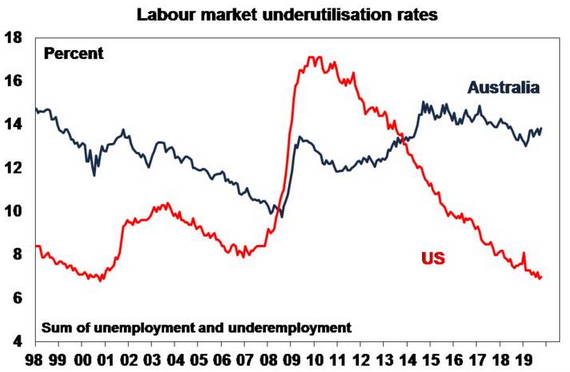
The big negative for the Australian dollar is that growth is weaker in Australia and spare capacity is much higher than in the US. For example, labour market underutilisation is 13.8% in Australia versus just 7% in the US, on the latest available data real growth in Australia is running at 1.4% year on year compared to 2% in the US and that translates to per capita GDP growth of -0.2% in Australia compared to 1.4% in the US. And the drag on growth from the housing downturn, weak consumer spending and the drought is likely to keep growth relatively weak in Australia for the next six months or so.


Source: Bloomberg, AMP Capital

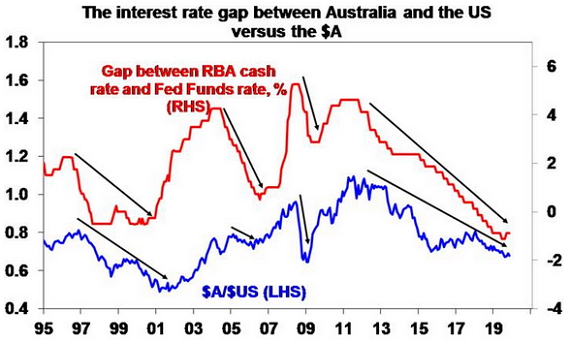
This will keep inflation lower in Australia than in the US. Ideally more fiscal stimulus is required, and the Government has brought forward infrastructure spending. But combined with extra drought assistance this only amounts to an extra 0.1% of GDP of fiscal stimulus over the next 18 months which is not enough to make a significant difference to the growth outlook. So in the absence of more significant fiscal stimulus soon, the RBA is likely to cut the cash rate further to 0.25% and undertake some quantitative easing (ie using printed money to boost growth). By contrast the Fed is at or close to the low in US rates and is unlikely to return to quantitative easing. This will continue to make it relatively less attractive to park money in Australia. As can be seen in the next chart, periods of a low and falling interest rate differential between Australia and the US usually see a low and falling $A.


Source: Bloomberg, AMP Capital

So the higher probability of further monetary easing in Australia points to more downside for the Australian dollar. Of course, a shift in the policy focus away from monetary easing and towards greater fiscal stimulus would be more positive for the Australian dollar but this looks unlikely in the short term with the Government more focussed on delivering a budget surplus.

Five positives for the $A

However, it’s no longer an easy (in hindsight) one way bet for the $A. There are basically five positives. First, the $A has already had a big fall. To its recent low it’s fallen nearly 40% from a multi-decade high of $US1.11 in 2011 & it’s had a fall of 18% from a high in January last year of $US0.81.

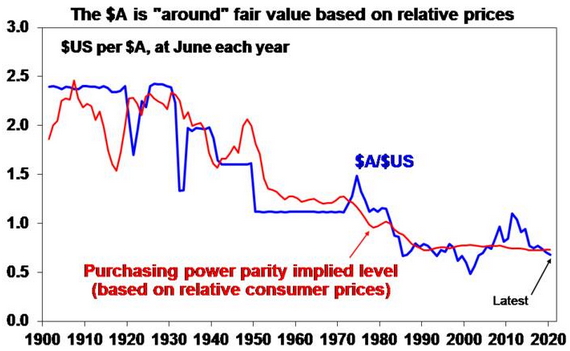
Second, this decline has taken it to just below fair value. This contrasts to the situation back in 2011 when it was well above long-term fair value. The best guide to this is what is called purchasing power parity according to which exchange rates should equilibrate the price of a basket of goods and services across countries. Consistent with this the $A tends to move in line with relative price differentials over the long term.


Source: RBA, ABS, AMP Capital

And right now, it’s just below fair value. Of course, as can be seen in the last chart, the $A could fall sharply below fair value as it tends to swing from one extreme to another. But this depends on the cyclical outlook for global growth and commodity prices. Which brings us to the next positive.

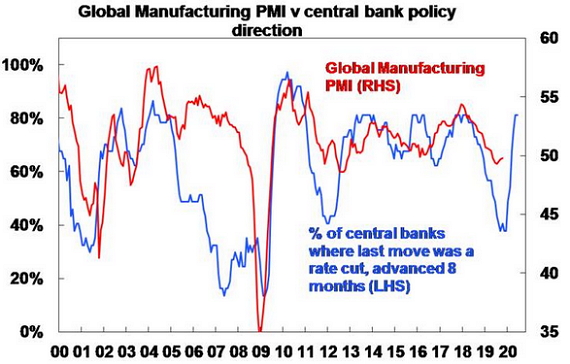
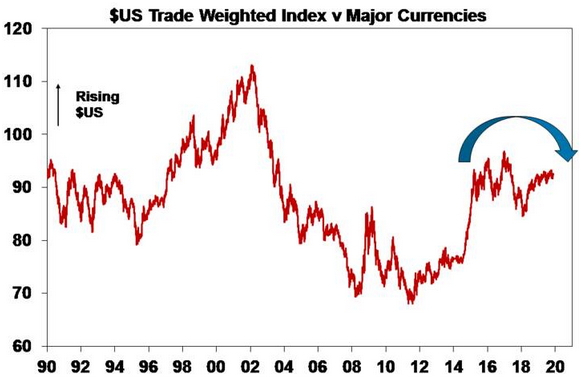
Third, the global economic and commodity price cycle is likely to turn up next year in response to global monetary easing, a bottoming in the global inventory and manufacturing cycle and a pause in President Trump’s trade wars as he refocusses on winning the presidential election.


Source: Bloomberg, AMP Capital

Based on historical experience, this should work against the US dollar as the US economy is less exposed to cyclical sectors than the rest of the world (which tends to see capital flow out of the US when global growth picks up and into the US when it slows). A weaker US dollar would in turn be positive for commodity prices & the $A, which is a “risk on” currency given its greater exposure to cyclical industries like raw materials.


Source: Bloomberg, AMP Capital

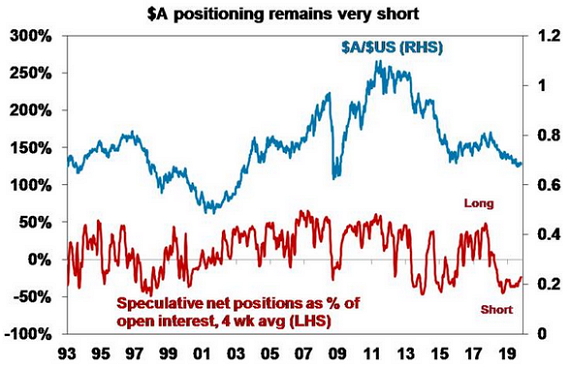
Fourth, this comes at a time when global sentiment towards the $A remains very negative as reflected in short or underweight positions in the $A being at extremes – see the next chart. In other words, many of those who want to sell the $A have already done so and this leaves it vulnerable to a rally if there is good news.


Source: Bloomberg, AMP Capital

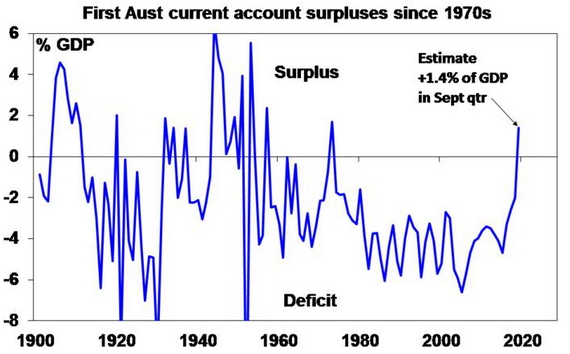
Finally, the current account has returned to surplus in Australia. The high iron ore price has helped, but so too have strong resource export volumes, services exports and a rising net equity position in Australia’s favour on the back of rising superannuation assets offshore. So the improved current account may be a permanent feature. This means less dependence on foreign capital inflows which is $A positive.


Source: ABS, AMP Capital

So where to from here?

The prospects for weaker growth and more monetary easing in Australia relative to the US suggests short-term downside pressure for the $A remains. But with the $A having already had a big fall to just below long term fair value, the global growth outlook likely to improve, short $A positions running high and the current account in surplus it’s likely that the $A may be close to, or may have already seen, its low. Our base remains for it to fall to around $US0.65 as the RBA continues to ease but at the end of 2020 it’s likely to be stuck around $US0.65-70 (or I’ll be honest & admit I don’t have a strong view either way!).

Of course, if the US/China trade war escalates badly again and the global economy falls apart, causing a surge in unemployment in Australia as export demand and confidence collapses and another big leg down in house prices the Aussie will fall a lot more…but that’s looking less likely.

What does it mean for investors and the RBA?

With the risks skewed towards the $A bottoming soon the case to maintain a large exposure to offshore assets that are not hedged back to Australian dollars has weakened. Of course, maintaining a position in foreign exchange for Australian-based investors against the $A provides some protection should things go wrong globally (say in relation to trade) or in Australia (say in relation to household debt).

For the RBA a shift in global forces towards being more supportive of the Australian dollar over the year ahead would complicate the RBA’s desire to boost Australian economic growth. Stronger demand for Australian exports would be positive, but upwards pressure on the $A would suggest that further monetary easing may be needed to help keep it down.


Source: AMP Capital 25 Nov 2019

Important notes: While every care has been taken in the preparation of this article, AMP Capital Investors Limited (ABN 59 001 777 591, AFSL 232497) and AMP Capital Funds Management Limited (ABN 15 159 557 721, AFSL 426455) (AMP Capital) makes no representations or warranties as to the accuracy or completeness of any statement in it including, without limitation, any forecasts. Past performance is not a reliable indicator of future performance. This article has been prepared for the purpose of providing general information, without taking account of any particular investor’s objectives, financial situation or needs. An investor should, before making any investment decisions, consider the appropriateness of the information in this article, and seek professional advice, having regard to the investor’s objectives, financial situation and needs. This article is solely for the use of the party to whom it is provided and must not be provided to any other person or entity without the express written consent of AMP Capital.

A fulfilling retirement isn’t just about money, it’s about staying healthy, active and connected

So much of preparing for retirement is about the dollars and cents.

  • Working out whether a transition to retirement strategy works for you.

  • Deciding which type of income stream is appropriate to deliver the right balance between income and capital gain.

  • Making sure that you structure your finances to receive any government benefit that’s due.

Hopefully if you get the numbers right it means you wake up on day 1 of your retirement fully prepared to meet the financial challenges. But enjoying a fulfilling retirement isn’t just about money. It’s also about facing up to new social, physical and emotional challenges.

If you don’t think about cultivating a healthy body, healthy mind and healthy social network then all your good work may come to nothing.

Fortunately, there are plenty of ways to energise your daily life once you’ve left the workforce for good.

  1. Get active! Walking, jogging, swimming, cycling…whatever your preference it’s great to get out there and shake off the cobwebs of a long career. If you haven’t exercised for a while, start with a modest target and work your way up. And if you’re already a MAMIL or gym bunny, set yourself a new target or event to train for.

  2. Help others! You’ve got a lifetime of experience so why not use your skills. If you were a project manager, admin guru or design whizz in your previous life, then by helping others you’ll be helping yourself feel more connected.

  3. Learn something new! There’s no better way to get the brain cells working than to learn a new task. Whether it’s conversational Spanish, spinning a pot or kayaking in the bay, you’ll be firing up the synapses and keeping your cognitive skills ticking over. And you’ll be meeting like-minded new friends to keep you on your toes.

  4. See the world! The kids have flown the coop, the mortgage is paid off or substantially reduced and you suddenly have heaps of free time. So what are you waiting for? Now’s your chance to head off on that trip of a lifetime. It doesn’t matter whether it involves cruising along the Rhine enjoying a cold glass of local Riesling as another majestic fairytale castle comes into view or zigzagging up the east coast in your campervan on the grey nomad trail, you’ve now got the time to realise your travel dreams.

  5. Go back to work! Seems crazy? More work after a lifetime of work? Maybe…but take a moment to think it through. It can be difficult to adjust after making a clean break between the world of work and the world of retirement. One day you’re surrounded by the support network of colleagues, valued for your expertise and experience, and the next you’re sitting at home wondering what to do. One answer is to keep your hand in at work. Whether it’s a day or two a week as a consultant in your old profession or something completely new in a local business, it can be hugely satisfying to keep working on your terms, not to mention beneficial to your hip pocket.

  6. Be spontaneous! Don’t plan everything to the final degree. Remember when you went on that road trip across Tassie back in the day? Every morning you’d get up and decide what you’d do. Go for a swim. Cast your line to catch something for the BBQ. Head off on a bushwalk. Or simply pack up your things and drive up the coast. For a long time you’ve been at the beck and call of work hours, kids’ activities, mortgage repayments. Everything’s been super planned down to the finest detail. Now you’re free, why not go free range and do something different, whether it’s adopting a new pet or volunteering at the local op shop.

What you could do

How it could help

Walk two kms a day

  • Get fit

  • Connect with the neighbourhood

Learn Spanish

  • Stretch your brain

  • Improve your holiday experience

  • Meet new people

Volunteer at your local op shop

  • Help to raise money for charity

  • Widen your social network

  • Use your work skills

Take up paddle boarding

  • Improve your fitness

  • Make new friends

  • Get out and about

Join the committee on a local sports club

  • Use your work skills in a new environment

  • Pursue your passion

  • Make a difference

Adopt a dog

  • Give yourself companionship

  • Meet new friends at the dog park

  • Improve your mental health

 So whatever your retirement plan, it’s a good idea to go beyond the spreadsheet and think more broadly about what makes up a comfortable retirement.

Source : AMP October 2019 

Important:
This information is provided by AMP Life Limited. It is general information only and hasn’t taken your circumstances into account. It’s important to consider your particular circumstances and the relevant Product Disclosure Statement or Terms and Conditions, available by calling Phone: 07 5641 4134, before deciding what’s right for you.

All information in this article is subject to change without notice. Although the information is from sources considered reliable, AMP and our company do not guarantee that it is accurate or complete. You should not rely upon it and should seek professional advice before making any financial decision. Except where liability under any statute cannot be excluded, AMP and our company do not accept any liability for any resulting loss or damage of the reader or any other person

How to identify and avoid credit scams

Scammers have clever ways to get your banking, credit card or personal details, and to trick you out of your money by offering you a loan. 

Credit card scams

Scammers don’t need to steal your credit card to take your money – all they need are your card details. They can get these by: 

  • contacting you online or by phone, pretending to be your bank or another company, and tricking you into giving them your credit card details

  • accessing your information from unsecured websites you’ve visited

  • installing spyware on your computer so they can see the files you use, websites you visit and information you store. Spyware can be installed remotely.

Some scammers also steal new cards from letterboxes, skim the details off cards to use later, or apply for cards using stolen identities

If scammers know your PIN, they can get cash advances from an ATM using a ‘cloned’ credit card (where your details have been copied onto the magnetic strip of another card). 

Warning signs of a credit card scam

Your credit card details may have been taken by a scammer if: 

  • there are purchases on your credit card statement that you didn’t make

  • you have accidently given your credit card details (on the phone or internet) to someone you later realise you should not have trusted

  • your credit card is lost or stolen. 

Loan scams

Scammers will contact you via phone or email to offer you a loan or credit. They will say they are a registered Australian company or Australian credit licensee. They may even have an Australian phone number or address to appear legitimate. If you agree to the loan, they will ask you for upfront payments before you get access to the money. 

Signs of a loan scam

You might be at risk of falling victim to a loan scam if you’re:

  • offered a loan by being contacted out of the blue

  • asked to make upfront payments before you get the loan, to pay for things like insurance, tax or initial repayments

  • told to deposit your upfront payment into a bank account, a cryptocurrency wallet or by buying a gift card for the scammer to redeem

  • emailed from a generic email address (e.g. a gmail, hotmail or outlook account), or an email address that looks like it’s from a legitimate institution but is spelled incorrectly

  • approved for a loan amount that is more than you require

  • offered a very low interest rate.

Requests for account information (phishing)

Scammers may contact you via email, text message, social media, or phone call and pretend to be a bank, financial institution, phone company, or even a university or government agency. The aim of the scam is to get you to give them your personal details, bank account numbers, credit card numbers and most importantly, your passwords. 

For example, an email they send may say there has been a security breach and ask you to download their security software, which is really a trojan virus. The virus could infect your computer and give someone else control of it. It could also track your key strokes to get your user names and passwords. 

Signs of a phishing scam

The email or text message you receive is definitely a phishing scam if it:

  • claims to be from a bank or company that you do not have an account with

  • contains a link that leads you to a website where you are asked to enter your bank account details

  • says your details are required for security and maintenance upgrades or to ‘verify’ your account

  • says you are due to receive a refund for a fee that you were mistakenly charged.

The email or text message could also be a phishing scam if it:

  • does not address you by your full name

  • has spelling errors or grammatical mistakes

  • is a survey that offers you a reward or prize for filling it in.

How to protect yourself from banking and credit scams

Scammers can be ruthless, so it’s important to be vigilant about protecting your information and know who you’re dealing with. Visit protect yourself from scams for more information. 

What to do if you’ve been scammed

If a scammer gets access to your credit card or bank account, call your bank immediately and ask them to freeze the account. See what to do if you’ve been scammed for more detailed information on what to do next. 

Scammers are skilled at finding ways to get their hands on your money. Always be vigilant about protecting your personal information and be suspicious of anyone offering you easy money – there is almost always a catch. 

Source : ASIC MoneySmart

Reproduced with the permission of ASIC’s MoneySmart Team. This article was originally published at www.moneysmart.gov.au/scams/banking-and-credit-card-scams#phishing

Important note: This provides general information and hasn’t taken your circumstances into account.  It’s important to consider your particular circumstances before deciding what’s right for you. Although the information is from sources considered reliable, we do not guarantee that it is accurate or complete. You should not rely upon it and should seek qualified advice before making any investment decision. Except where liability under any statute cannot be excluded, we do not accept any liability (whether under contract, tort or otherwise) for any resulting loss or damage of the reader or any other person.  Past performance is not a reliable guide to future returns.

Important
Any information provided by the author detailed above is separate and external to our business and our Licensee. Neither our business nor our Licensee takes any responsibility for any action or any service provided by the author.

Any links have been provided with permission for information purposes only and will take you to external websites, which are not connected to our company in any way. Note: Our company does not endorse and is not responsible for the accuracy of the contents/information contained within the linked site(s) accessible from this page