These free government grants for small businesses and startups are your first port of call in getting off to a flying start.

Cash has always been one of the most valuable assets for startups. Applying for free government grants for small businesses can be a great way of accessing sorely needed funding without having to give away equity.

At present, there are over 300 government grants and assistance opportunities available for Australian businesses, many of which can be extremely lucrative for small businesses operating in many different industry sectors.

READ: Top 5 mistakes startup owners make when applying for grants

Of all the different funding opportunities that the Australian government offers, there are some grants that are particularly lucrative for startups and small businesses. These opportunities exist on a federal, state and even city level and all are worth looking into.

Before outlining some of the more current and specific grants, let’s first look at the three overarching and industry-agnostic federal funding opportunities that can see an SME through some of its major early milestones.

1. The Research & Development (R&D) Tax Incentive

The R&D Tax Incentive was designed to assist businesses who are conducting innovative and experimental activities in order to create novel products and processes in the science and technology space.

In 2011, changes to this incentive saw SMEs being allowed to claim a refundable tax offset for the costs associated with their eligible R&D activities. This meant that if the business is running at a loss-making position, they would receive their tax offset as a cash rebate.

The current value of the tax offset for SMEs conducting eligible R&D activities is 43.5 per cent, which means if you’re running at a loss and have spent $100,000 on eligible activities, you could potentially receive $43,500 in cash.

The deadline for registering your eligible R&D is 10 months after the end of your income year and your eligibility is self-assessed. For further information on what you’ll need to register for the refund, visit the relevant Business.gov.au webpage.

2. Accelerating Commercialisation (AC) Grant

Once you’ve finished up with most of your R&D activities, the next big step in the startup journey is figuring out how to successfully get your product to market. That’s where the AC Grant fits in nicely.

This competitive grant offers up to $1,000,000 in matched funding to assist with the commercialisation of new products or processes into new markets.

The good news about this grant is that you can apply for it at any time and, should you be successful, you’ll receive guidance and network support as part of the grant’s ‘portfolio services’.

3. Export Market Development Grant (EMDG)

Many SMEs tend to look at the Australian market as a ‘pilot program’ where they test and refine their product or service before they ‘go global’. Once you’re ready to expand beyond the shores of Australia, you’ll be ready to take advantage of the EMDG.

READ: Here’s what you need to know about the Export Market Development Grant

The EMDG is designed to see businesses through their overseas market exploration phase. It offers a 50 per cent reimbursement (capped at $150,000 per application) for businesses who are spending money on activities that promote their product, good or service to the overseas market.

From the idea phase to the commercialisation phase, following on to overseas expansion, the federal government can play a large part in funding your business along the way.

State-based grants

Don’t forget that many state and local governments offer small business grants as well. We’ve listed some of the more prominent ones from Victoria, NSW and Queensland below.

Victorian government grants

Here are a couple of great opportunities that Victorian startups and small businesses should keep an eye on.

1. LaunchVic Funding Rounds – Over the last couple of years, LaunchVic has been offering various rounds of funding opportunities that are designed to support the Victorian startup ecosystem. Their current round (Round X) offers Victorian businesses with up to $250,000 to run initiatives that will help support Victoria based startup founders. The guidelines to this one have been designed to be as vague as possible in order to attract ‘out of the box’ ideas from a diverse range of providers. (UPDATE: This funding opportunity is currently closed.)

2. City of Melbourne Small Business Grants – Every year, the City of Melbourne runs a competitive grant program called the City of Melbourne Small Business Grant, which offers businesses located in the Melbourne CBD up to $30,000 to either launch, expand or export their business offering.

New South Wales government grants

There are a couple of government grants that are specifically offered to NSW startup and scale-up businesses. These grants are administered by Jobs for NSW.

1. MVP Grant – This competitive grant offers up to $25,000 to very early stage startups who are yet to generate revenue to assist them in putting together a minimum viable product (MVP). Grant applications are available online and all year round, with assessment generally taking eight weeks after the date of application.

2. Building Partnerships Grant – Once an MVP has been developed and the business is generating revenue, this competitive grant offers up to $100,000 to assist them with customer acquisition projects. (UPDATE: Jobs for NSW have paused accepting new applications for this grant for this financial year. Keep an eye on the website or send an enquiry if you’d like to know when they next open).

Queensland government grants

While there are several government funding opportunities that the Queensland government offer, one of the more popular ones has been the Ignite Ideas Fund – a competitive grant program administered by Advance Queensland.

This grant offers up to $200,000 and is designed to assist Queensland based SMEs who are ready to commercialise their innovative product or process. (UPDATE: Round 6 of this funding initiative closed on 14 October. Round 7 is expected to open in April 2020).

Industry-specific grants

When it comes to industry specific grants, the government tend to offer grants and assistance to businesses working within their five ‘growth sectors’ which are: energy, mining, advanced manufacturing, health and agribusiness.

For instance, businesses working within the energy industry sector can access very lucrative industry specific grants through the Australian Renewable Energy Agency (ARENA).

Another example would be for businesses working within the agribusiness sector. They can access grants like The Enterprise Solution Centre, which offers funding of up to $100,000 to support businesses working within that specific industry sector.

This all just the tip of the iceberg. For all the current information on the Australian government grants/assistance landscape, head over to www.business.gov.au/assistance and www.grants.gov.au and you’ll find hundreds of opportunities that your business could benefit from.

NB: This article was first published in March 2019 and has been updated to reflect changes to various industry grants and funding opportunities.


Source : MYOB October 2019 

Reproduced with the permission of MYOB. This article by Benjamin Kluwgant was originally published at https://www.myob.com/au/blog/government-grants-startups-small-businesses/

Important:
This provides general information and hasn’t taken your circumstances into account. It’s important to consider your particular circumstances before deciding what’s right for you. Although the information is from sources considered reliable, we do not guarantee that it is accurate or complete. You should not rely upon it and should seek qualified advice before making any investment decision. Except where liability under any statute cannot be excluded, we do not accept any liability (whether under contract, tort or otherwise) for any resulting loss or damage of the reader or any other person.

Any information provided by the author detailed above is separate and external to our business and our Licensee. Neither our business nor our Licensee takes any responsibility for any action or any service provided by the author.

Any links have been provided with permission for information purposes only and will take you to external websites, which are not connected to our company in any way. Note: Our company does not endorse and is not responsible for the accuracy of the contents/information contained within the linked site(s) accessible from this page.

If a reduction in income is on the cards and you’re starting to worry about your cash situation, you’re not alone. Here are some pointers to help you prepare.

One million employed Aussie families are expecting a child or have recently had a child, with almost all families taking some form of leave from employment during that time1.

Meanwhile, findings from AMP’s Women, Parental Leave and Financial Stress Report revealed 71% of those expecting a baby were experiencing some level of financial stress2.

According to those surveyed, this was largely due to expecting parents feeling uncertain around what was included in government-funded parental leave policies as well as parental leave policies that were offered by some employers3.

We take a look at what else came out of the report, while providing a few financial tips that could come in handy if you’re feeling a bit overwhelmed by what’s up ahead.

How expecting parents feel financially

Uncertainty around parental leave payments from the government and potentially employers impacted how expecting parents were able to budget for the gap in income while they were on leave4.

According to the research, one in five primary caregivers took employer-funded leave, but didn’t know the specifics of their benefits, with 68% of those adding that superannuation was the last thing on their mind when having a child5.
 

Another finding revealed that it could be a particularly stressful time for single-parent families as they were unable to rely on another income source during their time out of the workforce, which emphasised why it was important to try to plan ahead as much as possible6.

Some tips to stay on top of your money situation

Look into potential medical expenses sooner rather than later

Medical costs may include doctor and hospital bills, scans, birthing classes and special medical tests.

Regardless of whether you want to have your baby in a public or private hospital, there may still be out-of-pocket expenses with either option, even if you have Medicare or private health insurance.

Many private health funds also have waiting periods before you can claim on pregnancy and birth-related costs, so this is worth looking into if it’s something you’re thinking about.

Meanwhile, if you want your child to be covered under a health insurance policy, this is worth some investigation, as a single or couple policy may need to be extended to a family policy.

Start making a list of some of the upfront and ongoing costs you’re likely to come across

These might include things like:

  • car seat and stroller

  • cot and mattress

  • change table and high chair

  • baby clothes and nappy bag

  • food, nappies, bottles and formula

  • childcare (which may be worth looking into ahead of your baby’s arrival).

Also consider whether you could go without a few non-essential baby items, whether you can buy things second hand, or if you might be able to get a few items handed down from family or friends.

If you’re planning on having a baby shower, organising a gift registry might also be worthwhile so that your friends and family know what you don’t have but may need, which could help to ensure you don’t end up with multiple same-sized onesies that your baby may only fit into for a little while.

Look at whether you’re eligible for employer-funded incentives early on

Many organisations have their own parental leave policies, which may include various paid and unpaid parental leave entitlements for new mothers and fathers.

Check out whether your employer has such a scheme in place and what they offer. You may also want to find out if you’re eligible for any annual leave, long-service leave or regular unpaid leave if you’re planning to take time off work.

See what government assistance may be available to you

If you meet criteria, primary carers of newborn or adopted children can apply for parental leave payments from the government, which provide the national minimum wage for up to 18 weeks7.

These payments can be received in addition to any payments your employer pays under their own parental leave policy if you happen to be eligible.

You may be entitled to other assistance such as Dad and Partner Pay, which provides up to two weeks of government funded pay, and the Family Tax Benefit, which helps with the cost of raising children8.

There’s also a range of additional payments for families, such as assistance with child care fees that also may help.

Start creating a budget with the information you’ve collected

Once you’ve considered the costs, any entitlements you may be eligible for and how long you may take off work, it’s important to set up a budget and start putting money aside where you can.

When you do this, remember to account for existing day-to-day expenses, such as utility bills, groceries, petrol, insurance, rent or home loan repayments, and other debts you may be paying off.

Remember to also factor in any additional sources of income you could be receiving and whether you have family that may be able to assist in helping you minimise expenses, such as childcare.

Think about whether you have time to pay off any existing debts

If you do have existing debts—credit cards, personal loans or a home loan—it may be a good idea to reduce these debts as much as you can before the baby arrives, particularly as, like with most things, there may be additional unexpected expenses along the way.

Higher interest rates and added fees can also affect what you pay back on top of the principal amount, so consider shopping around to see if you can get a better deal.

You may want to look into whether consolidating your debts into one (if it means you’ll pay less in fees and interest charges) might be a good option for you.

Understand what impact there could be on your superannuation

Superannuation is generally not paid when you’re on parental leave, so you may want to consider whether you’ll make additional contributions while you’re still working.


There are more ways than one to boost your super savings, which you could start doing at any time. And, the good news is, there may be some financial benefits in doing so.

Please contact us on Phone: 07 5641 4134if you seek further information on this topic.

 1-6 AMP’s 2018 Women, Parental Leave and Financial Stress Report pages 5, 6
Department of Human Services – Parental Leave Pay
Department of Human Services – Parental Leave Pay – related payments and services  

Source : AMP November 2019

  Important:
This information is provided by AMP Life Limited. It is general information only and hasn’t taken your circumstances into account. It’s important to consider your particular circumstances and the relevant Product Disclosure Statement or Terms and Conditions, available by calling Phone: 07 5641 4134, before deciding what’s right for you.

All information in this article is subject to change without notice. Although the information is from sources considered reliable, AMP and our company do not guarantee that it is accurate or complete. You should not rely upon it and should seek professional advice before making any financial decision. Except where liability under any statute cannot be excluded, AMP and our company do not accept any liability for any resulting loss or damage of the reader or any other person.

You’re so close. You were diligent in making additional contributions to your super when it made sense and have saved enough in your fund of choice. You have created a realistic retirement budget. You dream of more days at the beach, turning into a grey nomad, with none, zero, nada, office commitments.

To increase the odds that your retirement fantasy matches the reality consider these three simple questions:

Start with three simple questions:

  • Have you got enough?
  • Have you had enough?
  • Do you have enough to do?

Assuming the answer is yes to all three then complete a few important steps before you bid farewell to work. Our pre-retirement checklist can guide you through this process.

As with longer-term retirement planning, this process need not eat up days of time. You should be able to complete most of it in an afternoon, or in small chunks spread out over several days.

Somewhere from two years to six months before your retirement morning tea or farewell drinks, schedule time to start ticking items off this list so that they don’t intrude on your days at the beach or with the grandkids.

1) Know how you plan to spend your time in retirement. The idea of not working appeals to many people, but some retirees miss being busy and socialising with others. To prepare for this possibility, check out possible part-time work or volunteer opportunities. Drop by the local community organisation, community garden or other social outlets. Look into taking a class or learning a new skill or finally expanding that passion/hobby to the next level. Make some plans to fill your days.

2) Go to the doctor for a checkup. Review your health insurance and match your health needs to your coverage.

3) Revisit your financial plan. Have you saved enough to fund your planned retirement lifestyle now it is much more in focus? Do you have an emergency fund? Does your asset allocation match your required return and risk tolerance?

4) Check whether you are eligible for the age pension or any other payments and services from the Australian Government. You can apply for the age pension three months before you plan to retire.

5) Review your super statements and look for lost or unclaimed super.

6) Create or make needed changes to your will, enduring power of attorney and advance health directive. Pay special attention to beneficiaries so that your money goes to the intended person.

7) Decide how and when you will access your super. You may access your super when you reach preservation age, which ranges from 55 to 60, depending on when you were born. You may take your super as a lump sum, a regular pension, or a combination of both. For more information on these decisions, you may want to read this guide from the Australian Securities & Investment Commission.

Following these steps can allow you to head into retirement with confidence and the necessary information to design the post-work life you desire.


Source: Vanguard Australia December 2019

Written by Robin Bowerman, Head of Corporate Affairs at Vanguard.

Reproduced with permission of Vanguard Investments Australia Ltd

Vanguard Investments Australia Ltd (ABN 72 072 881 086 / AFS Licence 227263) is the product issuer. We have not taken yours and your clients’ circumstances into account when preparing this material so it may not be applicable to the particular situation you are considering. You should consider your circumstances and our Product Disclosure Statement (PDS) or Prospectus before making any investment decision. You can access our PDS or Prospectus online or by calling us. This material was prepared in good faith and we accept no liability for any errors or omissions. Past performance is not an indication of future performance.

© 2019 Vanguard Investments Australia Ltd. All rights reserved.

Important:
Any information provided by the author detailed above is separate and external to our business and our Licensee. Neither our business nor our Licensee takes any responsibility for any action or any service provided by the author.

Any links have been provided with permission for information purposes only and will take you to external websites, which are not connected to our company in any way. Note: Our company does not endorse and is not responsible for the accuracy of the contents/information contained within the linked site(s) accessible from this page.


So, you love fishing when you are on holidays but are finding it hard to convince others just how awesome angling is? Don’t fear – we have five solid reasons why holidaymakers should fish during their break.

1.     Connection

Put down the iPads and mobile phones and connect the good old-fashioned way – through conversation. Fishing is the type of activity that encourages chatter and, therefore, is a great way to spend time with friends. There’s something about the tranquillity of a quiet fishing spot and being in a relaxed environment that brings out the best in casual conversation.

2.     Family time

For families, it’s tough to get everyone to agree on a holiday activity, especially as your children grow older. Yet fishing is the ideal family pursuit. This timeless activity can be enjoyed by all ages: you don’t grow out of fishing – you grow into it. Better still, our fishing tips for beginners can help anyone to get started.

If fishing with children, let them play a part in the process to better understand the art of landing a catch. Fishing teaches children useful skills and values such as the importance of preparation, patience, and persistence among many others.

There is something particularly exhilarating about landing that first catch – and the excitement on your child’s face is likely to be priceless.

3.     Easy access

Fishing is such a versatile activity. It doesn’t matter where you are in Australia; it’s easy to find somewhere to dangle a line. Whether it’s from the beach or rocks, on the banks of a river or lake, or in a boat, fishing can be enjoyed with ease. And where there’s water, there is sure to be a BIG4 park.

4.     Relaxing

Holidays are all about relaxation, and fishing is a great way to keep entertained while taking it easy. Find a quiet spot to cast your fishing rod, perhaps even pack a picnic lunch, and enjoy a pleasant outing with family or friends.

5.     Value for money

Sure, when you’re just starting out fishing can put a bit of a dent in the wallet. Buying equipment for any hobby comes at a cost. However, once you’ve bought your gear, ongoing costs are minimal. In fact, it can be argued that fishing offers great value for money.

Now that you’re armed with some perfectly good reasons why fishing and holidays are a wonderful mix, start planning your next adventure with BIG4.

Source : BIG4 Holiday Parks

Reproduced with the permission of BIG4 Holiday Parks. This article first appeared on BIG4.com.au https://www.big4.com.au/articles/5-reasons-to-go-fishing-while-on-holidays and was republished with permission.

Important:
Any information provided by the author detailed above is separate and external to our business and our Licensee. Neither our business, nor our Licensee take any responsibility for any action or any service provided by the author.

Any links have been provided with permission for information purposes only and will take you to external websites, which are not connected to our company in any way. Note: Our company does not endorse and is not responsible for the accuracy of the contents/information contained within the linked site(s) accessible from this page.

Managing a business takes a lot more than knowledge alone – you also need strength and determination in spades. And that also means there’s a significant risk of burning out.

The longer you’re in business, the more successful you are and the easier running a business becomes.

But many business owners burn out and give up before they reach this point.

So, what can you do to keep business burnout at bay and last the distance?

Here are five things to seriously consider doing so that you can maintain the rage when appropriate, without the risk of running out of steam.

1. Take holidays

I know from personal experience how difficult it can be to schedule in time for yourself when you own a business.

Who’s going to manage it while you’re away? Will you lose customers? Can you afford to not work in the business?

All these thoughts prevent us from doing the best thing for ourselves and our business and, that is to take a break.

Small business owners are ‘on’ 24/7 so it is even more important that you take breaks from your business.

Holidays give you the chance to recharge those batteries, keep perspective and renew your enthusiasm for what you do. I recently took the longest holiday I had taken in 20 years. It was only five weeks, but it was the best thing I have done for me and my business.

I completely relaxed, which I understand is difficult for business owners. Prior to that, I’d only taken a maximum two-week holiday.

But as you know, it’s pretty hard to recharge in just two weeks – you are only just starting to feel like you are on holidays and then you are back at work.

My advice is to schedule in a decent break every couple of years and to regularly take breaks, of one week at least, throughout the year.

It takes practice to put yourself first in business (clearly it has taken me 20 years), so start now.

2. Identify and remove stressors

Take note of what things really stress you out in your business and see if you can remove them.

It might be an annoying customer who never pays on time, or a particular supplier, a dodgy printer or wasting hours of every day sifting through spreadsheet upon spreadsheet.

Remove as many of these things as you can because they generate stress every day.

Consider sacking the customer, change suppliers if possible, and ditch the spreadsheets for an online accounting software package.

Making change can make your business day more enjoyable, thereby reducing the chances of burnout.

3. Take action! Don’t procrastinate

Putting off the things you don’t want to do is understandable, but it isn’t great for running a business.

There are always going to be things that we don’t really want to do that we have to do as business owners. Avoiding them doesn’t make them go away.

They are still there, but they now create a real burden of guilt and anxiety that can make it hard to face the business day.

Set aside some time every week or every month just to tackle the things that need to be done. It might be contacting the Tax Office, sorting out your technology, updating your database or making those follow up phone calls.

Reduce the torture of the never-ending to-do list and just start getting stuff done.

4. Engage a coach

You may have heard the quote ‘a problem shared is a problem halved’ that’s the power of getting a professional to come and work with you.

Many business owners are working in isolation which creates its own challenges.

Engaging a coach can be the perfect antidote to business burnout.

Having a coach can help you:

  • Feel less alone

  • Feel supported

  • See your business through a fresh set of eyes

  • Feel more motivated

  • Be more productive and reach your goals faster

5. Review regularly

Highlight the positive outcomes you’ve achieved on a weekly or monthly basis and regularly review how you are tracking towards your business goals.

This keeps your focus on why you are in business and what you are hoping to achieve. It gives you a moment to get off the treadmill, take a breath and reset.

Focusing on the positive can help lift your mood and give you a more positive perspective. It can help to keep you clear on why you are in business.

When you remember why you are doing something, it helps you keep motivated.

Business burnout can spell disaster for businesses and business owners so it’s really important to take steps to avoid it at all costs.

Choose at least one of the five suggestions and start implementing it today so you’ll last the distance and reach those small business rewards that only come with time.

Source : MYOB 

Reproduced with the permission of MYOB. This article by  was originally published at https://www.myob.com/au/blog/5-ways-to-avoid-business-burnout/

Important:
This provides general information and hasn’t taken your circumstances into account. It’s important to consider your particular circumstances before deciding what’s right for you. Although the information is from sources considered reliable, we do not guarantee that it is accurate or complete. You should not rely upon it and should seek qualified advice before making any investment decision. Except where liability under any statute cannot be excluded, we do not accept any liability (whether under contract, tort or otherwise) for any resulting loss or damage of the reader or any other person.

Any information provided by the author detailed above is separate and external to our business and our Licensee. Neither our business nor our Licensee takes any responsibility for any action or any service provided by the author.

Any links have been provided with permission for information purposes only and will take you to external websites, which are not connected to our company in any way. Note: Our company does not endorse and is not responsible for the accuracy of the contents/information contained within the linked site(s) accessible from this page.

The cost of owning a pet

The cost of owning a dog over its lifetime can be up to $25,000 (Source: BankWest Family Pooch Index). Cats cost slightly less but also live longer than dogs, so they set owners back around the same amount.

If you’re getting a pet, the cost will vary according to its breed, age, size, whether they have health issues, and if you choose to take out pet insurance. 

Add up the weekly costs of your pet and then put them in your budget

budget planner


Cost of a pet

Did you know the average dog costs more than $1,400 per year? The cost of a pet infographic explores the average cost of pet ownership and pet insurance in Australia.

Expenses for a new pet

Here are some of the expenses you might be paying when you get a new pet. Bear in mind this is only a guide and you should do your own research on the actual costs for your pet.

Pet expenses checklist

Item

Cost

Buying the cat or dog

Starts from around $200, but depends on the breed and where you get it from

Vet expenses (including microchipping, vaccination, de-sexing, check-ups, and unexpected costs like accidents and health issues)

Up to $1,000 in the first year, then about $450 every year after

(Source: BankWest Family Pooch Index)

Health expenses (flea, tick, worming)

Between $300-450 each year, depending on your pet’s size

Pet food

About $800 per year for premium dog food, PLUS treats

Accessories (e.g. collar, harness, leash, car restraint, bowls, kennels and beds, toys, toilet mats and kitty litter, scratching posts)

Up to $500 initially to set up, then about $100 per year

Other services (e.g. obedience training, grooming, dog walking, boarding fees, local council registration)

Ring around or check local services but council registration fees can cost between $30-$190 per year 

Pet insurance

Between $20-$60 per month, per pet

Estimate of total costs for the first year: $3,000 to $6,000 (not including unexpected health problems)

Weighing up the cost of pet insurance

Pet insurance can help cover the cost of your pet is sick or injured and needs veterinary care. The cost of pet insurance will depend on your pet’s size, age and other factors. There will also be an excess to pay on most claims, so get quotes from different providers on the costs for the level of cover you would like. 

Pet insurance is optional and you’ll need to work out if the cost of the premium is worth the coverage you’ll get. Be sure to check the claim process, excess gap cost, and the exclusions before you sign up. For more information see pet insurance.

Ways to reduce your pet costs

The cost of owning a pet can really add up, but there are some simple things you can do to cut the cost of owning one. Here are some ideas. 

  • Buy your pet from a shelter – If you buy your pet from the RSPCA or a cat or dog shelter, not only will you be saving an animal that needs a home, it will already be de-sexed, wormed and vaccinated. You may also save on local council registration fees, so be sure to check.

  • Register your pet – If you don’t, the fine can be much higher than the registration fee and your pet can be more easily found if they are lost. Check with your local council for accurate costs and requirements.

  • Get your pet de-sexed – If you don’t plan to breed your pet, the cost to de-sex will be lower than the cost of bringing up a litter. With some councils, it is mandatory to have your cat de-sexed, so make sure you check this as the fine could be high.

  • Keep your pet healthy – Providing regular exercise, a good diet, and dental care are important to maintaining your pet’s overall health and avoiding complications later in their life. Keep an eye on their weight and provide regular bones or dental treats for your pet to keep their teeth and gums healthy. 

  • Phone a friend – Rather than shelling out for a boarding kennel while you go away on holidays, ask an animal-loving friend to pet sit in your home. 

  • Pamper your pet yourself – Save money by trimming your own pet’s nails and treating them to a bath, rather than paying someone else to do it. If your pet requires regular haircuts, invest in a pair of clippers and teach yourself to trim their coats through online instructional videos. They probably won’t mind as much as humans would if you give them a bad haircut.

  • Invest time to train – Rather than paying for a professional to help with your pet’s behavioural problems, do some research and put the time in yourself first. There are plenty of online resources available, including videos to demonstrate what to do.

  • Go DIY – You can make your own toys, treats, play structures, and even beds to save you money. There are heaps of online tutorials to help you, it could save you heaps and can also be quite rewarding.   

It is important you plan for the upfront and ongoing expenses of your new pet to ensure they will fit in with your household and your budget.

Source : ASIC’s MoneySmart 

Reproduced with the permission of ASIC’s MoneySmart Team. This article was originally published at www.moneysmart.gov.au/life-events-and-you/life-events/getting-a-pet

Important note: This provides general information and hasn’t taken your circumstances into account.  It’s important to consider your particular circumstances before deciding what’s right for you. Although the information is from sources considered reliable, we do not guarantee that it is accurate or complete. You should not rely upon it and should seek qualified advice before making any investment decision. Except where liability under any statute cannot be excluded, we do not accept any liability (whether under contract, tort or otherwise) for any resulting loss or damage of the reader or any other person.  Past performance is not a reliable guide to future returns.

Important
Any information provided by the author detailed above is separate and external to our business and our Licensee. Neither our business nor our Licensee takes any responsibility for any action or any service provided by the author.

Any links have been provided with permission for information purposes only and will take you to external websites, which are not connected to our company in any way. Note: Our company does not endorse and is not responsible for the accuracy of the contents/information contained within the linked site(s) accessible from this page.

 

The end of the year is a great time for self-reflection. It’s a time when you can ask questions to help clarify and inform about your clients, profits, processes and more. But here are five unusual questions you’ve possibly never asked before; the answers to which might boost both your joy and sales in 2020.

Question 1: When did I laugh the most?

This may seem like a light-hearted question but it’s surprisingly serious. The moments where you enjoyed a genuine, wholesome laugh were likely the moments where you felt a pure sense of joy.  This is a priceless mental health boost that benefits you in both work and play. 

So, can you pinpoint when you laughed the most? For example, if you laughed heartily and regularly with a particular peer or colleague, can you collaborate or interact with them more often? If you laughed most with a friend or family member, can you engineer your work-life balance to spend more time with them? 

“Two popular answers to the question about what you love most about being a business owner are ‘freedom’ and ‘flexibility’. However, many have been so busy and/or stressed that they enjoyed neither. “

Question 2: When did I feel the most excited during my workday ?

Have you ever wanted to jump out of bed to start the work day? If so, you know how invigorating it feels to be EXCITED! 

Did you get excited when delivering a presentation, attending networking events, working with a particular type of client, or doing a specific stream of work? 

Whatever made you excited, can you do that more often? For example, if you’re a graphic designer who absolutely loved creating logos for mechanics, but spent most of your year designing corporate annual reports, can you set aside time next year to attract more of your ideal logo-designing clients from the motor industry?

Question 3: In what clothes did I feel the most comfortable?

Some of us like to chill out in trakies while others like to dress to impress. Your preferred attire is generally (but not always) a good indicator of your preferred work style. For example, if you love getting dressed up, can you attend more events?  If you prefer wearing pyjamas all day, maybe less client meetings are the go? Wear more of what you love, and love the way you work.

Question 4:  What’s my reply to, “What do you love most about being a business owner?”

We all enjoy being business owners for different reasons, what’s your favourite reason? And, in the past year, did you get enough of that wondrous thing you love so much? 

Two popular answers to this question are “freedom” and “flexibility”. However, many have been so busy and/or stressed that they enjoyed neither.  If this is you, can you outsource some tasks, speak to a coach or fire some clients? Whatever you love most about being a micro business owner, can you get more of it in the New Year? 

Question 5: What food and drink did I enjoy the most?

Food and drink are a big, enjoyable part of our lives, so why not let some of that joy infiltrate into your workday? In offices there are Friday night drinks, working lunches, birthday cakes and more, but when working for yourself, food can become the stuff you shovel down your throat at the computer. 

So, what did you love eating and drinking the most in the past year? If you loved a particular dish at a local restaurant, can you have client lunches there? Can you create your own Friday night drinks with colleagues?  Can you meet with prospects at your favourite café, or have your very own brainstorming sessions there? Or, can you simply ensure you eat away from your desk/workspace more often? Your favourite food can certainly lift your mood, and perhaps increase productivity and sales too. 

Although these five questions are slightly different to the ones you usually read about, if you choose to ask them, the answers may provide useful insights to help boost business and happiness in 2020. I hope they do!

Source : Flying Solo

This article by Lucinda Lions  is reproduced with the permission of Flying Solo – Australia’s micro business community. Find out more and join over 100K others. 


Important:
This provides general information and hasn’t taken your circumstances into account. It’s important to consider your particular circumstances before deciding what’s right for you. Any information provided by the author detailed above is separate and external to our business and our Licensee. Any information provided by the author detailed above is separate and external to our business and our Licensee. Neither our business, nor our Licensee take any responsibility for any action or any service provided by the author.

Any links have been provided with permission for information purposes only and will take you to external websites, which are not connected to our company in any way. Note: Our company does not endorse and is not responsible for the accuracy of the contents/information contained within the linked site(s) accessible from this page.

Meltdowns in the street, vomit in the car and that dreaded statement of, “I’m bored,” continue to curse family holidays the world over. Travelling with kids is always going to be an adventure that’s split between magical moments and holiday hell. However, that’s never going to stop us from going, right? 

Next time you’re set to jet or drive off, take these top travel hacks with you. 

1. Slow things down 

No matter where you’re going on holiday, chances are you’ll need to double the estimated travel time when the kids are going too. While rushing around at home is often a normal part of everyday routine, this feeling amplifies to meltdown stage if it’s a plane, bus or train you’re rushing to catch. And, the person melting down is probably going to be you! 

The key is to slow everything down by leaving ample time, and then some, in the planning stage. Don’t book flights with quick connections or pay in advance for activities with rigid time restrictions. Leave plenty of time to get to the airport or station. Make sure everyone’s had a snack and gone to the bathroom before getting off a plane, to avoid dramas during long waits at customs or baggage claims. Want to be on the road by 9am to arrive at lunchtime? Leave for your road trip two hours earlier. 

2. Book a hotel for the kids

It could be tempting to book the kids into their own hotel after the twentieth ‘boredom’ tantrum of the day. Failing that, the next best thing is to book a hotel that suits the kids in the first place. When you’re researching, look a little further than the pool and a family room. 

Does the hotel offer a dedicated kids’ pool? A playground? Menus for children? Cot and stroller hire? Babysitting services? Kids clubs? The more facilities a hotel has for children, the better chances there are of other kids being there too. You know what that means? It’s back to lazing by the adult pool for you. 

3. Take packing seriously

What you pack, and often what you don’t pack, makes all the difference to your state of mind. First of all, what can you eliminate by buying or hiring it there? Strollers, car seats and cots are literally huge inconveniences, so relieve yourself of the responsibility if you can. 

Know that overpacking is a major cause of headaches on holidays, so write down a list of essentials and don’t be tempted by the ‘just in case’ items. You’ll want to throw them away when you’re carrying heavy bags and a toddler or two. 

When you’re in transit without suitcases, always check that you have everything you need for a day in a backpack, in case of luggage delays. It’s handy to gather a couple of brand new toys, activities or books to whip out in meltdown moments. There’s nothing like something new to holt a tantrum in its tracks (and no one on the planet will judge you for bribery on holidays).  

4. Gear up for adventure

Children lose their parents all the time, whether deliberately or not, so it’s best to prepare for the inevitable. If you’re visiting busy tourist attractions, deck the kids out in bright colours and write your phone number on a cool wristband they can wear. Don’t forget to take snacks, as they may not find anything they like there. Bandaids and antiseptic are always a good idea. 

Most importantly, to turn meltdowns into magical moments, pack your sense of humour and don’t stop expecting the unexpected.


Source: Clientcomm

This provides general information and hasn’t taken your circumstances into account. Any links have been provided with permission for information purposes only and will take you to external websites, which are not connected to our company in any way. Note: Our company does not endorse and is not responsible for the accuracy of the contents/information contained within the linked site(s) accessible from this page.



https://w.soundcloud.com/player/?url=https%3A//api.soundcloud.com/tracks/724800409%3Fsecret_token%3Ds-wsdpL&color=%23ff5500&auto_play=false&hide_related=true&show_comments=false&show_user=true&show_reposts=false&show_teaser=true&visual=true%22%3E

With interest rates at historic lows and concerns regarding valuations of equity markets, retirees often wonder what is the right strategy to generate sustainable income for the longer term? In this podcast episode, we speak with Dermot Ryan, Co-Portfolio Manager at AMP Capital, to discuss this timely topic.


Author: Tim Keegan, Global Head of Marketing Digital & Innovation & Direct, Sydney, Australia

Source: AMP Capital 9 Dec 2019

Important notes: AMP Capital Funds Management Limited (ABN 15 159 557 721, AFSL 426455) (AMPCFM) is the responsible entity and the issuer of units in the AMP Capital Equity Income Generator (Fund). To invest in any the Fund, investors will need to obtain the current PDS from AMP Capital Investors Limited (ABN 59 001 777 591, AFSL 232 497) (AMP Capital). The PDS contains important information about investing in the Fund and it is important that investors read the PDS before making a decision about whether to acquire or continue to hold or dispose of units in the Fund. Neither AMP Capital, AMPCFM, nor any other company in the AMP Group guarantees the repayment of capital or the performance of any product or any particular rate of return referred to in this podcast. Past performance is not a reliable indicator of future performance. While every care has been taken in the preparation of this podcast, AMP Capital makes no representation or warranty as to the accuracy or completeness of any statement in it including without limitation, any forecasts. This podcast has been prepared for the purpose of providing general information, without taking account of any particular investor’s objectives, financial situation or needs. Investors should, before making any investment decisions, consider the appropriateness of the information in this podcast, and seek professional advice, having regard to their objectives, financial situation and needs. This podcast is solely for the use of the party to whom it is provided and must not be provided to any other person or entity without the express written consent of AMP Capital. For more information on the fund, please click here.

There are several global events and themes on our radar for the remainder of 2019 and moving into 2020. Those who recognise the utility of bonds in a broader investment portfolio should take note of these broader conditions.

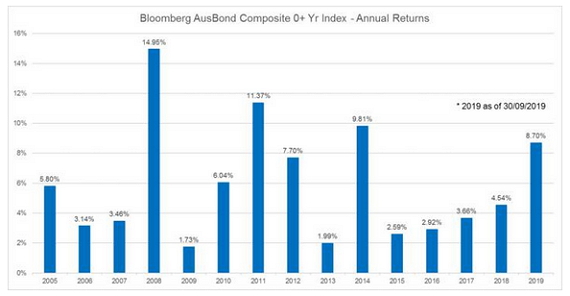
There have been strong gains for bonds in recent months, after a period of declines. An example from the Australian market is pictured below. Part of the reason for this could be that bond markets are responding to an anticipated global economic recovery.  


Source: Bloomberg, as at 30/9/2019

Here, we take a look at some key events on the global stage that impact fixed income markets.

Financial conditions

Policy easing has contributed to more supportive financial conditions worldwide, which is one to watch moving into 2020.

In fact, the monetary easing put into effect this year is one of the reasons our chief economist, Shane Oliver, holds some optimism about the global economy for the year to come.

That said, central banks are expected to remain dovish for a period, and in some cases, constrained in their ability to offer further support. The Reserve Bank in Australia, for example, has called on the federal government to introduce fiscal stimulus into the economy.

Growth on the global stage

Economic growth internationally is, as ever, one to watch. Broadly speaking, although monetary policy is set to have an impact, conditions are still soft and the risk of recession lingers.

Further, there are ongoing weak spots of note. For example, there is an increasing risk that trade-induced weaknesses in both Europe and Asia are becoming entrenched. Given time, this may begin to spill over into the United States.

In addition, core inflation has been suppressed, but looks set to be moving slowly higher if growth can rebound globally.

Trade tensions

The fixed income market is also not immune to the knock-on impacts of an event which has had a far-reaching impact on international economies since it began: the US-China trade war.

The political climate in the US, as it heads towards the federal election in 2020, could prompt a short-term breakthrough. US President Donald Trump will be under pressure to keep the economy stable, and progress on trade talks with China would be favourable for his campaign.

Nevertheless, the conflict remains a key risk to watch and monitor for impact.

In focus: the Australian market

No doubt, in a lower-for-longer environment, investors in the Australian market would be questioning the utility of a bond portfolio.


Source: AMP Capital Global Fixed Income team, 30/09/2019.

Granted, Australian bonds will not be able to provide the same defensive attributes that they have historically, given the multi decade falls in yield, but in a world of ever increasing negative yielding debt, Australian bonds continue to offer defensive characteristics. Australian bonds whilst offering a low yield, remain a triple AAA rated, liquid, defensive asset, that is attractive to many of its peers.


Author: Ilan Dekell, Head of Macro Sydney, Australia

Source: AMP Capital 5 Dec 2019

Important notes: While every care has been taken in the preparation of this article, AMP Capital Investors Limited (ABN 59 001 777 591, AFSL 232497) and AMP Capital Funds Management Limited (ABN 15 159 557 721, AFSL 426455) (AMP Capital) makes no representations or warranties as to the accuracy or completeness of any statement in it including, without limitation, any forecasts. Past performance is not a reliable indicator of future performance. This article has been prepared for the purpose of providing general information, without taking account of any particular investor’s objectives, financial situation or needs. An investor should, before making any investment decisions, consider the appropriateness of the information in this article, and seek professional advice, having regard to the investor’s objectives, financial situation and needs. This article is solely for the use of the party to whom it is provided and must not be provided to any other person or entity without the express written consent of AMP Capital.