https://vimeo.com/377480434

Determining the best option for income investment can be a challenging task, and retirees in particular have a specific set of needs that set them apart from other investors.

A decade ago, generating an income in excess of six per cent was very achievable, and could be diversified across a number of relatively low-risk asset classes such as long-term bonds, term deposits and residential property.

Today, however, it’s a different story, with fixed income and annuities returning record-low yields. High income options are now very limited, and investors must search hard and take on a level of additional risk in order to secure sufficient and reliable yields. In this environment, equities look to be the best way forward.

Not only are equities able to generate strong cash flows, in many cases they also provide franking credits. Having escaped regulatory risk in the May federal election, franking credits have become a very important and stable driver of income returns in a retiree investor’s portfolio.

Alongside stable legislation there has also been a record number of franking credits dispensed in the Australian share market. Companies are delivering record amounts of franking credits through dividends, a massive number of off-market buybacks and increased special dividends. The record was set in 2018 and the second half of 2019 saw a strong run rate, suggesting promise for this profitable trend to continue.

We believe that performance in equities will only increase over the short term . Returns from franking credits alone are currently almost equivalent to returns across cash, bonds and credit, and are higher than term deposits, fixed income or annuities.

Overall, taking advantage of franked dividends and franking from buybacks through Australian equities looks set to be an increasingly valuable part of a retiree’s ability to drive income from their portfolio over the next few years.  


Author: Dermot Ryan, Sydney, Australia

Source: AMP Capital 15 Jan 2020

Important notes: While every care has been taken in the preparation of this article, AMP Capital Investors Limited (ABN 59 001 777 591, AFSL 232497) and AMP Capital Funds Management Limited (ABN 15 159 557 721, AFSL 426455) (AMP Capital) makes no representations or warranties as to the accuracy or completeness of any statement in it including, without limitation, any forecasts. Past performance is not a reliable indicator of future performance. This article has been prepared for the purpose of providing general information, without taking account of any particular investor’s objectives, financial situation or needs. An investor should, before making any investment decisions, consider the appropriateness of the information in this article, and seek professional advice, having regard to the investor’s objectives, financial situation and needs. This article is solely for the use of the party to whom it is provided and must not be provided to any other person or entity without the express written consent of AMP Capital.

As climate strikes continue to take place around the world, some small business owners are asking whether they can reduce their carbon footprint.

Climate change is being heralded as perhaps the most serious issue our generation faces, with many initiatives taking place around the world to raise awareness about its potential impacts.

Aside from being an issue discussed in government, homes and schools, climate change has moved to the top of the agenda for businesses as well.

In September, tens of thousands of businesses around the world (and many hundreds in Australia) participated in a climate strike, an event that was branded with the slogan ‘This is not business as usual’. The inference here is that business leaders can’t ignore how a climate change future might impact them.

If you’re one of the growing number of business leaders wondering what they can do to help address climate change through their operations, there are some simple first steps you can take.

ClimateClever: Helping people act on climate change

As society becomes more aware of climate change, it’s more important than ever for people to understand the impact their day-to-day activities may have on the environment.

There are many startups around the world that’ve been working tirelessly to develop technology-based solutions that help fight climate change, and one such business is ClimateClever.

Founded by Dr Vanessa Rauland in 2017, ClimateClever is an innovative software solution that allows people to calculate and track their carbon footprint, audit their buildings and create evidence-based (and achievable) action plans to reduce energy consumption levels.

Given her PhD in Low Carbon Cities (Philosophy) and her vast experience in helping people reduce the level of energy they consume, I spoke with Rauland to hear more about her ideas on the strategies that small business owners can use to play their part in addressing the negative effects climate change may pose.

Rauland’s advice takes shape as four simple steps. And it turns out following these steps can actually save your business money.

1. Measure your carbon footprint

The first thing Rauland highlighted the first challenge to be addressed when considering how to reduce a business’s carbon footprint, and that’s how to measure it.

“Knowing how to measure carbon consumption is one of the hardest things for businesses to do,” Rauland told The Pulse.

“Existing energy meters are not particularly transparent, and businesses don’t have a frame of reference as to what the energy consumption benchmark is supposed to be.

“You can’t set targets if you don’t have visibility.”

According to Rauland, another big part of the issue is that the accounts team of a business often develop the habit of paying energy bills without looking out for anomalies that may indicate where emission reductions might take place (and perhaps even save you money).

“If you aren’t looking at the numbers, you tend to miss big ticket items.”

But, if business owners can increase their efforts in measuring their carbon consumption, the ability to reduce their impact becomes much more realistic.

Rauland encouraged business owners to “start the conversation” by reaching out to colleagues from businesses of a similar size to their own and ask about their energy consumption and “compare numbers”.

“This will help businesses create that frame of reference about where they fit into the climate change story.

“Training the accounts staff to mindfully pay company energy and other utility bills and to flag large changes in energy consumption patterns to upper management can also create more of a climate-change-conscious environment at work.”

2. Start with the big-ticket items

Have you ever walked into the kitchen after you’ve hosted a dinner party at your house, looked at the huge pile of dishes, overflowing rubbish bags and dirty countertops, and felt too overwhelmed to know how or where to start the cleanup?

If so, you know exactly how many business owners feel about addressing climate change at work.

Between changing old, inefficient lightbulbs to LEDs, composting, recycling and keeping track of energy consumption across the entire business, not knowing where to start is a very common barrier between the business owner and the concept of reducing their carbon footprint.

In order to break down this barrier, Rauland encouraged business owners to go right back to basics and look to address the big-ticket items first.

“Big appliances like air conditioning systems and fridges are a great place to start, as they consume enormous amounts of energy.

“During the summer months, set the temperature on the air-conditioning system to 22-24 degrees and encourage people to dress for the weather.

“Workplaces that have their thermostats on 17-18 degrees don’t realise that they’re increasing their energy consumption by 10 percent with every degree.”

Similarly, you may find there are other large appliances needlessly chewing up your power bill and increasing your carbon footprint.

“As for fridges, try and use them efficiently by filling them up as much as possible before turning on a second one.

“Aside from being better for the environment, fridges work more effectively that way as well.”

3. Make sustainability part of your business culture

Being conscious of a company’s energy consumption levels can’t just be the passion of the business owner.

Rauland explained that if a small business owner truly wants to make a difference, they need understand that reducing their business’s carbon footprint has to be a group effort whereby everyone within the organisation has a role to play.

“Spread the roles across the entire company and encourage everybody takes part in reducing the organisation’s impact on the environment.

“Talk about it in meetings, send out emails about it, write climate change policies collaboratively and make everyone in the organisation part of the climate change conversation.

“The key is to bring everyone on board.”

4. Use your energy savings wisely

Aside from the direct benefits that being environment-conscious at work can bring to the global climate change issue, when businesses put effort into finding more efficient ways to consume energy, they can end up saving the business (a lot of) money.

As part of her advice to small businesses, Rauland recommended that business owners consider to donating part or all of their savings to a cause that their employees collectively decide on.

“It puts a deeper level of meaning and impact into the businesses climate change narrative.”

According to Rauland, allocating part of those savings to incentives that encourage staff to be conscious of climate change outside of the office as well is also a great way to add another dimension to a business’ efforts to reduce its impact.

“Taking the money saved from your overuse of electricity and giving it back to the employees in ways like paying for their train or bus tickets to work, can be a great way to offer a financial incentive to employees, while encouraging them to think more about their own personal carbon footprint outside of the office as well.”

Rauland’s advice indicates that just about any business can find ways to reduce their carbon footprint while also increasing efficiencies and save money.

Source : MYOB

Reproduced with the permission of MYOB. This article by Benjamin Kluwgant was originally published at https://www.myob.com/au/blog/reduce-small-businesss-carbon-footprint/

Important:
This provides general information and hasn’t taken your circumstances into account. It’s important to consider your particular circumstances before deciding what’s right for you. Although the information is from sources considered reliable, we do not guarantee that it is accurate or complete. You should not rely upon it and should seek qualified advice before making any investment decision. Except where liability under any statute cannot be excluded, we do not accept any liability (whether under contract, tort or otherwise) for any resulting loss or damage of the reader or any other person.

Any information provided by the author detailed above is separate and external to our business and our Licensee. Neither our business nor our Licensee takes any responsibility for any action or any service provided by the author.

Any links have been provided with permission for information purposes only and will take you to external websites, which are not connected to our company in any way. Note: Our company does not endorse and is not responsible for the accuracy of the contents/information contained within the linked site(s) accessible from this page


When it comes to superannuation, most funds offer a range of investment options.

If there’s one thing certain in life it’s change. And generally your attitude towards saving and investing will change as you get older.

How your super is invested when starting your first job may not be the right approach when you’re approaching retirement. Luckily you can change your investment options at any time and this could make a real difference to how much money you have when you retire.

There are usually several different investment options to choose from. If you haven’t selected an investment option, you’re probably invested in your fund’s default option, which will generally take a balanced approach to risk and return.

To get up to speed on your super investment options, we’ve answered three common questions: how your money is invested, the different options available, and how your stage of life may influence your preferences.

What do super funds do with my money?

Typically, no less than 9.5% of your before-tax salary (if you’re eligible) is paid into super, which is then taxed at a maximum of 15%. Your super fund will invest this money over the course of your working life, so you can hopefully retire comfortably.

Your super fund will let you choose from a range of investment options and generally the main difference will be the level of risk you’re willing to take to potentially generate higher returns.

If you’re not sure what you’re invested in, contact your super fund. You may also be able to see your current investment option by logging into your super fund’s online portal – this may also give you a current balance and other information such as your projected super savings over a lifetime.

What are the super investment options I can choose from?

Most super funds let you choose from a range, or mix of investment options and asset classes. These might include ‘growth’, ‘balanced’, ‘conservative’ and ‘cash’ but the terms can differ across super funds. Here’s a small sample of the typical type of investment options1 available:

  • Growth options aim for higher returns over the long term, however losses can also be notable when markets aren’t performing. They typically invest around 85% in shares or property.

  • Balanced options don’t tend to perform as well as growth options over the long term, but the loss is also less when there are market downturns. They typically invest around 70% in shares or property, with the rest in fixed interest and cash.

  • Conservative options generally aim to reduce the risk of market volatility and therefore may generate lower returns. They typically invest around 30% in shares and property, with the rest in fixed interest and cash.

  • Cash options aim to generate stable returns to safeguard the money you’ve accumulated. They typically invest 100% in deposits with Australian deposit-taking institutions, such as banks, building societies and credit unions.

Super funds may have different allocations, so it’s important to read your super fund’s product disclosure statement before making any decisions. It could be a good idea to consider factors such as your current stage in life, and future plans and goals before choosing the super investment option that’s right for you.

What’s the right investment option for me?

Choosing the most suitable investment option generally comes down to your goals for retirement, your attitude to risk and the time you have available to invest.

If you’re young, you may have more time to ride out market highs and lows, and therefore be willing to take on more risk in the hope of achieving higher returns.

If you’re closer to being able to access your super, you may prefer a conservative approach as a share market crash could be harder to recover from than if you’re 20 years away from retirement.

While many people put off thinking about super, being informed and engaged from a young age and throughout your career may make a big difference to the returns generated and your final super balance.

Adam Spencer explains more about this in the video below.

What is a lifecycle investment strategy?

If you need further assistance, speak to us on Phone: 07 5641 4134 .

Source : AMP January 2020 

Important:
This information is provided by AMP Life Limited. It is general information only and hasn’t taken your circumstances into account. It’s important to consider your particular circumstances and the relevant Product Disclosure Statement or Terms and Conditions, available by calling Phone: 07 5641 4134, before deciding what’s right for you.

All information in this article is subject to change without notice. Although the information is from sources considered reliable, AMP and our company do not guarantee that it is accurate or complete. You should not rely upon it and should seek professional advice before making any financial decision. Except where liability under any statute cannot be excluded, AMP and our company do not accept any liability for any resulting loss or damage of the reader or any other person.

If you struggle to stick to a healthy diet, don’t exercise regularly or can’t make time for peaceful moments of rest, chances are you need a holiday – and don’t we all! The thing is, we often jet off to exotic shores only to overindulge in junk food, a few too many sunset cocktails and late nights that add up to pure exhaustion on the plane ride home. 

And, there’s nothing wrong with that.

However, if you want to take a break that truly results in a rejuvenated mind, body and spirit, health and wellness holidays are the way to go. Best of all, some of the world’s most beautiful destinations offer an abundance of healthy living options and retreats that are guaranteed to produce that holiday glow, on a budget. 

Luang Prabang, Laos

The motto for life in Luang Prabang is ‘boh pen yang’, which basically translates to ‘no worries’. Here, each day starts with the sounds of chanting and temple drums before sunrise and Tak Bat. The morning alms ceremony sees lines of orange-robed monks wind through the UNESCO-listed streets, in a silent procession that supports the monks with food and the almsgivers with spiritual nourishment. 

With your spirit soothed, walk or cycle to the picturesque banks of the Nam Khan River for a class with Luang Prabang Yoga. Join a cooking class at Bamboo Tree to learn healthy tips, after selecting your own organic produce from the outdoor market. Because you’ll save money staying at charming guest houses for as little as $50 a night, splash out on revitalising spa treatments at Amantaka or Mekong Spa

Chiang Rai, Thailand

The ‘land of smiles’ is world-famous for a wealth of tropical retreats that are custom-made to guide guests back to peace, health and happiness. With yoga classes, detox programs, spa treatments and personalised healthy eating plans galore, it’s almost impossible to leave without feeling like a new person. 

Best of all, you don’t have to spend up big to get a slice of luxury with your health kick. Head to laidback Chiang Rai for cheap accommodation surrounded by temples and mountains, with plenty of budget-friendly, organic local produce to tempt your taste buds. Check out Museflower Retreat and Spa for wellness packages, treatments and workshops. 

Ubud, Bali

You can’t take two steps in Ubud without running into a yoga or massage studio – and that’s only a slight exaggeration. Bali’s spiritual and cultural centre offers everything you need for a health and wellness holiday, with a price tag that puts a smile on your face before you even sink into a massage. 

There are plenty of health retreats offering programs to de-stress, detox and revive. However, with daily walks in emerald rice fields, meals at restaurants serving chemical-free meat and organic produce, cheap-as-chips massages and a yoga class or three, it’s easy enough to design your own health and wellness holiday here. 

A little bit of balance between cocktail-sipping and healthy pursuits is all it takes to truly rejuvenate and reap all the rewards from your next break – including a happy holiday budget! 


Source: Clientcomm library 

Important note:
This provides general information and hasn’t taken your circumstances into account.  It’s important to consider your particular circumstances before deciding what’s right for you. Although the information is from sources considered reliable, we do not guarantee that it is accurate or complete. You should not rely upon it and should seek qualified advice before making any investment decision. Except where liability under any statute cannot be excluded, we do not accept any liability (whether under contract, tort or otherwise) for any resulting loss or damage of the reader or any other person.  Past performance is not a reliable guide to future returns.

Any information provided by the author detailed above is separate and external to our business and our Licensee. Neither our business nor our Licensee takes any responsibility for any action or any service provided by the author. 

Any links have been provided with permission for information purposes only and will take you to external websites, which are not connected to our company in any way. Note: Our company does not endorse and is not responsible for the accuracy of the contents/information contained within the linked site(s) accessible from this page.

Our high-level investment view for this year is that a combination of improving global growth boosting profits and still easy monetary conditions will help drive reasonable investment returns, albeit more modest than the very strong gains of 2019. This note revisits five charts we see as critical to the outlook.


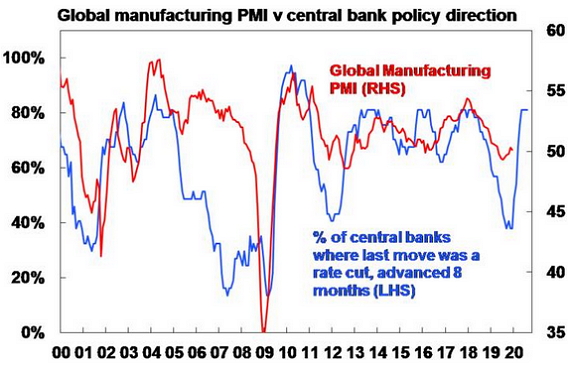
Chart #1 – Global business conditions PMIs

Global Purchasing Managers Indexes (PMIs) – surveys of purchasing managers at businesses in most major countries – are an excellent and timely guide to the state of the global economy. Although services sector PMIs held up better than for manufacturers – which tend to be more cyclical – both softened through 2018 and into mid-2019. Since then they have shown signs of improvement suggesting that the global monetary easing seen through 2019 with interest rate cuts and renewed quantitative easing is working. Going forward they will need to improve further to be consistent with our view that growth will pick up this year.


Source: Bloomberg, AMP Capital

But so far, the 2018-19 slowdown in business conditions PMIs (and hence global growth) looks like the slowdowns around 2012 and 2015-16 as opposed to the recession associated with the global financial crisis (GFC).

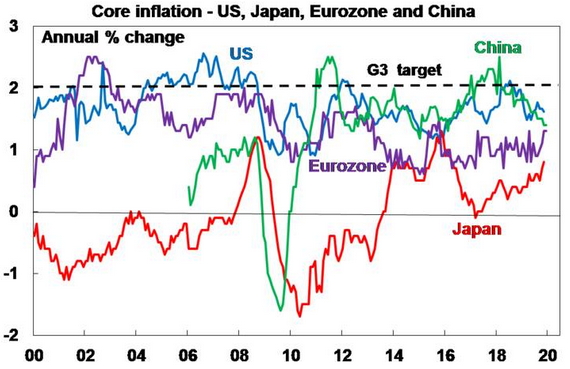
Chart 2 – Global inflation

Major economic downturns are invariably preceded by a rise in inflation to above central bank targets causing central banks to slam the brakes on. At present, core inflation – ie inflation excluding the volatile items of food and energy – in major global economies remains benign. In the US, the Eurozone and Japan core inflation is well below their central bank targets of 2%. Inflation in China spiked to 4.5% through last year, but core inflation has been falling to 1.4% and is well below the Government’s 3% target/forecast. A clear upswing in core inflation would be a warning sign that spare capacity has been used up, that monetary easing has gone too far, and that the next move will be aggressive monetary tightening. But at present, we are a long way from that.


Source: Bloomberg, AMP Capital

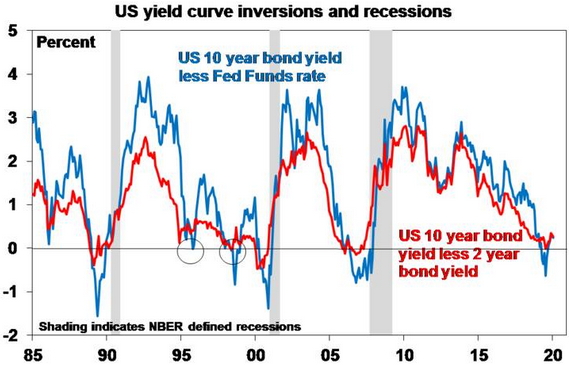
Chart 3 – The US yield curve

The yield curve is a guide to the stance of monetary policy. When short-term interest rates are low relative to long-term rates businesses can borrow short and lend (or invest) long and this grows the economy. But it’s not so good when short rates are above long rates. An inverted US yield curve has preceded past US recessions. So, when this happened last year there was much concern that a US recession was on the way.

However, in recent months various versions of the yield curve – with the gap between the US 10 year bond yield and the Fed Funds rate and the US 10 year bond yield and the 2 year bond yield shown in the next chart – have uninverted as the Fed cut rates and hence short-term yields fell, good economic data provided confidence that recession will be avoided and the US/China trade war de-escalated reducing the threat posed by the trade war.


Source: NBER, Bloomberg, AMP Capital

While the US yield curve has uninverted in the past and yet a recession has still come along, the uninversion seen in recent months coming after such a shallow and short-lived inversion provides confidence that the inversion seen last year gave a false signal as occurred in the mid to late 1990s (as circled).

In addition, it’s also worth noting that other indicators suggest that US monetary policy was far from tight – the real Fed Fund rate was barely positive, and the nominal Fed Funds rate was well below nominal GDP growth and both are far from levels that in the past have preceded US recessions.

So it’s a good sign that the US yield curve has been steepening in recent months. A return to yield curve inversion – which became deeper than seen last year – would be a concern of course.

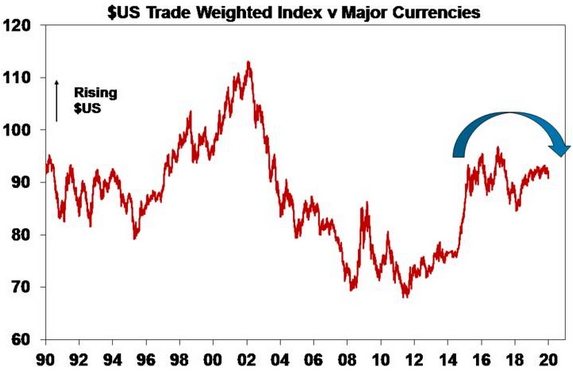
Chart 4 – The US dollar

Moves in the value of the US dollar against a range of currencies are of broad global significance. This is for two reasons. First, because of the relatively low exposure of the US economy to cyclical sectors like manufacturing and materials the $US tends to be a “risk-off” currency, ie it goes up when there are worries about global growth. Second, because of its reserve currency status and that a lot of global debt is denominated in US dollars particularly in emerging countries, when the $US goes up it makes it tough for emerging countries. 


Source: Bloomberg, AMP Capital

So when global uncertainty is rising this pushes the $US up which in turn makes it hard for emerging countries with $US denominated debt. If we are right though and global growth picks up a bit, trade war risk remains in abeyance and the Iran conflict does not become big enough to derail things then the $US is likely to decline further which would be positive for emerging countries.

Chart 5 – World trade growth

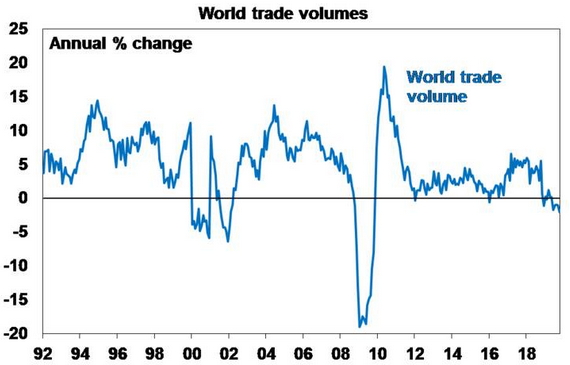
It’s reasonable to expect growth in world trade to slow over time as services become an ever-greater share of economic activity and manufacturing becomes less labour dependent. However, President Trump’s trade wars since 2018 combined with slower global growth saw global trade fall last year. This year should see some reversal if the trade wars remain in abeyance as Trump focuses on keeping the US economy strong to aid his re-election and global growth picks up a bit.


Source: CPB World Trade Volume Index, Thomson Reuters, AMP Capital

US recession still a way away

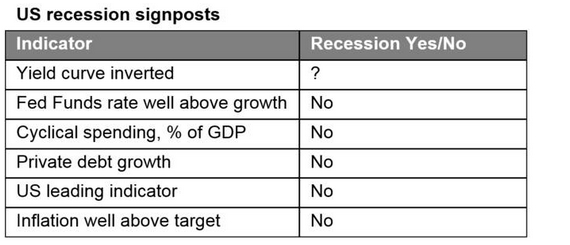
In recent years there has been much debate about whether a new major bear market in shares is approaching. Such concerns usually reach fever pitch after share markets have already fallen 20% or so (as they did into 2011, 2016 and 2018). The historical experience tells us that what happens in the US is critical to how deep share market falls get. Deep (“grizzly”) bear markets like the 50% plus fall seen in the GFC are invariably associated with US recession. So, whether a recession is imminent in the US, and more broadly globally, is critically important in terms of whether a major bear market is on the way. The next table summarises the key indicators we are still watching in this regard.


Source: AMP Capital

These indicators are still not foreshadowing an imminent recession in the US. The yield curve is most at risk if it inverts again. But other measures of monetary policy in the US are not tight and we have not seen the sort of excesses that normally precede recessions – discretionary or cyclical spending as a share of GDP is low, private debt growth has not been excessive, the US leading indicator is far from recessionary levels and inflation is benign.

Concluding comments

At present, most of these charts or indicators are moving in the right direction, with the PMIs improving a bit, inflation remaining low, the yield curve steepening, the $US showing signs of topping and the US/China trade truce auguring well for some pick up in world trade growth. But to be consistent with our view that this year will see good returns from shares we need to see further improvement and so these charts are worth keeping an eye on.


Source: AMP Capital 15 Jan 2020

Important notes: While every care has been taken in the preparation of this article, AMP Capital Investors Limited (ABN 59 001 777 591, AFSL 232497) and AMP Capital Funds Management Limited (ABN 15 159 557 721, AFSL 426455) (AMP Capital) makes no representations or warranties as to the accuracy or completeness of any statement in it including, without limitation, any forecasts. Past performance is not a reliable indicator of future performance. This article has been prepared for the purpose of providing general information, without taking account of any particular investor’s objectives, financial situation or needs. An investor should, before making any investment decisions, consider the appropriateness of the information in this article, and seek professional advice, having regard to the investor’s objectives, financial situation and needs. This article is solely for the use of the party to whom it is provided and must not be provided to any other person or entity without the express written consent of AMP Capital.

The lists of Australia’s wealthiest individuals and families published annually by different media organisations are generally an interesting read.

Ranking them by their net wealth, they show that many of the richest Australians have progressively become richer over time through a combination of business expansion, market forces and shrewd investment decisions.

In fact, looking at the aggregate data compiled over the last 20 years, the combined wealth of the top 200 wealthiest people has increased more than five-fold to over $300 billion.

Yet, the real story behind these rich list rankings only becomes apparent when one digs a little deeper and compares how individual fortunes have changed from year to year.

Total wealth gains have not been uniform. Some individuals and families have managed to increase their fortunes every year, without fail. But others, because of unfavourable market conditions, poor investment decisions or a combination of both, have suffered losses over the same time and slipped well down the overall rankings. Some have even fallen off the rich list entirely.

The power of cumulative returns

Had the latter cohort, who have slipped down or off the wealth rankings, simply adhered to a diversified managed investment strategy over the last 20 years, their net worth would have at least trebled.

To illustrate this point, we’ve compiled our own data showing the respective gross cumulative returns over 17 years from four different investment strategies based on an initial $10,000 investment back in 2002.

The reason we’ve picked 17 years is because this coincides with the inception of Vanguard’s four diversified LifeStrategy index funds, covering conservative, balanced, growth and high growth allocations.

By definition, our conservative diversified investment strategy is structured around a portfolio of different funds with a 70 per cent allocation to fixed income investments and 30 per cent to equities.

Our balanced strategy is split 50:50 between fixed income and equities funds, our growth strategy 70 per cent equities and 30 per cent fixed income, and our high growth strategy 90 per cent equities and 10 per cent fixed income.

The results are illustrated in the table below showing what a $10,000 investment made in December 2002 would have been worth at 30 September 2019 based on the respective cumulative investment returns from each strategy without any additional capital contributions.

Diversified Strategy Total Cumulative Return Value* Gross Annual Return ^
Conservative $29,450 6.73%
Balanced $33,442 8.05%
Growth $37,502 7.91%
High growth $39,801 8.25%

* At 30 September 2019. ^ Gross annual return since inception.

Note that the above returns assume the reinvestment of all income distributions, and do not take into account any management cost rebates. Gross returns are calculated before allowing for management costs, but after transaction costs.

What the numbers show, however, is that even an investor who stuck with the conservative investment strategy all the way through since inception would be well ahead by now.

And keep in mind that the last 17 years includes the huge markets dip through the period of the Global Financial Crisis from late 2007 through to early 2009, and all the most recent volatility brought about by economic, geopolitical and trade concerns.

The benefits of regular contributions

The return numbers by value become even more compelling when regular capital contributions are added to the equation.

To do this we’ve used the compound interest calculator on the Australian Securities & Investment Commission’s MoneySmart website, using the same $10,000 initial deposit 17 years ago and the same gross annual return percentages. However, we’ve added in a regular deposit amount of $217 per month, which equates to $50 per week, compounded monthly.

The table below shows the total cumulative return value based on regular monthly deposits having been made since inception based on the same four diversified LifeStrategy index funds.

Again, the returns assume reinvestment of all income distributions and do not take into account any management cost rebates. The gross returns have been calculated before allowing for management costs, but are after transaction costs.

Diversified Strategy Total Cumulative Return Value* Gross Annual Return ^
Conservative $113,695 6.73%
Balanced $133,297 8.05%
Growth $131,041 7.91%
High growth $136,598 8.25%

* At 30 September 2019, based on a $50 per week contribution. ^ Gross annual return since inception.

Regardless of the investment strategy chosen at the beginning of the period, investors with a modest regular contributions strategy would have increased their initial $10,000 holding more than ten-fold.

Inputting higher initial deposit numbers and higher regular deposits will obviously produce even more impressive long-term results.

Vanguard’s late founder John C. Bogle encapsulated all this so well when he stated: “Stay the course. No matter what happens, stick to your program. It’s the most important piece of investment wisdom I can give you.”


Source : Vanguard November 2019 

By Tony Kaye, Personal Finance Writer, Vanguard Australia.

Reproduced with permission of Vanguard Investments Australia Ltd

Vanguard Investments Australia Ltd (ABN 72 072 881 086 / AFS Licence 227263) is the product issuer. We have not taken yours and your clients’ circumstances into account when preparing this material so it may not be applicable to the particular situation you are considering. You should consider your circumstances and our Product Disclosure Statement (PDS) or Prospectus before making any investment decision. You can access our PDS or Prospectus online or by calling us. This material was prepared in good faith and we accept no liability for any errors or omissions. Past performance is not an indication of future performance.

© 2019 Vanguard Investments Australia Ltd. All rights reserved.

Important:
Any information provided by the author detailed above is separate and external to our business and our Licensee. Neither our business nor our Licensee takes any responsibility for any action or any service provided by the author.

Any links have been provided with permission for information purposes only and will take you to external websites, which are not connected to our company in any way. Note: Our company does not endorse and is not responsible for the accuracy of the contents/information contained within the linked site(s) accessible from this page. 

Binding death benefit nominations in an SMSF can provide useful direction to the trustee of a fund after death, for distribution of benefits. However, over the past six months, we have noticed some common issues arising that need attention.

1. Issue: ‘Everything will be OK, my family will look after it.’

Many members of SMSFs make the incorrect assumption that just because it was all peace and harmony while they were alive, this will continue on their demise.

While most disputes are settled prior to getting to a court hearing, there are enough cases where the apparent intention of the deceased made clear during their life was never reduced to writing. The result is that unintended family members may end up with superannuation to the detriment of others.

Make sure that your intention to pay super benefits to particular family members is put in writing, as a binding direction to the trustee of the fund.

2. Issue: Not understanding who can make a claim or receive a superannuation death benefit.

The superannuation laws have strict rules around who can receive your death benefit. The law limits your superannuation death benefit to your dependants, plus it can be paid to your estate via your legal personal representative. Your dependants for super purposes include your spouse, children, anyone dependant on you for support and anyone with whom you have an interdependency relationship.
Make sure you are clear about who should receive your superannuation after your death.

3. Issue: Not understanding the place of superannuation in your last will and testament.

One misunderstanding is that your last will and testament can decide how your superannuation is to be distributed amongst your beneficiaries. This is incorrect, as the rules of your super fund initially determine how your super is to be distributed.

Your fund may allow you to make a binding death benefit nomination, which directs the trustee as to who is to receive your superannuation. This includes your dependants, and you can have your super paid your legal personal representative who is responsible to distribute the amount received as instructed in your will. If you don’t have a binding death benefit nomination, then the rules of the fund may allow the trustee discretion to distribute your super benefit to your dependants including to your estate via your legal personal representative.

Make sure you have a clear direction for the distribution of your superannuation otherwise payment may be up to the trustees of your fund after your death.

4. Issue: Incorrect binding death benefit nominations.

Many SMSFs have trust deeds which include standard binding death benefit nominations or require that the nominations follow a set format. If they do, then make sure any nomination that you sign is consistent with that nomination. You may find a standard nomination from the web to use or be provided with one from an accountant or adviser.

Make sure you use a nomination that satisfies the trust deed or distribution of your death benefit may be at the discretion of the fund trustees.

5. Issue: Incorrectly completed death benefit nominations.

We often see binding death benefit nominations that are incomplete or are incorrect. The information required to be included in the nomination will depend on the particular form, but it will usually include:

  • the member’s name

  • who the member nominates to receive the death benefit

  • how much of the death benefit is to be paid to the dependant or legal personal representative

  • any other instructions concerning payment of the death benefit

  • the member’s signature and dated

  • witnesses including the witness signature and dated

The binding death benefit nominations we see have one or more of these bits of information missing, which may render the nomination invalid or limit who may be eligible to receive the death benefit. If the nomination is considered invalid it may then rely on the fund trustee discretion for distribution of the death benefit.

Make sure your death benefit nomination has been completed correctly or it may be up to the trustee to decide how your death benefit will be distributed.

6. Issue: Not keeping the death benefit nomination up to date.

As things change during your life, you may wish to direct the payment of your superannuation to someone else. This may occur if you have children, change relationships or someone becomes dependent upon you for support.

Each time your family or relationship circumstances change review your death benefit nomination to see whether any change is required.

7. Issue: Failure to finalise a marriage breakdown.

Superannuation splitting usually is included as part of a marriage or relationship settlement. However, any binding death benefit nomination you have in place at the time of the settlement may still be valid and it is possible for benefits to be paid to your ex-partner.

As part of the settlement be sure to review your binding death benefit nomination and make any amendments necessary to take into account your changed circumstances.

8. Issue: Not addressing the legal competency of fund members.

Whether a trustee of an SMSF is competent to act in the interests of a deceased member is something that should be under consideration at all times. If the trustee is unable to act in that capacity, then who would take over the running of the fund?

To cater for this situation the trust deed of the fund or constitution of the corporate trustee should provide an alternative if the trustee or director of the corporate trustee become legally incompetent due to disability. Another option could be for the trustee to grant an enduring power of attorney to another person who could take over when they are unable to act.

Being prepared when a trustee is unable to act by using an ensuring power of attorney may allow an SMSF to continue in difficult times.

9. Issue: Not taking the specific makeup of an SMSF into consideration.

SMSFs operate in a unique way and may have investments which can be retained in the fund or transferred to the beneficiary as part of the payment of a death benefit. It is possible for a binding death benefit nomination to direct particular assets to one or more beneficiary.

Consideration needs to be taken of the fund’s assets in satisfaction of the payment of a death benefit. This may involve taxation issues, including income tax and stamp duty in relation to the transfer

10. Issue: Taking estate planning considerations into account.

Estate planning has become more important since the commencement of the transfer balance cap from 1 July 2017. The cap restricts the amount that can be used to start an income stream(s) in a superannuation fund, including death benefit pensions.

If a person becomes entitled to a reversionary or death benefit pension there is potential that their transfer balance cap of $1.6 million has been exceeded. This may require the transfer of part of the death benefit out of the fund as a lump sum. Depending on the wishes of the deceased it may be paid to a dependant or to their estate and have different tax consequences.

As part of deciding what is to happen with your death benefit the estate planning issues should be taken into account.

There’s a lot to think about…

It doesn’t matter whether you have an SMSF or belong to one of the larger super funds, the distribution of your death benefit should be made by the fund trustees as you want it. Any directions or instructions provided to the trustee must be clear and as required by the fund’s trust deed. Otherwise payment of your death benefit may be up to the trustee’s discretion and end up in the hands of someone you never intended.

By Graeme Colley
Executive Manager, SMSF Technical and Private Wealth – SuperConceptsSydney, Australia

Please contact us on Phone: 07 5641 4134 if you seek further assistance on this topic.

Source : AMP CAPITAL October  2019 

Important notes: While every care has been taken in the preparation of this article, AMP Capital Investors Limited (ABN 59 001 777 591, AFSL 232497) and AMP Capital Funds Management Limited (ABN 15 159 557 721, AFSL 426455)  (AMP Capital) makes no representations or warranties as to the accuracy or completeness of any statement in it including, without limitation, any forecasts. Past performance is not a reliable indicator of future performance. This article has been prepared for the purpose of providing general information, without taking account of any particular investor’s objectives, financial situation or needs. An investor should, before making any investment decisions, consider the appropriateness of the information in this article, and seek professional advice, having regard to the investor’s objectives, financial situation and needs. This article is solely for the use of the party to whom it is provided and must not be provided to any other person or entity without the express written consent of AMP Capital.

When it comes to building our dream solo business, capital can be the one thing we can’t can’t always count on, but that doesn’t mean we can’t get started.

A friend recently told me the best part about having taken on some extra work at night was the way it was inspiring plans for her future business.

The two hours she spent on this project every week exposed her to an industry she’d always wanted to be part of. And while she couldn’t commit to spending more time on doing this project, and couldn’t afford to simply quit her day job and start her business idea, the investment in time was paying dividends for her future, because she was learning.

Research, learning and planning is absolutely key to the success of any business, Flying Solo founder Robert Gerrish told me recently.

“A good idea is not a viable business, it’s just a good idea. Most businesses fail because they haven’t been clear on their target market. No matter how good the product or service is in theory, they fall down when they haven’t spent time making sure there’s a market out there of potential customers who will actually buy it.”

“A good idea is not a viable business, it’s just a good idea”

With that in mind, Robert says there are six key things any budding soloist can start doing today, to set them on track for future business success, no matter how much money you’ve got in the bank.

1. Develop a pitch

Start by imagining you’re preparing to meet an investor (and in this case the investor happens to be you!) and slowly start putting together a pitch for your business. This takes the heat off you in terms of having to work out how you will afford to do everything, and will force you to get clear on the type of business you want to build and how to build it.

2. Make sure you can answer the following questions:

What’s the idea for your business? What challenges does the business address?

Why would anyone care that I start this business? Who does this business appeal to and what problem are you solving for them?

3. Talk to your prospective customer

This can’t be just family or friends because they will always tell you your business idea is great! Get specific about the market for your business, find ways to talk to those people and in doing so, find some proof that you’re selling they want to buy.

4. Acknowledge any gaps in your knowledge

If people were really honest with themselves they kind of know where their weaknesses are; we often don’t confront our weaknesses, because it’s a lot more fun to just to what we enjoy. My weakness was understanding finances, it never interested me and I would always push them away. Lucky my strength was marketing, so it made up for that. Start off by being clear about weaknesses and upskill.

5. Devote time every day for professional development (10 mins – 30 mins)

Listen to a business podcast, read a website, or visit a business just like the one you want to start and observe how things work. Whatever it is you choose to do to educate yourself, just make it consistent,  just 10-30 minutes a day for learning will help.

6. Find a buddy

Once you’re clear on the gaps in your skills and knowledge, hunt around for someone who is good at those aspects of the business. Post a note on the Flying Solo forums, ask around at networking events; simply by saying something like “I’m a great marketer but really terrible with finances. Is there anyone here that’s really great with money and a terrible marketer” You will be surprised at how readily people are willing to share their expertise.

Source : Flying Solo

This article by Lucy Kippist is reproduced with the permission of Flying Solo – Australia’s micro business community. Find out more and join over 100K others.


Important:
This provides general information and hasn’t taken your circumstances into account. It’s important to consider your particular circumstances before deciding what’s right for you. Any information provided by the author detailed above is separate and external to our business and our Licensee. Any information provided by the author detailed above is separate and external to our business and our Licensee. Neither our business, nor our Licensee take any responsibility for any action or any service provided by the author.

Any links have been provided with permission for information purposes only and will take you to external websites, which are not connected to our company in any way. Note: Our company does not endorse and is not responsible for the accuracy of the contents/information contained within the linked site(s) accessible from this page.

Introduction

The Australian bushfire season that began in September has been horrific with more than 7 million hectares of bush destroyed, more than 25 deaths, significant loss of livestock, estimates of more than a billion wildlife animals killed and more than 1800 homes destroyed. More than 200 fires are still burning. Following the intensification of the bushfires over the Christmas/New Year period attention has now turned to the impact on the economy. This note looks at the key impacts.

The short-term impact on GDP and wealth

Physical disasters invariably cause a brief disruption to economic activity as measured by GDP followed by a boost as wealth destroyed by the disaster is rebuilt. In this sense measured across a year or so they are often seen as positive for economic growth, albeit this seems perverse particularly for those directly impacted.

The damage to property and wealth flowing from the bushfires will likely run into many billions. For example, the Victorian Black Saturday bushfires are estimated to have cost $4.4bn, whereas the current fires have covered an area 15 times bigger. So there will be a very big rebuilding boost to economic activity to come once the fires are brought under control. But the fires have been very widespread, have been going on for several months now and the crisis is continuing, so there will be a significant short-term negative impact and it likely will involve more than a short-term disruption to economic activity.

  • Activity related to farming, manufacturing, transport, tourism and business generally in the affected areas will be disrupted – this will involve around 2-3% of the population and will be concentrated around the March quarter. It will also be partly offset as affected people have to undertake spending that they otherwise wouldn’t have had to.

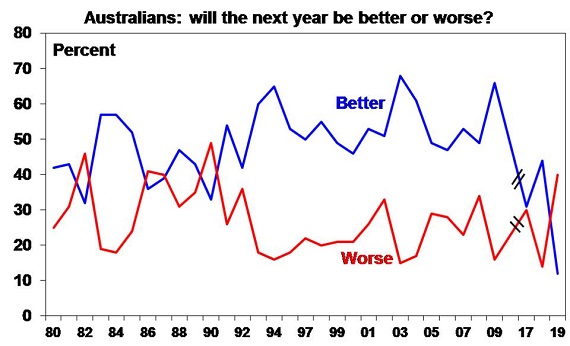
  • A bigger impact on economic activity is likely to come via a hit to consumer spending as the constant news of the fires and the smoke haze in several capital cities weighs on confidence. Australians were already very hesitant about the economic outlook after the slowdown in growth seen last year and continuing weak wages growth and high underemployment. A Roy Morgan survey released late last year found that 40% of Australians thought that 2020 will be worse than 2019, which is the worse reading since the early 1990s recession. At the same time a record-low 12% thought it would be better resulting in a net negative reading of 28% which is the worst in the survey’s 40-year history.

View larger image

Source: Roy Morgan; AMP Capital

This may exaggerate how bad things really are. The economy is still in far better shape than it was at the time of the early 1990s recession (I was there, I remember!). But a combination of more negative news flow today due to the rise of social media, more divisive politics and expectations rising faster than reality may be altering perceptions of the economy in a negative way and exaggerating the gloom. Nevertheless, a range of other surveys also show that consumers are uncertain and depressed, and this looks to have intensified since Christmas. The constant terrible news since October about the bushfires along with the smoke in cities is likely weighing further on the national psyche adding to weakness in consumer spending as Australians feel less motivated to spend when their fellow Australians are suffering. The hit to household spending power from higher prices for food and a likely rise in insurance premiums flowing from the fires will only accentuate this.

  • Inbound tourism is also likely to be impacted by the heavy coverage of the bushfires globally – with ridiculous maps showing much of Australia on fire (including where I am right now) – likely to adversely affect perceptions of Australia. This may be short lived (just as the positive boost from the 2000 Olympics was) but it could still last a year or so.

Taken together we expect a detraction from GDP due to the bushfires of around 0.4% starting in the December quarter but mainly impacting the March quarter before a rebuilding boost kicks in from the June quarter. Given the uncertainty, the range around this negative impact is -0.25% up to a worse case of -1% of GDP should the fires continue on a widespread basis through the rest of summer. The rebuilding boost should reverse much of this drag later in the year, but there is considerable uncertainty around this as the impact on tourism and consumer spending may linger longer.

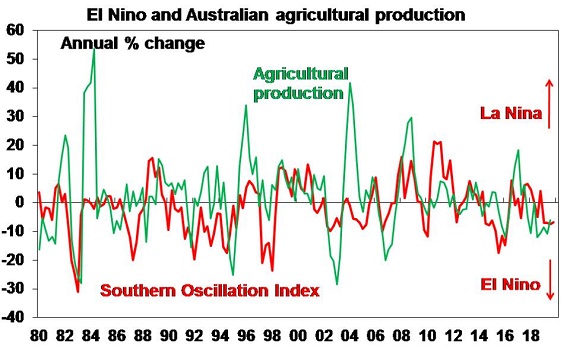
A big proximate contributor to the severity of the bushfires is the severe drought gripping much of Australia. This has already driven a decline in agricultural production, which has been directly detracting around 0.2 percentage points from GDP growth for the last two years. Unfortunately, the Southern Oscillation Index is still in El Nino territory pointing to ongoing relatively dry conditions in eastern and top-end Australia.

View larger image

Source: ABS, Australian Bureau of Meteorology, AMP Capital

More policy stimulus

With the bushfires likely to contribute to a flow of weak economic data for the next several months, questioning the RBA’s “gentle turning point” in the economy and resulting in a movement away from the achievement of the RBA’s full employment and inflation goals, the fires have only added to the pressure for more policy stimulus. We remain of the view that the RBA will cut the cash rate to 0.5% in February (with the market probability now up to 53.4% from a low of 36% before Christmas) and to 0.25% probably in March. The bushfires will push up food prices and insurance premiums but the RBA’s focus on underlying inflation will mean that it should look through this. In fact, increases in such prices will act as a tax on consumer spending power and are negative for spending and so could depress underlying inflation.

The pressure for further fiscal stimulus has also intensified. The Federal Government has already committed an additional $2bn for bushfire recovery to be spent this year and next (which is relatively small at 0.05% of GDP per year) and the NSW Government has committed another $1bn. However, the total hit to government budgets from the bushfires is likely to be much greater than this given assistance under existing disaster programs, extra expenses associated with fighting the fires and the impact of slower growth in the short term on revenue flows.

More broadly given the hit to confidence a circuit breaker is arguably needed to help boost economic growth. Monetary policy alone is unlikely to be enough. So there is a need for a broader fiscal stimulus – maybe in the form of a bring forward of the personal tax cuts, an increase in Newstart and broad based investment allowances. To have an impact it needs to be at least 0.5% of GDP (or around $10bn).

Rightly in the face of the pain caused by the bushfires the Government has relaxed the focus on achieving a budget surplus and it is now questionable as to whether it will be achieved this year and next. That is not a major problem in the relative scheme of things given the relatively good state of Australia’s public finances.

Some longer-term challenges

The bushfires pose a number of longer-term challenges.

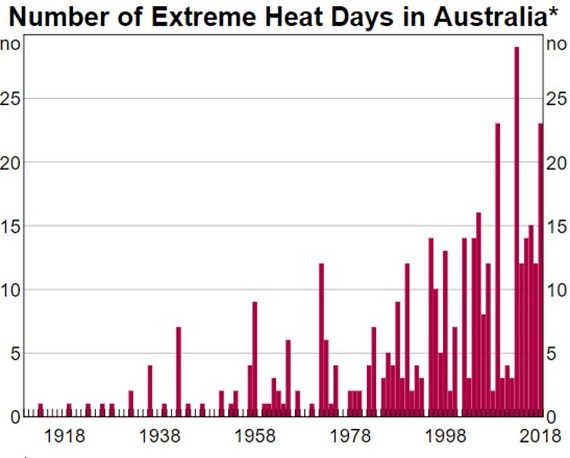
First, increased pressure to adopt a tougher stance in reducing carbon emissions. While Australia has always had droughts and bushfires we have been warned for more than a decade now that the world and Australia is getting warmer, that increasing global greenhouse gas emissions are likely contributing to this and that in the absence of actions to reduce emissions the world will get significantly warmer with the outcome being rising sea levels and more extreme weather events – including storms, floods and droughts – with more severe bushfires an outcome of the latter.

View larger image

* Number of extreme heat days each year. Source: Bureau Meteorology, RBA

Second, the damage inflicted by the extreme bushfires highlights the need for investors to be aware of industries and businesses that are vulnerable to climate change risk – whether it comes from the physical impact from climate change or via measures to reduce emissions.

Thirdly, the severity of the bushfires and the risk that this is the new normal will necessitate better strategies for reducing the risk to property posed by future bushfires.

Finally, in the absence of policy action the bushfires risk accentuating the decline of some regional communities particularly where key industries have been destroyed by the fires – with some taking their insurance and rebuilding elsewhere. This will only further centralise Australia in its big cities adding to all the costs that entails – notably congestion and expensive housing.

What does it mean for investors?

The likelihood of more RBA monetary easing and continuing weak economic growth in the short term will likely keep Australian bond yields down relative to global bond yields, possibly pushing them lower.

This will also keep the Australian dollar relatively soft.

So far the Australian share market appears to be looking through the short-term hit to economic growth focusing more on the rebuilding boost, but the negative impact of the bushfires risks seeing it remain a relative underperformer versus global shares.


Source: AMP Capital, 10th Jan 2020

Important notes: While every care has been taken in the preparation of this article, AMP Capital Investors Limited (ABN 59 001 777 591, AFSL 232497) and AMP Capital Funds Management Limited (ABN 15 159 557 721, AFSL 426455) (AMP Capital) makes no representations or warranties as to the accuracy or completeness of any statement in it including, without limitation, any forecasts. Past performance is not a reliable indicator of future performance. This article has been prepared for the purpose of providing general information, without taking account of any particular investor’s objectives, financial situation or needs. An investor should, before making any investment decisions, consider the appropriateness of the information in this article, and seek professional advice, having regard to the investor’s objectives, financial situation and needs. This article is solely for the use of the party to whom it is provided and must not be provided to any other person or entity without the express written consent of AMP Capital.

After the poor returns for investors in 2018, 2019 turned out surprisingly well with average balanced growth superannuation funds looking like they have returned around 15%.


Source: Mercer Investment Consulting, Morningstar, AMP Capital

But can it continue this year? Particularly with an intensification of the US/Iran conflict adding to global uncertainty and the drought and horrendous bushfires further weighing on the Australian economy. Here is a summary of key insights and views on the investment outlook in simple point form.

Five reasons 2019 turned out well for investors

2019 saw slowing growth and weak profits amidst an escalating US/China trade war and tensions with Iran and yet it turned out well for investors. Here are five reasons why:

  • Easy money – central banks eased monetary policy in response to the growth slowdown and various threats to growth reversing the tightening seen in 2018.

  • Cheap starting point for assets – after the falls of 2018 shares started 2019 cheap and they and other assets were made relatively cheaper as interest rates & bond yields fell. 

  • The crowd was very gloomy at the start of 2019 with much fear about the outlook – when this is the case it’s always easier for assets to rise in value.

  • While geopolitical threats remained high there was some relief by year end – with the US & China reaching a Phase 1 trade deal; Iran tensions not seeing a major or lasting disruption to oil supplies; and a hard Brexit avoided for now. 

  • Global growth was not as bad as feared – despite a mid-year recession obsession as yield curves inverted. In fact, global growth indicators looked to be stabilising by year end.

Seven lessons from 2019

  • Don’t fight the Fed, ECB, PBOC or RBA – as long as recession is avoided monetary easing is positive for investment returns from growth assets.

  • The starting point matters – when assets are cheap, and the crowd is negative as they were at the start of 2019 it’s relatively easier to get good returns.

  • Post GFC caution remains but can be both negative and positive – yes it periodically weighs on growth, but it is keeping economies from overheating and thereby is helping to extend the economic and investment cycle.

  • Geopolitics remains a significant driver of markets and economic conditions – but it can be positive whenever there is any relief and things don’t turn out as bad as feared.

  • Just because Australian housing is expensive & household debt is high does not mean house prices are going to crash.

  • Stick to an investment strategy – 2019 started in gloom and had its share of distractions but investors would have done well if they just stuck to a well-diversified portfolio.

  • Remember that while shares can be volatile and unlisted assets also come with risks, the income stream from a well-diversified mix of such assets can be relatively stable and higher than the income from bank deposits.

Five big picture themes for 2020

  • A pause in the trade war, but geopolitical risk to remain high. President Trump is likely to want to keep the US/China trade war on the backburner but it could still flare up again and other issues include the escalation seen so far this year in the Iran conflict, a return to worries about a “hard Brexit” at year end if UK/EU free trade talks don’t go well and the US election if a hard left Democrat candidate gets up.

  • Global growth to stabilise & turn up thanks to policy stimulus with business surveys recently showing stabilisation.

  • Continuing low inflation and low interest rates. Growth won’t be strong enough to push underlying inflation up much and some central banks will still be easing (including the RBA).

  • The US dollar is expected to peak and head down as global uncertainty declines a bit and non-US growth picks up.

  • Australian growth is expected to remain weak given the housing construction downturn, weak consumer spending and the drought with bushfires not helping.

Key views on markets for 2020

Improving global growth & still easy monetary conditions should drive reasonable investment returns this year but they are likely to be more modest than the double-digit gains of 2019 as the starting point of higher valuations for shares & geopolitical risks are likely to constrain gains and create some volatility: 

  • Global shares are expected to see total returns around 9.5% in 2020 helped by better growth and easy monetary policy. 

  • Cyclical, non-US and emerging market shares are likely to outperform, if the US dollar declines as we expect.

  • Australian shares are likely to do okay this year but with total returns also constrained to around 9% given sub-par economic & profit growth. 

  • Low starting point yields and a slight rise in yields through the year are likely to result in low returns from bonds.

  • Unlisted commercial property and infrastructure are likely to continue benefitting from the search for yield but the decline in retail property values will still weigh on property returns. 

  • National capital city house prices are expected to see continued strong gains into early 2020. However, poor affordability, the weak economy and still tight lending standards are expected to see the pace of gains slow leaving property prices up 10% for the year as a whole. 

  • Cash & bank deposits are likely to provide very poor returns, with the RBA expected to cut the cash rate to 0.25%.

  • The $A is likely to fall to $US0.65 as the RBA eases further, then drift up as global growth improves to end little changed.

Seven things to watch

  • The US trade wars – we are assuming the Phase 1 trade deal de-escalates the trade war, but Trump is Trump and often can’t help but throw grenades.

  • US politics: the Senate is unlikely to remove Trump from office if the House votes to impeach and another shutdown is also unlikely but both could cause volatility as could the US election if a hard-left Democrat gets up (albeit unlikely). 

  • The US/Iran conflict – which could escalate further with Iran unlikely to negotiate and Trump wanting to sound tough, potentially disrupting oil supplies.

  • A hard Brexit looks like being avoided but watch UK/EU free trade negotiations through the year.

  • Global growth indicators (PMIs).

  • Chinese growth – a continued slowing in China would be a major concern for global growth.

  • Monetary v fiscal stimulus in Australia – significant fiscal stimulus could head off further RBA easing.

Four reasons global growth is likely to improve a bit

  • Global monetary conditions have eased significantly over the last year. China has also seen significant fiscal stimulus.

  • The stabilisation seen in business conditions PMIs in recent months suggests monetary easing is getting some traction. 

  • We still have not seen the excesses – massive debt growth, overinvestment, capacity constraints or excessive inflation – that normally precede recessions.

  • The de-escalation of the US/China trade war should help reduce a drag on business confidence (at least for a while).

Five reasons Australia is likely to avoid a recession

The bushfires are estimated to knock around 0.4% mainly from March quarter GDP mainly due to the impact on agriculture, tourism and consumer confidence and spending. Coming at a time when Australian growth is already weak it risks knocking March quarter growth to near zero or below. However, while the risk of recession has increased, it remains unlikely:

  • Infrastructure spending is strong.

  • Mining investment is starting to rise again.

  • The bushfires will be followed by a boost to spending from the June quarter as rebuilding kicks in.

  • Already weak growth, made worse by the bushfires in the short term will likely force further fiscal stimulus.

  • The $A is likely to remain weak providing a boost to growth.

Three reasons why the RBA will cut rates this year

  • Growth is likely to disappoint RBA expectations for 2.8% growth this year.

  • This will keep underemployment high, wages growth weak and inflation lower for longer.

  • Fiscal stimulus is unlikely to come early enough.

We expect the RBA to cut the cash rate to 0.5% in February & to 0.25% in March, with quantitative easing likely from mid-year.

Three reasons why a deep bear market is unlikely

Shares are vulnerable to a correction after the strong gains seen over the last year, but a deep bear market (where shares fall 20% and a year after are a lot lower again) is unlikely:

  • Global recession remains unlikely. Most deep bear markets are associated with recession.

  • Measures of investor sentiment suggest investors are cautious, which is positive from a contrarian perspective.

  • The liquidity backdrop for shares is still positive. For example, bank term deposit rates in Australia are around 1.3% (and likely to fall) compared to a grossed-up dividend yield of around 5.7% making shares relatively attractive.

Nine things investors should remember

  • Make the most of the power of compound interest. Saving regularly in growth assets can grow wealth substantially over long periods. Using the “rule of 72”, it will take 48 years to double an asset’s value if it returns 1.5% pa (ie 72/1.5) but only 9 years if the asset returns 8% pa.

  • Don’t get thrown off by the cycle. Falls in asset markets can throw investors out of a well thought out strategy at the wrong time – as some were at the end of 2018. 

  • Invest for the long term. Given the difficulty in getting short term market moves right, for most it’s best to get a long-term plan that suits your wealth, age & risk tolerance & stick to it.

  • Diversify. Don’t put all your eggs in one basket.

  • Turn down the noise. Increasing social media and the competition for your eyes and ears is creating a lot of noise around investing that is really just a distraction. 

  • Buy low, sell high. The cheaper you buy an asset, the higher its prospective return will likely be and vice versa.

  • Beware the crowd at extremes. Don’t get sucked into the euphoria or doom and gloom around an asset.

  • Focus on investments that you understand and that offer sustainable cash flow. If it looks dodgy, hard to understand or has to be based on odd valuation measures or lots of debt to stack up then it’s best to stay away. 

  • Accept that it’s a low nominal return world – when inflation is 1.5%, a 15% superannuation return is very pretty good (and not sustainable at that rate).


Source: AMP Capital 9 Jan 2020

Important notes: While every care has been taken in the preparation of this article, AMP Capital Investors Limited (ABN 59 001 777 591, AFSL 232497) and AMP Capital Funds Management Limited (ABN 15 159 557 721, AFSL 426455) (AMP Capital) makes no representations or warranties as to the accuracy or completeness of any statement in it including, without limitation, any forecasts. Past performance is not a reliable indicator of future performance. This article has been prepared for the purpose of providing general information, without taking account of any particular investor’s objectives, financial situation or needs. An investor should, before making any investment decisions, consider the appropriateness of the information in this article, and seek professional advice, having regard to the investor’s objectives, financial situation and needs. This article is solely for the use of the party to whom it is provided and must not be provided to any other person or entity without the express written consent of AMP Capital.