Share markets are at or around record levels despite lots of worries, particularly around the coronavirus (Covid-19) outbreak. A common concern is that this is because central banks (like the Fed and the RBA) are distorting market forces and just want higher asset prices. And flowing from this its argued that prices for assets like shares and property are overvalued, record highs are artificial, and a crash is inevitable. Markets are at risk of a short-term correction given the large gains since the last greater than 5% correction into August and given the risks around Covid-19. But beyond this it’s a lot more complicated than the bears would have it.

Central banks really just responding to market forces…

There is some truth to the claim that central banks want higher asset prices. Higher asset prices are part of the transmission mechanism for monetary easing to the economy because they boost wealth and this helps boost spending. As former Fed Chair Alan Greenspan said in 2010 “a stock market rally may be the best economic stimulus”. But it’s not quite that simple:

  • First, central banks also fret about that financial instability that flows from higher asset prices as they may lead to overvalued markets that could crash or encourage people to take on too much risk say via excessive debt. Recall Alan Greenspan’s concerns about “irrational exuberance” and don’t forget the credit tightening that occurred from 2017 in Australia that was designed to slow “risky” housing lending. 

  • Second, more fundamentally central banks are really just responding to market forces. In the post GFC world we have seen lower inflation in response to ongoing spare capacity and competition from online disruptors, offshoring and automation. More fundamentally, reflecting greater caution we have seen desired saving exceed desired investment globally. All of which has driven lower interest rates which central banks have just responded too. To have not cut official interest rates would have defied market forces and caused even weaker growth, higher unemployment and even lower inflation. 

  • Finally, its rational for asset prices to move up in response to lower inflation and lower interest rates.

…lower inflation equals higher PEs (and lower yields)

The next chart shows the ratio of share prices to consensus expectations for earnings over the next 12 months, which is often referred to as forward PEs. As can be seen, these are now above their long-term averages in the US and Australia, although US and global PEs are still well below tech boom extremes.


Source: Thomson Reuters, AMP Capital

However, the next chart shows the long-term relationship between inflation on the horizontal axis and the price to earnings ratio on the vertical axis. The PE tends to move higher as inflation falls, although its less clear once inflation falls into deflation. And right now we have very low inflation of just below 2% globally.


Source: Bloomberg, AMP Capital

A rise in PEs in response to low inflation, providing it’s not deflation, makes sense for three reasons:

  • First, low inflation means lower interest rates which boosts the value of future profits and dividends making shares more attractive. Or put simply lower inflation and interest rates boosts the attractiveness of higher yielding assets so investors switch into those higher yielding assets which pushes up their price relative to their earnings, dividends or rents. 

  • Second, low inflation means reduced economic volatility and uncertainty and hence investors are prepared to price shares on higher price to earnings multiples. The next chart shows rolling 10-year volatility in annual GDP growth for the US and Australia. It’s been in a downtrend since the first half of last century with the drivers being the growing importance of the more stable services sector, declining inventory levels which reduced the manufacturing inventory cycle and macro policies aimed at stabilising economic growth. But the shift to lower inflation from the 1980s and 1990s has likely also contributed.


Source: Bloomberg, AMP Capital

  • Finally, low inflation means improved quality of earnings as firms tend to understate depreciation when inflation is high and so overstate actual earnings. So again, investors are prepared to pay more for shares when inflation is low.

The equity risk premium remains okay

So, while share markets may be around record levels and price to earnings multiples are relatively high there is some rational for this given that it’s a low inflation and low interest rate world. And the longer inflation remains down its conceivable that the higher PEs may go. How high is impossible to know for sure. But as a result, it makes sense to look at share market valuations that allow this. The next chart subtracts the 10-year bond yield for the US and Australia from their earnings yields (using forward earnings). This basically gives a sort of proxy for the equity risk premium – the higher the better. While this gap is well down from its post GFC highs, it’s still reasonable, suggesting shares are still more attractive than bonds. Of course, this will change if bond yields rise, but as we have seen in recent years this is taking a long while to eventuate with various events including trade wars and the coronavirus outbreak conspiring to keep yields low.


Source: Thomson Reuters, AMP Capital

What about property?

Basically, the same applies in relation to property and other assets in that lower inflation drives higher valuations for them too. This is evident in lower rental yields (or capitalisation rates) as lower inflation and interest rates pushes up the price relative to rents that investors are prepared to buy property at. This has certainly happened in Australian property markets with rental yields falling sharply since the 1980s and 1990s. This is particularly the case for residential property to the point that it is overvalued on some measures, with a shortage of dwellings relative to underlying demand enabling this to be perpetuated (but that’s a whole other issue beyond the scope of this note!). If the rental yield is inverted and expressed as a PE it would have risen to around 20 times for high quality commercial property but to a whopping 50 times for residential property, compared to around 12 times for both in the early 1980s and compared to around 18 times for shares. This would suggest residential property remains relatively expensive!


Source: REIA, JLL, Bloomberg, AMP Capital

So, what’s the catch?

There are two catches. First valuations are no guide to timing markets and none of this precludes a correction in shares, particularly given the risks around coronavirus as noted earlier.

Second, just as low interest rates and low bond yields mean low prospective returns from cash and bonds, high PEs – or their inverse of lower earnings yields – and lower rental yields for property point to more constrained returns from shares and property on a medium-term basis. The following chart shows a scatter plot of the PE ratio for US shares since 1900 (horizontal axis) against subsequent 10-year total returns (ie dividends and capital growth) from shares. It indicates a negative relationship, ie when share prices are relatively high compared to earnings subsequent returns tend to be relatively low.  


Source: Bloomberg, AMP Capital

The same inverse relationship exists for Australian shares.

Concluding comment

The bottom line is that while shares may be vulnerable to a correction, the rally in markets does not seem excessive given the low inflation and low interest rate environment. Key to watch for would be a recession, which would depress earnings and risk tolerance, or a sharp acceleration in inflation, which would drive sharply higher interest rates and a revaluation downwards in prices for shares and other assets. But beyond the risks to economic activity posed by the coronavirus outbreak both seem unlikely at present.


Source: AMP Capital 19 Feb 2020

Important notes: While every care has been taken in the preparation of this article, AMP Capital Investors Limited (ABN 59 001 777 591, AFSL 232497) and AMP Capital Funds Management Limited (ABN 15 159 557 721, AFSL 426455) (AMP Capital) makes no representations or warranties as to the accuracy or completeness of any statement in it including, without limitation, any forecasts. Past performance is not a reliable indicator of future performance. This article has been prepared for the purpose of providing general information, without taking account of any particular investor’s objectives, financial situation or needs. An investor should, before making any investment decisions, consider the appropriateness of the information in this article, and seek professional advice, having regard to the investor’s objectives, financial situation and needs. This article is solely for the use of the party to whom it is provided and must not be provided to any other person or entity without the express written consent of AMP Capital.

New laws to protect your retirement savings

Around 40% of working Australians claim they don’t have life insurance1. Yet, with 13.5 million insurance policies inside super2, it’s likely many people may have life insurance without knowing it3

The bigger picture

There’s a good chance, at some point in your career, you joined your employer’s default super plan – this is the plan your employer pays super into if you don’t nominate your own. Why? Perhaps it was the easiest option for you when completing all your paperwork, or maybe it was the better deal.

Many employer default super plans also include insurance – something people may not realise they’re paying for. What’s more, many are disengaged with their super, or are unaware of the ins and outs of the fund they’re in. This means they may have multiple accounts – so may also be paying multiple sets of fees for super and insurances that mightn’t be right for them.

So, what’s insurance inside super?

It’s insurance you pay for via your super account. There are different types of insurance offered in this way, including life insurance (or death cover), total and permanent disablement (TPD) cover, and temporary salary continuance (TSC) (also known as income protection).

Insurance is important, but it’s equally important to make sure the type and level of insurance you’re paying for suits your needs and circumstances.

To explore how much insurance you might need, please contact us on Phone: 07 5641 4134

About the super laws

The federal government has introduced super laws to help prevent super balances from being eroded by fees, insurance costs for cover that people may not want or need. Particularly, for:

  • young members

  • low account balances

  • super accounts that haven’t had a contribution for a long time.

 Insurance cancellations

The new laws generally require insurance inside super to be cancelled if:

  • a member’s super balance doesn’t reach $6,000 between 1 November 2019 and 1 April 2020 and/or

  • the account doesn’t receive a contribution or rollover for 16 months,

unless the member tells their super fund that they’d like to keep their insurance.

 Also

  • from 1 April 2020, super funds must not provide insurance to new members aged under 25 or with an account balance below $6,000, unless the member requests it.


If the insurance inside a super account is cancelled because of these changes, the law requires the account to be transferred to the Australian Tax Office (ATO) if the balance is below $6,000 and no contributions or rollovers have been received for 16 months. Some exceptions apply, please contact us on Phone: 07 5641 4134 to discuss.

A checklist for what you can do

Your super savings are important, and so is insurance. Here are some steps you can take to understand your super and insurance better and make sure it’s working for you.

1. Check what you’ve got – have a look at your current super and insurance. Check the balance and how much you’re paying. 

2. Find out if you have multiple super accounts – if you’re not sure whether you have other super accounts, an online search is a good way to find out. If you do find more super, you may want to consider consolidating it into a single account to make it easier to manage and possibly save on fees.

  • Search for other super

3. Before consolidating – check whether you have any insurance double ups – if you have more than one super account with the same type of insurance, you may be paying for insurance you don’t need. This is particularly relevant for TSC, where you’ll most likely only be able to claim up to 75% of your pre-disability income4, regardless of whether you have TSC cover within multiple super accounts.

Before you cancel your insurance or consolidate your accounts, carefully consider the features, benefits and costs for each. You can also talk to an adviser to make sure you’re making the right decision for you. Keep in mind that it can be difficult to reinstate insurance that’s cancelled.

4. Work out how much you need and what fits your lifestyle – it’s a good idea to speak to us on Phone: 07 5641 4134 about this to make sure your personal circumstances are taken into account.

  • Explore how much insurance you might need

  • Find out more about reviewing your insurance

5. If you’ve heard your insurance might be cancelled – respond to your super fund accordingly if you want to keep it. Make sure you’re also across how the insurance cancellation will affect you and your loved ones before you decide.

6. Keep on top of it – life changes, which means our insurance needs change too. It’s a good idea to review your insurance needs alongside other major life changes like getting a new job, moving to a new house, or having kids. That way, your insurance can keep up with your life.


Insurance through superannuation, research 2016. Rice Warner
Metlife Insurance Inside Super Report 2018, page 10
4 If you receive income from another source, like WorkCover, this will be offset against the 75% pre-disability income

Source : AMP November 2019 

Important:
This information is provided by AMP Life Limited. It is general information only and hasn’t taken your circumstances into account. It’s important to consider your particular circumstances and the relevant Product Disclosure Statement or Terms and Conditions, available by calling Phone: 07 5641 4134, before deciding what’s right for you.

All information in this article is subject to change without notice. Although the information is from sources considered reliable, AMP and our company do not guarantee that it is accurate or complete. You should not rely upon it and should seek professional advice before making any financial decision. Except where liability under any statute cannot be excluded, AMP and our company do not accept any liability for any resulting loss or damage of the reader or any other person.

One of the biggest retirement challenges is ensuring that the savings accumulated during your working years lasts as long as you do.

If you had invested $10,000 in Australian shares on 31 October 2009 without any further contributions or withdrawals, you would have experienced an average of 8.3% annualised rate of return and ended up with $22,278 a decade later on 31 October 2019.

Obviously, the numbers change once you start withdrawing income.

Unforeseen events such as market downturns can shorten the lifespan of your retirement portfolio if you withdraw funds to pay bills during a period of falling share values. The market downturn not only impacts the value of your portfolio but the regular withdrawal of funds to pay for everyday expenses (exactly what your retirement portfolio was meant to do) means that the capital left in your portfolio to help earn gains when the market eventually rebounds, is also diminished.

If the market downturn continues into the beginning of your retirement years, during which a high proportion of negative returns occur, it can have a lasting negative effect, ultimately reducing the amount of income you can withdraw over your lifetime. This is known as the sequence of returns risk.

Fortunately, there are number of straightforward strategies that can limit the odds that investors will fall into the downturn trap.

An approach that has been rather successful in the US is the target date fund model, which works to derisk an investment portfolio based on a ‘target date’ for retirement with the fund. The concept has been gaining momentum here in Australia and superannuation funds typically base these products on a ‘lifecycle design’.

Vanguard’s US target date fund glide-path takes place over four stages and constructs a portfolio based on balancing market, inflation, and longevity risks in an efficient and transparent manner over an investor’s life cycle. Investors are generally split into four phases beginning at those aged 40 years and younger, and gradually moving towards the fourth and final retirement phase. The first phase considers the time horizon of an investor in the early stages of their career, thus allocating up to 90 percent of the portfolio to equities. Phases 2 and 3 gradually de-risk the portfolio away from equities before the retirement phase.

Phase 1 starts with an allocation of around 90 percent to equities and then commences de-risking during the mid to late career phase. Phase 3 encompasses the transition to retirement phase, where the portfolio de-risks further before reaching a landing point in the final retirement phase.

While this is a sound concept, it could have adverse effects if not implemented properly. For instance, being too conservative in the investment approach during the early years of one’s career or too aggressive as one approaches retirement. The objective of this asset allocation model is to avoid being either extreme end of the spectrum and to adequately diversify where possible.

Having a proper asset allocation strategy will improve the odds that your retirement portfolio will endure but you may want to investigate other methods that also achieve this goal. Another suggestion is the dynamic spending strategy, in which investors set minimum and maximum percentage withdrawals based on market performance and individual goals.

Whichever strategy you choose, finding a way to curb the effects of volatility on your retirement portfolio may improve your odds of retiring on your own terms and not the market’s.

Please call us on Phone: 07 5641 4134 if you would like to discuss.

Source : Vanguard 

Written by Robin Bowerman, Head of Corporate Affairs at Vanguard.

Reproduced with permission of Vanguard Investments Australia Ltd

Vanguard Investments Australia Ltd (ABN 72 072 881 086 / AFS Licence 227263) is the product issuer. We have not taken yours and your clients’ circumstances into account when preparing this material so it may not be applicable to the particular situation you are considering. You should consider your circumstances and our Product Disclosure Statement (PDS) or Prospectus before making any investment decision. You can access our PDS or Prospectus online or by calling us. This material was prepared in good faith and we accept no liability for any errors or omissions. Past performance is not an indication of future performance.

© 2020 Vanguard Investments Australia Ltd. All rights reserved.

Important:
Any information provided by the author detailed above is separate and external to our business and our Licensee. Neither our business nor our Licensee takes any responsibility for any action or any service provided by the author.

Any links have been provided with permission for information purposes only and will take you to external websites, which are not connected to our company in any way. Note: Our company does not endorse and is not responsible for the accuracy of the contents/information contained within the linked site(s) accessible from this page.

Ready to jet off to exotic locales this year? Lonely Planet has released their ‘Best in Travel 2020’ destinations, to fire up your inspiration. These top spots offer the best value, in terms of getting off the beaten path, soaking up exciting experiences and keeping your budget happy too. 

East Nusa Tenggara, Indonesia

Are you looking for an alternative to Bali? The islands of East Nusa Tenggara offer all the sundrenched beaches and cultural diversity you want, without the crowds. With more than 500 islands, the options for diving, surfing and jungle adventures to spot Komodo dragons are virtually limitless. Stay on one of the three largest islands of Flores, Sumba and Timor, and fly into the capital, Kupang City. 

Budapest, Hungary


Budapest has long been one of the best-value capital cities in Europe, when it comes to getting bang for your buck. From majestic architecture lining the impossibly romantic Danube to inexpensive thermal baths to soothe your mind and body, you’ll feel cocooned in luxury without the price tag. Exploration of the most fascinating attractions, like the Jewish Quarter, elegant churches and sunsets on Gellert Hill, are largely free.  

Madhya Pradesh, India

In terms of travel on a shoestring budget, it’s hard to beat India when it comes to cheap accommodation and delicious food. Madhya Pradesh is a hub for wildlife adventures, at Pench National Park and Bandhavgarh Tiger Reserve, to spot deer, boar, monkeys and even big cats. While you’re there, delve into historic small towns and temples, with plenty of traditional Tikkis to keep you going. 

Buffalo, NY, USA

With New York, Las Vegas and LA always in the spotlight, Buffalo doesn’t often get a look in on travel itineraries. However, New York State’s second-most populous city is on

the rise, with hotels, restaurants and attractions, like Explore & More children’s museum and Graycliff Estate, nudging tourists in its direction. Plus, Niagara Falls is just a short drive away. 

Azerbaijan

Straddling Europe, the Middle East and Asia, Azerbaijan is a jumble of fascinating cultures and a country that’s been well off the tourist radar, until now. It’s the capital of Baku, elegantly facing the Caspian Sea, that captures the imagination first. Ringed by deserts, the city’s Unesco-listed ancient centre joins mansions, romantic parks and a cosmopolitan atmosphere for a journey that’s uniquely ‘Azerbaijan’. 

Serbia

Belgrade has firmly made its mark within the ranks of Eastern Europe’s trendiest capitals, with all the right ingredients of excellent museums, art galleries, cafes and sizzling nightlife. But, the value of visiting Serbia goes far beyond the bright lights. Venture out to discover a rich tapestry of natural and historic sites, including the wetland habitats of Vojvodina, Studenica Monastery and theĐerdap Gorge.

Tunisia


The vast, rolling dunes of the Sahara combine with mysterious medina alleyways and beachside bliss in Tunisia. Relax along the Mediterranean coast in the resort town of Hammamet, explore intriguing Berber villages and fulfil your Star Wars fantasies in settings you’re sure to recognise. A stay in the clifftop town of Sidi Bou Said transports you straight to Greek Island dreams, without the cost. 

Cape Winelands, South Africa


When wine tastings are at the top of your travel wish list, the vineyards outside of Cape Town are calling your name. The Constantia Wine Route is just a short drive from the city and hosts prestigious vineyards dating back to the 1650s. Then, there’s the Stellenbosch region with 148 wine farms decorated by lush gardens, historic manor houses and world-class restaurants. Get your fix of French-inspired sparkling delights along the Franschhoek route. 

Athens, Greece


If you’re a history buff or culture vulture, it’s standard procedure to pay exorbitant prices to line up for hours and discover the world’s most famous sites. Not so, in Athens. Just wandering around this ancient city is enough to enjoy the magic of the Parthenon, the Acropolis and endless architectural marvels without a ticket office in sight. 

Zanzibar, Tanzania

Can’t afford a trip to the Maldives or the Caribbean? These postcard-perfect beaches stretch across Zanzibar’s coast, with seafront accommodation for a fraction of the cost. If you manage to drag yourself away from the beach, get lost among the narrow alleys and crumbling buildings of UNESCO-listed Stone Town. And don’t worry, you’ll never be far from menus featuring the abundant ‘catch of the day’, in Zanzibar.

Source: Clientcomm library

Important note:
This provides general information and hasn’t taken your circumstances into account.  It’s important to consider your particular circumstances before deciding what’s right for you. 

Any information provided by the author detailed above is separate and external to our business and our Licensee. Neither our business nor our Licensee takes any responsibility for any action or any service provided by the author.

Any links have been provided with permission for information purposes only and will take you to external websites, which are not connected to our company in any way. Note: Our company does not endorse and is not responsible for the accuracy of the contents/information contained within the linked site(s) accessible from this page.


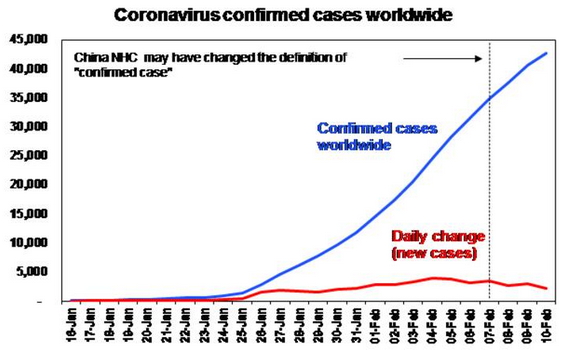
2020 has seen a very noisy start to the year with one major event with significant human and investment market implications after another. For Australia it started with an intensification of the bushfires but moved on to a significant ramping up of US/Iran tensions where, according to President Trump, war came “closer than you thought” and now the coronavirus outbreak is creating fears of a global pandemic and a big hit to global economic activity. These are scary in terms of their human consequences, but also in terms of the potential economic fallout and what it means for investors. The coronavirus outbreak in particular continues to pose significant uncertainty around the short-term economic outlook. In terms of the key things to watch there is some good news with signs of a reported slowing in new cases in China and still limited transmission outside China (which has 99% of cases).  


Source: PRC National Health Commission, Bloomberg, AMP Capital

And the mortality rate at just over 2% remains lower than with SARS. Against this there remains much debate about the true number of cases, it’s common in outbreaks to see periods of stabilisation only to be followed by a spike in cases and the disruption to economic activity in China and from global travel bans remain significant all of which makes it easy to imagine the worst in terms of economic consequences. Each week China remains say 2/3rds shut it knocks 1.3% off its GDP or 0.25% directly off global GDP.

Then again much of 2018 and 2019 saw endless talk about how much the trade war was going to knock off global growth. More fundamentally, the coronavirus outbreak is part of a seemingly never-ending worry list which is receiving an ever-higher prominence as the information age enables the rapid dissemination of news, opinion and noise. But as Frank Zappa warned “information is not knowledge, knowledge is not wisdom”. The danger is that information overload is making us worse investors as we focus on one worry after another resulting in ever shorter investment horizons.

Are the worries more worrying than ever?

When I was a teenager in the 1970s I used to bemoan my grandmother for reading too much gloom into the nightly TV news and telling me that the world is much worse today than when she was young….when there was WW1, Spanish influenza that reportedly killed around 50 million people, the Great Depression and WW2 when her brother was killed. However, now it seems the worry list is even bigger. Yes, there is a fundamental element as global growth is slower, technological disruption is leading to worker anxiety and inflated expectations, and the world seems awash in geopolitical risks.

But there is a huge psychological aspect to this that is combining with the increasing availability of information and intensifying competition amongst various forms of media for clicks, that is magnifying perceptions around various worries.

We all suffer from a behavioural trait that in its financial manifestation is known as “loss aversion” in that a loss in financial wealth is felt much more distastefully than the beneficial impact of the same sized gain. This probably reflects the evolution of the human brain in the Pleistocene age when the trick was to avoid being eaten by a sabre-toothed tiger or squashed by a woolly mammoth. This makes us biased to be more risk averse and on the lookout for threats which leaves us more predisposed to bad news stories as opposed to good news stories. So bad news and gloom find a more ready market than good news or balanced commentary as it appeals to our instinct to look for threats. Hence “bad new sells”. Of course, this has always been the case so there is nothing new here.

The big change though is that we are now exposed to more information in relation to everything including our investments. This is great in the sense that we can check things, analyse them and sound informed easier than ever. But often we have no way of weighing such information and no time to do so. If we can’t filter it, it becomes information overload and noise. This can be bad for investors as when faced with more (and often bad) news we can freeze up and make the wrong decisions with our investment as our natural “loss aversion” combines with what is called the “recency bias” that sees people give more weight to recent events which can see investors project recent bad news into the future and so sell after a fall.

Finally, the problem is being compounded by an explosion in media outlets all competing for your attention. We are now bombarded with economic and financial news and opinions with 24/7 coverage by web sites, subscription services, finance updates, dedicated TV and online channels, etc. And in competing for your attention, bad news and gloom trumps good news and balanced commentary as “bad news sells.”

So naturally it seems that the bad news is ‘badder’ and the worries more worrying than ever. Google the words “the coming financial crisis” and you get 236 million search results – up from 115 million when I did it 18 months ago – with titles such as:

  • “World economy is sleepwalking into a new financial crisis”;

  • “4 early warnings signs of the next financial crisis”;

  • “The coming economic crash”;

  • “Why the next global financial crisis may dwarf…2008”; and

  • “Financial crisis – Bible prophecy & current events.”

The trouble is that there is no evidence that all this noise is making us better investors. Average returns are no higher than in the past. A concern is that the combination of a massive ramp up in information combined with our natural inclination to zoom in on negative news is making us worse investors: more fearful, more jittery and more short term focussed.

Five ways to manage the perpetual worry list

So here we take another look at five ways to manage the worry list and turn down the noise:

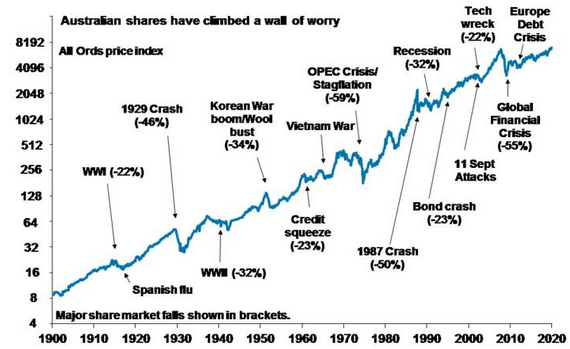
Firstly, put the latest worry list in context. Remember that there has always been an endless stream of worries. Here’s a list of the worries of the last five years that have weighed on markets at various points: deflation; commodity/oil crash; Grexit; China worries; Brazil and Russia in recession; manufacturing slump globally; Fed rate hikes; Brexit; South China Sea tensions; Trump; Eurozone elections; North Korea; Germany; Catalonia; Italy; US inflation and rates; Trade war; China slowdown; Aust Royal Commission; Aust housing downturn; US government shutdown; inverted yield curves; impeachment; Aust recession fears; and Iran tensions. Yet despite this extensive worry list investment returns have actually been okay with average balanced growth super funds returning 7.3% pa over the last five years after taxes and fees. In fact, the global economy has had plenty of worries over the last century, but it got over them with Australian shares returning 11.8% pa since 1900 and US shares 9.9%pa.


Source: ASX, AMP Capital

And while history doesn’t repeat it does rhyme and it’s often useful to look back at previous similar events to the latest worry to see how they panned out. This is where the experience around SARS is useful in relation to the latest coronavirus outbreak.

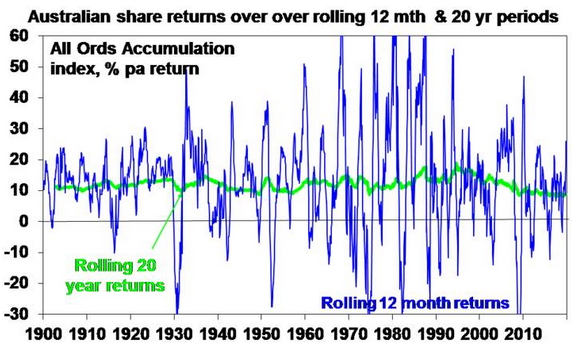
Secondly, recognise how markets work. A diverse portfolio of shares returns more than bonds and cash over the long-term because it can lose money in the short-term. While the share market is highly volatile in the short-term it has seen strong returns over rolling 20-year periods. So, volatility driven by worries and bad news is normal. It’s the price investors pay for higher long-term returns.


Source: Global Financial Data, AMP Capital

Thirdly, find a way to filter news so that it doesn’t distort your investment decisions. For example, this could involve building your own investment process or choosing 1-3 good investment subscription services and relying on them. Or simpler still, agreeing to a long-term strategy with a financial planner and sticking to it. Ultimately it all depends on how much you want to be involved in managing your investments.

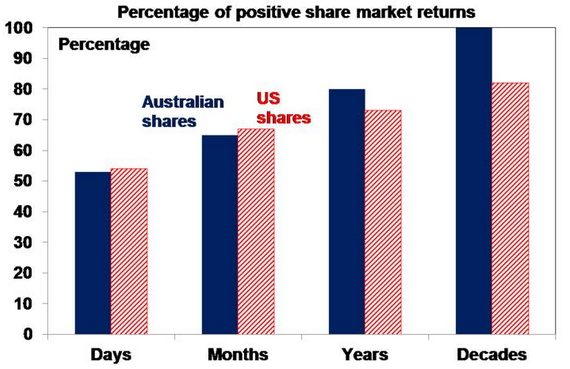
Fourthly, don’t check your investments so much. If you track the daily movements in the Australian All Ords price index or the US S&P 500, it has been down almost as much as it has been up. So, day to day it’s pretty much a coin toss as to whether you will get good news or bad. By contrast if you only look at how the share market has gone each month and allow for dividends the historical experience tells us you will only get bad news 35% of the time. Looking only on a calendar year basis, data back to 1900 indicates that the probability of bad news in the form of a loss slides further to 20% for Australian shares and 27% for US shares. And if you can stretch it out to once a decade positive returns have been seen 100% of the time for Australian shares and 82% of the time for US shares.  


Data from 1995 and 1900. Source: Global Financial Data, AMP Capital

The less frequently you look the less you will be disappointed and so the lower the chance that a bout of “loss aversion” triggered by a bad news event will lead you to sell at the wrong time. So, try to avoid looking at market updates so regularly.

Finally, look for opportunities that bad news throws up. Periods of share market turbulence after bad news throw up opportunities as such periods push shares into cheap territory.

Concluding comment

My long-term experience around investing tells me that it’s far more productive to lean into prognostications of financial gloom because most of the time they are wrong and end up just distracting investors from their goals.


Source: AMP Capital 12 Feb 2020

Important notes: While every care has been taken in the preparation of this article, AMP Capital Investors Limited (ABN 59 001 777 591, AFSL 232497) and AMP Capital Funds Management Limited (ABN 15 159 557 721, AFSL 426455) (AMP Capital) makes no representations or warranties as to the accuracy or completeness of any statement in it including, without limitation, any forecasts. Past performance is not a reliable indicator of future performance. This article has been prepared for the purpose of providing general information, without taking account of any particular investor’s objectives, financial situation or needs. An investor should, before making any investment decisions, consider the appropriateness of the information in this article, and seek professional advice, having regard to the investor’s objectives, financial situation and needs. This article is solely for the use of the party to whom it is provided and must not be provided to any other person or entity without the express written consent of AMP Capital.

Education is the gift that parents can give their children that keeps on giving.

But if you are considering private schools it is a gift that comes with a significant – and usually rising – bill attached.

Cue visions of stately buildings, sweeping playing fields, uniformed students—and steadily rising school fees.

One in three Australian children attend a non-government school1 and education is the second largest expense for many families, with some spending a third of their household budget on school fees2. Private school education costs are outpacing both inflation and wages growth3.

A cursory internet search found that a private school in New South Wales charges almost $37,000 a year for a year 12 place.

And even if you were sending your child to a public school, fees aren’t the only thing you need to plan for. Other items to consider include is the cost of textbooks, contributions to the increasingly prevalent compulsory laptop program, school uniforms and an endless list of ‘back to school’ items you’ve never heard of.

So savvy parents start planning early. But what’s the best way to save for your children’s education? And how can you avoid the trap of redrawing your mortgage, or worse?

The first step to successfully funding your children’s education expenses is planning.

And the first question to ask is – how much will you need?

The costs of education vary dramatically depending on both your choice of school and how early you choose a fee-paying school. There is an enormous difference between sending a child to a private school from kindergarten and going private for high school only. Some schools also offer day-care and pre-school places, potentially adding up to five extra years of fees.

Once you understand how much you need, the next question is how long you have—and how much you can add to your savings pool as you go. The longer the time frame before school fees become due, the more time there is to invest and compound your earnings. The more you can save along the way, the faster you will reach your goal.

It’s also important to think about your risk tolerance as higher returns are possible only with higher risk.

The next step is to select an appropriate savings vehicle for your money.

There are three basic ways to hold and grow the money you save for your children’s education: you can save regular amounts into a bank account, but given record low interest rates that is looking less attractive, you could build an investment portfolio – a basket of shares for example – or buy a managed fund or a more specialised product like an investment bond.

Saving your money in the bank might seem the safest option, but with school fee growth outpacing inflation it can actually mean you go backwards. Still, it remains a good option if your timeframe is tight or your risk tolerance low.

For people paying off a mortgage it can make sense to use an offset account to park savings. An offset account effectively earns interest at an equivalent rate to your mortgage. You can then redraw the funds when it is time to pay the school fees.

Managed investment schemes are another option for growing your savings over the years before school begins. Many people opt for making regular contributions to managed funds) or exchange traded funds allowing their savings to compound over time.

Managed investments can be terrific for providing diversification, which can reduce your risk of capital loss by spreading your investments over different asset classes and over hundreds or thousands of individual investments. They also come with the flexibility of withdrawing fund whenever you need them.

But as with every investment, do your research as some of these products come at a high cost, with fees varying wildly.

Investment bonds are another option for saving but they are a peculiar beast so extra research may be required to understand what you are investing in and any specific restrictions or conditions.

As you make these decisions, keep two principles in mind—watch your costs and stay the course.

Remember that lower cost investments usually outperform their higher cost counterparts4, and starting early will give you – and your children – the best chance of success.

1 https://www.abs.gov.au/ausstats/abs@.nsf/mf/4221.0
2 https://edstart.com.au/blog/record-low-wage-growth-impact-on-family-budget-and-school-fees/
3 https://edstart.com.au/report
4 https://personal.vanguard.com/pdf/ISGSFA.pdf

Source : Vanguard

Written by Robin Bowerman, Head of Corporate Affairs at Vanguard.

Reproduced with permission of Vanguard Investments Australia Ltd

Vanguard Investments Australia Ltd (ABN 72 072 881 086 / AFS Licence 227263) is the product issuer. We have not taken yours and your clients’ circumstances into account when preparing this material so it may not be applicable to the particular situation you are considering. You should consider your circumstances and our Product Disclosure Statement (PDS) or Prospectus before making any investment decision. You can access our PDS or Prospectus online or by calling us. This material was prepared in good faith and we accept no liability for any errors or omissions. Past performance is not an indication of future performance.

© 2020 Vanguard Investments Australia Ltd. All rights reserved.

Important:
Any information provided by the author detailed above is separate and external to our business and our Licensee. Neither our business nor our Licensee takes any responsibility for any action or any service provided by the author.

Any links have been provided with permission for information purposes only and will take you to external websites, which are not connected to our company in any way. Note: Our company does not endorse and is not responsible for the accuracy of the contents/information contained within the linked site(s) accessible from this page.

The thing I love most about coming back to work at the start of the new year is a renewed willingness to do and look at things differently. 

Call it clarity. Fresh perspective. Or more honestly, the result of shutting down the laptop and having rested for a week or two. Bliss. 

I like to think of the climb back into work as an opportunity to hit the refresh button on all the tasks from the ‘old’ year and consider doing them differently. 

It’s a good way to lift the spirits when you’d rather be on the beach with your kids, and may even prompt a better way of doing the things you always do.

Helpfully too there are always plenty of ideas floating about how to improve the way you do ‘you’. 

This one from American CEO coach, author and speaker, Lauren Zander has really inspired me.

She calls it the meditation of ‘designing your days’ and it’s done by swapping out your regular to-do list with a letter to yourself, about how the day ahead unfolded.  

Here’s how Lauren explained it to Forbes magazine

I teach clients to “design their day” each day.  This is where I have them write out how their day went before it actually happened and send it to me and any other people in their lives who will hold them accountable to it. Your “Designed Day” (DD) is an accounting of how you want your best and most fun day to unfold, equipped with attitude and aspirations.” 

It’s basically like writing a letter to your future 5:30pm self, at the start of the day detailing all the things that went well for you. Lauren says the power of this process helps us connect our daily ‘tasks’ with our emotional and even spiritual aspirations. 

Whether you told the truth at a meeting and inspired everyone to do the same, or you completed all the work you set out to accomplish, had zero traffic, out of the blue magic or found that key new person to hire. YOU get to create excellence that is on point with your dreams. You get to manage and inspire yourself, keep your promises and talk to your life, directing it and practicing the art of authoring it,” she says. 

Now that’s what I call I an interesting twist on the ‘normal’.


Source : Flying Solo

This article by Lucy Kippist is reproduced with the permission of Flying Solo – Australia’s micro business community. Find out more and join over 100k others.


Important:
This provides general information and hasn’t taken your circumstances into account. It’s important to consider your particular circumstances before deciding what’s right for you. Any information provided by the author detailed above is separate and external to our business and our Licensee. Any information provided by the author detailed above is separate and external to our business and our Licensee. Neither our business, nor our Licensee take any responsibility for any action or any service provided by the author.

Any links have been provided with permission for information purposes only and will take you to external websites, which are not connected to our company in any way. Note: Our company does not endorse and is not responsible for the accuracy of the contents/information contained within the linked site(s) accessible from this page.

How to build environmental and social considerations into your investments.

In the wake of recent ferocious bushfires, the climate change debate has climbed the news agenda, with many Australians now considering what they can do to help.

If you’d like your money to make a difference to the environment as well as your future, now might be the time to consider ethical investing.

It’s a growing trend. More than half of all investments in Australia are already invested responsibly and ethically according to the Responsible Investment Association of Australia (RIAA)1 .

AMP financial adviser Di Charman says, “Every little bit counts and for those wanting to take action on the environment, money is a powerful language that can be a force for good”.

“Whether it’s through super, investments or savings, more and more people are reviewing their financial arrangements to ensure their funds are put to work in a way that does no harm, and ideally leaves the world in a better place”.

“Responsible investment takes into account environmental, social and governance (ESG) factors into the investment process of research, analysis, selection and monitoring of investments.

Here are some tips to help Australians who want their finances to be environmentally friendly.

Understand what matters to you.

Everyone’s values are different, so you need to first work out what’s most important to you. Do you feel strongly about not investing in fossil fuels? Are you interested in discovering cutting-edge solutions for climate change or is improving energy efficiency a greater priority for you? How will these preferences affect your investment performance? From here you can identify the areas where you don’t want to invest or, conversely, where you’d rather put your money to make a positive impact.

Do your research and get to know the ESG principles.

Each investment manager has its own investment policy when it comes to ESG investing. For instance, some may apply a ‘negative screening’ or ‘exclusion’ policy, meaning that they steer clear of certain sectors like fossil fuels. Be mindful of exclusion policies as they may lead to increased volatility in your portfolio. Climate change investing tends to be a form of ‘positive screening’—in other words, actively choosing to invest in companies that are making a difference in areas such as renewable energy. RIAA is a good resource to use when you’re starting on this journey as it details the investment strategies of ethical and sustainable funds. Many super funds or investment managers also now have information about sustainability and ESG on their websites. Look to see if they have signed the United Nations backed Principles of Responsible Investing and whether they have published their scorecard.

Start with super.

Do you know where your super is invested? Does it offer a socially responsible investment (SRI) option? Make sure you read all the information provided by your super fund about the particular sectors, businesses and investment activities considered for investment. It’s worthwhile knowing that some people believe many SRI options don’t go far enough. Again, it pays to know what matters most to you and then you can find an option that aligns with your values.

Don’t forget the eggs rule.

One of the key principles of good investing is diversification—not putting all your eggs in one basket. It spreads risks and ensures you’re not exposed to any single investment or asset class. So consider the risks of crafting a portfolio that’s too narrow and concentrated. Climate-themed funds also haven’t been around for a long time, with many having only launched several years ago. This makes their performance hard to assess.

Ask for help.

Being a more responsible investor involves a lot of research and working out exactly how far you want your investment decisions to reflect your sustainable and ethical concerns and can be a minefield (pun intended). For example, you might not want to invest in coal companies, metallurgical coal miners and mining companies, but what about transport companies that freight coal, coal seam gas, oil and conventional gas, electricity generators, or diversified energy generators that may have large investments in renewables as well as coal?

Please contact us on Phone: 07 5641 4134 if you seek further discussion on this topic.


1 ‘From values to riches: charting consumer attitudes and demand for responsible investing in Australia’, Responsible Investment Association Australasia, Nov 2017

Source : AMP January 2020 

Important:
This information is provided by AMP Life Limited. It is general information only and hasn’t taken your circumstances into account. It’s important to consider your particular circumstances and the relevant Product Disclosure Statement or Terms and Conditions, available by calling Phone: 07 5641 4134, before deciding what’s right for you.

All information in this article is subject to change without notice. Although the information is from sources considered reliable, AMP and our company do not guarantee that it is accurate or complete. You should not rely upon it and should seek professional advice before making any financial decision. Except where liability under any statute cannot be excluded, AMP and our company do not accept any liability for any resulting loss or damage of the reader or any other person

The last few weeks have seen escalating concern that a new coronavirus (called 2019 novel coronavirus or nCoV) originating in the Chinese city of Wuhan in Hubei province will become a global pandemic. Concern has been heightened after the World Health Organisation (WHO) declared the outbreak an “international public health emergency” on 30 January and the number of cases has continued to escalate.

While this is first and foremost a human crisis, there has been increasing concern that the associated disruption to economic activity will trigger a global economic slump. Consequently, share markets have seen falls (ranging from 3% for global and Australian shares to around 7% for Asian shares and 12% for Chinese shares), commodity prices have fallen, and bond yields have collapsed again. While the current situation is highly uncertain, the experience with SARS, bird flu, swine flu & Ebola highlight worst-case pandemic fears don’t usually eventuate.

What do we know about this Coronavirus

Here is a summary of information regarding nCoV:

  • Coronaviruses circulate in animals but can be transmitted to humans and affect the respiratory system. SARS in 2003 & MERS in 2012 were examples. Symptoms can be treated but there are no vaccines or antiviral drugs for them (at present). Like SARS, nCoV looks to have originated in wildlife markets in China.

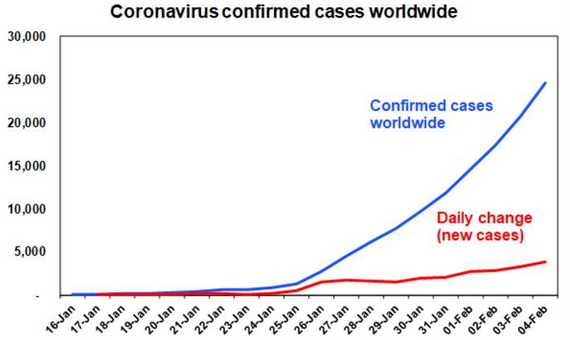
  • So far there are over 24,500 confirmed cases worldwide, with 99% of cases in China. But the number of cases is still rising rapidly and more/faster testing could mean many more with spikes in the number of new daily cases.

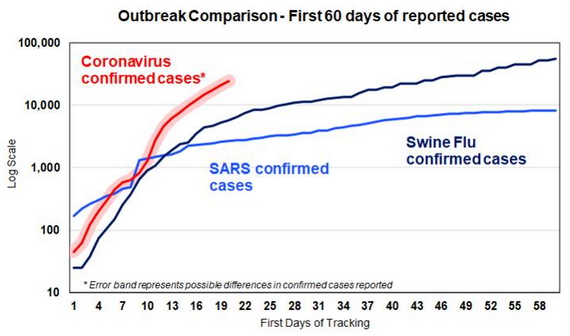
  • So far the mortality rate is running at 2% which puts it above swine flu but well below SARS (which settled around 9%). And of those dying, its mainly been older people or those with pre-existing conditions (as with common flu). 

  • Against this, nCoV has been more contagious with total cases well above those for SARS (8000) and patients can be contagious but without symptoms for 1-2 weeks.


Source: PRC National Health Commission, Johns Hopkins CSSE, AMP Capital


Source: PRC National Health Comm, Johns Hopkins CSSE, WHO, AMP Capital

  • Containment measures – notably in China – have been more aggressive and started earlier than in the case of SARS. These include restricting travel into and out of Hubei province and various countries have restricted (and in some cases banned) foreign travellers entering from China.

Past experiences

To provide some context it is worth reviewing past pandemics – both real and feared. There were three influenza pandemics in the last century: 1918-19, 1957 and 1968. The 1957 and 1968 pandemics are estimated to have killed up to 4 million people. However, the 1918 Spanish flu pandemic was the most severe. While the mortality rate was low, up to 50 million people died worldwide. With a big proportion of the population staying at home, economic activity was severely disrupted, although this was compounded by the ending of World War I. US industrial production slumped 18% between March 1918 and March 1919. Australian real GDP slumped 5.5% in 1919-20 (but then rebounded 13.6% in 1920-21). The share market impact is hard to discern given the ending of WWI, however US and Australian share markets rose through much of the pandemic period.

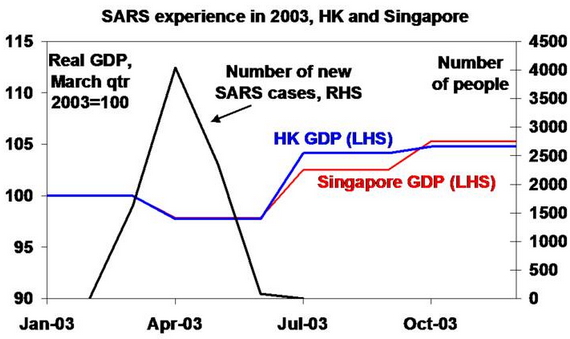
The SARS outbreak of 2003 is a more useful guide. After emerging in China around February 2003, SARS infected about 8000 people (mostly in Asia) in 30 countries over a five-month period and had a mortality rate of about 9%. SARS had a big negative impact on the countries most affected as people stayed home for fear of catching it. GDP in China, Hong Kong and Singapore slumped by over 2% in the June quarter of 2003. Growth then subsequently rebounded.


Source: Thomson Reuters, AMP Capital

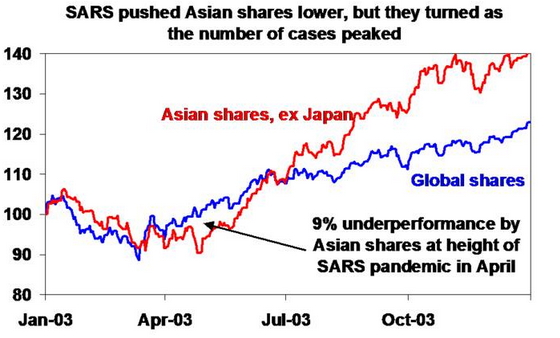
Reflecting SARS, Asian shares fell in April 2003, even though global shares started to move out of a three year bear market from March. The April 2003 low in Asian shares coincided with a peaking in the number of new cases.


Source: Thomson Reuters, AMP Capital

Most pandemics have taken 6-18 months to run their course and peter out as measures are taken to slow their spread (eg, hygiene, quarantining, banning gatherings, preventing travel). SARS ended quicker due to the nature of the virus and rapid action by authorities. In 2005/2006, there was significant concern that a severe strain of bird flu (called H5N1), which was resulting in human casualties, mainly in parts of Asia where people had contact with chickens, would mutate into a form that was readily transmissible between humans. However, this didn’t really eventuate and as such the economic impact was modest although it did cause bouts of volatility in share markets. Similarly, concern that the spread of swine flu would become a global pandemic rattled share markets for a while around April 2009, and Ebola did the same in 2014, but both quickly faded.

The economic and financial impact of nCoV

After strong double-digit gains over the last year and with investor sentiment pushing up to high levels indicating a degree of complacency, share markets were at high risk of a correction in mid Jan and the fears around coronavirus have provided the trigger. Given their greater sensitivity to Chinese growth, commodity prices like Chinese shares are down by more and the Australian dollar has fallen to October lows below $US0.67. What happens from here depends on how long it takes for the outbreak to be contained. The higher number of cases than with SARS or swine flu suggests a greater economic impact. But given the range of possibilities, the best way to get a handle on the economic and investment market impact is to consider several scenarios. Here we consider two.

1. Containment within the next month or two – the number of cases continues to rise but it remainsmainly contained to China (and Hubei) and the number of new cases starts to peak in the next month or so. This would allow travel restrictions to be removed by the June quarter. Under this scenario:

  • GDP in China and parts of Asia would likely take a 2 to 3% hit (taking Chinese GDP growth from 6% year on year in the December quarter to 3-4%yoy in the current quarter) as workers stay home and travel dries up. With the Chinese economy now being four times the share of global GDP it was at the time of SARS, this along with some drag on growth in developed countries would knock world growth to around 2.5% year on year (from around 3%). However, growth would rebound in the June quarter as travel restrictions are removed and things return to normal.

  • Australian growth could see a 0.2% hit in the current quarter mainly due to the loss of Chinese tourists (which account for 20% of tourism earnings and 0.2% of GDP) but also lower raw material demand and an impact on confidence. With the bushfire impact this could see GDP contract, but growth would rebound in the June quarter.

  • Against this background share markets, commodity prices and the $A could still fall a bit further in the near term but would quickly rebound by the June quarter. Easier than otherwise monetary and fiscal policies – with more stimulus measures already announced in China – would aid this.

2. Global pandemic – the number of cases continues to escalate beyond China and aren’t contained until say mid-year.

  • This scenario would see a bigger and longer negative impact on economic activity. Global travel would collapse. Many would simply not come into work – a reasonable estimate is around 20% of workers, although this might be spread over time. This would see a sharp slump in global GDP and the risk of global recession. Australia would not be immune and would likely see two negative quarters of growth with flow on to education exports to China (which accounts for another 0.6% of Australian GDP).

  • Share markets would likely fall sharply – maybe by 20% or so – reflecting the huge economic uncertainty. Cash would be the place to be. The $A could fall to around $US0.60.

  • However, economic activity would rebound quickly once it’s clear the pandemic is under control. Share markets are likely to anticipate this. But this wouldn’t occur till the second half of the year.

Concluding comment and what to watch

While there is reason for concern and it is easy to dream up nightmare scenarios, the experience with SARS, bird flu (with “predictions” it could kill as many as 150 million people) and the mini panic regarding swine flu and Ebola tell us that the worst case fears of pandemics usually don’t come to pass. Rapid containment measures provide some confidence this will be the case. As such, our base case scenario (with 75% probability) is one of containment over the next month or two. This could still see more downside in share markets and bond yields in the near term, but they are likely to rebound by the June quarter as economic growth rebounds. The key things to watch are:

  • The daily number of new cases – the SARS experience saw markets rebound once this showed signs of peaking.

  • The spread of new cases and deaths in developed countries – if this remains limited then markets will also get more confident that the economic fallout will be short lived.


Source: AMP Capital 5 Feb 2020

Important notes: While every care has been taken in the preparation of this article, AMP Capital Investors Limited (ABN 59 001 777 591, AFSL 232497) and AMP Capital Funds Management Limited (ABN 15 159 557 721, AFSL 426455)  (AMP Capital) makes no representations or warranties as to the accuracy or completeness of any statement in it including, without limitation, any forecasts. Past performance is not a reliable indicator of future performance. This article has been prepared for the purpose of providing general information, without taking account of any particular investor’s objectives, financial situation or needs. An investor should, before making any investment decisions, consider the appropriateness of the information in this article, and seek professional advice, having regard to the investor’s objectives, financial situation and needs. This article is solely for the use of the party to whom it is provided and must not be provided to any other person or entity without the express written consent of AMP Capital.


At its meeting today, the Board decided to leave the cash rate unchanged at 0.75 per cent.

The outlook for the global economy remains reasonable. There have been signs that the slowdown in global growth that started in 2018 is coming to an end. Global growth is expected to be a little stronger this year and next than it was last year and inflation remains low almost everywhere. One continuing source of uncertainty, despite recent progress, is the trade and technology dispute between the US and China, which has affected international trade flows and investment. Another source of uncertainty is the coronavirus, which is having a significant effect on the Chinese economy at present. It is too early to determine how long-lasting the impact will be.

Interest rates are very low around the world and a number of central banks eased monetary policy over the second half of last year. There is an expectation of a little further monetary easing in some economies. Long-term government bond yields are around record lows in many countries, including Australia. Borrowing rates for both businesses and households are at historically low levels. The Australian dollar is around its lowest level over recent times.

The central scenario is for the Australian economy to grow by around 2¾ per cent this year and 3 per cent next year, which would be a step up from the growth rates over the past two years. In the short term, the bushfires and the coronavirus outbreak will temporarily weigh on domestic growth. The household sector has been adjusting to a protracted period of slow wages growth and, last year, to a decline in housing prices, with the result that consumption has been quite weak. Following this period of balance-sheet adjustment, consumption growth is expected to pick up gradually. The overall outlook is also being supported by the low level of interest rates, recent tax refunds, ongoing spending on infrastructure, a brighter outlook for the resources sector and, later this year, an expected recovery in residential construction.

The unemployment rate declined in December to 5.1 per cent. It is expected to remain around this level for some time, before gradually declining to a little below 5 per cent in 2021. Wages growth is subdued and is expected to remain at around its current rate for some time yet. A further gradual lift in wages growth would be a welcome development and is needed for inflation to be sustainably within the 2–3 per cent target range. Taken together, recent outcomes suggest that the Australian economy can sustain lower rates of unemployment and underemployment.

Inflation remains low and stable. Over 2019, CPI inflation was 1.8 per cent and underlying inflation was a little lower than this. The central scenario is for CPI inflation to be around 2 per cent in the near term and to fluctuate around that rate over the next couple of years. In underlying terms, inflation is expected to increase gradually to 2 per cent over the next couple of years.

There are continuing signs of a pick-up in established housing markets. This is especially so in Sydney and Melbourne, but prices in some other markets have also increased. Mortgage loan commitments have also picked up, although demand for credit by investors remains subdued. Mortgage rates are at record lows and there is strong competition for borrowers of high credit quality. Credit conditions for small and medium-sized businesses remain tight.

The easing of monetary policy last year is supporting employment and income growth in Australia and a return of inflation to the medium-term target range. The lower cash rate has put downward pressure on the exchange rate, which is supporting activity across a range of industries. Lower interest rates have assisted with the process of household balance sheet adjustment. They have also boosted asset prices, which in time should lead to increased spending, including on residential construction. Progress is expected towards the inflation target and towards full employment, but that progress is expected to remain gradual.

With interest rates having already been reduced to a very low level and recognising the long and variable lags in the transmission of monetary policy, the Board decided to hold the cash rate steady at this meeting. Due to both global and domestic factors, it is reasonable to expect that an extended period of low interest rates will be required in Australia to reach full employment and achieve the inflation target. The Board will continue to monitor developments carefully, including in the labour market. It remains prepared to ease monetary policy further if needed to support sustainable growth in the economy, full employment and the achievement of the inflation target over time.

Source: Reserve Bank of Australia, February 4th, 2019

Enquiries

Media and Communications
Secretary’s Department
Reserve Bank of Australia
SYDNEY

Phone: +61 2 9551 9720
Email: rbainfo@rba.gov.au