My Business Health, a free web portal designed to provide holistic support to small business owners, is now live.

Many small and family business owners may not be aware that their everyday worries – be it cash flow, staff related concerns or paying suppliers – can actually cause high levels of psychological distress.

Accessed via the Australian Small Business and Family Enterprise Ombudsman website, My Business Health offers practical information and resources to help with those day-to-day issues that keep small business owners awake at night.

If you are experiencing any such worries or concerns about your business, visit My Business Health today and find out how it can help you.

Please contact us on Phone: 07 5641 4134 if you seek further assistance .

Source : ATO Small Business Newsroom January 2020 

Reproduced with the permission of the Australian Tax Office. This article was originally published at https://www.ato.gov.au/Newsroom/smallbusiness/General/Holistic-support-for-small-business/

Important:
This provides general information and hasn’t taken your circumstances into account.  It’s important to consider your particular circumstances before deciding what’s right for you. Although the information is from sources considered reliable, we do not guarantee that it is accurate or complete. You should not rely upon it and should seek qualified advice before making any investment decision. Except where liability under any statute cannot be excluded, we do not accept any liability (whether under contract, tort or otherwise) for any resulting loss or damage of the reader or any other person. 

Any information provided by the author detailed above is separate and external to our business and our Licensee. Neither our business nor our Licensee takes any responsibility for any action or any service provided by the author.

Any links have been provided with permission for information purposes only and will take you to external websites, which are not connected to our company in any way. Note: Our company does not endorse and is not responsible for the accuracy of the contents/information contained within the linked site(s) accessible from this page.

The safe withdrawal rate. It’s an alluring concept. An amount you can spend each year and yet be sure you’ll never run out of money in retirement.

It’s an enduring concept too – ever since a financial planner did a comprehensive study in the mid 90s. And even better it’s got a simple number attached – 4 per cent.

That’s how much of your money you’re supposed to be able to spend each year and never run out.

The concept and that simple number have become so popular they have entered investing folklore. There are more than 13,000 videos on YouTube explaining the “4 per cent rule” as it’s become known.

But today’s investing world with low interest rates and a subdued outlook for equities markets looks very different from the 1990s and investors are beginning to ask if the so-called safe withdrawal rate remains safe.

The origins of the 4 per cent rule are a paper by Californian financial planner William Bengen. He worked out that over 75 years of actual market returns, people who withdrew 4 per cent of their savings in the first year of retirement and then adjusted the withdrawal for inflation every year after that stood a very high chance of not running out of money before they died.

The 4 per cent figure is also mirrored in the federal government’s minimum drawdown factor for superannuation. Based on a different theory to Bengen’s, the federal government’s recommendation is designed to ensure most of the money saved in a low tax environment is spent in retirement.

The minimum drawdown factor starts at 4 per cent, based on advice from Australian Government Actuary which determined most people would spend about three quarters of their super at that rate and not leave an unseemly amount of money for the children when they die.

The problem with both these numbers is that investment returns higher than 4 per cent are becoming increasingly difficult to achieve. Bond yields have fallen from as high as 6 per cent in 1998 to below 1.5 per cent today. A 50:50 stocks and bond portfolio yielded more than 4 per cent in 1998, but in today’s environment would yield only half that.

Happily, we’re living longer too, however that also means our money needs to last longer.

At the time Bengen was writing, an Australian man retiring at 65 could expect to live to 81. Today, a man retiring at 65 can expect to live to 85. Women live even longer. And life expectancy keeps rising.

These are important issues because the impact of running out of super in retirement can be severe.

And what’s often unsung is the reverse problem of people unnecessarily constraining their lifestyle in retirement for fear of running out of money. There’s no fun in living on chips and beans only to leave it all to the kids.

So if 4 per cent is no longer the safe withdrawal rate, what is?

Unfortunately, it’s not that simple.

The first question is understanding your goals.

Choosing an appropriate spending goal has four elements: your basic living expenses, a contingency reserve for unexpected events, discretionary spending so you can enjoy yourself, and any legacy you want to leave to your heirs.

These are deeply personal questions, but a retiree’s views on these four goals and the relative importance of each of them is crucial to understanding and projecting retirement.

Then, there are four factors driving what your personal safe withdrawal rate looks like.

How long you expect to live? Could you tolerate running out of money completely? What’s your asset allocation? Are you willing to pull back spending in years that deliver bad market returns?

Clearly the shorter the time horizon, the more money you can withdraw each year, but for most retirees that’s an unpleasant unknown. And most of us contemplating these questions aren’t planning to run out of money before we go.

What’s more controllable is asset allocation. The more conservative an asset allocation – say more in bonds and cash and less in stocks – the lower the expected returns and the less you can safely withdraw each year. More risky investments come with potentially higher returns and the ability to spend more money, but a higher risk of market shocks impacting the portfolio value and raising the risk of running out of money earlier.

But the most powerful lever is your spending flexibility.

Vanguard crunched the numbers and came up with a range suitable for most investors – 3.5 per cent to 5 per cent depending on how conservative the portfolio was.

Those people willing to be flexible in year-to-year spending – pulling back in negative return years and spending more in good ones – dramatically increase their chances of not running out of money.

Being flexible even allows them to lift their safe withdrawal rate well above the 4 per cent benchmark.

In fact, a retiree who is willing to cut back spending in bad years by just 2.5 per cent can lift their starting safe withdrawal rate as high as 5 per cent of their savings – without increasing the chances of running out of money.

Vanguard calls this a “dynamic spending strategy”.

So how much more can you spend in a good year?

The Vanguard numbers show the best result comes from capping your spending increases each year at 5 per cent– even if your portfolio grows faster than that.

A person who has spent $40,000 in the previous year can safely lift spending up to $42,000 if the next year is a good year (e.g. $40,000 plus 5 per cent). But in a poor year, they should cut spending to $39,000 ($40,000 less 2.5 per cent). Using this ‘cap and floor’ approach to calculate each year’s spending allows retirees more certainty that they won’t run out of cash before they die.

So, here’s how you work out a safe withdrawal rate from your savings in a low interest rate world: be diversified, but include stocks in your portfolio; know what you need to live; be willing to spend a little less in bad market years; and be happy to spend a bit more when things are going well.

As for Mr Bengen who kicked off the whole debate, he doubled down a few years later, lifting his projected safe withdrawal rate to 4.5 per cent over a 30-year retirement.

But he included a warning – in the event of a prolonged market downturn, even he plans to change his mind and revise that number a little lower.

Please contact us on Phone: 07 5641 4134 if you seek assistance on this topic.

Source : Vanguard January 2020 

Reproduced with permission of Vanguard Investments Australia Ltd

Vanguard Investments Australia Ltd (ABN 72 072 881 086 / AFS Licence 227263) is the product issuer. We have not taken yours and your clients’ circumstances into account when preparing this material so it may not be applicable to the particular situation you are considering. You should consider your circumstances and our Product Disclosure Statement (PDS) or Prospectus before making any investment decision. You can access our PDS or Prospectus online or by calling us. This material was prepared in good faith and we accept no liability for any errors or omissions. Past performance is not an indication of future performance.

© 2019 Vanguard Investments Australia Ltd. All rights reserved.

Important:
Any information provided by the author detailed above is separate and external to our business and our Licensee. Neither our business nor our Licensee takes any responsibility for any action or any service provided by the author.

Any links have been provided with permission for information purposes only and will take you to external websites, which are not connected to our company in any way. Note: Our company does not endorse and is not responsible for the accuracy of the contents/information contained within the linked site(s) accessible from this page.

When I was in my 20s, I flirted with dreams of becoming a race car driver or a foreign correspondent. Whether by choice or chance, neither dream eventuated into reality and somehow the lottery numbers that would deliver instant wealth never fell my way either.

What did eventuate however was starting my first full-time job and discovering the freedom of a steady income stream, the revelation that you could be paid while on holidays and a small but practical epiphany that water doesn’t flow from your taps without paying the monthly bill.

Your experience might have been similar to mine; our twenties are usually a period of substantial growth and for better or for worse, a time when we come face-to-face with new financial responsibilities.

Looking back life seems a lot simpler back then. Budgeting was primarily handled by remembering to go to the bank on a Friday to withdraw enough cash to get you through the weekend’s activities and phones were things screwed to the wall at home or housed in dedicated booths on major street corners. They certainly were not a source of instant cash.

But if I were to give some general financial advice to my twenty-something self, it’d probably be themed around the following:

Talk about money… often!

Money can often be an awkward topic to broach but it can also be a valuable conversation to have with friends and family. Starting a dialogue about finances with and getting advice from people you trust can encourage you to think more proactively about how you manage, save and invest your own money.

For example, if you are thinking of investing for the first time and unsure as to where to begin, it is likely that your peers are going through or have recently been through a similar experience. If that’s the case, they might often be a good source of information as the knowledge you share is more likely to be the right level of detail and complexity.

Alternatively, talking about finances with older family members can yield helpful tips and insights as they’d have had the benefit of hindsight. It is amazing the amount of new information you can pick up just by hearing from those around you.

Although one caveat here is that everyone has their own bias so good to challenge perceived accepted wisdom. In my case the family background was conservative and based around property and bank term deposits so attending an early ASX seminar on sharemarket investing was both an eye-opener and the start of a lifelong journey.

From savvy budgeting tips to providing the motivation you need to finally sort out your superannuation, simply having a chat about money can not only compound your interest in the topic, but might also set you up better for the lifestyle you want in the future.

If you are still unsure as to where best to start, sometimes having an initial discussion with a licensed financial adviser can help you better define and work towards your financial goals.

Don’t procrastinate

You may have heard the saying that the best time to invest was yesterday, or that time in the market beats market timing. While it is always important to do your research before making an investment decision, it is also easy to get caught up in the mountains of information out there and be paralysed by procrastination and choice. You can have the right intentions to be financially responsible but all intentions are merely that without the action.

The right time to sort out your finances is now and the right time to invest is when you feel that you are in a position to do so, not necessarily if the market is up or down. Because there is no hard deadline for when you need to consolidate your super and stop paying fees on three different accounts, or no crystal ball to predict the date you’ll experience a financial emergency, it’s easy to put it all off and continue to be financially complacent.

And of course being twenty something means you have something incredibly valuable – time to ride out market cycles because nothing is guaranteed.

It’s all about balance

Being financially responsible doesn’t mean never treating yourself. It’s about figuring out a balance that allows you to live your best life both now and in the future.

A widely-used rule is “60-20-20” where 60 per cent of your income goes towards daily living costs such as food, utilities, rent or mortgage, 20 per cent is allocated towards your savings and the other 20 per cent can be spent on discretionary items like entertainment, travel or dining out.

This rule is even easier to follow if you set up different bank accounts for each bucket and automate the transfers for when you receive your pay so it splits between accounts accordingly. Of course, this is only a general guide and you should find the allocation that works best for your financial situation.

The above might sound like just common sense but getting on top of your finances really is as simple as having a little interest and discipline. And who knows, being financially responsible earlier on might mean you have the resources later in life to finally become the race car driver of your dreams.

Please contact us on Phone: 07 5641 4134 if you seek further assistance on this topic.

Source : Vanguard

Written by Robin Bowerman, Head of Corporate Affairs at Vanguard.

Reproduced with permission of Vanguard Investments Australia Ltd.

Vanguard Investments Australia Ltd (ABN 72 072 881 086 / AFS Licence 227263) is the product issuer. We have not taken yours and your clients’ circumstances into account when preparing this material so it may not be applicable to the particular situation you are considering. You should consider your circumstances and our Product Disclosure Statement (PDS) or Prospectus before making any investment decision. You can access our PDS or Prospectus online or by calling us. This material was prepared in good faith and we accept no liability for any errors or omissions. Past performance is not an indication of future performance.

© 2020 Vanguard Investments Australia Ltd. All rights reserved.

Important:
Any information provided by the author detailed above is separate and external to our business and our Licensee. Neither our business nor our Licensee takes any responsibility for any action or any service provided by the author.

Any links have been provided with permission for information purposes only and will take you to external websites, which are not connected to our company in any way. Note: Our company does not endorse and is not responsible for the accuracy of the contents/information contained within the linked site(s) accessible from this page.

The past week has seen a renewed escalation in concern that the coronavirus outbreak (Covid-19) has become or is becoming a global pandemic. This is first and foremost a human crisis and our thoughts are with all those affected and those trying to combat the outbreak. Naturally though investment markets are starting to become increasingly concerned about the disruptive impact on economic activity. As a result, while most share markets recovered their initial decline on the back of the virus with some hitting new highs last week, we are now seeing renewed sharp falls. This note updates our initial analysis from three weeks ago (see The China Coronavirus outbreak) as to the impact of the outbreak.

Scenarios

Our assessment three weeks ago saw as our base case with 75% probability that the outbreak would be contained within the next month or two. This could still see more downside in share markets & bond yields but there would be a rebound by the June quarter as growth rebounds. The downside case saw a full-blown pandemic with delayed containment resulting in sharp drawn out slump in economic activity, the risk of recession and a 20% or so fall in share markets with the $A falling to around $US0.60. Of course, there are lots of variations around this. We thought the key things to watch are the daily number of new cases and the spread of new cases in developed countries.

Where are we with the Covid-19 outbreak so far?

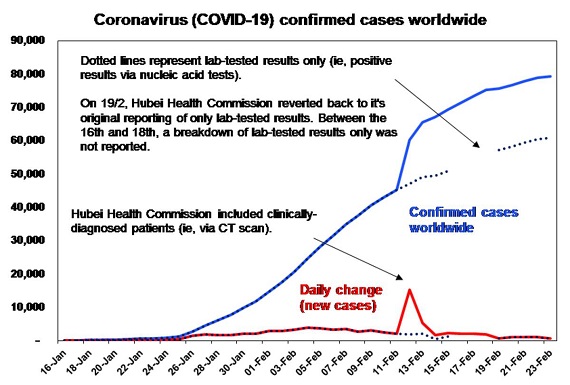
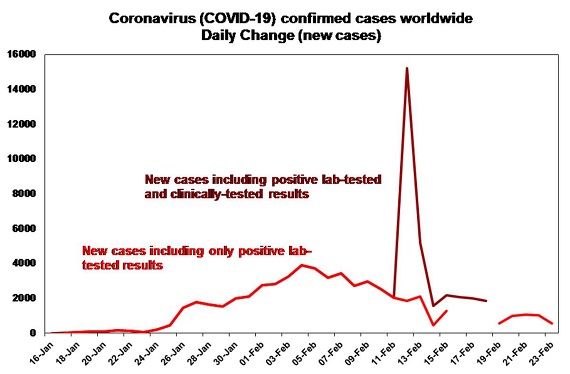
  • First, while the total number of reported cases is now around 80,000 worldwide there has been some good news in that the daily number of new cases is down from its peak earlier in February. This is due to a sharp fall in the reported number of new cases in China. This has been confused by definitional changes in China – with Hubei initially reporting lab confirmed results, then including clinically tested results, then reverting to lab tested results only. However, both approaches have issues & even if it’s roughly right it’s good news if China is starting to get the outbreak under control.

View larger image

Source: PRC National Health Commission, Bloomberg, AMP Capital 

View larger image

Source: PRC National Health Commission, Bloomberg, AMP Capital

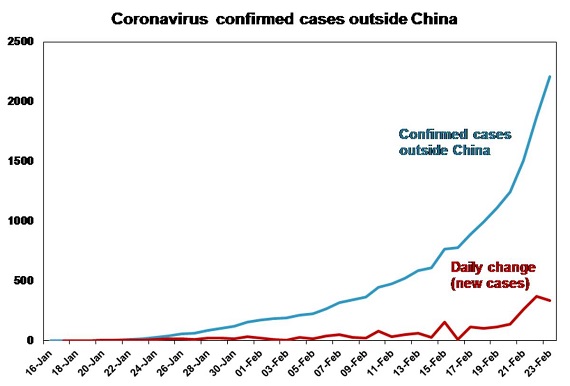
  • Against this, the number of new cases outside China has spiked – particularly in South Korea, Japan, Italy and Iran.

View larger image

  • The mortality rate has increased to 3.3% – although there is uncertainty about it. Some argue it’s higher because it’s wrong to divide deaths into all cases as there is a lag from getting the disease to dying. Others argue it’s much lower because only those who are seriously ill are showing up for help and being measured. The mortality rate does look to be below the 9% for SARS but above that for swine flu though and it’s mainly the old and sick who are most vulnerable.

  • There is still much uncertainty about how it’s spread – with leaky plumbing and aerosolising of toilet water or contaminated water possibly playing a role in the spread of the virus in the Diamond Princess cruise ship in Japan.

  • Containment measures in China have been aggressive and if the declining number of new cases in China is correct maybe they are working. Australia’s quick toughening in entry and quarantine conditions may also have helped in contrast to other countries that now have many more cases. However, some governments may not be able to implement and enforce such tough measures.

The spread of cases beyond China has raised increasing concerns that Covid-19 is become a global pandemic. While we and others have made comparisons to the SARS outbreak of 2003, the swine flu pandemic of 2009 is also relevant. Despite efforts to contain the disease it is estimated to have ultimately infected 700million to 1.4billion people but because its death rate was low at around 0.02-0.04% it doesn’t get referred to much. Partly due to this swine flu had little impact on the global economic recovery of 2009 although it did occasionally rattle share markets. Though Covid-19’s mortality rate looks to be greater than that of swine-flu its worth noting that swine-flu’s mortality was initially reported to be as high as 9.5%.

A big hit to global growth

Whether Covid-19 is soon contained, turns into a re-run of swine-flu or something a lot more deadly remains to be seen. Our base case remains one of containment by the end of March. But the risk of it taking longer is significant and in any case it’s increasingly clear that the economic impact will be quite severe as containment measures spread globally disrupting supply chains and spending.

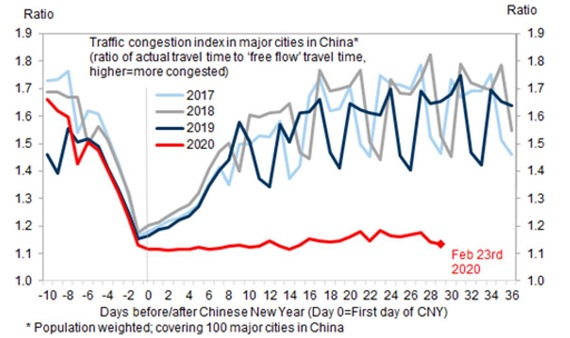
  • Some estimates suggest that as much as 50% of China’s economy has been locked down for the last three weeks which means nearly 12% knocked off Chinese GDP this quarter. While the Chinese Government is refocussing on efforts to restore economic activity outside Hubei and high-risk areas, so far there is only mixed evidence of that. Coal consumption at power stations, migrant flows to cities, property sales and steel demand are up from their lows but remain well below normal levels for this time of year. And there has been no pickup in traffic congestion.

View larger image

Source: Wind, Goldman Sachs

  • Numerous companies globally are reporting disruption to supply chains or reduced demand flowing from Covid-19.

  • Containment measures including travel restrictions in countries like Japan, Korea and Italy will spread the economic disruption globally.

  • Our rough estimate is that March quarter global GDP could now be zero or slightly negative.

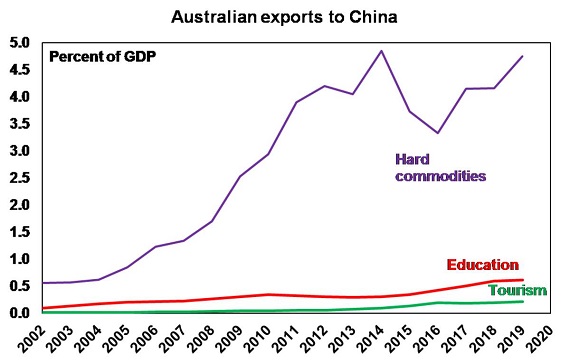
  • Australian GDP is likely to go backwards this quarter (with our current estimate being -0.1%) thanks to the bushfires and the hit from coronavirus. The vulnerability of the Australian economy to China is apparent from the next chart. Exports to China make up nearly 9% of Australia’s GDP including hard commodities at nearly 5%, tourism at 0.2% and education at 0.6%. For other major countries it’s less than 3%. Chinese tourist arrivals stopped with the travel ban, education is under threat although there is a bit more time and bulk commodity shipments are showing signs of being impacted (although this has been distorted by storms). Clearly the longer it drags on and the more the outbreak and disruption spreads globally the bigger the impact on Australia including the risk of two negative quarters, ie recession. The rising threat to the Australian economy from coronavirus is adding to the likelihood that the RBA will cut rates in March or April and the pressure for more fiscal stimulus in the May budget is increasing.

View larger image

Source: ABS, AMP Capital

Concluding comments

The increasing global spread of the coronavirus has increased the risk of greater economic disruption for longer resulting in say a 20% fall in share markets. However, our base case of containment is that Chinese, global and hence Australian growth will rebound in the June quarter (avoiding recession in Australia’s case) although the risk of a delay is significant. Against this background share markets, commodity prices and the $A remain at high risk of more downside in the short-term, but assuming some containment and a growth rebound in the June quarter markets should rebound by then. Easier than otherwise monetary and fiscal policies – with ever more stimulus measures announced in China and more monetary and fiscal easing globally – would add to this. The key things to watch for remain a further downtrend in the daily number of new cases globally and a peak in new cases in developed countries.

In a big picture sense, the fall in share markets should be seen as just another correction after markets ran hard and fast into record highs this year from their last decent correction into August last year.

Finally, for most investors given the obvious difficulty in trying to time any of this – whether it’s a further share market fall of 5% or 20% or no further fall at all and then when to get back in – it makes sense to turn down the noise around the virus and stick to a long-term investment strategy.

Source: AMP Capital 25 Feb 2020

Important notes: While every care has been taken in the preparation of this article, AMP Capital Investors Limited (ABN 59 001 777 591, AFSL 232497) and AMP Capital Funds Management Limited (ABN 15 159 557 721, AFSL 426455) (AMP Capital) makes no representations or warranties as to the accuracy or completeness of any statement in it including, without limitation, any forecasts. Past performance is not a reliable indicator of future performance. This article has been prepared for the purpose of providing general information, without taking account of any particular investor’s objectives, financial situation or needs. An investor should, before making any investment decisions, consider the appropriateness of the information in this article, and seek professional advice, having regard to the investor’s objectives, financial situation and needs. This article is solely for the use of the party to whom it is provided and must not be provided to any other person or entity without the express written consent of AMP Capital.

The First Home Loan Deposit Scheme is a Australian Government initiative to support eligible first home buyers purchase a home sooner.

It does this by providing a guarantee that will allow eligible first home buyers on low and middle incomes to purchase a home with a deposit of as little as 5 per cent.

The Scheme will support up to 10,000 loans each financial year, starting from 1 January 2020.

Please contact us on Phone: 07 5641 4134 for information on participating lenders.

Are you an eligible first home buyer?

The Scheme is open to singles or couples.

Singles

If you are looking to purchase your first home as the only person named as a borrower in your home loan, then you would apply under the Scheme as a single.

Couples

If you are looking to purchase your first home with your spouse or de facto partner, where you are both named as borrowers in your home loan, then you would both apply under the Scheme as a couple.

NHFIC has developed a tool to help first home buyers find out whether they meet the Scheme’s eligibility criteria.

Click here to view the Eligibilty tool.

Property price thresholds

To ensure the Scheme is only available for the purchase of a modest home, or the purchase of land and construction of a modest home, the property price thresholds (maximum property purchase price under the Scheme) will apply in capital cities, large regional centres and regional areas.

NHFIC has also developed a tool to help first home buyers find out the property price threshold for the suburb in which they are looking to purchase a property. Please note that this tool is provided as a guide only and does not mean that you will receive either a guarantee or a loan from a participating lender.

Click here to view the price threshold tool.

Fact Sheets

Please click here to download a Fact Sheet

Please click here to download some FAQs

If you have any questions or require further information please contact us on Phone: 07 5641 4134.

Source:

https://www.nhfic.gov.au/what-we-do/fhlds/

No matter the size of your business, introducing greener work practices should be top of the new year agenda. By making moves to reduce, reuse and recycle, You’ll not only help save the planet, you’ll reduce your energy costs and appeal to likeminded customers.

Whatever the political situation, an increasing number of people in Australia and New Zealand value environmental sustainability in business practices. And they’re changing their purchasing habits as a result.

By adopting and spruiking your eco-credentials, you’re not only able to attract and retain environment-minded clientele, you’re also likely to entice – and keep – more staff, with the HP Australia Environmental Sustainability Study 2018 revealing 70 percent of 22 to 30-year-old Australians would prefer to work for a company with environmentally sustainable practices.

To make 2020 your greenest year yet, here are 20 easy eco-resolutions for your business.

1. Install bike racks

Encourage your staff to reduce their carbon footprint – while getting fit – by cycling to work. Install a secure bike rack in the office, then don your helmet and get riding.

2. Allow employees to work remotely

Being more flexible and allowing employees to work from home once a week – or more – is a sustainability no-brainer. As well as keeping cars off the road, fewer people in the office equals less energy consumption. It’s a win-win.

3. Introduce a ‘no single-use cups’ rule

Place a total ban on takeaway coffee cups and remove disposable cups from your water cooler. Instead, ask staff to bring in their own refillable water bottles and coffee cups.

READ: Should your café consider ditching single-use items?

4. Stock the kitchen with real crockery, cups and cutlery

To discourage employees from accepting throw-away cutlery from the local café, make sure your staff kitchen is fully stocked. And if you don’t want to deny forgetful staff their caffeine fix? Have a spare stash of KeepCups on hand.

5. Switch to reusable coffee pods

Coffee is the fuel of worker bees, so having a pod machine on site might seem like an investment in productivity. But with Aussies consuming around six million coffee pods daily and only five percent recyclable, it’s a disaster for the environment.

If you already have a machine – don’t chuck it! Instead, purchase Crema Joe’s reusable coffee capsules, or sign up to their new coffee pod refill and exchange service (currently Melbourne only).

6. Use recycled toilet paper

The staff bathroom is another spot where you can make simple changes. Stock up on 100 percent recycled loo roll from Who Gives A Crap, and know that 50 percent of profits will be used to build toilets in developing countries.

7. Install high-speed hand dryers

Paper hand towels may be convenient, but they can’t be recycled once used. For a smaller environmental footprint, consider swapping to a high-speed hand dryer.

8. Go paperless (where possible)

With cloud-based computing, responsible businesses are making moves towards ditching paper. If going 100 percent paperless is not feasible for your business, make as many small changes as you can.

Introduce paperless billing, discourage staff and customers from printing emails (pop a reminder in your email signature!), and print double-sided.

9. Shred and recycle your documents

Always buy recycled printing paper and recycle your own documents once you’re done with them. If privacy is an issue, buy a paper shredder and shred everything before recycling.

10. Work with sustainable suppliers

Do a sustainability audit of all your suppliers, and support those with green initiatives. Also shop local where possible to reduce transport miles.

11. Switch to energy-efficient light bulbs

Changing to LED lighting will reduce energy consumption and save you money. Install sensor lights in lower-traffic areas, and make sure all lights go off at home time.

READ: How to reduce your small business’s carbon footprint

12. Only use the dishwasher when full

If your office kitchen has a dishwasher, make sure it’s on eco mode and that staff are only running full loads.

13. Introduce some plants

Not only do plants look great, they’ve been shown to increase productivity in the workplace. They also help purify the air and reduce stress.

14. Make recycling easy

Have dedicated bins for general waste and different types of recycling (paper, ink cartridges, bottles and cans, etc). Make sure these are clearly marked and positioned for convenience. Make your own signs, or you can download some here.

15. Adjust the thermostat

If half your staff are wearing jumpers in the height of summer, something is NQR. Turning the temperature up a few degrees in summer and down in winter can result in big energy savings.

16. Encourage carpooling

Suggest that staff who live in the same area set up a carpool. Employees will not only be reducing their carbon emissions, they’ll enjoy the social benefits.

17. Carbon offset staff flights

Try to limit unnecessary staff travel by sticking with virtual meetings when possible. If you or a team member does have to fly, check the box and fork out a few dollars to offset the carbon emissions.

18. Buy upcycled office furniture and refurbished computers

Shop around for second-hand office furniture and refurbished equipment. You’ll save money and keep products out of landfill. It’s also an easy way to give your workplace some character.

19. Take marketing online

Replace offline marketing with a (much greener) digital strategy. If you must send flyers and direct mail materials, have them printed on recycled paper.

20. Dispose of old computers responsibly

Drop your old computers, printers and accessories at a local TechCollect drop-off point to prevent e-waste ending up in landfill.

Source : MYOB

Reproduced with the permission of MYOB. This article by Pip Jarvis was originally published at https://www.myob.com/au/blog/tips-sustainable-business-2020/

Important:
This provides general information and hasn’t taken your circumstances into account. It’s important to consider your particular circumstances before deciding what’s right for you. Although the information is from sources considered reliable, we do not guarantee that it is accurate or complete. You should not rely upon it and should seek qualified advice before making any investment decision. Except where liability under any statute cannot be excluded, we do not accept any liability (whether under contract, tort or otherwise) for any resulting loss or damage of the reader or any other person.

Any information provided by the author detailed above is separate and external to our business and our Licensee. Neither our business nor our Licensee takes any responsibility for any action or any service provided by the author.

Any links have been provided with permission for information purposes only and will take you to external websites, which are not connected to our company in any way. Note: Our company does not endorse and is not responsible for the accuracy of the contents/information contained within the linked site(s) accessible from this page.

At the end of 2018, after a dismal fourth quarter – in fact, the worst quarterly performance in seven years – the Australian share market closed at a two-year low.

No doubt, many investors at the time were probably anticipating a mediocre year ahead.

Yet, seven months later, the Australian share market had not only recovered all its 2018 fourth-quarter losses, but breached its all-time peak set back in November 2007.

And, while ongoing geopolitical tensions and economic fears, overshadowed by the US-China trade war, have continued to rattle global financial markets through 2019, it’s been a relatively solid investment year.

The message from us at Vanguard to investors, as always, has been to tune out from the daily market noise, and to remain disciplined and diversified, irrespective of shorter-term volatility.

Many investor portfolios are well ahead on where they started 12 months ago. In fact, just about every major asset class barring cash has delivered strong year-to-date returns.

Driving that has been an insatiable hunt for yield. With interest rates at record lows, investors globally have been searching for investments generating higher returns. Concurrently, investors seeking a degree of safety have diverted capital into the more defensive asset classes such as bonds.

That’s driven huge capital inflows into shares, listed property and fixed income assets. In turn, that demand has driven strong price appreciation across global financial markets.

Strong double-digit returns

Those with broad exposures to Australian, US and international shares, and to Australian and international listed property, have achieved double-digit 12-month returns. Even bonds have returned close to 10 per cent so far this year.

You can see the relative returns of a range of different asset classes over the year, and all the way back to 1970, by accessing and bookmarking the Vanguard Interactive Index Chart.

Of course, past performance is never an indicator of future performance. The best and worst performing asset classes will often vary from one year to the next.

Australian listed property was the best-performing asset class return in the financial year to 30 June, 2019, delivering 19.3 per cent. But, in 2018, the best performer was US shares, and the financial year before it was hedged international shares.

In fact, the last example of the same asset class delivering the best returns in two consecutive years was more than a decade ago, back in 2008 and 2009, when hedged international bonds returned 8.6 per cent and 11.5 per cent respectively.

Taking a longer-term look

Although shorter-term returns analysis can be somewhat useful, it’s only when one does a much longer examination of investment trends that a more meaningful picture emerges.

This year marks two decades since the turn of the century, so it’s an opportune time to capture almost a full 20 years of investment returns across eight different asset classes.

The chart data below goes up to the end of October (the latest chart data available) – which is broadly in line with total returns through to the middle of December.


You can replicate the same data through our Index Chart. Using a base investment figure of $10,000, and assuming all distributions are fully reinvested, the first broad observation is that investors have achieved consistent growth over time.

As expected, returns across different asset classes over the last 20 years have varied. Most notably, the 2007 to 2009 period shows the sharp deterioration in asset values stemming from the 2007 US subprime crisis that precipitated the global financial crisis. After reaching an all-time high in November 2007, the Australian share market dropped 54 per cent over the 14 months to February 2009 before starting its long-term recovery run that finally saw the S&P/ASX 200 Index surpass its previous record in July this year.

Over the past 20 years the ASX has returned more than 8 per cent per annum, turning a hypothetical $10,000 investment made in January 2000 into just over $49,000. That’s a 390 per cent return, excluding any fees, expenses and taxes.

A $10,000 investment into international listed property over the same time frame would have returned 10.2 per cent per annum and be worth more than $68,000, using the same assumptions as above. That equates to a 580 per cent total return. Investors in any of the major asset classes would have done well over the past 20 years, and obviously those with investments across multiple asset classes would have achieved the smoothest returns.

But you didn’t need ‘2020 vision’ back in the year 2000 to know that total asset class returns would increase over time. It’s a basic rule of compounding that when investment returns are reinvested over a long period that the value of a portfolio also will increase.

You can replicate this same pattern over other periods of time. Having a regular investment contributions strategy will amplify returns, in the same way as compulsory and voluntary superannuation contributions add to members’ account balances in accumulation phase.

The importance of diversification

Heading into 2020, financial markets most likely will remain decidedly jittery. A US-China trade truce still appears distant, and escalating trade and cross-border tax issues between the US and other countries will add to markets pressure.

Asset class returns will vary, as they always do, depending on these and other catalysts.

As can be gleaned from the index chart, especially from a longer-term perspective, spreading your money across a range of investments is one of the best ways to reduce your exposure to market risk.

This way you are not relying on the returns of a single asset class.

Ways to diversify are:

  • Include exposure to different asset classes, like shares, fixed interest and property.

  • Hold a spread of investments within an asset class, like different countries, industries and companies.

  • Invest in a number of funds managed by different fund managers. For example, consider blending active with index managers.

The right mix of asset classes or investments for you will depend on your goals, time frame and tolerance for risk.

If you don’t use one already, consider seeing a professional financial adviser to help you determine the optimal asset allocation for your individual needs.

Please contact us on Phone: 07 5641 4134 if you seek further assistance .

Source : Vanguard 

Reproduced with permission of Vanguard Investments Australia Ltd

Vanguard Investments Australia Ltd (ABN 72 072 881 086 / AFS Licence 227263) is the product issuer. We have not taken yours and your clients’ circumstances into account when preparing this material so it may not be applicable to the particular situation you are considering. You should consider your circumstances and our Product Disclosure Statement (PDS) or Prospectus before making any investment decision. You can access our PDS or Prospectus online or by calling us. This material was prepared in good faith and we accept no liability for any errors or omissions. Past performance is not an indication of future performance.

© 2020 Vanguard Investments Australia Ltd. All rights reserved.

Important:
Any information provided by the author detailed above is separate and external to our business and our Licensee. Neither our business nor our Licensee takes any responsibility for any action or any service provided by the author.

Any links have been provided with permission for information purposes only and will take you to external websites, which are not connected to our company in any way. Note: Our company does not endorse and is not responsible for the accuracy of the contents/information contained within the linked site(s) accessible from this page.

Epidemics can rattle markets, and as fund managers we need to know what is worth reacting to and what is a product of the 24-hour news cycle. Here, we share some learnings for advisers and investors facing information overload.

In the age of information, it can be easy for investors and advisers alike to be swayed or distracted by articles, statements and opinions which lack evidence, rigour and analysis. Certain headlines can be frightening and foster an air of anxiety.

Our role as guardians of clients’ capital means we apply refined filters to assess incoming information and guide our investment decisions. We have models to help us separate signal from noise during the regular flow of economic data, however navigating ad hoc events for which there may not be a ready-made model, is another critical aspect of portfolio management.

The situation unfolding with the Coronavirus is, above all, a human tragedy. For investment managers, who have a responsibility to be a steady hand during this time, it represents an ad hoc event to interpret and manage with caution. We share some of our thinking on the Coronavirus below, with insight to our thinking and processes during events of this nature.

1. Monitoring scale and severity

The scale of an epidemic is an important factor in analysing market impact, but you first need to determine what to measure. In the case of an epidemic, mortality rates hit our fear impulse hardest. However for financial markets the significance of an event like this boils down to the level of disruption caused to regular flow of goods and people.

By way of example, over 11,000 people died from the Ebola outbreak in West Africa in 2014.However the disruption caused to the global economy was much less than we’ve seen with the Coronavirus that originated in Wuhan, because of the differences in population density and the impact to global supply chains.

The media has placed a high value on the mortality rate, and the undeniable human tragedy this situation entails. As investment managers, our lens includes various other factors. Our focus has also been on the level of disruption caused to the economy, a function of the scale of the response required to contain the epidemic (e.g. flight cancellations) and the likely time to containment. In that respect, coronavirus has already exceeded both Ebola and the SARS outbreak in 2003.


Sources: PRC National Health Comm, Johns Hopkins CSSE, WHO, AMP Capital

2. Understanding context and the knock-on effect

The economic context also sets the scene for how harshly an event can impact markets. Further, it has large bearing on how lengthy the recovery phase will be.

In the case of SARS, GDP in China fell by over 2% in the June quarter of 20031. The economic backdrop wasn’t particularly helpful at the time – the global economy was still feeling the effects of early 2000s recession which saw the collapse of Enron, bursting of the Tech bubble and the September 11 terrorist attacks.

While the situation isn’t quite as dire this time around, the virus has arrived at a time where great hope has been placed on emerging markets’ ability to rebound from an 18-month long US-China trade war. China was set to play an important role in this rebound story and, critically, it’s share of global GDP has increased nearly three-fold since the 2003 SARS outbreak2.

Equity market watchers will also be acutely aware of the markets sensitivity to US-China trade relations, and the coronavirus raises new questions about China’s ability to meet its obligations under the recently signed Phase One trade deal when it agreed to buy large quantities of US goods in exchange for tariff relief. Compounding the issue is the looming US Presidential election where Trump may not be in the position or mood to offer the type of leniency China requires to avert a more dramatic slowdown.

3. Adding a grain of salt

There have been some fairly wild conspiracy theories circulating since the onset of the Coronavirus, which the World Health Organisation (WHO) has called out3 as damaging and unnecessarily fear provoking.

The WHO has also been compelled to address some specific myths in an online fact sheet – including that eating garlic or covering your body in sesame oil helps prevent the Coronavirus.

There are also a number of more sinister headlines and theories in circulation, including that the virus was a biological warfare experiment gone wrong and the passing of the doctor that discovered the virus was part of an elaborate cover up. Absurd as some of these stories may seem, they do have the ability to impact an investors mindset and undermine the level of trust in the official reporting.

Here, a little situational awareness and rational thought can provide a timely filter. This is critically important when making investment decisions and analysis.

Over the past 16 months, China’s hog population has decreased by approximately one-third as a result of African Swine Flu, resulting in an 110% increase in the price of pork4. Under these circumstances it is reasonable to assume some behavioural shifts by the Chinese consumer, i.e. an increase in demand for substitute meats which may have unintentionally created the conditions for a coronavirus. It is also reasonable to assume that the doctor that sadly passed away was working tirelessly to help contain the virus, which compromised his immune system.

A portfolio manager deals in probabilities and thinking along these lines can be a vital debunking tool which allow you move on quickly to other things.

“At the WHO we’re not just battling the virus, we’re also battling the trolls and conspiracy theories that undermine our response,” WHO Director General Dr Tedros Adhanom Ghebreyesus said. In that statement, he endorsed a headline from The Guardian5 reading “Misinformation on the Coronavirus might be the most contagious thing about it.”

By and large we are closely monitoring sources like the WHO, while taking note of studies from other credible institutions, such as the London School of Hygiene and Tropical Medicine and the Imperial College London as they become available.

4. Keeping calm

As our chief economist, Dr Shane Oliver, often reminds us: our worst-case fears are just that – worst-case fears, and experience in recent history confirms this. Our senior economist, Diana Mousina, has also pointed out how fears of a Spanish flu type of situation – which was in 1918 and killed about 50 million people – have not yet come to pass here.

So while there is no doubting the severity of the Coronavirus; the disruption it has already caused and could cause were it to morph into a pandemic, an investment manager must remain grounded by probabilities because a steady hand is imperative during times of crisis.

With the benefit of a tried and true investment process and an ability to identify the facts that matter, we can get on with doing what we do best: growing and guarding our client’s capital.


1 National Bureau of Statistics China, Bloomberg 2020
2 https://www.imf.org/external/datamapper/PPPSH@WEO/OEMDC/ADVEC/WEOWORLD
3 https://www.bbc.com/news/world-51429400
4 https://www.forbes.com/sites/siminamistreanu/2019/12/28/chinas-swine-fever-crisis-will-impact-global-trade-well-into-2020/#57a3ba1531ae
5 https://www.theguardian.com/commentisfree/2020/feb/08/misinformation-coronavirus-contagious-infections


Author:  Brad Creighton, Portfolio Strategist – Dynamic Markets Sydney, Australia

Source: AMP Capital 18 Feb 2020

Important notes: While every care has been taken in the preparation of this article, AMP Capital Investors Limited (ABN 59 001 777 591, AFSL 232497) and AMP Capital Funds Management Limited (ABN 15 159 557 721, AFSL 426455) (AMP Capital) makes no representations or warranties as to the accuracy or completeness of any statement in it including, without limitation, any forecasts. Past performance is not a reliable indicator of future performance. This article has been prepared for the purpose of providing general information, without taking account of any particular investor’s objectives, financial situation or needs. An investor should, before making any investment decisions, consider the appropriateness of the information in this article, and seek professional advice, having regard to the investor’s objectives, financial situation and needs. This article is solely for the use of the party to whom it is provided and must not be provided to any other person or entity without the express written consent of AMP Capital.

Lessons from 2019

Economic growth is slowing, but still growing

Following the Australian federal election in 2019, those of us who were optimistic about the outlook for Australian GDP growth were surprised at the extent to which the Reserve Bank of Australia (RBA) cut interest rates. However, these cuts were also in the context of weak consumer confidence, housing price instability and low wage growth which led to a generally flatter mood, driving growth lower. From a real estate perspective this has yielded mixed results.

On the one hand, slowing economic growth has had an impact on demand and rental growth as businesses and consumers choose to save rather than take on new space. But on the plus side, falling interest rates typically coincide with rising real estate values, which we saw in 2019 as investors exploit the gap between lower interest rates and their rental yield.

With returns for fixed income products falling to record lows, investors have favoured real estate’s average return of 9.8% for the year to December 2019 (MSCI/IPD Total Return Index), in order to generate the higher, more attractive returns for their portfolios.

Lower for longer and longer is the new normal

Falling interest rates and slowing economic growth have cemented this lower for longer and longer period of minimalist expansion which will arguably be the new “norm” going forward.

Prior to 2019, economic growth levels were pointing to renewed momentum, finally breaking free of the quantitative easing period that prevailed post the Global Financial Crisis. However, with growth levels so anaemic, quantitative easing – where the Reserve Bank becomes an active buyer of government and corporate bonds to inject liquidity into the economy – now looks like the most likely outcome.

This has driven returns on traditional savings products like term deposits and government bonds to new lows, forcing investors to move into other asset classes to generate income streams that can sustain their retirement lifestyle, or boost their savings.

Real estate investment cycle extended… but not all sectors benefited

Commercial real estate yields, which reflect the value of rent against the asset price, have been compressing consecutively since 2009, marking the longest growth cycle ever recorded (JLL REIS Data). We expect to see this cycle prolonged as investors chasing more attractive returns move into real estate and out of more liquid asset classes like equities and bonds.

The one exception to this rule in 2019 was the retail sector, which saw mixed results. There are multiple global forces driving down retail values – rising competition from e-commerce, shrinking investor appetite for exposure to the sector and changing consumer habits favouring less “shopping for stuff” in favour of experiences and convenience-based offerings.

While last year marked a turning point for retail, on a global basis, Australian retail still remains more competitively priced due to its scarcity and our robust population growth compared to the US and UK where retail valuations have been falling by as much as 40% (CBRE Research).

On balance, 2019 was a positive year for real estate investors. The risks and rewards became clearer as central banks responded to sluggish growth and improving capital values benefitted from low interest rates. We also saw risks on the demand side rising as consumer and business confidence hit record lows. With this in mind, where next for 2020?

Investment strategies for 2020

Residential

Residential is benefitting more than most real estate asset classes from the immediate effects of falling interest rates. With mortgages now priced below 3% in some cases, home buyers have plunged back into the market, reversing the pricing downturn of 2017-18.

With the prospect of more rate cuts in 2020, house values are anticipated to remain in positive growth territory for at least another one to two years.

Populous markets like Sydney and Melbourne remain the firm favourites to deliver the most stable growth over the medium term, however recovery markets such as Perth and Brisbane will offer investors more affordable entry points, with higher growth upside as these markets enter a sustained upswing beyond 2021.

Office

While office was the market leader for total returns, 2019 saw returns across most major markets decelerate as the impact of slowing economic growth created a drag on rental growth, particularly in Sydney and Melbourne.

While demand from tenants is expected to slow in 2020, rents should remain solid as there are no signs of a supply breakout before 2022.

Pricing in all office markets is also expected to rise this year, as global investor demand for Australian office product remains very strong.

Beyond the core markets of Sydney and Melbourne, which will still deliver strong, but slowing returns, the resource states of Brisbane and Perth remain on track for recovery led growth in the short to medium term.

Value add strategies, such as retrofitting older office stock and upgrading facilities in prime locations which remain highly prized by tenants for their amenity and offer good core fundamentals, are worth considering to generate higher returns and long term rental income.

Industrial and logistics

Logistics is expected to outperform all commercial real estate sectors in 2020, providing investors with the highest total returns in both capital and income growth. This is predicated on three key drivers:

  • Global demand for logistics assets from investors is already at record levels (refer to first chart below), as portfolios are re-weighted away from retail, which will provide short and long-term support to pricing; 

  • Rental growth will benefit from an increasing sophistication of the tenant pool as it transitions from blue collar sectors to more technology enabled, consumer led products; and

  • The average price of an industrial asset is typically 80-90% lower than a retail or office asset, making it a highly liquid market. But with such strong competition for product, accessibility will be difficult.

In order to acquire logistics assets, investors can consider infill sites – older facilities with shorter lease terms in highly sought-after markets with rising land values or development sites in larger greenfield locations with longer lease terms and newer generation assets.

Another strategy gathering momentum is the repurposing of other property types for logistics use. Bulky goods retail or smaller shopping centres in strategic locations can make good conversion opportunities whilst delivering rental income over the medium term.

While 2020 is set to be logistics’ year to come out on top, not all logistics and industrial assets are created equal, so careful site selection and tenant vetting will be critical to minimise risk.

Retail

Turning to the retail sector, the new war for consumers is being spread between two distinct camps – convenience and experience.

The convenience end of the bell curve favours supermarkets, food services and other essential household services. This is why we have seen smaller format neighbourhood centres continue to show positive capital growth as investors seek low volatility, smaller more liquid assets.

On the experience side, this is where the super regionals dominate the market as they have the largest footprint and an array of offerings such as cinemas, restaurants, car parking and global fashion brands. Consumers will go here to have a social experience with their friends and also access their convenience services.

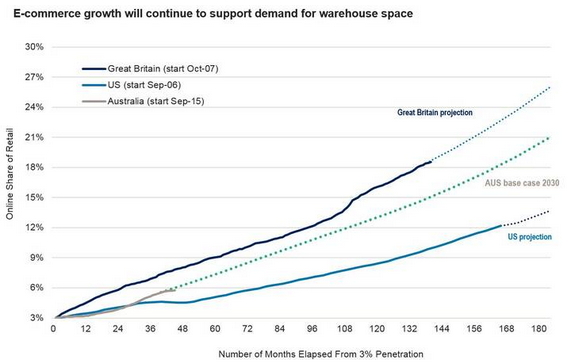
While pricing for retail on the whole will show some softening in 2020, it won’t be as much as we previously anticipated. Online sales, which currently account for 7% of all retail spend (ABS), will continue to challenge the bricks and mortar sector, but with 93% of our spend still in store, the overwhelming majority of our retail spending will remain in shopping centres for the foreseeable future.

Final thoughts

Overall the outlook for real estate is bifurcating – on the one hand, pricing growth will accelerate across most sectors in 2020, as the benefits of cheap debt and attractive returns keep investor demand levels high.

However, this optimism needs to be measured with a sober reflection on the weak fundamentals of the Australian economy, which continue to amplify the risks on the demand side.

The good news is, the picture emerging is a lot clearer than in 2019, and despite a record growth cycle, the evidence suggests there is still more upside for real estate investors in 2020 and plenty of opportunities across sectors to find solid returns (refer second chart below).
 

Author:  Luke Dixon, Head of Real Estate Research – Real Estate Sydney, Australia

Source: AMP Capital 18 Feb 2020

Important notes: While every care has been taken in the preparation of this article, AMP Capital Investors Limited (ABN 59 001 777 591, AFSL 232497) and AMP Capital Funds Management Limited (ABN 15 159 557 721, AFSL 426455) (AMP Capital) makes no representations or warranties as to the accuracy or completeness of any statement in it including, without limitation, any forecasts. Past performance is not a reliable indicator of future performance. This article has been prepared for the purpose of providing general information, without taking account of any particular investor’s objectives, financial situation or needs. An investor should, before making any investment decisions, consider the appropriateness of the information in this article, and seek professional advice, having regard to the investor’s objectives, financial situation and needs. This article is solely for the use of the party to whom it is provided and must not be provided to any other person or entity without the express written consent of AMP Capital.


At home and abroad, major events have rattled global markets in the first quarter and are set to have an ongoing impact. However, it’s not all bad news, and as always – it’s a good idea to turn down the noise.

The United States and Europe

You might not know it from the headlines, but there has been some positive data coming out of the US this month.

This includes:

  • The ISM (Institute for Supply Management) manufacturing conditions index rebounded into positive territory in January.

  • The non-manufacturing ISM conditions index also rose and it remains solid.

  • Small business optimism remains high.

  • Jobs growth remained strong in January with unemployment remaining ultra-low

  • Earnings seasons results have been generally good: Taking a look at data up to February 7, 64% of US S&P 500 companies had reported, with 76% beating on earnings expectations by an average of 5%. Further, 67% had beaten sales expectations. Earnings growth looks to be up by about 2.5% year-on-year, compared to market expectations a few weeks ago for a 2% decline.

Brexit is (finally) here

The United Kingdom officially left the European Union on January 31, after years of negotiations.

In good news for markets, so far, it appears the UK parliament is leaning towards wanting free trade to continue between the UK and the EU. Time will tell whether a deal is agreed by year end or not. But the key point is that Brexit has not contributed to the domino effect of countries wanting to leave the Eurozone that had been feared a few years ago. If anything, the Eurozone looks more determined to stay together.

Also:

  • In January, Eurozone business conditions PMIs (Purchasing Managers Index) were revised up and are continuing to recover from the lows experienced last year.

  • Likewise, global business conditions indicators also continued to recover in January

News from Australia

For some time, Australia will be dealing with the implications of the bushfires which ravaged the east coast. The mega-blazes which formed over the Christmas and early 2020 periods were largely extinguished after a deluge of rain in recent weeks, but we can expect a hit to GDP, especially in the March quarter.

In saying that, there has been some positive economic data recently.

  • House prices were up solidly again in January. 

  • Building approvals fell just 0.2% in December, but this followed an 11% gain in November, and they are up slightly on a year ago.

  • Job ads also rose in January. 

  • Retail sales were soft in December, but real retail sales managed an okay rise in the December quarter as a whole.

  • The trade surplus remained high in December

The Coronavirus, China and global markets

The 2019 novel coronavirus, commonly referred to as the Coronavirus, was declared an international public health emergency by the World Health Organisation (WHO) on January 30 this year. This is, first and foremost, a human crisis.

There has been understandable concern about the knock-on impact to markets. At the moment, share markets have seen falls, with the Chinese market taking the biggest hit at about 12% followed by Asian shares. For global and Australian shares there have been falls at around 3%, although some or all of this has been reversed depending on the market.

No doubt, the Coronavirus will have an impact on markets for a while yet, particularly for China. Trade, people movement and confidence has been restricted, so it follows that we can expect the global and local Asian economies to take a short-term hit.

Keeping an eye on context

There are some points about this situation that are being lost in the noise, including:

  • Fear can be louder than reality  

The current situation regarding the Coronavirus is highly uncertain. However, the experience with SARS, bird flu, swine flu and Ebola in recent history highlight worst-case pandemic fears don’t usually eventuate. 

In the last century, there were three influenza pandemics. The 1918 Spanish flu pandemic was most severe, killing about 50 million people worldwide. Economic activity was severely disrupted as people stayed in their homes, compounded by the end of World War I. Nothing has surpassed this since, which was 102 years ago.

A more relative case is the SARS outbreak in 2003. SARS infected about 8000 people, mostly in Asia, after an initial outbreak in China. SARS had a big negative impact on the countries most affected as people stayed home for fear of catching it. GDP in China, Hong Kong and Singapore slumped by over 2% in the June quarter of 2003. Growth then subsequently rebounded.

  • Containment measures are aggressive

When compared to SARS, the containment measures from China in particular have been more aggressive and started earlier. Airlines and nations worldwide have imposed tight travel bans in and out of China and the Wuhan’s Xubei province, where the outbreak started. This may partly explain why 99% of cases have still been confined to China with about two thirds in Xubei province.

With measures such as these in mind, our base case scenario (with 75% probability) is one of containment over the next month or two. In this case, GDP in China and parts of Asia would likely take a 2 to 3% hit or maybe even deeper. Australian GDP could also take a significant hit in the current quarter as resource exports, tourism and education are impacted and this could see GDP go negative. But growth would then rebound in the June quarter. If this occurs shares, commodity prices and the Aussie dollar could see more volatility and downside in the near term but will largely be able to look through the short term economic and profit disruption to the eventual rebound.

A cool head

As I’ve long said – keeping your head calm in extreme times is critical. This includes when the crowd is convinced that disaster is upon us. These periods present temptation to make fear-based investment decisions, which seldom reaps results. So, in the interest of your investments long term best health keep calm, and carry on.


Author:  Dr Shane Oliver, Head of Investment Strategy and Economics and Chief Economist, AMP Capital Sydney, Australia

Source: AMP Capital 17 Feb 2020

Important notes: While every care has been taken in the preparation of this article, AMP Capital Investors Limited (ABN 59 001 777 591, AFSL 232497) and AMP Capital Funds Management Limited (ABN 15 159 557 721, AFSL 426455) (AMP Capital) makes no representations or warranties as to the accuracy or completeness of any statement in it including, without limitation, any forecasts. Past performance is not a reliable indicator of future performance. This article has been prepared for the purpose of providing general information, without taking account of any particular investor’s objectives, financial situation or needs. An investor should, before making any investment decisions, consider the appropriateness of the information in this article, and seek professional advice, having regard to the investor’s objectives, financial situation and needs. This article is solely for the use of the party to whom it is provided and must not be provided to any other person or entity without the express written consent of AMP Capital.