The coronavirus crisis is first and foremost a human crisis and my thoughts are particularly with those on the front line of this battle. But, of course, its impacting many aspects of life at present, including investment markets. Successful investing can be really difficult in times like the present when markets have collapsed into a bear market with falls globally of around 30% from their highs amidst immense uncertainty about the economic hit from coronavirus and how much policy stimulus and central bank support can head off collateral damage and boost an eventual recovery. Trying to work this out is driving huge volatility in investment markets making it very easy for short term traders to get whipsawed. I will be the first to admit that my crystal ball is even hazier than normal right now. As the US economist, JK Galbraith once said “there are two types of economists – those that don’t know and those that don’t know they don’t know.” And this is certainly an environment where much is unknown.

Olivers Insights: Five charts on investing to keep in mind in rough times like these

But while history does not repeat in that each cycle is different it does rhyme in that each has many common characteristics. So, while we haven’t seen a pandemic driven bear market before the basic principles of investing have not changed. This note revisits five charts I find particularly useful in times of stress.

Chart #1 The power of compound interest

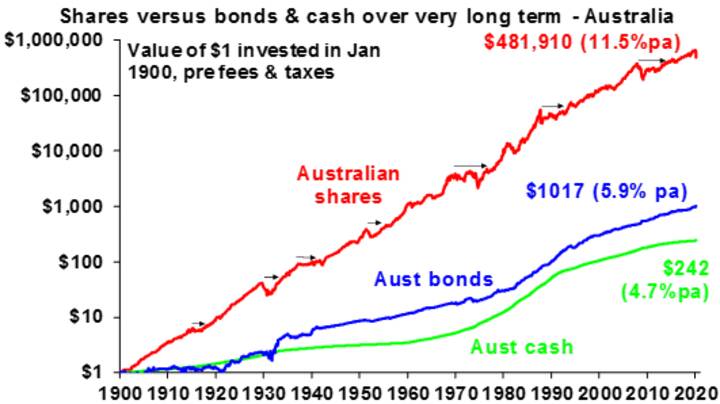
This is my favourite chart. It shows the value of $1 invested in various Australian assets in 1900 allowing for the reinvestment of dividends and interest along the way. That $1 would have grown to $242 if invested in cash, to $1017 if invested in bonds and to $481,910 if invested in shares. While the average return since 1900 is only double that in shares relative to bonds, the huge difference between the two at the end owes to the impact of compounding – or earning returns on top of returns. So, any interest or return earned in one period is added to the original investment so that it all earns a return in the next period. And so on. I only have Australian residential property data back to 1926 but out of interest it shows (on average!) similar long term compounded returns to shares.

click to enlarge
Source: Bloomberg, AMP Capital

Key message: to grow our wealth, we must have exposure to growth assets like shares and property. While shares have collapsed lately amidst massive coronavirus uncertainty and the short-term outlook for Australian housing is vulnerable too, both will likely do well over the long-term.

Chart #2 Don’t get blown off by cyclical swings

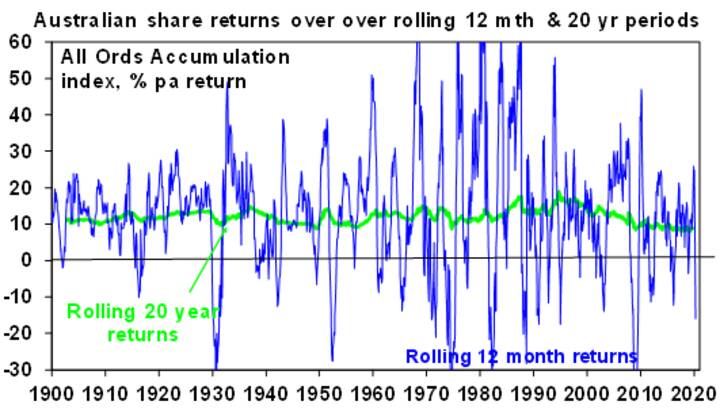
The trouble is that shares can have lots of setbacks along the way as is evident during the periods highlighted by the arrows on the previous chart. Just like now. Even annual returns in the share market are highly volatile, but longer-term returns tend to be solid and relatively smooth as can be seen in the next chart. Since 1900, for Australian shares roughly two years out of ten have had negative returns but there are no negative returns over rolling 20-year periods.

click to enlarge
Source: Bloomberg, AMP Capital

The higher returns shares produce over time relative to cash and bonds is compensation for the periodic setbacks they have. But understanding that these periodic setbacks are just an inevitable part of investing is important in being able to stay the course and get the benefit of the higher long-term returns shares and other growth assets provide over time.

Key message: short-term sometimes violent swings in share markets are a fact of life but the longer the time horizon, the greater the chance your investments will meet their goals. So, in investing, time is on your side and it’s best to invest for the long-term when you can.

Chart #3 The roller coaster of investor emotion

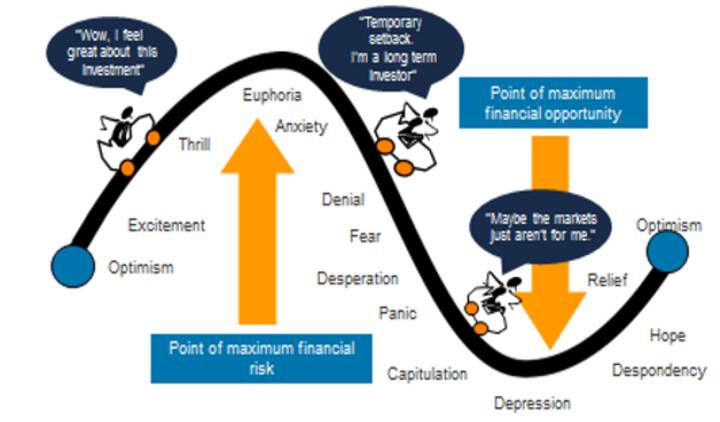
It’s well known that the swings in investment markets are more than can be justified by moves in investment fundamentals alone – like profits, dividends, rents and interest rates. This is because investor emotion plays a huge part. This has been more than evident over the past few weeks. The next chart shows the roller coaster that investor emotion traces through the course of an investment cycle. Once a cycle turns down in a bear market, euphoria gives way to anxiety, denial, capitulation and ultimately depression at which point the asset class is under-loved and undervalued and everyone who is going to sell has – and it becomes vulnerable to good (or less bad) news. This is the point of maximum opportunity. Once the cycle turns up again, depression gives way to hope and optimism before eventually seeing euphoria again.

The roller coaster of investor emotion

 click to enlarge
Source: Russell Investments, AMP Capital

Key message: investor emotion plays a huge role in magnifying the swings in investment markets. The key for investors is not to get sucked into this emotional roller coaster. Of course, doing this is easier said than done which is why many investors end up getting wrong footed by the investment cycle.

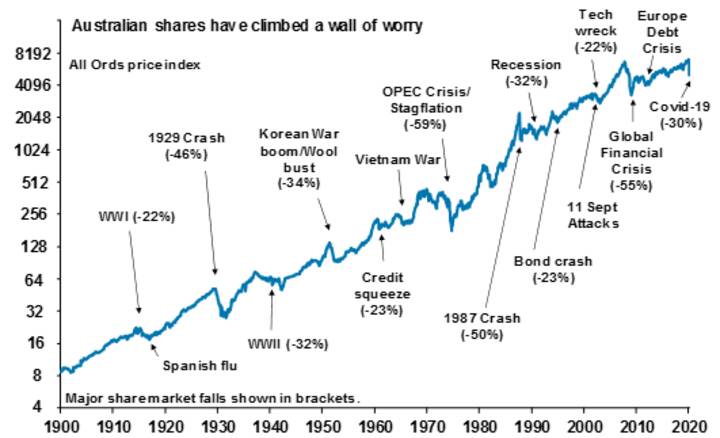
Chart #4 The wall of worry

There is always something for investors to worry about. And in a world where social media is competing intensely with old media it all seems more magnified and worrying. This is arguably evident now in relation to coronavirus uncertainty. The global economy has had plenty of worries over the last century, but it got over them with Australian shares returning 11.5% per annum since 1900, with a broad rising trend in the All Ords price index as can be seen in the next chart, and US shares returning 9.6% pa. (Note that this chart shows the All Ords share price index whereas the first chart shows the value of $1 invested in the All Ords accumulation index, which allows for changes in share prices and dividends.)

Key message: worries are normal around the economy and investments and sometimes they become intense – like now. But they eventually pass. For example, back in mid-January it seemed the bushfires, smoke shrouding our cities and regular news of homes and lives lost would never end. But when I went to regional NSW in the last week it was lovely, green and wet. And so, it is with coronavirus – this too will pass eventually.

click to enlarge

Source: ASX, AMP Capital

Chart #5 Timing is hard

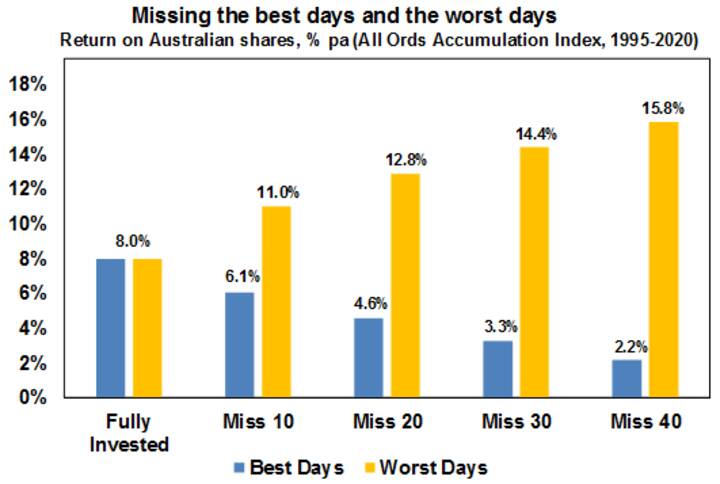
The temptation to time markets is immense. With the benefit of hindsight many swings in markets like the tech boom and bust and the GFC look inevitable and hence forecastable and so it’s natural to think why not switch between say cash and shares within your super to anticipate market moves. This is particularly the case in times of emotional stress like now when all the news around coronavirus and its impact on the economy is bad. Fair enough if you have a process and put the effort in. But without a tried and tested market timing process, trying to time the market is difficult. A good way to demonstrate this is with a comparison of returns if an investor is fully invested in shares versus missing out on the best (or worst) days. The next chart shows that if you were fully invested in Australian shares from January 1995, you would have returned 8% pa (with dividends but not allowing for franking credits, tax and fees).

 click to enlarge
Covers Jan 1995 to 17 March 2020. Source: Bloomberg, AMP Capital

If by trying to time the market you avoided the 10 worst days (yellow bars), you would have boosted your return to 11% pa. And if you avoided the 40 worst days, it would have been boosted to 15.8% pa! But this is very hard, and many investors only get out after the bad returns have occurred, just in time to miss some of the best days. For example, if by trying to time the market you miss the 10 best days (blue bars), the return falls to 6.1% pa. If you miss the 40 best days, it drops to just 2.2% pa.

Key message: trying to time the share market is not easy.


Source: AMP Capital 17 March 2020

Important notes: While every care has been taken in the preparation of this article, AMP Capital Investors Limited (ABN 59 001 777 591, AFSL 232497) and AMP Capital Funds Management Limited (ABN 15 159 557 721, AFSL 426455) (AMP Capital) makes no representations or warranties as to the accuracy or completeness of any statement in it including, without limitation, any forecasts. Past performance is not a reliable indicator of future performance. This article has been prepared for the purpose of providing general information, without taking account of any particular investor’s objectives, financial situation or needs. An investor should, before making any investment decisions, consider the appropriateness of the information in this article, and seek professional advice, having regard to the investor’s objectives, financial situation and needs. This article is solely for the use of the party to whom it is provided and must not be provided to any other person or entity without the express written consent of AMP Capital.


Have you ever thought about the fact that your ‘digital estate’ may incorporate just as many items as your material belongings? Everything from music, photos, accounts, social media profiles and attempted memoirs rest on the cloud. That’s a lot of personal stuff to manage upon one’s death, much like a house full of cherished possessions. 

These days, there’s just as much need for a ‘digital executor’ as there is for one in a traditional sense. Here’s a look at how to manage your digital afterlife. 

Consider your wishes

First thing’s first, what do you want to happen with your accounts when you die? Much the same as your Will, deciding on this beforehand saves your family and friends from any doubt about your wishes. For example, do you want your social media accounts deleted or continued, perhaps for business or memorial purposes? 

Have a think about all your accounts, what they contain, and the best course of action for either continuing them or shutting them down. This way, you can leave instructions as to how you’d like them managed. As an added bonus of being prepared, this is a great way to clean up your ‘digital estate’ now, as it’s easy to forget just how many unused or ineffective accounts we have! 

Give someone your passwords

If there’s someone you absolutely trust, giving your login details to them is by far the easiest method of ensuring your wishes are carried out, whether that’s to keep or delete accounts. This is particularly true for social media sites, as even family members aren’t given access to passwords. 

This makes it easy for someone to delete your accounts, update them and keep an eye on them in case of spam or hackers. Don’t want to give anyone your passwords right now? Research password management services that let you appoint a nominee who’ll gain access to your passwords upon request, in the case of death or incapacity. 

Research the options for different social media platforms

Depending on the social media platforms you use, different rules apply to account deactivation and their ongoing use. First of all, make sure family or friends know which accounts you have and what you’d like done with them. One of the most popular options is to have an account memorialised, so the content remains visible to those it was shared with in the first place.

When you nominate a legacy contact on Facebook, through the Settings and Security tabs, that person can respond to friend requests and add posts to your profile. You can change the nominated legacy contact at any time. It’s possible to memorialise Instagram accounts, however, they can’t be changed. Twitter allows for deactivation, but no one will be able to gain access to the account unless you’ve given them your login details. 

Make a detailed list of your digital accounts and devices

Along with social media, and presuming financial and insurance accounts will be in the hands of a power of attorney, you could have accounts including:

  • Email addresses

  • E-readers

  • Shopping accounts 

  • Websites and blogs

  • Copyrighted materials

  • Video sharing accounts

  • Online storage accounts

  • Subscription accounts

  • Domain names

Keep a record of them and forward this to the appropriate people, including logins and passwords so they can be easily deactivated or managed. This includes digital assets that may require passwords to access, such as external hard drives, tablets, smartphones and digital music players. With the information about everything ‘digital’ all recorded in one place, it’ll be easy for friends and family to manage. 

Back everything up

Whether you view it as a shame or a fantastic convenience, many of us don’t have photo albums anymore, let alone handwritten letters. Consider compiling cherished memories and backing them up on a hard drive, specifically for this purpose. This way, you don’t run the risk of anything becoming lost in the cloud, in the case of complications with retrieving passwords or information. 

Source: Clientcomm library

Important note:
This provides general information and hasn’t taken your circumstances into account.  It’s important to consider your particular circumstances before deciding what’s right for you. Although the information is from sources considered reliable, we do not guarantee that it is accurate or complete. You should not rely upon it and should seek qualified advice before making any investment decision. Except where liability under any statute cannot be excluded, we do not accept any liability (whether under contract, tort or otherwise) for any resulting loss or damage of the reader or any other person.  Past performance is not a reliable guide to future returns.Any general tax information provided in this publication is intended as a guide. It is not intended to be a substitute for specialised taxation advice or an assessment of your liabilities, obligations or claim entitlements that arise, or could arise, under taxation law, and we recommend you consult with a registered tax agent.

Any information provided by the author detailed above is separate and external to our business and our Licensee. Neither our business nor our Licensee takes any responsibility for any action or any service provided by the author.

Any links have been provided with permission for information purposes only and will take you to external websites, which are not connected to our company in any way. Note: Our company does not endorse and is not responsible for the accuracy of the contents/information contained within the linked site(s) accessible from this page.

Get more out of each morning by listening to these brilliant business podcasts on your ride to work.

It’s hardly a secret that podcasts are the new radio.

The audio format is growing, with ABC’s 2019 Podcast Survey finding 30 percent of Australians listen to a podcast monthly.

That’s a number that only looks set to increase as the medium finds more mainstream appeal.

And while comedy and true crime are the most popular genres, it’s not just entertainment out there – there’s a healthy appetite for informative and educational content.

After all, what better way to make the most of your commute than by gaining insights and honing your skills?

With that in mind, we’ve put together five of our favourite business podcasts aimed at owners, managers and entrepreneurs of all kinds. It’s a mix of inspiration and information from at home and abroad.

READ: Speakers on International Women’s Day podcast seek #balanceforbetter

And of course, we feel it’s only fair to add our SUCCESS: The Podcast into the mix (a 10-part series which sees us ask a range of diverse personalities the deceptively simple question: “Are you successful?”)

So whether you’re a tradie or own a cafe, looking for some practical tips, motivation or straight up inspiration – there’ll be something in this list to make you want to hit ‘subscribe’.

The Hospopreneurs

If you work in hospitality – from front-of-house all the way to the back-end supply chain, there’s something for you in James Henderson’s Hospopreneurs.

Each episode is an informative Q&A with a diverse range of industry figures – from craft brewers to catering companies through to app developers and legal experts.

And with 70-plus episodes under the belt, there’s a lot of insights, nuggets and downright interesting stories to delve into.

Henderson has a focus on innovators and creative types within the industry, which, combined with his informed but not in your face approach to interviewing, results in some fascinating listening. If hospitality is your world,

Hospopreneurs is a great way to stay on top of the latest trends and significant developments.

Rework

Rework, a podcast by the team from Basecamp promises to offer a better way to work and run your business.

Basecamp, if you’re not familiar, is a remote workforce productivity tool/way of life espoused by founder Jason Fried, whose book It Doesn’t Have to Be Crazy at Work questions a lot of the ‘norms’ of modern business, like endless meetings and email chains.

If cutting through this chatter and focusing on productivity sounds like your cup of tea, you should give Rework a listen.

With episode titles like ‘The Open Office’ and ‘The Worst Performance Review’ along with a sustained focus on remote work as well as the impact of tech and digital on business, this one is well worth a listen.

How I Built This

If you’re into your business origin tales, then Guy Raz has the podcast for you.

Billed as the podcast that ‘drives into the stories behind some of the world’s best-known companies’, US-based Raz’s style is both informative and story-driven, resulting in a podcast that makes you feel inspired as you learn.

Featuring founders including the likes of Michael Dell (Dell Computers), Selina Tobaccowala (Evite) and even James Dyson (Dyson), here’s a podcast that’s got an eye for the entrepreneurial.

Lady Startup

If you’re looking for something akin to How I Built This but with more of a local, fem-forward flavour, then Lady Startup from Mamamia is the podcast to get listening to in 2020.

Hosted by Rachel Corbett, each episode features ‘some of the most inspiring and successful female entrepreneurs’ with an aim of revealing how they ideated, launched and grew their respective businesses into the successful enterprises they are today.

Featured speakers include Ronni Kahn (OzHarvest), Kate Morris (Adore Beauty) and Melanie Perkins (Canva).

Tradies in Business

This one does exactly what it says on the tin. Tradies in Business is for tradies, by tradies.

Hosted by trade-focused financial advisors and business coaches Warrick Bidwell and Nicole Cox, Tradies in Business is all about providing targeted tips and developing skills that are relevant to people who work with power tools.

From advice on topics like how to avoid problem clients and when to raise your rates through to interviews with industry insiders and external experts on a range of useful topics.

Equal parts big picture and targeted, practical tips, this one is a must if you run your own trades-based business.

Source : MYOB


Reproduced with the permission of MYOB. This article by Felix Scholz was originally published at https://www.myob.com/au/blog/top-five-business-podcasts-2020/

Important:
This provides general information and hasn’t taken your circumstances into account. It’s important to consider your particular circumstances before deciding what’s right for you. Although the information is from sources considered reliable, we do not guarantee that it is accurate or complete. You should not rely upon it and should seek qualified advice before making any investment decision. Except where liability under any statute cannot be excluded, we do not accept any liability (whether under contract, tort or otherwise) for any resulting loss or damage of the reader or any other person.

Any information provided by the author detailed above is separate and external to our business and our Licensee. Neither our business nor our Licensee takes any responsibility for any action or any service provided by the author.

Any links have been provided with permission for information purposes only and will take you to external websites, which are not connected to our company in any way. Note: Our company does not endorse and is not responsible for the accuracy of the contents/information contained within the linked site(s) accessible from this page.

Conventional wisdom used to dictate Australians were better paying off their home loans and once debt free turning their attention to building up their super. But with interest rates at record lows and many super funds potentially offering a higher rate of return, what’s the right strategy in the current market? AMP’s Technical Strategy Manager John Perri investigates.

It’s one of the most common questions financial advisers get. Are clients better off putting extra money into superannuation or the mortgage? Which strategy will leave them better off over time? In the super versus mortgage debate, no two people will get the same answer – but there are some rules of thumb you can follow to work out what’s right for you.

One thing to consider is the interest rate on your home loan in comparison to the rate of return on your super fund. As banks follow the RBA’s lead in reducing interest rates, you may find the returns you get in your super fund are potentially higher.

Super is also built on compounding interest. A dollar invested in super today may significantly grow over time. Keep in mind that the return you receive from your super fund in the current market may be different to returns you receive in the future. Markets go up and down and without a crystal ball, it’s impossible to accurately predict how much money you’ll make on your investment.

Each dollar going into the mortgage is from ‘after-tax’ dollars, whereas contributions into super can be made in ‘pre-tax’ dollars. For the majority of Australians saving into super will reduce their overall tax bill – remembering that pre-tax contributions are capped at $25,000 annually and taxed at 15% by the government (30% if you earn over $250,000) when they enter the fund.

So, with all that in mind, how does it stack up against paying off your home loan? There are a couple of things you need to weigh up.

Consider the size of your loan and how long you have left to pay it off

A dollar saved into your mortgage right at the beginning of a 30-year loan will have a much greater impact than a dollar saved right at the end.

The interest on a home loan is calculated daily

The more you pay off early, the less interest you pay over time. In a low interest rate environment many homeowners, particularly those who bought a home some time ago on a variable rate, will now be paying much less each month for their home.

Offset or redraw facility

If you have an offset or redraw facility attached to your mortgage you can also access extra savings at call if you need them. This is different to super where you can’t touch your earnings until preservation age or certain conditions of release are met.

Don’t discount the ‘emotional’ aspect here as well. Many individuals may prefer paying off their home sooner rather than later and welcome the peace of mind that comes with clearing this debt. Only then will they feel comfortable in adding to their super.

Before making a decision, it’s also important to weigh up your stage in life, particularly your age and your appetite for risk.

Whatever strategy you choose you’ll need to regularly review your options if you’re making regular voluntary super contributions or extra mortgage repayments. As bank interest rates move and markets fluctuate, the strategy you choose today may be different from the one that is right for you in the future.

Case study where investing in super may be the best strategy

Barry is 55, single and earns $90,000 pa. He currently has a mortgage of $200,000, which he wants to pay off before he retires in 10 years’ time at age 65.

His current mortgage is as follows:

 Mortgage

 $200,000

Interest rate

3.50% pa

Term of home loan remaining

20 years

 Monthly repayment (post tax)

 $1,160 per month


Barry has spare net income and is considering whether to:

  • make additional / extra repayments to his home mortgage (in post-tax dollars) to repay his mortgage in 10 years, or

  • invest the pre-tax equivalent into superannuation as salary sacrifice and use the super proceeds at retirement to pay off the mortgage.

Assuming the loan interest rate remains the same for the 10-year period, Barry will need to pay an extra $820 per month post tax to clear the mortgage at age 65.

Alternatively, Barry can invest the pre-tax equivalent of $820 per month as a salary sacrifice contribution into super. As he earns $90,000 pa, his marginal tax rate is 34.5% (including the 2% Medicare levy), so the pre-tax equivalent is $1,252 per month. This equals to $15,024 pa, and after allowing for the 15% contributions tax, he’ll have 85% of the contribution or $12,770 working for his super in a tax concessional environment.

To work out how much he’ll have in super in 10 years, we’re using the following super assumptions:

  • The salary sacrifice contributions, when added to his employer SG contributions, remain within the $25,000 pa concessional cap.

  • His super is invested in 70% growth/30% defensive assets, returning a gross return of 3.07% pa income (50% franked) and 2.37% pa growth.

  • A representative fee of 0.50% pa of assets has been used.

Assuming the assumptions remain the same over the 10-year period, Barry will have an extra $154,458 in super. His outstanding mortgage at that time is $117,299, and after he repays this balance from his super (tax free as he is over 60), he will be $37,159 in front.

Of course, the outcome may be different if there are changes in interest rates and super returns in that period.

Case study where paying off the mortgage may be the best strategy

32 year old Duy and 30 year old Emma are a young professional couple who have recently purchased their first home.

They’re both on a marginal tax rate of 39% (including the 2% Medicare levy), and they have the capacity to direct an extra $1,000 per month into their mortgage, or alternatively, use the pre-tax equivalent to make salary sacrifice contributions to super.

Given their marginal tax rates, it would make sense mathematically to build up their super.

However, they’re planning to have their first child within the next five years, and Emma will only return to work part-time. They will need savings to cover this period, as well as assist with private school fees.

Given their need to access some savings for this event, it would be preferable to direct the extra savings towards their mortgage, and redraw it as required, rather than place it into super where access is restricted to at least age 60.

Pleae contact us on Phone: 07 5641 4134 if you seek further discussion on this topic. 

Source : AMP January 2020 

Important:
This information is provided by AMP Life Limited. It is general information only and hasn’t taken your circumstances into account. It’s important to consider your particular circumstances and the relevant Product Disclosure Statement or Terms and Conditions, available by calling Phone: 07 5641 4134, before deciding what’s right for you.

All information in this article is subject to change without notice. Although the information is from sources considered reliable, AMP and our company do not guarantee that it is accurate or complete. You should not rely upon it and should seek professional advice before making any financial decision. Except where liability under any statute cannot be excluded, AMP and our company do not accept any liability for any resulting loss or damage of the reader or any other person.

Introduction

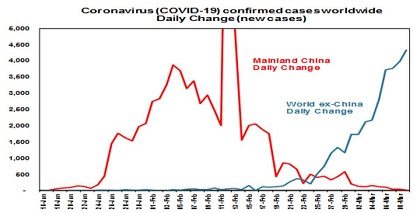
Coronavirus continues to rattle investment markets as the number of new cases outside China continues to rise posing increasing uncertainty over the impact on economic activity. And its impact has intensified following the collapse of OPEC discipline causing a further plunge in oil prices raising concerns about debt servicing for oil producers. From their highs global shares and Australian shares have had a fall of around 20%.

View larger image

Source: PRC National Health Commission, Bloomberg, AMP Capital

Given the extreme uncertainty this note looks at various scenarios in relation to global and Australian economic growth and what signposts to look at in relation to how it may unfold.

Much ado about nothing or a major global catastrophe

It seems there are two extreme views on coronavirus. Some see it as just a bad flu and can’t see what the fuss is all about. Others think that it will trigger a major humanitarian and economic catastrophe killing millions and triggering a major global recession as excessive leverage is finally exposed. The optimist in me wants to lean to the former:

  • So far over 114,000 people are reported to have contracted the virus of which nearly 4000 have died. Of course, this number is still growing but in China where the number of new cases has collapsed (see the first chart) the number is 80,754 cases and 3136 deaths. In the 2017-18 US flu season alone 44.8m Americans got sick and 61,099 died.

  • The actual death rate from Covid-19 may be 1% or lower, rather than the currently reported rate of 3.5% because many of those who get the virus don’t get sick enough to seek medical help and so won’t be included in the case count. The Diamond Princess episode may provide a rough guide – all 3711 passengers and crew have been tested with 705 contracting the virus of which seven have died and most of those are believed to have been over 70. This would suggest a death rate of around 1% which is only just above that for regular flu for those over 65.

  • It appears to be less contagious than regular flu.

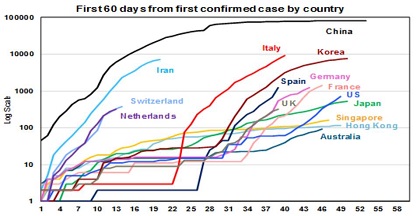
  • China’s experience shows it can be contained. Maybe this is due to extreme containment measures in Hubei that are not possible in other countries. But the case count in the rest of China has also been contained with less extreme measures and Singapore and Hong Kong have had some success in slowing new cases without extreme quarantining

View larger image

Source: PRC National Health Commission, Bloomberg, AMP Capital

  • Alternatively, at some point authorities outside China may just conclude that containment is impossible and, as the death rate is not apocalyptic, shift from containment to just treating those who get very sick. This could enable life to return to normal, albeit with a change in behaviour – less handshaking, frequent handwashing and wearing a mask.

But I also must concede I just don’t know. There is much that is unknown about the virus itself and how long it will continue to spread. And even if there is a switch to just treating the very sick it’s unclear there will be enough hospital beds. And there is also the human or behavioural overlay which is intensifying the economic impact. Just look at the toilet paper frenzy to see that this can have a real economic effect even before the virus has really taken hold in Australia. While there may be a boom in demand for hand sanitisers, toilet paper and long-life food, this will be a temporary boost as the spread of the virus globally and the disruption that containment measures are causing is continuing to increase the risk of a longer and deeper hit to economic activity. And there is a risk of secondary effects as the short-term disruption risks leading to business failures and households defaulting on their debts if they can’t keep up their payments and so causing a deeper impact on economic activity. The secondary effects of the coronavirus outbreak and its flow on is highlighted by the 45% collapse in oil prices since mid-January. Ultimately lower petrol prices will be a good thing as this will boost consumer spending when the virus goes away but for now all the focus is on the downside of lower oil prices – debt problems and less business investment by producers.

Base case versus global recession and beyond

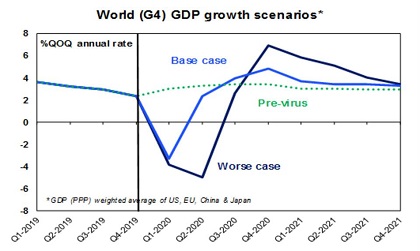
Given all these uncertainties it’s still too early to say that shares, commodity prices and bond yields have bottomed. The following charts present three scenarios for the global economy:

  • How we saw global growth panning out prior to the virus. Basically, we were expecting a mild pick-up in growth.

  • A sharp downturn centred around the March quarter as the Chinese economy contracts sharply but rebounds in the June quarter offsetting recessions in developed countries including in the US. This is our base case.

  • A worse case downturn that sees global growth contract in the March quarter (led by a sharp contraction in China) and the June quarter as (as developed countries get badly hit) resulting in a global recession to be then followed by a rebound as life returns to normal led by China.

Note: the scenarios show quarterly annualised growth. The key is to focus on the pattern of growth rather than the precise level.

View larger image

Source: Bloomberg, AMP Capital

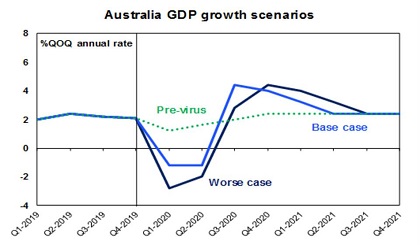
The next chart shows three scenarios for Australian growth:

  • How we saw global growth panning out prior to the virus.

  • Mild downturns in the March and June quarters driven initially by the lockdown in the China and then the coronavirus flow on to the rest of the world and Australia, followed by a second-half rebound. This is our base case.

  • A worse case downturn that sees deeper downturns in the March and June quarters then followed by a rebound as life returns to normal.

View larger image

Source: Bloomberg, AMP Capital

Last week we moved to forecasting a recession for the Australian economy in our weekly report. We were already expecting a negative March quarter on the back of the bushfires and the hit to tourism, education exports and commodity exports from the slump in China. But the spread of coronavirus globally and in Australia has made it likely that we will also see a contraction in the June quarter too. As with the global outlook this should really be “a disruption” that will pass once the virus runs its course – hopefully at least as the Northern Hemisphere heads toward summer. The worse case scenarios would likely see a deeper decline in shares and bond yields.

What to watch?

Shares will bottom when there is confidence that the worst is over in terms of the economic impact from the virus and its largely factored in. So, the debate is largely now about how big the hit to growth will be and this relates to how long the virus will weigh on global growth and any secondary effects it may cause. In this regard the key things to watch are as follows:

  • A peak in the number of new cases – as per the first chart.

  • News of successful vaccines or anti-virals.

  • Whether governments switch from containment.

  • Timely economic indicators, eg, jobless claims and weekly consumer confidence data in the US and Australia.

  • Measures of corporate stress, eg, spreads between corporate bond yields and government bond yields.

  • Measures of household stress, eg, unemployment and non-performing loans.

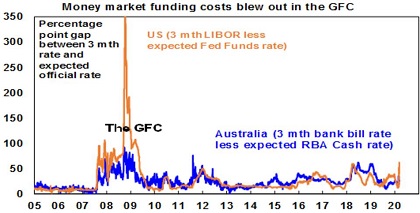
  • Measures of market stress, eg, bank funding costs as measured by the gap between 3-month rates and central bank rates. These have risen but are well below GFC levels.

View larger image

Source: Bloomberg, AMP Capital

  • The monetary and fiscal policy response – this will be critical in terms of minimising the impact on vulnerable businesses and households from the coronavirus disruption, ensuring financial markets remain liquid and driving a quick recovery once the threat from the virus is over. So far so good with policy makers moving in the right direction (rapidly so in Australia it seems) – but there is a fair way to go.

What does it all mean for investors?

The rapidity of the fall in share market has been scary. In our view the key things for investors to bear in mind are as follows:

  • periodic sharp falls in share markets are healthy and normal. With the long-term trend ultimately remaining up & providing higher returns than other more stable assets.

  • selling shares or switching to a more conservative investment strategy after a major fall just locks in a loss.

  • when shares fall, they are cheaper and offer higher long-term return prospects. So, the key is to look for opportunities the pullback provides. It’s impossible to time the bottom but one way to do it is to average in over time.

  • while shares have fallen, dividends from the market haven’t. Companies like to smooth their dividends over time – they never go up as much as earnings in the good times and so rarely fall as much in the bad times.

  • shares and other related assets bottom at the point of maximum bearishness, ie, just when you feel most negative towards them.

  • the best way to stick to an appropriate long-term investment strategy, let alone see the opportunities that are thrown up in rough times, is to turn down the noise.


Source: AMP Capital 10th March 2020

Important notes: While every care has been taken in the preparation of this article, AMP Capital Investors Limited (ABN 59 001 777 591, AFSL 232497) and AMP Capital Funds Management Limited (ABN 15 159 557 721, AFSL 426455) (AMP Capital) makes no representations or warranties as to the accuracy or completeness of any statement in it including, without limitation, any forecasts. Past performance is not a reliable indicator of future performance. This article has been prepared for the purpose of providing general information, without taking account of any particular investor’s objectives, financial situation or needs. An investor should, before making any investment decisions, consider the appropriateness of the information in this article, and seek professional advice, having regard to the investor’s objectives, financial situation and needs. This article is solely for the use of the party to whom it is provided and must not be provided to any other person or entity without the express written consent of AMP Capital.

It wasn’t long ago that the common view was to save and invest through your working life and then retire to a portfolio that delivered at least a 5 per cent income yield every year. For many retirees it worked, at least while interest rates were high. They could live comfortably on income payments and preserve their principal for rainy day events or large ticket items like aged care.

But in an era of all-time low interest rates, that plan no longer works.

Retirees today must work with expected equity returns in Australia of between 4 and 6 per cent over the next decade, alongside fixed income returns between 0.5 and 1.5 per cent1. Globally, Vanguard data shows the median balanced portfolio is expected to return 4.9 per cent per annum over the next 10 years. That includes both income and capital growth2.


Given many retirees target an annual spending rate of 4 per cent of their portfolio it leads to what appears to be an insurmountable problem: spending 4 per cent when your portfolio’s income component is around half that doesn’t add up. Something must give—you either find higher yielding (and riskier) investments or start selling assets and drawing down on your capital to fund your spending.

The underlying question is one of portfolio construction.

How can you design a portfolio that provides income to live off while preserving your capital across your retirement?

The answer lies in recognising that the two types of return in an investment portfolio—income and capital—are interrelated. And that preferencing income over capital growth is not always the right way to go.

All investment portfolios provide two types of return. The income return is made up of the dividends and interest while the capital return comes from the growth of the value of the underlying assets over time.

The problem is many of us are hardwired to prefer an income-biased portfolio – many investors are fine with spending the total amount of income generated by a portfolio but balk at the idea of spending capital. Given a choice between a portfolio that returns 4 per cent income and 2 per cent capital growth over one that returns 2 per cent income and 4 per cent capital growth, many will prefer the one with the higher income despite the fact that both portfolios returned 6 per cent.

This preference can lead to problems when spending is not covered by the natural yield of a portfolio.

In that case, a retiree has three choices—spend less, sell assets, or overweight the portfolio to income producing assets.

That third option can lead to trouble.

Chasing income means seeking out higher yielding companies, buying fixed income investments like high-yield corporate bonds and emerging market debt or diversifying into property investments.

On the surface these provide an attractive yield, but that higher income can come at a cost as risk and return are correlated. Higher yield means higher risk.

The solution is to take a total return approach.

Total return investing involves holding a diversified portfolio that aims to maximise the overall return of the portfolio, rather than preferencing income over growth.

Total return investing has a number of advantages, led by the fact it allows investors to maintain diversification which reduces the risk of capital loss.

The approach also provides better control over the size and timing of withdrawals, allowing a retiree to decide how much and how often to take cash rather than being held to the schedule of dividend payments and distributions. Being able to reduce withdrawals in a down year dramatically increases your chances of not running out of money in retirement.

This means the portfolio’s longevity3 is improved under a total return approach—and that means the portfolio can support your lifestyle for longer.

1.https://static.vgcontent.info/crp/intl/auw/australia/documents/research/rs219 vemo2019 summary

2.https://pressroom.vanguard.com/nonindexed/Vanguard Global Economic Market Outlook 2020

3. https://www.vanguard.co.uk/documents/adv/literature/total return investing


Please contact us on Phone: 07 5641 4134 if you seek further discussion on this topic.

Source : Vanguard

Written by Robin Bowerman, Head of Corporate Affairs at Vanguard.

Reproduced with permission of Vanguard Investments Australia Ltd

Vanguard Investments Australia Ltd (ABN 72 072 881 086 / AFS Licence 227263) is the product issuer. We have not taken yours and your clients’ circumstances into account when preparing this material so it may not be applicable to the particular situation you are considering. You should consider your circumstances and our Product Disclosure Statement (PDS) or Prospectus before making any investment decision. You can access our PDS or Prospectus online or by calling us. This material was prepared in good faith and we accept no liability for any errors or omissions. Past performance is not an indication of future performance.

© 2020 Vanguard Investments Australia Ltd. All rights reserved.

Important:
Any information provided by the author detailed above is separate and external to our business and our Licensee. Neither our business nor our Licensee takes any responsibility for any action or any service provided by the author.

Any links have been provided with permission for information purposes only and will take you to external websites, which are not connected to our company in any way. Note: Our company does not endorse and is not responsible for the accuracy of the contents/information contained within the linked site(s) accessible from this page.

You don’t have to pay yourself super, but when you retire, you might be glad you did.

You can make regular or lump sum payments, can usually claim a tax deduction on contributions, and may be able to save tax.

Why pay yourself super

There are advantages to contributing to super:

  • You save for your retirement.

  • You can claim a tax deduction for super contributions.

  • Super contributions are taxed at 15%, so you may save tax depending on your situation.

  • Super investments usually get better returns than bank savings accounts, so your savings will grow faster.

How to pay yourself super

If you already have a super fund, check that you can make contributions when you’re self employed. You’ll need to give your fund your tax file number (TFN) so they can accept contributions.

If you don’t have a fund, see choosing a super fund.

Transfer a regular amount or a lump sum

There are two ways to contribute, depending on how you pay yourself. If you receive:

  • A wage — set up a regular transfer into super from your before-tax income.

  • Income from business revenue — transfer a lump sum when you have enough cash flow.

Tax deductions for super contributions

You can claim a tax deduction for contributions you make from your pre-tax income (known as concessional contributions). You benefit because you reduce your taxable income.

To claim a tax deduction, you need to send a ‘Notice of intent to claim’ form to your super fund before the end of the financial year. Contact your fund to find out how much time you need to allow for processing.

See claiming deductions for personal super contributions on the Australian Taxation Office (ATO) website for detailed information.

Always confirm the details of any super contributions with your accountant or tax agent.

How much to contribute to super

As a guide, employers contribute at least 9.5% of an employee’s earnings to super.

There are limits to how much you can contribute each financial year:

  • up to $25,000 in concessional contributions  (from your pre-tax income, for which you can claim a deduction), and

  • up to $100,000 in non-concessional contributions  (from your after-tax income)

If you’re on a low income, you may be eligible for government super contributions, see super contributions.


Source : ASIC’s MoneySmart

Reproduced with the permission of ASIC’s MoneySmart Team. This article was originally published at https://moneysmart.gov.au/grow-your-super/super-for-self-employed-people

Important note: This provides general information and hasn’t taken your circumstances into account.  It’s important to consider your particular circumstances before deciding what’s right for you. Although the information is from sources considered reliable, we do not guarantee that it is accurate or complete. You should not rely upon it and should seek qualified advice before making any investment decision. Except where liability under any statute cannot be excluded, we do not accept any liability (whether under contract, tort or otherwise) for any resulting loss or damage of the reader or any other person.  Past performance is not a reliable guide to future returns.

Important
Any information provided by the author detailed above is separate and external to our business and our Licensee. Neither our business nor our Licensee takes any responsibility for any action or any service provided by the author.

Any links have been provided with permission for information purposes only and will take you to external websites, which are not connected to our company in any way. Note: Our company does not endorse and is not responsible for the accuracy of the contents/information contained within the linked site(s) accessible from this page..

Knowledge is power. Financial knowledge is particularly powerful when it comes to securing your future. Women and men alike can benefit from acquiring financial knowledge and skills. But when it comes to money, women face unique challenges.

The last few years have seen the spotlight shining brightly on women’s issues globally with calls for political and social change, and exciting progress has been made to close the gender gap. However, there are still a number of problem areas. It may come as a surprise that one of these areas is financial literacy.

What is financial literacy?

Financial literacy is not simply numeracy. The OECD International Network on Financial Education defines financial literacy as a combination of awareness, knowledge, skill, attitude and behaviour necessary to make sound financial decisions and ultimately achieve financial wellbeing.

Being financially literate is essential when it comes to retirement planning, wealthaccumulation and economic empowerment.

The financial literacy gap

One of the most striking findings from the latest Household, Income and Labour Dynamics in Australia (HILDA) report1 is there is a clear gender divide in financial literacy. The data revealed that women exhibit much lower levels of financial literacy than men. The HILDA survey measures basic financial literacy by asking 5 key questions and only 35 % of women answered all five questions correctly, compared with 50 % of men.

Ultimately, for women to be truly empowered, it’s essential to be financially literate and plan for the long term. Here’s why:

Lower lifetime earnings

Women are more likely to have taken time out from work to care for children or parents and are more likely to have earned less than men. Also, factors such as divorce, the loss of a partner, an illness or even financial abuse can leave women in a precarious financial position, particularly later in life.

Lower super balances

Data from the Australian Bureau of Statistics2 released in November 2019 revealed the median superannuation balance remains lower for women than men. In 2017–18, the median superannuation balance at, or approaching, preservation age (55-60 years) was $119,000 for women and $183,000 for men. While these figures are well up on the equivalent figures from 2015/2016, ($158,700 for men and $105,400 for women) a significant gap between men and women still exists.

Longer life expectancy

Lower lifetime earnings need to stretch for longer, as women tend to live longer than men (80.7 years for men and 84.9 years for women)3. That’s an extra 4.2 years to plan for living and medical expenses.

Closing the gap

Thinking about the long term when it comes to money can help make sure women are prepared for retirement, protected during emergencies and are making the most of their money.

The good news is, there are many resources available to women to help close the gap. Added to that, data tells us women are generally more likely to want to learn about managing money better. . ASIC’s MoneySmart website is another free resource with tools and information that offer guidance and support.

Set up the next generation for success

To help close the gap for the next generation, it’s particularly important to raise financially literate children. The first place kids learn about money is in the home from their family. It’s where their financial habits are formed at a young age, and where they develop their attitudes and beliefs about money that they carry into adulthood. Parents and grandparents can have a powerful, positive impact on their children’s wellbeing in the future by helping them form good money habits for life.

Tap into our resources

Financial literacy is essential for women and men to feel secure about their financial future and be truly empowered. Please contact us on Phone: 07 5641 4134 if you seek further discussion on this topic.

1 HILDA report: https://melbourneinstitute.unimelb.edu.au/__data/assets/
pdf_file/0009/2874177/HILDA-report_Low-Res_10.10.18.pdf
2 ABS: https://www.abs.gov.au/ausstats/abs@.nsf/Lookup/by%20Subject/
4125.0~Nov%202019~Main%20Features~Economic%20Security~4
3 ABS: https://www.abs.gov.au/ausstats/abs@.nsf/mf/3302.0.55.001


Source : AMP February 2020 
 

Important:
This information is provided by AMP Life Limited. It is general information only and hasn’t taken your circumstances into account. It’s important to consider your particular circumstances and the relevant Product Disclosure Statement or Terms and Conditions, available by calling Phone: 07 5641 4134, before deciding what’s right for you.

All information in this article is subject to change without notice. Although the information is from sources considered reliable, AMP and our company do not guarantee that it is accurate or complete. You should not rely upon it and should seek professional advice before making any financial decision. Except where liability under any statute cannot be excluded, AMP and our company do not accept any liability for any resulting loss or damage of the reader or any other person.

At its meeting today, the Board decided to lower the cash rate by 25 basis points to 0.50 per cent. The Board took this decision to support the economy as it responds to the global coronavirus outbreak.

The coronavirus has clouded the near-term outlook for the global economy and means that global growth in the first half of 2020 will be lower than earlier expected. Prior to the outbreak, there were signs that the slowdown in the global economy that started in 2018 was coming to an end. It is too early to tell how persistent the effects of the coronavirus will be and at what point the global economy will return to an improving path. Policy measures have been announced in several countries, including China, which will help support growth. Inflation remains low almost everywhere and unemployment rates are at multi-decade lows in many countries.

Long-term government bond yields have fallen to record lows in many countries, including Australia. The Australian dollar has also depreciated further recently and is at its lowest level for many years. In most economies, including the United States, there is an expectation of further monetary stimulus over coming months. Financial markets have been volatile as market participants assess the risks associated with the coronavirus. Australia’s financial markets are operating effectively and the Bank will ensure that the Australian financial system has sufficient liquidity.

The coronavirus outbreak overseas is having a significant effect on the Australian economy at present, particularly in the education and travel sectors. The uncertainty that it is creating is also likely to affect domestic spending. As a result, GDP growth in the March quarter is likely to be noticeably weaker than earlier expected. Given the evolving situation, it is difficult to predict how large and long-lasting the effect will be. Once the coronavirus is contained, the Australian economy is expected to return to an improving trend. This outlook is supported by the low level of interest rates, high levels of spending on infrastructure, the lower exchange rate, a positive outlook for the resources sector and expected recoveries in residential construction and household consumption. The Australian Government has also indicated that it will assist areas of the economy most affected by the coronavirus.

The unemployment rate increased in January to 5.3 per cent and has been around 5¼ per cent since April last year. Wages growth remains subdued and is not expected to pick up for some time. A gradual lift in wages growth would be a welcome development and is needed for inflation to be sustainably within the 2–3 per cent target range.

There are further signs of a pick-up in established housing markets, with prices rising in most markets, in some cases quite strongly. Mortgage loan commitments have also picked up, although demand for credit by investors remains subdued. Mortgage rates are at record lows and there is strong competition for borrowers of high credit quality. Credit conditions for small and medium-sized businesses remain tight.

The global outbreak of the coronavirus is expected to delay progress in Australia towards full employment and the inflation target. The Board therefore judged that it was appropriate to ease monetary policy further to provide additional support to employment and economic activity. It will continue to monitor developments closely and to assess the implications of the coronavirus for the economy. The Board is prepared to ease monetary policy further to support the Australian economy.

Source: Reserve Bank of Australia, March 3rd, 2020

Enquiries

Media and Communications
Secretary’s Department
Reserve Bank of Australia
SYDNEY

Phone: +61 2 9551 9720
Email: rbainfo@rba.gov.au

The plunge in share markets over the last week has generated much coverage and consternation. This is understandable given the rapidity of the falls – with US shares having their fastest 10% fall from an all-time high on record – and the uncertainty around the coronavirus (Covid-19) and its impact on economic activity. From their highs to recent lows US shares have fallen 13%, Eurozone shares have fallen 16%, Japanese and Chinese shares have fallen 12% and Australian shares have fallen 12%. This note looks at the issues for investors and puts the falls into context.

What’s driving the latest plunge?

The plunge basically reflects two things.

  • After very strong gains from their last greater than 5% correction into August last year, share markets had become vulnerable to a correction.

  • The uncertainty around the impact of the coronavirus outbreak which is on the verge of becoming a pandemic and its impact on global growth has unnerved investors dramatically. Shares had recovered from their initial fall on the back of the virus into early February on signs that the number of new cases in China was falling (which is continuing), limited cases outside China and expectations that policy easing would limit any damage. This has been blown apart in the last week as cases have popped up en masse in Italy, South Korea and Iran, more cases have appeared elsewhere around the world and this has resulted in expectations of a deeper and longer hit to global growth.

After big falls shares have become technically oversold, measures of negative investor sentiment such as the VIX (or fear) index and demand for option protection have spiked. So, shares could have a short-term bounce. But given the uncertainties around Covid-19 – with more cases in the US and Australia likely to pop up – the situation could get worse before it gets better, so the share pullback could have further to go – notwithstanding short-term bounces.

Considerations for investors

Sharp market falls with headlines screaming that billions of dollars have been wiped off the share market are stressful for investors as no one likes to see the value of their investments decline. The current situation is doubly stressful because of fears for our own and others health – particularly for the elderly. However, several things are worth bearing in mind:

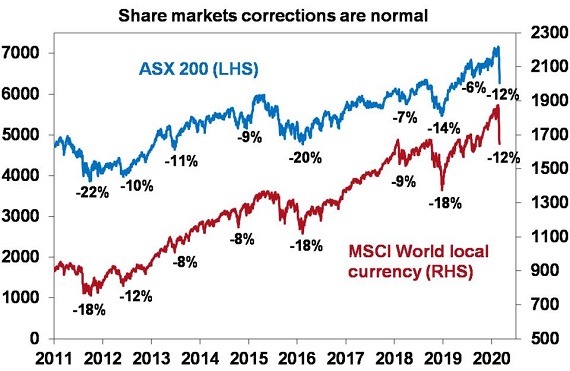
First, while they all have different triggers and unfold a bit differently to each other, periodic corrections in share markets of the order of 5%, 15% and even 20% are healthy and normal. For example, during the tech/dot-com boom from 1995 to early 2000, the US share market had seven pull backs greater than 5% ranging from 6% up to 19% with an average decline of 10%. During the same period, the Australian share market had eight pullbacks ranging from 5% to 16% with an average fall of 8%. All against a backdrop of strong returns every year. During the 2003 to 2007 bull market, the Australian share market had five 5% plus corrections ranging from 7% to 12%, again with strong positive returns every year. More recently, the Australian share market had a 10% pullback in 2012, an 11% fall in 2013 (the taper tantrum), an 8% fall in 2014, a 20% fall between April 2015 and February 2016, a 7% fall early in 2018, a 14% fall between August and December 2018 and a 7% fall into August last year. And this has all been in the context of a gradual rising trend. And it has been similar for global shares – with the last big fall in US shares being a 20% plunge into Christmas eve 2018. See the next chart. While they can be painful, share market corrections are healthy because they help limit a build-up in complacency and excessive risk taking.

View larger image

Source: Bloomberg, AMP Capital

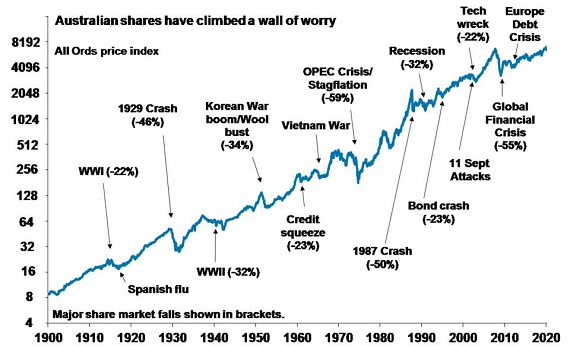
Related to this, shares climb a wall of worry over many years with numerous events dragging them down periodically, but with the long-term trend ultimately up & providing higher returns than other more stable assets. Bouts of volatility are the price we pay for the higher longer-term returns from shares.

View larger image

Source: ASX, AMP Capital

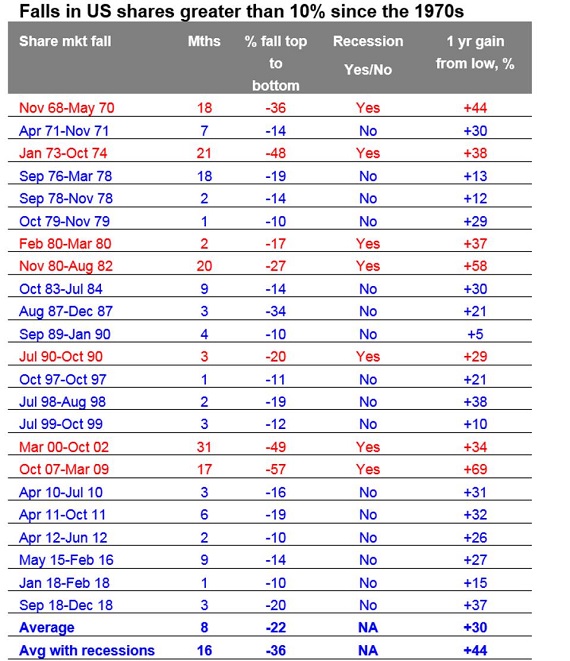
Second, the main driver of whether we see a correction (a fall of 5% to 15%) or even a mild bear market (with say a 20% decline that turns around relatively quickly like we saw in 2015-2016) as opposed to a major bear market (like that seen in the global financial crisis (GFC)) is whether we see a recession or not – notably in the US as the US share markets tends to lead for most major global markets. The next table shows US share market falls greater than 10% since the 1970s. I know it’s heavy – but I like this table! The first column shows the period of the fall, the second shows the decline in months, the third shows the percentage decline from top to bottom, the fourth shows whether the decline was associated with a recession or not and the fifth shows the gains in the share market one year after the low. Falls associated with recessions are highlighted in red.

View larger image

Falls associated with recessions are in red. Source: Bloomberg, AMP Capital.

Several points stand out:

  • First, share market falls associated with recession tend to be longer and deeper. 

  • Second, after the low the, share markets generally rebound sharply – which invariably makes it very hard for investors to time, as by the time they realise what has happened and get back in the market is above where they sold. 

  • Finally, as would be expected the share market rebound in the year after the low is much greater following falls associated with recession.

So, whether a recession is imminent or not in the US is critical in terms of whether we will see a major bear market or not. In fact, the same applies to Australian shares. Our assessment is that a US/global recession is not inevitable. We have not seen the excesses – in terms of overall debt growth (although housing debt is a source of risk in Australia), overinvestment, capacity constraints and inflation – that normally precede recessions in the US, globally or Australia. And we have not seen the sort of monetary tightening that leads into recession. In fact, monetary conditions remain very easy. However, the uncertainty around the coronavirus outbreak and the likelihood of economic shutdowns designed to contain it beyond those in China do suggest a greater than normal risk on this front. That said even if there were a recession growth would likely rebound quickly once the virus came under control as economic activity sprang back to normal helped by policy stimulus.

Third, selling shares or switching to a more conservative investment strategy or superannuation option after a major fall just locks in a loss. With all the talk of billions being wiped off the share market, it may be tempting to sell. But this just turns a paper loss into a real loss with no hope of recovering. The best way to guard against making a decision to sell on the basis of emotion after a sharp fall in markets (as many including me are tempted to do!) is to adopt a well thought out, long-term strategy and stick to it.

Fourth, when shares and growth assets fall, they are cheaper and offer higher long-term return prospects. So, the key is to look for opportunities the pullback provides – shares are cheaper and some more than others. It’s impossible to time the bottom but one way to do it is to average in over time.

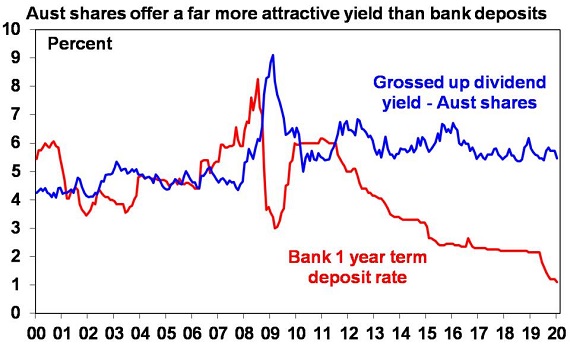
Fifth, while shares have fallen, dividends from the market haven’t. They will come under some pressure as the economy and profits take a hit from a deeper and longer coronavirus outbreak. But companies like to smooth their dividends over time – they never go up as much as earnings in the good times and so rarely fall as much in the bad times. So, the income flow you are receiving from a well-diversified portfolio of shares is likely to remain attractive, particularly against bank deposits.

View larger image

Source: RBA, Bloomberg, AMP Capital

Sixth, shares and other related assets often bottom at the point of maximum bearishness, ie, just when you and everyone else feel most negative towards them. So, the trick is to buck the crowd. “Be fearful when others are greedy. Be greedy when others are fearful,” as Warren Buffett has said.

Finally, turn down the noise. At times like this, negative news reaches fever pitch. Talk of billions wiped off share markets and warnings of disaster help sell copy and generate clicks & views. But we are rarely told of the billions that market rebounds and the rising long-term trend in share prices adds to the share market. Moreover, they provide no perspective and only add to the sense of panic. All of this makes it harder to stick to an appropriate long-term strategy let alone see the opportunities that are thrown up. So best to turn down the noise. 


Source: AMP Capital 2 March 2020

Important notes: While every care has been taken in the preparation of this article, AMP Capital Investors Limited (ABN 59 001 777 591, AFSL 232497) and AMP Capital Funds Management Limited (ABN 15 159 557 721, AFSL 426455) (AMP Capital) makes no representations or warranties as to the accuracy or completeness of any statement in it including, without limitation, any forecasts. Past performance is not a reliable indicator of future performance. This article has been prepared for the purpose of providing general information, without taking account of any particular investor’s objectives, financial situation or needs. An investor should, before making any investment decisions, consider the appropriateness of the information in this article, and seek professional advice, having regard to the investor’s objectives, financial situation and needs. This article is solely for the use of the party to whom it is provided and must not be provided to any other person or entity without the express written consent of AMP Capital.