On 30 March, the Government announced the $130 billion JobKeeper Payment to help keep Australians in jobs as we deal with the significant economic impact from the Coronavirus.

For more information please click here for the JobKeeper Payment factsheet

JobKeeper payment – Information for employers

If your business has been significantly impacted by the Coronavirus you will be able to access a wages subsidy to continue paying your employees. Under the JobKeeper program, you will be able to claim a fortnightly payment of $1,500 per eligible employee from 30 March 2020, for a maximum of six months. This assistance will help you keep staff and will help you restart when the crisis is over.

Fact sheet – JobKeeper payment – Information for employers
Last updated: Monday 30 March 2020

JobKeeper payment – Information for employees

The JobKeeper payment helps businesses significantly impacted by the Coronavirus cover the costs of their employees’ wages, so more Australians can retain their jobs and continue to earn an income. Your employer will notify you if they intend to claim the fortnightly payment of $1,500 on your behalf.

Fact sheet – JobKeeper payment – Information for employees
Last updated: Monday 30 March 2020

If you would like to discuss, please call on Phone: 07 5641 4134.

Source: Australian Government – The Treasury

Much of the media coverage of the coronavirus pandemic is focusing on the potential health impacts. The potential financial impacts are likely to be severe as well, including:

  • a slowdown in the economy,

  • job losses,

  • drops in income, and

  • straining household budgets.

However, just like you can take physical health precautions, now is the time to contact us on Phone: 07 5641 4134 and discuss steps you can take to protect your financial health from the impacts of the coronavirus.  Here are some suggestions.

1. Prepare (or review) your household budget

If you don’t already have a household budget that itemises all your income sources as well as all your expenses, now is the perfect time to do one. If you already have one in place, now is also the ideal time to review it.

Your budget should have a column for your income and a column for your expenses. Split your expenses column into two sections: essential and non-essential expenses. Essential expenses are all the things you need to live, such as food, accommodation and utility services like electricity.

Non-essential expenses, on the other hand, are things that you can do without, like entertainment.

2. Eliminate (or minimise) any unnecessary expenditure

You should immediately aim to eliminate or minimise any unnecessary (non-essential) expenditure. This will ensure you don’t waste any money you already have or that you earn.

3. Reduce your home/car loan repayments

If you have been paying more than the minimum repayment on your home/car loan, consider only paying the minimum payment required as per your loan contract.

You could also talk to your lender about reducing your home/car loan repayments before you miss any payments. You may be able to take advantage of the recent announcements by the big banks to pause/defer your loan repayments for up to 6 months.

It’s important to understand that late or missed repayments negatively affect your credit rating. If you develop a bad credit rating, you may find it harder to get finance in the future.

4. Review discretionary investment and super contributions

The share market is being heavily impacted by the global coronavirus panic at the moment, and this will affect super fund returns.

Under certain circumstances, superannuation funds may be accessible. Please contact us on Phone: 07 5641 4134 if you feel this might apply to you.

You should also contact us to discuss if it is prudent to temporarily cease any discretionary investment or super contributions if you’re currently making them.

5. Review your existing investment strategies

Now is not the time to panic. However reviewing your investment strategies is a sensible financial strategy, and it’s especially important during times of uncertainty. Please seek professional advice to ensure that your investment strategy is appropriate for both your current circumstances and your future needs.

6. Check if you’re eligible for any government assistance

If you’re running a business or you’re currently receiving a government benefit, you’re likely to be eligible for financial assistance under the economic stimulus package recently announced by Prime Minister Scott Morrison in response to the coronavirus outbreak.

7. Be wary of scammers

Unfortunately, scammers tend to target vulnerable people to exploit financially during times of uncertainty. Be wary of anyone looking to sell you anything that you’re not familiar with at the moment.

8. Prepare (or review) your Will

We don’t wish to be macabre. Preparing a Will and reviewing it when circumstances change is a sensible financial strategy for anyone, regardless of the outbreak of the coronavirus.

If you don’t currently have a Will, you should take the time to prepare one. If you already have one in place, review it to ensure that any wealth you have will be distributed the way you want.

Power of attorney is an important part of any estate plan. It will ensure your financial affairs remain in order if you are unable to sign important documents. With the coronavirus affecting the elderly more than any other age group, this could become a very important document.

The bottom line

Unfortunately, no one has a crystal ball to accurately predict the full impacts of the coronavirus. However, it’s important to take steps to protect your financial health (as well as your physical health) during these uncertain times.

How we can help

Please contact us on Phone: 07 5641 4134 if you have any concerns about your financial health. We’ll take the time to understand your specific situation and needs before providing you with the best possible advice.

Source: Clientcomm library

Important note:
This provides general information and hasn’t taken your circumstances into account.  It’s important to consider your particular circumstances before deciding what’s right for you. Although the information is from sources considered reliable, we do not guarantee that it is accurate or complete. You should not rely upon it and should seek qualified advice before making any investment decision. Except where liability under any statute cannot be excluded, we do not accept any liability (whether under contract, tort or otherwise) for any resulting loss or damage of the reader or any other person.  Past performance is not a reliable guide to future returns.Any general tax information provided in this publication is intended as a guide. It is not intended to be a substitute for specialised taxation advice or an assessment of your liabilities, obligations or claim entitlements that arise, or could arise, under taxation law, and we recommend you consult with a registered tax agent. 

Any information provided by the author detailed above is separate and external to our business and our Licensee. Neither our business nor our Licensee takes any responsibility for any action or any service provided by the author.

Any links have been provided with permission for information purposes only and will take you to external websites, which are not connected to our company in any way. Note: Our company does not endorse and is not responsible for the accuracy of the contents/information contained within the linked site(s) accessible from this page.

With the COVID-19 coronavirus crippling the Australian economy and affecting livelihoods, the Australian Federal Government has announced a range of measures to support small to medium-sized enterprises (SMEs).


The total stimulus (including for individuals) announced to date is worth $189 billion, or 10% of the size of the Australian economy, and the government has said more financial support will be announced over the coming months.

If you’re a small or medium business operator we explain below some of the benefits you may be eligible for.

Cash flow measures

The government is providing two tax-free payments to eligible SME and not for-profit businesses. To qualify, your business must employ people and have an aggregated annual turnover of less than $50 million.

The amount received will be determined by staff salaries and wages, as businesses will receive a payment equal to 100% of the tax on salary and wages they withhold to the Australian Taxation Office (ATO), initially from a minimum of $10,000 to a maximum of $50,000. If your business isn’t required to withhold tax you will receive the minimum payment of $10,000.

This payment will be delivered by the ATO as an automatic credit in the activity statement system from 28 April 2020 when you lodge your activity statement.

Businesses will then qualify for a second payment equal to their first payment. This will be received in instalments as automatic credit when lodging activity statements through June and September 2020, bringing the total minimum payment to $20,000 and the total maximum payment to $100,000.

These payments are aimed at helping SMEs pay their rent, electricity and other bills, and retain staff. Around 690,000 SMEs and 30,000 not-for-profits are expected to be eligible.

Additional payments for some SMEs that employ apprentices/trainees

Businesses with less than 20 full-time employees, which includes apprentices/trainees, can also apply to have the government pay 50% of their apprentice/trainee’s wage for up to nine months, from 1 January to 30 September 2020, to a maximum of $21,000 per apprentice/trainee.

The subsidy will also be available to businesses of any size who take on an apprentice/trainee who has been let go by another business.

Employers will be able to access the subsidy after an eligibility assessment is undertaken by an Australian Apprenticeship Support Network provider and can register for the subsidy, which is expected to support up to 70,000 small businesses, from early April.

Other assistance measures for businesses

  • The government has introduced a Coronavirus SME Guarantee Scheme, under which it will underwrite 50% of new short-term, unsecured loans to SMEs by lenders. SMEs with a turnover of up to $50 million will be eligible for a maximum loan of $250,000 over three years, with no repayments due for the first six months. Australian banks, including AMP Bank, have also announced they will defer repayments on existing loans for SMEs affected by the coronavirus for up to six months.

  • The government is increasing the instant asset write-off threshold from $30,000 to $150,000 and expanding it to include all businesses with aggregated annual turnover of less than $500 million (up from $50 million) until 30 June 2020. This is to encourage business owners to continue investing in business assets.

  • The government is also introducing a time-limited 15-month investment incentive by accelerating depreciation deductions. Eligible businesses will be able to deduct 50% of the cost of an eligible asset on installation, with existing depreciation rules applying to the balance. This will apply to businesses with aggregated turnover below $500 million and to the purchase of new assets.

Outlook for the Australian economy

AMP Capital Senior Economist Diana Mousina says that while the government stimulus is welcome, it’s unlikely to be enough to keep Australia from falling into recession.

Ms Mousina says that the combined economic impact of the summer bushfires, lower Chinese tourism and education spending, global coronavirus shutdown and recessions in the US and Europe will all take a toll, however the government’s spending measures should help to limit the severity of the downturn.

“The fiscal stimulus package will help in limiting the depth of the Australian recession, it will help to keep companies afloat (and should provide some limit for keeping the unemployment rate from skyrocketing) and it is necessary to get a strong recovery after the virus has run its course.”

Please contact us on Phone: 07 5641 4134 if you would like to discuss.

With the COVID-19 coronavirus crippling the Australian economy and affecting livelihoods, the Australian Federal Government has announced a range of measures to support both businesses and individuals.

The information in this article was last updated on Wednesday 25 March.

The total stimulus announced to date is worth $189 billion, or 10% of the size of the Australian economy, and the government has said more financial support will be announced over the coming months.

Here we explain some of the benefits you may be eligible for.

Coronavirus supplement

For the next six months, the government will establish a new coronavirus supplement worth $550 per fortnight. This will be paid to both existing and new recipients of JobSeeker Payment, Youth Allowance Jobseeker, Parenting Payment, Farm Household Allowance and Special Benefit, doubling the payment for those currently on these benefits to $1,100 per fortnight. Students receiving Youth Allowance, Austudy and Abstudy will also be eligible.

Asset tests and waiting periods that typically apply to these types of payments will be waived, and eligibility will be extended to permanent employees who are temporarily stood down.

Sole traders, the self employed, casual workers and contract workers whose volume of work has been affected may also be eligible, provided they’re earning less than $1,075 a fortnight. These payments will begin from 27 April 2020.

Household stimulus payments

The government is providing two separate, tax-free $750 payments to social security, veteran and other income-support recipients, including those on the Age Pension, and eligible concession card holders.

The first payment will be made from 31 March 2020 and the second payment from 13 July 2020.However, people eligible for the coronavirus supplement (detailed above) won’t be entitled to the second payment.

It’s expected that up to 6.6 million people will be eligible for the first payment and around five million for the second payment, with around half of these pensioners.

Temporary access to super

The government will allow some people affected by the coronavirus to access up to $10,000 of their super between now and 1 July 2020, and a further $10,000 in the first three months of the 2020-21 financial year, tax free.

Those who are eligible include the unemployed, people receiving JobSeeker Payment, Youth Allowance Jobseeker, Parenting Payment, Farm Household Allowance and Special Benefit. And also people who’ve been made redundant, had their work hours reduced by 20% or more or sole traders whose turnover has reduced by 20% or more since 1 January this year.

Applications can be made online from mid-April by using myGov. Members will self-certify that they satisfy the eligibility criteria. Please contact us on Phone: 07 5641 4134 to discuss.

Support for retirees

To assist those in retirement the government is temporarily reducing minimum super drawdown requirements for account-based or allocated pensions, annuities and similar products by 50% for the current financial year and the 2020-21 financial year. This should reduce the need for retirees to sell investment assets in the current soft sharemarket conditions to fund their minimum drawdown requirements.

In addition, the upper and lower social security deeming rates will also be reduced by 0.25% from 1 May in recognition of the impact of persistent low interest rates on retirees’ savings. This comes on top of a 0.5% reduction announced earlier in March.

The government says the change will benefit around 900,000 income support recipients, including around 565,000 people on the Age Pension who will, on average, receive around $105 more from the Age Pension in the first full year that the reduced rates apply.

Minimum payment rates for account-based and allocated income streams
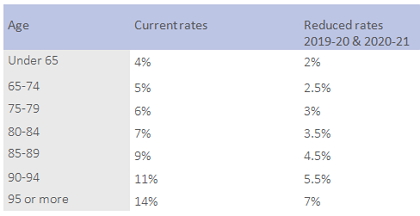
Source: Australian Government’s Economic Response to the Coronavirus: treasury.gov.au/coronavirus

State and territory stimulus

The state and territory governments have also announced economic stimulus packages. The majority of these have so far focused on businesses, however there have been a few measures for individuals, including:

  • Western Australia: The WA Government has frozen scheduled increases for household fees and charges, including electricity, water, motor vehicle charges, the emergency services levy and public transport fares, which were previously due to increase by $127 from 1 July. And the Energy Assistance Package, which is available to eligible concession card holders, will be doubled from $300 to $600 from 1 July.

  • Tasmania: The Tasmanian Government has announced one-off payments of $250 for individuals (or up to $1,000 for families) who are required to self-isolate. Recipients must hold a Health Care Card, Pensioners Concession Card or be low-income earners who can demonstrate a need for financial support, including casual workers.

  • Australian Capital Territory: The ACT Government will give rebates of $150 on household rates, as well as freeze a number of fees and charges, including the fire and emergency services levy, public transport, vehicle registration and parking fees. Public housing tenants will receive $250 in rental support, as well as a one-off rebate for residential utility concession holders of $200 to help with power bills.

  • Queensland: The Queensland Government has announced a $200 rebate for all Queensland households (including the $50 Asset Ownership Dividend already announced) to offset the cost of water and electricity bills, which will be automatically applied through electricity bills.

Outlook for the Australian economy

AMP Capital Senior Economist Diana Mousina says that while the government stimulus is welcome, it’s unlikely to be enough to keep Australia from falling into recession.

Ms Mousina says that the combined economic impact of the summer bushfires, lower Chinese tourism and education spending, global coronavirus shutdown and recessions in the US and Europe will all take a toll, however the government’s spending measures should help to limit the severity of the downturn.

“The fiscal stimulus package will help in limiting the depth of the Australian recession, it will help to keep companies afloat (and should provide some limit for keeping the unemployment rate from skyrocketing) and it is necessary to get a strong recovery after the virus has run its course.”

Due to the uncertainty around the country’s economic position, the Federal Government has also announced that it will postpone the next Federal Budget. The budget is usually handed down in May, but has been postponed until 6 October 2020.

Please contact us Phone: 07 5641 4134 if you would like to discuss.


Source: Australian Government’s Economic Response to the Coronavirus: treasury.gov.au/coronavirus


While the full economic effects from the virus remain uncertain, the outlook has deteriorated since the Government’s initial Economic Response announced on 12 March 2020.
 
 
The spread of the virus worldwide has broadened, and is expected to be more prolonged. Governments, both international and domestic, have announced stricter mitigation measures to slow the spread of the virus, which are having significant economic impacts.
 
On Sunday 22nd March, the Government announced a second set of economic responses which, combined with the previous actions, total $189 billion across the forward estimates, representing 9.7 per cent of annual GDP.
 
Included in the announcement are temporary changes to superannuation. Please contact us on Phone: 07 5641 4134 to discuss your circumstances before acting on these changes.
 
Please find below the key elements of this latest stimulus;

Supporting Individuals and Households

Support for Businesses

 
If you would like to discuss any of the areas targeted, please call on Phone: 07 5641 4134.

Source: Australian Government – The Treasury

Over the weekend in Australia, the federal government announced a second fiscal stimulus package to offset the hit to growth from COVID-19.

Below are some of the main take-aways:

  • An additional $46bn worth of direct government spending for individuals and businesses impacted the coronavirus.

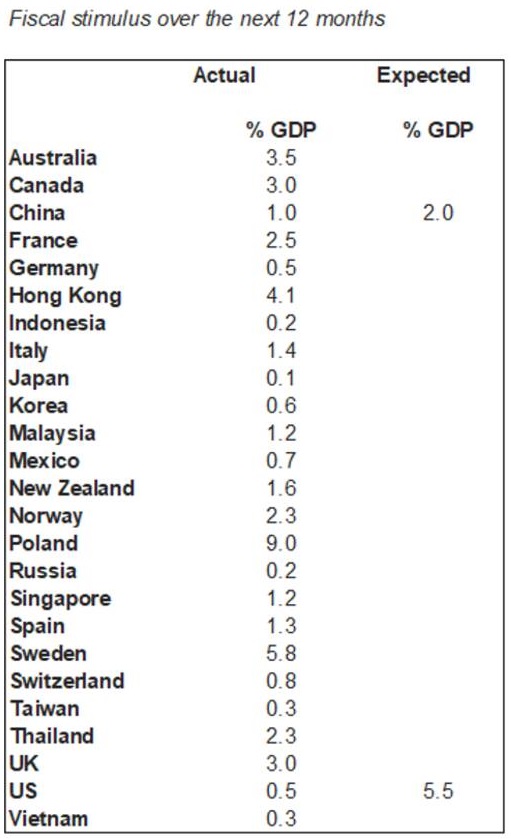
Along with the first round of stimulus announced recently ($17.6bn to individuals and businesses, $2.4bn to the healthcare sector and $5bn of stimulus by the states) total Australia fiscal stimulus in response to coronavirus is worth around 3.5% of GDP.

This is in-line with other countries who have recently announced fiscal packages (see the table below). Most of the stimulus in Australia is front-end loaded over the next year.

Source: UBS, Bloomberg, AMP Capital

  • Other stimulus measures include cheap bank financing which is aimed to stimulate borrowing, part of this was announced by the Reserve Bank of Australia last week.

The government also announced a $20bn loan guarantee to help impacted small/medium-sized businesses meet cash flow requirements. If you include these total loan guarantees with the direct fiscal stimulus then total stimulus in the economy is worth around 10% of GDP.

Then there are also the RBA interest rate cuts and three-year government bond purchases to meet the 0.25% yield target. So there is a lot of stimulus being thrown around in Australia which is completely necessary at the moment.

  • Details of the package announced yesterday also include: increase the payment of the Newstart allowance (an additional $550/fortnight) and expanded eligibility for income support (the Newstart allowance). It also includes a further $750 payment (on top of the $750 already announced) for those on welfare support (5.2 million Australians), early access to superannuation for those whose wages have been directly affected by the virus (draw up to $10K from superannuation this and next financial year) tax-free, more flexibility around retirees on drawing down on their superannuation and increasing cash payments to SMEs ($20K payment up to $100K).

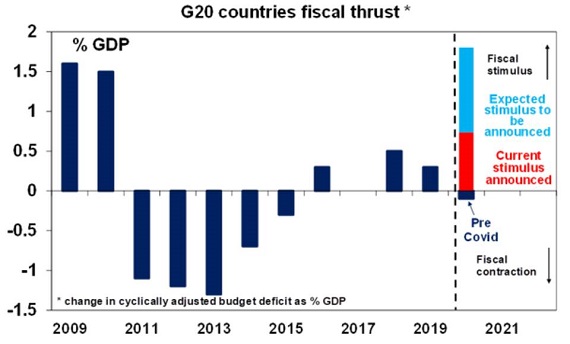
  • Total global stimulus to combat the economic risks from the coronavirus should equal around 2% of GDP (including measures that we expect to be announced from the US and China). This is more than during the GFC (see the chart below) as countries deal with the most disruptive global shock since WWII.

View larger image

Source: UBS, Bloomberg, AMP Capital

  • The PM said that more stimulus is likely, expect more direct cash handouts to Australian households more broadly to be announced over the next few weeks.

  • Increased government spending stimulus alongside the hit to economic growth means that Australian AAA credit rating by international ratings agencies will be at risk of being downgraded. But the rest of the world is (relatively) in the same boat as governments will stretch budgets to support the economy. In theory, a downgrade to the sovereign AAA credit rating will increase Australian bond yields and the cost of borrowing for the government. However, the evidence on this isn’t conclusive. The US downgrade in 2011 saw bond yields fall after its credit rating was downgraded.

  • As we have said before we don’t think that fiscal stimulus will be enough to keep Australia out of recession over March/June quarter. The hit to GDP growth in the March quarter from lower Chinese tourist and education spending, along with the impact to the bushfires will be large. June quarter GDP growth will be impacted by the rest of world (ex China) dealing with coronavirus shutdowns and we see a Eurozone and US recession occurring this year which will be another negative impact to Australian export growth. On top of that, more local infections of the virus is leading to some lockdowns with more expected which will limit consumer spending. Our base case is now for a 3.5% contraction in the Australian economy but it could be larger.

  • The fiscal stimulus package will help in limiting the depth of the Australian recession, it will help to keep companies afloat (and should provide some limit for keeping the unemployment rate from skyrocketing) and it is necessary to get a strong recovery after the virus has run its course. It is important to keep tracking how the daily change in new coronavirus infections is tracking globally (see the chart below), especially compared to the China experience. Unfortunately there are no signs yet of EU/US infections reaching a peak as lockdowns have only been imposed for a short time.

By Diana Mousina 
Economist – Investment Strategy & Dynamic Markets

Source: AMP Capital 23 March 2020

Important notes: While every care has been taken in the preparation of this article, AMP Capital Investors Limited (ABN 59 001 777 591, AFSL 232497) and AMP Capital Funds Management Limited (ABN 15 159 557 721, AFSL 426455) (AMP Capital) makes no representations or warranties as to the accuracy or completeness of any statement in it including, without limitation, any forecasts. Past performance is not a reliable indicator of future performance. This article has been prepared for the purpose of providing general information, without taking account of any particular investor’s objectives, financial situation or needs. An investor should, before making any investment decisions, consider the appropriateness of the information in this article, and seek professional advice, having regard to the investor’s objectives, financial situation and needs. This article is solely for the use of the party to whom it is provided and must not be provided to any other person or entity without the express written consent of AMP Capital.

“Stocks at record highs despite uncertain geopolitical landscape”

“Shares plunge as coronavirus outbreak renews investor fears”

“Markets enter correction territory after worst loss since GFC”

You would have seen these headlines or similar over the last few weeks. It’s evident that investment markets are on edge. We’ve experienced an unprecedented bull run on the Australian Securities Exchange (ASX), bolstered by low interest rates and now, investors and commentators alike are naturally questioning if this rally is at an end given the emerging economic impacts of the COVID-19 virus.

The virus outbreak is certainly having a dramatic impact as it hits different regions of the world. 

So what do you do when market volatility increases, share values begin to tumble and rise, and media coverage intensifies?

Focus on what you can control. It’s natural to be nervous but it’s also crucial to tune out the noise, focus on the long term and stay the course.

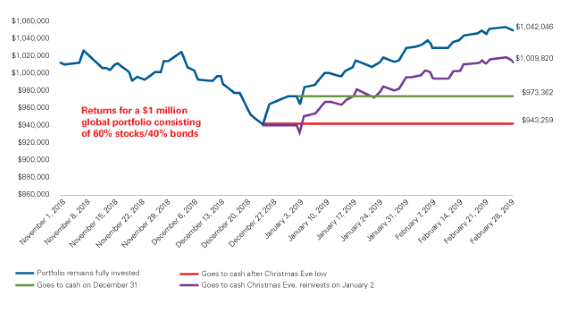
The graph below shows the trajectory of a portfolio based on four different investment decisions taken at the end of December 2018 when the market experienced a downturn.

It’s an important lesson in investor behaviour.

Source: Vanguard US calculations, based on data from FactSet, as of February 28, 2019.

Although the portfolio would have lost 5.7% since 1 November 2018, by staying the course and not selling at the market low, investors who remained in their asset allocation ended up gaining back 4.2% in just two months.

If the investor cashed out in December and then reinvests just a few days later, the value of their portfolio is still not as high as if they had remained.

Cashing out in December would mean the portfolio is nearly $100,000 less than what it could have been by February 2019.

By not sticking to your financial plan and losing sight of your goals when markets are volatile and emotions begin to dominate decision-making, you are potentially forfeiting not only the opportunity to regain and increase portfolio value, but also what is likely years of hard work and patience.

Emotionally reacting to market noise might be difficult to avoid but the downsides of succumbing to it should be carefully considered before you cash out or change investment tack.

It’s also always a good idea to consult your financial adviser in times of market downturn for both reassurance and perhaps, rebalancing.

As the humble Vanguard adage goes, “stay the course” in good times and bad. It cannot insure you from adverse market movements, but by having a diversified portfolio it does position you to ride out market storms and not be blown off the course you set in your financial plan.


Please contact us on Phone: 07 5641 4134 if you seek further discussion on this topic.

Source : Vanguard

Written by Robin Bowerman, Head of Corporate Affairs at Vanguard.

Reproduced with permission of Vanguard Investments Australia Ltd

Vanguard Investments Australia Ltd (ABN 72 072 881 086 / AFS Licence 227263) is the product issuer. We have not taken yours and your clients’ circumstances into account when preparing this material so it may not be applicable to the particular situation you are considering. You should consider your circumstances and our Product Disclosure Statement (PDS) or Prospectus before making any investment decision. You can access our PDS or Prospectus online or by calling us. This material was prepared in good faith and we accept no liability for any errors or omissions. Past performance is not an indication of future performance.

© 2020 Vanguard Investments Australia Ltd. All rights reserved.

Important:
Any information provided by the author detailed above is separate and external to our business and our Licensee. Neither our business nor our Licensee takes any responsibility for any action or any service provided by the author.

Any links have been provided with permission for information purposes only and will take you to external websites, which are not connected to our company in any way. Note: Our company does not endorse and is not responsible for the accuracy of the contents/information contained within the linked site(s) accessible from this page.

As a result of the coronavirus pandemic, many Australian workers have been thrust into working from home for the first time.

By putting in place some systems and boundaries, you can help make the best of the situation, get your work done and maintain your mental wellbeing.

1. Designate a workspace or home office

If you are used to going into an office every day, then the separation between work and home is physical. You need to try and recreate this as much as possible, with a designated workspace in your home.

If you are fortunate enough to have a spare room in your house, then you could convert this room into your office temporarily. But, your workspace doesn’t have to be a separate room. It could just be a corner of your living room. The important thing is that you have a space where you can turn “on” to work. When you leave that space, you should be able to turn “off”.

2. Get dressed 

While it might be tempting to stay in pyjamas all day, getting dressed for work each day will improve your state of mind and mentally prepare you to start work.

You don’t have to dress up in your usual, formal workwear, but the simple act of getting changed will help you get into work mode. 

3. Stick to clearly defined work hours

The biggest challenge of working from home is having the discipline to set boundaries. You are in charge of your environment and have to hold yourself accountable. This discipline also extends to knowing when enough is enough when it comes to work hours.

While it may not be possible for everyone, especially for workers with kids, trying to set clearly defined work hours will help you maintain a healthy work-life balance and avoid burnout.

4. Get out and about (if you are not self-isolating)

If you are not self-isolating, you should get your shoes on, get outside and enjoy the fresh air at some point in your day. Reward yourself after a few hours of work with a 20-minute walk with your dog or get your yoga mat outside and salute the sun in the fresh air. 

When you return to your home workspace, you will likely feel more energised and be more productive for the rest of your work day.

5. Stay social (virtually)

If you are used to working in a bustling office, working from home can feel lonely.

With video conferencing tools like Zoom, Google hangouts and Skype (to name a few), you can virtually recreate those casual in-office conversations that break up your workday. 

It’s crucial during these challenging times that you stay connected and engaged with your work colleagues. 

Source: Clientcomm library

Important note:
This provides general information and hasn’t taken your circumstances into account.  It’s important to consider your particular circumstances before deciding what’s right for you. Although the information is from sources considered reliable, we do not guarantee that it is accurate or complete. You should not rely upon it and should seek qualified advice before making any investment decision. Except where liability under any statute cannot be excluded, we do not accept any liability (whether under contract, tort or otherwise) for any resulting loss or damage of the reader or any other person.  Past performance is not a reliable guide to future returns.Any general tax information provided in this publication is intended as a guide. It is not intended to be a substitute for specialised taxation advice or an assessment of your liabilities, obligations or claim entitlements that arise, or could arise, under taxation law, and we recommend you consult with a registered tax agent.

Any information provided by the author detailed above is separate and external to our business and our Licensee. Neither our business nor our Licensee takes any responsibility for any action or any service provided by the author.

Any links have been provided with permission for information purposes only and will take you to external websites, which are not connected to our company in any way. Note: Our company does not endorse and is not responsible for the accuracy of the contents/information contained within the linked site(s) accessible from this page.

The coronavirus is first and foremost a public health issue, but it is also having a very major impact on the economy and the financial system. As the virus has spread, countries have restricted the movement of people across borders and have implemented social distancing measures, including restricting movements within countries and within cities. The result has been major disruptions to economic activity across the world. This is likely to remain the case for some time yet as efforts continue to contain the virus.

Financial market volatility has been very high. Equity prices have experienced large declines. Government bond yields have declined to historic lows. However, the functioning of major government bond markets has been impaired, which has disrupted other markets given their important role as a financial benchmark. Funding markets are open to only the highest quality borrowers.

The primary response to the virus is to manage the health of the population, but other arms of policy, including monetary and fiscal policy, play an important role in reducing the economic and financial disruption resulting from the virus.

At some point, the virus will be contained and the Australian economy will recover. In the interim, a priority for the Reserve Bank is to support jobs, incomes and businesses, so that when the health crisis recedes, the country is well placed to recover strongly.

At a meeting yesterday, the Reserve Bank Board agreed to the following comprehensive package to support the Australian economy through this challenging period:

  1. A reduction in the cash rate target to 0.25 per cent.

    The Board will not increase the cash rate target until progress is being made towards full employment and it is confident that inflation will be sustainably within the 2–3 per cent target band.

  2. A target for the yield on 3-year Australian Government bonds of around 0.25 per cent.

    This will be achieved through purchases of Government bonds in the secondary market. Purchases of Government bonds and semi-government securities across the yield curve will be conducted to help achieve this target as well as to address market dislocations. These purchases will commence tomorrow. The Bank will work closely with the Australian Office of Financial Management (AOFM) and state government borrowing authorities to ensure the efficacy of its actions. Further details about the implementation of this are provided in the accompanying notice.

  3. A term funding facility for the banking system, with particular support for credit to small and medium-sized businesses.

    The Reserve Bank will provide a three-year funding facility to authorised deposit-taking institutions (ADIs) at a fixed rate of 0.25 per cent. ADIs will be able to obtain initial funding of up to 3 per cent of their existing outstanding credit. They will have access to additional funding if they increase lending to business, especially to small and medium-sized businesses. This facility is for at least $90 billion. Further details are available in the accompanying notice.

    The Australian Government has also developed a complementary program of support for the non-bank financial sector, small lenders and the securitisation market, which will be implemented by the AOFM.

  4. Exchange settlement balances at the Reserve Bank will be remunerated at 10 basis points, rather than zero as would have been the case under the previous arrangements.

    This will mitigate the cost to the banking system associated with the large increase in banks’ settlement balances at the Reserve Bank that will occur following these policy actions.

The Reserve Bank will also continue to provide liquidity to Australian financial markets by conducting one-month and three-month repo operations in its daily market operations until further notice. In addition, the Bank will conduct longer-term repo operations of six-month maturity or longer at least weekly, as long as market conditions warrant.

The various elements of this package reinforce one another and will help to lower funding costs across the economy and support the provision of credit, especially to small and medium-sized businesses.

Australia’s financial system is resilient and well placed to deal with the effects of the coronavirus. The banking system is well capitalised and is in a strong liquidity position. Substantial financial buffers are available to be drawn down if required to support the economy. The Reserve Bank is working closely with the other financial regulators and the Australian Government to help ensure that Australia’s financial markets continue to operate effectively and that credit is available to households and businesses.

Today’s policy package from the Reserve Bank complements the welcome fiscal response from governments in Australia. Together, these measures will support jobs, incomes and businesses through this difficult period and they will also assist the Australian economy in the recovery.

Source: Reserve Bank of Australia, March 19th, 2020

Enquiries

Media and Communications
Secretary’s Department
Reserve Bank of Australia
SYDNEY

Phone: +61 2 9551 9720
Email: rbainfo@rba.gov.au

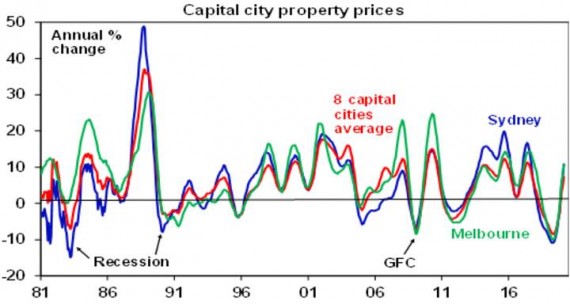
The Australian housing market was boosted from mid-last year by the combination of the Federal election removing the threat of changes to negative gearing and capital gains tax, rate cuts and regulatory easing. So, after a 10% drop in average capital city prices into mid last year – the biggest fall in property prices for at least 40 years – they have since rebounded by 9%. Our assessment was that price increases would slow from the pace seen since mid-year, but that the combination of low rates, solid population growth and the fear of missing out would still see solid price growth this year.

Olivers Insights: Five charts on investing to keep in mind in rough times like these

However, the coronavirus pandemic & associated shutdowns to economic activity now poses a significant threat to the outlook for property prices. The question is how big the threat is?

Social distancing will likely delay property transactions

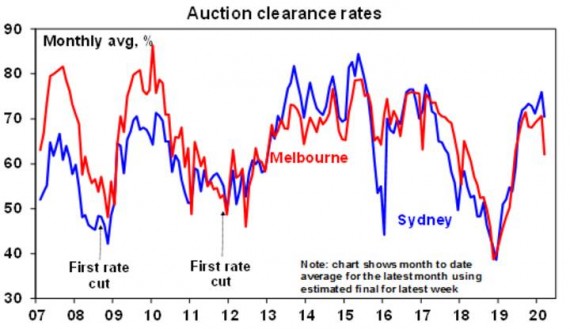
The absence of many Chinese buyers flowing from travel bans appears to have had little impact on property demand with clearance rates remaining strong in February.

click to enlarge

Source: Domain, AMP Capital

However, auction clearance rates and sales momentum are showing some signs of slowing this month. This may reflect an increasing desire on the part of buyers and sellers to put property transactions on hold to avoid being exposed to the virus unnecessarily. Social distancing policies will only intensify this. On its own this may crash transactions but may just flatten price gains.

Recession is the big threat

However, it’s the likely recession that we have now entered due to coronavirus related shutdowns that imposes the big risk. We expect at least two negative quarters of GDP growth in the March and June quarters with the risk that the September quarter is also negative. And the contraction could be deep because big chunks of the economy will be largely shut – tourism, travel, and entertainment with a severe flow on to parts of retailing. The toilet paper, sanitiser and canned/frozen food boom may help supermarkets for a while – but as Deutsche Bank recently calculated for every $1 spent on such items there is $15 spent on things that are vulnerable to social distancing.

Past large share market falls have seen a mixed impact on property prices. The 1987 50% share market crash actually boosted home prices as investors switched from shares to property. But the key is what happens to unemployment as this often forces sales and crimps demand. Back in 1987 the economy remained strong and unemployment fell but the recessions of the early 1980s and early 1990s saw falls in average national capital city home prices of 8.7% and 6.2% respectively as unemployment rose. The GFC share market fall of 55% also saw a 7.6% home price fall, even though it wasn’t a recession, because unemployment rose from 4% to nearly 6%.

click to enlarge

Source: Core Logic, AMP Capital

So, a lot depends on how deep the recession is and how far unemployment rises. Our base case is for a rise in unemployment to around 7.5% which is likely to drive a 5% or so dip in prices ahead of a property market recovery into next year as the economy bounces back and pent up demand is unleashed again helped by ultra-low interest rates. Government and RBA measures to help struggling businesses and households through the coronavirus shutdown should help in preventing a really big rise in unemployment.

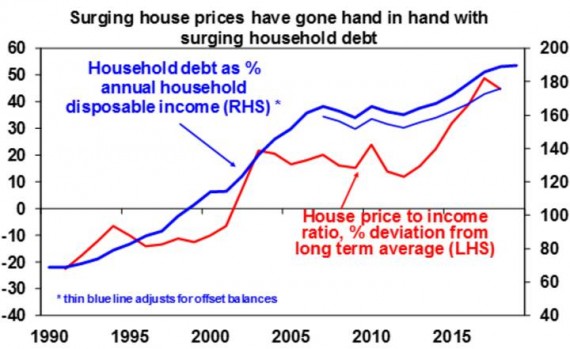
However, if the recession turns out to be long – pushing unemployment to say 10% or more – then this risks tripping up the underlying vulnerability of the Australian housing market flowing from high household debt levels and high house prices. The surge in prices relative to incomes (and rents) over the last two decades has gone hand in hand with a surge in household debt relative to income that has taken Australia from the low end of OECD countries to the high end.

click to enlarge

Source: OECD, RBA, AMP Capital

This is nothing new and we have long described it as Australia’s Achilles’ heel. Some things have given us a bit of confidence in recent times prices won’t just crash spontaneously.

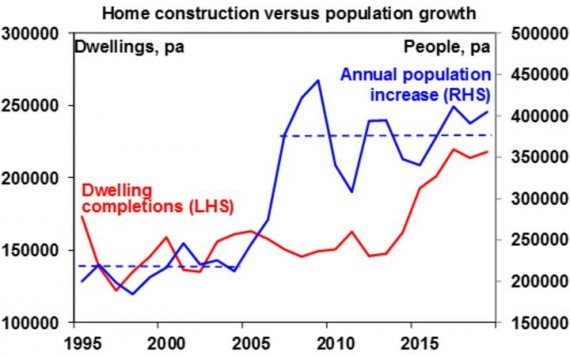
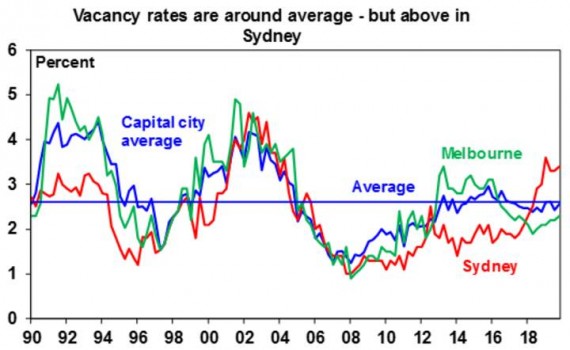
  • First, the property market has been chronically undersupplied. Annual population growth since mid-last decade has averaged 373,000 people compared to 217,000 over the decade to 2005, which requires roughly an extra 75,000 homes per year. Unfortunately, the supply of dwellings did not keep pace with the population surge (next chart) so a massive shortfall built up driving high home prices. Thanks to the surge in unit supply since 2015 this has been reduced but capital city vacancy rates are still around their long-term average indicating a lack of over supply, although Sydney may be more at risk.

click to enlarge

Source: ABS, AMP Capital

click to enlarge

Source: REIA, AMP Capital

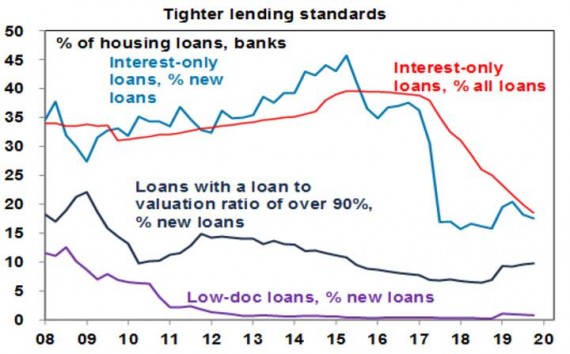
  • Second, talk of mortgage stress has been overstated. Despite some seeing negative equity into mid-last year and a significant proportion of borrowers switching from interest only to principle & interest loans over the last few years (which has seen interest only loans drop from nearly 40% of all loans to 18%) there has been no surge in forced sales and non-performing loans. While Australia saw a deterioration in lending standards with the last boom, it was nothing like other countries saw prior to the GFC. Much of the increase in debt has gone to older, wealthier Australians, who are better able to service their loans.

click to enlarge

Source: APRA, AMP Capital

We have always concluded that the combination of high prices and debt on their own won’t trigger a major crash in prices unless there are much higher interest rates or a recession. Unfortunately, we are now facing down the barrel of the latter. A sharp rise in unemployment to say 10% or beyond risks resulting in a spike in debt servicing problems, forced sales and sharply falling prices. This could then feedback to weaken the broader economy as falling home prices lead to less spending and a further rise in unemployment and more defaults and so on. This scenario could see prices fall 20% or so.

Bear in mind though that part of this would just be a reversal of the 9% bounce in average capital city prices seen since mid-last year.

It’s also not our base case but it highlights why governments and the RBA really have to work hard to avoid letting the virus cause a lot of company failures, surging unemployment and household defaults.


Source: AMP Capital 19 March 2020

Important notes: While every care has been taken in the preparation of this article, AMP Capital Investors Limited (ABN 59 001 777 591, AFSL 232497) and AMP Capital Funds Management Limited (ABN 15 159 557 721, AFSL 426455) (AMP Capital) makes no representations or warranties as to the accuracy or completeness of any statement in it including, without limitation, any forecasts. Past performance is not a reliable indicator of future performance. This article has been prepared for the purpose of providing general information, without taking account of any particular investor’s objectives, financial situation or needs. An investor should, before making any investment decisions, consider the appropriateness of the information in this article, and seek professional advice, having regard to the investor’s objectives, financial situation and needs. This article is solely for the use of the party to whom it is provided and must not be provided to any other person or entity without the express written consent of AMP Capital.