Tom Young

The Australian market might feel like a bloodbath now, but for me, it’s been a long time since I’ve seen so much value in the market for those who can hold their nerve.

COVID-19 has, rightly, made governments around the world sacrifice economic growth for the preservation of human health. This has sent society into an untested spin – who could have ever imagined that planes would stop flying, the 2020 sporting year would be all but cancelled, and we’d be confined to our homes for likely all of autumn.

Markets have been equally volatile, though amid the volatility now we are seeing some gains, not just tumbles. However, it’s important to remember this is a true black swan event, not triggered by anything fundamentally wrong with the Australian economy. Australia has come into this crisis with relatively low debt compared to global counterparts and a strong fiscal position1. Recovery will likely return the economy to its regular operations, and we believe hindsight will show many good companies, which can trade through this, would have been a great buy.

In this piece we take a look at some household favourites, with an allegiance to the view that this market disruption is temporary, and decisions should be made on long-term goals and fundamentals: strong balance sheets, robust business models and sustained demand beyond COVID-19.

The telcos

After going through a rough patch with headwinds from the NBN rollout, we believe the telcos are in a stronger position now than they have been for the last few years. In fact, we have been progressively increasing our exposure to the sector since the middle of 2019.

In the COVID-19 outbreak, telcos are an essential service, and they’re facing a surge in demand as households look to boost their coverage and data packages to suit their working needs2. Some have, for example, offered free data packages in an effort to boost the capacity of mobile users and households3. It fits well into the ‘Team Australia’ mandate from Prime Minister Scott Morrison.

Longer term, some are positioning themselves to capitalise on the 5G network, as an alternative to the NBN. AMP Capital has written about the transformative potential of 5G extensively, including here, and can see a competitive advantage for telcos which are able to provide a superior service to the NBN4.

Dividends looking shaky

My colleague Dermot Ryan, co-porfolio manager for Australian equities, penned this piece explaining why dividends could be cut by at least a third in the next twelve months, leading to a larger cut to aggregate dividends than we saw in the GFC.

In our view, it’s going to be very hard for any company receiving significant federal and state aid to also maintain their previous levels of dividend payments to shareholders. The banks are in that category, and it’s reasonable to expect there will be pressure on their dividends.

Some may be fearing a similar scenario to the UK, where British banks have suspended dividends in the face of COVID-195. Indeed, APRA recently wrote a letter to the Australian banks asking them to make “prudent reductions in dividends”6 While the short-term outlook for bank dividends is impossible to lock down, it’s important to remember that about a third of ASX 200 dividends come from the banks7, meaning the government would realise how important those dividends are for retirees. While that will likely provide some support to near term bank dividends, we believe it’s prudent for retirees relying on dividend income to ensure their dividends are adequately diversified.

Where to from here?

My view is that, when this crisis is over, many will look back on the domestic market and recognise that there were buying opportunities. As we’ve said, companies with solid balance sheets which can trade through this are in a good position to take advantage of the inevitable rebound – and currently, those companies are probably a lot cheaper than they were two months ago.

It’s important to remember markets will always climb a wall of worry. Conditions will ease, and investors with their eyes on the long-term will want to be as ready as they can to be for the market recovery.


1 https://www.afr.com/policy/economy/mega-stimulus-to-test-australia-s-aaa-credit-rating-20200319-p54bnr
2 https://www.afr.com/companies/telecommunications/nbn-telcos-prepare-for-unprecedented-demand-20200315-p54a7h
3 https://www.itnews.com.au/news/telstra-follows-optus-with-extra-mobile-data-in-virus-response-539389
4 https://www.afr.com/business-summit/telstra-warns-nbn-will-lose-customers-as-it-enters-wireless-battle-20200311-p54902
5 https://www.forbes.com/sites/stephenpope/2020/04/01/british-banks-will-suspend-dividends-so-shines-a-good-deed-in-a-weary-world/#6d7c390668f1
6 https://www.apra.gov.au/sites/default/files/2020-04/Capital%20management.pdf
7 AMP Capital, Factset

Author: Tom Young, Co-Portfolio Manager (Income), Australia

Source: AMP Capital 16 April 2020

Important notes: While every care has been taken in the preparation of this document, AMP Capital Investors Limited (ABN 59 001 777 591, AFSL 232497) makes no representation or warranty as to the accuracy or completeness of any statement in it including, without limitation, any forecasts. Past performance is not a reliable indicator of future performance. This document has been prepared for the purpose of providing general information, without taking account of any particular investor’s objectives, financial situation or needs. An investor should, before making any investment decisions, consider the appropriateness of the information in this document, and seek professional advice, having regard to the investor’s objectives, financial situation and needs. The information in this document contains statements that are the author’s beliefs and/or opinions. Any beliefs and/or opinions shared are as at the date shown and are subject to change without notice. This document is solely for the use of the party to whom it is provided and must not be provided to any other person or entity without the express written consent of AMP Capital.


The Australian Government has announced a new $18 million program to help fund and launch new startup businesses that are owned and run by women entrepreneurs.

In a plan that will run for the next three years, the objective of The Boosting Female Founders Initiative is to help female-led businesses overcome the inherent disadvantages they face in their chosen industry.

It has also been designed to enable female founders to expand into domestic and international markets and become self-sufficient.

The initiative will be offering funding grants worth between $25,000 and $480,000 with the first round of grants closing on 14 April 2020.

Jessica Janson, founder of tech startup Dogshare, sees the initiative as a positive step forward, despite not being able to apply for the grant this time around due to the timing of the application deadline.

“Traditionally, women miss out on funding and it’s my belief that a lot of this has to do with what has come before us,” said Janson.

READ: Additional grants to support SMEs and startups

“For many of us, selling yourself is not something that comes naturally, but we’re often competing for angel investment or seed funding against others who promise to ‘change the face of XY industry forever’.”

What are the intended outcomes of the initiative?

In addition to boosting the economy through diversity of startups, the most obvious outcomes are an increased number of startups and financial investments founded by women, new products and services brought to market and increased economic growth.

Janson agreed that this kind of impact upon the tech industry is crucial, now more than ever.

“All industries can benefit from an equal representation of founders and leaders.

“Technology enabled business, in particular, needs female founders to encourage today’s girls to get excited about STEM,” she said.

“These are such important skill sets for a modern world and I fear that if girls don’t see enough female leaders in these roles they will be less likely to get involved with this imperative modern day skill.”

Is my startup eligible?

To be eligible you must:

  • be a female-founded (majority owned and led by women) startup

  • have an Australian Business Number (ABN)

  • be registered for the Goods and Services Tax (GST)

  • be one of the following entities:show evidence that your startup is a female founded (majority owned and led by women. See section 14 of the grant opportunity guidelines for further information on the definition of a female-founded business)

    • an entity incorporated in Australia

    • an incorporated trustee on behalf of a trust

    • an Aboriginal and Torres Strait Islander Corporation registered under the Corporations (Aboriginal and Torres Strait Islander) Act 2006

    • a partnership

    • a sole trader

  • show evidence that your startup is a female founded (majority owned and led by women. See section 14 of the grant opportunity guidelines for further information on the definition of a female-founded business)

  • provide evidence to support your source of funding (such as, a letter from contributor/s confirming funding amount) (Stage Two applications only)

  • provide evidence from your board (or chief executive officer or equivalent if there is no board) that the project is supported, and that you can complete the project and meet the costs of the project not covered by grant funding (like ineligible expenditure see Appendix B of the grant opportunity guidelines) (Stage Two applications only)

In the future, Janson says grants such as these will become less common as business moves towards a more equal footing.

“Right now we’re working to level the playing field and because that playing field has been dominated by men in the hundreds of years behind us, as it becomes more common to see women in leadership roles and at the helm of businesses, it will become the new normal,” said Janson.

Nevertheless, the combination of strict submission timelines and the COVID-19 lockdown has created a situation whereby Janson worries these grants may favour businesses that are already ahead of the pack.

“The major difficulty with this first grant round is that it was announced with one month before EOI closing date and requires the applicant to have already secured 50 percent of their total project budget as part of this matched funding.

“For example, if your project has a total value of $100,000 you would need to already have $50,000 in the bank at the time of the EOI date. This money is effectively then ‘on hold’ until the earliest start date of your project in November,” explained Janson.

For a startup struggling to maintain cash flow under lockdown, this could be an untenable situation.

“In this climate, it would be incredibly difficult for many startups to raise money and then an even bigger ask to put that money aside for up to eight months until your project can commence.

“It really favours businesses that are already in a strong financial position.

“Nevertheless, it’s wonderful to see the Australian Government backing female-led enterprise and hopefully for future rounds they’ll provide startups with plenty of notice to enable them to raise any required matched funding,” said Janson.

To apply for the program and first round of grants, please visit the Australian Government for Business website.


Source : MYOB April 2020 

Reproduced with the permission of MYOB. This article by David Rayfield was originally published at https://www.myob.com/au/blog/

Important:
This provides general information and hasn’t taken your circumstances into account. It’s important to consider your particular circumstances before deciding what’s right for you. Although the information is from sources considered reliable, we do not guarantee that it is accurate or complete. You should not rely upon it and should seek qualified advice before making any investment decision. Except where liability under any statute cannot be excluded, we do not accept any liability (whether under contract, tort or otherwise) for any resulting loss or damage of the reader or any other person.

Any information provided by the author detailed above is separate and external to our business and our Licensee. Neither our business nor our Licensee takes any responsibility for any action or any service provided by the author.

Any links have been provided with permission for information purposes only and will take you to external websites, which are not connected to our company in any way. Note: Our company does not endorse and is not responsible for the accuracy of the contents/information contained within the linked site(s) accessible from this page.

Working from home isn’t a new concept, but for many, this is the first time. Setting up ourselves for success seems so far in the future… At first, the thought is nice, but then habits creep in. Corporate-casual is now code for yoga pants, if any pants. Our desk slowly migrates to the comfort of our covers. Water-cooler chat becomes solo treks to the fridge where we pick on whatever’s available… But we can change this habit with a little healthy preparation. So, here are our Food Matters approved snacks for the home office. 

Sea Salt, Fresh Raspberry, & Slivered Almond Chocolate

Chocolate is a necessity for any workday snack, that’s always been the motto in my house. Use this food prepping opportunity to make your own filled with delicious and nutritious treats. Plus, it tastes that much better when you know you’ve made it yourself – but that doesn’t mean you should eat it all at once!


Strawberry Lemon Gummy Hearts

Curb your sugar craving with these gummy candies that are actually good for you! Using fresh, local ingredients, and quality-sourced gelatin (or agar agar if you’re looking for a plant-based alternative), these treats can be rationed for those moments you need a little pick-me-up.

Tempeh Satay Rice Paper Rolls

We love these for lunch and dinner, but thinking ahead and prepping a batch early means we’ve got snacks for the week that give us a decent serve of vegetables for the day. Tempeh is a great source of protein, housing all the essential amino acids, and going through three stages of fermentation to ensure it’s easily digestible. These are fun to make with the kids, so set aside a little time to prep morning tea for tomorrow! 

Crispy Roasted Chickpeas

I always try to keep a jar of roasted chickpeas handy… They’re great salad toppers, go wonderful as chickpea croutons in soups, and absolutely moreish on their own. This simple recipe is easy to knock together in minutes and nourishes your body from the inside out.

Carrot Hummus with Rosemary Linseed Crackers

Everyone knows the best hummus is often reliant on the cracker that it goes with, so run no risks and make your own for the week ahead! This simple spread as a broad-ranging nutrient profile, and is always good to have on hand for when a hunger pang sneaks up on you.

Nut & Date-Free Chocolate Chia Protein Balls

If you’re living with a nut allergy or trying to limit your natural sugar intake, bliss balls have always been a tricky taste to tackle. These are a Food Matters trusted recipe, both nut and date free, meaning everyone can enjoy a little truffle-like goodness on their tea

Chilli Lime Tamari Trail Mix

After a while, most trail mixes begin to taste the same. This chili lime twist gives a little kick to your favorite nuts and seeds. High in essential amino acids and all the wonderful micronutrients, it’s easy to make up a big jar and grab a small handful whenever you feel you need a pick-me-up.

No-Bake Superfood Energy Bars

If your favorite muesli bars are no longer in reach, these no-bake bars are just as delicious and so simple to make. Nutrient-rich with a mouth-watering chocolate coating… These are a great recipe for the kids to learn to make while you’re busy working!

Green Machine Gluten Free Fritters

A trick I learned in my university days was prepping versatile foods that could be used in a million different ways. Once a week I would make up a batch of fritters with whatever seasonal ingredients I had left in my fridge. These were great for a quick breakfast or easy lunch, but my favorite was for a mid-morning snack with a little substance. Chef Cynthia’s Green Machine Fritters are packed with yummy veggies and are naturally free for all the coeliac folk out there!

Superfood Greens & Matcha Bliss Balls

If you find your bliss balls are always ending up the same, try this green and gorgeous twist on everyone’s favorite snack. A quick and easy way to aid in alkalizing the body for optimal health, while treating ourselves to a yummy and filling snack. Get some green goodness in your gut!

Cookie Dough Bon Bons

Nothing makes your soul feel good like eating cookie dough straight from the bowl. With this recipe, it’s not just condoned, but encouraged! Using chickpeas for a nutrient-rich, creamy base, it seems impossible to think that these bon bons are as healthy as they are tasty!

Working from home isn’t a new concept, but for many, this is the first time. Setting up ourselves for success seems so far in the future… At first, the thought is nice, but then habits creep in. Corporate-casual is now code for yoga pants, if any pants. Our desk slowly migrates to the comfort of our covers. Water-cooler chat becomes solo treks to the fridge where we pick on whatever’s available… But we can change this habit with a little healthy preparation. So, here are our Food Matters approved snacks for the home office. 

Spiced Beetroot Hummus

Instead of using your shopping trips to scramble for the best dips, invest in some ingredients you can keep at home to make your own at the drop of a hat – sans nasty preservatives. This beetroot hummus has a delightful kick to it, and is so easy to enjoy on your pomodoro breaks.

Avocado Hummus with Za’atar Pita Chips

If you’re finding it difficult to get new flavors into your at-home diet and would do anything for the chance to dine out, this simple snack brings us the best of Middle Eastern cuisine. Easily made gluten-free by swapping pitas for corn tortillas, it’s always wise to keep a supply nearby.

Super Green Pepita Pesto

As delicious on pasta for dinner as it is spread on a cracker for a snack, this pesto packs a punch. Toasted pepitas and delicious greens – this is so easy to whip up and keep in the fridge for the week ahead!

Healthy Snickers Bars

When 3 pm comes around and you’re feeling like a sneaky stroll to the vending machine, remember that you’ve got your own in the fridge! Rich in healthy fats and free from processed ingredients, this afternoon treat might just be the thing that carries you through today.

Source : Food Matters March 2020 

Reproduced with the permission of the Food Matters team. This article by Tess Patrick  was originally published at https://www.foodmatters.com/recipe/15-healthy-and-easy-snacks-when-youre-working-home


Important:
This provides general information and hasn’t taken your circumstances into account.  It’s important to consider your particular circumstances before deciding what’s right for you. Although the information is from sources considered reliable, we do not guarantee that it is accurate or complete. You should not rely upon it and should seek qualified advice before making any investment decision. Except where liability under any statute cannot be excluded, we do not accept any liability (whether under contract, tort or otherwise) for any resulting loss or damage of the reader or any other person. 

Any information provided by the author detailed above is separate and external to our business and our Licensee. Neither our business nor our Licensee takes any responsibility for any action or any service provided by the author.

Any links have been provided with permission for information purposes only and will take you to external websites, which are not connected to our company in any way. Note: Our company does not endorse and is not responsible for the accuracy of the contents/information contained within the linked site(s) accessible from this page.


You may hear about investment market volatility and think it has nothing to do with you, especially if you don’t own any investments, such as shares.

So, it may surprise you to learn that most working Australians are investors in the share market through their super. In fact, Australia’s super funds are one of the major investors in the Australian share market, owning 39% of the Australian Securities Exchange’s (ASX) total shares, worth $700 billion in 2019.

Super funds also invest in other types of investments such as global shares, cash, fixed income, bonds, both listed and unlisted infrastructure, both listed and unlisted property, and private equity. Each of these has its own risk profile; assets such as shares, infrastructure, property and private equity tend to be more volatile – or prone to share price fluctuations – but this higher level of risk usually comes with higher financial returns. By contrast, investments such as cash and bonds are lower risk, but the amount of money you can earn from these investments is also typically lower.

Choosing your investment option

While you may not necessarily select which assets your fund invests in on your behalf, you can have control over how your super is invested more broadly by contacting your super fund and choosing an investment option. While the investment options differ from fund to fund, most offer options such as conservative, balanced, growth and high growth. As the names indicate, the risk and return profile of each option is different.

A conservative option would typically be lower risk, with a larger percentage of your money in cash, fixed income and bonds and a focus on preserving your super balance. Generally, this type of option would usually be fairly low risk and provide lower stable financial returns. A high growth option would typically invest a larger percentage of your money in shares, infrastructure, property and private equity, with a focus on growing your super balance. The level of return has the potential to be high as is the level of risk, depending on market cycles.

If you don’t choose an investment option, the default option for most funds is either a balanced or growth option – and around 80% of Australian super accounts are invested in their fund’s default option. This means that for most Australians, while your super may have some exposure to higher-risk assets, this would be balanced by lower-risk assets.

What to do when investment markets are volatile

Whether the impact of investment market volatility is something you should focus on probably depends on how close you are to retiring.

  • Young people and mid-lifers

Depending on what your long-term objectives are, if you’re a young person or mid-lifer who is accumulating super and whose retirement is some way away, investment market falls may be of less concern. Super is a long-term investment, and history indicates that markets do eventually recover, so it may be best to turn down the noise and remain focused on your long-term objectives. You can always speak to a professional adviser and consider all your options before deciding what the best long-term strategy is for you.

If you switch investment options from a higher-risk option to a lower-risk one during a market fall this means your super fund will sell the higher-risk assets it owns on your behalf to buy the new lower-risk assets. As a consequence, the high-risk assets may be sold at lower prices and this can in turn lock in the losses. It also means that you might miss out on the growth that comes when markets recover.

When markets fall it’s worth looking at the positives and when it comes to your super there are a couple. Firstly, Australian super funds have performed strongly over the past few years, so your super has probably been growing at a rate above historical averages. Secondly, for people with a long-term investment horizon, investment market falls can be beneficial, as they allow your super fund to buy investments at a lower cost now, and these have the potential to rise in value over time.

  • Pre-retirees

For those closer to retirement, it can be more difficult to overlook and ignore investment market volatility. As you approach retirement, you may be invested in a conservative investment option to protect your super.

If you decide you want to make a change to your investment mix in response to market falls, for an option that offers greater diversity or more protection, doing so when markets are down may mean locking in losses. If you decide to make a change, it may be better to do this gradually after considering all your options and speaking to a professional adviser (if possible).

  • Retirees 

People who have already retired and have taken their super can also be affected when investment markets fall. If the money from your super is now invested in an account-based pension (allocated pension or annuity) or similar product, you must meet the Australian Government’s minimum super drawdown requirements. These requirements outline the percentage of the super that must be withdrawn each year, based on your age. To avoid having to sell assets at a loss to fund the drawdown requirements when investment markets fall, it may be worth trying to meet these requirements using other assets, such as cash or term deposits.

Ask the experts

Before making any changes to your super or your income in retirement, it’s important to seek advice from a financial adviser. Please contact us on Phone: 07 5641 4134.


1 Rainmaker Information, By 2033 super funds in Australia will control more than half the ASX, May 2019.
2 Super Guide, Choosing an investment option.

Source : AMP April 2020 

Important:
This information is provided by AMP Life Limited. It is general information only and hasn’t taken your circumstances into account. It’s important to consider your particular circumstances and the relevant Product Disclosure Statement or Terms and Conditions, available by calling Phone: 07 5641 4134, before deciding what’s right for you.

All information in this article is subject to change without notice. Although the information is from sources considered reliable, AMP and our company do not guarantee that it is accurate or complete. You should not rely upon it and should seek professional advice before making any financial decision. Except where liability under any statute cannot be excluded, AMP and our company do not accept any liability for any resulting loss or damage of the reader or any other person.

At its meeting today, the Board reaffirmed the targets for the cash rate and the yield on 3-year Australian government bonds of 25 basis points, as well as the other elements of the package announced on 19 March 2020.

The coronavirus remains first and foremost a very major public health issue, but it is also having very significant effects on economies and financial systems around the world. Many countries are expected to experience large economic contractions as a consequence of the public health response. Large increases in unemployment are also expected. Once the virus is contained, a recovery in the global economy is expected, with the recovery supported by both the large fiscal packages and the significant easing in monetary policy that has taken place.

Financial market volatility has been historically high and many markets around the world have been dislocated. There are, however, some signs that markets are working more effectively than they were a few weeks ago. This improvement partly reflects the substantial measures undertaken by central banks.

In Australia, the yield on 3-year Australian Government bonds is now around the target level set by the Board and the functioning of the government bond markets has improved. The Bank will do what is necessary to achieve the 3-year yield target, with the target expected to remain in place until progress is being made towards the goals for full employment and inflation. Since this target was introduced, the Bank has bought around $36 billion of government bonds in secondary markets, including bonds issued by the states and territories. The Bank will continue to promote the smooth functioning of these important markets. If conditions continue to improve, though, it is likely that smaller and less frequent purchases of government bonds will be required.

The Bank has injected substantial liquidity into the financial system through its daily open market operations to support credit and maintain low funding costs in the economy. It will continue to ensure that the financial system has sufficient liquidity. Given the substantial liquidity that is already in the system and the commencement of the Term Funding Facility, the daily open market operations are likely to be on a smaller scale in the near term. Operations at longer terms will continue, but the frequency of these operations will be adjusted as necessary according to market conditions.

The first drawings under the Term Funding Facility were made yesterday. This facility will help lower funding costs across the banking system and provides an incentive for lenders to support credit to businesses, especially small and medium-sized businesses. Authorised deposit-taking institutions have access to at least $90 billion in funding under this facility.

There is considerable uncertainty about the near-term outlook for the Australian economy. Much will depend on the success of the efforts to contain the virus and how long the social distancing measures need to remain in place. A very large economic contraction is, however, expected to be recorded in the June quarter and the unemployment rate is expected to increase to its highest level for many years.

The coordinated monetary and fiscal response, together with complementary measures taken by Australia’s banks, will soften the expected contraction and help ensure that the economy is well placed to recover once the health crisis has passed and restrictions are removed. These various responses are providing considerable support to Australian households and businesses through what is a very difficult period. The Australian financial system is resilient. It is well capitalised and in a strong liquidity position, with these financial buffers available to be drawn down if required to support the economy.

The Board is committed to doing what it can to support jobs, incomes and businesses as Australia deals with the coronavirus. The comprehensive policy package announced last month will also support the expected recovery. The Board will not increase the cash rate target until progress is being made towards full employment and it is confident that inflation will be sustainably within the 2–3 per cent target band.

The Board wishes the best to all Australians as our country deals with this very difficult situation.

Source: Reserve Bank of Australia, April 7th, 2020

Enquiries

Media and Communications
Secretary’s Department
Reserve Bank of Australia
SYDNEY

Phone: +61 2 9551 9720
Email: rbainfo@rba.gov.au

By guest author, Emily Connell Gronholt, Nutritional Medicine Practitioner

Working from home has suddenly become the new norm as Australia faces the spread of the coronavirus. For many, this is accompanied by having children at home.  

Loneliness and lack of connectivity are a real risk of extended periods of working from home, as is the risk of burnout for those of us that are juggling homeschooling kids with our regular workload.

Understandably mental health becomes a top priority. So how can we thrive, not just survive, during this period of change and uncertainty?

As someone who has worked from home for several years, I have developed a few ‘start straight away’ practical strategies to help you stay mentally healthy to prevent burnout.

1. Focus on the positives

Firstly, try and focus on the benefits of working from home, like the flexibility and the need for a less extensive wardrobe (even when on a video call only, the top half needs to be presentable – just don’t stand up!). Then there is the opportunity to be more productive with fewer distractions from work colleagues. And, the reduced commuting time which comes with additional environmental benefits. 

2. Be mindful of what and when you’re eating

As a nutritionist, food is my top priority and research supports the clear link between food and mood. The freedom of working from home can lead to random eating and snacking, or sometimes not eating at all. 

  • Schedule in food breaks into your routine. 

  • Try to move away from your work station to eat mindfully. 

  • Prepare your healthy snacks and lunch for the day in the morning (do this for the kids as well). 

  • Eat foods that improve your mood.

Don’t think that just because your fridge and pantry are right there, you’ll figure something out when you need to – this is when it becomes easier to reach for the processed convenience foods that negatively impact our mental health. Smoothies are a great ‘go-to’ for a tight deadline and having some chopped veggies prepared for the week can be a life saver! 

Ultimately, your diet is only as good as the food you have around you so surround yourself with fresh whole real food.

3. Get moving

Think of creative ways you can incorporate daily movement because your step count will be down considerably! I like to walk around my house during phone meetings. Or check out Pinterest for easy DIY ideas on how to turn your desk into a stand-up station.  

Chris Hemsworth wants to keep you fit and sane while in isolation and is offering his Centr fitness app for free for 6 weeks. 

You can also find free YouTube videos to suit your level of fitness and exercise preferences.

4. Schedule in some sunshine

Fresh air and sunshine are still possible – even in lockdown

Take the laptop outside and soak up some sunlight and source some natural Vitamin D, beneficial for immune function. Use websites like Sunsmart or apps like D minder on how to do this safely.  

5. Work in sprints and take breaks

I’m a lover of the ‘Pomodoro Technique’ which is all about working in sprints of 25 minutes work, focused on a single task (notification free), 5 minutes rest and then repeat five times. 

Then schedule a break – for food, for some movement or even a social video call with a friend. The 5 minutes rest is a great time to stretch, pat the dog, ‘salute the sun’ on the patio, have a drink of water or do a 5-minute meditation (Insight Timer is an amazing free app for this).

6. Sleep

Try to avoid, where possible, making your home workspace your bedroom. Sleep is paramount in managing stress, mental health, immunity and overall wellbeing. As tempting as it is to roll over, grab the laptop, and get the workday started while still in your PJs, this habit over time will hurt productivity, prevent the body and the mind from winding down, and mess with your ability to sleep. 

7. Stay connected

Lack of connection and loneliness are key risk factors of working at home, even more so now with social distancing and isolation becoming a common part of our daily practice. Now more than ever, it is crucial to be intentional with staying connected. There are a whole host of online platforms to allow this such as Zoom, Facetime/Skype, or apps such as Houseparty.

Schedule in at least two online face to face interactions per day – one for work, one for pleasure. And do this for the kids too – they are also missing their friends.

8. Music

One of the best ways to stay mentally healthy, motivated, and productive is by listening to music while you work. This is also a great way of blocking out the background noise associated with not being the only one currently in your house if the kids are home.

But not all types of music suit all types of work. Lyrics can be a real distraction, especially if your job involves writing – like mine. Search for playlists on Spotify, Apple music or YouTube, for the type of mood or work you’re doing – there are study beats, ‘beat-strumentals’ that offer purely instrumental tracks from a variety of genres, and even subliminal playlists suited to maximizing creativity, focus, and clarity.

9. Set a knock off time

Research shows that being ‘always on’ while working from home leads to the blurring of work and non-work boundaries resulting in burnout and poor mental health. When working from home, you no longer have the physical boundary of leaving an office building to signal the end of the day. You might not even have the luxury of shutting the door on the home office as the kitchen table becomes not only the place of family gathering but also the main workspace. 

Dr. Adam Fraser in his research on the ‘3rd Space’ is an expert when it comes to these transitions in our daily roles. He suggests an approach of ‘Reflecting, Resting, and Resetting’. It can be as easy as a 5-minute daily ritual of packing up your workspace, stopping and reflecting on your day, take three deep breaths to rest and become present, and then reset by deciding how you want to show up in your next role whether that be a friend, parent, partner or another role.

Unprecedented is a word that is well and truly getting a work out at the moment but everything about what we are experiencing is extraordinary and so requires extra ordinary measures to keep us healthy, especially mentally healthy.  It is natural to have concerns and feel overwhelmed and it is important to acknowledge these feelings. Speak to a friend, a family member, a colleague or contact professional support services like Lifeline so you don’t feel so alone in these feelings.  

The journey to mental health involves what you put in your body – whether that be food, words, thoughts and actions.  So, choose foods that heal, words which uplift and actions that motivate, that are kind, and keep you in the flow.


Source Emily Connell Nutritional Medicine 

Emiy Connell, BHSc Nutritional Medicine, BAppSc Occupational Therapy

Emily is a Nutritional Medicine practitioner, writer, speaker, facilitator and trainer.  Emily combines her passion for Nutritional Medicine with her background in Occupational Therapy, mental health & management to support people to achieve health & inspire wellness.  

Important note:
This provides general information and hasn’t taken your circumstances into account.  It’s important to consider your particular circumstances before deciding what’s right for you. 

Any information provided by the author detailed above is separate and external to our business and our Licensee. Neither our business nor our Licensee takes any responsibility for any action or any service provided by the author.

Any links are provided for information purposes only and will take you to external websites, which are not connected to our company in any way. Note: Our company does not endorse and is not responsible for the accuracy of the contents/information contained within the linked site(s) accessible from this page.

By guest author, Emily Connell Gronholt, Nutritional Medicine Practitioner 

There is no better time to be getting our kids in the kitchen, with school holidays looking completely different this year as the country grapples with the spread of coronavirus.

The idea of letting kids in the kitchen can be daunting, and you might be wondering ‘why would I now, of all times, want to add that additional stress into my life’. 

However, healthy behaviours and positive relationships with food start at an early age, so it makes sense to get kids started in the kitchen sooner rather than later to promote good health and life skills.

Teaching our children to take control of their health

One of the big barriers to people not cooking with their kids is not having enough time. I get it! It’s not an ideal time to be engaging kids in cooking when you are running in from soccer training after a full day of work knowing that you have 15 minutes to get through the dinner/bath/bed routine. 

However, when seeking any positives of this coronavirus tragedy, one may be that many of us potentially have more time at home, with our kids, than ever before. It’s our time to shine as parents!

By setting aside a few hours each week to teach your kids some simple cooking skills, you will set them up for a life so they can make informed choices about what they eat and take control of their health.

A chance to come together

Cooking brings people together – and cooking with kids is no different. In this time of high stress and change, which unavoidably is also impacting our kids, spending time together doing positive activities doesn’t just get those carrots peeled quicker, it is a chance to talk and to connect. 

It’s not just cooking!

As well as teaching kids important information about food, where it comes from, and how to prepare it, cooking also teaching valuable academic skills:

  • Maths: get kids to measure, count or weigh ingredients and work out fractions

  • English: get kids to read the recipe, even better design their own and write it down. Read the ingredients and get kids thinking about what words they recognise and what words sound like chemicals. This is a great discussion starter for thinking about what makes up the food we eat, what are ‘real whole foods’ and what ‘foods’ are not food but instead a highly processed chemical cocktail.

  • History: why not investigate what foods or meals they ate during the Renaissance!

  • Geography: try an international recipe

  • Science: cooking is all about chemical reactions. I always love watching what happens when you mix the bicarb of soda with the melted honey and butter when baking a batch of Anzac biscuits

  • PDHPE: cooking is an excellent opportunity to discuss how food is medicine and how the food we eat influences our mood, our energy, our growth, our skin, our sleep – our everything!

Start with easy, healthy recipes

You might want to start with a family favourite recipe that you can make together. Or jump online to get some inspiration. 

Here are a few sites to get you started:

Whole Food Simply 

Australian healthy food guide 

Healthy kids NSW

Choose age-appropriate tasks

Children as young as two can start helping – they can start by washing the fruit and veg or breaking up the broccoli. Three-year-olds can mix or shake up dressings. Four-year-olds can mash bananas and set the table. Five-year-olds can measure, and break eggs (if you don’t mind eating a bit of shell).  

Keep it simple – it can be as easy as starting them on spreading some avocado on a rice cracker or adding ingredients to a smoothie or mixing some bliss balls or scrambling some eggs.  

Cooking for confidence and belonging

Yes, it’s probably quicker doing it yourself, but one of the most fabulous skills you can gift your child is the ability to cook. It allows them to feel like a valuable part of the family, helps develop responsibility and builds their confidence.


Source: Emily Connell Nutritional Medicine 

Emiy Connell, BHSc Nutritional Medicine, BAppSc Occupational Therapy

Emily is a Nutritional Medicine practitioner, writer, speaker, facilitator and trainer.  Emily combines her passion for Nutritional Medicine with her background in Occupational Therapy, mental health & management to support people to achieve health & inspire wellness.  

Important note: 
This provides general information and hasn’t taken your circumstances into account.  It’s important to consider your particular circumstances before deciding what’s right for you. 

Any information provided by the author detailed above is separate and external to our business and our Licensee. Neither our business nor our Licensee takes any responsibility for any action or any service provided by the author.

Any links are provided for information purposes only and will take you to external websites, which are not connected to our company in any way. Note: Our company does not endorse and is not responsible for the accuracy of the contents/information contained within the linked site(s) accessible from this page.

We are all having to learn new socially responsible and acceptable ways of behaving.

Social distancing, in a few short weeks, has gone from an abstract notion more applicable to strangers than friends and relatives to having a hard spatial definition – 4 square metres to be precise.


At times like this there are many, many things more important than investment portfolios or your favourite sporting code.

The lines of people outside Centrelink offices in recent weeks speaks volumes for the real-world economic impact the coronavirus is already having on everyday Australians.

It also provoked an eerie resemblance to the queues outside banks in northern England during the global financial crisis, where a family holiday had coincidentally provided a close up view of the panic caused by the collapse of the Northern Rock bank back in 2008.

Past performance, as we all know, is no guarantee of future performance. But history also provides the only tangible data points for us to provide context for what is happening. History may not repeat itself but it certainly rhymes from time to time.

The COVID-19 virus presents a very different challenge than the global financial crisis because it is a public health crisis rather than shock to the financial system, and Federal and State government responses reflect that.

The move by the Federal Government to allow access to up to $20,000 in superannuation – while controversial on some levels – is a good reminder that the funds in superannuation belong to the members and the ability to access funds on hardship grounds will help some of the most severely affected people get through the coronavirus shutdown.

For those people fortunate enough to have the financial resources to weather the storm there remains the issue of what, if anything, to do now. The one lesson that we can take out of the global financial crisis was that people who exited to cash then missed the market rebound. In the short run there may have been a sense of relief at being out of the market’s volatile swings but over the medium term, as markets stabilised and then recovered, portfolios that had headed for the safety of cash did not keep up.

Market timing – particularly at times of severe stress and uncertainty – is akin to trying to catch falling knives as markets whipsaw around. There is also the fundamental challenge that exiting involves not one but two decisions. In many ways the decision to exit is the easier one. Much harder is the decision around when to re-enter. Discussing your concerns and revisiting your plans with your financial planner or partner might be a better first step.

It doesn’t mean losses – even if only on paper at this stage – don’t hurt. They do. In fact losses hurt more than an equivalent gain gives us pleasure. Behavioural finance experts, like Professor Daniel Kahneman, call that the coefficient of loss aversion. So you are not imagining it when your portfolio slumps 5% and the emotional pain feels stronger than the joy you get when it goes up 5%.

Times like this remind us why the argument for diversifying your portfolio across the full range of asset classes and setting the asset allocation in line with our risk profile and investment goals makes such good sense. It can help temper the emotional impacts and allow you to sit tight and weather even a pandemic storm.

While out walking at the weekend I heard a couple discussing their superannuation balance. One person was clearly rattled and talking about having to continue working. Their partner made a bold suggestion – why don’t you stop looking?

Perhaps that is another form of social distancing we can practice – keep a healthy distance from that account balance until markets have returned to something resembling normal service.

Please contact us on Phone: 07 5641 4134 if you seek further discussion on this topic.


Source : Vanguard March 2020 

Written by Robin Bowerman, Head of Corporate Affairs at Vanguard.

Reproduced with permission of Vanguard Investments Australia Ltd

Vanguard Investments Australia Ltd (ABN 72 072 881 086 / AFS Licence 227263) is the product issuer. We have not taken yours and your clients’ circumstances into account when preparing this material so it may not be applicable to the particular situation you are considering. You should consider your circumstances and our Product Disclosure Statement (PDS) or Prospectus before making any investment decision. You can access our PDS or Prospectus online or by calling us. This material was prepared in good faith and we accept no liability for any errors or omissions. Past performance is not an indication of future performance.

© 2020 Vanguard Investments Australia Ltd. All rights reserved.

Important:
Any information provided by the author detailed above is separate and external to our business and our Licensee. Neither our business nor our Licensee takes any responsibility for any action or any service provided by the author.

Any links have been provided with permission for information purposes only and will take you to external websites, which are not connected to our company in any way. Note: Our company does not endorse and is not responsible for the accuracy of the contents/information contained within the linked site(s) accessible from this page.

Along with the horrible human consequences, the coronavirus pandemic is having a huge impact on the way we live and as a result investment markets. This has raised a whole bunch of questions: why does a big part of the economy have to go into “hibernation”? how long might it be for? how big will the hit to the economy be? what does it mean for unemployment? why is it so important for governments and central banks to protect businesses and workers? can we afford all this stimulus? This note provides a simple Q&A for most of the main issues from an economic & investment perspective. To the extent simple answers are possible in this environment!


Why do we need the shutdowns?

This is a medical issue, but it drives everything that follows. The answer is simple. Something like 15% of those who get coronavirus need hospitalisation and 5% need intensive care. And this is not just elderly people. And there is little to no community immunity to it. So, if a lot of people get it at once the hospital system can’t cope and the death rate shoots higher. Italy shows this with a death rate of 11.7%. So, unless we want to see the same surge in deaths as Italy we have to “flatten the curve” of new cases so the hospital system can cope. And to do this we have to practice social distancing which means meeting up with as few as people as possible which means staying at home wherever possible. This in turn means a big part of the economy gets shutdown.

Which sectors of the economy are most impacted?

Roughly 25% of the economy is being severely impacted and this covers discretionary retailing, tourism, accommodation, cafes, clubs, bars and restaurants, property and various personal services. But there is also likely to be a flow on to construction and parts of manufacturing as uncertainty leads to less housing construction for example. Only about 20% of the economy – communications, healthcare and public administration – will really get a boost.

How big will the hit to the economy be?

It’s impossible to be precise, but if 25% of the economy contracts by 50% with other sectors offsetting each other, that will drive a 12.5% detraction in economic activity mainly in the June quarter which is basically what we are assuming. This will the biggest hit to the economy seen since the Great Depression. Of course, if this leads to collateral or second round effects as, for example, businesses and households default on their loans the impact could be much greater and longer.

But why all the talk of hibernation?

The hibernation concept is a good way to look at it. As a result of the shutdown many businesses are seeing a massive loss in their sales and some must partially, or in many cases fully, shutdown until the virus is contained and the shutdowns can end. But rather than shutdown forever the best outcome is for them and their employees to effectively go into “hibernation” for a period so they can go back into business and resume their normal lives once the virus is under control but without being encumbered with so much more debt and rent arrears, etc, that they go bust anyway.

Why the need for massive government support?

This is where government and central bank action comes in. Since coronavirus became a global pandemic last month and countries progressively ramped up social distancing policies, governments and central banks have swung into action to help economies weather this storm. This is absolutely necessary. Such support is unlikely to stop a recession or depression like contraction in the economy. But it’s needed to minimise the collateral or second round impacts of the shutdowns and enable the economy to start up again when the threat from the virus abates. Australia has announced three fiscal stimulus tranches now totalling around $200bn or 10% of GDP, which is nearly double that of the GFC stimulus. Other countries have also announced massive stimulus with the US just signing off on one package worth $US2 trillion and now talking of another. The policy response is now of a magnitude that it’s starting to tip the risk scales against some sort of long depression/recession.

How will it be paid for?

Simple, the Government will issue bonds & borrow the money.

But can we afford such a surge in the deficit and debt?

First, to stress it’s absolutely necessary. The hit to the economy from the shutdowns could be 10 to 15% of GDP. This requires a similarly sized stimulus program to offset it otherwise we risk immeasurable collateral damage to the economy and people’s lives (causing an even bigger budget deficit).

Second, it makes sense for the public sector to borrow from households and businesses at a time when they are stuck at home and can’t spend due to the shutdowns or won’t spend due to uncertainty and for the Government to give the borrowed funds to help those businesses and individuals that are directly impacted. Using the funds to subsidise wages is a particularly smart move as it keeps people employed and keeps them linked to their employer. The trick is to curtail the stimulus once the economy bounces back otherwise the competition for funds will boost interest rates and create problems for the economy. So, the support programs are set to end after 15 months.

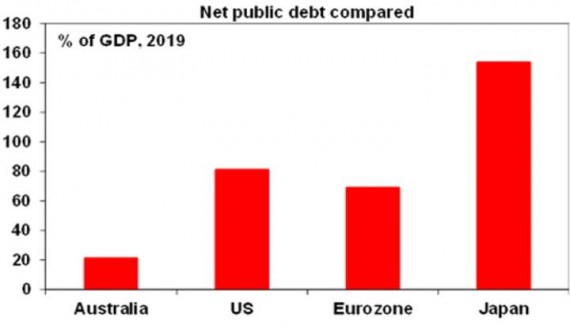
Third, Australia’s public debt is relatively low. Net public debt as a share of GDP is a quarter of what it is in the US. So, Australia has far greater scope to do fiscal stimulus than other countries.


Source: IMF, AMP Capital

Fourth, the cost of borrowing for the Federal Government is very low at just 0.25% for three years and 0.75% for ten years.

Finally, the budget blowout may risk a downgrade in Australia’s AAA sovereign debt rating, but Australia’s public finances will still look better than others. And I would rather a rating downgrade than a deep depression/recession any day.

When the dust settles Australia will be left with higher net public debt at maybe around 45-50% of GDP. It will be the price we paid to (hopefully) minimise the loss of life from the virus and at the same time minimise the hit to people’s livelihoods from the shutdown. This may necessitate forgoing the next round of tax cuts or a new deficit levy. And it may put a burden on future generations as wartime spending did. But I reckon that’s a cost most Australians are prepared to wear.

Why is monetary stimulus necessary? Low interest rates won’t get us to spend when we are stuck at home

Yes, people can’t spend much now, but as with government stimulus much of the central bank easing has been aimed at “protecting” the economy. This has three key elements:

  • lowering interest rates to make it easier for borrowers to service their loans – eg, the RBA has cut interest rates and targeted lower bond yields to cut long term borrowing costs; 

  • pumping money into financial markets to make sure they keep functioning. As the crisis intensified bond yields perversely started to rise (as fund managers had to sell their liquid winning assets to meet redemptions) and corporate borrowing rates surged as investors feared defaults so the Fed pumped money into the US bond and credit markets to push yields back down. The ECB has done something similar in Europe by buying Italian bonds; and 

  • ensuring cheap access to funds for borrowers – eg, the RBA has provided funding for banks for 3 years at 0.25% which has enabled the banks to cut rates and offer debt payment holidays. The Fed is even undertaking direct lending.

How does quantitative easing help the government stimulus measures? Won’t it cause inflation?

Quantitative easing – which the RBA has now joined the Fed, ECB and Bank of Japan in doing – involves using printed money to buy government bonds in order to help keep interest rates down. The central bank buys these bonds in the secondary market (eg from fund managers) so it’s not directly providing the money to the government and those bonds must still be paid back when they mature. So, it’s not really “helicopter money” – which would see the RBA print money and give it to the Government which it would then spend. But of course, it is aiding the government’s stimulus program by helping to keep bond yields down. In the meantime, the balance sheet of the RBA will rise as it holds more bonds, but this is not a major issue unless inflation starts to rise due to all the extra printed money in the system. The Fed, ECB and Bank of Japan have been doing QE for years with no rise in inflation, so the RBA has a long way to go before it becomes a problem. Put simply there is no magical right or wrong level for the RBA’s balance sheet so if you are worried about it, just ‘chillax’.

How high will unemployment go?

We see unemployment rising well above 10% in the US (possibly to even 25%). But in Australia, there is a good chance that the Government’s wage subsidy scheme will keep up to 6 million workers in the most affected parts of the economy in a job and this may contain unemployment to below 10% here. The decline in unemployment though will likely be slow though depending on the shape of the recovery.

Will the recovery in the level of economic activity look a V, a U or an L?

Much will depend on how long it takes to control the virus. An L shaped (or no real) recovery is unlikely given: evidence that shutdowns will slow down the number of new cases as occurred in China and may now be starting to occur in Italy; the chances of a medical breakthrough; and all the stimulus which should aid some sort of recovery. By the same token a quick V style recovery is unlikely given that absent a quick medical solution the shutdowns will be phased down only gradually (with international travel being perhaps the last restriction to be removed). This suggests a U-shaped recovery is most likely.

Could anti-virals or a vaccine improve the outlook?

Put simply yes. A study of past epidemics and the medical response to them by my colleague Brad Creighton shows an ability of governments working with scientists and the medical community to rapidly speed up the development and deployment of anti-virals and vaccines. There is now a massive global effort on this front and some drugs are promising. So, it’s not out the question that there is a breakthrough enabling a quicker relaxation of shutdowns.

When will shares recover?

The historical record of share markets through a long litany of crises tell us they will recover and resume their long-term rising trend. The massive global policy response to support economies in the face of coronavirus driven shutdowns is starting to tilt the risk scales against a long depression scenario. This is why share markets have started to get some footing over the last week or so after seemingly being in free fall for a month. Key things to watch for a sustained bottom are: signs the number of new cases is peaking – with positive signs emerging in Italy; the successful deployment of anti-virals; signs that corporate and household stress is being successfully kept to a minimum – too early to tell; signs that market liquidity is being maintained and supported as appropriate by authorities – this has improved; and extreme investor bearishness – investor panic is already evident but it can get worse.


Source: AMP Capital 2 April 2020

Important notes: While every care has been taken in the preparation of this article, AMP Capital Investors Limited (ABN 59 001 777 591, AFSL 232497) and AMP Capital Funds Management Limited (ABN 15 159 557 721, AFSL 426455)  (AMP Capital) makes no representations or warranties as to the accuracy or completeness of any statement in it including, without limitation, any forecasts. Past performance is not a reliable indicator of future performance. This article has been prepared for the purpose of providing general information, without taking account of any particular investor’s objectives, financial situation or needs. An investor should, before making any investment decisions, consider the appropriateness of the information in this article, and seek professional advice, having regard to the investor’s objectives, financial situation and needs. This article is solely for the use of the party to whom it is provided and must not be provided to any other person or entity without the express written consent of AMP Capital.

As government-mandated lockdown comes into force, there are some existing risks to small business that could be felt more acutely if precautions aren’t taken. That’s right, it’s time to rethink your cybersecurity protocols.

Small businesses are already experiencing a financial downturn as a result of COVID-19.

Now, governments in Australia and New Zealand have announced further measures to restrict business activity to the bare essentials in a bid to prevent people meeting face to face and spreading the virus further.

This is resulting in an increasing number of workers and business owners reorganising their life around working from home.

Key COVID-19 lockdown concerns for small businesses:

  • Lockdowns are in place, so priority #1 is figuring out how to continue trading, where possible

  • For those who can do so, remote work is quickly becoming the norm, but this is causing challenges of its own

  • Small businesses aren’t all prepared for remote work and may not be aware of additional cybersecurity measures that should be taken

  • MYOB has offered 11 tips for improving your cybersecurity in lockdown below

And while that may be fine for those in larger organisations where systems and processes related to remote work have been in place for years, many small businesses are struggling to adjust.

“As we’ve watched countries across Europe effectively lock down their economies, it is becoming increasingly clear that businesses will be looking for ways to keep their operations running, and we should be providing support to enable them to do so,” said MYOB’s NZ country manager, Ingrid Cronin-Knight.

“Most SME’s will not have experienced a disruption to their business of this magnitude, and while technology has enabled more flexibility to connect in a virtual environment, many businesses will not have the knowledge or capability to implement such a significant change quickly and safely.

“Alongside the technical challenges of scaling up their work from home operation, are the risks – potentially very large – of securing these businesses against cyberattack.”

Cronin-Knight said security experts are warning about the risks of large scale moves to remote working, as cyber criminals seek to exploit the opportunity of more businesses moving online.

According to the MYOB Business Monitor survey of 1,000 New Zealand SMEs, almost a third (29 percent) of the nation’s businesses have been the victim of a cyber security breach in the form of malware, online scam, hack, phishing or ransomware attack.

The Australian Competition and Consumer Commission’s Scamwatch has also received multiple reports of COVID-19-themed scam texts being sent to the public, so it’s not hard to imagine government lockdowns will create an ideal environment for scammers, hackers and fraudsters.

Mitigating the risks to business of working from home

As working from home programs becoming increasingly prevalent to reduce the spread of COVID-19, cybersecurity will therefore become a key risk to be addressed by SMEs implementing this model.

MYOB’s head of product, SME, Dale Dixon says in the rapidly changing environment businesses should be as prepared as they can be for remote work, with clear guidelines on how to protect themselves and their businesses as best they can.

“If we follow the same path as many other countries and go into ‘lockdown’, businesses will look to keep their operations running by implementing remote working technology,” said Dixon.

“Not all businesses will have the knowledge or capability to implement a significant change to how they work quickly and safely.”

That’s because staff members working from home may not have access to the same tools and information an entire business has when planning cybersecurity measures, and the staff who would normally support them don’t have the same access they usually would.

There are several actions that SMEs can take to protect themselves online including updating all software with the latest security upgrades and patches, installing and updating firewalls on home services and using technology to enable password protection, such as 2-Factor Authentication (2FA).

In addition, it’s important to educate other home occupants, including kids, on the risks of scams, malware and phishing attacks that could infect devices.

Further, small business owners should seek to protect business communications by using a VPN or another secure communication method when connecting to your business over Public WiFi services.

“It’s important that all businesses consider the key security and continuity risks involved in transitioning to a remote working operation,” said Dixon.

Security recommendations for SMEs working from home:

  1. Update all software and operating systems with the latest security updates and patches

  2. Make sure firewall technologies are installed and configured appropriately on systems used at home

  3. Keep all endpoint protection services, such as anti-virus and anti-malware software enabled and updated

  4. Ensure routers and other telecommunications equipment don’t use default passwords and credentials.

  5. Use multi-factor authentication (2FA) for all remotely accessible services and systems where possible (2FA creates additional security by requiring a one-use code generated by an authorisation app)

  6. Update filtering for spam and malware on email systems

  7. Make sure backups are in place on all key systems and data

  8. Don’t store customer data without adequate security

  9. Keep staff informed of all incident response procedures as they apply to remote working

  10. Make certain that administrators or privileged users are aware and follow all security processes and procedures

  11. Provide adequate security awareness training regarding staying safe at home


Source: MYOB

Reproduced with the permission of MYOB. This article was originally published at www.myob.com/au/blog/

Important:

This provides general information and hasn’t taken your circumstances into account. It’s important to consider your particular circumstances before deciding what’s right for you. Although the information is from sources considered reliable, we do not guarantee that it is accurate or complete. You should not rely upon it and should seek qualified advice before making any investment decision. Except where liability under any statute cannot be excluded, we do not accept any liability (whether under contract, tort or otherwise) for any resulting loss or damage of the reader or any other person.

Any information provided by the author detailed above is separate and external to our business and our Licensee. Neither our business nor our Licensee takes any responsibility for any action or any service provided by the author.

Any links have been provided with permission for information purposes only and will take you to external websites, which are not connected to our company in any way. Note: Our company does not endorse and is not responsible for the accuracy of the contents/information contained within the linked site(s) accessible from this page.