This is an update of a note I wrote last November, but after the recent plunge in shares and the associated 10% or so loss in balanced growth superannuation funds through the March quarter, it’s particularly relevant now. When share markets plunge as they did into March the standard questions are: What caused the fall? What’s the outlook? And what does it mean for superannuation? The correct answer to the latter should be “nothing really, as super is a long-term investment and share market volatility is normal.” This may sound like marketing spin. But, except for those who are into trading or are close to or in retirement – shares and super really are long-term investments.

Super funds, growth assets & compound interest

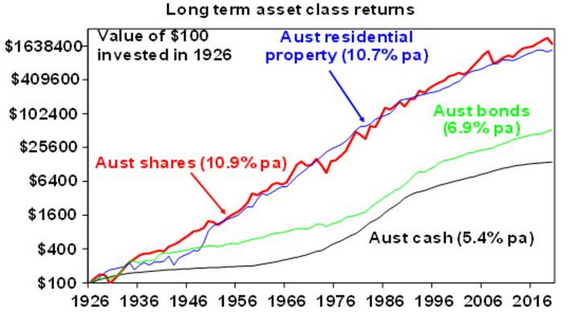
Superannuation is aimed (within reason) at providing maximum (risk-adjusted) funds for use in retirement. So typical Australian super funds have a bias towards shares and other growth assets that grow in value with the economy, particularly for younger members, and some exposure to defensive assets like bonds and cash to avoid excessive short-term volatility. These approaches aim to make the most of the power of compound interest which sees returns build on returns over time. The next chart shows the value of a $100 investment in Australian cash, bonds, shares and residential property from 1926 assuming any interest, dividends and rents is reinvested along the way.

Source: ABS, ASX, Bloomberg, REIA, AMP Capital

As return series for commercial property and infrastructure only go back a few decades I have used residential property as a proxy. Over the period shown since 1926 cash has returned 5.4% per annum, bonds 6.9% pa, property 10.7% pa and shares 10.9% pa. Because shares and property provide higher returns over long periods the value of an investment in them compounds to a much higher amount over long periods. So, it makes sense to have a decent exposure to them when saving for retirement. The higher return from shares and growth assets reflects compensation for the greater risk in investing in them – in terms of capital loss, volatility and illiquidity.

But investors don’t have 90 years?

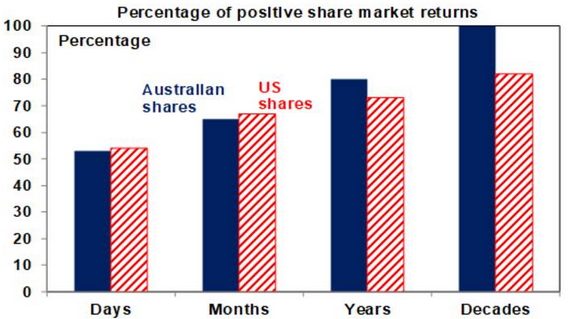
But while the above chart covered more than 90 years of returns, our natural tendency is to think very short term. Particularly so in times of uncertainty like now. And this is where the problem starts. On a day to day basis shares are down almost as much as they are up. See the next chart. So, day to day, it’s pretty much a coin toss as to whether you will get good news or bad on shares. But if you just look monthly and allow for dividends, the historical experience suggests you will only get bad news around a third of the time. If you go out to once a decade, positive returns have been seen 100% of the time for Australian shares and 82% for US shares. So while it’s hard given the bombardment of financial news these days it makes sense to look at your returns less because then you are more likely to get positive returns and less likely to make rash decisions based on short term bad news.

Daily & mthly data from 1995,yrs & decades from 1900. Bloomberg, AMP Capital

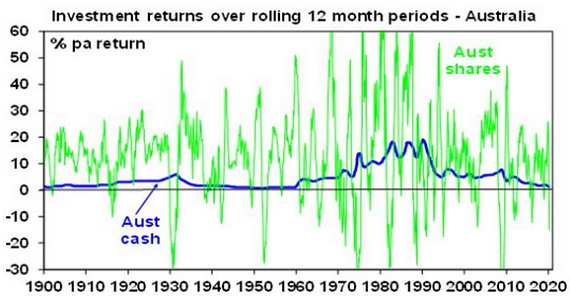
This can also be demonstrated in the following charts. On a rolling 12 month ended basis the returns from shares bounce around all over the place compared to the relative stability of cash (and bonds). See the next chart.

Source: ASX, Bloomberg, AMP Capital

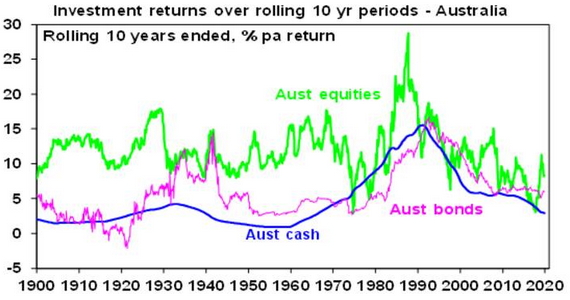
However, over rolling ten-year periods, shares have invariably outperformed, although there have been some periods where returns from bonds and cash have done better, albeit briefly.

Source: ASX, Bloomberg, AMP Capital

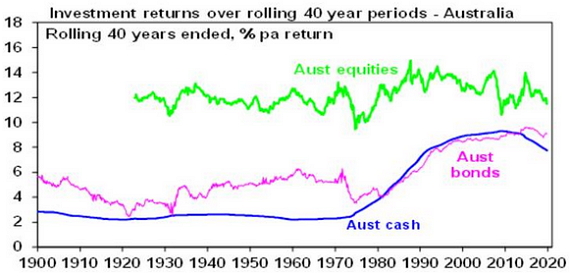
Pushing the horizon out to rolling 20-year returns has almost always seen shares do even better, although a surge in cash and bond returns from the 1970s/1980s has seen the gap narrow. Over rolling 40-year periods – the working years of a typical person – shares have always done better.

Source: ASX, Bloomberg, AMP Capital

This is all consistent with the basic proposition that higher short-term volatility from shares – often reflecting exposure to periods of falling profits and a risk that companies go bust – is rewarded over the long term with higher returns.

But why not try and time short-term market moves?

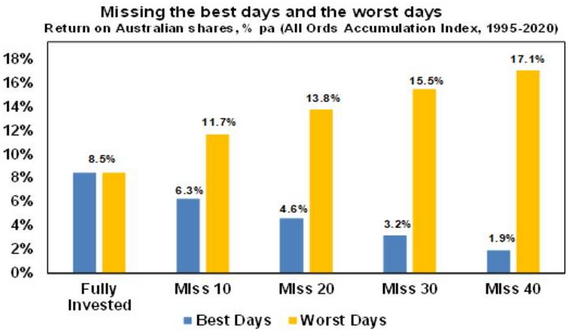
The temptation to do this is immense. With the benefit of hindsight many swings in markets like the tech boom and bust, the GFC and maybe in the years ahead the current episode look inevitable and hence forecastable and so it’s natural to think “why not give it a go?” by switching between say cash and shares within your super to anticipate market moves. Fair enough if you have a process and put the effort in. But without a tried and tested market timing process, trying to time the market is difficult. A good way to demonstrate this is with a comparison of returns if an investor is fully invested in shares versus missing out on the best (or worst) days. The next chart shows that if you were fully invested in Australian shares from January 1995, you would have returned 8.5% pa (with dividends but not allowing for franking credits, tax and fees).

Source: ASX, Bloomberg, AMP Capital

If by trying to time the market you avoided the 10 worst days (yellow bars), you would have boosted your return to 11.7% pa. And if you avoided the 40 worst days, it would have been boosted to 17.1% pa! But this is not easy as many investors only get out after the bad returns have occurred, just in time to miss some of the best days. For example, if by trying to time the market you miss the 10 best days (blue bars), the return falls to 6.3% pa. If you miss the 40 best days, it drops to just 1.9% pa.

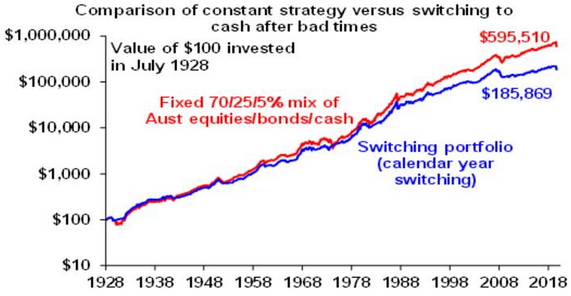
The following chart shows the difficulties of short-term timing in another way. It shows the cumulative return of two portfolios.

  • A fixed balanced mix of 70 per cent Australian equities, 25 per cent bonds and five per cent cash;

  • A “switching portfolio” which starts off with the above but moves 100 per cent into cash after any negative calendar year in the balanced portfolio and doesn’t move back until after the balanced portfolio has a calendar year of positive returns. We have assumed a two-month lag.

Source: ASX, Bloomberg, AMP Capital

Over the long run the switching portfolio produces an average return of 8.6% pa versus 9.9% pa for the balanced mix. From a $100 investment in 1928 the switching portfolio would have grown to $185,869 compared to $595,510 for the constant mix.

Key messages

First, while shares and other growth assets go through periods of short-term underperformance relative to bonds and cash, they provide superior returns over the long term. As such, it makes sense that superannuation has a high exposure to them.

Second, switching to cash after a bad patch is not the best strategy for maximising retirement savings and wealth over time as it locks in the loss with no hope of recovery.

Third, the less you look at your investments the less you will be disappointed. This reduces the chance of selling at the wrong time or adopting an overly cautious stance.

The best approach is to simply recognise that super and investing in shares is a long-term investment. The exceptions to this are if you are really into putting in the effort to getting short-term trading right and/or you are close to, or in, retirement.


Source: AMP Capital 28 April 2020

Important notes: While every care has been taken in the preparation of this article, AMP Capital Investors Limited (ABN 59 001 777 591, AFSL 232497) and AMP Capital Funds Management Limited (ABN 15 159 557 721, AFSL 426455) (AMP Capital) makes no representations or warranties as to the accuracy or completeness of any statement in it including, without limitation, any forecasts. Past performance is not a reliable indicator of future performance. This article has been prepared for the purpose of providing general information, without taking account of any particular investor’s objectives, financial situation or needs. An investor should, before making any investment decisions, consider the appropriateness of the information in this article, and seek professional advice, having regard to the investor’s objectives, financial situation and needs. This article is solely for the use of the party to whom it is provided and must not be provided to any other person or entity without the express written consent of AMP Capital.


Severe market downturns feel anything but fair. In many ways the biggest risk facing investors now is the impulse to take action and to make hasty, short-term decisions based on emotional factors rather than accepting where we are today and riding things out.

The loss of market value that seemingly evaporates overnight is deeply unsettling and challenging even for committed, well-diversified long-term investors.

But market downturns are not unexpected – most of us will experience several during our lifetimes – particularly after such a long bull market run where market surprises were generally on the upside.

Australia we also should remember has not felt a recession in 29 years. That may feel like cold comfort at this time particularly because we are first and foremost dealing with a global health crisis that unravelled extremely quickly, and then the economic impacts that flows from the measures required to contain and combat it.

Uncertainty and the sense of loss of control are powerful emotions to grapple with. But what we know from past market events is that patience will be rewarded and recoveries can be just as sudden and strong.

The positive news is that the general consensus among economists is that while the recession will likely be sharp it is also likely to be relatively short and the upswing quite rapid. It has also been encouraging to see governments around the world prescribing measures to help hasten the recovery.

But the question about what to do – now – remains. At Vanguard we feel there are probably five things investors should think about:

1. Tune out the noise. We all want to be informed but with dedicated television channels, websites and newsletters all on top of our normal media consumption habits this type of news event can be overwhelming. Consider checking in with one or two trusted sources and tune out the rest. It’s ok not to be checking account balances when markets are falling.

2. Revisit your asset allocation. These type of market events impact investors differently. But it is not all doom and gloom. Younger investors have that incredibly valuable asset – time – while those approaching retirement have just been given a sharp example of how much risk is in their portfolio. If it has surprised you then going forward as markets recover it may mean you should re-evaluate your risk tolerance and rebalance your portfolio to take a more conservative approach.

3. We know we cannot control markets but there are some things we can control – like costs. Costs are particularly painful during downturns so take the time to review high cost investments in your portfolio. For those already in retirement it may mean temporarily trimming back on discretionary lifestyle spending to lighten the amount you need to draw down.

4. Stay diversified. Different asset classes and sector exposures can help insulate your portfolio by spreading the risk.

5. Set realistic expectations. Have a long-term plan and be realistic about returns you expect in the decades ahead.

Staying the course can pay off, abandoning course can be costly.


Source : Vanguard March 2020 

Written by Robin Bowerman, Head of Corporate Affairs at Vanguard.

Reproduced with permission of Vanguard Investments Australia Ltd

Vanguard Investments Australia Ltd (ABN 72 072 881 086 / AFS Licence 227263) is the product issuer. We have not taken yours and your clients’ circumstances into account when preparing this material so it may not be applicable to the particular situation you are considering. You should consider your circumstances and our Product Disclosure Statement (PDS) or Prospectus before making any investment decision. You can access our PDS or Prospectus online or by calling us. This material was prepared in good faith and we accept no liability for any errors or omissions. Past performance is not an indication of future performance.

© 2020 Vanguard Investments Australia Ltd. All rights reserved.

Important:
Any information provided by the author detailed above is separate and external to our business and our Licensee. Neither our business nor our Licensee takes any responsibility for any action or any service provided by the author.

Any links have been provided with permission for information purposes only and will take you to external websites, which are not connected to our company in any way. Note: Our company does not endorse and is not responsible for the accuracy of the contents/information contained within the linked site(s) accessible from this page.

As part of its COVID-19 coronavirus economic response, the Federal Government is allowing eligible Australians to access some of their superannuation early.

If you’re eligible, you can access up to $10,000 of your super between 20 April 2020 and by 30 June 2020 and up to a further $10,000 from 1 July 2020 until 24 September 2020.

However, accessing your super early is not without its risks. Super is designed to pay for your life in retirement, so withdrawing money from it now could affect your retirement lifestyle. Below we look at five things to consider to help you make an informed decision.

1. Other government or financial assistance

Many people are suffering financially due to the business shutdowns that have resulted from COVID-19, and you may be having trouble paying your bills, repaying debts or finding money for other essentials, such as food and your rent or home loan. Accessing some of your super early could help to alleviate some of these financial pressures, but there may be other options.

For example, you may be eligible for one of the government’s other COVID-19 financial assistance measures, such as the JobKeeper Payment or Coronavirus Supplement.

Many banks are offering home loan and credit card repayment freezes, but you should check with your lender whether the freeze also applies to the interest on these debts or whether you’ll still be incurring interest during this time. Some landlords and utilities providers are also offering flexibility when it comes to rent and bill payments – it’s worth getting in contact to discuss your situation. Alternatively, your home loan or personal loan may have a redraw facility, you may qualify for a bank overdraft or you may have assets you can sell to boost your cash flow if it’s absolutely necessary.

2. The potential impact on your retirement

Depending on what your current super balance is and how close you are to retirement, withdrawing money from your super early could have a big impact on the quality of your retirement.

According to the Association of Superannuation Funds of Australia (ASFA), to retire comfortably a single person will need retirement savings of $545,000 while a couple will need $640,0001. If retirement is a long way off, it can be difficult to know how your super’s tracking or whether you’re on target to achieve a comfortable retirement. To help you get a general idea about this, check out how your super balance compares to others your age or use our retirement simulator.

It’s also worth considering that while the short-term impact of accessing some super now will be to reduce your super by the amount you withdraw, there may be a more significant impact on your retirement savings over the longer term. This is because you’ll miss out on the additional returns you could have earned through the investment of that money by your super fund – this is known as compounding. While compound interest is very powerful when it’s working to build your super balance, it can be equally powerful in magnifying the impact a withdrawal now could have on your super balance over the long term.

You can also calculate the potential impact on your retirement savings: visit https://moneysmart.gov.au/covid-19/accessing-your-super.

3. Your future plans

Another consideration is whether you have any future plans that may result in temporarily leaving the work force or reducing the amount of income you generate, all of which may affect your ability to save and contribute towards retirement. For example, if you’re planning to return to full-time study, take a gap year overseas, take time off to have a baby or move to working part-time, it’s worth remembering that all these things would likely lead to a reduction in the amount of super you accumulate during that time. And this could have a further impact on the quality of your retirement.

4. The current state of investment markets

Another potential downside associated with accessing some of your super now is that over the past few months investment markets have fallen due to uncertainty around the economic impact of COVID-19.

To withdraw money from your super, your super fund may need to sell some of the assets it owns on your behalf (such as shares and other types of investments). Selling these assets now may lock in any losses and the money you withdraw won’t have the opportunity to grow in value when investment markets recover.

5. The potential loss of insurance cover

Another possible consequence of accessing your super early is how the insurance inside your super will be affected. There are a couple of different ways this could happen.

Firstly, if you withdraw a lump sum from your super and it leads to a zero account balance, your super account may be closed, which means your insurance will be cancelled from the closure date.

Secondly, super laws were brought in in 2019, to help protect super balances from being unnecessarily reduced by insurance premiums. One of these laws, called the Protecting Your Super package, requires super providers to cancel any insurance inside super accounts that don’t receive a contribution or rollover for 16 months. This means, if you’re not in a position to make any contributions into your super account for 16 months, your insurance may be cancelled unless you tell your super provider you want to keep it.

If your insurance is cancelled because your account has been inactive for 16 months, and your account balance is below $6,000, we’re also required to transfer your balance to the Australian Tax Office. Where possible, the ATO will then try to connect this super money with your active super account. Exceptions apply.

What you can do about your insurance

If you’re thinking about accessing your super early, make sure you’re clear about how much insurance you currently have through your super, and whether you want it.

A good way to work out whether your insurance premiums aren’t unnecessarily reducing your balance is to use our general rule of thumb: your monthly insurance premium should be below 1% of your salary. (Note: This may not apply to people who require a higher amount of insurance cover to meet their needs).

To stop your insurance from being cancelled because the account becomes inactive for 16 months, make sure a contribution or rollover is made into the account before the 16 month mark is up, or fill in this keep my insurance form.

If your insurance does get cancelled, you’re still eligible to lodge a claim for a loss event if it occurred any time before the account was closed. There may also be a window of opportunity to get it back, although it can sometimes be hard to get back at the same price or benefit level. Check your PDS for all the details specific to your super and insurance.

If you’re concerned about your insurance and what’s right for you, you should speak to a financial adviser. Please contact us on Phone: 07 5641 4134.

Learn more about insurance inside super

Pay it forward

If you do decide to access some super early, it’s a good idea to first check your super balance . It might be worth working out exactly how much you’ll need and only withdrawing that amount, rather than the maximum $10,000 per withdrawal available – after all, the more money you can leave in your account to grow for the future the better your retirement might be.

Alternatively, if you’re not sure what the future may hold and decide to withdraw the full amount available, you could always consider putting any unused money back into your super later on.

Ask an expert

Before making any decisions, to check your super balance. It may also help to speak to an expert – to do this you can contact us Phone: 07 5641 4134.


1 ASFA, Retirement Standard, December 2019.


Source : AMP April 2020 

Important: This information is provided by AMP Life Limited. It is general information only and hasn’t taken your circumstances into account. It’s important to consider your particular circumstances and the relevant Product Disclosure Statement or Terms and Conditions, available by calling Phone: 07 5641 4134, before deciding what’s right for you. All information in this article is subject to change without notice. Although the information is from sources considered reliable, AMP and our company do not guarantee that it is accurate or complete. You should not rely upon it and should seek professional advice before making any financial decision. Except where liability under any statute cannot be excluded, AMP and our company do not accept any liability for any resulting loss or damage of the reader or any other person.

Stress, feelings of overwhelm, worry and fear are all normal and understandable reactions as we face the uncertainty of the COVID-19 pandemic.  We are in extraordinary times, and therefore extraordinary measures need to be taken when it comes to managing stress.  One of the best interventions to combat stress is to nourish your body with foods that can help promote positive mental health.

Stripping back stress

Stress affects all systems of the body and triggers biological responses. Stress can be positive, propelling us into action via the ‘fight/flight response’, allowing us to perform well or stay safe. However, when stress is chronic, it can create internal chaos, and we might be left:

  • Feeling tired

  • Feeling depressed or anxious

  • Lacking motivation and inability to concentrate and make clear decisions

  • Craving foods – especially salty and sweet foods

  • Feeling irritable and less tolerant

  • Having difficulty with sleep

  • With brain fog and lacking clarity

  • With physical symptoms such as increased heart rate, upset stomach, or low blood sugar

We cannot control a lot of what is happening around us right now with this COVID-19 pandemic, but doing the things we can control, like what foods we choose, can be critical in preserving mental health and managing stress during this time.

Eight food tips to beat stress

Eat regularly

Avoid skipping meals to prevent those blood sugar crashes, which may result in cravings and fatigue.  However, do avoid snacking late into the night so that your body gets essential rest from digesting overnight.

Love your gut 

Your gut is a collection of trillions of bacteria, the microbiome, that influence all aspects of health, including brain health via the gut-brain connection.  Include a wide variety of seasonal and colourful fruits and vegetables for prebiotic fibres to feed the microbiome.  And for a natural source of probiotics include fermented foods like kefir and natural unsweetened yoghurt, kombucha, kimchi, sauerkraut.  

Maximise the magnesium, zinc and B vitamins

 These essential vitamins play a vital role in helping your brain handle stress better.  These can be found in green leafy vegetables, legumes like chickpeas, lentils, and beans, in fish, grass-fed beef and free-range poultry and eggs, cruciferous vegetables like broccoli, avocados, and nuts.

Foods to support sleep  

I’m a firm believer (and see consistent proof of this with my patients) that when you sleep well, so many other conditions seem to improve, especially stress.  The body works hard during sleep carrying out essential healing and repair.  To improve sleep, avoid stimulants like caffeine, chocolate, and alcohol in the afternoon and evening and maintain a consistent sleep time and routine.

Sip away the stress

 The act of making a cup of tea can be quite stress-relieving in itself, forcing a moment of a ‘pause’.  Choose herbal blends that help with relaxation like chamomile, lemon balm, lavender, passionflower or green tea.

Ditch the sugar

 In times of stress, it is common to reach for the packaged and sugary foods.  However, these added refined sugars can increase anxiety and cause cravings and fatigue.  Swap out the refined sugars and ‘white’ carbohydrates, like sweets, white bread and pasta, processed cereals, soft drinks and sweet drinks.  Include whole food low-GI options such as brown basmati rice & quinoa, wholegrain sourdoughs, steel-cut oats, whole fruits, and sweet potato. 

Praise the protein

Protein provides the amino acids that are needed for essential brain chemicals – neurotransmitters – that make positive emotions and help combat feelings of stress.  Animal foods such as grass-fed meats and dairy, fish, free-range poultry and eggs, contain all eight essential amino acids making them a ‘complete protein’.  Vegetarian and vegan protein sources include eating a combination and wide variety of things like quinoa, hemp, beans and legumes, nuts and seeds.

High five the healthy fats

Healthy fast are essential for brain health, reducing inflammation and helping to stabilise mood.  Dress your salad with Extra Virgin Olive Oil, include oily fish like sardines or salmon twice a week, snack on raw nuts like almonds, walnuts or brazil nuts, have a side of eggs and avocado, and ditch the refined vegetable oils.

“Let food be thy medicine, and medicine be thy food.”

Focus on adding in the ‘good stuff’ and ‘crowd out’ the foods that don’t serve our mental health.  By eating nourishing foods rich in all the essential nutrients for combatting stress, eating less out of a packet and more real food, our bodies can be fuelled to maintain positive mental health.


Source: Emily Connell Nutritional Medicine 

Emiy Connell, BHSc Nutritional Medicine, BAppSc Occupational Therapy

Emily is a Nutritional Medicine practitioner, writer, speaker, facilitator and trainer.  Emily combines her passion for Nutritional Medicine with her background in Occupational Therapy, mental health & management to support people to achieve health & inspire wellness.  

Important note: 
This provides general information and hasn’t taken your circumstances into account.  It’s important to consider your particular circumstances before deciding what’s right for you. 

Any information provided by the author detailed above is separate and external to our business and our Licensee. Neither our business nor our Licensee takes any responsibility for any action or any service provided by the author.

Any links are provided for information purposes only and will take you to external websites, which are not connected to our company in any way. Note: Our company does not endorse and is not responsible for the accuracy of the contents/information contained within the linked site(s) accessible from this page.

The blanket coverage of coronavirus and its impact on the economy can lead to a lot of confusion right now. Some reports are hopeful of anti-viral drugs, others say a vaccine is at least a year away. There is talk of curve flattening but still rising cases and deaths. There is news of an easing in lockdowns but also worries about “second waves”. All this against a backdrop of collapsing economic data and surging unemployment. Some prognosticators say now is a great buying opportunity for investors whereas others see more financial pain ahead. This is a horrible time for humanity and particularly those directly affected by coronavirus, but I must say if ever there was a time to turn down the noise and listen to The Carpenters or Taylor Swift, this is it. Here is a summary of where we are currently at. First the bad news and then the good. I will keep it simple.

The bad news

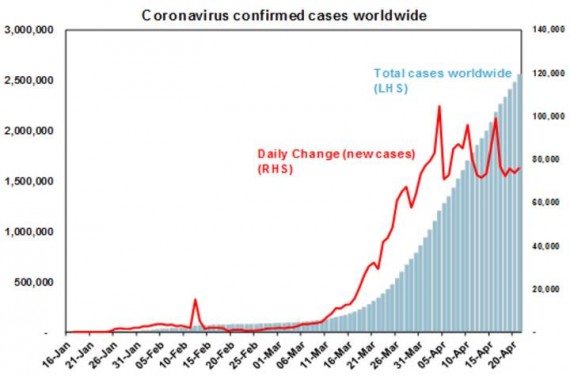
  • The reported number of coronavirus cases globally is still rising and has now gone through 2.5 million. 

  • The reported death rate is still rising and is now up to 6.9%.

  • Many worry about a “second wave” of cases. This occurred in the 1918 Spanish flu outbreak, and Singapore and Japan which had been cited as models for containment are now cited as examples of this (although they really still seem to be in part of a first wave as their quarantining efforts failed).

  • Most medical experts still say a vaccine may be a year or more away. I remember around 1984-85 constantly hearing a vaccine for HIV was a year away – but we are still waiting.

  • In the absence of a vaccine some worry about coronavirus outbreaks every winter as it migrates around the world.

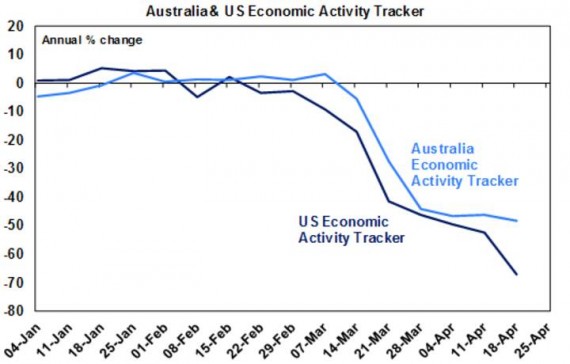
  • Economic activity data is literally falling off a cliff. This was highlighted last week by the IMF’s forecast for a contraction in the global economy of 3% this year and in advanced economies of around 6%. And this masks a likely 10 to 15% slump in GDP centred on the June quarter. Falls of that magnitude have not been seen since the Great Depression. The collapse in economic activity in the US and Australia is highlighted by weekly economic activity trackers we have constructed based on data for things like restaurant bookings, energy usage, confidence, foot traffic and jobs.


Source: Bloomberg, AMP Capital

  • We are constantly hearing forecasts of unemployment going to 10%, 15% and maybe even 30% in the US (which does not have the benefit of Australian JobKeeper wage subsidies – if you are having a salary paid by JobKeeper then you will not be unemployed).

  • This in turn is creating much consternation around whether there will be an economy left once the shutdowns end and/or how governments will get their debt down.

  • Finally, the blame game is on. While partly politically motivated, US China tensions seem on the rise again.

The good news

  • While the total number of coronavirus cases is rising, new cases appear to be levelling off or in decline.


Source: Worldometer, AMP Capital

  • Numerous European countries, led by Italy, look to be following the same path as China which saw a blowout in new cases, a lockdown followed 2-3 weeks later by a peak in new cases and then falling new cases. Australia appears to have been very successful in following this path (with the peak coming faster) and the US now seems to be following the same path, albeit its yet to show a decent downtrend in new cases. Social distancing clearly works! (Just out of interest – with various countries following the same pattern China has reported it makes me think the Chinese data on new cases is roughly right despite emerging scepticism.)


Source: Worldometer, AMP Capital


Source: Worldometer, AMP Capital

  • Following this, the focus is shifting towards an easing of lockdowns. Various European countries and New Zealand have already announced some easing, allowing some shops to open/activities to occur. The US has released guidelines for states to move through a three phased reopening if they meet various criteria (in terms of falling new cases & hospitals coping) before moving to each new phase. 

  • While Australia’s PM Scott Morrison has indicated that current restrictions will remain broadly in place for another few weeks, he has indicated three criteria for an easing in restrictions: better testing; better contact tracing; and confidence in containing outbreaks all of which makes sense given the risks Australia faces coming into winter. Of course, successful anti-virals and/or a vaccine would make it all a lot easier, but we can’t rely on either just yet.

  • Most countries talking of easing are well aware of the risk of a second wave (although President Trump’s bravado about “liberating” states is worrying). Hence a focus on phased easing only once certain criteria – around testing, new cases and quarantining – have been met. This is very different to what happened in relation to Spanish influenza where there really wasn’t any testing. For Australia this is likely to mean a gradual opening up from May. In the absence of a vaccine, full international travel is likely to be the last thing to return. That’s not great but given that in net terms its worth less than 0.5% of GDP to the Australian economy, it’s trivial compared to the 10-15% hit that’s come from shutting or partially shutting about 25% of the economy as it would be this mainly domestically driven activity that would bounce back as the shutdown is eased.

  • Fiscal and monetary stimulus has been ramped up to the point that they should help minimise second round effects on economies enabling them to bounce back faster. This is particularly the case in Australia where the focus has been on job subsidies to preserve jobs, support businesses and low-cost RBA funding has enabled banks to offer loan payment holidays. Yes, there may be longer term issues in paying down debt, but they are small compared to the cost of allowing a bigger and deeper hit to the economy from not protecting businesses and incomes through the shutdown.

If, as appears likely, an easing of the lockdowns becomes common place in May/June, then April or maybe May should be the low point in economic data much as February was in China. This does not mean that things will quickly bounce back to normal – some businesses will not reopen, uncertainty will linger, debt levels will be higher and business models will have to adapt to different ways of doing things around working and shopping. On our forecasts it will look like a deep V recovery in terms of growth rates, but looked at in terms of the level of economic activity it will take a lot longer to get back to normal and this will mean that it will take a while to get unemployment down – from a likely peak in Australia of around 10%. But at least growth will be able to return and spare capacity and high unemployment will mean that it will take a while for inflation to pick up and so low rates will be with us for a long time.

This is all very different to five or six weeks ago when there was talk of six-month lockdowns, no confidence as to whether they would work and the policy response was seen as inadequate.

What does it mean for investors?

From their high in February to their low around 23 March, global shares fell 34% and Australian shares lost 37% as all the news was bleak. Since that low to their recent high, shares have had a 20% plus rally helped by policy stimulus and signs of coronavirus curve flattening. But this strong rally has left them a bit vulnerable in the short term – particularly as we have now entered a period which is likely to be see very weak economic data and news on profits. The ongoing dislocation in oil prices – to a “record low” of -$40 a barrel for West Texas Intermediate – has added to this, although lower petrol prices are ultimately more of a help than a hindrance to a recovery in economic activity. So, the very short-term outlook for shares is uncertain and a re-test of the March low cannot be ruled out.

However, shares are likely to be higher on a 1-2 year horizon as evidence of curve flattening, easing shutdowns combined with policy stimulus ultimately see a return to growth against a background of still very low interest rates and bond yields.

From a fundamental investment point of view the historical experience that covers recessions, wars and even pandemics (in 1918) tells us that the long-term trend in shares and other growth assets is up and that trying to time bottoms is always very hard. No one will ring the bell at the bottom, which by definition will come at a time of maximum bearishness when all the news is horrible. Maybe the low was back in March, maybe it wasn’t. To borrow from John Kenneth Galbraith’s famous quote on forecasters I will admit that I know that I don’t know1. So a good approach for long-term investors is to average into markets after bear market falls over several months.


1 “There are two kinds of forecasters: those who don’t know, and those who don’t know they don’t know.” – JK Galbraith.

Source: AMP Capital 22 April 2020

Important notes: While every care has been taken in the preparation of this article, AMP Capital Investors Limited (ABN 59 001 777 591, AFSL 232497) and AMP Capital Funds Management Limited (ABN 15 159 557 721, AFSL 426455) (AMP Capital) makes no representations or warranties as to the accuracy or completeness of any statement in it including, without limitation, any forecasts. Past performance is not a reliable indicator of future performance. This article has been prepared for the purpose of providing general information, without taking account of any particular investor’s objectives, financial situation or needs. An investor should, before making any investment decisions, consider the appropriateness of the information in this article, and seek professional advice, having regard to the investor’s objectives, financial situation and needs. This article is solely for the use of the party to whom it is provided and must not be provided to any other person or entity without the express written consent of AMP Capital.

Australia’s $3 trillion superannuation system is largely framed around the long-term retirement needs of individuals.

Current legislation doesn’t allow couples to have joint member superannuation accounts, reflecting the various complexities around existing aged-based superannuation access rules and how they be applied across combined retirement assets.

That’s a work in progress, with various industry players having recently lodged submissions with the Federal Government recommending that married and de facto couples be enabled to blend and access each other’s superannuation savings.

Yet, what’s often overlooked by couples is the fact they already have the ability to transfer superannuation savings between themselves. This can be done under contributions splitting allowances that are regulated by the Australian Tax Office.

Used strategically, superannuation contributions splitting can produce major financial gains for couples over the long term.

The benefits of super splitting are most powerful around retirement, when couples are able to take advantage of tax-free lump sum withdrawals, and if one person is several years older than the other.

And recent changes to retirement legislation, such as the introduction of the $1.6 million pension balance cap and a five-year concessional contributions catch-up allowance, mean there are even more incentives and opportunities for couples to work together on their superannuation rather than separately.

Before getting into the granular details, here’s a general explainer of the contributions splitting rules.

How splitting works

The full guidelines around splitting, including eligibility and how to apply, are available on the ATO website.

On a basic level, the ATO allows couples to split up to 85 per cent of their annual 9.5 per cent employer concessional contributions, as well as additional salary sacrifice and personal super contributions. But any splitting of contributions must be done following the end of the financial year in which the super contributions were made.

Splitting can be done at any age, but a spouse must be either less than their applicable preservation age or between their preservation age and 65 years, and not retired.

Those wanting to split contributions need to first check whether their super fund allows it, and then download an application form from the ATO website.

Getting a better super balance

Couples often end up with vastly different superannuation account balances for various reasons, such as if one partner has stopped work to raise a family.

But contributions splitting isn’t necessarily about evening up a couple’s super balances. On a more holistic level, it’s more often about using contributions to maximise retirement outcomes further down the track.

Accessing an Age Pension

Long-term planning is the key with contributions splitting, especially when there is a large age gap between spouses.

When an individual reaches age pension age (currently 66) their superannuation balance becomes an assessable asset (along with other assets) for Age Pension calculation purposes. On the other hand, the superannuation of a younger spouse isn’t yet accessible.

If the older spouse’s assessable assets are below the pension assets test thresholds, they could be entitled to a part of full Age Pension.

The pension rules are very complex, and outcomes depend on a range of factors, but assuming an older spouse meets all the rules there could be a substantial benefit in splitting their contributions to their younger spouse over time so the older partner can qualify for a government pension.

Even if this is just a temporary financial benefit until the younger spouse reaches pension age, it could still be substantial over a number of years.

Tax-free lump sum withdrawals

Another example of maximising contributions splitting outcomes is the tax-free lump sum super allowance.

Any person reaching their preservation age is currently able to withdraw up to $210,000 from their super account as a tax-free lump sum.

Contributions splitting comes into play when one spouse is likely to end up with substantially more than the lump sum maximum level at retirement and the other will be well short.

By working together over time a couple can ensure that they both have at least the maximum lump sum withdrawal amount in their respective super accounts by their preservation ages, which would enable them to collectively withdraw up to $420,000 tax free.

The $1.6 million pension cap

The Federal Government’s recent move to cap the amount of funds that can be held in a tax-free pension account at $1.6 million represented one of the biggest changes to the superannuation system in years.

Those with more than $1.6 million must transfer any excess into a superannuation accumulation account and pay 15 per cent tax on earnings.

In a situation where spouses have very uneven super balances before retirement, and where one could breach what’s known as the transfer balance cap, it makes sense to use contributions splitting to keep the spouse with the highest super balance below the cap.

If super splitting becomes part of a couple’s ongoing financial strategy, starting as early in the relationship as possible, such a strategy could ensure both partners can keep their pension account balances below the mandated cap and thereby receive higher tax-free income.

The super catch-up rules

As detailed above, the contributions splitting rules allow couples to effectively move 85 per cent of their Superannuation Guarantee, salary sacrifice and personal concessional contributions from one partner to another.

Individuals are able to put $25,000 per annum in concessional contributions (taxed at 15 per cent) into their super account.

But behind the annual concessional limits are newly introduced catch-up rules allowing individuals with total superannuation balances below $500,000 on 30 June of the previous financial year to carry forward their unused annual allowances, on a rolling basis, for five years.

The five-year carry-forward period started on 1 July 2018, so the 2019-20 financial year is the first one where individuals can make extra concessional contributions if they didn’t make a full $25,000 concessional contribution in 2018-19.

And this will enable couples to potentially split even higher amounts from this financial year on, based on them being able to transfer up to 85 per cent of their eligible super payments.

The importance of advice

Contributions splitting is a powerful strategy that can have substantial financial outcomes for couples.

But it is complex and needs to be considered as part of a couple’s broader long-term investment strategy towards retirement.

There are a range of elements that need to be factored in, not the least being Government legislation around superannuation limits, Age Pension entitlements and potential tax implications.

So it’s important for couples to seek out professional financial advice, preferably as early as possible, to ensure they get the maximum benefits out of contributions splitting.

Please contact us on Phone: 07 5641 4134 if you seek further discussion on this topic.

Source : Vanguard 

Reproduced with permission of Vanguard Investments Australia Ltd

Vanguard Investments Australia Ltd (ABN 72 072 881 086 / AFS Licence 227263) is the product issuer. We have not taken yours and your clients’ circumstances into account when preparing this material so it may not be applicable to the particular situation you are considering. You should consider your circumstances and our Product Disclosure Statement (PDS) or Prospectus before making any investment decision. You can access our PDS or Prospectus online or by calling us. This material was prepared in good faith and we accept no liability for any errors or omissions. Past performance is not an indication of future performance.

© 2020 Vanguard Investments Australia Ltd. All rights reserved.

Important:
Any information provided by the author detailed above is separate and external to our business and our Licensee. Neither our business nor our Licensee takes any responsibility for any action or any service provided by the author.

Any links have been provided with permission for information purposes only and will take you to external websites, which are not connected to our company in any way. Note: Our company does not endorse and is not responsible for the accuracy of the contents/information contained within the linked site(s) accessible from this page.

These are unnerving times for investors. Markets are roiled by the outbreak of COVID-19 and its potential – and still uncertain – global health and economic impacts.

Investors probably will experience three or four of these type of market events in their lifetime – October 2008 when the global financial crisis hit being the last one; October 1987 being another that is seared into the memories of a generation of investors.

With the benefit of hindsight and the passing of 11 years since the GFC, those market shocks can now be seen in the broader context as fire sale buying opportunities. To channel Warren Buffett would you rather buy when the market is on sale or when it is priced at a premium? The challenge is that when the sharemarket is on sale there it is usually accompanied by a heightened sense of fear or panic.

As investors we crave certainty and confidence in our decisions and we are wired as emotional beings so the challenges are both real and confronting particularly when being bombarded with escalating bad news on the evening news and via social media platforms.

Diversification, discipline and a long-term perspective are an investor’s allies when deep in the trenches of a dramatic market downturn. While even a well-diversified portfolio is not shielded from a global equity market drop of 15-20% it will – thanks to the defensive fixed income allocation – soften the blow somewhat. More importantly it has you in position to benefit when the challenging period passes – which it will.

Much can be said about the value of diversification in times like this. When share markets are roaring along at 20% growth rates in a year (remember 2019?) you would probably rather be invested 100% in equities because that captures all that performance rather than the dilution affect that comes with spread of assets in a broadly diversified portfolio.

But if you look at the Vanguard Australian shares index ETF and compare it to the Vanguard Diversified Growth index ETF the data tells the story. The Vanguard Australian shares index ETF has done what it aims to by tracking the market performance closely and for the 12 months ended March 13 the performance is -10.42%.

In contrast the Vanguard Diversified Growth index over the same time period is -5.13%. No investor likes to see their performance number in red ink, but if you had a choice of outcomes the answer seems obvious and it is why Vanguard emphasises the benefits of diversification.

Major market impacts like COVID-19 may not have been predicted but they are not unexpected. A major challenge and impediment for investors in achieving their long-term goals is having the discipline to stay the course. Having a long-term financial plan tailored around your risk tolerance level and financial goals is a truly valuable tool to help you turn down the crescendo of short-term market noise.


Source: Vanguard March 2020

Written by Robin Bowerman, Head of Corporate Affairs at Vanguard.

Reproduced with permission of Vanguard Investments Australia Ltd

Vanguard Investments Australia Ltd (ABN 72 072 881 086 / AFS Licence 227263) is the product issuer. We have not taken yours and your clients’ circumstances into account when preparing this material so it may not be applicable to the particular situation you are considering. You should consider your circumstances and our Product Disclosure Statement (PDS) or Prospectus before making any investment decision. You can access our PDS or Prospectus online or by calling us. This material was prepared in good faith and we accept no liability for any errors or omissions. Past performance is not an indication of future performance.

© 2020 Vanguard Investments Australia Ltd. All rights reserved.

Important:
Any information provided by the author detailed above is separate and external to our business and our Licensee. Neither our business nor our Licensee takes any responsibility for any action or any service provided by the author.

Any links have been provided with permission for information purposes only and will take you to external websites, which are not connected to our company in any way. Note: Our company does not endorse and is not responsible for the accuracy of the contents/information contained within the linked site(s) accessible from this page.

Shifting work conditions can have an adverse impact on any team, let alone when a global pandemic is the cause. Here’s how to keep your team operating as effectively as possible.

If your business is lucky enough to be continuing as normal — or close to normal — during the COVID-19 pandemic, then you’re still facing a number of challenges.

One of those is making sure your team remains productive and in relatively high spirits. Working from home can make this a challenge.

Of course, businesses have options like monitoring software and constant video sharing to make sure employees do the right thing. But for many business owners, that may go too far.

Instead, there are plenty of less invasive methods for business owners to use in order to keep productivity moving along.

These methods aren’t just useful for a pandemic. Consider implementing these now so that your business emerges from the other side of this situation stronger than ever.

Help your team feel psychologically safe

This is a trying time for anyone. We aren’t working as normal, we’re working during a pandemic. That puts a psychological toll on anyone, which means their work will be affected. After all, COVID-19 affects everyone.

Google’s HR team has done a lot of research into the idea of psychological safety at work. In essence, psychological safety means employees have the ability to speak their mind (respectfully), try new ideas, speak freely, and that they won’t be punished for their mistakes.

In fact, Google found their highest performing teams all had this trait in common.

“On the flip side, the safer team members feel with one another, the more likely they are to admit mistakes, to partner, and to take on new roles,” the Google HR research found.

During a pandemic, help your employees feel psychologically safe. Let them know that it’s okay to feel upset, that their productivity might slip, and that they aren’t at risk of being punished for simply being human.


Give your employees license to work flexibly

With employees who have children at home, it’s going to be extraordinarily difficult for them to work a normal 7.5 hour day in one or two chunks.

Instead, be flexible. Think about what tasks need to get done, and then allow your employees – as much as possible – to schedule their day as they need to.

If they need to jump offline at 1pm and come back at 4pm, let them. If they need to get up at 7 and work until 3, let them.

If that enables them to be productive and help the company moving, don’t let the traditional idea of a 9-5 get in the way. After all, this isn’t a traditional work environment.

Conduct a working from home assessment with the team

Ideally you would do this before working from home, but an assessment will help you understand where everyone lands.

For this assessment, think carefully about these questions:

  • What tools do you use to communicate?

  • What tools do you use to collaborate?

  • What schedules does everyone follow at home?

  • How does your team intend to meet and understand each others’ roles and actions?

  • How will you keep track of ongoing work?

  • What technology do you have to support these arrangements?

In a team session, think through these questions carefully and ask everyone: how well do they feel these tools are working?

Getting everyone on board will help keep you all accountable, which helps increase productivity.

The Australian Government’s Flexibility Readiness guide is a great tool here.

Implement ongoing 1:1 meetings for managers and their direct reports

These meetings are crucial for productivity anyway, but during extended periods of working from home they are even more important.

Consider these statistics: Gallup found that only one in every three employees is engaged at work. Another Gallup study found only 40 percent of employees agree that their manager holds them accountable for performance.

But those employees also said they were more likely to be engaged.

Weekly or fortnightly 1:1 meetings with your reports should satisfy a few different purposes:

  • Avoid status updates on particular projects (those should within project teams)

  • Divide the time between things you want to talk about, and things the employee wants to talk about

  • Ask questions like:Listen to what your employee is saying and empathise with them

    • How are you feeling?

    • Is anything bothering you lately?

    • Is there anything stopping you from doing your best work?

  • Listen to what your employee is saying and empathise with them

  • Use the time to outline your own expectations of what the employee should be doing

This time is designed to keep both yourself, and the employee accountable. You let them know where they stand, and they let you know what’s in their way. Win-win.

Give employees permission to avoid notifications

One of the more difficult aspects of workplace tools in the constant ding-ding-ding of notifications that come through all the time. After all, it’s much easier and more tempting to send a message than walk by someone’s desk.

But take note from Slack CEO Stewart Butterfield, who said he even disengages the notification feature on the instant messaging program for his phone.

As a result? Employees can engage in “deep work” that allows them to get things done.

If an employee doesn’t reply straight away, consider whether you really need a response right then and there. If you don’t, let them go.

Source : MYOB April 2020 


Reproduced with the permission of MYOB. This article by Patrick Stafford was originally published at https://www.myob.com/au/blog/

Important:
This provides general information and hasn’t taken your circumstances into account. It’s important to consider your particular circumstances before deciding what’s right for you. Although the information is from sources considered reliable, we do not guarantee that it is accurate or complete. You should not rely upon it and should seek qualified advice before making any investment decision. Except where liability under any statute cannot be excluded, we do not accept any liability (whether under contract, tort or otherwise) for any resulting loss or damage of the reader or any other person.

Any information provided by the author detailed above is separate and external to our business and our Licensee. Neither our business nor our Licensee takes any responsibility for any action or any service provided by the author.

Any links have been provided with permission for information purposes only and will take you to external websites, which are not connected to our company in any way. Note: Our company does not endorse and is not responsible for the accuracy of the contents/information contained within the linked site(s) accessible

Dr Shane Oliver

The Federal Government’s fiscal stimulus programme centred around a wage subsidy to help combat the impact on the economy of coronavirus-driven shutdowns has generated much community support.

But how will it be paid for? Can we afford it? How does RBA quantitative easing fit into it? And what are the longer-term consequences in terms of inflation and debt?

A rise in public debt of half a trillion

These are valid questions given that together with the previous two fiscal stimulus packages it will add dramatically to Federal Government’s budget deficit – by around $200 billion over the next year (or about 10% of GDP). And to this needs to be added the hit to public revenue from the economic downturn we are now in. So the total rise in public debt could be $500 billion or so (or about 25% of GDP).

To the question of how it will be paid for the answer is simple: the Government will issue bonds and borrow the money required.

However, there are several things to say on all this.

First, it’s absolutely necessary. In normal circumstances, such a massive public stimulus program and boost to public debt – which is nearly double what we saw in the GFC – could not be justified. But these are not normal times. The hit to economic activity in Australia from the shutdowns could be 10% to 15% of GDP. This requires a similarly sized stimulus programme to offset it, otherwise we risk doing immeasurable collateral damage to the economy. It will take much longer to recover from such damage, ultimately resulting in an even bigger hit to the budget.

Second, to borrow from classic Keynesian economics, it makes sense for the public sector to borrow from households and businesses at a time when they are stuck at home and can’t spend. Government spending the borrowed funds helps smooth out the economy.

Sure the stimulus won’t stop the virus or spur immediate spending when people are locked up inside but it will help support businesses and household income. Then they can survive this period of hibernation and hopefully bounce back once it comes to an end. The trick for the Federal Government is to curtail the stimulus and its borrowing once the economy bounces back and the private sector starts to borrow again otherwise the competition for funds will boost interest rates and create problems for the economy.

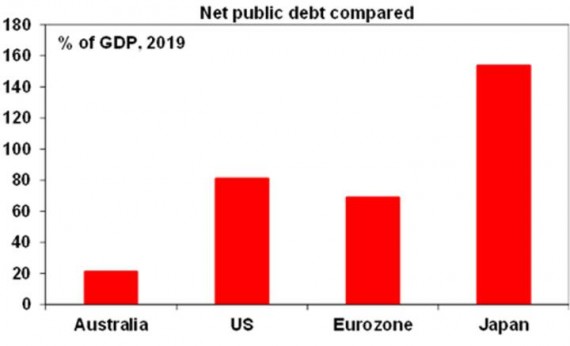
Third, Australia’s public debt is far lower than in other comparable countries. In fact, net public debt as a share of GDP is around a quarter of what it is in comparable advanced economies. See the next chart. So Australia has far greater scope to undertake fiscal stimulus than other comparable countries.


Source: IMF, AMP Capital

Fourth, the cost of borrowing for the Federal Government right now is very low at just 0.25% for three years and 0.75% for 10 years. So it’s not as if the Federal Government is incurring a huge interest bill or ‘crowding out’ private sector borrowing or investment.

Finally, the budget blowout may risk a downgrade in Australia’s AAA sovereign debt rating, but ratings are a bit of a relative game and Australia’s public finances will still look relatively better than others. I would rather a rating downgrade than a deep depression/recession any day … particularly when any downgrade will have no impact on the Federal Government’s cost of borrowing!

How does RBA quantitative easing fit into all this?

The RBA is using printed money to buy government bonds in order to help keep interest rates down. It’s buying these bonds in the secondary market (eg from fund managers) so it’s not directly providing the money to the Government and those bonds still have to be paid back when they mature. So it’s not really ‘helicopter money’, which would see the RBA print money and give it to the Government which it would then spend. But it is aiding the process by helping to keep bond yields down.

In the meantime, the balance sheet of the RBA will rise as it holds more bonds but this is not a major issue unless inflation starts to rise due to all the extra printed money in the system. The Fed, ECB and Bank of Japan have been expanding their balance sheets through QE for years now with no rise in inflation so the RBA presumably has a long way to go in this process before it becomes a problem. In fact if the Fed and others had not been doing QE, their countries would probably be mired in deflation by now. Put simply, there is no magical right or wrong for the level of the RBA’s balance sheet.

Longer-term consequences

When the dust settles, Australia will be left with much higher public debt at maybe around 45-50% of GDP in net terms but this will still be below that in other comparable countries. And it will be the price we paid to (hopefully) minimise the loss of life from the virus and at the same time minimise the hit to people’s livelihoods from the shutdown.

This may necessitate forgoing the next round of tax cuts due in 2022 or imposition of a new deficit levy at some point. And it may put a burden on future generations much as Government spending to fund the war effort in WW2 did. But I reckon that’s a cost most Australian’s are prepared to bear given that not acting now with public support mechanisms would likely lead to a far worse outcome.


Author: Dr Shane Oliver, Head of Investment Strategy and Economics and Chief Economist, AMP Capital Sydney, Australia  

Source: AMP Capital 15 April 2020

Important notes: While every care has been taken in the preparation of this article, AMP Capital Investors Limited (ABN 59 001 777 591, AFSL 232497) and AMP Capital Funds Management Limited (ABN 15 159 557 721, AFSL 426455) (AMP Capital) makes no representations or warranties as to the accuracy or completeness of any statement in it including, without limitation, any forecasts. Past performance is not a reliable indicator of future performance. This article has been prepared for the purpose of providing general information, without taking account of any particular investor’s objectives, financial situation or needs. An investor should, before making any investment decisions, consider the appropriateness of the information in this article, and seek professional advice, having regard to the investor’s objectives, financial situation and needs. This article is solely for the use of the party to whom it is provided and must not be provided to any other person or entity without the express written consent of AMP Capital.
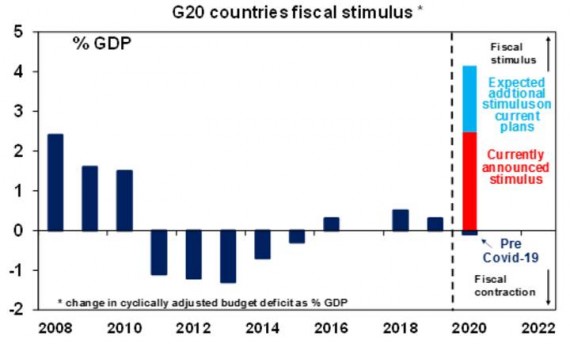
Along with massive fiscal stimulus globally to deal with the impact of coronavirus shutdowns on the economy, the last month or so has also seen massive monetary easing – with the latest being the US Federal Reserve expanding its emergency lending program to $US2.3 trillion. The economic shutdowns are necessary to slow the spread of coronavirus to take pressure off the medical system in order to minimise deaths. And because this will lead to a huge detraction in economic activity – we expect Australia and other developed countries to see a 10 to 15% fall in GDP centred on the current quarter – businesses, jobs and incomes need to be protected as far as possible through a period of hibernation so the economy can return to “normal” as quickly as possible once the shutdown ends. Hence government measures to support businesses, jobs and incomes via wage subsidies, payments to businesses, tax relief, rent relief etc. Such measures add to more than 4% of global GDP and are still rising. 


Source: IMF, AMP Capital

In Australia, fiscal stimulus is now up to around 10.5% of GDP and in the US it’s around 7% with more on the way.

However, monetary stimulus is also necessary to take pressure off indebted households and businesses and to ensure the flow of money and credit through the economy. Initially some of the focus was on rate cuts, but rates were already low or around zero, and so increasingly we are seeing quantitative easing (QE) or money printing. But surely this is unnatural – money doesn’t just grow on trees? Some fret this can only lead to hyperinflation. This note looks at what QE is and how it entails printing money, why it’s being used and what the risks are.

Summary of recent moves by major central banks?

But first here is a quick summary of recent major monetary policy easing measures since February:

  • The Fed has cut the Fed Funds rate by 1.5% to a range of zero-0.25%, announced unlimited buying of Treasury bonds and mortgage backed securities and announced a total of $US2.3trn in lending facilities that leverages up $US454bn in risk capital (which will take losses if needed) provided by the US Government. The latter will be used to lend to small and medium enterprises (through banks) and to state and local governments and for the purchase of investment grade and some high yield bonds, collateralised loan obligations and commercial mortgage backed securities.

  • The European Central Bank has reinstated quantitative easing totalling €870bn by year end with flexibility over the assets it can buy which will aid countries like Greece and Italy and expanded its low-cost bank funding program.

  • The Bank of England cut rates to 0.1% and started a £200bn bond buying program, more bank funding and a bit of direct government financing via a Ways & Means Facility (although this may be to smooth cash flows around bond issuance). 

  • The RBA has cut the cash rate by 0.5% to 0.25%, set a target for the 3 year bond yield of 0.25% to be supported by buying Government bonds and announced low cost funding for banks (called a Term Funding Facility) amounting to at least $90bn at just 0.25% interest for three years.

These all involve quantitative easing and hence money printing.

What is quantitative easing?

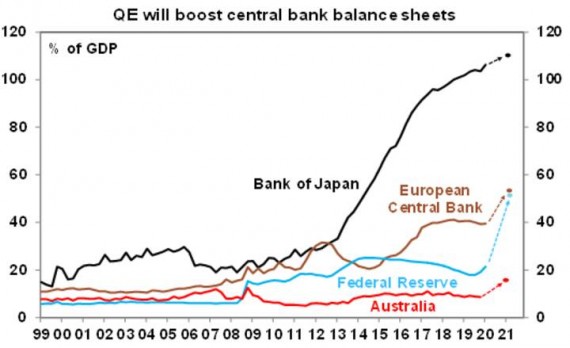
Quantitative easing involves a central bank printing money and using that money to buy government and private sector securities or to lend directly or via banks to pump cash into the economy. So this covers the Fed’s bond buying program and its lending facilities and in Australia it covers the RBA’s buying of Australian Government bonds and its low-cost funding of banks. It all shows up as an expansion in central banks’ balance sheets which shows their assets and liabilities. The printed money or cash increases the “liability” side of the balance sheet and the increased holding of bonds, private securities, direct loans or funding of banks shows up on the “asset” side. Rough estimates are that the moves announced over the last month or so will see the Fed’s balance sheet more than double to around $US11 trillion by year end or 50% of US GDP and the RBA’s balance sheet nearly double to around $340bn by year end or 17% of GDP. Of course, the Bank of Japan’s balance sheet dwarfs that of the Fed, ECB and RBA reflecting its massive quantitative easing program since 2012.


Source: Bloomberg, AMP Capital

So why do quantitative easing?

Normally central banks implement monetary policy by changing interest rates. But when interest rates have already fallen to zero, in order to support the economy central banks have been turning to boosting the quantity of money in the economy. Hence quantitative easing. The current expansion in quantitative easing (and its adoption in Australia) reflects:

  • A need to ensure that short term money markets continue to function – as lenders became reluctant to lend into money markets last month the Fed, RBA and other central banks injected short term funds into the markets. This should be temporary and will reverse as markets settle down.

  • A desire to ensure that sound businesses continue to receive funding. This has seen the Fed adopt a range of lending programs and the ECB and RBA provide low cost funding for banks so they can continue to lend to their customers.

  • A desire to ensure that the cost of funding remains low. A month ago Government bond yields started to rise (as fund managers were selling their liquid winning assets to meet redemptions), corporate borrowing rates surged as investors feared defaults and Europe was seeing a blow out in the gap between bond yields of fiscally weaker countries like Italy versus Germany. So, the Fed has been pumping money into the US bond and credit markets to push yields back down. The ECB has done something similar in Europe by buying Italian bonds. And the RBA announced a target of 0.25% for the 3-year bond yield and started buying bonds to support that target. Keeping bond yields down means lower fixed rate borrowing rates on business loans and mortgages.

  • To the extent bond buying keeps bond yields down it makes it easier for governments to fund their rising budget deficits. 

  • Finally, a lesson from the 1930s is that it’s very important to stop the money supply from shrinking. The 1930s saw multiple bank failures which accentuated the economic depression as people lost their savings and as a result the money supply collapsed. Printing money and expanding cash in the system helps make sure this does not occur.

But isn’t this helicopter money? What about MMT?

Not quite – although the Bank of England may be straying down this path. The BoE aside, as currently practiced central bank bond buying involves the central bank using printed money to buy already existing government bonds in the secondary market (eg from banks, super funds and foreign investors). So, it’s not directly providing the money to the government and those bonds must (at least in theory) still be paid back when they mature. So, it’s not really “helicopter money” – which would see a central bank directly give money to the government to spend.

Modern Monetary Theory (MMT) argues that if a country borrows in its own currency (which Australia does – so there is no risk of a currency crisis) and there is more risk of deflation than inflation then there is nothing wrong with using money printing to finance government spending which can be allocated in an equitable way. I have some sympathy for this. The trouble is that politicians would be at risk of becoming addicted to the flow of central bank money resulting in wasteful government spending and eventually hyperinflation. So central banks & governments are wary of doing this. At least for now – as this resolve may fade the longer inflation remains very low (and may already be fading in the UK!).

But of course, QE is aiding the government’s stimulus program by helping to keep bond yields down. And unlike in the period of quantitative easing seen in the US and Europe last decade which was accompanied by fiscal austerity, exploding budget deficits today provide a vehicle for quantitative easing to add to spending in the economy (once the shutdowns relax) so QE today is likely to be far more potent than it was last decade.

How will central banks get their balance sheets down?

There is no magical right or wrong level for a central bank’s balance sheet – as can be seen in the chart above they vary as a share of GDP from country to country. So, it’s not necessarily the case that central banks will need to shrink them (beyond the shrinkage that may occur when their lending and low cost bank funding programs end) – they could just remain at a permanently higher level with central banks just rolling their bond holdings over as bonds mature meaning effectively that governments may never need to pay a portion of their debt back. And in the process the interest governments pay on such debt could come back to them as a “dividend” payment from the central bank!

Won’t it just cause hyperinflation?

The biggest risk in this whole strategy is that the expansion of the money supply results in a surge in inflation. Early last decade when QE became popular there was much talk of hyperinflation and the US becoming the next Zimbabwe, but it didn’t because while narrow measures of money (cash and bank reserves) surged, broader money supply measures like credit growth remained subdued and at the same time spare capacity in the economy remained high. The same will likely apply now in the short term – until economic activity recovers to more normal levels such that spare capacity is used up (with unemployment falling and factories operating at full capacity) and lending growth picks up substantially it’s hard to see inflation picking up. If anything, inflation looks likely to fall – just look at the plunge in oil and petrol prices, the slump in demand for discretionary retail products and all the talk of falling wages.

Once economic activity has recovered there is a bigger risk of inflation and central banks may have to reverse easy money. But that’s an issue for some time away. We still have to end the shutdowns, and all go back to work and spending first.

What does it all mean for investors?

There are several implications in all this for investors. First, because the coronavirus shutdown has created such a big hit to economic activity which will take a while to fully recover from, low interest rates and easy monetary policy will likely be with us for a long time to come and once the growth outlook improves this is a positive for growth assets like shares.

Second, the country that expands its balance sheet and by implication its money supply the fastest seems likely to see a decline in its currency. Based on our balance sheet calculations the Fed looks to be leading the charge here – which could be negative for the US dollar. This may ultimately support commodity prices and the $A once the shutdowns end.

Third, ultimately ultra-easy money, huge budget deficits and public debt and an ongoing retreat from globalisation will add to the risk of an eventual pick-up in inflation which would be negative for bonds – but that’s still several years away.


Source: AMP Capital 16 April 2020

Important notes: While every care has been taken in the preparation of this article, AMP Capital Investors Limited (ABN 59 001 777 591, AFSL 232497) and AMP Capital Funds Management Limited (ABN 15 159 557 721, AFSL 426455) (AMP Capital) makes no representations or warranties as to the accuracy or completeness of any statement in it including, without limitation, any forecasts. Past performance is not a reliable indicator of future performance. This article has been prepared for the purpose of providing general information, without taking account of any particular investor’s objectives, financial situation or needs. An investor should, before making any investment decisions, consider the appropriateness of the information in this article, and seek professional advice, having regard to the investor’s objectives, financial situation and needs. This article is solely for the use of the party to whom it is provided and must not be provided to any other person or entity without the express written consent of AMP Capital.