By Tony Kaye, Senior Personal Finance Writer, Vanguard Australia

Reviewing the structure of your investment portfolio is an important and ongoing task that should ideally be undertaken at least once a year.

Doing so ensures your portfolio asset allocations remain aligned with your tolerance for risk and your broader long-term investment goals.

After such a tumultuous year on global financial markets in 2020, the value weightings of your current holdings may be out of kilter with your target asset mix and it may be prudent to recalibrate your portfolio.

But before making any rash investment decisions, your asset allocation strategy should consider the global economic landscape and the medium to long-term outlook for financial markets.

Read the economic signs

The global economic outlook and the likely behaviour of financial markets in 2021 remain hinged to COVID-19, and more specifically to health outcomes and responses.

Under more optimistic scenarios for COVID-19 vaccine effectiveness and coverage, economic output is likely to reach its pre-pandemic levels by the middle of the year.

Alternatively, less effective health outcomes will leave economies making only marginal progress from current levels.

In terms of asset allocation, this means investment decisions should necessarily take the current economic risks into account.

Indeed, country-specific economic growth rates will be varied over 2021, with some economies returning to their pre-COVID levels of employment and output faster than others.

To stimulate economic growth last year, central banks such as the Reserve Bank of Australia responded aggressively by cutting official interest rates to record lows.

This triggered a shift of investment capital out of lower-risk assets such as government bonds into higher-risk assets such as equities throughout the last year.

After falling sharply last February, global share markets surged through the remainder of 2020, with the U.S. market closing out December at a record high.

This at least partly explains why some investor asset allocation weightings may now be somewhat out of balance, especially if their target weightings include other asset classes such as bonds, infrastructure, property, cash and commodities.

How different countries respond to COVID-19 over 2021 will play directly into the operations and earnings of individual companies, which in turn will impact investment returns in those markets over the course of this year and potentially beyond.

In the recently released Vanguard Economic and Market Outlook, we noted that our outlook for global asset returns over 2021 and beyond is guarded.

High valuations and lower economic growth rates mean lower equity returns are likely over the next 10 years.

The expectation is for global equities to return between 5 per cent and 7 per cent per annum over the next decade, and for Australian equities to have a slightly higher return range between 5.5 per cent and 7.5 per cent per annum.

These forecasts compare with the higher double digit equity returns experienced during past decades.

On the fixed income front, interest rates globally are set to remain low despite the outlook for firming global economic growth and inflation as 2021 progresses.

While yield curves may steepen, short-term rates are unlikely to rise in any major developed market as monetary policies remain relaxed.

Bond portfolios, of all types and maturities, are expected to earn returns close to their current yield levels.

Follow the investment flows

Another tool in one’s asset allocation arsenal is to follow global and domestic investment flows.

Money flows are determined by both economic and potential investment return factors, and it’s evident from Australian Securities Exchange data that equity investors here continue to have a home bias but are increasingly directing capital offshore through exchange traded products such as ETFs.

In fact, last year around $7 billion of investor capital went into ETFs on the Australian share market that exclusively invest in ASX-listed shares, and about $7.1 billion went into funds covering equities in other countries and regions. (See Investors take ETF holdings to a record high).

Despite the marginally higher returns expectation for Australian equity, one’s asset allocation should avoid having excessive concentration risk and home bias.

It underscores the benefits of a globally diversified exposure in managing risk, particularly given the expectation for elevated risks in 2021 and a lower returns environment over the medium term.

Equities are likely to continue outperforming most other investments and the rate of inflation, with returns expected to be 3 to 5 percentage points higher than that of traditional bond instruments over the next decade.

That said, maintaining a broadly diversified portfolio that’s appropriately aligned to your goals and risk-tolerance is important, as is avoiding over-reaching for yield or return at the cost of unintended risk exposures. Fixed interest continues to play a key role in well-balanced portfolios as a buffer to volatility on equity markets.

In 2021, it will be important for investors to remain disciplined and focused on long-term outcomes, and to accept that current macro-economic events will likely translate into lower-for-longer investment returns.

An iteration of this article was first published in the Wealth section of The Australian on 26 January, 2021.

Please contact us on Phone: 07 5641 4134 for more information.

Source: Vanguard January 2021

Vanguard Investments Australia Ltd (ABN 72 072 881 086 / AFS Licence 227263) is the product issuer. We have not taken yours and your clients’ circumstances into account when preparing this material so it may not be applicable to the particular situation you are considering. You should consider your circumstances and our Product Disclosure Statement (PDS) or Prospectus before making any investment decision. You can access our PDS or Prospectus online or by calling us. This material was prepared in good faith and we accept no liability for any errors or omissions. Past performance is not an indication of future performance.

© 2021 Vanguard Investments Australia Ltd. All rights reserved.

Important: Any information provided by the author detailed above is separate and external to our business and our Licensee. Neither our business nor our Licensee takes any responsibility for any action or any service provided by the author. Any links have been provided with permission for information purposes only and will take you to external websites, which are not connected to our company in any way. Note: Our company does not endorse and is not responsible for the accuracy of the contents/information contained within the linked site(s) accessible from this page.


 

A permanent injury or illness can make it difficult or impossible to return work. TPD  insurance can provide a financial safety net to help support you and your family, and pay for medical and rehabilitation costs.

What TPD insurance covers

TPD insurance pays a lump sum if you become totally and permanently disabled because of illness or injury. 

Each insurer has a different definition of what it means to be totally and permanently disabled. It can cover you for either:

  • Your own occupation — you’re unable to work again in the job you were working in before your disability. This cover is more expensive and is usually only available outside super.

  • Any occupation — you’re unable to ever work again in any job suited to your education, training or experience. This cover is cheaper but has a higher threshold to claim, so it’s less likely to pay out.

Read the product disclosure statement (PDS) so you know how your insurer defines a total and permanent disability. Call the insurer or your super fund if you have questions about the policy.

Decide if you need TPD insurance

When deciding if you need TPD insurance, and how much, think about the expenses you’ll need to cover if you were permanently disabled and unable to work. These could include:

  • living expenses for you and your family

  • repaying debts such as a mortgage or credit card

  • medical and rehabilitation costs

  • savings you want for retirement

Also think about what you have that could help pay for these costs. This could include:

The gap between the amount you have and the amount you’ll need can be a guide as to how much TPD cover you may need.

If you need help deciding if you need TPD insurance, and how much, speak to a financial adviser.

How to buy TPD insurance

Check if you already hold TPD insurance through your super. Most super funds offer default TPD cover that’s cheaper than buying it directly. You can increase your level of cover through your super fund if you need to.

You can also buy TPD insurance from:

  • a financial adviser

  • insurance broker

  • an insurance company

TPD insurance can be bought on its own or packaged with life cover. If it’s packaged, your life cover may be reduced by any amount paid out on a TPD claim. Check the PDS or ask your insurer.

Before buying, renewing or switching insurance, check if the policy will cover you for claims associated with COVID-19.

TPD insurance premiums

You can generally choose to pay for TPD insurance with either:

  • stepped premiums — recalculated at each policy renewal, usually increasing each year based on the higher chance of a claim as you age

  • level premiums — charge a higher premium at the start of the policy, but changes to cost aren’t based on your age so increases happen more slowly over time

Your choice of stepped or level premiums has a large impact on how much your premiums will cost now and in the future.

Compare TPD insurance policies

Before you buy TPD insurance, compare policies to make sure you get the right one for you. Check:

  • if it covers ‘your own occupation’ or ‘any occupation’

  • exclusions

  • waiting periods before you can claim

  • limits on cover

  • premiums – now and in the future.

A cheaper policy may have more exclusions, or it may become more expensive in the future.

Use our Life insurance claims comparison tool

Compare how long different insurers take to pay a TPD claim and the percentage of claims they pay out.

What you need to tell your insurer

You need to tell your insurer anything that could affect their decision to provide you with TPD insurance. You need to give them this information when you apply, renew or change your level of cover. 

Insurers usually ask for information about your:

  • age

  • job

  • medical history

  • family history, such as a history of disease

  • lifestyle (for example, if you’re a smoker)

  • high risk sports or hobbies (such as skydiving) 

If an insurer doesn’t ask for your medical history, it may mean their policy has more exclusions or narrower policy definitions.

The information you provide will help the insurer to decide:

  • if they should insure you

  • how much your premiums will be

  • terms and conditions for your policy

It is important that you answer the questions honestly. Providing misleading answers could lead an insurer to decline a claim you make.

Making a TPD insurance claim

If you want to make a TPD claim, see making a life insurance claim for information on what to do. 

Please contact us on Phone: 07 5641 4134 if you seek further assistance on this topic.

Source : Moneysmart.gov.au January 2021 

Reproduced with the permission of ASIC’s MoneySmart Team. This article was originally published at https://moneysmart.gov.au/how-life-insurance-works/total-and-permanent-disability-tpd-insurance

Important note: This provides general information and hasn’t taken your circumstances into account.  It’s important to consider your particular circumstances before deciding what’s right for you. Although the information is from sources considered reliable, we do not guarantee that it is accurate or complete. You should not rely upon it and should seek qualified advice before making any investment decision. Except where liability under any statute cannot be excluded, we do not accept any liability (whether under contract, tort or otherwise) for any resulting loss or damage of the reader or any other person.  Past performance is not a reliable guide to future returns.

Important Any information provided by the author detailed above is separate and external to our business and our Licensee. Neither our business nor our Licensee takes any responsibility for any action or any service provided by the author. Any links have been provided with permission for information purposes only and will take you to external websites, which are not connected to our company in any way. Note: Our company does not endorse and is not responsible for the accuracy of the contents/information contained within the linked site(s) accessible from this page.

A way to utilise the equity in your home.

Many Australians own homes that are now worth far more than they still owe on their mortgages. With a home equity loan, you can unlock that “equity”.

What is home equity?

You’ll hear a lot about equity in relation to home loans. Equity is the difference between what your home is worth today and what you still owe on your mortgage.

Utilising your home equity

If your home is worth $400,000 and you only owe $100,000 on your mortgage, you have $300,000 in home equity. Previously, the only way you could utilise that equity was by selling your house. Now there is another way.

Home equity loan – unlocking home equity

With a home equity loan, the lender lets you borrow against the equity you have built up in your loan. Let’s say you need money for your daughter’s wedding. You don’t have any ready cash but you do have equity in your home. A home equity loan is one of a range of possible solutions.

Home equity loan – a better interest rate

If you need money, you could use a credit card or take out a personal loan. But you’ll probably get a better interest rate with a home equity loan because the loan security – your house – is so good.

Monthly repayments

One thing you need to remember with a home equity loan is that you still need to make monthly repayments. To learn more about home equity loans, contact us on Phone: 07 5641 4134 today.

Source: MFAA https://www.mortgageandfinancehelp.com.au/re-financing/what-home-equity-loan/

Reproduced with the permission of the Mortgage and Finance Association of Australia (MFAA)

Important: This provides general information and hasn’t taken your circumstances into account.  It’s important to consider your particular circumstances before deciding what’s right for you. Although the information is from sources considered reliable, we do not guarantee that it is accurate or complete. You should not rely upon it and should seek qualified advice before making any investment decision. Except where liability under any statute cannot be excluded, we do not accept any liability (whether under contract, tort or otherwise) for any resulting loss or damage of the reader or any other person. Past performance is not a reliable guide to future returns.

Any information provided by the author detailed above is separate and external to our business and our Licensee. Neither our business nor our Licensee takes any responsibility for any action or any service provided by the author.

Any links have been provided with permission for information purposes only and will take you to external websites, which are not connected to our company in any way. Note: Our company does not endorse and is not responsible for the accuracy of the contents/information contained within the linked site(s) accessible from this page.

Today, employees at age 40 are at a mid-point in their careers, making it a natural time to take stock and plan for the future.

People in their late thirties or early forties might not be able to cope with their younger rivals in some fields. This period of your career is the best moment to evaluate what you’ve achieved and make a plan for the future.

A good way to boost your self-confidence and increase your value on the labor market is to continue with your education through training sessions and courses. Read on to discover how you can approach career development at this stage of working life.


Expanding your knowledge


Many people think that they’re done with education when they finish high school or university studies. While this might be the case with formal education, modern businesspeople need to keep expanding their knowledge all the time.

When you enroll in a business training course, you decide to expand your knowledge. This influx of new information will launch you closer to managers and CEOs. As reported by Inc.com, CEOs read one book per week on average, Keep learning new things through reading and courses to stay competitive.


Finetuning your skills


Enrolling in a business course in your late thirties and forties is an ideal chance to polish your existing skills. Maybe you’re a great university teacher but you still haven’t worked in the cloud. Perhaps you’re a successful small business owner, but you’ve never attended a real business program.

So, attending business training at this stage of your career will enrich your existing skills. You’ll spice them up with some useful new tips and tricks as well.


Learning about innovations


Even though you might have a knack for business, it won’t be enough in the hectic business world of the future. Technology is changing the world extremely fast. Apps, collaboration tools, cloud services, SaaS products, artificial intelligence, and virtual reality are just some of the current trends.

They are all practical and useful tech options that can improve your business operability. For instance, learning more about cloud services will enable you to create a paperless office.

Business and other useful courses are here to prepare us for that new world and teach us how to use these innovations for your benefit.


Positions in international enterprises


Earning one or more business certificates in your forties can open new international opportunities. Modern companies always need new energy in their teams. From traditional international business names to new ventures on the business map, finishing business courses can skyrocket you into a completely different business environment.

Some managers and employees subscribe to such courses with the main aim to relocate to a more propulsive part of the world. While doing so, don’t forget to start learning the language of the target country. Of course, English is the lingua franca of the business world but don’t hesitate to broaden your linguistic horizons. This will make you even more competitive on the labor market. For if you know the language of the chosen country and possess both experience and business knowledge, your progress in these new surroundings will be much faster.


Working on networking


Networking is one of the buzzwords of the 21st century. Thanks to social media and fast communication, today it’s easier to expand your business network than before.

Therefore, attending business training is a great opportunity to build a firm core of valuable business connections.

Also, if you opt for online business education, you can both improve your skills while staying productive at your current job.


Abandoning bad habits


The routine of everyday business tasks brings both benefits and disadvantages. The positive thing is that you will improve your efficiency because practice makes perfect. If you repeat the same process multiple times per day, you will get better and more productive at it.

On the negative side, doing a job routinely leads to bad habits. You might not be committed to working as you used to be and you might start procrastinating.

A new business course will wake you up and invigorate your preparedness for new working styles.


Climbing the social ladder


We’ve already talked about networking and lead generation during business courses.

It’s good to know that attending such training sessions is beneficial in the sense of vertical progress. The more relevant courses and training sessions you successfully complete, the better chances you have to be promoted.

Today, knowledge is the most valuable currency. So, keep learning, both formally and on your own, to pave your way to the top.


Streamlining your potentials


After one decade or more in the niche, you might start losing your edge.

This can happen if you keep doing the wrong tasks for a long time. Many people spend vital parts of their careers on projects that don’t fully use their potentials. For instance, a talented business analyst might keep working in the accounting department and wasting their talent.

Business training sessions are useful from that point of view – they often make people aware that they can streamline their potentials to achieve higher goals.


Setting a new career course


All the skills, knowledge bits, and connections you acquire during your business training will help you set a new career course. Apart from those tangible benefits, you’ll also feel a boost of self-confidence and openness to new opportunities.

On the one hand, you’ll confirm and verify that you already possess substantial knowledge.

On the other hand, you’ll start adopting new strategies and technologies for business development.

For instance, you might decide to start your individual career working from a co-working space or as a digital nomad.


Ensuring a higher salary


The end goal for many attendees of business courses is to ensure a higher salary.

It’s important to know that the sole fact that you’ve attended one or more courses doesn’t guarantee anything. You might still keep struggling for every cent if you don’t apply what you’ve learned.

But, it’s more probable that attending live or online business courses will increase your chances of ensuring a lucrative business future.

The business world is more and more competitive. New entrepreneurial gladiators are entering this global arena every day, eager to hack their way to the top.

Experienced members of the business community mustn’t become spectators of this clash, instead they need to take part in it. Attending business courses means taking the plunge and breathing new life into your career.

Please contact us on Phone: 07 5641 4134 if you seek further assistance on this topic.

Source: MYOB https://www.myob.com/au/blog/business-training-and-education-age-40/

Reproduced with the permission of MYOB. This article by Anita Sambol was originally published at https://www.myob.com/au/blog/business-training-and-education-age-40/

Important: This provides general information and hasn’t taken your circumstances into account. It’s important to consider your particular circumstances before deciding what’s right for you. Although the information is from sources considered reliable, we do not guarantee that it is accurate or complete. You should not rely upon it and should seek qualified advice before making any investment decision. Except where liability under any statute cannot be excluded, we do not accept any liability (whether under contract, tort or otherwise) for any resulting loss or damage of the reader or any other person.

Any information provided by the author detailed above is separate and external to our business and our Licensee. Neither our business nor our Licensee takes any responsibility for any action or any service provided by the author. Any links have been provided with permission for information purposes only and will take you to external websites, which are not connected to our company in any way. Note: Our company does not endorse and is not responsible for the accuracy of the contents/information contained within the linked site(s) accessible from this page.

 

For investors, it can be better to travel than to arrive. The last year has been characterised by unremittingly gloomy headlines but a counter-intuitively buoyant stock market. This is puzzling for many, but even experienced investors who understand that this is how markets work are starting to call time on the remarkable rally since last spring.

Are they right to do so? In the short term, possibly. On a medium to longer term view, I suspect not. The risk of a correction has risen recently, and I would not be at all surprised if a combination of apparently positive developments provides the trigger for a setback. Brexit in the bag, Biden in the White House and jabs in millions of arms are all good news but investors may not see it that way. While there was so much still to be resolved, investors could happily look through the gloom. It is the first glimpse of the sunlit uplands that could focus our attention on all that remains unfixed.

You don’t have to go back too far to see the same pattern in the wake of the financial crisis. From March 2009, stock markets traced a similar path. Overlay the latest rally and it is hard to distinguish it from the earlier bounce. But a year into the recovery and investors had become a great deal more skittish. Between the middle of April 2010 and early June, the MSCI World index of global stocks fell by 16%, a significant correction.

It would have been easy to be unsettled by that reversal in the market. After the trauma of late 2008 and early 2009, it would have been tempting to think the previous 12 months had been some kind of sucker’s rally. It was not. It was the first phase of one of the market’s longest bull markets. The correction was the pause that refreshed. Ten years on the market has risen nearly three-fold. The stumble of 2010 was followed by another in 2011 (remember Greece) and another in 2015 (China this time) but all three were just tests of investors’ resolve.

Many experienced and successful investors are raising red flags today. The annual letters to shareholders from the likes of Jeremy Grantham and Seth Klarman are sounding the alarm about speculative behaviour, irresponsible central banks and excessive valuations. They hear worrying echoes of 2000 in the eightfold rise in Tesla’s share price and Bitcoiners’ renewed crypto crush. They are right to be concerned – complacency is a tell-tale sign that a top is near; when the market rises on good news but ignores bad data or rising infection rates it is a signal that investors are seeing what they want to and rationalising away everything else.

It is also true that the comparison with 2009 is not exact. The market had fallen by 60% from its credit bubble peak compared to last year’s 35% slide from top to bottom. You might have expected a big rally then, not least because valuations were a good deal lower at the trough than they were in March last year. Bond yields had not hit rock bottom and had further to fall; that hand has already been played this time. In 2010 the market remained well below its previous peak; today, special cases like the UK excepted, prices are regularly hitting new highs.

So, I would not be at all surprised to see a correction at some point in the next few months. The more important question is what we should do in anticipation. And the answer to that is the hardest thing of all for an investor – nothing.

Jeremy Grantham’s latest missive outlined his definition of a successful bear market call. ‘It is simply that sooner or later there will come a time when an investor is pleased to have been out of the market. That is to say he will have saved money by being out, and also have reduced risk or volatility on the round trip.’

I agree with that. Missing the very top of the market in 2000 or 2008 will not have worried an investor who sat out the savage three-year downturn that followed the dot.com bust or the much shorter one that accompanied the credit crunch. But the difference between the duration of those two drastic bear markets is important because it signals the difficulty, actually the near impossibility, of timing your re-entry into the market. Navigating market corrections involves two calls – sale and repurchase – and you have to get both at least roughly right. Good luck.

In the case of a short-term correction in an underlying bull market, the need to get back in promptly is even more important. And that is what I expect for a handful of reasons. First, although there are some signs of excess, they are isolated not widespread. Second, despite a likely short-term technical recession caused by the second wave lockdowns, growth this year and next will likely be strong and synchronised. Third, shares are relatively cheap (OK, bonds are expensive, but the comparison still matters). Fourth, unemployment says there is slack in the economy; inflation remains tomorrow’s problem not today’s. Fifth, we are experiencing co-ordinated fiscal and monetary policy stimulus that we have not seen for 70 years.

The final reason to ride out the correction, if and when it comes this year, is the possibility that the 2020s turns out to be a historic decade of growth and innovation. Ten years in which the short-term recovery from the pandemic coincides with the longer-term opportunities to rebuild the western world’s crumbling infrastructure. All that while simultaneously investing in the solutions to the climate crisis that has hidden behind Covid but never went away. It is better to travel to arrive, but the journey continues.

Tom Stevenson is an investment director at Fidelity International. The views are his own. He tweets at @tomstevenson63.

Please contact us on Phone: 07 5641 4134 if you seek further assistance on this topic.

Source: Fidelity January 2021

Reproduced with permission of Fidelity Australia. This article was originally published at https://www.fidelity.com.au/insights/investment-articles/riding-it-out/

This document has been prepared without taking into account your objectives, financial situation or needs. You should consider these matters before acting on the information. You should also consider the relevant Product Disclosure Statements (“PDS”) for any Fidelity Australia product mentioned in this document before making any decision about whether to acquire the product. The PDS can be obtained by contacting Fidelity Australia on 1800 119 270 or by downloading it from our website at www.fidelity.com.au. This document may include general commentary on market activity, sector trends or other broad-based economic or political conditions that should not be taken as investment advice. Information stated herein about specific securities is subject to change. Any reference to specific securities should not be taken as a recommendation to buy, sell or hold these securities. While the information contained in this document has been prepared with reasonable care, no responsibility or liability is accepted for any errors or omissions or misstatements however caused. This document is intended as general information only. The document may not be reproduced or transmitted without prior written permission of Fidelity Australia. The issuer of Fidelity Australia’s managed investment schemes is FIL Responsible Entity (Australia) Limited ABN 33 148 059 009. Reference to ($) are in Australian dollars unless stated otherwise.
© 2021. FIL Responsible Entity (Australia) Limited.

Important:
This provides general information and hasn’t taken your circumstances into account. It’s important to consider your particular circumstances before deciding what’s right for you. Any information provided by the author detailed above is separate and external to our business and our Licensee. Neither our business nor our Licensee takes any responsibility for any action or any service provided by the author. Any links have been provided with permission for information purposes only and will take you to external websites, which are not connected to our company in any way. Note: Our company does not endorse and is not responsible for the accuracy of the contents/information contained within the linked site(s) accessible from this page.

So, you’re thinking of buying your first residential investment property? There are a few things to consider before making the move. Here are our top 10 tips for avoiding potential difficulties and ensuring success.

1. Know your goal

Understanding your financial objectives is key to finding the right investment property. The actual property itself is rarely the end goal when it comes to investing – the financial elements should be your key focus. First, decide what your investment goal is and then create a plan to achieve it within a realistic time frame.

Are you looking for a plan for retirement? An income-generator to fund your children’s education? Or building equity to gain a regular income? Define a plan and review it regularly as your situation and the market changes.

2. Research, research, research

Understanding which property is going to work best for your situation is key. It needs to be one that will be of high demand from renters and, possibly, owner-occupiers down the track. Be sure to research which types of properties are in demand and rents quickly in particular areas, and those that don’t. Is this an area popular with families who want three- or four-bedroom homes, or with singles looking for studio apartments? Speak with property managers and check ads to find out what renters are currently looking for, and how their needs may change in the future. What developments are planned nearby? Get to know the neighbourhood you’re planning to invest in.

3. Old or new?

It’s the age-old debate: should you buy a renovator’s delight or something you can rent straight away? It’s great if it can be rented out as is, but potential to renovate should also be considered. The ability to easily and economically add value to a property is a plus, as it could increase rental returns. Don’t immediately write off a property just because it needs a paint job or the kitchen cabinets need replacing, but at the same time avoid overcapitalising if it’s not going to deliver returns. It’s a balancing act, so consider your skill levels, the extent of makeover required, and your access to funds to pay for renovations.

4. Location, location, location

Location is critical to performance. Some of the things to consider include:

  • How far is the property from the CBD or business areas?

  • Are there schools nearby?

  • How’s the shopping? Can tenants walk to local shops or will they need to drive?

  • What and where are the public transport options?

  • What other amenities are close by? Are there cafes, a medical centre, a pharmacy, a gym?

5. Do your sums

Always check your finances before deciding to purchase a property. Get pre-approval and make sure you can cover repayments as well as extra upfront costs such as conveyancing, inspections and taxes. There are also ongoing costs to consider including landlord insurance, strata and property management fees, property maintenance, council rates and utilities.

You need to set yourself a realistic picture of a property’s cash flow, rather than vague idea of whether rent will cover expenses, so use a spreadsheet to calculate all foreseeable expenses. If cash flow is negative, can you afford to maintain the property? What happens if it’s vacant for a couple of months? Do your sums carefully and always ensure you factor in a financial buffer to avoid mortgage stress.

6. Choose the right setup

When it comes to investing, it’s important to understand how to set up the purchase to receive the most benefit. The entity should be tax-effective and protect any existing assets. You can purchase in your name, through your super or through a trust, but always understand how the purchase will affect you and your family. Expert advice can assist in maximising your benefits.

7. Pick the right features

You want to appeal to the highest number of tenants, so look for properties that offer that little something extra, like a second bathroom or a lock-up garage. Also, look at properties that appeal to many segments. For example, a lift may appeal to both retirees and a young family, as both will be looking to avoid stairs. Just make sure the benefits outweigh any extra costs.

8. Check your emotions at the door

Remember, you won’t be living in this home, so there doesn’t need to be an emotional connection to the home or the area. Your decision should always be about which property will give you the best return, not which one is most suited to your own tastes and lifestyle.

9. Timing is key

It’s a great idea to keep on top of the market’s movements and its dynamics. While there are investment opportunities available most of the time, some market conditions are more favourable. Do plenty of research and, if you don’t fully understand it, ask for help.

10. Get expert advice

Your broker can put you in touch with experts when it comes to real estate and investment. This means accountants, real estate agents, lawyers and valuers. These people are immersed in the industry and will be able to guide you in your decision-making.

Please contact us on Phone: 07 5641 4134 if you seek further assistance on this topic.

Source: Your Loan Hub https://www.yourloanhub.com.au/2018/08/10-tips-for-choosing-an-investment-property/

(C) Advantedge Financial Services Holdings Pty Ltd ABN 57 095 300 502. This article provides general information only and may not reflect the publisher’s opinion. None of the authors, the publisher or their employees are liable for any inaccuracies, errors or omissions in the publication or any change to information in the publication. This publication or any part of it may be reproduced only with the publisher’s prior permission. It was prepared without taking into account your objectives, financial situation or needs. Please consult your financial adviser, broker or accountant before acting on information in this publication.

Important: Any links have been provided with permission for information purposes only and will take you to external websites, which are not connected to our company in any way. Note: Our company does not endorse and is not responsible for the accuracy of the contents/information contained within the linked site(s) accessible from this page. 

Financial wellbeing has become the big buzzword in recent years. It seems like everyone is talking about it, even the banks. There’s a good reason for this, especially after the events of this year. 

According to studies 46% of workers spend at least three work hours each week thinking about their finances. And poor financial wellness costs Australian businesses $33 billion per annum. And this was before COVID.

As a business owner, having control over your finances and in turn your choices has a dramatic impact on your life at work, and at home. 

So here’s five steps you can take to achieve that sense of security and freedom financial wellbeing brings.  

Take control over your finances

As 2020 has shown us in stark reality, there’s things we can control, and things we can’t. Whether it’s for your business or home budget, never before has managing your cashflow and spending been more important than now; knowing exactly where your money goes each month. There are many budget tracking tools you can use to help you with this.

Cashflow planning and saving really comes down to behaviour; how you commit to working towards achieving your goals. During COVID restrictions we all learnt to adjust our spending to suit the situation. The same habits should be applied now to ensure you maintain that control over your finances.

Absorb a financial shock

This is a big one. Obviously we’ve gone through and will continue to feel the impacts of a volatile economy. Now more than ever is a good time to review aspects such as income protection, personal and business insurances (‘key person’ is an important one), estate planning and emergency funds so that you’re financially prepared for the unexpected – whatever that may look like. 

Plan for these ongoing costs. It may be difficult parting with the money at the time, but it could be the difference between sinking or swimming when faced with a crisis. Knowing that your interests are protected will take a significant weight off your mind.

Keep looking forward

I know how tough this year has been, especially trying to maintain a business as well as a household. What you can’t afford to do though is lose sight of your goals and stop working on a plan to get there. Yes, the goalposts may have changed and you may have to use the word of 2020 – pivot. But that should focus you even more on shaping what the next 12 months, three years and ten years looks like. 

We all need hope to move forward for our own wellbeing. To focus on what will motivate us to keep striving and pushing ahead. Adversity often brings opportunity. So maintain your passions or explore new ones. And go for it.

Don’t go it alone

As a business owner and entrepreneur, you have to take on many of the responsibilities yourself. Planning and protecting your financial future shouldn’t be one of them. It’s simply not worth the risk – for your business and lifestyle. 

Whether it’s your accountant, financial planner, lawyer, mentor or a combination of all; a trusted advisor is worth their weight in gold. Use their expertise, not just for the sense of security and confidence they bring but also to ensure you don’t miss out on opportunities to improve your financial situation. The work you put into your business should be the same amount of work you put into your finances. They go hand-in-hand.  

Enjoy a balanced life

When we talk about work/life balance, what 2020 presented us wasn’t exactly what we had in mind. It did open our eyes, however, to different ways of working and how businesses may operate in the future. Do you need to work five days in an office anymore? Can your business use online tools to make it more efficient, productive and give you back some time? Will that one hour meeting interstate be better via Zoom than in person? All these new possibilities should be part of your thinking to help better align your professional life with your home life. 

When that happens, you’ll also find your financial and emotional wellbeing will be aligned as well. And that is an outcome you simply can’t put a price on. 

Source: Flyingsolo January 2021

This article by Ryan Watson, founder and CEO of Tribeca Financial, is reproduced with the permission of Flying Solo – Australia’s micro business community. Find out more and join over 100K others https://www.flyingsolo.com.au/join. 

Important: This provides general information and hasn’t taken your circumstances into account. It’s important to consider your particular circumstances before deciding what’s right for you. Any information provided by the author detailed above is separate and external to our business and our Licensee. Neither our business, nor our Licensee take any responsibility for any action or any service provided by the author. Any links have been provided with permission for information purposes only and will take you to external websites, which are not connected to our company in any way. Note: Our company does not endorse and is not responsible for the accuracy of the contents/information contained within the linked site(s) ac www.flyingsolo.com.au.

Application & establishment fees, stamp duty + more.

When taking out a mortgage, many people forget to consider the associated fees and expenses. Here are some of the extra costs that you’ll need to consider when you take out a home loan.

Home loan application fees

Most lenders charge a home loan application fee. This can range from loan to loan, and covers:

  • Loan contracts

  • Property title checks

  • Credit checks

  • Attending a settlement

Mortgage fees and costs

  • Mortgage establishment fees – Lenders generally charge a mortgage establishment fee – a fee for setting up a mortgage.

  • Property valuation – A third party chosen by the lender, is appointed to determine the value of your land and improvements.

  • Mortgage registration – Your Mortgage deed needs to be registered with the government.

  • Mortgage stamp duty – Some State Governments charges stamp duty to register your mortgage.

  • Lenders mortgage insurance – If you don’t have 20% of the purchase price or the value of the property, the lender will require you to pay  for a lenders mortgage insurance policy that covers their risk in the event you default on your repayments.

Property fees and costs

  • Building, Pest and Electrical Inspection fees – It’s wise to have your property inspected for any structural or electrical problems and for pests (e.g. termites).

  • Stamp duty – Governments charge Stamp Duty to transfer the ownership of a property.

  • Registration of transfer fee – The new owner of the property needs to be registered at the Land Titles Office.

  • Legal fees – You generally need to pay a Solicitor of Settlement Agent to handle the transfer of ownership of the property on your behalf

  • Home & contents insurance – Most homeowners insure their home and contents against a range of threats: burglary, fire, storm, etc. Lenders insist that your property is insured while you have a mortgage.

  • Life and income protection insurance – Borrowers should consider protecting their incomes and themselves while they have a mortgage.

  • Utility costs – Connecting electricity, gas and telephone can attract a fee.

  • Council Rates – Your local council charges rates to cover garbage collection and a host of other services.

  • Water Rates – The water corporation charges rates for the supply and upkeep of water to your property.

  • Body corporate fees – If you buy an apartment or Strata Titled property, body corporate fees are charged, and some fees can be significant – particularly if the building is in need of a major work (e.g. concrete cancer, security upgrade, new hot water system, etc) or if there are lifts, pools and other communal facilities.

  • Maintenance costs – Don’t forget to make provision for regular maintenance on your home – even if you decide not to undertake significant renovation.

To learn more about the hidden costs of buying a home, talk to us today on Phone: 07 5641 4134.

Source: MFAA https://www.mortgageandfinancehelp.com.au/first-home-buyer-news/application-establishment-fees-stamp-duty-more/

Reproduced with the permission of the Mortgage and Finance Association of Australia (MFAA)

Important: This provides general information and hasn’t taken your circumstances into account.  It’s important to consider your particular circumstances before deciding what’s right for you. Although the information is from sources considered reliable, we do not guarantee that it is accurate or complete. You should not rely upon it and should seek qualified advice before making any investment decision. Except where liability under any statute cannot be excluded, we do not accept any liability (whether under contract, tort or otherwise) for any resulting loss or damage of the reader or any other person. Past performance is not a reliable guide to future returns.

Any information provided by the author detailed above is separate and external to our business and our Licensee. Neither our business nor our Licensee takes any responsibility for any action or any service provided by the author.

Any links have been provided with permission for information purposes only and will take you to external websites, which are not connected to our company in any way. Note: Our company does not endorse and is not responsible for the accuracy of the contents/information contained within the linked site(s) accessible from this page.

By Robin Bowerman, Head of Corporate Affairs, Vanguard Australia

Good advice is valuable.

The right words of advice – whether it be from friends or family, business mentor, sports coach – can have lasting impact on the way we lead our lives, manage our businesses.

The same holds true for financial advice. The right advice can deliver more than just a better investment outcome. Think peace of mind heading into retirement, lower stress in a relationship and possibly even higher levels of happiness.

The need for advice ought to be beyond dispute. Yet it is not.

The value of advice ought to be well understood. Yet it is not.

With an ageing population and growing pool of superannuation assets the financial advice industry ought to be thriving. Yet it is not.

The Financial Services Council recently released a research report titled the Future of Advice prepared by the independent research and actuarial firm Rice Warner. While the report is aimed at advancing the public policy debate on the financial advice industry it contains some strong learnings for individual investors.

The report rightly identifies the challenges consumers face in managing their financial position and points to the need for advice in order to maximise income and avoid financial difficulties. A task made harder by the interplay of tax, super and social security regimes.

The research has modelled a range of cameos to assess the value of advice and estimates that those who obtain advice accumulate more than three times more assets after 15 years than those who make their own decisions (including doing nothing)”.

That is a significant financial payoff and is in line with proprietary research by Vanguard titled Adviser’s Alpha that independently researched the impact of advice and estimated the value about 3% in improved net return.

The value of the advice is not always for the wealthy or in the complexity. The Rice Warner paper says the greatest cumulative increase in funds at retirement when advice is taken at younger ages comes from asset allocation advice. Regardless of wealth level for an individual aged 40 about half the value of the advice is derived from simple advice in respect of savings.

Indeed individuals who are in the low socio-economic wealth bands are expected to gain more from advice than those who are wealthy. That reflects the tendency of those individuals to save less of their disposable income and allocate assets to safe but low-yielding asset classes such as cash and term deposits.

The Rice Warner research makes a strong case for the tangible, financial benefit of getting advice – with one important caveat. Costs matter.

The modelling of the impact of advice was done on a before-fees basis because fees vary widely across the industry. Importantly, the research showed that advice fees of 1% of a portfolio value would likely be a “net detractor” in purely financial terms.

There is considerable public policy discussion around the so-called “advice gap” which refers to the gap between those who could benefit from advice and those who actually receive it. During the Royal Commission into Financial Services poor and unethical practices within the industry were publicly exposed and as a result there has been considerable restructuring of the advice industry with major banks withdrawing as major players in the market along of with the number of individual financial planners falling as some choose to simply exit the industry.

Not surprisingly after the revelations from the royal commission the regulatory focus was heightened around investor protection. The financial planning industry today looks quite different today to five years ago – conflicted remuneration has been banned, a best interest’s duty introduced and educational and professional standards are in the process of being lifted.

But the very measures meant to protect consumers are impacting the cost and complexity of providing advice and the Rice Warner report calls out the fundamental problem that the law regards most financial advice as complex and risky for consumers. So “simple advice has the same complex and lengthy processes as high-risk advice,” according to Rice Warner.

Consider the components that are required to provide a financial plan:

  • Fact find

  • Fee disclosure statement

  • Statement of Advice

  • Record of advice

  • Opt-in requirement (where this an ongoing fee arrangement)

The result is that the complexity of delivering advice has driven up costs and as a result it is the middle ground where the “advice gap” has widened and that in part is because the cost of delivering the advice is much higher than consumers are prepared to pay.

The FSC/Rice Warner study has recommended a new model with the aim of simplifying the advice delivery structure and making it more affordable.

The proposal is separating Personal Advice into two categories – simple personal advice and complex personal advice.

Simple advice would deal with well understood financial needs and products. Complex personal advice would cover things that are known to be complex and/or risky but also include areas where specialised advice skill are required such as derivatives or self-managed super funds.

Whether the FSC/Rice Warner proposal is the best solution is up for debate with regulators, policy makers and the industry. ASIC has kick started this discussion in asking for feedback on the roadblocks towards the delivery of good-quality affordable personal advice. What is clear though is that it is a debate worth having in order to ensure mainstream Australian investors can get both the right level of advice at an affordable price and the long-term benefits that good advice can provide.

An iteration of this article was first published in The Age / Sydney Morning Herald on 19 Jan 2021.

Please contact us on Phone: 07 5641 4134 for more information. 

Source: Vanguard January 2021

Vanguard Investments Australia Ltd (ABN 72 072 881 086 / AFS Licence 227263) is the product issuer. We have not taken yours and your clients’ circumstances into account when preparing this material so it may not be applicable to the particular situation you are considering. You should consider your circumstances and our Product Disclosure Statement (PDS) or Prospectus before making any investment decision. You can access our PDS or Prospectus online or by calling us. This material was prepared in good faith and we accept no liability for any errors or omissions. Past performance is not an indication of future performance.

© 2021 Vanguard Investments Australia Ltd. All rights reserved.

Important: Any information provided by the author detailed above is separate and external to our business and our Licensee. Neither our business nor our Licensee takes any responsibility for any action or any service provided by the author. Any links have been provided with permission for information purposes only and will take you to external websites, which are not connected to our company in any way. Note: Our company does not endorse and is not responsible for the accuracy of the contents/information contained within the linked site(s) accessible from this page.

Australia’s superannuation market is rapidly maturing, with 65% of Australia’s $2.8 trillion super assets sitting in the hands of fund members aged 50 years and older.

Balances on average are also increasing and, with Australia having one of the longest life expectancies in the developed world, people will be spending a lot of time – 30 years or more – in retirement. The cash rate is also sitting at an unprecedented low, offering those approaching retirement little comfort.

It is obvious that a fundamental shift in the investment strategies offered to Australians will be required to meet the needs of future retirees.

Low rates increase need for sensible risk-taking

Investing in low-risk investments such as cash in today’s low interest rate environment is likely to result in mediocre outcomes. Those approaching retirement and retirees themselves need to consider taking sensible investment risk but this also requires the ability to adequately manage these risks at a time when wealth preservation is vital.

When people are saving for retirement, the focus tends to be solely on performance. While that may be appropriate during the so-called ‘accumulation phase’, it fails to address the complex needs of those people approaching retirement or in retirement, the ‘decumulation phase’.

When approaching retirement, an investor’s risk appetite instinctively decreases. The tolerance for risk is much lower than in the many years of accumulation where workers, via their superannuation contributions and longer-term outlook, cultivate a pot of money to retire on comfortably.

So, how do retirees and those approaching retirement marry wealth preservation and a sufficient amount of investment risk together?

Common assumptions may not work in decumulation

Retirees still need to take appropriate investment risk to address inflation and longevity risk, but there also needs to be a focus on the impact of market volatility on retirement outcomes, known as sequencing risk.

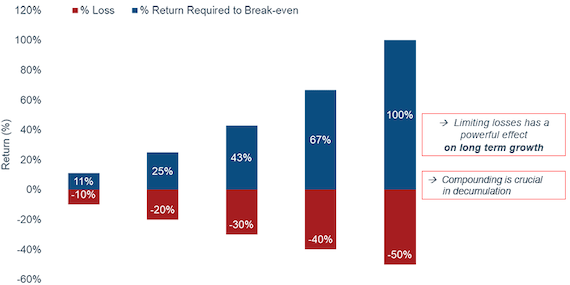
While the effects of compounding and dollar cost averaging are positive for savings and accumulation, the opposite is true during decumulation. In fact, limiting losses in retirement has a more powerful effect on long-term growth than capturing the full upside of market gains.

For instance, a 10% investment loss requires an 11% gain to simply return to the original point before the loss occurred. A 20% investment loss requires a 25% gain, and so on, to the point where a 50% loss needs a 100% gain to return to the original balance.

Compounding is not well understood

What positive returns are required to break-even after market losses?

The following examples provide a stark illustration of the impact of losses on a retiree’s portfolio during drawdown (decumulation).

Assuming a starting balance of $500,000 and a drawdown of $3,000 per month, the corresponding performance of four different investing options over the 20 years between August 1999 and August 2019 (20 years) are as follows:

  • An investment in the MSCI World Index would see the investor run out of money by May 2014.

  • An investment in a fund capturing 80% downside and 100% upside has a final balance of $402,000 in August 2019.

  • An investment in a fund capturing 80% of the downside and 110% of the upside has a balance of $1,102,000 in August 2019.

  • But, an investment in a fund capturing 40% of the downside and only 80% of the upside, has a balance of $1,600,000 at the end of the 20 years.

Reduce risk during retirement

Clearly, while taking some risk in retirement is needed to avoid unpalatable outcomes, limiting downward movements in retirement portfolios is even more important than capturing the full upside in markets.

While products with a guarantee attached can offer comfort, the cost of that guarantee can be high. The challenge for retirees is to find an investment that provides high participation in equity up markets but consistently limits the downside impact of markets at a sensible overall cost.

One option is a low volatility equity fund which offers access to equity markets but aims to lower risk through careful stock selection. By choosing a diversified portfolio of high quality stocks that are expected to fall less than the market, the portfolio manager’s focus is on limiting the impact of falls.

Another approach used by financial advisers and superannuation funds is the bucketing framework.

Bucketing allocates part of the portfolio to cash and other income for the next two to three years of income needs, while taking market risk on other assets. If there is a period of volatility, retirees don’t need to draw down on the growth assets and can better ride out the volatility. At the same time, if markets are prosperous, then they can top up the income bucket. This approach is becoming increasingly common, with most advisers having at least two buckets at their disposal, sometimes more.

In summary, investors in retirement still need to take on equity risk, but the compounding effect of investment losses can have a devastating effect on retirement portfolios. The right kind of equity exposure in retirement should come with downside protection and a capture spread that enables sufficient participation in the market upswings.

Please contact us on Phone: 07 5641 4134 if you seek further assistance on this topic.

Source: Fidelity January 2021
Reproduced with permission of Fidelity Australia. This article was originally published at https://www.fidelity.com.au/insights/investment-articles/decumulation-phase-calls-for-retiree-risk-rethink/

This document has been prepared without taking into account your objectives, financial situation or needs. You should consider these matters before acting on the information. You should also consider the relevant Product Disclosure Statements (“PDS”) for any Fidelity Australia product mentioned in this document before making any decision about whether to acquire the product. The PDS can be obtained by contacting Fidelity Australia on 1800 119 270 or by downloading it from our website at www.fidelity.com.au. This document may include general commentary on market activity, sector trends or other broad-based economic or political conditions that should not be taken as investment advice. Information stated herein about specific securities is subject to change. Any reference to specific securities should not be taken as a recommendation to buy, sell or hold these securities. While the information contained in this document has been prepared with reasonable care, no responsibility or liability is accepted for any errors or omissions or misstatements however caused. This document is intended as general information only. The document may not be reproduced or transmitted without prior written permission of Fidelity Australia. The issuer of Fidelity Australia’s managed investment schemes is FIL Responsible Entity (Australia) Limited ABN 33 148 059 009. Reference to ($) are in Australian dollars unless stated otherwise.
© 2021. FIL Responsible Entity (Australia) Limited.

Important:
This provides general information and hasn’t taken your circumstances into account. It’s important to consider your particular circumstances before deciding what’s right for you. Any information provided by the author detailed above is separate and external to our business and our Licensee. Neither our business nor our Licensee takes any responsibility for any action or any service provided by the author. Any links have been provided with permission for information purposes only and will take you to external websites, which are not connected to our company in any way. Note: Our company does not endorse and is not responsible for the accuracy of the contents/information contained within the linked site(s) accessible from this page.