
Exit and early termination fees can put the brakes on plans to sell, to refinance, and to renovate or purchase  an investment property. Here’s how to avoid them from the start.

Fees charged for the early repayment of variable-rate loans were phased out by government reforms in 2011. However, fixed-rate loans may still carry these fees, and both fixed-rate and variable-rate home loans taken before the reforms may still impose penalties for early repayments. Those pre-reform loans may now still be running.

“In most instances, for most lenders, fixed-term loans had a term of five years,” a lender expert explains. “That will be the case for most borrowers pre-2011.”

If you took out a loan before 2011 and have decided to sell, it can be difficult avoiding early termination fees for fixed-rate loans, as they protect your lender against the loss of the interest they reasonably expected to earn on your finance.

You are able to receive a waiver or fee reduction, although you rely on the discretion of your lender to receive one. Having a good repayment history and being a long-term customer helps.

“Different lenders will have different policies in relation to early repayment. Fees can be waived upon request but some lenders prefer to charge them,” the lender expert says.

To avoid early repayment fees in future, it is a good idea to take extra precaution when deciding to take a fixed-term home loan.

Fees on fixed-rate loans may include exit fees and early termination fees. Exit fees can range from $150 to $350. Early termination fees can be more costly and are charged against fixed-rate loans that are exited before the fixed-rate term is complete. They can be charged in a number of situations, including switching home loans or making extra repayments on your loan.

“The key thing to consider is whether to go for a variable option or a fixed-rate option. If you do take a fixed-rate mortgage, you will effectively be locking in the fixed-rate term, and the fixed-rate interest periods for whatever the term is,” the lender expert explains.

“That means that it’s not an appropriate product for someone who wants to pay out their loan early.”

Consider your future goals. Do you have plans to move city or change your job? Are there any foreseeable disruptions to your financial circumstance likely to take place during the space of your fixed-term rate?

Avoiding exit fees on homes loans ultimately comes down to understanding the products you are able to choose from and being clear about what you are signing up for.

“I would also recommend customers get some help when they are seeking out their loan. We certainly recommend that brokers provide really good services for customers in that regard,” the lender expert says.

To avoid being caught out by fees and charges, speak to us on Phone: 07 5641 4134 about different types of loans and how to match one to your plans for the future.

Source: MFAA

Reproduced with the permission of the Mortgage and Finance Association of Australia (MFAA)

Important: This provides general information and hasn’t taken your circumstances into account.  It’s important to consider your particular circumstances before deciding what’s right for you. Although the information is from sources considered reliable, we do not guarantee that it is accurate or complete. You should not rely upon it and should seek qualified advice before making any investment decision. Except where liability under any statute cannot be excluded, we do not accept any liability (whether under contract, tort or otherwise) for any resulting loss or damage of the reader or any other person.  Past performance is not a reliable guide to future returns.

Any information provided by the author detailed above is separate and external to our business and our Licensee. Neither our business nor our Licensee takes any responsibility for any action or any service provided by the author.

Any links have been provided with permission for information purposes only and will take you to external websites, which are not connected to our company in any way. Note: Our company does not endorse and is not responsible for the accuracy of the contents/information contained within the linked site(s) accessible from this page.


Knowing exactly what deductions apply to travel expenses can save a heap of hassle at tax time.

The Australian Taxation Office (ATO) has released a new ruling that clarifies what expenses employees can deduct for work-related travel.

The new ruling, Income tax: When are deductions allowed for employees’ transport expenses? was released this week, bringing together and clarifying the rules for business advisors and their clients alike.

Key takeaways:

  • The ATO’s new ruling sheds light on what travel expenses employees can and cannot claim

  • Travel between work locations (neither of which are your home), is typically tax deductible

  • Incidental work-related travel, such as a receptionist who makes a stop to pick up office newspapers on their way to work, can’t be claimed on tax

Travel from home to a regular place of work generally isn’t deductible. The ruling states that even if you travel to work by plane, receive a travel allowance or make incidental business-related stops on the way to work, you still cannot claim your travel expenses.

But moving between two separate work locations – like driving from your office to a construction site, or from your business to a meeting at a client’s office – can be claimed.

Tax specialist and accountant, Leo Hollestelle said the ruling is well timed ahead of the busy End of Financial Year period.

“It’s timely that these views are brought together and codified into a single ruling,” said Hollestelle. “Tax advisors will be able to more easily familiarise themselves with the rules and in turn advise their clients on it.”

Where’s your regular place of work?

Interestingly, there are several exceptions that – if claimed correctly – can give you an edge come tax time. This is especially true when it comes to defining what a “regular work location” actually is.

For example, imagine you currently work for a business with an office 15-minutes from your home.

But you’re asked to cover a long-service vacancy for six months at another of your business’s offices one hour away. Because this new office becomes your regular place of work for a sustained period of time, travel to and from it cannot be claimed on tax.

But, if your period of work was only for three months, then it could be argued that the second office never became a regular place of work.

Therefore, travel could potentially be claimed on tax.

This is a call to take care in making any assumptions about what you can actually claim. As the ATO ruling states, ‘the full facts and circumstances of the specific working arrangement in place must always be considered in determining the nature and deductibility of the transport expenses incurred’.

And that’s something to keep in mind when it comes to all travel-related tax claims this tax time, as it could be this ruling also indicates an increase in scrutiny for travel-related claims.

“While the ruling is very much in line with the Commissioner’s existing views on travel expenses, the timing is worth noting,” said Hollestelle.

“After a year where many employees have been working from home, it may be the ATO is concerned there will be both workers and employers seeking to make dubious claims in the tax period ahead.”

Want to find out exactly how tax changes and updates might impact your business? Contact us today on Phone: 07 5641 4134.

Source: MYOB February 2021

Reproduced with the permission of MYOB. This article by MYOB Team was originally published at https://www.myob.com/au/blog/travel-expenses-ato-clarifies-what-you-can-claim/

Important:
This provides general information and hasn’t taken your circumstances into account. It’s important to consider your particular circumstances before deciding what’s right for you. Although the information is from sources considered reliable, we do not guarantee that it is accurate or complete. You should not rely upon it and should seek qualified advice before making any investment decision. Except where liability under any statute cannot be excluded, we do not accept any liability (whether under contract, tort or otherwise) for any resulting loss or damage of the reader or any other person.

Any information provided by the author detailed above is separate and external to our business and our Licensee. Neither our business nor our Licensee takes any responsibility for any action or any service provided by the author. Any links have been provided with permission for information purposes only and will take you to external websites, which are not connected to our company in any way. Note: Our company does not endorse and is not responsible for the accuracy of the contents/information contained within the linked site(s) accessible from this page.

This reporting season was one of the most positive we’ve seen in years, with Australian companies across many sectors delivering strong growth, despite the challenges of the Covid pandemic.

For equity markets, the ‘valuation reality check-up’ cycle looks to have kicked-off, a theme which is likely to dominate for much of 2021. Bond market observers have been concerned about low risk spreads for an extended period. Whereas equity markets have witnessed record loss making IPOs, record valuations for many sectors and momentum factors delivered outsized returns. We also saw an abundance of liquidity delivering euphoric conditions and correlations rise as everything moved to high valuations.

Let’s look at the current market through the lens of the fund’s investment process – in context of viability, sustainability and credibility. With respect to viability, the return outlook has improved and the direction of earnings and return on capital rising with economic recovery and increasing confidence.

One sticking point though is likely to be pricing power. Companies that dominate their field and have pricing power will have an easier journey than those with intense competition. Increased activity levels may make it difficult to make a margin or pass through inflationary pressures despite significant recovery on the horizon.

In terms of sustainability, cash flows are improving and corporate debt levels in Australia are generally reasonable. Pockets of high momentum such as the ‘buy now pay later’ sector have relied on low costs of capital to gain market share and this will be tested as the cost of capital rises. To date capital intensive businesses have enjoyed growth with a low cost of debt, however debt spreads are rising. Credibility will likely become more relevant throughout the year as corporate survival, leverage to recovery and love premiums or momentum euphoria normalise.

From the contextual portfolio construction view of quality, momentum, transition and value (QMTV), one dominant feature to emerge was lower correlations. Stock specific and valuation factors were a far greater focus during first half results season, and this is likely to continue in 2021.

Quality valuations are more in check now that growth premiums are being dispersed throughout the economy.  We are seeing growth in the cyclical industrials, consumer, financials, resources and energy sectors reducing the need for investors to place significant PER (Price-to-Earnings Ratio) scarcity multiples on quality names. The phenomenal euphoric valuations momentum stocks have enjoyed will be challenged by rising rates, rising scepticism and a greater focus on sustainability and viability. Transition and value stocks will need to deliver earnings growth and demonstrate pricing power and margin growth beyond that of the top line growth associated with high economic activity levels.

There were a few disappointments during the results season which demonstrates that some industries remain highly competitive even during tough times. The value rally has run through a couple of stages now. Stage one – price to book normalisation. Stage two – rising expectations wave. Stage 3 – will be the reality phase and stocks will need to deliver to continue moving upwards and out of value into transition. Some will return to peak cycle, peak earnings, peak sentiment as they move into momentum.

2021 is shaping up to be a far more positive year. Stock picking and disciplined valuation check-ups will be key!

For more information, contact us on Phone: 07 5641 4134.

Source: Fidelity March 2021

Reproduced with permission of Fidelity Australia. This article was originally published at https://www.fidelity.com.au/insights/investment-articles/time-for-a-valuation-reality-check-up/. This document has been prepared without taking into account your objectives, financial situation or needs. You should consider these matters before acting on the information. You should also consider the relevant Product Disclosure Statements (“PDS”) for any Fidelity Australia product mentioned in this document before making any decision about whether to acquire the product. The PDS can be obtained by contacting Fidelity Australia on 1800 119 270 or by downloading it from our website at www.fidelity.com.au. This document may include general commentary on market activity, sector trends or other broad-based economic or political conditions that should not be taken as investment advice. Information stated herein about specific securities is subject to change. Any reference to specific securities should not be taken as a recommendation to buy, sell or hold these securities. While the information contained in this document has been prepared with reasonable care, no responsibility or liability is accepted for any errors or omissions or misstatements however caused. This document is intended as general information only. The document may not be reproduced or transmitted without prior written permission of Fidelity Australia. The issuer of Fidelity Australia’s managed investment schemes is FIL Responsible Entity (Australia) Limited ABN 33 148 059 009. Reference to ($) are in Australian dollars unless stated otherwise. © 2020. FIL Responsible Entity (Australia) Limited.

Important: This provides general information and hasn’t taken your circumstances into account. It’s important to consider your particular circumstances before deciding what’s right for you. Any information provided by the author detailed above is separate and external to our business and our Licensee. Neither our business nor our Licensee takes any responsibility for any action or any service provided by the author. Any links have been provided with permission for information purposes only and will take you to external websites, which are not connected to our company in any way. Note: Our company does not endorse and is not responsible for the accuracy of the contents/information contained within the linked site(s) accessible from this page.

 

Savings accounts help your money grow faster by offering a higher interest rate than everyday transaction accounts. 

Get the highest interest on your savings

Savings accounts usually earn more interest than other accounts. They’re usually online, and don’t have a debit card, so it’s not as easy to dip into your money.

Higher interest rate

The higher the interest rate, the faster your hard-earned savings will grow.

A competitive savings account will offer an interest rate of around 1.5%. A transaction account will usually have an interest rate between 0% and 0.5%.

This means your savings will grow faster in a savings account.

Bonus interest rates

Many savings accounts offer a bonus interest rate if you meet certain conditions. For example, if you make regular deposits of $500 per month, or keep a minimum balance of $5,000.

Honeymoon interest rates

Some banks offer a higher interest rate for a short period of time, called a honeymoon interest rate. Always check what the interest rate will be after the honeymoon period ends.

No fees

The best option is a no-fee savings account — you don’t want account fees to eat up your savings.

Linked accounts

To open a savings account with some providers, you will also need to open a linked transaction account. This makes it easier to transfer money between the accounts.

Government deposit guarantee

Savings accounts are a low-risk investment. They are protected by the Australian Government’s financial claims scheme. This guarantees to pay you up to $250,000 for savings deposits in the unlikely event your bank, credit union or building society fails. This guarantee applies per person and per institution.

Visit the Financial Claims Scheme to find the institutions and deposits the scheme covers.

Compare savings accounts

Before you open a savings account:

Comparison websites can be useful, but they are businesses and may make money through promoted links. They may not cover all your options. See what to keep in mind when using comparison websites.

Compare these features:

Interest rate

  • what the interest rate is

  • how often it’s paid

  • if it has a bonus or honeymoon interest rate, and what the conditions are

Account fee

  • monthly account fee

Minimum balance

  • if you need to keep a minimum balance

Maximum balance

  • the maximum you can save in your account

Linked account

  • if you need a linked transaction account with the same provider

Withdrawals

  • how often you can withdraw money

Regular deposits

  • if you need to make regular deposits, and how much

Review regularly for a better interest rate

Review your savings account regularly. Compare it to others on the market to make sure you’re getting the best interest rate. 

Contact us today on Phone: 07 5641 4134.

Source: moneysmart.gov.au
Reproduced with the permission of ASIC’s MoneySmart Team. This article was originally published at https://moneysmart.gov.au/banking/savings-accounts

Important note: This provides general information and hasn’t taken your circumstances into account.  It’s important to consider your particular circumstances before deciding what’s right for you. Although the information is from sources considered reliable, we do not guarantee that it is accurate or complete. You should not rely upon it and should seek qualified advice before making any investment decision. Except where liability under any statute cannot be excluded, we do not accept any liability (whether under contract, tort or otherwise) for any resulting loss or damage of the reader or any other person.  Past performance is not a reliable guide to future returns.

Important
Any information provided by the author detailed above is separate and external to our business and our Licensee. Neither our business nor our Licensee takes any responsibility for any action or any service provided by the author. Any links have been provided with permission for information purposes only and will take you to external websites, which are not connected to our company in any way. Note: Our company does not endorse and is not responsible for the accuracy of the contents/information contained within the linked site(s) accessible from this page.
By Richard Dinham, Head of Client Solutions and Retirement

For many, the word ‘retirement’ is associated with the idea of extended holidays to far-flung locations or spending quality time with grandchildren. And while the new-found status of “retiree” sits well with some, for others it’s a different story. It all depends on how smoothly the transition into retirement progresses. There are, in fact, a range of financial, emotional and psychological fears that are often linked to retirement – for good reason.

Australians spend most of their working lives saving for their retirement so that when the time comes to retire, they can lead a comfortable life. However, many people are uncertain about what to expect in retirement, and the issues they may face are not always just financial. For many investors, financial planners play a pivotal role in providing technical advice, guidance and peace of mind before, during and after the retirement process. But there are also the emotional and psychological impacts of transitioning to retirement to be considered.

Despite the best laid plans and the most strongly held expectations, around half of Australians do not retire for the reasons they think they will, nor at a time of their choosing.

Research from CoreData found that around 50 per cent of Australians retire early due to unexpected circumstances and within timeframes they did not choose. The reasons range from health issues to unemployment to providing care to loved ones. This can result in retirees feeling out of control and impacted not only financially, but emotionally as well.

Retirement planning is not a ‘one size fits all’ approach. But no matter what an individual’s needs are, solid financial planning allows for a smoother transition and helps alleviate the uncertainty of retirement.

Common fears and expectations associated with retirement 

While it is not surprising that pre-retirees with no superannuation savings are worried about funding their retirement, they are not the only cohort concerned. Despite healthy superannuation balances, CoreData’s research shows that close to two-thirds of pre-retirees are worried about being able to fund their retirement, with only a small percentage feeling very optimistic that they will have adequate financial resources to do everything they want in retirement.

In fact, more than half of those with retirement balances of between $750,000-$1 million say they worry about funding their retirement. These concerns only recede once an individual has accumulated more than $1 million in savings.

Encouragingly though, 43.9 per cent of pre-retirees expect to live a reasonable retirement life, understanding that not all of their desires will be fulfilled. Only four in 10 retirees say that their actual retirement lifestyle is aligned with what they expected, and three in 10 say their retirement lifestyle exceeds their expectations. 

Successful retirement factors

A successful retirement involves more than just money. Certainly, money allows for many of the things that make life worth living, but it is not enough on its own. Other important factors in a successful retirement include, mental and physical health, having realistic expectations and owning a home.

Retirement satisfaction occurs when a retirement lifestyle matches the retiree’s expectations. Not every retiree has expectations of a luxurious retirement lifestyle, but all of them expect basic needs to be addressed.

While pre-retirees are concerned about whether they will be able to fund their retirement, once a person is retired, the concern turns to whether they will run out of savings later in life.

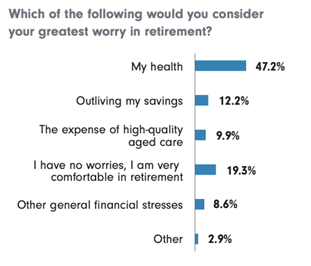
Around one in eight say their greatest worry is they will outlive their savings, and close to 10 per cent are worried about affording the costs of high-quality aged care facilities. While the welfare system allows for a basic level of income, budgeting for discretionary expenditure can cause stress.

Having adequate savings in place allows for a degree of flexibility when it comes to discretionary spending and provides a stronger sense of control.

When planning for retirement there are two core factors that determine the amount of savings a retiree needs – life expectancy and projected expenses. Individuals need to consider these, along with other factors including marital status, health and home ownership, when determining how much saving a retiree needs in order to enjoy their desired lifestyle.

Staying healthy

Early retirement is often seen in a favourable light and is eagerly planned for, however 28 per cent of Australians retire early (and unexpectedly) due to health-related issues. Almost half of all retirees consider their health as their greatest worry in retirement.

Which of the following would you consider your greatest worry in retirement?

Research from the Australian Centre from Financial Studies found those who retire early due to health issues are likely to have lower incomes and so are more likely to have lower superannuation balances. By default, they are also most likely to incur additional health-related expenses in retirement.

Maintaining a healthy lifestyle and addressing potential health issues early are therefore important factors to consider when planning for retirement.

Owning a home

Unsurprisingly, owning a mortgage-free home provides a greater sense of security and retirement satisfaction. Research from the Australian Housing and Urban Research Institute found older people with secure long-term accommodation tend to have better physical and mental health too.

Home ownership is also intrinsically linked to retirement readiness and satisfaction. Those who own more than one property with no mortgage typically experience retirement success. Single property owners also enjoy a high level of retirement satisfaction. In contrast, individuals who own no property score the lowest in terms of retirement satisfaction.

Retirement is one of the single largest changes in an individual’s life and it comes with a host of financial, emotional and psychological fears. A sound financial plan can help manage associated fears and expectations and most importantly, ensure the transition into retirement is as seamless as possible. Contact us on Phone: 07 5641 4134 today. 

Source: Fidelity February 2021

Reproduced with permission of Fidelity Australia. This article was originally published at https://www.fidelity.com.au/insights/investment-articles/fears-and-expectations/

This document has been prepared without taking into account your objectives, financial situation or needs. You should consider these matters before acting on the information. You should also consider the relevant Product Disclosure Statements (“PDS”) for any Fidelity Australia product mentioned in this document before making any decision about whether to acquire the product. The PDS can be obtained by contacting Fidelity Australia on 1800 119 270 or by downloading it from our website at www.fidelity.com.au. This document may include general commentary on market activity, sector trends or other broad-based economic or political conditions that should not be taken as investment advice. Information stated herein about specific securities is subject to change. Any reference to specific securities should not be taken as a recommendation to buy, sell or hold these securities. While the information contained in this document has been prepared with reasonable care, no responsibility or liability is accepted for any errors or omissions or misstatements however caused. This document is intended as general information only. The document may not be reproduced or transmitted without prior written permission of Fidelity Australia. The issuer of Fidelity Australia’s managed investment schemes is FIL Responsible Entity (Australia) Limited ABN 33 148 059 009. Reference to ($) are in Australian dollars unless stated otherwise.
© 2020. FIL Responsible Entity (Australia) Limited.

Important:
This provides general information and hasn’t taken your circumstances into account. It’s important to consider your particular circumstances before deciding what’s right for you. Any information provided by the author detailed above is separate and external to our business and our Licensee. Neither our business nor our Licensee takes any responsibility for any action or any service provided by the author. Any links have been provided with permission for information purposes only and will take you to external websites, which are not connected to our company in any way. Note: Our company does not endorse and is not responsible for the accuracy of the contents/information contained within the linked site(s) accessible from this page.

While SMEs account for 97 per cent of Australian businesses, it can still be difficult to make a case to a bank when looking for finance to start a new business or invest in the growth of an existing one. The good news is that applying for commercial finance through a bank is far from the only option.

Personal loans

A relatively young enterprise that doesn’t have a track record of success may not be looked upon favourably by banks, which make lending decisions based on risk. A lack of documented history doesn’t aid a business loan application, so for those who still want to go through the bank they use for transaction accounts, a personal loan could be the way to go.

The downside may be slightly higher interest rates and lower loan amounts, but a personal loan can provide a good buffer for start-ups and application is relatively easy.

“If someone told me that they’re going to run off and start a new business, I’d suggest, while still working in PAYG, to secure a personal loan before doing so,” advises the MFAA accredited finance broker. “Banks like to see at least two years’ worth of company tax returns, which could prove problematic for new businesses.”

Private funding

Private funding is when individuals lend generally through a trust account. While it can be a little more costly than the average business loan, it carries the advantage of flexibility.

“If it’s a ridiculously difficult deal to put together, with no banks wanting to touch it due to not having the appropriate documentation or being outside LVRs, then [private funding] would be an option I’d advise,” says the finance broker. “In saying that, however, I would strongly recommend speaking with a broker who has experience in private lending because, as a consumer, you’re kind of flying blind and you need to know that they’re going to be trustworthy.”

Raise the money

Crowdfunding can help raise the funds needed to finance a startup or a product. The two main types are equity crowdfunding, where a share of the business is offered in return for funds, and rewards crowdfunding, where a product or service is pre-sold prior to the launch of the business or product.

While it may seem like the most hassle-free approach, with no applications or forms required to be filled out, it does entail high risk. According to crowdfunding platform Indiegogo, the success rate for small businesses is extremely low, with only 3.1 per cent reaching their goals in 2015.

Talk to a broker

Skipping the banks entirely and talking to a commercial finance broker means gaining access to myriad finance products and loan types, as well as expertise in matching your needs to the right loan type. An experienced finance broker can take a broad view of a business’s finance, assist in business planning, and use their deep knowledge of a client’s needs to look beyond a simple ‘lowest interest rate’ formula in selecting a finance product, ensuring that business owners have access to the capital they need, when they need it. 

Securing finance is imperative for a business’s prosperity. MFAA accredited brokers can assist with business planning and finding the right type of finance to support growth and success. Call us today on Phone: 07 5641 4134.

Source: MFAA https://www.mortgageandfinancehelp.com.au/business-finance-news/small-business-finance-without-bank/

Reproduced with the permission of the Mortgage and Finance Association of Australia (MFAA)

Important:
This provides general information and hasn’t taken your circumstances into account.  It’s important to consider your particular circumstances before deciding what’s right for you. Although the information is from sources considered reliable, we do not guarantee that it is accurate or complete. You should not rely upon it and should seek qualified advice before making any investment decision. Except where liability under any statute cannot be excluded, we do not accept any liability (whether under contract, tort or otherwise) for any resulting loss or damage of the reader or any other person.  Past performance is not a reliable guide to future returns.

Any information provided by the author detailed above is separate and external to our business and our Licensee. Neither our business nor our Licensee takes any responsibility for any action or any service provided by the author.

Any links have been provided with permission for information purposes only and will take you to external websites, which are not connected to our company in any way. Note: Our company does not endorse and is not responsible for the accuracy of the contents/information contained within the linked site(s) accessible from this page.



Keeping all your super in one place is a smart move. In this article, we’ll look at the case to consolidate.

Why you should consolidate your super

Around 40% of us have more than one super account1 – this is usually a result of starting a new job. In fact, Aussies hold at least $14 billion in ‘lost’ super accounts – money they’ve probably forgotten about. It’s an astonishing amount – the gross domestic product (GDP) of Malta or Mongolia. Around $600 for every man, woman and child in the country.1

There are a number of advantages to combining your super savings into a single account. It will make it easier to keep track of your money, cut down on paperwork, maximise your super savings and potentially reduce the amount of account fees you have to pay.2

Little effort. Big payoff.

You can roll your super into a single account electronically or via paper form, the old school way. And because we like to make things easy, we will even help you set up an account and find any lost super hiding out there.

Before you make the decision to consolidate, it’s important that you:

  • confirm that your new fund will offer you (and you can obtain) appropriate insurance cover3 to replace any cover you may lose if you change funds

  • check to see if there are any termination or exit fees from your current fund

  • compare the total fees with your existing funds

  • ensure you lodge your ‘Notice of intent’ with the Trustee and an acknowledgement is received (if you intend to claim a tax deduction for personal contribution/s made to the current fund)

  • consider the impact on the tax and preservation components of each of your existing funds

  • check with your employer that they’re able to contribute to your chosen fund. 

One account, one set of fees, one less thing to stress about

You can consolidate your super with us at any time online. Simply choose one of the options below and we’ll get started. Call us on Phone: 07 5641 4134.

 
2 When you transfer all or part of your super, your entitlements under the other fund(s) may cease. You need to consider all relevant information before you make a decision to transfer your superannuation, such as administration, exit, buy/sell spreads or withdrawal fees that may apply in respect of the existing fund(s). Similarly you should consider insurance entitlements which may cease when you consolidate your super. You should also consider your contribution caps and the impact on the tax and preservation components of each of your superannuation interests before consolidating (you should ask your fund(s) for information) and seek advice where required. ASIC Money Smart 2015, found at: https://www.moneysmart.gov.au/superannuation-and-retirement/keeping-track-and-lost-super/consolidating-super-funds
 
Appropriate insurance can include level and types of cover as well as policy terms.
 

Reproduced with permission of National Australia Bank (‘NAB’). This article was original published at https://www.nab.com.au/personal/life-moments/work/plan-retirement/consolidate-super

National Australia Bank Limited. ABN 12 004 044 937 AFSL and Australian Credit Licence 230686. The information contained in this article is intended to be of a general nature only. Any advice contained in this article has been prepared without taking into account your objectives, financial situation or needs. Before acting on any advice on this website, NAB recommends that you consider whether it is appropriate for your circumstances.

© 2021 National Australia Bank Limited (“NAB”). All rights reserved.

Important:
Any information provided by the author detailed above is separate and external to our business and our Licensee. Neither our business nor our Licensee takes any responsibility for any action or any service provided by the author. Any links have been provided with permission for information purposes only and will take you to external websites, which are not connected to our company in any way. Note: Our company does not endorse and is not responsible for the accuracy of the contents/information contained within the linked site(s) accessible from this page.

After spending your working life building retirement savings, you may be reluctant to eat into your “nest egg” too quickly. This is understandable, given that we are living longer than previous generations and may need to pay for aged care and health costs later in life.

But this cautious approach also means retirees are living more frugally than they need to. This was one of the key messages from the Government’s recent Retirement Income Review, which found most people die with the bulk of the wealth they had at retirement intact.

One of the benefits of advice is that we can help you plan your retirement income so you know how much you can afford to spend today, secure in the knowledge that your future needs are covered.

Making the most of super

According to the Review: “It appears (most people) see superannuation as mainly about accumulating capital and living off the return on this capital, rather than as an asset they can draw down to support their standard of living in retirement.”

The figures back this up. The average super account balance on the death of a member in the year to June 2020 was $102,660.i While not a huge amount, it is an indication that retirees may be able to withdraw more than the minimum amount from their super to live more comfortably without breaking the bank.

Minimum super pension withdrawals

Under superannuation legislation, once you retire and transfer your super into a pension account you must withdraw a minimum amount each year. This amount increases from 4 per cent of your account balance for retirees aged under 65 to 14 per cent for those aged 95 and over. (These rates have been halved temporarily for the 2020 and 2021 financial years due to COVID-19.)

One of the common misconceptions about our retirement system, according to the Retirement Income Review, is that these minimum drawdowns are what the Government recommends. Instead, they are there to ensure retirees use their super to fund their retirement, rather than as a store of tax-advantaged wealth to pass down the generations.

In practice, super is unlikely to be your only source of retirement income.

The three pillars

Australia’s retirement income system is built around three potential sources of income, known as the three pillars:

  • A means-tested Age Pension

  • Compulsory super, and

  • Voluntary savings both in and out of super.

The Retirement Income Review, and the government, argue that the family home should be included with voluntary savings or as a fourth pillar, but more on that later.

Most retirees live on a combination of Age Pension topped up with income from super and other investments. Despite compulsory super being around for almost 30 years, over 70 per cent of people aged 66 and over still receive a full or part-Age Pension.

While the Retirement Income Review found most of today’s retirees have adequate retirement income, it argued they could do better. Not by saving more, but by using what they have more efficiently.

Withdrawing more of your super nest egg is one way of improving retirement outcomes, but for those who could still do with extra income the answer could lie in the nest itself.

Unlocking housing wealth

Australian retirees are some of the wealthiest in the world, with median household wealth of around $1.4 million. Yet close to $1 million of this wealth is tied up in the family home.

Studies have also shown that most people use a form of mental accounting which sets aside super for income, other financial assets for emergencies and the family home for future bequests.ii

That’s a lot of money to leave to the kids, especially when many retirees end up living in homes that are too large while they struggle to afford the retirement lifestyle they had hoped for.

For these reasons there is growing interest in ways that allow retirees to tap into their home equity (see box). Of course, not everyone will want or need to take advantage of these options, but they are available if you would like some extra income.

Here are some options to use your home to generate retirement income:

  • Downsizer contributions to your super. If you are aged 65 or older and sell your home, perhaps to buy something smaller, you may be able to put up to $300,000 of the proceeds into super (up to $600,000 for couples). Strict rules apply, so speak to us for more details.

  • The Pension Loans Scheme (PLS). Offered by the government via Centrelink, for Australians of Age Pension age who own real estate in Australia, this scheme provides regular fortnightly payments that accrue as a debt secured against the property.

  • Reverse Mortgages (also called equity release or home equity schemes). Similar to the PLS but offered by commercial providers. Depending on your age and lender policy, you may be able to take the amount you borrow as a regular income stream, line of credit, lump sum or combination of these.  

The big picture

Discussions about retirement in the media and around the kitchen table often focus on how much super you have and whether it’s enough. Super is important, but it’s not the only source of retirement income.

If you would like to discuss your retirement income needs and how to make the most of your assets, give us a call on Phone: 07 5641 4134.


i APRA, https://www.apra.gov.au/sites/default/files/2021-01/Annual%20superannuation%20bulletin%20-%20June%202015%20to%20June%202020%20-%20superannuation%20entities_1.xlsx
ii https://householdcapital.com.au/third-pillar-forum/retirement-insights/prof-hazel-bateman/

This provides general information and hasn’t taken your circumstances into account. Any links have been provided with permission for information purposes only and will take you to external websites, which are not connected to our company in any way. Note: Our company does not endorse and is not responsible for the accuracy of the contents/information contained within the linked site(s) accessible from this page.

By Beatrice Yeo, Economist, Vanguard Australia

The Reserve Bank of Australia has recently made an unprecedented change to the way it targets inflation.

The bank’s mandate is to use monetary policy to keep a lid on price rises and achieve full employment. It does this by targeting an inflation rate of between 2 and 3 per cent a year, on average over the economic cycle.

For 27 years, it has done this by looking forward, aiming to set rates based on its forecasts of where inflation might land.

In November last year however, it announced a change in approach1.

The RBA said it will instead be watching for actual – not forecast – inflation to be in the target range. Only then will it be the right time to lift interest rates from their all-time lows.

After years of pre-emptively moving to contain inflation, the RBA is now holding off until the sleeping dragon awakes before it springs into action.

So what exactly is inflation? Why is the RBA so keen to see it return?

And more importantly, what does this all mean for investors?

Simply put, inflation is merely a term for rising prices. Its counterpart, deflation, is the term for falling prices.

Inflation and deflation are measured in Australia using the Consumer Price Index which, much like a stock market index, simply averages out a range of prices.

But unlike a stock market index, which averages the prices of a group of shares, an inflation index averages the prices of the goods and services used by households.

The consumer price index is calculated by the Australian Bureau of Statistics and covers an enormous range of purchases – from rent and mortgages to healthcare, clothing and even pet food.

The ABS collects around 100,000 prices every quarter and revises the index annually based on the actual spending of Australian households2.

Inflation has been a feature of economies through history, often occurring in bursts of surging prices and collapsing currencies as governments issued money to finance wartime spending3.

But getting prices and currencies sharply lower often came at a real cost to the regular population, who would suffer unemployment, reduced incomes and sometimes even food shortages.

Central banks, and economists, argue that keeping prices rising modestly creates conditions for the best economic outcome. Rising prices encourages investment by businesses. It boosts consumer demand and consumption because individuals purchase products before they get more expensive.

So as such, the RBA aims to achieve an inflation rate averaging between 2 per cent and 3 per cent a year.

But what does all this have to do with investing?

Inflation reduces the value of savings because the things we are saving for – whether that’s a home, a holiday or retirement – will cost more by the time we get around to buying them.

Right now, this is not having too much of an effect. The Reserve Bank forecasts the inflation rate to stay low over the next few years, rising to an annual rate of only 1.5 per cent by 2022.

But the bank has committed to getting inflation higher, saying it will keep interest rates at rock bottom until the rate of inflation is sustainably within the 2 to 3 per cent target range.

And even if the RBA was not on the case, the trillions in government stimulus and central bank support being pumped into the global economy also risks sparking a jump in inflation.

This poses a challenge for investors.

An annual inflation rate of 1.5 per cent cuts the value of a dollar by 14 per cent every decade. At 3 per cent inflation, every decade that passes cuts the value of a dollar by a little over a quarter.

Older investors will recall that at one stage during the 1970s inflation breakout, inflation in Australia reached an incredible 17.5 per cent4.

In fact, for a full two decades up until the end of the 1980s, inflation averaged 9 per cent per year, meaning that, over the period, cash lost a hard-to-comprehend 85 per cent of its purchasing power.

While we are not expecting a return of such corrosive price rises, it may still be worthwhile to consider potential hedges for modest inflation.

Depending on whether higher inflation is accompanied by higher or lower economic growth5, investors’ choice of instruments to hedge inflation may vary.

Under a high growth-high inflation scenario, traditional cash and fixed income investments without built-in inflation protection fare poorly, with their fixed dollar returns unable to recoup the purchasing power lost to inflation. However, these safe-havens could still play an important role in the event of a stagflation scenario – where higher inflation coincides with lower growth and persistently high unemployment.

Equites get a mixed report card. In a high growth-high inflation scenario, expected returns on equity would be high, causing the frontier to be steep. Long and short rates would also rise faster than expected, resulting in an optimal portfolio with higher allocation to equity relative to the baseline. Conversely, a low growth-high inflation environment would prove to be less conducive for equities as companies may struggle to raise output prices even as their input prices rise.

Commodities have historically performed well during inflation because as inputs, their prices tend to rise alongside the goods and services they are used to make. Gold is considered a store of value because it is so scarce. Its value rises alongside inflation. But commodities also make quite volatile investments, do not normally generate an income and can spend long periods underperforming.

Real estate investments are touted as an inflation hedge as their value usually keeps pace with prices and rents can be adjusted upwards as prices rise. But real estate also suffers from the fact that the cost of things like maintenance, property management, insurance and taxes tend to also rise with inflation. And when the RBA is satisfied inflation has returned, it will respond with higher interest rates, with directly affects the real estate industry.

In any case, ultimately when preparing a portfolio the key thing to keep in mind is that the future you plan for may or may not occur.

A portfolio prepared for one set of economic circumstances will likely underperform during another.

This means that a properly diversified portfolio will provide most people with the best combination of performance and risk, whether or not the old enemy of inflation threatens again.

1 https:https://intl.assets.vgdynamic.info/intl/australia//www.rba.gov.au/speeches/2020/sp-gov-2020-11-16.html
2 https://www.rba.gov.au/education/resources/explainers/pdf/inflation-and-its-measurement.pdf?v=2020-11-10-10-59-25
3 https://fraser.stlouisfed.org/title/economic-review-federal-reserve-bank-atlanta-884/november-1993-34996/inflation-long-going-294441
4 https://www.rba.gov.au/speeches/2003/sp-dg-100403.html
5 See Vanguard research on inflation: https://personal.vanguard.com/pdf/ISGGMMIN.pdf

Source: Vanguard February 2021

Vanguard Investments Australia Ltd (ABN 72 072 881 086 / AFS Licence 227263) is the product issuer. We have not taken yours and your clients’ circumstances into account when preparing this material so it may not be applicable to the particular situation you are considering. You should consider your circumstances and our Product Disclosure Statement (PDS) or Prospectus before making any investment decision. You can access our PDS or Prospectus online or by calling us. This material was prepared in good faith and we accept no liability for any errors or omissions. Past performance is not an indication of future performance.

© 2021 Vanguard Investments Australia Ltd. All rights reserved.

Important: Any information provided by the author detailed above is separate and external to our business and our Licensee. Neither our business nor our Licensee takes any responsibility for any action or any service provided by the author. Any links have been provided with permission for information purposes only and will take you to external websites, which are not connected to our company in any way. Note: Our company does not endorse and is not responsible for the accuracy of the contents/information contained within the linked site(s) accessible from this page.

If you’re thinking about selling your home and downsizing, consider the pros and cons. Check if selling your home affects your government benefits.

Consider the costs and your needs before you downsize

Take time to consider your needs. Make sure your new home suits your lifestyle, budget and level of independence.

Some of the costs to consider include:

  • buying and selling in the same market

  • real estate agent fees

  • stamp duty

  • legal fees

  • furniture removal

See buying a house for more information.

Pros and cons of downsizing your home

Weigh up the pros and cons to decide if downsizing is right for you.

Pros

  • Increased cash flow — Downsizing could free up money to pay off your mortgage, invest or spend.

  • Easier to maintain — A smaller place takes less effort to clean and maintain.

  • More convenient — You can choose a layout and fittings that better meet your needs, or a location closer to family, transport and services.

  • Lower insurance and utility bills — In general, a smaller home costs less to insure and is cheaper to heat or cool.

Cons

  • Less space — A smaller place means less space for things, so you may have to make some hard choices.

  • Less flexibility — Your new place may have less privacy, fewer guest rooms, or less space for entertaining.

  • New neighbourhood — It may take time to get used to new surroundings.

  • Emotional connection — Your family home may be full of memories, which can make it difficult to let go.

Alternatives to downsizing your home

If you decide to stay in your home, alternatives to downsizing include:

  • Renting out space — Consider renting out a room or taking in a boarder.

  • Converting to dual occupancy — See if you can convert your home so that you live in one half and rent or sell the other half.

  • Considering equity release — Explore whether a reverse mortgage or home reversion may suit. There is risk involved and a long-term financial impact, so get independent financial advice first.

Before going ahead with any of these options, check the tax impact and whether it will affect your government benefits.

Impact on Age Pension or government benefits

Your eligibility for the Age Pension depends on the:

Your home is not included in the assets test. When you sell your home, the proceeds are exempt for up to 12 months if you plan to use them to buy, build or renovate another home.

The proceeds are ‘deemed’ in the income test — they are assessed as income from financial assets. This may affect the amount of government benefits you get.

See Age Pension and government benefits for more information.

What to do after you downsize

After you’ve sold your home:

  • Try renting for a while — If you’re having trouble deciding where to live, rent in a new area to see how you like it.

  • Invest the proceeds — Consider investing any extra money into an income-producing adsset. See how to invest to explore your options.

  • Get help if you need it — Government services like the Commonwealth Home Support Programme can help you to live independently and assist with daily tasks like shopping, cleaning, personal care or home maintenance. See aged care for more options.

You may be able to contribute up to $300,000 from the sale of your home to your super. See downsizing contributions into superannuation on the Australian Taxation Office (ATO) website.

Get independent advice before you go ahead

Before you downsize:

  • Consult a legal professional to review sale contracts and oversee settlement.

  • Get independent advice from a financial adviser about options for investing your sale proceeds.

  • Ask the Services Australia Financial Information Service how it will affect your pension or government benefits.

To learn more, contact us today on Phone: 07 5641 4134. 

Source: Moneysmart.gov.au
Reproduced with the permission of ASIC’s MoneySmart Team. This article was originally published at https://moneysmart.gov.au/retirement-income/downsizing-in-retirement

Important note: This provides general information and hasn’t taken your circumstances into account.  It’s important to consider your particular circumstances before deciding what’s right for you. Although the information is from sources considered reliable, we do not guarantee that it is accurate or complete. You should not rely upon it and should seek qualified advice before making any investment decision. Except where liability under any statute cannot be excluded, we do not accept any liability (whether under contract, tort or otherwise) for any resulting loss or damage of the reader or any other person.  Past performance is not a reliable guide to future returns.

Important
Any information provided by the author detailed above is separate and external to our business and our Licensee. Neither our business nor our Licensee takes any responsibility for any action or any service provided by the author. Any links have been provided with permission for information purposes only and will take you to external websites, which are not connected to our company in any way. Note: Our company does not endorse and is not responsible for the accuracy of the contents/information contained within the linked site(s) accessible from this page.