Super is a way of saving for retirement. Your employer must pay a percentage of your earnings into your super account, and your super fund invests the money until you retire.

There are lots of different super funds out there, and different types of accounts. Find out how to compare super funds, find your lost super, and consolidate funds into one.

Look after your super

Your super is your money. Look after it by:

  • choosing an account with lower fees

  • comparing your fund’s performance with others

  • combining accounts if you have more than one

  • checking your insurance before you change funds

  • knowing what’s involved before deciding whether to choose an SMSF

  • being wary of anyone offering to withdraw your super early 

Watch: What is super?

If you would like to learn more about looking after your super, call us on Phone: 07 5641 4134 today.

Source: moneysmart.gov.au
Reproduced with the permission of ASIC’s MoneySmart Team. This article was originally published at https://moneysmart.gov.au/how-super-works

Important note: This provides general information and hasn’t taken your circumstances into account.  It’s important to consider your particular circumstances before deciding what’s right for you. Although the information is from sources considered reliable, we do not guarantee that it is accurate or complete. You should not rely upon it and should seek qualified advice before making any investment decision. Except where liability under any statute cannot be excluded, we do not accept any liability (whether under contract, tort or otherwise) for any resulting loss or damage of the reader or any other person.  Past performance is not a reliable guide to future returns.

Important
Any information provided by the author detailed above is separate and external to our business and our Licensee. Neither our business nor our Licensee takes any responsibility for any action or any service provided by the author. Any links have been provided with permission for information purposes only and will take you to external websites, which are not connected to our company in any way. Note: Our company does not endorse and is not responsible for the accuracy of the contents/information contained within the linked site(s) accessible from this page.
 

End of financial year (EOFY) is a stressful time for small business owners and their tax agents alike. Make things easier for you and your accountant by taking up the following four habits.

Recently there have been considerable studies on the habits of small business owners and, without fail, those who follow the best practices around record keeping and tax essentials consistently outperform their competitors when it comes to annual revenue and satisfaction with their business overall.

Leanne Berry, founder of business consulting firm Love Your Numbers, says the best advice she can give to small business owners is to be prepared.

“Don’t wait until the last minute and stress over things not done,” Berry said.

“Instead, create good habits early on and make sure everything is reconciled and you have all your supporting documentation ready.”

But what is the best way to go about being prepared for EOFY? Below are a few tips on how to be prepared and to make EOFY as stress free as possible.

1. Record everything

The number one response accountants give when asked about the most important thing in small business EOFY preparation is to record everything.

In order to prepare an accurate tax return and support the claims you make; you need to keep careful records.

You should record all information relating to receipts and correspondence around payments you have received (income), receipts and correspondence around anything you have spent on the business (expenses), any assets you have acquired or disposed of (such as equipment), gifts or donations, GST and payroll information (if relevant).

Berry also recommends her clients go digital: “Get accounting software and go digital or paperless with all your paperwork,” she said.

“We recommend clients use a program like MYOB and a receipt capture app linked to your accounting software to ensure that everything is stored digitally.”

That way, all your important financial records are easily shared with your accountant or the tax office when needed.

While many accounting programs help you keep track of the day to day sums and finances, ensuring you keep physical or digital copies of original receipts, invoices, logbooks and other expense-related material is essential in case you are audited. In fact, legally, you must keep full account records for up to five years.

2. Get help

Good record keeping will ensure that the EOFY tax process each year is quick and easy. Unfortunately, if you’ve kept poor records and need extensive help from a tax professional, things can get pretty costly, pretty quickly.

The recurrent tax mistakes small business owners make when it comes to recording information are generally down to a lack of understanding. Berry notes that most clients do not understand “all the requirements of EOFY, payroll, inventory, bad debts, financing, super, director loans, dividends, and director fees”.

To assist with this, Berry suggests working with a bookkeeper or BAS agent to take the stress out of EOFY.

“It is a good idea to engage with a professional bookkeeper or BAS Agent.

“They have the knowledge and skills to assist you to stay compliant in a complicated tax world and will always prove to be the best investment in your business.”

3. Put some aside

One of the biggest financial mistakes small business owners make is forgetting to put aside money for GST and tax. It’s essential to remember that GST you collect is not your money, and that taxes are accrued every time a customer pays an invoice.

If you are an employer, you also have to remember your PAYG liabilities, which enable your employees meet their end-of-year tax liabilities. Each time you pay staff, you are withholding tax from staff wages which needs to be paid to the Government. Unfortunately, this money doesn’t leave your account with the wages, so it’s essential to check your PAYG debt each month and stay on top of what you owe (but if you’ve made the switch to Single Touch Payroll, this may no longer be an issue for you.)

A good habit is to put aside around 30 percent of all income you receive, or at least 90 percent of your previous year’s tax bill to ensure you’ve got some cash set aside and your tax bills don’t come as a shock.

4. Audit your year

Once your tax has been finalised for the year and you have a complete picture of your financial activity, it’s time to review your business results. Speak with your accountant and ask for any tips on better record keeping. Also, audit your results and see if there’s any other areas of business you could be performing better in.

The ATO publishes small industry benchmarks to assist in the comparison of a business performance against potentially similar businesses in the same industry. The benchmarks are calculated from income tax returns and activity statements from over 1.3 million small businesses.

These benchmarks account for businesses with different turnover ranges (greater than $30,000 and less than $15 million) across more than 100 industries and are published as a range to recognise the variations that occur between businesses due to factors such as location and the businesses circumstances.

For more information on the benchmarks, visit the ATO’s Small Business Benchmarks page.

While EOFY can feel like a very daunting time of the year if you’re unprepared, ensuring you’ve kept good records and have been planning for it each month in line with the above advice, there’s no reason it should cause any extra stress.

Call us on Phone: 07 5641 4134 if you have any questions. 

Source: MYOB June 2019

Reproduced with the permission of MYOB. This article by Renae Smith was originally published at https://www.myob.com/au/blog/eofy-effective-small-business-habits/

Important:
This provides general information and hasn’t taken your circumstances into account. It’s important to consider your particular circumstances before deciding what’s right for you. Although the information is from sources considered reliable, we do not guarantee that it is accurate or complete. You should not rely upon it and should seek qualified advice before making any investment decision. Except where liability under any statute cannot be excluded, we do not accept any liability (whether under contract, tort or otherwise) for any resulting loss or damage of the reader or any other person.

Any information provided by the author detailed above is separate and external to our business and our Licensee. Neither our business nor our Licensee takes any responsibility for any action or any service provided by the author. Any links have been provided with permission for information purposes only and will take you to external websites, which are not connected to our company in any way. Note: Our company does not endorse and is not responsible for the accuracy of the contents/information contained within the linked site(s) accessible from this page.

While it’s not something anyone likes to think about, planning your estate may make things a little easier for your family and friends later.

What is your ‘estate’?

Your ‘estate’ includes everything you own – your ‘earthly possessions’, if you will. It can include for example cash, property, cars, boats, furniture, jewellery, family heirlooms, art, shares and more.

What is estate planning?

This is where you decide what will happen to your belongings after you pass away. By leaving a clear set of ‘instructions’, you help make sure that the people you care most about aren’t faced with any unnecessary conflict or uncertainty.

Why is estate planning important?

Even if you don’t have much money or property, planning your estate is the best way to make sure that special belongings go to the people who will treasure them. Often, it’s these items that matter most.

Why an estate plan is a good plan

  • Your assets get passed on to beneficiaries that you choose. If you pass away without a valid will (and in turn, without a valid estate plan) you’re considered to have ‘died intestate’ and your assets get distributed according to your state’s inheritance laws—not your wishes.

  • If you leave kids behind, you decide who cares for them and how—not the courts.

  • You minimise the tax your beneficiaries may pay when they inherit your assets.

  • You reduce the risk of conflict between family and friends when you pass away.

What’s in your will?

Your will is a legal document that’s part of your estate plan. It outlines how you want your estate to be managed and how you want your assets to be distributed when you pass away.

If you have a fairly straightforward estate and know how you’d like to distribute it, you can easily write your will yourself. It’s as simple as buying a will pack from Australia Post and select news agencies, or downloading it online.

For more complicated estates, it might be a good idea to get advice from a solicitor or the Public Trustee. You can then appoint them to be your executor.

Your will checklist

Your will should:

  • clearly identify your beneficiaries

  • clearly identify your executor

  • have the right date on it

  • be signed correctly

  • be witnessed correctly

  • list exactly how you want your estate to be distributed to your beneficiaries (including any plans if they pass away before you)

  • be up to date.

Should you review your estate plan?

Life is never predictable, so it’s a good idea to update your estate plan when things change.

Why you might change your estate plan

  • You get married.

  • You get divorced.

  • You have kids.

  • Your partner, dependant or loved one passes away.

  • You experience financial hardship.

Other things to consider

Organising life insurance and a funeral plan can make things easier for your family later. Learn the ins and outs of life insurance, or find out about estate planning in more detail by calling us on Phone: 07 5641 4134.

Glossary

Beneficiary

Person(s), usually named in the will, who receive money or assets after the death of your family member or friend.

Executor

Person(s) chosen in the will to make sure all things noted in the will are distributed as per your family member or friend’s request.

Source: NAB https://www.nab.com.au/personal/life-moments/unplanned/losing-loved-ones/will

Reproduced with permission of National Australia Bank (‘NAB’). This article was original published at https://www.nab.com.au/personal/life-moments/unplanned/losing-loved-ones/will

National Australia Bank Limited. ABN 12 004 044 937 AFSL and Australian Credit Licence 230686. The information contained in this article is intended to be of a general nature only. Any advice contained in this article has been prepared without taking into account your objectives, financial situation or needs. Before acting on any advice on this website, NAB recommends that you consider whether it is appropriate for your circumstances.

© 2021 National Australia Bank Limited (“NAB”). All rights reserved.

Important:
Any information provided by the author detailed above is separate and external to our business and our Licensee. Neither our business nor our Licensee takes any responsibility for any action or any service provided by the author. Any links have been provided with permission for information purposes only and will take you to external websites, which are not connected to our company in any way. Note: Our company does not endorse and is not responsible for the accuracy of the contents/information contained within the linked site(s) accessible from this page.


It’s been a year of change like no other and that extends to tax and superannuation. As the end of the financial year approaches, now is a good time to check some new and not so new ways to reduce tax and boost your savings. 

So gather up any paperwork you need to prepare your personal tax return. This may include bank and superannuation statements, records related to share or property investments, receipts for charitable donations and work-related expenses.

With so many of us confined to our homes over the past year, the big deductible item this year is likely to be working from home expenses.

Home office expenses

If you have been working from home, the Australian Taxation Office (ATO) has introduced a temporary shortcut method which can be used for the 2020-21 financial year. This allows you to claim 80c for each hour you worked from home during the year. 

The shortcut method covers the additional running costs for home expenses such as electricity, phone, internet, cleaning and the decline in value of home office furniture and equipment. You don’t even need a separate office space in your home. To make a claim, you just need a record of the hours your worked from home, which could be a roster, time sheet or diary. 

Some people may get a better result claiming the work-related portion of their actual working from home expenses using the actual cost method. While you don’t need a separate home office, if you work from the kitchen table or the couch the amount you can claim this way may be limited. 

Alternatively, if you do have a dedicated home office, you can claim using the fixed rate method. The fixed rate is 52c an hour for every hour you work at home and covers things like gas and electricity, and the decline in value or repair of office furniture and furnishings. On top of this, you may also be able to claim the work-related portion of phone and internet expenses, computer and stationery supplies, and the decline in value of your digital devices.

Top up your super

If your super could do with a boost and you have cash to spare, now is the time to check whether you are making the most of the contribution strategies available to you. 

You can make tax-deductible contributions up to $25,000 a year, but be mindful that this includes and Super Guarantee payments by your employer. You can also contribute up to $100,000 a year after tax. From July 1 these caps will increase to $27,500 and $110,000 respectively, so it’s important to factor this into decisions you make before June 30.

For instance, if you recently received a windfall and are considering using the ‘bring forward’ rule, you might consider holding off until after July 1. This rule currently allows you to bring forward two years’ after-tax contributions allowing you to put up to $300,000 (3 x $100,000) into your super account. By holding off until July 1 you could contribute up to $330,000 under the new limits.

Also increasing on July 1 is the amount you can transfer from your super account into a pension account. The transfer balance cap is increasing from $1.6 million to $1.7 million. 

So if you are about to retire and your super balance is close to the cap, it may be worth delaying until after June 30. For those already in pension phase, you may be able to use a portion of the increase, but the calculations are complex so contact us to discuss your options.

Finally, from 1 July 2020, if you are under age 67 you can now make voluntary contributions without meeting a work test (previously this was restricted to under 65s). And if 2020-21 is the first year that you no longer satisfy the work test, you may still be able to add to your super if you had a total super balance below $300,000 on 1 July 2020.

Manage investment gains and losses

After a bumper year for shares and property, if you sold any investments this financial year it’s likely you made a capital gain. Now is a good time to look at your portfolio for any loss-making investments with a view to selling before June 30. Any capital loss may potentially be used to offset some or all of your gains.

Of course, any decisions to buy or sell should fit with your overall investment strategy and not for tax reasons alone. It’s also worth noting that the ATO takes a dim view of selling loss-making shares in June only to buy them back in July, a strategy it might consider tax avoidance. 

For all the challenges of the past year, there are still many ways to improve your overall financial situation. So get in touch to make the most of strategies available to you to before June 30. 

Pre-pay expenses

While COVID has changed many things, some things stay the same. Such as the potential benefits of pre-paying next year’s expenses to claim a tax deduction against this year’s income.

Some examples are pre-paying 12 months’ premiums for your income protection insurance and work-related expenses such as professional subscriptions and union fees. If you are unsure what you can claim, the ATO has a guide for a range of occupations.

If you own an investment property, you might also consider pre-paying 12 months’ interest on your loan and other property-related expenses. 

Speak to a financial adviser or tax agent before making any financial decisions. If you would like help getting ready for tax time, call our office on 02 4342 1888 today.

If you’re a sole trader and need to get your taxes organised, start by reading these expert tips for maximising your return and get a jump start on next financial year.

End of financial year can be stressful for any business owner, especially when it comes to completing your tax return. But rest assured, with a little pre-planning and expert help, you can easily reduce your tax-time stress while maximising your return.

To help make tax time less, well, taxing, we chatted to Chartered Accountant and small and solo accounting practice coach, Amanda Gascoigne.

Here are her top tax time tips for sole traders – and some common mistakes to avoid. Remember: you have until 31 October to lodge your tax return for the last Financial Year, so now is the time to act.

Key takeaways:

  • Organising your records and setting up good recordkeeping practices now will save you time in future

  • Don’t leave tax planning to the very last minute if you want to be thorough, reducing the risk of an audit and maximising your deductions

  • There are tech tools to help streamline the process

  • Seek professional advice from a certified tax agent near you


Separate business and personal expenses


It might seem simpler as a sole trader to have a single bank account and credit card, but it’s a mistake that could impact your tax return. According to Gascoigne, if you don’t already have a business account set up, you should make this a priority.

“Pay all of your business expenses through a business bank account and a dedicated credit card as this will ensure you don’t miss out on any tax deductions,” she said.

And if you do have to pay for something business-related with cash, or from a personal account? Reimburse yourself from your business bank account so you have a record.


Know the rules around expense claims


“If you are spending money on things that help you make money in your business, it will be either fully deductible or partially deductible,” said Gascoigne.

But it’s important you only claim the portion that is used for your business. For example, if you have one mobile phone for both work and personal use, you can only claim a certain percentage of your bill as a business deduction.

According to Gascoigne, an expense that’s regularly overlooked is the use of a privately-owned vehicle. “Often it could be this vehicle that is used for quotes, banking and collecting mail or business supplies,” she said.

If this is the case, a logbook should be maintained as proof of business use or business kilometres.

For other expenses such as mobile phone and home internet, Gascoigne advised keeping a diary for a representative four-week period to show your usual pattern of use, which can then be applied to the full year.

To learn what can – and can’t – be deducted, head to the ATO website’s business tax deductions summary.


Keep digital copies of work-related receipts


There’s a lot of confusion around the need for receipts, said Gascoigne.

“Many business owners believe that they don’t need a receipt if an expense is less than $82.50, however that is for GST purposes only, not tax purposes.

“You cannot claim a tax deduction for an expense if you do not have a receipt.”

You are required to keep these records for a minimum of five years. And, as paper receipts fade and are easily misplaced, it’s best to have a backup in case of an audit.

“My top tip here would be to start keeping your receipts digitally by using MYOB’s Capture App or Receipt Bank,” said Gascoigne.


Don’t leave tax planning and returns to the last minute


According to Gascoigne, it’s always best to undertake tax planning strategies prior to 30 June. This enables you access to a range of tax reduction strategies you may not be able to put in place at a later date.

A good accountant is invaluable during the tax planning stage of your financial year.

Instead of leaving completing tax returns until the last minute, Gascoigne recommends sole traders complete their returns well before the due date, even if a tax bill is anticipated.

“This way they can start setting aside money for that year and the current year.

“Sometimes the bill is less than anticipated and they could be losing sleep unnecessarily,” she said.

And if you do have a tax debt and do not have the funds available? You can apply to the ATO for a payment arrangement.


Don’t go it alone


Whether you’re yet to submit last year’s tax return or planning for the new year, consider seeking some outside help.

Enlisting an accountant can save you time and money, and provide valuable insight into the health of your business.

According to Gascoigne, having an accountant produce your profit and loss statement and tax return is the best way to ensure your tax is minimised.

Additionally, a good accountant can help you achieve your business and personal goals.

“Accountants will be able to comment on how your results compare to other clients in the same industry, can help you set budgets and charge rates and so much more,” she said.

“An accountant is an integral part of your business team – see them as an investment and not a cost.”


Avoid these common sole trader tax-time errors


According to Gascoigne, some of the most common mistakes made by sole traders at tax time are:

  • Not declaring all income received — that means keeping your invoices in order and staying on top of BAS

  • Claiming expenses that are not business related

  • Not taking into account the private proportion of expenses

  • Not keeping a logbook, which can limit your motor vehicle claims

  • Not claiming interest on motor vehicle loans and business loans

  • Incorrectly claiming loan repayments as leases

  • Not claiming expenses that were paid for personally


Some final tax time tips for sole traders


Gascoigne recommends the following steps be taken to remove the stress from tax time:

  1. Keep good records, preferably with online accounting software. This will ensure you can keep your eyes on your numbers throughout the year.

  2. Set aside tax (and GST if registered) throughout the year to avoid a nasty surprise at tax time. Your accountant will be able to help you calculate the amount to set aside.

  3. Hire a good accountant. Someone you can relate to, speak openly with, and who will consider all options to legitimately reduce your tax.

We’re here to make tax time easier, give us a call on Phone: 07 5641 4134 to maximise your tax planning strategies before June 30.

Source: MYOB August 2020

Reproduced with the permission of MYOB. This article by Pip Jarvis was originally published at https://www.myob.com/au/blog/tax-time-tips-for-sole-traders-2020/

Important:
This provides general information and hasn’t taken your circumstances into account. It’s important to consider your particular circumstances before deciding what’s right for you. Although the information is from sources considered reliable, we do not guarantee that it is accurate or complete. You should not rely upon it and should seek qualified advice before making any investment decision. Except where liability under any statute cannot be excluded, we do not accept any liability (whether under contract, tort or otherwise) for any resulting loss or damage of the reader or any other person.

Any information provided by the author detailed above is separate and external to our business and our Licensee. Neither our business nor our Licensee takes any responsibility for any action or any service provided by the author. Any links have been provided with permission for information purposes only and will take you to external websites, which are not connected to our company in any way. Note: Our company does not endorse and is not responsible for the accuracy of the contents/information contained within the linked site(s) accessible from this page.

Refinancing your home loan to take advantage of a lower interest rate might save you money. Before you switch, make sure the benefits outweigh the costs.

If you’re struggling with your home loan repayments, see problems paying your mortgage for help.

Before you decide to switch

If you’re thinking about switching home loans, you’re probably focused on getting a better interest rate. But there are other things to consider before switching.

Ask your current lender for a better deal

Tell your current lender you are planning to switch to a cheaper loan offered by a different lender. To keep your business, your lender may reduce the interest rate on your current loan.

If you have at least 20% equity in your home, you’ll have more to bargain with. Having a good credit score will also help with negotiations.

Compare any loan they offer you with the other loans you’re considering. See choosing a home loan for tips on what to look for.

Negotiate the length of the new loan

Some lenders will only refinance with a new 25 or 30 year loan term. You could end up with a longer loan term than the years left to pay off your current mortgage.

The longer you have a loan, the more you’ll pay in interest. If you do decide to switch, negotiate a loan with a similar length to your current one.

Weigh up the cost of lender’s mortgage insurance

If you have less than 20% equity in your home, you might have to pay lender’s mortgage insurance (LMI). This can increase the cost of switching and outweigh the savings you’ll get from a lower interest rate.

If you decide to switch, ask for a refund of some of the LMI from your current loan.

Compare the costs of switching your mortgage

Get at least two different quotes on home loans for your situation.

Check the average interest rate

Choose your loan and repayment types to see the average interest rate for new home loans in February 2021

Compare the fees and charges

mortgage broker or a comparison website can help you find out what’s available.

Comparison websites can be useful, but they are businesses and may make money through promoted links. They may not cover all your options. See what to keep in mind when using comparison websites.

Compare these fees and charges:

Fixed rate loan

  • If you are on a fixed rate loan, you may need to pay a break fee.

Discharge (or termination) fee

  • A fee when you close your current loan.

Application fee

  • Upfront fee when you apply for a new loan.

Switching fee

  • A fee for refinancing internally (staying with your current lender but switching to a different loan).

Stamp duty

  • You may be liable for stamp duty when you refinance. Check with your lender.

Ask the new lender to waive the application fee to get your business.

Check if you’ll save by switching

Once you have a short list of potential loans and the fees involved, use the mortgage switching calculator to work out if you’ll save money by changing home loans. It also shows how long it will take to recover the cost of switching.

Simon and Tiana consider refinancing

Simon and Tiana’s fixed rate home loan period ends in a few months and their interest rate will increase. They decide to see what other lenders are offering.

They find two loans with a lower interest rate and the features they want.

Loan A has an application fee of $600 and Loan B has an application fee of $300. Simon and Tiana decide to pick Loan A because it has the lowest interest rate, which offsets the higher establishment fee.

By switching loans they will save $84,040 ($280 a month) over the life of their 25-year loan. They will recover the switching costs in five months.

Source: www.moneysmart.gov.au 
Reproduced with the permission of ASIC’s MoneySmart Team. This article was originally published at https://moneysmart.gov.au/home-loans/switching-home-loans

Important note: This provides general information and hasn’t taken your circumstances into account.  It’s important to consider your particular circumstances before deciding what’s right for you. Although the information is from sources considered reliable, we do not guarantee that it is accurate or complete. You should not rely upon it and should seek qualified advice before making any investment decision. Except where liability under any statute cannot be excluded, we do not accept any liability (whether under contract, tort or otherwise) for any resulting loss or damage of the reader or any other person.  Past performance is not a reliable guide to future returns.

Important
Any information provided by the author detailed above is separate and external to our business and our Licensee. Neither our business nor our Licensee takes any responsibility for any action or any service provided by the author. Any links have been provided with permission for information purposes only and will take you to external websites, which are not connected to our company in any way. Note: Our company does not endorse and is not responsible for the accuracy of the contents/information contained within the linked site(s) accessible from this page.

You can claim GST credits for most business purchases. However, there are some things that are GST-free or that you can’t claim for various reasons.

  • If your suppliers aren’t registered for GST, you can’t claim GST credits. That applies even if they give you a tax invoice with an ABN and GST amount on it.

  • Use the ABN Lookup online tool to check if your suppliers are registered for GST. It’s also available in the ATO app.

  • Things such basic foods, some medical goods or services and other items are GST-free.

  • Check your tax invoices and only claim the amount of GST shown.

  • If you use an item for both personal and business use, you can only claim the business portion.

  • There is no GST on wages you pay to staff.

  • There are also some property transactions where you can’t claim GST credits. For example, you can’t claim GST credits when buying a property using the margin scheme or build-to-rent developments.

As part of your record keeping, remember to keep your tax invoices.

Call us on Phone: 07 5641 4134 to see how we can help you with your tax. 

Source: ATO January 2021

Reproduced with the permission of the Australian Tax Office. This article was originally published on https://www.ato.gov.au/Newsroom/smallbusiness/GST-and-excise/Tips-for-claiming-GST-credits/.

Important:
This provides general information and hasn’t taken your circumstances into account.  It’s important to consider your particular circumstances before deciding what’s right for you. Although the information is from sources considered reliable, we do not guarantee that it is accurate or complete. You should not rely upon it and should seek qualified advice before making any investment decision. Except where liability under any statute cannot be excluded, we do not accept any liability (whether under contract, tort or otherwise) for any resulting loss or damage of the reader or any other person. 

Any information provided by the author detailed above is separate and external to our business and our Licensee. Neither our business nor our Licensee takes any responsibility for any action or any service provided by the author. Any links have been provided with permission for information purposes only and will take you to external websites, which are not connected to our company in any way. Note: Our company does not endorse and is not responsible for the accuracy of the contents/information contained within the linked site(s) accessible from this page.

By Tony Kaye, Senior Personal Finance Writer, Vanguard Australia

As an investor, it can be worrying when returns move into negative territory.

Many of us are used to seeing that with share investments, but it’s less common when it comes to high-quality, investment grade bonds.

In recent months, however, that’s exactly what’s been happening with bonds. The prices on government bonds, which are generally regarded as relatively risk-free investment securities, have been falling.

This comes at a time when the income returns from government bonds remain quite low.

So, why have the trading prices of bonds (fixed interest securities) been falling on markets?

What’s actually happening with bond prices at the moment is being driven by rising growth and future growth expectations across developed economies such as Australia.

Governments around the world have been stimulating growth by pumping huge amounts of capital into their economies to counter the debilitating financial effects of the COVID-19 pandemic.

But a counter effect of doing this is that if economic growth moves too quickly it can lead to higher inflation.

This may then require central banks such as our Reserve Bank to lift official interest rates to ensure the economy doesn’t become too overheated.

While central banks have poured cold water over the prospects of official rates rising anytime soon, it’s these expectations that have driven a rise in government bond yields.

And that’s resulted in a corresponding fall in bond market prices.

Are negative bond returns a concern?

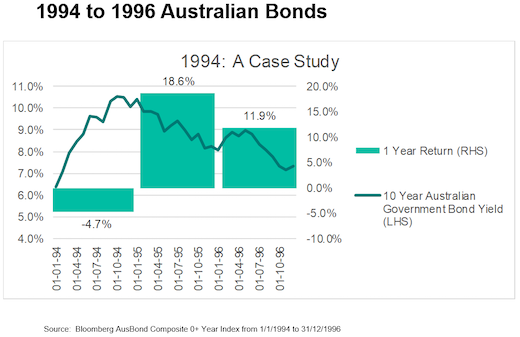
Negative price returns from bonds are certainly nothing new and, to illustrate that, it’s useful to look back to historical events between 1994 and 1996.

As shown in the chart below, Australian 10-year bond returns fell into negative territory in 1994 as bond yields (interest rates) rose. But, over the course of 1995 and 1996, bond returns rose sharply as yields declined from their peak above 10 per cent.

Bond yields are shown on the green line and left-hand axis, and annualised bond performance is shown on the three green bars.

While there is less scope for a sharp fall in bond yields as experienced in 1995 and 1996 given the current overall lower yield environment, it’s still important to focus on the role of having fixed income (bonds) in a diversified portfolio.

Understanding the role of bonds

On a risk-return basis, bonds sit below shares and above cash.

Equity market returns have been rising strongly over the past year since the huge sell-offs on global share markets in February-March last year.

With the strong growth comes a higher element of risk.

Being lower risk than shares, bond returns are generally expected to underperform shares over the long term.

Likewise, being slightly higher risk than cash held in savings and term deposit accounts, bonds are generally expected to outperform cash over the long term.

It’s important to understand that one of the key roles of bonds in an investment portfolio is to offset the higher risk inherent in shares.

Bond returns tend to move in the opposite direction to shares and play a valuable role in protecting near-term downside risk when the share market performs worse than expected over short periods. They tend to act as a buffer to volatility in shares.

In other words, they provide asset class diversification to help smooth out total investment returns over time.

While bonds do not generally outperform riskier asset classes such as shares over the long run, they have a more stable return profile.

In addition, having exposure to bonds with longer maturity dates (for example, 10-year bonds and longer) than shorter-term securities (one year or less) provides further protection, because longer-term securities tend to perform better when equities perform poorly.

This introduces the benefits of investing into bond index funds, which have holdings in a wide range of bond issues that have different maturity dates.

As individual bond issues reach their maturity date over time, investments can be purchased in new bond issues with higher yields. This increases the prospects for future income.

Investing in bonds during a time of rising yields, as we’re seeing now, will deliver higher income returns. This may be attractive to those seeking higher income in the future.

While seeing a negative price return from fixed interest securities is not overly common, keep in mind that asset class returns do invariably change on a continual basis.

Having broad exposure to the stronger performance from equities will deliver growing investment returns over time and provide diversification.

But if there are events that cause a sharp fall on equity markets, as we experienced last year, a flight to safe and quality investments, such as government bonds, will continue to reduce portfolio volatility.

Your overall portfolio allocation to different assets ultimately comes back to your investment goals and risk profile, and more specifically to your overall time frame.

An iteration of this article was first published in Canstar on 23 March 2021.

Speak to us on Phone: 07 5641 4134. 

Source: Vanguard https://www.vanguard.com.au/personal/education-centre/en/insights-article/bonds-still-adds-up

Reproduced with permission of Vanguard Investments Australia Ltd

Vanguard Investments Australia Ltd (ABN 72 072 881 086 / AFS Licence 227263) is the product issuer. We have not taken yours and your clients’ circumstances into account when preparing this material so it may not be applicable to the particular situation you are considering. You should consider your circumstances and our Product Disclosure Statement (PDS) or Prospectus before making any investment decision. You can access our PDS or Prospectus online or by calling us. This material was prepared in good faith and we accept no liability for any errors or omissions. Past performance is not an indication of future performance.

© 2021 Vanguard Investments Australia Ltd. All rights reserved.

Important:
Any information provided by the author detailed above is separate and external to our business and our Licensee. Neither our business nor our Licensee takes any responsibility for any action or any service provided by the author. Any links have been provided with permission for information purposes only and will take you to external websites, which are not connected to our company in any way. Note: Our company does not endorse and is not responsible for the accuracy of the contents/information contained within the linked site(s) accessible from this page.


Looking to stay on top of your bookkeeping ahead of EOFY and minimise your tax burden? Start by dropping these five habits.

The way a business operates internally generally impacts how they appear on the outside.

Robust internal practices give an organisation the agility that it needs to stay a step ahead, while the opposite leads to inefficiencies that cause a constant stream of headaches and challenges across the board.

Bookkeeping is an example of one of those internal business practices.

Maintaining organised records of your business’s financial transactions can make significant differences to the way it operates.

Clean books mean less time spent looking for specific transactions and invoices, and more time focusing on important elements like growth, employee experience and customer success.

Keeping financial records in order also allows a business to quickly adapt to sudden changes in pace or direction. Receiving a clear picture of the business’s short- and long-term financial position through up-to-date financial statements affords the business the ability to pivot with confidence as circumstances alter.


It all comes down to discipline


Organised books require a strong sense of discipline from all those involved in the record keeping process.

For many business owners though, strictness in this area tends to fall to the wayside. With myriad distractions and conflicting priorities, poor bookkeeping habits are developed and can turn into a negative cycle.

But the value of good bookkeeping practices cannot be understated, which is why avoiding the typical habits that business owners tend to develop is crucial, especially in the current climate where change is constant.

According to Kara Harrison, startup accountant at LUNA, staying away from the following five bad bookkeeping habits is key if a business is to keep its financial records as pristine as possible.

1. Quit mixing business and personal affairs

For many small business owners, the lines between personal life and company operations can be blurry. To keep the books clean though, Harrison encouraged these business owners to avoid dipping their personal pens in their own company’s ink.

“There are so many bookkeeping issues that arise when clear boundaries between personal and business affairs aren’t identified,” Harrison said.

“If you’re operating as a sole trader, keeping a separate bank account for all business transactions will prevent confusion and make business bookkeeping easier.”

Harrison also encouraged small business owners operating under standard corporate structures to be aware of the compliance issues surrounding director drawings, including the implications of Division 7A of the Income Tax Assessment Act 1936, which outlines the rules of such drawings.

2. Stop delaying bank reconciliations

Making sure that company transactions have been recorded correctly requires for payments to be viewed against the company’s banking ledger – a process commonly referred to as bank reconciliation.

Bank reconciliation can be time consuming and often feels repetitive but is a necessary task to undertake in order to keep financial statements up to date.

According to Harrison, delaying reconciliation can create a host of problems for small business owners that may seriously hinder their ability to make important decisions.

“In the startup world, businesses need to be ready for an evaluation at the drop of a hat, and without having done your reconciliation work properly, accurate evaluations are impossible to conduct.”

Harrison suggested that business owners set up a process where reconciliation takes place consistently.

“It can be once a week or once a fortnight, just make sure your books are always up to date and reconciled.”

3. Don’t forget to attach invoices and receipts to transactions

The next bad habit to be aware of is not remembering to attach invoices to each transaction.

Based on her experience in bookkeeping for small businesses and startups, Harrison emphasised the importance of putting systems in place that make the process of receipt attaching easier.

“Having the invoice on hand will give you all the details you need to know about a particular transaction and attaching it to the relevant transaction streamlines the process and places all financial data in one spot.”

Harrison also highlighted that requesting an email copy of the receipt from a supplier, or at least sending a picture of the paper copy to a designated email address right away helps keep receipts on record, making it easier to upload them to the business’s accounting software on the go.

4. Stop putting off the setup of automation tools

One of the biggest challenges associated with running a business is relying on memory to get things done, which is why so many businesses are turning to automation.

Harrison shared some examples of the types of tasks that small business owners may look to automate, including the generation of recurring invoices, invoice reminders, setting up bank rules for reconciliation and invoice uploading.

“The key is to critically analyse the way your business operates and identify the areas that need to be automated,” she said.

“Automation comes down to working smarter, not harder.”

READ: A cure for shoebox accounting

5. Start customising chartered accounts

The final habit that Harrison implored small business owners to drop was the use of template profit and loss statements that aren’t customised to the specific needs of the business.

According to Harrison, the most common presentation of this habit is when business owners use a ‘general expenses’ account as a dumping ground for random expenses.

“These accounts are never helpful and tend to make life difficult when it comes to preparing a company’s BAS, tax return, or applying for government incentives,” she said.

“If you’re unsure of which category an expense falls into, create a new account.”

Another tip that Harrison suggested was to split out different revenue streams into separate accounts on the company’s profit and loss statement.

“Grouping all of your revenue into one line item makes it difficult for someone to gain true insight into your business’s financial position.

“By separating the various streams of revenue, the company’s gross profit margin becomes more accurate, and creates a much clearer picture of what is actually taking place.”


Give your bookkeeping the attention it needs


In sum, virtually all of a business’s operations depend on a quality bookkeeping strategy, and as a result of its significance, bookkeeping should always have a place on a business’s overall agenda.

Whether you’re a business owner who does their bookkeeping in house, or if you’ve outsourced it to a professional, always keep in mind that bookkeeping is not a task to downplay, but an area of the business that requires ongoing attention and respect.

If you would like assistance getting your accounts under control as we approach the end of financial year, call us today on Phone: 07 5641 4134.

Source: MYOB April 2021

Reproduced with the permission of MYOB. This article by Benjamin Kluwgant was originally published at https://www.myob.com/au/blog/bad-bookkeeping-habits-to-break-2021/

Important:
This provides general information and hasn’t taken your circumstances into account. It’s important to consider your particular circumstances before deciding what’s right for you. Although the information is from sources considered reliable, we do not guarantee that it is accurate or complete. You should not rely upon it and should seek qualified advice before making any investment decision. Except where liability under any statute cannot be excluded, we do not accept any liability (whether under contract, tort or otherwise) for any resulting loss or damage of the reader or any other person.

Any information provided by the author detailed above is separate and external to our business and our Licensee. Neither our business nor our Licensee takes any responsibility for any action or any service provided by the author. Any links have been provided with permission for information purposes only and will take you to external websites, which are not connected to our company in any way. Note: Our company does not endorse and is not responsible for the accuracy of the contents/information contained within the linked site(s) accessible from this page.


If you’re employed, your employer should be paying a percentage of your earnings into your super account.

It’s worth checking to make sure you’re being paid the right amount.

If you can afford it, making extra contributions is a great way to boost your retirement savings. And it can reduce your tax. If you’re on a low income, you may be eligible for extra contributions from the government.

Check you’re getting the right amount of super

In most cases, you’re eligible to receive super from your employer if you:

  • earn $450 or more in a month

  • are aged 18 or over

Even if you have a casual job, your employer must pay you super.

If you’re under 18, you must work more than 30 hours a week.

See employees on the Australian Taxation Office (ATO) website for more information about eligibility.

How much super your employer must pay

Your employer must pay at least 9.5% of your ‘ordinary time earnings’ into your super account.

This minimum payment is called the super guarantee.

Ordinary time earnings are what you earn for your ordinary hours of work. See checklist: salary or wages and ordinary time earnings on the ATO website.

Check how much super you’re getting

To see how much super your employer is paying you, check your:

  • payslip

  • myGov account

  • super account — online or by calling your fund

Employers only have to transfer super into your super account once a quarter (every three months). Some choose to pay more often. Ask your employer how often they pay yours.

If your employer is not paying your super

If you’re not getting the right amount, talk to your employer.

If your employer isn’t paying your super, report them to the ATO. See unpaid super from your employer on the ATO website.

Grow your super with extra contributions

You can grow your super by making extra payments yourself. Even small amounts add up over time, and voluntary contributions can reduce the amount of tax you pay.

If you’re on a low income, you may be eligible for extra contributions from the government.

Pre-tax super contributions: salary sacrifice

You can ask your employer to pay part of your pre-tax pay into your super account. This is known as a salary sacrifice or salary packaging.

The payments, called concessional contributions, are taxed at 15%. For most people, this will be lower than their marginal tax rate. You benefit because you pay less tax while you boost your retirement savings.

Generally, making extra concessional contributions is tax effective if you earn more than $37,000 per year.

There’s a limit to how much extra you can contribute. The combined total of your employer and salary sacrificed contributions must not be more than $25,000 per financial year.

If you’re self-employed, concessional contributions are tax deductible. See super for self-employed people.

Make after-tax super contributions

You can also make contributions to your super from your after-tax pay.

These payments are called non-concessional contributions because you have already paid tax on the money. You can make up to $100,000 in non-concessional contributions each financial year.

See non-concessional contributions on the ATO website for more information.

Low income super tax offset

If you earn $37,000 or less, you may be eligible for a low income superannuation tax offset (LISTO) of up to $500 per year.

You don’t need to do anything. The ATO will work out your eligibility and pay the money into your super account.

See low income super tax offset on the ATO website.

Government co-contributions

If you earn less than $52,697 per year (before tax) and make after-tax super contributions, you may be eligible for a matching contribution from the government, called a co-contribution. The government will work out how much you are entitled to when you lodge your tax return. If you’re eligible, the government will pay the co-contribution directly to your fund. See super co-contribution on the ATO website.

Downsize your home and put money into super

If you’ve owned your home for more than 10 years and you sell it, you may be able to contribute up to $300,000 from the sale to your super.

You must be age 65 or older and meet the eligibility requirements. See downsizing contributions into superannuation on the ATO website.

Spouse contributions

You can split your employer super contributions with your spouse. Contact your fund or see contributions splitting on the ATO website for more information.

If your spouse earns a low or no income, you may be able to claim a tax offset if you contribute to their super fund. See tax offset for super contributions on behalf of your spouse on the ATO website. 

Casy Study

Cara boosts her super by salary sacrificing

Cara earns $90,000 before tax, excluding her employer’s super contribution. If she decides to redirect $10,000 of her pay into salary sacrifice super contributions, she will save $3,450 in tax, with the extra money going into her super fund.

Cara’s income

Without salary sacrifice

With salary sacrifice

Gross salary

$90,000

$90,000

Less salary sacrifice to super

$0

$10,000

Less tax and Medicare levy

$22,067

$18,617

Take home (net) pay

$67,933

$61,383

Cara’s super


Employer super contribution

$8,550

$8,550

Plus salary sacrifice

$0

$10,000

Less contributions tax

$1,282

$2,782

Net super contribution

$7,268

$15,768

Assumptions: The figures used in this table are estimates only and are based on 2018—19 income tax rates. They include the low and middle income tax offset and a Medicare levy of 2%. Employer super contributions remain the same after salary sacrifice.

In this scenario, Cara’s take home pay will drop by $6,550. Cara will save $1,950 in tax on income and super, and have an extra $8,500 in her super.

For more information, call us on Phone: 07 5641 4134.

Source: moneysmart.gov.au
Reproduced with the permission of ASIC’s MoneySmart Team. This article was originally published at https://moneysmart.gov.au/grow-your-super/super-contributions

Important note: This provides general information and hasn’t taken your circumstances into account.  It’s important to consider your particular circumstances before deciding what’s right for you. Although the information is from sources considered reliable, we do not guarantee that it is accurate or complete. You should not rely upon it and should seek qualified advice before making any investment decision. Except where liability under any statute cannot be excluded, we do not accept any liability (whether under contract, tort or otherwise) for any resulting loss or damage of the reader or any other person.  Past performance is not a reliable guide to future returns.

Important
Any information provided by the author detailed above is separate and external to our business and our Licensee. Neither our business nor our Licensee takes any responsibility for any action or any service provided by the author. Any links have been provided with permission for information purposes only and will take you to external websites, which are not connected to our company in any way. Note: Our company does not endorse and is not responsible for the accuracy of the contents/information contained within the linked site(s) accessible from this page.