
If you need help in your home, or can no longer live independently, the Australian Government provides a range of aged care services.

These services are subsidised, but you need to contribute to the cost if you can afford to.

Where to start

The first thing to do is think about what you need. You might want to stay in your own home, but need some help with domestic chores. Or you might be ready to start looking at options for longer-term residential care.

Talk to your family or friends about what you want. This will help you get the right care when the time comes.

Once you have an idea of your needs, contact My Aged Care. They will:

  • check your eligibility

  • assess your care needs

  • assess your financial situation

It’s important to plan ahead, as this process can take time. There are waiting lists for some services.

Care and help at home

To help you stay in your own home for as long as possible, the government provides subsidised home care. This is to help with everyday tasks like shopping, cooking and transport, as well as with personal and nursing care.

There are two types of home care:

What you pay

If you can afford to do so, you may have to pay:

  • a basic daily fee — a standard amount that everyone has to pay

  • an income-tested fee — an amount that will vary depending on your income and assets

If you can’t afford to pay, you may be able to get financial hardship assistance.

Check My Aged Care’s fee estimator to see how much you might have to pay for home care.

Residential aged care

If you can no longer live at home, you may choose to move to an aged care home (sometimes called a nursing home or residential aged care facility). Care is available 24 hours a day. This can be a short-term stay or a permanent move.

What you pay

If you can afford to do so, you may have to pay:

  • a basic daily fee — a standard amount that everyone has to pay

  • an income tested fee — an amount that will vary depending on your income and assets

  • accommodation payment — an amount for your room, based on its quality, location and features

The accommodation payment is the biggest cost. You can pay this as a:

  • bond or lump sum up-front, which is refundable (called a Refundable Accommodation Deposit, or RAD)

  • daily amount (called a Daily Accommodation Payment, or DAP)

  • combination of RAD and DAP

If you can’t afford to pay, you may be able to get financial hardship assistance.

Check My Aged Care’s fee estimator to see what accommodation payment you might have to pay.

Selling or keeping your family home

You may be thinking of selling the family home to pay the bond (RAD). Or maybe you’re wondering whether it’s better to rent it out to help pay the daily amount (DAP)?

You have 28 days after you go into aged care to decide how to pay for your accommodation. You must pay the DAP until the RAD is paid:

  • if you decide to pay a RAD within those 28 days, you have 6 months to pay the RAD

  • if you decide to pay a RAD after those 28 days, it is due as agreed between you and the provider

You may need professional financial advice to work out whether selling or renting your home is the best option.

Either way, be aware that what you choose to do with the family home may affect the Age Pension assets test.

If you sell the home, its value will count towards the Age Pension assets test.

If you rent out the home, its value may count towards the Age Pension assets test, depending on when you moved into aged care.

If you keep the home without renting it out, it is exempt from the Age Pension assets test for two years from the date that you moved into aged care. (This may vary if you are, or were, a couple when you moved into aged care.)

Speak to a Services Australia Financial Information Service (FIS) officer for more information.

Short-term help

Short-term help is available, either in your own home or in an aged care home. There are different types of care:

  • transition care (or after-hospital care) — for when you’ve been in hospital and need help with your recovery

  • respite care — for when you or your carer needs a break (for a few hours, a few days, or longer)

  • short-term restorative care — for when you’ve had a setback and want to get your independence back

Private retirement accommodation

As well as government subsidised aged care homes, there are many private retirement accommodation options. For this kind of accommodation, you pay the full amount yourself.

The Australian Competition and Consumer Commission has information about types and costs of retirement homes.

For more information, call us on Phone: 07 5641 4134. 

Source: moneysmart.gov.au
Reproduced with the permission of ASIC’s MoneySmart Team. This article was originally published at https://moneysmart.gov.au/aged-care

Important note: This provides general information and hasn’t taken your circumstances into account.  It’s important to consider your particular circumstances before deciding what’s right for you. Although the information is from sources considered reliable, we do not guarantee that it is accurate or complete. You should not rely upon it and should seek qualified advice before making any investment decision. Except where liability under any statute cannot be excluded, we do not accept any liability (whether under contract, tort or otherwise) for any resulting loss or damage of the reader or any other person.  Past performance is not a reliable guide to future returns.

Important
Any information provided by the author detailed above is separate and external to our business and our Licensee. Neither our business nor our Licensee takes any responsibility for any action or any service provided by the author. Any links have been provided with permission for information purposes only and will take you to external websites, which are not connected to our company in any way. Note: Our company does not endorse and is not responsible for the accuracy of the contents/information contained within the linked site(s) accessible from this page.


Purchasing your first home is a huge milestone and cause for much deserved celebration. To ensure that achieving this milestone is as smooth and enjoyable an experience as possible, we’ve outlined the steps that need to be taken.

1. Prepare yourself for a huge commitment

A mortgage is a long-term, ongoing commitment that should not be entered into without careful preparation and consideration. As a legal binding document, you need to take care to ensure that the loan is suitable for you. 

“Even at the last moment when the contract has been given the green light by your solicitor and a full loan finance has been approved, if there are red flags or any kind of uncertainty, don’t ignore those,” advises a finance broker.

2. Surround yourself with a good network

The next step is to seek professional advice. Dealing with an accredited broker is the best way to ensure you secure a loan that suits your needs and unique financial circumstances. In addition to supporting you through every stage of the loan process, a good broker will have a strong network of reliable professionals, including quality conveyancers, solicitors or even agents, that they can connect you with.

“First home buyers deserve the attention of a network of people that really want them to succeed,” says the finance broker. “You want to feel confident that you’ve got the best care you can to guide you into the final stage of purchasing a house.”

3. Put your best foot forward

Whether you approach a lender directly, or employ a broker to act on your behalf, be prepared to provide some supporting documents to help paint a complete picture of your current financial standing, and to help prove that you can meet your loan requirements.

While this can take some work, this preparation is essential if you want to position yourself as an ideal candidate for a loan. Preparing these documents in advance can also help quicken your loan application process. 

Typically, you will be required to provide the following documents to aid your loan application. But the documents required may vary from lender-to-lender.

IDENTIFICATION: You will be required to supply a variety of primary and secondary identification documents. Primary identification can include your birth certificate, current passport, or citizenship documents. Secondary identification may include your driver’s licence, state/territory proof-of-age card, your Medicare card or a student identification card.

PROOF OF INCOME: Depending on your income and employment situations, you may need to provide different documents to prove you can meet your loan commitments. Full-time and part-time employees may be required to supply up-to three months of pay slips from your employer. Casual employees may be required to provide the notice of assessment from their last ATO tax assessment. Self-employed applicants may be required to provide the notice of assessment from their latest personal ATO tax assessment, as well as their businesses tax return and profit and loss paperwork. In addition to these, you should also provide documentation from any other incomes – if any – such as from rent, shares or Centrelink.

ASSETS AND LIABILITIES: Your lender may want to see evidence of any of your existing assets and liabilities. Documentation, or information regarding any existing property, vehicles, savings or superannuation that you own; or regarding any existing loans or credit that you owe, may be needed.

NOTE ON REFINANCING YOUR MORTGAGE: In situations where you are refinancing your mortgage, you may also be required to provide your latest statements from your existing mortgage.

Once you have selected or created a shortlist of the lenders or brokers you would like to work with, it may be helpful to contact them to find out specifically what documents they would require.

4. Ask for help

If you crunch the numbers and realise you can’t afford the recommended 20 per cent deposit, there are other options you can explore, such as a guarantor or lender’s mortgage insurance.  Again, it’s important that you are informed about the risks and requirements of each of these options, which is why it’s best to seek out the help of a broker. 

“Using a guarantor saves a lot of money but it is a huge ask,” advises the finance broker. “Openly discuss with your guarantor well in advance to ensure they understand their obligations.”

5. Take care with the details

Besides the usual proof of income and financial capability, ensure that your identification and supporting documents reflect your correct legal name.

“It is the single most ridiculous thing that occurs amongst first home buyers these days,” says the finance broker. “If your name has a hyphen, make sure that there’s a hyphen on everything.”

Also ensure that you have all the documents that proves good character at the ready. These include rental ledgers, statements of your saving patterns and account transactions.

For more information, call us on Phone: 07 5641 4134.

Source: MFAA

Reproduced with the permission of the Mortgage and Finance Association of Australia (MFAA)

Important:
This provides general information and hasn’t taken your circumstances into account.  It’s important to consider your particular circumstances before deciding what’s right for you. Although the information is from sources considered reliable, we do not guarantee that it is accurate or complete. You should not rely upon it and should seek qualified advice before making any investment decision. Except where liability under any statute cannot be excluded, we do not accept any liability (whether under contract, tort or otherwise) for any resulting loss or damage of the reader or any other person.  Past performance is not a reliable guide to future returns.

Any information provided by the author detailed above is separate and external to our business and our Licensee. Neither our business nor our Licensee takes any responsibility for any action or any service provided by the author.

Any links have been provided with permission for information purposes only and will take you to external websites, which are not connected to our company in any way. Note: Our company does not endorse and is not responsible for the accuracy of the contents/information contained within the linked site(s) accessible from this page.


For many of us, retirement means dream holidays, reading books and spending time with grandchildren.

However for some Australians, the notion of enjoying their golden years after a lifetime of hard work hit a roadblock last year when COVID-19 struck, and hit economies and markets hard. Many businesses were affected by COVID-19 and the associated restrictions, impacting employers, employees, profit margins and, ultimately, dividends. Retirees have been feeling the pinch, particularly self-funded retirees, and those that utilise investment properties as a source of retirement funding may also feel the effects with rental reductions and an influx of properties on the market.

Against this background, it is important to remember that retirees still need to take measured risk in order to meet their goals but they may need to plan differently than they would have in the past.

Why do investors need investment risk? 

Regardless of retirement status, all investors face investment risk of some kind. Risk refers to the degree of uncertainty or potential financial loss that is inevitable in any investment decision. Typically, as investment risks rise, investors seek higher returns to counteract their own anxieties for taking such risks.

However, retirees usually view the world very differently from when they were working, and perhaps the single largest change they experience is how they respond to risk – typically investors are much more “loss averse” in retirement, that is they fear losses much more than gains feel good.

But even though retirees are more risk-averse, it is still necessary to take some degree of investment risk with their superannuation assets. If they opt to take little or no investment risk, then their investment outcomes will almost certainly be less than needed to achieve their lifestyle goals.

So, it’s clear that careful risk management is imperative for retirees when constructing their investment strategies and needs to take into account their unique risk profile. This profile includes their risk tolerance, risk capacity and risk requirement.

Risk tolerance refers to an investor’s subjective attitude towards taking risk – it’s a measure of how they feel when markets become volatile and uncertain. However even if people are willing to take the risk, they may in fact not be able to afford it – what they can actually afford is referred to as risk capacity.  And risk requirement is the amount of risk people need to take in order to achieve their desired returns.

All in all, investors, or their advisers, need to have a comprehensive understanding of their risk requirement to achieve their goal, their tolerance for risk and their capacity to bear investment risk. A solid retirement strategy balances all three of these risk components.

Strategies designed for retirement

Of course, there is no single investment strategy likely to suit all Australians. Retirees need to take into account multiple factors when considering what strategy will work best for them including their risk profile, their financial circumstances and objectives, the taxation system, and Centrelink benefits.

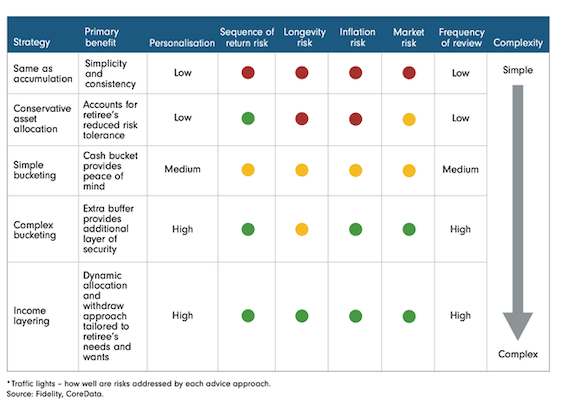
There is a spectrum of retirement investment strategies Australians can pursue which range, at its most simple, from a ‘business as usual’ approach to a significantly more complex approach, ‘income layering’. The spectrum of strategies allows for varying degrees of personalisation, and not all of them address all of the risks investors face in retirement. Table 1 compares features of each of the most common approaches used by advisers for retirement strategies and how well each approach deals with the primary risks.

Table 1


Strategy 1: Same as accumulation phase

As the name suggests, this is a ‘business as usual’ approach and involves retirees simply extending the same investment strategy from the accumulation phase into the retirement phase. As the goal in the accumulation phase will usually be to maximise total return on investment, retirees opting for this approach implicitly remain long-term investors with the ability to continue to tolerate market risk.

While this strategy seems the most simple, it potentially overlooks the sequence of return risk. It also fails to consider most retirees’ reducing risk capacity as they age. 

Strategy 2: Transition to a more conservative asset allocation

Many Australians opt to move to a more conservative asset allocation strategy in retirement. Generally, retirees’ portfolios would have a large percentage of the total portfolio allocated to low-risk and low-volatility assets such as conservative equities, fixed-income and money market securities.

This strategy ultimately helps to manage the sequence of return risk potentially making it suitable for retirees who value downside protection more than the upside growth. However, if the strategy is overly conservative, the relatively constrained upside potential of the strategy may expose investors to greater inflation risk.         

Strategy 3: Simple bucketing

This strategy divides investors’ portfolios into separate components (or buckets) with each bucket serving different objectives. A simple bucketing approach has only two buckets: a cash bucket and a diversified investment bucket. This approach provides retirees with a short-term cash buffer against market shocks. When combined with a rebalancing discipline this approach can be effective in providing the right amount of risk exposure whilst providing the investor with sufficient liquidity for their short-term needs during periods of market volatility. In this way, investors can better manage both sequencing risk and market risk.

Strategy 4: Complex bucketing

Retirees seeking a more bespoke approach could go with a more complex bucketing strategy which builds on the simple bucketing approach and divides investors’ accumulated savings into discrete pools with different objectives. The complex bucketing strategy also helps to manage retirees’ sequencing and inflation risks by segmenting the retirement savings pool into different time horizons.

This approach can be considered to be an asset-liability matching strategy as it seeks to match short-term liabilities (or spending requirements) with cash and short-term bonds, providing investors with confidence that money will be available when needed, even in declining markets. It also seeks to match investors’ long-term liabilities (or expected expenses) with relatively long-term assets such as equities, with the aim of providing greater return and ultimately, the resources to meet their expected future spending needs. By not needing to draw on the long-term assets when markets are volatile, the benefits of compounding are able to come through with this type of strategy.

Strategy 5: Income layering

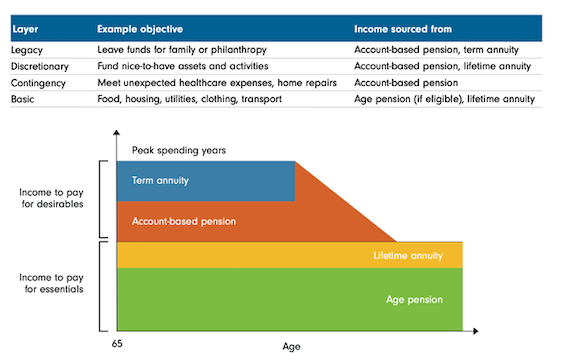
Similar to the complex bucketing strategy, this strategy divides retirees’ portfolios into separate components, based on their spending needs for life. Spending needs can be grouped into four distinct categories: basic living expenses, contingency expenditures, discretionary expenses and legacy (children’s inheritance), as shown in Table 2. 

Table 2


(Source: Challenger) 

This type of strategy matches investors’ income priorities with their spending priorities and separates their needs from their wants, while prioritising income accordingly. Term annuities or bond ladders can be used to provide the shorter-term income needs.

When working out which retirement strategy is best suited for an investor, a number of factors needs to be taken into account including their risk profile, financial circumstances, the taxation system, Centrelink benefits and the climate they are operating within.

To summarise, a certain level of risk-taking is necessary for retirees to achieve their investment objectives and a solid retirement strategy balances all three components of a retirees’ risk profile, allowing them to sleep soundly at night without needing to worry about their investments. 

If you have any questions regarding your investment strategy, please do not hesitate to call us on Phone: 07 5641 4134. 

Source: Fidelity April 2021
Reproduced with permission of Fidelity Australia. This article was originally published at https://www.fidelity.com.au/insights/investment-articles/risk-in-retirement-finding-the-right-balance/

This document has been prepared without taking into account your objectives, financial situation or needs. You should consider these matters before acting on the information. You should also consider the relevant Product Disclosure Statements (“PDS”) for any Fidelity Australia product mentioned in this document before making any decision about whether to acquire the product. The PDS can be obtained by contacting Fidelity Australia on 1800 119 270 or by downloading it from our website at www.fidelity.com.au. This document may include general commentary on market activity, sector trends or other broad-based economic or political conditions that should not be taken as investment advice. Information stated herein about specific securities is subject to change. Any reference to specific securities should not be taken as a recommendation to buy, sell or hold these securities. While the information contained in this document has been prepared with reasonable care, no responsibility or liability is accepted for any errors or omissions or misstatements however caused. This document is intended as general information only. The document may not be reproduced or transmitted without prior written permission of Fidelity Australia. The issuer of Fidelity Australia’s managed investment schemes is FIL Responsible Entity (Australia) Limited ABN 33 148 059 009. Reference to ($) are in Australian dollars unless stated otherwise.
© 2021. FIL Responsible Entity (Australia) Limited.

Important:
This provides general information and hasn’t taken your circumstances into account. It’s important to consider your particular circumstances before deciding what’s right for you. Any information provided by the author detailed above is separate and external to our business and our Licensee. Neither our business nor our Licensee takes any responsibility for any action or any service provided by the author. Any links have been provided with permission for information purposes only and will take you to external websites, which are not connected to our company in any way. Note: Our company does not endorse and is not responsible for the accuracy of the contents/information contained within the linked site(s) accessible from this page.
By Robin Bowerman, Head of Corporate Affairs, Vanguard Australia

Owning a home has for decades now been a prerequisite to achieving the Great Australian Dream. While this ideal may be being challenged and redefined as rising prices have pushed affordability further out of reach for first home buyers, Australians still undeniably harbour a strong love affair with property.

Perhaps the term ‘real estate’ itself is indicative of why we have such aspirations. Real estate feels real – we can see it, touch it, live in it. Unlike the intangibility of shares and bonds, physical dwellings can offer a greater sense of stability and security, and it satisfies one of our basic human needs – shelter.

With COVID-19 the driving force behind sustained record low interest rates, first home-buyer subsidies and remote working in locations far from city centres, the Australian property market, particularly in regional parts of the country, is enjoying a red hot run.

Bull markets, including in property, are bred in part by emotion. It’s tempting to follow the crowd – if the average time it takes for regional properties to sell is decreasing and regional home values have surged 6.5 per cent since March last year, then more and more people will start to take an interest in this trend. Perhaps this is best captured by the notion of Fear of Missing Out – which somewhat ironically is what Melbourne City Council is using in its latest marketing campaign to lure folks back into the CBD.

Appreciating that property is a mainstay of many Australian investment portfolios, it makes sense to account for it as a growth asset in your investment plan and asset allocation. While recognising the strengths of property, it is also important to recognise its limitations such as its illiquidity, the cost to transact and the reality that prices do not always go up. Investors can also find themselves unintentionally tilting their portfolio too strongly towards one single asset, bringing with it its own concentration risk.

There’s a multitude of factors to also consider before buying a home or investment property, ranging from the ongoing cash required to service a mortgage to the many (and not insignificant) taxes, fees and rental tenant management costs one may encounter over their property-owning lifespan.

There’s additionally the risk that interest rates may not stay low forever. While the RBA has indicated rates are unlikely to change for the next three years, most home loan terms extend past that. What will it mean for your mortgage repayments if they do rise in a few years?

Understandably however, the more timely challenge investors are facing right now is that near-zero term deposits are not an attractive investment option. But it is worth remembering that your cash allocation is not only there just for yield, but also to form the defensive part of your portfolio and mitigate investment risks. For example it is common to see SMSF portfolios with relatively high cash holdings as a proxy for fixed interest. So when thinking about residential property be clear about the risks as well as the potential benefits.

Goals, preferences and priorities differ from investor to investor. Wealth accumulation and investment decisions can be deeply personal, just like definitions of the Great Australian dream and what it means to feel secure and successful.

What is applicable to every investor is the need to consider all investment decisions through a long-term lens. Dramatically altering asset allocations based on short-term market trends can have long-lasting impacts on wealth.

To illustrate, we might all be enjoying the perks of working from home right now, but if housing policies change or office life rebounds strongly, will regional properties still be performing their role in your portfolio? The answer lies in your asset allocation.

An iteration of this article was first published in The Age and related publications on 30 March 2021.

If you have any questions regarding your current asset allocation, call us today on Phone: 07 5641 4134. 

Source: Vanguard https://www.vanguard.com.au/personal/education-centre/en/insights-article/asset-allocations-still-hold-the-key

Reproduced with permission of Vanguard Investments Australia Ltd

Vanguard Investments Australia Ltd (ABN 72 072 881 086 / AFS Licence 227263) is the product issuer. We have not taken yours and your clients’ circumstances into account when preparing this material so it may not be applicable to the particular situation you are considering. You should consider your circumstances and our Product Disclosure Statement (PDS) or Prospectus before making any investment decision. You can access our PDS or Prospectus online or by calling us. This material was prepared in good faith and we accept no liability for any errors or omissions. Past performance is not an indication of future performance.

© 2021 Vanguard Investments Australia Ltd. All rights reserved.

Important:
Any information provided by the author detailed above is separate and external to our business and our Licensee. Neither our business nor our Licensee takes any responsibility for any action or any service provided by the author. Any links have been provided with permission for information purposes only and will take you to external websites, which are not connected to our company in any way. Note: Our company does not endorse and is not responsible for the accuracy of the contents/information contained within the linked site(s) accessible from this page.

We explain the difference between debit and credit, how to manage credit and also what to do if you’re in financial difficulty.

Different types of credit

Credit can include:

  • personal loans and home loans

  • credit and store cards

  • education loans

  • hire purchases

  • short term or ‘pay day’ loans

  • a mobile phone

  • internet services

  • electricity or gas

  • water services.

Managing credit

When you agree to repay credit, you’re responsible for repaying the money you owe under the terms of any contract you make. This is true for both your mobile phone contract and a large debt like your home loan.

Before you borrow money and agree to a credit contract:

  • compare loans, credit cards, energy offers and other types of credit to get the most affordable deal

  •  work out the repayments before you agree to borrow money and make sure they fit into your budget

  • check your credit history by getting a credit report

  • read the contract, ask questions if you don’t understand it and get independent legal advice before you agree to anything substantial like a home loan.

If you’ve never borrowed money before, we recommend checking out MoneySmart’s Borrowing basics.

Once you’ve agreed to your credit contract (including utility and service contracts), it’s important to make repayments on time. If you don’t repay the credit as you’ve agreed there might be financial impacts such as late payment fees. It can also affect your credit record and future credit applications. Credit Smart have put together 12 Steps to maintain a healthy credit report.

When you apply for credit, get a mobile phone contract or agree to a contract with an energy company this information goes on your credit file and becomes part of your credit history.


Financial difficulty

If you’re struggling to meet your loan repayments or pay your bills, it’s always a good idea to contact your lender or service provider and let them know what’s happening. You may be eligible for hardship assistance or a repayment plan.

We understand that life can take unexpected turns. If you’re finding your loan or credit card repayments difficult to make we may be able to offer assistance when you need it most.

The best way to let us know about your situation is to contact NAB AssistFinancial Counselling Australia is a free, confidential service to assist people in financial difficulty. Financial counsellors are qualified professionals who can provide you with the information, support and advocacy to assist you with your financial situation.

Credit repair

If you’ve got a bad credit history it can be tempting to pay someone to help you fix it, but credit repair agencies may not always be able to do what they claim. In most cases, default listings and other historical information cannot be removed from your credit report unless they are proven to be wrong. ASIC’s Money Smart site has some helpful information on what credit repair companies can and can’t do.

Source: NAB https://www.nab.com.au/personal/life-moments/manage-money/money-basics/credit

Reproduced with permission of National Australia Bank (‘NAB’). This article was original published at hhttps://www.nab.com.au/personal/life-moments/manage-money/money-basics/credit

National Australia Bank Limited. ABN 12 004 044 937 AFSL and Australian Credit Licence 230686. The information contained in this article is intended to be of a general nature only. Any advice contained in this article has been prepared without taking into account your objectives, financial situation or needs. Before acting on any advice on this website, NAB recommends that you consider whether it is appropriate for your circumstances.

© 2021 National Australia Bank Limited (“NAB”). All rights reserved.

Important:
Any information provided by the author detailed above is separate and external to our business and our Licensee. Neither our business nor our Licensee takes any responsibility for any action or any service provided by the author. Any links have been provided with permission for information purposes only and will take you to external websites, which are not connected to our company in any way. Note: Our company does not endorse and is not responsible for the accuracy of the contents/information contained within the linked site(s) accessible from this page.

Before you come close to signing on the dotted line, there are 10 important factors to consider closely, writes accountant and business advisor Nick Roberts.

Starting a business from scratch and going without income in the initial period can be a daunting prospect, so it’s tempting to buy a business instead.

But before the excitement clouds your objectivity think carefully — the corporate world is littered with disastrous business acquisitions. So how can you avoid ending up the same way?

This article will cover the 10 major elements that should be taken into account prior to signing any deals. Understanding these and keeping them in mind will give you the best chance of a successful acquisition.

1. Reason for sale

Sometimes it’s not easy but, if possible, determine the real reason for the sale of the business. Is it a good reason such as retirement, separation, or the owner’s overstretched? Or is the business heading to the wall?

The reason for sale will undoubtedly influence your justifications for purchasing, and it may also impact the strategy to develop for taking the business on.

2. What are you buying?

Don’t buy the company — buy the trade and assets.

Establish exactly what assets you’re buying and how much you need to pay — are they worth it? If you’re buying goodwill, this is not tax deductible. Is all the goodwill attached to the owner or to the business? Goodwill can dissipate quickly, especially if a business takeover is botched.

3. Restraint of trade

Basic stuff, but you’d be surprised how many purchasers try and save money on professional advice and make a hash of it.

A client of mine sold his business and opened up again just a few kilometres away because there was no restraint of trade imposed. Guess what happened?

READ: Key considerations when taking a business online

4. Due diligence

You cannot avoid a thorough review of the business before proceeding. Don’t be fobbed off with limited or restricted information, you hold the whip hand because you are waving your money in front of the vendor.

Yes, this may cost you, but don’t be penny wise yet pound foolish. In any case, it may not cost as much as you think, especially if you can do some of the work yourself. A good accountant will have a checklist on what to look out for.

A client of mine who is looking to buy a business is actually working in the business right now. You can’t do better due diligence than that, he’s found out all sorts of things!

5. Impacted staff

Staff these days are the number one business problem and especially in a small business where staff numbers are limited, because losing even one employee can be catastrophic.

A change of business owner is almost guaranteed to prompt staff departing and, these days, getting the right staff is a real challenge.

6. Real estate

If you’re buying a business with premises you need good advice whether you’re buying or leasing.

If leasing, how long is left on the lease? Are the premises suitable? Is the location the best? Are there any building maintenance works that will fall to you to make good?

7. The handover

Typically, buying a business where the existing owner is prepared to stay on a while and assist you with getting to grips with the business will command a higher price.

Even a small business can be complex and there are many things to take on board, so a reasonable handover period can be invaluable.

8. Key relationships

Building a successful business requires establishing and maintaining relationships with all sorts of people, not just staff and customers but suppliers too, because these days getting things done by tradespeople, professionals or suppliers of goods and services generally is not that easy.

As a business purchaser, you need to work out very quickly the important people you need to get to know and keep on side, it’s a huge component of goodwill that is often overlooked.

9. Working capital

Many business purchasers underestimate the working capital required to operate a business and typically, available cash or borrowing facilities have already been utilised in paying for the business.

Get an accountant to prepare a simple cashflow forecast highlighting your peak cash needs.

10. How much should you pay?

Unfortunately valuing a small business is notoriously difficult, primarily because of the overriding involvement of the owner of the business. Take away the business owner and you often take away the business.

Many pay huge sums of money for a small business just to buy themselves a job and end up being worse off financially.

With many business purchases it can depend upon just how much money the purchaser has to spend, which I’ve always thought strange, but it’s just the way things are. There’s no simple answer so seek the advice of a good accountant and be prepared to walk away, that being the necessary risk of negotiating hard.

In conclusion, while owning and operating a business can bring huge rewards and satisfaction as well as building wealth, it’s also very risky. So take your time, do plenty of research, and call us on Phone: 07 5641 4134. That way, you’re minimising the risks and setting yourself up for success.

Source: MYOB March 2021

Reproduced with the permission of MYOB. This article by Nick Roberts was originally published at https://www.myob.com/au/blog/buying-a-business-key-factors-to-consider/

Important:
This provides general information and hasn’t taken your circumstances into account. It’s important to consider your particular circumstances before deciding what’s right for you. Although the information is from sources considered reliable, we do not guarantee that it is accurate or complete. You should not rely upon it and should seek qualified advice before making any investment decision. Except where liability under any statute cannot be excluded, we do not accept any liability (whether under contract, tort or otherwise) for any resulting loss or damage of the reader or any other person.

Any information provided by the author detailed above is separate and external to our business and our Licensee. Neither our business nor our Licensee takes any responsibility for any action or any service provided by the author. Any links have been provided with permission for information purposes only and will take you to external websites, which are not connected to our company in any way. Note: Our company does not endorse and is not responsible for the accuracy of the contents/information contained within the linked site(s) accessible from this page.

Hedge funds use investment strategies that are more complex than other managed funds. Many aim for positive or less volatile returns, in both rising and falling markets.

A hedge fund is a complex investment and risks vary. Read the product disclosure statement and consider getting financial advice before you invest.

How hedge funds work

Hedge funds (‘absolute return’ funds) use pooled funds to invest in alternative assets or strategies. This may include the use of derivatives, alternative investments or leverage in domestic and international markets.

Hedge fund returns may depend less on traditional assets, like shares and bonds. This can make it a good way to diversify a portfolio.

A hedge fund may aim to deliver positive or less volatile returns, in both rising and falling markets. It could try to outperform a benchmark, such as a market index or interest rate. Or achieve a benchmark return with less volatility.

Hedge fund features

There are different types of hedge funds. The features and risks of each depend on:

  • fund strategy

  • what assets it invests in

  • where assets are

  • investment tools used

  • fund manager’s knowledge and skill

See the fund’s product disclosure statement (PDS).

Investment tools

Common investment tools include:

  • Leverage — When a fund increases its exposure to certain assets or strategies, usually through borrowing. Leverage can increase returns, and increase losses.

  • Derivatives — Securities whose value depends on an underlying asset such as a share, commodity or index. Used to manage risk. And gain or reduce exposure to assets, markets or events. Enables an investor to buy or sell an asset in the future, based on an agreed price.

  • Short selling — An investor borrows a security from another party (a broker), then sells it on the market. The investor aims to buy an identical security at a lower price and return it to the lender. And hopes to profit from the difference between buy and sell prices.

  • Alternative investments — Investing in assets such as high yield bonds, synthetic assets, derivatives, unlisted shares or other hedge funds.

  • Active management — The fund manager decides what to invest in, and how much. The manager’s expertise is crucial to the fund’s success.

Fund of hedge funds

A ‘fund of hedge funds’ is a fund that invests in other hedge funds. It may invest all or some money in other hedge funds.

When a fund invests in another hedge fund, the underlying fund is usually not open to retail investors. The underlying fund may be offshore, with less monitoring.

A fund of hedge funds may have extra risks. For example, it may invest in multiple hedge funds, across assets and markets. This can make it harder to know where the fund invests your money, and what the risks are. You may also have to pay more fees.

Pros and cons of hedge funds

To decide if investing in hedge funds is right for you, consider the following:

Pros

  • Targeted strategies — A fund may target less volatile returns, so it loses less in a down market. This may be at the expense of gains in a rising market. Or mean a risk of greater losses. So consider your appetite for risk when choosing a fund.

  • Asset diversification — Can expose you to a broader range of asset classes and markets. This can help diversify your portfolio. And reduce exposure to downturns in some asset classes or markets.

Cons

  • Leverage risk — A fund may have an exposure greater than 100% of the assets invested. So, if markets move against the fund’s position, it could lose a lot. Derivatives and short selling both involve leverage risk.

  • Liquidity risk — Investing in assets not traded on an open market makes them harder to sell or value. If an asset devalues, it may be hard to sell fast if you want to get your money back. A fund of hedge funds may not be able to exit the underlying funds quickly. This makes it harder to redeem your money at short notice.

  • Concentration risk — Concentrating assets in a single market means a greater risk of losses, if that market underperforms.

  • Complex structure risk — May be hard to work out how the fund invests your money. And the risks you are taking on.

  • Counterparty risk — Derivatives could be purchased ‘over the counter’ by agreement with another party. That party may fail to honour the agreement.

What to check before you invest in a hedge fund

Read the product disclosure statement

Hedge funds vary in risk and complexity. The fund manager will give you a PDS before you invest. This sets out the features, benefits, costs and risks of the fund. Make sure you understand the investment before you go ahead.

Check your understanding of the fund

Use these questions to check your understanding of the fund:

  • Strategy — What are the investment goals? How will the fund achieve these goals?

  • Investment manager — Who manages the fund? Does the manager have relevant skills and experience?

  • Local or international — Does the fund invest in Australian or overseas assets? If overseas, have foreign currency risks been hedged?

  • Past performance — Past performance is not a reliable indicator of future performance. But it can give you an idea of how the fund has performed, in rising and falling markets. Look at medium to long-term performance (over 5 to 10 years).

  • Third party service providers — Does the fund uses third party service providers? If so, are they licensed in Australia? Or elsewhere, where financial regulations may be less strict?

  • Fees — How are fees charged? Does this offer an incentive for the fund manager to take extra risks? Does charging of a performance fee depend on the fund outperforming a benchmark? If so, is the benchmark appropriate? Will returns, after fees, justify any additional risks taken?

  • Structure — How are the investments structured? As a test, how easily could you explain this to someone else?

  • Redemptions — How quickly can you redeem your investment from the fund? Is there a minimum time your money must stay in the fund? Is there a minimum redemption amount? When you redeem, do you have to pay an exit fee?

Get advice if you need it

Talk to us on Phone: 07 5641 4134 if you need help deciding if this investment is right for you.

Source: moneysmart.gov.au
Reproduced with the permission of ASIC’s MoneySmart Team. This article was originally published at https://moneysmart.gov.au/managed-funds-and-etfs/hedge-funds

Important note: This provides general information and hasn’t taken your circumstances into account.  It’s important to consider your particular circumstances before deciding what’s right for you. Although the information is from sources considered reliable, we do not guarantee that it is accurate or complete. You should not rely upon it and should seek qualified advice before making any investment decision. Except where liability under any statute cannot be excluded, we do not accept any liability (whether under contract, tort or otherwise) for any resulting loss or damage of the reader or any other person.  Past performance is not a reliable guide to future returns.

Important
Any information provided by the author detailed above is separate and external to our business and our Licensee. Neither our business nor our Licensee takes any responsibility for any action or any service provided by the author. Any links have been provided with permission for information purposes only and will take you to external websites, which are not connected to our company in any way. Note: Our company does not endorse and is not responsible for the accuracy of the contents/information contained within the linked site(s) accessible from this page.

Salary packaging is when you and your employer ‘package’ your salary into income and benefits. It’s also known as salary sacrifice.

How salary packaging works

Salary packaging is when you arrange to receive less income after tax, in return for your employer paying for benefits out of your pre-tax salary. The benefits could be things like a car or a phone.

For example, you might package a salary of $100,000 so that you receive:

  • $85,000 as income

  • $15,000 car as a benefit

This reduces your taxable income to $85,000. You can benefit as you may pay less income tax.

You need to arrange your salary package before you get paid. You can’t package your salary after you’ve earned it.

Salary packaging is usually more effective for people on middle to high incomes. You may want to get professional tax advice to work out if salary packaging is right for you.

For more details about salary packaging, see salary sacrifice arrangements for employees on the Australian Taxation Office (ATO) website.

What you can salary package

You can salary package benefits you would normally pay for with your after-tax income, such as computers, cars, child care or super. But it depends on what your employer offers and you may have to pay tax.

Most employers will offer salary sacrifice for super to all employees, but may restrict who can package other benefits.

Benefits fall into three categories: fringe benefits, exempt benefits and super.

Fringe benefits

Fringe benefits can include:

  • salary sacrifice for a car

  • health insurance

  • loans (usually for a car)

  • school fees

  • childcare fees

  • other personal expenses

Your employer pays fringe benefit tax (FBT) on these benefits. See fringe benefits tax on the ATO website for more information.

Exempt benefits

Exempt benefits include:

  • portable electronic devices

  • computer software

  • protective clothing

  • tools of the trade

Your employer will not have to pay fringe benefits tax on these.

Super

Putting some of your pre-tax income into super has benefits for you and your employer. Your super fund will tax these contributions at 15% — the same as your employer’s contributions.

For most people this will be lower than their marginal tax rate. See salary sacrifice and personal super contributions for more information on how this can benefit you.

Important

Not-for-profit organisations have an FBT exemption. This means they provide fringe benefits for their employees without having to pay tax on those benefits.

Call us today on Phone: 07 5641 4134 to discuss whether a salary packaging arrangement would be beneficial for you. 

Source: moneysmart.gov.au
Reproduced with the permission of ASIC’s MoneySmart Team. This article was originally published at https://moneysmart.gov.au/income-tax/salary-packaging

Important note: This provides general information and hasn’t taken your circumstances into account.  It’s important to consider your particular circumstances before deciding what’s right for you. Although the information is from sources considered reliable, we do not guarantee that it is accurate or complete. You should not rely upon it and should seek qualified advice before making any investment decision. Except where liability under any statute cannot be excluded, we do not accept any liability (whether under contract, tort or otherwise) for any resulting loss or damage of the reader or any other person.  Past performance is not a reliable guide to future returns.

Important
Any information provided by the author detailed above is separate and external to our business and our Licensee. Neither our business nor our Licensee takes any responsibility for any action or any service provided by the author. Any links have been provided with permission for information purposes only and will take you to external websites, which are not connected to our company in any way. Note: Our company does not endorse and is not responsible for the accuracy of the contents/information contained within the linked site(s) accessible from this page.

After reeling from the impact of COVID-19 lockdowns in 2020, property values throughout Australia have strongly rebounded, rising at their fastest pace in 32 years. These exceptionally strong conditions are now being seen across all major capital cities, following the trend set by regional areas during the latter half of 2020.i

If you are in the market to buy property in the near future, no matter where you are looking in Australia, you are likely facing a market that favours the seller over the buyer, under quite competitive conditions. So, let’s look at the measures you can take to buy well and keep your cool under the current conditions.

Do your homework

It’s a good idea to be very familiar with the areas you are looking at buying in and physically inspect as many properties as possible, both so that you get a sense of your ‘must haves’ and ‘nice to haves’ and so that you can keep your finger on the pulse and know what represents good value in your preferred suburbs.

Be prepared to act fast!

If you have found a property that meets your criteria, try to view it as soon as possible by making an appointment with the agent, rather than waiting for open for inspections.

It’s also important to be prepared for a purchase and make sure you can respond quickly if a property ticks all (or even most of!) the boxes. Ensure you are familiar with the process of buying property and your rights and obligations as a buyer. Line up the necessary assistance you need including selecting a solicitor, as well as touching base with the relevant contacts for building or pest inspections so that you can call on them as required.

Buy with your head – not your heart

It’s important to keep your emotions in check and not make rash decisions just because the market is strong. Due diligence remains vital during the home buying process, speeding things up and acting rashly can end up costing you much more down the track.

The fact that you’ve missed out on properties you are keen on, does not need to be the reason you lower your standards drastically and make significant sacrifices in order to get a foothold in the market. Although it is important to be realistic about what you can and can’t afford and maintain a longer-term view in terms of your property purchase.

Strategies for success

In a seller’s market you should assume you are competing against other offers. One way of getting an edge on the competition is to be a flexible when it comes to settlement. It’s worth asking the seller if they need a shorter or longer settlement and if you are able to meet their needs in this area, it may give you an advantage over other bidders.

Pre-auction offers need careful consideration. Making an offer prior to an auction can work in your favour by enticing the seller and you may pick up the property for less than it would sell at auction. Equally, a prior offer may work against you by reinforcing to the seller that the property is highly sought after, encouraging them to ‘hold out’ for the auction.

Finance pre-approval

And last but certainly not least, having your finance pre-approved will help you to jump in when you need to and also to know your budget and what you can afford. Being pre-approved by a mortgage lender is a great way to show sellers that you’re not only serious about buying, but that you have the funds for the purchase ready to go.

We can help you review your finances, budget and repayments and get you sorted with the best loan for your circumstances so you are set for success in a competitive market. Call us on Phone: 07 5641 4134.

i https://www.corelogic.com.au/sites/default/files/2021-03/210401_CoreLogic_HVI.pdf

By Tony Kaye, Senior Personal Finance Writer, Vanguard Australia

How much investment risk are you willing to take?

If you’ve ever used a financial adviser, it’s one of the first questions you’ll be asked when establishing your overall investment strategy.

Because your tolerance for risk will ultimately determine the types of assets an adviser will recommend for you to invest in.

It’s a question all investors should be considering right now, at a time when some are taking on more investment risk than ever before, both on global share markets and bond markets.

In essence, what’s occurring is being driven by a combination of forces.

Record low interest rates are spurring some investors to take on more risk by buying into riskier securities and other types of investment products offering higher returns. Economic factors, including the massive government stimulus programs underway linked to COVID-19, are also playing a hand in the activity.

And, at the same time, there has been an escalation in share market trading activity based around speculation.

How speculators are driving markets

In recent weeks there has been a noticeable spike in speculative investment activity on share markets.

This is primarily being driven by smaller investors (operating in unison within large groups) buying into companies on the basis of rumours gleaned from online investment forums and social media channels.

In some cases, frenzied buying activity by these speculators has seen some company share prices soar and then fall back sharply, and very quickly, after heavy selling. In many cases, investors who have rushed in blindly have been left wearing large losses when share prices have dropped suddenly.

Companies in the U.S. technology sector have been the prime targets of this type of speculation, as have companies involved in biotechnology.

Although not as pronounced in Australia, there has also been a rush of investor capital into buy-now, pay-later technology companies and into miners associated with the production of battery metals.

The sudden spike in first-time online broking account openings here following last year’s sharp COVID-induced market correction spurred the Australian Securities and Investment Commission to issue a warning around the risks of trying to time markets.

The same applies to investors speculating on companies without doing proper research.

A high-yield bonds surge

Bonds are generally considered to be less risky than shares, but recent heavy buying activity in what’s known as the “high yield” sector of the bond market has also drawn attention to potential investment risks.

High-yield bonds are bonds issued by companies with credit ratings below what credit ratings agencies regard as investment grade.

For a bond issue to be regarded as investment grade, it needs to be rated between AAA (the highest rating) and BBB-minus. Issues classified as high yield are rated between BB-plus and C-minus, with companies at the lower end of the spectrum carrying a higher risk of credit default.

Companies with low credit ratings may use the bond market to raise capital from investors, because they’re unlikely to secure funding from lenders such as banks.

For investors willing to take on the risk of lending their money, the bond issuing companies typically pay a higher income return than the investment grade bonds largely issued by governments and companies with better credit ratings.

Which is where current economic events are coming to the fore. The combination of record low interest rates and government financial support measures have made it extremely attractive for companies to refinance their borrowings, even those with low credit ratings.

In effect, borrowing money has never been cheaper. At the same time, investors wanting higher income returns than they’ve been able to get by buying into lower-risk government bonds and investment-grade credit have been willing to buy into high-yield bond issues.

That’s largely because low interest rates mean companies have a much better chance of servicing their debt payments, and because government stimulus programs have reduced the risk of many companies going into financial default – at least for now.

But the latest twist for investors has come because of the surge in demand for high-yield bonds. This has driven up their prices, which in turn has resulted in their investment yields falling to the lowest levels ever seen.

Basically, when market prices rise yields decline. Yields are falling, so investors are effectively getting less return for taking on higher risk. And the inherent risks in holding high-yield bonds, if a company does go into default, remains.

It’s another example of potential investment risks.

Risks versus reward

Taking risk is part and parcel of investing, because wherever you invest there are always factors that can lead to potential financial losses.

There are a wide range of potential investment risks, including market risk, credit risk, inflation risk, liquidity risk and geopolitical risk (generally risks associated with specific countries and regions).

Understanding risks, why some assets are lower risk than others, and determining your own risk tolerance, are all fundamental aspects in mapping out your investment goals and strategy.

In basic terms, the higher the potential reward, the higher the risk of losing money. The lower the risk, the lower the potential reward.

Diversification within asset classes, and across different asset classes, remains the most powerful strategy for managing traditional risks.

To learn more, contact us on Phone: 07 5641 4134.

Source: Vanguard February 2021

Vanguard Investments Australia Ltd (ABN 72 072 881 086 / AFS Licence 227263) is the product issuer. We have not taken yours and your clients’ circumstances into account when preparing this material so it may not be applicable to the particular situation you are considering. You should consider your circumstances and our Product Disclosure Statement (PDS) or Prospectus before making any investment decision. You can access our PDS or Prospectus online or by calling us. This material was prepared in good faith and we accept no liability for any errors or omissions. Past performance is not an indication of future performance.

© 2021 Vanguard Investments Australia Ltd. All rights reserved.

Important: Any information provided by the author detailed above is separate and external to our business and our Licensee. Neither our business nor our Licensee takes any responsibility for any action or any service provided by the author. Any links have been provided with permission for information purposes only and will take you to external websites, which are not connected to our company in any way. Note: Our company does not endorse and is not responsible for the accuracy of the contents/information contained within the linked site(s) accessible from this page.