Understanding exactly how much of what you spend is tax deductible is crucial for understanding what you can spend on your business (and when). 

People often fall into the trap of thinking that spending a dollar on tax deductible expenses or assets will save a dollar in tax.

But the tax man isn’t that generous.

In fact, with the ongoing changes to marginal tax rates, there’s even less advantage given to lower income earners.

To demonstrate the point, let’s consider you as an individual taxpayer and the marginal tax rates that apply to you for the 2020-21 tax year:

$18,201 – $45,000

19 cents for each dollar over $18,200

$45,001 – $120,000

$5,092 plus 32.5 cents for each dollar over $45,000

$120,001- $180,000

$29,467 plus 37 cents for each dollar over $120,000

$180,001 and over

$51,667 plus 45 cents for each dollar over $180,000

If your taxable income is less than $18,201 per year, you will not pay any tax.

So if you buy a tax-deductible subscription, for example, you won’t receive any tax benefit because you’re not going to pay any tax anyway.

But let’s say you earn more than $180,000 and you spend a dollar on the same tax-deductible subscription. How much tax will you save and get back from the tax man?

Any income earned over $180,000 attracts tax at 45 cents in the dollar (plus the Medicare levy of two percent), so a $1 tax deduction will give you a tax saving of 47 percent.

But what’s the actual cost of the subscription once tax is accounted for?

The $1 for the subscription less a 47 cents tax saving equals an out-of-pocket cost of 53 cents.

Pretty good, right? It’s no wonder those with taxable incomes over $180,000 say, “I love being in partnership with the tax man!”

Why do you think people who earn over $180,000 love negative gearing with residential property? It’s because every dollar they lose, the tax man pays nearly half of that loss in tax savings.

But where does that leave you if your taxable income is less than $180,000? Well, it depends on what your taxable income is.

If your taxable income is between $45,001 and $120,000, every dollar spent on tax-deductible costs will earn you a tax saving of 37 cents excluding the Medicare levy.

Should you rush out and start spending?

The higher your taxable income, the more the ATO will shelter the cost. But for those with lower taxable incomes, you should only ever spend what you need to regardless of what portion of that spend is tax deductible.

Your tax-paying entity or company will also have an impact on your tax saving.

For example, a company with turnover less than $50 million is taxed at 26 cents in the dollar (for FY2020-21), while a self-managed superannuation fund (SMSF) is generally taxed at 15 cents in the dollar assuming it is in accumulation phase.

So, a dollar spent on a tax-deductible expense in a company or SMSF will cost the company 74 cents after tax and the SMSF a significant 85 cents after tax.

Which begs the question why negative gearing into property in an SMSF is considered so attractive when you realise that, for every dollar lost after rental income, the tax man only pays 15 cents?

The SMSF funds every dollar lost to the tune of 85 cents. The investment had better be a good one, if it’s to recover the after-tax losses over the period of ownership and still provide the SMSF with a solid capital gain.

Don’t forget there are other tax concessions available that will impact your decision on whether you incur a cost or not.

Obtaining a tax deduction in June 2021 will mean that you will receive the tax credit for that cost in your 2021 income tax return, and you will receive the refund for the expense when you lodge your 2021 tax return.

That means spending up in July will mean that you will not receive the tax saving until you lodge your 2022 income tax return and that’s at least another 11 months away.

In short, timing is a consideration, but only if you really need that tax deduction.

Remember the two golden rules of tax deductions:

  1. Tax deductions aren’t a refund. At best, if you earn more than $180,000, you will save 45 cents per dollar, and if you earn less than $180,000 then your tax deduction goes down significantly, too.

  2. If you don’t need it, don’t buy it. The full amount is better off in your pocket than any tax deduction.

Always think about the need, the timing and the tax saving (based on the applicable marginal tax rate) when offloading those hard-earned dollars of yours.

The easiest thing you can do to help with this is to make sure you’re capturing and tracking all your small business financials in online accounting software as well as consulting closely with a certified tax agent.

The information provided here is of a general nature for Australia and should not be your only source of information. Please contact us on Phone: 07 5641 4134, as each small business’ circumstance will vary for end of financial year.

Source: MYOB April 2021

Reproduced with the permission of MYOB. This article by Debra Anderson was originally published at https://www.myob.com/au/blog/understanding-tax-deductions/

Important:
This provides general information and hasn’t taken your circumstances into account. It’s important to consider your particular circumstances before deciding what’s right for you. Although the information is from sources considered reliable, we do not guarantee that it is accurate or complete. You should not rely upon it and should seek qualified advice before making any investment decision. Except where liability under any statute cannot be excluded, we do not accept any liability (whether under contract, tort or otherwise) for any resulting loss or damage of the reader or any other person.

Any information provided by the author detailed above is separate and external to our business and our Licensee. Neither our business nor our Licensee takes any responsibility for any action or any service provided by the author. Any links have been provided with permission for information purposes only and will take you to external websites, which are not connected to our company in any way. Note: Our company does not endorse and is not responsible for the accuracy of the contents/information contained within the linked site(s) accessible from this page.


As the new financial year gets underway, there are some big changes to superannuation that could increase your retirement savings. 

Some, like the rise in the Superannuation Guarantee (SG), will happen automatically so you won’t need to do a thing. Others, like higher contribution caps, may require some planning to get the full benefit. Whether you are just starting your super journey, close to retirement, a member of a big super fund or have a self-managed super fund (SMSF), it pays to know what’s going on. 

Changes starting from 1 July 2021.

Increase in the Super Guarantee

If you are an employee, the amount your employer contributes to your super fund has increased from 9.5 per cent to 10 per cent of your pre-tax ordinary time earnings. For higher income earners, employers are not required to pay the SG on amounts you earn above $58,920 per quarter (up from $57,090 in 2020-21).

Say you earn $100,000 a year before tax. In the 2021-22 financial year your employer is required to contribute $10,000 into your super account, up from $9,500 last financial year. When you factor in years spent working and compounding interest, this could significantly boost your retirement savings, especially for those just starting their career. 

The SG rate is scheduled to rise again to 10.5 per cent on 1 July 2022 and gradually increase until it reaches 12% on 1 July 2025.

Higher contribution caps

For the first time in four years, the annual concessional (before tax) contributions cap has increased from $25,000 a year to $27,500. These contributions include SG payments from your employer as well as any salary sacrifice arrangements you have in place and personal contributions you claim a tax deduction for. 

At the same time, the cap on non-concessional (after tax) contributions has gone up from $100,000 to $110,000. This means the amount you can contribute under a bring-forward arrangement has also increased, provided you are eligible. 

Under the bring-forward rule you can put up to three years’ non-concessional contributions into your super in a single financial year. So, this year, if eligible, you could potentially contribute up to $330,000 this way (3 x $110,000), up from $300,000 previously. This is a useful strategy if you receive a windfall and want to use some of it to boost your retirement savings. 

More generous Total Super Balance and Transfer Balance Cap

Super remains the most tax-efficient savings vehicle in the land, but there are limits to how much you can squirrel away in super for your retirement. These limits, however, have just become a little more generous.

The Total Super Balance (TSB) threshold which determines whether you can make non-concessional (after-tax contributions in a financial year is assessed at 30 June of the previous financial year. The TSB at which no non-concessional contributions can be made this financial year will increase from $1.6 million to $1.7 million. 

The same limit applies to the amount you can transfer from your accumulation account into a retirement phase super pension. This is known as the Transfer Balance Cap (TBC), and it has also just increased from $1.6 million to $1.7 million. 

If you retired and started a super pension before July 1 this year, your TBC may be less than $1.7 million and you may not be able to take full advantage of the increased TBC. The rules are complex, so get in touch if you would like to discuss your situation.

Reduction in minimum pension drawdowns extended

In response to record low interest rates and volatile investment markets, the government has extended the temporary 50 per cent reduction in minimum pension drawdowns until 30 June 2022.

Retirees with certain super pensions and annuities are required to withdraw a minimum percentage of their account balance each year. Due to the impact of the pandemic on retiree finances, the minimum withdrawal amounts were also halved for the 2019-20 and 2020-21 financial years.

Age of retiree

Temporary minimum withdrawal 

Normal minimum withdrawal 

Under 65

2%

4%

65 to 74

2.5%

5%

75 to 79

3%

6%

80 to 84

3.5%

7%

85 to 89

4.5%

9%

90 to 94

5.5%

11%

95 or older

7%

14%

Source: ATO

But wait, there’s more

Next financial year is also shaping up as a big one for super, with most of the changes announced in the May 2021 Federal Budget expected to start on 1 July 2022.

The Budget included proposals to:

  • repeal the work test for people aged 67 to 74 who want to contribute to super

  • reduce the minimum age for making a downsizer contribution (using sale proceeds from your family home) from 65 to 60

  • abolish the $450 per month income limit for receiving the Super Guarantee

  • expand the First Home Super Saver Scheme

  • provide a two-year window to commute legacy income streams

  • allow lump sum withdrawals from the Pension Loans Scheme

  • relax SMSF residency requirements. 

All these measures still need to be passed by parliament and legislated.

Time to prepare

There’s a lot for super fund members to digest. SMSF trustees in particular will need to ensure they document changes that affect any of the members in their fund. But, these latest changes also present retirement planning opportunities.

Whatever your situation, if you would like to discuss how to make the most of the new rules, please get in touch on Phone: 07 5641 4134. 


There is a way to enjoy the lifestyle your favourite suburb provides and still get on the property market. It’s called ‘rentvesting’ – owning an investment property while renting where you live.

Property Investment Professionals of Australia’s 2020 research shows that more than 44% of first-time buyers are rentvesting.i While it’s a strategy that’s growing in popularity, for it to successfully deliver, you still need to do your research.

Weighing up the pros and cons of continuing to rent

The first thing to consider is how comfortable you are with renting for the mid- to long-term. As a renter, you save by not paying maintenance costs as well as bills like strata fees, and perhaps council and water rates. It’s also easier to move if your needs change.

However, your home being less permanent can also be a negative. You may have to move at short notice, the rent may be expensive or go up dramatically, and you may have restrictions around decorating.

It’s all about the numbers

Weighing up the rentvesting option involves crunching your income and outgoing expenses numbers plus any property value increase expected over your investment timeframe.

Typical landlord expenses include insurance, maintenance, rates, loan repayments, property manager fees and vacant periods. To save yourself some nasty surprises, calculate the difference between all your outgoings and your rental and personal income. This will let you know if you can accommodate an urgent repair or an increase in your own rent.

Being an investor rather than first home buyer means you miss out on First Home Owner Grants. These regularly change so it’s wise to check what’s currently available and then work out if the rental income or tax savings from negative gearing a property would offset this loss. Your property is negatively geared when your rental return is less than property-related expenses. This net rental loss can then be offset against your income to reduce your taxable income and how much tax you need to pay.

It’s also important to keep in mind that the high transaction costs of buying and selling property mean a rental investment often works best when held long-term, say 10 years or more.

Matching location to your goals

Not having to factor in personal lifestyle considerations means rentvesting opens up areas to buy in. Whether you’re looking in metropolitan or regional areas, choosing the location and type of property that’s right for you comes down to understanding your long-term goals as well as your finances.

If your goal is to eventually buy your own home, it’s important to focus on areas with good capital growth potential. If you plan to be a long-term renter, you should concentrate on yield – or rental income as a percentage of your property’s value.

Most people want an investment property that’s hassle-free. That means looking for low-maintenance places in areas with high rental demand. A good property manager will also simplify things for you.

Applying for your investment loan

Typically, investment mortgages have higher interest rates than owner-occupier ones. Even with record low interest rates, rentvestors usually need at least a 10% deposit to safely secure a loan.

Lenders will include the rent you earn when calculating your ability to service a loan. So ask the selling agent to put the estimated rent in writing so it can be added to your loan application.

Leverage for buying your own home

Unlike an owner-occupied home, you have to pay capital gains tax (CGT) on any profit you make on the sale of an investment property. However, by holding onto your investment for more than 12 months, it is halved.

Even better news is that it may not be necessary to sell your investment property to buy a home. It might be possible to use your equity instead of a deposit.

Rentvesting can be a great way to balance the lifestyle you want today with your aspirations for the future. If you’d like to know if it is right for you, just get in touch on Phone: 07 5641 4134. I’ll be happy to crunch all the numbers to help you decide.

i PIPA 18 September 2020 Investor Sentiment Survey page 3. https://www.pipa.asn.au/wp-content/uploads/2020/09/PIPA_Investor-Survey-Report_2020_Sept18.pdf

By Robin Bowerman, Head of Corporate Affairs, Vanguard Australia

Making regular investments of smaller sums of money is one of the best ways to achieve an ambitious financial goal without feeling daunted by the task ahead. It can also help keep you on track so you can reach your goal faster.

Set and forget

Setting up automatic investments on your brokerage or fund platform is an easy way to ensure you contribute regularly whilst removing the pressure of deciding when to make each investment.

Not only do automatic investments simplify the process, it also discourages risky investment behaviour such as market timing or following the crowd.

Dollar-cost averaging

Automatic investments of the same amount of money each time is also a great way to implement the ‘dollar-cost averaging’ strategy and in many ways simply replicate what your workplace super contributions are doing but with the advantage that the money can be accessed for personal goals – house deposit, holiday, education expenses – compared with super which is locked away till retirement.

The price of ETFs and shares will fluctuate as markets rise and fall, which means the investments you have will have been purchased at different prices because they were bought at different times.

This is a good thing because when prices are up, you’ll buy fewer of them. When they’re down, you’ll buy more. Overall, this strategy will lower the average entry cost into specific assets over time.

While lowering the cost of investing is certainly a positive, the most powerful reason to practice dollar-cost averaging is that it encourages discipline and removes any behavioural biases or emotional factors when it comes to investing.

Investing based on emotional instinct, be that greed or fear, is dangerous. It can be easy to fall victim to market cycles – particularly during periods of volatility – and either panic-sell when markets dip or become overweight in particular asset classes when markets boom. Such actions can be detrimental to your long-term investment goals.

Dollar-cost averaging in practice

Below is an example of how dollar-cost averaging can build up investment balances over time, assuming you have $5000 to start with, set weekly contributions over a 10-year period and achieve a 6 per cent average annual return including distributions.

Weekly contributions amount

Balance after 10 years

$25

$26,089

$30

$29,516

$35

$32,943

$40

$36,370

$45

$39,797

$50

$43,224

As illustrated above, regularly investing smaller amounts can go a long way in accumulating wealth without you having to be overly concerned by what the market is doing.

For those wishing to invest over the long-term or need a strategy that is low-touch and low-fuss, dollar-cost averaging may be the answer.

For more information, speak to us today on Phone: 07 5641 4134.

Source: Vanguard May 2021

Reproduced with permission of Vanguard Investments Australia Ltd

Vanguard Investments Australia Ltd (ABN 72 072 881 086 / AFS Licence 227263) is the product issuer. We have not taken yours and your clients’ circumstances into account when preparing this material so it may not be applicable to the particular situation you are considering. You should consider your circumstances and our Product Disclosure Statement (PDS) or Prospectus before making any investment decision. You can access our PDS or Prospectus online or by calling us. This material was prepared in good faith and we accept no liability for any errors or omissions. Past performance is not an indication of future performance.

© 2021 Vanguard Investments Australia Ltd. All rights reserved.

Important:
Any information provided by the author detailed above is separate and external to our business and our Licensee. Neither our business nor our Licensee takes any responsibility for any action or any service provided by the author. Any links have been provided with permission for information purposes only and will take you to external websites, which are not connected to our company in any way. Note: Our company does not endorse and is not responsible for the accuracy of the contents/information contained within the linked site(s) accessible from this page.

If you find a transaction in your account that you don’t recognise, it could be unauthorised or mistaken.

If you think something is wrong, contact your bank as soon as possible.

Signs of unauthorised and mistaken transactions

An unauthorised transaction is when someone transfers money from your account without your permission.

mistaken transaction is when when you pay the wrong person or company by using the wrong bank details.

When you check your accounts, look for payments or withdrawals you don’t recognise, such as:

  • a payment to a person or company you don’t know

  • a cash withdrawal from a place you’ve never been

  • a transaction on a date when you didn’t use your account

  • a payment made twice

When you check transactions, keep in mind:

  • Transactions can take days to show up in your account. If you buy something on a weekend, the transaction might appear the next week.

  • The name of the shop or restaurant might not match the name on your bank statement. Check the business and trading names online.

How to get your money back

If you find something wrong, contact your bank as soon as possible.

The sooner you contact your bank, the more likely you are to get your money back — and if the transaction is unauthorised, the sooner the bank can stop any further transactions.

When you report a mistaken or unauthorised transaction, make sure the bank gives you a reference number. This will help if you to need to contact them again.

If your bank has signed up to ASIC’s ePayments code, they have to take steps to help you.

Mistaken transactions

You are likely to get your money back if it is still in the recipient’s account and if you report it to your bank:

  • within 10 business days

  • after 10 business days — but it will take longer to get your money back

  • after seven months — if the recipient agrees to the refund

Unauthorised transactions

You are more likely to get your money back if:

  • a forged, expired, blocked or cancelled card was used

  • a bank employee or a seller made the transaction fraudulently

  • the transaction took place before you received your card, PIN or password

  • a seller incorrectly debited your account more than once

  • the transaction took place after you told your bank that your card was lost or stolen

  • the transaction took place after you told your bank that someone else may know your PIN or password

  • it’s clear that you haven’t contributed to the loss

You are less likely to get your money back if you:

  • acted fraudulently

  • didn’t keep your PIN or password secret

  • unreasonably delayed telling your bank that your card was lost or stolen

  • unreasonably delayed telling your bank that someone else may know your PIN or password

  • accidentally left your card in an ATM

Protect yourself

Check your bank statements regularly, and get familiar with the different types of transactions in your account. This can make it easier to spot a mistake.

Source: moneysmart.gov.au
Reproduced with the permission of ASIC’s MoneySmart Team. This article was originally published at https://moneysmart.gov.au/banking/unauthorised-and-mistaken-transactions

Important note: This provides general information and hasn’t taken your circumstances into account.  It’s important to consider your particular circumstances before deciding what’s right for you. Although the information is from sources considered reliable, we do not guarantee that it is accurate or complete. You should not rely upon it and should seek qualified advice before making any investment decision. Except where liability under any statute cannot be excluded, we do not accept any liability (whether under contract, tort or otherwise) for any resulting loss or damage of the reader or any other person.  Past performance is not a reliable guide to future returns.

Important
Any information provided by the author detailed above is separate and external to our business and our Licensee. Neither our business nor our Licensee takes any responsibility for any action or any service provided by the author. Any links have been provided with permission for information purposes only and will take you to external websites, which are not connected to our company in any way. Note: Our company does not endorse and is not responsible for the accuracy of the contents/information contained within the linked site(s) accessible from this page.

 By Robin Bowerman, Head of Corporate Affairs, Vanguard Australia

Creating a financial plan is the first – and perhaps most important – step in investing.

Yet, that is not the way most people start their investing journey. Typically it starts with savings being built up and the realisation that there are sufficient funds to invest into longer term growth opportunities. From there, it often develops more as a collection of assets – direct shares, ETFs, and perhaps property – rather than into an overall financial plan.

Which is why at times the value of a financial plan and the financial advice that often goes with it if you work with a professional financial planner can be heavily undervalued. This is because a well-thought-out investment plan will set goals and provide a roadmap for investors to get there while also protects them from falling into some common behavioural traps that can be detrimental to their returns.

For example, without a plan, investors may be more inclined to try and time the market to chase overall returns or over-react when markets swoon, rather than invest with their personal, long-term goals in mind.

Another example is that without a plan, investors may be tempted to build a portfolio based on transitory factors such as news headlines, hype or fund ratings, or one that lacks appropriate diversification across markets and asset classes; all factors that can have a negative impact on long-term investment success.

You only have to look at the residential property market at the moment. It is hard to find a market commentator not forecasting strong growth in house price over the next 12 months. Rewind 12 months and it was hard to find a market commentator not forecasting double digit losses when the impact and uncertainty around COVID was probably at its peak.

Below are a few suggestions on how to create an investment plan so you can avoid these pitfalls.

Set goals

A sound plan begins with the basics of a budget and then identifying achievable goals. Just as a first-time runner wouldn’t expect to complete a marathon the next day, investors shouldn’t count on a sudden windfall. Investors should instead set realistic expectations based on both their current financial situation and future plans.

The aim for all investors is to build wealth but that is ultimately a means to an end whether it be funding your retirement lifestyle, paying education expenses or a must-do holiday. So setting specific goals coupled with the dollar amount they wish to achieve and when they would like to achieve it by can be a powerful motivator for spending and investing discipline.

For example, your goal could be saving up for a first-home deposit of $100,000 in five years, or saving $1,000,000 for retirement over the next 30 years. This in turn allows you to figure out what percentage return you need to generate annually in order to reach those goals– a definite reality check.

Whatever your purpose for investing is, make sure they’re clearly defined and attainable.

Clarify constraints

Along with understanding your goals, investors should also understand what resources they currently have and what their constraints may be.

Key questions to consider include what is your monthly income and what are your expenses? How much can you contribute on a regular or periodic basis? What is your risk tolerance? It may sound boring but setting a budget and sticking to it is fundamental.

Other constraints can include costs of investing, exposure to taxes, liquidity requirements or even, investments to avoid.

Determine asset allocation

Asset allocation refers to the way in which a portfolio is divided between asset classes. This decision is the key driver of a portfolio’s return variability.

A balanced asset allocation that incorporates a variety of asset classes and markets is a powerful way to manage risks. This is because different asset classes behave in different ways.

For example, if the equity market is weakening, it’s likely that bond markets are strengthening because these two asset classes tend to move in opposite directions. Having both asset classes in a portfolio can mitigate any adverse market movements, while at the same time ensure participation in stronger-performing segments.

Decide on monitoring frequency

Periodically monitoring and evaluating a portfolio relative to savings targets, return expectations and long-term objective is an important part of investing. But be careful of over-monitoring and adjusting asset allocations based on short-term market movements.

Just like how observing plants every hour will not reveal obvious growth, constantly checking on your investments is equally as unproductive and may instead create anxiety.

Your portfolio value will fluctuate daily; it will go up and down by the hour. By deciding at the outset how often you will check your portfolio and rebalance, you can more easily avoid unnecessary stress or the temptation to time the market and day trade.

One of Vanguard’s key principles for investment success is to adopt a long-term view and to stay the course. This means maintaining perspective and sticking to your investment plan, even in periods of market uncertainty.

For more information, call us on Phone: 07 5641 4134. 

Source: Vanguard April 2021

Reproduced with permission of Vanguard Investments Australia Ltd

Vanguard Investments Australia Ltd (ABN 72 072 881 086 / AFS Licence 227263) is the product issuer. We have not taken yours and your clients’ circumstances into account when preparing this material so it may not be applicable to the particular situation you are considering. You should consider your circumstances and our Product Disclosure Statement (PDS) or Prospectus before making any investment decision. You can access our PDS or Prospectus online or by calling us. This material was prepared in good faith and we accept no liability for any errors or omissions. Past performance is not an indication of future performance.

© 2021 Vanguard Investments Australia Ltd. All rights reserved.

Important:
Any information provided by the author detailed above is separate and external to our business and our Licensee. Neither our business nor our Licensee takes any responsibility for any action or any service provided by the author. Any links have been provided with permission for information purposes only and will take you to external websites, which are not connected to our company in any way. Note: Our company does not endorse and is not responsible for the accuracy of the contents/information contained within the linked site(s) accessible from this page.

Early retirement planning never hurt anyone. A financial adviser Tuy explains the steps many of his 50-something clients take in order to make the best retirement plans.

Retirement planning strategies

For financial adviser Tuy, financial advice isn’t about making the most money all of the time. “It’s about coming up with solutions and strategies to help you meet your personal goals.”

When to plan for retirement

“When people hit their 50s, those strategies are often around retirement lifestyle,” he says.

Tuy likens his role to planning a journey: “Someone asks you the best way to get to Docklands from Melbourne. You can run, drive, or jump on a bus or bike to get there. They’re all viable and your adviser will help work out what’s best for you, your budget, your family and your values.”

The statement of advice is the client’s comprehensive game plan to achieve all the things they want to do. “There will be about 20 pages that are very specific to your situation,” Tuy says. “It explains what you need to do to achieve your goals with various scenarios modelled – your current position versus your proposed position. If there’s more than one valid strategy you’ll be able to see them all, with an explanation of why one was chosen over the others.”

A comfortable retirement

Heading towards retirement, Tuy says the client and adviser need to work out what levers to pull in the coming years. Key questions that need answering are “what do you want your retirement to look like?” and “when do you want to retire?”.

According to Tuy, the answers vary enormously.

“They might say, ‘I want to continue living near my grandkids and buy a caravan for long road trips’. Or they might say ‘I need $60,000 a year for the rest of my life’. My job is to take all the things that require money as the basis of a smart retirement plan.”

Work backwards

Tuy emphasises that the backbone of an effective financial plan is the client’s cash flow, so his first step is to get a client to do an honest budget.

“It’s my job to work out the details of what’s possible. Once I understand your cash flow, I can work backwards from your goals. Basically, I make sure the client knows that if they spend just $x per week and invest $x per week for the next six years, they’ll achieve the retirement they want,” he says. “If they commit to that, the rest of the plan takes care of itself.”

Our budget calculator is another way of tracking your spending. In Tuy’s experience, clients usually find living within their new budget very achievable: “It just takes some basic habit tweaking,” he explains. “It could be as simple as deciding to put your future first. By that I mean every time you get paid, let’s invest more or use some to reduce your debt. What’s left over is your spending money.”

Tuy points out that as a society, we do the opposite. We spend first and what’s leftover we invest. “Can you guess what’s left over for most people at the end of every pay cheque? Nothing. An adviser can help change that.”

Facing facts

He admits some clients need a reality check.

“I might have to say ‘You know what? You actually can’t stop working now. We need you to work part-time for three more years’. They see it as, ‘All right, I’ll work three more years to have $60,000 a year for the rest of my life and leave some money to the kids’.”

Tuy tries to automate his clients’ finances: “It ticks along in the background and we review every year to make sure they’re still comfortable with everything.”

Downsizing is a consideration for many. Tuy has observed that most clients won’t downsize until they have to. “I pitch it as an ace up their sleeve. At the moment, they may be looking at an income of $30,000 to $50,000 in retirement. But if they downsize in 10 years’ time, we’ll look at the impact on any age pension, their ability to contribute to super, income tax and the retirement income needed.”

Modelling for SMSFs

Tuy admits that while self-managed super fund clients are generally more hands-on in their investment decision-making, they still value a retirement adviser for retirement planning help and scenario modelling.

“An adviser can very accurately crunch the numbers around what their retirement position will look like. We have sophisticated algorithms that include tax, cash flow, assets, liabilities, splitting super contributions with your spouse, social security and more.”

He says it’s rare that even a super self-directed client could stack up everything to answer a simple, “how much do I spend per week to make all of this happen?” scenario.

“Anything they want to do, we can model. And they know that all the fund managers and investments we give them access to have been stress tested.”

Ensuring the kids get what they should

“I might say to the client, ‘Make sure that if anything happens to you, your partner or your kids call me because I know about your finances’. I can get everything together quickly for an easier estate transition.”

Most people will find there are three or four possible financial strategies they can implement in their 50s. For Tuy, giving advice isn’t about the size of your nest egg.

“It’s about planning to use whatever you have to achieve the retirement you want. Getting advice around your budget and the strategy that will really deliver for you are the keys the best financial advice can give you.”

Request a complimentary financial planning consultation

With so many options, it’s a good idea to seek help to ensure you’re investing in a way that suits you. You can talk to us today on Phone: 07 5641 4134.

Source: NAB https://www.nab.com.au/personal/life-moments/work/plan-retirement/planning-in-50s

Reproduced with permission of National Australia Bank (‘NAB’). This article was original published at https://www.nab.com.au/personal/life-moments/work/plan-retirement/planning-in-50s

National Australia Bank Limited. ABN 12 004 044 937 AFSL and Australian Credit Licence 230686. The information contained in this article is intended to be of a general nature only. Any advice contained in this article has been prepared without taking into account your objectives, financial situation or needs. Before acting on any advice on this website, NAB recommends that you consider whether it is appropriate for your circumstances.

© 2021 National Australia Bank Limited (“NAB”). All rights reserved.

Important:
Any information provided by the author detailed above is separate and external to our business and our Licensee. Neither our business nor our Licensee takes any responsibility for any action or any service provided by the author. Any links have been provided with permission for information purposes only and will take you to external websites, which are not connected to our company in any way. Note: Our company does not endorse and is not responsible for the accuracy of the contents/information contained within the linked site(s) accessible from this page.

As the economy begins to get back on its feet, it’s time to get your business back on track and start preparing for this year’s tax time.

Although 30 June may seem a long way off, there have been so many changes and government initiatives announced during the current financial year, you are likely to need extra information and paperwork to lodge your business’ return.

Whether it’s reporting JobKeeper payments and Cash Flow Boost credits, using new tax incentives, or finalising the annual Single Touch Payroll (STP) report, it makes sense to start early. 

Here’s a list of things to consider or seek advice on when it comes to preparing your return.

Reporting JobKeeper support

JobKeeper payments are assessable income, so they need to be included in your business’ tax return if you operate through a company structure. Entities operating as a partnership or trust also need to report JobKeeper payments as business income in their partnership or trust return. 

If you are a sole trader who received JobKeeper payments, you need to include your payments as business income in your individual tax return. 

Cash Flow Boost credits

On the other hand, the government’s Cash Flow Boost payments to employers with a turnover of less than $50 million are classed as non-assessable income. This means your business won’t pay tax or GST on them

How these credits are reported in your tax return or financial statements depends on your business structure, so contact us for more advice.

Budget tax changes and incentives

It’s also sensible to consider whether or not you plan to take advantage of the government’s temporary full expensing measure, to deduct the full cost of eligible depreciable assets of any value, in this financial year. This measure applies to businesses with a turnover of up to $5 billion and was recently extended in the Federal Budget to include all eligible assets acquired, first used or installed by June 2023. 

Another tax decision to start mulling over is whether to use the new temporary loss carry-back measures. These allow you to offset tax losses against previous business profits on which tax has been paid to generate a tax refund. Losses incurred in 2019-20 and 2020-21 can be carried back against profits made in or after 2018-19. If you are eligible, you can elect to receive a refund when you lodge your 2020-21 return.

Extended tax concessions

Businesses with turnover of up to $50 million (up from $10 million) can now take advantage of tax concessions allowing an immediate deduction for eligible start-up expenses (such as professional fees and accounting advice) and prepaid expenditure incurred after 1 July 2020. 

From 1 April 2021, you can also claim an exemption from the 47 per cent FBT on any car parking or multiple work-related portable electronic devices (such as phones and laptops) provided to your employees.

Defer assessable income

Despite the difficult trading conditions, some businesses may need to consider deferring assessable income into the next tax year. Businesses wishing to delay paying tax on their income could review the potential benefits of deferring invoicing until after 30 June to ensure income from any payments is not assessable until the following financial year.

Undertake a stocktake 

Over the next few months, identify and dispose of any obsolete, slow-moving or damaged stock so you can claim a tax deduction for the write-off. This process can also provide valuable information for your year-end operational review and subsequent plans for strategic direction or product changes.

Employee super contributions

If you make Super Guarantee (SG) contributions for your employees, make these payments before 30 June to ensure the business qualifies for the relevant tax deduction and avoids an SG Charge (SGC) liability.

Since the SG Amnesty finished in September last year the ATO has been signalling it will be much more active in checking compliance in this area, making it important to ensure your reporting and payments are up to date.

Consider your personal tax 

Now is also a great time to review your personal tax preparations for 30 June. Look at personal tax decisions such as implementing a salary sacrifice arrangement for the remainder of the tax year, making personal super contributions and collecting the necessary paperwork to substantiate work-related deductions. 

Contact the ATO

If you are struggling to stay on top of your tax obligations due to the pandemic, consider contacting the ATO to discuss deferring your tax payments or varying your quarterly PAYG instalments. You can also apply to move your GST reporting cycle from quarterly to monthly to gain faster access to GST refunds.

If you would like help getting your business ready for tax time, call our office on Phone: 07 5641 4134 today.

Checklist for tax time 2021

  • Gather your JobKeeper documentation and payment information

  • Collect documentation for any government support you have received

  • Check your STP reports are updated 

  • Ensure your paperwork is ready to make your STP finalisation declaration by 14 July 2021

  • Make any necessary payments for PAYG withholding, income tax and GST 

  • Ensure you have copies of all necessary documentation (invoices, bills and payments, bank records, BAS, employee payments and PAYG withholding records etc.)

  • Check you can substantiate any tax deductions you plan to claim (vehicle logbooks, receipts, travel diaries etc.)

  • Consider strategies to reduce your taxable income, such as claiming a deduction for prepaid expenses like rent or insurance

  • Pay SG contributions and lodge your quarterly reports 

  • Decide on and pay any claimable expenses before 30 June

  • Calculate the depreciation on your capital assets 

  • Write-off bad debts or obsolete stock

  • Check if you can claim any work-at-home expenses and decide on the method (shortcut or fixed rate)

  • Collect all the necessary documents if you paused your business during 2020-21

  • Assess your business performance, prepare a budget, and review your wages, prices and fees for the new financial year

  • Remind your employees they won’t receive an annual payment summary and now require a myGov account to download them.

After a tumultuous 2020, we identify four main trends that will drive real estate this year and in the decade to come. Capital in search of yield should support current pricing, while specialist segments like laboratories will catch the eye of mainstream investors. Environmental concerns will spur more property refurbishment. Finally, political and inflation risks make knowing one’s tenant a cornerstone of sustainable returns.

1. The ‘gravity’ of yield

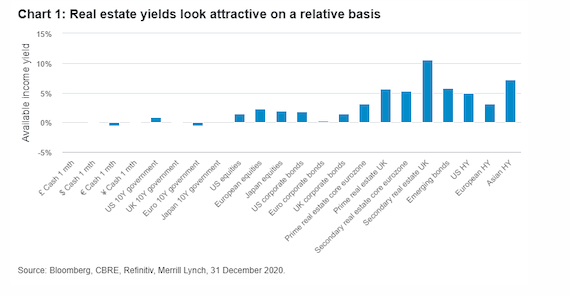
The continued monetary support for economies around the world has made bonds yielding more than one per cent ever scarcer.  At the end of 2020, only 38 per cent of global A-rated financial bonds and 45 per cent of A-rated industrial bonds offered more. In contrast, yields on prime real estate assets are around 3 to 4 per cent, often with long, secure income streams from the same companies whose bonds trade well below one per cent.

While some of the yield discount compensates investors for real estate’s illiquidity and depreciation, we believe the real yields on direct real estate will continue to be attractive to many investors relative to other asset classes. This should support continued inflows of capital to real estate markets, particularly the most liquid and transparent markets such as Germany, France and the Netherlands. This capital, when combined with investment deferred from last year, will exert further downward pressure on yields for assets in sectors such as logistics and residential.

The UK may benefit from this trend in 2021. The completion of a free trade deal with the European Union (EU) has removed some perceived risks, particularly around currency. And the roughly 100-basis-point spread between prime assets in the UK and those in similar-sized markets in continental Europe is likely to attract cross-border capital to the UK. Subsectors like last-mile logistics and regional offices are viewed as less exposed to trade disruption and may receive a bigger boost. The impact of non-tariff barriers to trade, however, still needs to play out.

2. Specialist real estate goes mainstream

Mainstream investor interest in specialist real estate sectors, such as data centres, self-storage, life science and healthcare had been growing in the mid-2000s before the 2008 financial crisis reversed much of this activity. But since then these segments have become well established in the real estate investment trust markets. The conditions are ripe for them to benefit from structural trends, such as demographic change and the use of technology, that will act as headwinds for the more traditional sectors of office and retail, which have also been impacted by Covid-19.

This is not without its challenges. Investors stepping into this area face competition from specialist investors and operators, lot sizes that are either at the small or very large end of the spectrum, as well as risks of obsolescence where building specifications are highly specialised. Nevertheless, assets in these sectors should provide diversification and good growth prospects for investors and we expect to see allocations to these specialist sectors steadily increase.

3. ESG becomes a disruptor

Buying new buildings with excellent green credentials is no longer enough. The industry needs to focus urgently on renovating and modernising the existing stock of buildings. Buildings are responsible for 40 per cent of energy consumption and 36 per cent of CO2 emissions in the EU. To meet the Paris Accord targets, commercial real estate will need to reduce its CO2 by more than 80 per cent by 2050.

For the real estate industry, the Global Real Estate Sustainability Benchmark (GRESB) rating framework has been key in driving real estate investors to put in place environmental, social and governance (ESG) policies, institute good practice, and capture data on utility use and waste recycling. However, there are growing concerns about ’greenwashing’ and investors are focusing on evidence of clear impacts. We expect new frameworks and targets to emerge to help measure impact, changing the way assets are assessed, monitored and managed.

This shift to a focus on impact may also provide some opportunities. There is evidence that pricing currently reflects a ‘brown discount’ for older assets with no ESG certification, but these properties could potentially deliver measurable impacts if they can be refurbished to good sustainability standards.

4. The importance of ‘know your tenant’

The pandemic focused minds on rent collection and tenant defaults. It showed the importance of a ‘know your tenant’ – or KYT – investment approach for delivering sustainable income. The quality of the asset and the length of the lease are no substitute for a well-capitalised tenant with a good business model in a resilient sector, which will be key to delivering attractive performance throughout the 2020s.

This is because some longer-term themes are coming into view as the focus turns to the reopening of economies. Most immediate is the growing political risk in the eurozone. The resignation of governments in the Netherlands and Italy, a change of leadership in the ruling party in Germany, and preparations for elections in France in 2022 all create uncertainty. The impact of political risk on the way governments chart a path out of lockdown, deliver a fast and effective roll-out of the vaccines and continue to support the economy will affect the speed of recovery.

Inflation is a further risk that may occur within three to five years, following a combination of supportive fiscal and monetary policy, a shift in central banks’ inflation targeting methodology and deglobalisation. Real estate investors need to consider the implications of these risks for portfolio construction, particularly when looking at lease lengths and indexation clauses.

Call us on Phone: 07 5641 4134 to discuss further.

Source: Fidelity April 2021
Reproduced with permission of Fidelity Australia. This article was originally published at https://www.fidelity.com.au/insights/investment-articles/four-real-estate-trends-to-watch-as-economies-reopen/

This document has been prepared without taking into account your objectives, financial situation or needs. You should consider these matters before acting on the information. You should also consider the relevant Product Disclosure Statements (“PDS”) for any Fidelity Australia product mentioned in this document before making any decision about whether to acquire the product. The PDS can be obtained by contacting Fidelity Australia on 1800 119 270 or by downloading it from our website at www.fidelity.com.au. This document may include general commentary on market activity, sector trends or other broad-based economic or political conditions that should not be taken as investment advice. Information stated herein about specific securities is subject to change. Any reference to specific securities should not be taken as a recommendation to buy, sell or hold these securities. While the information contained in this document has been prepared with reasonable care, no responsibility or liability is accepted for any errors or omissions or misstatements however caused. This document is intended as general information only. The document may not be reproduced or transmitted without prior written permission of Fidelity Australia. The issuer of Fidelity Australia’s managed investment schemes is FIL Responsible Entity (Australia) Limited ABN 33 148 059 009. Reference to ($) are in Australian dollars unless stated otherwise.
© 2021. FIL Responsible Entity (Australia) Limited.

Important:
This provides general information and hasn’t taken your circumstances into account. It’s important to consider your particular circumstances before deciding what’s right for you. Any information provided by the author detailed above is separate and external to our business and our Licensee. Neither our business nor our Licensee takes any responsibility for any action or any service provided by the author. Any links have been provided with permission for information purposes only and will take you to external websites, which are not connected to our company in any way. Note: Our company does not endorse and is not responsible for the accuracy of the contents/information contained within the linked site(s) accessible from this page.

By Tony Kaye, Senior Personal Finance Writer, Vanguard Australia

Across Australia residential property prices are booming, thanks to pent-up demand, record low interest rates and ready access to mortgage finance.

Median house prices in metropolitan and regional areas have surged, and that trend is set to continue as owner occupiers and investors compete for limited stock.

National dwelling values rose by an average 2.8 per cent in March, the fastest monthly gain since October 1988, according to CoreLogic. This followed price rises in every capital city.

But what’s happening in the property market here is actually being replicated right around the world, for precisely the same reasons.

Data from the Organization for Economic Cooperation and Development shows housing prices in 37 developed countries have risen at their fastest pace in almost 20 years.

The United States, China, Canada, New Zealand, South Korea, and much of Europe, are all heading into new territory in terms of property prices.

Parts of the Chinese property market have risen around 16 per cent over the last year, while prices in New Zealand have jumped more than 20 per cent since the start of 2020.

And it’s a situation that central banks and financial regulators are monitoring very closely. Although any rises in official interest rates are almost certainly off the cards for some time, some regulators may impose tighter controls on lending.

While they’re unlikely to intervene in any way at this stage and disrupt the pace of economic recovery, a general concern is that if property markets become too overheated that could create stronger inflationary pressures.

This would ultimately lead to higher rates, which is behind the market sentiment that’s currently driving longer-term government bond yields higher.

In its March monetary policy minutes, the Reserve Bank of Australia noted its board members had noted that housing market conditions warranted close monitoring in the period ahead.

“In particular, it was important that lending standards remain sound in an environment of rising housing prices and low interest rates.”

The Australian Prudential Regulation Authority (APRA) is also monitoring the market, but says there is no cause for immediate alarm.

The view for property investors

Australian economists and other property market forecasters are predicting that house prices will continue to gain ground over 2021.

The same may not be the case for apartment prices, particularly in Melbourne and Sydney where there is an oversupply of existing properties and more new apartments are under construction.

For property investors, there are a wide range of factors to consider.

Although residential prices are gaining broadly, property price growth is never uniform and capital returns vary considerably across cities and regions, by location, by property type, and an individual property’s physical condition.

On a rental income level, current market conditions remain fickle.

The impacts of COVID-19 during 2020, including a rise in unemployment levels, resulted in governments enacting legislation enabling severely affected tenants to seek rent reductions and payment deferrals.

As a result, many property owners are still contending with lower rental income and, in some cases, have needed to seek mortgage payment relief from their lenders.

Rental demand also has weakened due to the departure of temporary residents as a result of COVID-19, most notably foreign university students. This will be further exacerbated with net overseas migration to Australia expected to remain negative into 2022.

The outlook for rates

On a monetary policy level, the RBA has made it clear that, like most of other central banks, it is not likely to be raising official interest rates for several years.

That’s because neither wages, or inflation are rising fast enough to warrant a rate rise to dampen consumer sentiment at this stage, and especially with unemployment rates still elevated.

Yet, investing into property should generally be considered a long-term strategy. So, even though rates are at record lows now, there’s every likelihood they will rise over the medium term.

This should be factored into your future capacity to service borrowings.

Assessing your investment goals

Whether you already own investment property or are considering an investment into direct property for the first time, it’s vital to see how property fits in with your overall investment goals.

What is your overall strategy with owning property and your investment time frame?

It’s also important to understand that property is an illiquid asset. Unlike assets that are highly liquid and can be readily sold on financial markets, either as a whole or in smaller quantities, generally the only way to realise capital growth from an investment property is to sell it.

The only exception is when it’s possible to sub-divide land and sell off part of a property.

Furthermore, like other investments, owning property is not an instant pathway to gains. There are substantial entry, holding and exit costs.

And, as past episodes have shown, such as during the Global Financial Crisis, there will be periods when property prices decline, and sometimes quite sharply.

So, it’s vital to weigh up both the pros and cons of buying residential property purely on an investment basis.

For more information, call us on Phone: 07 5641 4134.

Source: Vanguard April 2021

Reproduced with permission of Vanguard Investments Australia Ltd

Vanguard Investments Australia Ltd (ABN 72 072 881 086 / AFS Licence 227263) is the product issuer. We have not taken yours and your clients’ circumstances into account when preparing this material so it may not be applicable to the particular situation you are considering. You should consider your circumstances and our Product Disclosure Statement (PDS) or Prospectus before making any investment decision. You can access our PDS or Prospectus online or by calling us. This material was prepared in good faith and we accept no liability for any errors or omissions. Past performance is not an indication of future performance.

© 2021 Vanguard Investments Australia Ltd. All rights reserved.

Important:
Any information provided by the author detailed above is separate and external to our business and our Licensee. Neither our business nor our Licensee takes any responsibility for any action or any service provided by the author. Any links have been provided with permission for information purposes only and will take you to external websites, which are not connected to our company in any way. Note: Our company does not endorse and is not responsible for the accuracy of the contents/information contained within the linked site(s) accessible from this page.